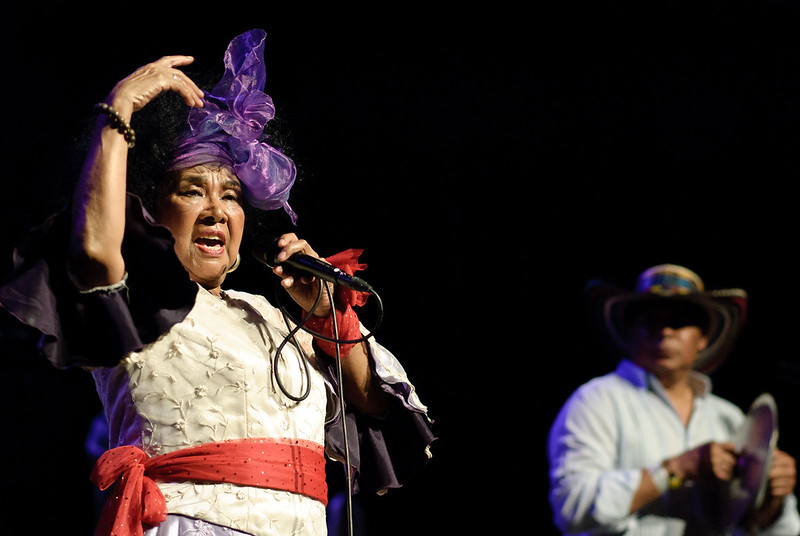
Totó la Momposina at the Sala Barts, Barcelona. Image credit: Dani Alvarez via Flickr
Colombia is mourning the death of legendary singer and dancer Totó la Momposina, the artist who carried the rhythms of the Caribbean coast to audiences around the world.
Totó’s death was disclosed in a statement by Colombia’s Ministry of Culture today, which described her as “the eternal master”, praising her decades-long contribution to Cumbia, Porro, Mapalé and Bullerengue music.
Her family confirmed that Totó died on Sunday, May 17, in Celaya, Mexico at age 85, after years battling neurocognitive health complications.
Born Sonia Bazanta Vides in 1940 in Talaigua Nuevo, Bolívar, near the historic river town of Mompox, Totó devoted her life to preserving and promoting traditional Caribbean music rooted in African, Indigenous and Spanish influences.
For more than six decades, Totó became the voice of Colombia’s Caribbean soul. Raised in a musical family — her father was a drummer and her mother a singer and dancer — she began performing at an early age before later studying folklore and music in Bogotá, Paris and Cuba.
In 1982, she accompanied Gabriel García Márquez to Stockholm during his Nobel Prize ceremony, where she performed Colombian Caribbean music before international dignitaries — a moment that became part of the country’s cultural history.
Her international breakthrough came with the 1993 album La Candela Viva, released through Peter Gabriel’s Real World label, which introduced global audiences to the song “El Pescador” and to authentic Colombian rhythms.
Over the years, Totó collaborated with and influenced artists across genres, while her music was sampled by international musicians including Jay-Z and Major Lazer. Her song “Latinoamérica” alongside Calle 13 won her two Latin Grammy Awards in 2011. She officially retired from performing in 2022 due to health complications.
Totó received numerous honors throughout her career, including the Womex Award in 2006, Colombia’s Life and Work Award in 2011, and the Latin Grammy Award for Musical Excellence in 2013.
Colombian President Gustavo Petro honored the singer in a post on X today, calling her “an exalted figure of Colombian Caribbean art and culture,” adding, “may she fly high to the stars.”
Her family also announced that a tribute honoring the singer-songwriter will be held on May 27 at the National Capitol in Bogotá, as the country prepares to bid farewell to one of the most influential voices in its cultural history.
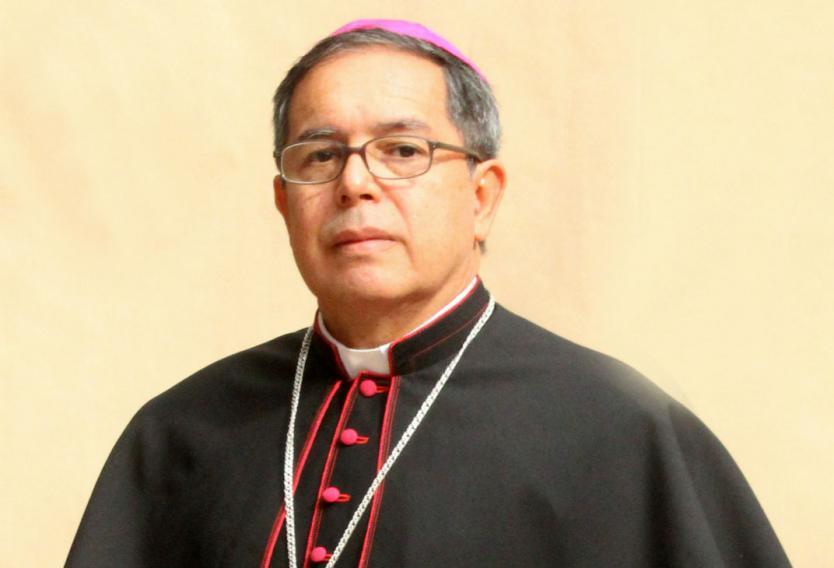
Colombia’s top Catholic official, Bogotá’s Archbishop Luis José Rueda Aparicio, marked Holy Thursday by washing the feet of transgender women and sex workers in the capital, in a gesture aimed at promoting the inclusion of marginalized communities.
Rueda carried out the ritual in the Santa Fe neighborhood, a central red-light area known as a “tolerance zone.” The ceremony was one of the Church’s Holy Week observances and drew community leaders, social organizations and local residents.
The washing of feet is a central rite of Holy Thursday (also known as Maundy Thursday), commemorating the biblical account of Jesus washing the feet of his apostles during the Last Supper. The act symbolizes humility, service and care for others, particularly the most vulnerable.
Rueda kneeled before participants to echo this tradition for the second year in a row. Last April, he performed a similar ceremony paying tribute to Sara Millerey, a trans woman murdered in Medellín earlier that year.
“May no one feel rejected, may no one feel excluded,” Rueda said during the mass he directed prior to the rite. In a statement for Noticias Uno, he added that “what societies do through discrimination is fracture”.
#NoticiasUNO| El Arzobispo Primado de Colombia, monseñor Luis José Rueda, lavó los pies a un grupo de personas de la comunidad trans y de mujeres trabajadoras sexuales en el barrio Santa Fe, zona de tolerancia de Bogotá pic.twitter.com/YpAXvuich2
Some participants described the moment as deeply meaningful.
Valentina Rojas, a transgender woman who took part, said she felt “happy” and “loved” after the ceremony.
The gesture comes amid ongoing tensions within the global Catholic Church over LGBTQ+ rights.
Pope Leo XIV has recently reiterated that Church teachings on sexuality and marriage are unlikely to shift in the near term, describing such issues as “highly polarizing.”
Although he has emphasized that all individuals are welcome in the Church, he has ruled out immediate doctrinal changes regarding same-sex relationships or transgender identity.
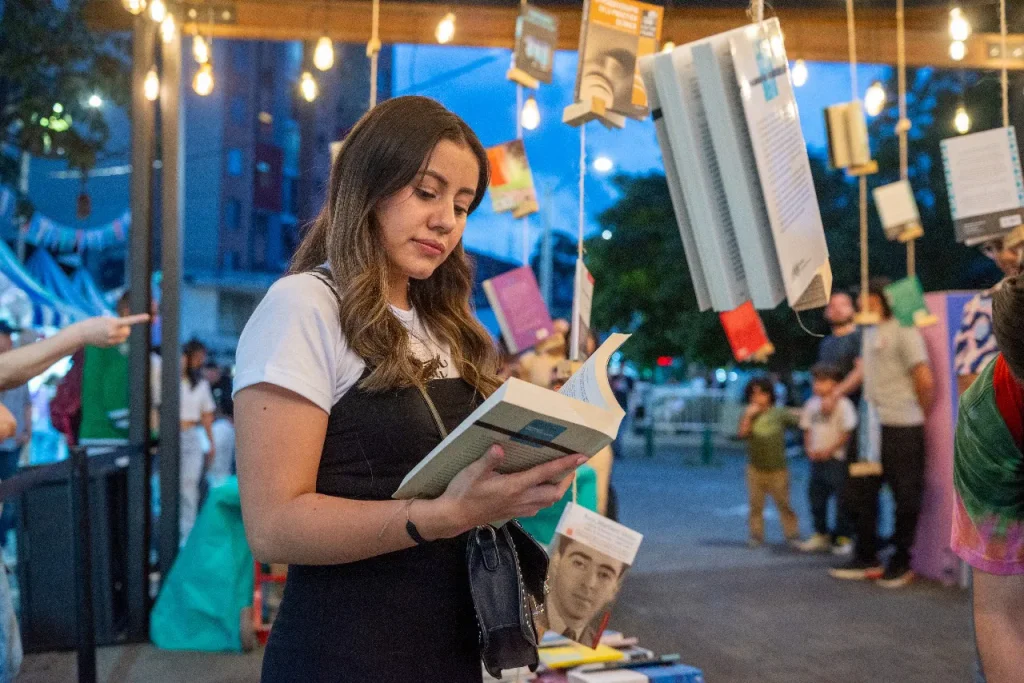
UNESCO has designated Medellín, Colombia’s second-largest city, as the World Book Capital for 2027, recognizing the Colombian city’s rapid growth in reading culture and its use of books and libraries as tools for social transformation.
The decision, announced in March, follows a recommendation by the organization’s World Book Capital Advisory Committee, made up of publishers, booksellers and authors.
Medellín will become the 27th city to hold the title since 2001, with its program set to begin on April 23, 2027, coinciding with World Book and Copyright Day.
UNESCO said Medellín has seen a 542% increase in bookstores over the past 70 years, placing it at the top of Colombia’s reading index. The city is home to more than 110 bookstores and 25 libraries, many of them built as part of urban renewal projects that transformed former prisons and police facilities into cultural spaces.
“Books are not just carriers of stories. They are a source of creativity and learning,” said UNESCO Director General Khaled El-Enany, adding that Medellín’s designation sends “a powerful message about how culture can build peace and social cohesion.”
Mayor Federico Gutiérrez described the recognition as a milestone for the city. “Medellín has shown that reading is a fundamental part of its culture,” he said. “We want every child born here to grow up with a book in their hands.”
Gutiérrez said Medellín’s bid for the World Book Capital designation was built around five strategic pillars, including early childhood reading programs to ensure access to books from birth, as well as initiatives to promote reading among students through book clubs and opportunities to meet authors and engage with their work.
Cities named World Book Capital commit to promoting reading across all age groups and organizing a year-long program of cultural activities. According to Spanish-language philologist Andrea Peláez, the initiative is designed to support cities with strong cultural momentum.
“These are cities with significant cultural mobilization,” Peláez said. “UNESCO supports them for a year to develop projects that promote reading, especially among young people and vulnerable communities, while strengthening literacy ecosystems overall.”
A key part of Medellín’s literary ecosystem is its Eventos del Libro, a series of large-scale public events including the Book and Culture Festival (Fiesta del Libro y la Cultura), which bring together writers, publishers and readers across the city.
These events promote reading through school programs, author visits and community activities, often encouraging students to engage with books ahead of meeting authors in person.
UNESCO said the designation is part of broader efforts to strengthen literacy and access to books worldwide, highlighting similar initiatives in regions such as Central America and Ethiopia.
Once associated with violence, Medellín has gained international recognition in recent decades for its cultural and urban transformation – with books and libraries playing part in that shift.
Featured image credit: Festival de Libro Medellín.
Voters in San Pedro de los Milagros. Credit: Manuela Peña Giraldo.
Colombians voted for a new Congress on March 8 in an election that stretched across thousands of rural towns and villages, where geography, infrastructure and the legacy of armed conflict continue to shape how citizens participate in democracy.
“I don’t like politics,” said Silvia Bedoya, 52, a resident of San Pedro de los Milagros in the mountains north of Medellín. “Instead of uniting people to move the country forward, it tends to divide us.”
Despite that frustration, Bedoya said voting still matters. “If you vote, at least you have the chance to raise your voice about something you don’t like,” she said. “If you don’t vote, you just have to accept what happens.”
More than 40 million Colombians were eligible to vote in the elections, with 13,493 polling stations installed nationwide, including 7,482 in rural areas, according to the National Registry Office. Security forces said they deployed 120,000 police officers across the country to guarantee the vote in the nation’s 1,104 municipalities.
The scale of the operation reflects the logistical challenges of voting in rural Colombia, where many communities remain separated by mountains, unpaved roads and long travel distances.
In San Pedro de los Milagros, a cattle-farming municipality in the Andean department of Antioquia, voters arriving at polling stations described a mixture of civic duty, skepticism toward politicians and concern over the country’s economic and social problems.
Mauricio Martínez, 47, declined to say who he supported, but emphasized the importance of participation. “Voting is the greatest right and duty we have as citizens,” he said.
Others said their choices were shaped by dissatisfaction with the government of President Gustavo Petro, Colombia’s first leftist president, whose progressive agenda – including a major land reform program – has drawn both support and criticism in rural areas.
Maicol Jovani Sepulveda, 28, said he voted for the right-wing Democratic Center (Centro Democrático) party after losing faith in promises he believed would help young people. “I believed they were going to help us study,” he said. “But I didn’t receive a scholarship and I couldn’t go to university, so I was disappointed.”
The Democratic Center won more than 40% of the vote for both the Senate and the House of Representatives in San Pedro de los Milagros, a 24% increase from 2022. Across the department of Antioquia, it was also the most voted list with over 31% of votes, followed by the ruling leftist Historic Pact (Pacto Histórico) coalition with 16%.
Some voters in the town said their support for the right reflected growing frustration with Petro’s government. Among them was María Regina Avendaño Muñoz, 63, who said she cast her vote for Centro Democrático after feeling disappointed with the administration: “I’m very sad because he promised change and convinced many young people and teachers who voted for him.”
Beyond individual concerns, analysts say structural barriers have long shaped political participation in rural Colombia.
Rural voters play an important role in Colombia’s political landscape. Although the country’s largest voting blocs are concentrated in major cities, the countryside has long been central to debates over land ownership, security and development – issues that have shaped the country’s decades-long armed conflict and remain at the center of national politics.
“When we talk about political participation, we’re really talking about processes of democratization – who gets to speak and under what conditions,” Bladimir Ramirez Valencia, a professor at the University of Antioquia’s Institute of Regional Studies who works with farmers’ organizations, told Latin America Reports.
Historically, he said, rural communities have faced both violence and logistical obstacles that limit their ability to vote. About 75% of the victims of Colombia’s armed conflict have been civilians, many of them farmers, according to historical estimates.
Distance alone can also be a barrier. “For many communities, polling stations used to be three or four hours away,” Ramírez said. “Bringing voting sites closer to those places is fundamental.”
Authorities expanded electoral infrastructure for the 2026 vote, increasing the number of polling stations by 5,5% in rural areas compared with the previous 2022 election.
In some regions of Antioquia, Ramírez said, rural residents traveled to voting sites on foot or by chiva, the brightly colored buses that connect remote villages with municipal centers.
Recent government policies may also be shaping political engagement in the countryside. Programs related to land reform, land restitution and rural development have helped strengthen the government’s legitimacy among some farming communities, Ramirez said. “When farmers feel they are being heard and see policies reaching their territories, that can influence how they participate politically.”
Still, rural voting patterns remain complex and vary widely by region. “You can find campesino families involved in social movements defending their land,” Ramírez said. “But when elections arrive, they still vote for traditional parties.”
Across Colombia’s countryside, the election reflected both deep skepticism toward politics and the determination of rural voters to take part in a democratic process that has historically been harder to reach in the country’s most remote regions.
Colombia’s outgoing president Alvaro Uribe meets the public during a visit to the Agro Del Pacífico 2010 agricultural fair in Cali. Image credit: Neil Palmer (CIAT) via Wikimedia Commons
Colombia’s former president Alvaro Uribe Velez will participate in this Sunday’s congressional election following his conviction and subsequent acquittal for procedural fraud and bribery of a public official.
While he is last in line for a seat in his party’s list, the Centro Democrático, or Democratic Center, hopes his name will help it secure between 18 and 20 seats in the 103-seat Senate.
Uribe is returning to the ballots after resigning from the Senate in 2020, when the Supreme Court began proceedings against him over witness tampering allegations.
In Colombia’s congressional elections, parties and party coalitions can run either closed lists, where voters choose only the party and seats go to candidates in a predetermined order, or open lists, where voters can select individual candidates. Since the Democratic Center is running a closed list, being number 25 means that Uribe is the least likely candidate to get a seat in Congress for his party.
“The political strategy of placing Uribe in the 25th position is highly effective for pulling in votes and taking advantage of voters’ lack of understanding [about how closed lists work],” political advisor Felipe García told The Bogotá Post.
The Democratic Center is a hyper-personalized party whose votes rely heavily on the stature of Uribe as the natural leader of Colombia’s political right. Therefore, it is likely that voters will go to the polls on Sunday to vote for whoever Uribe endorsed, regardless of whether he himself ends up being elected.
Legal battle
The legal case against Uribe centered on a libel suit he had brought against Senator Iván Cepeda Castro, the current leftist presidential frontrunner, who accused Uribe of being involved with paramilitary death squads.
Uribe and Cepeda represent opposite poles of Colombia’s political spectrum. Uribe is a conservative, hardline anti-guerrilla leader, whereas Cepeda supports peace negotiations with rebels.
While investigating a separate case to the libel inquiry, authorities overheard in a wiretap that Uribe’s lawyer, Diego Cadena, had contacted jailed paramilitaries to change their testimony in Uribe’s favor.
This evidence became key to a July 2025 ruling which made Uribe Colombia’s first ex-president to be criminally convicted, with judge Sandra Heredia sentencing him to 12 years of house arrest.
But the politician’s lawyers appealed the ruling and in October, the Superior Court of Bogotá acquitted Uribe of all charges, as the wiretap evidence against him was illegally collected.
A month before his acquittal, the Democratic Center – which was founded by Uribe – announced that its former leader would be number 25 on the party’s Senate candidate closed list.
Uribe’s 2020 resignation from the senate was seen as both a legal and political move, since it meant that his case would be picked up by the Attorney General’s Office, which at the time was headed by Francisco Barbosa Delgado, an ally of the former president.
After several failed attempts to close the case and after Barbosa left office as attorney general, the office formally charged former president Álvaro Uribe Vélez with bribery and witness tampering in May 2024. By that time, Uribe’s defense team was already alleging that the politician was the victim of lawfare.
Recently, the prosecution team in the Uribe trial and alleged victims of paramilitaries announced they would file an extraordinary appeal before the Supreme Court. The ruling is expected to carry greater legal significance than political or public impact, according to García.
Many victims’ groups celebrated Uribe’s conviction as a symbolic victory. Uribe was the president during the ‘false positives’ killings — cases in which Colombian soldiers killed civilians and falsely presented them as guerrilla members killed in combat.
Colombia will head to the polls this year to elect the country’s next president and members of Congress. A report released this week by the Ombudsman’s Office found that the government is failing to implement over half of the watchdog’s recommendations to ensure safe and fair elections.
On Monday, the office released a follow-up report to its October 2025 Electoral Early Warning (ATE 013-25), saying that around 42% of recommendations for safeguarding elections were being implemented.
Last June, the country made international headlines when pre-presidential candidate Miguel Uribe Turbay was shot in the head while holding a rally in Bogotá’s Modelia neighborhood. He would succumb to his injuries two months later.
Since then, Ombudsman Iris Marín Ortiz’s office has registered 457 cases of death threats against social leaders, human rights defenders, and political actors in the pre-election period, which officially began in January 2025 when President Gustavo Petro convened his cabinet to decide which members would step down to run for elected office in 2026.
The report noted that candidates face ongoing risks, from constraints on campaigning in armed group–controlled areas to stigmatization, threats, and even homicide.
“The risk is not that the elections will be canceled,” said Marín, but rather that un-safeguarded elections could ignore the “forced silence of communities in the face of the governance of armed groups in some regions of the country.”
The Ombudsman’s report categorized municipalities into five risk levels from lowest to highest intensity of identified violence, in order to guide authorities on security, protection, and the safeguarding of political rights.
Two hundred fifty-seven were classified at Ordinary Action Level, 216 at Permanent Monitoring Level, 425 at Priority Action Level, 162 at Urgent Action Level, and 62 at Immediate Action Level — the most critical stage. In the follow-up Report, although the number of municipalities at Permanent Monitoring Level decreased (195), there was an increase in municipalities that required Priority Action (433), Urgent Action (168), and Immediate Action (69).
Political violence has continued in the period since Uribe Turbay’s death. Earlier in February, Senator Jairo Castellanos’s armored vehicle was attacked at an ELN rebel checkpoint in the northeastern Arauca department, killing two of his bodyguards. A few days later, Indigenous Senator Aida Quilcué was temporarily kidnapped in an area of western Cauca where FARC dissidents are active.
Upon reviewing the Government’s response, the highest rate of implementation for the 11 recommendations is 65% and the lowest is 0%. Strengthening and support for political organizations was the least advanced recommendation, followed by inter-institutional coordination and joint action for rapid response.
According to the Report’s conclusions, insufficient implementation of ATE 013-25 led to weak institutional coordination, allowed illegal armed groups to maintain control, jeopardized victims’ political participation in Special Transitional Peace Electoral Districts (CITREP), and perpetuated impunity through ineffective justice mechanisms.
The Ombudsman issued six new recommendations and reinforced the previous ones, urging the Ministry of the Interior to lead the Intersectoral Commission for Rapid Response to Early Warnings (CIPRAT), align action plans, ensure measurable budgets, and eliminate overlapping measures that cause operational gaps.
On March 8, Colombians will head to the polls for legislative elections where they’ll vote for representatives to the national congress, senate as well as primary elections where political parties will choose presidential candidates to represent them in the first round of presidential voting on May 31.

 Login
Login