Reading view

Colombia presidential candidates appear in Governors’ Summit

Governors’ Summit 2026. Image credit: National Federation of Departments.

On Wednesday, the Universidad de la Sabana and the National Federation of Departments (FND) hosted the Governors’ Summit, a rare event that convened almost all of the frontrunners in Colombia’s presidential race.

Paloma Valencia, Abelardo de la Espriella, Sergio Fajardo, Roy Barreras, and Claudia López fielded questions from regional authorities about how they planned to tackle problems in Colombia’s provinces.

While Iván Cepeda, the leftist favorite, was scheduled to attend, his team pulled out at the last minute, fuelling the candidate’s reputation for being media-shy.

Early on Wednesday morning, governors and their aides began filtering into the heavily policed event in Chía, a municipality north of Bogotá.

The FND selected questions from governors which were then posed to candidates by the two moderators: El Tiempo Director Andrés Mompotes and his counterpart at radio station La FM, Juan Lozano.

The main themes of the day were tackling insecurity and armed groups, investing in regional development, and mechanisms to improve provincial representation.

For some governors, the event was an opportunity to redress an acute crisis; Erasmo Zuleta, who heads the local government in Córdoba, used the forum to highlight the ongoing effects of disastrous floods which began earlier this year.

“The emergency didn’t pass, nor did the tragedy. The floodwaters receded, leaving behind widespread damage; they took lives, homes, crops, and material possessions,” Zuleta told The Bogotá Post.

“Now more than ever, we need greater solidarity to recover from the damage,” continued the Governor, in a bid for help from the national government.

Another recurring theme was prison reform, following a recent scandal over a concert that took place in the Itagüí prison in Antioquia.

Abelardo de la Espriella, the firebrand criminal defense attorney and right-wing frontrunner, used the opportunity to push his tough-on-crime proposal.

“In Colombia, there are no prisons—there are universities of crime,” said de la Espriella, who took aim at the National Penitentiary and Prison Institute (INPEC), which he described as “a den of thieves.”

Abelardo de la Espriella talks at the summit. Image credit: National Federation of Departments.

The candidate added that Colombia should look to El Salvador to develop its incarceration model, praising dictator Nayib Bukele’s draconian mass imprisonment efforts that have dramatically reduced crime and drawn condemnation from rights’ groups.

Security, more broadly, was also high on the agenda, as Colombia grapples with a surge in violence related to illegal armed groups.

“Today we are living in the grip of insecurity. They want to drag us back into the abyss we thought we had left behind,” railed Paloma Valencia, the candidate for the right-wing Centro Democrático (Democratic Center) party. 

Fears of insecurity affecting democratic processes have overshadowed the elections, with the United Nations issuing a warning earlier this year that armed groups could disrupt the vote.

The Valle del Cauca department has been one of the most heavily affected by the armed conflict, with its capital, Cali, rocked by a wave of bomb attacks by rebel groups in the past year. 

But its Governor, Dilian Francisca Toro, offered reassurances in conversation with The Bogotá Post: “We ensure that in every municipality and across all regions, law enforcement is present so that we can have free, democratic elections where there is no restriction whatsoever on the ability to vote.”

Toro also cited the elections on March 8 as an example of the success of security planning: “In Valle del Cauca we really had very peaceful elections, and now, God willing, we will have them again.”

Amid the mounting threat by armed groups, candidates De la Espriella and Valencia vow an iron fist, using military force to crush rebel forces. They model themselves after former right-wing President Álvaro Uribe (2002-2010), who teamed up with the U.S. to launch a total war on the Revolutionary Armed Forces of Colombia (FARC). 

But leftist Iván Cepeda highlights the human rights abuses perpetrated by the government during that period, in which thousands of innocent civilians lost their lives. He proposes to continue the current administration’s Paz Total – or Total Peace – policy of negotiating with armed groups.

But Cepeda missed the opportunity to make his case to the public, fuelling criticism by his opponents.

De la Espriella has repeatedly called on Cepeda to agree to a debate, but the leftist candidate has yet to accept.

With less than two months before the May 31st election, there are increasingly few opportunities for the candidates to make their case before the public.

The post Colombia presidential candidates appear in Governors’ Summit appeared first on The Bogotá Post.


  •  

Latin America’s Fracttal buys one of Spain’s oldest maintenance firms

Fracttal, a maintenance intelligence platform that built its name across Latin America before relocating its headquarters to Madrid, has acquired TCMAN — Spain’s leading computerised maintenance management software provider — in a deal that deepens its roots in the European market it has been courting for several years.

TCMAN is not a minor target; founded in 1997, it is the dominant player in Spain’s computerized maintenance management system (CMMS) sector, with a client list that includes Acciona, Eiffage, Sanitas, and Quirón, and more than 250 organisations using its GIM platform to manage critical infrastructure, industrial, and healthcare assets. 

For Fracttal, which manages over 20 million assets across 60 countries, the acquisition is less a technology play than a relationships play – three decades of trust with Spanish enterprise clients that would take years to replicate from scratch.

Image courtesy of Fracttal

The deal follows Fracttal’s $35 million USD funding round announced in January 2026, and the company has moved quickly to deploy it. 

The strategic logic is clear: the global CMMS market is forecast to grow at 11.1% annually through 2030, reaching $2.41 billion, according to Grand View Research, driven by asset-intensive industries facing mounting pressure to reduce downtime and meet tightening safety regulations. 

McKinsey research has also found that AI-powered predictive maintenance can extend machine life by up to 40% and cut unplanned downtime by half – the value proposition Fracttal will now pitch to TCMAN’s existing base of enterprise clients.

That pitch will involve upgrading GIM with Fracttal’s AI, IoT, and analytics capabilities. Whether TCMAN’s clients, who are accustomed to a local specialist with decades of sector knowledge, will embrace a more technology-forward roadmap is the central execution question.

“Integrating TCMAN’s expertise with our platform strengthens our ability to continue developing intelligent maintenance solutions and deliver greater value to organisations managing complex and distributed assets,” said Raúl Peris, COO of Fracttal.

For TCMAN’s founder, the sale marks a natural evolution: “For over 30 years, we have helped companies in multiple sectors better manage their assets,” said Eloy Ortega. 

“Joining Fracttal allows us to expand the reach of our technology and continue evolving our solutions in a context where maintenance is increasingly strategic.”

Fracttal’s trajectory is itself a notable story for this region. The company grew out of Latin America – establishing operations in Chile, Colombia, Brazil, and Mexico before moving its headquarters to Madrid as it pushed into Europe. It now sits in the unusual position of being a Latin American-origin company acquiring a European incumbent on European soil, rather than the other way around. 

For a region more accustomed to being the target of international acquisitions than the source of them, that inversion is worth noting.

“Maintenance is a key ally in building a more sustainable, safe and efficient world,” said Christian Struve, CEO and co-founder. 

“This union allows us to accelerate that transformation, combining decades of industry experience with advanced technology and artificial intelligence.”

Featured image: Courtesy of Fracttal

Disclosure: This article mentions clients of an Espacio portfolio company.

The post Latin America’s Fracttal buys one of Spain’s oldest maintenance firms appeared first on The Bogotá Post.

  •  

Bogotá mayor furious at gang leader’s role as ‘peace negotiator’

La Mesa gang rounded up in Bogotá this week. Members are accused of murders and drug trafficking. Photo: Secretary of Security
La Mesa gang rounded up in Bogotá last week. Members are accused of murders and drug trafficking. Photo: Secretary of Security

The dismantling of a major crime gang which operated in Bogotá caused controversy last week after it emerged its leader was declared a peace negotiator under President Petro’s controversial Paz Total, or Total Peace, plan.

National police rounded up 23 members of the La Mesa gang in simultaneous operations in Tolima, Cesar and Bogotá. According to police reports, the gang was involved in serious crimes across the capital since 2012, including drug trafficking and murders.

News of the arrests was tainted by the fact that under the Paz Total process – the Petro government’s wide-ranging negotiations with armed groups – gang leader Gustavo Adolfo Pérez Peña, alias El Montañero, had his arrest warrant suspended under his role as gestor de paz, or ‘peace facilitator’.

The kingpin’s release sparked a furious response from Bogotá mayor Carlos Galán, who accused Petro of undermining the city’s efforts to curb crime.

Hoy en Bogotá anunciamos que, gracias a la Dijín, a la Fiscalía y a la @PoliciaBogota, fueron capturados 23 miembros de la banda “El Mesa”, entre ellos 8 sicarios. Mientras tanto, el Gobierno Nacional nombra al cabecilla de esa banda como gestor de paz y le levantó la orden de… pic.twitter.com/qiSmSoHgh7

— Carlos F. Galán (@CarlosFGalan) April 6, 2026

“While in Bogotá,…the prosecutor’s office and the police, with the support of the Bogotá mayor’s office, are working to capture and dismantle a criminal gang dedicated to serious crimes, the national government appoints the leader of that gang as a peace facilitator and lifts the arrest warrant for him,” he railed.

The gang was also suspected of being behind last year’s gruesome killings where pieces of the bodies of victims were wrapped in plastic bags and dumped on the city’s highways.

A free pass for career criminals like Pérez Peña makes fighting crime “incredibly difficult,” added Galán.

Dodging a warrant

Alias El Montañero during his capture in 2019.

Details of La Mesa’s criminal activities released by the prosecutor’s office this week showed the gang originated in Bello, Antioquia, but spread to Bogotá in 2012.

Court documents reported in local news outlet El Colombiano paint Pérez Peña as a hardened criminal; he has been imprisoned four times, including for armed robbery, homicide and illegal possession of firearms, but was freed before serving his full sentences.

His rap sheet includes attacks on armored trucks, notably a cash heist in Bogotá in 2003 where a policeman was shot dead.

Pérez Peña’s most recent jailing was in 2019 when he was sentenced to eight years for conspiracy to commit a crime and illegal possession of firearms. It was during this stint that he was freed as a peace facilitator.

And even while the La Mesa gang has been rounded up this week with members facing multiple charges and long prison sentences, its leader and founder continues at liberty.

Get out of jail free?

Inclusion of criminal gangs in the Paz Total process has proved one of the thorniest aspects of Petro’s flagship policies and a political hot potato in the run-up to next month’s presidential elections.

Since its inception in 2022, the government’s peace negotiators have tried to include some of Colombia’s most embedded crime dynasties under the acronym Estructuras Armadas Organizadas del Crimen de Alto Impacto (EAOCAI).

This Paz Urbana, or urban peace, initiative is based on the reality that in Colombia today lines are blurred between organized armed groups and engrained criminal structures.  Much of its effort has focused on Antioquia’s Valle de Aburrá, around Medellín, where many crime gangs took root after the fragmentation of the 1980s cocaine cartels.

The president’s office recently declared the process a partial success, claiming that the nominated peace spokespersons – many feared capos with violent histories – were now in a dialogue process which could “prevent further violence and prevent the resurgence of these structures”.

Many critics have predicted that – similar to the Paz Total process with large guerrilla groups – criminal gangs will leverage the negotiations to their own interests to gain time and territory or a get-out-of-jail-free card.

This week Medellín’s mayor Fico Gutíerez welcomed a resolution by the attorney general’s office to overturn many of the 23 nominations of local crime bosses as peace facilitators.

“The resolution removes 16 criminals currently serving sentences for serious crimes from the program. Seven remain eligible for the benefit,” he posted on X.

He also echoed Galán’s complaint that hardened criminals were being included in the peace process. “It is unacceptable that the Petro government has asked the prosecutor’s office to lift the current arrest warrant for homicide.”

Peace as a right

Defenders of Petro’s agenda hit back reminding that Paz Urbana was part of a constitutional process protected by Colombian law.

“Peace is a right, not a political strategy,” said Isabel Zuleta, a senator and key player in the Paz Total process.

The senator, who represents the government at the negotiating table with representatives of criminal gangs, accused the media and politicians of misreporting the negotiations.

“For nearly three years, a serious path toward de-escalating urban violence in Medellín and the Aburrá Valley has been painstakingly forged. Today, that work is being exploited by right-wing sectors that prefer to sabotage urban peace rather than acknowledge progress that is not electorally advantageous to them,” she said.

Zuleta also pointed out suspension of arrest warrants for gang leaders seeking peace did not free them of responsibilities for crimes they committed, nor would it stop judicial investigations.   

Meanwhile, a mix-up between Petro’s government and Attorney General’s Office emerged over Antioquia’s urban peace process: 16 of the 23 capos named as peace negotiators were already in prison, so suspending their “arrest warrants” was nonsensical as they were already detained in the high-security Itagüí Prison.

“We truly never imagined that a request would be made to suspend arrest warrants for people already serving sentences,” chief prosecutor Luz Adriana Camargo told Caracol Radio.

Senator Isabel Zuleta with crime bosses in Itagüí Prison. Photo: Paz Urbana

Prison party

For this judicial – rather than political – reason, Camargo revoked the suspension orders for the 16 capos already doing time.

“We are talking about dialogues inside a prison with convicted individuals,” she said.

The Attorney General’s office also corrected widespread fake news – amplified by right-wing presidential candidates Paloma Valencia and Abelardo de la Espriella – that the 16 jailed crime chiefs would be freed as part of the Paz Urbana negotiations.

In fact, there were no plans to release the IItagüí peace facilitators, clarified Camargo’s office.

But in a further twist this week the government froze the peace talks in the Itagüí Prison after revelations that the jailed capos mounted an unauthorized vallenato concert by popular singer Nelson Velásquez, reportedly costing 500 million pesos (US$140,000).

Parranda con Nelson Velásquez en cárcel de Itagüí no fue autorizada: Inpec investiga 7 funcionarios #LoMásBlu #MañanasBlu pic.twitter.com/FTU3exTVuF

— BluRadio Colombia (@BluRadioCo) April 9, 2026

For many commentators, the partying in the prison brought back painful memories of drug baron Pablo Escobar’s luxury lifestyle while supposedly imprisoned by the state in the 1990s.

Meanwhile the chief prosecutor Camargo came under fire for her decision to suspend warrants for seven other gang leaders currently on the run – including that of Pérez Peña of La Mesa.

This week the exact whereabouts of Pérez Peña was unknown, as was his willingness to engage in any peace process. According to a report by TV station Teleantioquia, the La Mesa gang leader was based in Madrid, Spain, while “moving around Europe as a sophisticated tourist”.

For El Montañero, coming home to Colombia, even under the guise of a peace facilitator, could be less of a holiday.

The post Bogotá mayor furious at gang leader’s role as ‘peace negotiator’ appeared first on The Bogotá Post.

  •  

Remoti wants to be the operating system for global teams built in Colombia  

Bogotá-based Remoti launched a “Workforce-as-a-Service” model and new app on April 14, 2026, making the case that managing distributed teams in Latin America requires dedicated infrastructure – and that the company’s nearly ten years of regional operating experience is the foundation for building it. 

The Remoti App consolidates the company’s services into three modules: Global Opportunities for talent matching, Workforce Operation covering payroll, compliance and contracts, and Marketplace & Financial Products providing financial tools to workers directly. 

“The world changed, and companies need new ways to build and operate global teams. With Workforce-as-a-Service, we’re allowing firms to integrate talent in Latin America with the same flexibility with which they build their technology in the cloud,” said Pablo Miller, CEO and founder of the startup. 

“At the same time, we’re allowing a new more structured, trustworthy and talent-backed experience in the region.” 

The bundling is a move away from the traditional staffing model and toward something closer to a managed HR platform with deep regional focus. 

The launch comes at a reasonable moment for the thesis: Colombia’s IT outsourcing market is projected to reach an annual growth rate of 7.37% through 2030, while the World Economic Forum’s Future of Jobs report found big data analysts, AI, and machine learning specialists will be among the fastest-growing job categories in the region – with 51% of employers calling for more public investment in reskilling. 

The harder question is differentiation. While others have built global employer-of-record and HR infrastructure at scale, Remoti’s angle is regional depth and operational ownership – WaaS is framed as a managed service, not a software product, implying the company absorbs more risk in exchange for deeper client relationships. 

“This launch marks a structural change in how organizations think about the redistribution of its operations and access to talent. It is the result of nearly 10 years building, operating and making a model perfect with international companies.” added Juan Felipe Velasco, managing director and co-founder at Remoti

The worker-facing financial products layer also points to a two-sided model that most competitors haven’t prioritized in the region. 

Remoti’s event included a policy panel with Congressman Antonio Zabarain, who sponsored legislation to promote Colombia’s tech sector – relevant context given that 61% of Colombian firms cite outdated or inflexible regulatory frameworks as a barrier to business transformation, according to the WEF, making compliance navigation a genuine value-add rather than a commodity service. 

Whether the WaaS framing holds up under the operational realities of multi-country employment compliance will determine how credible the platform story becomes.

Featured Image Source: A Chosen Soul via Unsplash+

Disclosure: This article mentions clients of an Espacio portfolio company.

The post Remoti wants to be the operating system for global teams built in Colombia   appeared first on The Bogotá Post.

  •  

Colombia’s #MeToo movement advances with questions for presidential candidates

International Women’s Day 2024 in Bogotá. Image credit: Juan Vargas via Wikimedia Commons

The more than 100 female Colombian journalists who signed the ‘No to the pact of silence’ – a petition calling for answers about former president Andrés Pastrana’s appearance in the Jeffrey Epstein files –have posed 10 questions to candidates in the upcoming presidential elections.

The questions, shared on X last Sunday, intend to make the candidates take a clear position before the public on key women’s issues, including the mentions of Pastrana in the Epstein files. 

So far, only two candidates – Roy Barreras and Sondra Macollins – have responded publicly to the questions, which come amid what some have described as Colombia’s #MeToo movement.

“We asked 10 questions to those seeking the presidency,” wrote Ana Cristina Restrepo, one of the women leading the ‘No to the pact of silence’, in an X post on April 12.

The questions addressed the preservation of abortion rights, equal representation in positions of high power, protocols to address violence against women, and the commitment to the continuation, protection, and strengthening of related public policies in support of women’s rights. 

Among the 102 women behind the questions are public figures like: María Elvira Samper, a writer, journalist and philosopher; Patricia Nieto, professor at the University of Antioquia and journalist; and Maria Teresa Ronderos, Director of the Ibero-American Center for Journalistic Investigation (CLIP).

The list also includes Jineth Bedoya Lima, a pioneer of #NoEsHoraDeCallar (it is not the time to be quiet) a campaign that denounces sexual violence and urges survivors to speak out against gender-based violence. Bedoya is herself a survivor of kidnapping, torture and sexual violence by paramilitaries in 2000, with her case going to the Inter-American Commission on Human Rights.

The first candidate to respond to the questions was center-left presidential hopeful Roy Barreras of the La Fuerza Party. “101 women signatories of #NoAlPactoDeSilencio, representing thousands of others, have put these 10 questions to the presidential candidates. Here, in this thread, are my answers,” he wrote on X on April 13.

Sondra Macollins, an independent candidate for the Digital Party, also answered in an X post on April 14.“I want to respond to what has been raised by #NoAlPactoDeSilencio because the truth is not negotiable,” she said.

“The time of the ‘untouchables’ and complicit silence is over. If there are names linked to Andrés Pastrana and Epstein, the country demands clear answers,” added Macollins.

The questions are seen as part of a new women’s rights movement which started in Colombia following the appearance of former president Andrés Pastrana in the Epstein files.

The materials included a photo of Pastrana and Ghislaine Maxwell wearing Colombian Air Force uniforms, alleged compromising emails, and testimonies where Maxwell described the two as friends and claimed to have flown a Black Hawk in Colombia. There were also reports that Pastrana flew on a private jet with Epstein and disgraced agent Jean-Luc Brunel, accused of recruiting minors for the late financier.

Later, #MeTooColombia was brought into focus following allegations by female journalists of sexual harassment in media outlets such as RTVC and Caracol.

According to the official ballot issued by Colombia’s National Civil Registry, there are 14 presidential candidates for the first round, which will take place on May 31. Four of them are women.

The post Colombia’s #MeToo movement advances with questions for presidential candidates appeared first on The Bogotá Post.

  •  

Colombia to cull its wild hippo population

Euthanasia planned for the numerous offspring of “cocaine hippos” originally smuggled in by Pablo Escobar. Not everyone is happy.

A hippo in Hacienda Napolés, the ranch where Pablo Escobar first introduced them. Photo: S. Hide
A hippo in Hacienda Nápoles, the ranch where Pablo Escobar first introduced them. Photo: S. Hide.

After years of debate over the fate of Colombia’s wild hippos – during which the feral beasts have multiplied in lush tropical rivers – the ministry of the environment has announced a plan to kill at least 80 of the African imports.

The non-native species was smuggled into Colombia by drug baron Pablo Escobar in 1980 as part of his collection of exotic animals – including rhinos and lions – which he kept at his ranch, Hacienda Napoles.

The infamous drug trafficker died in a rooftop battle in Medellín in1993, but a few hippos escaped his lowland ranch to find what biologists would later describe as “perfect conditions” in the nearby Magdalena River.

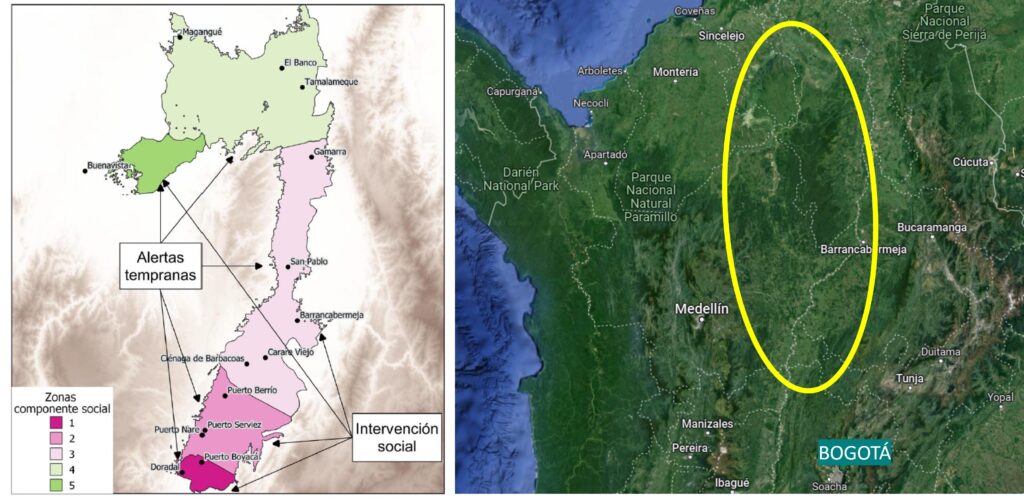
In the decades since around 200 offspring have spread over 100 kilometers (60 miles) of river and swamps bordering departments of Antioquia, Bolívar, Santander and Sucre.

But after years of procrastination over what to do with the wayward Hippopotamus amphibius – with various schemes to sterilize them or ship them to zoos and sanctuaries around the world – Colombia’s environment minister Irene Vélez said this week a cull was the only option.

“We’re talking of a process of euthanasia, which is the technical recommendation,” she told Blu Radio.

The plan was initially to reduce the population by 80 breeding individuals, then cull around 30 beasts per year which would systematically reduce the population.

The hippo range in Colombia, covering 100 kilometers of the Magdalena River Valley.

Hippo boom

The controversial decision is based on a 170-page technical report by the Humboldt Institute and Universidad Nacional in 2022.

The report concluded that the hippos were damaging the tropical ecosystem of the Magdalena river valley by spreading disease and overloading their watery habitat with nitrates: the amphibious herbivores grazed the riverbanks to each munch 50 kilos of grass a day – but then pooped the waste out into rivers and lakes.

Without an urgent cull the population “could increase to 500 hippopotamuses affecting our ecosystem by 2030,” Vélez told a press conference this week. This boom would further put at risk native populations of turtles and manatees.

See also: Hippos need culling, says report

Then there what the report referred to as “hippo – human interactions”, such as a car hitting a two-ton creatures on the main Bogotá – Medellín highway – which runs close to their main hangout near Puerto Triunfo – and even cases of locals trying to keep young ones as pets.

The report also pointed out that hippos were aggressive and territorial and officially the deadliest large mammal – they kill on average 500 people in Africa every year – and attacked boats and canoes on the river aswell as people, cattle and horses around the River Magdalena.

In other videos posted online people are seen chasing them down the highstreet in the town of Doradal.

Hippo takeover

To justify the cull, Vélez said reduction methods such as sterilization were too difficult – anaesthetizing wild hippos is no easy task – and none of the seven nations initially interesting in receiving live hippos for zoos and wildlife parks had followed through.

Watch out for hippos. Sign in Puerto Triunfo.

The cull would start in the second half of the 2026 around hippo hotspots close to Hacienda Nápoles in Puerto Triunfo and Isla del Silencio, a river island near to Puerto Boyacá, she said.

This island is home to a large group one of which attacked and severely injured a farmer collecting water from the riverbank in 2020, according to a news report.  Colombia’s wet lowlands had perfect conditions for hippos, biologist Katerine Corrales told a Caracol news crew visiting the island this week.  

“Africa has droughts and adverse weather patterns. Here we have a constant climate with abundant water and resources which generates a faster reproduction rate,” she said.

In the same report local villagers complained that the hippos had “taken over the island” and restricted commercial fishing.

Poor Pepe

Not everyone welcomed news of the cull. Hippo protection group Comisión Protectora de la Vida de los Hipopótamos – founded in the town of Puerto Triunfo close to Hacienda Nápoles and which benefits from hippo tourism –  rejected the “terrible decision of the national government to authorize a hippo hunt”.

“In our municipality, we are committed to the protection and conservation of these incredible living beings. Hippos are an important part of our identity, and we must live in harmony with them,” said the group on its Facebook page this week.

It called a meeting in Bogotá to seek “non-violent” alternatives to the cull, such as a return to the plan of transferring live hippos to other countries.

Previous attempts to shoot hippos have ended in public relations disasters, such as the killing of Pepe in 2009. The large male hippo was slated for transfer to a zoo in Costa Rica after rampaging around Puerto Berrio.

But he was shot after a bungled attempt to capture him, and photos of an army platoon posing with his remains caused public revulsion, and a court ban on hunting hippos.

Pepe also highlighted the affection local communities had for “Pablo’s hippos”. For some folk the state persecution of the mammals was synonymous with the hunt for Pablo Escobar, still a popular figure among communities that benefitted from his largesse in the 1980s.

In fact, in the drug baron’s heyday the original hippos were kept at his Hacienda Nápoles in a public zoo and safari park where local families could tour for free. Today the hacienda and zoo is still there but managed by the state as part of a huge amusement park.


A captive hippo in Colombia. Escapees have multiplied in the wild. Photo: S Hide.

A grave in Colombia

This week, Minister Vélez was adamant that culling must form part of any population control.

It was global restrictions on wildlife trafficking – the CITES agreements – that had condemned the hippos in Colombia by preventing them being easily shipped abroad, she explained.

“It’s not enough for a zoo to raise its hand; the country must authorize their entry. Unfortunately, no country has given the green light. This administrative silence indicates that there is no interest in receiving them”.

It seems that putting Pablo’s hippos in overseas zoos is proving as difficult as extraditing the cartel kingpin himself. Like their progenitor, the big beasts face a violent end in Colombia rather than a cage in a foreign land.

The post Colombia to cull its wild hippo population appeared first on The Bogotá Post.

  •  
❌