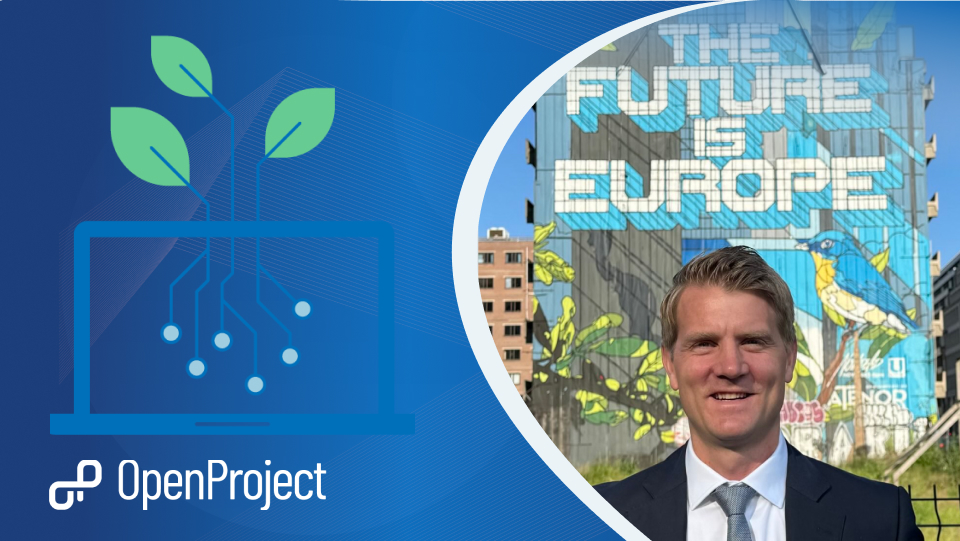
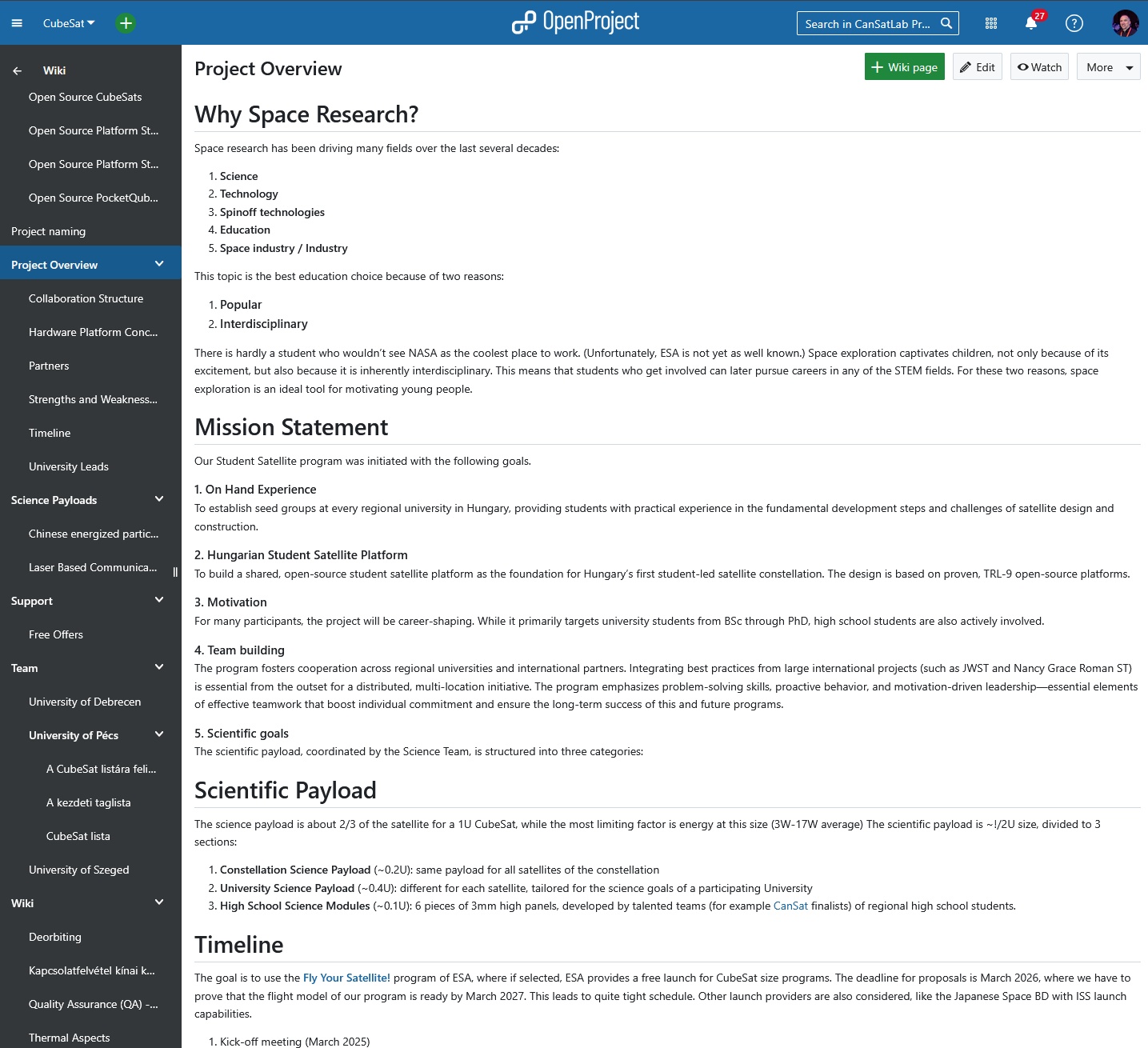
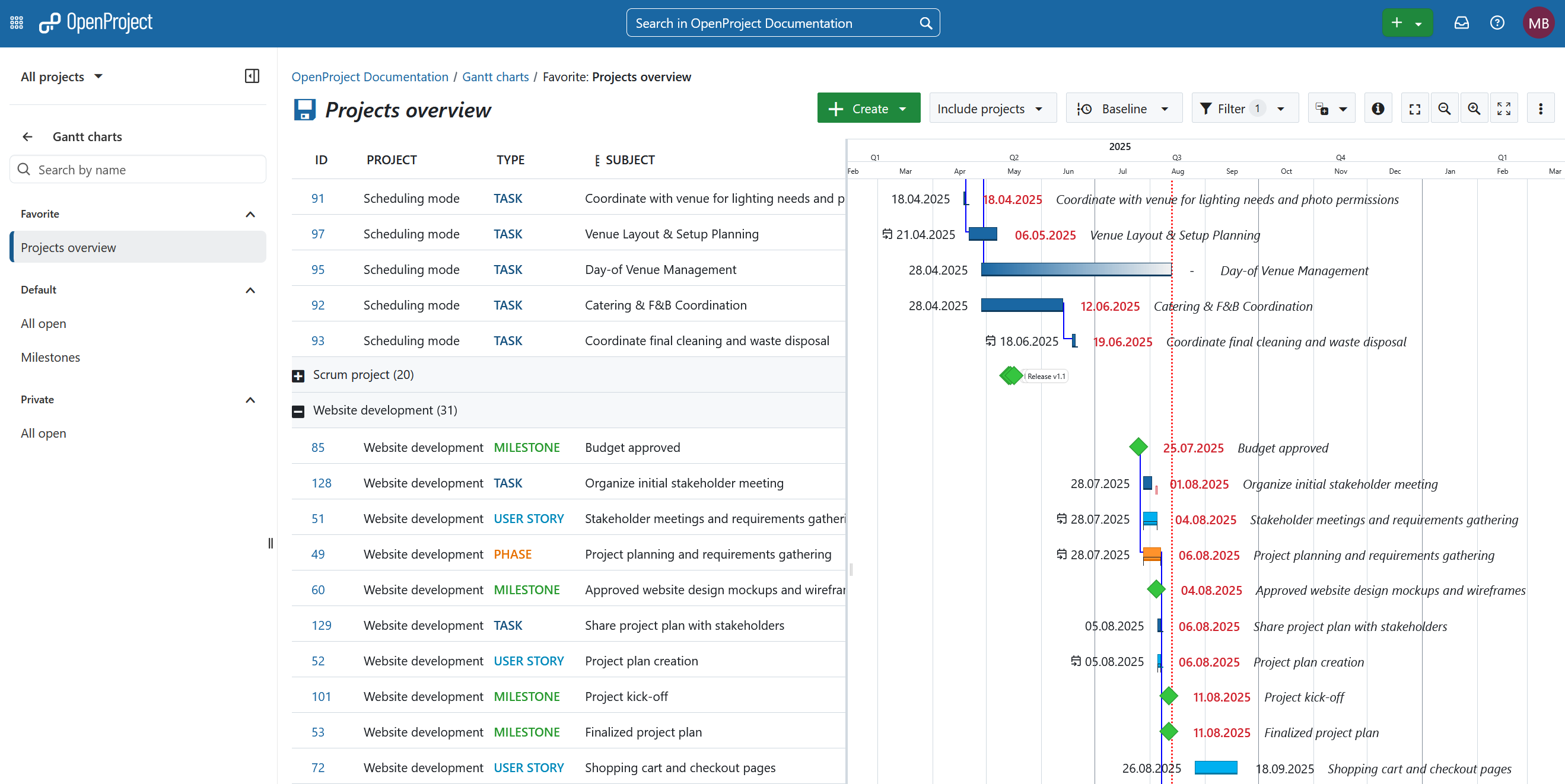
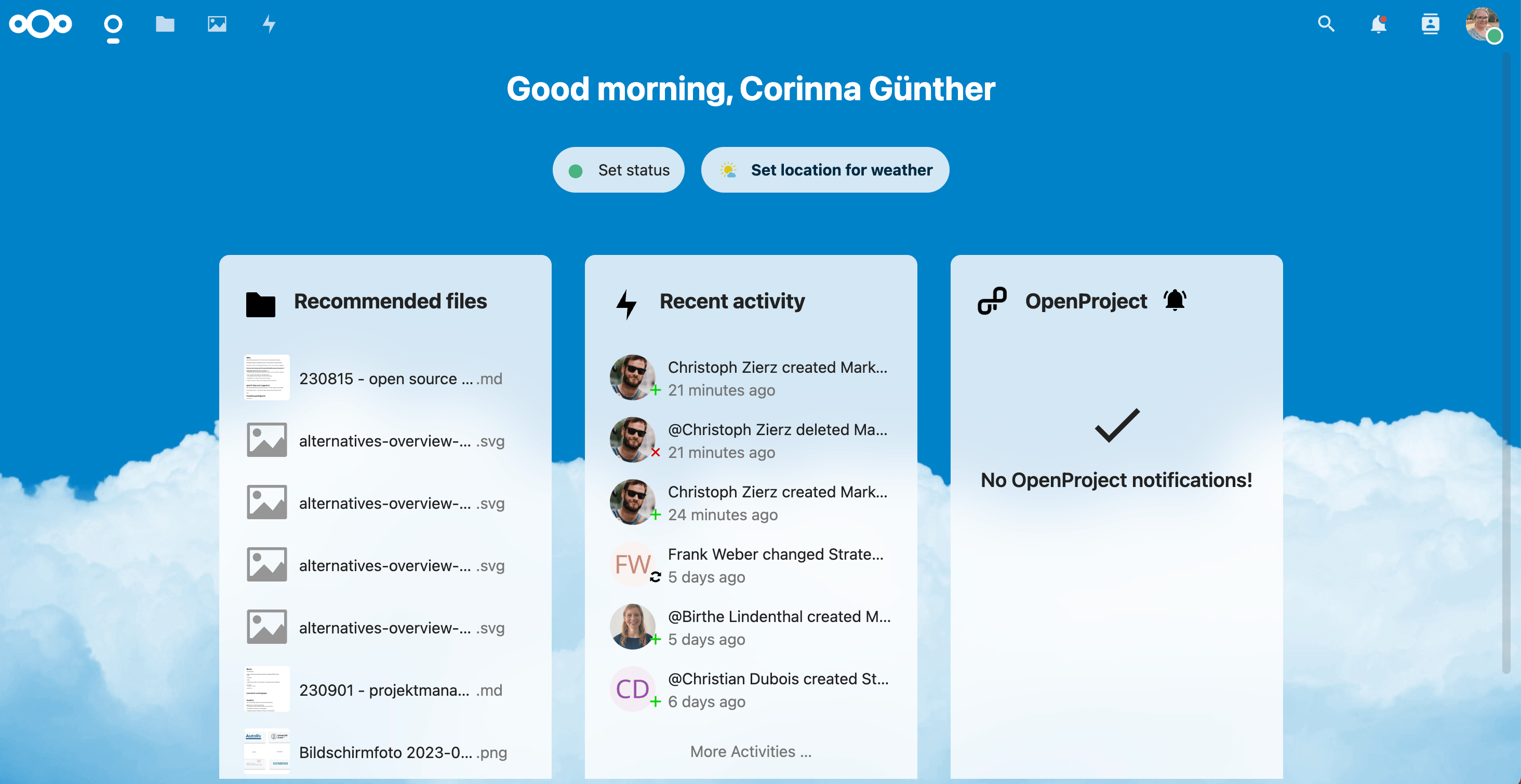
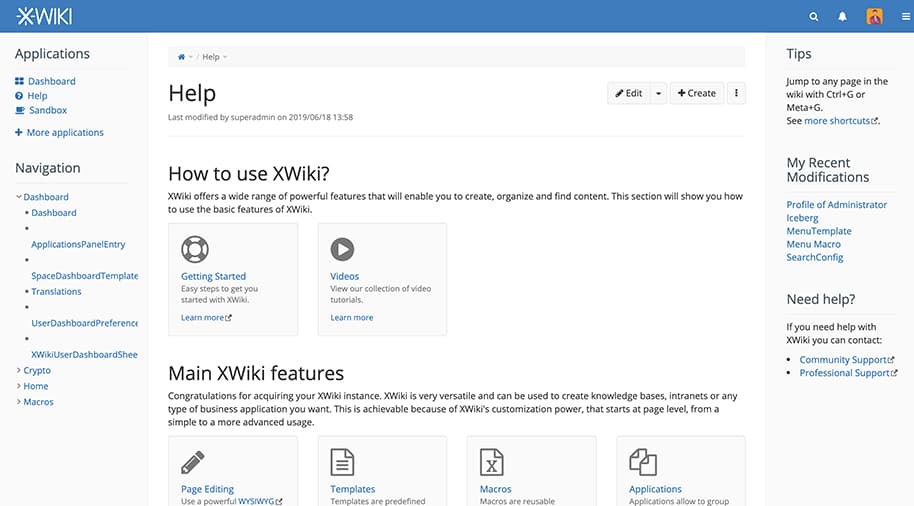
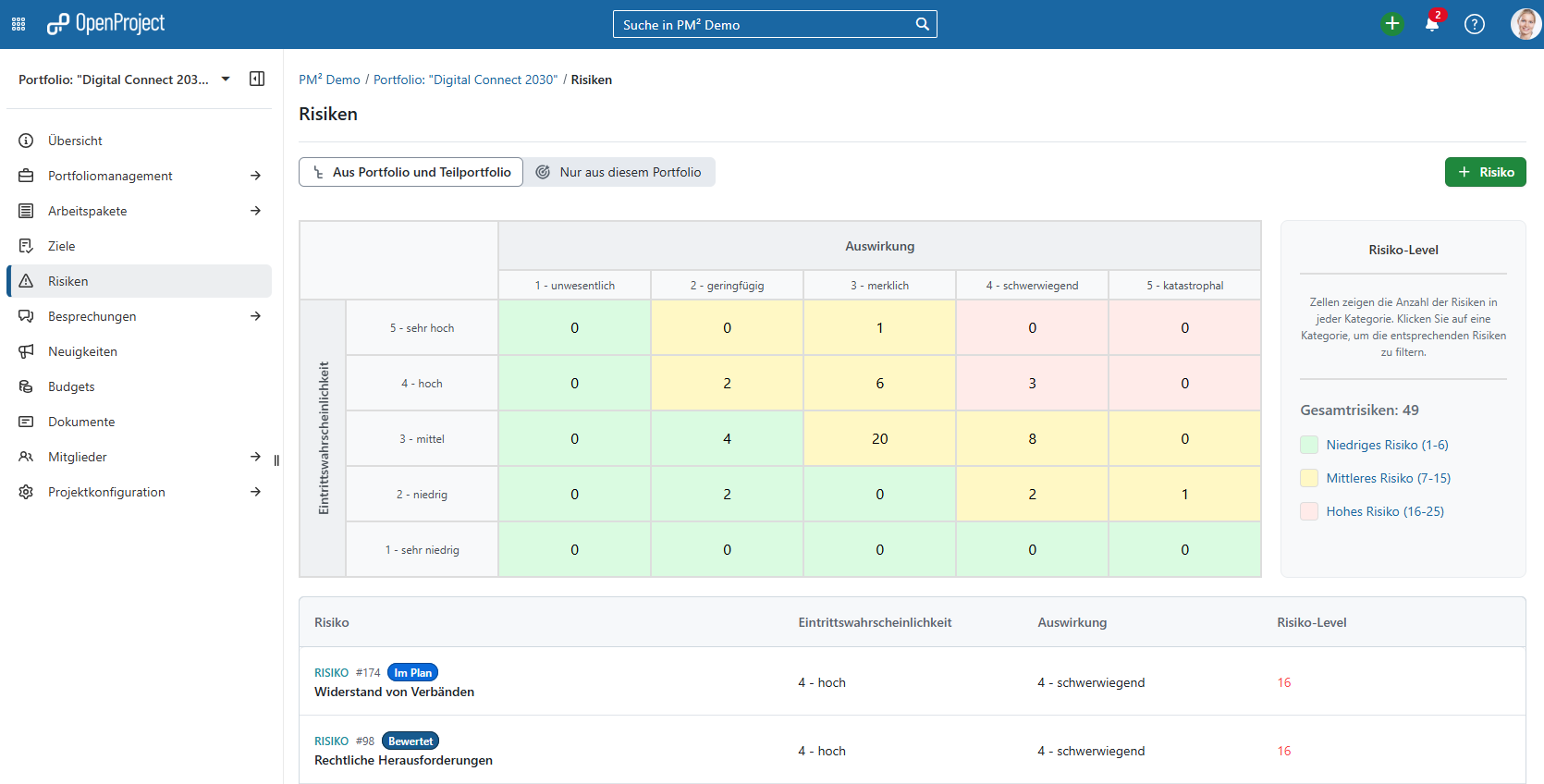
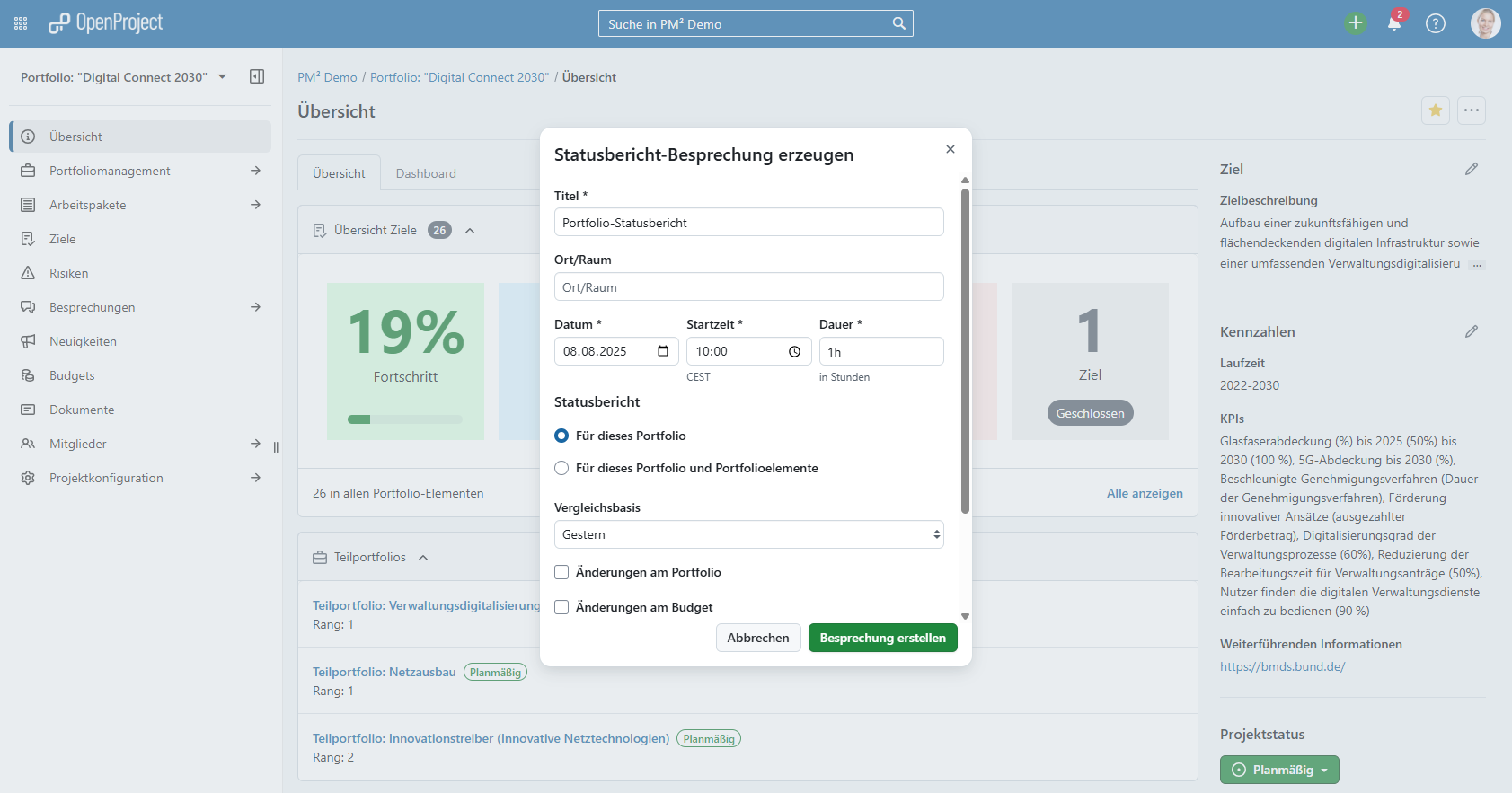
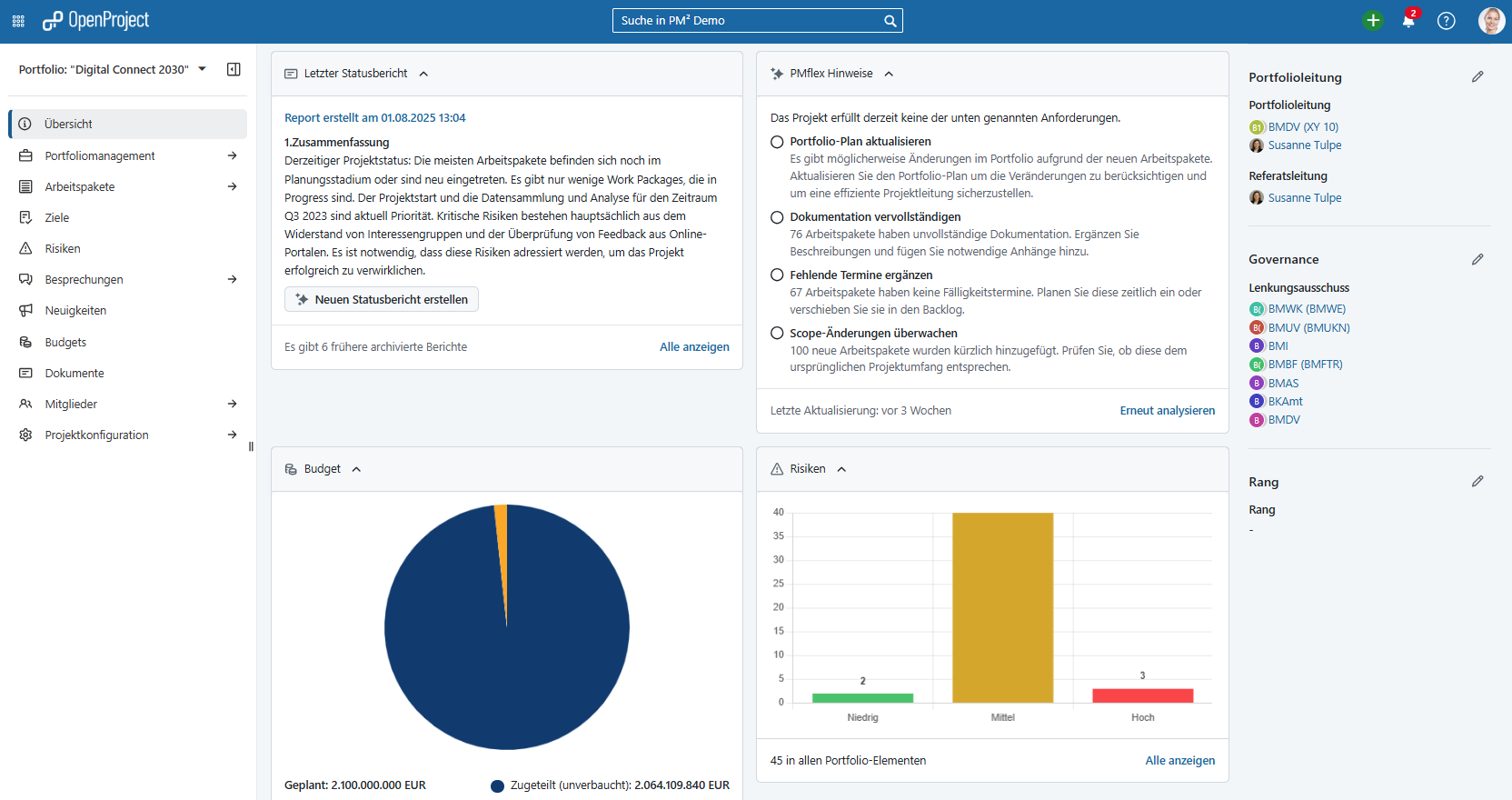
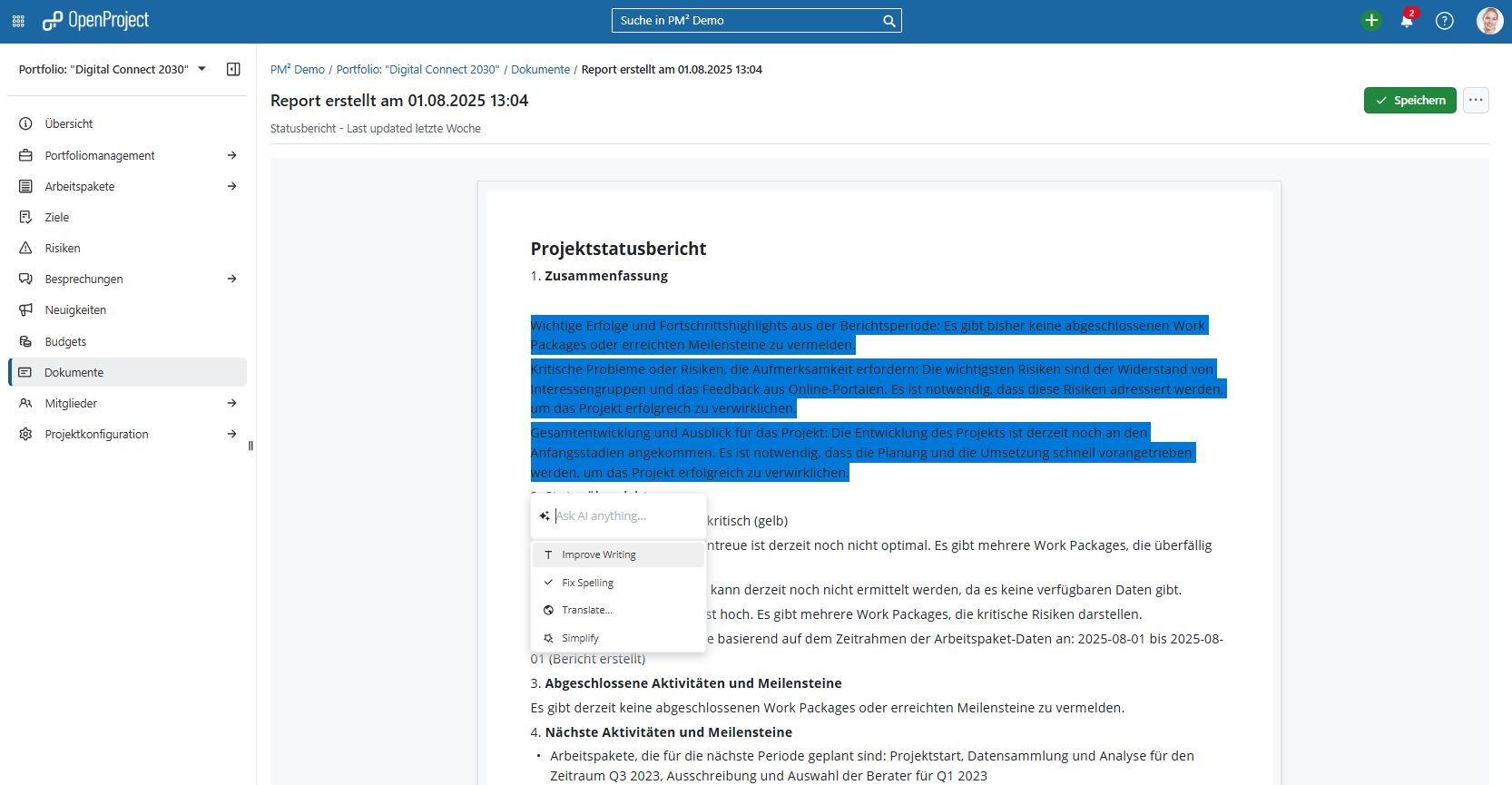
Europe needs open, interoperable tools to collaborate across borders. Especially in the public sector. This vision was reaffirmed at the Summit on European Digital Sovereignty in Berlin, where leaders committed to strengthening open source infrastructures like openDesk OpenProject was invited on site as part of openDesk.
Summit on European Digital Sovereignty
This week, the Summit on European Digital Sovereignty took place in Berlin, hosted by the German government and attended by high-level political leaders and open source innovators from across the continent. German Chancellor Friedrich Merz and French President Emmanuel Macron laid out a joint vision for a sovereign digital Europe.
OpenProject participated as part of openDesk
When we talk about digital sovereignty in Germany and Europe, we talk about openDesk. openDesk is the secure all in one office and collaboration suite, for the public sector and everyone else. OpenProject is proud to be a core component, powering project and task management in a secure, privacy-first environment.
In his speech, Merz mentioned ZenDiS’s OpenDesk as an alternative that is already being used at the Robert Koch Institute and is also in use, at least selectively, in the Chancellery and the Ministry of Digital Affairs. We reported on this in our blog a few weeks ago.
The significance of digital sovereignty is evident
It is a positive sign that all 27 EU member states have signed the “Declaration on European Digital Sovereignty” initiated by Austria, thereby establishing a framework for action on digital sovereignty.
Another strong signal is the increasing presence of openDesk and the topic of digital sovereignty in general in the press. After the summit, the official German news programs Tagesschau and Tagesthemen have reported on the importance of digital sovereignty.
As Adriana Groh, CEO of Sovereign Tech Agency, summarizes at her speach on the Berlin summit this week: “Open source has proven itself to be a winning strategy — not recently, but for decades.”
Conclusion: Attention is great, but the work continues
Europe has the talent, the tools, and the momentum to shape its digital future, openly and collaboratively. The Berlin summit was a powerful reminder that open source is no longer a niche solution, but a strategic choice at the highest levels of government.
OpenProject is proud to be part of this movement. Together with the openDesk ecosystem and partners across Europe, we are committed to creating digital tools that serve the public good.
Still, we share the feeling expressed by ZenDiS on LinkedIn, that we miss even clearer commitments to open source solutions. Because even though the importance of digital sovereignty is becoming increasingly apparent, there is still a lack of clear communication, decisions, and speed.
Managing goals in form of Objectives and Key Results (OKRs) is a proven framework used by companies of all sizes to align strategy and execution. To successfully work with OKRs, teams need a flexible and transparent OKR software that supports both high-level strategic planning and day-to-day task management. OpenProject is perfectly suited as an OKR software to meet this goal.
Read the following guide to learn how you and your organization can use the OpenProject software to manage your OKRs in three steps.
Insights: Our experience with OpenProject as OKR software
OpenProject is known as top project management and task software. What many people don’t yet realize is that the tool can also be used wonderfully for the OKR methodology. In other words, for strategic goal setting with Objectives and Key Results. The OpenProject team is a good example of how OpenProject works in practice as OKR software. Since Q1 2025, we have been using OpenProject to plan and track our corporate Strategic Initiatives, Objectives, and corresponding Key Results.
Today, we share our experience and learnings, so that you can benefit from our test runs and use these instructions to get started with your own OKRs right away.
Note
We will show some screenshots in this article. Please note that some of them actually show our real company OKR project while others are based on demo data. Nevertheless, the process and structure reflects the way we work with Objectives and Key Results internally.
Learning 1: OKR masters and regular check-ins
To start with OKRs in our company, we selected and trained two so-called OKR masters. They are experts in the OKR framework and know best how to handle Objectives and Key Results, e.g. when it comes to phrasing or questions like “What do I do with OKRs that we didn’t finish in this quarter?”.
To do so, they also attend our regular OKR check-ins – to answer questions and stay informed on how the different OKR teams proceed. In the first quarters, we scheduled these check-ins weekly. Now that everyone is more experienced in working with OKRs, some teams changed the frequency to bi-weekly or even monthly check-in meetings.
Learning 2: Dedicated OKR teams in a dedicated project
As we use the OpenProject software for many different projects, it was quite clear that we needed a dedicated OKR project for all our Objectives and Key Results. Nevertheless, this OKR project is not time-limited. New OKRs are added every quarter, and at the same time, we can view past quarters at any time.
What we have learned: Creating dedicated OKR teams is very helpful. Not only because the composition of OKR teams can differ from our usual team structure, but also because OKR teams may require different permissions.
In addition, we created an OKR wiki right at the beginning, which the OKR masters keep up to date. In it, employees can find all the information they need for internal work with OKRs.
Guide: How to use OpenProject as OKR software in 3 steps
These were our most important learnings after three quarters working with OKRs in OpenProject. Now, let’s see how exactly you can use the tool for OKRs, step by step.
For an OKR project, you’ll need specific work package types like:
Strategic Initiative
Objective
Key Result
Task
These are the work package types we use to manage our OKRs at OpenProject.
For statuses, we rely on the same ones we typically use, e.g. “new”, “in progress” or “closed”. Additionally we added the status “moved to next quarter”, which is very helpful if you want to continue on an Objective or Key Result in the following months. This way, accountables just need to update the status and change the version, e.g. from “Objectives 2025 Q3” to “Objectives 2025 Q4”.
As mentioned above, we advise to set up OKR groups for different teams so that everyone, e.g. the OKR master, can assign work packages to the specific teams. This allows individual teams to see at a glance which OKRs belong to them and decide among themselves who is accountable for which Objective or assigned to which task.
Tip
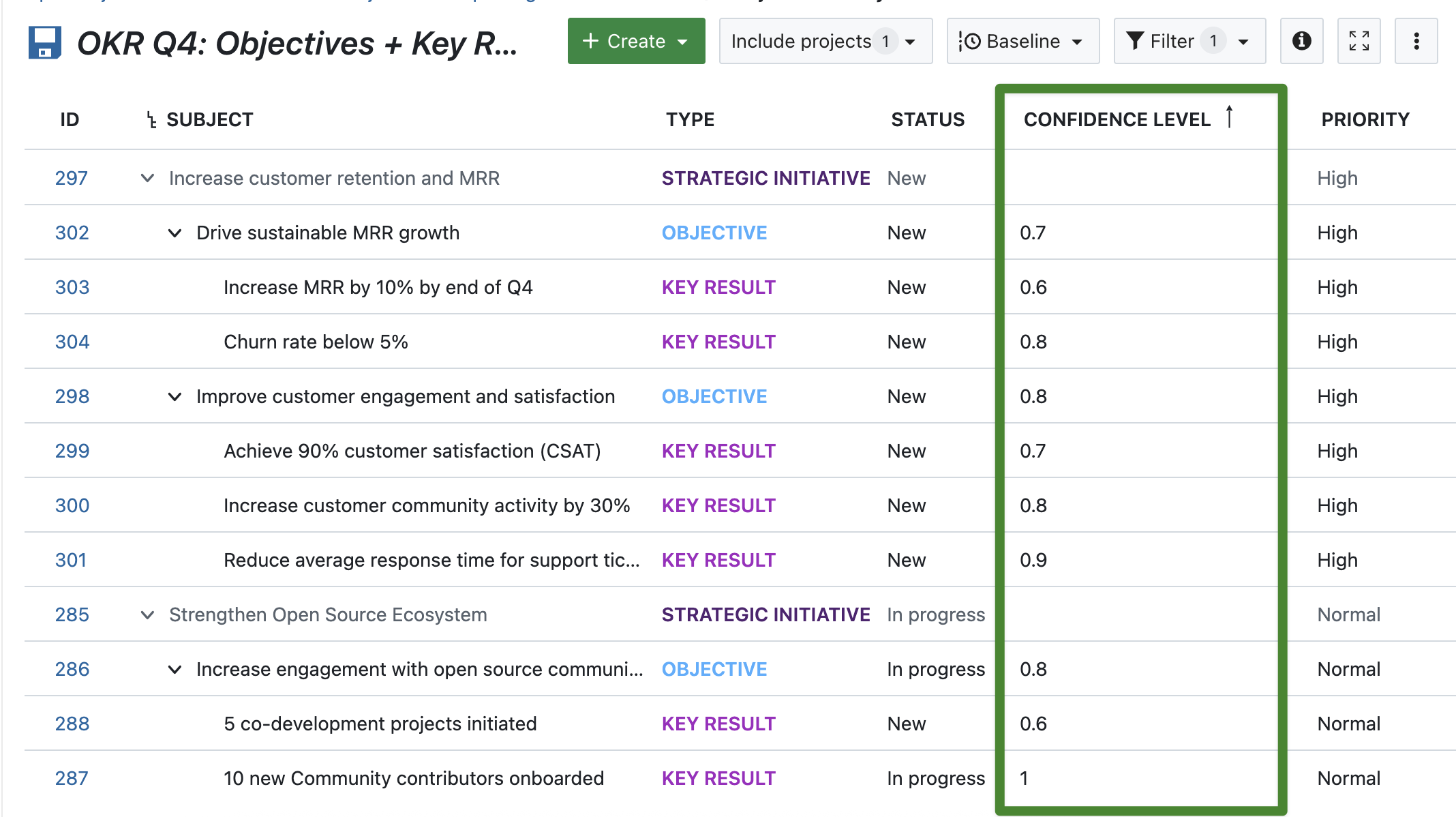
We’re still experimenting with custom fields for OKR work packages. One idea is to set up a custom field for the Confidence Level, on Objective and on Key Result level. Accountables can then update the Confidence Level regularly to track how certain they are that the Objective or Key Result will be achieved by the end of the quarter – for example, by setting it to 0.7 if they estimate the probability to be 70%.
Step 2: Start Strategic Initiatives, Objectives and Key Results for the next quarter
Now that everything is preset, step 2 can start: defining quarter-specific Strategic Initiatives, Objectives and Key Results. This step builds on the company’s vision, mission, and annual goals — ensuring that each new OKR directly contributes to the overall strategy. Typically, the Strategic Initiatives and Objectives are defined and approved at the management level, while the corresponding Key Results and related tasks are then discussed and refined collaboratively within each team.
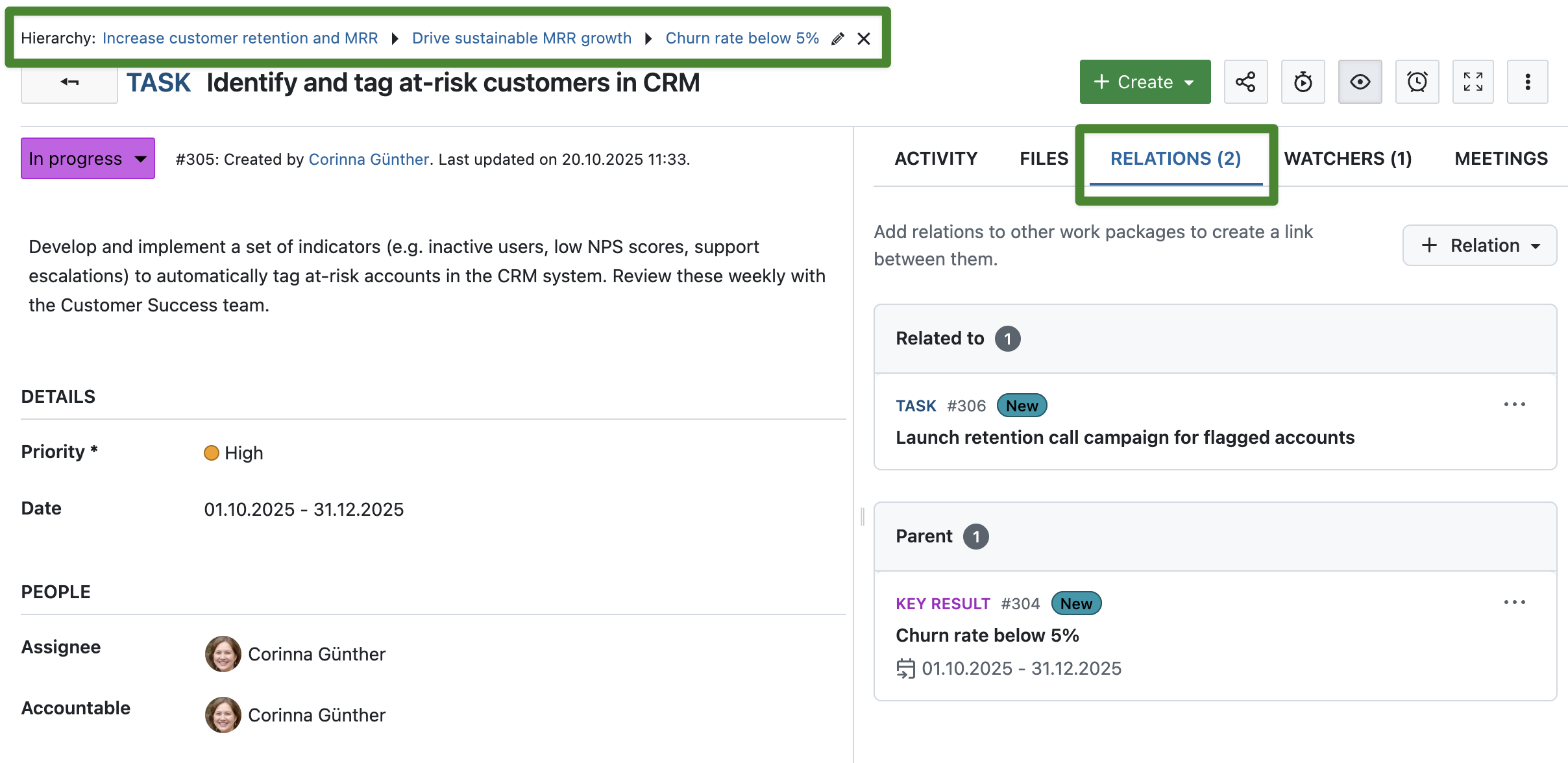
Work package relations
Of course, these work packages should all be linked in a smart way. In OpenProject, simply use parent-child relations to display dependencies between a Strategic Initiative, its Objectives and Key Results:
Once you have created all relevant work packages for the quarter and have set up all relations, it might be helpful to bulk edit them to add more information:
Set the start and finish date to the start and end of the quarter.
Set the version e.g. to Q4 2025, so that you can filter for that.
Adjust priorities if necessary.
Apart from these general attributes, it is always helpful to add work package descriptions and if you work with estimates and progress, fill out the fields for Work – depending on your progress reporting mode (which is defined on an instance level).
Step 3: Monitor and schedule regular OKR meetings
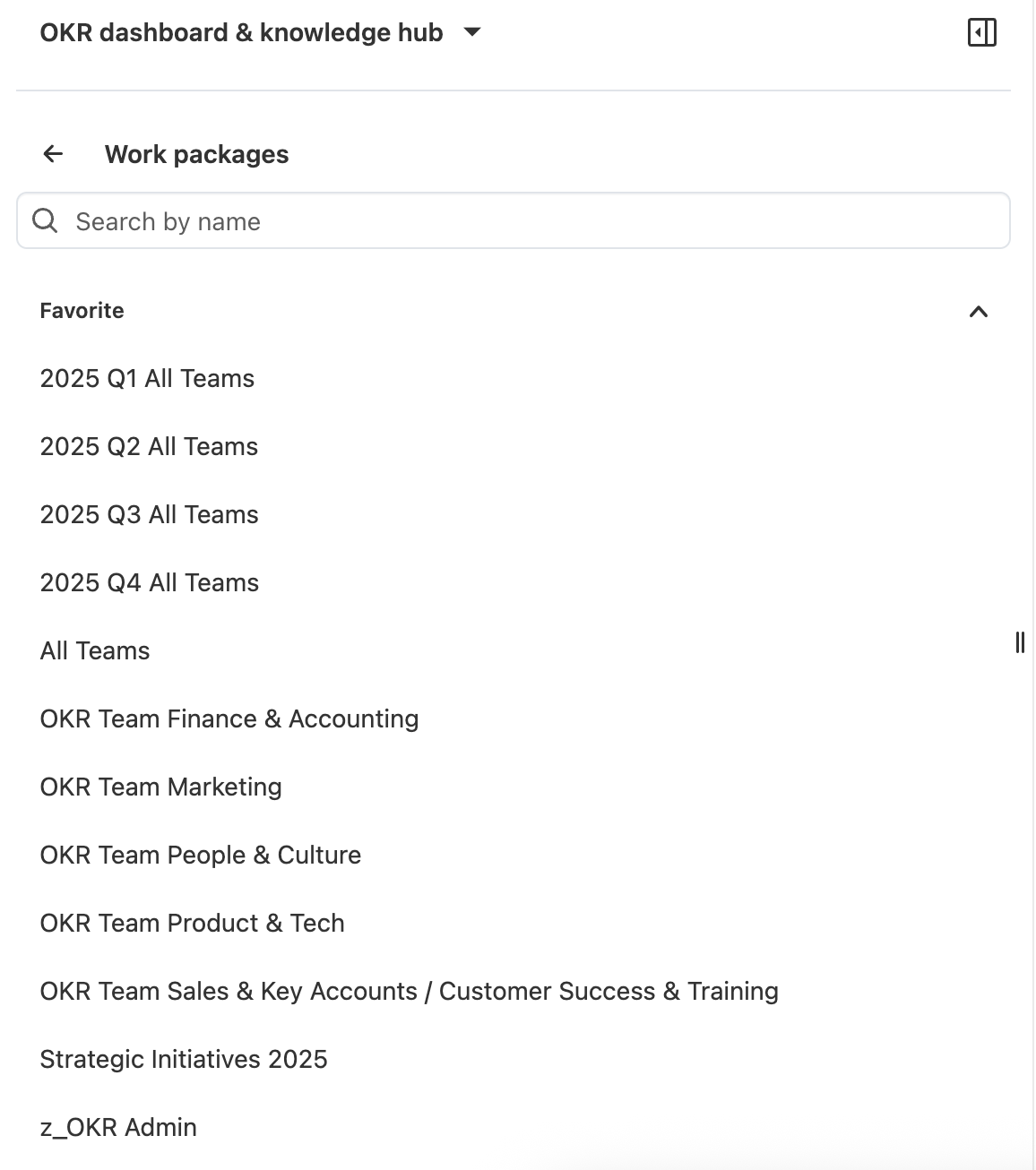
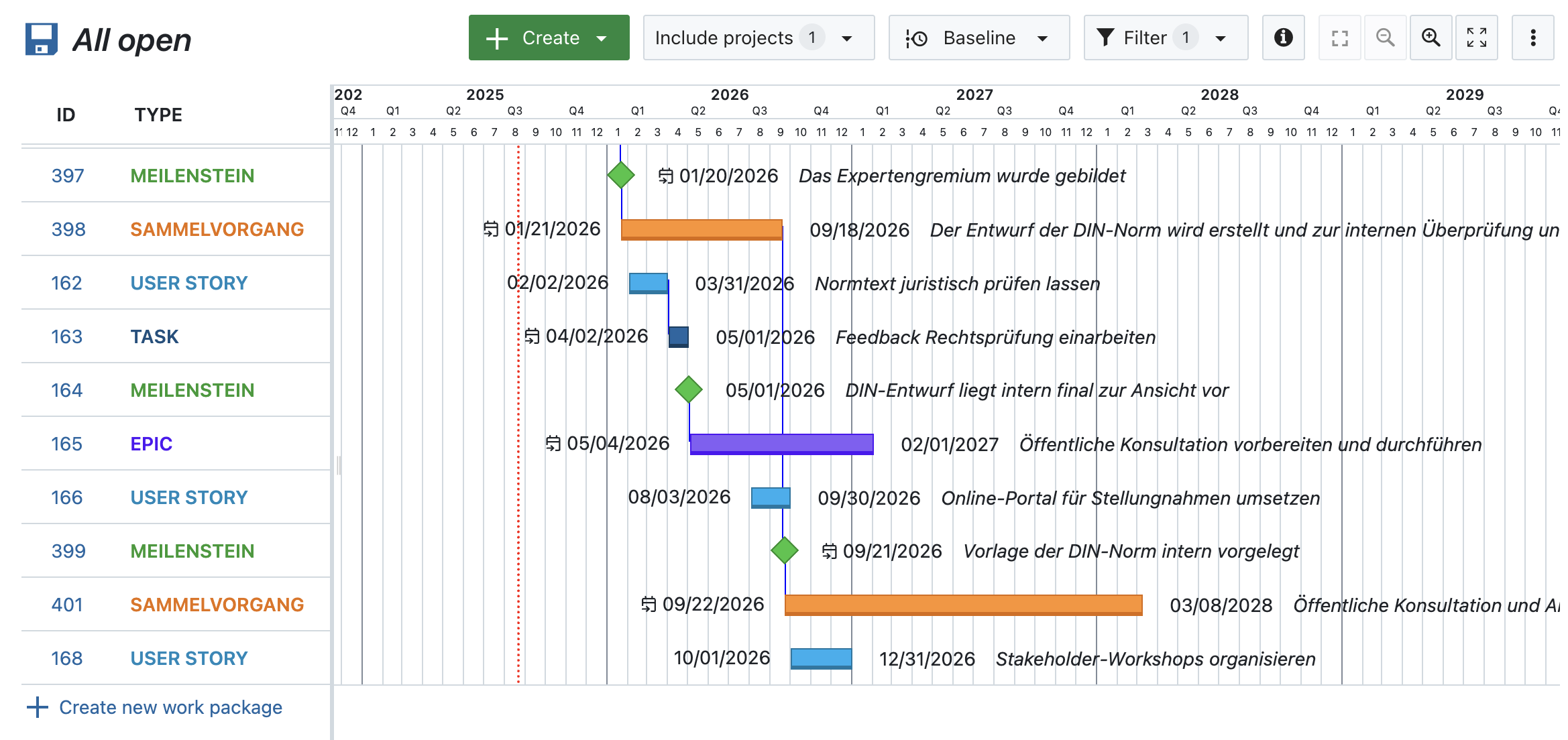
Once everything is set up in OpenProject, the real work can start. To keep track of your OKR progress, you can filter and save Work package tables, Boards or Gantt charts.
Work package tables
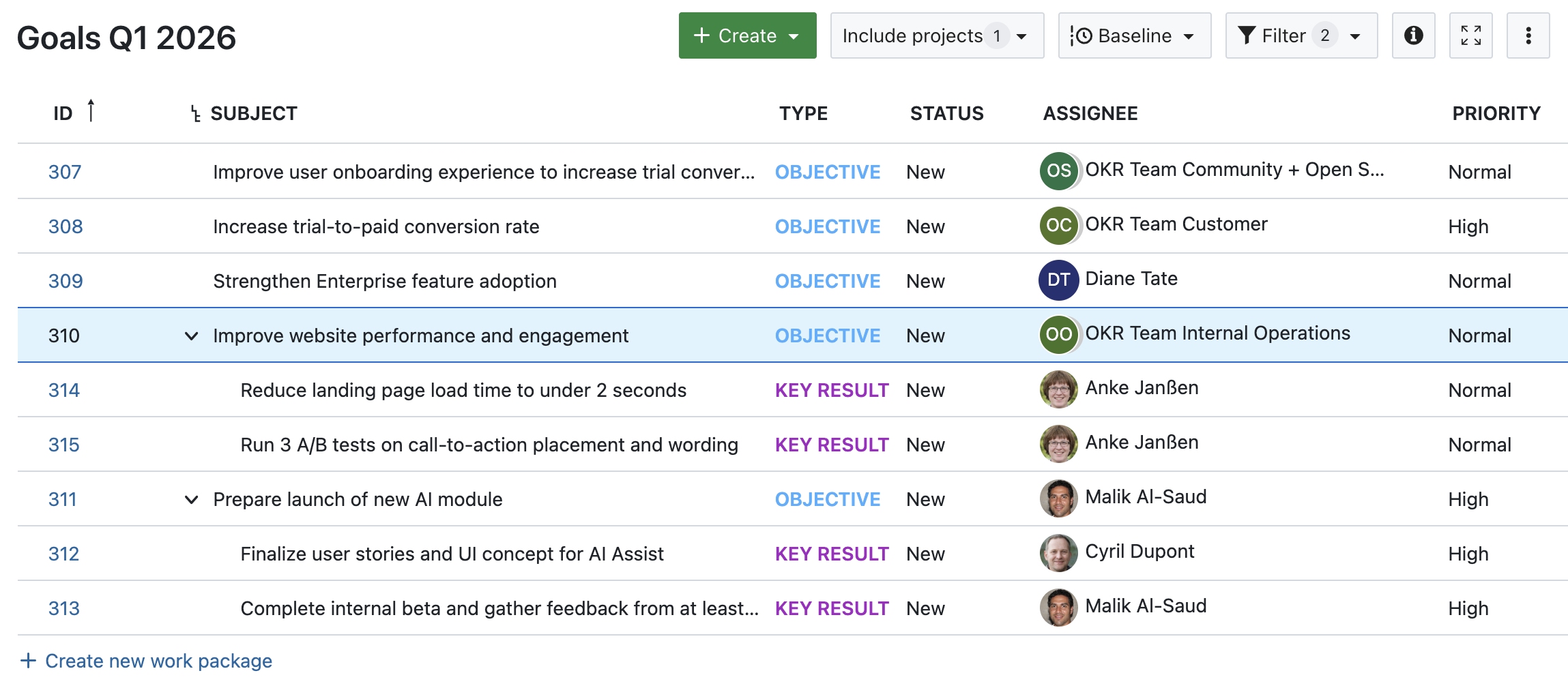
Here’s a real screenshot of our internal OKR work package tables:
You can see saved work package tables for all teams for different quarters as well as team-specific tables. Helpful on a management level is a filtered view for all Strategic Initiatives across quarters.
Boards
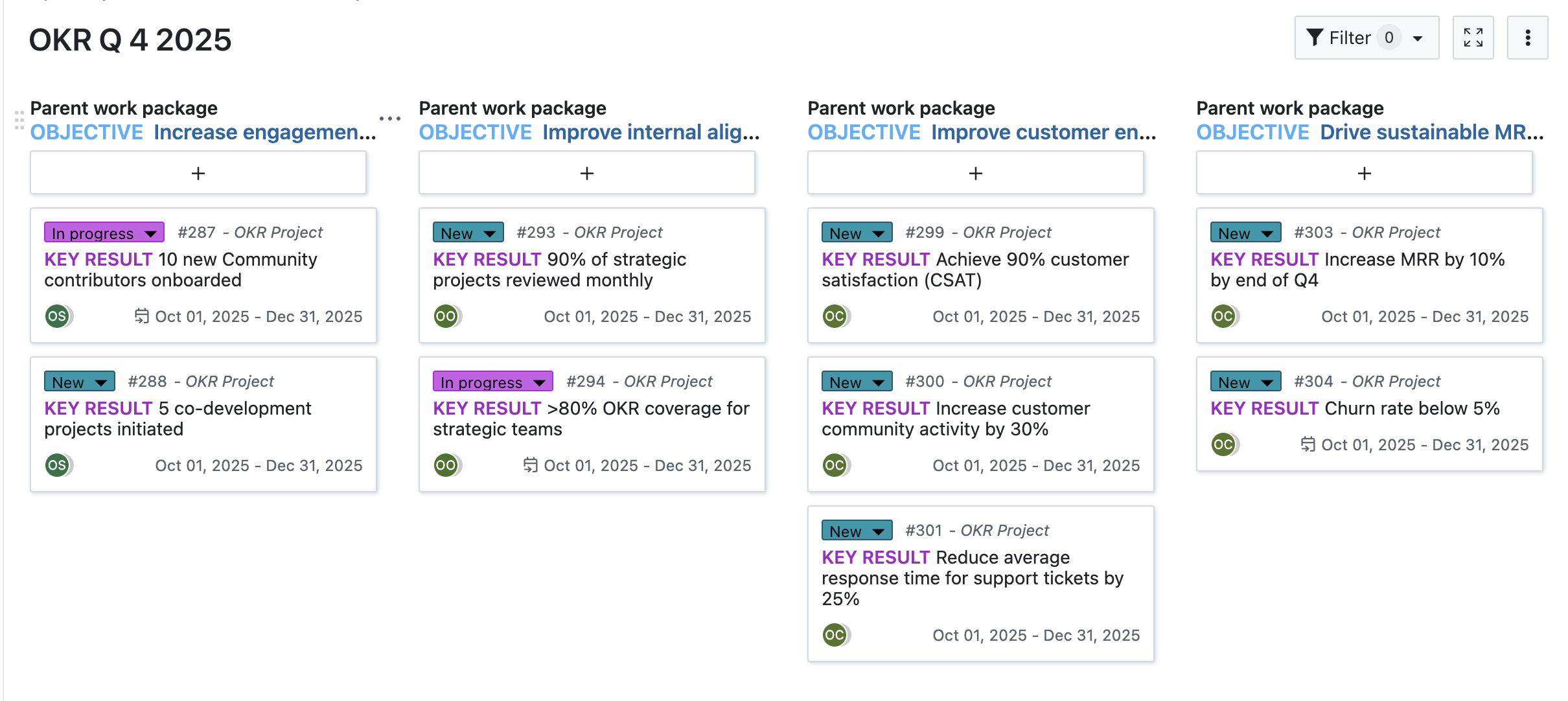
Some teams prefer working with boards instead of table views. For OKRs, a parent-child board is helpful to display Objectives and their corresponding Key Results:
This type of board view works well for (bi)weekly OKR check-ins to monitor and discuss progress for each Objective.
Meetings
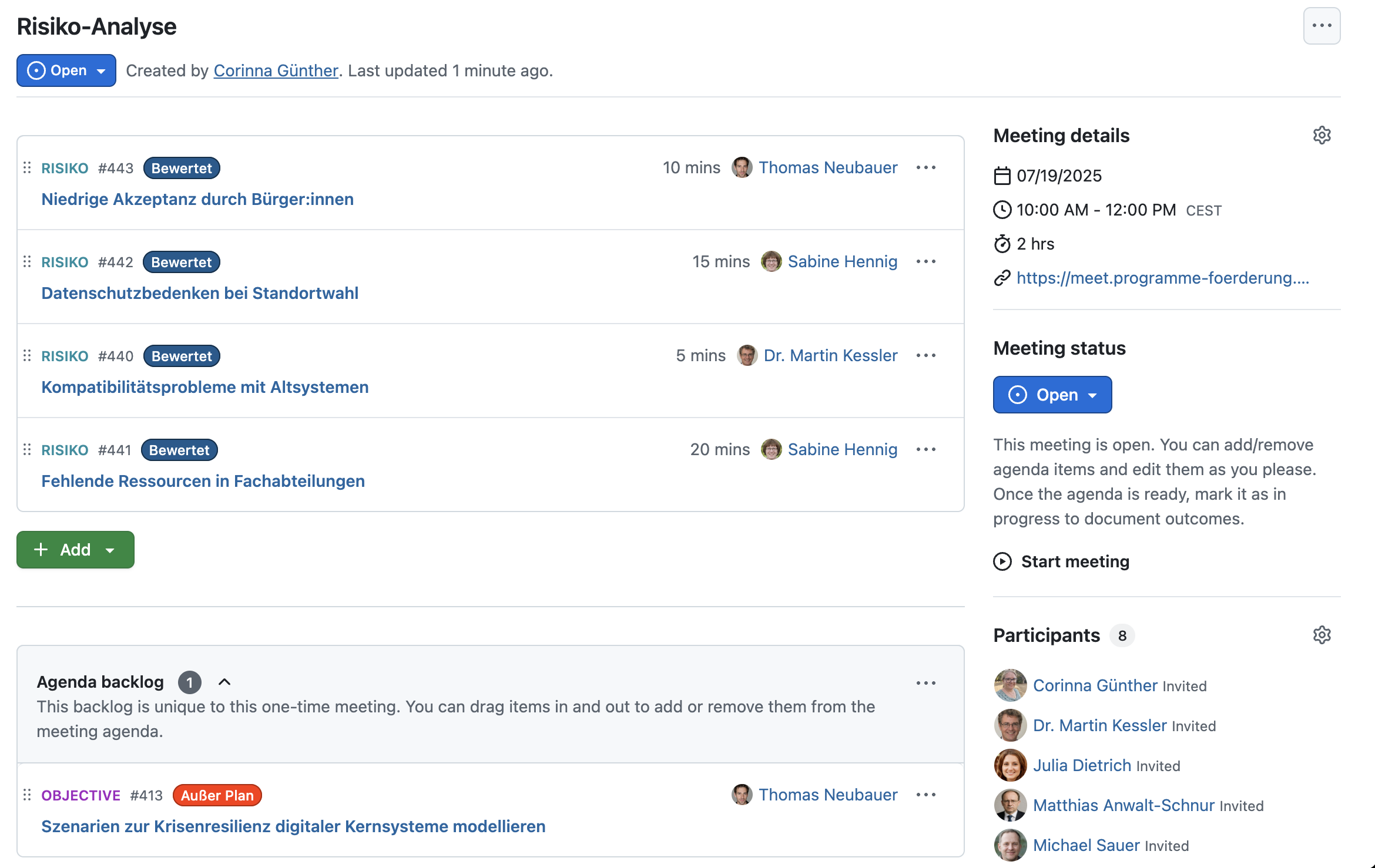
When it comes to OKR, regular check-ins are essential not only for the team but also on a management or OKR master level. Here’s where one of OpenProject’s most popular features comes into play: the Meetings module. Set up a recurring meeting series based on a template, and you’ll have a dedicated space to regularly review the progress of your Objectives and Key Results.
With just a few clicks, you can add them to the agenda, include comments, and record an outcome during the meeting. It couldn’t be more convenient — everything is presented at a glance, with direct links to the work packages and email invitations sent to participants. Done.
Overview and statistics
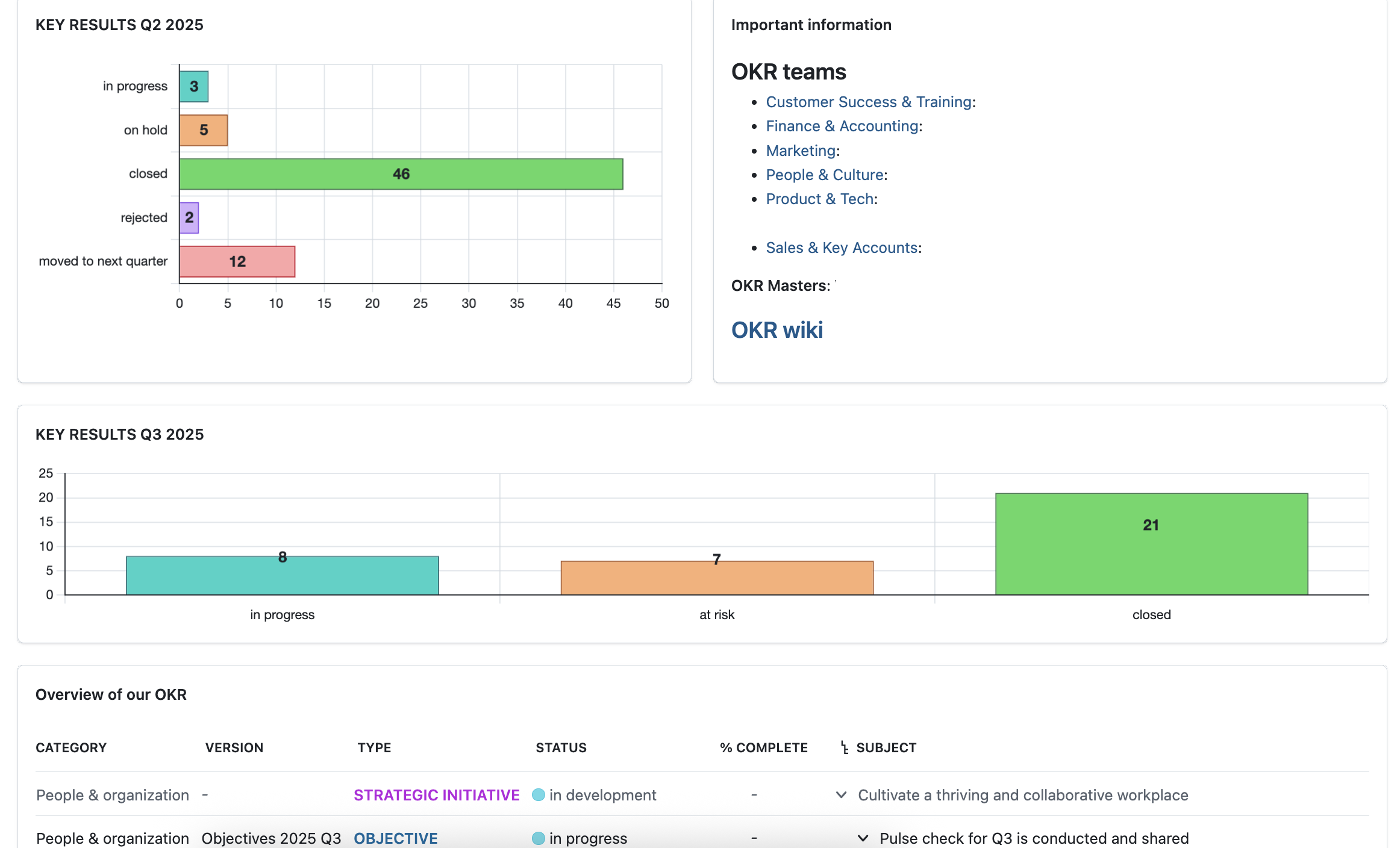
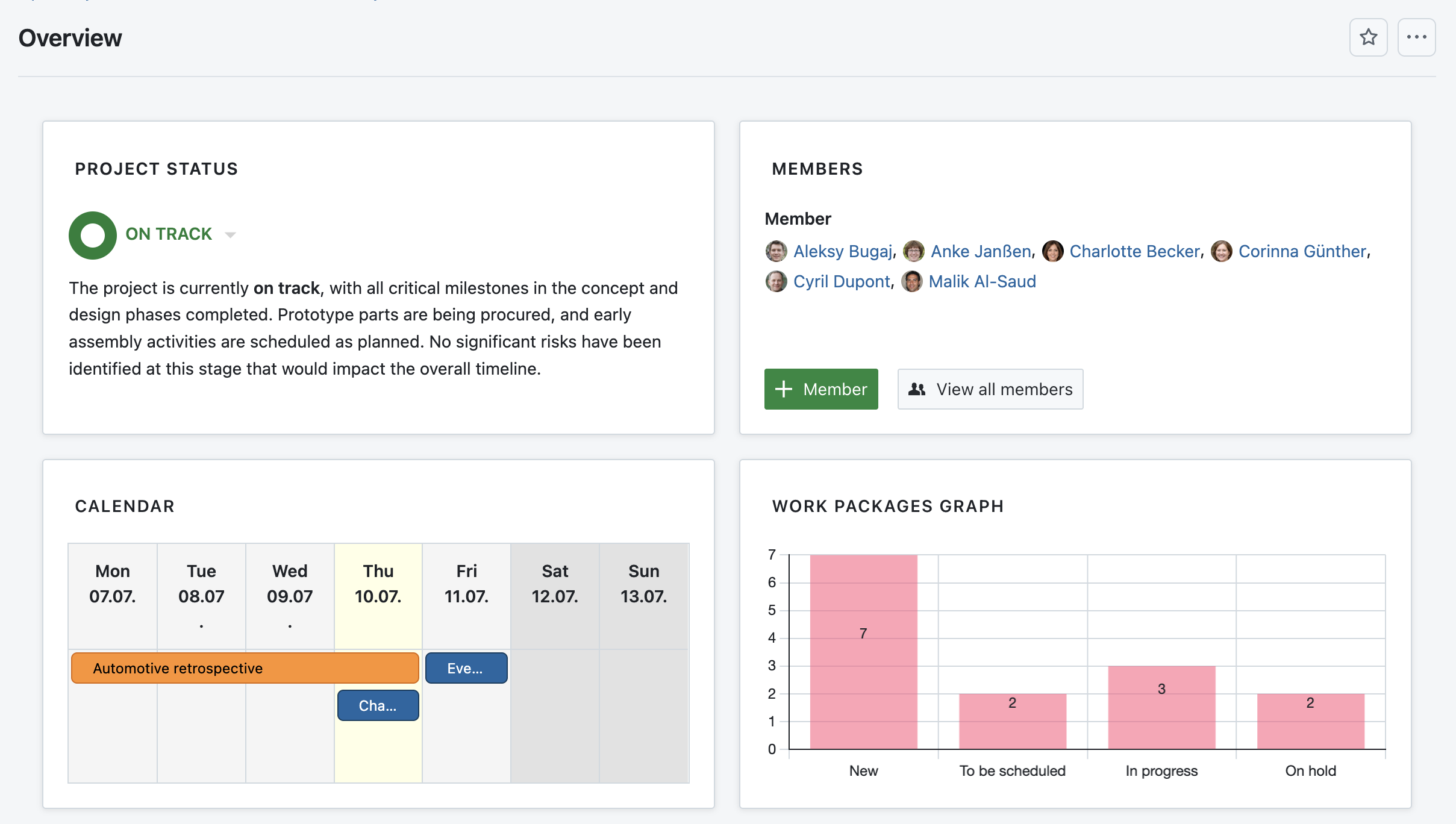
Use the project overview page to see at a glance which Key Results are at risk, closed or moved to the next quarter. Here’s an example of the OpenProject company OKR overview page:
Note
OpenProject is an OKR software that is frequently updated, with new releases every month. Looking ahead, we plan to improve our setup by experimenting with even more detailed dashboards and further automation. Take a look at our roadmap to see what we plan to release next!
Start a trial to test OpenProject for your OKRs
With everything set up, your team can now fully leverage OpenProject as OKR software to align goals, track results, and stay accountable.
OpenProject helps teams implement OKRs without switching tools. With flexible work package types and intuitive tracking, you can align strategy and execution in one place. Are you and your team working with OKRs as well? Try OpenProject now and see how OKR software built on open source can streamline your strategic alignment.
Digital collaboration in public administration is becoming increasingly important across Europe and beyond. Questions of data protection, interoperability, and digital sovereignty are now central to how governments organize their work.
In Germany, one initiative is setting a strong example: openDesk, an open source collaboration platform designed specifically for public institutions, developed by the Center for Digital Sovereignty of Public Administration (ZenDiS), a government-owned organization promoting open and secure IT infrastructures. openDesk integrates several trusted open source applications – including OpenProject for project management and task tracking – to enable secure, transparent, and independent collaboration within and between public organizations.
A milestone for openDesk: The German conference of Minister Presidents
At the October 2024 meeting in Leipzig, openDesk was used for the first time – only one week after the platform’s official launch. The organizing team from the State of Saxony wanted a secure, sovereign system for sharing documents, recording decisions, and collaborating on materials between all 16 states.
The result was a complete success. openDesk proved to be reliable, secure, and interoperable. The conference’s digital processes ran smoothly, and all participating offices could collaborate efficiently. This first real-world use case demonstrated that open source collaboration works even at the highest levels of government.
The technology behind openDesk
openDesk is a modular, fully open collaboration suite that combines several established open source solutions into one cohesive environment. It is developed and supported by a strong network of European and German partners who are committed to transparency, data protection, and digital sovereignty:
B1 Systems GmbH – consulting and infrastructure services for open source deployments.
Collabora Online – collaborative editing of office documents directly in the browser.
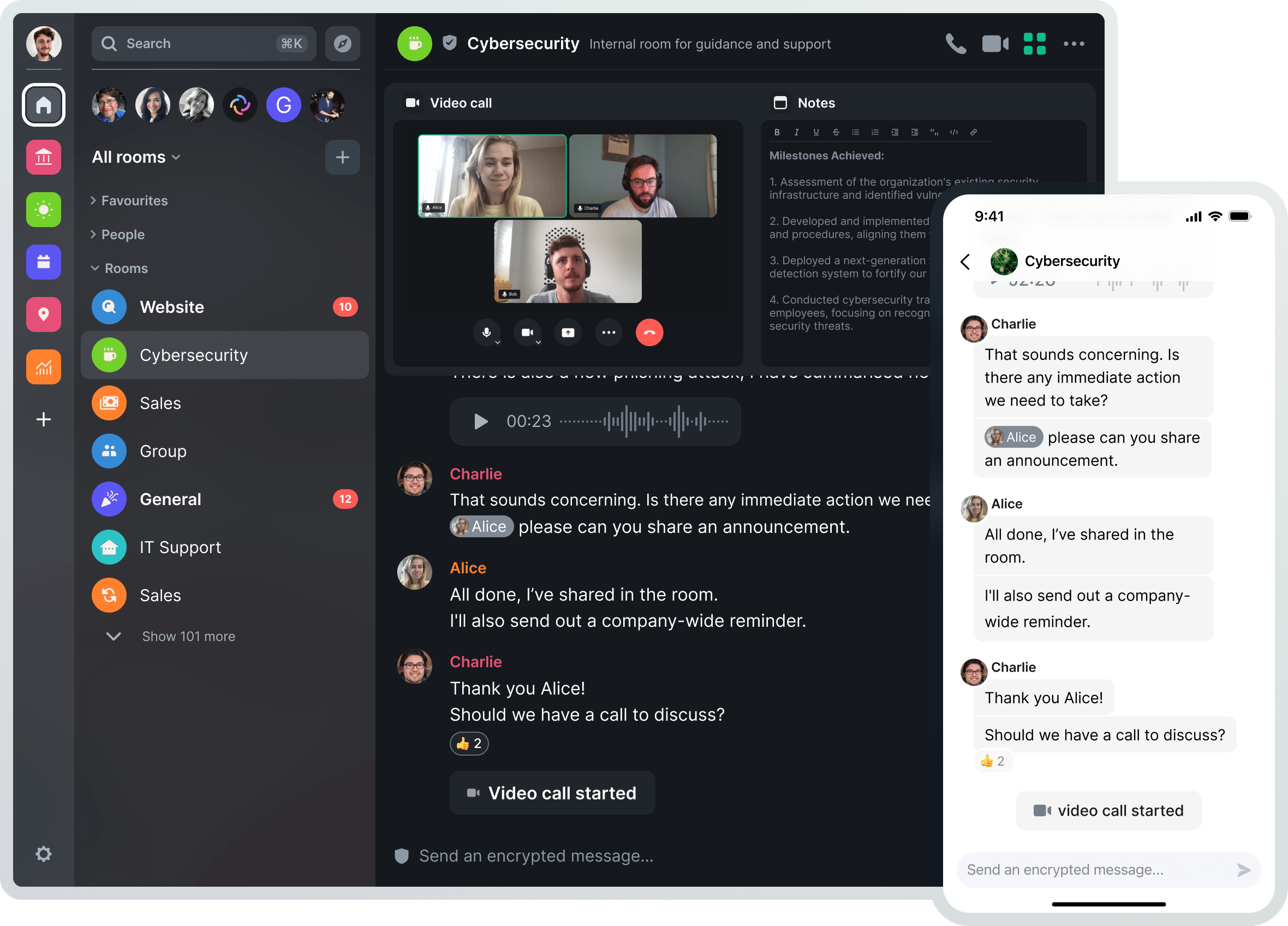
Element Software GmbH – secure chat and video communication based on the Matrix protocol.
Nextcloud GmbH – secure file storage, synchronization, and sharing.
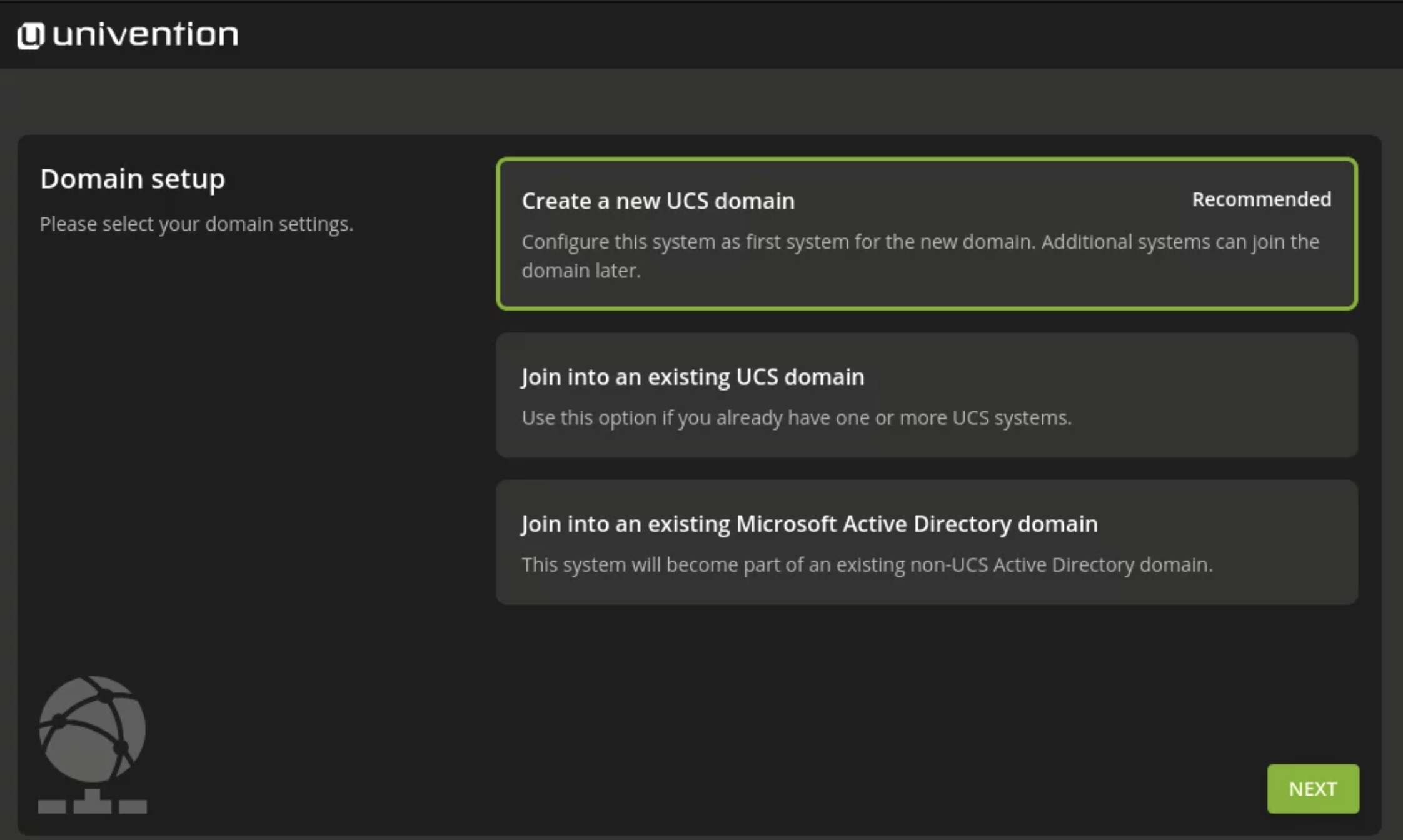
Univention GmbH – identity and access management for public IT systems.
XWiki SAS – open knowledge management and documentation platform.
Together, these organizations deliver a sovereign, privacy-respecting digital workspace that meets the strict security and data protection standards of European public administrations.
Secure hosting within Germany
During the first deployment at the MPK in Saxony, openDesk was operated by Adfinis and hosted on the cloud infrastructure of IONOS, which is certified according to the C5 security standard of the German Federal Office for Information Security (BSI).
The more recent MPK meeting under the chairmanship of the state of Rhineland-Palatinate was hosted by STACKIT, the cloud provider of the Schwarz Group (known for Lidl and Kaufland), with technical support from B1 Systems.
This collaboration between public institutions, mid-sized IT service providers, and open source software vendors shows how digital sovereignty is becoming a practical reality in Europe – secure, independent, and future-proof.
Growing momentum: The International Criminal Court joins the movement
Digital sovereignty is not just a German or European topic anymore. The idea of using open, transparent, and locally controlled software is gaining international traction.
Recently, the International Criminal Court (ICC) in The Hague announced its decision to replace Microsoft products with openDesk. This move by one of the world’s most important international justice institutions underlines a growing trend: organizations handling sensitive information are increasingly turning to open source solutions to ensure long-term independence and control over their data.
OpenProject as a key component of openDesk
As one of the core components of openDesk, OpenProject provides the backbone for structured project and task management. It enables transparency, accountability, and traceability of decisions – essential qualities for complex administrative environments.
OpenProject helps public sector teams coordinate their work effectively, stay aligned on responsibilities and timelines, and maintain full control over their data. Hosted on European infrastructure and fully open source, it meets the highest privacy and compliance standards.
By the end of 2025, openDesk aims to deploy around 160,000 licenses across German public institutions. The platform continues to expand – from large organizations like the Robert Koch Institute to smaller but strategically critical bodies such as the Conference of Minister Presidents.
openDesk and its components, including OpenProject, represent a shared vision: digital sovereignty as the new standard, not the exception.
OpenProject 16.6 has been released and this version introduces new features and improvements again. Please take a few minutes to learn what changes for you. We will summarize the most important changes in this blog article and, as always, please see our release notes that contain all changes, features and bug fixes.
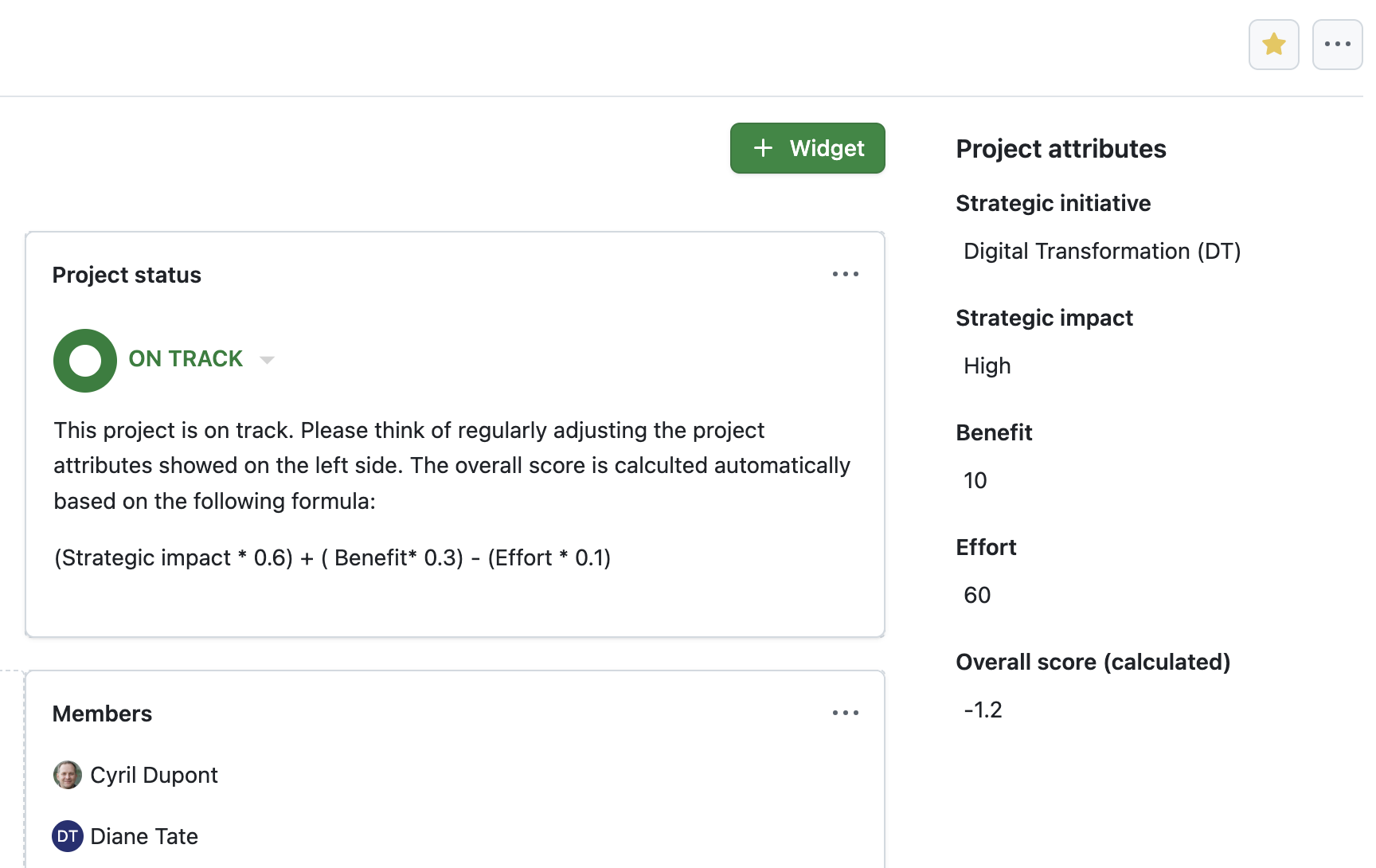
Project evaluation and scoring (Enterprise add-on)
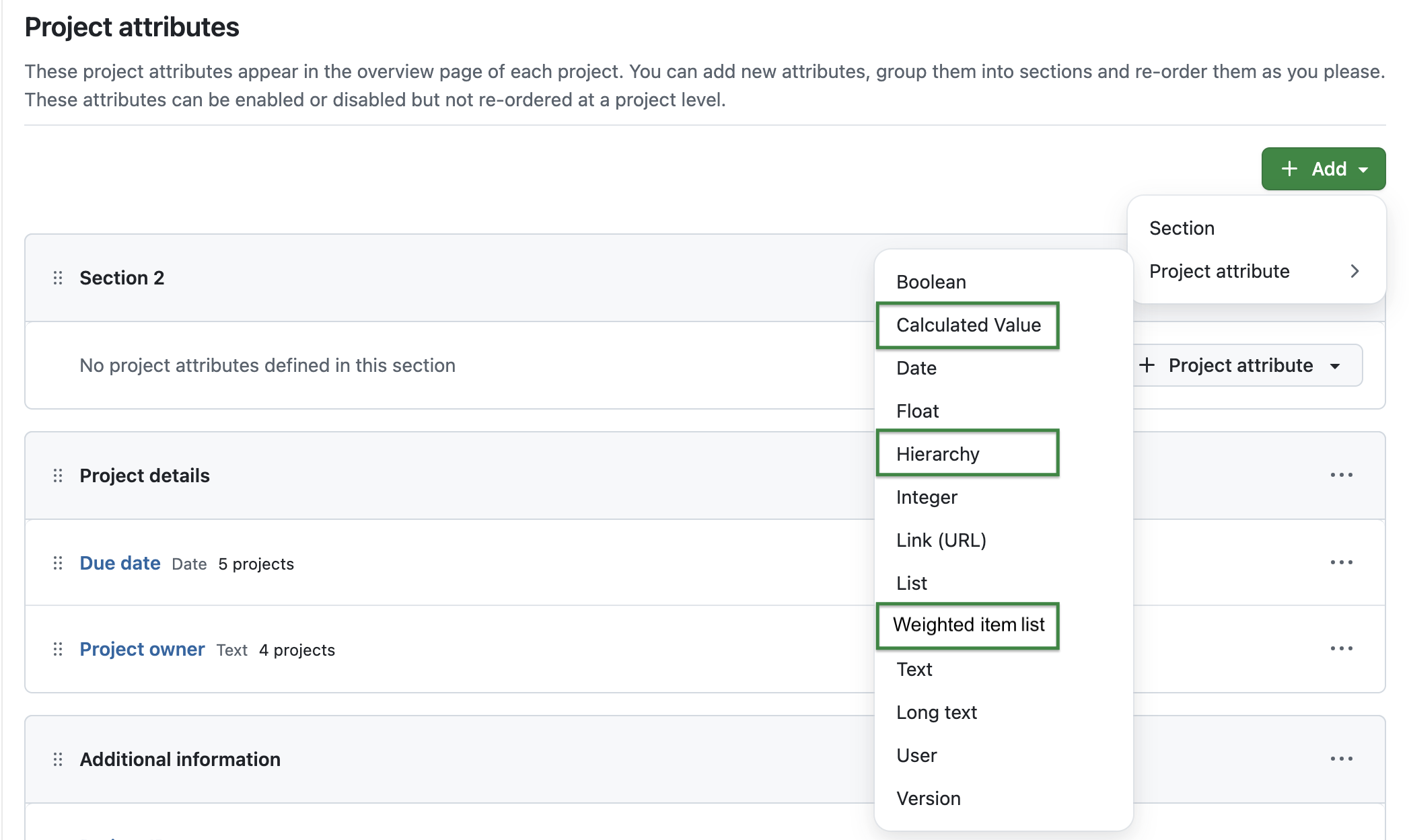
With OpenProject 16.6, project portfolio managers gain new ways to make their work more measurable and transparent. The release introduces three new project attribute types: Hierarchy, Weighted item lists, and Calculated value. They can be combined to evaluate and compare projects based on consistent criteria.
These attributes allow organizations to build their own evaluation models. Hierarchy project attributes let you organize information in a structured, nested way — for example, grouping initiatives by region, department, or program.
Weighted item lists extend this concept by assigning numeric scores to list options, such as effort levels or risk ratings. These values can then be used as input for automated calculations.
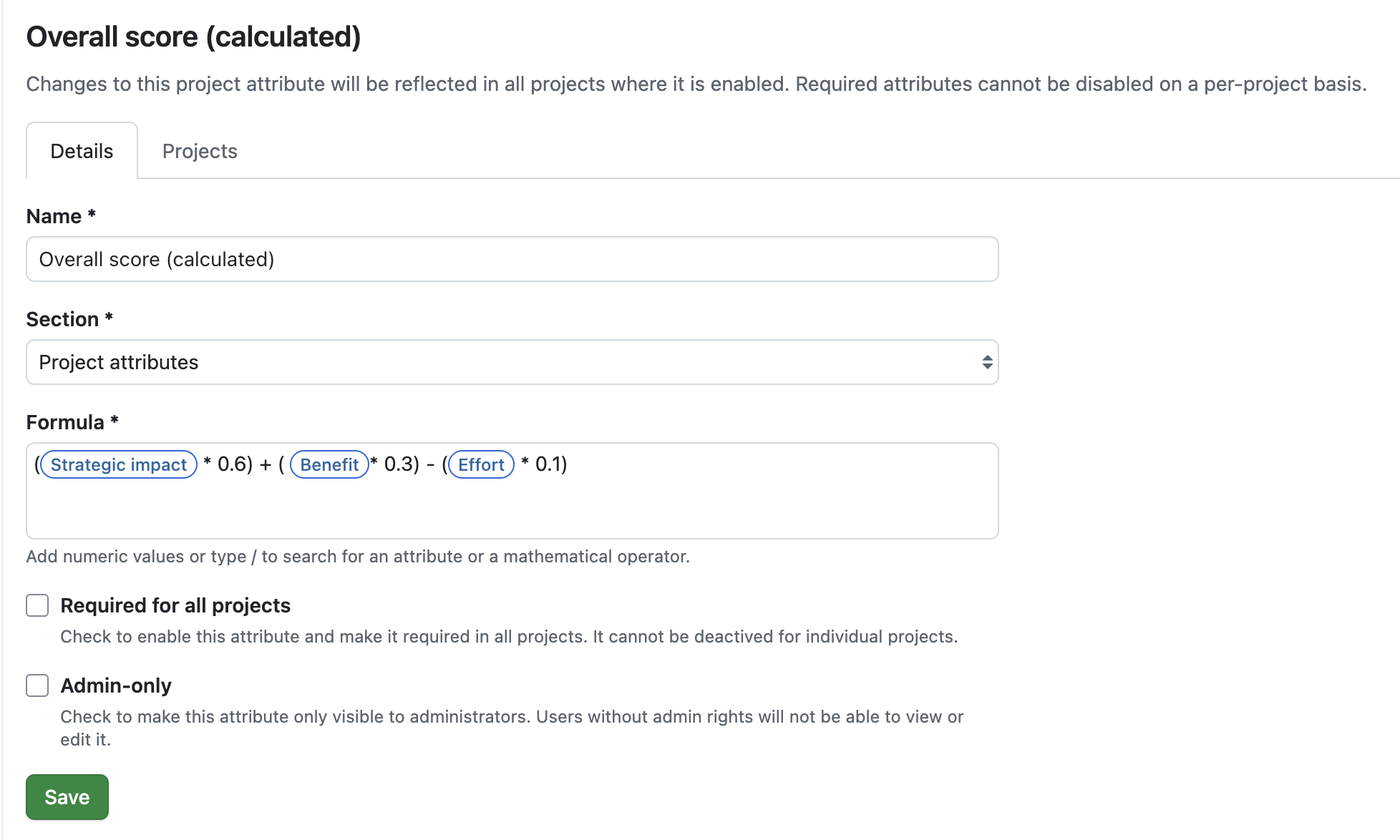
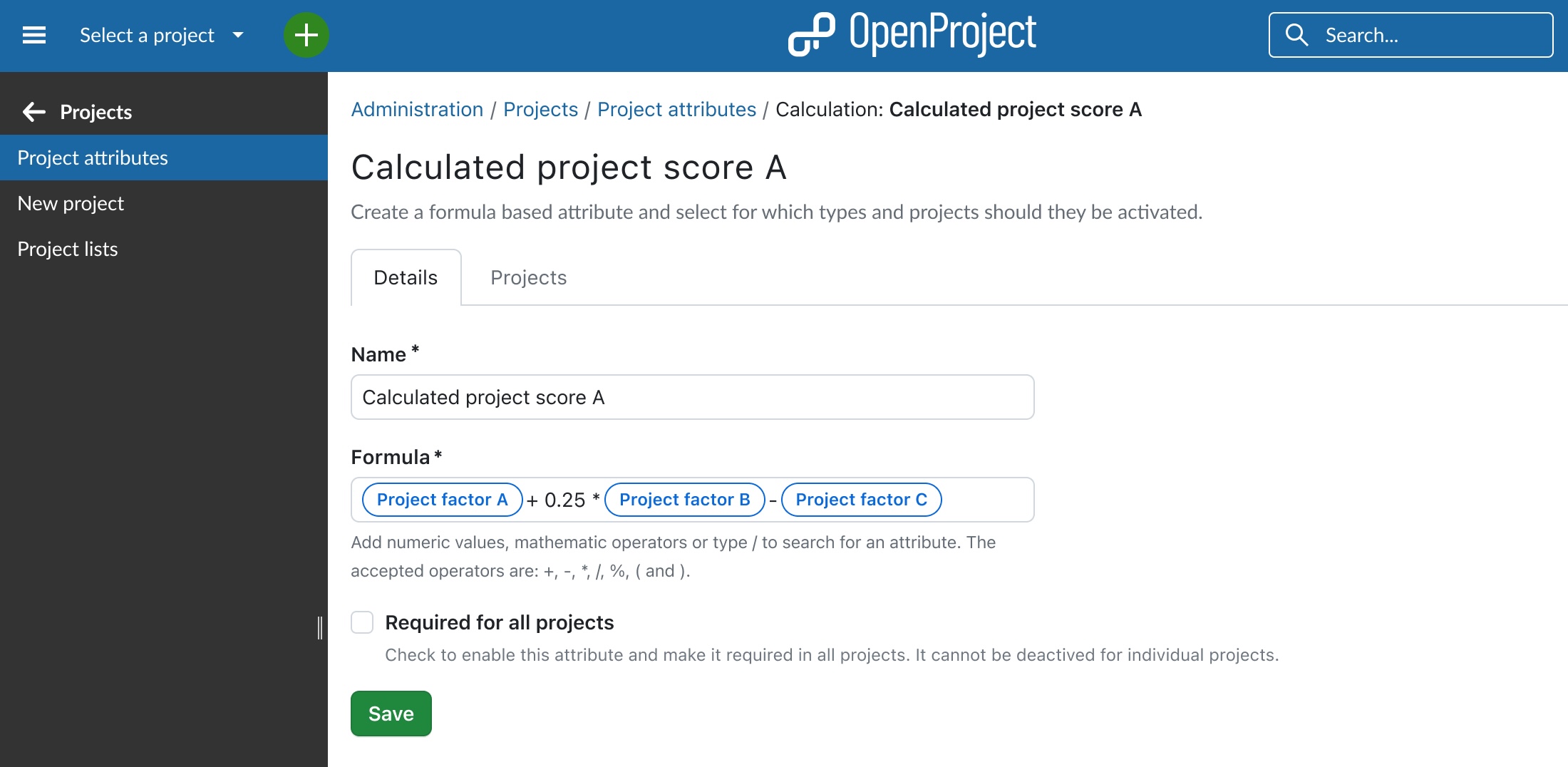
Calculated values enable automatic computations based on formulas using numeric project attributes, including scores from Weighted item lists or even other calculated values. The computed result is displayed directly on the project overview and in the project list. It automatically updates whenever one of its source attributes (e.g., Benefit or Effort in the example below) changes.
Here’s an example of a calculated value called ‘Overall score (calculated)’ with the following formula: (Strategic impact * 0.6) + ( Benefit * 0.3) - (Effort * 0.1)
These new attribute types open up flexible ways to work with project data. Scoring is just one typical example — the same structure can be used to represent strategic priorities, aggregate indicators, or define your own evaluation framework that fits your organization’s needs.
Working with large projects and complex portfolios can be challenging when pages take too long to load or filters lag behind. That’s why OpenProject 16.6 focuses on improving performance, ensuring that even large-scale installations with thousands of projects and millions of work packages remain fast and reliable.
To achieve this, several backend processes have been improved. Database queries and API responses have been refined to avoid unnecessary counting operations, and the autocompleter for adding work package relations now only retrieves the data it actually needs. These changes reduce query load and make the application more efficient overall.
As a result, users will notice faster response times, smoother navigation, and more responsive filtering — even in the largest environments.
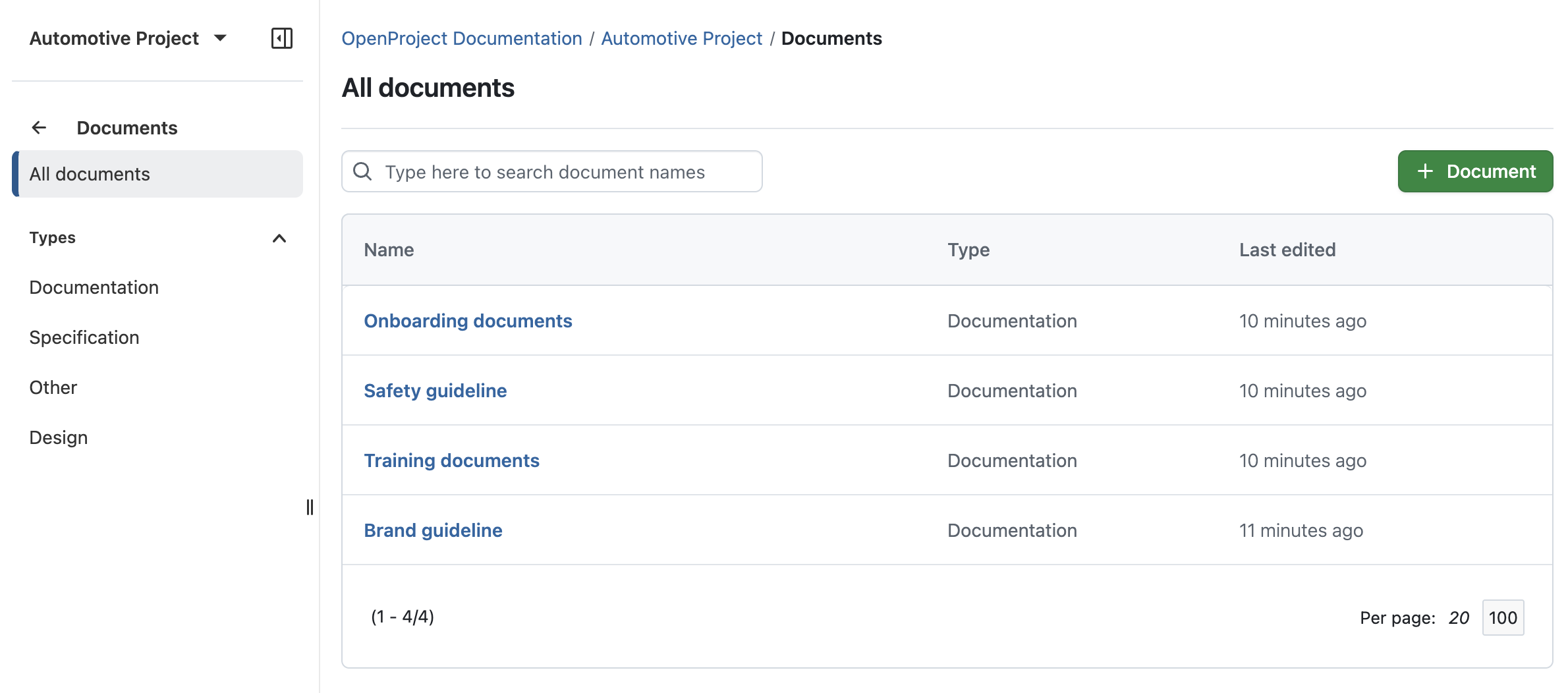
New index page for Documents module
Managing project documents efficiently is key to keeping everyone aligned. But as projects grow, finding the right file can become a challenge. To make this easier, OpenProject 16.6 introduces the first step toward a more powerful and collaborative Documents module.
The new index page provides a structured overview of all project documents, showing each file’s Name, Type (the category), and Last edited date. The most recently updated items are always on top. A quick filter helps you search by title, and the navigation menu on the left lets you narrow the list by Type (previously called Category). Both terms are used synonymously in this first step, as Type will gradually replace Category in future updates.
A new + Document button makes adding content straightforward, and on mobile devices, the view adapts to show only the most relevant details.
While this is a smaller change on its own, it marks the beginning of a broader improvement to how teams will work with documents in OpenProject. We are excited about the upcoming changes that will make document management and live collaboration easier and more intuitive.
Small usability enhancements can make a big difference in everyday work. OpenProject 16.6 brings several refinements that make managing information smoother, meetings more efficient, and administration tasks easier to navigate.
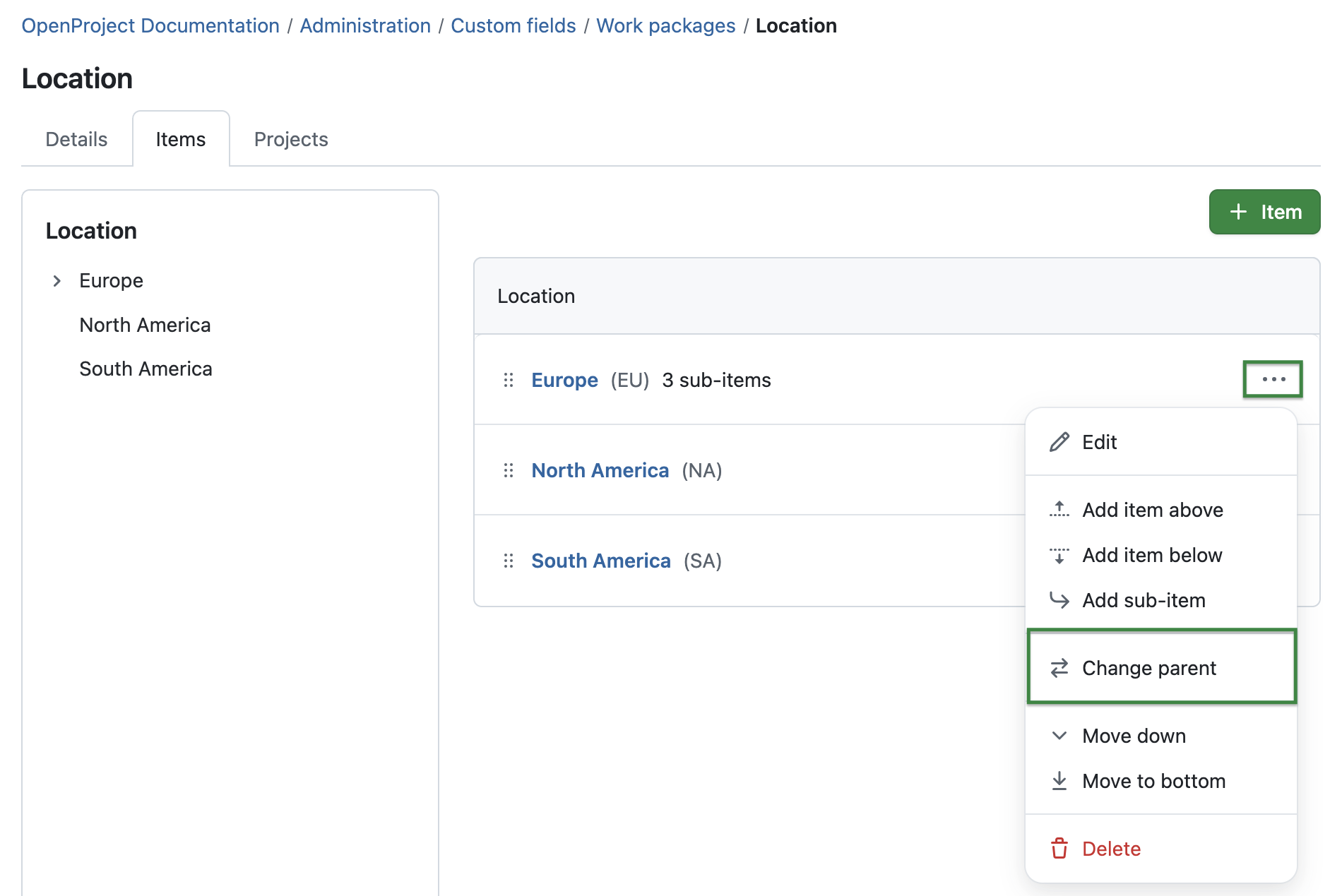
Change parent of a custom field item or project attribute (Enterprise add-on)
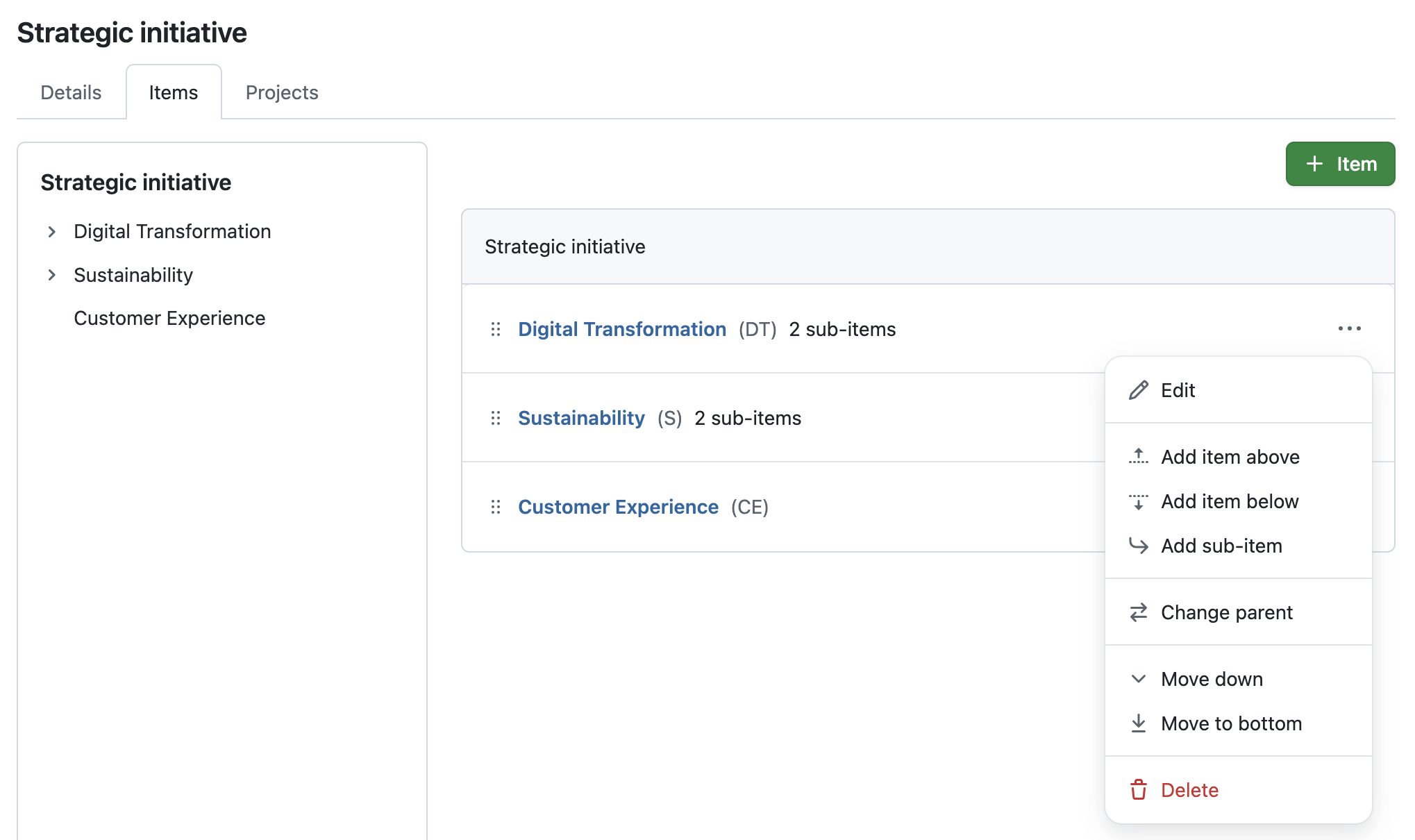
Administrators can now rearrange items within hierarchical custom fields (Enterprise add-on) or project attributes without having to recreate them. A new Change parent option opens a dialog showing the hierarchy tree, allowing quick reorganization through search and selection.
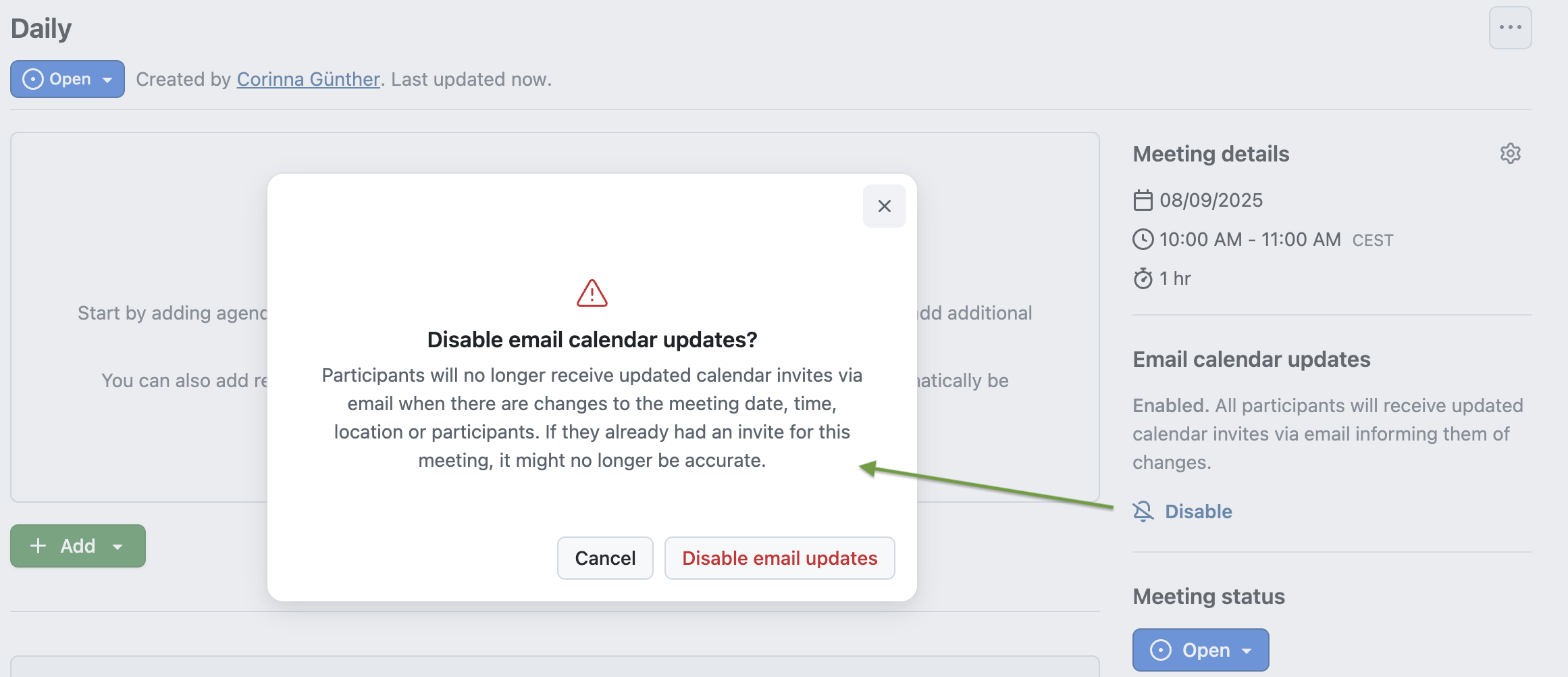
Updated “More” menu in meetings
In the Meetings module, moderators can now move agenda items directly between sections using the new Move to section action. This saves time in meetings with multiple sections or longer agendas and helps keep discussions better structured.
Editing individual attributes even if other fields are invalid
Users can now edit visible fields even if other required fields are missing or invalid. This prevents unnecessary validation errors — for example, when a required field was added later — and lets users continue their work without interruption.
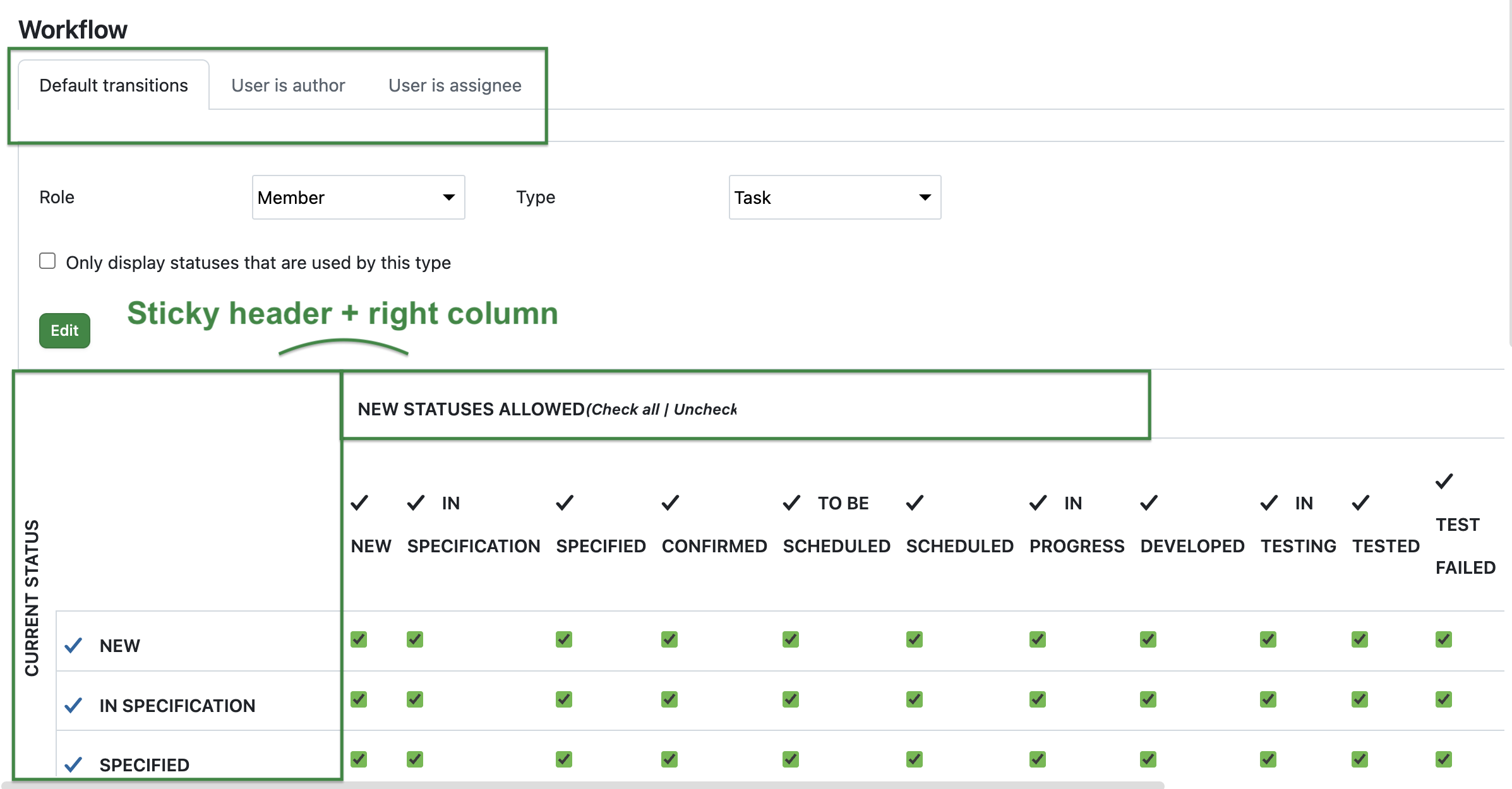
Sticky header and first column in workflows
In Administration → Work packages → Workflow, the table now has a sticky header and sticky first column. This makes it easier for administrators to keep an overview of transitions when scrolling through large workflow tables.
On mobile devices, the date picker once again includes a mini calendar view for selecting start and finish dates. This makes it easier to see weekdays and working days at a glance, improving usability when managing tasks on the go.
OpenProject 16.6: Migration, installation, updates and support
You will find more information about all new features and changes in our Release notes or in the OpenProject Documentation.
If you need support, you can post your questions in the Community Forum, or if you are eligible for Enterprise support, please contact us and we are happy to support you personally.
New to OpenProject? To test all features of OpenProject 16.6 right away, create a 14 days free trial instance for our OpenProject Enterprise cloud.
Prefer to run OpenProject 16.6 in your own infrastructure? Here you can find the Installation guidelines for OpenProject.
A very special thank you goes to Helmholtz-Zentrum Berlin, City of Cologne, Deutsche Bahn and ZenDiS for sponsoring released or upcoming features. Your support, alongside the efforts of our amazing Community, helps drive these innovations. Also a big thanks to our Community members for reporting bugs and helping us identify and provide fixes. Special thanks for reporting and finding bugs go to Sven Kunze, Stefan Weiberg, Gábor Alexovics, Alexander Aleschenko, and Tobias Nowakow.
This release, we specifically want to thank Emon for reporting a security vulnerability on our website. Reports and feedback like this are one of the reasons we love OSS and appreciate being part of such an amazing community.
Last but not least, we are very grateful for our very engaged translation contributors on Crowdin, who translated quite a few OpenProject strings! This release we would like to particularly thank the following users:
William, for a great number of translations into Chinese Traditional.
Pickart, for a great number of translations into Catalan.
Maxime77, for a great number of translations into French.
Would you like to help out with translations yourself? Then take a look at our translation guide and find out exactly how you can contribute. It is very much appreciated!
As always, we welcome any feedback on this release. 💙
OpenProject as a secure web-based project management software supports many different use cases. At the beginning of each quarter, it is very convenient to follow the OKR process in OpenProject, set your strategic goals, derive smaller goals, and break them down into manageable and measurable smaller results.
What are OKRs?
After Agile, OKR is now arguably a well known buzzword in modern business management and people management. Not only does the company set goals from the top down anymore, but the employees are also involved in the formulation of the company’s goals in this management framework.
OKR stands for Objectives and Key Results. With OKRs, individual tasks of employees and/or teams are linked to the strategic corporate goals. Based on the corporate goals, the teams regularly (e.g., every quarter) derive their individual or team goals and define measurable results for those goals.
Objectives are qualitative goals: Where do I want to go or what do I want to achieve (always with regard to the corporate goal(s)). Key Results are quantitative smaller results (tasks) which count towards the Objective: What do I have to do to achieve the goal and how can I measure it?
We use OpenProject as OKR software ourselves to support our (slightly modified) form of OKRs. Among many other features, goals can be easily defined in OpenProject. Define, document and follow-up on (strategic) business goals. The work package module is very suitable for this. First, the work package types GOAL and KEY RESULT are added and activated in the project.
If required, additional custom fields, such as Goal Category and KPI can be added to the work package type. Collect and specify the (strategic) goals in this Goal Backlog. Here it is advisable to subdivide e.g. after different Goal categories. During your goal planning, prioritize the goals in OpenProject, assign them to an Accountable, and add them to a version (e.g. Goals Q1 2026).
For the planning of the next quarter, set a filter, e.g. to the version “Goals Q1 2026”. You can discuss these strategic goals with the team and each responsible person, then break them down into individual qualitative goals (Objectives) for the next period and add measurable Key Results for those.
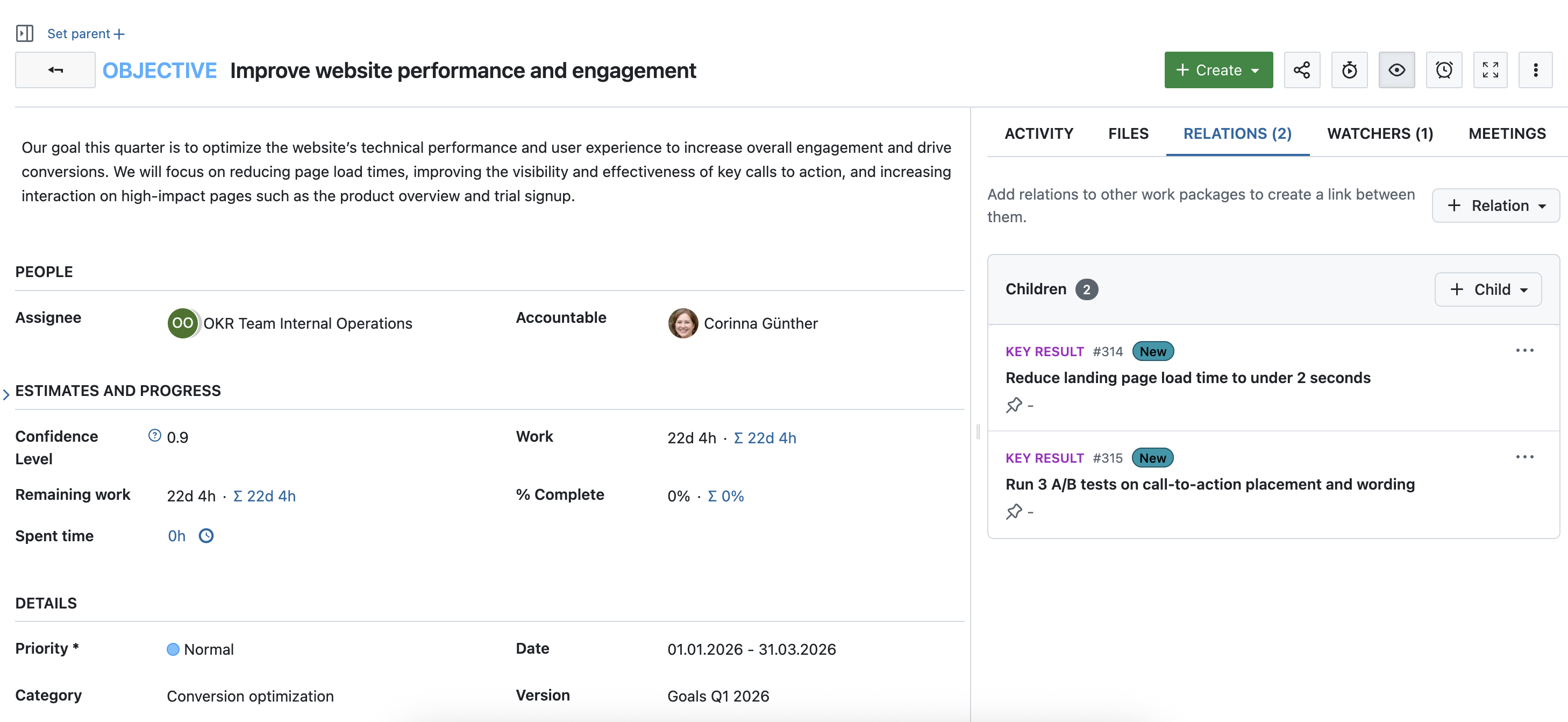
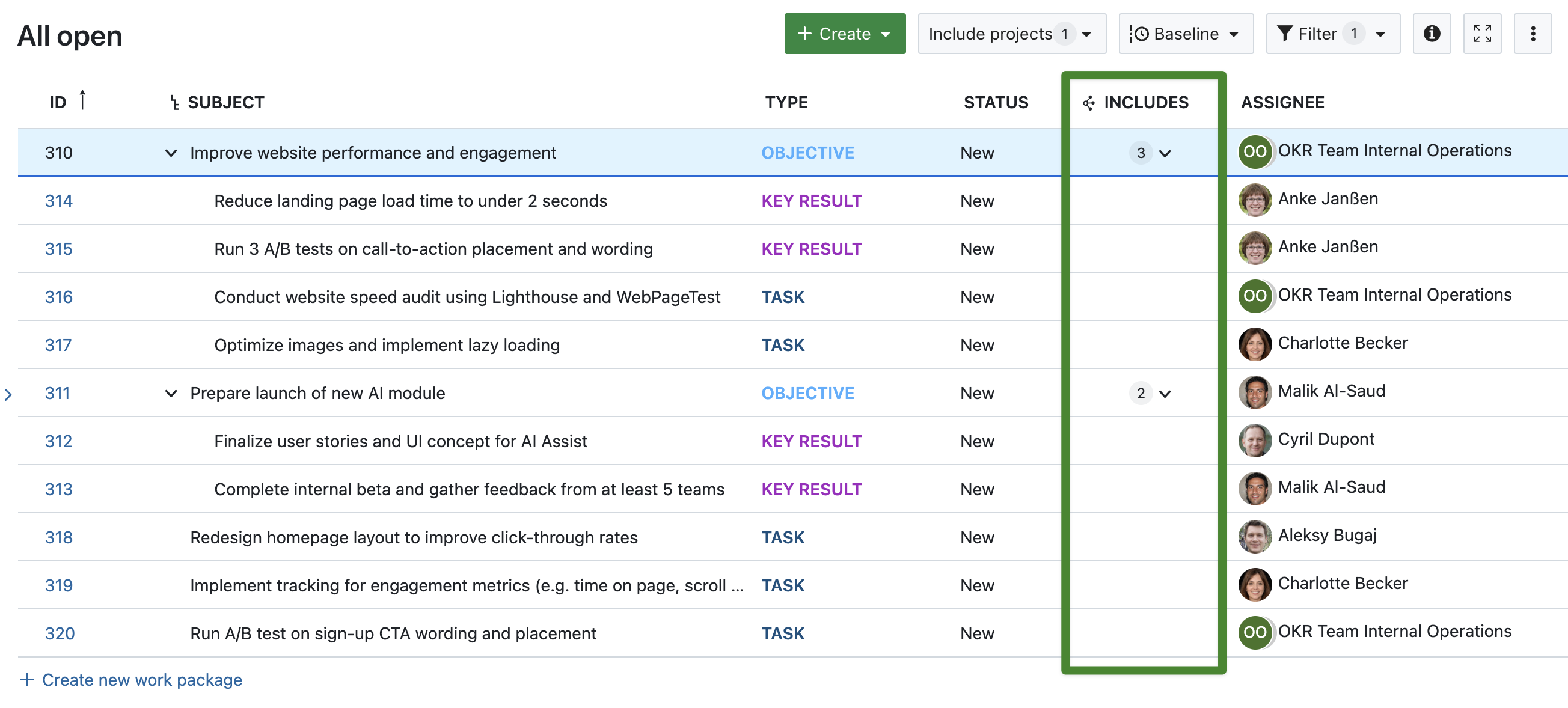
This works very well in OpenProject via the relations feature. Either choose the relation “Includes” between the Objective and the respective Key Results or add Key Results as children for Objectives.
In the list you can then display which Key Results need to be completed in order to fulfil the Objective. Of course, all other features of the work packages, such as comments, status, priority, %Complete, custom fields, workflows, etc. work in addition to this.
If you set Key Results as children, you could create a “Part of” relation between tasks and Objective. Or, the other way round, add the “Includes” relation to the Objective.
This way, you are able to configure your OKR process to your needs. This enables transparent and efficient documentation and tracking of OKRs as well as direct integration with project management.
What else should be considered when working with OKRs?
It is best to start with only a few Objectives. You should clearly discuss within the company / team what you want to focus on in the next quarter.
Key Results should be broken down and documented in as much detail as possible. It should include a measurable result so that you know exactly when the goal was achieved. If necessary, you can work with the %Complete field in OpenProject to show how far along you are in achieving each Key Result and to visualize progress over time.
The team should agree on whether the goals are stretch or fix goals, i.e. goals that can be realistically completed at the end of the period. Either way they should be SMART. Read more about goal setting in this wikipedia article.
If a goal is not achievable within a period, we try to break it down into smaller iterations if possible. If this is not possible, we accept that a goal can be carried over into the next period, including new Key Results.
Evidently, OKR software can only support the process. It is important to discuss the goals and the results in detail with the team, to review them in regular meetings and to improve them if necessary. A review of the process and lessons learned with the team is especially recommended at the end of each completed planning period and before the next iteration.
We look forward to your feedback, suggestions, and ideas on how to best use OpenProject as OKR software.
With the end of Jira Data Center announced and prices rising year after year, vendor lock-in is no longer just an abstract risk, it has already become reality. Many organizations now face a costly migration to the cloud, whether they want it or not.
But there’s another way. Open source software gives you back control: over your data, your infrastructure, and your budget. It’s built on transparency, community, and long-term reliability, without locking you into a single company’s roadmap or pricing. And while Atlassian has been steadily raising prices, open source has grown into a powerful, future-ready alternative.
OpenProject is your secure, self-managed alternative to Jira, and it’s only one piece of the puzzle. Whether you also rely on Confluence, Bitbucket, or other parts of the Atlassian stack, there are strong open source options ready to support your team. You’re not stuck. You’ve got choices. And we’re here to help.
Migrating away from Atlassian: We know it’s not easy
Still, switching tools isn’t a decision you make lightly. You’ve built entire workflows around Jira and Confluence. You’ve got hundreds of users, complex integrations, and a mountain of project data to manage. The idea of replacing your Atlassian stack can feel overwhelming, and we understand that.
But here’s the good news: there is a way forward. With powerful, professional open source software, you can migrate from Atlassian on your own terms, without compromising on functionality, security, or support. Whether you’re seeking a Jira replacement, a Confluence alternative, or a complete open source stack, we’re here to support you during this journey.
Tip
Why open source? Open source software means no vendor lock-in, giving you full control over your infrastructure, updates, and data, with affordable pricing. It offers transparency, letting you inspect the source code and know exactly how your tools work. And with Community-driven development, features evolve based on real need, not shareholder interests. And these are just some of at least 8 reasons to choose an open source software.
The open source ecosystem is ready for you
You don’t have to give up powerful workflows just because you’re moving away from Atlassian. Today’s open source tools are mature, well-integrated, and ready to replace the full Atlassian stack, from project management and documentation to team chat and file sharing.
OpenProject as alternative to Jira
OpenProject provides issue tracking, agile boards, Gantt charts for project timelines, cost and time tracking, and much more — fully self-managed or hosted, with a strong focus on data sovereignty. You decide if you want to host your data in the cloud or on your own servers. So if you’re looking for a Jira Data Center alternative, OpenProject is built for you.
XWiki is a powerful and extensible open source wiki platform. It enables collaborative documentation, structured content management, and fine-grained access control, making it a flexible alternative to Atlassian Confluence. And: Since July 2025, XWiki and OpenProject are officially partners to offer a strong alternative to Confluence and Jira.
Element, based on the Matrix protocol, offers secure, end-to-end encrypted messaging and collaboration. It’s perfect for teams looking for a self-hosted alternative to Atlassian’s chat tools or Slack.
Nextcloud as alternative to Atlassian’s file management tools
Nextcloud is the most popular self-hosted open source platform for file sharing and collaboration. With advanced access control, integration options, and European data protection standards, it’s a strong alternative to proprietary cloud file systems. And: Nextcloud integrates with OpenProject and vice versa.
Collabora Online is a powerful open source office suite for editing documents, spreadsheets, and presentations in real time. It’s a great choice for teams looking to replace Confluence and Microsoft 365 with a self-hosted solution.
Frequently asked questions about Atlassian alternatives
Switching away from Atlassian isn’t just a technical decision, it’s a strategic one. If you’re considering alternatives to Jira, Confluence, or other Atlassian tools, you likely have questions about features, pricing, migration, and the open source ecosystem. Here are some answers to help you navigate the transition with confidence.
Why is open source software free and still costs money?
Open source doesn’t mean zero cost. It means freedom: to use, inspect, modify, and host the software yourself. Many open source vendors like OpenProject offer a free Community edition, alongside paid support and enterprise features. This ensures long-term sustainability and helps teams get professional assistance where needed. Still, open source software like OpenProject is often more affordable than proprietary tools like Atlassian. And if your budget ever becomes tight, your data stays safe, because OpenProject will always provide a cost-free Community edition.
I want one suite for all tools. Does that exist for open source?
Yes. In Europe, there is openDesk, your secure all in one office and collaboration suite. It brings together leading open source solutions — including OpenProject, XWiki, Nextcloud, and more — to create a fully sovereign digital workplace. The tools are interoperable, user-friendly, and developed with long-term public and enterprise use in mind.
Does OpenProject include the features I currently use in Jira, or do I need plugins?
OpenProject comes feature-rich out of the box. Unlike Jira, which often requires multiple plugins for core functionality, OpenProject includes agile boards, Gantt charts, cost tracking, time logging, custom workflows, and more — all in one system. This makes it especially attractive for teams moving away from Jira Data Center or self-managed Jira installations.
Of course, OpenProject is not exactly the same product as Jira, and users will need to adapt to some differences in workflows. However, OpenProject customers value its personalized and responsive support, as well as documentation available in English, German, French, Spanish and Portuguese.
How can I migrate my data from Atlassian / Jira or Confluence?
You have several options for migrating your data, whether you’re switching from Jira, Confluence, or both. Here’s what we recommend:
Export Confluence content using the Markdown Exporter app and paste it into OpenProject Wiki or other modules.
For a fully supported migration, we recommend contacting ALM Toolbox, an experienced migration partner that specializes in Atlassian to OpenProject transitions.
Students across Europe are building satellites in handy beverage can format – ESA calls the program CanSat, a competition for can satellites. At the forefront of participants from the USA, Germany, and India are Hungary, where a total of 84 teams are participating – and relying on OpenProject. The record participation in ESA’s student competition is a great success for the small country, which is now almost catching up with Germany.
Read this case study to learn more about this fascinating project.
ESA asks students to develop a simulation of a satellite that fits into a beverage can
The task is outstanding: Develop a simulation of a satellite that fits into a standard beverage can – the Student Spacelab Network (SSN) was created to support ESA’s CanSat Competition. The teams need OpenProject for the organization.
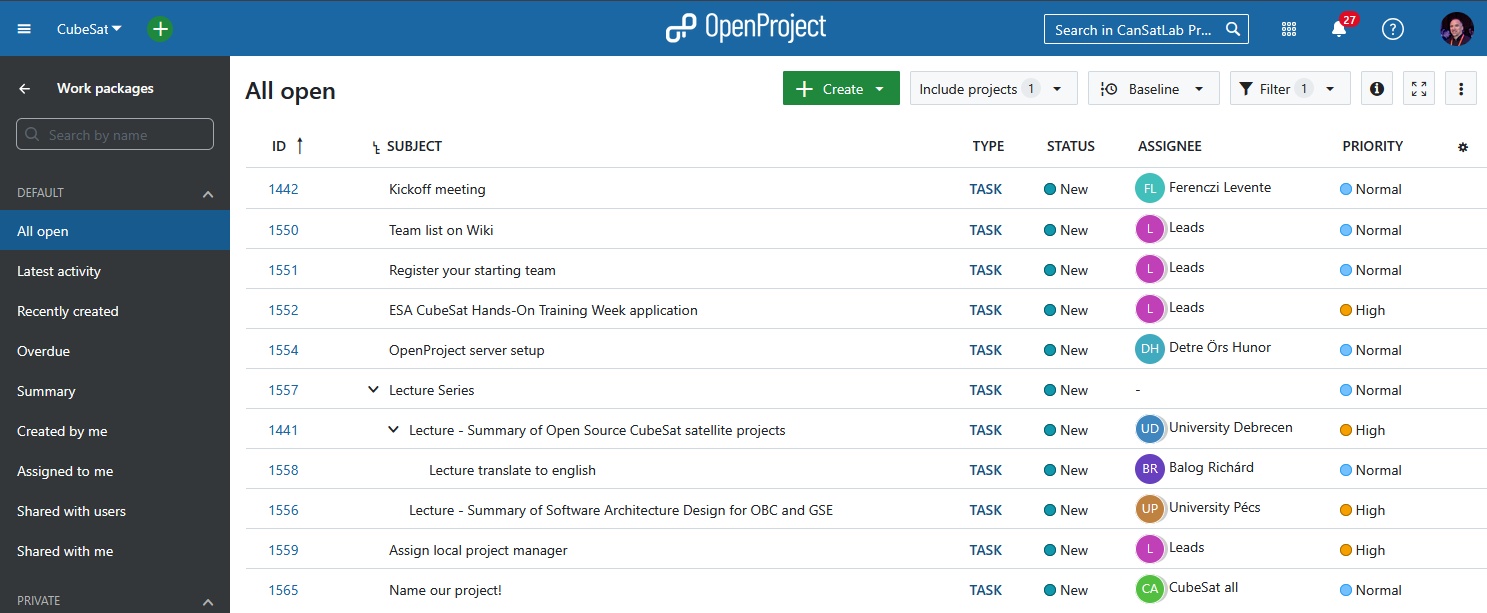
Image: In the CanSat Lab and Student Spacelab Network, over 80 groups use OpenProject to organize themselves to build satellites together. (Source: SSN)
And it sounds simple: The ESA project requires “the simulation of a real satellite”, including all common subsystems, all in the confined space of a small 0.33-liter soda can.
Hungarian students plan, build, and launch satellites
The can must contain a power supply, sensors, and a communication system. In the final test, the small unit must survive a rocket launch that carries it almost a kilometer high into the atmosphere, where a scientific experiment takes place. Alternatively, the cans may also be launched from a platform, drone, or balloon – but a safe landing is always a must so that the data from the experiment can be evaluated.
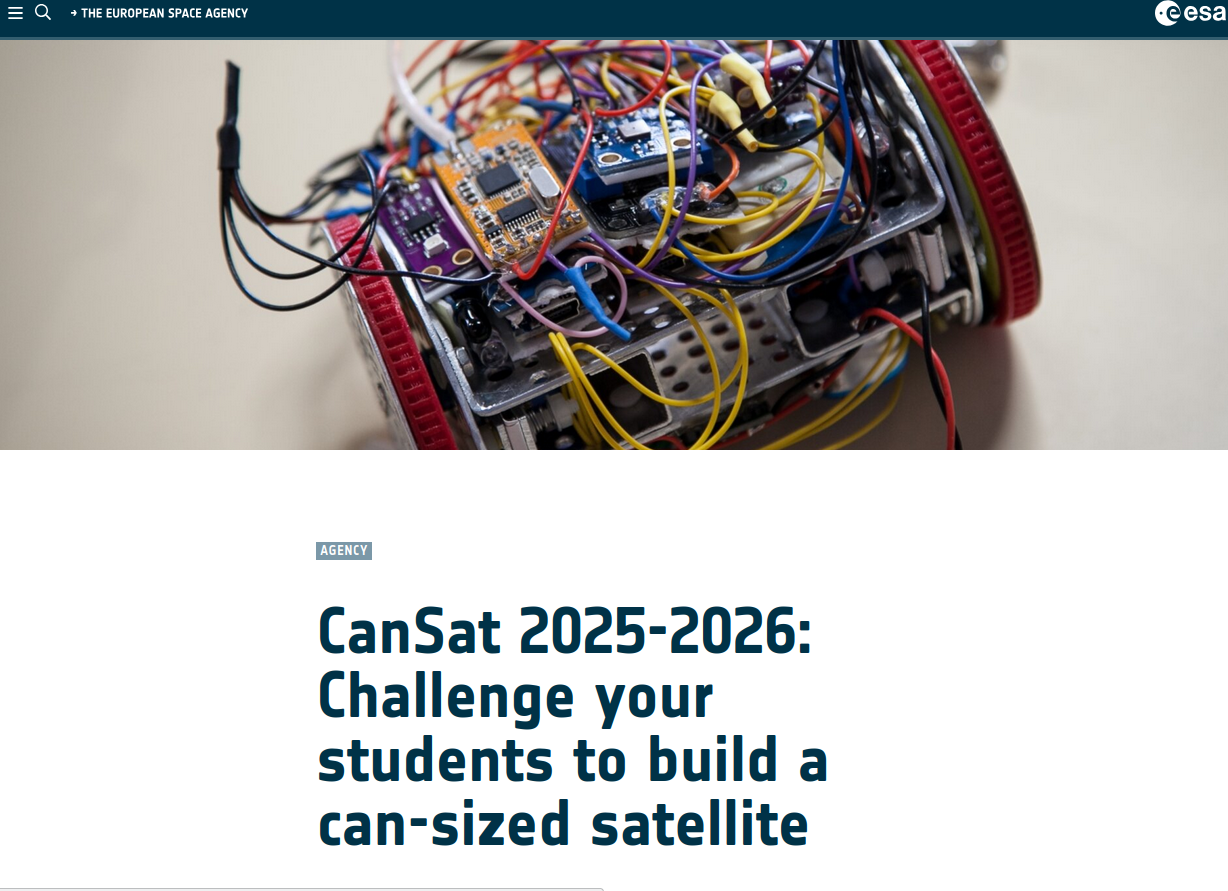
Image: “Challenge your students to build a can-sized satellite”: Under this motto, ESA is calling on students and scientists to nurture the next generation. (Source: ESA)
Required experiments for CanSat
As far as the experiments are concerned, one requirement is to measure the air temperature and air pressure once per second, including transmission via radio. However, the components of the second experiment are left entirely up to the student team and their imagination – they range from measuring data during descent to launching a mini rover from the can.
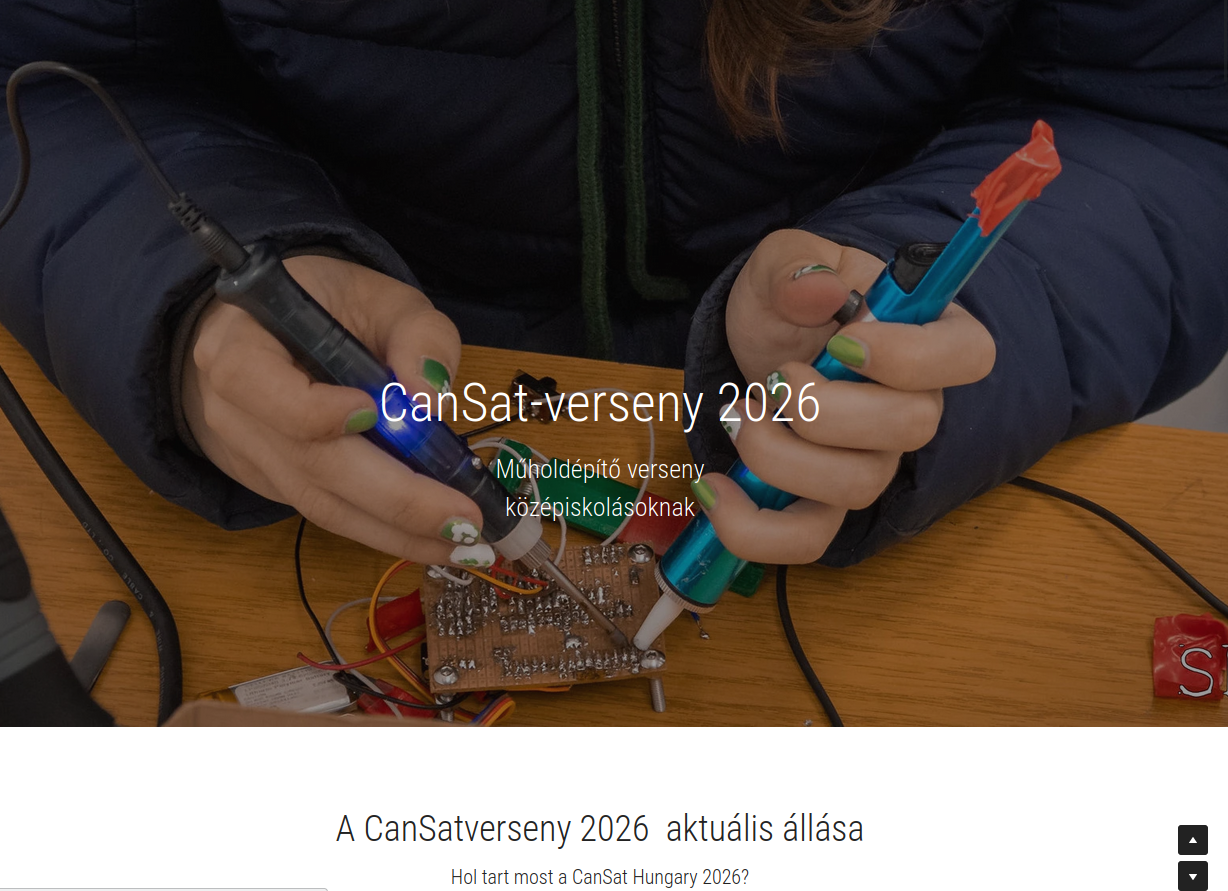
Image: Many students take part in national satellite construction competitions such as this one here in Hungary every year. (Source: CanSat)
At the same time, there is a great deal of pride in this first Hungarian non-profit laboratory network, which offers curious, motivated teenagers the opportunity to get involved in space travel and work with high-tech equipment. Dreams come true in a country with a long tradition of craftsmanship and technology – who would have thought they could simply get involved in a space project?
Successful competition for young talent – everyone wants to go into space
This works thanks to good planning: building mini-satellites requires laboratories such as those found at universities or well-equipped companies. The aim of the CSL is to provide the basic equipment that students need to build the satellites, such as 3D printers and soldering stations. But that’s not all: robot-controlled production lines, metal 3D printers, laser cutters, CNC milling machines, and much more are also available throughout Hungary. The photos from the CanSatLab Finals 2024 show the teams in the final competition with the rockets that launch the small satellites or how they glide safely back to the ground on parachutes.
Fourteen universities and twenty companies are on board in Hungary, and the infrastructure at over 40 locations is completely accessible remotely. The goal is to always have specialists on site who can provide support with their expertise on the machines and also with satellite construction. If the desired funding is secured (and as of October 2025, it looks like there will even be 80 locations), in addition to the mentors, there will also be online help and workshops, hybrid presentations, and further training for both students and mentors.
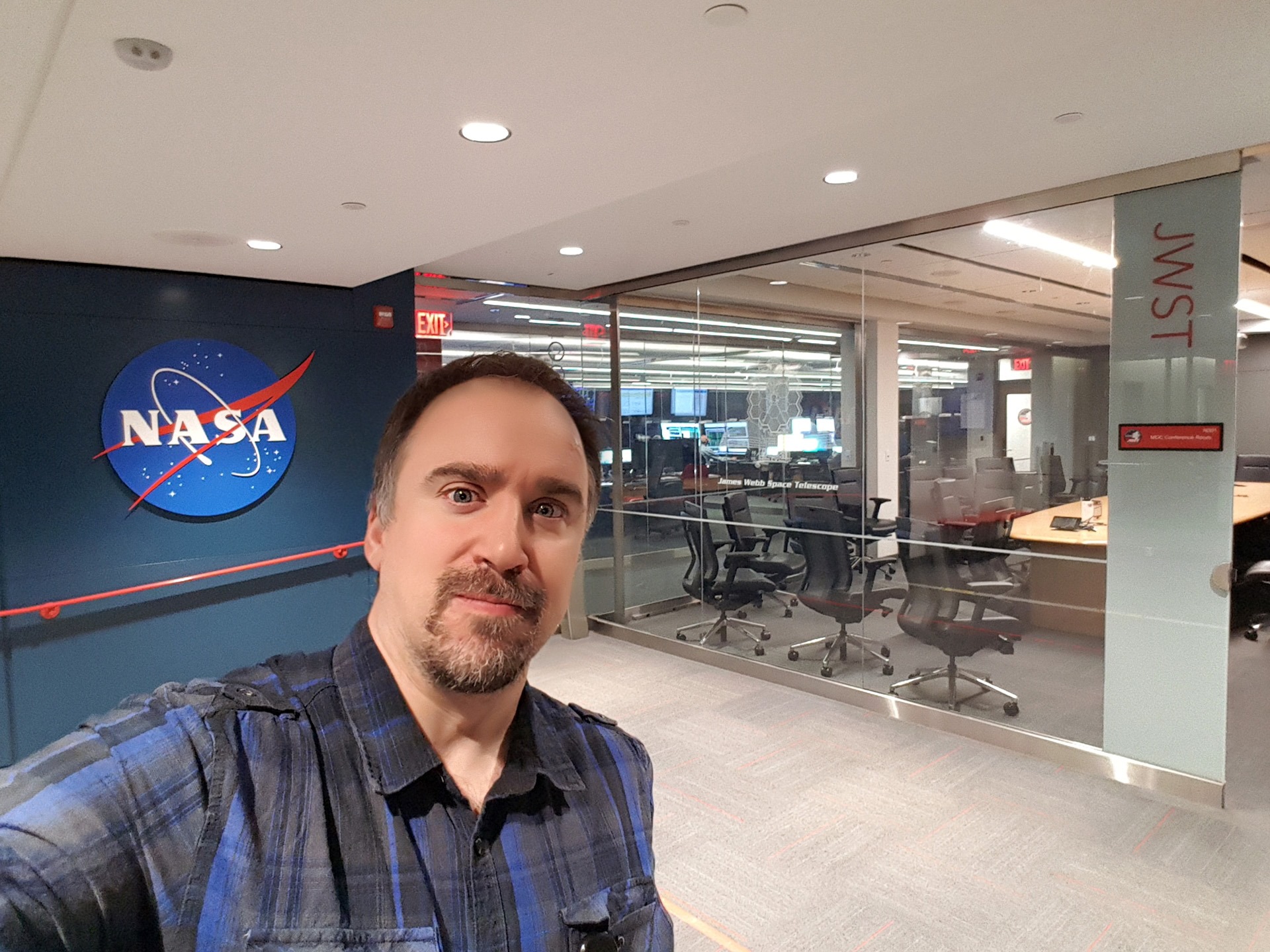
Image: Örs Hunor Detre, organizer of the Student Spacelab Network SSN, a project of ESA’s CanSat competition. Source: CanSatLab
Building on the experience of the James Webb Space Telescope
The mastermind behind the Hungarian CanSatLabs is Örs Hunor Detre, who himself worked for ESA for many years. Örs worked on the Nancy Grace Roman Space Telescope RST from the outset, having previously held a position of responsibility at the James Webb Space Telescope JWST and worked at the Max Planck Institute for Astronomy in Heidelberg from 2008 to 2023. For the JWST, he supervised the Mid-Infrared Instrument MIRI as European Electrical Lead and Mechanism Subject Matter Expert, and he enjoys showing photos from his work with NASA and ESA experts in Europe and the USA.
Image: The James Webb Space Telescope is the largest of its kind in space. Örs Hunor Detre had the opportunity to work on it and was responsible for MIRI, the Mid-Infrared Instrument. (Source: NASA, flickr)
“Space projects are just cool; they can motivate and inspire people, says Detre, “and that’s especially important with students.”
The Hungarian learned “how an institute should function” at ESA and NASA and has clear ideas about where the journey should take him. “Everyone wants the NASA badge, it’s cool, and telling kids that they can get it too is great.” Astronomy is a wonderful introduction to astrophysics, and that’s where you can really let your imagination run wild, “because all the sciences are represented there”, he enthuses.
Future plans for CanSat
Next year, the project is to be expanded even further, with a self-imposed goal of creating a Hungarian satellite constellation consisting of more than four CubeSats – if funding is secured.
The aim is then to overtake Germany, which currently ranks first in terms of participants. “Our goal is for our non-profit organization to use space research to get high school students excited about STEM subjects (science, technology, engineering, and mathematics). To achieve this, we offer technical and environmental support and collaborate with universities, experts, and space research companies,” explains Detre.
Ten universities, 150 employees, over 40 locations networked with OpenProject
To make this plan a reality, ten universities with around 150 employees have joined forces and set up a professional project management system, OpenProject, of course. “We started with the Community version on one server for all aspects, across eight countries, until we realized we needed support.” Because funding was limited, OpenProject supported CanSatLab with the Enterprise version.
Image: The scientists at SSN / CanSatLab led by Detre now use many features in OpenProject, from documentation to in-depth project management.
Open source software is becoming more and more important, especially in the public sector in Europe. Open source implies providing access to its source code or segments of it, permitting utilization, modification, additions, and distribution. This means that the software is particularly transparent and therefore secure and reliable. By using an open source software in the public sector, you make sure to play it safe. You also stay independent by avoiding a vendor lock-in, which could save a lot of money.
OpenProject is a popular choice in the public sector when looking for task or project management software. But what about other software categories like file sharing, messaging or an office suite? There are several great software solutions on the market which are gaining more and more recognition in the European public sector.
OpenProject: The open source project management software
You are reading this article on the OpenProject blog: We provide an open source software for efficient task and project management – all in one system. OpenProject is suitable for various project management methodologies, including classic, agile and hybrid approaches. It facilitates collaboration between distributed teams throughout the project lifecycle. OpenProject is designed for organizations of all sizes and industries that manage their projects according to open source principles and value data control.
Manage your tasks and projects with various OpenProject highlight features like:
Nextcloud: The open source content collaboration platform
“Regain control over your data” – is what Nextcloud offers you. The open source software enables users to collaborate remotely and share data in an easy and secure way. This is particularly appreciated by customers from the public sector. Nextcloud works on-premises or as SaaS in a cloud version.
With the Nextcloud Hub, you can work and collaborate in – currently – six different areas:
Nextcloud Files: Universal file access and sync platform.
Nextcloud Talk: Private audio and video conferencing with text chat and screen sharing option.
Nextcloud Groupware: Calendar, contacts, mail and other productivity features.
Nextcloud Assistant: Local AI assistant that can generate content and more.
Nextcloud Flow: Set of intuitive components to automate workflows.
Tip
If you already use OpenProject, you have one more reason to manage your files via Nextcloud! There is a Nextcloud integration for OpenProject and an OpenProject app for Nextcloud – to provide the best user experience based on open source software.
Try out Nextcloud file management in a free 60 minutes trial and get access to Nextcloud Files, Nextcloud Groupware, and Nextcloud Office.
XWiki: The open source enterprise wiki
XWiki offers an open source generic platform for developing projects and collaborative applications. Customers use XWiki as an open source alternative to Confluence.
XWiki offers many features, for example:
Advanced collaborative editing: WYSIWYG and macro editors
Structured information: AppWithinMinutes, livetables, blog and more
Enterprise integration: Groups management, LDAP connection and more
Flexibility and extensibility: Over 600 extensions
Element is an open source and Matrix-based end-to-end encrypted messenger and secure collaboration app. In contrast to other messenger software products, your communication is end-to-end-encrypted, which makes chatting about confidential information feel much more relaxed. Especially when using a messenger, people quickly forget that they may be exchanging sensitive data.
The Element messenger offers group chats for individuals or teams, voice and video chat and also bridges between communication silos like WhatsApp or Signal.
Tip
At OpenProject, we are passionate about using open source software solutions for our work. So we use Element to chat between colleagues, discuss topics in channels, and organize socializing events like game nights. Always knowing that our data is secure and end-to-end-encrypted.
Get started with Element by contacting their sales team and choose between a self-hosted or the fully-managed cloud version.
Univention: The open source solution for identity and access management
Univention develops open source solutions for central identity and access management in large network infrastructures. Customers are enterprises, IT admins and especially educational and administrative organizations. Apart from the Univention Corporate Server (UCS), there is UCS@school, a platform particularly optimized for educational use cases.
UCS can be easily integrated into existing environments, and the integrated app center offers a multitude of enterprise solutions. Thanks to Univention, the open source and sovereign workplace solution openDesk is based on a reliable and secure IT infrastructure.
Take a look at Univention to see their products, read about use cases and start a demo.
Open-Xchange: The open source e-mail provider
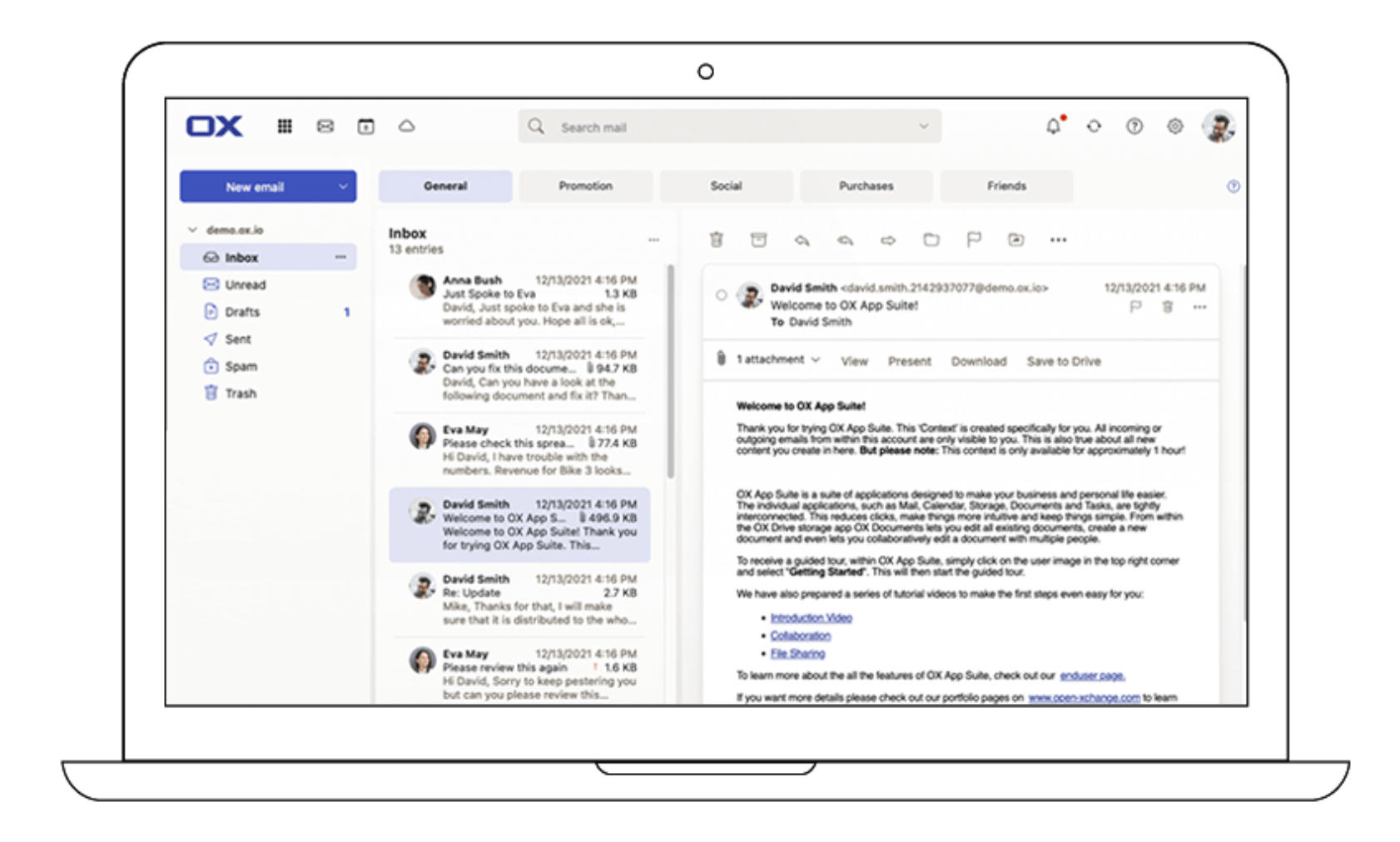
Open-Xchange (OX) provides an e-mail platform for hosting, telcos and organizations, especially for the public sector. These are OX’s different products for secure e-mail communication:
OX Cloud: An e-mail and collaboration solution for e-mail providers
OX App Suite: A modular e-mail and productivity suite
PowerDNS: A provider of secure open source and commercial DNS software
Dovecot Pro: A full-service e-mail platform with compliant support for the IMAP, POP3, LMTP, and Manage Sieve protocols
Collabora Online is an open source office suite that supports all major document, spreadsheet and presentation file formats to integrate in your own infrastructure. It works both for organizations or enterprises and for hosting and cloud businesses. Available on desktop and mobile.
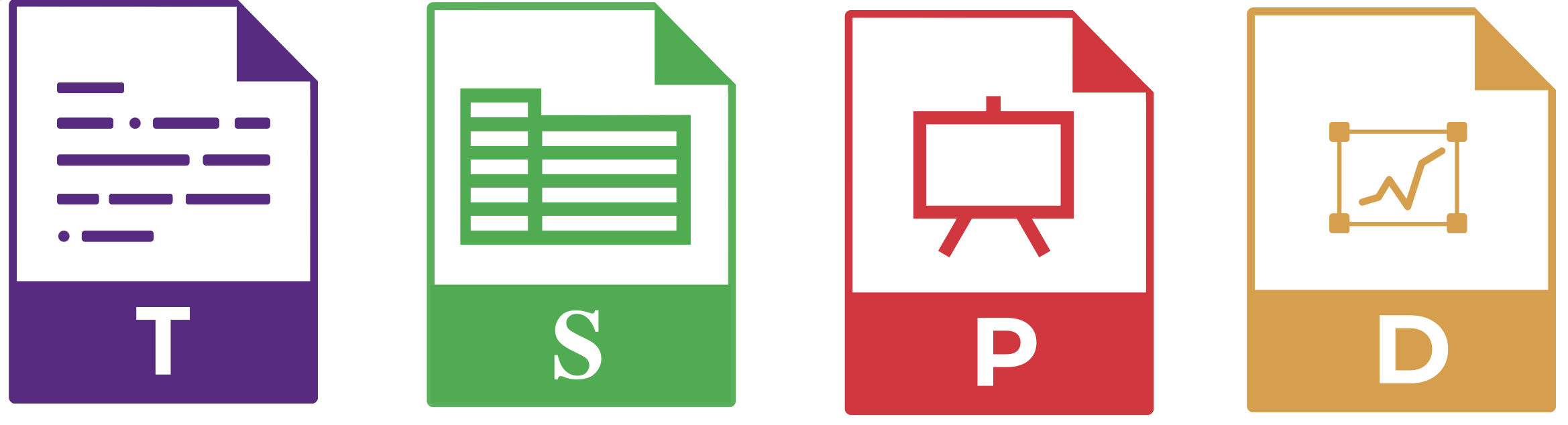
These are Collabora Online’s apps:
Writer: A WYSIWYG text editor that supports odt, .docx, .doc, .docm and .rtf
Calc: A spreadsheet app that supports .ods, .xlsx, .xls, .xlsm and .csv
Impress: A presentation editor that supports .odp, .pptx and .ppt
Draw: An app to draw shapes and diagrams that supports .odg and .vsd
Tip
Collabora is well integrated online with Nextcloud, so you can create documents directly in Nextcloud Office and edit them collaboratively.
Nordeck: Open source widgets for Element, Matrix and Jitsi
Nordeck offers support in the classic digitization steps in terms of connecting and networking prefabricated solutions, as well as development services in the open source area. It stands for sovereign and secure digital solutions.
Apart from offering individual software solutions and consulting, Nordeck has developed widgets for Element:
NeoBoard: A collaboration board with fixed stage size and division into individual slides
NeoBarCamp: A session planner for the workshop format “BarCamp”
NeoDateFix: A widget to have scheduled video meetings
NeoChoice: A voting widget to make quick decisions based on individual opinions
API Toolkit: A reusable framework for creating matrix widgets
What is better than one open source tool? Right - several open source tools, combined in one workplace solution. This is available with openDesk, as we explained in an initial blog post: “The rise of the Sovereign Workplace: Your open source alternative to Microsoft and Google”. With openDesk, you get access to multiple open source software products combined in a flexibly customizable workplace solution. Book a demo now on the official openDesk website.
The decisive factors for the choice of software in the public sector are data sovereignty, transparency and security without vendor lock-in. Therefore, we should increasingly rely on open source software in Europe. Let’s continue working together to realize a true open source alternative. This way, companies stay independent and at the same time know: My data is safe.
OpenProject 16.5 has been released and this version introduces new features and improvements again. Please take a few minutes to learn what changes for you. We will summarize the most important changes in this blog article and, as always, please see our release notes that contain all changes, features and bug fixes.
Add work packages to a meeting section in the Meetings tab
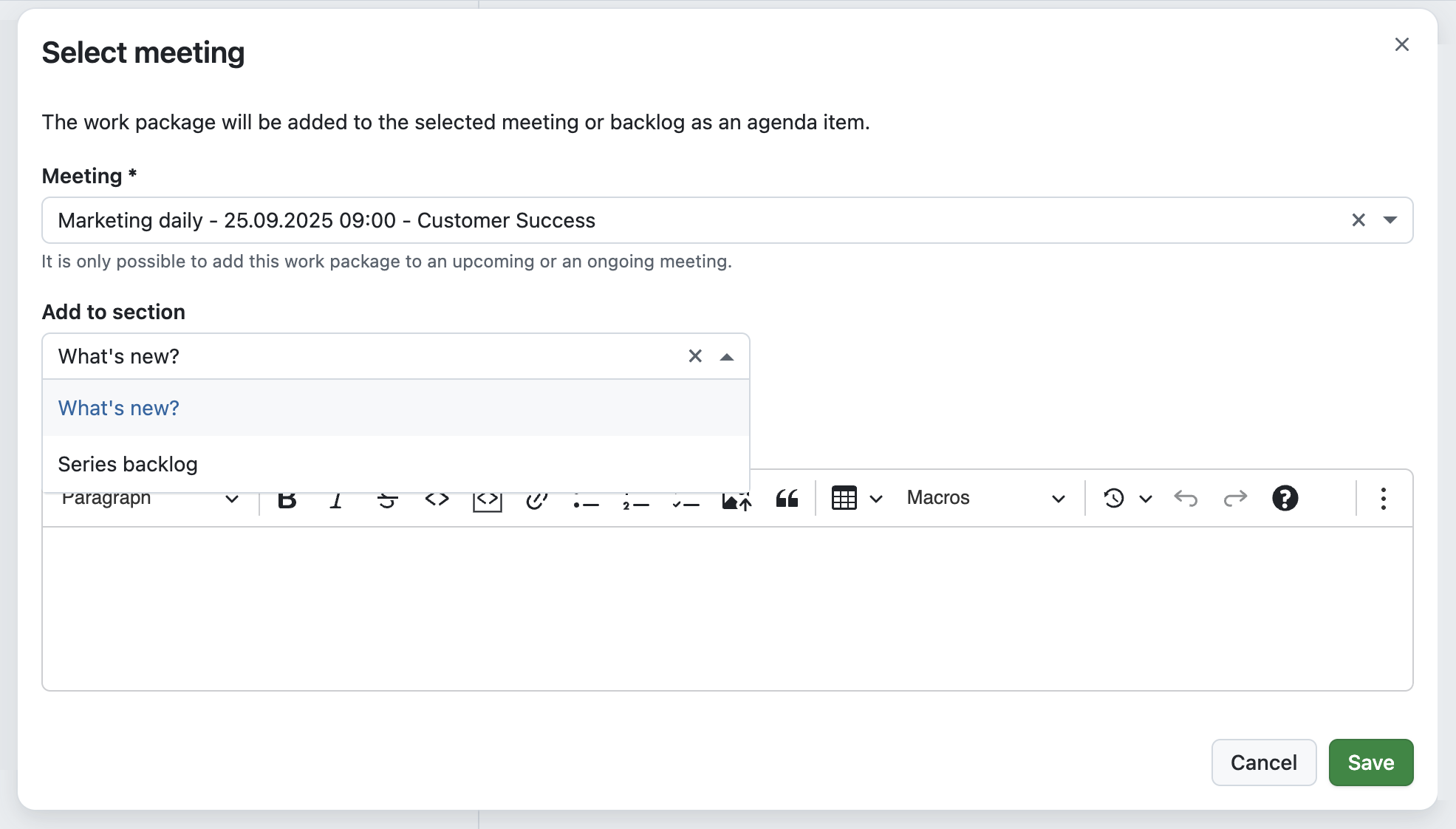
When preparing for a meeting, it’s often the small details that make a big difference. Until now, adding a work package to a meeting from the Meetings tab was already possible, but it always landed at the end of the agenda. Teams then had to manually move it to the right section — an extra step that sometimes led to confusion.
With 16.5, this process becomes much smoother. When you add a work package to a meeting, you can now add it directly to the right section or choose the backlog. The improved meeting selector also makes it easier to find the right meeting, whether it’s one of your upcoming appointments or part of a recurring series.
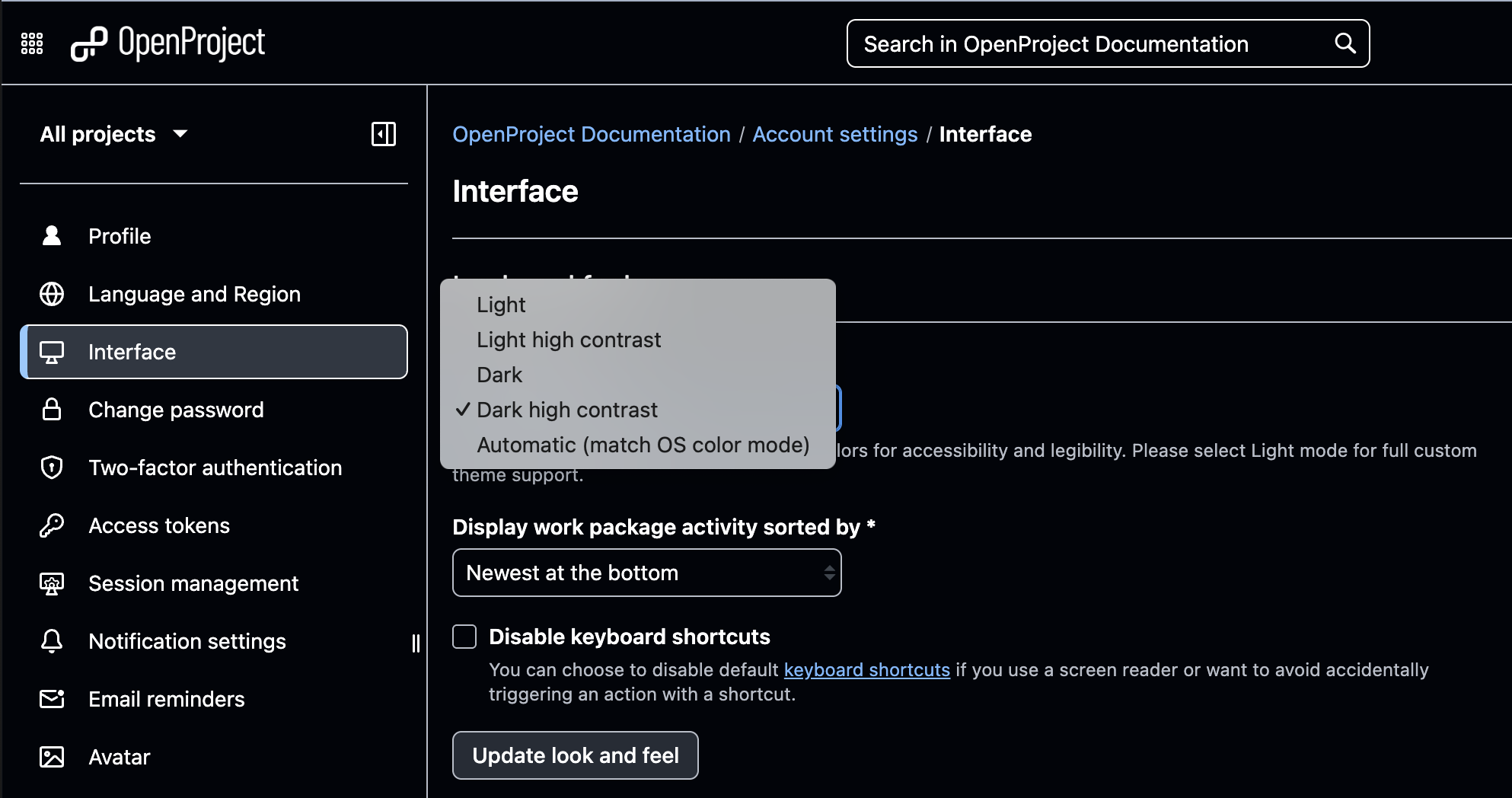
Choose color mode more conveniently with “Increase contrast” checkboxes
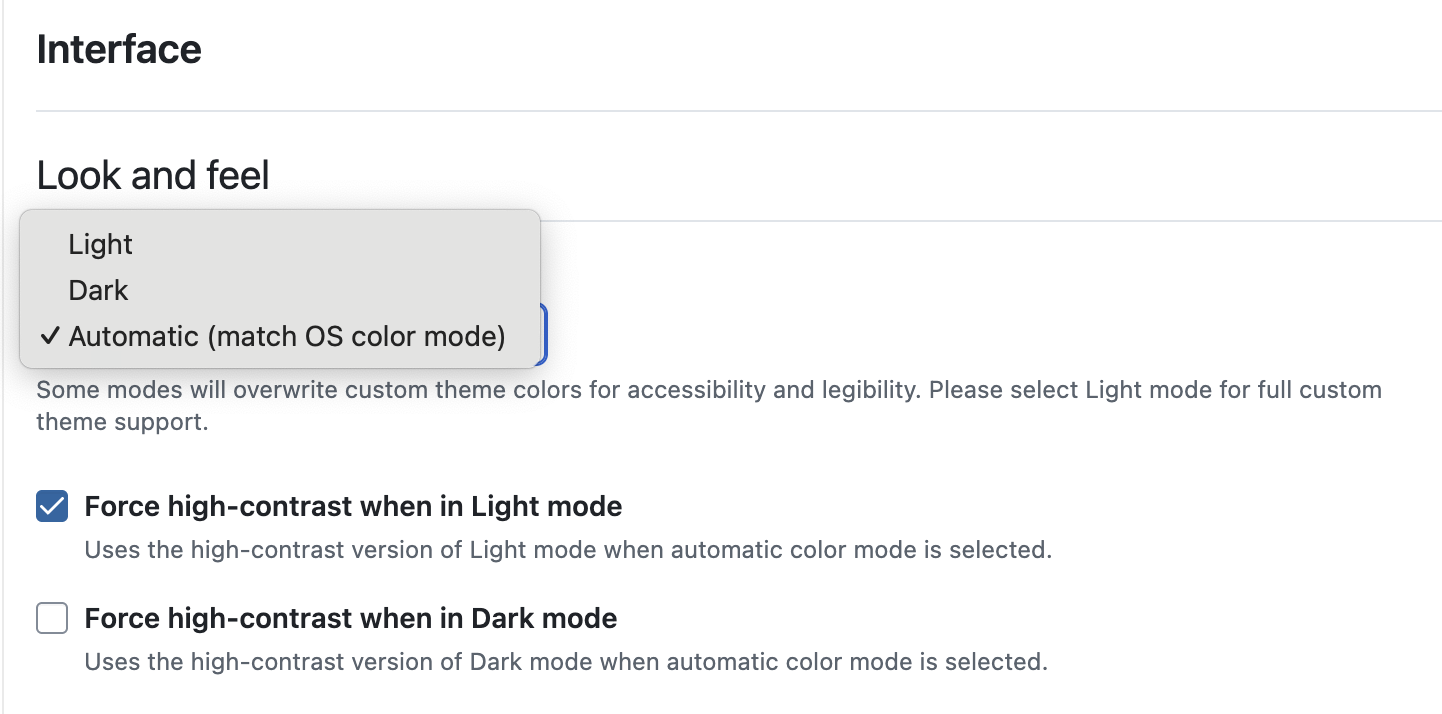
Over the last releases, we have steadily improved how you can adapt OpenProject’s appearance to your needs. In 16.4, we introduced the option to automatically sync the color mode with your operating system, as well as a dark high-contrast mode alongside the existing light one.
With 16.5, we are making these settings even more practical. Instead of switching between multiple predefined modes, you can now simply choose Light, Dark, or Automatic, and then enable an “Increase contrast” checkbox for the selected mode.
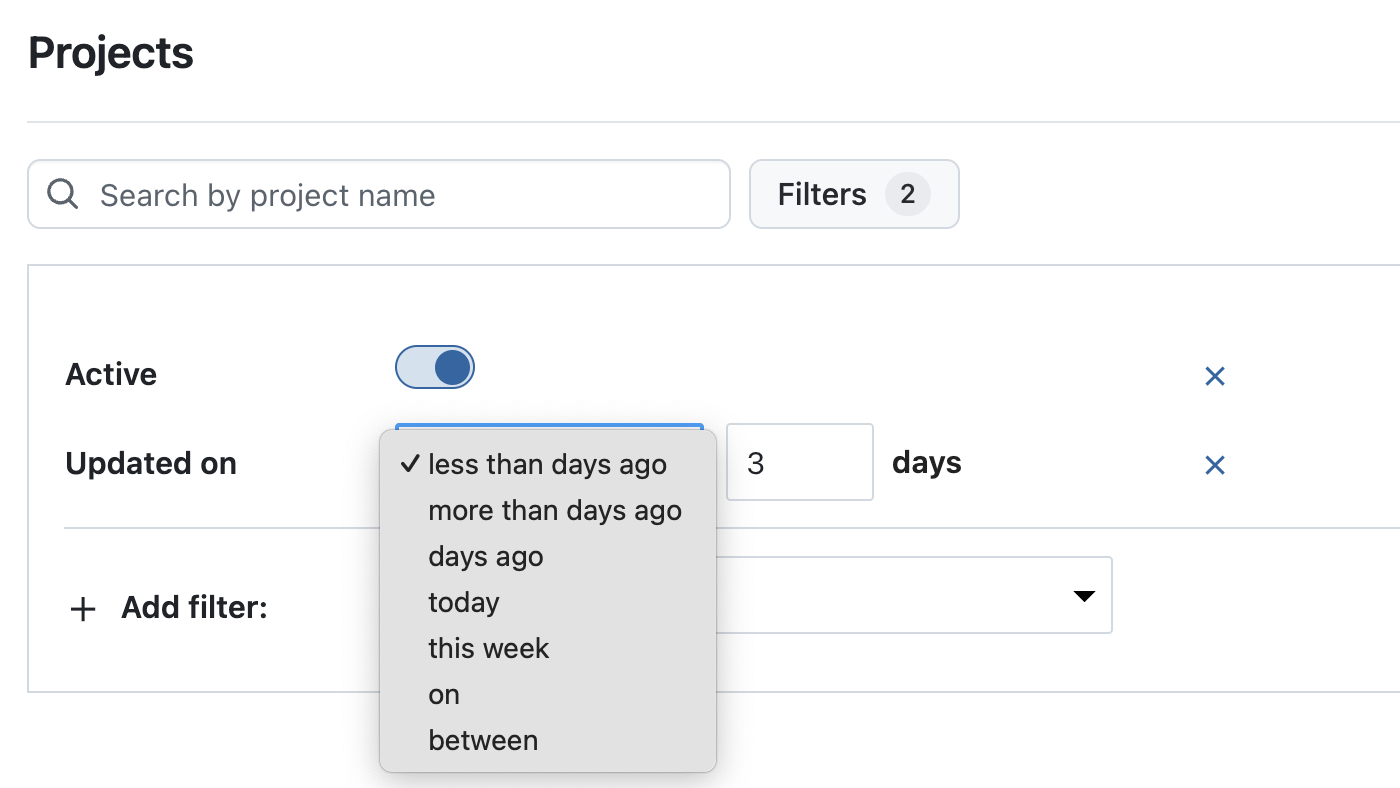
When you manage many projects, you often just want to see what changed recently. In 16.5, project lists include an “Updated on” filter and a sortable “Updated on” column. Sort by this column (newest first) or combine the filter with other criteria to focus on the projects that were modified most recently.
For integrations and automation, the API now supports an updated_at filter on the /api/v3/projects endpoint. This lets you request only projects changed since a given timestamp — useful for delta syncs that reduce waiting time and server load.
Note
Updated on reflects direct changes to the project itself (for example, a new custom field or a renamed project). Latest activity at is much broader and includes activity within the project, such as attribute changes to work packages.
Jump to highlighted target elements from deep links
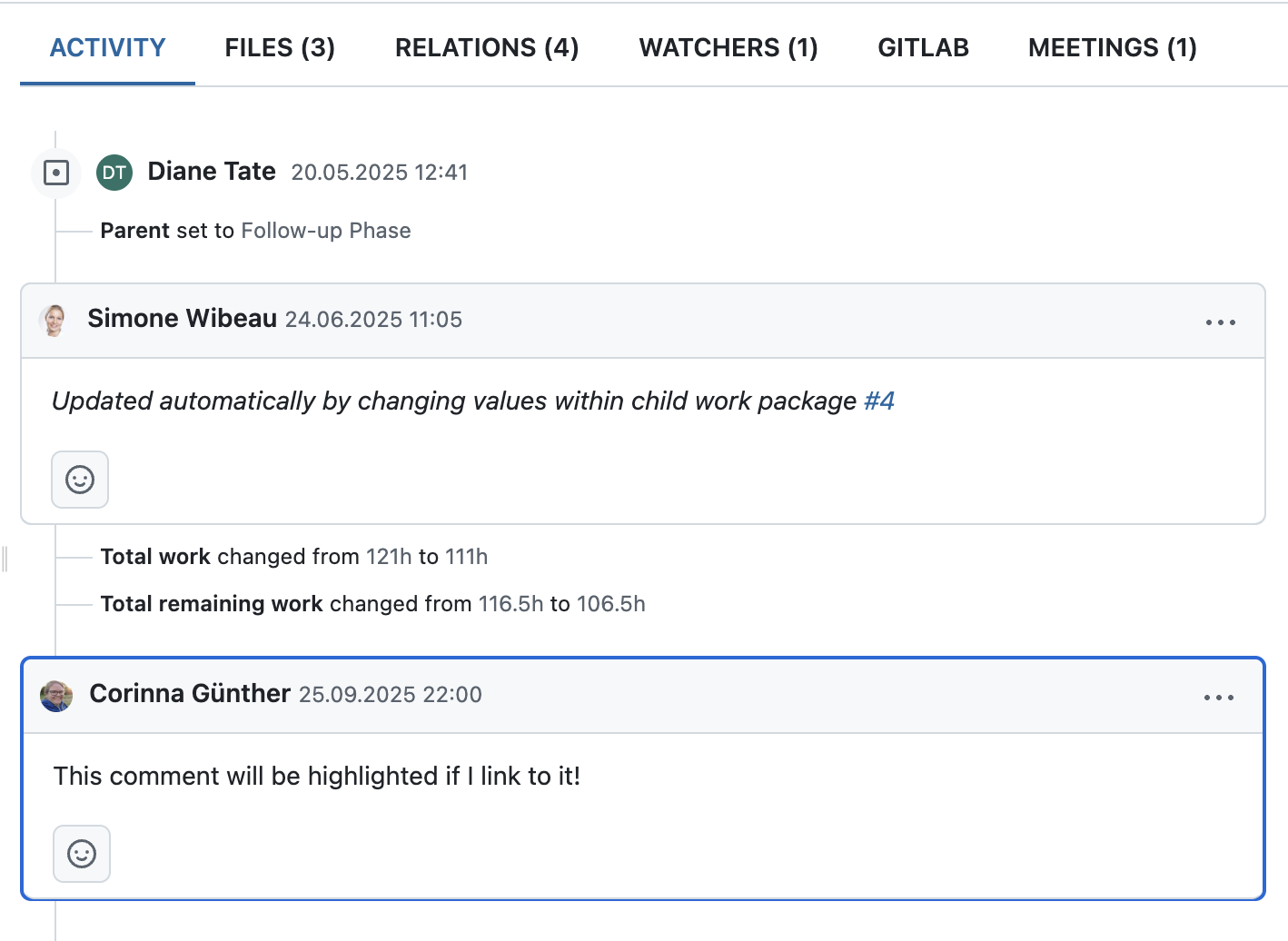
Deep links are especially useful when you want to point colleagues directly to a specific item in OpenProject. With 16.5, these links now do more than just open the right page — they also scroll to the exact position and highlight the target element.
For example, when sharing a link to a comment in the Activity tab or to an item in a meeting agenda, the element is automatically displayed near the top of the page and temporarily marked with a blue outline. This makes it clear what the link refers to, helping teams save time and avoid misunderstandings.
Confirm critical actions with more accessible danger dialogs
Accessibility is an ongoing priority for us, and with 16.5 we have improved how danger dialogs work for users of assistive technologies. These dialogs are shown when potentially destructive actions require an extra confirmation step.
In this release, we added ARIA semantics so that screen readers announce the relationship between the confirmation checkbox and the action button. When the checkbox is checked, users hear that the button to proceed is now active; when it is unchecked, they are informed that the button is inactive and that they need to tick the checkbox to continue.
Better access to helpful information
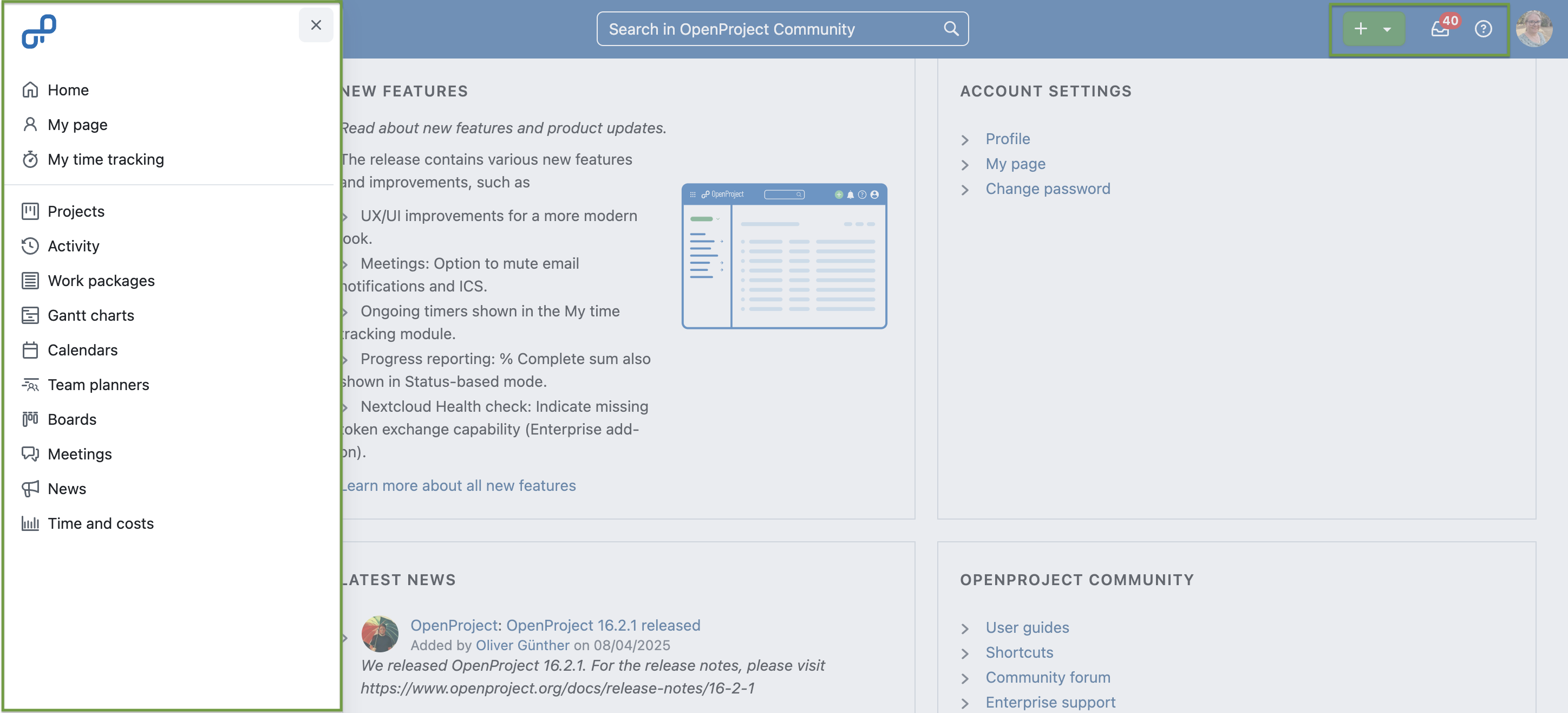
Finding the right information quickly is essential, especially when you are just getting started or want to dive deeper into specific features. With 16.5, we have updated the help menu in the header navigation (the ? icon on the right). The entries have been restructured, links refreshed, and localizations added to make it easier to find what you are looking for.
We also included a new Getting started video right inside the menu, giving new users a simple introduction to OpenProject and offering a helpful refresher for experienced teams. These changes are also reflected in the Community widget that is displayed on the home page of every new instance, so guidance is available right from the start.
OpenProject 16.5: Migration, installation, updates and support
You will find more information about all new features and changes in our Release notes or in the OpenProject Documentation.
If you need support, you can post your questions in the Community Forum, or if you are eligible for Enterprise support, please contact us and we are happy to support you personally.
New to OpenProject? To test all features of OpenProject 16.5 right away, create a 14 days free trial instance for our OpenProject Enterprise cloud.
Prefer to run OpenProject 16.5 in your own infrastructure? Here you can find the Installation guidelines for OpenProject.
A very special thank you goes to Helmholtz-Zentrum Berlin, City of Cologne, Deutsche Bahn and ZenDiS for sponsoring released or upcoming features. Your support, alongside the efforts of our amazing Community, helps drive these innovations. Also a big thanks to our Community members for reporting bugs and helping us identify and provide fixes. Special thanks for reporting and finding bugs go to Alexander Aleschenko, Lars Tiedemann, Akihiko Fujikawa, and Johannes Baumgarten.
Last but not least, we are very grateful for our very engaged translation contributors on Crowdin, who translated quite a few OpenProject strings! This release we would like to particularly thank the following users:
Samo, for a great number of translations into Turkish.
Kuma Yamashita, for a great number of translations into Japanese.
Would you like to help out with translations yourself? Then take a look at our translation guide and find out exactly how you can contribute. It is very much appreciated!
As always, we welcome any feedback on this release. 💙
We have released version 2.10.0 of the OpenProject integration app for Nextcloud! ✨ This update brings several usability improvements and fixes to make your project collaboration experience even smoother.
We recommend updating to the latest version via your Nextcloud app center to benefit from the newest enhancements.
Changes of the release 2.10.0:
Clearer error messages for missing or unsupported apps
Improved group handling to avoid user removal issues
Enhanced SSO support for external token exchange setups
Better translations and more user-friendly messages
Thanks to Nextcloud for the continued partnership!
After March 28, 2029, Jira Data Center licenses and apps will expire and become read-only, leaving cloud hosting as the only supported way to stay with Jira. But for many organizations, cloud hosting is not an option. On top of that, Atlassian recently burdened its customers with significant price increases for Jira Service Management (JSM) Cloud products.
The challenge: Finding a new self-hosted project management software within a short period of time, migrating existing data and onboarding the users so that your teams can switch over as effortlessly as possible.
Looking for: A feature-rich and affordable project management tool that also offers long-term on-premises solution. A solution where you have full ownership and control of your data within your own infrastructure.
Break free from Jira’s vendor lock-in and choose freedom with OpenProject
OpenProject offers exactly what many (still) Jira customers are looking for: a secure, powerful, and, above all, reliable solution for their projects, at attractive pricing models, or even completely free of charge in our Community version.
Next steps for your migration from Jira Data Center to OpenProject
If your organization depends on Jira Data Center, you have to act now.
Start your free OpenProject trial to get to know our product hands-on.
Map your use cases with OpenProjects features or ask us for help to understand your possibilities with OpenProject.
Choose a self-managed, long-term solution.
We will help you plan a migration path and the onboarding plan.
OpenProject is a powerful open source alternative to Jira
OpenProject is a highly developed, fully featured best-in-class project management software that offers a long-term on-premise solution. It supports both self-hosted and managed hosting options and gives you full control over your infrastructure without locking you into a specific vendor.
With advanced work package tracking – comparable to Jira issues – and comprehensive modules for agile boards, Gantt charts, and time and cost tracking, OpenProject covers a wide range of project requirements.
The software is available as a cost-free Community Edition, while the Enterprise Edition includes powerful add-ons for authentication, integrations, and custom workflows at fair prices.
OpenProject has been continuously developed for over ten years by a growing German company. It is based on a strong commitment to transparency, data sovereignty, and long-term reliability. We continuously develop the product based on our users’ needs.
Important
OpenProject will continue offering its on-premises solution — including new features and security updates — beyond 2029. You choose where to run your data.
Benefit from the open source alliance
Perhaps you’ve considered switching to open source before, but the timing never seemed right? Now is the perfect moment. Security and reliability is just one of at least 8 reasons to choose open source software whenever possible. It’s user-centric, offers fast developments and a high level of customization. And, of course, without vendor lock-in that Atlassian customers currently face.
OpenProject is part of a strong open source ecosystem that builds secure, sovereign alternatives to proprietary software — and actively works to improve interoperability. One example is our partnership with XWiki and CryptPad, officially launched in July 2025. So if you are looking for a Confluence alternative we can recommend checking out XWiki, which is optimized for shared use with OpenProject.
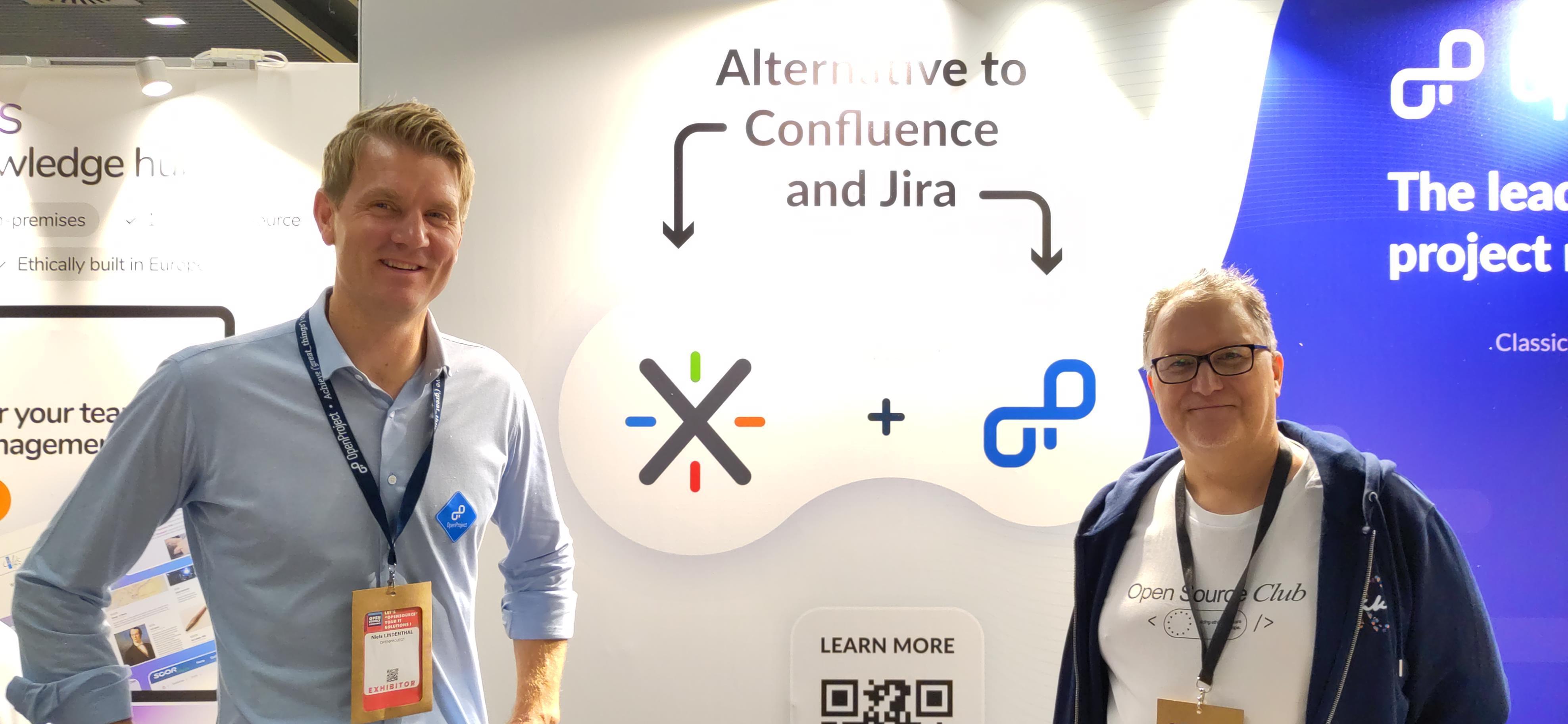
Image: Niels Lindenthal (CEO OpenProject) and Ludovic Dubost (CEO XWiki and CryptPad) at the OSXP in Paris.
Nice to know: OpenProject and XWiki are also part of openDesk, offering a fully sovereign workspace for the public sector in Europe. Stronger together is more than just a slogan for us.
Tip
Another advantage of transparent source code: the members of our open source Community share the same values, and some of them are very competent and proactive. This led to the creation of the OpenProject Jira Importer – a tool written and hosted by a Community member and available as open source as well.
No strings attached: Start your free trial now
Your next step doesn’t need to be complicated. Start a free OpenProject trial today or get in touch to discuss migration paths from Jira Data Center. Because at OpenProject, we are on our user’s side and let you decide where and how to host your data.
When managing complex projects, it is beneficial to use a project management methodology for guidance. PRINCE2 is one of the most popular and widely used methodologies available. OpenProject is a popular tool that supports PRINCE2, offering the advantages of open source software while also being cost-effective. Let’s learn how exactly project managers can implement PRINCE2 with OpenProject.
Note
Originally published in 2018, this article has been substantially revised to reflect the latest changes in both PRINCE2 and OpenProject. The PRINCE2 framework was updated to version 7 in September 2023, adding new priorities such as sustainability, people-centric management, and digital/data integration. At the same time, OpenProject has introduced key features — like meetings enhancements, baseline comparison, and new permissions — that make applying PRINCE2 workflows easier and more powerful.
Article navigation
If you are already familiar with the PRINCE2 framework, you can jump straight to the practical section on using OpenProject.
PRINCE2 (or Projects inControlled Environments) offers a structured process for projects & provides recommendations for each project phase. It is one of the leading project management methodologies (next to PMBOK (from the Project Management Institute)) and is used in over 150 countries.
PRINCE2 provides a clear structure for projects and is based on 7 principles, 7 practices (formerly known as themes) and 7 processesas described by PRINCE2.com. Let’s take a look at those basics before diving into the OpenProject software.
7 Principles
PRINCE2 is built on seven principles which represent guiding obligations and good practices.
The 7 Principles are:
Continued business justification: A project must make good business sense (justified use of time and resources, clear return on investment).
Learn from experience: Previous projects should be taken into account. Project teams use a lessons log for this purpose.
Define roles, responsibilities and relationships: The decision makers in the project are clearly defined. Everyone in the project knows what they and others are doing. The ‘relationships’ has been added later to PRINCE2 as dependencies are an important part of project management.
Manage by exception: The project board is only informed if there is or may be a problem. As long as the product is running well, there is not a lot intervention from managers.
Manage by stages: Difficult tasks are broken into manageable chunks, or management stages.
Focus on products: Everyone knows ahead of time what is expected of the product. Product requirements determine work activity.
Tailor to suit the project: The PRINCE2 methodology can be tailored and scaled. Projects which are adjusted based on the actual needs perform better in general than projects which use PRINCE2 dogmatically. Formerly known as ‘Tailor to the environment’.
7 Practices
In addition to these 7 Principles, there are 7 Practices – formerly called ‘Themes’ – which are addressed continually throughout the project. They provide guidance for how the project should be managed. They are set up at the beginning of the project and then monitored continually to keep the project on track:
Business Case: This practice is used to determine if a project is worthwhile and achievable. It is related to the principle of Continued Business Justification.
Organization: Project managers are required to keep a record of every team member’s roles and responsibilities. It is related to the Define Roles and Responsibilities principle.
Quality: At the beginning of the project, the project manager defines what constitutes the quality of the project. This is related to the Focus on Products principle.
Plans: A plan is set up which describes how objectives are going to be achieved. It is focused on cost, quality, benefits, timescale and products.
Risk: Uncertain events during the project are identified, assessed and controlled. They are recorded in a risk log. Positive risks are called opportunities, negative risks are called threats.
Issue: How to handle change requests and all types of project-related concerns that arise and require resolution. Issues shouldn’t be ignored, but changes should only be implemented once agreed upon. This practice was formerly called ‘Change’.
Progress: This principle is about tracking the project. This allows project managers to verify and control whether they are performing according to the project plan.
7 Processes
To structure the step-wise progression through a project, there are 7 Processes. Every one of the steps is overseen by the project manager and approved by the project board:
1. Starting up a project
Create a project mandate to answer logistical questions about the project. It covers the purpose of the project, who will carry it out and how to execute it.
From the project mandate a project brief is derived, as well as lessons log and discussions with project members.
A project team is assigned.
2. Directing a project
This is an ongoing process covering the entire life time of the project.
The project board manages activities such as initiation, stage boundaries, guidance, project closure.
3. Initiating a project
During this stage, the project manager determines what needs to be done to complete the project and outlines how the performance targets will be managed (cost, time, quality, benefits, risks, scope)
4. Controlling a stage
Project managers break the project into work packages / manageable activities and assign them to the project members.
The project manager oversees and reports the work package progress.
5. Managing product delivery
This manages how the communication between the team and the project manager is controlled.
The activities include accepting, executing and delivering work packages.
6. Managing stage boundaries
The project manager and the board review every stage. The board decides whether to continue the project. The project manager records lessons learned with the team for the next stage.
This process includes
Planning the next stage
Updating the project plan
Updating the business case
Reporting the stage end or producing an exception plan
7. Closing a project
In the final process, the project is closed. This includes decommissioning the project, identifying follow-on actions, preparing project evaluation and benefits reviews, freeing up leftover resources and handing over products to the customer.
Implementing PRINCE2 with OpenProject
OpenProject supports the seven processes, seven principles and seven practices laid out by the PRINCE2 methodology. Let’s see how exactly project managers can implement PRINCE2 with OpenProject in 7 steps:
Starting up a project: Create a project, activate modules, create project Mandate, add members.
Directing a project: Define roles and permissions, create decision checkpoints and track them.
Initiating a project: Define performance targets, set up budgets and assign them.
Controlling a stage: Create work packages and relations, estimate and assing work.
Before any work begins, PRINCE2 recommends clarifying whether the project is viable and worth pursuing. In OpenProject, this “starting up” step is fast and intuitive — you create a new project space, enable the modules you need, and prepare the foundation for structured collaboration, governance, and documentation.
Create a project
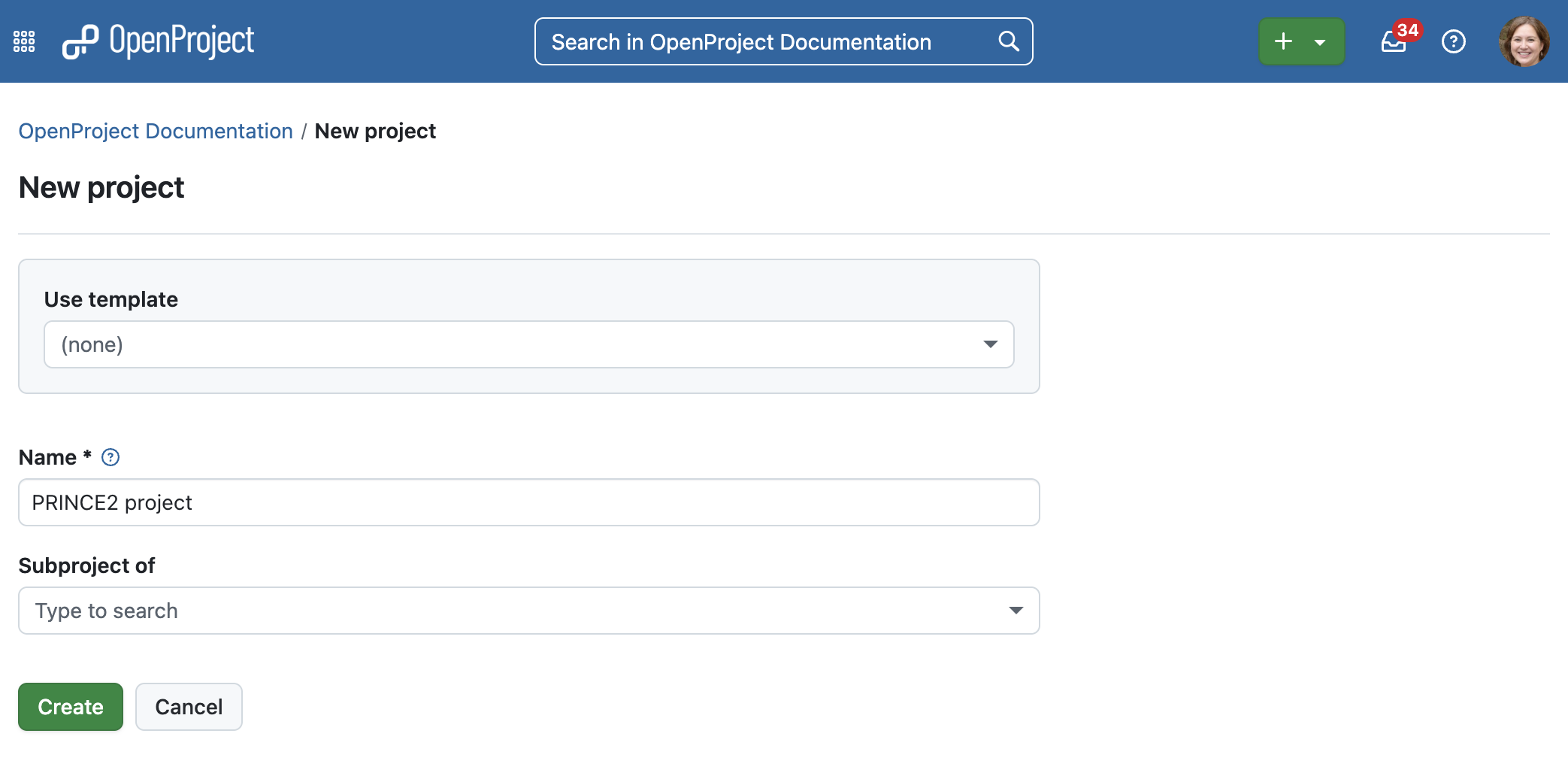
Starting up a project in OpenProject starts by simply creating a project. Simply click on the green + button in the header navigation and select + Project in the dropdown. Next, all you need is to provide a name and click on Create.
Activate the modules you need
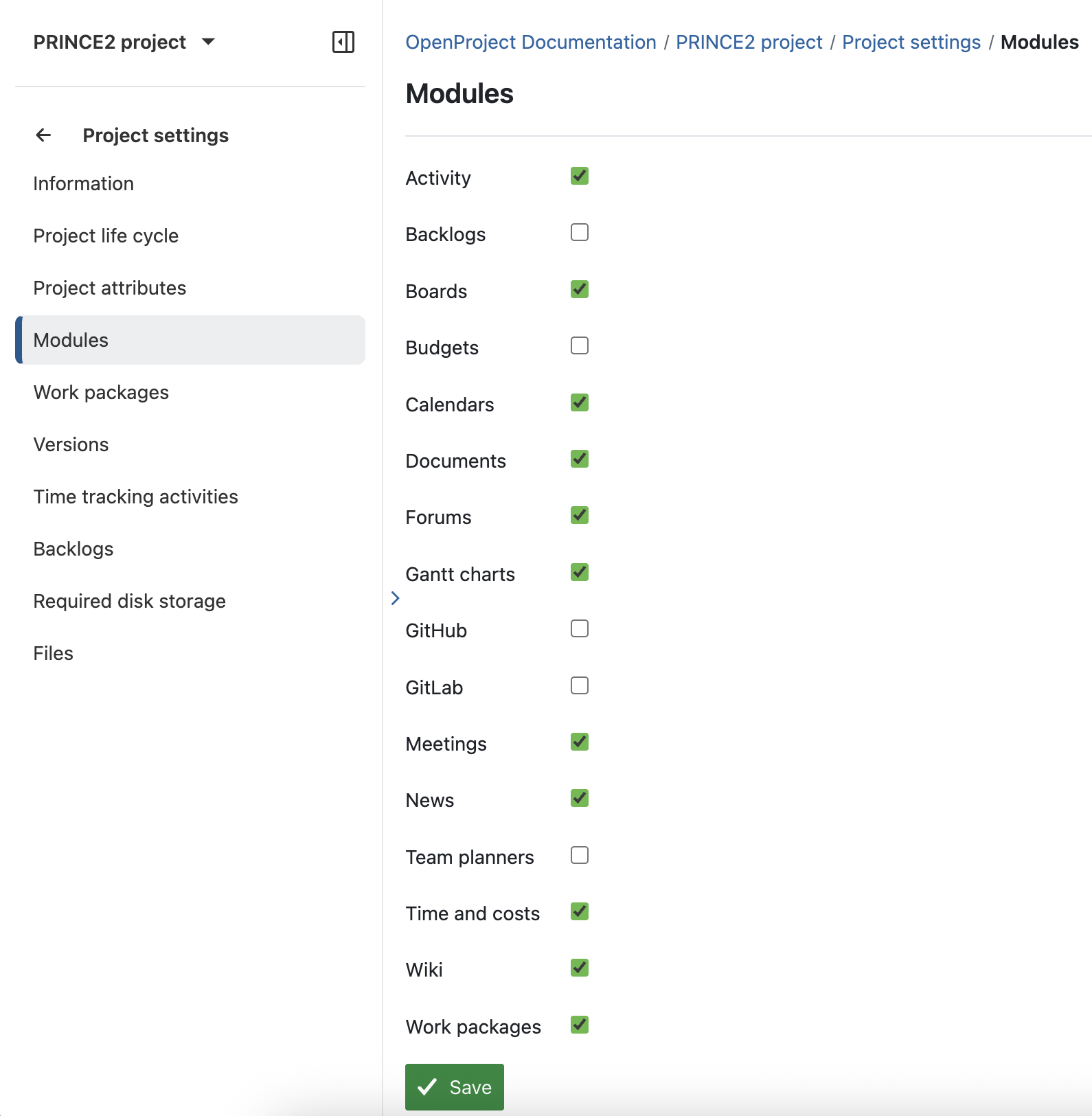
Now the project is created and you can start with some basic settings. Navigate to project settings → Modules to make sure that the Wiki, Work packages, Time and costs, and — optionally — Meetings, Forums, Budgets, and News modules are activated. These modules support transparency, collaboration, and documentation, which are all central to a people-focused approach in PRINCE2 7.
The Wiki module is especially useful for documenting your Project Mandate, Lessons Log, and other artifacts like communication plans. This aligns with PRINCE2’s emphasis on accountability, people, and continual learning.
Create a Project Mandate in the Wiki module
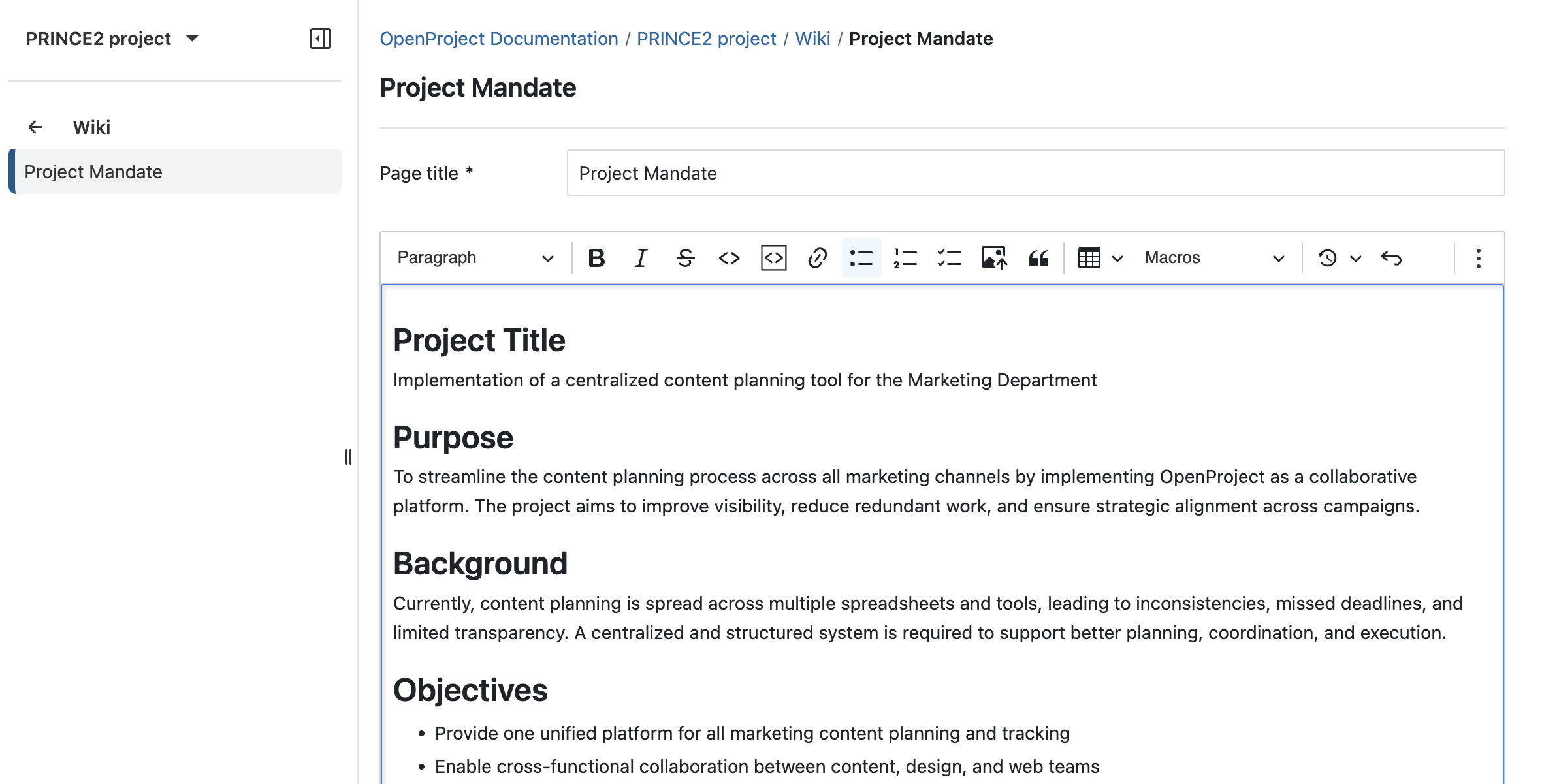
Next, select Wiki from the side menu on the left side and use it to create the Project Mandate. Make sure to press the Save button at the end. If you like, you can already create more wiki pages, such as the Lessons log as well.
Add members to your project
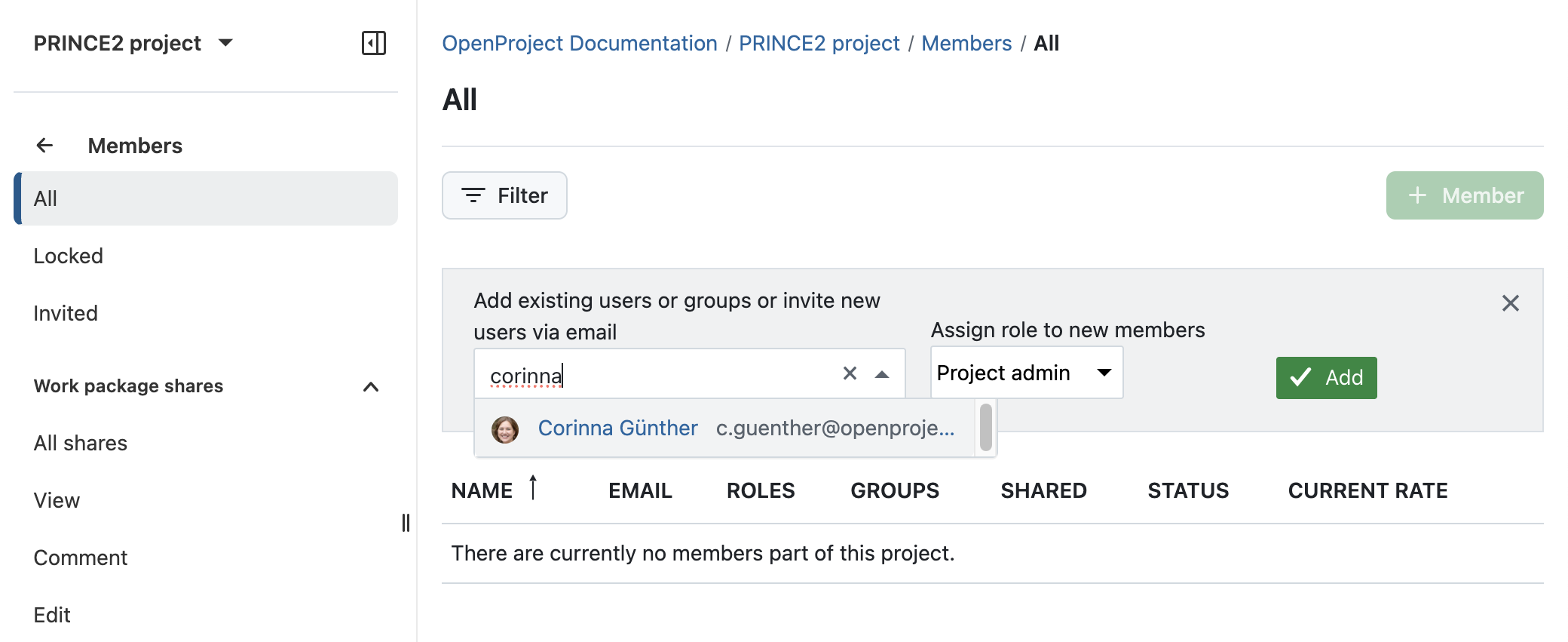
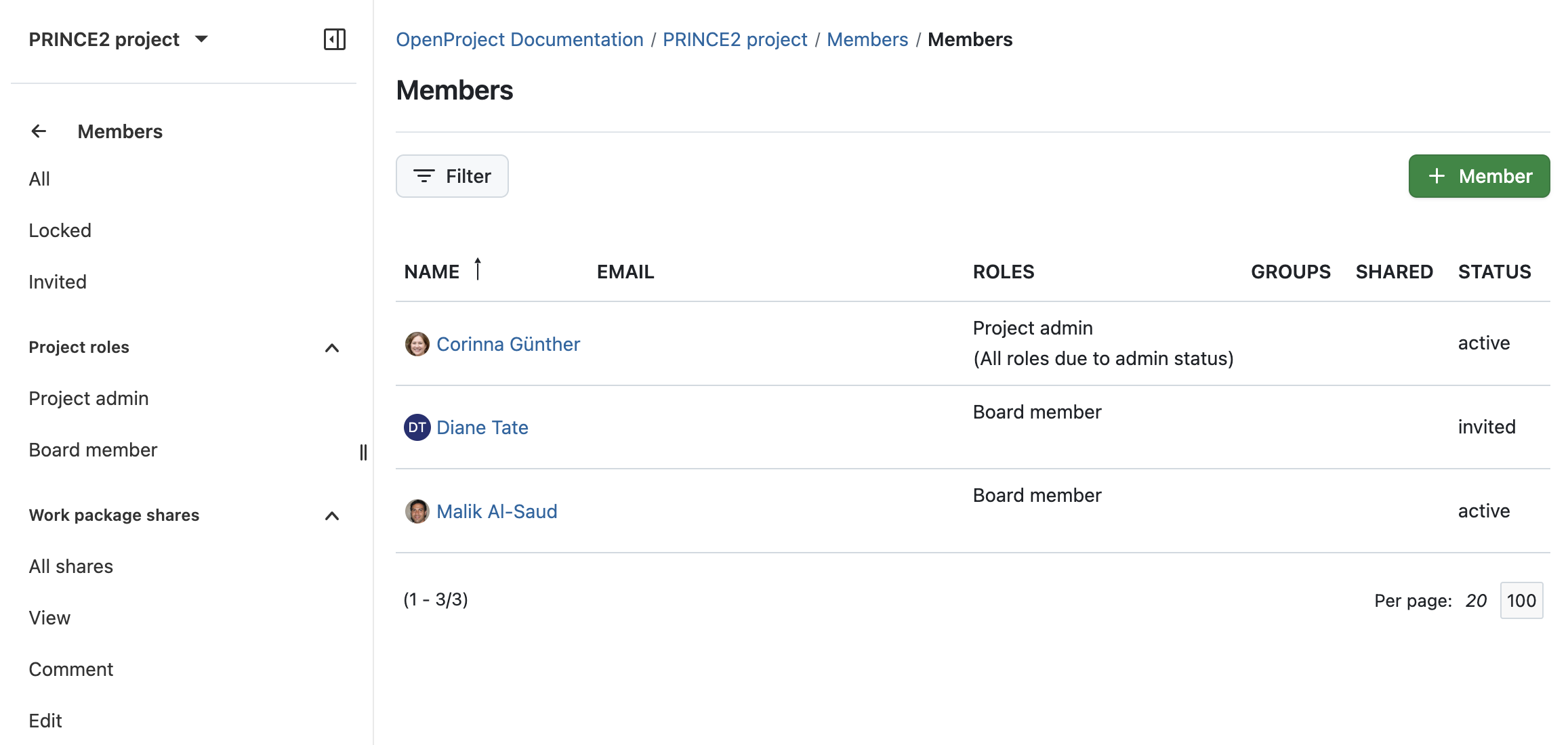
Afterward, go back to your project and select Members from the side menu to add the project members and assign them roles.
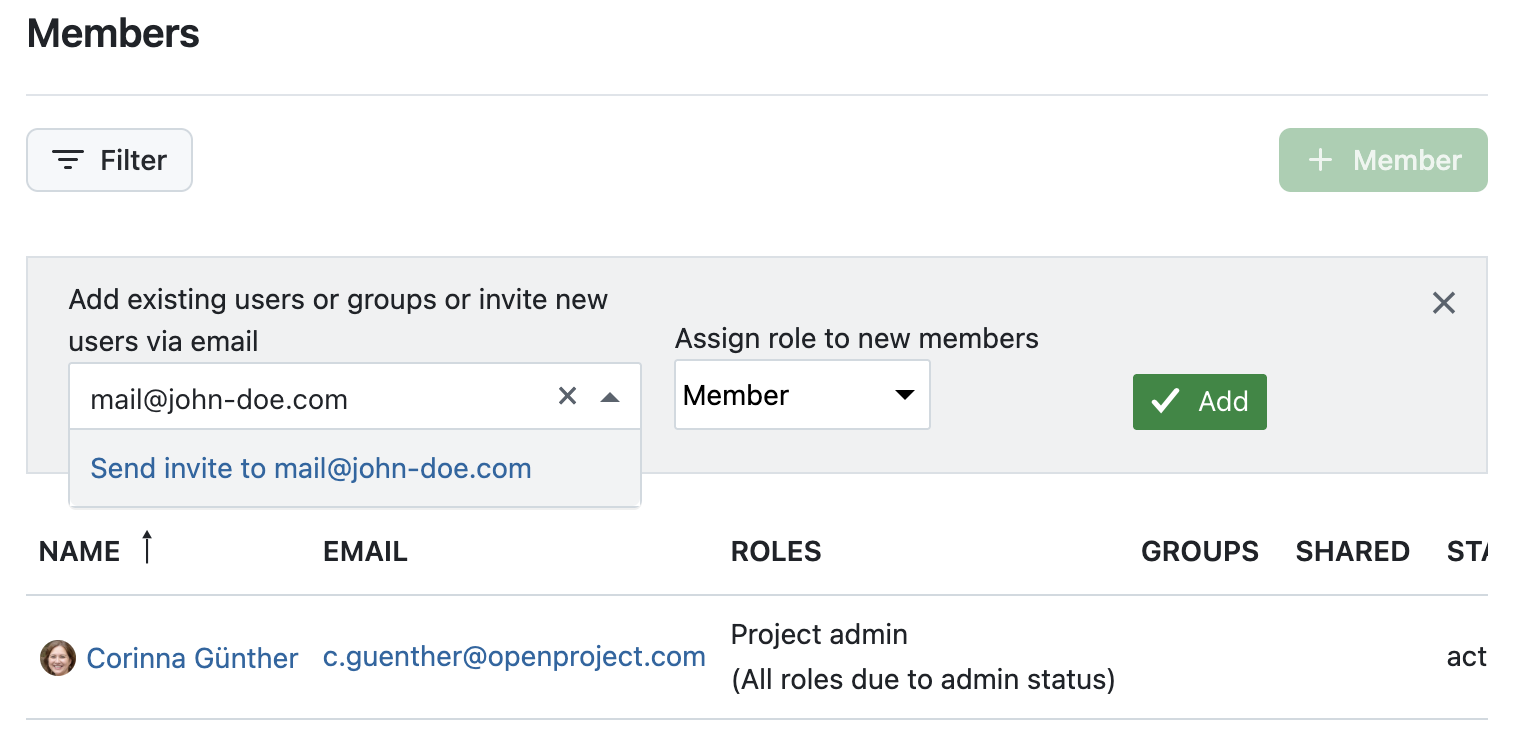
If the project members do not yet have an OpenProject account, you can send an invite to them directly in your project.
Tip
If you’re a system admin, you can invite new members to your instance and add them to the project afterward. Click on your avatar on the top right and select Administration → Users and permissions. You can also assign entire groups to add multiple project members at once.
2. Directing a project
Once the project is set up and the team assigned, the project board’s role in PRINCE2 is to guide the project and approve important decisions. In OpenProject, you can reflect this setup through roles, permissions, and decision checkpoints.
Define roles and permissions
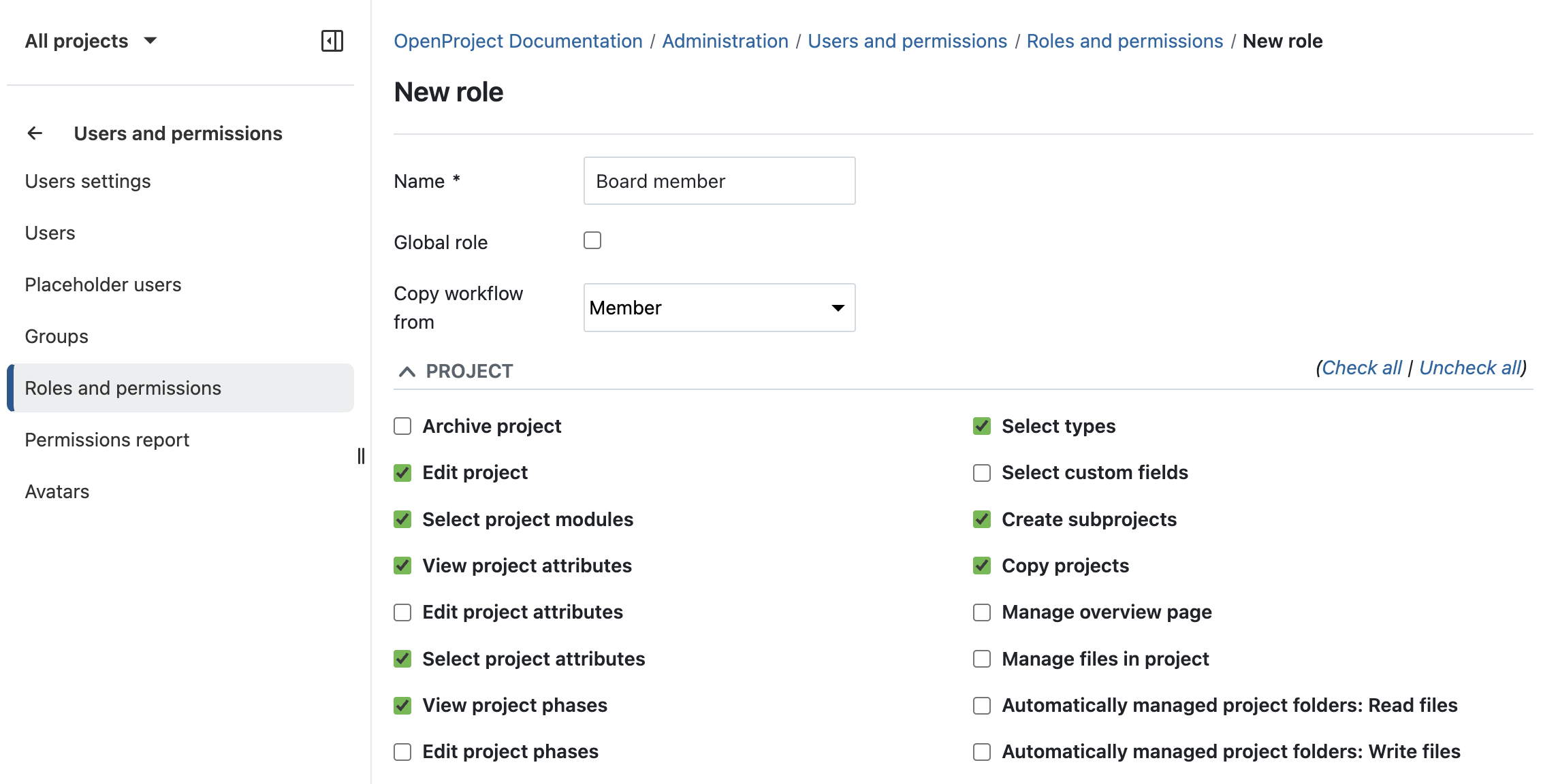
You can configure which roles have permissions to edit, approve, or only view information under Administration → Users and permissions → Roles and permissions.
This lets you ensure that:
Project managers can update plans and work packages.
Board members can review progress and approve major stages.
Team members see only what’s relevant to them.
If these permissions are set in the system administration, you can go back to your project, navigate to Members in the left menu and assign key roles like Project Manager and Board Member.
Create decision checkpoints with Milestones and Gantt charts
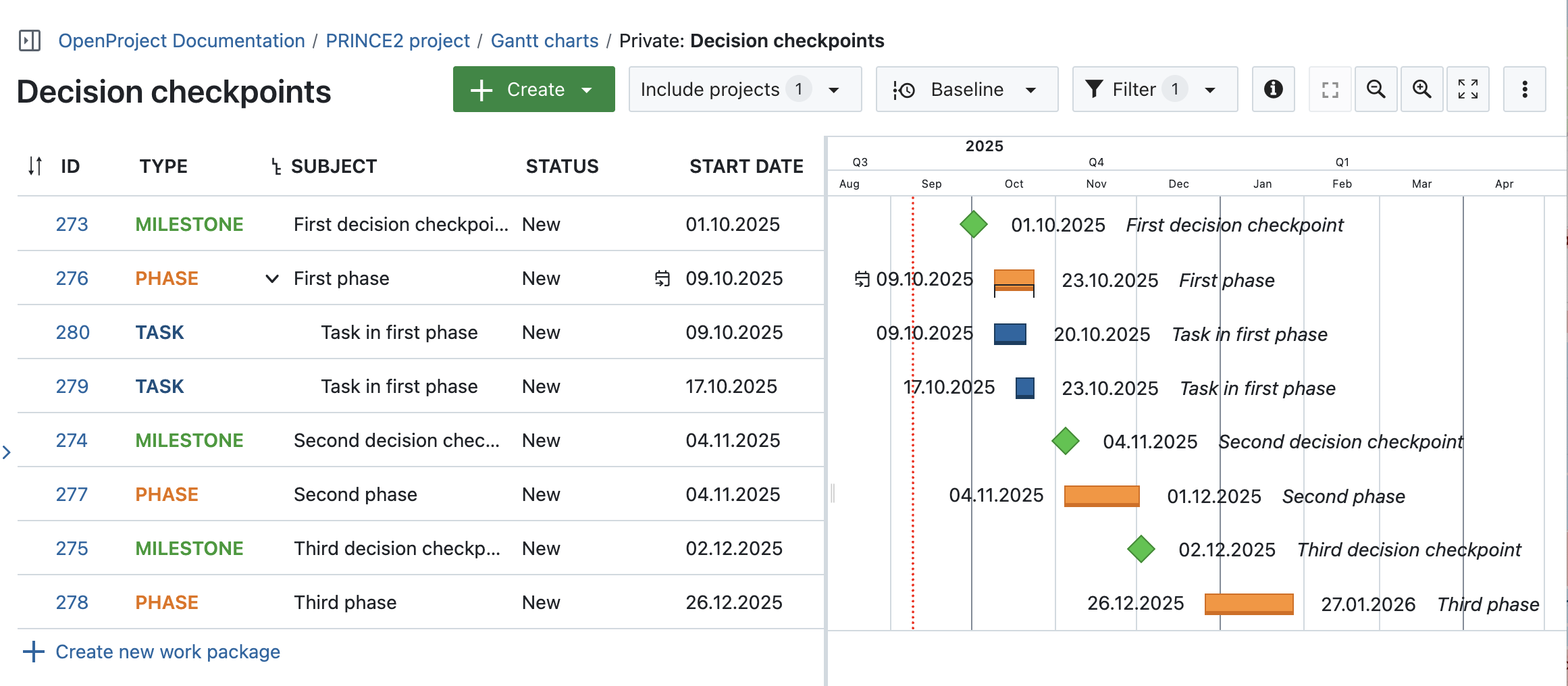
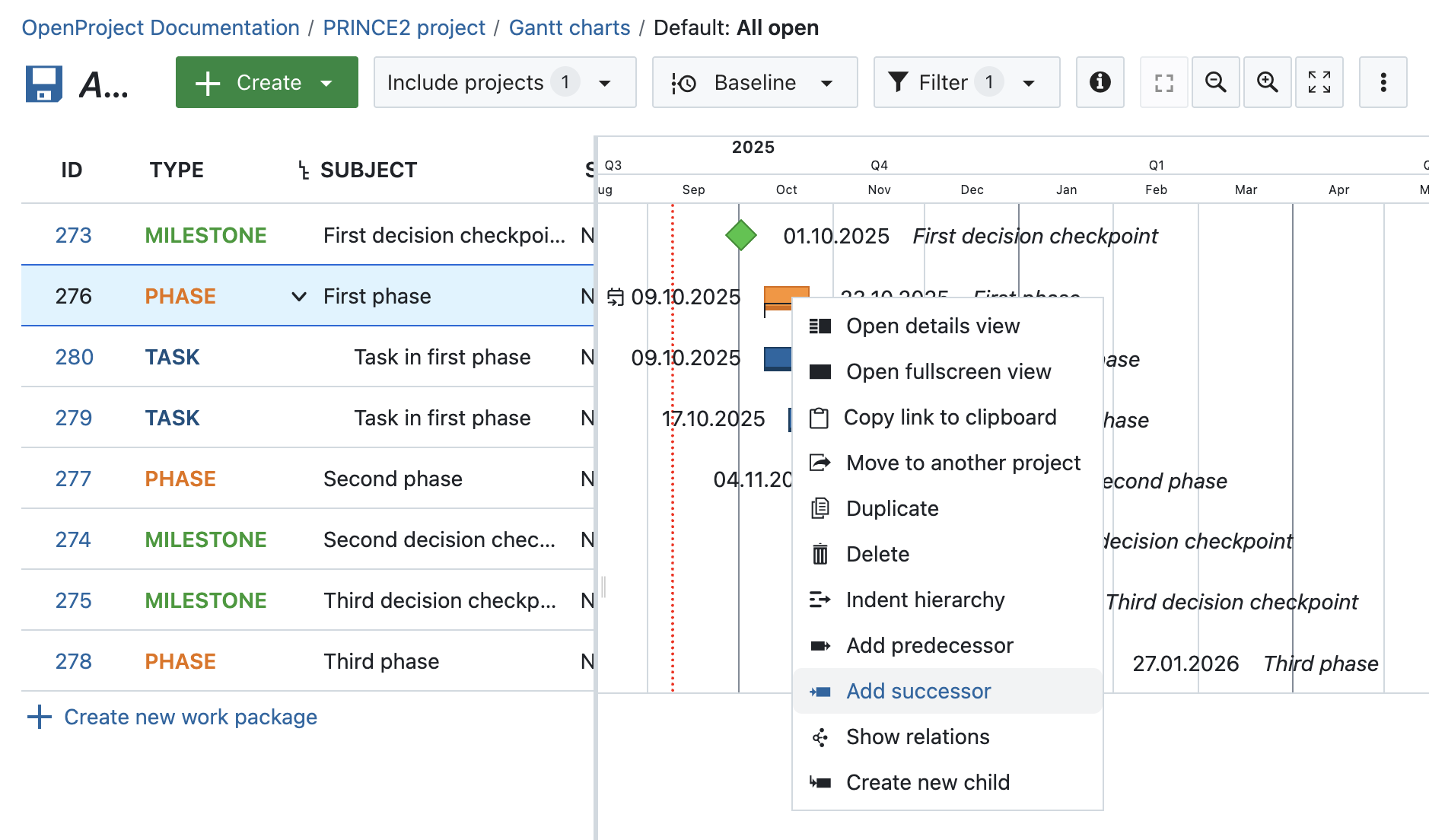
Use Milestones to mark stage boundaries that require approval. In OpenProject, milestones are a type of work package that has a target date, but no duration like other type of work packages. To display milestones and their connected work packages, use OpenProject’s Gantt charts.
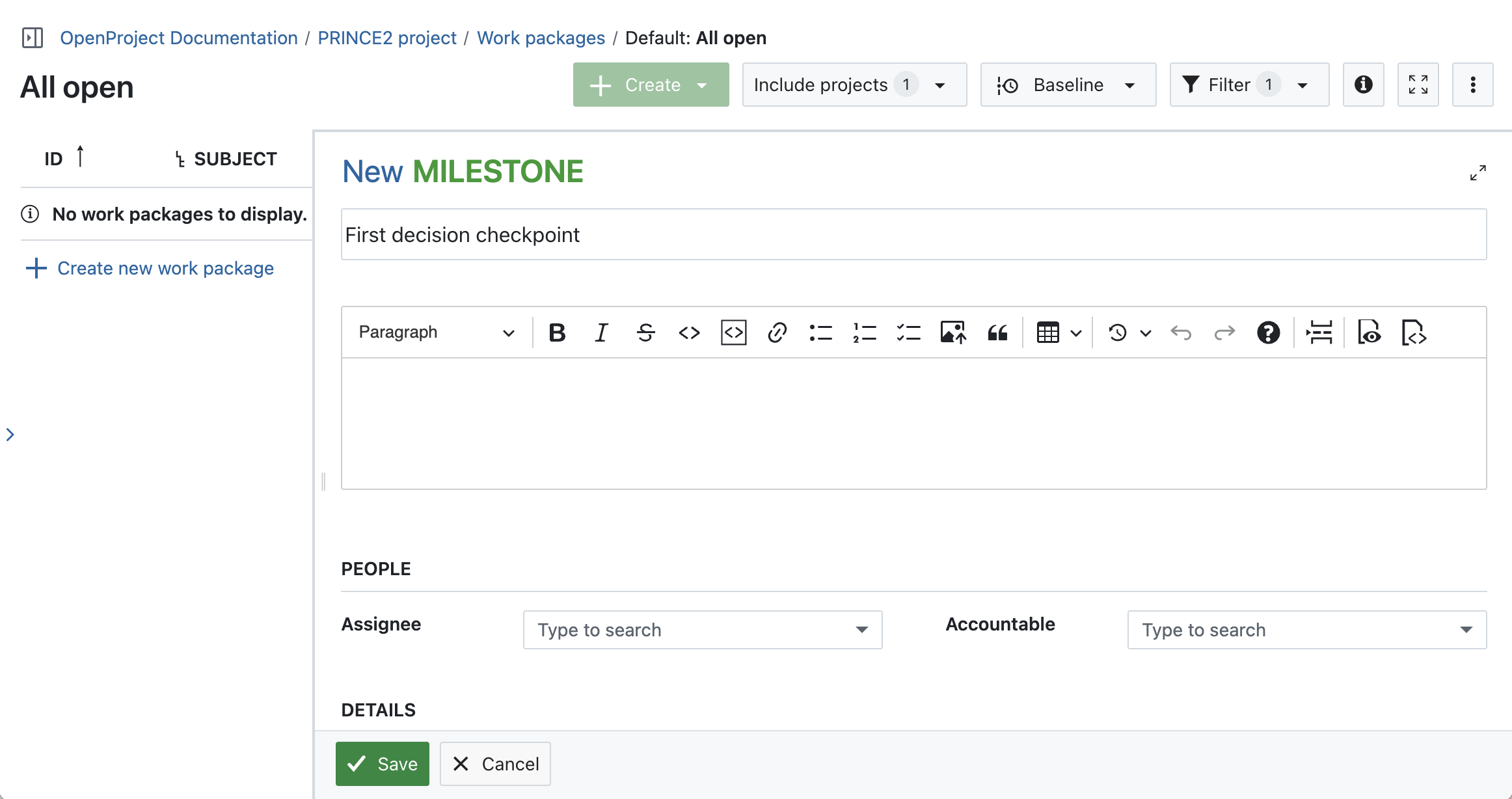
Go to Gantt charts in the left side menu, click on the green + Create button and select Milestone in the dropdown. You can also add watchers (e.g. the group ‘board members’) to be notified when a milestone is reached.
Create several decision checkpoints (Milestones) along with phases, tasks and other work package types you need and create relations and hierarchies.
Track decisions and approvals
Use status fields to indicate when a stage or work package is waiting for board approval. For example, set the status to “Pending board decision” or use a custom field with dropdown options like “Pending”, “Approved”, or “Exception required”.
Board members can leave comments or change the status directly in the work package — no separate tool or email chain needed.
3. Initiating a project
Once the project board has authorized the start, PRINCE2 focuses on planning how the project will be executed, controlled, and completed. In OpenProject, this is where you lay the groundwork: define performance targets, plan project phases, and estimate resources.
Define performance targets
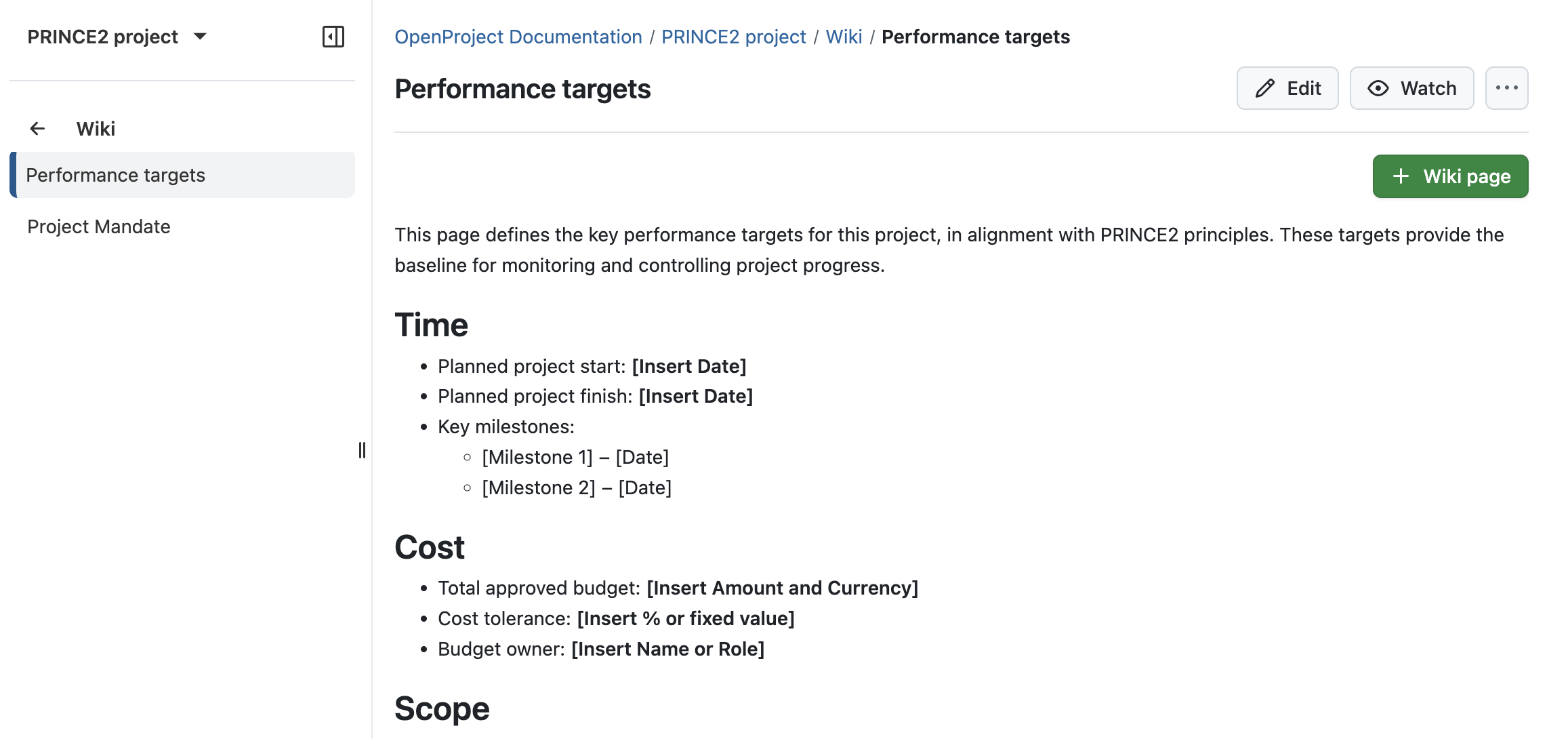
Use a Wiki page to summarize the project’s key targets — such as time, cost, scope, risk, quality, and benefits. This creates a shared understanding for everyone involved.
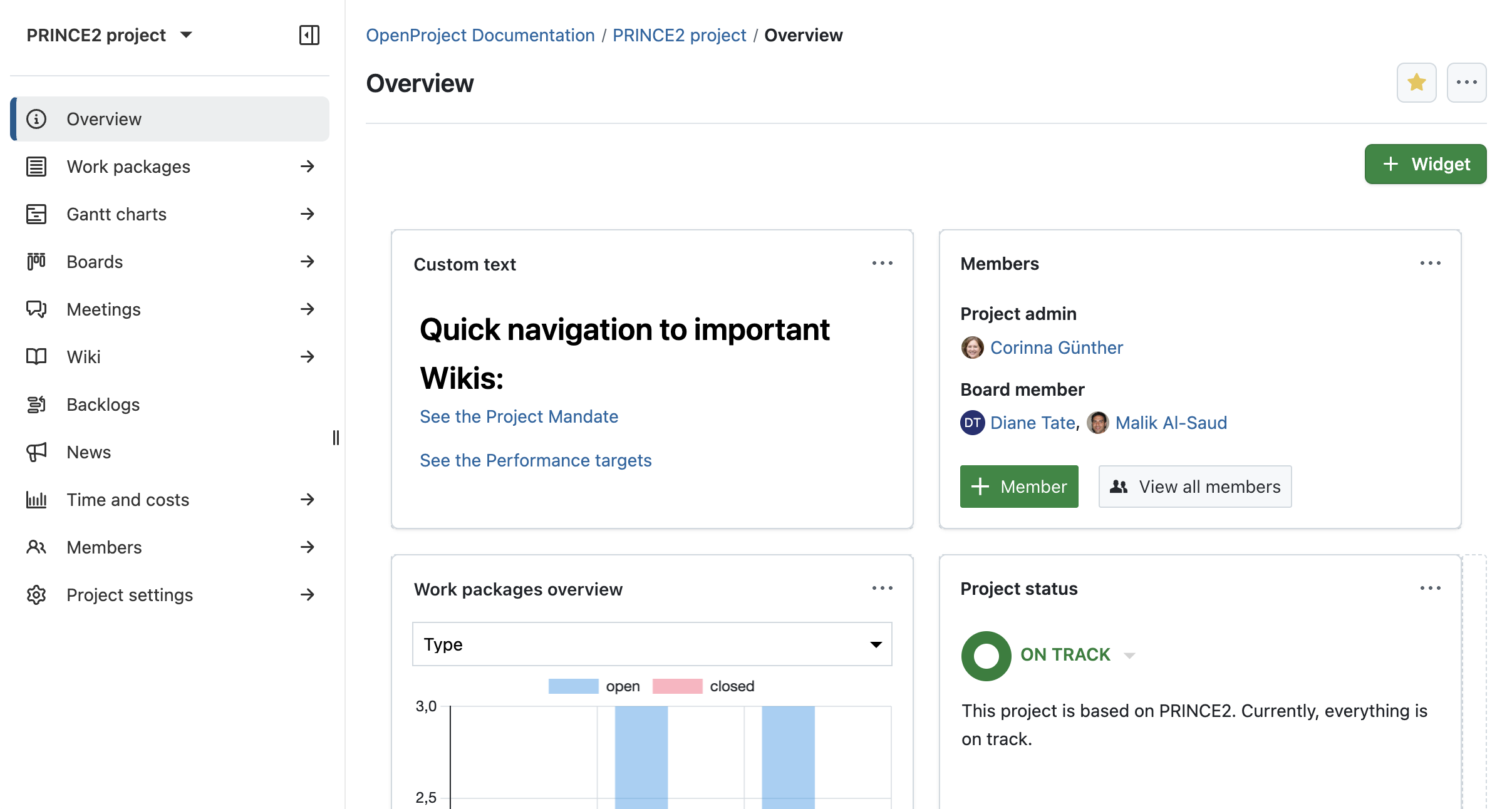
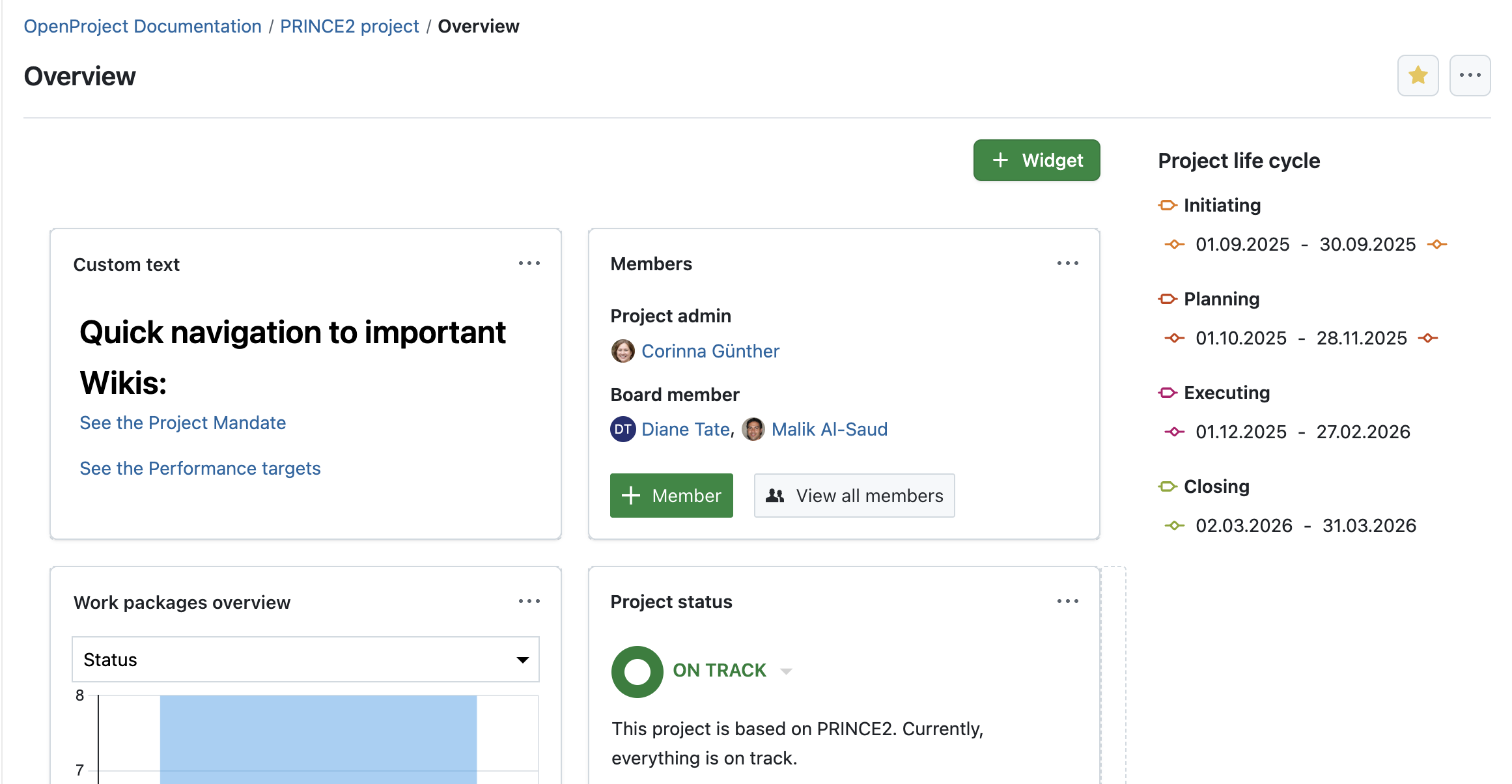
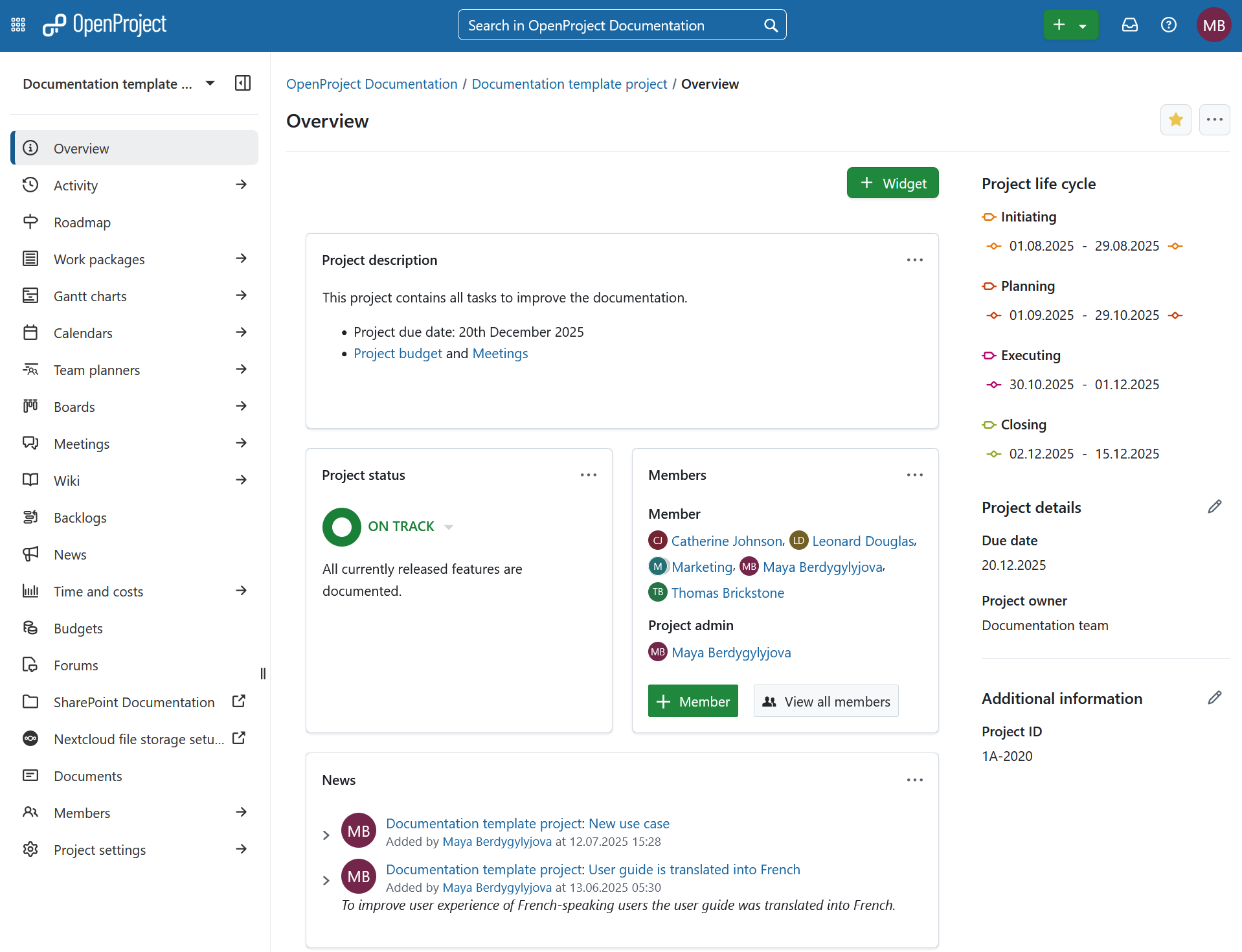
You can include the wiki as a custom text widget on the project overview page to make it visible at a glance. To do this, open the Overview, and click on + Widget, then select Custom text. On this page, you can also display other key performance targets to see all important information when accessing your project.
Set up budgets and assign them
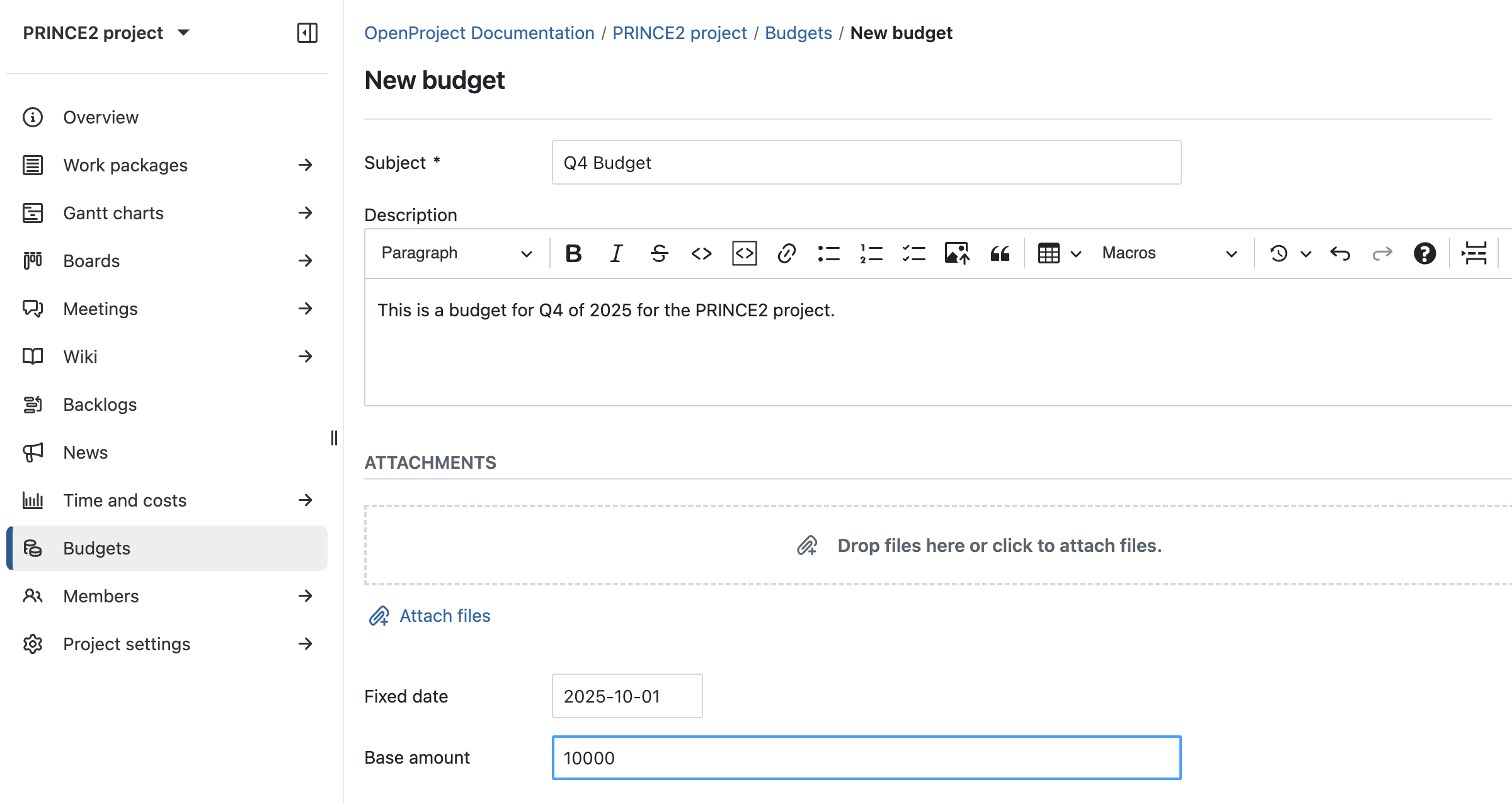
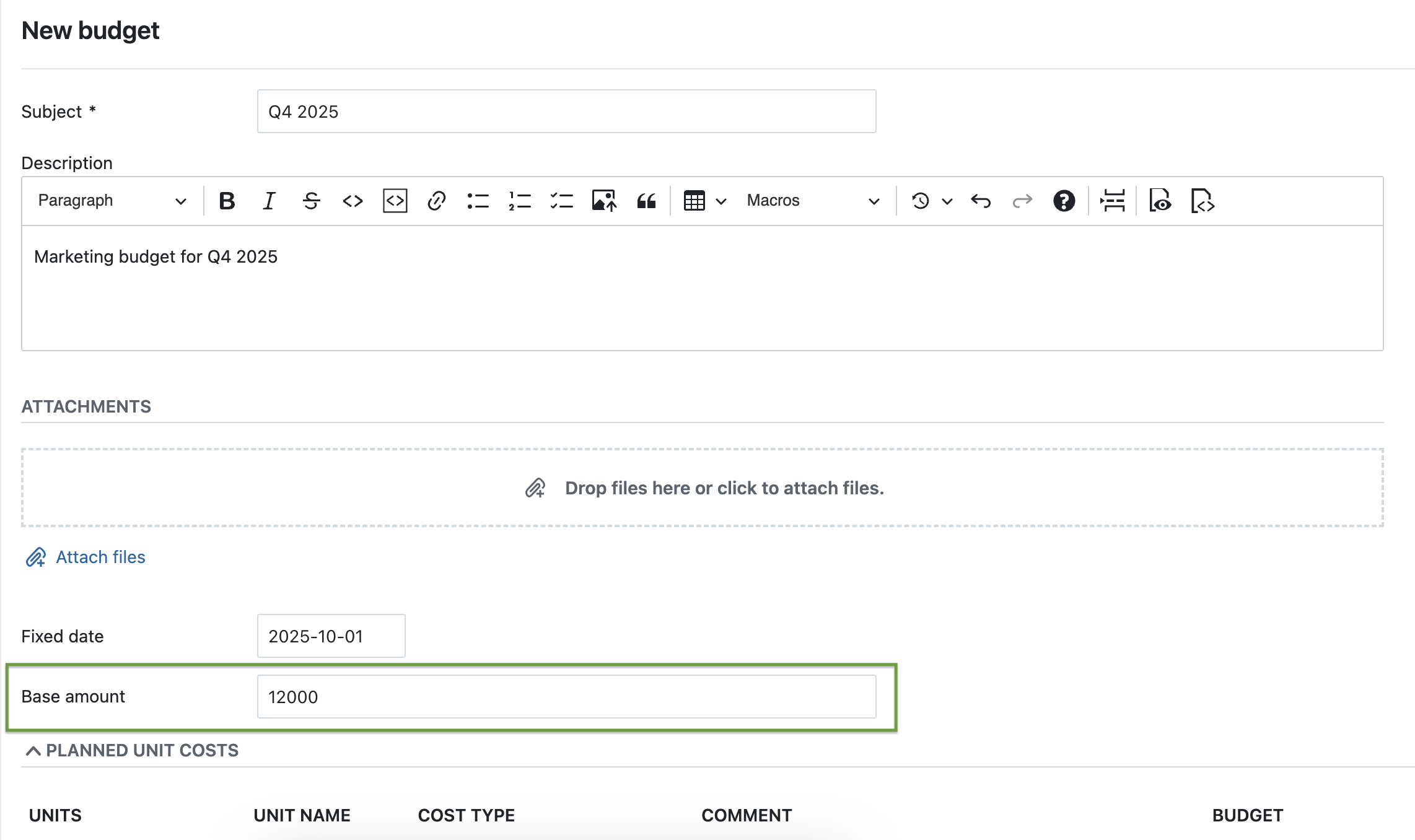
Go to the Budgets module to create a new budget. Enter a name and define cost units, such as hourly labor rates or material costs. You can also set a base amount. This will help you track whether the PRINCE2 project remains within its financial boundaries throughout.
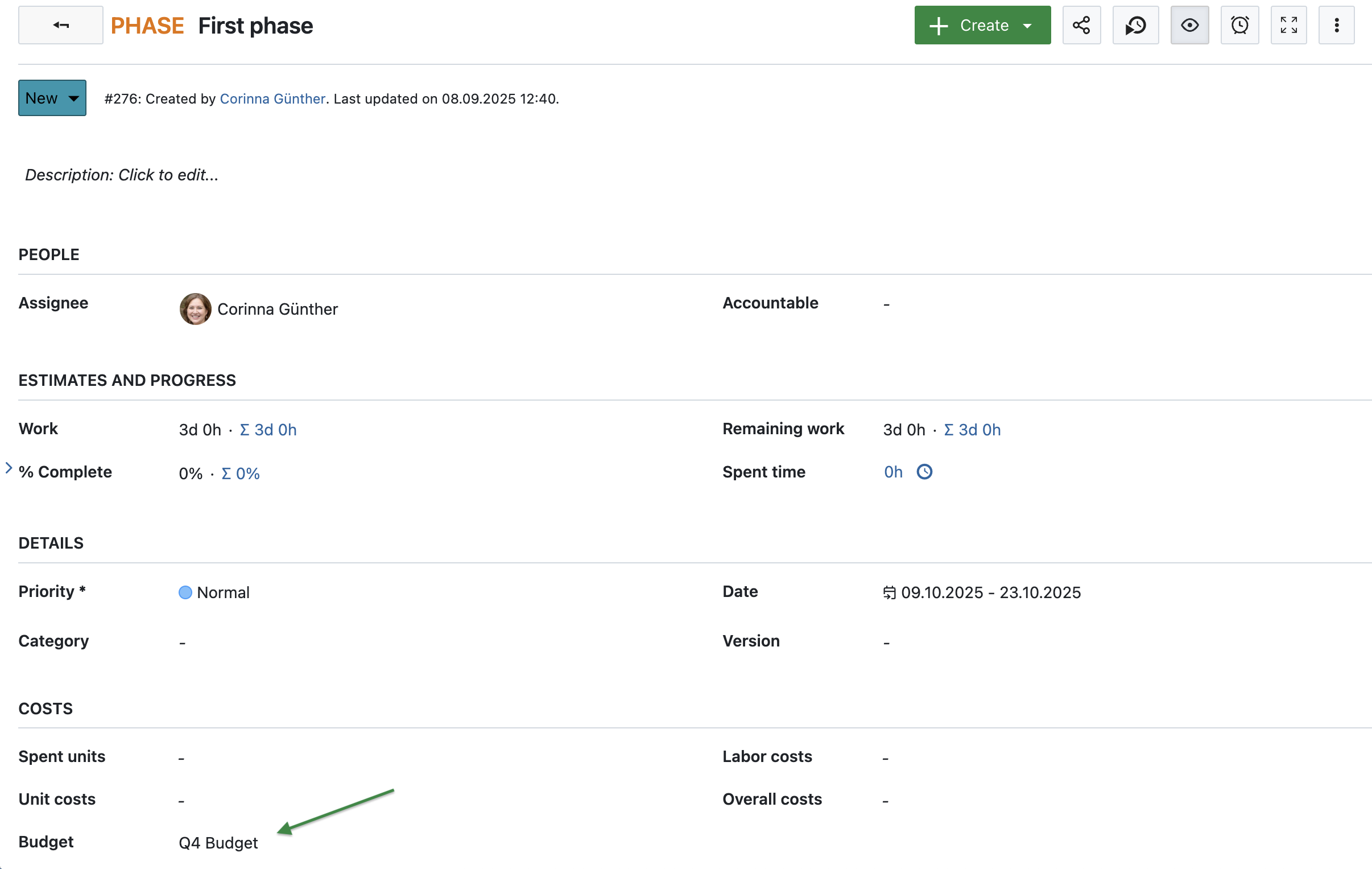
If you’ve created phases or milestones in the directing phase, you can now assign budgets to them. Click the info icon to open the Details view, then assign them to your budget under the Costs section. This ensures financial alignment across stages.
In PRINCE2, the project manager is responsible for monitoring progress within each stage and ensuring that work packages are delivered according to the plan. In OpenProject, you can break phases into smaller work packages, assign responsibilities, and track progress using the work package table.
Break down the work and create relations
After setting up the initial phases and milestones, continue by breaking the phases down into work packages. To do this, click on the three little dots next to a phase and select Create new child. Select type Task or Work package if you created a separate type for this. See the OpenProject user guide on how to create a new type.
To show dependencies between work packages and create logical links, users can create different types of relations between work packages, e.g. predecessor, successor, child, blocks, part of … or relations without logical effects on the related work package.
Estimate work
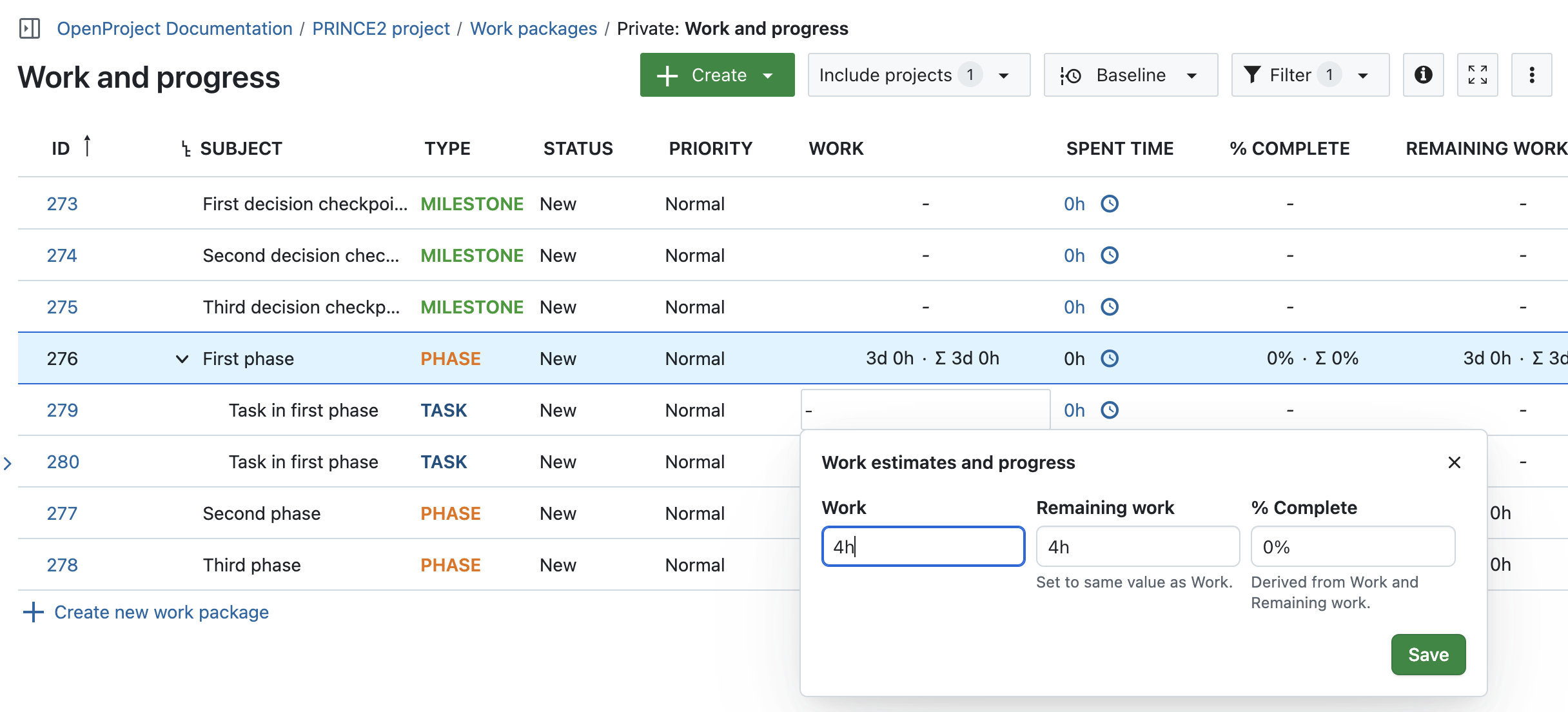
During the Controlling a stage process in PRINCE2, it’s crucial to track ongoing work and respond proactively to any risks of deviation. In OpenProject, the Estimates and progress section in each work package provides a clear overview of effort and status.
This section includes:
Work
Spent time
Remaining work
% Complete
To add work, you can either open a work package and add the information there. Or, if you want to edit several work packages right after each other, create a work package table that shows columns for progress. Add the column Estimated time to provide an effort estimate in hours.
Assign work
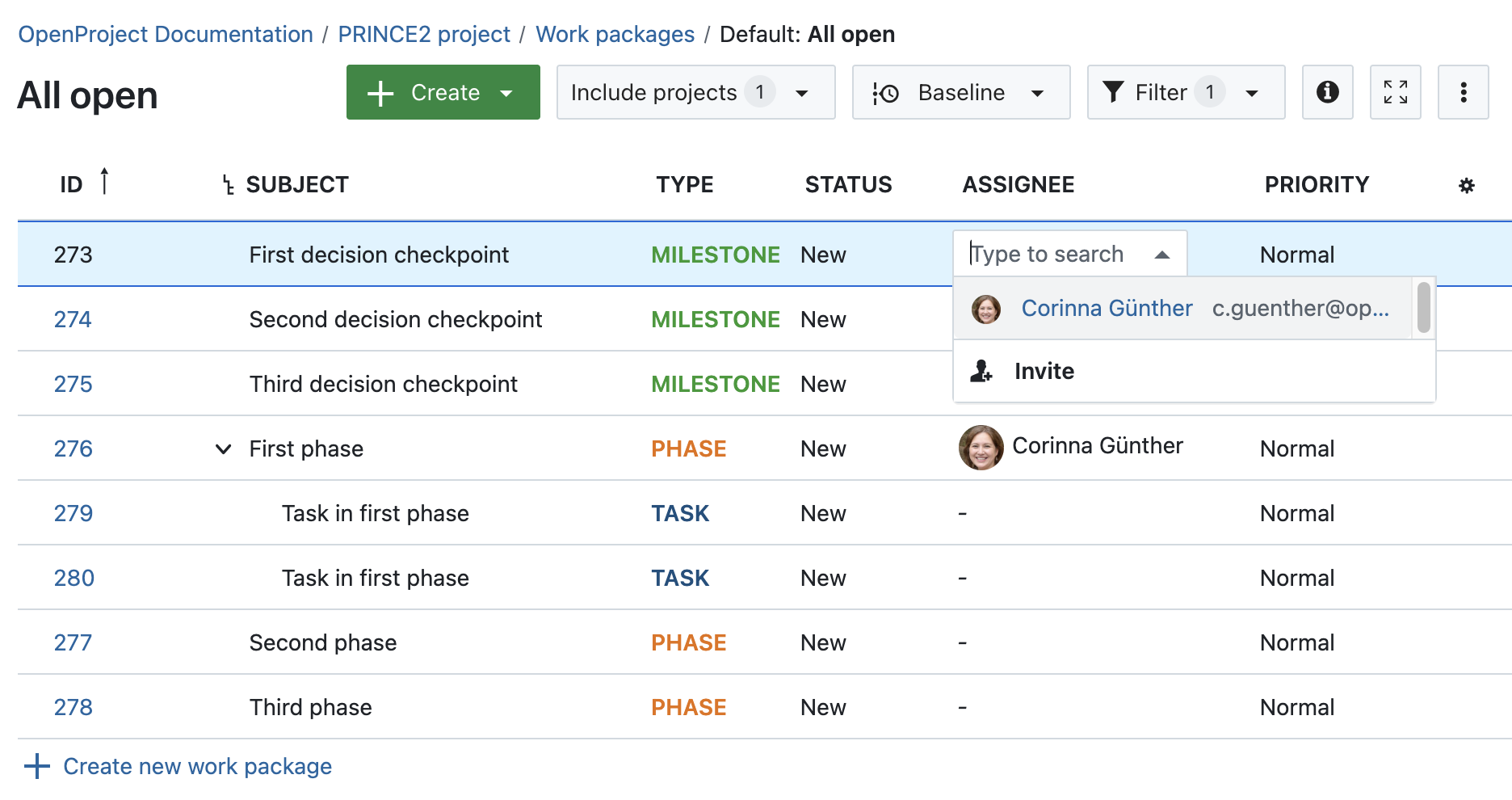
Afterward, continue by assigning the work packages to the project members by clicking on the cells in the Assignee column.
5. Managing product delivery
According to PRINCE2, this process focuses on the scheduled execution of work and the delivery of high-quality outcomes. OpenProject supports this through structured collaboration, time tracking, and transparent communication — all directly linked to each work package.
Log time on work packages
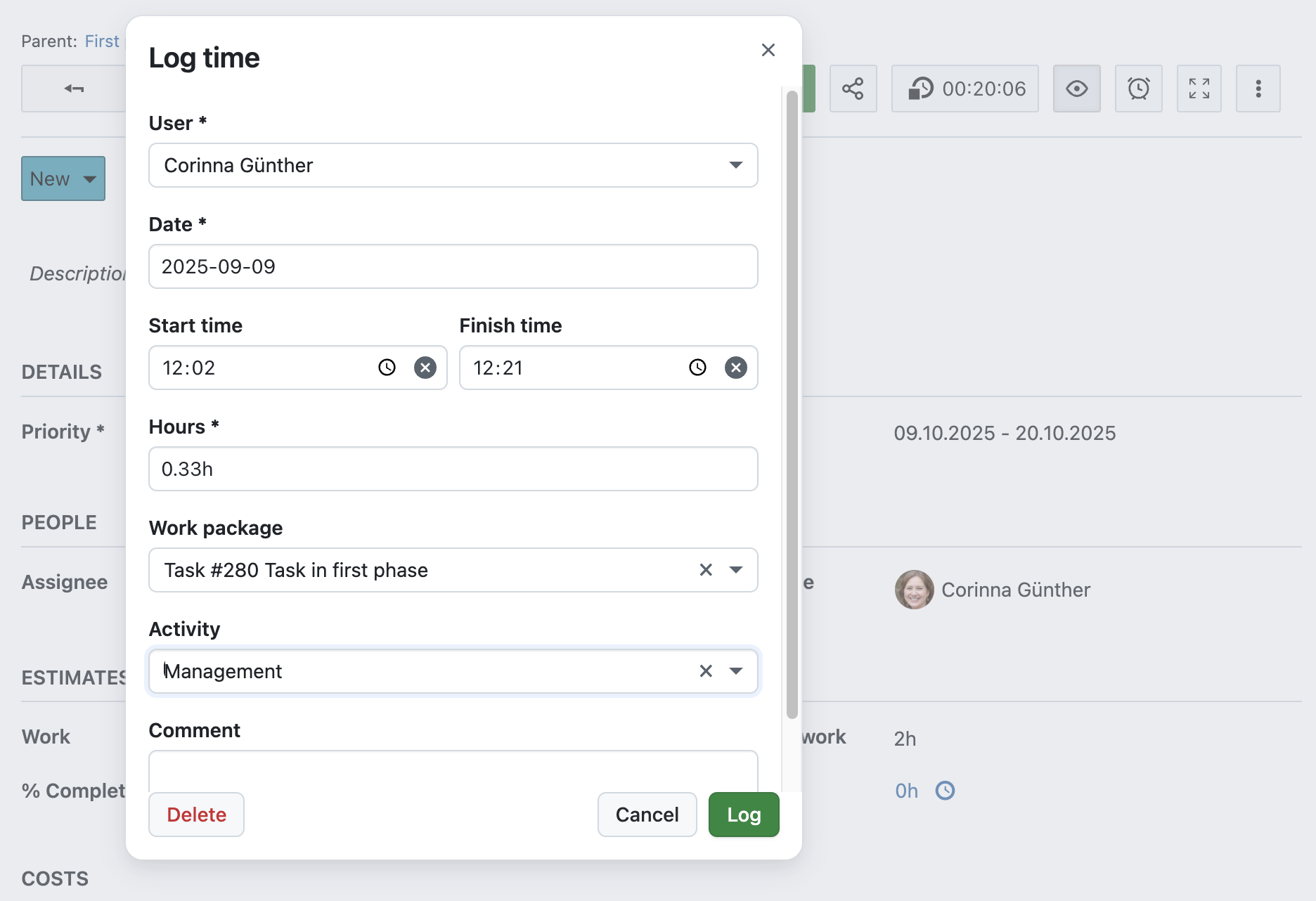
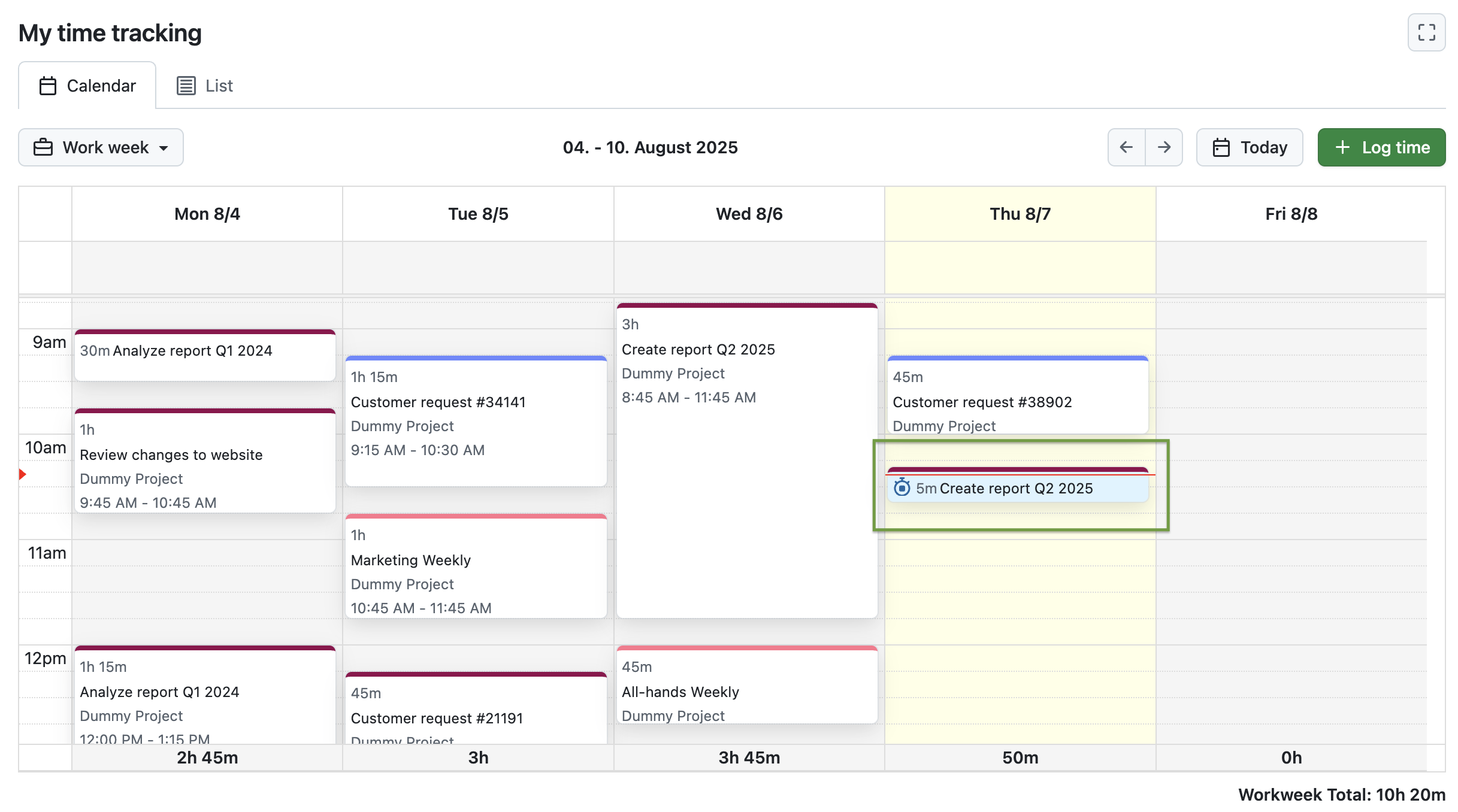
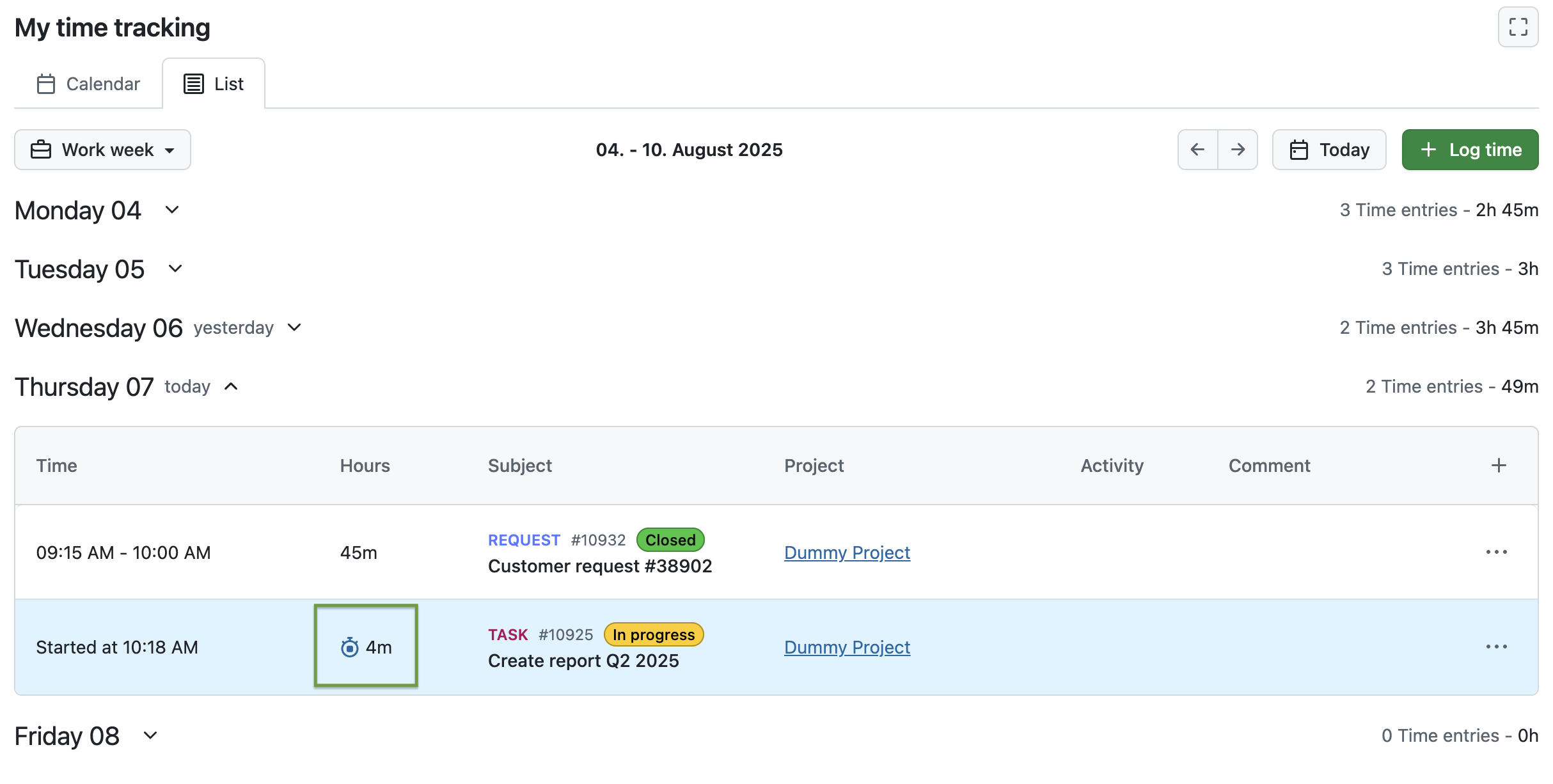
While working on the project, project members can log their time by opening the work package details view, selecting the More (three dots) menu and then the Log time entry. Alternatively, they can click the Time tracking button (clock icon) in the top bar. This starts a timer. Clicking it again stops the timer and opens the Log time modal with the duration pre-filled.
Communicate and document on work packages
To facilitate the communication within the project, OpenProject offers the forums, meetings and news module.
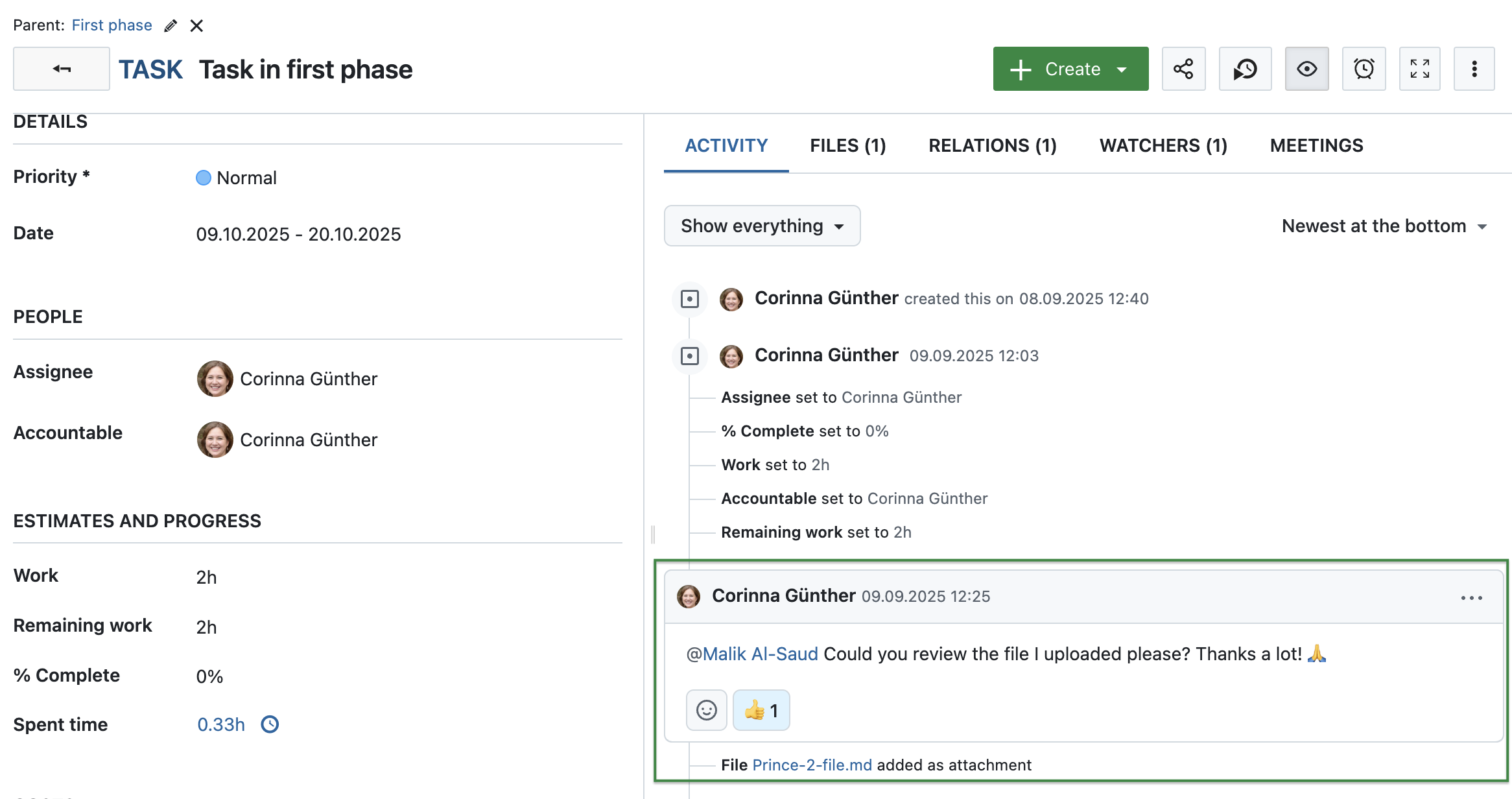
The Activity tab in each work package enables team members and project managers to collaborate and keep track of changes. Use @mentions, emoji reactions, and internal comments (available as Enterprise add-on) to stay aligned throughout the delivery phase. Read more about work package activity with OpenProject.
And then there is file management with OpenProject: Upload files with few clicks to your work package or use one of our integrations to link to and from Nextcloud, OneDrive (Enterprise add-on) or SharePoint (Enterprise add-on).
6. Managing stage boundaries
In PRINCE2, every stage should end with a review and approval before moving on. In OpenProject, you can support this by structuring your project into phases and milestones, tracking progress in the Estimates and progress section, and reviewing key outcomes with the team.
The progress of the phases is documented automatically in the Activity section of the phase. Additionally, the progress can be set directly, as we described in the section on how to control a stage.
Manage meetings
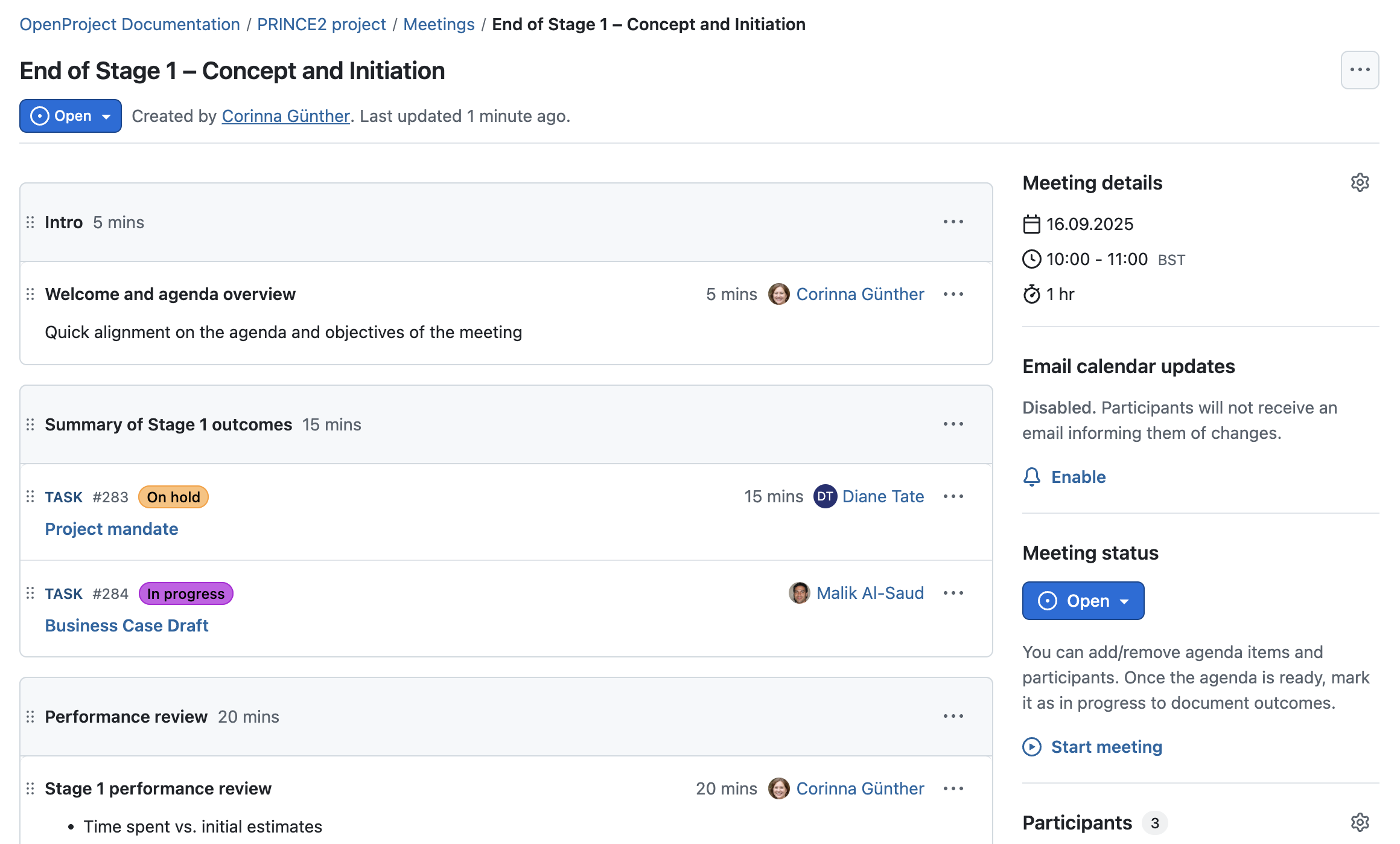
To review progress and make go/no-go decisions between stages, we strongly recommend using OpenProject’s Meetings module. It allows you to prepare structured agendas, assign work packages for discussion, and document decisions directly — all in one place.
You can use recurring meetings (e.g., after each stage) and apply templates to keep reviews consistent across projects. During the meeting, outcomes can be recorded directly in the agenda, and follow-up actions can be created as work packages right away. This ensures accountability and traceability for your stage boundary decisions.
Tip
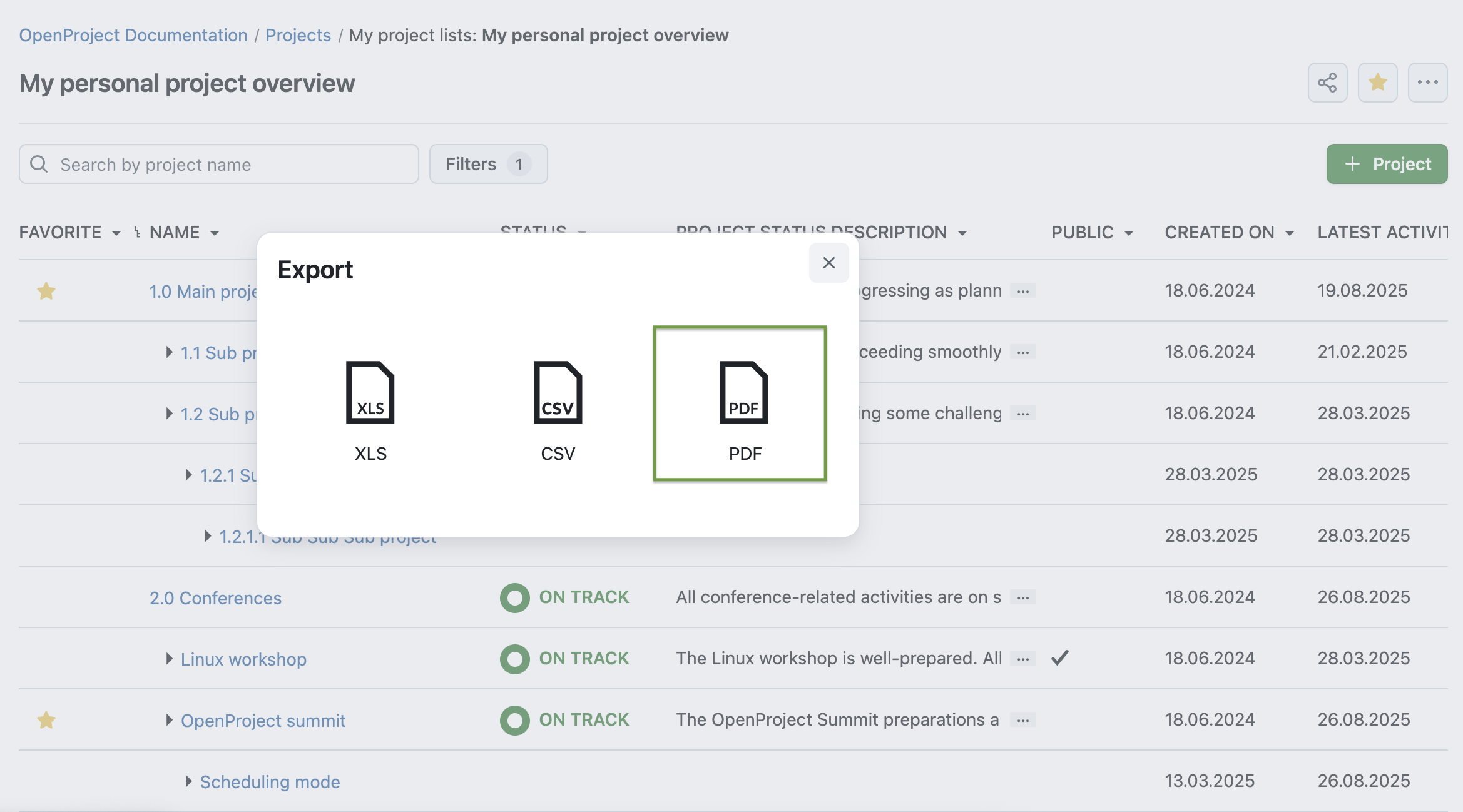
Need to share meeting notes with external stakeholders? Simply export the meeting as a PDF to circulate a summary of key outcomes.
Project life cycle with stages and stage gates
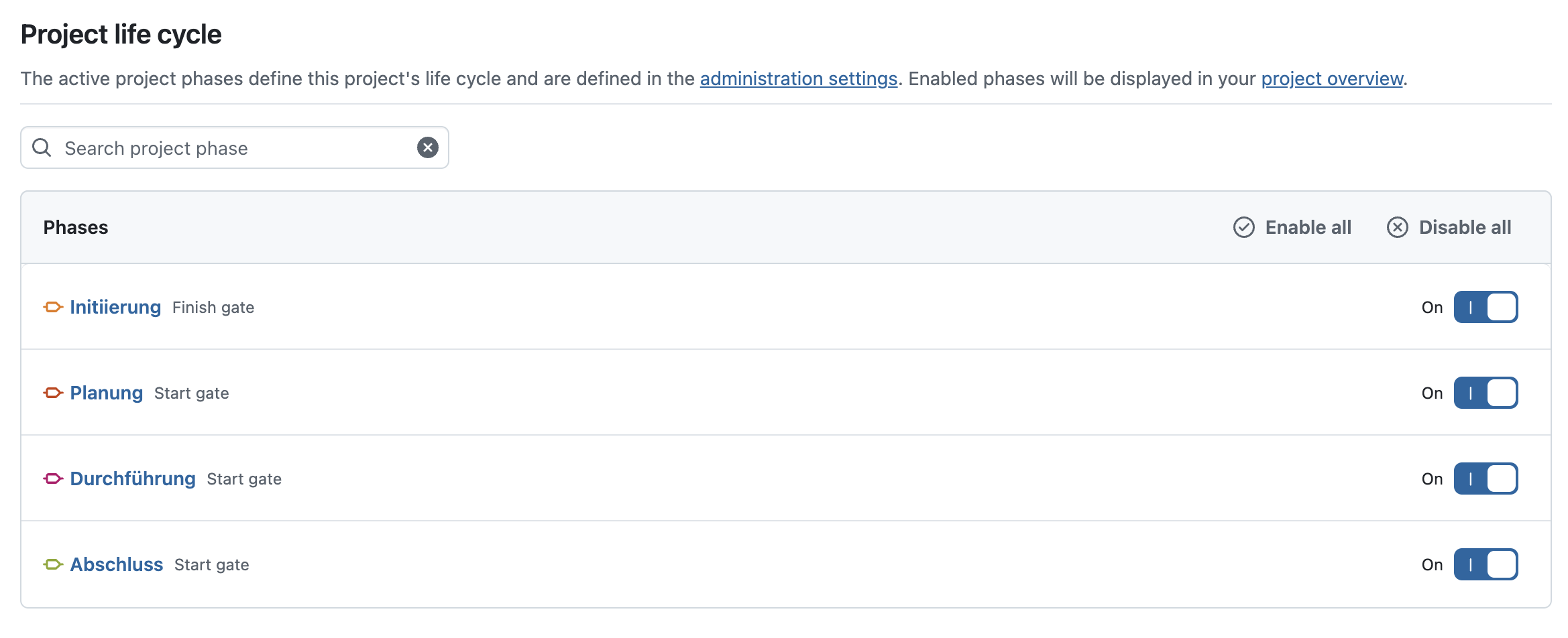
Support stage transitions with approval gates: OpenProject’s project life cycle feature — originally designed for the PM² framework — lets you define phases and gates. In our Enterprise edition, you can edit them and create new ones. Use this feature to visually structure your PRINCE2 stages and introduce checkpoints for management approvals before continuing.
Baseline comparison
To assess how you’re performing against your original plan, use the Baseline comparison feature. With one click, you can quickly see what has changed in your work package tables since a previous snapshot—helpful for identifying deviations before moving to the next stage.
7. Closing the project
In PRINCE2, closing a project means formally completing all work, reviewing outcomes, and handing over deliverables. OpenProject provides the structure and documentation tools to support a smooth and transparent closure process.
PDF reports
When all the tasks, phases and milestones have been completed, you can document the final project report in a wiki page, add a news or create a new document. If you finish your project with a meeting, you can download this as a PDF to generate a final report as well.
Archive the project
As a last step, you can archive the project by selecting Project settings and then Archive. If you think you’ll work on a project with a similar structure in the future, you can also set this project as a template.
Tip
Archiving a project also helps keep your workspace clean and focused on active work. You can still access closed projects and filter them in your project list as needed.
Apply PRINCE2 to your free OpenProject test environment
Whether you’re certified in PRINCE2 or simply looking for a structured, flexible framework, OpenProject gives you the tools to manage projects with clarity, accountability, and transparency — all in a secure, open source environment.
More and more organizations are turning to open source alternatives to implement PRINCE2 and avoid vendor lock-in or rising license costs. With OpenProject, you can build workflows that match your organization’s needs, without compromising control.
Start your free OpenProject trial now and see for yourself how you can implement your company’s workflows with OpenProject. No credit card, no phone number, no strings attached. So there’s really no reason not to give OpenProject a try: https://start.openproject.com/
Working remotely has many advantages, above all maximum flexibility for employees. However, having colleagues spread across the globe also has the disadvantage that you can’t just meet up for a coffee or after-work get-together.
That’s why we in the OpenProject team – which works 100% remotely – try to make sure that social interaction isn’t neglected. One way to socialize in a relaxed atmosphere is through monthly game nights, which are organized by and for employees outside working hours.
Read this article to get an insight into what these events are like.
Ways to make remote work fun
So, how do you keep connected in a remote team? You don’t have hallway conversations, you don’t have socializing in the office after 5pm, you don’t even have similar summer or Christmas events as in non-remote companies.
At OpenProject, here’s what we do to socialize:
Virtual Christmas party,
On-site meetups wherever possible, at least once a year with the whole company,
Monthly random coffee chats (2-4 people),
After work game nights.
Together, these activities help keep the team together and bring fun to work. Let’s take a closer look at OpenProject game nights now.
How game nights at OpenProject work
Game nights are internally organized by employees and usually take place once a month, always outside working hours and are, of course, absolutely voluntarily. Even though sometimes new colleagues join, it’s usually the same group of 5-10 people who are participating.
We started the first game night in 2023, and it soon became an unofficial, but regular place to socialize.
And over time, game night has also become a space for running jokes and shared humor.
To keep things easy and fun and include everyone who wants to participate, we follow these simple ground rules:
Browser-based games only,
Free to play only,
In the evening, outside working hours,
Once a month, we start a poll to decide on the next date.
Games we like to play
As mentioned above, we restrict ourselves to browser-based games to have low-entry barriers. Here are some of our all-time favorites:
skribbl – Each player takes turns drawing a term, which the others guess via text chat (as often as they like). Points are awarded for guessing correctly quickly and for drawing well.
codenames – Two teams play against each other, with one person from each team having to explain certain terms from a 5x5 grid of cards to their team. But: they are only allowed to say one word and one number (indicating how many cards are meant).
timeguessr – You see a random picture and have to decide when and where it was taken. We play that by one person sharing their screen and us collectively discussing to find the right solution.
make it meme – A fun game in which each person chooses a meme (image) and adds text to it. After a few minutes, the outcomes are presented and you can vote for the memes you like best. For us, this is THE game of inside jokes.
garticphone – There are various creative game variations to choose from. They all involve drawing and a kind of Chinese whispers. For example, everyone draws a picture, then receives the picture of another player and has to write a short description. After that, everyone receives only a text and has to draw a picture to go with it - and so on.
wikispeedruns – This game plays through Wikipedia: You choose a starting term and an ending term – e.g. from OpenProject to Banana. To get from the Wikipedia page for the starting term to the ending term, you have to click on links in the text. The player who needs the fewest clicks wins.
Some games are cooperative, some are competitive, and most require a little creativity. A mouse is helpful, especially for drawing-based games, but other than that, all you need is a stable internet connection. And, of course, it’s not really about winning or creating the most beautiful doodles — the focus is always on having fun together.
Some visual insights
Image: Outcomes of a game called Garticphone: One draws something, the next person has to re-draw it but with less time, and so on. From art to absurdity in a few hilarious steps.
Image: Collage of outputs created during OpenProject game nights. Two doodles from garticphone, one meme from make it meme, and one image from wikispeedrun.
Note
As OpenProject employees speak different native languages, we generally communicate in English. Still, it happens sometimes that all game nights participants are German speaking. This is where we switch language and the reason why one image from the above is in German.
Want to take part? Become a colleague!
These social activities are organized by the team, for the team — and are entirely optional. But they’re a great way to have fun together. If this sounds like the kind of workplace you’d enjoy, take a look at our current vacancies.
OpenProject 16.4 has been released and this version introduces new features and improvements again. We look forward to hearing your thoughts and feedback on the latest updates. Please take a few minutes to learn what changes for you. We will summarize the most important changes in this blog article and, as always, please see our release notes that contain all changes, features and bug fixes.
In this blog article, we will focus on two main topics: the new automatic color mode sync together with dark high contrast mode for a more convenient and accessible interface, and the PDF export of project lists for more professional reporting.
We will also briefly summarize additional important features. Here is a quick navigation to all feature descriptions:
We always have many milestones on the roadmap, but some features stand out because they affect everyone. With OpenProject 16.4, you can enable automatic color mode sync in your personal settings. OpenProject will then match your operating system (OS) preference and switch automatically between light and dark mode. If your OS uses high contrast, OpenProject will select the corresponding light high contrast or dark high contrast mode for optimal readability.
These different color modes are more than just convenient options. They are part of our ongoing commitment to accessibility — a principle that has been part of OpenProject from the very beginning, when the project was forked from Redmine in order to remove accessibility barriers. You can read more about this in our articles on real progress in accessibility, written by Niels Lindenthal.
By the way: When our developer Kabiru Mwenja, who is responsible for the color mode changes, demoed the auto-sync feature for the first time, the whole team was genuinely excited. This shows that even though it is a simple option, it makes a real difference in everyday work for many users.
On the one hand, we still believe that the best way to collaborate is directly in OpenProject with living documents. On the other hand, we also know that for many organizations, PDFs remain an essential format. Whether for regulatory requirements (e.g. in the public sector), for digital or printed filing, or simply for sharing professionally styled reports with stakeholders.
This is why, over the past two years, we have continuously added PDF export features to different modules: work packages and tables, work package descriptions, meetings, Gantt charts, timesheets — and now also project lists.
With OpenProject 16.4, you can now export project lists as structured PDF reports. The export includes:
A table of contents that reflects your project hierarchy (when multiple projects are included).
A cover page and numbered sections (e.g., 1, 1.1, 1.2).
Linked section titles to jump back into OpenProject.
The same attributes and order that you configured in the list view.
To export, open the More (three dots) menu on the project list and select Export. In the modal, choose XLS, CSV, or – now also possible – PDF.
Custom fonts for all PDF exports (Enterprise add-on)
Another improvement, available as an Enterprise add-on for customers of Enterprise Basic and higher, is the ability to define custom fonts for all PDF exports. Administrators of the Enterprise Basic plan and higher can now upload fonts under Administration → Design → PDF export font. Once uploaded, the font will be used consistently across every PDF export in OpenProject — from project lists and work packages to meetings, Gantt charts, and timesheets.
This feature is particularly important for organizations with strict corporate design requirements. It ensures that all exported documents reflect the organization’s professional branding and style.
Improved meeting participants dialog
Managing participants now runs smoother: you can search and multi-select users with autocomplete when preparing a meeting, and track attendance during the meeting with simple toggles — including Mark all as attended. The dialog also aligns visually with sharing components and shows a cleaner status on the right pane and in PDFs.
Synchronize group information via OIDC (Enterprise add-on)
OpenProject 16.4 introduces the ability to synchronize group memberships from your OpenID Connect (OIDC) provider. This makes it easier to manage user groups and permissions centrally in your identity provider and ensures that memberships in OpenProject reflect those settings whenever users log in. Admins can filter which groups to import, extract name substrings, auto-create groups, and distinguish between locally managed vs. synchronized memberships.
Improved budget handling in project queries and budget planning
Budget setup is more practical: you can define a Base amount (a fixed sum) without detailing material or labor costs — and still add them later, if needed. Project lists now include planned budget, spent budget, spent percentage, and available budget for a clearer overview. We plan to continue improving budgets in upcoming releases. Read more about budgets in our user guide.
Updated Home and Project overview page
We refreshed the widgets on the Home and the Project overview pages:
cleaner styling (white backgrounds in Light mode, rounded corners, improved Dark mode support),
an always-visible More (three dots) menu,
a clearer add widgets click zone,
and a new + Widget button in the subheader that opens the selection modal and places new widgets at the top for instant feedback.
OpenProject 16.4: Migration, installation, updates and support
You will find more information about all new features and changes in our Release notes or in the OpenProject Documentation.
If you need support, you can post your questions in the Community Forum, or if you are eligible for Enterprise support, please contact us and we are happy to support you personally.
New to OpenProject? To test all features of OpenProject 16.4 right away, create a 14 days free trial instance for our OpenProject Enterprise cloud.
Prefer to run OpenProject 16.4 in your own infrastructure? Here you can find the Installation guidelines for OpenProject.
A very special thank you goes to Helmholtz-Zentrum Berlin, City of Cologne, Deutsche Bahn and ZenDiS for sponsoring released or upcoming features. Your support, alongside the efforts of our amazing Community, helps drive these innovations. Also a big thanks to our Community members for reporting bugs and helping us identify and provide fixes. Special thanks for reporting and finding bugs go to Björn Schümann, Harald Herz, James Neale, Rince wind, Alexander Aleschenko, Sam Yelman, Stefan Weiberg, Tom Gugel, Johannes Baumgarten, and Christoph Nodes.
Last but not least, we are very grateful for our very engaged translation contributors on Crowdin, who translated quite a few OpenProject strings! This release we would like to particularly thank the following users:
Alin Marcu, for a great number of translations into Romanian.
William, for a great number of translations into Chinese Traditional.
OlhaTrotska, for a great number of translations into Ukrainian.
Would you like to help out with translations yourself? Then take a look at our translation guide and find out exactly how you can contribute. It is very much appreciated!
As always, we welcome any feedback on this release. 💙
Marketing teams, we know your struggles. Your content planning deserves better than sticky notes and scattered tools. Sometimes, all it takes is a smart structure and the right tool to turn chaos into clarity. Customize OpenProject to plan your content efficiently in one place — it’s free, open source, and built for team collaboration. From discussing a new strategy to handing over content pieces for review, manage your marketing work in a clear, precise way. And be the flagship of your organization.
This article gives you tips and practical insights into how we at OpenProject use our own tool: for content planning, social media calendars, campaign coordination, and more.
Looking for a great and low-cost content planning tool?
Especially small marketing teams face challenges like:
How do we plan and organize our content effectively?
How can we make it transparent which content still needs review or is ready to be published?
What should we do with content ideas that aren’t ready to be scheduled yet?
How can we make sure the whole team has full visibility into content plans and responsibilities?
How do we coordinate with other departments — like Sales or Product — without endless email threads or lost feedback?
How can we collaborate with freelancers or external partners without granting access to everything?
And above all: How do we keep everything in one place, without paying for yet another tool?
OpenProject is free and open source
Maybe you’ve already tried to solve these challenges with tools like Trello, Asana, or Notion — but none of them fit your exact workflow? Perhaps they lack transparency, are hard to customize, or simply cost too much?
OpenProject is a powerful alternative to these content and project planning tools. It’s free and open source — which means no licensing fees in the Community edition, full data control, and maximum flexibility. You can tailor your setup to match exactly how your marketing team works.
OpenProject makes it easy to manage all types of content in one place — from blog articles and social posts to videos, designs, and written copy — so your entire planning process stays connected.
It comes with all the essential features for content planning and team collaboration:
Agile boards to track content status from draft to publication.
Calendar views to schedule blog posts, campaigns, and social media content.
Relations between tasks / content pieces (e.g. the social post for a blog article).
File management and comments to collaborate transparently in one place.
Insights: How to use OpenProject in a marketing team
But let’s get specific: What does OpenProject actually look like when used as a content planning tool? In the following sections, we’ll give you a detailed look into how we — the OpenProject marketing team — use our own software every day. Because we know the struggles of content planning firsthand. And we know exactly how to tailor OpenProject to organize and structure marketing work effectively.
OpenProject gives you a lot of flexibility — but you have to know how to make the most of it.
Content planning with OpenProject
Let’s start with the basics: In OpenProject, everything begins with a “project” — but that doesn’t mean it has to be a classic project with deadlines and deliverables. You can simply create one called “Marketing” and use it as your team’s workspace. Depending on your structure, you can also create sub-projects like Content marketing or Event marketing. If you’re a small team, we recommend starting with just one project, which keeps everything in one place and is easy to manage.
Now it’s time to define your work packages. In OpenProject, work packages are the building blocks and can be of types like task, campaign goal, blog article, or social media post. This is where the flexibility of OpenProject really shines: You define the types that make sense for your marketing work, and you choose the status values that reflect your workflow.
For example, a blog article might move through the following statuses: New → To be scheduled → Scheduled → In progress → Needs review → Closed.
To make your setup even more precise, you can use roles like Assignee and Accountable to clarify responsibilities — for example, who’s currently reviewing a piece and who’s ultimately responsible for delivery. And if your team needs additional information to stay aligned, you can define custom fields to track things like campaign goals, target audiences, or publishing channels. It’s all fully customizable to match your team’s workflow.
Table view or board view — work how your team prefers
In OpenProject, you can work in different views depending on your team’s style:
The Table view shows your content tasks in a familiar spreadsheet-like format. It’s great for bulk editing, filtering, grouping, and customizing columns — like status, finishing date, or assignee.
The Board view lets you organize content in an agile Kanban-style layout. It’s perfect for visual planning and drag-and-drop changes between statuses like In progress, Needs review, or Published.
You can switch between views anytime, and every view can be customized to show exactly what your marketing team needs.
With this structure in place, your marketing team is ready to manage all kinds of content workflows, from blog posts to social media management and event planning.
Blog article management
We’ve already given you some insights in our blog article management above. Let’s walk through the full process, from idea to publication.
One person comes up with an idea and creates a new work package of type Blog article. They add all their thoughts into the description and @mention their colleagues or team leads in the Activity tab to discuss if and when this idea is ready to follow up on.
The mentioned person answers and updates the status from New to To be scheduled. They also assign the work package to the person responsible for writing and publishing.
When the article is written, the status is set to Needs review and the assignee is changed to the colleague who will do the review. This makes responsibilities clear at every stage.
When the article is ready to be published, a date must be set. If you’ve set up a calendar (by filtering for type blog article), the article will now be shown there.
Here’s an insight into the blog article calendar at OpenProject:
Tip
Subscribe to your OpenProject calendar from your external calendar app. This way, you always see when blog articles are scheduled. This isn’t just helpful for your team, but also for Sales, Support, or others who want a quick overview of upcoming content.
Once the article is published, the work package is marked as Closed. This removes it from your open work lists, but it still exists for future reference or performance tracking.
Of course, you might now want to share your new content piece for the world to see. To do so, let’s look at how to manage social posts with OpenProject.
Social Media management
Once your content is ready, it’s time to get it out into the world — and social media is usually the next step. With OpenProject, you can plan and coordinate your social media posts just as precisely as your long-form content.
Each social post becomes its own work package. You can set the type to Social media and use custom fields to track channels (e.g. LinkedIn, X/Twitter, Instagram) or campaign tags. This keeps everything structured and filterable.
A typical process might look like this:
Create a work package of type Social Post for each planned social post. Add the content draft directly into the description or attach a file if needed. Make sure to add a date so that your post will appear in the calendar.
Add relations between social posts and the content they support (e.g. a blog article or campaign). That way, you always see which social activities belong to which main content pieces.
Assign responsibilities and collaborate in the comments to finalize your posts. You can also assign the whole team if you don’t know yet who will take care of it.
Event and campaign management
At OpenProject, we actually don’t run many marketing campaigns or large-scale events — but we know how crucial structured coordination can be for teams that do. Especially when multiple parties are involved, things can get messy fast without a clear system.
That’s where OpenProject’s flexibility really helps: You can create a dedicated subproject for each event or campaign. This allows you to keep your planning structured, define specific settings, and even invite external stakeholders or agencies without giving them access to your full Marketing workspace.
Meeting management
Need to align schedules, assign tasks, or review campaign materials? Use the Meetings module to prepare agendas and capture outcomes. This helps not only with event preparation, but also with recurring internal check-ins or retrospective meetings.
Tip
At OpenProject, we use our own Meetings module for regular 1:1 meetings between the team lead and content manager. The content manager simply adds the work packages they’re currently working on or need to discuss — and a meeting template ensures all sessions follow a consistent structure. This is what we mean by keeping “everything in one system”.
Team collaboration beyond your marketing team
OpenProject is the perfect choice for open-minded and clever marketing teams who want to customize a content planning tool to their exact needs. From managing blog articles and planning social media posts to coordinating campaigns, events, and team meetings — everything stays in one place, structured and transparent. You define the workflow, the content types, and the collaboration setup.
Marketing teams are often the first to structure their work, but rarely the first to get the tools they deserve. OpenProject helps you take the lead by offering a free content planning tool: streamline your content workflows, collaborate efficiently with other teams, and set an example for transparent, organized work across your organization.
Show what smart teamwork looks like. Become the blueprint for how your company gets things done.
Start your free trial today
You’re probably not reading this just out of curiosity. You’re managing campaigns, chasing approvals, and trying to bring order to creative chaos. We’ve been in the same spot, and that’s why we built this setup for ourselves. If it works for us, it could work for you too.
You know that every good article ends with a call to action, and here’s ours: Start your free trial today. No credit card, no phone number, no pressure. After 14 days, it’s entirely your call whether to continue — but we believe OpenProject will speak for itself.
Using project templates will save your team a lot of time. No more repetitive work and you also streamline the way your organization works, making sure the structure of your projects is coherent.
Let us have a look at how you can set up project templates in OpenProject.
Create and remove project templates
In OpenProject, only administrators can create and remove project templates. That way, there is a handful of people ensuring consistency and overseeing the amount and structure of templates.
To set up a new project template, you do the same as creating a new project.
You name your project that will become your template.
To make this project a template, go to project settings and click on the 3-dot-menu to choose set as template to make the project a template.
In case a project template is not relevant anymore and should not be used any longer, this is also the spot where you can remove it from templates.
Project templates example case
We will demonstrate which modules you can set up to make best use of project templates.
Let us use the example of organizing a conference. This is something that can occur frequently, e.g. quarterly or annually. In order to not having to start from scratch every time and also to help in case different colleagues are organizing conferences, a template can be very useful to save time and build on past experiences.
Naming your template
When you create your project template as described above, consider adding template to its name, making it easy to distinguish it from your normal projects. Your project template will appear e.g. in the project list so that you would want to be able to see which of the projects serve as templates.
Modules template
Activate the relevant modules for your template und project settings. This way these modules will always appear and can be used straight away.
Work package template
Set up the work packages needed to manage your project from initiation to closing. Thereby include relations and hierarchies to make it quick and easy when you start a new project from your template.
Of course you can also customize your work package form in the template to include all relevant information for your organization. Every time you open a new work package, you will then see the attribute list that you had set up.
Agile boards template
If you are using the boards view to get things done with your team, set these up, too. Configuring the lists of action boards will provide you with prefilled boards as they automatically draw input from your work packages.
Members template
Consider setting up your members for your project templates. Either the whole team will always be the same or you set up the core members that will for sure be part of a project like this. Define roles and permissions, rates and groups.
Custom fields template
Creating custom fields in your project template allows you to have it available for all future projects based on this template. We created for example an approval field so that managers can approve artworks or merchandise or the likes. Please note that if a custom field is enabled globally, it will automatically be displayed in a template project.
Project attributes template
If you want to display specific attributes on the project overview page, you can create new project attributes for your template project.
Select a template for a new project
We showed only the most relevant modules to give you an idea about the benefits of project templates. Other modules like Meetings or Wiki can of course also be set up for your template.
When creating a new template, you can now choose the template you created – and select the modules you would like to copy.
Important
Please note that due to complexity reasons, the modules Budgets and Time and costs cannot be copied for now. Please do not set these up in your template as when you use the template, these modules will appear empty in your newly created project.
For more information about project templates and other OpenProject-related questions, please see our documentation.
Programme management in public administration is complex. Multiple projects need to be coordinated, dependencies managed, and the achieved benefits demonstrated transparently. With PM², the project management methodology of the European Commission, there is a clear framework for this. The German Federal Office of Administration has adapted this standard with PMflex specifically for German authorities – practice-oriented and with checklists for programmes, portfolios, and projects.
To keep an overview as a programme manager, you need a central control point – a kind of cockpit that bundles all relevant information. The open source software OpenProject, developed in Europe, provides exactly this support. In this article, we present seven features that specifically support and empower you in programme management.
What does good programme management mean?
Good programme management means steering several interrelated projects so that they jointly deliver the planned benefits. Unlike project management, it is not only about successfully completing a single initiative, but about keeping the overall impact in focus. While portfolio management sets the strategic selection and prioritization, programme management ensures the coordinated operational execution.
For public administrations, this approach is crucial: programme management creates transparency, enables accountability to stakeholders, and ensures that political or organizational objectives are actually achieved.
Programme management in the public sector in Europe
OpenProject supports you in implementing both approaches. With standardized workflows, transparency across programme structures, and central documentation, it is an ideal tool for managing programmes according to PM² and PMflex.
Tip
Of course, OpenProject supports not only programme management but also project and portfolio management. Projects form the operational level, programmes bundle several projects with a shared benefit, and portfolios provide the strategic orientation. With OpenProject, administrations have one solution that covers all three levels – integrated, transparent, and compliant with PM² and PMflex.
Seven features for successful programme management
In PM² and PMflex, phases and phase gates are central building blocks. Every programme runs through defined stages – from initiation through planning and implementation to closure. At the phase gates, it is checked whether a phase has been successfully completed and whether the next one may start. This governance ensures that decisions are transparent and traceable.
OpenProject helps you apply this logic in practice. Even in the cost-free Community Edition, you can create and monitor phases and phase gates according to PM² specifications. In the Enterprise Edition, you can customize them individually as well as add new phases or phase gates. This way, you stay in control – and always know whether your programme is on track.
2. Keep the overview: Programme dashboards and baseline
For programme managers, a quick overview at the programme level is essential:
Monitor the status of all sub-projects (e.g. phase, phase-gate status, traffic light).
Detect deviations and bottlenecks early (schedule, budget, quality).
Track upcoming milestones and deadlines.
Identify risks and issues that need to be escalated.
Consolidate key figures for reporting and decision-making.
With OpenProject, you set up an overview page (dashboard) for each programme that displays all relevant information. In addition, you can create, filter, save and share project lists to consolidate the metrics of all sub-programs or sub-projects in one clear table. To dive deeper into work packages, risks, and recent changes, you can use the Baseline feature.
Returning to the cockpit metaphor from the introduction: in OpenProject, this becomes your cockpit, where all information is available at a glance and forms the basis for well-founded decisions at any time.
3. Clarify dependencies: Milestones and relations
Programmes consist of many sub-projects with close content-related and time-related interdependencies. To detect delays or conflicts at an early stage, dependencies and common milestones must always be visible.
In OpenProject, you represent a programme as a project with sub-projects. Dependencies are managed through the diverse relations types between work packages:
Temporal dependencies such as predecessor / successor.
Logical relations such as blocks / blocked by or includes.
Parent-child relations to clearly structure complex tasks.
Programme-level milestones that apply to multiple sub-projects.
These dependencies can be visualized in different views – for example, in the Gantt chart for timelines, in table views for detailed overviews, or also in parent-child boards (Enterprise add-on) to visualize the hierarchy of work packages.
4. Make impact visible: Outputs, outcomes, and benefits
In PM² and PMflex, a clear distinction is made between three levels:
Outputs are the tangible results of a project, e.g. a new IT system.
Outcomes are the direct effects when these results are used, e.g. active use of the system.
Benefits are the long-term value for the organization, e.g. more efficient processes or reduced costs.
For programme managers, it is crucial to keep this entire chain of impact in view, rather than focusing only on the completion of individual deliverables.
OpenProject supports you by allowing outputs, outcomes, and benefits to be defined as separate work package types. These types can be equipped with status transitions for custom workflows, attributes, and status values, and tailored exactly to the specific steering needs. This creates a transparent structure that makes it clear at any time whether the programme is actually delivering the planned benefits.
5. Detect problems early: Risk and issue management
Good risk management helps you sleep at night. As a programme manager, you need to keep an eye not only on current problems but also on potential risks and issues that may endanger the entire programme.
In OpenProject, risks and issues can be represented just like Outputs or Outcomes as their own work package types – with individual workflows and attributes. This allows you to manage probabilities of occurrence, impacts, and countermeasures systematically and ensures that critical points are not lost in the daily project routine.
Note
The OpenProject team is currently working intensively on an extended risk module that will soon support the PMflex requirements even more consistently and enable more precise control at the programme level. Stay up to date: Risk module development on OpenProject Community
6. Create transparency: Reports and controlling
For programme managers, it is essential to always have reliable information available – for their own control and for mandatory reporting upwards. You need clarity about the status of your programme, and at the same time standardized documentation to reliably inform portfolio managers, agency leaders, or political decision-makers.
OpenProject provides standardized reports and controlling features for this purpose. Status reports, budget overviews, or progress analyses can be consolidated and exported directly as PDFs – ideal for regular communication with stakeholders. In addition, OpenProject takes PMflex templates into account, so your reports comply with established standards and are ready to use without additional editing.
This way, you keep your own overview while at the same time providing transparent, comparable information for control at portfolio and management level.
7. Strengthen collaboration: Meetings based on work packages
What if your team meetings started exactly where the actual work happens? Instead of meticulously gathering information from emails or external Word or Excel documents, in OpenProject you can directly access work packages stored in the programme or sub-project.
This way, you create agendas with the relevant topics in no time, document results directly during the meeting, and generate minutes immediately – in the OpenProject style, with links to the respective risks, milestones, outcomes, and more. Everyone involved stays aligned, and traceability is ensured at all times. OpenProject’s Meetings module is a highlight for many programme managers, and offers significant advantages, especially in public sector programmes with many stakeholders.
Conclusion: Successfully implementing programme management with PM² and PMflex
Programme managers in public administrations face the task of steering complex initiatives transparently and traceably. With PM² and PMflex, clear standards are available – and with OpenProject, a tool that consistently supports these standards in practice.
From phase gates to dashboards, risk management, and meetings: OpenProject provides you with an integrated “cockpit” that ensures governance, creates transparency, and strengthens collaboration. This way, you not only guide programmes reliably through the individual phases but also ensure that the planned outcomes and benefits are actually achieved.
Especially in public administration, where traceability and accountability are crucial, OpenProject is the right solution to bring programmes to success according to European standards.
OpenProject 16.3 is here, bringing a fresh look, more control over email notifications for meetings, along with other improvements that make everyday work more efficient. This release is all about helping you stay focused, find what you need faster, and keep your projects running smoothly.
We will summarize the most important changes in this blog article and, as always, please see our release notes that contain all changes, features and bug fixes.
Here is a quick navigation to all feature descriptions:
Your workspace should help you focus — not distract you. That’s why in 16.3, we’ve refined the design and navigation to make OpenProject easier and more pleasant to use:
The header has been redesigned with Primer, including a fresh icon for notifications.
The grid icon now opens as a smooth lateral menu, giving you quick access to Home, My Page, and My time tracking.
The sign-in modal and running time tracking section have moved to a new overlay menu on the right, keeping the header clean and uncluttered.
These changes make it easier to find your way around and keep important tools within reach.
Better control of meetings notifications
Receiving emails about every small update can be annoying. With OpenProject 16.3, you can now choose whether participants receive email calendar updates when creating or copying a meeting.
A simple checkbox in the meeting form lets you enable or mute notifications. The current status is always visible in the sidebar:
For one-time meetings, you can toggle notifications directly there.
For recurring meetings, you can set the preference in the template so it applies to the whole series.
This small change gives you more control over how and when participants are informed and keeps your communication timely and relevant.
We’ve made it easier to avoid double time entries and keep an eye on your work in progress. The My time tracking module now clearly shows if a timer is running: In both list view and calendar view, the work package currently being tracked is marked with a small timer icon and blue background. This makes it easy to spot ongoing tracking, especially if you step away and return later in the day.
Progress reporting in work package tables is now more reliable. In OpenProject 15.5, we introduced % Complete sums, but in some cases — especially when not all work packages had values for Work or Remaining work — the calculation could be misleading.
With 16.3, these % Complete sums are now calculated accurately across all progress calculation modes, including status-based and simple averages. This means you can trust the numbers you see, no matter how your team tracks progress.
For teams using the Nextcloud integration in the Corporate plan, there’s now a clearer way to spot one specific issue: missing token exchange capability. If your identity provider doesn’t support token exchange (often due to older OIDC settings), the health check will now flag this directly. That way, you’ll get a precise message pointing to the cause, instead of a generic “token refresh failed” error.
Faster cost reporting with autocomplete
Cost reports are a powerful way to get insight into your projects — and now, setting them up is faster. In OpenProject 16.3, key filters like User or Work package now support autocomplete in cost report filters. Just start typing and select from matching results, instead of scrolling through long lists. It’s a small change that can save you time every week.
You will find more information about all new features and changes in our Release notes or in the OpenProject Documentation.
If you need support, you can post your questions in the Community Forum, or if you are eligible for Enterprise support, please contact us and we are happy to support you personally.
New to OpenProject? To test all features of OpenProject 16.3 right away, create a 14 days free trial instance for our OpenProject Enterprise cloud.
Prefer to run OpenProject 16.3 in your own infrastructure? Here you can find the Installation guidelines for OpenProject.
A very special thank you goes to City of Cologne, Deutsche Bahn and ZenDiS for sponsoring released or upcoming features. Your support, alongside the efforts of our amazing Community, helps drive these innovations. Also a big thanks to our Community members for reporting bugs and helping us identify and provide fixes. Special thanks for reporting and finding bugs go to Sven Kunze, Michael Lathion, Gábor Alexovics, and Tom Gugel.
Last but not least, we are very grateful for our very engaged translation contributors on Crowdin, who translated quite a few OpenProject strings! This release we would like to particularly thank the following users:
Alin Marcu, for a great number of translations into Romanian.
William, for a great number of translations into Chinese Traditional.
OlhaTrotska, for a great number of translations into Ukrainian.
Would you like to help out with translations yourself? Then take a look at our translation guide and find out exactly how you can contribute. It is very much appreciated!
As always, we welcome any feedback on this release. 💙
AI is everywhere. Especially large language models (LLM), which are what most people mean when they talk about AI today. These models are becoming common tools at work and in everyday life. At the same time, concerns around data protection and transparency remain.
At OpenProject, we’ve been exploring this topic deeply. We recognize both the incredible potential and the valid concerns. This article gives you a first look at how OpenProject approaches AI — and what you can expect as a user.
How does OpenProject approach AI?
At OpenProject, we approach AI — or more precisely, language models — with both curiosity and caution. Our goal is clear: help users save time and reduce complexity, without compromising privacy or open source standards.
We stick to a simple principle: “A fool with a tool is still a fool.” This applies to software just as much as it does to artificial intelligence: What matters is how you use it. Or, in other words, technology only helps if it’s used responsibly. That’s why we develop AI-powered features to assist, not replace, human decision-making.
We will use language models to save our users time and hassle in their work. At the same time, we remain firmly committed to our principles: Open source standards will not be broken and data protection is our top priority.
One quick note: While we use the term “AI” in this article, we technically refer to large language models (LLMs). The distinction matters, but for clarity, we follow everyday language.
Important
Even though we will be implementing AI/LLM features in OpenProject, the final decision will always be up to you, the user. Therefore, we want to emphasize that we will offer the option to enable or disable AI features.
OpenProject follows strict ethical AI guidelines
Human decision authority
AI serves as decision support, never autonomous decision-making
Transparent recommendations with clear explanations
Human oversight required for all critical decisions
Clear accountability chains maintained
Privacy & GDPR compliance
Strict data isolation between projects and tenants
Our AI features are designed to align with PM² as well as with PMflex, the official German standard for strategic project and portfolio management in the public sector. This means workflows automatically follow government requirements — no manual checks needed.
Thanks to AI, OpenProject can detect risks early, before they disrupt timelines or budgets. Real-time analytics and predictive insights give public sector teams the confidence to make data-driven decisions.
At the same time, automating workflows and reporting can save up to 80% of the time normally spent on admin tasks — allowing teams to focus on strategy rather than routine.
Preview of some of the first AI features in OpenProject
Even though we cannot make any firm promises regarding the release date for AI features at this time, we would like to show you some features that we are working on intensively. Especially with the still relatively new topic of AI, we want to test all features extensively before we release them.
Note
Some technical information: To develop AI features, we use our own OpenProject Haystack. Just like the rest of OpenProject, all source code is publicly available. Visit our Haystack GitHub to see it and learn more about the system architecture.
During a hackathon in July, we designed several AI-powered features and showcased them in a demo. Here’s a short overview of the specific AI features that we now continue working on:
Automatically generated tips to improve your project management
Some users are new to project and portfolio management and might need support. Ideally, this takes place directly in the application so that users don’t have to look up information in their handbook. Additionally, no external handbook can give you the exact information you need based on the data you already created.
This is why we created a feature to automatically display tips, specifically based on PMflex and PM² standards. But also users who are not working with these standards will benefit from this feature as some hints and are generally helpful in the area of project and portfolio management.
Here’s an example of how we implemented this feature on a demo instance:
These are the hints in the example screenshot:
Update portfolio plan
Complete documentation
Add missing deadlines
Monitor scope changes
The overview page only shows the five most relevant notes. The information includes not only missing tasks, but also notes on what has already been accomplished.
Automatically generated status reports
Creating a project status report can be very time-consuming and tedious, requiring a lot of copying and pasting. With the help of the OpenProject LLM, users save several hours of time and can focus on more important things.
The feature to generate status reports by just pressing a button is still in development, and some parts of it don’t even need AI functionality. The LLM mainly summarizes the information used in the project and creates a short text based on that.
After one minute, your project status report is created and you can adjust, save and share it with others. This is how a status report could look:
AI Document features: Ask AI, Improve writing and more
OpenProject is working on integrating familiar AI-powered writing tools directly into its editor — making it easy to translate, rephrase, check spelling, or generate first drafts without switching tools. Within the Documents module, on which we’re also currently working, the AI can also perform helpful tasks like summarizing longer texts. This streamlines your workflow and supports teams in creating high-quality content more efficiently.
Conclusion and outlook on AI features in OpenProject
“We are continuing to work on AI features with one goal in mind: more efficient, standard-compliant work with a single mouse click, even without prior knowledge of AI.” – Dominic Bräunlein, Feature lead for AI topics at OpenProject
With OpenProject, we are committed to building AI features that are not only helpful, but also ethical, secure, and transparent. We believe that language models can significantly support users in their daily work — especially in the public sector, where structured processes, compliance, and documentation are essential.
By combining AI with OpenProject’s proven project management features, we want to reduce manual effort, accelerate strategic alignment, and make professional project and portfolio management accessible to more people. Whether you’re new to project management or a seasoned expert — our goal is to support your work without replacing your judgment.
We will continue developing and testing AI features carefully, hand in hand with our Community, partners, and users. If you’re interested in trying out the first features, we’ll keep you informed through our blog and newsletter. The future of project management is intelligent, but above all: open and secure.
What does a software solution look like that enables employees in the public sector to successfully prioritize, manage, implement, and report on strategic initiatives?
At OpenProject, we explored this question during a hackathon last week. In this article, we give you an overview of our results.
The requirements we defined are based on PM² the open source project management methodology provided by the European Commission.
If you already want to “spoil” the results, feel free to watch the following video (available in German only), which we presented at the end of the hackathon:
Wanted: A software solution for the strategic implementation of digitalization initiatives
Transparency is one of our core values, so in this article we want to share an overview of the hackathon, the requirements, and of course our proposed solutions.
Requirements included:
Compatibility to PM² (tailoring)
Consistency across portfolio, program, and project levels
Cross-agency collaboration
Agility
Enjoyable user experience
Challenges for us:
Only one week to develop additional features, comprehensive demo material, documentation, and (video) presentation. All of this alongside our daily business, including the release of version 16.2.
Immersing ourselves in the working environment and various user stories from public administration, which operates very differently than we do internally. Here, our extensive experience with the public sector, especially in connection with openDesk, was a major advantage.
Overview of the required user stories:
Several user stories were provided, each with associated data like budget, status, target states, and more. Every user story included at least one fictional persona, from whose perspective the solution needed to be demonstrated.
Prioritize portfolio elements
Manage portfolio
Report program status
Report project status
In addition to the predefined user stories, we also showcased how the solution could be used on the go via the mobile app.
Delivered: Full commitment for ten new PM² features
Alongside 19 developers, many other OpenProject team members were fully engaged in the PM² hackathon. Despite — or perhaps because of — the short timeframe and complex requirements, the energy and team spirit were tangible across all days, even across our globally distributed remote workspaces.
For Rosanna Sibora, who had her very first week at OpenProject as Chief Product Officer during the hackathon, the team’s commitment, creativity, and passion made a strong impression:
“During the hackathon, I was impressed by how well the self-organized teams collaborated. It clearly showed me how well-aligned the OpenProject team is and how open and empowering the culture is. We proved that 2+2 is definitely more than 4 — and what can be achieved with great collaboration and empowerment.” – Rosanna Sibora, CPO, OpenProject GmbH
OpenProject implementation – behind the scenes:
Full energy and passion, not just from developers
15,000+ lines of new code
Team formation for developing new features, building a demo instance, and designing product mockups for additional features
Daily hackathon stand-ups, retros, and pulse checks with the PM² experts and other stakeholders, 100% remote collaboration using other open source tools like Big Blue Button and Element
Daily operations continued in parallel: support and release of OpenProject 16.2
OpenProject implementation – on the product level:
While the current version of OpenProject already supports the majority of requirements, we identified several aspects we wanted to expand or develop from scratch during the hackathon week. Especially relevant across all user stories was the development of features for reporting and managing goals, risks, and budgets.
Here is an overview of our main development focuses during the hackathon:
Let’s take a closer look at what these features and requirement implementations looked like by the end of the hackathon week.
Important
Please note that this is a summary of key developments. Additional features were also planned, designed, and developed during the hackathon. As these features were created in a very short time, they are not yet fully tested or finalized.
Planning and managing portfolios and programs
To support PM², OpenProject needed to manage not just projects but also portfolios and programs. Modeling these was the first step during the hackathon. Portfolio, sub-portfolio, and program extend the existing project hierarchy with the ability to group projects and manage them collectively.
Enhancing portfolio and program dashboards
On the overview pages for portfolios, (sub-)programs, or even projects, managers want to see key information about goals, milestones, risks, and budgets at a glance. To enable this, we created widgets during the hackathon that visually aggregate this data: charts for budgets and risks, listings of components with their priority, status, and goal progress. These widgets were implemented as prototypes in a new dashboard using the OpenProject Design System.
Portfolio management with proposal functionality
We created a dedicated module for portfolio management where managers can first create portfolio proposals and then submit them for review. These can be downloaded as PDFs or added to a meeting.
Linking and improved display of budget planning and overviews
OpenProject already supports extensive budgeting and cost tracking, but previously limited this to individual projects. During the hackathon, we added cross-project budgeting, distinctions between planned and booked costs, and modeling of sub-budgets. The overview page and project lists can now display total budgets and their components.
Calculated project scoring
Portfolio managers want to calculate project scores automatically based on project attributes, allowing better evaluation, prioritization, and communication of decisions. This functionality was further developed during the hackathon and activated on the demo instance to display ranking values for project weighting.
It is now possible to apply formulas to freely configurable values that together generate a score. This increases transparency and comparability of evaluations.
This feature is still in development (thanks City of Cologne for their support here), so we’re showing a design draft here:
Risk management and overview
Since risk management is a core requirement for the public sector, we created a dedicated risk module. It includes a risk matrix that visualizes project, portfolio, or program risks with color-coded severity.
Modeling is based on probability (1–5) and impact (1–5). The system calculates a risk level from these values.
This also means: Risks now have their own data type and are a core part of OpenProject. Users are encouraged to document risks, monitor them regularly, and take countermeasures.
Create status report meetings
Status reports are a key element of PM². But they are not just documents — they are often discussed in meetings. That’s why we created a feature to automatically generate status report meetings.
Directly from the overview page, managers can create proposals for a status report meeting with the steering committee. They can select a baseline timeframe and add currently relevant information from the portfolio. The system generates an agenda based on selected changes for further editing.
Documents module with real-time editing
A few weeks ago, OpenProject successfully participated in Hack Days 2025 in Paris, organized by the French government’s digital directorate, DINUM (direction interministérielle du numérique). We’ve now extended those features to enable collaborative real-time editing for multiple users.
To support collaborative creation and sharing of typical documents, the OpenProject documents module was completely redesigned. It now allows for automatically updated content and real-time collaborative editing.
Mobile app enhancements for portfolio/program management
We have been working on a mobile app (iOS/Android) for OpenProject for some time. During the hackathon, we also developed new functionality to differentiate between portfolio, program, and project levels in the app.
Please note that developing a high-quality mobile app takes time, and we want to ensure the best experience before release. Of course, we will announce availability as soon as it’s ready for users.
AI foundations and support for documents and project/portfolio management
OpenProject was extended with two core services: Haystack to gather relevant information, and a custom LLM (Large Language Model). Both services operate within the same network as OpenProject and have no internet access. No data leaves the cluster for AI usage.
Detailed AI features developed during the hackathon include:
AI-generated status report drafts
Create drafts of status reports based on work packages and attributes visible to the respective user, using a local AI trained on PMflex
AI assistance in project and portfolio management
Display of PMflex-based best practices on the overview page, based on analysis of project data and work packages
A secure local AI assists with introducing best practices and provides timely management recommendations
AI support in documents
Writing tools in the OpenProject editor (translate, rephrase, spell check, generate drafts, etc.)
Familiar AI editing features directly inside the editor
The documents module uses the LLM to perform simple text tasks like summarizations
PDF export of portfolio and program status
We believe in a single source of truth for project data. However, there many use cases where an export is extremely helpful, e.g. when information needs to be documented in external systems. So during the hackathon we built a status report engine that creates pixel-perfect PDF files from the data in the system.
Status information
Budget
Risks
Objectives
KPIs
Milestones
Custom attributes
[…]
Kudos go to the German Federal Ministry of the Interior who sponsored the pdf export of work packages in 2023. The PDF export library we developed laid the foundation for this feature.
As an outlook, we are working on more configuration options to adjust the export to the specific needs. Additionally, we plan to add further charts and illustrations.
Found? – What happens after the hackathon?
All released features will be available either in OpenProject itself or in openDesk, the secure office and collaboration suite designed specifically for the public sector.
Demo environments provided through OpenProject’s SaaS infrastructure
Even though the work is progress this hackathon clearly demonstrated how OpenProject, as an open source solution, can meet the concrete requirements of public administration — quickly, competently, and collaboratively.
There is a visible shift toward data sovereignty, open standards, and independent software solutions — not only, but especially in the public sector.

 Login
Login