
Reading view

RCN Poll Reveals Cepeda’s 30% Ceiling, Right’s Path to Consolidation

Colombia’s presidential race has entered poll season with a revealing snapshot from Noticias RCN and Spanish firm GAD3 that points to an election defined less by early frontrunners than by who can consolidate votes after March’s inter-party consultations.

At first glance, Historic Pact senator Iván Cepeda appears comfortably ahead. The RCN poll places him at 30% voting intention — well above far-right independent Abelardo de la Espriella (22%) and miles ahead of the scattered field trailing behind in single digits.

But a deeper reading of the numbers suggests Cepeda’s lead may already be capped.

The 30% figure aligns almost perfectly with President Gustavo Petro’s loyal electoral base, which has consistently hovered between 28% and 32% since his rise to national prominence. In other words, Cepeda appears to have consolidated petrismo rather than expanded beyond it. The poll reinforces this ceiling: 5% of respondents favor a blank vote, 11% say they would vote for none of the candidates, and 14% remain undecided — a combined 30% still outside the Petro orbit and unlikely to gravitate toward Cepeda.

Further down the list, potential left-leaning or independent figures barely register: Sergio Fajardo, Aníbal Gaviria, Juan Daniel Oviedo, Roy Barreras and Camilo Romero each sit around 1%. Even Claudia López and Germán Vargas Lleras score negligible fractions. The fragmentation benefits Cepeda for now, but it also masks the absence of new voters entering his camp.

By contrast, the Right’s apparent weakness hides a powerful consolidation opportunity.

The Gran Consulta por Colombia, on March 8, shows Paloma Valencia leading the consultation vote with 23%. Yet the poll also reveals that the rest of the consultation slate collectively commands nearly 20%: Juan Manuel Galán (8%), Vicky Dávila (8%), Juan Carlos Pinzón (6%), Juan Daniel Oviedo (4%), Aníbal Gaviria (3%), Enrique Peñalosa (2%), David Luna (1%) and Mauricio Cárdenas (1%).

This bloc is electorally decisive because it represents Colombia’s ideological center — liberal technocrats, urban moderates and business-friendly reformists who reject Petro’s economic direction but resist extreme rhetoric. Valencia’s political résumé, Senate visibility and party machinery position her as the most viable leader to absorb that vote once the consultation narrows the field.

If she consolidates those nearly 20 points, her support would leap toward — or beyond — 40%, instantly surpassing Cepeda’s apparent plateau.

De la Espriella’s 22% underscores the volatility on the Right but also its fragility. His voters overlap heavily with Valencia’s base and are expected to migrate toward a unified conservative candidacy. Even Uribe has hinted that such unity is inevitable in a runoff; the RCN poll suggests it could happen much earlier under electoral pressure.

Yet the poll’s most intriguing subplot lies within the Left’s own consultation, where Roy Barreras emerges as a latent threat to Cepeda despite low headline numbers.

In the Frente Amplio consultation, Cepeda commands 34%, but the striking figure is the 44% who say they would vote for none. Barreras registers 4%, and Camilo Romero 3%, revealing a progressive electorate deeply unconvinced by the current slate.

Barreras’ political positioning explains why that matters. Though aligned with Petro’s government, his ideological lineage is closer to former President Juan Manuel Santos — pragmatic, transactional and coalition-oriented. Unlike Cepeda, Barreras is seen as someone capable of negotiating with centrists and conservatives alike. He represents continuity without ideological rigidity.

If Barreras manages to capture even part of that dissatisfied 44%, Cepeda’s narrow base could erode quickly. The RCN poll already shows Cepeda strong only where the Left is unified and stagnant where broader voters are involved.

Second-round simulations deepen the warning. Cepeda defeats De la Espriella 40% to 32%, but those numbers again reflect Petro’s core plus soft undecideds. Against Paloma Valencia he drops to 43% versus her 20% — a gap that would narrow dramatically once Valencia inherits the consultation bloc. More telling still, Cepeda’s numbers barely move across matchups, reinforcing the perception of a fixed ceiling.

Colombia’s presidential arithmetic is therefore shifting beneath the surface.

Cepeda leads because the field is divided. Valencia stands to surge because her side is about to unify. Barreras lurks as the only left-leaning figure capable of fracturing Cepeda’s ideological monopoly and attracting voters beyond Petro’s loyalists.

While headlines focus on Cepeda versus De la Espriella, the RCN poll suggests the real race may ultimately emerge after March 8 — between Paloma Valencia consolidating a broad anti-Petro coalition and Roy Barreras positioning himself as the Left’s only candidate with cross-spectrum appeal.

In Colombia’s elections, momentum follows math. And the math is just beginning to move.
  •  

Hard-Left Candidate Iván Cepeda Leads Poll for Colombia’s 2026 Election

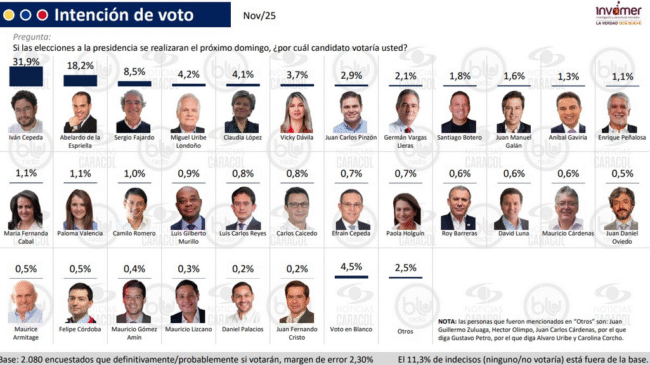
Senator Iván Cepeda of the ruling Historic Pact coalition has emerged as the early front-runner in Colombia’s 2026 presidential race, according to a nationwide Invamer poll released Sunday by Caracol TV and Blu Radio. The survey – the first major measurement since the lifting of Colombia’s recent polling restrictions – places the left-wing candidate at 31.9% of voting intention, six months ahead of the first round.

The results position Cepeda well ahead of candidate Abelardo de la Espriella of Defensores de la Patria, who received 18.2%, and independent centrist Sergio Fajardo, who registered 8.5%. Miguel Uribe Londoño, running for the leadership of  President Álvaro Uribe Vélez’s Centro Democrático party, follows with 4.2%. Uribe Londoño is the father of Senator Miguel Uribe Turbay, victim of an assassination attempt on June 7, and who died two months later at the Santa Fe Hospital in Bogotá.

The findings come amid broad public dissatisfaction with the country’s direction and with the administration of President Gustavo Petro, who leaves office on August 7, 2026. According to the poll, 56% of respondents disapprove of Petro’s administration, while 37% approve. Although disapproval has dipped slightly from previous months, nearly six in ten Colombians remain critical of the government. National sentiment is similarly pessimistic: 59.8% believe Colombia is “on the wrong track,” compared with 34.4% who feel otherwise.

Internal security stands out as the leading concern. Asked whether Petro’s “Total Peace” policy had made them feel safer, 66.2% claim it made them feel more insecure. Nearly 65% believe the initiative is moving in the “wrong direction”, and 73% say the government has lost territorial control to illegal armed groups. Only 20% expressed confidence in the government’s peace and security approach.

The Invamer survey, conducted between November 15 and 27 among 3,800 respondents in 148 municipalities, does not include public reaction to the latest scandal involving alleged infiltration of state institutions by FARC dissidents. The poll has a 1.81% margin of error and a 95% confidence level.

Cepeda’s lead reflects firm support among left-leaning voters and measurable gains among independents and left-leaning centrists. Though only 24% of those polled identified themselves as “left-wing”, the senator’s 31.9% support suggests he is drawing backing among younger voters. He also carries a relatively high rejection rate: 23.9% said they would “never” vote for him.

The survey challenges the perception that Cepeda lacks room to grow beyond the left, even as 50% expressed that they would prefer to vote for a candidate opposed to Petro. Analysts believe the Historic Pact’s decision to hold its internal consultation last month helped consolidate support within the coalition and gave Cepeda a strategic advantage.

The Invamer poll of Colombia’s of 30 presidential candidates. Photo: Caracol/Blu Radio.

Despite his lead, Cepeda could face voter rejection should Petro’s disapproval ratings continue to climb. The candidate’s current negative rating is among the highest of any public figure, and his pro-Petro agenda on security, economy, and U.S relations could push the center closer to the moderate right. Still, the poll indicates Cepeda would win a runoff against De la Espriella with a wide margin, but face a “technical tie” with the mathematician and former Governor of Antioquia.

De la Espriella, meanwhile, has quickly consolidated the anti-Petro vote, emerging as a “dark horse” at the extreme right of the spectrum. Once absent from early electoral projections, the lawyer now surpasses established Centro Democrático politicians – including senators María Fernanda Cabal, Paola Holguín, and Paloma Valencia.

Former defense minister under President Juan Manuel Santos and ex-Ambassador to Washinton, Juan Carlos Pinzón, is in seventh place (2,9%), but these early numbers are likely to increase, given that he maintains a close relationship with three ideological camps (Centro Democrático, La U, Cambio Radical) represented in Presidents Uribe and Juan Manuel Santos, and German Vargás Lleras.

 Even though the poll found that 63% of eligible voters know who De la Espriella is, there is room for continued growth for the five candidates who marked above 2% in the poll, among them, Vargas Lleras in fifth place (2.1%).

The centrist bloc, historically influential in Colombian politics, appears fragmented. Fajardo, once considered a reliable alternative to both left and right, no longer polls in double digits. While he maintains a lower rejection rate than most rivals and doubles the numbers of former Bogotá mayor Claudia López (4.1%), analysts say the proliferation of centrist candidates could dilute Fajardo’s base. Combined, these candidates would outpace De la Espriella’s support, but the numbers suggest this does not translate into a cohesive electoral force.

Foreign policy is also shaping voter priorities. A large majority – 78% – said maintaining strong relations with the United States is essential for the next administration. Respondents widely rejected Petro’s decision to use a megaphone in New York to urge U.S. soldiers not to follow orders from former President Donald Trump; 78% disapproved of the act, even though half of respondents hold an unfavorable view of Trump.

President Petro reacted to the poll on social media, framing the electoral landscape as a struggle between entrenched elites and what he described as a “powerful people” seeking to reclaim the state. Referring implicitly to Uribe and Fajardo, the president said Colombia must reject “mafioso elites” and work toward a “free and educated” society.

The Centro Democrático announced it will conduct an internal vote among more than 4,000 active party members to select two candidates for a March 2026 primary. The contenders are senators Cabal, Holguín, and Valencia, and Miguel Uribe Londoño.

With six months until the first round on May 31, 2026, the Invamer poll highlights a polarized electorate, deep concerns over security and corruption, and an early advantage for the ruling coalition’s candidate — with substantial uncertainty and new political alignments spearheaded by former presidents, especially Álvaro Uribe.

  •  
❌