
Reading view

Colombia rules out external factors in SATENA crash as probe opens

Colombian authorities said on Thursday they have found no evidence so far of “external factors” contributing to the crash on Wednesday of a SATENA Beechcraft 1900 aircraft on the Cúcuta–Ocaña route , which killed all 15 people on board.

The conclusions were presented during a press conference held at Ocaña airport in the northeastern department of Norte de Santander. The briefing was led by Major General Óscar Zuluaga Castaño, president of Colombia’s state-owned airline SATENA, and Jorge Campillo, president of aviation company SEARCA, which operated the aircraft under a charter arrangement. Local officials, including Ocaña’s acting mayor and government secretary Hugo Guerrero, also attended.

The aircraft crashed on Jan. 28 while operating Flight NSE 8849, which departed from Camilo Daza Airport in Cúcuta at 11:42 a.m. local time and was scheduled to land in Ocaña at around 12:05 p.m. Contact with air traffic control was lost at 11:54 a.m. while the plane was flying over the Catatumbo region, a mountainous area long affected by armed conflict and the presence of illegal armed groups.

Authorities confirmed that all 13 passengers and two crew members died in the crash. Among those on board were Congressman Diógenes Quintero and Carlos Salcedo, a candidate for Colombia’s House of Representatives.

Officials said that, at this stage of the investigation, there is no indication that the aircraft was affected by “external factors”. The term refers to events such as the aircraft being struck by a drone or the involvement of a terrorist-related incident, including a bombing.

According to flight-tracking data from FlightRadar24, the Beechcraft 1900 had reached a cruising altitude of approximately 12,000 meters before beginning its approach to Ocaña near the town of Ábrego. The aircraft then descended to about 7,900 meters moments before disappearing from radar. The plane has only been in the air 12 minutes for a 20-minute flight. Authorities said there is still no information regarding the recovery of the aircraft’s flight data recorder or cockpit voice recorder.

SATENA and SEARCA said the aircraft, registration HK-4709, met all airworthiness and maintenance requirements and was operating under approved technical and regulatory standards at the time of the accident. Weather conditions along the route and at the destination airport were described as favorable for flight operations. According to the air traffic controlers at Ocaña, the final words from the cockpit were: “We are ready to descend”.

The pilot in command, Manuel Vanegas, had accumulated more than 10,000 flight hours, while the co-pilot, José Joaquín de la Vega, had logged over 7,000 hours, officials said. Both crew members were operating within the duty-time limits established by Colombia’s aviation regulations, with no indications of fatigue or excessive workload.

The Cúcuta–Ocaña–Medellín route began operations in March 2025 under which SEARCA is responsible for the aircraft, maintenance, crews and insurance. SATENA said SEARCA has provided services to the airline for more than 25 years, with a track record supported by compliance with technical, operational and regulatory standards.

Over the past seven years, SEARCA has transported more than 269,000 passengers across nearly 17,800 flights, accounting for more than 12,400 flight hours, according to SATENA. During 2025 alone, SEARCA conducted more than 7,000 flights on 25 routes, representing 16.5% of SATENA’s total operations.

Officials said all aircraft operated by SATENA and SEARCA are equipped with mandatory terrain awareness and warning systems, as well as additional technology designed to allow safe operations in areas with complex topography, such as the Catatumbo mountain range.

The region where the aircraft went down has seen repeated clashes between the ELN guerrilla and dissident factions of FARC, as well as violence linked to drug trafficking routes and other illicit economies. Authorities said the rugged terrain complicated access for emergency and recovery teams during the initial search and rescue operation.

SATENA said the determination of the cause of the crash will rest exclusively with Colombia’s aviation accident investigation authorities, working alongside the Colombian Aerospace Force and judicial entities. SEARCA said it is fully cooperating with the investigation and will provide all documentation and information requested.

Despite the accident, SATENA confirmed it will not suspend operations on the route, citing its mandate to maintain connectivity to remote regions of the country. The airline said it will continue operating with heightened oversight and coordination with aviation authorities.

SATENA and SEARCA reiterated their condolences to the families of the victims and said providing institutional support and accompaniment to relatives remains a priority as the investigation continues.

  •  

SATENA flight carrying 15 loses contact over Colombia’s Catatumbo

A Beechcraft 1900 aircraft operating a domestic flight for Colombia’s state-owned airline SATENA lost contact with air traffic control on Wednesday while flying over the Catatumbo region in the northeastern department of Norte de Santander, an area heavily affected by armed conflict and the presence of illegal armed groups.

In an official statement, SATENA said Flight NSE 8849/ 9R-8895, covering the Cúcuta–Ocaña route, departed from Camilo Daza Airport in Cúcuta at 11:42 a.m. local time and was scheduled to land in Ocaña at around 12:05 p.m. The airline said the aircraft made its last radio contact at 11:54 a.m., while flying at an altitude of 7,900 feet.

The aircraft, a Beechcraft 1900 with registration HK-4709, was operated by the company SEARCA on behalf of SATENA. It was carrying 13 passengers and two crew members, SATENA said. Among those on board were Congressman Diógenes Quintero and Carlos Salcedo, a candidate for Colombia’s House of Representatives, according to official information.

The plane was last tracked between the municipalities of Ábrego and Hacarí, in a mountainous zone of Catatumbo known for ongoing clashes between the ELN guerrilla group and FARC dissidents, as well as for drug trafficking routes and other illicit economies that have fueled violence in the region for decades. The rugged terrain and persistent insecurity could complicate both civilian movement and emergency response operations.

SATENA said it had activated all available resources to locate the aircraft and was coordinating search and rescue efforts with the Colombian Aerospace Force’s Command and Control Center and the Civil Aviation Authority’s Technical Accident Investigation Directorate. The airline did not comment on possible causes for the loss of contact.

Colombia’s Civil Aviation Authority said emergency protocols had been triggered shortly after communication was lost, while military and civilian aircraft were deployed to assist in the search. Local authorities said ground teams were also being mobilized, though access to parts of the region remains limited.

There was no immediate confirmation of the aircraft’s location or the condition of those on board. SATENA said it would continue to issue official updates as information becomes available and urged the public to rely on verified sources while search operations continue.

UPDATE: At 4:26 Colombian authorities confirmed that SATENA flight NSE 8849/ 9R-8895 covering the Cúcuta–Ocaña route, crashed near Curasica, Playa de Belén, Norte de Santander. No survivors have been found among the wreckage.  

  •  

Airlines suspend Bogotá – Caracas routes over military build-up in the region.

Electronic jamming and missiles are two of the risks identified by US regulators.

Latam airlines suspended its Bogota´- Caracas route this week after FAA advice. Photo: CD Dobelli

Major airlines cancelled flights from Bogotá to Caracas this week after US regulators warned of “heightened military activity” around Venezuela.

Avianca and LATAM suspended flights through Venezuelan airspace, along with at least five other airlines, as a response to a Federal Aviation Authority NOTAM (Notice to Airmen) that reported “Global Navigation Satellite System (GNSS) interference” around Maiquetía “Simón Bolívar” International Airport, which serves nearby Caracas.

The warnings were linked to military exercises under way in Venezuela, a response to threats from US forces massing in the Caribbean and aerial attacks on suspect drug boats, some originating from Venezuelan waters.

Colombia’s own airline regulator, Aeronáutica Civil de Colombia, repeated the FAA’s warning but said that air operators in Colombia could take “autonomous decisions” over flights to Venezuela.

On Monday several airlines were continuing direct flights from Bogotá, such as Wingo, Avior (a Venezuelan airline) and Satena (a commercial airline linked to the Colombian Ministry of Defense). Copa offered connections via Panama.

Mobile missiles

The list of airlines suspending flights continued to grow on Monday night with TAP, Turkish Airlines, Iberia and GOL being joined by Air Europa and Plus Ultra.

This came despite pushback from Venezuela’s Instituto Nacional de Aeronáutica Civil (INAC) which threatened to punish airlines for following the FAA’s recommendations.  According to a report in Aviation Online, airlines avoiding Caracas could in the long term lose access to the country’s airspace.

INAC also issued an ultimatum for airlines suspending flights “to resume services within a 48-hour period” or risk losing their landing permits.

Meanwhile the US FAA issued a more detailed FAA backgrounder clarifying that Venezuela had “at no point expressed an intent to target civil aviation”.

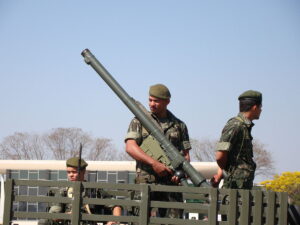
Portable Russian anti-aircraft missile similar to those used in Venezuela. Photo: André Gustavo Stumpf

It did, however, seem concerned that the current context could trigger an air accident.

Venezuela, it said, had mobilized “thousands of military and reserve forces” with access to shoulder-mounted anti-aircraft missiles, or MANPADs (man-portable air defense systems), capable of downing low-altitude aircraft.

This followed comments by Maduro last month that his military were in possession of Russian-made Igla-S missiles “with no fewer than 5,000 of them in key anti-aircraft defense positions to guarantee peace, stability, and tranquility”.

Jammers and spoofers

The more immediate risk was to electronic systems, said the FAA documents, with several civil aircraft recently reporting interference while transiting Venezuela, in some cases causing “lingering effects throughout the night”.

“GNSS jammers and spoofers can affect aircraft out to 250 nautical miles [450 kilometres] and can impact a wide variety of critical communication, navigation, surveillance, and safety equipment on aircraft.”

The FAA said it would “continue to monitor the risk environment for US civil aviation operating in the region and make adjustments, as appropriate, to safeguard U.S. civil aviation”.

In fact, the US airlines stopped all direct commercial and cargo flights into Venezuela as part of an order issued in 2019, related to sanctions against the Maduro regime, widely seen as illegitimate, with the US State Department offering a bounty of US$50 million “for information leading to the arrest and / or conviction” .

The rule of Venezuelan leader Nicolás Maduro is widely seen as illegitamate. Photo: Steve Hide
Venezuelan leader Nicolás Maduro has a US$50 million bounty on his head. Photo: Steve Hide

Open to talks

Commentators on US – Venezuelan relations this week said that FAA announcement was not necessarily a sign of imminent US military action. Former Associated Press analyst Dan Perry told News Nation that the FAA warning was “a message that they [the FAA] expected the country to become unstable”, but did not point to a ground invasion.

For most observers, the NOTAM was a continuation of the maximum pressure strategy pursued by Washington against the Maduro regime, including a recent decision to declare the Cártel de los Soles — a disconnected group of corrupt military officers who facilitate drug shipments — as a Foreign Terrorist Organization.

Last week Maduro said he was open to talks with Washington, according to AP News, though US President Trump underscored that military action was “still on the table”.

In recent months the US has sent eight navy ships, a submarine, an aircraft carrier and 10,000 service members to the Caribbean. And since August, US firepower has killed at least 83 people in aerial attacks on speedboats suspected of running drugs; for anyone arriving in Venezuela, air is still safer than sea.

The post Airlines suspend Bogotá – Caracas routes over military build-up in the region. appeared first on The Bogotá Post.

  •  

Avianca Grounds Most of Its A320 Fleet After Airbus Issues Safety Alert

Colombia’s flagship carrier, Avianca, announced Friday it has grounded more than 70% of its Airbus A320 fleet after the European manufacturer issued an urgent global bulletin ordering operators to carry out immediate software updates to prevent potential flight-control failures.

The disruption, one of the most severe to hit the airline in years, comes as Airbus launched one of the largest fleet-wide recalls in its history, affecting some 6,000 A320 commercial aircraft worldwide — more than half of the global fleet. The A320 is the world’s most widely used single-aisle airliner and the backbone of Avianca’s operations across Latin America and to U.S and Canadian hubs.

There are around 11,300 A320 jets in operation in total.

In a statement, Avianca said Airbus notified operators on November 28 that a significant portion of A320 require a mandatory software modification. The update, which Airbus described as reverting to an earlier software version, must be applied before affected aircraft can resume flights, except for ferry operations to maintenance bases.

“As soon as the aircraft reach their maintenance bases, they must remain on the ground until the updates are completed,” Avianca said. “This order affects more than 70% of Avianca’s fleet.”

The airline warned that the grounding will trigger significant operational disruptions over the next 10 days as engineers work to install the update across its aircraft. To limit further complications and manage passenger flow, Avianca has temporarily closed ticket sales for travel dates through December 8 — an extraordinary measure taken to “reorganize its capacity and re-accommodate passengers on available flights.”

Customers with upcoming reservations will receive direct notifications from the airline detailing their travel options.

The update requirement has already led to cascading delays and cancellations across several regions. Reuters reported that, at the time Airbus issued its notice to more than 350 operators, roughly 3,000 A320 aircraft were airborne. Airlines in the United States, Europe, South America, India and New Zealand said the repairs could trigger operational disruption during one of the busiest travel weeks of the year.

American Airlines, the world’s largest operator of the A320 family, said about 340 of its 480 aircraft require the fix. The carrier expects the majority of updates to be completed by Saturday, estimating about two hours of work per jet. Delta Airlines said updates to a small portion of its Airbus A320 planes will likely be completed by Saturday morning, a spokesperson said.

Avianca, however, expects the impact to last longer given the scale of its grounded fleet in Latin America and the limited availability of maintenance slots at Bogotá’s El Dorado International Airport.

The airline said its priority is passenger and crew safety and that it is working “as quickly as possible” to complete the mandatory modifications and restore normal operations.

To mitigate the fallout, Avianca is offering several options to affected passengers:

  • Rebooking on the nearest available Avianca flight or on partner airlines with which it has commercial agreements.

  • Flexible changes, allowing travelers to reschedule without penalty fees or fare differences, subject to availability, for up to 180 days after the original travel date.

  • Refunds for unused flight segments through the airline’s website, call center, sales offices or travel agencies.

Avianca urged customers not to go to the airport unless their flight has been confirmed and to closely monitor email notifications associated with their reservation, as well as updates on its official channels.

Despite the scale of the disruption, the airline said the swift grounding demonstrates its commitment to safety while complying with Airbus’ unprecedented directive.

“The priority of Avianca is to ensure the safety of our passengers and crew,” the company said, adding that it aims to complete the required modifications as soon as possible to “minimize service disruptions.”

  •  
❌