
Reading view

Colombia in a Breath: Wind Instruments That Tell the Story of a Nation

Musical instruments are far more than tools for producing sound: they embody the cultural identity of a territory, carrying spiritual meanings, collective memory, and the deep-rooted expressions that shape a community’s history. Colombia en un Aliento 2026 (Colombia in a Breath 2026) invites audiences on a sonic journey through the country’s wind instruments, encouraging reflection on how human breath and aerophones have shaped identities, spiritual practices, and spaces of encounter from pre-Hispanic times to the present day.

Conceived as a national cultural project, Colombia en un aliento: instrumentos de viento que narran un país (Wind Instruments That Tell the Story of a Nation) brings together ancestral knowledge, popular traditions, and contemporary artistic creation. Through an interdisciplinary approach, the initiative connects past, present, and future via a wide-ranging cultural program structured around four thematic lines.

El soplo como rito de la vida (Breath as a Rite of Life) explores the symbolic and ritual significance of wind instruments among Indigenous and Afro-Colombian cultures, where blowing air through wood is understood as an act of vitality, spirituality, and connection with the natural world. In these traditions, breath is not merely physical – it is a force that sustains life, memory, and the sacred.

El viento del encuentro (The Wind of Encounter) focuses on the social and communal role of wind instruments in fiestas, carnivals, and collective celebrations. From village plazas to major public gatherings, these instruments create shared rhythms, reinforce bonds of belonging, and transform music into a space for encounter and social cohesion.

Alientos universales, músicas locales (Universal Breaths, Local Music) examines historical processes of cultural exchange, mestizaje, and adaptation. It traces how wind instruments introduced from other parts of the world were reinterpreted across Colombia’s diverse regions, giving rise to musical expressions deeply rooted in local landscapes, histories, and identities.

Respirar el future (Breathing the Future) looks toward contemporary creation techniques, from experimentation with digital technologies to new sonic languages. The section reflects on current artistic practices in which tradition and innovation coexist, opening pathways for composition, teaching, and cultural narratives.

Together, these four thematic pillars support spaces for reflection and research, that strengthen Colombia’s sound identity. From making local knowledge visible and fostering cultural innovation, more than a series, Colombia en un Aliento / Colombia in a Breath proposes a collective experience – an invitation to understand wind instruments as symbols of life, resistance, and social cohesion.

As a year-long project by the Cultural Subdirectorate of the Banco de la República – Central Bank – this initiative will continue in 2027 with a new thematic focus on the human voice as a sonic element, expanding its exploration of sound as a carrier of memory and meaning.

The initiative will be officially launched with the public conversation “El soplo y los instrumentos: sonidos que cuentan historias / Breath and Instruments: Sounds That Tell Stories” on Tuesday, February 3 at 5:00 p.m. in the Audiovisual Hall of the Luis Ángel Arango Library (BLAA) in Bogotá.

The event will feature José Pérez de Arce, Chilean musicologist and leading authority on ancestral aerophones; Humberto Galindo, Colombian researcher and director of the Museo Mundo Sonoro; and Luis Fernando Franco, composer and co-founder of Guana Récords with more than four decades dedicated to musical research and creation.

The conversation will also be streamed live on Banrepcultural’s YouTube channel, opening this shared reflection on breath, sound, and identity to audiences in Colombia and internationally.

For more information visit the cultural page of the Central Bank: https://www.banrepcultural.org/noticias/instrumentos-de-viento-en-colombia-en-un-aliento-2026
  •  

Beatriz González: The Artist of Colombia’s Political Memory (1932-2026)

Beatriz González, one of Latin America’s most influential contemporary artists, whose boldly colored, deliberately unrefined paintings and installations confronted Colombia’s long history of political violence, public mourning and social inequality – while also reshaping the country’s most important public art collection – died on Jan. 9, 2026, at her home in Bogotá. She was 93.

Her death was announced by the Banco de la República, Colombia’s central bank, where for more than four decades she played a decisive role in shaping the institution’s cultural mission and its vast art collections. In a statement, the bank described her as “an essential figure in Colombian art and culture” and “a masterful narrator of memory.”

González was not only a prolific artist but also a historian, curator, educator and critic — a rare figure who helped define how Colombia would see its art, its past and, ultimately, itself. “Artists exist so that memory is not thrown in the trash,” she once said, a line that came to stand as a quiet manifesto for a career devoted to preserving what official histories often erased.

Born in Bucaramanga in 1932, González came of age during La Violencia, the brutal civil conflict that engulfed Colombia between 1948 and 1958. That formative experience would leave an indelible mark on her work. After briefly studying architecture, she enrolled at the University of the Andes in Bogotá, graduating with a degree in fine arts in 1962. She later studied printmaking in Rotterdam and counted among her teachers the influential critic Marta Traba, who helped shape modern art discourse in Latin America.

González’s early work drew attention for its irreverent treatment of European art history and Colombian popular imagery. Her critical view of “good taste” led her to reject academic refinement in favor of what the art critic Germán Rubiano described as an approach that was consciously unpolished and deliberately opposed to sophistication.

She appropriated masterpieces by Manet, Leonardo da Vinci and Raphael, flattening their compositions and translating them into the visual language of curtains, furniture and household objects. Armoires, beds, trays and even wallpaper became supports for paintings marked by compressed figures and bold color palettes — a strategy that blurred the boundary between high art and domestic life.

One of her earliest and most discussed works, The Sisga Suicides (1965), reimagined a newspaper photograph of a young couple who drowned themselves in a dam outside Bogotá. Rendered in vivid, almost cheerful colors, the painting exposed the uneasy coexistence of tragedy and banality in Colombian public life — a theme that would recur throughout her career.

By the 1980s, González’s art took on an increasingly overt political tone. Press photographs of presidents, massacres and grieving families became central to her work. She painted them repeatedly, transforming news images into objects of repetition and contemplation, as if to ask how a society becomes accustomed to its own suffering. “It’s been a critique of power that has permeated my work,” she told ArtReview in 2016. “For that very reason, I don’t think of it as ‘political’; it has an ethical commitment.”

Her focus on mourning was particularly stark in works depicting mothers weeping after the 1996 Las Delicias massacre, in which dozens of Colombian soldiers were killed by the FARC guerrilla. These images, stripped of sentimentality, confronted viewers with grief as a collective, inescapable condition. The depth with which González addressed both individual and collective mourning stands among her most significant contributions to contemporary art.

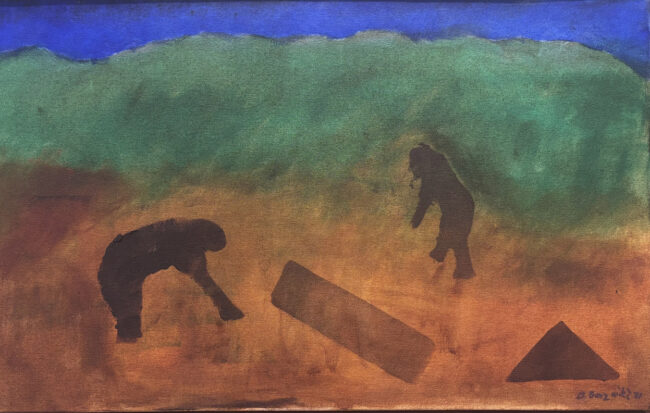
The Burial. Beatriz González/Private Collecion

That macabre clarity intensified in the 2000s. In Anonymous Auras (2023), one of her final major works, González installed more than 8,000 printed silhouettes of workers carrying corpses across the wall niches of Bogotá’s Central Cemetery. The figures – anonymous, repetitive and almost ritualistic – transformed the cemetery into a monumental archive of loss, honoring victims whose names were never recorded.

“Artists exist so that memory is not thrown in the trash”

Parallel to her artistic production, González exerted extraordinary influence as a curator and cultural policymaker. Beginning in the 1980s, she became a close collaborator of the Banco de la República’s cultural division, serving as a researcher, curator and longtime member of its advisory committee on visual arts. In that role, she helped guide the formation of a national art collection with a distinctly Colombian focus, while insisting on dialogue with international works of the highest quality.

Few individuals knew the Central Bank’s art collection as intimately as González. Over more than forty years, she worked alongside successive generations of curators, historians and collectors, helping to consolidate one of the most important public art collections in Latin America.

In 2020, she donated her personal archive and library — nearly 100,000 documents — to the Banco de la República to ensure free public access. The archive documents not only her artistic practice but also her work as an educator, curator and historian, and provides an unparalleled record of Colombian art, politics and visual culture.

Her institutional impact reached beyond the Central Bank. At the Museo de Arte Moderno de Bogotá (MAMBO), she founded the influential School of Guides, a pioneering program for museum education that trained figures who would later become leading artists and curators. From 1989 to 2004, she served as chief curator of the Museo Nacional de Colombia, where she reorganized the permanent collection and helped redefine the country’s historical narrative through art.

International recognition came steadily. Her work appeared in Documenta 14, the Berlin Biennale and the landmark exhibition “Radical Women: Latin American Art, 1960–1985.” Major retrospectives were held at the Pérez Art Museum Miami, the Museum of Fine Arts, Houston, and the CAPC in Bordeaux. In 2026, the Barbican Centre in London is set to host her first major retrospective in the United Kingdom.

González received numerous honors, including Colombia’s Premio Vida y Obra and honorary doctorates from the University of the Andes and the University of Antioquia. In 2025, the city of Bogotá awarded her the Civil Order of Merit, recognizing her invaluable legacy and profound influence on the nation’s cultural life.

Yet she remained skeptical of accolades. She preferred to speak of discipline, research and responsibility — and of the obligation, as she saw it, to bear witness. From a childhood habit of collecting film-star postcards to a lifetime spent gathering images of state violence, Beatriz González devoted herself to the stubborn preservation of memory and to an unapologetic voice in Colombian contemporary art.

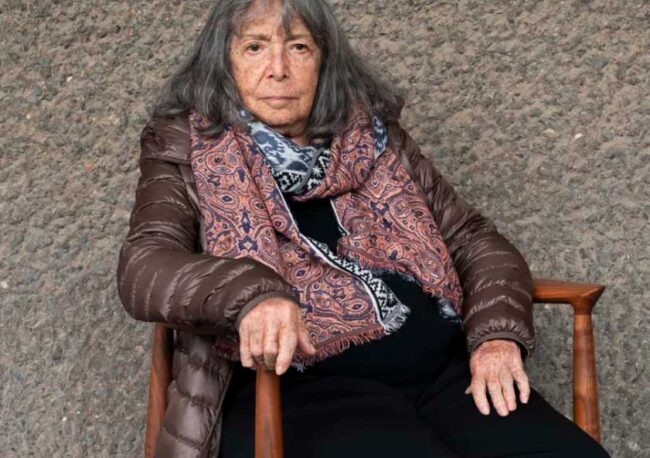
Portrait of Beatriz González, photographed at the Barbican, London, September 2024, ahead of a major retrospective of her work. © Louise Yeowart Barbican Art Gallery. Courtesy of the Barbican Centre.

Read the Banco de la República’s tribute (in Spanish) to Beatriz González, written by Claudia Cristancho Camacho of the Cultural Section and Art Collection. 

https://www.banrepcultural.org/noticias/despedimos-la-maestra-beatriz-gonzalez-figura-esencial-del-arte-y-la-cultura-en-colombia

  •  
❌