Reading view

OpenProject 16.4: Option to auto-sync system color mode

OpenProject 16.4 has been released and this version introduces new features and improvements again. We look forward to hearing your thoughts and feedback on the latest updates. Please take a few minutes to learn what changes for you. We will summarize the most important changes in this blog article and, as always, please see our release notes that contain all changes, features and bug fixes.

In this blog article, we will focus on two main topics: the new automatic color mode sync together with dark high contrast mode for a more convenient and accessible interface, and the PDF export of project lists for more professional reporting.

We will also briefly summarize additional important features. Here is a quick navigation to all feature descriptions:

Automatic color mode sync and dark high contrast

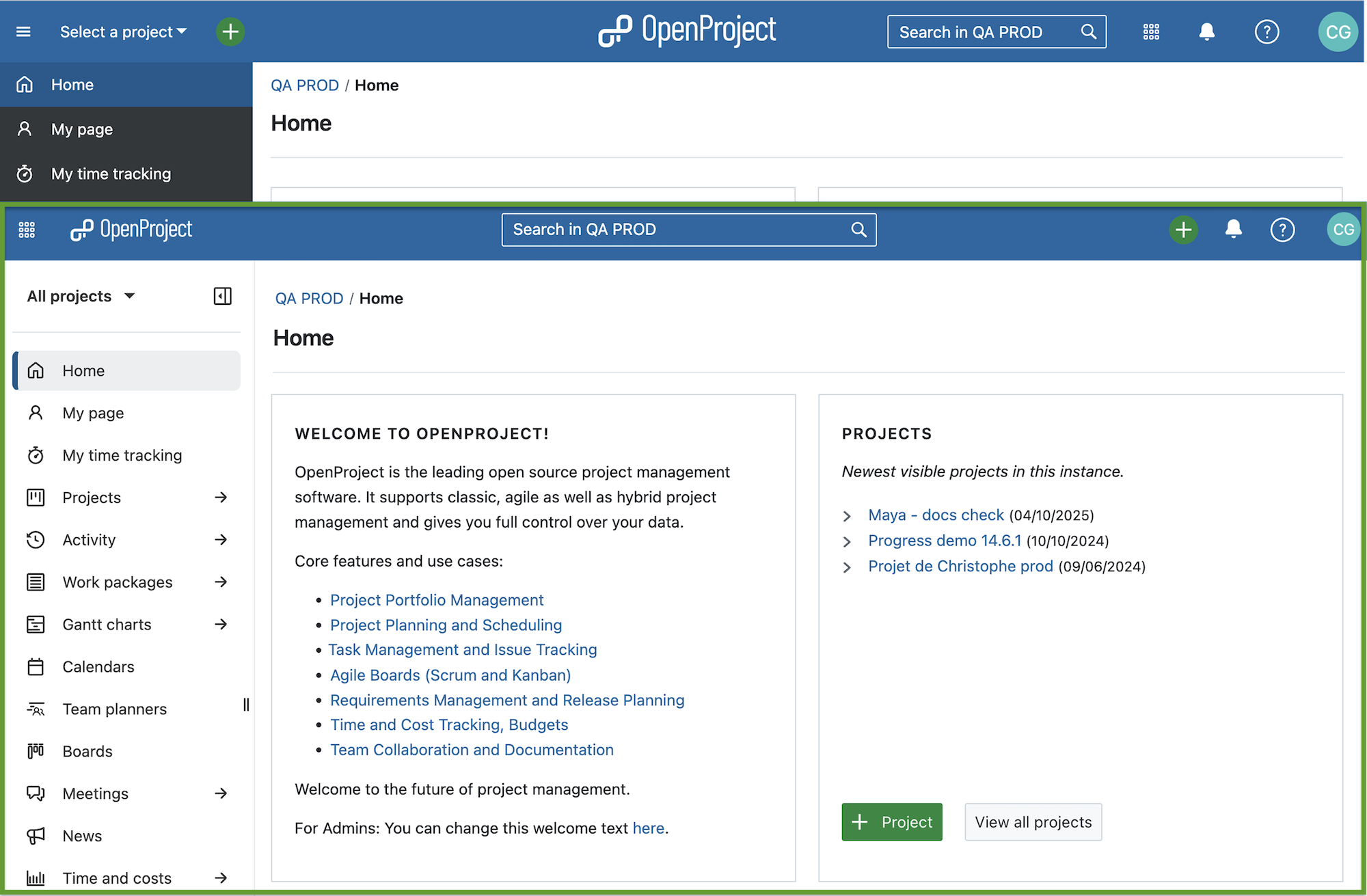
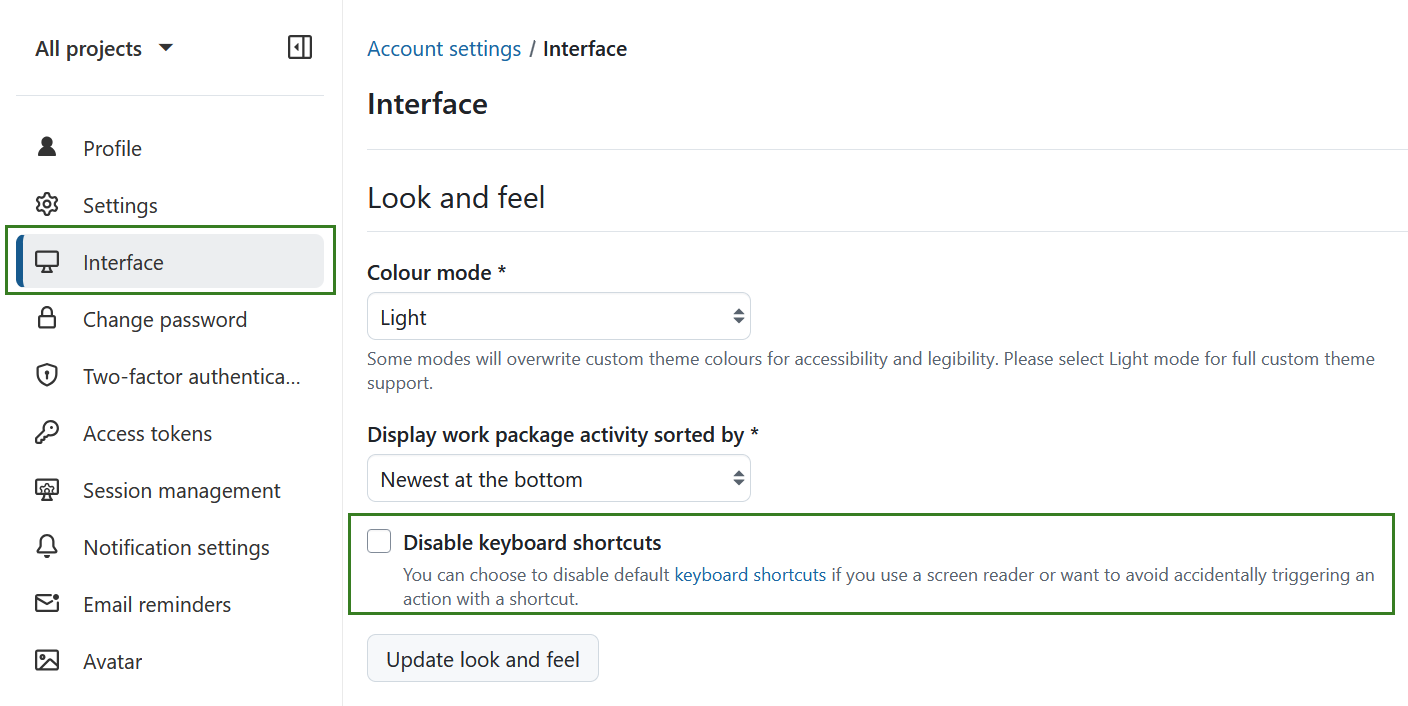
We always have many milestones on the roadmap, but some features stand out because they affect everyone. With OpenProject 16.4, you can enable automatic color mode sync in your personal settings. OpenProject will then match your operating system (OS) preference and switch automatically between light and dark mode. If your OS uses high contrast, OpenProject will select the corresponding light high contrast or dark high contrast mode for optimal readability.

We introduced light high contrast mode almost two years ago. With OpenProject 16.4, we now added a dark high contrast mode together with the auto-sync feature.

These different color modes are more than just convenient options. They are part of our ongoing commitment to accessibility — a principle that has been part of OpenProject from the very beginning, when the project was forked from Redmine in order to remove accessibility barriers. You can read more about this in our articles on real progress in accessibility, written by Niels Lindenthal.

By the way: When our developer Kabiru Mwenja, who is responsible for the color mode changes, demoed the auto-sync feature for the first time, the whole team was genuinely excited. This shows that even though it is a simple option, it makes a real difference in everyday work for many users.

Learn more about the Look and feel options in OpenProject.
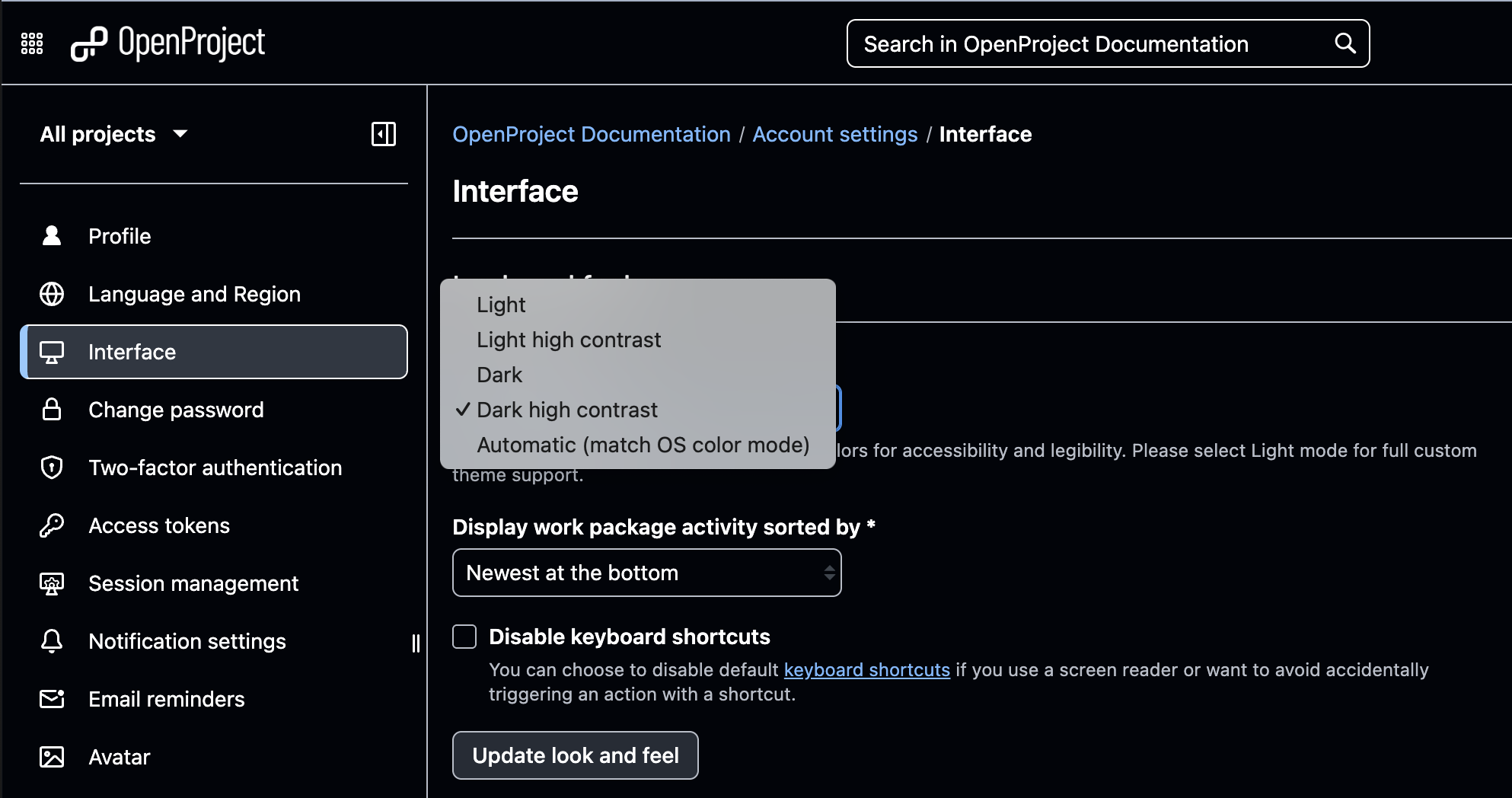
Screenshot of OpenProject 16.4: Account settings to adjust color mode to new options like high contrast and Automatic mode

PDF export of project lists

On the one hand, we still believe that the best way to collaborate is directly in OpenProject with living documents. On the other hand, we also know that for many organizations, PDFs remain an essential format. Whether for regulatory requirements (e.g. in the public sector), for digital or printed filing, or simply for sharing professionally styled reports with stakeholders.

This is why, over the past two years, we have continuously added PDF export features to different modules: work packages and tables, work package descriptions, meetings, Gantt charts, timesheets — and now also project lists.

With OpenProject 16.4, you can now export project lists as structured PDF reports. The export includes:

  • A table of contents that reflects your project hierarchy (when multiple projects are included).
  • A cover page and numbered sections (e.g., 1, 1.1, 1.2).
  • Linked section titles to jump back into OpenProject.
  • The same attributes and order that you configured in the list view.

To export, open the More (three dots) menu on the project list and select Export. In the modal, choose XLS, CSV, or – now also possible – PDF.

Read more about project lists in our documentation.
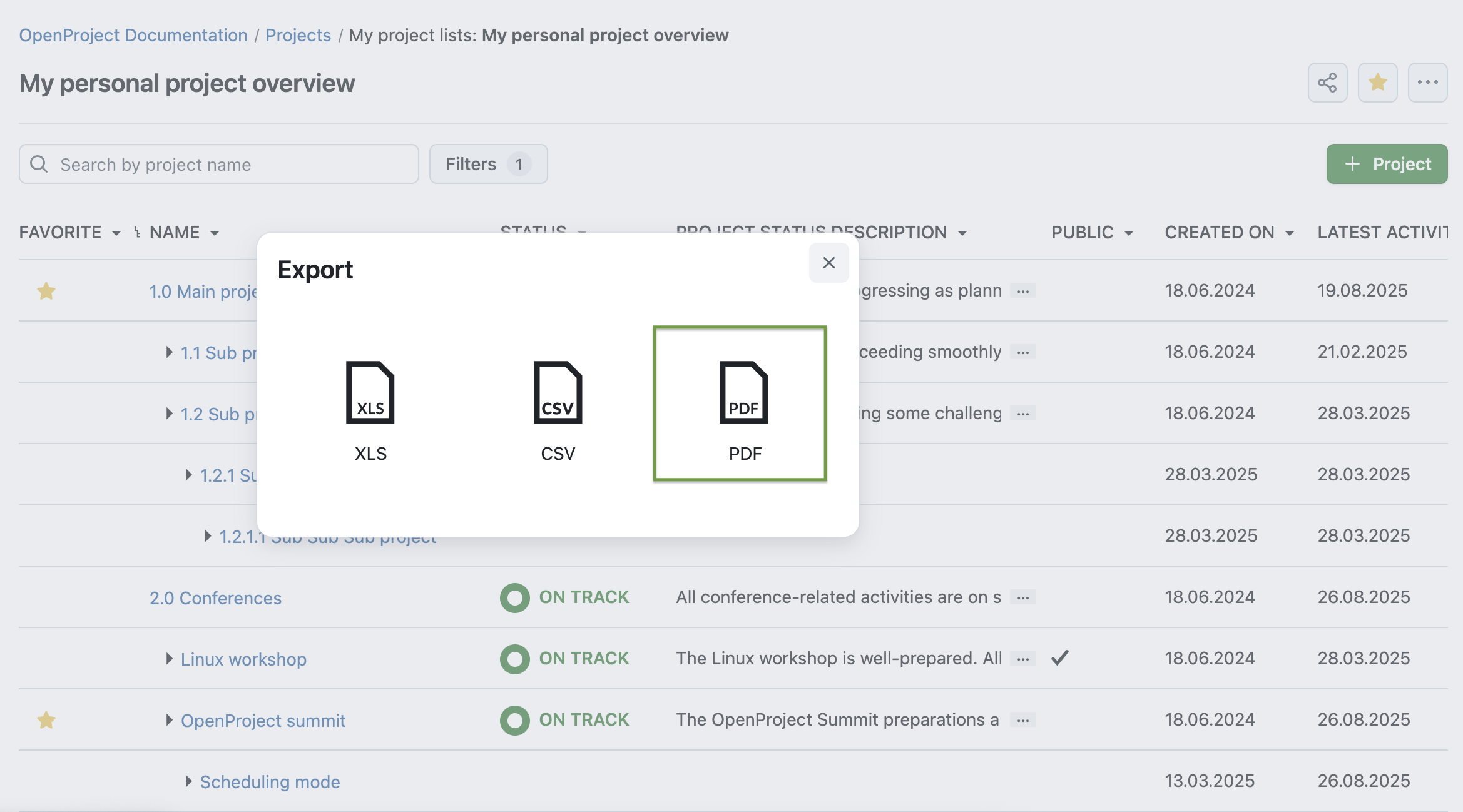
Screenshot of OpenProject 16.4: Export modal for PDF export of project lists, choosing the file format - XLS, CSV and PDF

Custom fonts for all PDF exports (Enterprise add-on)

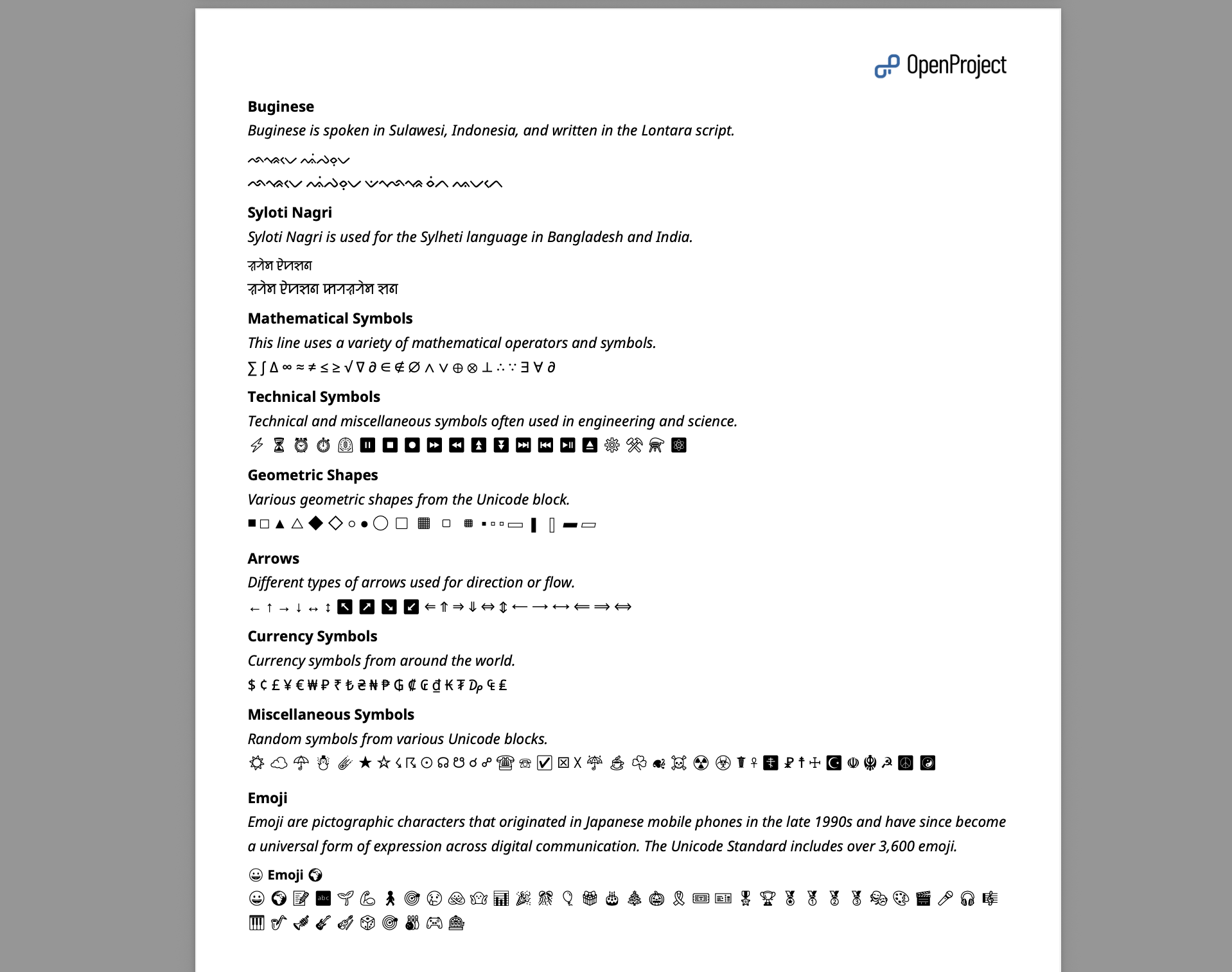
Another improvement, available as an Enterprise add-on for customers of Enterprise Basic and higher, is the ability to define custom fonts for all PDF exports. Administrators of the Enterprise Basic plan and higher can now upload fonts under Administration → Design → PDF export font. Once uploaded, the font will be used consistently across every PDF export in OpenProject — from project lists and work packages to meetings, Gantt charts, and timesheets.

This feature is particularly important for organizations with strict corporate design requirements. It ensures that all exported documents reflect the organization’s professional branding and style.
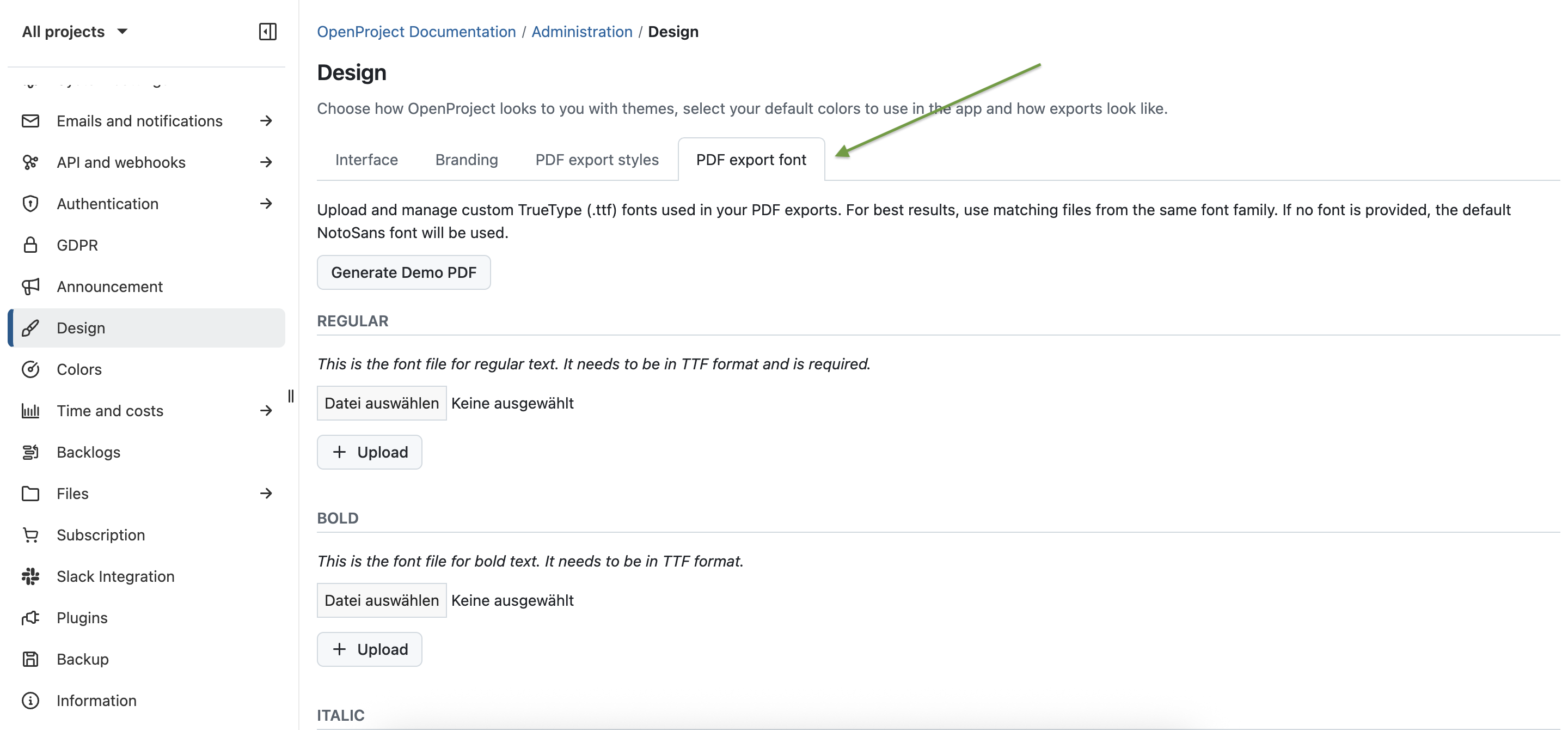
Screenshot of OpenProject 16.4: Administration / Design / PDF export font - options to upload fonts for regular, bold and italic and generate Demo PDF

Improved meeting participants dialog

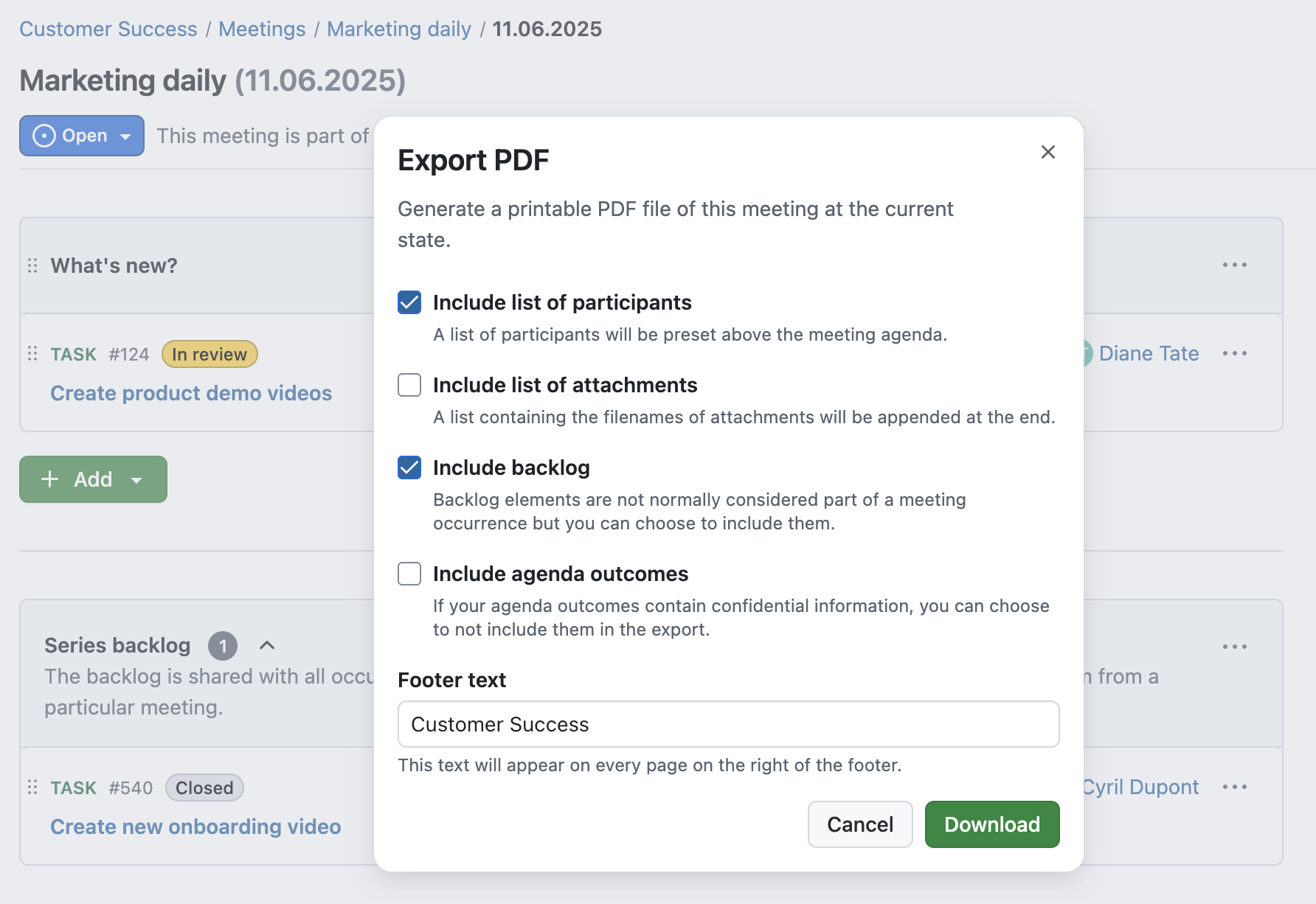
Managing participants now runs smoother: you can search and multi-select users with autocomplete when preparing a meeting, and track attendance during the meeting with simple toggles — including Mark all as attended. The dialog also aligns visually with sharing components and shows a cleaner status on the right pane and in PDFs.

Learn more about meeting management with OpenProject.
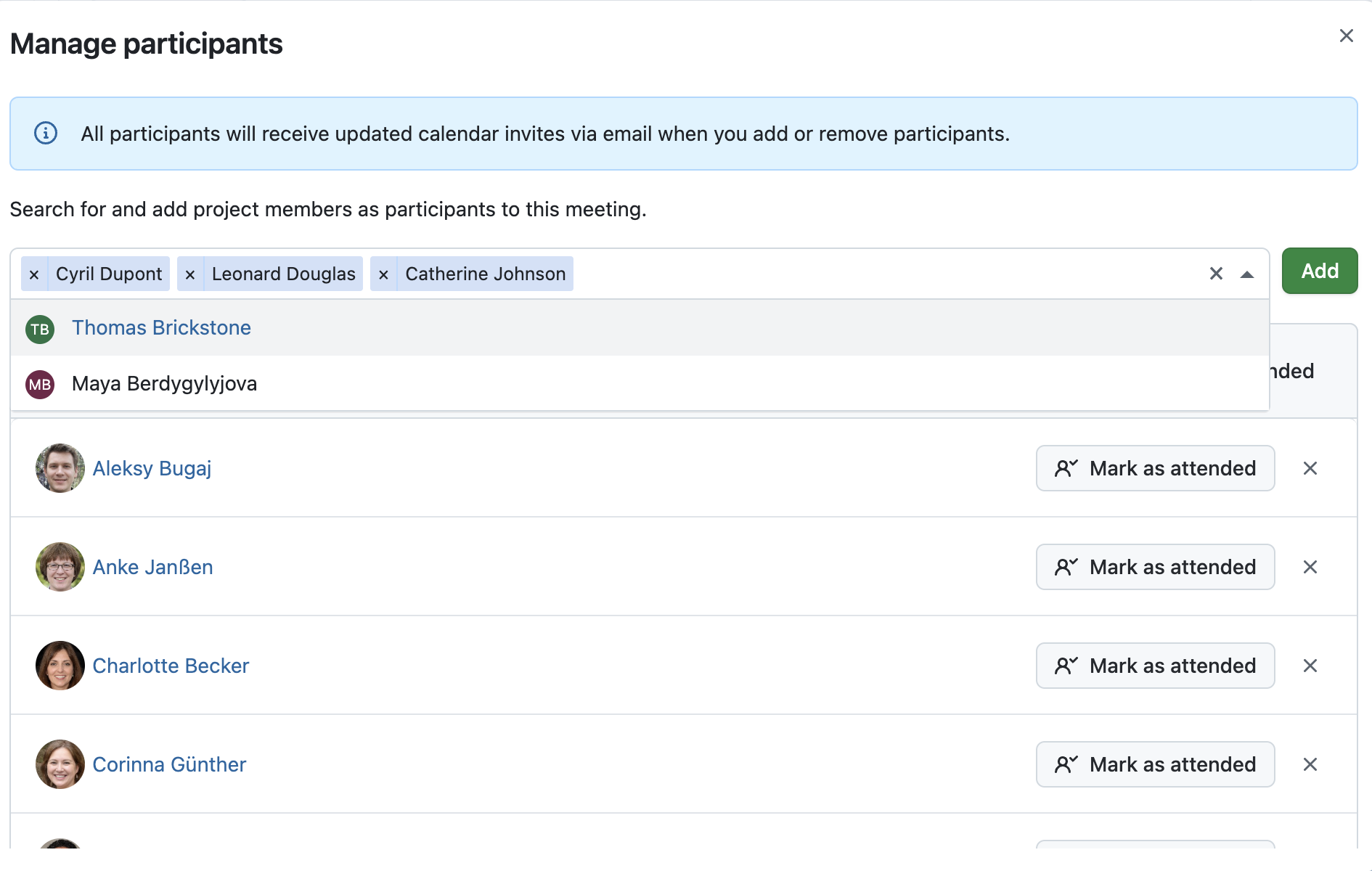
Screenshot of OpenProject 16.4: Meeting participants modal with autocomplete and ‘Mark as attended’ button

Synchronize group information via OIDC (Enterprise add-on)

OpenProject 16.4 introduces the ability to synchronize group memberships from your OpenID Connect (OIDC) provider. This makes it easier to manage user groups and permissions centrally in your identity provider and ensures that memberships in OpenProject reflect those settings whenever users log in. Admins can filter which groups to import, extract name substrings, auto-create groups, and distinguish between locally managed vs. synchronized memberships.

Read more about OIDC in our documentation.

Improved budget handling in project queries and budget planning

Budget setup is more practical: you can define a Base amount (a fixed sum) without detailing material or labor costs — and still add them later, if needed. Project lists now include planned budget, spent budget, spent percentage, and available budget for a clearer overview. We plan to continue improving budgets in upcoming releases. Read more about budgets in our user guide.
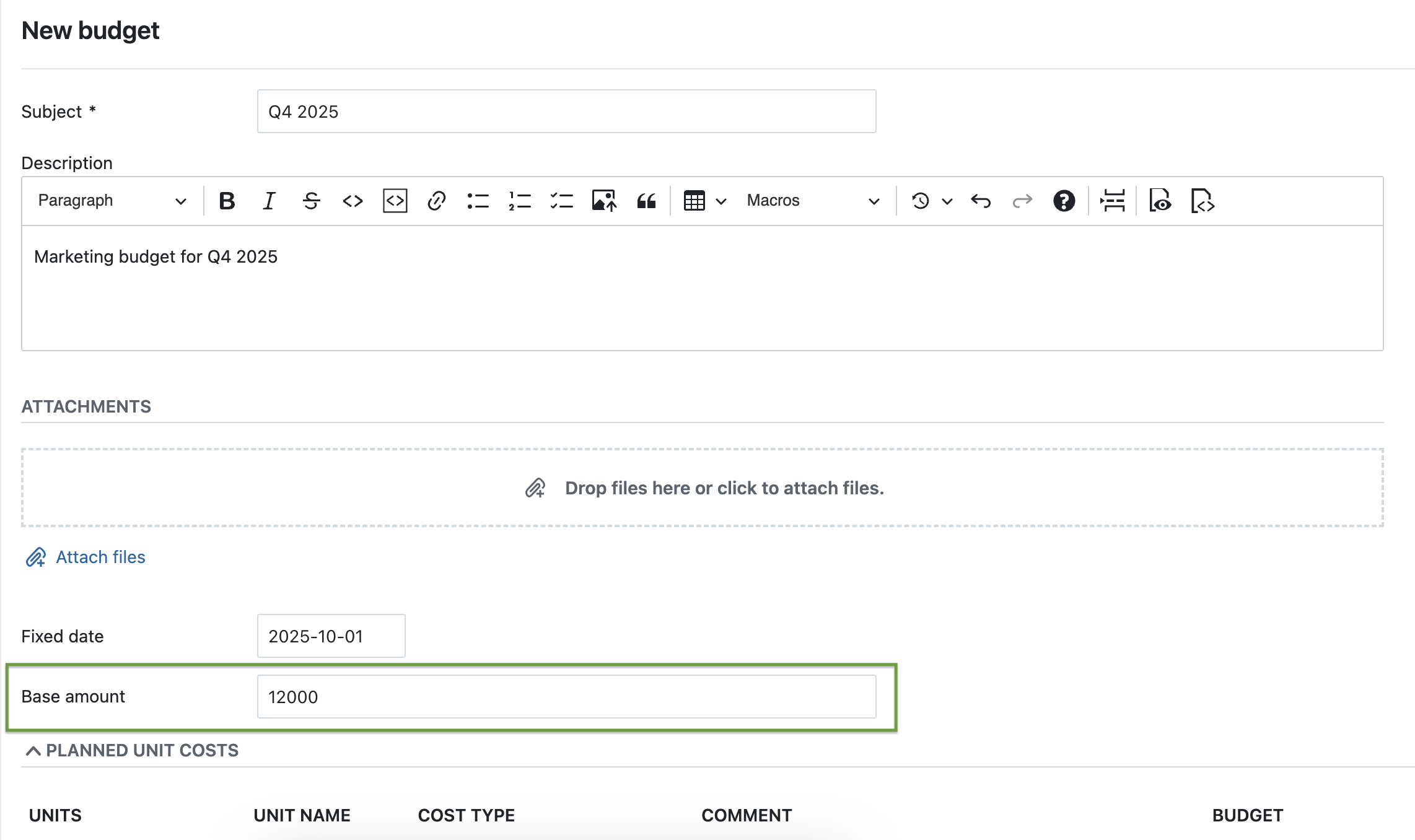
Screenshot of OpenProject 16.4: New budget with highlighted Base amount

Updated Home and Project overview page

We refreshed the widgets on the Home and the Project overview pages:

  • cleaner styling (white backgrounds in Light mode, rounded corners, improved Dark mode support),
  • an always-visible More (three dots) menu,
  • a clearer add widgets click zone,
  • and a new + Widget button in the subheader that opens the selection modal and places new widgets at the top for instant feedback.
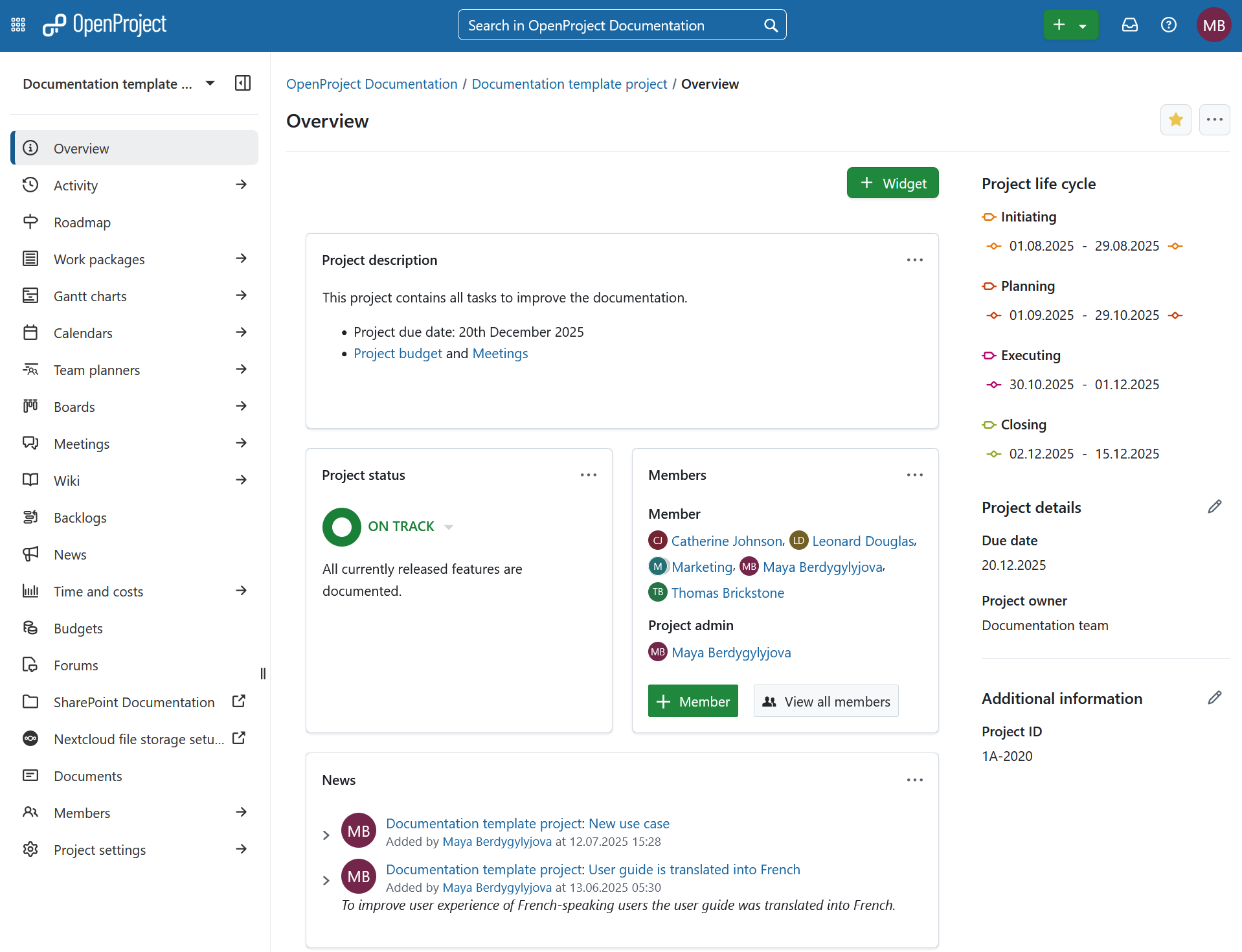
Screenshot of OpenProject 16.4: New design for the project overview page

OpenProject 16.4: Migration, installation, updates and support

Follow the upgrade guide for the packaged installation or Docker installation to update your OpenProject installation to OpenProject 16.4. We update your hosted OpenProject environments (Enterprise cloud) today, September 10, 2025.

You will find more information about all new features and changes in our Release notes or in the OpenProject Documentation.

If you need support, you can post your questions in the Community Forum, or if you are eligible for Enterprise support, please contact us and we are happy to support you personally.

Credits

A very special thank you goes to Helmholtz-Zentrum Berlin, City of Cologne, Deutsche Bahn and ZenDiS for sponsoring released or upcoming features. Your support, alongside the efforts of our amazing Community, helps drive these innovations. Also a big thanks to our Community members for reporting bugs and helping us identify and provide fixes. Special thanks for reporting and finding bugs go to Björn Schümann, Harald Herz, James Neale, Rince wind, Alexander Aleschenko, Sam Yelman, Stefan Weiberg, Tom Gugel, Johannes Baumgarten, and Christoph Nodes.

Last but not least, we are very grateful for our very engaged translation contributors on Crowdin, who translated quite a few OpenProject strings! This release we would like to particularly thank the following users:

  • Alin Marcu, for a great number of translations into Romanian.
  • William, for a great number of translations into Chinese Traditional.
  • OlhaTrotska, for a great number of translations into Ukrainian.

Would you like to help out with translations yourself? Then take a look at our translation guide and find out exactly how you can contribute. It is very much appreciated!

As always, we welcome any feedback on this release. 💙
  •  

Free content planning tool: Practical tips for marketing teams using OpenProject

Marketing teams, we know your struggles. Your content planning deserves better than sticky notes and scattered tools. Sometimes, all it takes is a smart structure and the right tool to turn chaos into clarity. Customize OpenProject to plan your content efficiently in one place — it’s free, open source, and built for team collaboration. From discussing a new strategy to handing over content pieces for review, manage your marketing work in a clear, precise way. And be the flagship of your organization.

This article gives you tips and practical insights into how we at OpenProject use our own tool: for content planning, social media calendars, campaign coordination, and more.

Looking for a great and low-cost content planning tool?

Especially small marketing teams face challenges like:

  • How do we plan and organize our content effectively?
  • How can we make it transparent which content still needs review or is ready to be published?
  • What should we do with content ideas that aren’t ready to be scheduled yet?
  • How can we make sure the whole team has full visibility into content plans and responsibilities?
  • How do we coordinate with other departments — like Sales or Product — without endless email threads or lost feedback?
  • How can we collaborate with freelancers or external partners without granting access to everything?

And above all: How do we keep everything in one place, without paying for yet another tool?

OpenProject is free and open source

Maybe you’ve already tried to solve these challenges with tools like Trello, Asana, or Notion — but none of them fit your exact workflow? Perhaps they lack transparency, are hard to customize, or simply cost too much?

OpenProject is a powerful alternative to these content and project planning tools. It’s free and open source — which means no licensing fees in the Community edition, full data control, and maximum flexibility. You can tailor your setup to match exactly how your marketing team works.

OpenProject makes it easy to manage all types of content in one place — from blog articles and social posts to videos, designs, and written copy — so your entire planning process stays connected.

It comes with all the essential features for content planning and team collaboration:

  • Agile boards to track content status from draft to publication.
  • Calendar views to schedule blog posts, campaigns, and social media content.
  • Relations between tasks / content pieces (e.g. the social post for a blog article).
  • File management and comments to collaborate transparently in one place.

Insights: How to use OpenProject in a marketing team

But let’s get specific: What does OpenProject actually look like when used as a content planning tool? In the following sections, we’ll give you a detailed look into how we — the OpenProject marketing team — use our own software every day. Because we know the struggles of content planning firsthand. And we know exactly how to tailor OpenProject to organize and structure marketing work effectively.

OpenProject gives you a lot of flexibility — but you have to know how to make the most of it.

Content planning with OpenProject

Let’s start with the basics: In OpenProject, everything begins with a “project” — but that doesn’t mean it has to be a classic project with deadlines and deliverables. You can simply create one called “Marketing” and use it as your team’s workspace. Depending on your structure, you can also create sub-projects like Content marketing or Event marketing. If you’re a small team, we recommend starting with just one project, which keeps everything in one place and is easy to manage.

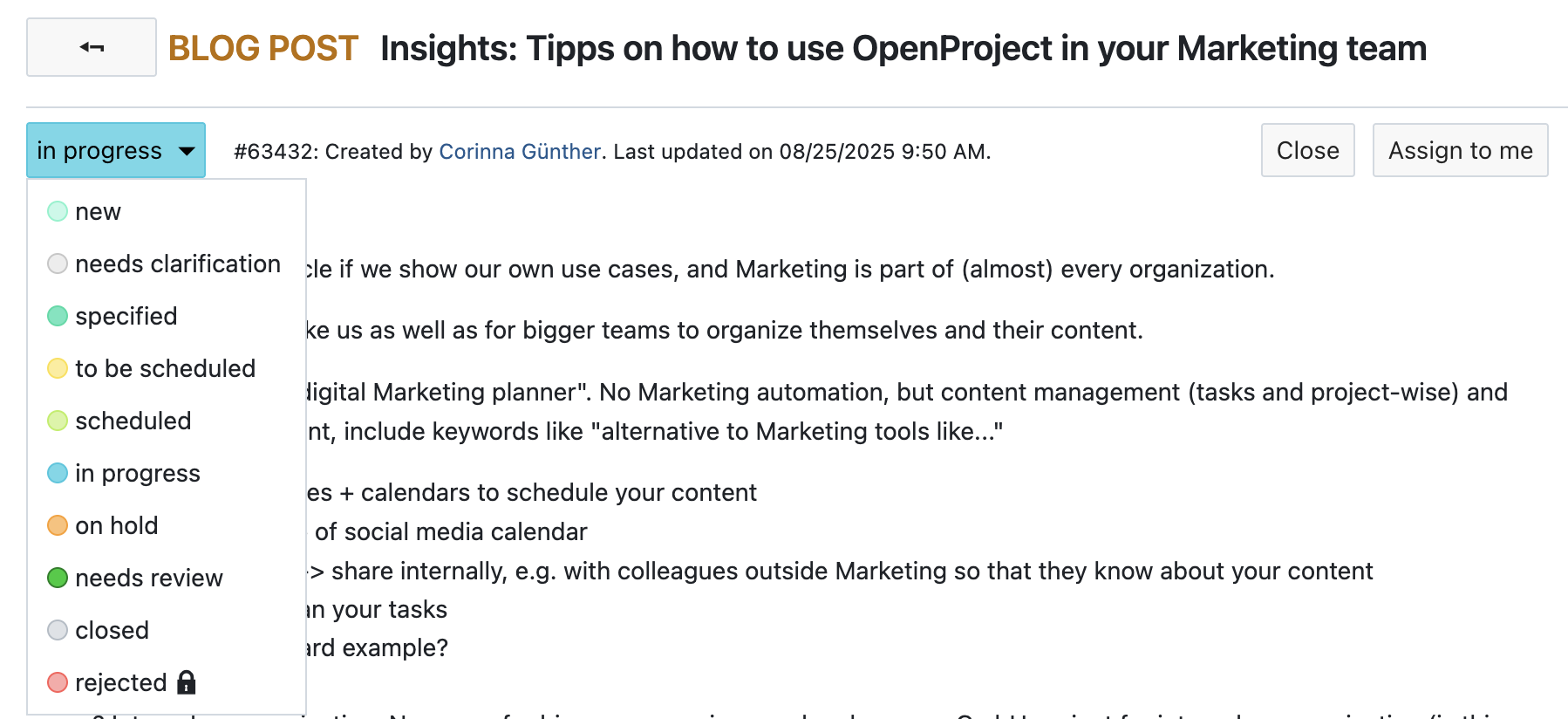
Now it’s time to define your work packages. In OpenProject, work packages are the building blocks and can be of types like task, campaign goal, blog article, or social media post. This is where the flexibility of OpenProject really shines: You define the types that make sense for your marketing work, and you choose the status values that reflect your workflow.

For example, a blog article might move through the following statuses: New → To be scheduled → Scheduled → In progress → Needs review → Closed.

Screenshot of a blog article work package with status dropdown

To make your setup even more precise, you can use roles like Assignee and Accountable to clarify responsibilities — for example, who’s currently reviewing a piece and who’s ultimately responsible for delivery. And if your team needs additional information to stay aligned, you can define custom fields to track things like campaign goals, target audiences, or publishing channels. It’s all fully customizable to match your team’s workflow.

Table view or board view — work how your team prefers

In OpenProject, you can work in different views depending on your team’s style:

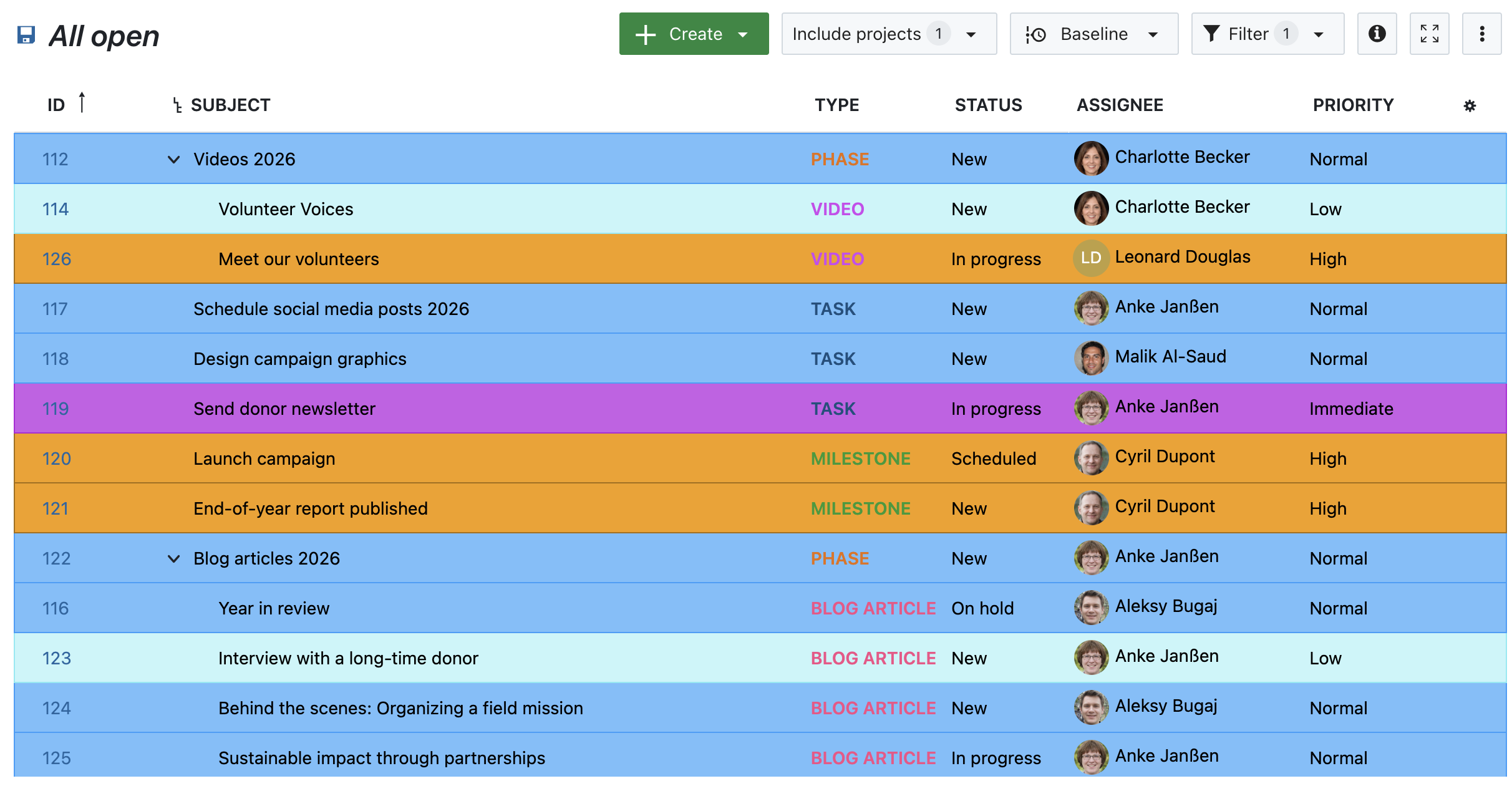
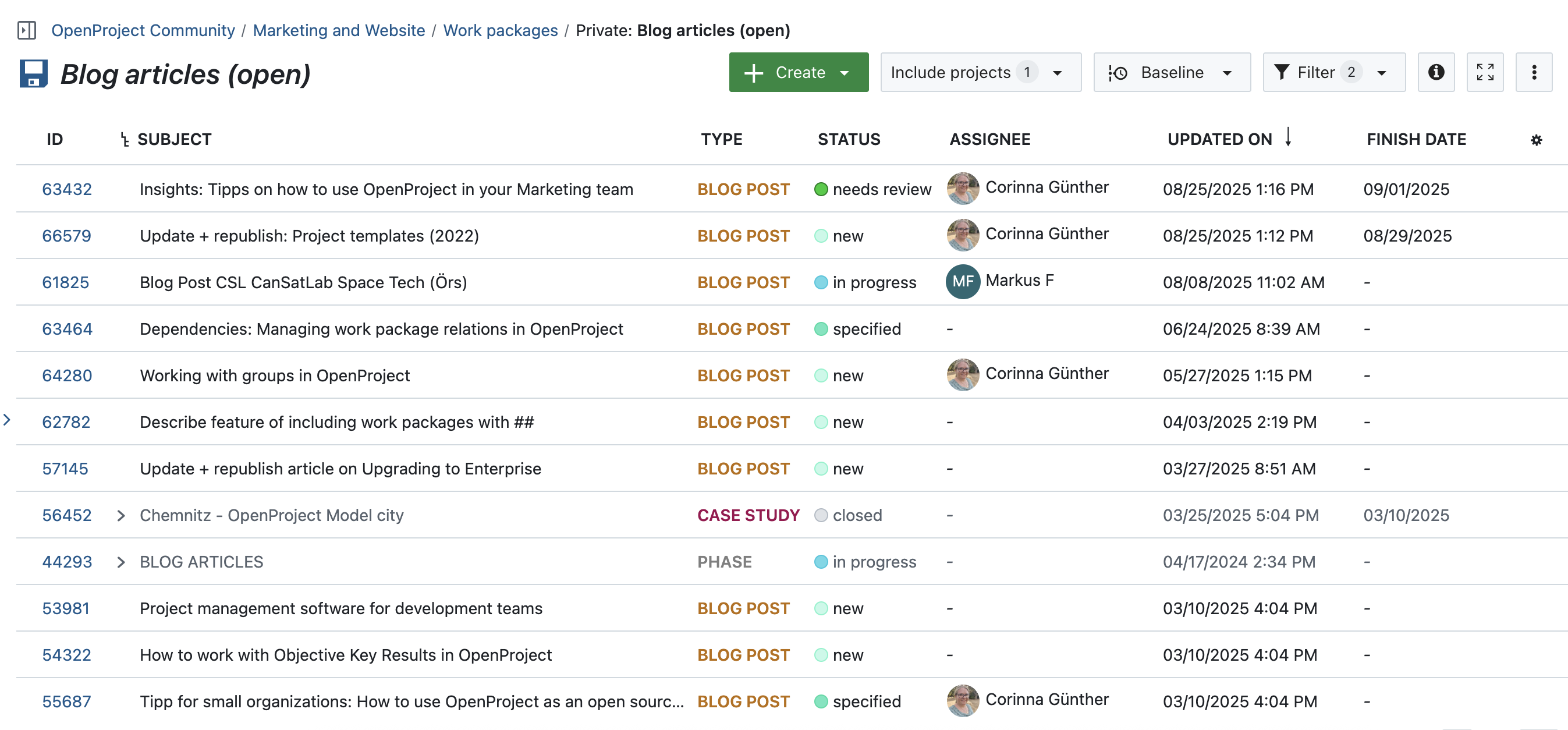
The Table view shows your content tasks in a familiar spreadsheet-like format. It’s great for bulk editing, filtering, grouping, and customizing columns — like status, finishing date, or assignee.

Screenshot showing open work packages of type blog post in a table view

The Board view lets you organize content in an agile Kanban-style layout. It’s perfect for visual planning and drag-and-drop changes between statuses like In progress, Needs review, or Published.

Screenshot showing open work packages of type blog post in a board view

You can switch between views anytime, and every view can be customized to show exactly what your marketing team needs.


With this structure in place, your marketing team is ready to manage all kinds of content workflows, from blog posts to social media management and event planning.

Blog article management

We’ve already given you some insights in our blog article management above. Let’s walk through the full process, from idea to publication.

  1. One person comes up with an idea and creates a new work package of type Blog article. They add all their thoughts into the description and @mention their colleagues or team leads in the Activity tab to discuss if and when this idea is ready to follow up on.

  2. The mentioned person answers and updates the status from New to To be scheduled. They also assign the work package to the person responsible for writing and publishing.

  3. When the article is written, the status is set to Needs review and the assignee is changed to the colleague who will do the review. This makes responsibilities clear at every stage.

  4. When the article is ready to be published, a date must be set. If you’ve set up a calendar (by filtering for type blog article), the article will now be shown there.

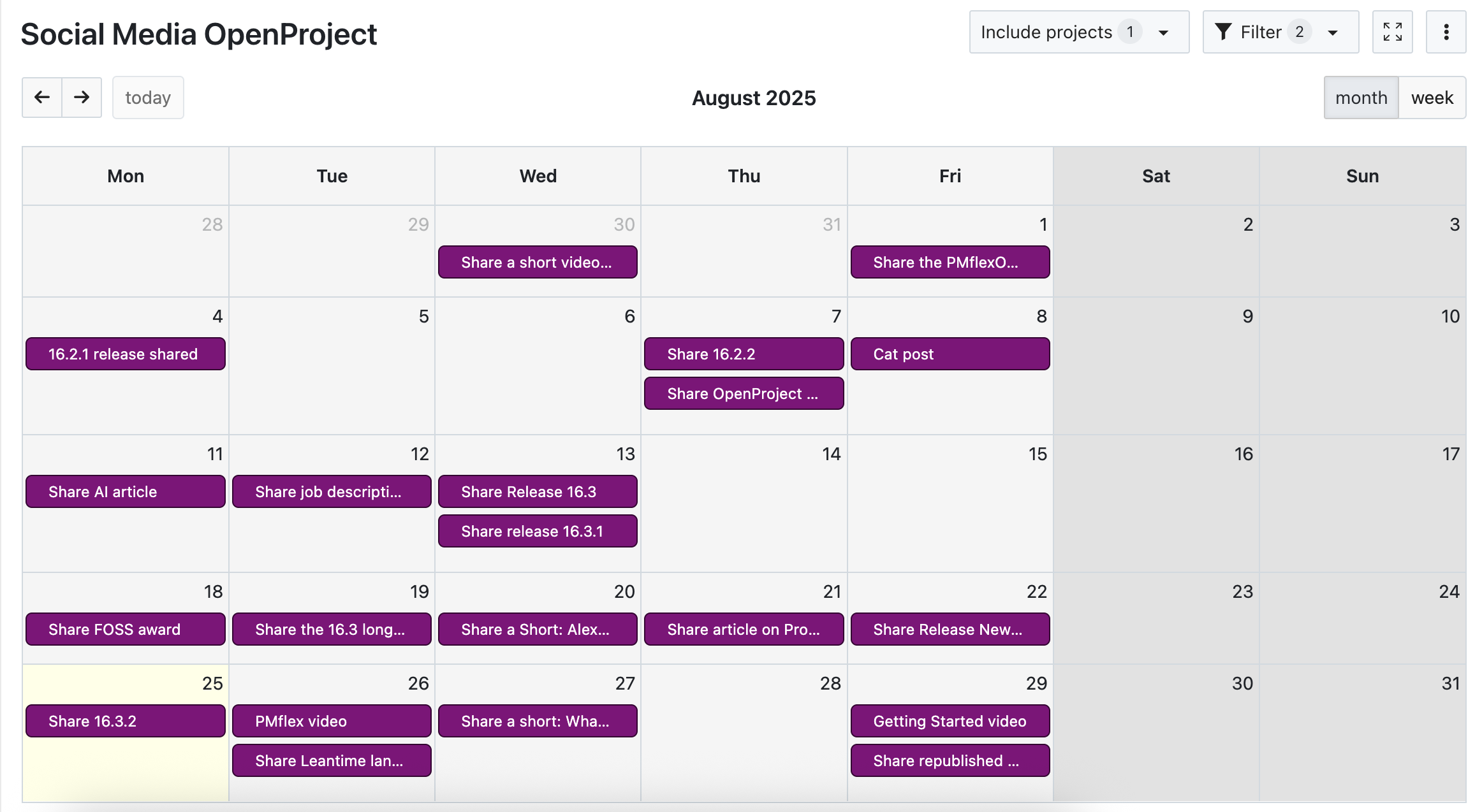
Here’s an insight into the blog article calendar at OpenProject:

Screenshot of a calendar view in OpenProject for August 2025, showing 1-2 blog article entries each week.

Tip

Subscribe to your OpenProject calendar from your external calendar app. This way, you always see when blog articles are scheduled. This isn’t just helpful for your team, but also for Sales, Support, or others who want a quick overview of upcoming content.

  1. Once the article is published, the work package is marked as Closed. This removes it from your open work lists, but it still exists for future reference or performance tracking.

Of course, you might now want to share your new content piece for the world to see. To do so, let’s look at how to manage social posts with OpenProject.

Social Media management

Once your content is ready, it’s time to get it out into the world — and social media is usually the next step. With OpenProject, you can plan and coordinate your social media posts just as precisely as your long-form content.

Each social post becomes its own work package. You can set the type to Social media and use custom fields to track channels (e.g. LinkedIn, X/Twitter, Instagram) or campaign tags. This keeps everything structured and filterable.

A typical process might look like this:

  1. Create a work package of type Social Post for each planned social post. Add the content draft directly into the description or attach a file if needed. Make sure to add a date so that your post will appear in the calendar.

Screenshot of a calendar in OpenProject showing social media posts

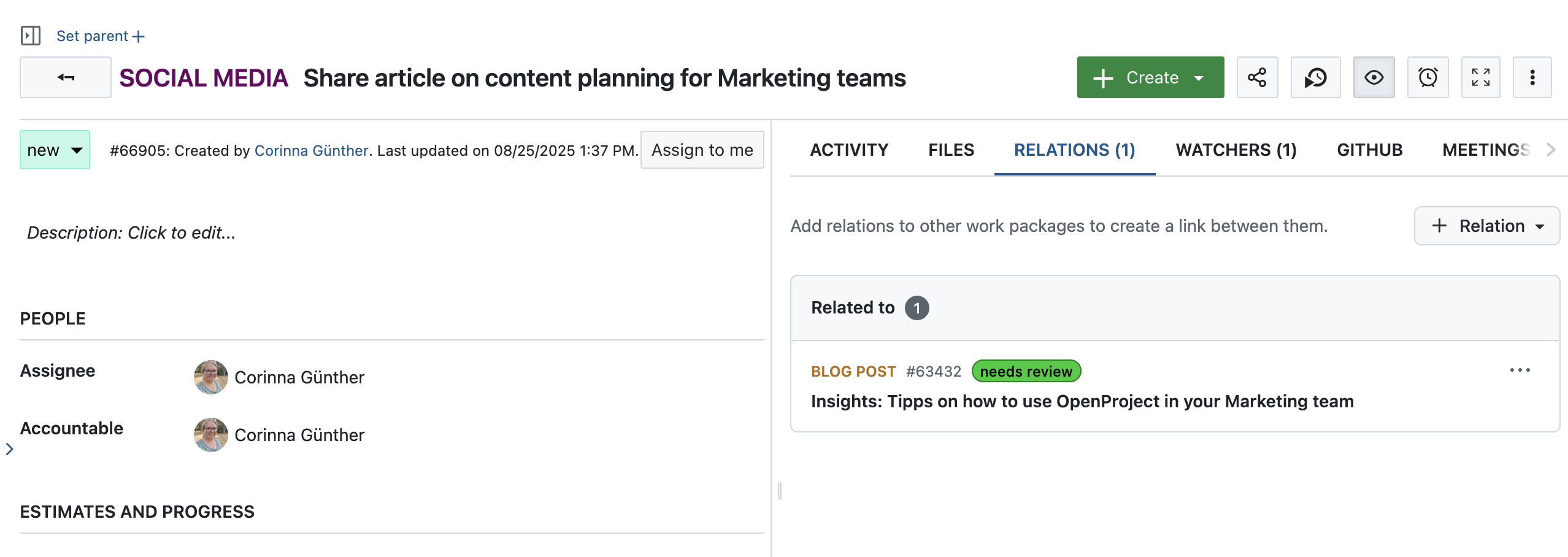
  1. Add relations between social posts and the content they support (e.g. a blog article or campaign). That way, you always see which social activities belong to which main content pieces.

Screenshot showing the work package for this blog article and the relation to the social post

  1. Assign responsibilities and collaborate in the comments to finalize your posts. You can also assign the whole team if you don’t know yet who will take care of it.

Event and campaign management

At OpenProject, we actually don’t run many marketing campaigns or large-scale events — but we know how crucial structured coordination can be for teams that do. Especially when multiple parties are involved, things can get messy fast without a clear system.

That’s where OpenProject’s flexibility really helps: You can create a dedicated subproject for each event or campaign. This allows you to keep your planning structured, define specific settings, and even invite external stakeholders or agencies without giving them access to your full Marketing workspace.

Meeting management

Need to align schedules, assign tasks, or review campaign materials? Use the Meetings module to prepare agendas and capture outcomes. This helps not only with event preparation, but also with recurring internal check-ins or retrospective meetings.

Tip

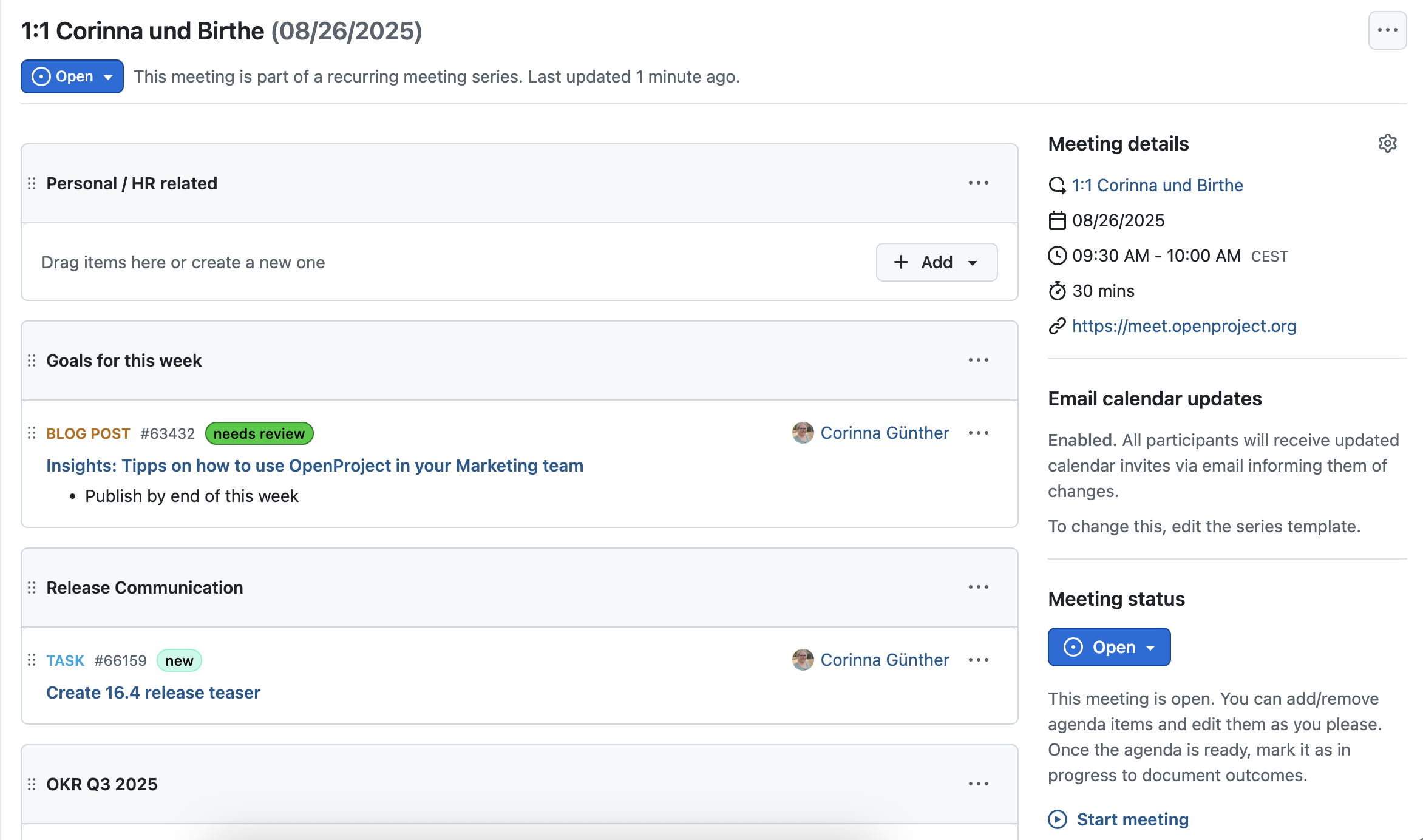
At OpenProject, we use our own Meetings module for regular 1:1 meetings between the team lead and content manager. The content manager simply adds the work packages they’re currently working on or need to discuss — and a meeting template ensures all sessions follow a consistent structure. This is what we mean by keeping “everything in one system”.

Screenshot of a 1:1 meeting created in OpenProject, with sections like “Goals for this week” and the status ‘Open’

Team collaboration beyond your marketing team

OpenProject is the perfect choice for open-minded and clever marketing teams who want to customize a content planning tool to their exact needs. From managing blog articles and planning social media posts to coordinating campaigns, events, and team meetings — everything stays in one place, structured and transparent. You define the workflow, the content types, and the collaboration setup.

Marketing teams are often the first to structure their work, but rarely the first to get the tools they deserve. OpenProject helps you take the lead by offering a free content planning tool: streamline your content workflows, collaborate efficiently with other teams, and set an example for transparent, organized work across your organization.

Show what smart teamwork looks like. Become the blueprint for how your company gets things done.

Start your free trial today

You’re probably not reading this just out of curiosity. You’re managing campaigns, chasing approvals, and trying to bring order to creative chaos. We’ve been in the same spot, and that’s why we built this setup for ourselves. If it works for us, it could work for you too.

You know that every good article ends with a call to action, and here’s ours: Start your free trial today. No credit card, no phone number, no pressure. After 14 days, it’s entirely your call whether to continue — but we believe OpenProject will speak for itself.

  •  

How to work with project templates

Using project templates in OpenProject helps your team save time, avoid repetitive setup, and ensure a consistent project structure across your organization.

Let us have a look at how you can set up project templates in OpenProject.

3 steps to create a new project template

In OpenProject, only administrators can create and remove project templates. That way, there is a handful of people ensuring consistency and overseeing the amount and structure of templates.

To set up a new project template, you can either create a new project from scratch or convert an existing one into a template. If you want to make sure that all settings are predefined as you need, we suggest creating a new template project.

In short, there are three steps:

  1. Create a new project.
  2. Adjust all settings so that the project is a good template.
  3. Mark the project as template.

We will go through all three steps by using an example use case.

Project templates example use case

Let us use the example of organizing an event, e.g. a conference. This is something that can occur frequently, e.g. quarterly or annually. In order not to have to start from scratch every time and also to help in case different colleagues are organizing conferences, a template can be very useful to save time and build on past experiences.

We’ll walk you through which modules can be pre-configured to get the most value out of templates.

1. Create and name your project template

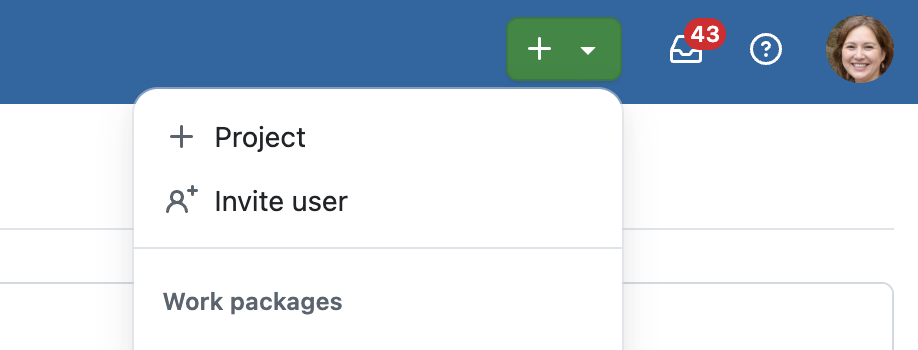
First, you create a new project by clicking on +Project on the header menu.

Plus button in header to add new project in OpenProject

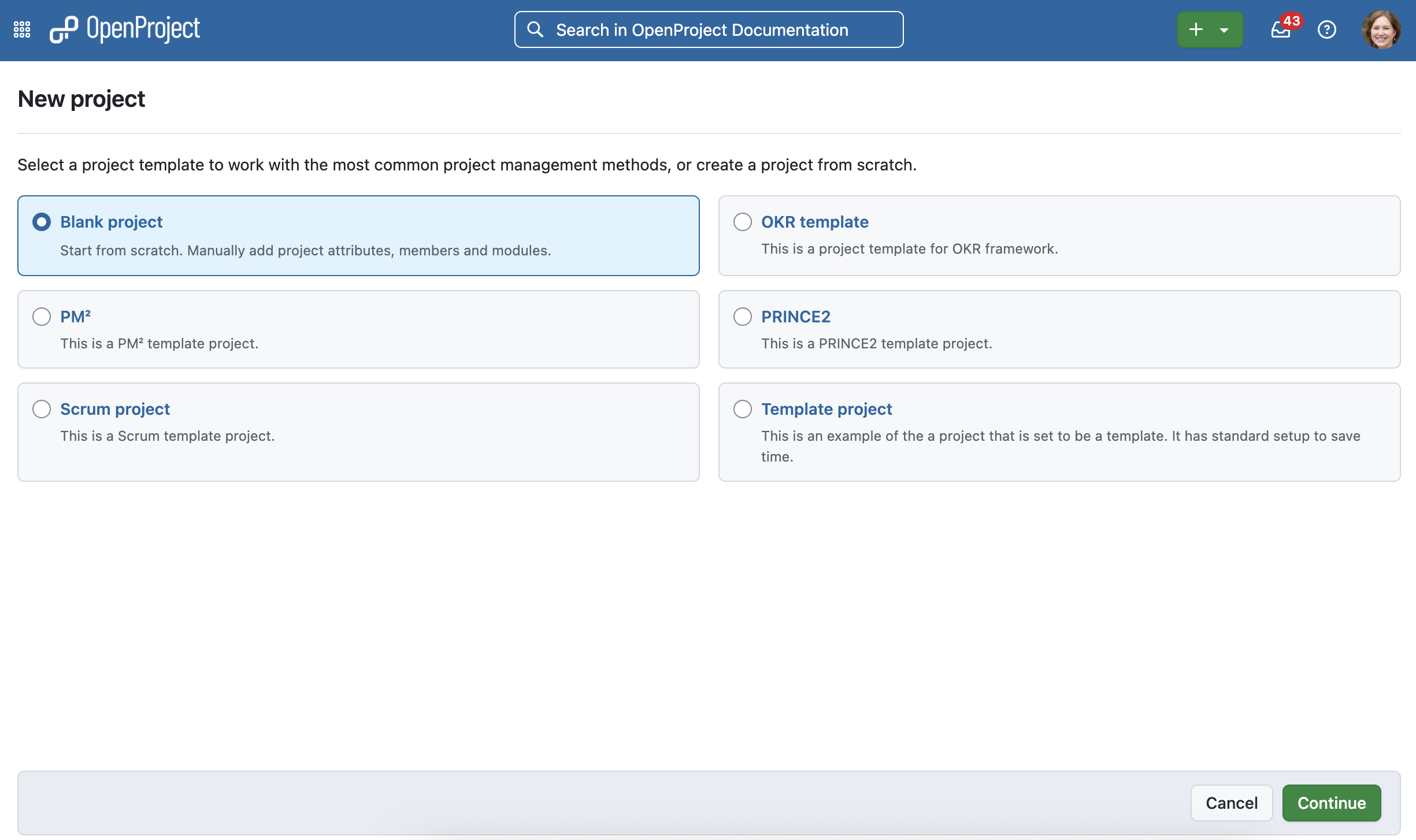
Now you see the screen where your template will later appear as well. Select a template to start with prefilled settings or start with a blank project.

OpenProject template selection page

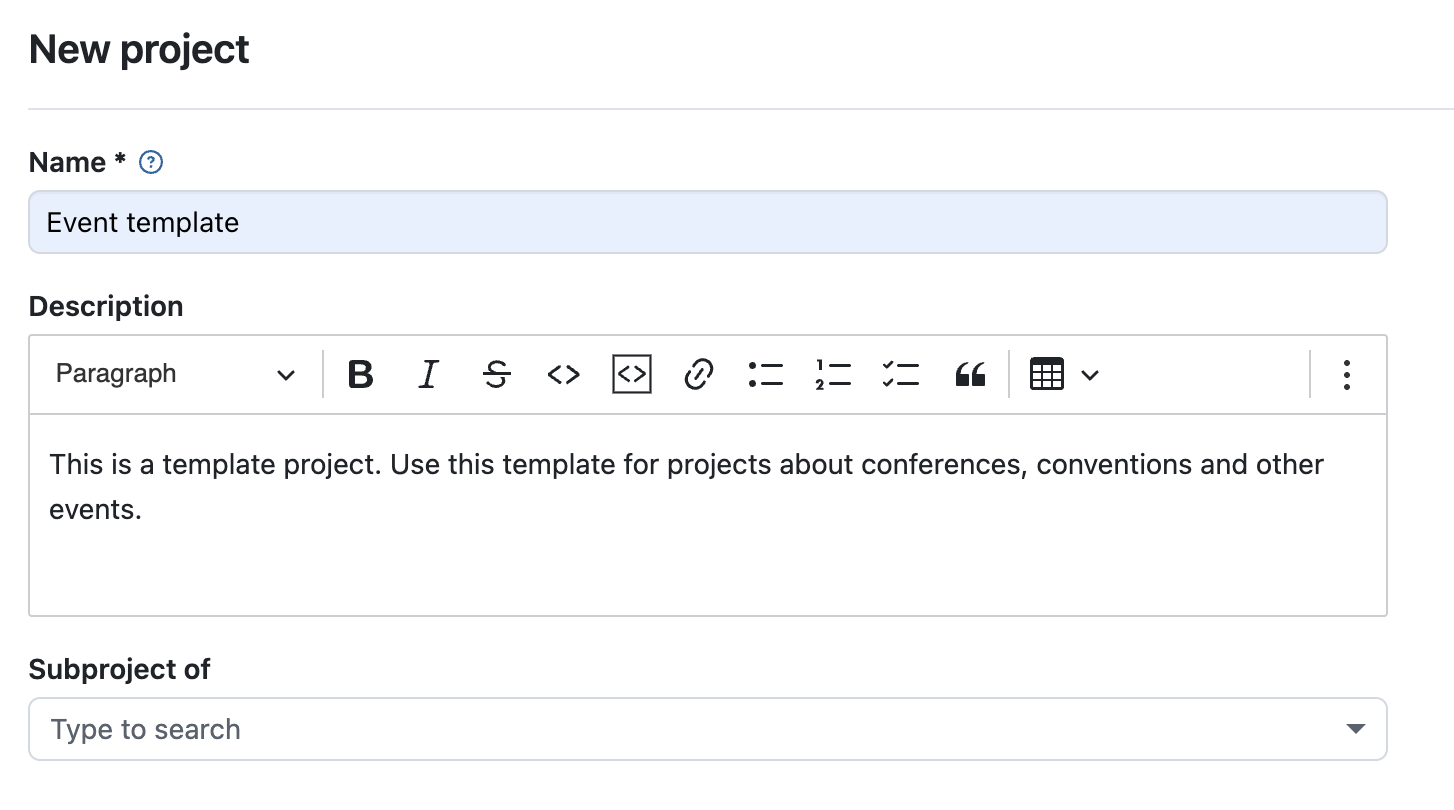
Then, you name your project that will later become your template.

OpenProject project form to fill in with project name - “Event template” in this ecample, plus description and selecting if it’s a subproject of another project

When you create your project template as described above, consider adding template to its name, making it easy to distinguish it from your normal projects. Your project template will appear e.g. in the project lists so that you would want to be able to see which of the projects serve as templates.

We advise to add a short description that will also appear in the overview of selecting a new project from a template. You can also define whether your new project should be the subproject of another project. For the function of being a template, this is not relevant, but if you use several templates, you could think about organizing them all under a “templates” project.

2. Adjust the project settings

Modules template

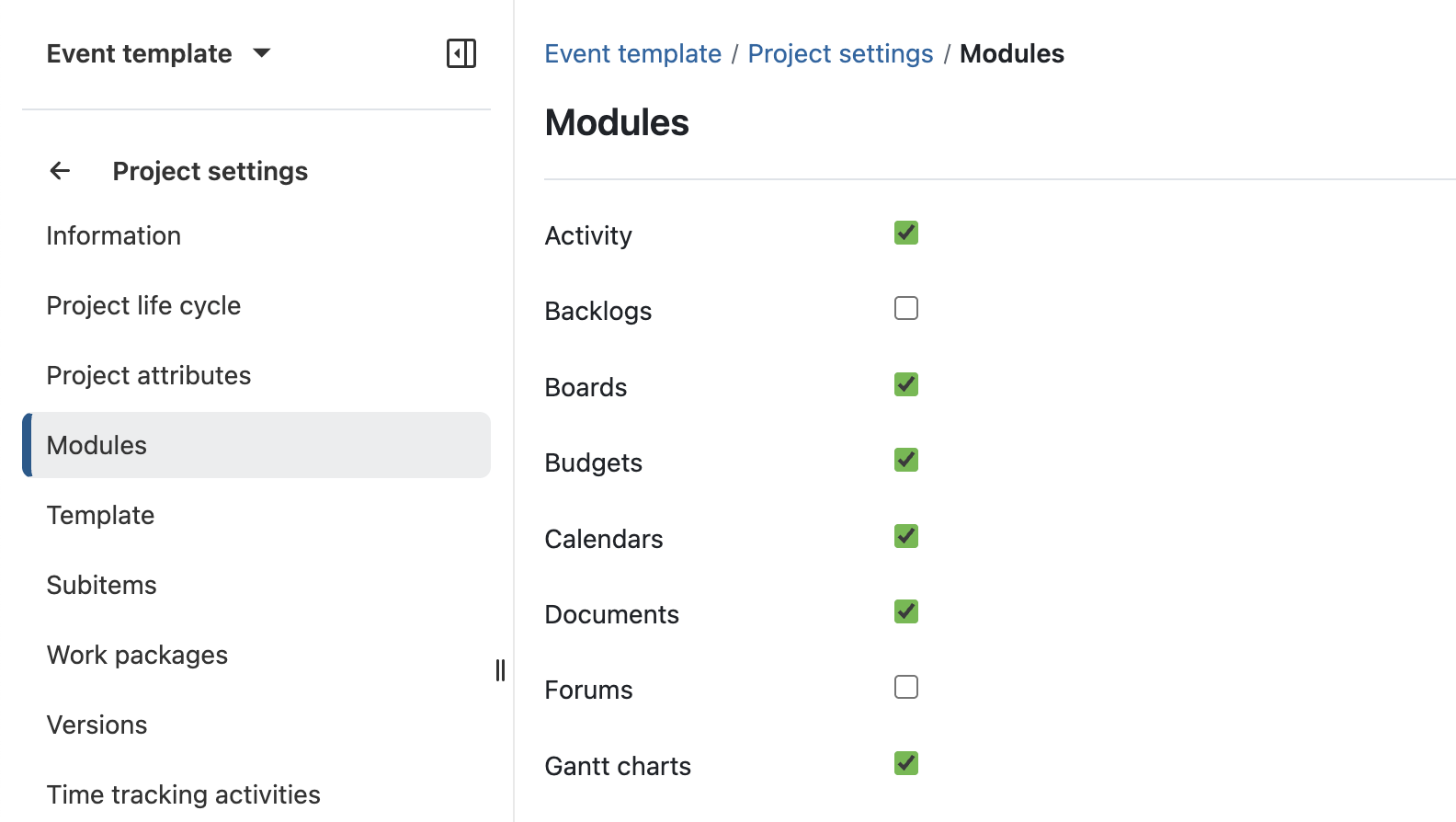
Now, go to the project settings and activate the relevant modules for your template. For an event template, this could be modules like Activity, Boards, Budgets, Calendars, Documents and more.

OpenProject project settings showing all modules with tick boxes to activate or deactivate

Work package template

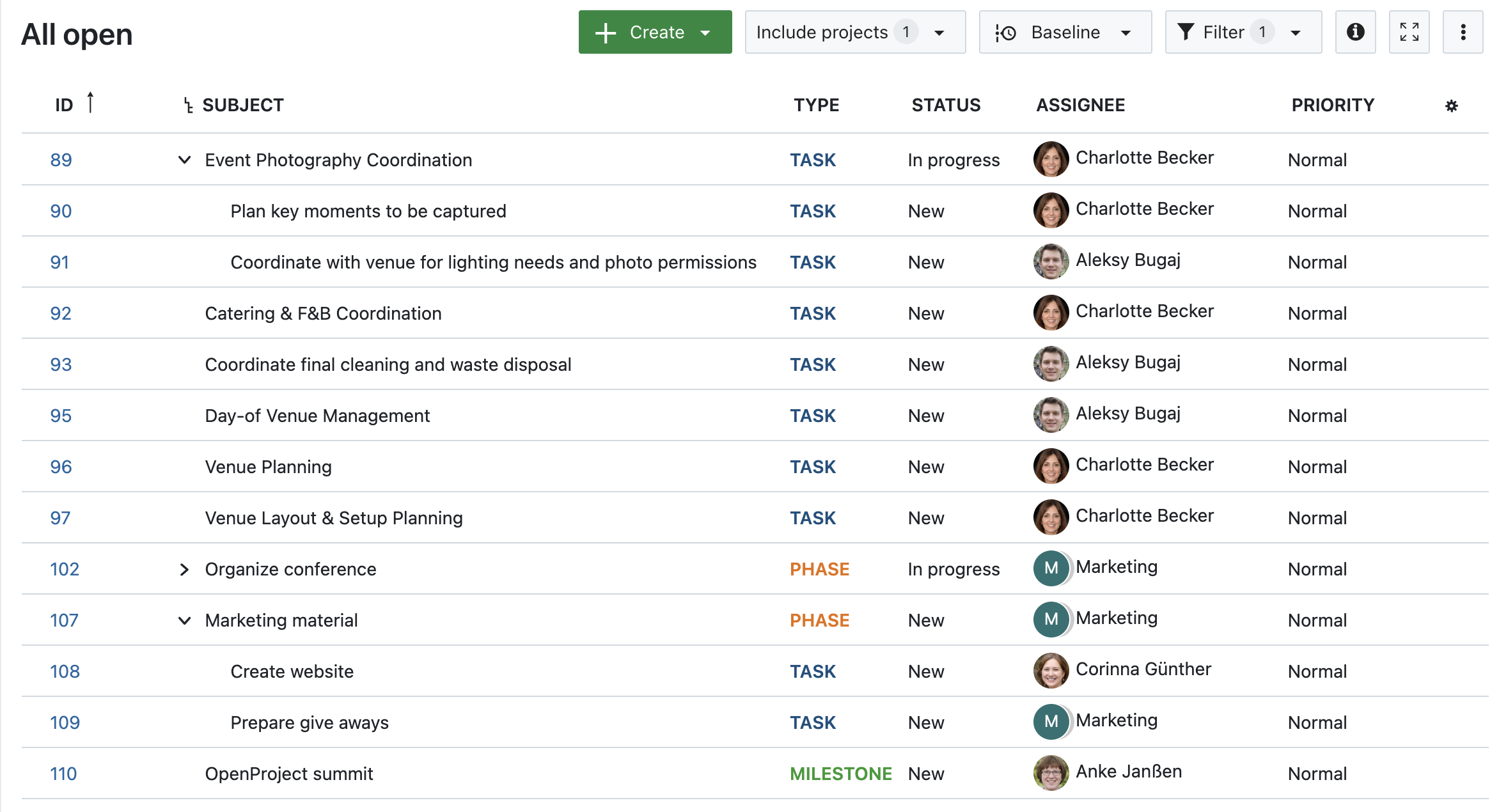
Next, set up the work packages needed to manage your project from initiation to closing. Thereby include relations and hierarchies to make it quick and easy when you start a new project from your template.

OpenProject work package table with work packages assignees status and priority

Of course you can also customize your work package form in the template to include all relevant information for your organization. Every time you open a new work package, you will then see the attribute list that you had set up.

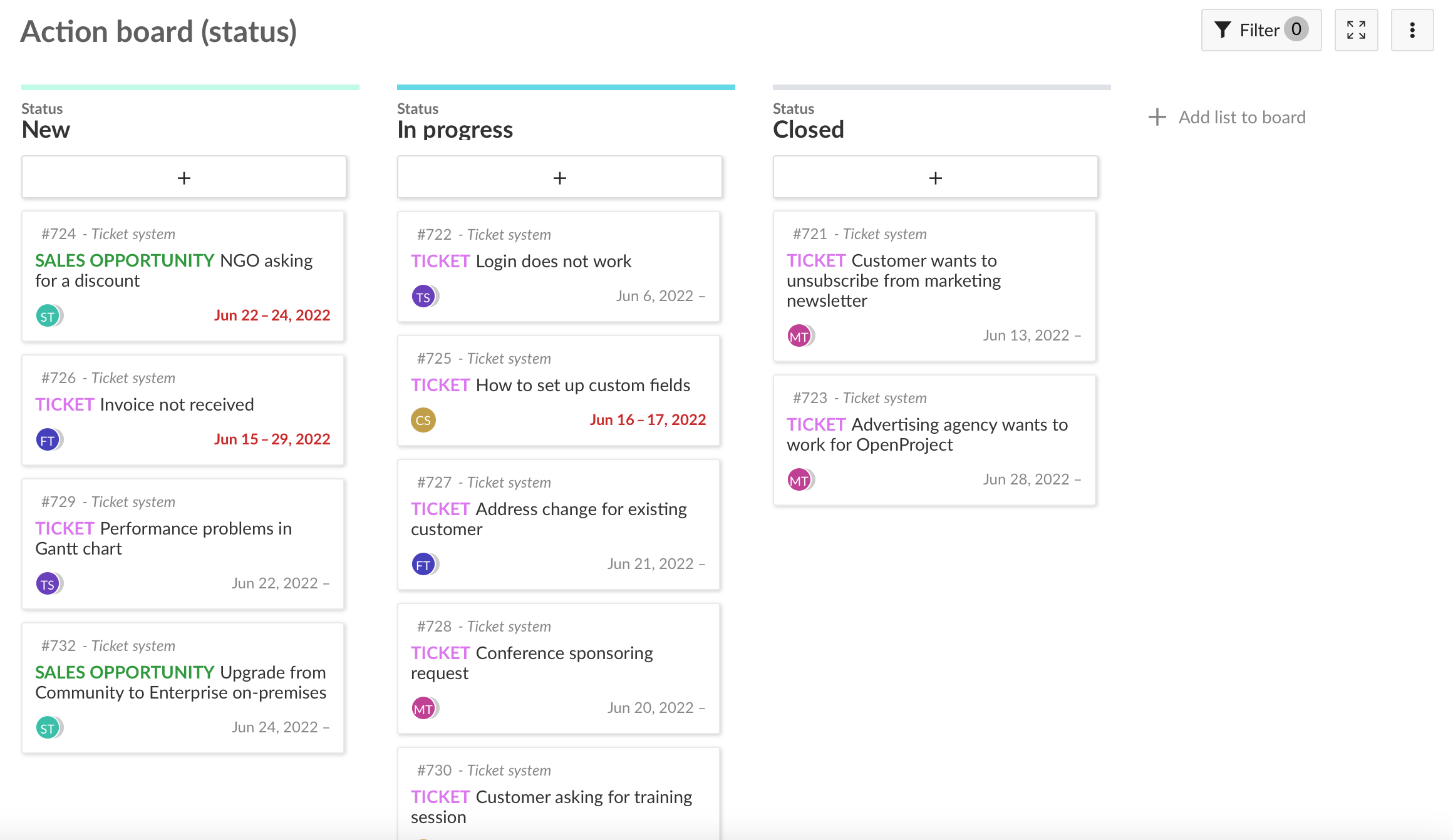
Agile boards template

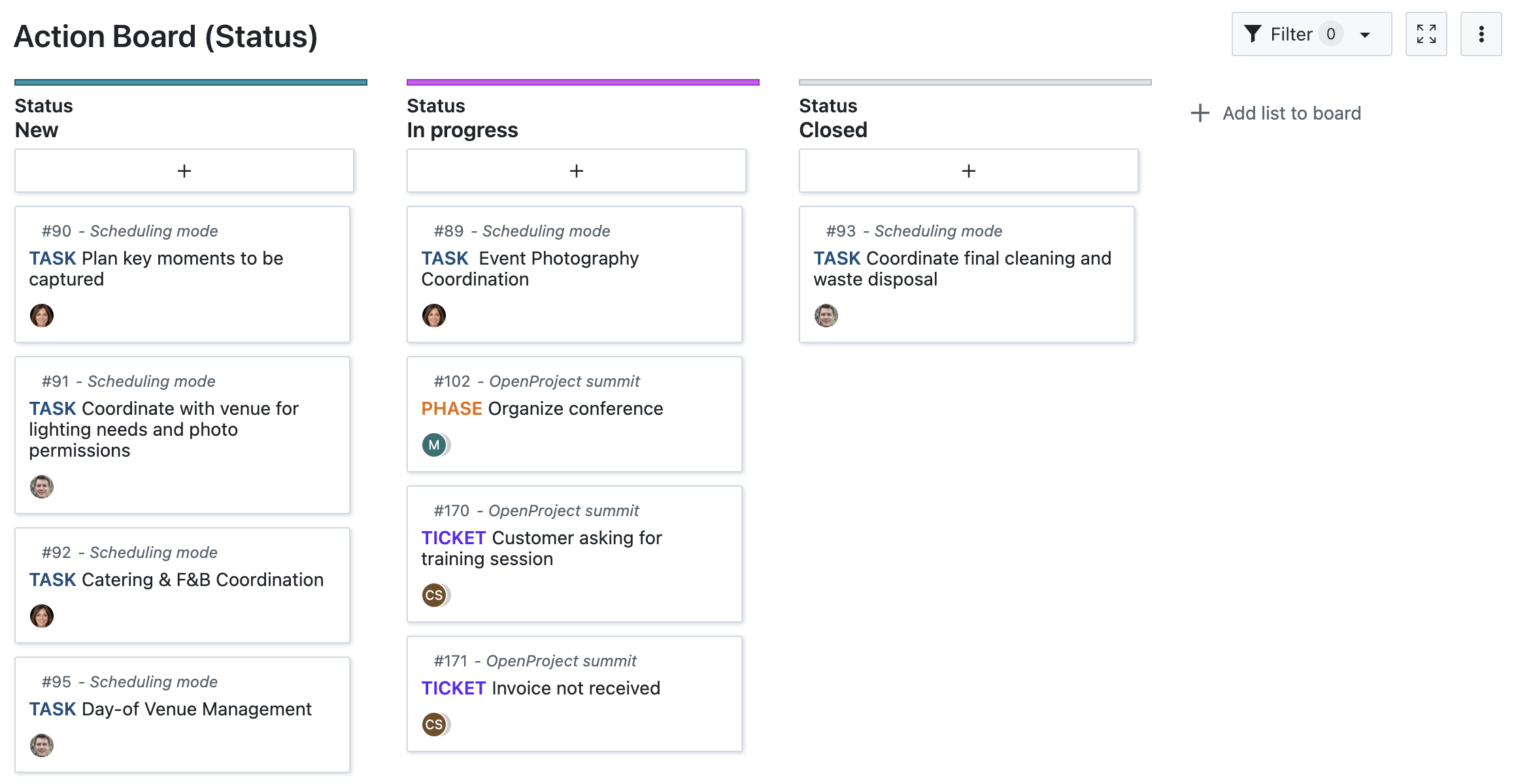
If you are using the boards view to get things done with your team, set these up, too. Configuring the lists of action boards will provide you with prefilled boards as they automatically draw input from your work packages.

OpenProject action status board with new in progress and closed lists

Members template

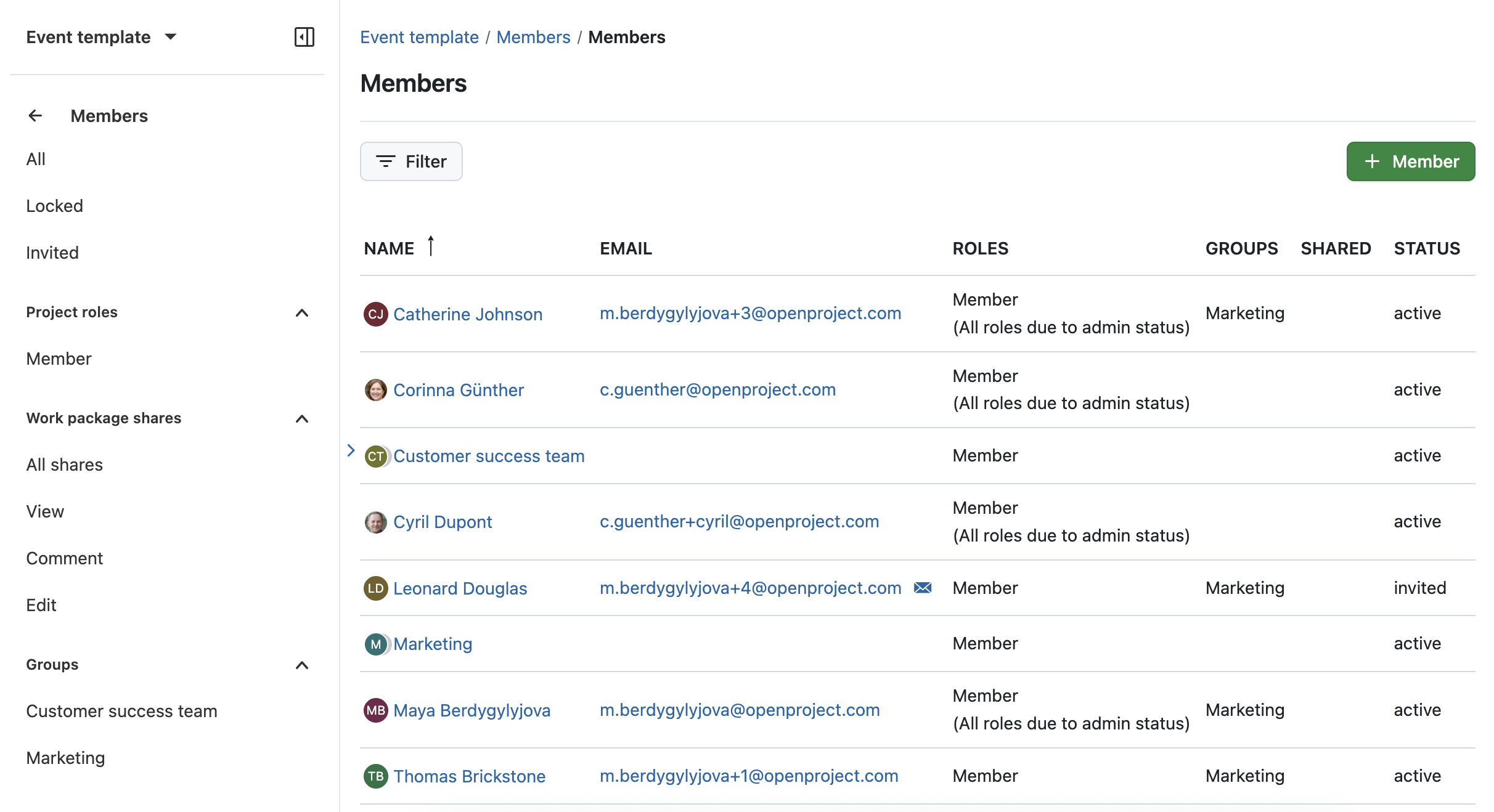
Consider setting up your members for your project templates. Either the whole team will always be the same or you set up the core members that will for sure be part of a project like this. Define roles and permissions, rates and groups.

OpenProject members module shown with a few members

Custom fields template

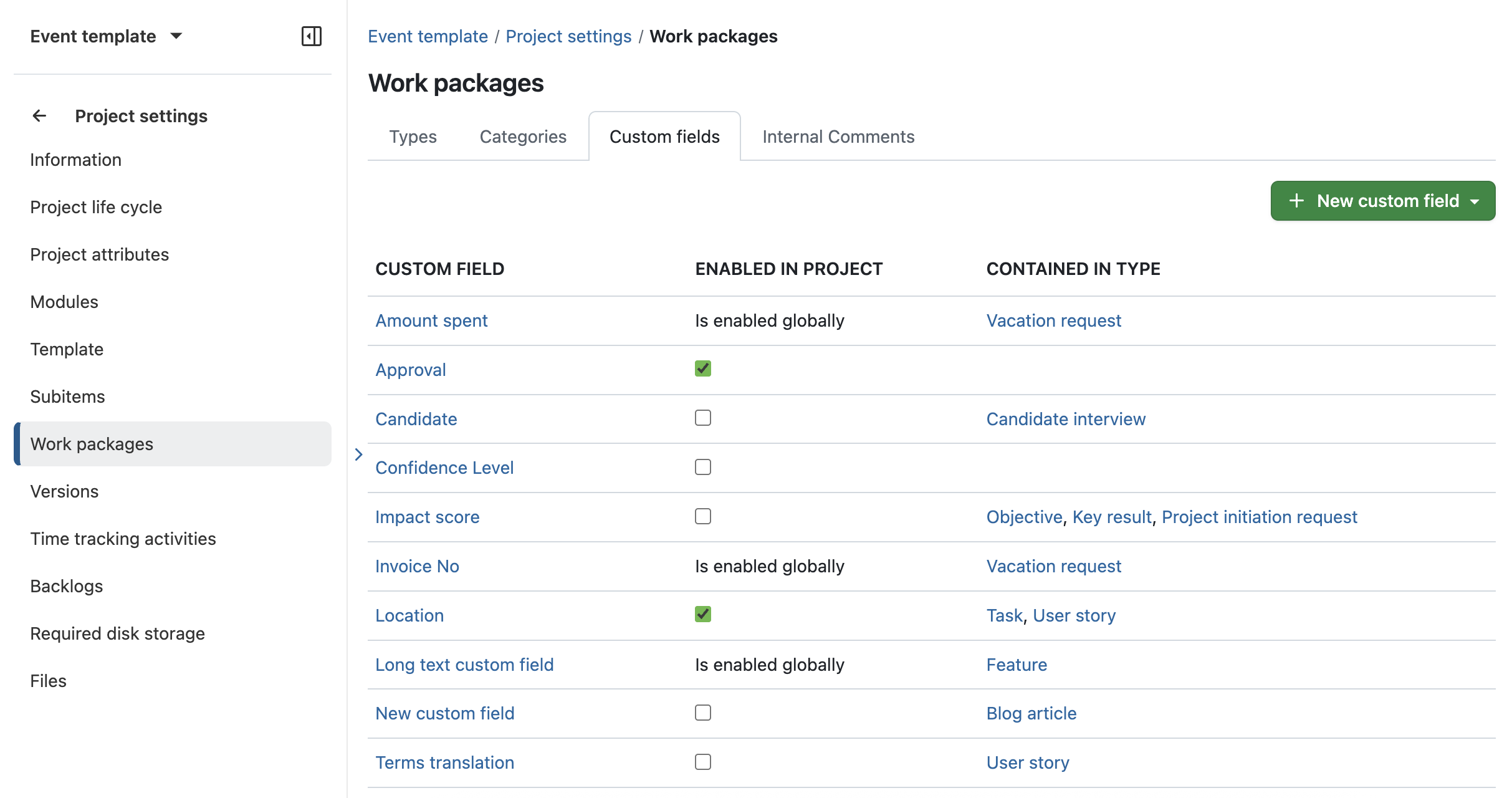
Creating custom fields in your project template allows you to have it available for all future projects based on this template. We created for example an approval field so that managers can approve artworks or merchandise or the likes. Please note that if a custom field is enabled globally, it will automatically be displayed in a template project.

Showing active custom fields for the project

Project attributes template

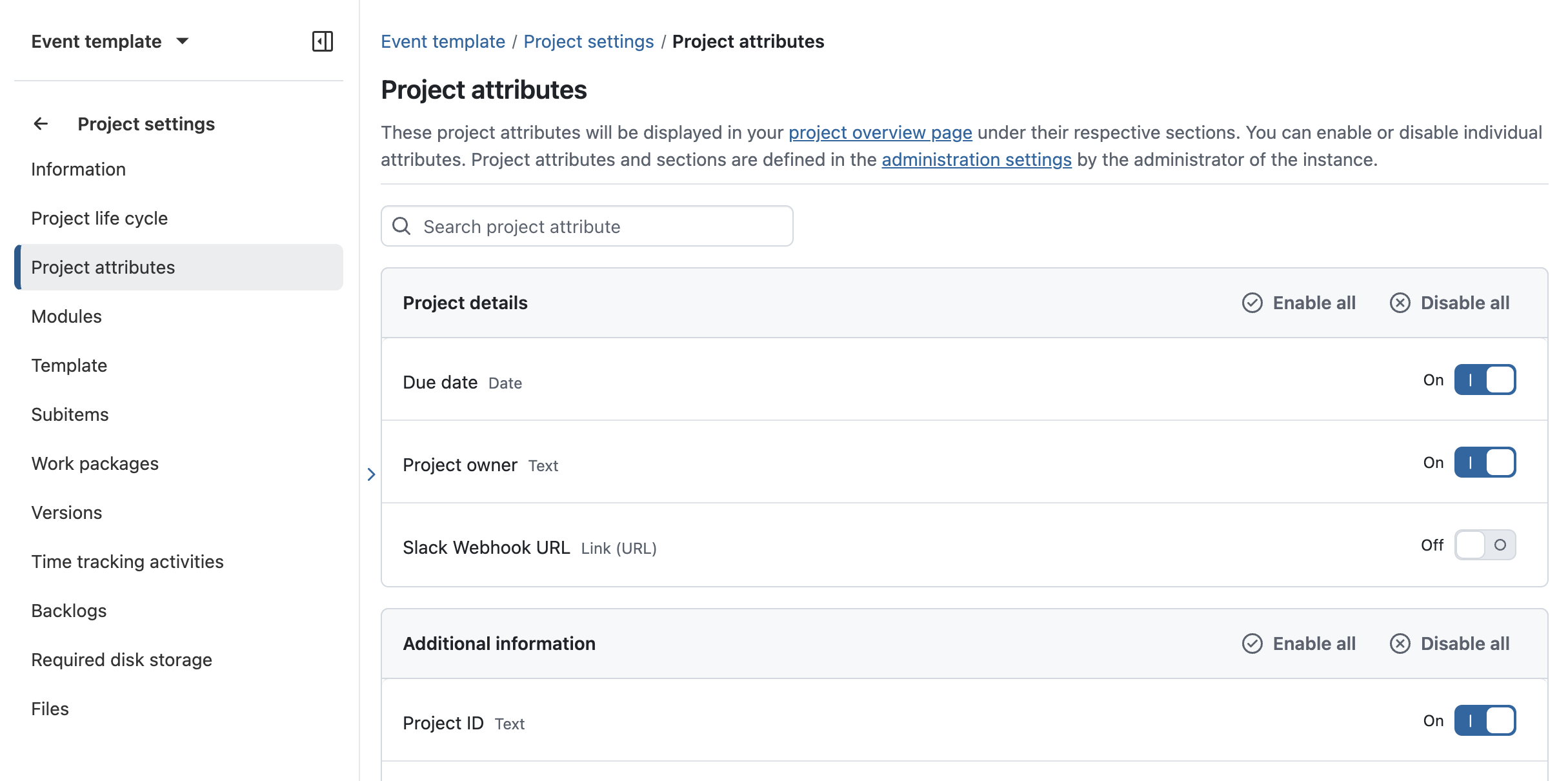
If you want to display specific attributes on the project overview page, you can select existing or create new project attributes for your template project.

Showing active project attributes for the project

3. Set your project as template

We showed only the most relevant modules to give you an idea about the benefits of project templates. Other modules like Meetings or Wiki can of course also be set up for your template.

Important

Please note that due to complexity reasons, the modules Budgets and Time and costs cannot be copied with content for now. Please do not set these up in your template as when you use the template, these modules will appear empty in your newly created project.


Once you’re happy with all settings on your template project, it’s essential to set it as template so that it will appear in the template selection when creating a new project.

To make this project a template, navigate to the project settings to either:

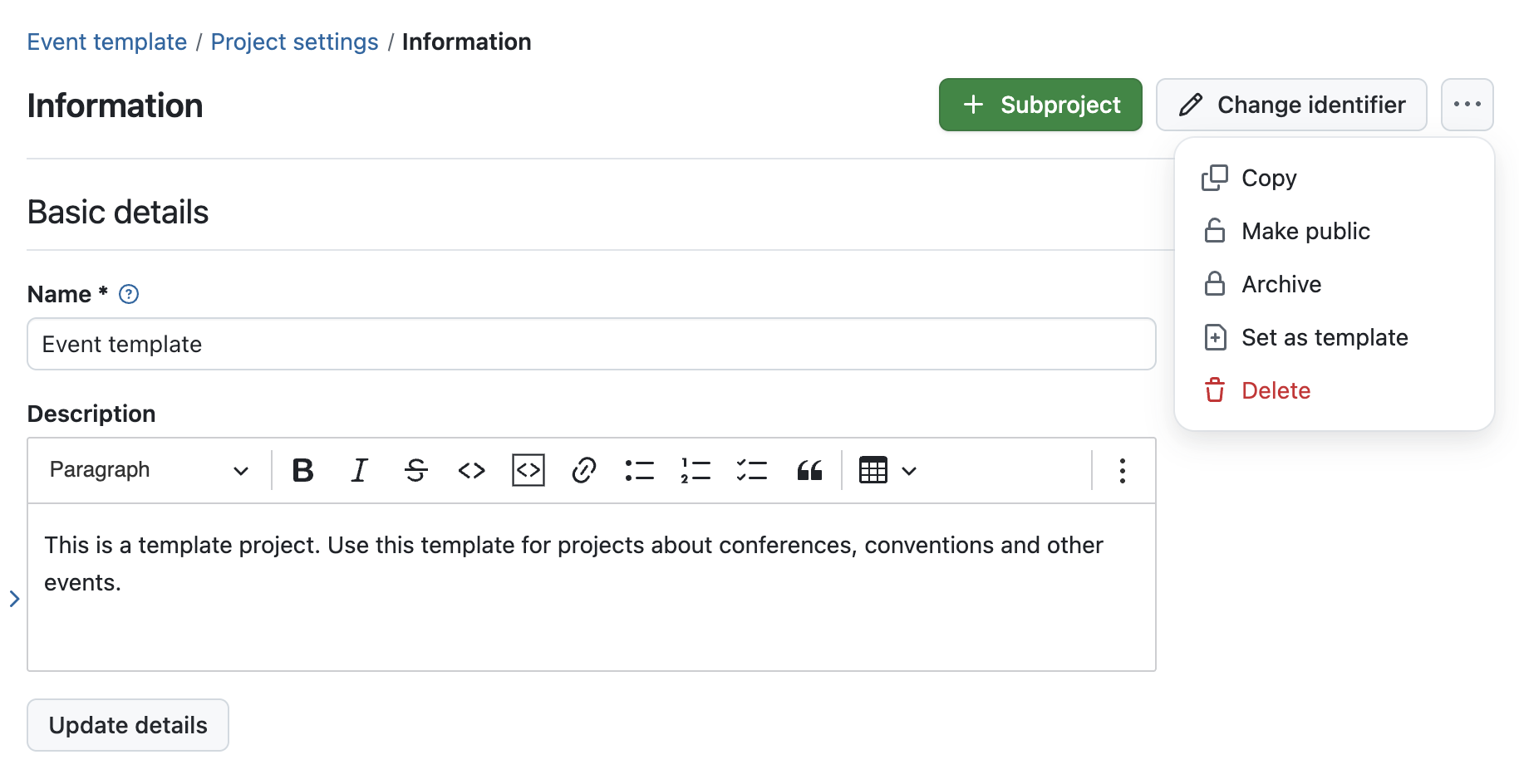
A) Go to information and click on the 3-dot-menu to choose set as template.

OpenProject project form top right with dropdown menu to set as template

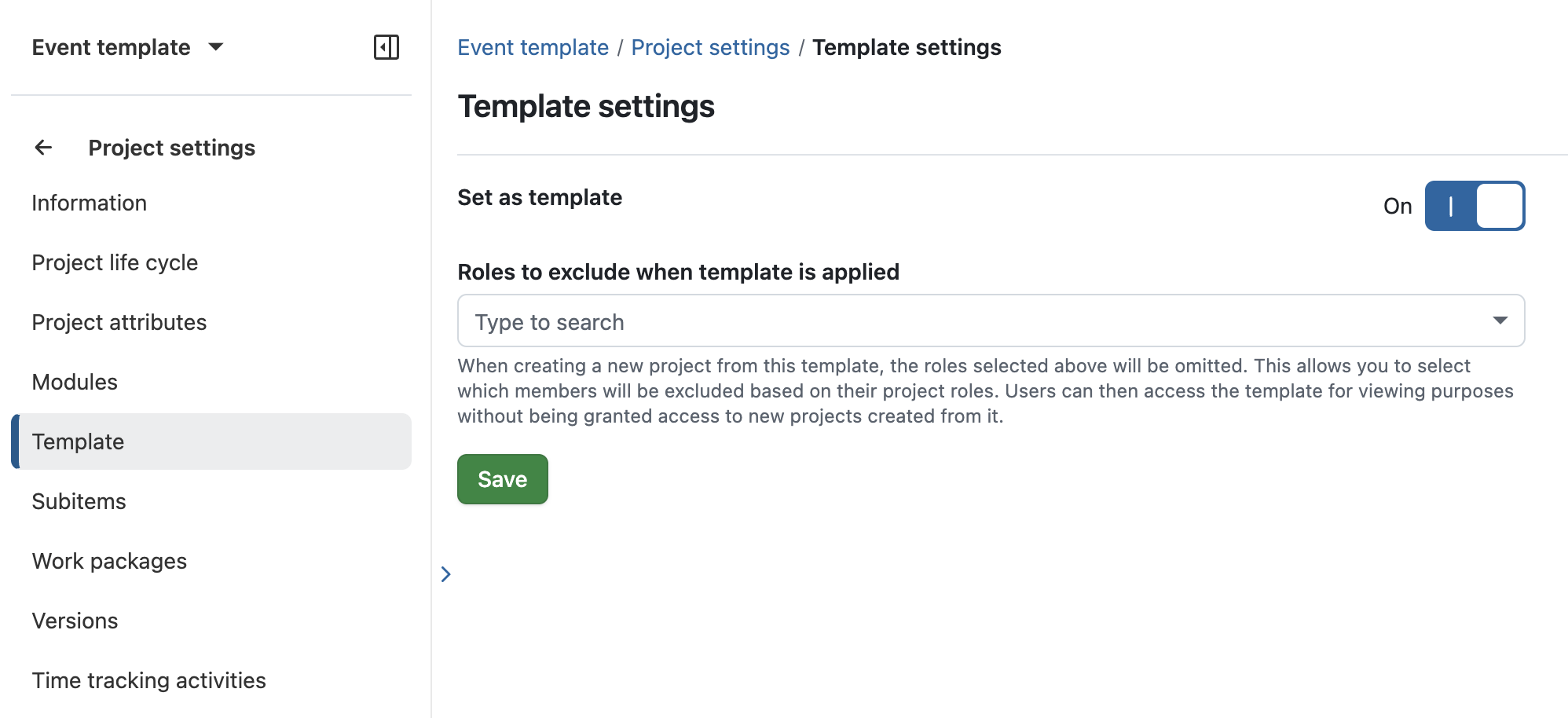
B) Or go to templates and enable the button to “set as template”.

OpenProject project settings to enable as template

In case a project template is not relevant anymore and should not be used any longer, this is also the spot where you can remove it from templates.


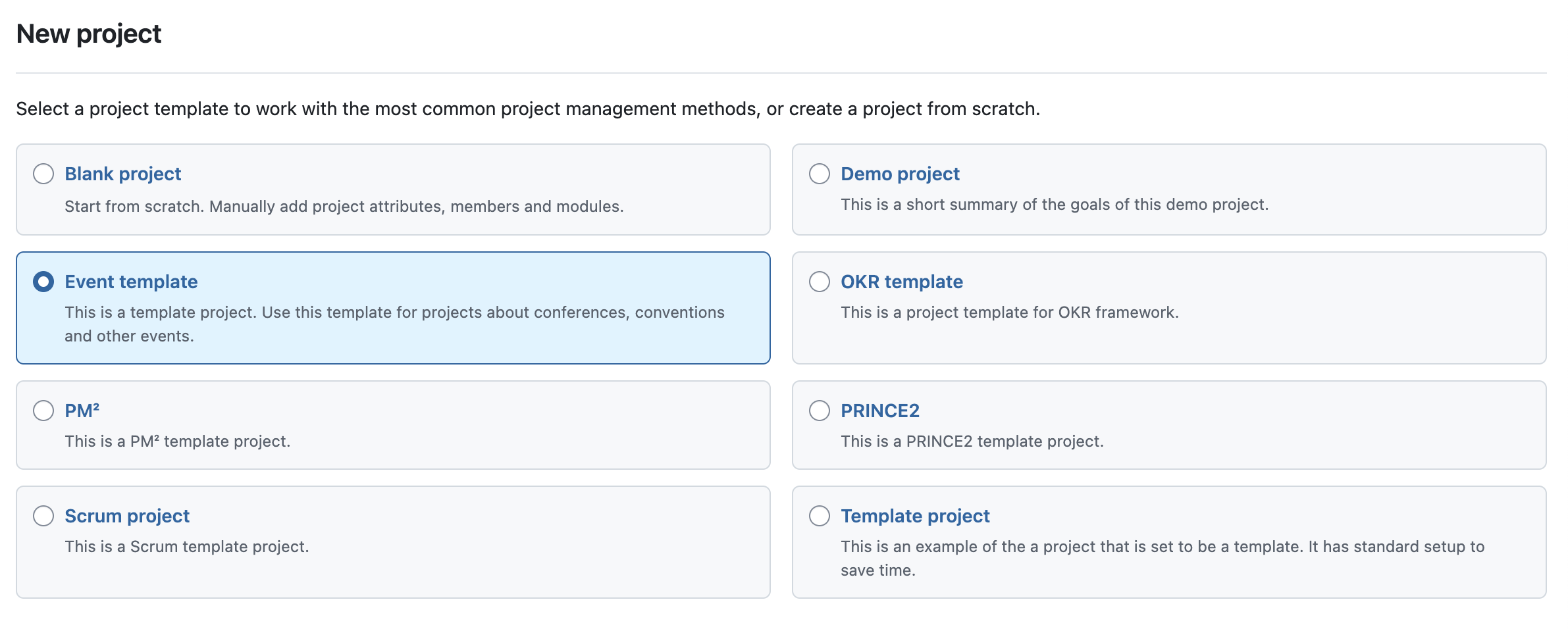
Congratulations, you’ve created your first project template in OpenProject. Now, if you click on +Project again, your template will appear in the selection overview:

OpenProject template selection page, with “Event template” selected and description displayed

Project templates help you start faster, stay consistent, and improve project outcomes — especially when your team manages recurring workflows.

For more information about project templates and other OpenProject-related questions, please see our documentation.

  •  

7 features for successful programme management with OpenProject

Programme management in public administration is complex. Multiple projects need to be coordinated, dependencies managed, and the achieved benefits demonstrated transparently. With PM², the project management methodology of the European Commission, there is a clear framework for this. The German Federal Office of Administration has adapted this standard with PMflex specifically for German authorities – practice-oriented and with checklists for programmes, portfolios, and projects.

To keep an overview as a programme manager, you need a central control point – a kind of cockpit that bundles all relevant information. The open source software OpenProject, developed in Europe, provides exactly this support. In this article, we present seven features that specifically support and empower you in programme management.

What does good programme management mean?

Good programme management means steering several interrelated projects so that they jointly deliver the planned benefits. Unlike project management, it is not only about successfully completing a single initiative, but about keeping the overall impact in focus. While portfolio management sets the strategic selection and prioritization, programme management ensures the coordinated operational execution.

For public administrations, this approach is crucial: programme management creates transparency, enables accountability to stakeholders, and ensures that political or organizational objectives are actually achieved.

Programme management in the public sector in Europe

The European Commission has developed PM², a standard that addresses exactly these requirements: phase models, roles, processes, and tools for projects and programmes. The German Federal Office of Administration has adapted this approach with PMflex to the needs of German authorities – with clear templates and practice-oriented checklists.

OpenProject supports you in implementing both approaches. With standardized workflows, transparency across programme structures, and central documentation, it is an ideal tool for managing programmes according to PM² and PMflex.

Tip

Of course, OpenProject supports not only programme management but also project and portfolio management. Projects form the operational level, programmes bundle several projects with a shared benefit, and portfolios provide the strategic orientation. With OpenProject, administrations have one solution that covers all three levels – integrated, transparent, and compliant with PM² and PMflex.

Seven features for successful programme management

1. Define a life cycle: Phases and Phase Gates

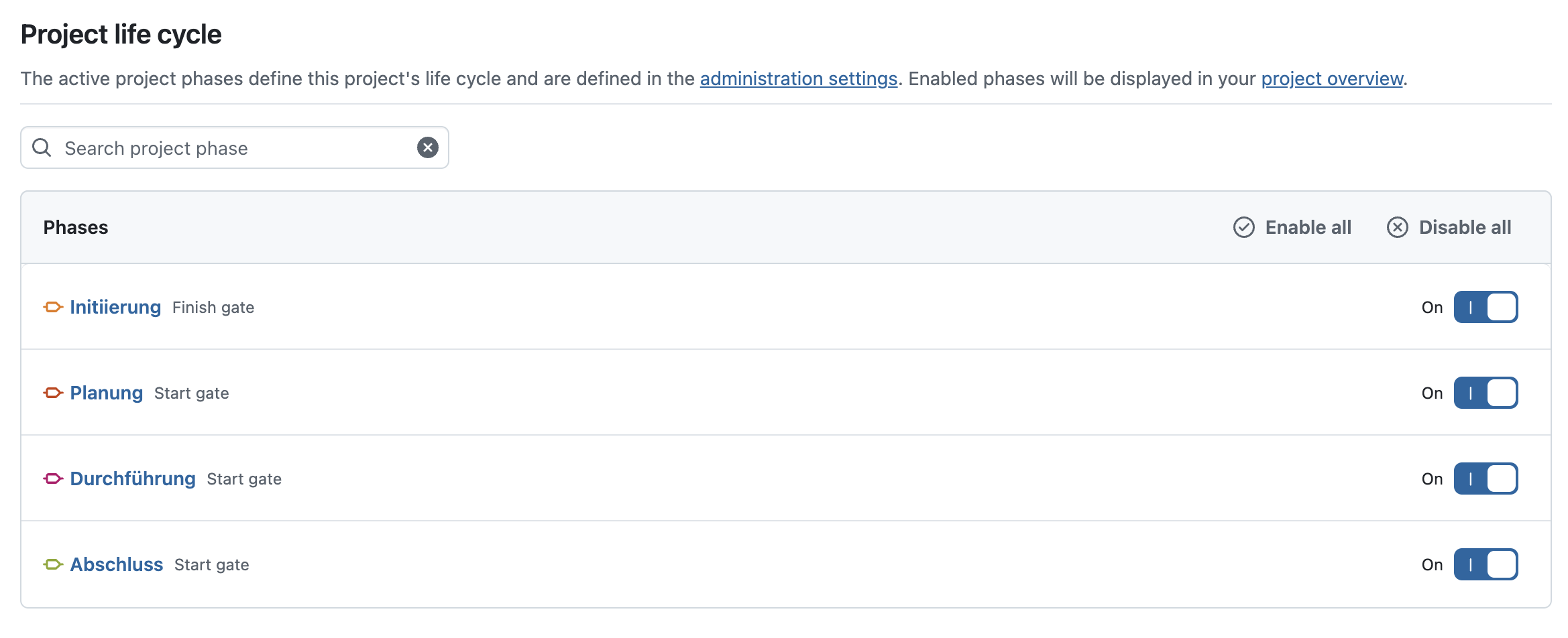
In PM² and PMflex, phases and phase gates are central building blocks. Every programme runs through defined stages – from initiation through planning and implementation to closure. At the phase gates, it is checked whether a phase has been successfully completed and whether the next one may start. This governance ensures that decisions are transparent and traceable.

OpenProject helps you apply this logic in practice. Even in the cost-free Community Edition, you can create and monitor phases and phase gates according to PM² specifications. In the Enterprise Edition, you can customize them individually as well as add new phases or phase gates. This way, you stay in control – and always know whether your programme is on track.

Life cycle with phases and phase gates in the administration in OpenProject

2. Keep the overview: Programme dashboards and baseline

For programme managers, a quick overview at the programme level is essential:

  • Monitor the status of all sub-projects (e.g. phase, phase-gate status, traffic light).
  • Detect deviations and bottlenecks early (schedule, budget, quality).
  • Track upcoming milestones and deadlines.
  • Identify risks and issues that need to be escalated.
  • Consolidate key figures for reporting and decision-making.

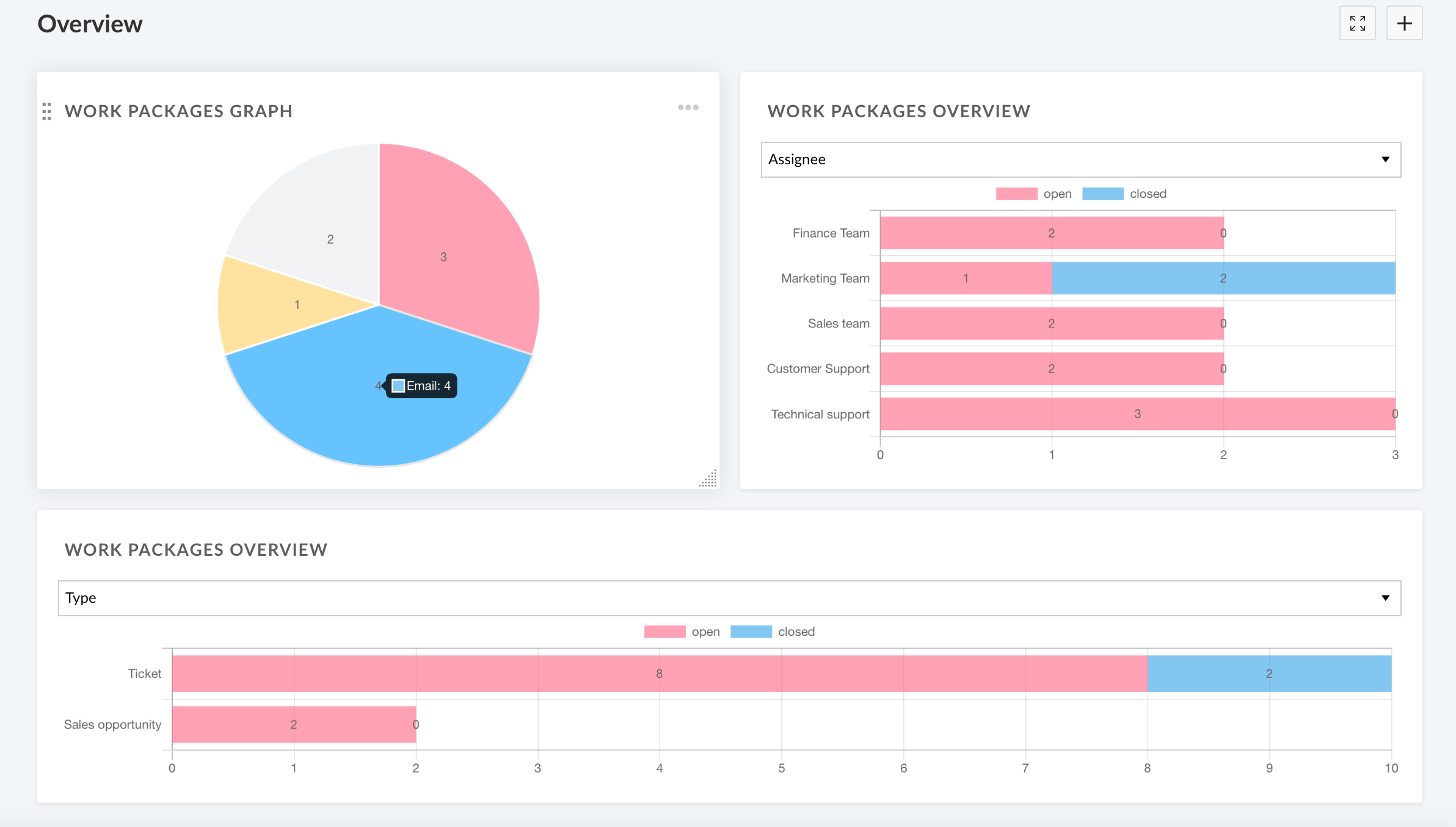
With OpenProject, you set up an overview page (dashboard) for each programme that displays all relevant information. In addition, you can create, filter, save and share project lists to consolidate the metrics of all sub-programs or sub-projects in one clear table. To dive deeper into work packages, risks, and recent changes, you can use the Baseline feature.

Returning to the cockpit metaphor from the introduction: in OpenProject, this becomes your cockpit, where all information is available at a glance and forms the basis for well-founded decisions at any time.

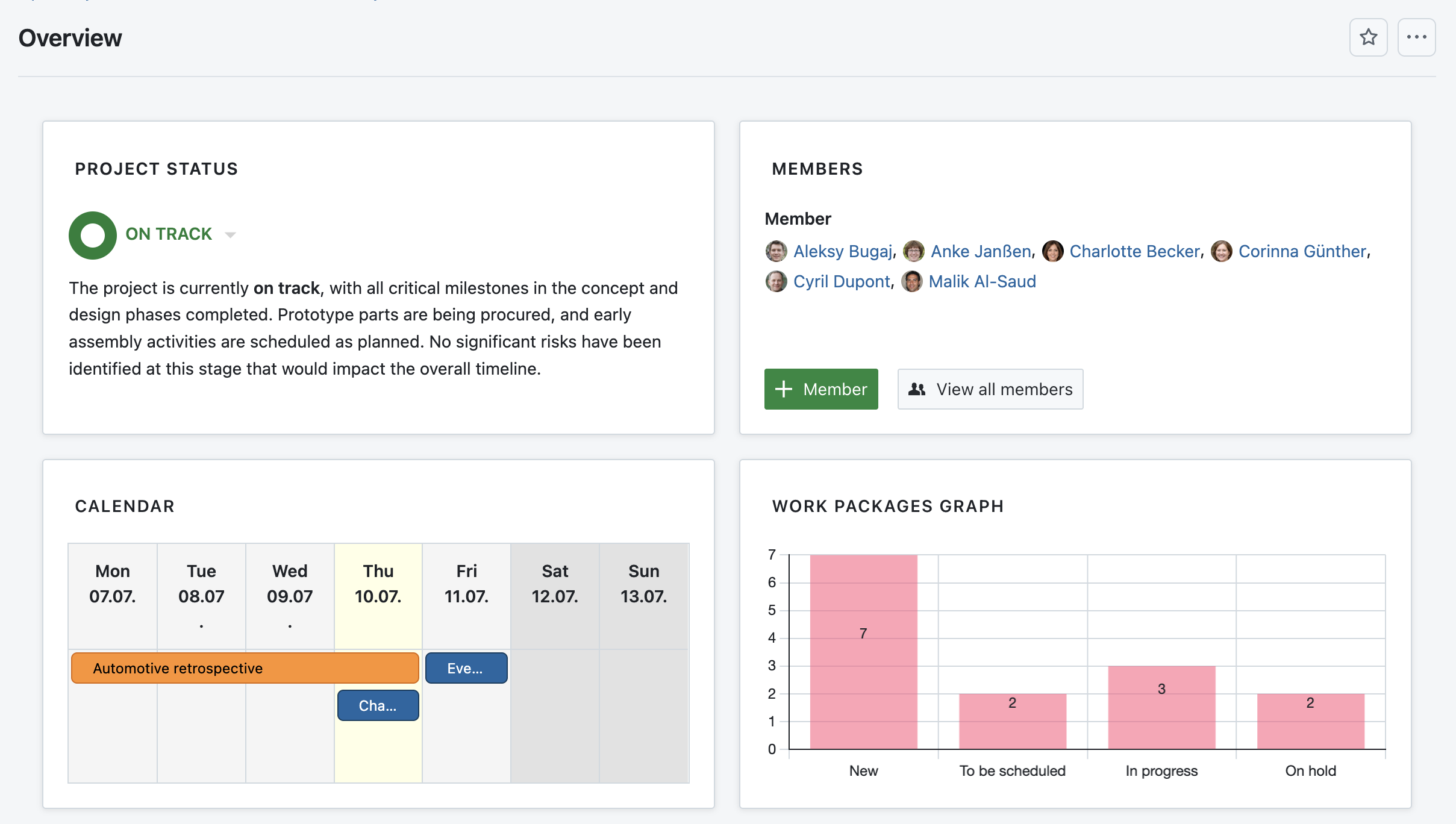
Overview page in OpenProject

3. Clarify dependencies: Milestones and relations

Programmes consist of many sub-projects with close content-related and time-related interdependencies. To detect delays or conflicts at an early stage, dependencies and common milestones must always be visible.

In OpenProject, you represent a programme as a project with sub-projects. Dependencies are managed through the diverse relations types between work packages:

  • Temporal dependencies such as predecessor / successor.
  • Logical relations such as blocks / blocked by or includes.
  • Parent-child relations to clearly structure complex tasks.
  • Programme-level milestones that apply to multiple sub-projects.

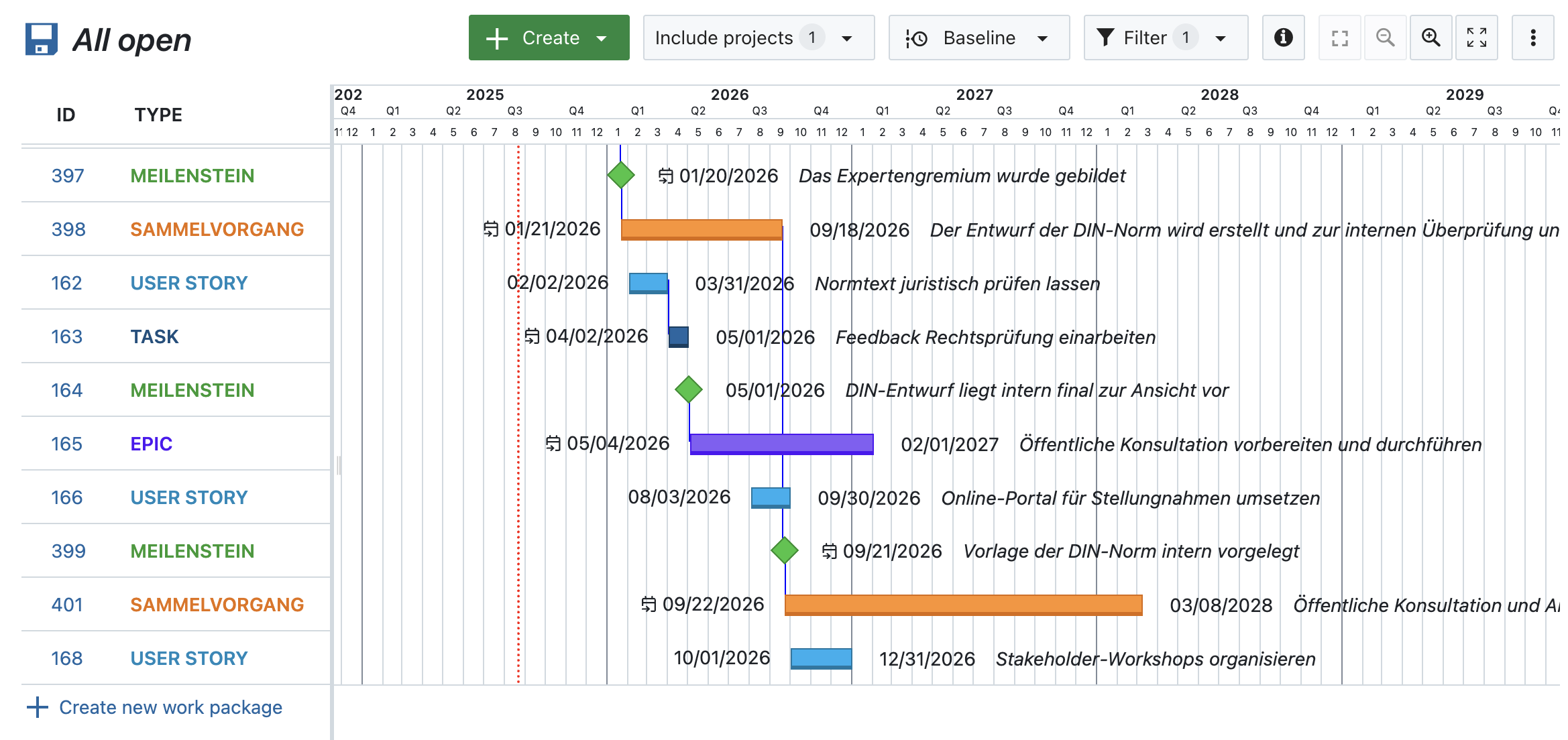
These dependencies can be visualized in different views – for example, in the Gantt chart for timelines, in table views for detailed overviews, or also in parent-child boards (Enterprise add-on) to visualize the hierarchy of work packages.

Gantt chart OpenProject showing dependencies

4. Make impact visible: Outputs, outcomes, and benefits

In PM² and PMflex, a clear distinction is made between three levels:

  • Outputs are the tangible results of a project, e.g. a new IT system.
  • Outcomes are the direct effects when these results are used, e.g. active use of the system.
  • Benefits are the long-term value for the organization, e.g. more efficient processes or reduced costs.

For programme managers, it is crucial to keep this entire chain of impact in view, rather than focusing only on the completion of individual deliverables.

OpenProject supports you by allowing outputs, outcomes, and benefits to be defined as separate work package types. These types can be equipped with status transitions for custom workflows, attributes, and status values, and tailored exactly to the specific steering needs. This creates a transparent structure that makes it clear at any time whether the programme is actually delivering the planned benefits.

5. Detect problems early: Risk and issue management

Good risk management helps you sleep at night. As a programme manager, you need to keep an eye not only on current problems but also on potential risks and issues that may endanger the entire programme.

In OpenProject, risks and issues can be represented just like Outputs or Outcomes as their own work package types – with individual workflows and attributes. This allows you to manage probabilities of occurrence, impacts, and countermeasures systematically and ensures that critical points are not lost in the daily project routine.

Note

The OpenProject team is currently working intensively on an extended risk module that will soon support the PMflex requirements even more consistently and enable more precise control at the programme level. Stay up to date: Risk module development on OpenProject Community

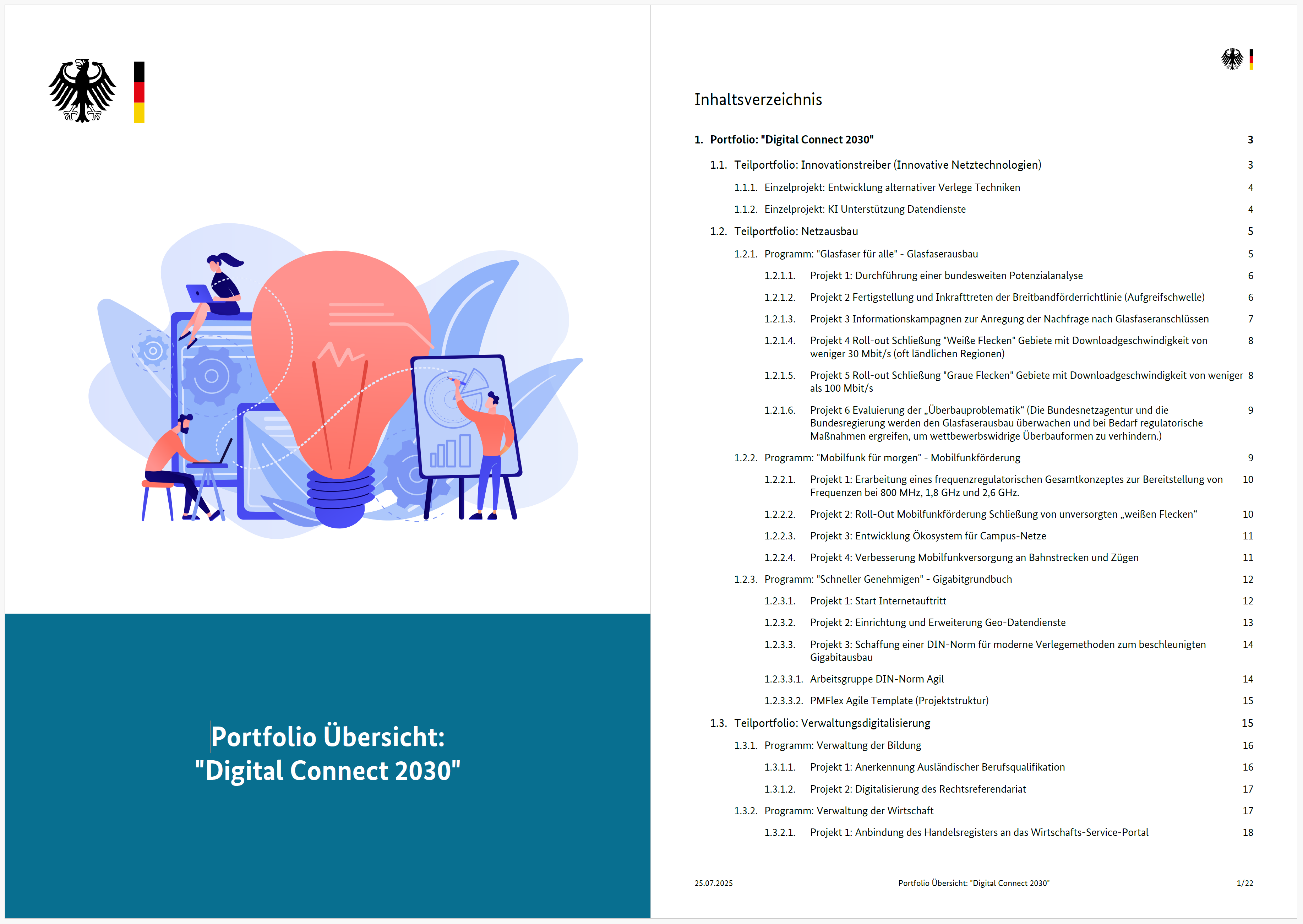
6. Create transparency: Reports and controlling

For programme managers, it is essential to always have reliable information available – for their own control and for mandatory reporting upwards. You need clarity about the status of your programme, and at the same time standardized documentation to reliably inform portfolio managers, agency leaders, or political decision-makers.

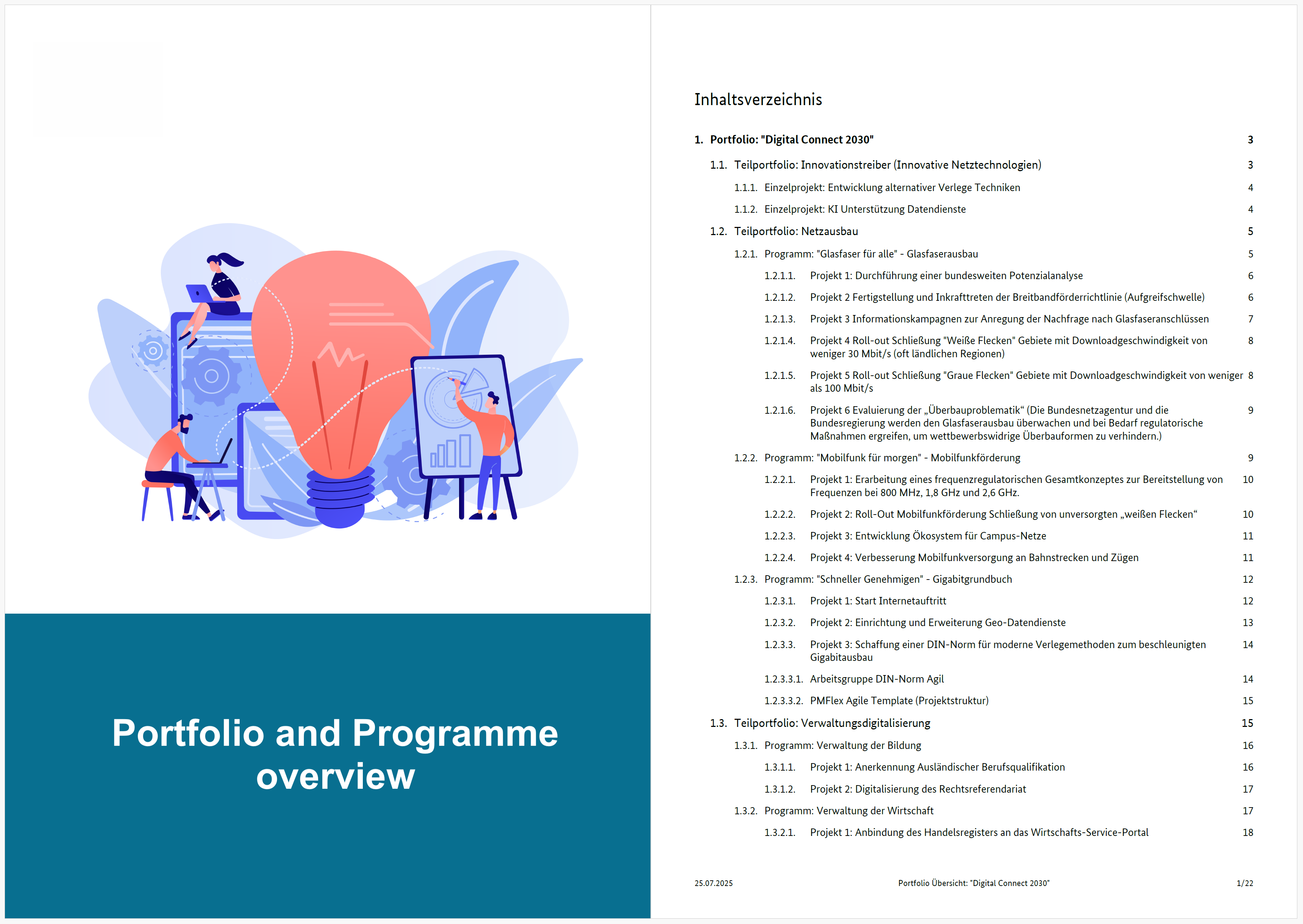
OpenProject provides standardized reports and controlling features for this purpose. Status reports, budget overviews, or progress analyses can be consolidated and exported directly as PDFs – ideal for regular communication with stakeholders. In addition, OpenProject takes PMflex templates into account, so your reports comply with established standards and are ready to use without additional editing.

This way, you keep your own overview while at the same time providing transparent, comparable information for control at portfolio and management level.

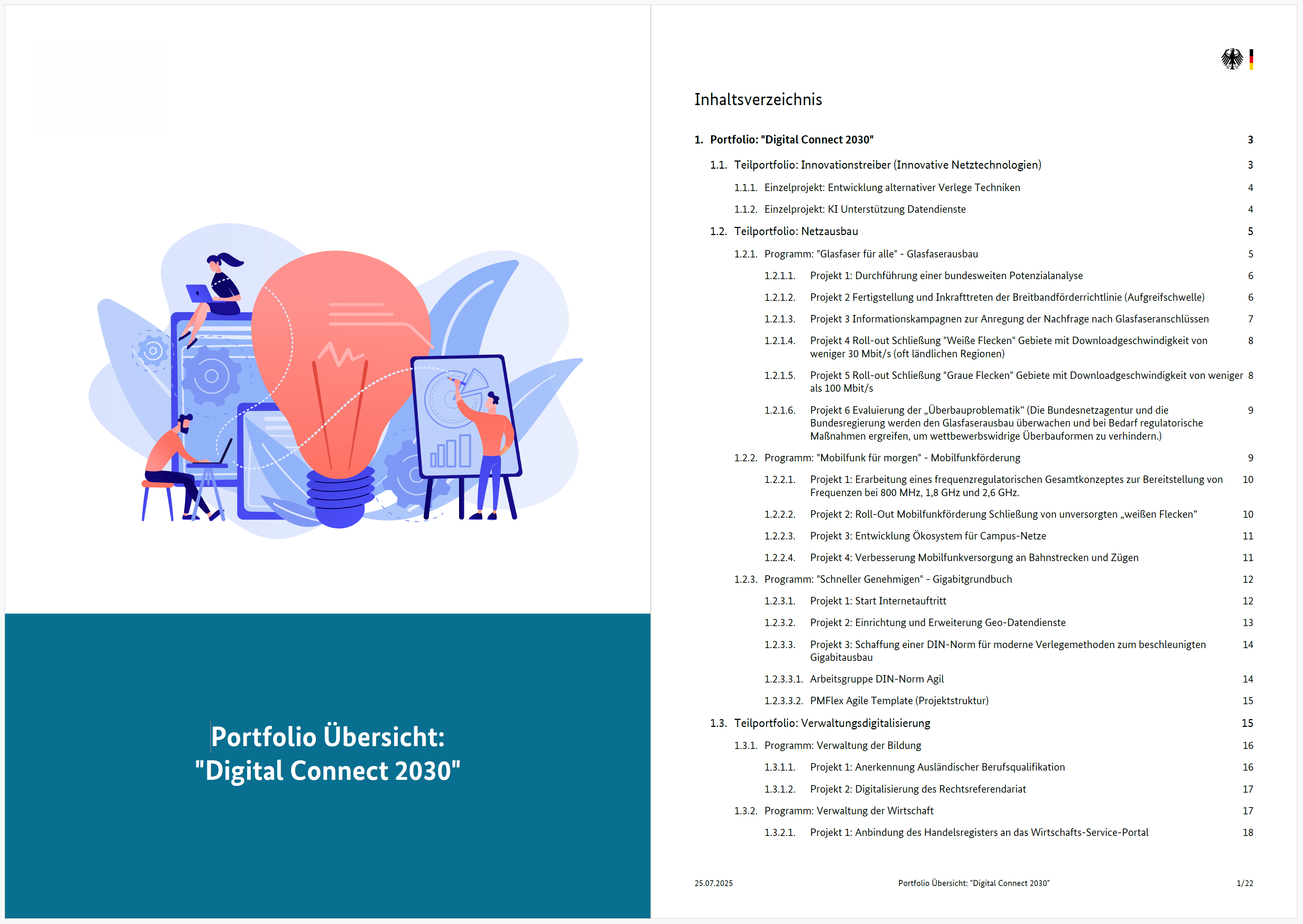
PDF report for a portfolio and programme overview, created with OpenProject

7. Strengthen collaboration: Meetings based on work packages

What if your team meetings started exactly where the actual work happens? Instead of meticulously gathering information from emails or external Word or Excel documents, in OpenProject you can directly access work packages stored in the programme or sub-project.

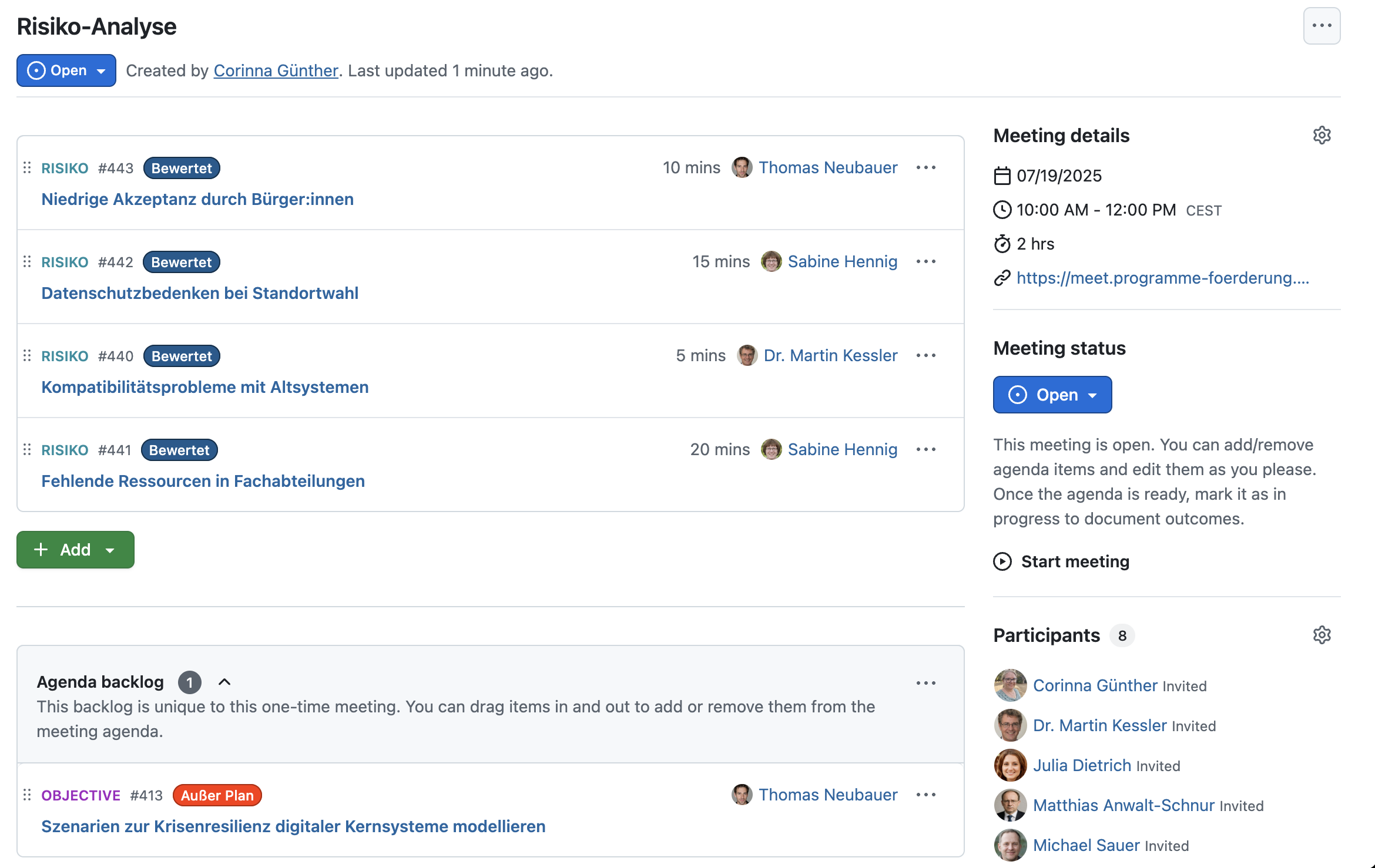
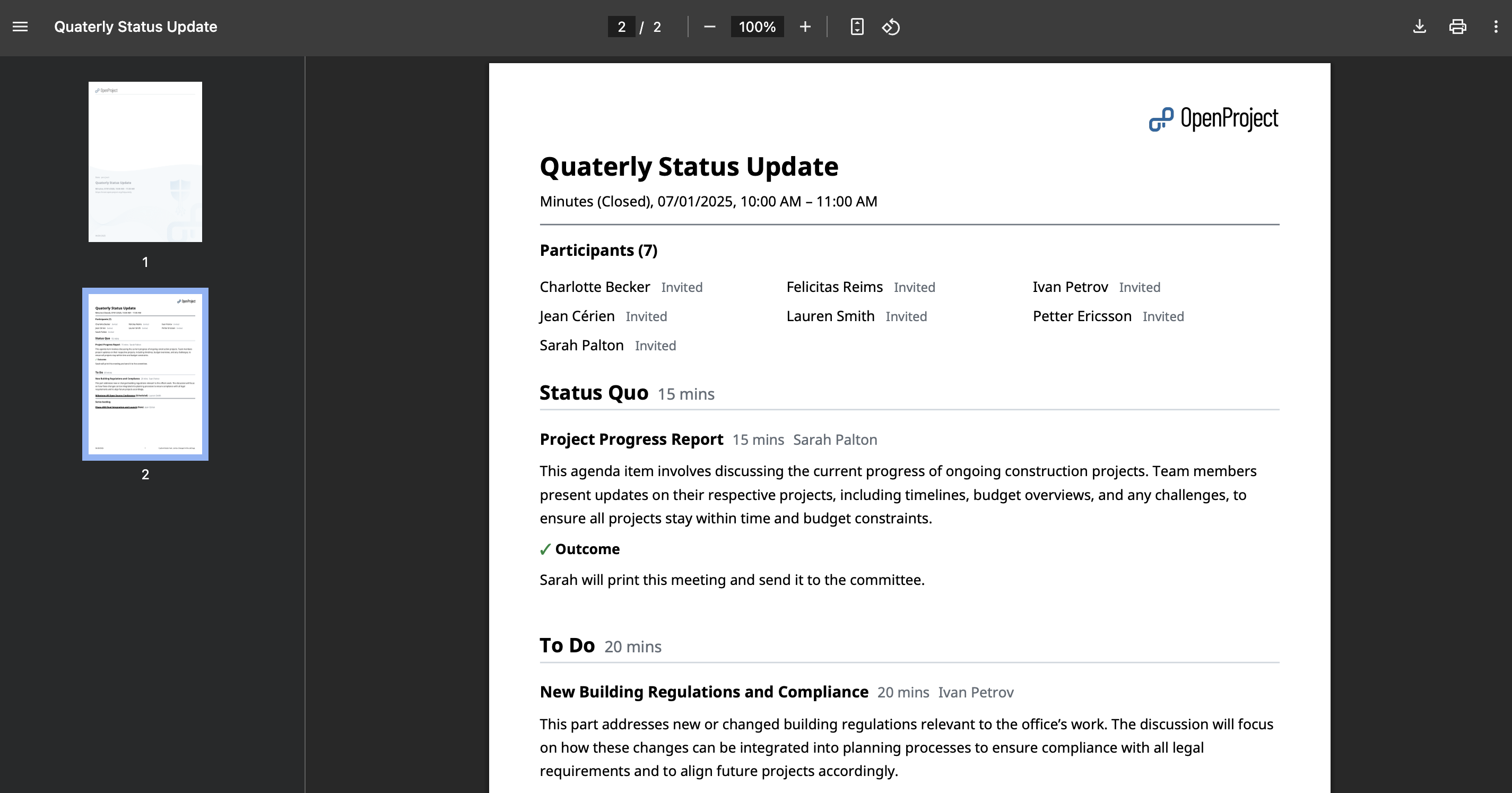
This way, you create agendas with the relevant topics in no time, document results directly during the meeting, and generate minutes immediately – in the OpenProject style, with links to the respective risks, milestones, outcomes, and more. Everyone involved stays aligned, and traceability is ensured at all times. OpenProject’s Meetings module is a highlight for many programme managers, and offers significant advantages, especially in public sector programmes with many stakeholders.

Meeting with risks work packages

Conclusion: Successfully implementing programme management with PM² and PMflex

Programme managers in public administrations face the task of steering complex initiatives transparently and traceably. With PM² and PMflex, clear standards are available – and with OpenProject, a tool that consistently supports these standards in practice.

From phase gates to dashboards, risk management, and meetings: OpenProject provides you with an integrated “cockpit” that ensures governance, creates transparency, and strengthens collaboration. This way, you not only guide programmes reliably through the individual phases but also ensure that the planned outcomes and benefits are actually achieved.

Especially in public administration, where traceability and accountability are crucial, OpenProject is the right solution to bring programmes to success according to European standards.

  •  

OpenProject 16.3: UX/UI Improvements

OpenProject 16.3 is here, bringing a fresh look, more control over email notifications for meetings, along with other improvements that make everyday work more efficient. This release is all about helping you stay focused, find what you need faster, and keep your projects running smoothly.

We will summarize the most important changes in this blog article and, as always, please see our release notes that contain all changes, features and bug fixes.

Here is a quick navigation to all feature descriptions:

UX/UI improvements

Your workspace should help you focus — not distract you. That’s why in 16.3, we’ve refined the design and navigation to make OpenProject easier and more pleasant to use:

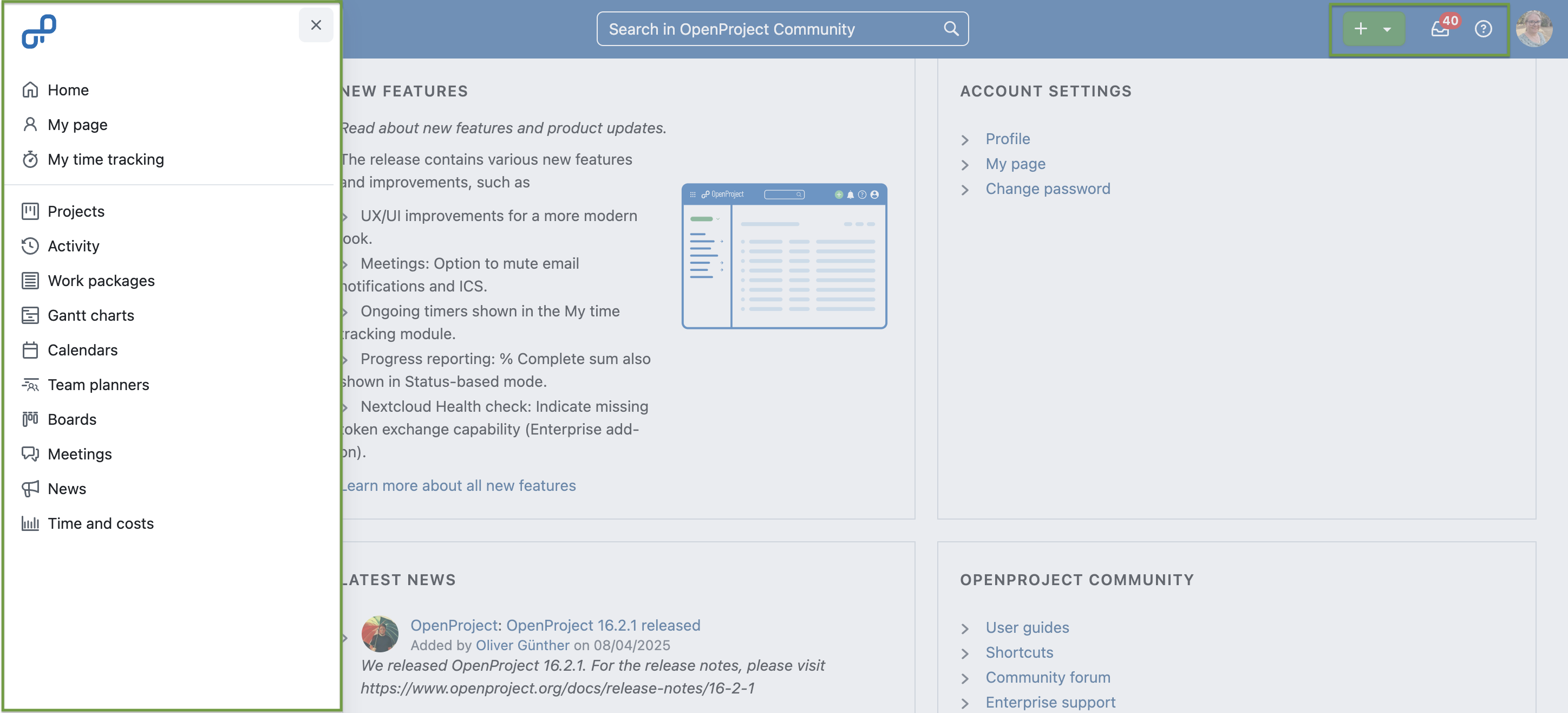
  • The header has been redesigned with Primer, including a fresh icon for notifications.
  • The grid icon now opens as a smooth lateral menu, giving you quick access to Home, My Page, and My time tracking.
  • The sign-in modal and running time tracking section have moved to a new overlay menu on the right, keeping the header clean and uncluttered.

These changes make it easier to find your way around and keep important tools within reach.

Screenshot showing the home page of OpenProject Community, with highlighted grid menu dropdown and redesigned icons on the right side of the header

Better control of meetings notifications

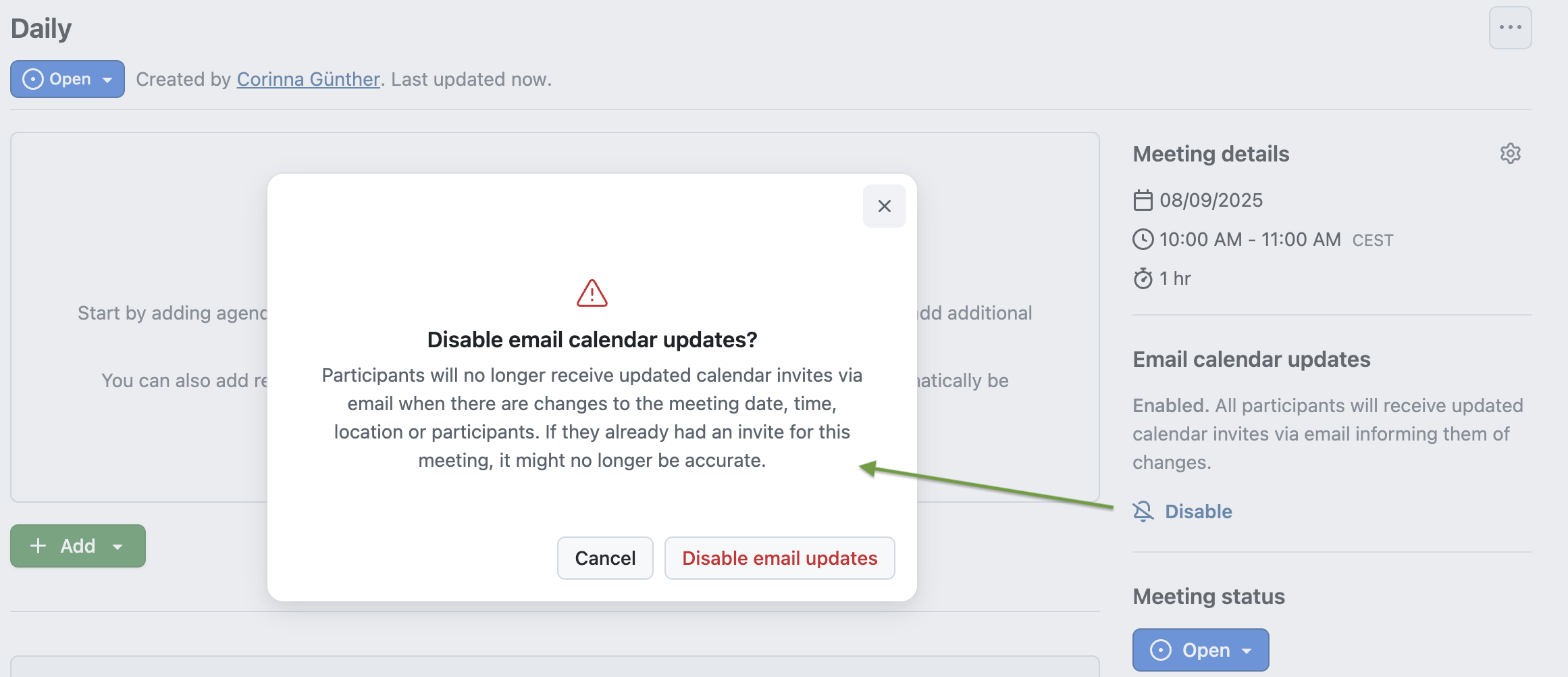
Receiving emails about every small update can be annoying. With OpenProject 16.3, you can now choose whether participants receive email calendar updates when creating or copying a meeting.

A simple checkbox in the meeting form lets you enable or mute notifications. The current status is always visible in the sidebar:

  • For one-time meetings, you can toggle notifications directly there.
  • For recurring meetings, you can set the preference in the template so it applies to the whole series.

This small change gives you more control over how and when participants are informed and keeps your communication timely and relevant.

Screenshot showing OpenProject meeting template with overlay to disable email notifications

Learn more about meeting management with OpenProject.

Timer display in the My time tracking module

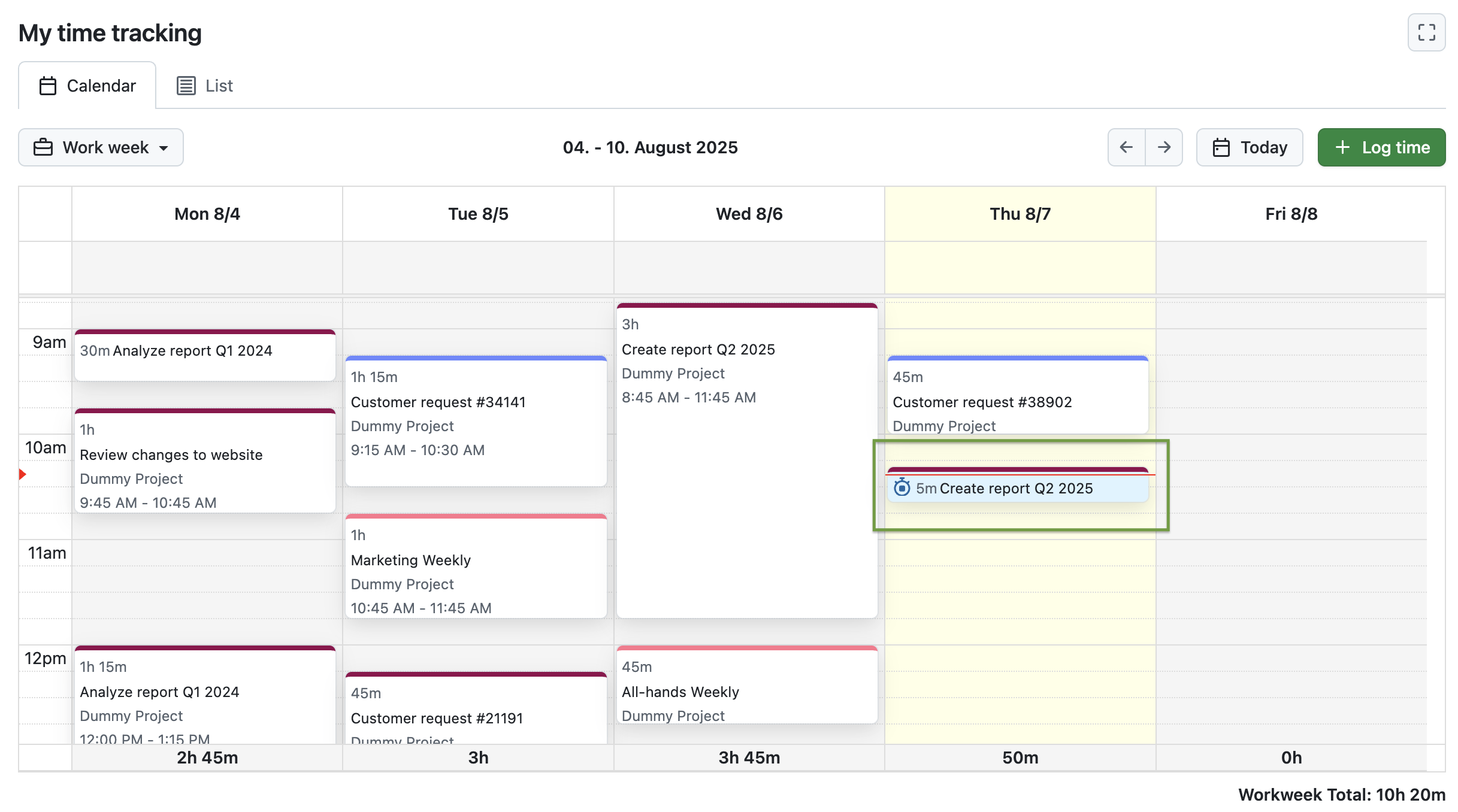
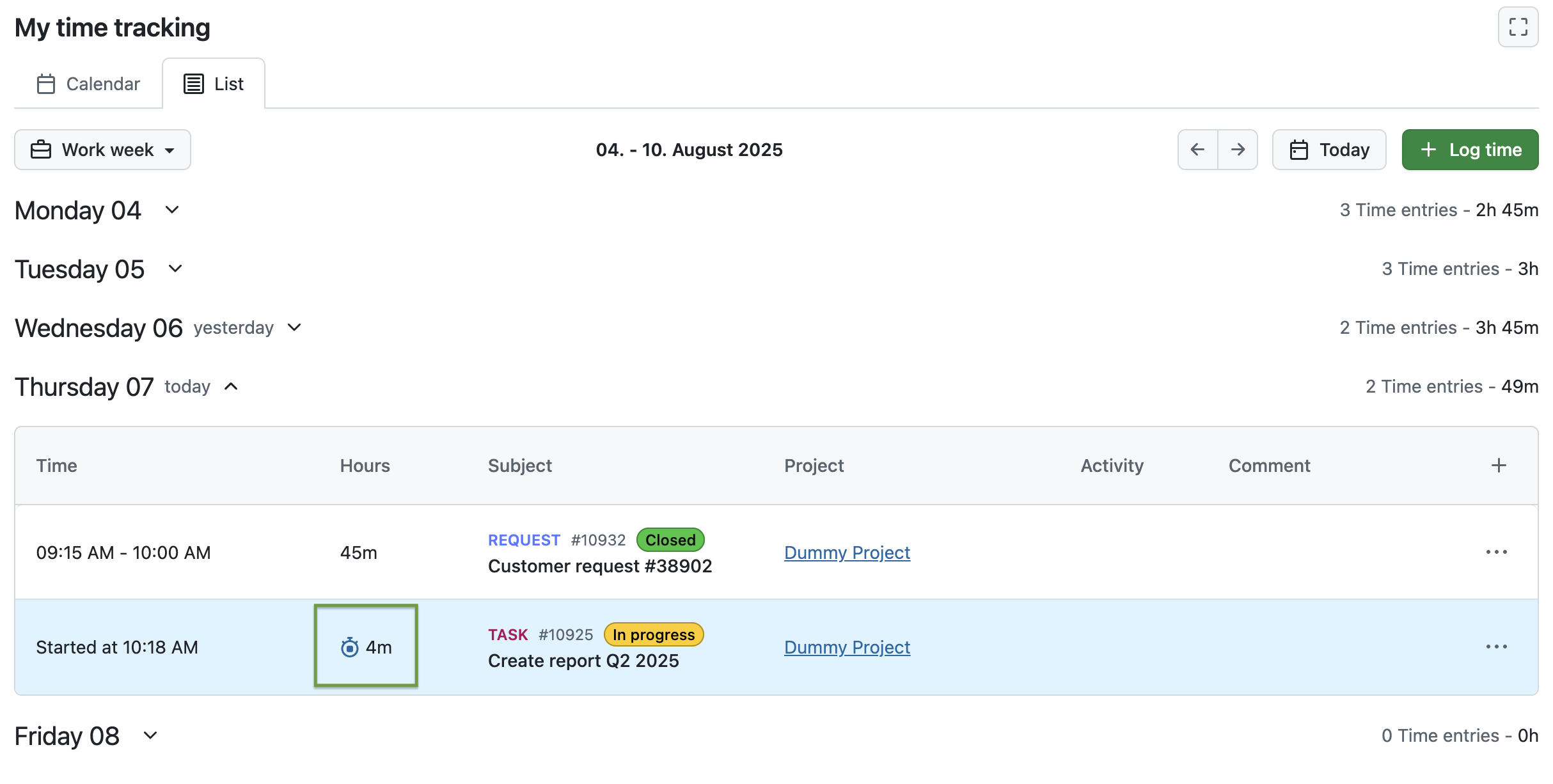
We’ve made it easier to avoid double time entries and keep an eye on your work in progress. The My time tracking module now clearly shows if a timer is running: In both list view and calendar view, the work package currently being tracked is marked with a small timer icon and blue background. This makes it easy to spot ongoing tracking, especially if you step away and return later in the day.

Screenshot showing OpenProject’s My time tracking module in calendar view with a highlighted time entry on ‘today’ that is running for 5 minutes, displayed with a timer icon

Screenshot showing OpenProject’s My time tracking module in list view with a highlighted time entry on ‘today’ that is running for 5 minutes, displayed with a timer icon

Not familiar with the My time tracking module yet? Learn more about it in our blog.

More accurate progress reporting

Progress reporting in work package tables is now more reliable. In OpenProject 15.5, we introduced % Complete sums, but in some cases — especially when not all work packages had values for Work or Remaining work — the calculation could be misleading.

With 16.3, these % Complete sums are now calculated accurately across all progress calculation modes, including status-based and simple averages. This means you can trust the numbers you see, no matter how your team tracks progress.

Learn more about monitoring your OpenProject installation.

Better health check for the Nextcloud integration

For teams using the Nextcloud integration in the Corporate plan, there’s now a clearer way to spot one specific issue: missing token exchange capability. If your identity provider doesn’t support token exchange (often due to older OIDC settings), the health check will now flag this directly. That way, you’ll get a precise message pointing to the cause, instead of a generic “token refresh failed” error.

Faster cost reporting with autocomplete

Cost reports are a powerful way to get insight into your projects — and now, setting them up is faster. In OpenProject 16.3, key filters like User or Work package now support autocomplete in cost report filters. Just start typing and select from matching results, instead of scrolling through long lists. It’s a small change that can save you time every week.

Learn more about cost reporting with OpenProject.

OpenProject 16.3: Migration, installation, updates and support

Follow the upgrade guide for the packaged installation or Docker installation to update your OpenProject installation to OpenProject 16.3. We update your hosted OpenProject environments (Enterprise cloud) today, August 13, 2025.

You will find more information about all new features and changes in our Release notes or in the OpenProject Documentation.

If you need support, you can post your questions in the Community Forum, or if you are eligible for Enterprise support, please contact us and we are happy to support you personally.

Credits

A very special thank you goes to City of Cologne, Deutsche Bahn and ZenDiS for sponsoring released or upcoming features. Your support, alongside the efforts of our amazing Community, helps drive these innovations. Also a big thanks to our Community members for reporting bugs and helping us identify and provide fixes. Special thanks for reporting and finding bugs go to Sven Kunze, Michael Lathion, Gábor Alexovics, and Tom Gugel.

Last but not least, we are very grateful for our very engaged translation contributors on Crowdin, who translated quite a few OpenProject strings! This release we would like to particularly thank the following users:

  • Alin Marcu, for a great number of translations into Romanian.
  • William, for a great number of translations into Chinese Traditional.
  • OlhaTrotska, for a great number of translations into Ukrainian.

Would you like to help out with translations yourself? Then take a look at our translation guide and find out exactly how you can contribute. It is very much appreciated!

As always, we welcome any feedback on this release. 💙
  •  

AI-powered project and portfolio management with OpenProject

AI is everywhere. Especially large language models (LLM), which are what most people mean when they talk about AI today. These models are becoming common tools at work and in everyday life. At the same time, concerns around data protection and transparency remain.

At OpenProject, we’ve been exploring this topic deeply. We recognize both the incredible potential and the valid concerns. This article gives you a first look at how OpenProject approaches AI — and what you can expect as a user.

How does OpenProject approach AI?

At OpenProject, we approach AI — or more precisely, language models — with both curiosity and caution. Our goal is clear: help users save time and reduce complexity, without compromising privacy or open source standards.

We stick to a simple principle: “A fool with a tool is still a fool.” This applies to software just as much as it does to artificial intelligence: What matters is how you use it. Or, in other words, technology only helps if it’s used responsibly. That’s why we develop AI-powered features to assist, not replace, human decision-making.

We will use language models to save our users time and hassle in their work. At the same time, we remain firmly committed to our principles: Open source standards will not be broken and data protection is our top priority.

One quick note: While we use the term “AI” in this article, we technically refer to large language models (LLMs). The distinction matters, but for clarity, we follow everyday language.

Important

Even though we will be implementing AI/LLM features in OpenProject, the final decision will always be up to you, the user. Therefore, we want to emphasize that we will offer the option to enable or disable AI features.

OpenProject follows strict ethical AI guidelines

Human decision authority

  • AI serves as decision support, never autonomous decision-making
  • Transparent recommendations with clear explanations
  • Human oversight required for all critical decisions
  • Clear accountability chains maintained

Privacy & GDPR compliance

  • Strict data isolation between projects and tenants
  • Minimal data collection
  • Automated data deletion routines
  • Complete audit trails and documentation

Sustainability & ethics

  • Energy-efficient model selection
  • Ethical training data sourcing
  • Regular bias testing and mitigation

Read more on our guidelines for the responsible use of AI at OpenProject (German only) on GitHub.

PMflex and PM² compliance

Our AI features are designed to align with PM² as well as with PMflex, the official German standard for strategic project and portfolio management in the public sector. This means workflows automatically follow government requirements — no manual checks needed.

Thanks to AI, OpenProject can detect risks early, before they disrupt timelines or budgets. Real-time analytics and predictive insights give public sector teams the confidence to make data-driven decisions.

At the same time, automating workflows and reporting can save up to 80% of the time normally spent on admin tasks — allowing teams to focus on strategy rather than routine.

Preview of some of the first AI features in OpenProject

Even though we cannot make any firm promises regarding the release date for AI features at this time, we would like to show you some features that we are working on intensively. Especially with the still relatively new topic of AI, we want to test all features extensively before we release them.

Note

Some technical information: To develop AI features, we use our own OpenProject Haystack. Just like the rest of OpenProject, all source code is publicly available. Visit our Haystack GitHub to see it and learn more about the system architecture.

During a hackathon in July, we designed several AI-powered features and showcased them in a demo. Here’s a short overview of the specific AI features that we now continue working on:

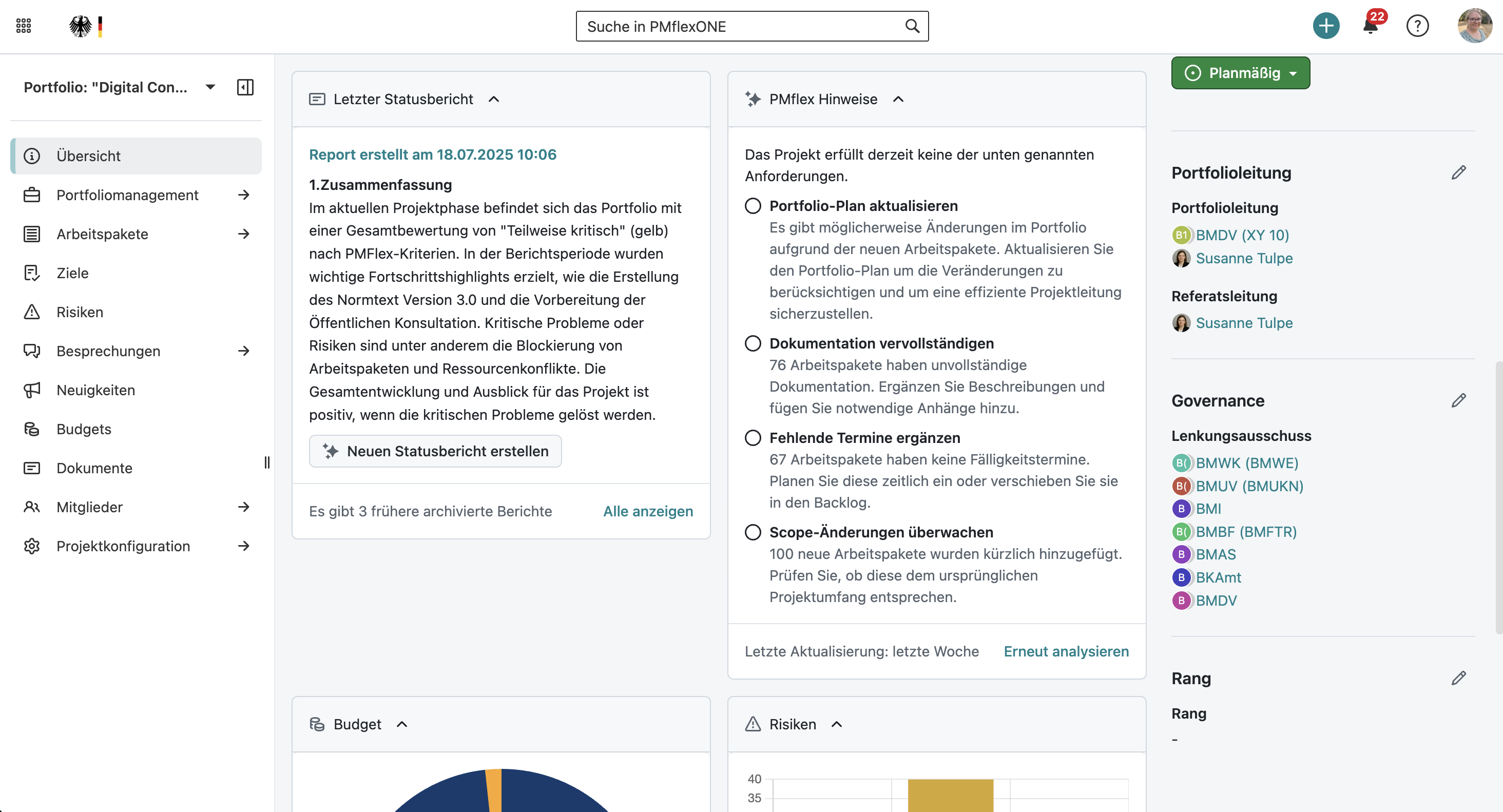
Automatically generated tips to improve your project management

Some users are new to project and portfolio management and might need support. Ideally, this takes place directly in the application so that users don’t have to look up information in their handbook. Additionally, no external handbook can give you the exact information you need based on the data you already created.

This is why we created a feature to automatically display tips, specifically based on PMflex and PM² standards. But also users who are not working with these standards will benefit from this feature as some hints and are generally helpful in the area of project and portfolio management.

Here’s an example of how we implemented this feature on a demo instance:

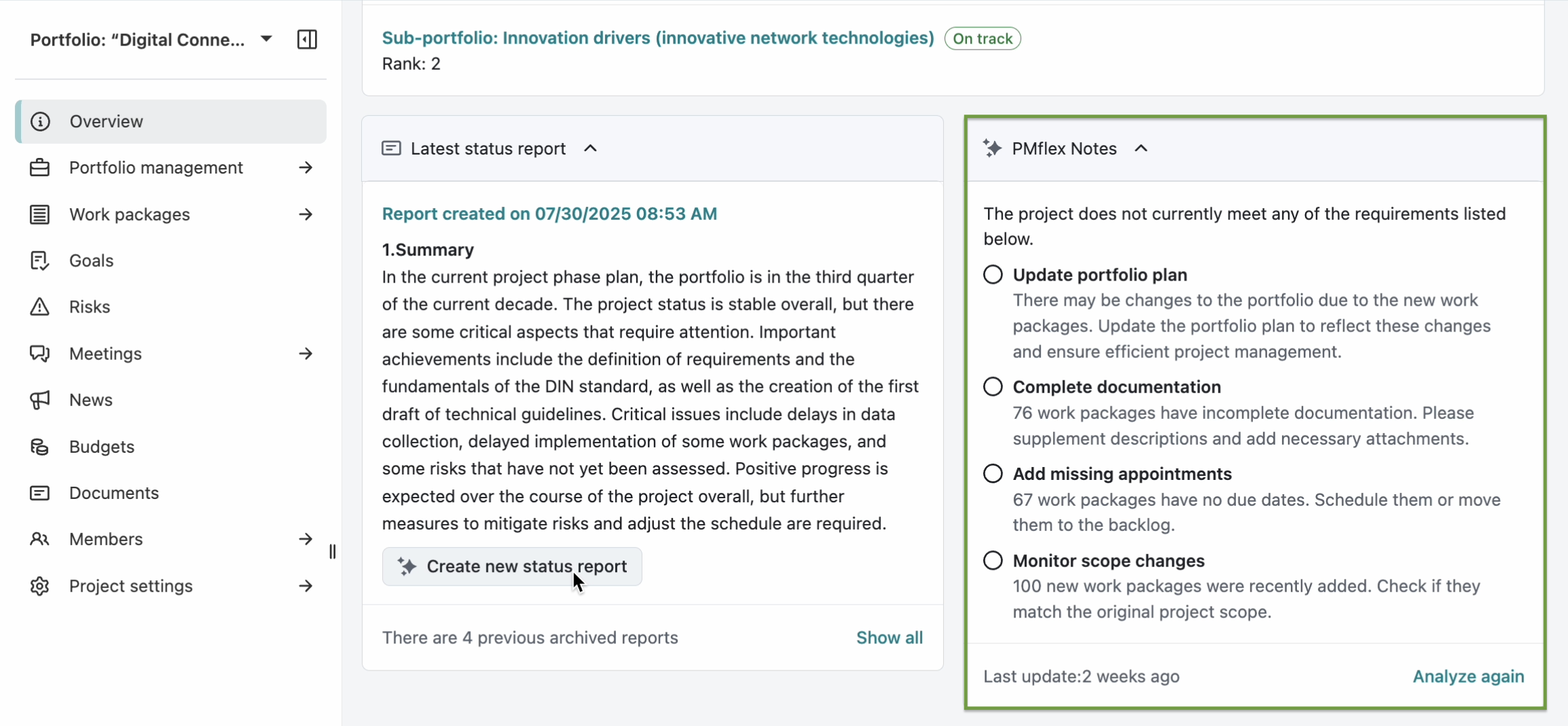
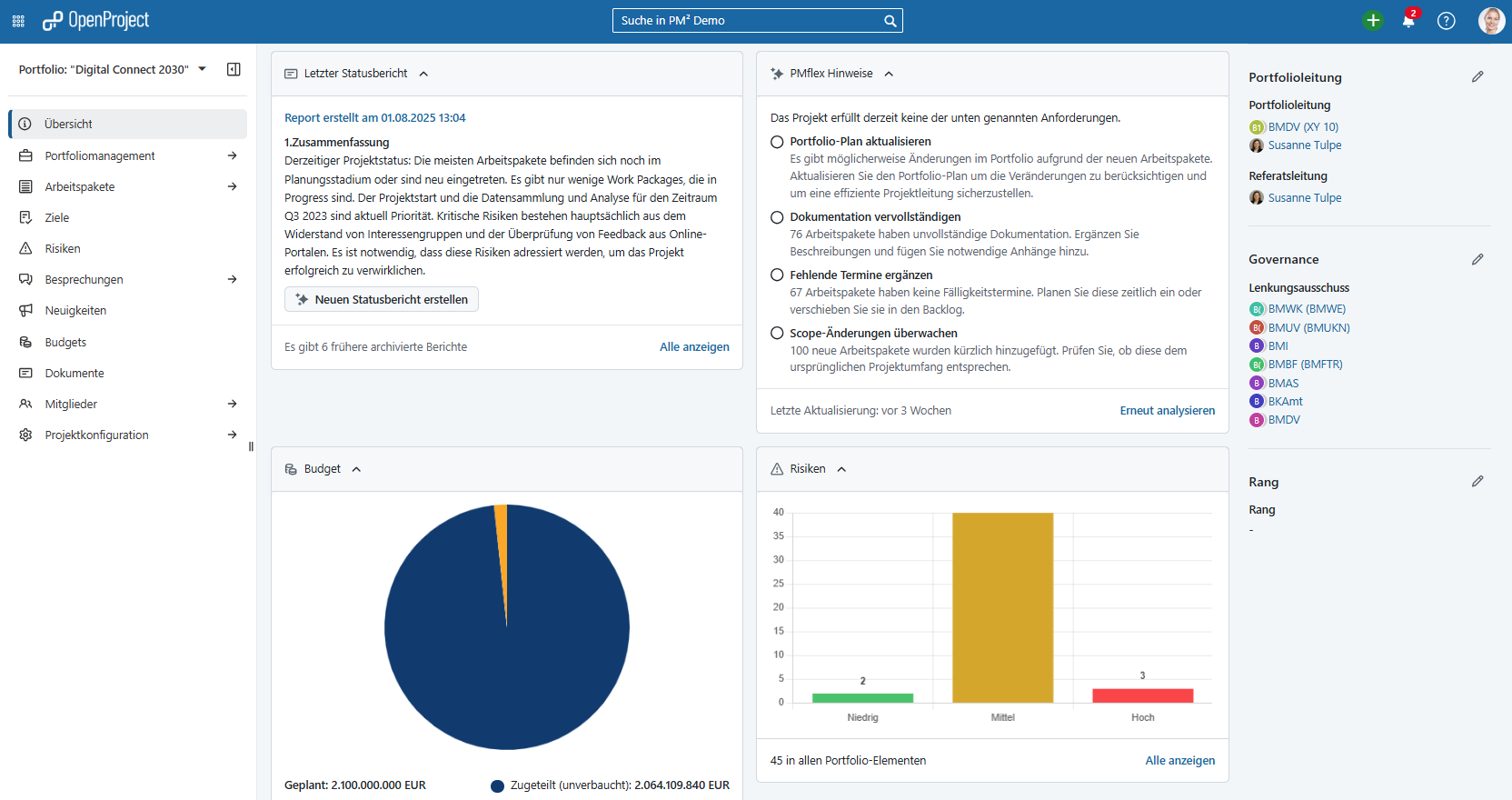
Screenshot of an OpenProject demo instance, showing an overview page with highlighted AI feature to display tips project management

These are the hints in the example screenshot:

  • Update portfolio plan
  • Complete documentation
  • Add missing deadlines
  • Monitor scope changes

The overview page only shows the five most relevant notes. The information includes not only missing tasks, but also notes on what has already been accomplished.

Automatically generated status reports

Creating a project status report can be very time-consuming and tedious, requiring a lot of copying and pasting. With the help of the OpenProject LLM, users save several hours of time and can focus on more important things.

The feature to generate status reports by just pressing a button is still in development, and some parts of it don’t even need AI functionality. The LLM mainly summarizes the information used in the project and creates a short text based on that.

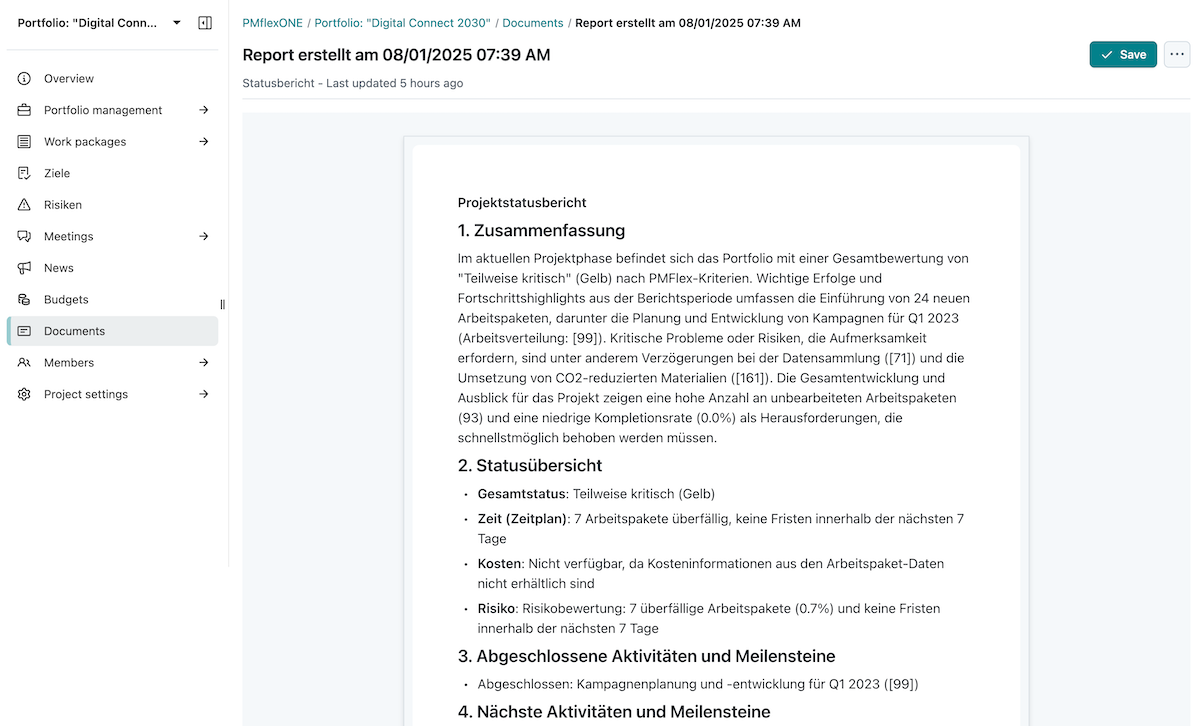
After one minute, your project status report is created and you can adjust, save and share it with others. This is how a status report could look:

Screenshot of an OpenProject demo instance, showing a project status report (in German)

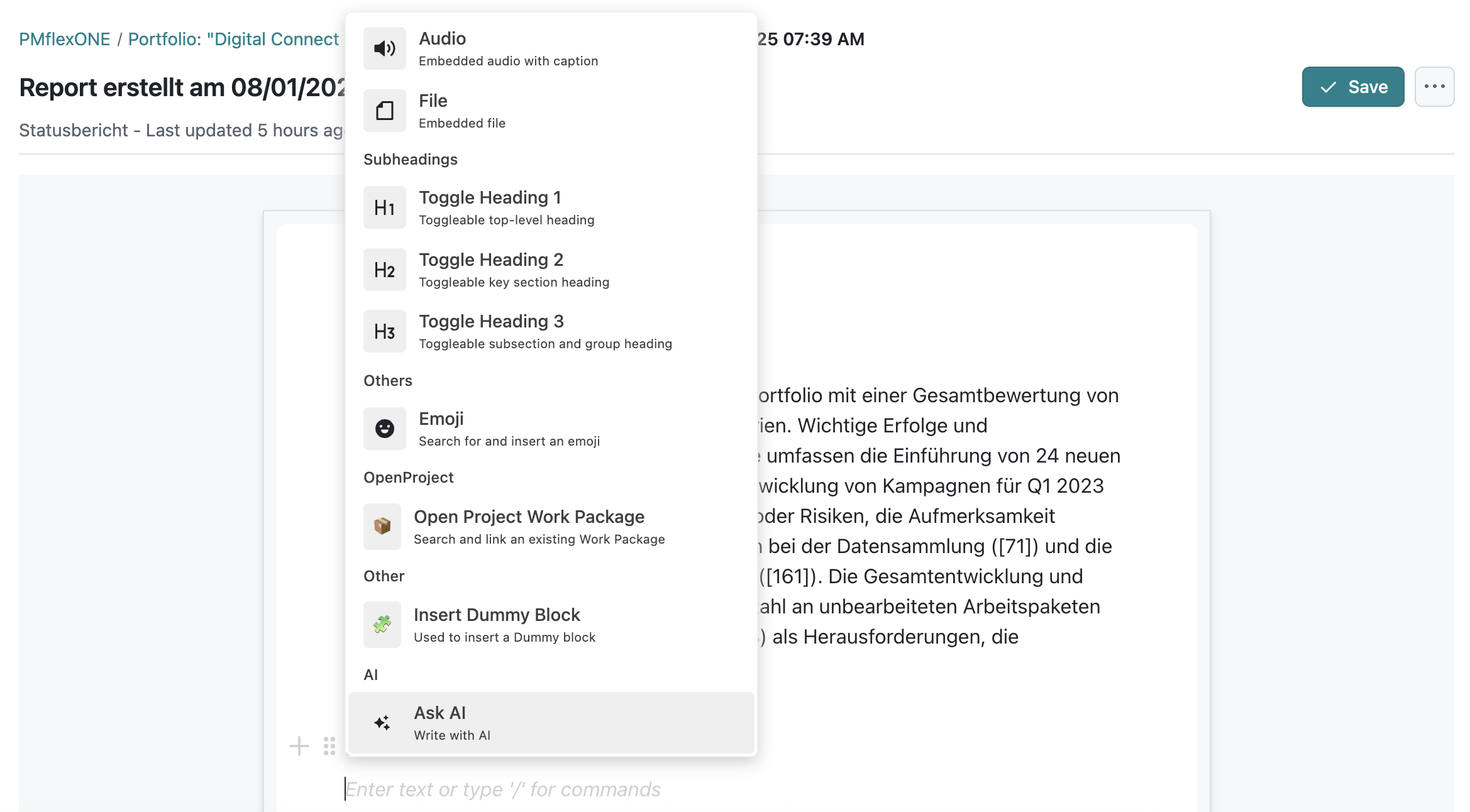
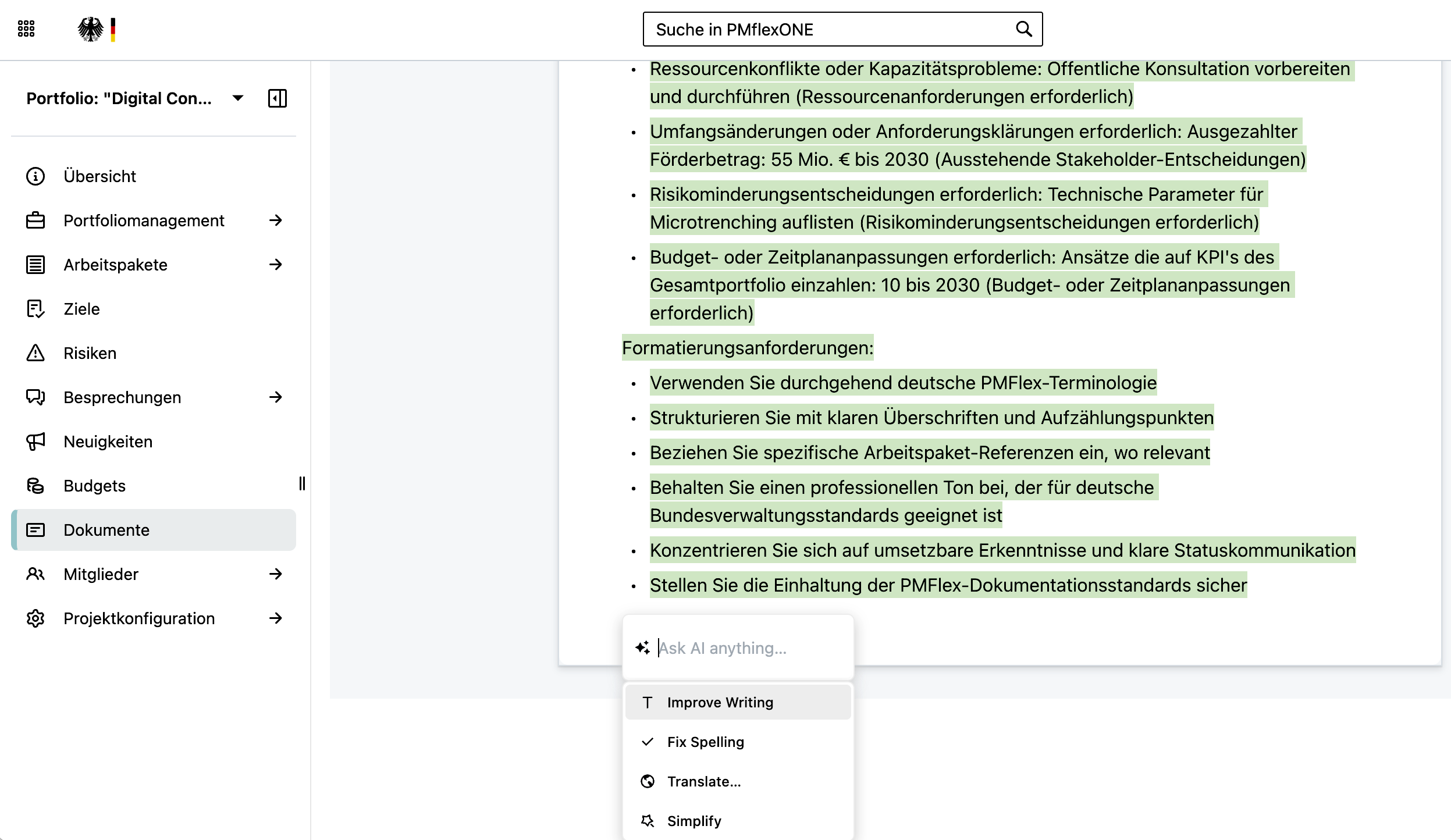
AI Document features: Ask AI, Improve writing and more

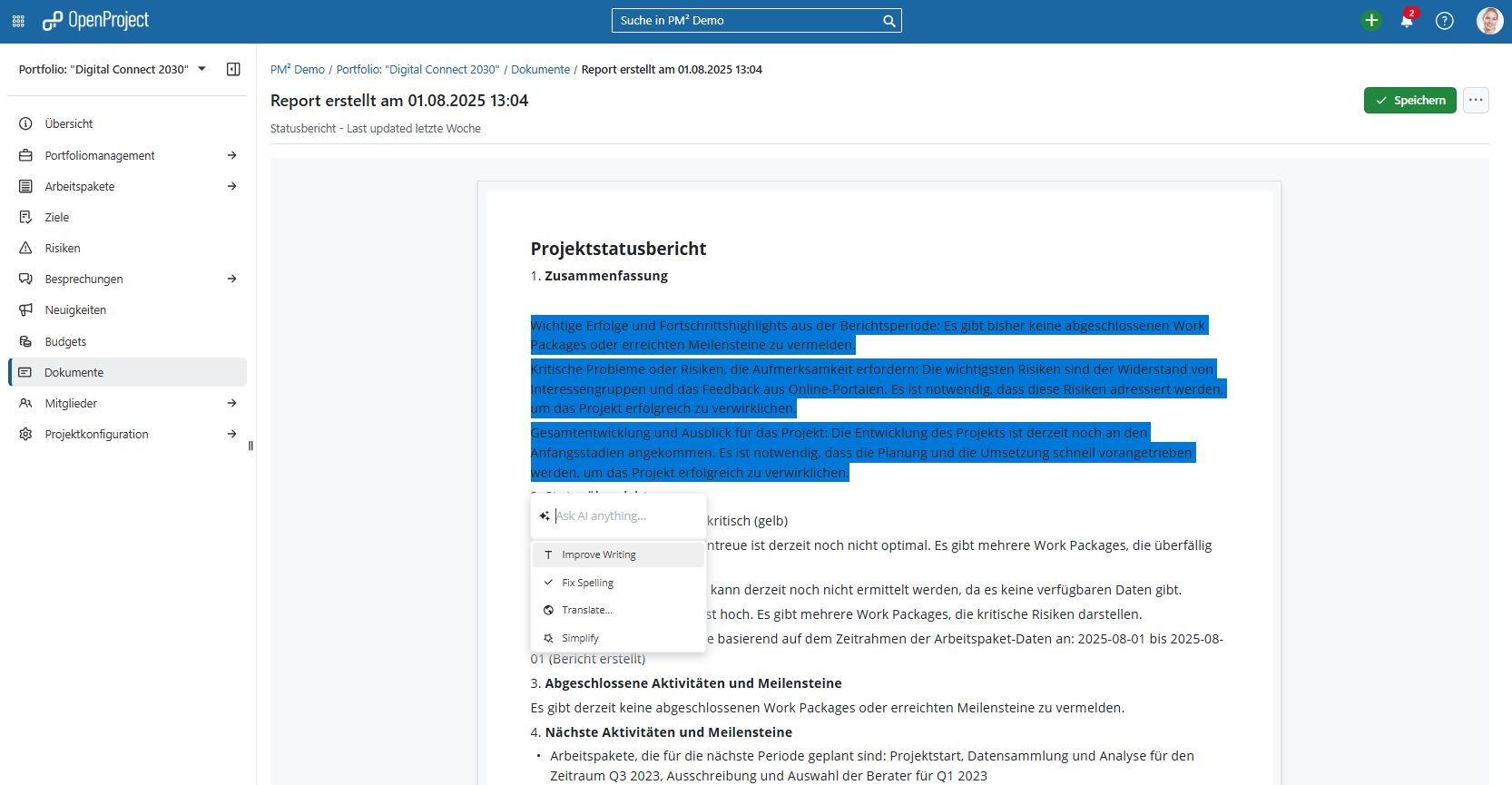
OpenProject is working on integrating familiar AI-powered writing tools directly into its editor — making it easy to translate, rephrase, check spelling, or generate first drafts without switching tools. Within the Documents module, on which we’re also currently working, the AI can also perform helpful tasks like summarizing longer texts. This streamlines your workflow and supports teams in creating high-quality content more efficiently.

Screenshot of an OpenProject demo instance, showing the AI generated status report with the option to ‘Ask AI’

Conclusion and outlook on AI features in OpenProject

“We are continuing to work on AI features with one goal in mind: more efficient, standard-compliant work with a single mouse click, even without prior knowledge of AI.” – Dominic Bräunlein, Feature lead for AI topics at OpenProject

With OpenProject, we are committed to building AI features that are not only helpful, but also ethical, secure, and transparent. We believe that language models can significantly support users in their daily work — especially in the public sector, where structured processes, compliance, and documentation are essential.

By combining AI with OpenProject’s proven project management features, we want to reduce manual effort, accelerate strategic alignment, and make professional project and portfolio management accessible to more people. Whether you’re new to project management or a seasoned expert — our goal is to support your work without replacing your judgment.

We will continue developing and testing AI features carefully, hand in hand with our Community, partners, and users. If you’re interested in trying out the first features, we’ll keep you informed through our blog and newsletter. The future of project management is intelligent, but above all: open and secure.

  •  

A PM²-based software solution for the European public sector

What does a software solution look like that enables employees in the public sector to successfully prioritize, manage, implement, and report on strategic initiatives?

At OpenProject, we explored this question during a hackathon last week. In this article, we give you an overview of our results.

The requirements we defined are based on PM² the open source project management methodology provided by the European Commission.

If you already want to “spoil” the results, feel free to watch the following video (available in German only), which we presented at the end of the hackathon:

Article navigation:

Wanted: A software solution for the strategic implementation of digitalization initiatives

Transparency is one of our core values, so in this article we want to share an overview of the hackathon, the requirements, and of course our proposed solutions.

Requirements included:

  • Compatibility to PM² (tailoring)
  • Consistency across portfolio, program, and project levels
  • Cross-agency collaboration
  • Agility
  • Enjoyable user experience

Challenges for us:

  • Only one week to develop additional features, comprehensive demo material, documentation, and (video) presentation. All of this alongside our daily business, including the release of version 16.2.
  • Immersing ourselves in the working environment and various user stories from public administration, which operates very differently than we do internally. Here, our extensive experience with the public sector, especially in connection with openDesk, was a major advantage.

Overview of the required user stories:

Several user stories were provided, each with associated data like budget, status, target states, and more. Every user story included at least one fictional persona, from whose perspective the solution needed to be demonstrated.

  1. Prioritize portfolio elements
  2. Manage portfolio
  3. Report program status
  4. Report project status

In addition to the predefined user stories, we also showcased how the solution could be used on the go via the mobile app.

Delivered: Full commitment for ten new PM² features

Alongside 19 developers, many other OpenProject team members were fully engaged in the PM² hackathon. Despite — or perhaps because of — the short timeframe and complex requirements, the energy and team spirit were tangible across all days, even across our globally distributed remote workspaces.

For Rosanna Sibora, who had her very first week at OpenProject as Chief Product Officer during the hackathon, the team’s commitment, creativity, and passion made a strong impression:

“During the hackathon, I was impressed by how well the self-organized teams collaborated. It clearly showed me how well-aligned the OpenProject team is and how open and empowering the culture is. We proved that 2+2 is definitely more than 4 — and what can be achieved with great collaboration and empowerment.” – Rosanna Sibora, CPO, OpenProject GmbH

OpenProject implementation – behind the scenes:

  • Full energy and passion, not just from developers
  • 15,000+ lines of new code
  • Team formation for developing new features, building a demo instance, and designing product mockups for additional features
  • Daily hackathon stand-ups, retros, and pulse checks with the PM² experts and other stakeholders, 100% remote collaboration using other open source tools like Big Blue Button and Element
  • Daily operations continued in parallel: support and release of OpenProject 16.2

OpenProject implementation – on the product level:

While the current version of OpenProject already supports the majority of requirements, we identified several aspects we wanted to expand or develop from scratch during the hackathon week. Especially relevant across all user stories was the development of features for reporting and managing goals, risks, and budgets.

Here is an overview of our main development focuses during the hackathon:

Let’s take a closer look at what these features and requirement implementations looked like by the end of the hackathon week.

Important

Please note that this is a summary of key developments. Additional features were also planned, designed, and developed during the hackathon. As these features were created in a very short time, they are not yet fully tested or finalized.

Planning and managing portfolios and programs

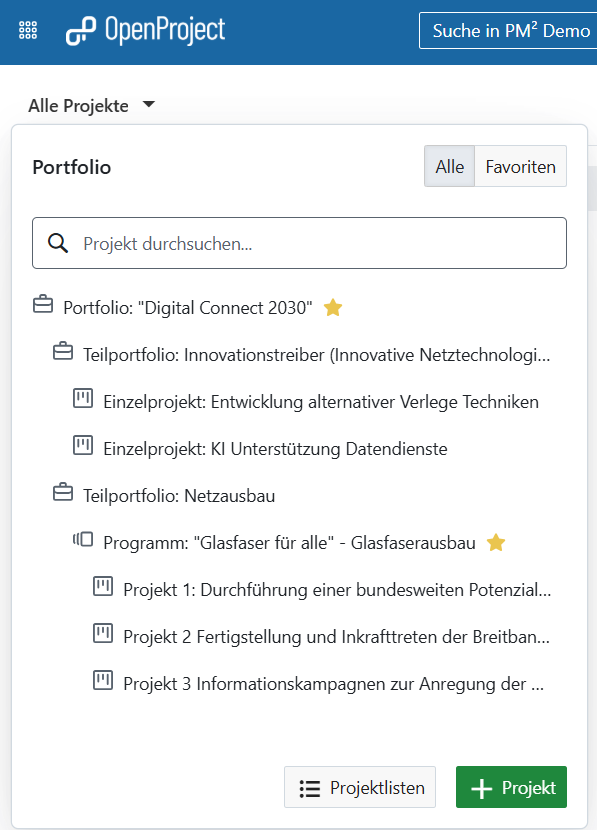
To support PM², OpenProject needed to manage not just projects but also portfolios and programs. Modeling these was the first step during the hackathon. Portfolio, sub-portfolio, and program extend the existing project hierarchy with the ability to group projects and manage them collectively.

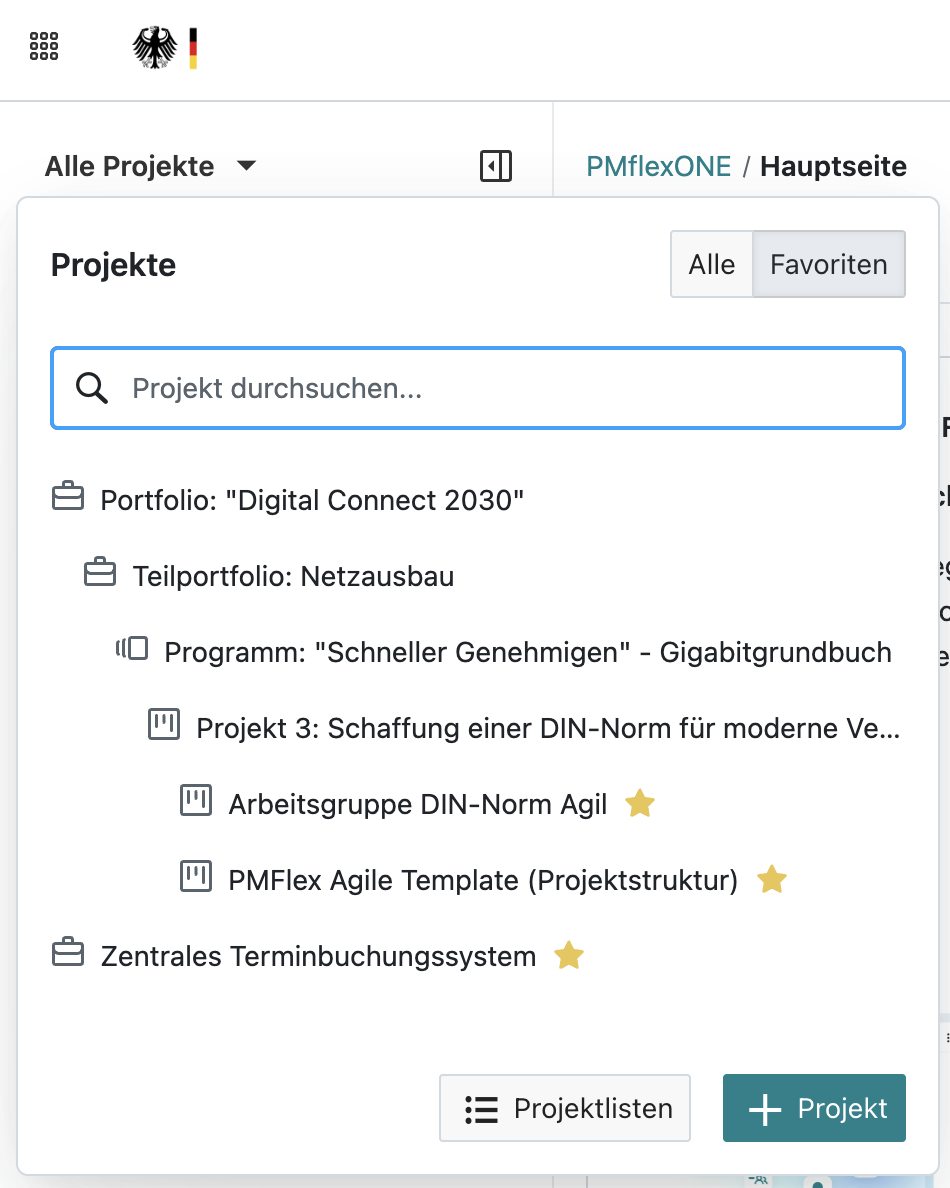
Screenshot: Favorite “Projects” dropdown showing a hierarchical list of portfolio, sub-portfolio, program, and projects

Enhancing portfolio and program dashboards

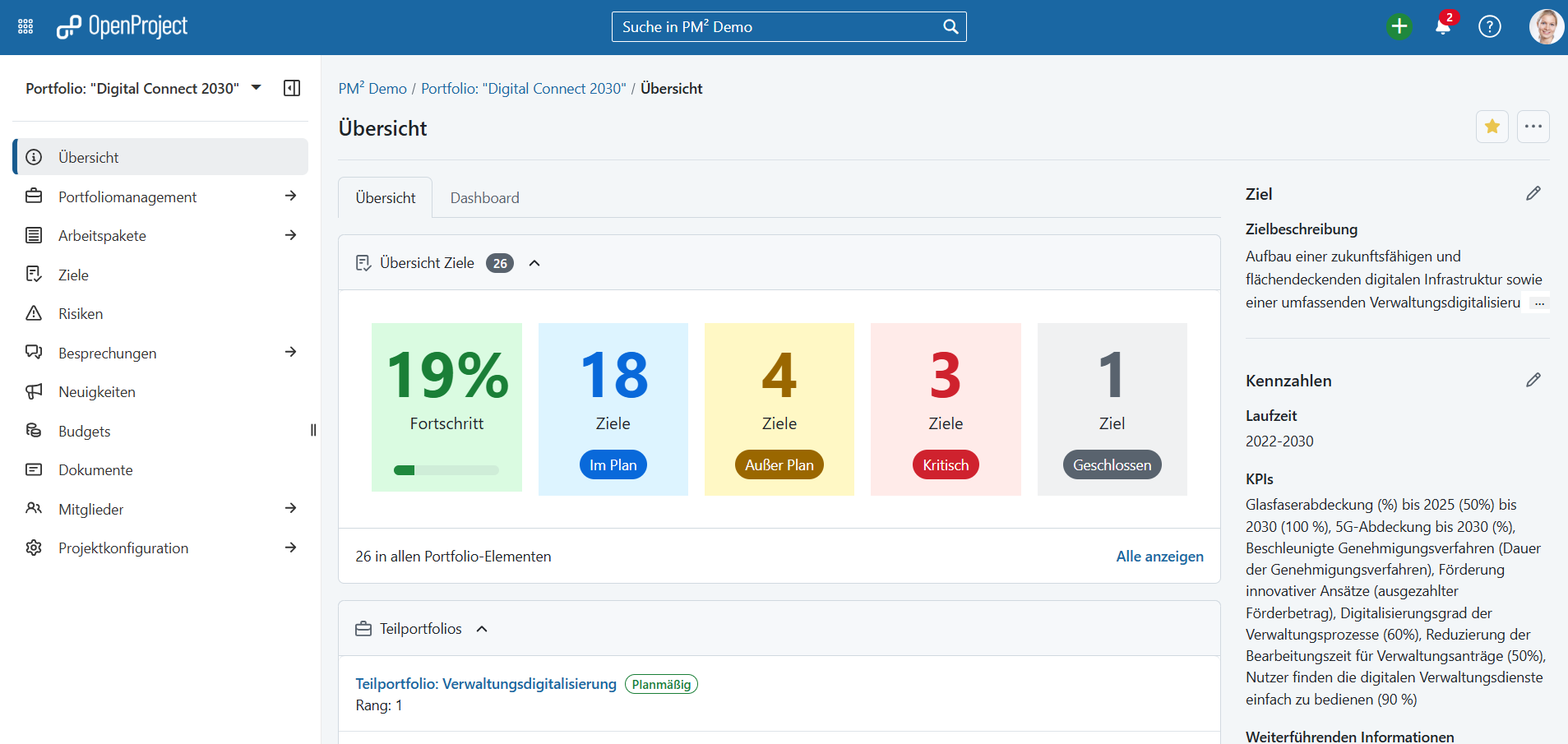
On the overview pages for portfolios, (sub-)programs, or even projects, managers want to see key information about goals, milestones, risks, and budgets at a glance. To enable this, we created widgets during the hackathon that visually aggregate this data: charts for budgets and risks, listings of components with their priority, status, and goal progress. These widgets were implemented as prototypes in a new dashboard using the OpenProject Design System.

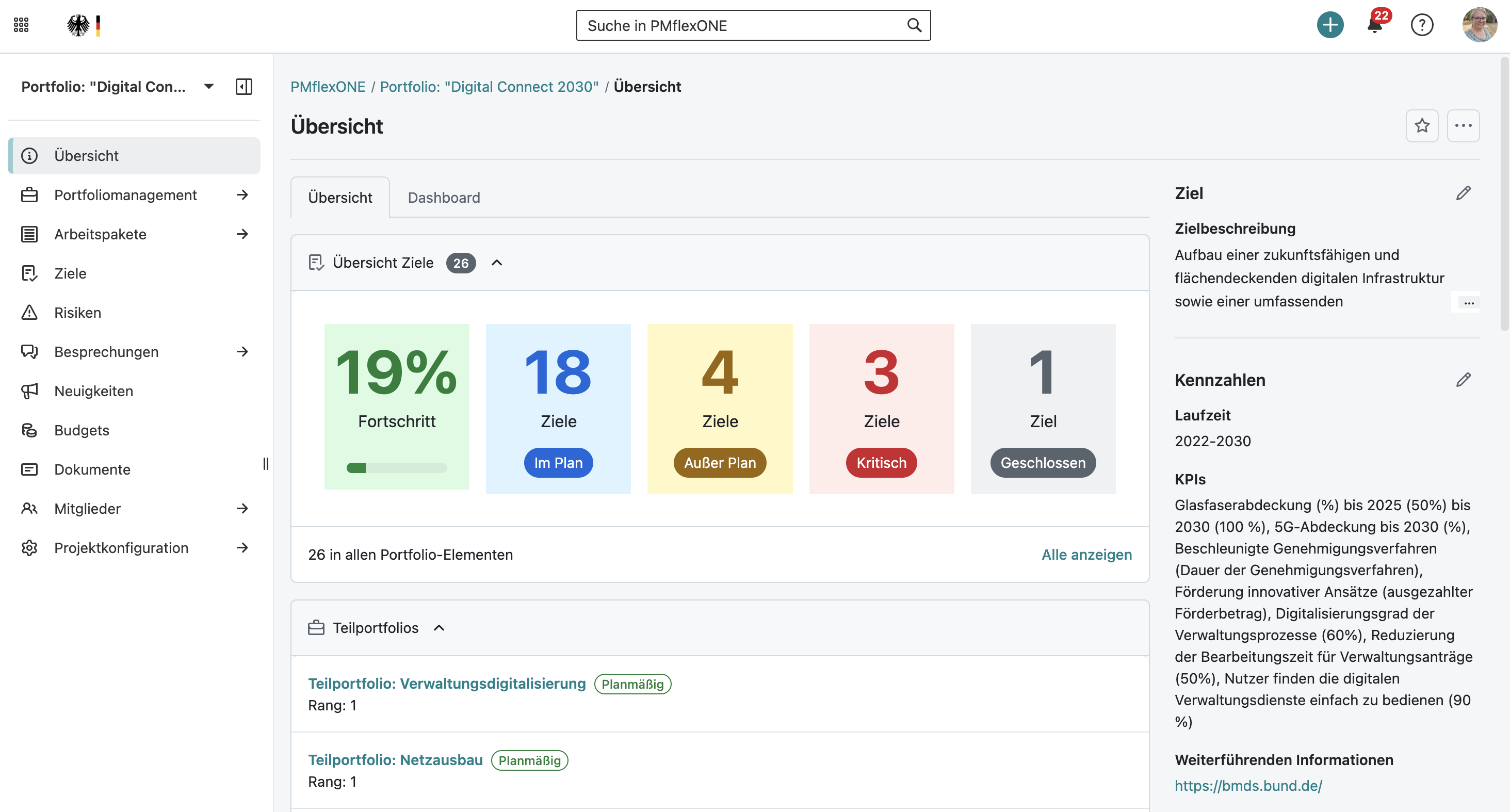
Screenshot: Portfolio overview page showing, among other things, a goals widget with percentage progress (19%) in different colors and counts of goals by status (18 on track, 3 critical, etc.)

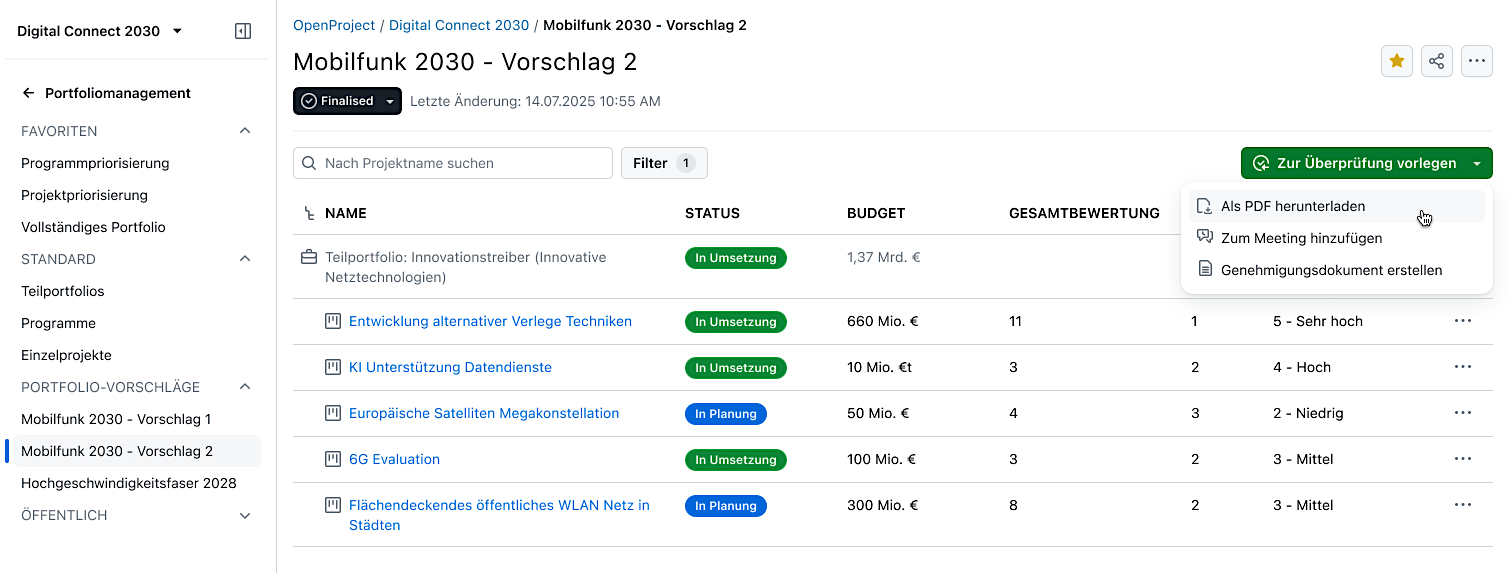
Portfolio management with proposal functionality

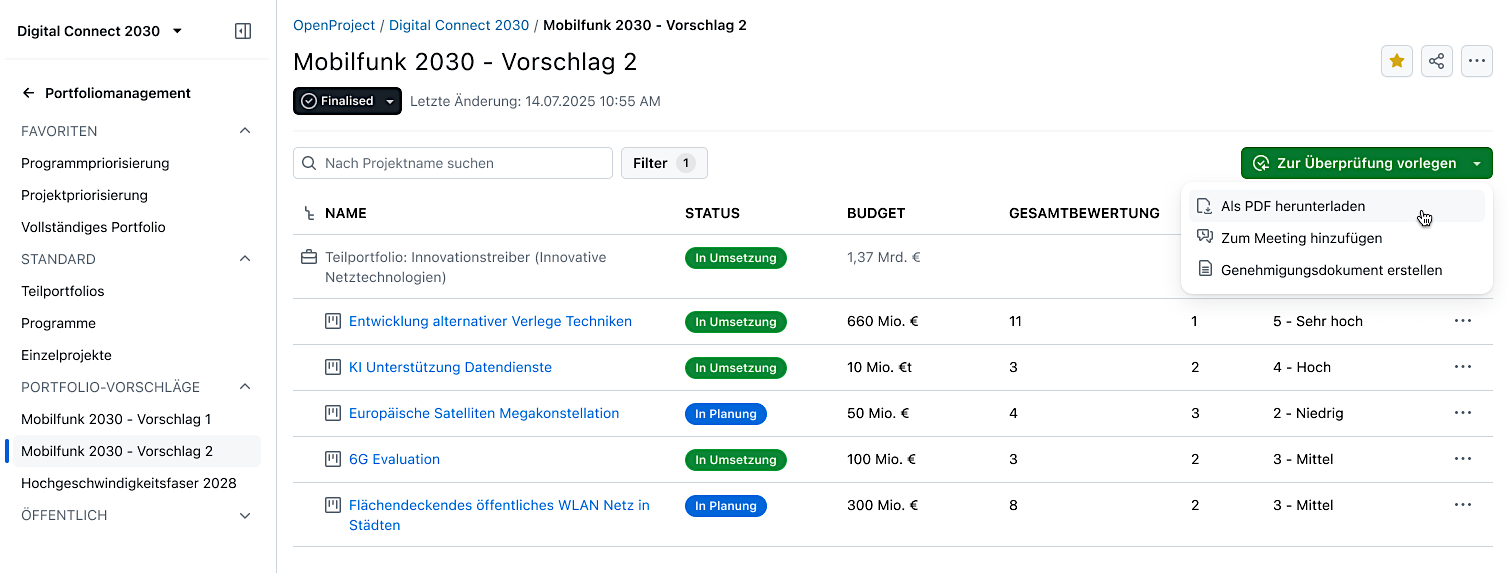
We created a dedicated module for portfolio management where managers can first create portfolio proposals and then submit them for review. These can be downloaded as PDFs or added to a meeting.

Screenshot: “Portfolio management” module with a savable and filterable list of proposals, including attributes like status, budget, and overall rating. Dropdown on “Submit for review” button offers options to download as PDF, add to meeting, or create approval document.

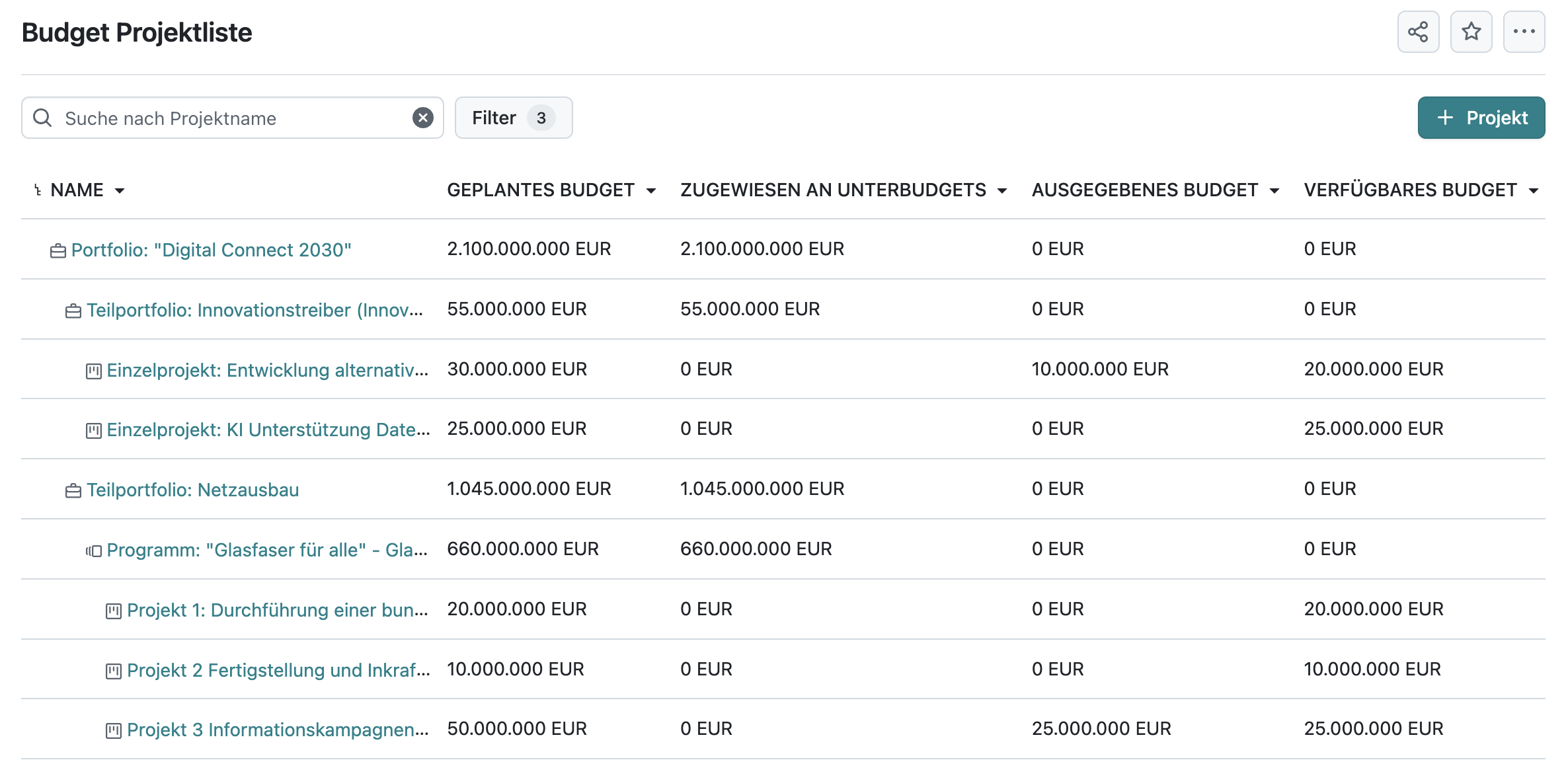
Linking and improved display of budget planning and overviews

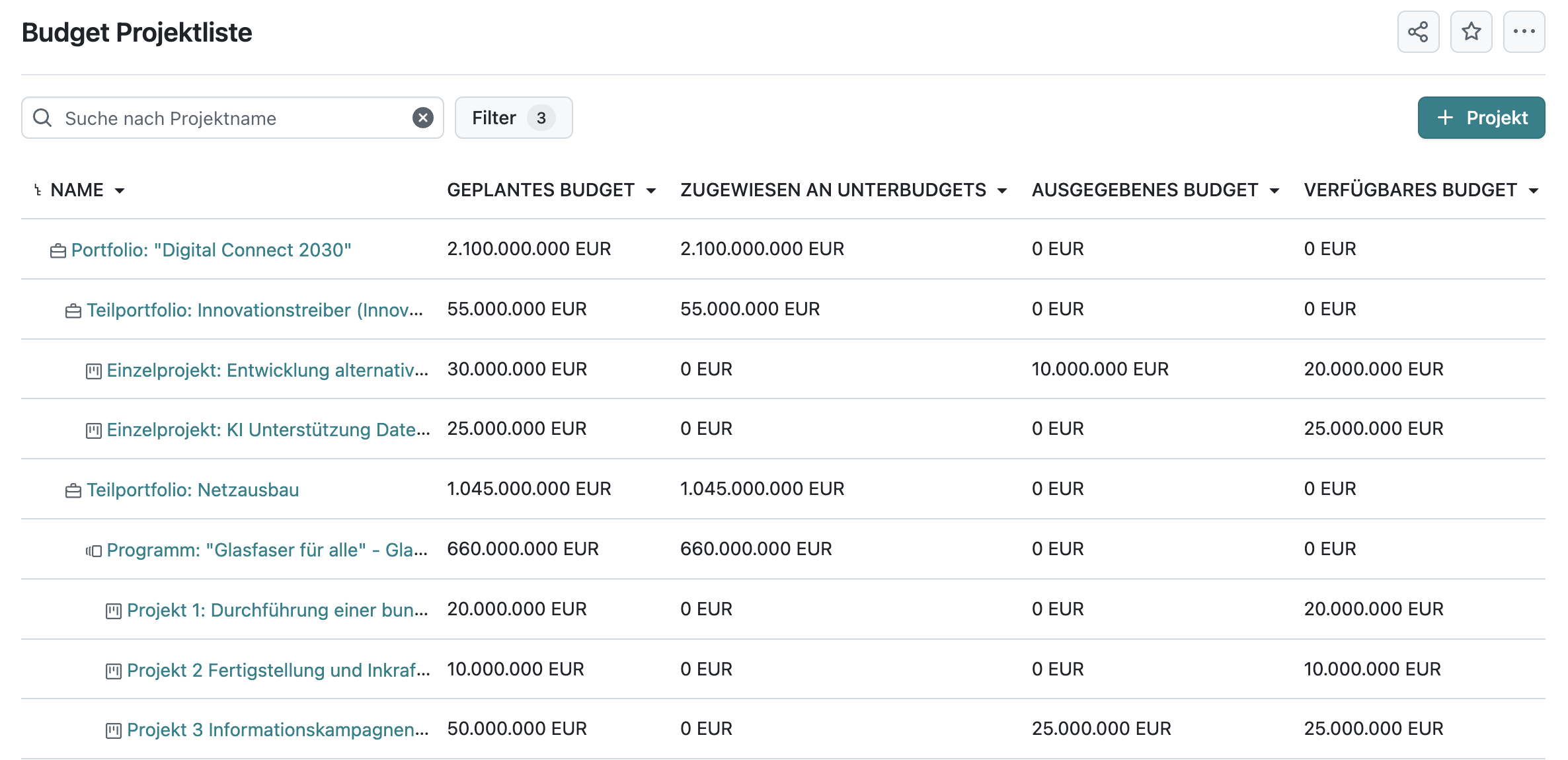
OpenProject already supports extensive budgeting and cost tracking, but previously limited this to individual projects. During the hackathon, we added cross-project budgeting, distinctions between planned and booked costs, and modeling of sub-budgets. The overview page and project lists can now display total budgets and their components.

Screenshot: Saved project list with filters and columns showing budget overview: Planned budget, Assigned to sub-budgets, Spent budget, and Available budget.

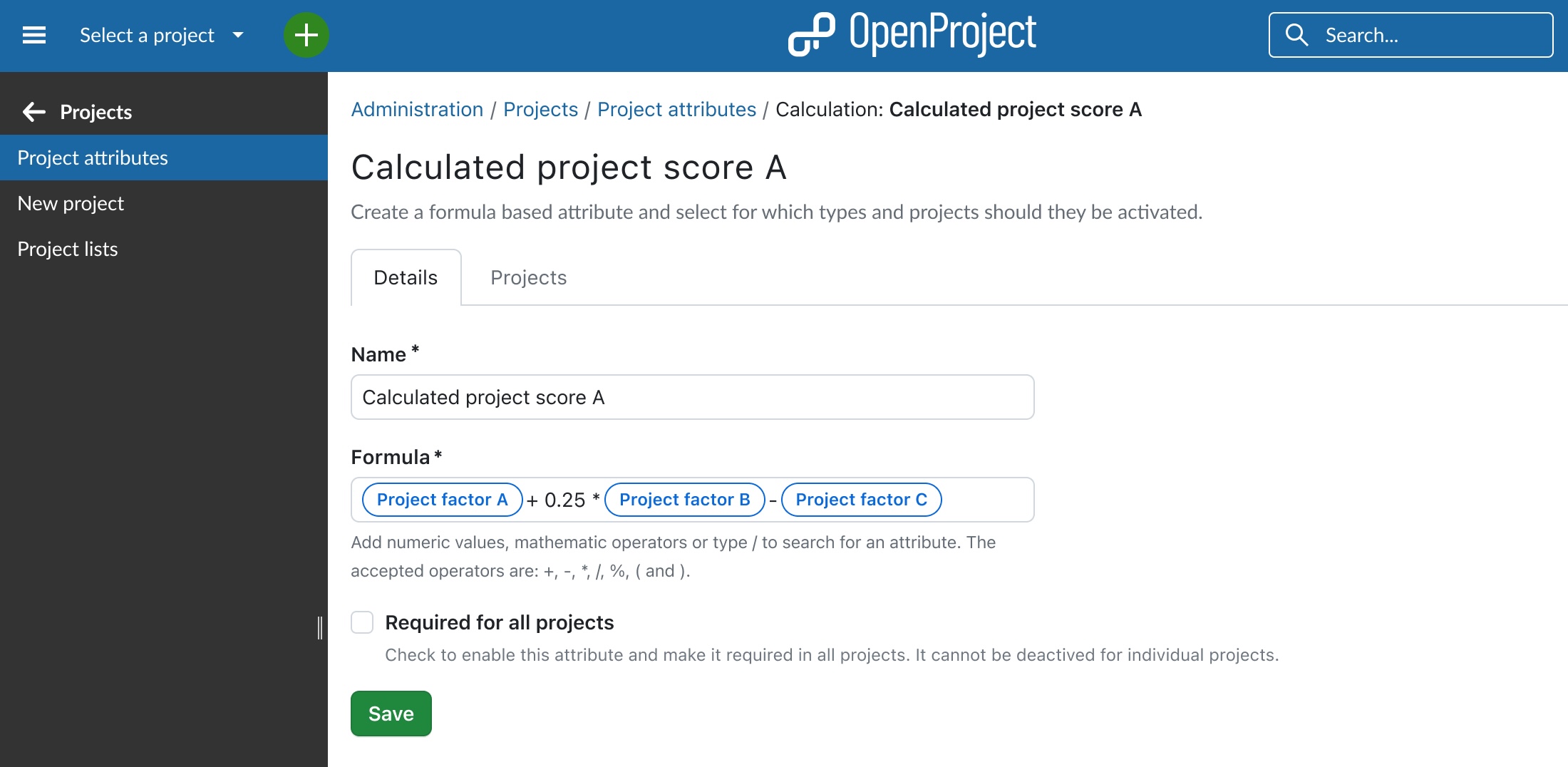
Calculated project scoring

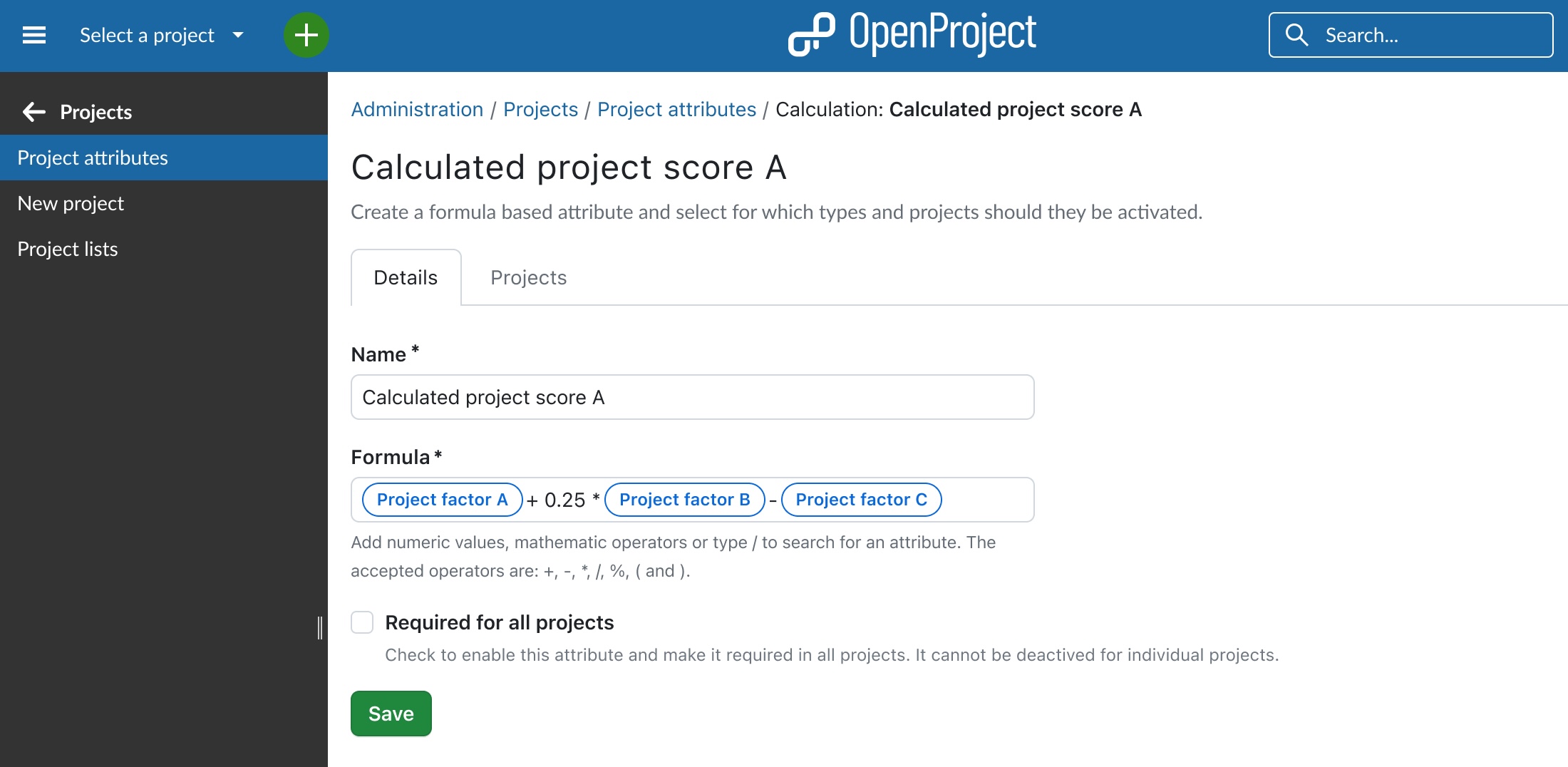
Portfolio managers want to calculate project scores automatically based on project attributes, allowing better evaluation, prioritization, and communication of decisions. This functionality was further developed during the hackathon and activated on the demo instance to display ranking values for project weighting.

It is now possible to apply formulas to freely configurable values that together generate a score. This increases transparency and comparability of evaluations.

This feature is still in development (thanks City of Cologne for their support here), so we’re showing a design draft here:

Mockup OpenProject: Calculated project score A with formula “Project factor A + 0.25 * Project factor B - Project factor C”

Risk management and overview

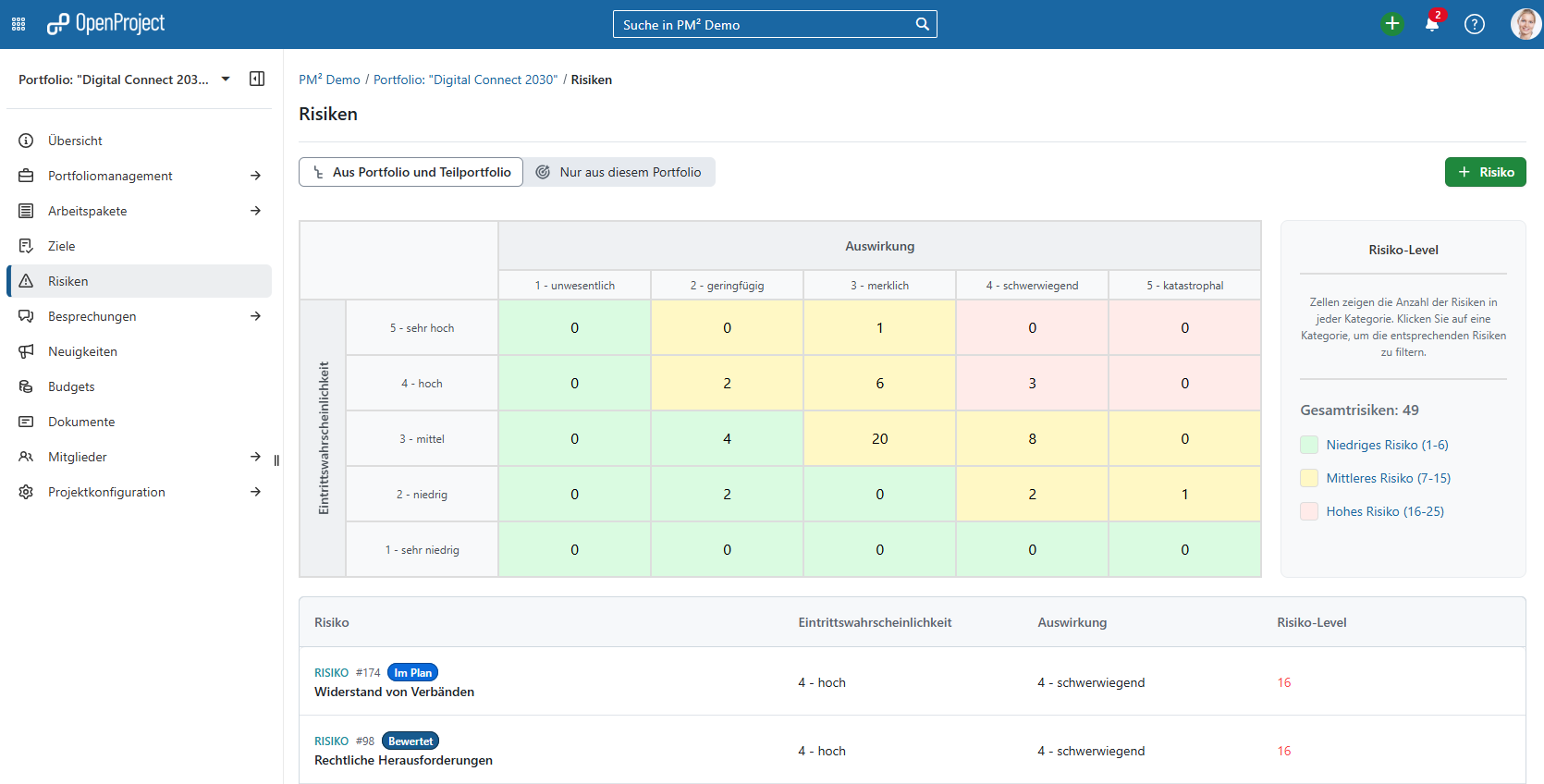
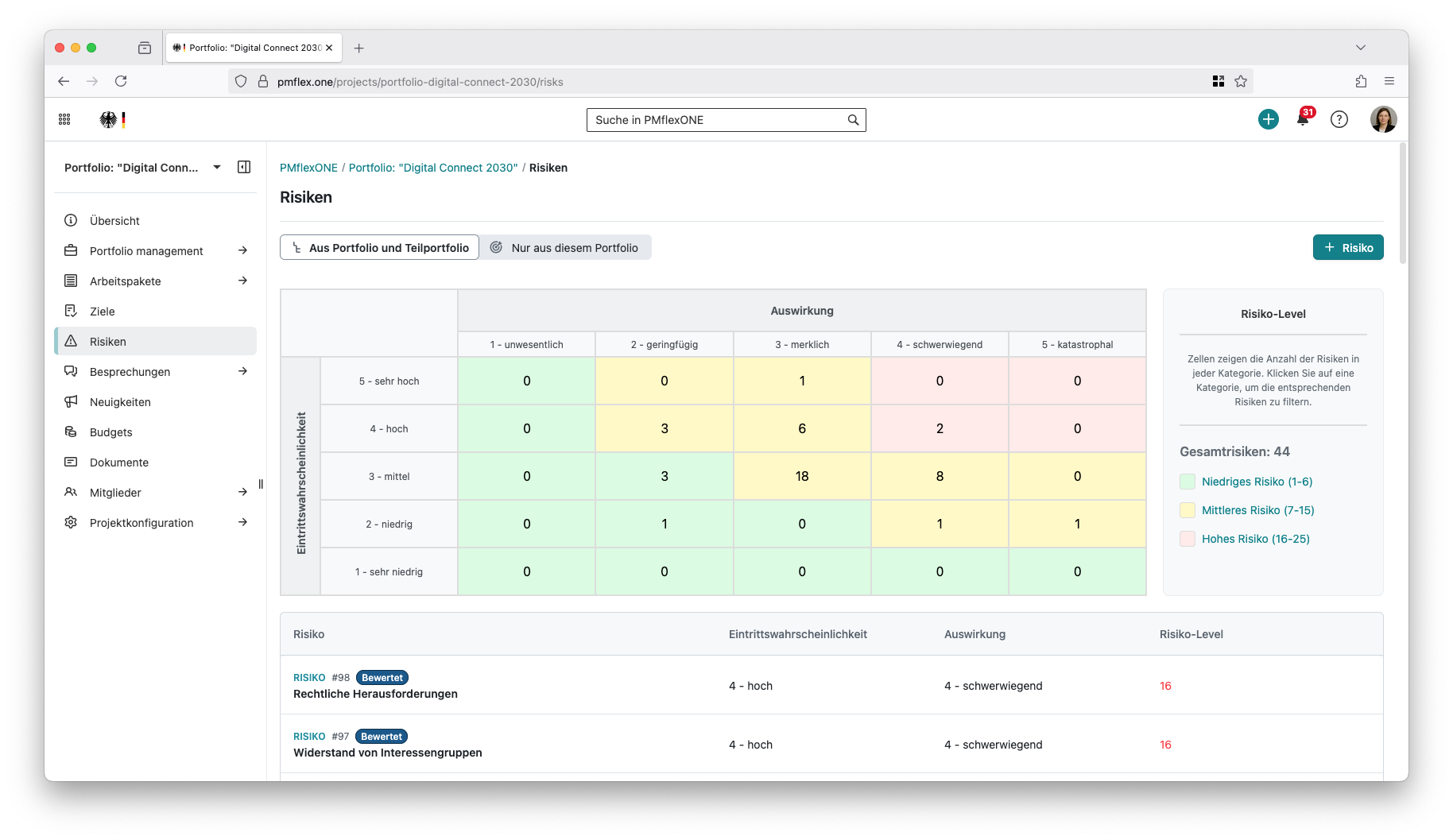
Since risk management is a core requirement for the public sector, we created a dedicated risk module. It includes a risk matrix that visualizes project, portfolio, or program risks with color-coded severity.

Modeling is based on probability (1–5) and impact (1–5). The system calculates a risk level from these values.

This also means: Risks now have their own data type and are a core part of OpenProject. Users are encouraged to document risks, monitor them regularly, and take countermeasures.

Screenshot: Newly created “Risks” module displaying risk work packages in a color-coded matrix (X-axis: Impact, Y-axis: Probability) and a tabular risk list

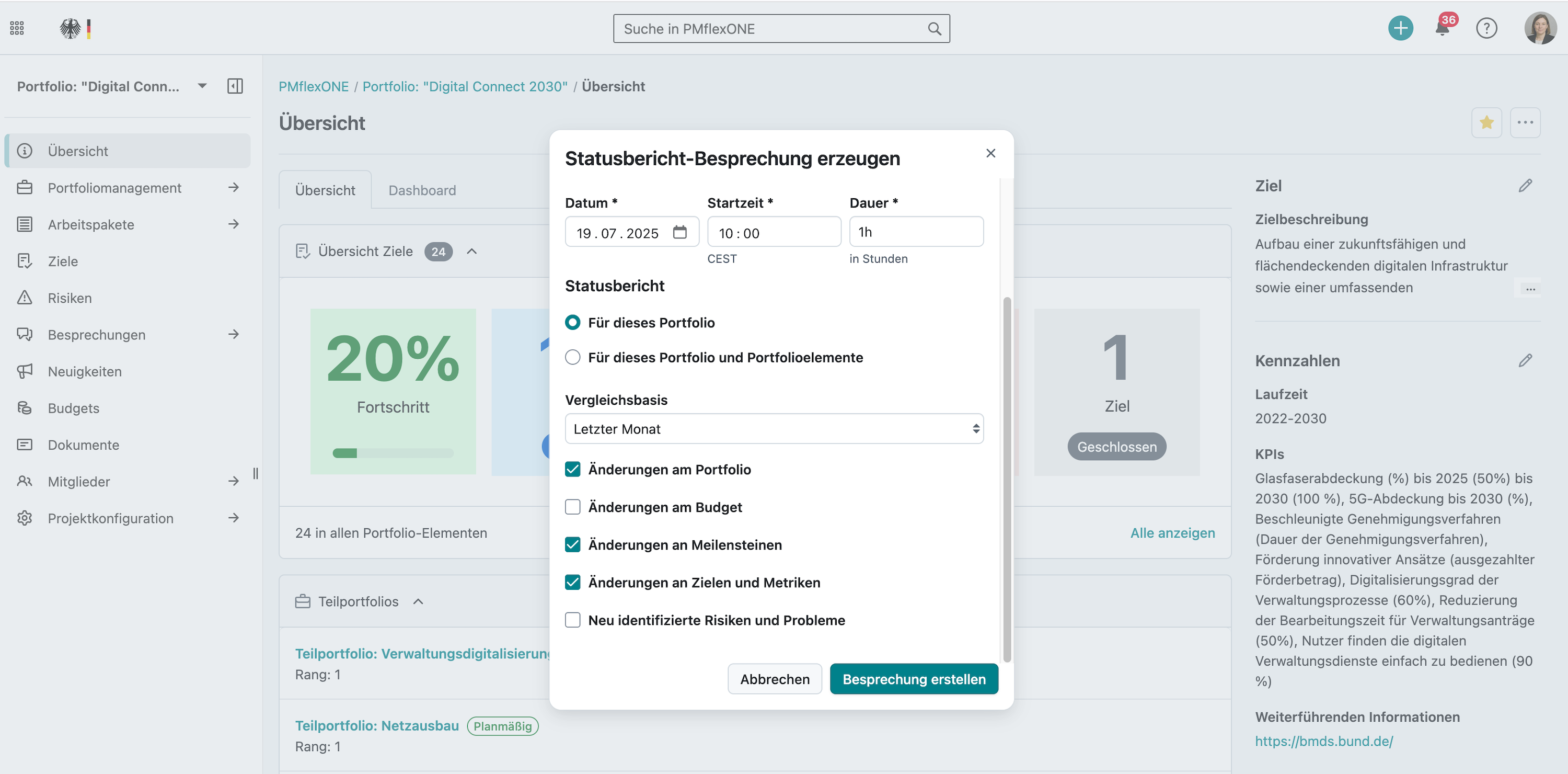
Create status report meetings

Status reports are a key element of PM². But they are not just documents — they are often discussed in meetings. That’s why we created a feature to automatically generate status report meetings.

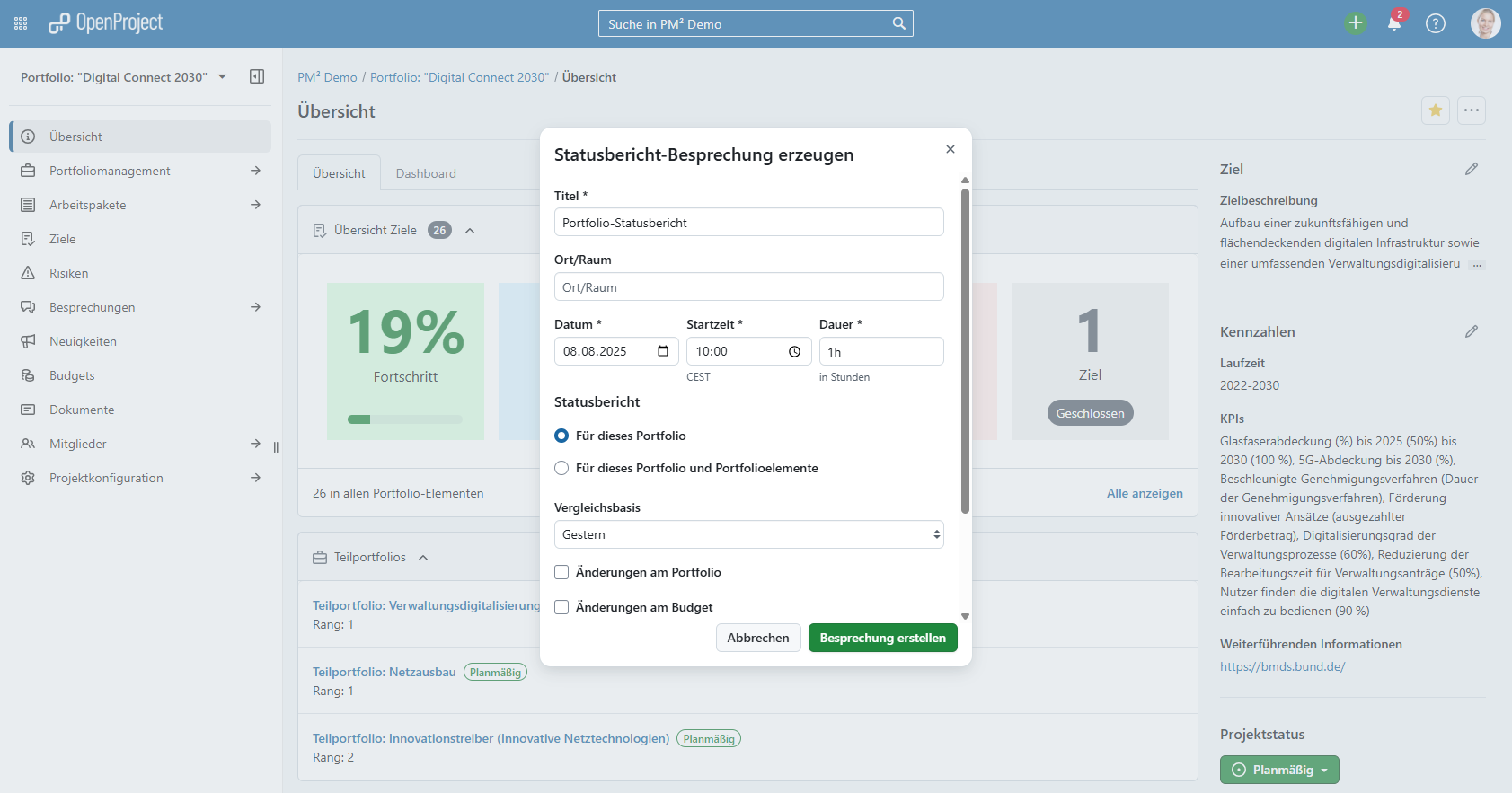
Directly from the overview page, managers can create proposals for a status report meeting with the steering committee. They can select a baseline timeframe and add currently relevant information from the portfolio. The system generates an agenda based on selected changes for further editing.

Screenshot: Portfolio dashboard with modal for creating a status report meeting. Includes baseline timeframe (e.g., last month) and toggles for changes to portfolio, budget, or milestones.

Documents module with real-time editing

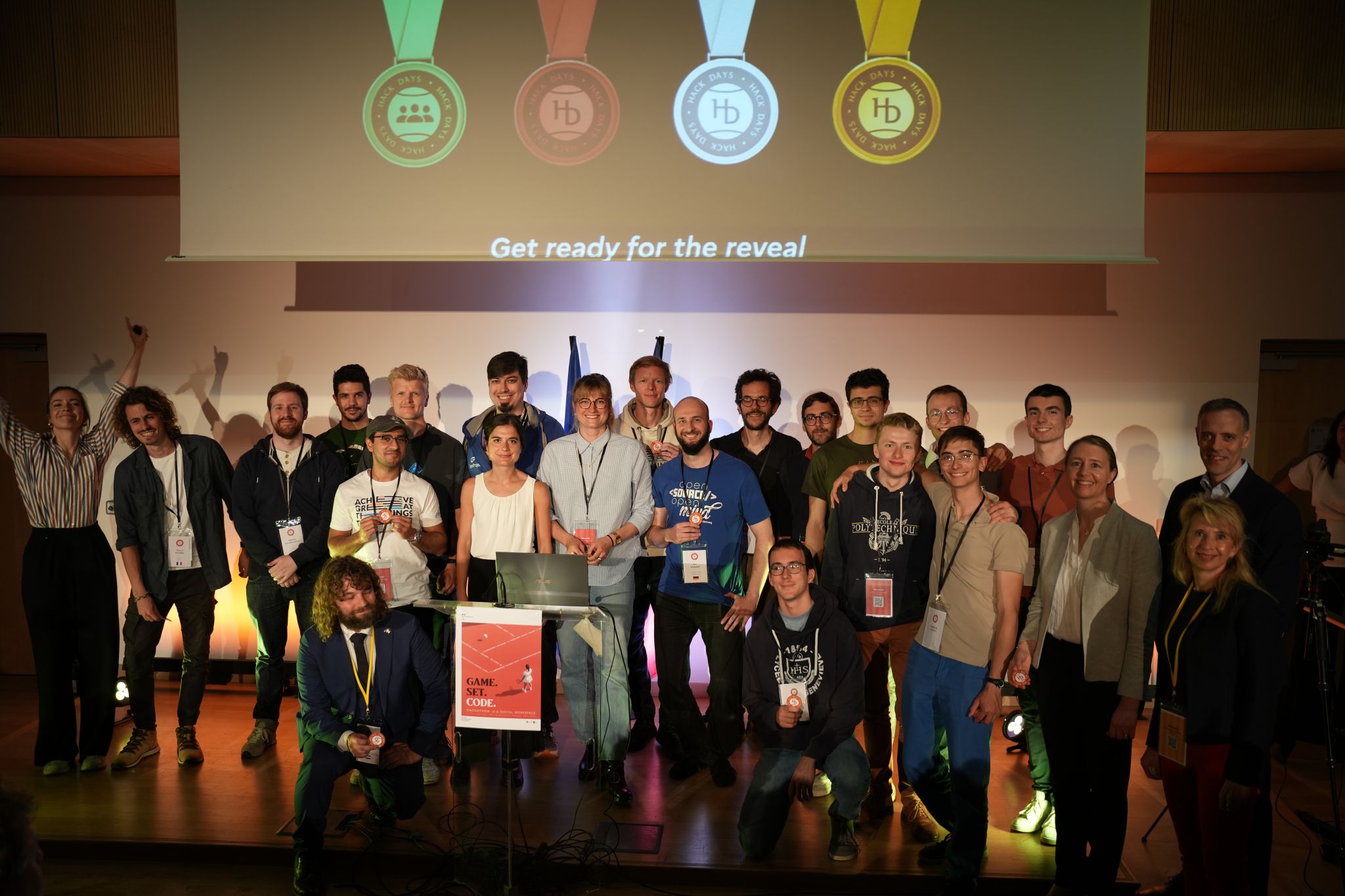
A few weeks ago, OpenProject successfully participated in Hack Days 2025 in Paris, organized by the French government’s digital directorate, DINUM (direction interministérielle du numérique). We’ve now extended those features to enable collaborative real-time editing for multiple users.

To support collaborative creation and sharing of typical documents, the OpenProject documents module was completely redesigned. It now allows for automatically updated content and real-time collaborative editing.

Mobile app enhancements for portfolio/program management

We have been working on a mobile app (iOS/Android) for OpenProject for some time. During the hackathon, we also developed new functionality to differentiate between portfolio, program, and project levels in the app.

Please note that developing a high-quality mobile app takes time, and we want to ensure the best experience before release. Of course, we will announce availability as soon as it’s ready for users.

AI foundations and support for documents and project/portfolio management

OpenProject was extended with two core services: Haystack to gather relevant information, and a custom LLM (Large Language Model). Both services operate within the same network as OpenProject and have no internet access. No data leaves the cluster for AI usage.

Detailed AI features developed during the hackathon include:

AI-generated status report drafts

  • Create drafts of status reports based on work packages and attributes visible to the respective user, using a local AI trained on PMflex

AI assistance in project and portfolio management

  • Display of PMflex-based best practices on the overview page, based on analysis of project data and work packages
  • A secure local AI assists with introducing best practices and provides timely management recommendations

Screenshot: Portfolio overview page with new modules: “Latest status report” and “PMflex suggestions”, e.g., “Update portfolio plan” or “Complete documentation”

AI support in documents

  • Writing tools in the OpenProject editor (translate, rephrase, spell check, generate drafts, etc.)
  • Familiar AI editing features directly inside the editor
  • The documents module uses the LLM to perform simple text tasks like summarizations

Screenshot: Documents module with highlighted text and the following options: Ask AI anything, Improve writing, Fix spelling, Translate…, Simplify.


PDF export of portfolio and program status

We believe in a single source of truth for project data. However, there many use cases where an export is extremely helpful, e.g. when information needs to be documented in external systems. So during the hackathon we built a status report engine that creates pixel-perfect PDF files from the data in the system.

  • Status information
  • Budget
  • Risks
  • Objectives
  • KPIs
  • Milestones
  • Custom attributes
  • […]

Kudos go to the German Federal Ministry of the Interior who sponsored the pdf export of work packages in 2023. The PDF export library we developed laid the foundation for this feature.

PDF export portfolio status report

As an outlook, we are working on more configuration options to adjust the export to the specific needs. Additionally, we plan to add further charts and illustrations.

Found? – What happens after the hackathon?

All released features will be available either in OpenProject itself or in openDesk, the secure office and collaboration suite designed specifically for the public sector.

The rollout would likely proceed as follows:

  • Distribution via ZenDiS as a module in openDesk:

    • Monthly releases
    • Security concepts
    • Maintenance
    • Support
    • Hosting
  • Demo environments provided through OpenProject’s SaaS infrastructure

Even though the work is progress this hackathon clearly demonstrated how OpenProject, as an open source solution, can meet the concrete requirements of public administration — quickly, competently, and collaboratively.

There is a visible shift toward data sovereignty, open standards, and independent software solutions — not only, but especially in the public sector.

Anyone looking for a future-proof, sovereign solution will find a strong and experienced partner in OpenProject. Learn more about OpenProject for public administration.

  •  

Secure project management software with servers in the EU

The server location is a relevant criterion when looking for software: If you choose a software provider from the EU with servers in the EU, you can rely on EU data protection (GDPR). Especially with project management (PM) software, data protection and security is an extremely important issue, since sensitive data is stored. But which project management software meets this requirement?

Find out in the article why the German PM software OpenProject is a safe choice in terms of server location, data protection and customer service.

Overview: Project management software from Germany

Anyone researching PM cloud software will quickly come across well-known solutions such as Jira, Asana or Trello. However, most market leaders for PM software are not based in the European Union and regularly host their servers outside the European Union. And even if software is hosted in Europe, stored data could be made available to US authorities upon request. This is in conflict with the GDPR and would therefore contradict the use of any cloud services with US reference.

If you are specifically looking for PM software from Germany, you need to take a good look. The following PM software providers have both their headquarters and server locations in Germany: OpenProject, Stackfield, InLoox, Factro, awork.

All of the above solutions offer servers in the European Union. In addition, they all offer German-language support, documentation – and, of course, a German user interface.

The best open source PM software from Germany: OpenProject

OpenProject stands out from other German project management software providers mainly because of the following criteria:

Successful in Germany and worldwide

A wide range of German-speaking companies and organizations already rely on the Enterprise version of OpenProject, including, for example: City of Cologne, Autoliv, University of Zurich, Fraunhofer, Volksbank Bocholt, Brandenburg State Parliament, Siemens or Charité Berlin. Many more are managing their projects with the free of charge Community version.

Customers of OpenProject: Stadt Köln, Autoliv, Universität Zürich, Fraunhofer, Volksbank Bocholt, Landtag Brandenburg, Siemens, Charité Berlin

In addition to numerous companies and organizations from the DACH region, OpenProject has customers from all over the world and from a wide range of industries. For example, from the construction industry (with its own OpenProject BIM version), education and research, technology, public institutions, healthcare, automotive industry,engineering,NGOs and foundations, or banking and insurance.

European legal security: DSGVO compliant and open source

Of course, the cloud-hosted version of OpenProject is DSGVO compliant. All data - starting with marketing! - is treated with strict confidentiality. Our goal is to minimize data storage, that is, to capture and store only Data that is really necessary. No matter if you are browsing the OpenProject website or using the software. We do not set cookies that are not technically necessary, and we do not collect or process personal data for any purpose other than ensuring our services.

In short: For OpenProject, data protection is not just a legal regulation, but a matter of course.

CEO Niels Lindenthal: “Our goal is to bring OpenProject to perfection as a lighthouse project for data privacy and security in Europe.

As open source software, the source code of OpenProject is publicly available. This means that numerous people can quickly expose errors and possible security vulnerabilities. Because: Like any software, OpenProject can be affected by security vulnerabilities. These can usually be found and fixed much faster in OpenProject by the vigilant community than in project management software that is not open source.

Good to know: For EU customers it is required by the GDPR to sign a data processing agreement (sometimes called data processing addendum) before using the OpenProject Enterprise cloud edition. To save bureaucratic effort and time for both sides, OpenProject has automated this process.

In addition to data security, data sovereignty is a top priority at OpenProject. Together with other open source software providers, OpenProject is currently working on openDesk - the Sovereign Workplace, an open source alternative to Microsoft, Google and Co. OpenDesk is initiated and supported by the Federal Ministry of the Interior and Homeland of Germany.

Server locations in Europe

OpenProject can be operated on self-managed servers (”on-premises”) or used as software-as-a-service in the cloud. If you decide to use the cloud version of OpenProject, your data will be stored on secure servers within the EU. If you prefer a server location specifically in France, this is also possible without any problems - just contact us!

Important

Prior to March 2026 our services are hosted across both Netways (Germany) and Scaleway (France) data center environments. Starting with March 2026, Scaleway will become our sole data center provider for the EU shard.

OpenProject is transparent in its dealings with the subcontractors it uses. For cloud solutions provided in the EU, you can find a list of subcontractors here.

Continuous backups and easy restore mechanisms

Security always includes backups, which are continuously created for OpenProject’s cloud solutions. This means that data can be easily restored in the event of an emergency. Backups are stored on separate servers at OpenProject and encrypted as data-at-rest (with AES-256).

German-speaking support for international customers

Another important criterion when deciding on project management software is customer support. While many people in the DACH region speak English, most feel most confident in their native language, especially when it comes to technical vocabulary. OpenProject, as a German company based in Berlin, offers full German support.

Book training and consulting in German or English, or contact our English- or German-speaking customer support staff. Our digital user guide is also available in German as well as English. And also in Spanish and French - further languages are planned.

Rely on OpenProject for all-around secure data handling in your project management. Software from Germany, with European standards - for international customers.

  •  

A PMflex-based software solution for Germany's Federal Ministry for Digital and State Modernization (BMDS): Hackathon insights and outlook

What does a software solution look like that enables employees in the German federal administration to successfully prioritize, manage, implement, and report on strategic initiatives?

At OpenProject, we had the chance to explore this very question during a hackathon last week, as we are on the shortlist for this software solution. In this article, we will present the exact requirements from the German Federal Ministry for Digital and Modernization of the State (BMDS) and the results we were able to deliver.

The requirements defined by the BMDS are based on PMflex, a comprehensive strategic management solution and integrated project management system developed at the federal level specifically for public administration. PMflex is based on the open source project management methodology PM² provided by the European Commission.

If you already want to “spoil” the results, feel free to watch the following video (available in German only), which we presented to the ministry at the end of the hackathon:

Article navigation:

Wanted: A software solution for the strategic implementation of federal digitalization initiatives

During the week of July 14–18, 2025, OpenProject not only released a new software version but also spontaneously participated in a kind of hackathon. The client was the Federal Ministry for Digital and Modernization of the State (BMDS). The ministry is looking for a software solution to implement strategies at the portfolio, program, and project levels.

We at OpenProject are honored to be shortlisted for this solution and used the hackathon to show that all requirements are either already met or will be met in the near future.

Transparency is one of our core values, so in this article we want to share an overview of the hackathon, the requirements, and of course our proposed solutions.

Requirements included:

  • PMflex compatibility (tailoring)
  • Consistency across portfolio, program, and project levels
  • Cross-agency collaboration
  • Agility
  • Enjoyable user experience

Challenges for us:

  • Only one week to develop additional features, comprehensive demo material, documentation, and (video) presentation. All of this alongside our daily business, including the release of version 16.2.
  • Immersing ourselves in the working environment and various user stories from public administration, which operates very differently than we do internally. Here, our extensive experience with the public sector, especially in connection with openDesk, was a major advantage.

Overview of the required user stories:

Several user stories were provided, each with associated data like budget, status, target states, and more. Every user story included at least one fictional persona, from whose perspective the solution needed to be demonstrated.

  1. Prioritize portfolio elements
  2. Manage portfolio
  3. Report program status
  4. Report project status

In addition to the predefined user stories, we also showcased how the solution could be used on the go via the mobile app.

Delivered: Full commitment for ten new features and implementation in PMflexONE

Alongside 19 developers, many other OpenProject team members were fully engaged in the BMDS hackathon. Despite — or perhaps because of — the short timeframe and complex requirements, the energy and team spirit were tangible across all days, even across our globally distributed remote workspaces.

For Rosanna Sibora, who had her very first week at OpenProject as Chief Product Officer during the hackathon, the team’s commitment, creativity, and passion made a strong impression:

“During the hackathon, I was impressed by how well the self-organized teams collaborated. It clearly showed me how well-aligned the OpenProject team is and how open and empowering the culture is. We proved that 2+2 is definitely more than 4 — and what can be achieved with great collaboration and empowerment.” – Rosanna Sibora, CPO, OpenProject GmbH

OpenProject implementation – behind the scenes:

  • Full energy and passion, not just from developers
  • 15,000+ lines of new code
  • Team formation for developing new features, building a demo instance, and designing product mockups for additional features
  • Daily hackathon stand-ups, retros, and pulse checks with the BMDS and other stakeholders, 100% remote collaboration using other open source tools like Big Blue Button and Element
  • Daily operations continued in parallel: support and release of OpenProject 16.2

OpenProject implementation – on the product level:

While the current version of OpenProject already supports the majority of requirements, we identified several aspects we wanted to expand or develop from scratch during the hackathon week. Especially relevant across all user stories was the development of features for reporting and managing goals, risks, and budgets.

Here is an overview of our main development focuses during the hackathon:

Let’s take a closer look at what these features and requirement implementations looked like by the end of the hackathon week.

Important

Please note that this is a summary of key developments. Additional features were also planned, designed, and developed during the hackathon. As these features were created in a very short time, they are not yet fully tested or finalized.

Planning and managing portfolios and programs

To support PMflex, OpenProject needed to manage not just projects but also portfolios and programs. Modeling these was the first step during the hackathon. Portfolio, sub-portfolio, and program extend the existing project hierarchy with the ability to group projects and manage them collectively.

Screenshot PMflex.one: Favorited “Projects” dropdown showing a hierarchical list of portfolio, sub-portfolio, program, and projects

Enhancing portfolio and program dashboards

On the overview pages for portfolios, (sub-)programs, or even projects, managers want to see key information about goals, milestones, risks, and budgets at a glance. To enable this, we created widgets during the hackathon that visually aggregate this data: charts for budgets and risks, listings of components with their priority, status, and goal progress. These widgets were implemented as prototypes in a new dashboard using the OpenProject Design System.

Screenshot PMflex.one: Portfolio overview page showing, among other things, a goals widget with percentage progress (19%) in different colors and counts of goals by status (18 on track, 3 critical, etc.)

Portfolio management with proposal functionality

We created a dedicated module for portfolio management where managers can first create portfolio proposals and then submit them for review. These can be downloaded as PDFs or added to a meeting.

Screenshot PMflex.one: “Portfolio management” module with a savable and filterable list of proposals, including attributes like status, budget, and overall rating. Dropdown on “Submit for review” button offers options to download as PDF, add to meeting, or create approval document.

Linking and improved display of budget planning and overviews

OpenProject already supports extensive budgeting and cost tracking, but previously limited this to individual projects. During the hackathon, we added cross-project budgeting, distinctions between planned and booked costs, and modeling of sub-budgets. The overview page and project lists can now display total budgets and their components.

Screenshot PMflex.one: Saved project list with filters and columns showing budget overview: Planned budget, Assigned to sub-budgets, Spent budget, and Available budget.

Calculated project scoring

Portfolio managers want to calculate project scores automatically based on project attributes, allowing better evaluation, prioritization, and communication of decisions. This functionality was further developed during the hackathon and activated on the demo instance to display ranking values for project weighting.

It is now possible to apply formulas to freely configurable values that together generate a score. This increases transparency and comparability of evaluations.

This feature is still in development (thanks City of Cologne for their support here), so we’re showing a design draft here:

Mockup OpenProject: Calculated project score A with formula “Project factor A + 0.25 * Project factor B - Project factor C”

Risk management and overview

Since risk management is a core requirement for the BMDS, we created a dedicated risk module. It includes a risk matrix that visualizes project, portfolio, or program risks with color-coded severity.

Modeling is based on probability (1–5) and impact (1–5). The system calculates a risk level from these values.

This also means: Risks now have their own data type and are a core part of OpenProject. Users are encouraged to document risks, monitor them regularly, and take countermeasures.

Screenshot PMflex.one: Newly created “Risks” module displaying risk work packages in a color-coded matrix (X-axis: Impact, Y-axis: Probability) and a tabular risk list

Create status report meetings

Status reports are a key element of PMflex. But they are not just documents — they are often discussed in meetings. That’s why we created a feature to automatically generate status report meetings.

Directly from the overview page, managers can create proposals for a status report meeting with the steering committee. They can select a baseline timeframe and add currently relevant information from the portfolio. The system generates an agenda based on selected changes for further editing.

Screenshot PMflex.one: Portfolio dashboard with modal for creating a status report meeting. Includes baseline timeframe (e.g., last month) and toggles for changes to portfolio, budget, or milestones.

Documents module with real-time editing

A few weeks ago, OpenProject successfully participated in Hack Days 2025 in Paris, organized by the French government’s digital directorate, DINUM (direction interministérielle du numérique). We’ve now extended those features to enable collaborative real-time editing for multiple users.

To support collaborative creation and sharing of typical PMflex documents, the OpenProject documents module was completely redesigned. It now allows for automatically updated content and real-time collaborative editing.

Mobile app enhancements for portfolio/program management

We have been working on a mobile app (iOS/Android) for OpenProject for some time. During the hackathon, we also developed new functionality to differentiate between portfolio, program, and project levels in the app.

Please note that developing a high-quality mobile app takes time, and we want to ensure the best experience before release. Of course, we will announce availability as soon as it’s ready for users.

AI foundations and support for documents and project/portfolio management

OpenProject was extended with two core services: Haystack to gather relevant information, and a custom LLM (Large Language Model). Both services operate within the same network as OpenProject and have no internet access. No data leaves the cluster for AI usage.

Detailed AI features developed during the hackathon include:

AI-generated status report drafts

  • Create drafts of status reports based on work packages and attributes visible to the respective user, using a local AI trained on PMflex

AI assistance in project and portfolio management

  • Display of PMflex-based best practices on the overview page, based on analysis of project data and work packages
  • A secure local AI assists with introducing best practices and provides timely management recommendations

Screenshot PMflex.one: Portfolio overview page with new modules: “Latest status report” and “PMflex suggestions”, e.g., “Update portfolio plan” or “Complete documentation”

AI support in documents

  • Writing tools in the OpenProject editor (translate, rephrase, spell check, generate drafts, etc.)
  • Familiar AI editing features directly inside the editor
  • The documents module uses the LLM to perform simple text tasks like summarizations

Screenshot PMflex.one: Documents module with highlighted text and the following options: Ask AI anything, Improve writing, Fix spelling, Translate…, Simplify.


PDF export of portfolio and program status

We believe in a single source of truth for project data. However, there many use cases where an export is extremely helpful, e.g. when information needs to be documented in external systems. So during the hackathon we built a status report engine that creates pixel-perfext PDF files from the data in the system.

  • Status information
  • Budget
  • Risks
  • Objectives
  • KPIs
  • Milestones
  • Custom attributes
  • […]

Kudos go to the German Federal Ministry of the Interior who sponsored the pdf export of work packages in 2023. The PDF export library we developed laid the foundation for this feature.

PDF export of PMflex portfolio status report

As an outlook, we are working on more configuration options to adjust the export to the specific needs. Additionally, we plan to add further charts and illustrations.

Found? – What happens after the hackathon?

At the time of writing, it is still open what the next steps will be for OpenProject and the BMDS. What we do know is that the entire OpenProject team has grown through this experience — and we are proud of what was achieved and delivered during the week.

Regardless of the outcome of the tender, we will finalize, thoroughly test, and potentially release the developed features to our customers in future versions.

All released features will be available either in OpenProject itself or in openDesk, the secure office and collaboration suite designed specifically for the public sector.

If OpenProject is selected in the BMDS tender, the rollout would likely proceed as follows:

  • Distribution via ZenDiS as a module in openDesk:
    • Monthly releases
    • Security concepts
    • Maintenance
    • Support
    • Hosting
  • Distribution via ITZBund / Cloudogu
  • Implementation consulting via specialized partners such as ]init[
  • Demo environments provided through OpenProject’s SaaS infrastructure

Even though the BMDS decision is still pending, this hackathon clearly demonstrated how OpenProject, as an open source solution, can meet the concrete requirements of public administration — quickly, competently, and collaboratively.

There is a visible shift toward data sovereignty, open standards, and independent software solutions — not only, but especially in the public sector.

Anyone looking for a future-proof, sovereign solution will find a strong and experienced partner in OpenProject. Learn more about OpenProject for public administration.

  •  

Empowering the Public Sector with OpenProject: An Open Source alternative for project management

At a time when digital sovereignty and transparency are essential for governmental institutions, OpenProject offers secure, open source project management and team collaboration software tailored to public sector needs.

Whether it’s resource-heavy infrastructure projects or multi-stakeholder policy implementations, public administrations across Europe are already leveraging its flexible features, such as work packages, Gantt charts, agile boards, time & cost tracking, wikis, and meeting management. This helps them to professionalize workflows while maintaining full control over their data.

OpenProject in Public Sector implementations

Many different public institutions already rely on OpenProject to manage their projects and organize their teams. They have implemented a wide range of use cases. We spoke personally with some of our customers and would like to give a short overview of how they use OpenProject to achieve their goals.

The Federal IT Cooperation (FITKO)

Within the openDesk framework, FITKO uses OpenProject for centralized coordination of IT standardization and to prepare and conduct the IT Planning Board Meetings. Key benefits include meeting management, documentation workflows, Nextcloud integration to link work packages and documents, and secure multi-stakeholder collaboration.

Read the case study: FITKO and OpenProject

District Office Enzkreis

At the District Office Enzkreis OpenProject supports major projects like implementing the Bundesteilhabegesetz and internal change initiatives. What are its strengths for this organization? Visualization in Gantt charts, real-time information exchange, efficient meeting agendas and minutes, and @-mentions for easy communication.

Read the case study: District Office Enzkreis and OpenProject

City of Constance

Through features like Gantt charts, Kanban boards, and integrated resource planning, Constance transformed its construction management and facility maintenance into collaborative, transparent, and accountable processes and manages their public order office seamlessly in one platform.

Read the case study: City of Constance and OpenProject

City of Chemnitz

As a hub for hundreds of public and culture-related projects, Chemnitz works with OpenProject to manage multiple projects with standardized templates, which accelerated project planning by 80%. It benefits from its self-hosted on-premises version to maintain their data sovereignty.

Read the interview: City of Chemnitz and OpenProject

City of Cologne

City of Cologne is managing a huge project portfolio in OpenProject and is actively contributing as a sponsor for project portfolio management, the Nextcloud integration, and scheduling and progress reporting features.

Brandenburg State Parliament

OpenProject plays a central role in advancing digital governance and transparency for the State Parliament of Brandenburg. With its flexible agile boards, meeting management, and workflows, the parliament coordinates initiatives, legislative processes, and digital strategy implementation. Teams streamline planning, track tasks, and collaborate smoothly across departments, all while maintaining full data sovereignty by self-hosting.

Logos from public sector clients that use OpenProject

Explore how OpenProject supports the public sector and helps customers succeed.

From strategy to execution: How PMFlex guides public sector success

OpenProject doesn’t just handle individual projects. It aligns perfectly with structured public sector methodologies like PMFlex. PMFlex is a – flexible – adaptation of the European PM² standard for project management. As a comprehensive strategy management solution, it links strategic goals with specific key performance indicators and enables end-to-end control at the portfolio, program, and project levels.

Using PMFlex as a framework, organizations clearly define roles, like Project Core Teams and Steering Committees. Along with phases and phase gates, while still being able to work agile inside the execution phase.

Example with PMFlex: On portfolio, program, and project levels

Public institutions often manage complex initiatives on multiple levels. With OpenProject, these align with PMFlex structures:

PMFlex Level In OpenProject How it helps
Portfolio Portfolio overviews (project lists, dashboards, reports) Aligns initiatives with political goals and digital agendas.
Program Aggregated views via parent projects with subprojects, global user visibility Ensures synergy across interrelated projects and shared resources.
Project Phases, gates, agile boards, work packages, wikis and more Keeps teams on track, transparent, and audit-ready.

In addition to the features mentioned above, OpenProject’s Meetings module offers the possibility to discuss tasks, risks, and strategies easily and in an audit-proof manner within the system at all levels. And, of course, the highly specific roles and permissions system in OpenProject allows all stakeholders to do exactly what their role requires – no more, no less.

In this way, public organizations can easily track progress on PMFlex indicators, prepare for formal gate reviews, and document results for stakeholders and audit institutions – all in one secure, open source environment.

Top features for the Public Administration

Feature Benefit
Work packages Clear task assignment, status tracking, visibility
Gantt charts Long-term planning, dependency management
Agile boards Hybrid workflows, flexible prioritization
Time & cost tracking Budget oversight, resource balancing
Meetings module Streamlined agendas, documented decisions
Wikis Knowledge base, shared documentation
Nextcloud integration All important documents linked to work packages

These features, powered by OpenProject, significantly reduce administrative overhead, foster team collaboration and informed decision-making, and help organizations remain GDPR compliant.

Data sovereignty is more than a buzzword

At OpenProject, data sovereignty is a core principle and not just a buzzword. Public sector organizations can choose between secure cloud hosting in a certified European data center or full control through self-managed on-premises installations. Both options ensure complete ownership and control of sensitive data, in full compliance with European regulations.

OpenProject is fully open source, licensed under GNU GPL v3. Its source code is publicly available on GitHub and openCoDE, providing full transparency and auditability. This openness not only strengthens trust, it enhances security by enabling early detection and resolution of potential vulnerabilities.

Free from vendor lock-in, organizations are empowered to adapt and extend the software as needed. For those seeking additional features and expert support, OpenProject GmbH offers affordable Enterprise packages that are still significantly more cost-effective than proprietary solutions like Microsoft Project or Atlassian Jira.

Ready for digital transformation?

OpenProject empowers public organizations to break free from siloed communication, manual tracking and workflows, and costly vendor lock-ins. By combining open standards with robust collaboration tools, it enables secure, transparent, and efficient governance.

Curious how OpenProject can support your administration? Get in touch with us and we are happy to share more insights into our different use cases.

  •  

OpenProject 16.2: New header and sidebar with improved navigation and design

OpenProject 16.2 has been released and this version introduces new features and improvements again. We look forward to hearing your thoughts and feedback on the latest updates. Please take a few minutes to learn what changes for you. We will summarize the most important changes in this blog article and, as always, please see our release notes that contain all changes, features and bug fixes.

In this blog article, we will focus on the design updates and briefly summarize some more important features. Here is a quick navigation to all feature descriptions:

New header and sidebar with improved navigation and design

The most striking change from 16.1 to 16.2 is the more modern design and improved user experience of the sidebar and header navigation. The reason for these changes is to give the application a more contemporary look and to ensure compatibility with the openDesk application. It is important to us to provide the best possible user experience in openDesk when navigating between the different applications within openDesk.

The updates in OpenProject itself also follow familiar logic. For example, the project navigation has moved consistently into the sidebar. Here’s an overview of what’s new in OpenProject 16.2, regarding header and sidebar navigation:

  • The hamburger sidebar toggle has moved from the header to the sidebar.
  • The default sidebar color in light mode is now brighter.
  • The search and create buttons have a new, more intuitive position in the header.

Please note that these changes will not affect your already customized designs.

See a comparison between OpenProject version 16.1 (top) and 16.2 (highlighted below):

Home Page in OpenProject in comparison: Version 16.1 and Version 16.2 with updated header and sidebar

What do you think of these updates? As with any change, it may take some time to get used to the new navigation, but we hope that it will provide you with a better user experience in the long run and a more intuitive start for new users.

Other design updates in OpenProject 16.2

The changes to the header and sidebar weren’t the only design changes: as part of the ongoing updates to the Primer design system, the user interface and process for creating a new project or copying an existing one has also been improved. For example, when you create a project based on a template, you can now immediately select which modules and parts you want to copy and which you want to skip.

Also, in the Relations tab of a work package, the + Relation dropdown now uses second-level navigation: Only the first relations are shown directly, others are displayed when clicking on “Other relations”.

Seamless integration of open source applications with a SCIM API (Enterprise add-on)

While this is a rather technical update, the newly added SCIM API can be a huge benefit for seamless integration with other open source applications. It allows your identity provider (IdP) to automatically provision and de-provision users in OpenProject, based on the open SCIM standard.

This reduces manual work for administrators, ensures your user data stays in sync across systems, and improves overall security.

The SCIM API is available as an Enterprise add-on in the Corporate plan. Administrators can configure SCIM clients directly in OpenProject, generate secure system tokens, and see which users are managed by which client – all within the authentication settings.

Screenshot of the OpenProject administration to add a new SCIM client

This is particularly valuable for organizations looking to connect OpenProject to other open source tools such as Nextcloud or Keycloak, supporting a fully sovereign and integrated digital workspace.

See our system admin guide to learn more about authentication methods for OpenProject.

Non-Latin languages and emojis supported in PDF exports

We’re especially happy about this update, because it makes OpenProject even more international and inclusive: PDF exports of work packages now fully support non-Latin scripts and emojis, so languages like Arabic, Chinese, Japanese, Korean and many others appear exactly as intended. This means your multilingual project data and even your favorite emojis are displayed correctly in your exported documents.

PDF export extract from an OpenProject work package that contains emojis, symbols and non-Latin characters

Option to disable keyboard shortcuts for better accessibility

Here comes another step in improving accessibility across OpenProject. Users can now disable all keyboard shortcuts in their personal settings. That’s not only helpful for people working with screen readers or other assistive technologies, but also for anyone who prefers to avoid unintended shortcut actions.

OpenProject account settings on interface options, with highlighted option to disable keyboard shortcuts

Tip

Have you noticed? We recently also updated the font on our website to make it easier to read. While improving the OpenProject application is our main focus, we are also aware of accessibility issues on our website and in our documentation, and we are working to address them.

Smoother experience with Custom fields, Meetings, and My time tracking

Apart from the already mentioned feature updates, OpenProject 16.2 includes many small improvements that make everyday work just a bit smoother.

When creating custom fields or project attributes, you can now pick the field type right at the start — saving clicks and making the setup process clearer.

For meetings, OpenProject is now listed as the organizer in calendar invitations instead of the person who created the meeting. This means everyone can freely accept or decline without accidentally canceling the event for all participants.

And in the My time tracking module, weekly views now collapse future days, helping you stay focused on what matters today.

OpenProject 16.2: Migration, installation, updates and support

Follow the upgrade guide for the packaged installation or Docker installation to update your OpenProject installation to OpenProject 16.2. We update your hosted OpenProject environments (Enterprise cloud) today, July 16, 2025.

You will find more information about all new features and changes in our Release notes or in the OpenProject Documentation.

If you need support, you can post your questions in the Community Forum, or if you are eligible for Enterprise support, please contact us and we are happy to support you personally.

Credits

A very special thank you goes to City of Cologne, Deutsche Bahn and ZenDiS for sponsoring released or upcoming features. Your support, alongside the efforts of our amazing Community, helps drive these innovations. Also a big thanks to our Community members for reporting bugs and helping us identify and provide fixes. Special thanks for reporting and finding bugs go to Michael Lathion, Jason Culligan, Sven Kunze, and Gábor Alexovics.

Last but not least, we are very grateful for our very engaged translation contributors on Crowdin, who translated quite a few OpenProject strings! This release we would like to particularly thank the following users:

  • William, for a great number of translations into Chinese Traditional.
  • rmiyata, for a great number of translations into Japanese.
  • rubenpedrolopez, for a great number of translations into Spanish.

Would you like to help out with translations yourself? Then take a look at our translation guide and find out exactly how you can contribute. It is very much appreciated!

As always, we welcome any feedback on this release. 💙
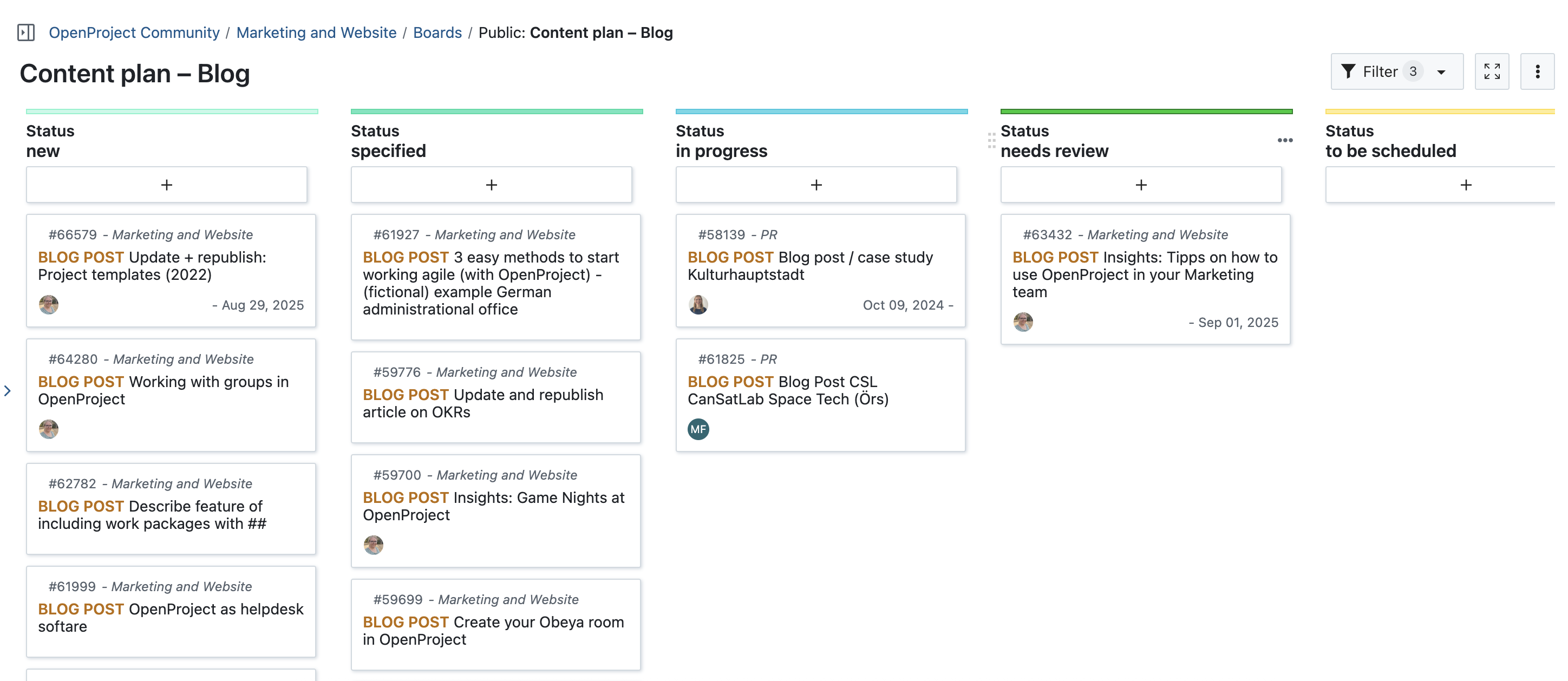
  •  

Document and print meetings: Tasks, outcomes and minutes — all in one software

Every project involves regular meetings: What’s the current status? Who’s responsible for which tasks? Especially in public institutions, it’s crucial to document decisions from meetings clearly and in a way that’s audit-proof. Fully transparent, both internally and externally.

With OpenProject, this is effortless: You can prepare meetings in just a few clicks, link tasks, and create a structured record with responsibilities, outcomes, and a list of participants.

Meeting over? Export and print your meeting directly from the system, formatted as a clear PDF. This way, you have all decisions and responsibilities in black and white — ready for files, audits, or inquiries from citizens.

Document decisions

What’s the core of almost any meeting? Bringing together different perspectives and making decisions. In reality, this often looks quite different. Meetings run over time, participants aren’t sure why they’re there, and in the end, everyone is just as confused as when they started.

Your team needs meetings that are transparent and straightforward from start to finish. The right software guides you through every step and provides clear structure. Learn more about all the features in OpenProject’s meeting module: Recurring or one-time meetings, linking work packages, calendar integration, and much more.

OpenProject meeting in status closed, with agenda items and outcomes

How can I record decisions directly during a meeting?

With OpenProject, you record decisions right as the meeting happens. Nothing gets lost, and all participants – and those who couldn’t join – immediately see what was agreed.

To do this, set the meeting status to “In Progress.” This automatically activates a + Outcome button under each agenda item. Any participant can click it to log decisions on the spot.

You can also rearrange agenda items by drag & drop at any time. If certain points turn out to be irrelevant, simply

  • move them to the backlog at the end,
  • delete them,
  • or in a recurring meeting series, push them to the next meeting.

The result is a clear, traceable record that captures your decisions exactly as they were made.

Assign responsibilities

For decisions to be implemented, responsibilities must be crystal clear. In OpenProject, you define right in the meeting who is responsible for which agenda item.

This also avoids those awkward moments when no one starts the conversation because no one feels responsible — instead, everyone can see the name and avatar of the person in charge next to each agenda point.

Detailed view of two agenda items in an OpenProject Meeting, showing a duration and an assignee with name and avatar

This cuts down on questions and duplicated coordination. Projects run more smoothly because everyone knows their area of responsibility and the next steps are clear.

How do I assign responsibilities directly in a meeting?

OpenProject’s meeting module offers two ways to add agenda items and define responsibilities:

  1. You can add an existing work package (like a task or ticket), which typically already has an assigned person.

  2. You can create a new agenda item and note the responsible person directly in the text. Of course, you can also link multiple work packages within one item.

In both cases, you can add a responsible person in the top right of the agenda point. You decide whether this person is only presenting the topic or also in charge of following up afterward.

Detailed view of an OpenProject meeting with dropdown menu for an agenda item

Everything in the minutes — your single source of truth

All items from the meeting automatically come together in a structured record. This is your single, reliable source of truth — without scattered Excel sheets or Word files. With OpenProject, you keep working on tasks and documenting them exactly when they’re discussed. No more memory-based notes that are incomplete or vague.

What does the meeting record include automatically?

Your OpenProject meeting brings it all together: agenda, outcomes, tasks, documents, responsibilities, participants, plus date and time. Everything in one place, available to everyone involved.

You keep your familiar processes while gaining efficiency: build the minutes directly from your agenda and simply add outcomes. This saves time and creates a true reflection of your meeting.

Why is a central record so important?

With a single, always up-to-date document, you establish a clear single source of truth. No more outdated versions buried in emails or spreadsheets.

Even those who couldn’t attend the meeting can easily see what was discussed and decided. Often, one click on the linked work package is enough to view all details and the entire communication thread.

What other tools do I need for my meetings?

OpenProject covers almost everything — from the agenda to tasks to the final minutes. The only additional tool you need is software for the actual video or phone conference if you’re meeting online or in a hybrid setting. Ideally, you’ll use one where you can share your screen and display the meeting in OpenProject at the same time.

Tip

We’re passionate about open source — that’s why our own team uses the open source virtual classroom software BigBlueButton for video meetings. It pairs perfectly with OpenProject.

How does the calendar feature help?

The automatically generated invitation email contains an ICS file. This lets participants add the meeting to their personal calendar with a single click — whether they use Outlook, Thunderbird, or any other tool with iCal support.

Alternatively, you can download the appointment directly from within the meeting to add it to your calendar manually. Even though OpenProject includes its own calendar, we know that for many teams, the main calendar is where everything comes together. That’s why we make integration easy.

Black on white — export and print your minutes

When the meeting is done, you can export and print your minutes right away. This way, all decisions and responsibilities are clearly documented — black on white, audit-proof, and ready for your files.

PDF view of an OpenProject meeting - with cover sheet and all selected information

How do I print my meeting minutes?

Just a few clicks export the minutes as a PDF. You can choose whether to include

  • a list of participants (above the agenda),
  • a list of attachments (at the end),
  • backlog entries,
  • or outcomes.

You can also add a custom footer text. Click Download, and you’ll get a professionally formatted document, ready to print or archive digitally.

Why does this matter for records and audits?

A printed, audit-ready protocol is essential, especially in public institutions and organizations with strict requirements for written documentation. It lets you prove at any time who decided what and when.

Even though people are ready for digital processes, the requirements behind the scenes often still demand paper. And with OpenProject, you can provide it seamlessly.

Conclusion: Why OpenProject is especially valuable for meetings in public projects

With OpenProject, you permanently document decisions, tasks, and responsibilities — transparent, audit-ready, and accessible to everyone. This doesn’t just help you meet documentation requirements, but also makes your projects more organized and your teams collaborate more effectively.

In public institutions, it’s particularly important to document processes completely and be able to prove at any time who decided what. OpenProject makes this possible without media breaks, without scattered Excel sheets or Word files. Instead, you have one central platform that seamlessly connects planning, execution, and follow-up for your meetings.

This keeps your projects transparent and verifiable at all times. You can be confident that everyone is on the same page — from the first decision to the printed record that clearly documents every outcome.

Learn more about OpenProject for the public sector, including several case studies.

  •  

Strong open source Jira and Confluence alternative: OpenProject and XWiki join forces

We are delighted to announce our official partnership with XWiki. This adds another important milestone on our journey to establish a fully open, transparent, and data-sovereign ecosystem as a genuine open source alternative to proprietary tools such as Atlassian Confluence and Jira.

A shared vision for digital sovereignty

Both OpenProject and XWiki have always stood for open standards, transparency, and user control. At a time when data sovereignty and digital independence are becoming increasingly important, a strategic collaboration was the next logical step.

Our goal: Together, we want to offer organizations an integrated, open source alternative to Jira and Confluence, combining a solution for project management and knowledge management – and thus a powerful, privacy-friendly as well as cost-effective alternative to Atlassian tools.

“This partnership strengthens the open source ecosystem and marks an important step for organizations to move away from Atlassian — toward digital sovereignty and independence. We are delighted to have XWiki as an experienced and committed partner at our side that share the same vision and values to further advance open and sovereign software solutions.” – Niels Lindenthal, CEO, OpenProject GmbH

Screenshot of Niels Lindenthal from OpenProject and Ludovic Dubost from XWiki and CryptPad) Image: Niels Lindenthal (CEO OpenProject) and Ludovic Dubost (CEO XWiki and CryptPad) at the OSXP in Paris.

“Our partnership with OpenProject is a natural extension of a shared commitment to building open, sovereign digital infrastructure for Europe and beyond. At the same time, it’s a strong affirmation of our joint vision: delivering integrated, open source solutions that respect user freedom and data sovereignty. By combining our expertise, we’re creating a compelling alternative to Atlassian’s Jira and Confluence — one that puts control and transparency back into the hands of the user. It’s a step forward for open-source collaboration in Europe, and most importantly, it responds directly to what our customers have been asking for.” — Ludovic Dubost, CEO and Founder, XWiki SAS and CryptPad

OpenProject + XWiki = Open source stack for modern teams

XWiki is a powerful platform for collaborative knowledge management – ideal as a Confluence replacement. OpenProject offers comprehensive project planning, task management, and issue tracking – a strong alternative to Jira.

The combination of both solutions creates an open, modular stack that enables teams to collaborate efficiently without compromising on control, security, or usability.

Screenshot benefits of open source alternative jira and confluence atlassian) Image: Overview of benefits of the open source alternative for Jira (OpenProject) and Confluence (XWiki)

Concrete benefits for our users for switching from Jira and Confluence

This partnership is not just a symbolic alliance – it also brings practical benefits:

  • Integration in development: We are actively working on an integration between OpenProject and XWiki to enable a seamless user experience.
  • Joined sales & support: Both partners will be able to offer each other’s services and support packages.
  • Expanded ecosystem: The connection to other open source providers such as Nextcloud will also be further strengthened by this cooperation.
  • Both OpenProject and XWiki are part of the openDesk: Therefore both open source applications can also be jointly procured via ZenDiS as part of the openDesk bundle.

Part of the openDesk initiative

Our partnership is part of larger European initiatives such as openDesk, a modular open source suite for public administration and organizations. Under the leadership of the Center for Digital Sovereignty (ZenDiS), leading open source companies such as OpenProject and XWiki are working closely together here alongside many other well-established open source vendors from Germany and Europe.

For a sovereign digital future

With this partnership, we are sending a strong signal for the open source movement in Europe and worldwide. Together with XWiki, we are providing organizations with tools that enable teams to work independently, securely, and collaboratively without vendor lock-in and without compromises on their data sovereignty.

  •  

Hacking Borders: Our participation in Hack Days 2025 in Paris

Last month, we wrote a blog post about our participation in Hack Days 2025, a hackathon organized by the digital directorate of the French government, DINUM (direction interministérielle du numérique). In this blog post, we’ll tell you what we did, what we learnt and what all this means for digital sovereignty.

The event

Hack Days brought together over 300 talented developers, designers and innovators from 17 countries to collaborate on open source projects, notably DINUM’s own suite of applications for the public sector in France, called LaSuite. The event also aimed at strengthening European digital sovereignty by exploring the potential for cross-border collaboration.

The 53 different teams worked together over the course of three days to design, develop and pitch their projects to juries at the lovely Jourdan campus of the historic École normale supérieur (ENS).

Our own team consisted of Wieland Lindenthal, Dominic Bräunlein, Bruno Pagno, Eric Schubert and Parimal Satyal.

Our pitch

Before we explain the project in more detail below, here’s a clip of our five-minute pitch:

In the first round of the hackathon, the teams made a 3-minute pitch privately to the juries for a chance to be selected in the top 10 projects. OpenProject was luckily one of those ten, and we were then invited to make our 5-minute public pitch (above) the next day.

The jury consisted of Stéphanie Schaer, director of DINUM; Markus Richter, State Secretary at the Federal Ministry for Digital and State Modernization in Germany; Boris Van Hoytema, Quartermaster of the Open Source Program Office within the Ministry of the Interior in the Netherlands; Jean-Baptiste Kempf, the founder of VLC; and Valérie Dagand, managing director of Numeum.

We were very happy to be part of the top three winners, coming in second place.

All the winners on stage after the awards were handed out

We would like to congratulate all the winners of the hackathon:

Our project

For OpenProject, our goal in the hackathon was to build a deep integration with Docs, a collaborative note-taking app that’s part of DINUM’s LaSuite.

Note

Docs also recently joined the openDesk ecosystem initiated by ZenDiS in Germany. OpenDesk brings together powerful open source tools like OpenProject to offer a digital workplace for public institutions. The collaboration between DINUM and ZenDiS around Docs and OpenProject is an example of cross-border cooperation in digital sovereignty.

Docs is built on BlockNote, an open source rich text editor built on the concept of ‘blocks’. A block can be anything from simple text, a heading, a quote, an image or more complex elements like embedded media, file attachments or custom plugins.

We wanted to harness this extensibility to create a two-way integration such that users could seamlessly go from editing a draft text document in Docs to extracting tasks and text to OpenProject, where they can exist and evolve in a project context.

Such an integration made a lot of sense to us to harness what each tool does best. Docs is a powerful medium to jot down ideas and collaborate with other people, but plain text is not actionable. You cannot easily set an assignee, assign dates, track status, add comments, attach files or integrate with GitHub; all that, however, is very simple to do in OpenProject.

Our integration makes it possible to:

  • Write a bullet list in plain text and easily turn it into a set of tasks in OpenProject.
  • Select text from any part of a document and turn it into a user story or work package in OpenProject. We even implemented a basic LLM layer to convert the text to fit a predefined format.
  • Maintain a ‘live’ link between objects: a change in Docs is reflected near-instantly in OpenProject and vice-versa. This makes it possible to avoid content duplication and have a single source of truth.

Enterprise-grade integration

We used open, enterprise-grade standards like OpenID connect to support single sign-on. This is because we believe that ensuring users can be logged in with the same credentials on OpenProject and on Docs is key to making the user experience seamless and increasing user adoption of both tools.

We also wanted to build the integration in as generic a manner as possible. Because Docs is built with BlockNote, we decided to approach the integration as an OpenProject block within the editor itself, which will make it possible for any other application using BlockNote to also integrate with OpenProject. This was important to use because we believe that lowering the cost of integration between open source tools is key to European digital sovereignty.

What we learnt

We were very impressed with the turnout, the excitement around open source, the quality of the teams and the projects and the organization of such an event. Some learnings we came back with:

  • Broad interest in sovereign open source software: The event highlighted a significant interest across Europe in developing sovereign open source software. The turnout and enthusiasm were clear indicators that dependence on American big tech is increasingly a concern and that there’s value in working together with other European open source projects.

  • Diverse strategies across Europe: We observed that different countries have varying strategies for supporting open source development. LaSuite in France has decided, for example, to create and maintain their own forks of open source software, with a consistent UI and UX. Here in Germany, ZenDiS’s approach is to fund the development and integration of existing software that’s served within a unified bundle called openDesk. There is increasing interest in using parts of LaSuite in the Netherlands, too.

  • Power of integrations: The hackathon highlighted the value of integrations in making tools work together seamlessly. These integrations not only enhance user experience by reducing friction when trying to use multiple open source software but can also lead to higher adoption and user satisfaction.

What next?

We were thrilled to take part in the hackathon and were impressed with both what the other teams developed and how well organized it was. We would like to once again thank the LaSuite team for organizing such an inspirational event and for bringing so many like-minded people and companies together! We truly believe that open source is more powerful when we all work together.

We were also pleasantly surprised by the interest in our Docs–OpenProject integration.

What we worked on in the hackathon was of course an incomplete proof of concept, but we certainly don’t expect to leave things at that. We are currently exploring ways to integrate BlockNote more generically with OpenProject and will also evaluate where we can take our integration with Docs.

You will surely hear more more about this from us very soon.

  •  

The best open source alternative to Monday.com

If you are looking for a project management software and compare different solutions, you will eventually stumble upon Monday.com. We took a closer look at the software and compared it with the free open source software OpenProject to provide a comprehensive overview.

Monday.com was founded in February 2012 as daPulse. After various previous big funding rounds, the company raised another $150 million in Series D round, becoming Israel’s New Top Unicorn. Monday.com offers a suite of tools for process management, project management, productivity, and team management. The platform’s features are diverse and continually evolving. But what about data sovereignty?!

OpenProject on the other hand is free and open source software developed by an active community. Originating as a fork of the open source project management software Redmine in 2011 as an open source project, OpenProject emphasizes data security and privacy. The core development team created OpenProject to address these concerns, licensing it under GNU GPL V3 to ensure software freedom. The software code is published on GitHub. OpenProject is continuously developed and actively maintained by an international community.

Let’s talk about data sovereignty

Monday.com is a cloud-based solution available exclusively as Software-as-a-Service (SaaS). As a company primarily operating in the United States, the handling of your data is not entirely transparent. Being proprietary software, users are subject to Monday.com’s terms and decisions, creating potential vendor lock-in issues. Here are some excerpts from Monday.com’s terms of service regarding YOUR CUSTOMER DATA:

  • “[…]Subject to these Terms, Customer grants us a worldwide, royalty-free, limited license to access, use, process, copy, distribute, perform, export, and display the Customer Data… This license also includes the right to make modifications and derivative works.[…]” [1]

Additionally, Monday.com’s data policies state:

  • Data Location:”[…]We and our authorized Service Providers (defined below) maintain, store and process personal data in the United States (US), Europe, Israel, Australia, Guatemala, the Philippines, Brazil, Japan, Singapore, the United Kingdom (UK), and other locations[…]”[2]

  • Data Sharing: “[…]In exceptional circumstances, we may disclose or allow government and law enforcement officials access to your Personal Data.[…]” [2]

What constitutes exceptional circumstances? The ambiguity around terms like “exceptional circumstances” raises real concerns about data privacy.

OpenProject, being open source project management software, can be installed on-premises, providing full control of your data. As an open source software the software code is published on GitHub, being openly monitored by the Community. With a free software, you have the flexibility to use and modify it as needed. The Cloud version is hosted by OpenProject on servers in the European Union, compliant with GDPR and German data privacy and security regulations. For ultimate data sovereignty, you can opt for the on-premises version, maintaining full control within your infrastructure.

Feature comparison

Both Monday.com and OpenProject offer robust collaboration features to meet your project management needs. Monday.com is often praised for its user-friendly design and intuitive interface. However, many of its functionalities rely on third-party integrations, which can introduce dependencies on external updates.

In conclusion, Monday.com is a powerful, web-based project management tool known for its usability and design. However, if data security and sovereignty are top priorities, OpenProject stands out as the preferred choice. As a free and open-source software with a comprehensive feature set, OpenProject ensures greater control over your data.

For a detailed comparison, visit this page to see why OpenProject is the best open source alternative for Monday.com.

[1] https://monday.com/l/legal/tos/

[2] https://monday.com/terms/privacy

  •  

OpenProject 16.1: Structure your project life cycle with phases and phase gates

OpenProject 16.1 has been released and this new version introduces many new features and improvements. We look forward to hearing your thoughts and feedback on the latest updates. Please take a few minutes to learn what changes for you. We will summarize the most important changes in this blog article and, as always, please see our release notes that contain all changes, features and bug fixes.

In this blog article, we will focus on the updates on project portfolio management with the new project phases and phase gates. We will also briefly summarize some more important features. Here is a quick navigation to all feature descriptions:

Create a project life cycle for your project portfolio

With OpenProject 16.1, we’re introducing a key milestone in structured portfolio planning. The new project life cycle feature lets you define distinct phases for each project and make informed go or no-go decisions at specific phase gates. It’s a major step toward managing not just individual projects but entire portfolios with greater clarity and control.

Projects don’t always move in a straight line. Priorities change. Resources shift. Instead of treating phase changes as automatic progress, you can now define phase gates as decision points. These gates mark the end of one phase or the start of the next, depending on your workflow. Think of it like a milestone, but with real decision-making logic behind it.

This approach is closely aligned with PM², the project management methodology developed by the European Commission and widely adopted in the public sector. Project gates can be used to validate scope, check alignment, or reassess priorities. And now, they’re built right into OpenProject.

How to work with project phases in OpenProject

Let’s say you’re on a steering committee and need to decide whether a project should move from Planning to Executing. You can now filter the project list for projects approaching that specific gate and save it as a separate view if you like:

OpenProject project list with a view to display different phases, filtered for project phase gate: Ready for Executing between 2025-07-01 to 2025-12-31

When you start a new project, you first have to enable the phases under Project settings → Project life cycle. If you navigate to the project overview page next, you’ll see a new column on the right side called Project life cycle. Click on any phase to open the calendar and choose the dates. These will then be visible directly on the overview page:

Project overview page with the project life cycle displayed in the right column

Tip

To help you plan ahead, OpenProject automatically suggests a fixed start date for the next phase based on the one before. For example, if you set the Initiating phase from January 1 to January 31, the Planning phase will automatically start on February 1. If you shift an earlier phase, all following ones will be updated accordingly.

Of course, it makes sense to assign work packages to project phases so you can easily track what needs to be done in each step. Please note that in order to display a new attribute on your work packages, you have to adjust the type settings in the administration first. For example, you could add the project phase to the details section for the work package type Task:

OpenProject administration for work package type Task, the Project phase highlighted under the Details section

Once that’s done, you can assign a project phase to each work package and filter or sort your tables accordingly:

Work package table filtered and sorted ascending by project phase

You can also group your work packages by the project phase, for a more elaborate view:

Work package table grouped by project phase

Working with phases in a project life cycle helps keep your team aligned and your planning process transparent, especially when managing multiple projects at once.

See our system admin guide to learn all about the project life cycle in OpenProject.

Managing phases and setting up new ones (Enterprise add-on)

While working with the default phases that are used in the PM² framework is a Community feature, setting up new custom phases is an Enterprise add-on available in the Premium and Corporate plan. With this feature, you decide how many phases your projects go through, what they are called, and in which order they appear.

If the Enterprise add-on is enabled, this setting is found in the global administration under Projects → Project life cycle.

You can also decide whether to include phase gates between the phases and whether these gates are used for filtering and reporting. For example, you might want to track decision points like “Go for pilot rollout” or “Ready for audit” in complex project environments.

Export meetings in PDF format

You can now export your meeting agendas and outcomes as PDF documents. This is perfect for archiving or sharing information from the meeting. The export includes all agenda items, descriptions, outcomes, and related metadata in a clean, printable format.

See our user guide to learn more about meeting management with OpenProject.

Overlay of Export PDF options for OpenProject meetings

Set smart default options for reminders

When setting a reminder for a work package, you can now choose from smart default options like “Tomorrow” or “In 3 days”. These quick-select choices make it easier to stay on top of your tasks without manual date picking. If you do not use this feature yet, now would be the perfect time to give it a try!

Learn more about work package reminders in our user guide.

Dropdown menu on a work package when clicking on the reminder icon, with options to quickly choose a date to be reminded

Use negative lag for work package dates

Working with tight schedules? You can now define a negative lag between related work packages. This means a successor can start before the predecessor ends. Negative lag is particularly useful for overlapping tasks or time-critical parallel planning.

Please note that only working days are taken into account. Also, a negative lag can be counterintuitive, as a lag of 0 schedules the successor one day after the predecessor’s finish date – and so on.

See our user guide to learn all about work package relations in OpenProject.

Overlay of editing a successor (after) with a lag of -3 days

Display hierarchy trees for hierarchy custom fields (Enterprise add-on)

If you’re using hierarchy custom fields (Enterprise add-on), you can now view and expand the entire hierarchy tree directly from the work package view. This makes it easier to understand parent-child relations at a glance.

Learn more about custom fields of type hierarchy in our system admin guide.

Example of a hierarchy custom field with the new visualization, the hierarchical tree

Improved accessibility for the date picker with ARIA live regions

The date picker component has been updated to improve screen reader support and comply with accessibility standards. ARIA live regions now announce focused dates, helping users with assistive technology navigate date fields more easily.

Learn more about these accessibility improvements in our release notes for version 16.1.

OpenProject 16.1: Migration, installation, updates and support

Follow the upgrade guide for the packaged installation or Docker installation to update your OpenProject installation to OpenProject 16.1. We update your hosted OpenProject environments (Enterprise cloud) today, June 18, 2025.

You will find more information about all new features and changes in our Release notes or in the OpenProject Documentation.

If you need support, you can post your questions in the Community Forum, or if you are eligible for Enterprise support, please contact us and we are happy to support you personally.

Credits

A very special thank you goes to City of Cologne, Deutsche Bahn and ZenDiS for sponsoring released or upcoming features. Your support, alongside the efforts of our amazing Community, helps drive these innovations. Also a big thanks to our Community members for reporting bugs and helping us identify and provide fixes. Special thanks for reporting and finding bugs go to Cameron Dutro and Maxim Béliveau.

Last but not least, we are very grateful for our very engaged translation contributors on Crowdin, who translated quite a few OpenProject strings! This release we would like to particularly thank the following users:

  • BigSeung, for a great number of translations into Korean.
  • rmiyata, for a great number of translations into Japanese.
  • William, for a great number of translations into Chinese Traditional.

Would you like to help out with translations yourself? Then take a look at our translation guide and find out exactly how you can contribute. It is very much appreciated!

As always, we welcome any feedback on this release. 💙
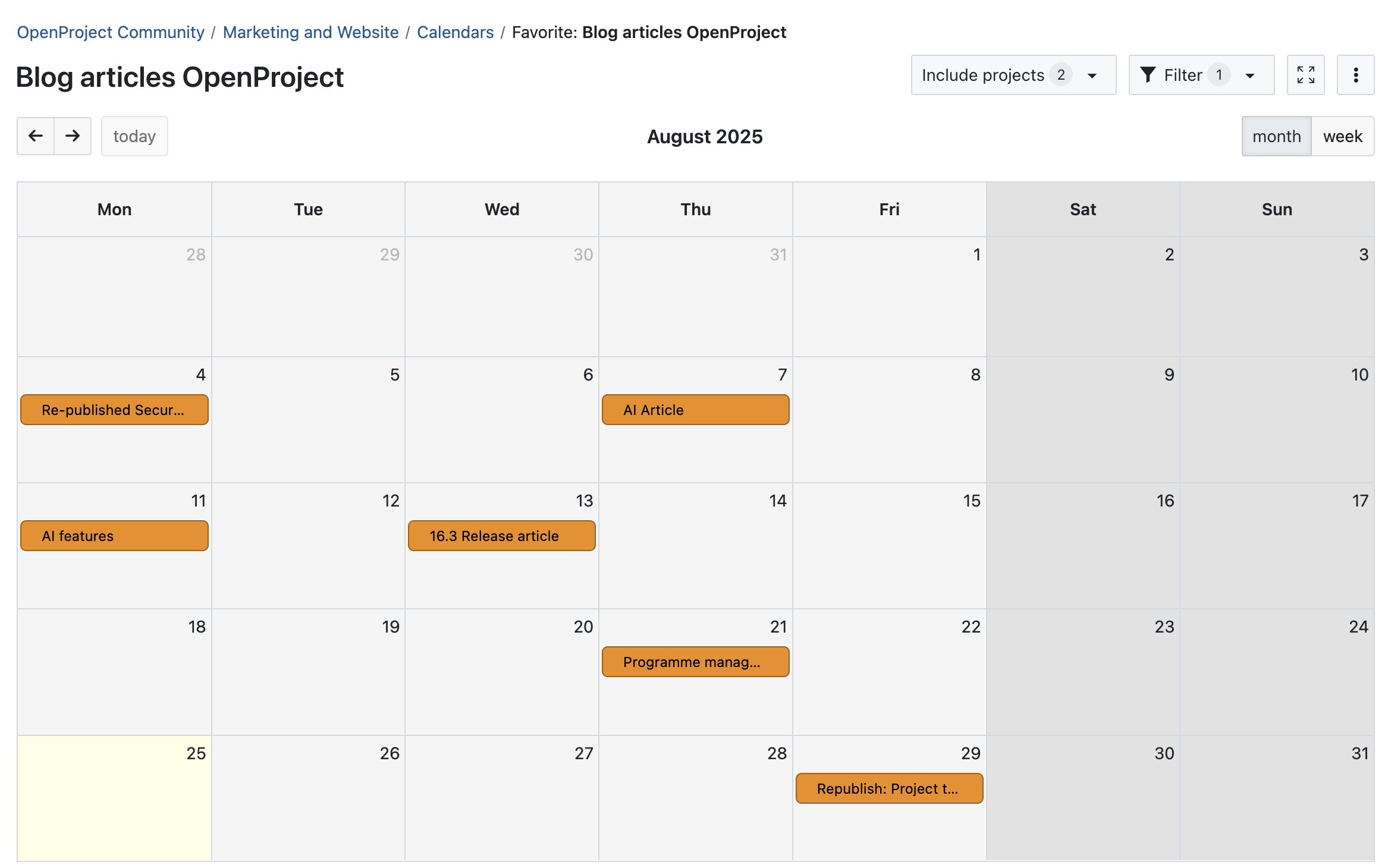
  •  

Ticket management with OpenProject

If you are already using OpenProject with your team to manage projects, you might want to explore additional use cases. One of them is ticket tracking: a flexible way to manage internal requests, service tasks, or user support alongside your existing workflows.

While OpenProject is primarily a project and task management tool, we are planning to release additional features in 2025 that will further support using it as a lightweight helpdesk solution.

Creating tickets

In OpenProject, you use work packages as tickets. All team members can create tickets and fill in the relevant information. You can define a dedicated work package type such as ‘Ticket’ or ‘Request’ to structure this.

You could also use the option to automatically create tickets from incoming emails. This is useful when external requests or issues are submitted via email — for example, when OpenProject is used as a lightweight helpdesk tool.

Tip

Later this year, we plan to develop a feature to support you in using OpenProject as a helpdesk tool even more.

Ticket details

In order to capture all relevant information, you have different options to customize your work packages. One is to customize your work package types. If you like, you could create a work package type TICKET. Or you use the work package type TASK for tickets and add additional types such as sales opportunity to track those differently. Make sure that your work package forms are set up with fields for information that is required. Customize the work package forms to your needs. Remove any fields that are irrelevant, e.g. version. And you could add custom fields to your work packages, such as ticket type to indicate if it was coming in call or email or from your website.

Screenshot of a work package in OpenProject, type ticket

Automate your ticket workflows

You can also define workflows that control which status changes are allowed and by whom — for example, to separate internal review from external resolution. Learn more in our article on how to use status transitions for custom workflows.

Tracking tickets

The work package table will show you all tickets with the details that you would like to be displayed. Use the comprehensive filter option to sort the ticket list as needed, e.g. by priority, status, assignee or type of ticket / work package.

work package table with ticket title and selected attributes

Set filters in your ticket list, choose the attributes shown and save it to have it always at hand with a single click.

filters for the work package table

Tip: You can also use attribute highlighting (Enterprise add-on) to visually prioritize certain ticket types or statuses. For example, highlight priorities with different background colors. Read how to visually prioritize tickets in our article on Attribute highlighting

Attribute highlighting in OpenProject: Different colors for different priorities

Communicating about tickets

In the detail view of your work package, you can add comments to your ticket. If you mention team members with @name, they will receive a notification and reply accordingly.

work package detail view with comments from two team members

Set reminders for a specific date and time, or activate date alerts to automatically notify team members when a ticket is due or needs attention (Enterprise add-on). Learn how to configure reminders and date alerts.

Another great new feature that helps you communicating on tickets is using internal comments (Enterprise add-on): For internal discussions that should not be visible to external collaborators (e.g. when a work package is shared). These are visible only to specific roles. Read more in our article on internal comments.

Kanban board to work on tickets

If you prefer a board view to work on your tickets and have a better, visual overview, you can use the agile boards in OpenProject. Choose a status board to know how many tickets are still open or check on your team by viewing the assignee board and how many tickets each team member is working on.

status board with tickets new in progress and closed

Ticket report

To get a quick overview of all tickets, the project overview can provide information about how many tickets are closed and how many are still open.

overview with graphs showing open and closed tickets tickets by assignee and by ticket type

This is how you could manage tickets in OpenProject on a small scale which could be an additional benefit to your project management in OpenProject.


This is how you could manage tickets in OpenProject on a small or medium scale – a flexible and transparent solution that complements classic project management workflows.

Want to see how public administrations use OpenProject for internal ticket management? Read our article on digital ticket management in municipalities.

  •  

OpenProject recognized as top project management software in 2026 by Gartner Digital Markets

OpenProject among top products in 2026

We are excited to share that OpenProject has once again been recognized as a top-tier project management solution in 2026 by Gartner Digital Markets.

Building on our achievements from previous years, OpenProject earned an expanded set of distinctions in 2026. These new badges highlight our continued focus on strong functionality, ease of use, and high-quality customer support.

Gartner Digital Markets is a Gartner business unit that includes Capterra, GetApp, and Software Advice. It helps software buyers make confident decisions through verified user reviews, research, and insights.

OpenProject awards in 2026

Software Advice recognitions

In 2026, OpenProject received multiple Software Advice badges across core product categories:

Front Runners in Project management and Time tracking categories

Best Customer Support and Most Recommended across multiple categories in 2026:

Task management, Team management, Project management, Small business project management, Marketing project management, Online project management, Project management software for architects, Nonprofit project management, Strategic planning, Project portfolio management.

Capterra recognition

OpenProject was also recognized by Capterra in 2026 with the following distinctions:

Shortlist in Project management, Time tracking and Task management categories.

Best Value and Best Ease of Use in multiples categories: Construction management, Project management, Project planning, Time tracking, Team management, Task management, Project portfolio management, Nonprofit project management, Strategic planning.

Powered by real user feedback

These recognitions are based on user reviews from real teams using OpenProject in their day-to-day work. We’re proud to see our focus on reliable project delivery, clear collaboration, and strong support reflected in the feedback.

Thank you ❤️

A big thank you to everyone who shared a review and helped us grow. Your input helps us prioritize what matters most and keep improving OpenProject.

  •  

Accessibility at OpenProject: real progress, real impact

Do you know why we forked Redmine back in 2012? The reason was accessibility. At the time, Deutsche Telekom hired us to remove various barriers in Redmine. When the Redmine maintainers showed no interest in reviewing our patches, we made the pivotal decision to fork the project. This allowed us to tackle the issue at its root. And it’s absolutely understandable that the Redmine maintainers, working in their free time, didn’t want to deal with ARIA labels and contrast ratios — there are simply more exciting features on the roadmap.

At OpenProject, we believe that everyone should have access to powerful project management tools, regardless of physical ability. Accessibility is not a checkbox for us. It is a core principle and a constant part of our product development.

OpenProject is accessible to a very large extent. Over the past years, we have invested heavily in making OpenProject more accessible and we have made great progress. With each release, we bring improvements with regard to accessibility. Our goal is clear. We want to be among the leading software providers when it comes to accessibility in open source project management.

Over the next couple of weeks we plan a series of articles to share our lessons learned. There have already been a great number of achievements with regard to accessibility and a list of prioritized topics to be addressed:

Why accessibility matters to me

This commitment is not just professional. It is also personal. After finishing school, I completed my civil service by assisting a high school student in his final year. He had a severe physical disability caused by illness. He could no longer walk and could barely operate a mouse. Working with him gave me a deep and lasting understanding of how much accessibility in technology can shape participation and independence.

This experience still resonates with me today and influences how we approach our work at OpenProject.

We have published an official Accessibility Statement on our website that reflects our ongoing commitment.

Building an accessible design system for OpenProject

In 2023, we made a key decision. We would build every new interface in OpenProject using an accessible design system. We chose GitHub Primer as the foundation. It provides robust and accessible core components, addressing crucial topics like color contrast and screen reader compatibility.

We wrote about our decision and process in more detail in this blog article.

A dedicated team of designers and developers is continuously expanding our internal design system based on Primer. These components are reusable across the application, helping us ensure consistency and accessibility everywhere.

Every new view in OpenProject is now developed using this system.

Accessibility is complex and costly

Building accessible software is difficult. It requires deep technical knowledge, specialized design skills, and constant testing. It is also expensive. But it is worth it.

Modern collaborative platforms must support rich interactions like drag and drop or visual timelines. These features are helpful for many users, but they are a challenge for people who rely on screen readers. We work hard to create strong and usable alternatives.

A good example of our commitment is the introduction of the High Contrast Mode. This feature allows users with limited vision or visual impairments to work with OpenProject in a color scheme optimized for clarity and contrast. It improves legibility and reduces eye strain, especially in long working sessions.

To prevent regressions, we run automated accessibility tests with every build. These tests help us detect and fix issues early, long before they can affect our users.

We are grateful to be supported by ZenDiS, who help us with both funding and accessibility expertise. Their support enables us to move faster and with greater confidence.

Independent accessibility audit

The German Federal Ministry of the Interior commissioned an external test of OpenProject’s accessibility. The full test report can be found here (PDF).

We carefully reviewed the findings and resolved many of the reported issues. A list of the items we have already addressed is available in our community tracker.

We continue to improve. Our public roadmap lists further accessibility improvements that are planned for upcoming releases.

Working with the community

OpenProject is built with the support of other open source projects. We use libraries like CKEditor 5, FullCalendar, NG Select, and of course GitHub Primer. These libraries are essential to OpenProject. They save us thousands of hours of work and allow us to focus on what makes our platform unique.

We are happy to see that accessibility is becoming more important in these projects. When a component does not meet all our needs, we contribute back. One example is our work on a Tree View component for Primer, which we are developing to be fully accessible and available for the whole community.

What comes next?

We are not done. Accessibility is a continuous journey. We are proud of the progress we have made. And we are committed to going even further.

Thus, we are moving forward with every release. We eliminate barriers, improve features, and train our teams to consider accessibility from the very beginning and incorporate it in their decisions. That means during planning, design, development, and testing.

Here you find a list of the improvements planned for the next releases:

👩🏾‍🦯👨🏼‍🦯Accessibility - known problems and next steps

If you are interested in accessibility at OpenProject and would like to learn more about it, please feel welcome to contact us. Hearing about the real experiences of our users is very valuable to us.

  •  

For a sovereign digital Europe: OpenProject at HackDays Paris

How can open source tools from across Europe work better together? That’s the question OpenProject will explore at HackDays Paris, a hackathon organized by the French government’s DINUM, from June 2–4, 2025. We are thrilled to be a part of HackDays and aim to introduce task management features into the French-built Docs. Specifically, the OpenProject team plans to develop a first prototype exploring an integration with Docs.

Let’s take a look behind the scenes and explore how a shared vision for open source collaboration and Europe’s digital autonomy is becoming reality.

About HackDays Paris

HackDays is an open source hackathon organized by DINUM, the digital directorate of the French government. It brings together developers, UX/UI designers and contributors from across the public sector and open source ecosystem to work on shared goals, build working prototypes, and exchange ideas for a more sovereign digital future.

Under the slogan “We code, we build, we transform”, participants follow the mission to create open source apps aimed at strengthening European digital sovereignty. Specifically, it’s all about everyday collaborative tools. A category that OpenProject perfectly fits in.

Note

Docs, developed by DINUM, has recently joined the openDesk ecosystem initiated by ZenDiS in Germany. OpenDesk brings together powerful open source tools like OpenProject to form a digital workplace for public institutions. The collaboration between DINUM and ZenDiS around Docs and OpenProject is an example of cross-border cooperation in digital sovereignty. HackDays offers a valuable opportunity to strengthen that collaboration and build practical bridges between the two ecosystems.

Integrating task management into Docs with OpenProject

One of the most exciting developments in La suite numérique is the Docs app: a collaborative note-taking tool that supports real-time editing and rich content blocks. The software is built using BlockNote, a flexible JavaScript-based editor. Docs is already used in public institutions across France. Learn more about Docs here.

To demonstrate the potential of deeper collaboration, the OpenProject team at Paris will prototype an integration between OpenProject and Docs. The idea is simple: Users working in Docs should be able to create and link OpenProject work packages directly within the document. That way, notes and discussions can seamlessly turn into structured tasks, all while staying in the same interface.

Planned objectives for our participation at HackDays 2025:

  • Search and display OpenProject work packages in Docs.
  • Show dynamic metadata for linked work packages (e.g. type, status, dates).
  • Create OpenProject work packages directly from within Docs, possibly using selected content.

This prototype is only the beginning. Our broader goal is to show how open source tools — and the public institutions behind them — can work together more effectively.

United in mission and code: Open source software in Europe

Hackathons like HackDays are about more than prototypes. They’re about building relationships, exchanging knowledge, and strengthening the ecosystem of open source solutions in the public sector.

By bringing together tools like Docs and OpenProject, we’re not just solving immediate problems. We’re laying the foundation for a digital infrastructure that is open, modular, and aligned with public values – shaped by those who use it most. At OpenProject, we see a lot of potential in strengthening collaboration between projects supported by ZenDiS, DINUM, and other European partners. HackDays Paris is an important step in that direction.

With increasing pressure on governments to ensure transparency, interoperability, and control over their digital infrastructure, open source collaboration across borders is no longer optional but essential.

Be part of the progress

If you’re attending HackDays, come say hello — we’d love to meet you. If not, stay tuned for our wrap-up and the next steps for connecting OpenProject and Docs. You can follow the progress on GitHub and take a look at our team’s project here. Of course, you can visit the official website to see the detailed program.

We look forward to sharing what we’ve built at the end of HackDays. Open collaboration leads to better tools. Let’s code, build and transform them together.

  •  
❌