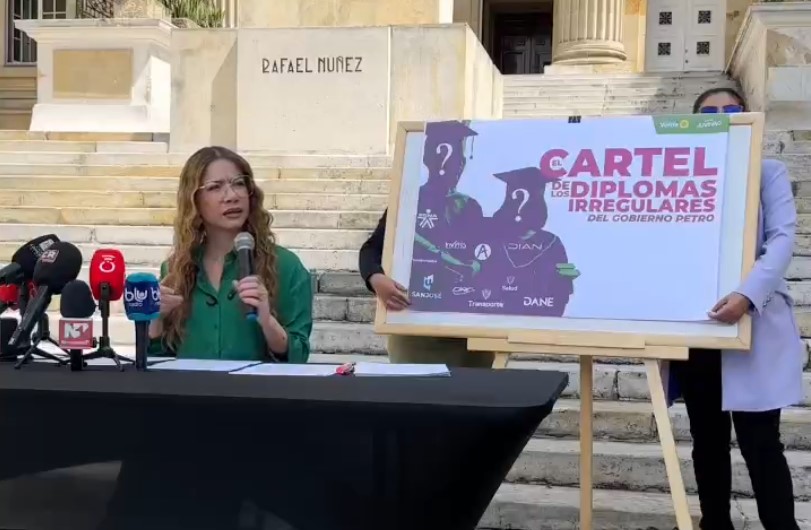
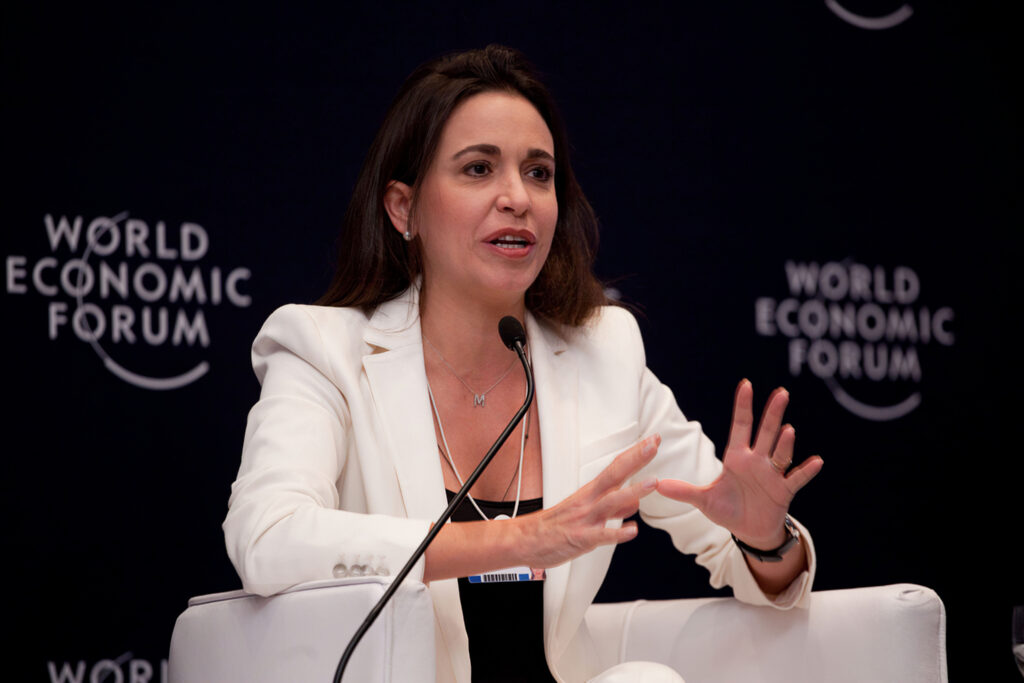
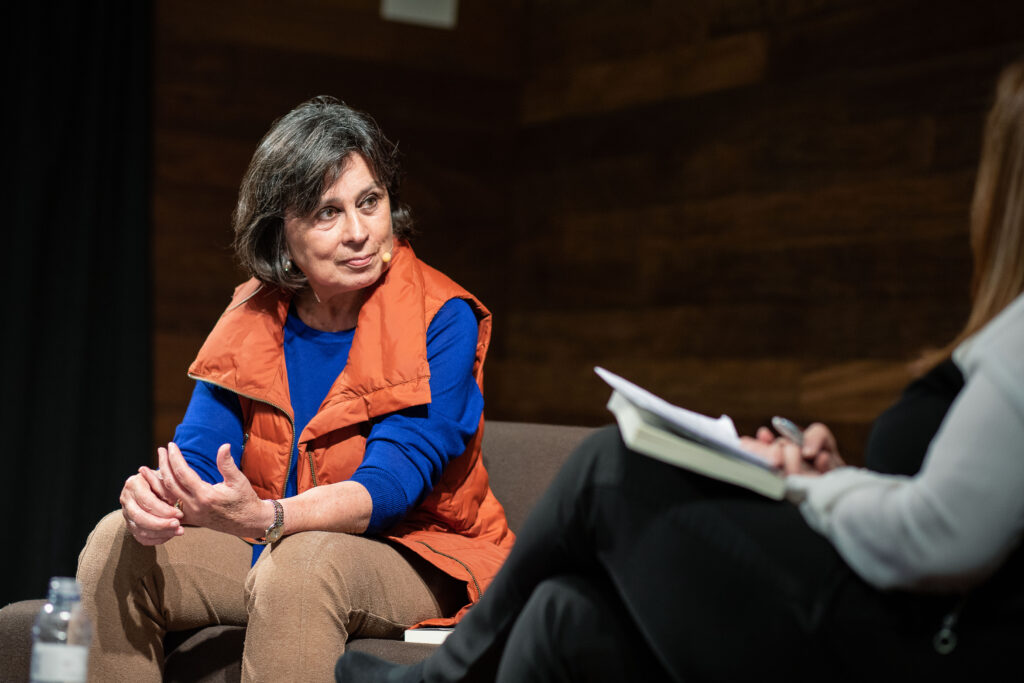
Representative Catherine Juvinoa at a press conference in Bogotá this week. Photo: X
A simmering spat over candidates for government posts boiled up this week with revelations that a Bogotá university was faking professional titles for workers in Petro’s administration.
According to congress members revealing the scandal, 24 public servants got top contracts using dodgy titles from Universidad Fundación San José, a mold-breaking higher education institute once famed for accessible courses, but now under scrutiny for selling degrees.
They also accused Petro and his education chiefs of dragging their feet in investigating the university for the suspected fraud case.
“Petro’s promises for education come to nothing,” said house representative Catherine Juvinao after she claimed to have identified 24 cases where officials and contractors in top government entities appeared to have been hired with diplomas from the Univerisity Foundation San José without all the tests.
One stand-out case was a government functionary who, according to university records, graduated in four quite different degrees – Business Administration, Industrial Engineering, Public Accounting and International Marketing – on the same day.
“This is one of the most serious cases. Who graduates with four degrees on the same day?,” the representative said in an interview with Semana magazine.
According to Juvinoa, the university handed out diplomas to students who had failed to complete the independent technical tests, known as PruebaPro, and in some cases had not studied at all.
Fake titles for plum jobs?
Although academic fraud has occured regularly in Colombia – and similar scandals have rocked previous governments – the investigations by Juvinao and her team are targeting an administration that promised to turn its back on corruption.
This week’s revelations followed last year’s political dogfight over the proposed appointment of 23-year-old Juliana Guerrero as vice-minister of youth. The candidate, who was close to both Petro and his education minister, was already embroiled in controversies over private use of police planes. Then in September she was found to have falsified her accounting qualifications at the university.
After public pressure the university rescinded the degree, and Guerrero herself told Caracol news that she intended to take the independent exams to regain her title in November.
Juliana Guerrero, the candidate accused of faking her qualifications. Photo: Interior Ministry
Further investigations revealed a bigger suspicion: that the Petro government was routinely using the university – with which it had contracts – to fudge academic requirements for candidates favoured for plum jobs.
This week Juvinao accused Petro government or running a “Cartel of Dodgy Diplomas” in cahoots with the San José university. “It’s bad news that our first left-wing government ended up being a monument to mediocrity, captured by an institution,” she said.
The state was “closing the door to those who studied hard by merit,” she said, while calling for a probe by the Attorney General’s office, adding that: “we have all the evidence to support any investigation”.
Political Attacks
For its part, the Ministry of Education announced this week it was investigating the University Foundation San José related to the case of Guerrero, Petro’s preferred candidate for the Ministry of Youth.
In the same communication, the ministry strongly denied it had any link to “illicit activities related to the expedition of academic titles”.
The Colombian president repeatedly defended Guerrero’s nomination for the post last year even after her degree was pulled by the university. Her only error was to claim her title before taking the final exam, he said, suggesting a storm in a teacup. The attacks were personal and political, he added.
“So, Juliana’s graduation exam, after completing her studies, was registered for in July and is scheduled for next November. Is that the summary of this scandal?” he wrote on X.
At first view Petro’s gesture seemed on target; young candidates, particularly female, get torrents of abuse in the rough-and-tumble of Colombian politics, often facing a public scrutiny less applied to old-school politicos.
But looking back that defence now seems misplaced: financial data revealed this month showed Guerrero had paid for her degree course long after receiving her diploma – almost unheard of in Colombia – while the university itself confirmed that she “never went to classes or presented exams nor complied with the accounting program”.
Doubling down
This week Petro doubled down on his defense of the University Foundation San José, claiming the accusations by the opposition unfairly focused on “poor single mothers” trying to get ahead.
“Private universities…allow these working women to study faster,” he said. “[Politicians] to gain votes shouldn’t destroy working women. I expect a public apology from these congresswomen to the working women of Colombia.”
To complicate the president’s narrative, referring to the Guerrero case, the university announced it had “detected and denounced a fraud” and had itself requested the attorney general’s office to investigate. It also promised to “stregthen internal audits” to prevent future cheating.
Representative Juvinao told Semanatold Semana magazine that the Guerrero case suggested corruption in the form of cash for qualifications, and was likely “the tip off an iceberg”.
“There is a deliberate strategy to fabricate qualifications to fit the needs of Petro’s government departments,” she said.
In a country where people struggle for further education – and value highly their hard-earned academic qualifications – what started as an online spat over a youth representative is becoming a scandal with much more scope.
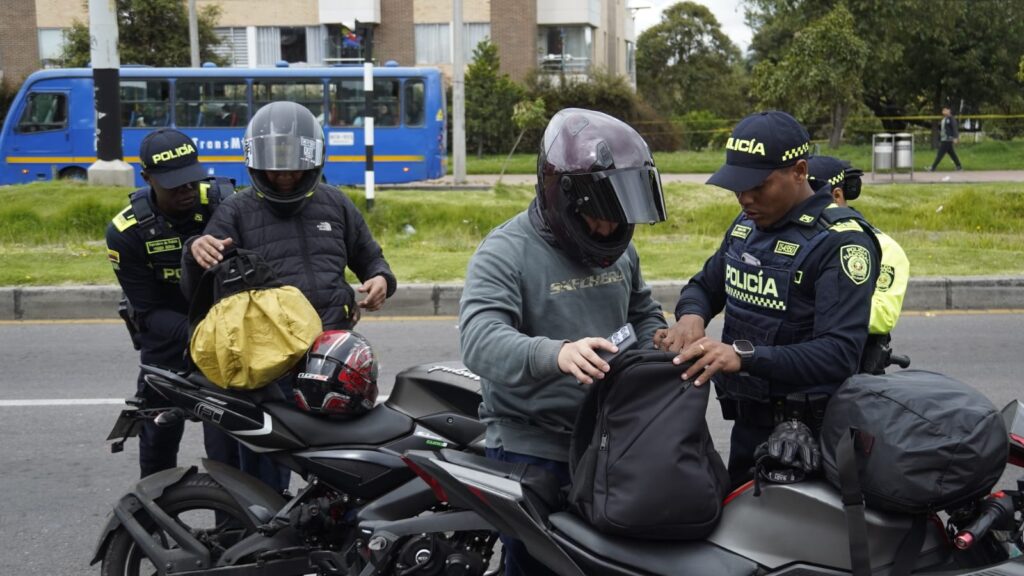
Police hunting suspected gang members on the streets of Bogotá. Photo Secretaría de Seguridad.
Bogotá’s mayor and security chiefs celebrated some positive results last week with stats showing an overall reduction of high-impact crimes in the city during 2025, with the murder rate dropping in the city even as violent deaths increased across Colombia.
“In Bogotá in 2025, there were fewer homicides robberies, fewer vehicle thefts, fewer motorcycle thefts, fewer cases of extortion, more drug seizures, more weapons seizures, and more arrests,” said Bogotá´s mayor Carlos Galán, presenting a security scorecard showing security shifts in the first two years of his administration.
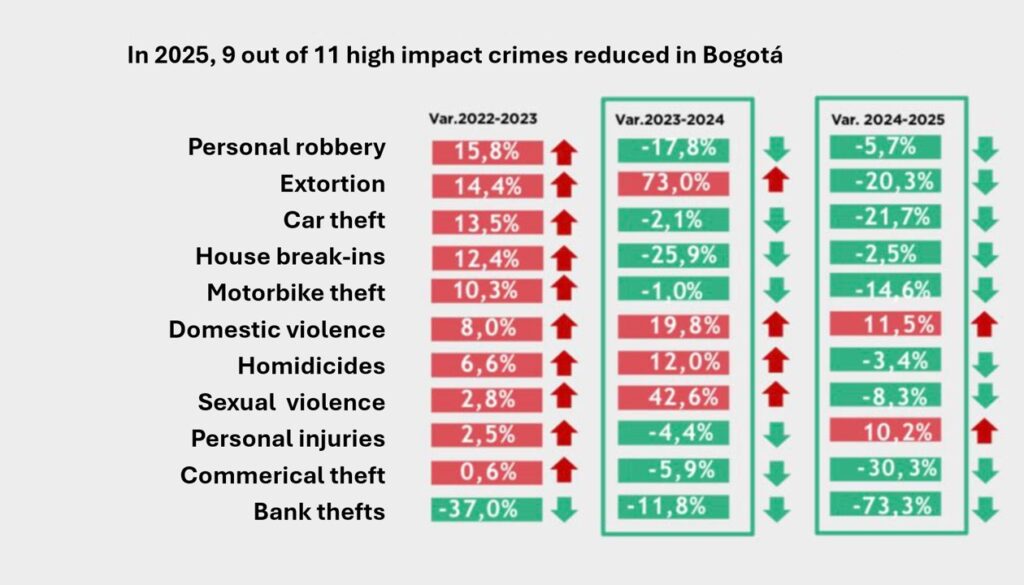
Some decreases were significant, such as extortion cases dropping by 20 per cent, stolen car cases by 22 per cent and commercial theft by 30 per cent. Others were less impressive: street robberies only reduced by 6 per cent, and cases of sexual violence by 8 per cent.
Official data presented by Bogotá’s mayor this week shows an overall reduction in high impact crime. Source: Secretaría de Seguridad
Homicides, perhaps the most significant metric, reduced last year by just 3.4%, with 1,165 killings recorded on the national police database compared to 1,214 in 2024. This gave Bogotá – with a population of around 8 million – a current homicide rate of 14.8 deaths per 100,000 of the population, according to the standard formula used to compare deaths across varying population sizes.
Limited success
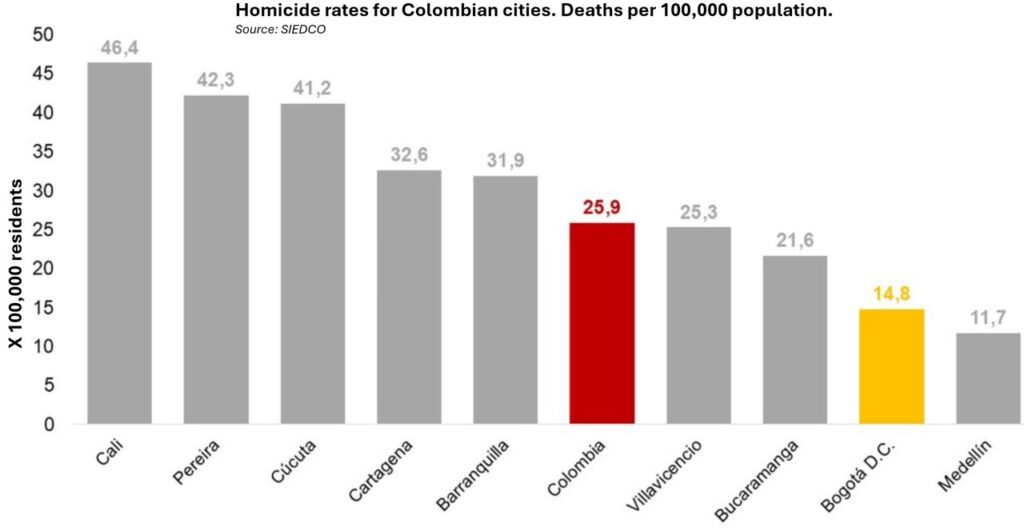
This was way short of Mayor Galán’s stated goal of 8 deaths per 100,000 during his four-year tenure, but a better result than the national one. At 14.8, Bogotá’s homicide rate was considerably lower than Colombia’s national figure of 25.9 deaths per 100,000 of the population, based the alarming total of 12,484 violent deaths reported nationwide – a two per cent increase on the previous year.
City security secretary César Restrepo also pointed out that Bogotá had proportionally less murders than other major cities such as Bucaramanga, Cartagena, Barranquilla, Pereira and Cali (see table below). Medellín, however, bested the capital with a reduced rate of 11.7 per 100,000.
Comparison of homicide rates across Colombia. Adapted fromSecretaría de Seguridad
And in our own comparison with cities worldwide, Bogotá’s homicide rate was lower than Washington D.C. (17 per 100,000) Baltimore (23 per 100,000) or New Orleans (33 per 100,000) but much higher than most European cities such as London (currently at 1 per 100,000) or Berlin (3 per 100,000).
Backdrop of violence
The challenges facing Bogotá in reducing violence against a national backdrop of increasing insecurity were highlighted in a recent study by think tank Centro de Paz y Seguridad Externadista which compared homicides rates between recent national governments.
The current Petro government reported 40,633 violent deaths during its first three years, an increase of 11 per cent over the same period for the Juan Manuel Santos government (2014 to 18) and seven per cent higher than during Ivan Duque’s tenure from 2018 to 2022.
The data pointed to a failure of the Petro’s Paz Total (‘Total Peace’) process which reduced military pressure on illegal armed groups allowing them to expand their range and illegal activities in the last three years, concluded the report.
“Although the government insists that the national conflict is de-escalating, the figures point to another scenario: homicidal violence remains at high levels,” said study leader Andrés González in December presenting the findings on YouTube.
González also pointed out that while most territorial battles took place in rural areas, the effects reflected in urban hubs where local crime groups – often with links to larger armed groups – used lethal violence in conflicts linked to extortion and micro trafficking.
Catch and release
Another challenge for Bogotá’s security was the low conviction rate for captured criminals, according to city police chief Giovanni Cristancho in an interview with El Tiempo. Out of 33,000 criminals arrested in the city in 2025, less than 10 per cent ended up in jail, he said.
Criminals showed little fear of the justice system, and many caught by the police were multiple offenders, said Christancho, with the police having to “catch the same person 20 times”.
Recycling criminals back on the streets was “outside the control of the district government”, security chief Restrepoalso told El Tiempo last week, but recognised it reflected badly on the city administration.
“Most citizens express their annoyance because criminals are either released or not convicted. As long as these other conditions remain unresolved, all the results we announce will continue to generate frustration among the public,” he said
This chimed with a common perception in Bogotá that even if the police are clamping down, the justice system as a whole is failing the city. Those concerns were echoed in a recent public survey by city watchdog Bogotá Como Vamos that found that a 62% of respondents perceived Bogotá as less secure, the highest figure recorded since 2008.
Catch and kill
Low conviction rates could explain the resurgence of vigilante justice being meted out by frustrated rolos in recent years, with groups of citizens organizing to capture and beat offenders, sometimes tying them to lampposts or parading them naked through neighborhood and posting videos on social media.
Barrio justice has long been a problem in Bogotá; a study from 2016, reported in The Bogotá Post, showed an average of one lynching death every three days over a 12 month period in the city.
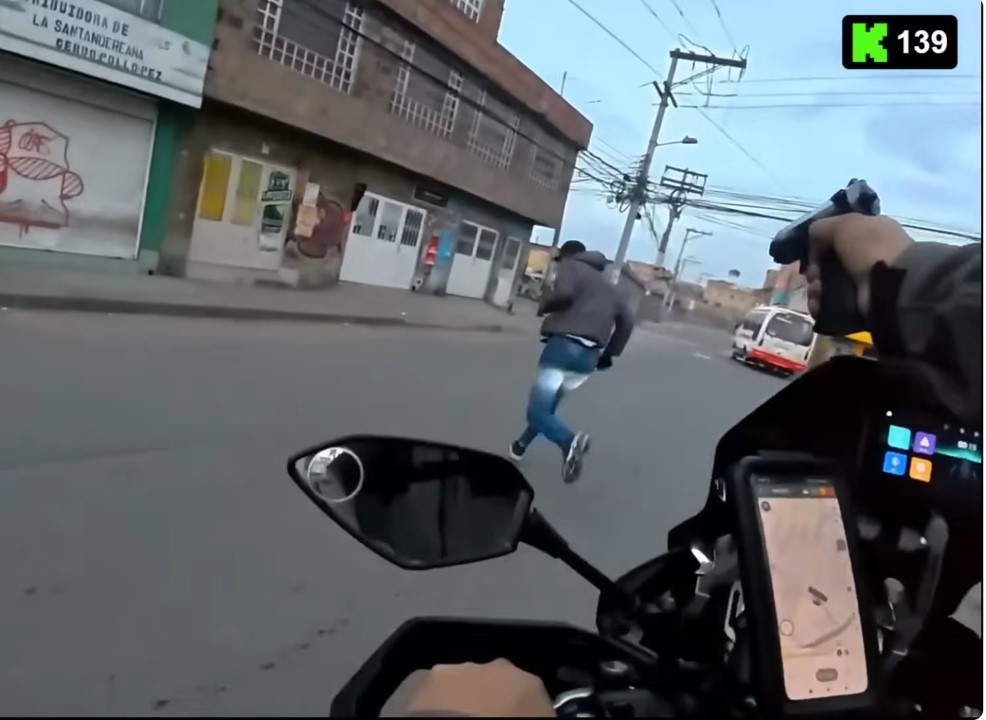
A more recent phenomenon in the city is the rise of fleets of armed private security guards mounted on motorbikes chasing down stolen vehicles.
Screenshot from Youtube video of private security guard opening fire on suspect car thief in downtown Bogotá. Vigilante firms are increasingly acting as law enforcement, often at risk to the public.
One company, Self Security GPS, uses satellite tracking and immobilizer devices to recover stolen vehicles, but also regularly posts alarming videos of their ‘commandos’ taking down car thieves, sometimes with dramatic shoot-outs on the street with passers-by diving for cover.
According to data from the mayor’s office, at the last count, there were 150,000 private security guards “supporting security in Bogotá” – far outnumbering the 17,500 uniformed police.
Increasingly though, frustration among everyday citizens has boiled over into drastic reactions to street crime. Such an attempt at instant justice ended in tragedy last week with three deaths after a Bogotá driver was robbed at gunpoint by two masked robbers on a motorbike; the victim gave chase and crushed the fleeing assailants with his pick-up truck. In the ensuing multi-vehicle crash one of the robbers was killed, along with two innocent travelers who also lost their lives.
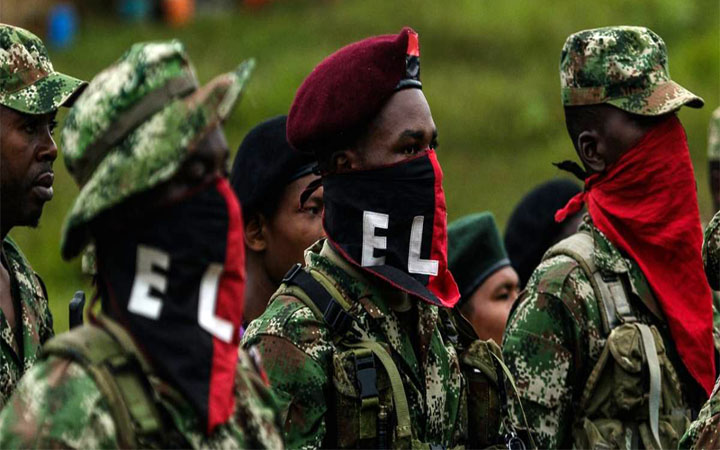
The National Liberation Army (ELN) rebel group has proposed a “national accord” to settle its long-running insurgency against the Colombian state in a statement released on Sunday.
The proposal – which the group says would encompass social, political, environmental and security issues – comes amid renewed pressure on Colombia’s largest guerrilla force, with Washington and Bogotá mulling joint operations against it.
Colombian President Gustavo Petro, who suspended peace talks with the ELN last year, shot down the idea of an agreement, citing the rebels’ alleged involvement in drug trafficking and recruiting child soldiers.
“The National Liberation Army proposes … that a national agreement be established to overcome the structural crisis and the social, political, and armed conflict that has lasted for more than seven decades [in Colombia],” read the ELN’s statement.
The group suggested the agreement would be negotiated following presidential elections scheduled for May and aim to “eradicate poverty”, “overcome drug trafficking,” and “protect ecosystems,” among other goals.
But Petro fired back at the proposal in a post on X, saying the ELN had squandered their chance to negotiate a peace deal: “An agreement was offered, and the ELN destroyed it with bloodshed and fire, killing humble farmers.”
“No negotiations can move forward… without a real end to illicit economic activity and the abandonment of child recruitment,” continued the South American leader.
Petro assumed office with the goal of negotiating peace deals with Colombia’s many armed groups, but suspended talks with the ELN in January last year over its involvement in a wave of violence in the northeastern Catatumbo region.
Since then, government forces have increased pressure on the rebel group by ramping up military action.
But the White House’s recent military buildup in the region has added a new dimension to the Colombian counterinsurgency.
The ELN has historically used Venezuela as a safe haven, out of reach from Colombian forces. But since Washington’s military buildup in the Caribbean and intervention on January 8, guerrilla operations in the country have become increasingly vulnerable.
Indeed, some rebel commanders had already begun returning to Colombia in recent months due to concerns around Washington’s military buildup, according to a military officer cited by AFP.
The Venezuelan government is also under pressure to take action against the ELN, with Secretary of State Marco Rubio saying Washington’s support for Maduro’s successors is contingent on its ability to expel Colombian rebels, among other conditions.
A potential coalition of forces against the ELN is also forming. Interior Minister Armando Benedetti told Colombian radio station Blu Radio that Petro had discussed joint operations against the ELN in a call with Donald Trump last week.
Petro also floated the idea of a triple alliance between Bogotá, Caracas, and Washington, potentially targeting rebel outposts on both sides of the border.
The ELN has roughly 5,000 fighters and has been active since the 1960s.
A week on from the extraordinary events of the third of January, where does Colombia stand, what happens next and what do people think?
Despite aggressive rhetoric, Colombian president Gustavo Petro and US president Donald Trump have ended up on relatively good terms over the last week after Maduro’s capture, and for now there appears to be a wary calm between the Palacio Nariño and the White House. It’s too early to talk of a bromance, but there’s certainly been a rapid de-escalation.
The US president pointedly praised Petro’s tone in his tweet after they spoke over the phone on Wednesday, indicating that the Colombian president had been rather less bullish one on one compared to his public speeches and tweets.
Petro also seems happy with the conversation, saying that he had cleared the air and underlining that he is not connected to the illegal drug trade. He pointed out that he has stepped up seizures of drugs and has in fact been threatened various times over his life by drug cartels.
Esto es Histórico.
Hablaremos con Trump, de la Paz del Continente, de la soberanía , de un Pacto por la Vida basado en las energías limpias. Se puede descarbonizar la matriz de EEUU si se vuelve real el potencial de energías limpias de Suramérica pic.twitter.com/0bqPP2lAYe
Petro had criticised his counterpart in the White House all week, convened protests against the US military’s actions in Venezuela and called an emergency meeting of the UN Security Council, of which Colombia is a temporary member.
However, Petro appears to have struck a far more conciliatory note when actually talking to the US president on Wednesday. For his part, Donald Trump also turned down the heat, saying it was a great honour to speak with the Colombian president and that they would talk further in person at the White House.
Petro has confirmed that this will take place in the first week of February. He’s also invited interim Venezuelan president Delcy Rodríguez to visit the Palacio Nariño for talks.
Alongside his usual flurry of tweets, Petro had been setting this in motion, with his Interior Minister (and former ambassador to Venezuela) Armando Benedetti sending a memo to the US underlining their commitment to fighting drug production.
Antagonism serves both sides
Petro has been highly critical of Trump’s actions in the Caribbean from the outset. He has warned Trump “not to wake the jaguar” and denounced his strikes on boats over the last few months.
Bad blood between the pair goes back a long way, but has really ramped up in recent weeks. Even before the extraordinary events of last weekend, Petro’s fierce criticism of the military build up in the Caribbean had led to him and his estranged wife Veronica Alcócer being stuck on the Clinton List.
The truth is that antagonistic public rhetoric plays well for both Petro and Trump, regardless of how much damage it may do to the reputation of either country. They both get to play the big man and impress their base, which both need right now in the face of domestic woes.
Presidente Donald J. Trump sobre la llamada con el Presidente Gustavo Petro: https://t.co/1lTgSYF8hb
Trump doesn’t seem to mind Petro’s words, as long as he gets his way. That fits with his previous actions, including his fallout when running against current Secretary of State Marco Rubio. He says Petro’s been very hostile, but that’s all in the past.
For Petro, this also sets him up nicely for his post-presidential life. In an interview this week he expressed a desire to tour the world speaking at conferences and the international exposure this week has been good for that. On top of that, Trump will likely lift the restrictions on him and his family as a reward for toeing the US line.
What’s the feeling in the calles?
One could have been forgiven for not noticing the midweek protests. Despite the best efforts of hyperbolic foreign journos, Bogotá has been far from a seething cauldron of dissent. In reality, a few hundred Petro diehards trooped out as expected.
Most Colombians are well aware of the reality of Maduro’s rule and the abuses carried out in its name. Apart from a very few outliers, there is no love lost for Nicolás Maduro and an overwhelming satisfaction that he’s no longer Venezuelan president.
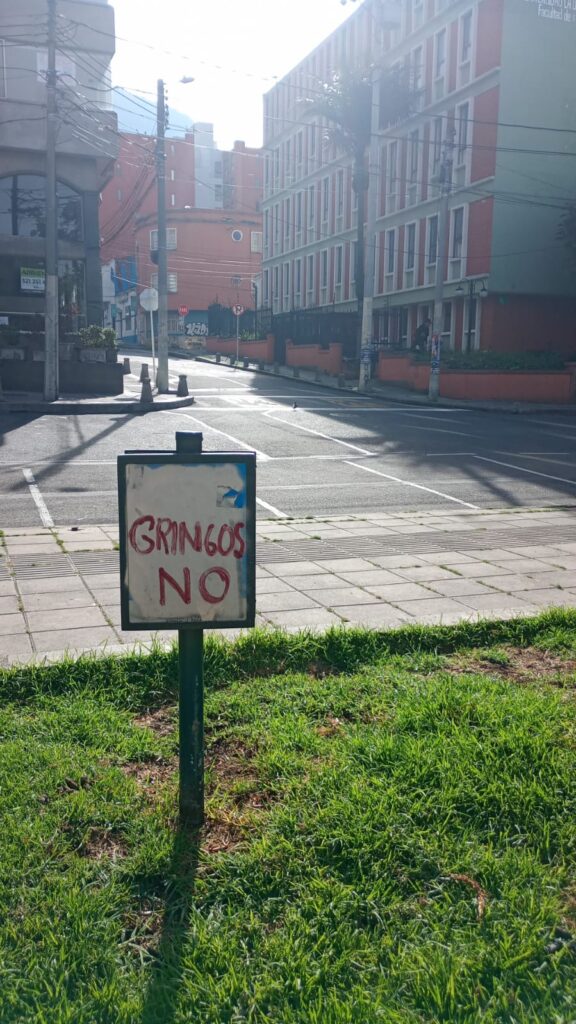
Not the most welcoming sign in Chapinero
That’s not to say, though, that Colombians are wildly happy about the current situation. Colombia is a very different country to her neighbour, but there remains a relatively well-founded concern among many that there may be attacks on Colombian territory.
Anti-American sentiment is not exactly thriving, but graffiti and the like is already going up in certain parts of the city. There’s little to no appetite in the country for any US military activity in Colombia, even against cartels or guerrillas.
Worries still linger over the possibility of other repercussions. The waits for American visas have only just started to come down, with new appointments a year hence. Many worry that will increase again and that extant visas for expat Colombians may be affected too.
Tariffs, too, are never far from people’s minds, although Trump’s current position towards Colombia seems to be benign. Tourism will possibly be affected, both in the short and medium term.
Of course, Bogotá has a thriving Venezuelan expat community as well. While there is general delight at Maduro being arrested, there remain justifiable fears over what comes next. Delcy Rodríguez is seemingly no-one’s first choice and most hope for the promise of free and fair elections.
The Plaza de Bolívar and many others around both Bogotá and Colombia have seen large groups of Venezuelans gathering both to celebrate Maduro’s fall and to call for a transition towards a proper democracy. Most, however, are just getting on with life and wary of reading too much into things at present.
A particular trend has been for exiled Venezuelans to take to social media in order to decry what they often see as ‘Venezuelasplaining’. Many accounts are keen to point out that while the US might only be interested in oil, neither were China, Russia and Iran after arepa recipes.
Venezuelan man:
“Those who say that the U.S. is only interested in our oil, I ask you: What do you think the Russians and the Chinese wanted here?
As for other Colombian politicians, there’s been a mixed reaction. The Centro Democrático has had a well-coordinated and fierce response, aggressively trying to connect Petro and his allies to Maduro, with some success.
Others are resisting the temptation to use Venezuela as a political football, preferring to cautiously celebrate Maduro’s capture while expressing concern both about the manner it was done and the current political inclarity in the country.
What happens next?
For now, Delcy Rodríguez appears to be in control of Venezuela. She’s been sworn in as president and Trump says she’s committed to working with Washington. That means allowing US oil companies in, buying American goods and stopping shadow fleet sales.
While Trump had initially been dismissive of Maria Corina Machado, saying she had little support or respect in Venezuela, he’s changed his position a little and has a meeting lined up with her soon. This may be connected to her apparent offer to share her Nobel Peace Prize with him.
Regime enforcers have been on maneuvers throughout the past week to quieten internal dissent and quell momentum towards thoughts of a full democratic transition. The ELN has stepped up operations near to the Venezuelan border and Iván Mordisco has suggested a coalition of guerrillas to fight interventionism.
Plenty remains unclear about the whole situation. Trump has expressed a lot of opinions and thoughts but hasn’t elaborated on what the details behind any of it might be. There’s also a worrying lack of corroboration from other players.
Rodríguez and Petro haven’t really confirmed his takes on their talks, nor have oil companies definitively committed to full investment. At the moment, it seems like all parties are reasonably happy with the state of play but keeping options open.
Petro gets to play the plucky leader standing up to US imperialism, shoring up his party’s base at home ahead of coming elections while burnishing his reputation overseas. Trump gets to be the decisive commander in chief that took out a rival, while Rodríguez has received a promotion.
For now, it really could go in a number of different directions and small actions might be the things that push the country in certain directions. There are lots of cards on the table and plenty of big decisions to be taken.
Worryingly, the most likely scenario at the moment seems to be that the regime continues in power, just with a new leader and a new-found willingness, however reluctant, to work with the USA. For the ordinary Venezuelan, tragically, little much has changed as things stand.
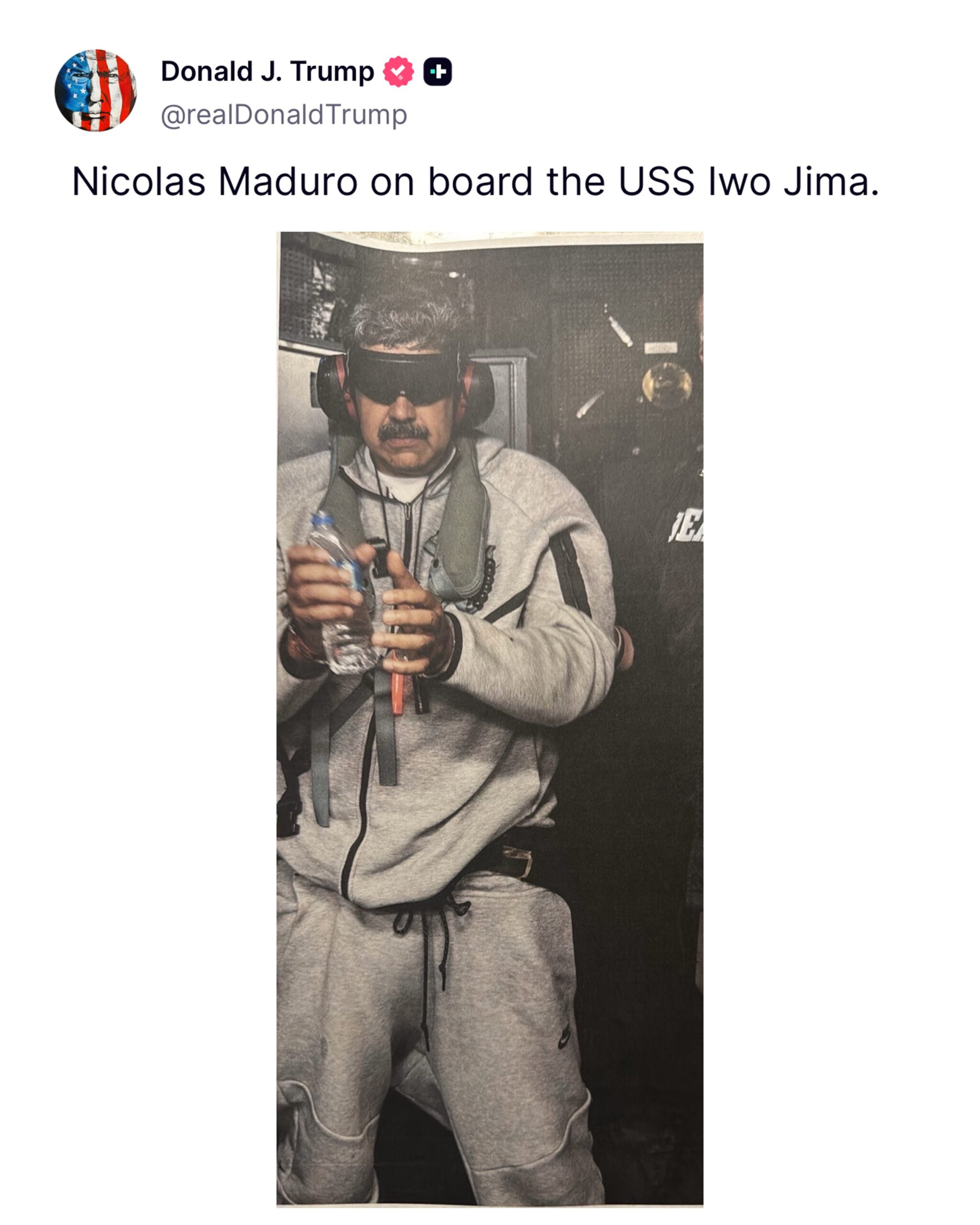
Arrested president of Venezuela Nicolás Maduro. Photo courtesy of X
The US carried out limited airstrikes in Venezuela this morning and claim to have captured Nicolás Maduro. Colombia has reacted with strong condemnation.
Colombia this morning woke to the news that US forces had attacked the neighbouring capital Caracas. President Donald Trump claimed via Truth Social that Maduro had been captured and extricated from the country, with the airstrikes necessary for that operation to take place.
It later emerged that the attack and capture was an arrest. The US has confirmed Maduro’s indictment in New York and that he will stand trial for narcotrafficking and potentially other offences. This dates back to 2020, although it was not widely known that Maduro’s wife Cilia, captured with him, had also been part of that case.
What is Colombia’s position?
Unsurprisingly, President Gustavo Petro is firmly against US action in general and particularly in the neighbouring country. In the short term he has sent troops to the border in preparation for a possible surge in refugees. Interestingly, it seems that the Colombian government may have had advance warning, as his security meeting started at 3AM.
Acabamos de terminar consejo de seguridad nacional desde las 3 am.
Se despliega la fuerza pública en la frontera, se despliega toda la fuerza asistencial que dispongamos en caso de entrada masiva de refugiados.
La embajada de Colombia en Venezuela está activa a llamadas de…
Petro rejects all US actions that violates the sovereignty of Venezuela and Latin America. He has said already that he will use his position on the UN security council to discuss this matter and search for a solution. In this, he will find support domestically and internationally.
For many in Colombia, and indeed Latin America in general, this brings memories of US interventionism during the Cold War. From helping to topple Allende in Chile, supporting dictatorships across the Southern Cone and the Sandinista affair, there is a long history of meddling in regional politics.
Equally, there is no love for Nicolás Maduro in Colombia. That is shared across the political spectrum for different reasons and comes through solidarity with the Venezuelan people, a dislike of the immigration wave he caused or a fierce disagreement with leftwing politicians in general.
However little sympathy there is for Maduro, that does not equate to support for direct military action from the US in foreign territory. Many Colombians have fears that similar might happen to their country. While that seems unlikely, Donald Trump is at best unpredictable and few would have seen today’s actions coming a year ago.
Colombia is also likely to have strained relations with the incoming administration in Caracas. Petro and many on his side are no fans of Machado, who they see as a classic representative of the Latin rightwing oligarchy.
Petro will be wary of supporting the notion that presidents can be toppled in this manner and regime change forced upon a nation by foreign forces. At the least, he will call for free and fair elections to be held sooner rather than later.
Relations with the USA have significantly deteriorated, for obvious reasons, but Colombia is very much with international feeling on this one, with Trump the pariah. A number of world leaders have issued statements decrying and condemning the US actions. Only Machado, Netanyahu and Argentina’s Milei have departed from the consensus, unsurpisingly.
ELN held a short-lived paro armado in December warning against foreign interference in the region, so it’s entirely likely that they might announce similar measures in the next few weeks. It’s unclear how or if groups such as the gaitanistas may react, given that they were recently declared terrorist organisations by the US State department.
What happens next?
For Colombia, the three biggest fears for the future are the probability of refugees fleeing across the border; the possibility that similar will happen here; the effects on this year’s election. This might have been a relatively quick operation, but its effects will linger for months at bare minimum and likely years.
Venezuela itself will have to work out who is going to replace Maduro in the presidential Palacio Miraflores. That could well be recent Nobel Peace Prize winner María Corina Machado, or could be a general stepping up to lead an interim government while elections are organised.
It could even be a continuation government, refusing to give in after the loss of Maduro and daring further strikes. US Secretary of State Marco Rubio has ruled out further actions for the time being now that Maduro has been captured.
The likelihood of large scale US actions within Colombian territory is very low, despite Trump’s rhetoric that Petro might be next in line. The country has just assumed a position on the UN security council and is a member of NATO. Having said all that, focused operations targeting terrorists are certainly possible and Trump is often hard to predict.
Even smaller, focused operations would be incredibly controversial within Colombia and Petro would be pushed to respond strongly, not only by his own supporters. However, his options are relatively limited. He does not have the firepower to make serious counterattacks and is unlikely to want to do so outside of Colombian territory, for example against carriers in international waters.
Any operation involving boots on the ground within Colombia would be a very different story and the military would be more or less forced to intervene. That would push tensions to boiling point with the White House.
Venezuelan immigrants to Colombia already number around two million or more and this action is likely to see increased travel across the borders. Colombia has sent troops to the border in order to attempt to maintain order. Cities such as Cúcuta in Norte de Santander and Riohacha in La Guajira are already under strain and will struggle to absorb further numbers.
It is entirely possible that serious criminal elements and/or government or armed fores members will try to cross within the chaos, putting added pressure on the Colombian government. They may be destabilising elements and there may be pressure from the US not to harbour who they see as essentially international criminals.
For the upcoming election, candidates are already in a difficult position on this topic and things are likely to get harder. Rightwingers have spent years railing against the Venezuelan regime, but will be aware that most Colombians oppose this action.
The added complication is the possibility of Trump supporting one side or another, even making remarks like he did before the Guatemalan election or even offering financial support as he did in the Argentinian elections.
That will be tricky – being on Trump’s side will alienate enough voters to make victory unachievable, yet coming into office in conflict with the leader of the USA will make governing difficult. Candidates have a fine line to walk in terms of balancing electoral rhetoric with diplomacy.
Then there’s the question of who is in the Palacio Miraflores in Caracas. Hard leftwingers will start off on a bad footing with a Machado government or similar, whereas rightwingers will chime with her politically. If there is a sort of continuity, expect the opposite.
Given the surprise, if not shock, of this morning’s actions, it is hard to predict exactly what will happen next, other than there will be short term chaos at least. Trump, of course, thrives on chaos and has a gift for navigating uncertain times. He described this as a “brilliant operation” but few in the region will be in agreement. After all, he is not the one who has to live with the consequences.
As the year winds to an end, the Bogotá Post looks back at 2025 in Colombia
2025 might well be looked back upon in years to come as the calm before the storm. An early sign of the potentially troubled waters ahead was the assassination of Senator Miguel Uribe in early June. Other themes included friction with the US, political deadlock and a sense that much is being put off for next year.
Colombia still welcomes the world, but maybe not the US president. Photo: Emma Whitaker-Pitts
Relations with the USA started badly after Trump was sworn in, as he deported Colombian immigrants in chains on military planes. Petro at first refused to receive the flights, before relenting and allowing them to land but greeting the travellers and treating them with dignity.
From there it got worse, with Petro turning up on the New York streets protesting while on a visit to the UN. Trump in turn has no love for Petro, calling him a bad guy and putting him and his family on the Clinton List, alongside highly controversial longtime advisor Armando Benedetti. It also emerged at that point that Petro had separated from Veronica Alcocer some time ago.
After the US started bombing alleged narco ships in international waters in the Caribbean, things took an even darker turn. Petro, like most world leaders, was highly critical of US operations in the Caribbean, leading Trump to warn that “he could be next”.
Bogotá herself kept on with business as usual, although that’s not always a good sign. Mayor Gálan has little to show at the mid point of his time in the Palacio Liévano. Crime and rubbish are the most visible signs of a city that sometimes feels stuck in place, although the Metro seems to be on track.
Away from the febrile world of Colombian politics, there was plenty going on in cultural fields, from an impressive Copa América run by the superpoderosas to possibly the best festival Cordillera yet in Bogotá.
Violence mars the start of 2026 campaigning
Senator Miguel Uribe was assassinated at the start of his electoral bid in a worrrying reminder of what can happen in Colombian politics. The politician was shot a number of times in the head while making a visit to Modelia and put into intensive care for a month before passing.
Miguel Uribe giving a speech
One shooter, just 15 years of age was shot and captured at the scene by Uribe’s protection. Other suspects and accomplices were relatively quickly captured, although the intellectual author of the crime remains unclear. While social networks have been hothouses of rumours and propaganda, candidates have thankfully so far stayed largely clear of commenting.
Runners and riders for the presidency have emerged and started the process of thinning the field. The Liberales, Conservadores and Cambio Radical are yet to declare their representatives. However, there are still six candidates for political parties and another 14 who have acquired the requisite 635,000 signatures to run as independents.
Among the latter names there are some big names such as Claudia López, Luis Murillo, Abelardo de Espriella and Vicky Dávila. There’s also a number of seeming no-hopers, but remember that was Rodolfo Hérnandez this time last year and he got to the second round as a semi-protest candidate.
Iván Cepeda is Petro’s successor candidate for Pacto Historico, while the Centro Democrático have plumped for Paloma Valencia. Sergio Fajardo is back in the race again, for Dignidad y Compromiso. That means no place for some high profile heavyweights such as Maria Fernanda Cabal, Susana Muhamed and Gustavo Bolívar.
High-profile roadblocks, change by the back door
One of the constants in Colombian politics in 2025 was that major reforms and were blocked and delayed, yet a few things were snuck in through alternative measures. This was exemplified by Petro declaring economic emergency in a constitutionally dubious manner.
The reforma de salud was sunk again in the springtime, but by mid-year MinSalud had gone ahead with some of the changes anyway. This may well be reversed by an incoming government next year, meaning that EPSs remain somewhat in limbo.
Cómo así que no hay que castigar alcohol cuando más se tiene alcohol en la mercancía, ¿no sabe que es la droga que más produce muerte y daños en los sistemas presupuestales de salud? Menos alcohol en las personas y la sociedad es productivo y beneficioso para la vida. Aquí no se… https://t.co/GFbT4Wx0k5
Major budget changes are unlikely to get through under anyone, so failing to get this done can’t really be laid at Petro’s door. However, he’s gone ahead with what he can do: enormous hikes in the minimum salary, IVA abolished on certain items, demanding that pension funds divest from foreign investments and repatriate their savings.
Paz Total is looking more and more like Fracaso Total as time ticks on. At best, talks with various groups are going nowhere, while other talks have essentially collapsed. Trump declaring the Gaitanistas a terrorist group has muddied the waters even further. The ELN, Colombia’s largest remaining guerilla force, in particular have intensified operations.
While some of that has underlined the difference between their rhetoric and reality, with December’s paro nacional affecting little of the country, other attacks have been bloody and worrying, with the increased use of drones a dangerous direction of travel.
Economic uncertainty?
Whether the economy is doing well or not and whether that is because or in spite of the government will depend mainly on your fellings towards Petro. It’s a mixed bag with plenty of caveats on both sides. GDP growth has been good and ahead of expectation, with unemployment continuing to fall and inflation slowing. Those new jobs are largely formal, too.
However, the GDP growth isn’t as fast as it could be, while it’s outperforming regionally, it’s behind the global average. Unemployment is at a low point for the century, but is still mainly informal and the rate of decrease is slowing. It’s hard to guess how the recently announced minimum wage hike to COP$2,000,000 will affect this.
The minimum salary has reached a symbolic COP$2,000,000
Much more worrying is that much of this may be built on sand. While Petro has struggled to get big-ticket bills through the legislature, he’s quietly done things behind the scenes that have ramped up public spending. He’s betting on that being an investment which will keep delivering in the long run. If not, it will be an albatross for future governments.
Inflation remains at 5.3% annually, not calamitous, but stubbornly high. The cost of living, too, is ever-increasing, not helped by uncertainty in global trade routes. Despite all that wind and bluster between Trump and Petro, tariffs remain at the standard 10% for the time being.
Petro finally got his reforma laboral over the line, in some ways a major achievement considering the opposition it faced in the Senate. However, the text of the bill is somewhat underwhelming. For the main part, there are minor changes such as a cap on overtime and night shifts starting two hours earlier as well as solidifying full time contracts as the norm.
The most substantial change is a commitment to make online providers such as Rappi pay social security and workplace risk contributions for their workers. This may find the devil is in the details in terms of bringing it into reality.
Colombia also brought the Bre-B system of instant payments online. This is already having a huge impact in a country where digital payments are widespread and popular. Long term, this provides a base for increasing transparancy and reducing corruption. However, questions remain over the infrastructure underpinning these systems.
Transport no longer stuck in a jam
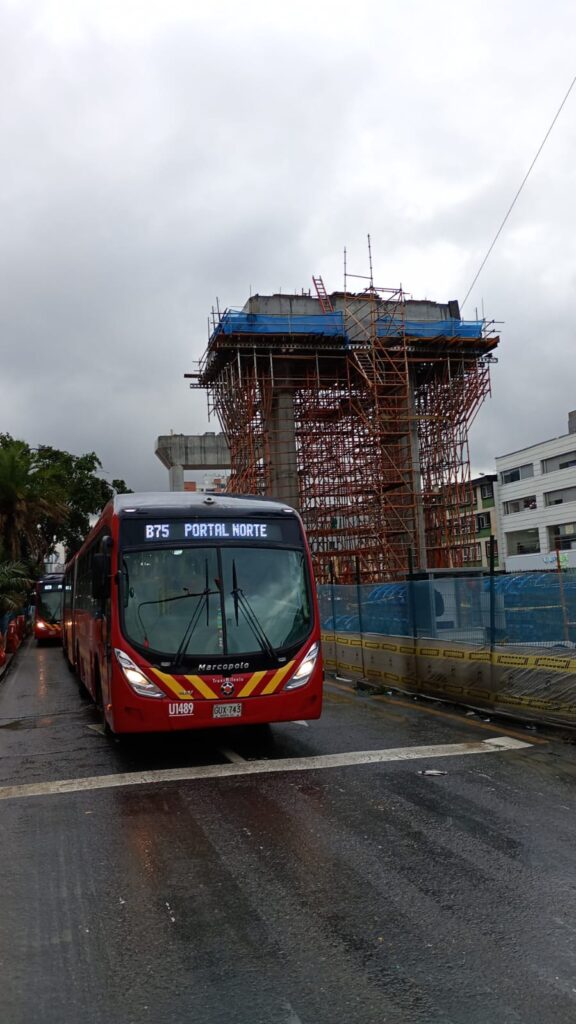
The Metro columns are popping up along the Caracas
The really big local news has been that the Metro is progressing as planned. This might not seem like big news, but given how long the project spent in planning and the tendency of the president to stick his beak in, it’s just good to see something being done.
The first trains have arrived in the country and are running tests while the towering columns of the track are in place all over the city. Today, that means pain as Transmi stations close and traffic is rerouted, but all is in place for a fully integrated public transport system in the future.
RegioTram is also more or less on schedule, although it will need to be reworked to connect with the Bogotá systems, after it was pointed out that the planned stations are a fair distance away from the trnasmi and Metro. Regardless, connecting satellite towns with the capital is a gamechanging proposal.
Life in the city remains irritating due to continued high crime levels and the seeming refusal of Carlos Fernando Galán to do anything about rubbish on the streets. The best that can be said about Gálan at this point is that he has done little of note, hardly a glowing resumé, given his ambitions coming into office.
Culture vultures
Festival Cordillera is now intertwined with la nevera
The capital saw a celebration of Latino music as Festival Cordillera 2025 confirmed the event’s stature as a lodestone of music in Colombia. With Festival Estéreo Picnic 2025 providing a balance that focuses on anglophone music, the capital is well set. However, with both those festivals in the Parque Bolívar, Rock al Parque is struggling to stay relevant.
Plenty of other bands were touring throughout the year too, with Bogotá increasingly on the map for big-name world superstars. That means enduring the likes of Guns N’ Roses, but also means that rolos can see contemporary stars like Dua Lipa.
Former busker Ed Sheeran popped up on stage as a surprise guest of J Balvin in December, while another Brit unsurprisingly failed to turn up because that’s what Morrissey does these days. Latinos across Instagram responded by trolling the famous vegetarian with meat recipes.
Elsewhere online, Colombian food performed well on a host of dubious internet polls, sparkign waves of reposted joy throughout the year. In more dispiriting news, Club Colombia Negra was discontinued by Bavaria, meaning you have few chances to neck the country’s last widely available dark lager.
For those more interested in staying home, Colombia’s first ever board games convention took place in November. Ludotopia was an undisputed success, attracting the likes of Wingspan artist Ana Maria Martínez (who teased the upcoming expansion for Wingspan South America, Central America and Caribbean) and proving that Bogotá retains a dynamic and evolving cultural scene.
Colombia fall just short again
The women’s football team came into the Copa América on good form and were within seconds of taking the title. With two minutes of regular time to go, Mayra Ramírez put Colombia ahead for the third and seemingly last time at 3:2. Brazilian superstar supersub Marta, in her last tournament, broke Colombian hearts as she rolled back the years with a last gasp equalizer in the sixth minute of injury time.
The drama wasn’t over, as she then put Brazil in front for the first time in extra time before Leicy Santos equalized and took the game to penalties. There, the game slipped through the fingers of the superpoderosas as perma-champions Brazil showed their experience. They took the shoot out 5:4 for their 9th title in ten Copa Américas.
The men’s team, also runners up in their Copa América, ground their way to qualification for next year’s World Cup in North America. Conmebol was a slogfest this time around, with everyone except Argentina involved in taking points off each other and goals in short supply.
Eventually, Colombia found form, only losing a single game in the year and finishing with a goalfest against Venezuela, beating their fierce rivals 6-3 in the last game. That leaves Colombia 13th in the FIFA rankings – unlucky for some maybe, but not coach Nestor Lorenzo.
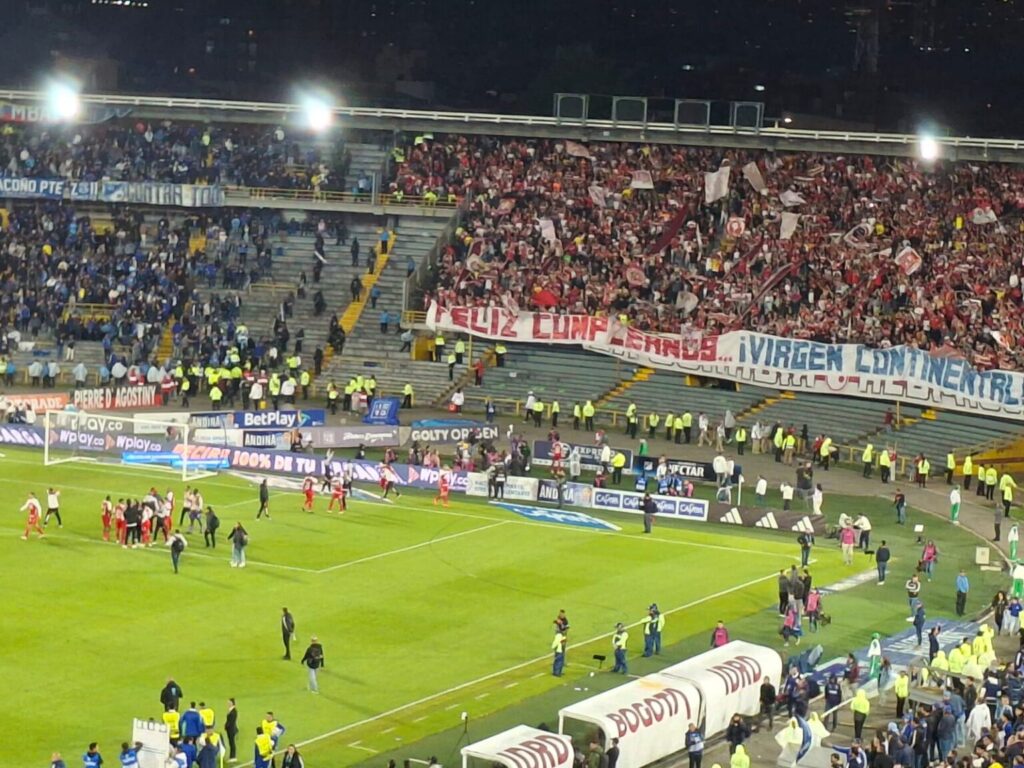
Santa Fe had a sweet victory over Millos en route to the first title
On the local stage, Santa Fe reclaimed the liga apertura for Bogotá, triumphing in Medellín over Independiente thanks to an inspired performance from Wigan legend Hugo Rodellega. Knocking out Millos and El Tigre Falcao on the way made it even sweeter. Junior of Barranquilla took the finalizácion, with Nacional winning the Copa Colombia. The latter was a Medellín derby and marred by a pitch invasion and violence at the end.
Cricket Colombia hit a six as MinDeportes officially recognised the gentleman’s game as a sport in the country. This opens up the field for more funding and support for events. They also welcomed a visiting team from Trinidad and Tobago as well as setting a T20 record for a last wicket chase in the Gulf Series against México.
What’s coming next?
Next year promises much more drama in Colombia, with national elections set to be hard-fought. This is an unusual cycle, as the country is preparing to see who will succeed a leftist president. Whether there will be continuity, a sharp tack rightwards or a drive for the centre is still anyone’s guess.
The lineups for the capital’s big music festivals seem strong, with a supporting cast of superstars also set to tour. The men’s football team have a relatively straightforward group in the World Cup and will fancy themselves to do well.
Our predictions for 2026 will be coming in the next few days, but whatever comes to pass, we’ll be here to keep you in the loop with what’s happening in Colombia and why. We got some of the 2025 calls right, after all. right Happy new year from the Bogotá Post – your English voice in Colombia!
An extraordinary leap of 23.78% in the Colombian minimum salary per month brings it to a symbolic COP$2,000,000
More money in many wallets with the Colombian minimum salary 2026
An unprecedented hike in the Colombian minimum salary for 2026 was announced on Monday 29 December, bringing the rate to two million pesos per month. That represents an increase of 23.78% on the 2025 number. That’s the biggest jump ever – only 1997 comes close in recent years with 21.02%.
The minimum salary itself (SMMLV or Salario Mínimo Mensual Legal Vigente) has gone up to COP$1,750,905. There is also a transport subsidy (COP$249,095) which brings the effective minimum salary in Colombia for 2026 to two million on the nose.
Business leaders had suggested a rise of around 7.21%, keeping it above annual inflation (5.3% as of November), while trade unions and syndicates had called for an optimistic 16%. Both were left in the dust by Petro’s extraordinary decision.
The extraordinary rise is not due directly to inflation, nor to the rising cost of living, but represents a fundamental change in the rationale behind the number. Colombian president Gustavo Petro explained that the minimum salary should be considered a household income, not individual. He calls this salario vital, or salario digno.
Whether the household basis for the minimum salary holds up to scrutiny is hard to say. It certainly was the case, but like most other middle-income countries Colombia is rapidly changing. The idea of a single income supporting a family is less true every year, with Colombian households under 3.5 people on average and with 1.5 workers. That means a true dependency ratio of nearly one to one.
It was calculated by working around the price of a basket of goods for the average family (canasta básica), logged at nearly 3 million pesos for four people. Using that number of 1.5 workers gave the convenient round number of two million.
The minimum salary (not including the transport subsidy) is the baseline number that in turn influences a whole lot of other values in Colombia, such as fines and public salaries which are counted as multiples of the SMMLV. That includes, happily for Congress, politicians’ pay.
What does the increase in the Colombian minimum salary mean for the economy?
Far harder to work out is the long term impact of this rise in the Colombian minimum salary. Petro claims it will further stoke private spending in the country as the increased wages percolate throughout the economy and allow continued growth.
It will increase labour costs for a number of businesses, especially small companies, some of which will struggle to keep their heads above water with such a sudden rise in payroll. For medium and larger size businesses, this includes mandatory SENA apprentices.
Note that payroll costs for employers will increase by more than the 23.78% headline figure, as they have to make social security payments based on an employee’s wage as well as the wage itself.
Massive firms who are liquid enough to be able to absorb costs will likely be absolutely fine, even if there are a couple of high-profile exceptions. Companies that are dodging the system, either through informal working or false self-employment, will also likely thrive.
Of course, the new reforma laboral promises to regularise and/or eliminate such practices. On paper, that is. In reality, these are the potential counterintuitive effects that could be the legacy of this increase in the Colombian minimum salary.
Colombia saw a sharp downtick in the number of employees on minimum salary this year, while informal work and self-employment has risen to around 55% of the workforce. This trend could continue much more rapidly with companies unwilling to pay the high new Colombian minimum salary.
A further issue is how close the minimum salary is now to the average. This will particularly affect smaller businesses and recent graduates. The former will find it hard to offer salaries that are significantly above minimum to attract quality employees, while the latter will find themselves often close to minimum salary and waiting longer for a return on their studies.
It is worth remembering that both minimum salaries themselves and increases to them are often bitterly opposed the world over and predictions of chaos are frequently sown. In most cases there is short term turbulence followed by long term stability.
Is this a political power play?
Despite Petro’s official line about household incomes, many will see this as a nakedly political move ahead of next year’s elections. It certainly will play well among the Colombia Humana base and potential voters as a reason to keep faith with the left and cast their vote accordingly next year.
A more charitable view would be to say that it’s one of the last significant acts that Petro can take before leaving office, so he’s gone big to deliver an achievement. Those have been in short supply over his time in the Palacio Nariño.
What’s undoubtable is that this creates a massive headache for next year. Regardless of who takes power, they won’t be expected to deliver quite such a large rise. However, they will have to be careful how far they go below it.
Any successor to Petro will at least be able to say their allies prepared the ground and maybe get away with a modest increase. An incoming fiscal conservative will be under pressure to deliver another big increase against their natural instincts and take heat for not doing so, while actually cutting the rate would be close to political suicide.
While a lot of candidates in the 2026 election might say that this was a fiscally imprudent move, they will have to be careful how far they push it. Many in Colombia will agree with them, but those same people are also likely benefiting from the increase.
There are also the optics of a rich politician arguing against the very many voters who are on minimum wage or even those who aspire to earn minimum wage. It’s not a good look to argue against giving stuff to the people whose vote you want.
Short term gains, but long term problems?
So in the end this is a huge play from Petro, which has won him a useful political victory for today. It backs up his rhetoric, as he can easily claim he’s acting on behalf of the workers. There’s plenty of truth in that, as many Colombians work on minimum wage.
It may be a bribe to the electorate, but many will claim that no one else has at least offered them anything like this ever before, so good on him. Going into the 2026 election candidates on Petro’s side will be able to point to this achievement, while opposition candidates face pressure to offer at least something similar or be painted as rich folk denying the poor.
It’s hard to see a short term in which we won’t see a lot of businesses go bankrupt. The longer term is harder to read, as most companies will be unhappy but able to keep going. The effect on public salaries is potentially alarming with the state already running a deficit, unable to achieve fiscal reform and still expanding.
Ironically, it’s entirely possible that the increase in the Colombian minimum salary for 2026 might lead to more informality and less dynamism in the economy. However, it’s also completely believable that the economy is resilient enough to handle it with ease. This may be Petro’s biggest gamble yet and even he doesn’t know how it’ll play out.
A handful of Colombian and Latin American authors this week said they will not attend an upcoming literature festival in Cartagena due to the planned presence of Nobel Peace Prize winner and Venezuelan opposition leader María Corina Machado.
Author Laura Restrepo was the first to announce her decision not to attend Hay Festival, which takes place in Cartagena from January 29 through February 1, 2026. The author cited Machado’s pro-U.S. intervention stance in Venezuela as her reason for boycotting the festival.
“The reason is the attendance of Ms. María Corino Machado, an active supporter of U.S. military intervention in Latin America,” Restrepo wrote.
Since September, the U.S. military has gathered a mass of warships off the coast of Venezuela, blowing up small boats it alleges are ferrying drug traffickers in the Caribbean and eastern Pacific Ocean. U.S. President Donal Trump has said President Nicolás Maduro’s days are numbered and authorized the CIA to conduct clandestine operations in the country in an apparent effort to oust the dictator.
Restrepo sent a letter withdrawing her participation to Hay Festival Director Cristina de la Fuerte. She said that while she understands the festival’s philosophy of fostering debate from diverse perspectives, with Machado, “a line was crossed.”
“One cannot give a platform or facilitate an audience for someone who, like Ms. Machado, promotes positions and activities in favor of the subjugation of our peoples and against the sovereignty of our countries. Imperialist intervention is not something to be debated, but rather rejected outright,” said the author and former journalist.
Author Laura Restrepo via Wikimedia Commons.
Colombia’s former Culture Minister, Juan David Correa, shared Restrepo’s letter on X, expressing his solidarity with those who withdrew from the festival. “And for all those who believe that one thing is freedom of expression, and another is inviting the denial of national sovereignty,” he wrote.
Restrepo’s boycott was soon joined by poet and writer Giuseppe Caputo, who made his public statement through his Instagram account:
“In the face of the serious situation of escalating imperial violence, it is better to cancel participation in a festival taking place in front of the bombarded waters of the Caribbean Sea, one that has chosen to invite someone who dedicated a peace prize to the fascist responsible for these crimes,” he wrote.
Machado, who received the 2025 Nobel Peace Prize on December 10, has expressed her support for the Trump administration and its military actions.
In a recent interview on CBS’ Face the Nation, she showed her support for U.S. interventionism in the country. “I absolutely support President Trump’s strategy,” she said in response to the oil tanker seizure and apparent economic blockade by the U.S. She added that, as Venezuelan people “are very grateful to him.”
In addition to Colombian authors, other Latin American writers have expressed their discontent with Machado’s attendance. Dominican activist Mikaelah Drullard and Bolivian psychologist María Galindo have also declined to attend the festival.
In response, the Hay Festival issued an official statement asserting that, as a non-profit foundation, it provides spaces for reflection and plural conversation, reflected in the “voices coming from different backgrounds, traditions, and positions,” featured in its programming.
“We reaffirm our conviction that open, plural, and constructive dialogue remains an essential tool for addressing complex realities,” the statement read.
The organization also stated that the festival does not align with or endorse the opinions, political positions, or statements of its invited guests.
“We respect the decision of those who have chosen not to take part in this edition, because we understand culture and thought as territories where dissent, critical reflection, and respectful listening are fundamental to citizenship.”
The Hay Festival began in Hay-on-Wye, Wales, United Kingdom in 1987 and has expanded to global editions in Colombia, Mexico, Peru, Spain and the U.S. The festival focuses on literature, music, journalism, current affairs, philosophy, film, theater, and related fields. Its website says the festival “celebrates and inspires different opinions, perspectives, and points of view.”
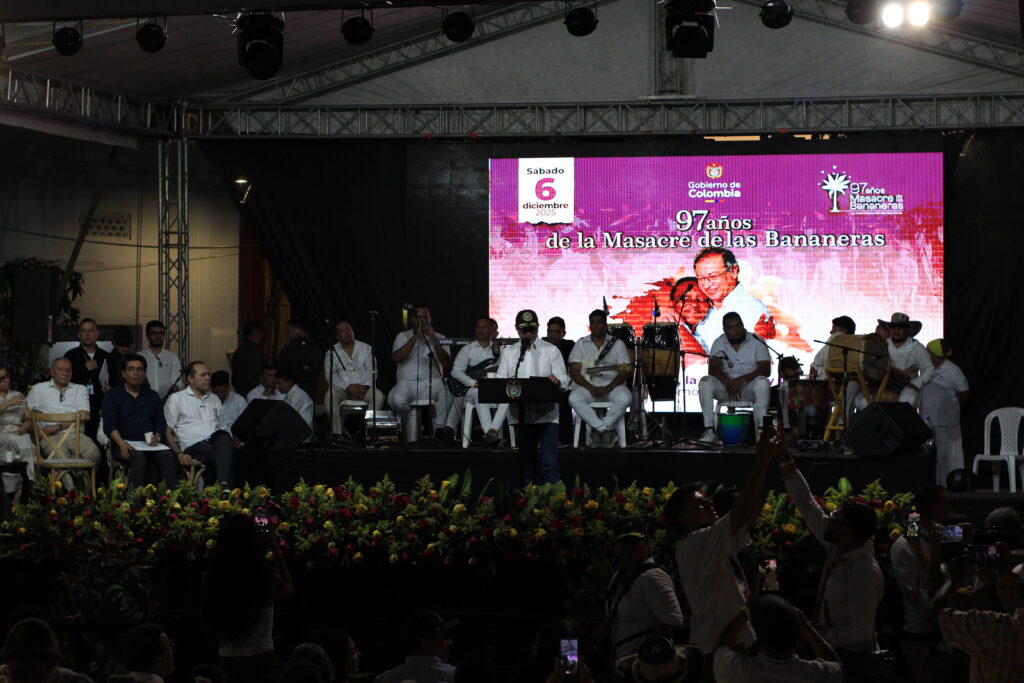
Gustavo Petro speaking in Ciénaga, Colombia to commemorate the 1928 “Banana Massacre”. Image credit: Cristina Durado Suaza
On December 6, during a speech to commemorate the 1928 “Banana Massacre,” President Gustavo Petro recognized Colombian state complicity in the massacre, which has become a milestone of the labor rights movement in the country.
“The president at the time [Miguel Abadía Méndez] ordered General [Carlos] Cortés Vargas to fire upon the bodies of thousands of unarmed people. The United States ambassador at the time [Jefferson Caffery] stated in a cable that at least one thousand people were killed (…) History was unable to determine the exact number,” said Petro.
On December 5 and 6, 1928, workers on the United Fruit Company banana plantation in the Caribbean coastal town of Ciénaga were striking poor conditions when Colombia’s national army – in collusion with the U.S. fruit company – killed workers in an attempt to quell the strike.
“I have the honor to report that the Bogotá representative of the United Fruit Company told me yesterday that the total number of strikers killed by the Colombian military exceeded 1,000,” wrote then-U.S. Ambassador to Colombia Jefferson Caffery. United Fruit Company is known today as Chiquita Brands International.
The president also reflected on what he deemed similarities between U.S.-Colombia relations 97 years ago and today.
“It seems that much of what happened then is happening today,” said Petro. “There was a threat of invasion of Colombia by the United States. They threatened that if the national government at that time, led by the conservative Miguel Abadía Méndez, supported the banana workers, there would be an invasion.”
He went on to mention that it “seems that things are similar today” with the threat of a U.S. invasion “within our own country, if the president doesn’t say or do what they want.”
In addition to calling Petro a drug trafficker and sanctioning him, the Trump administration has killed at least 95 people – some of them Colombian – in boat strikes off the Pacific and Caribbean coasts, and has even threatened to strike drug installations within Colombian territory.
Remembering the Banana Massacre, nearly 100 years on
This year’s remembrance event featured a pop-up museum about the massacre; floral offerings for victims; and a lot of music, including a performance of “Las Bananeras” by Leo Infante.
Discussion and community forums were also organized by the Ministry of Labor, the Escuela Nacional Sindical (National Union School), and the CONARE, which is the committee created to represent the union movement in the collective reparation process as a victimized group in the Colombian armed conflict.
The Bogotá Post sat in on some of the sessions where participants discussed memory, lived experiences, reparations, and violence.
On the main stage, President Petro and members of his cabinet listened to various speakers, including Mildreth Maldonado Pava, representing the descendants of victims and survivors of the massacre. Her grandfather was a survivor.
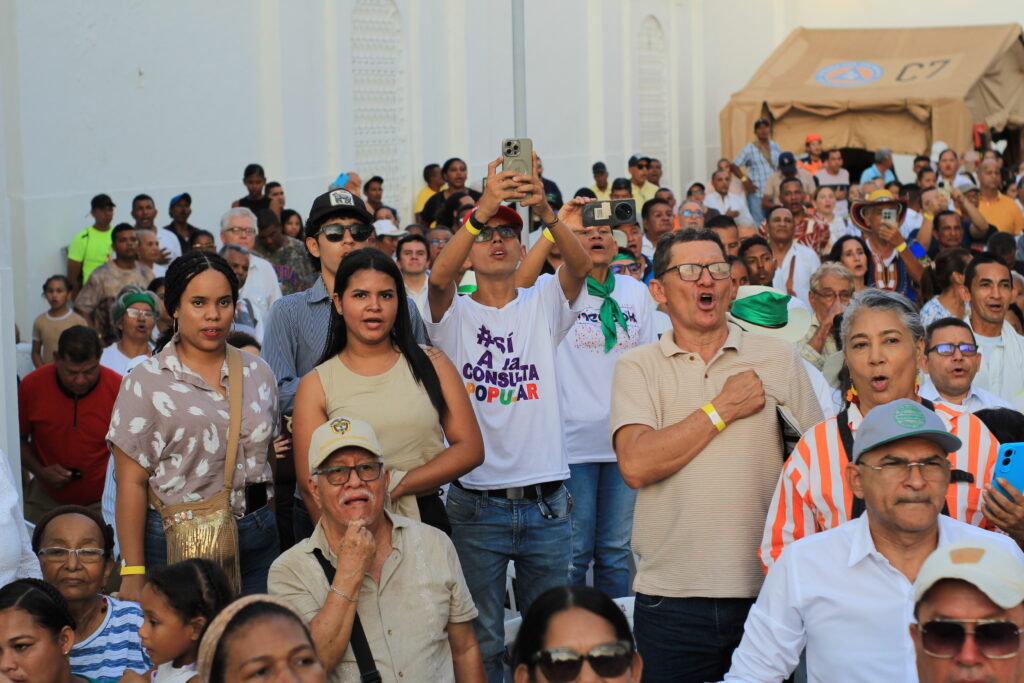
Colombians gathered in Ciénaga to commemorate the 97th anniversary of the “Banana Massacre”. Image credit: Cristina Dorado Suaza.
“It is difficult, but not impossible, to know the truth,” said Maldonado. “I am here fulfilling a dream that has been waiting for nearly 100 years – a dream that hurts, but that has patiently endured amid so many other pains.”
When it was his turn to address the crowd, President Petro called on security forces to respect the Constitution and human dignity.
“The public armed forces of any country in the world obey their president only as long as the Constitution is respected; but when an order from a president – whoever that president may be, anywhere in the world – goes against the Constitution of their own country or goes against the Constitution of humanity itself … no member of the military should obey such orders.”
Over Dorado Cardona, general secretary of The Central Union of Workers (CUT) and a spokesperson for the union and workers movement, highlighted the importance of reparation of the union movement as a collective victim as a key commitment for the current government.
“We, as the union movement, say, ‘we only die when we are forgotten,’” Dorado bellowed.
Towards collective reparation
Colombia remains one of the most dangerous countries in the world for labor activists. There have been 15,481 registered acts of violence against Colombian trade unionists between 1970 and 2021, according to Sinderh, a database from Colombia’s National Union School.
Strikingly, 63% of all trade unionist murders worldwide between 1971 and 2023 occurred in Colombia, according to the Ministry of Labor with figures provided by the International Labor Organization (ILO).
In Colombia, Collective Reparation processes – distinct from reparations to individual victims of the internal conflict – constitute a comprehensive route to remedy the harms suffered by groups affected by the armed conflict.
Many in the country argue that given all the anti-unionist violence suffered, there remains an outstanding debt to the union movement as a whole. Petro’s Government was the first to recognize the movement as a subject of Collective reparation in 2023.
“The union movement has been deeply harmed,” Nadiezhda Natazha Henríquez Chacín, a magistrate for the Special Jurisdiction for Peace (JEP), Colombia’s transitional justice mechanism, told The Bogota Post.
“These years of war have almost completely destroyed it down to its foundations (…) Union struggles have won labor rights, yet the movement has been persecuted and stigmatized,” the Ciénaga-born judge added.
For the union movement, the difficulties with the entities arising in the collective reparation process contradict the significant effort the government has made through its social reforms.
“It is not understood that the reparation of the union movement must go beyond administrative measures (…) The essential Collective Reparation Plan must be guaranteed as a public policy that extends beyond any single Government and becomes a State policy,” Dorado Cardona, the union leader, stated.
“It is necessary to rebuild, to transform; this work of memory is essential, but it is also a form of transformative reparation,” the magistrate remarked.

 Login
Login