Login
Login
Petro said Colombian state complicit in 1928 ‘Banana Massacre’ at commemoration event
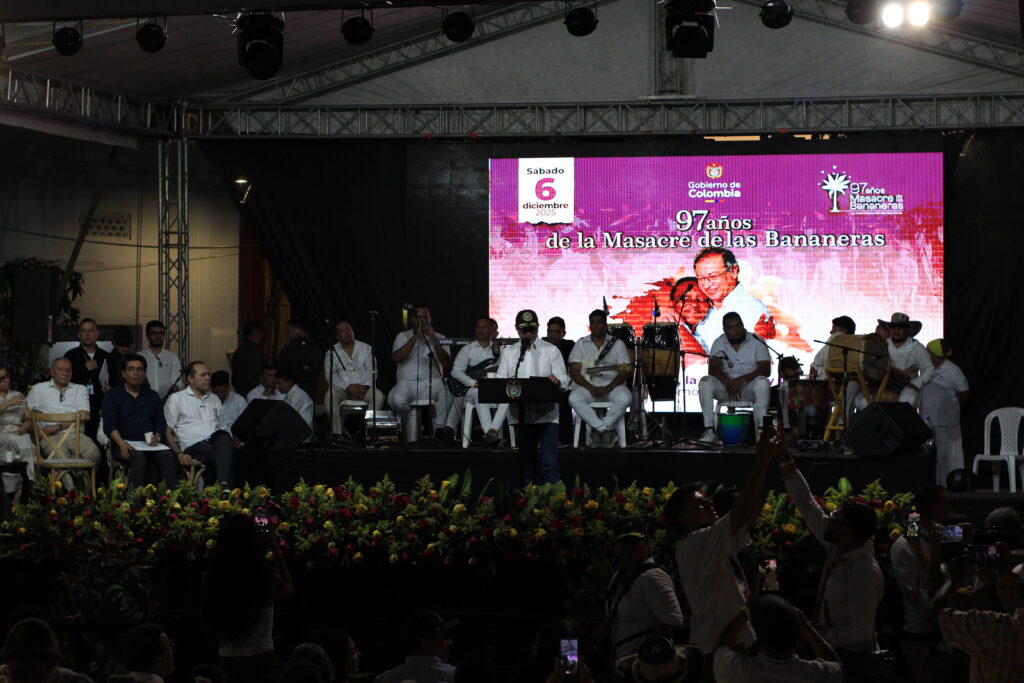
On December 6, during a speech to commemorate the 1928 “Banana Massacre,” President Gustavo Petro recognized Colombian state complicity in the massacre, which has become a milestone of the labor rights movement in the country.
“The president at the time [Miguel Abadía Méndez] ordered General [Carlos] Cortés Vargas to fire upon the bodies of thousands of unarmed people. The United States ambassador at the time [Jefferson Caffery] stated in a cable that at least one thousand people were killed (…) History was unable to determine the exact number,” said Petro.
On December 5 and 6, 1928, workers on the United Fruit Company banana plantation in the Caribbean coastal town of Ciénaga were striking poor conditions when Colombia’s national army – in collusion with the U.S. fruit company – killed workers in an attempt to quell the strike.
“I have the honor to report that the Bogotá representative of the United Fruit Company told me yesterday that the total number of strikers killed by the Colombian military exceeded 1,000,” wrote then-U.S. Ambassador to Colombia Jefferson Caffery. United Fruit Company is known today as Chiquita Brands International.
The president also reflected on what he deemed similarities between U.S.-Colombia relations 97 years ago and today.
“It seems that much of what happened then is happening today,” said Petro. “There was a threat of invasion of Colombia by the United States. They threatened that if the national government at that time, led by the conservative Miguel Abadía Méndez, supported the banana workers, there would be an invasion.”
He went on to mention that it “seems that things are similar today” with the threat of a U.S. invasion “within our own country, if the president doesn’t say or do what they want.”
In addition to calling Petro a drug trafficker and sanctioning him, the Trump administration has killed at least 95 people – some of them Colombian – in boat strikes off the Pacific and Caribbean coasts, and has even threatened to strike drug installations within Colombian territory.
Remembering the Banana Massacre, nearly 100 years on
This year’s remembrance event featured a pop-up museum about the massacre; floral offerings for victims; and a lot of music, including a performance of “Las Bananeras” by Leo Infante.
Discussion and community forums were also organized by the Ministry of Labor, the Escuela Nacional Sindical (National Union School), and the CONARE, which is the committee created to represent the union movement in the collective reparation process as a victimized group in the Colombian armed conflict.
The Bogotá Post sat in on some of the sessions where participants discussed memory, lived experiences, reparations, and violence.
On the main stage, President Petro and members of his cabinet listened to various speakers, including Mildreth Maldonado Pava, representing the descendants of victims and survivors of the massacre. Her grandfather was a survivor.
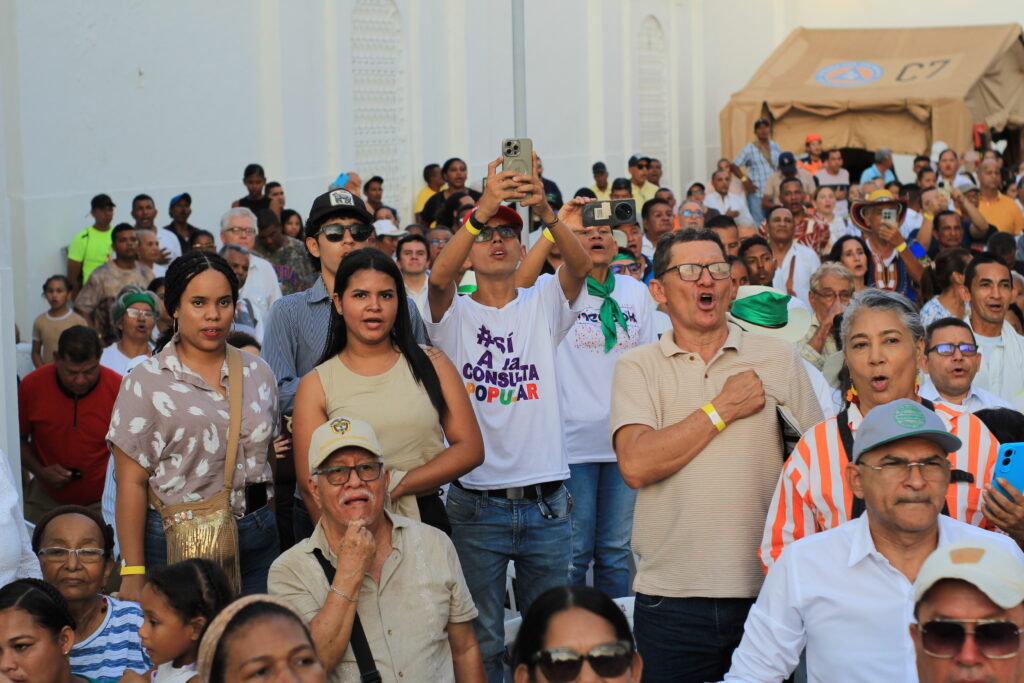
“It is difficult, but not impossible, to know the truth,” said Maldonado. “I am here fulfilling a dream that has been waiting for nearly 100 years – a dream that hurts, but that has patiently endured amid so many other pains.”
When it was his turn to address the crowd, President Petro called on security forces to respect the Constitution and human dignity.
“The public armed forces of any country in the world obey their president only as long as the Constitution is respected; but when an order from a president – whoever that president may be, anywhere in the world – goes against the Constitution of their own country or goes against the Constitution of humanity itself … no member of the military should obey such orders.”
Over Dorado Cardona, general secretary of The Central Union of Workers (CUT) and a spokesperson for the union and workers movement, highlighted the importance of reparation of the union movement as a collective victim as a key commitment for the current government.
“We, as the union movement, say, ‘we only die when we are forgotten,’” Dorado bellowed.
Towards collective reparation
Colombia remains one of the most dangerous countries in the world for labor activists. There have been 15,481 registered acts of violence against Colombian trade unionists between 1970 and 2021, according to Sinderh, a database from Colombia’s National Union School.
Strikingly, 63% of all trade unionist murders worldwide between 1971 and 2023 occurred in Colombia, according to the Ministry of Labor with figures provided by the International Labor Organization (ILO).
In Colombia, Collective Reparation processes – distinct from reparations to individual victims of the internal conflict – constitute a comprehensive route to remedy the harms suffered by groups affected by the armed conflict.
Many in the country argue that given all the anti-unionist violence suffered, there remains an outstanding debt to the union movement as a whole. Petro’s Government was the first to recognize the movement as a subject of Collective reparation in 2023.
“The union movement has been deeply harmed,” Nadiezhda Natazha Henríquez Chacín, a magistrate for the Special Jurisdiction for Peace (JEP), Colombia’s transitional justice mechanism, told The Bogota Post.
“These years of war have almost completely destroyed it down to its foundations (…) Union struggles have won labor rights, yet the movement has been persecuted and stigmatized,” the Ciénaga-born judge added.
For the union movement, the difficulties with the entities arising in the collective reparation process contradict the significant effort the government has made through its social reforms.
“It is not understood that the reparation of the union movement must go beyond administrative measures (…) The essential Collective Reparation Plan must be guaranteed as a public policy that extends beyond any single Government and becomes a State policy,” Dorado Cardona, the union leader, stated.
“It is necessary to rebuild, to transform; this work of memory is essential, but it is also a form of transformative reparation,” the magistrate remarked.
The post Petro said Colombian state complicit in 1928 ‘Banana Massacre’ at commemoration event appeared first on The Bogotá Post.