
Reading view

Fernando Botero Takes on Singapore with Landmark Exhibition

Singapore has never been shy about scale. But this season, the city’s appetite for monumentality takes on a distinctly Latin American accent. For the first time, the work of Colombian master Fernando Botero makes his Singapore debut with the largest exhibition of his work ever showcased in Asia.

Spanning galleries, inter-active theatres and extensive public gardens, the landmark show presents more than 130 works, positioning the city-state as a hub for global Botero immersion. As the largest presentation of the Medellín-born artist (1932-2023), and timed to coincide with Singapore Art Week, Botero in Singapore unfolds across gallery walls, immersive media spaces and public gardens.

“My father loved Singapore,” remarked the artist’s son Fernando Botero Zea to The Strait Times, highligting that with this retrospective, the country now “has the highest concentration of Botero per capita”.

At the heart of the programme is Heart of Volume, a major gallery exhibition at IMBA Theatre, presenting more than 100 works drawn directly from the Botero family collection. Spanning seven decades, the exhibition traces the evolution of what the artist famously described not as exaggeration, but as “volume”: a formal strategy that lends weight, humour and authority to everyday scenes, portraits, still lifes and reimagined art-historical references.

Seen up close, the discipline behind Botero’s apparent abundance becomes clear. Small watercolours and intimate studies reveal a careful calibration of colour and balance, while larger canvases demonstrate his lifelong dialogue with European painting traditions—from Renaissance composition to modernist distortion—filtered through a distinctly Colombian sensibility. The effect is quietly didactic without ever feeling academic, a curatorial tone well suited to Singapore’s measured cultural landscape.

If Heart of Volume offers intimacy, Garden Grandeur delivers spectacle. Extending across the Silver Garden at Gardens by the Bay, ten monumental bronze sculptures bring Botero’s work into the rhythm of daily life. A towering Horse—more than three meters tall and weighing three tonnes – anchors the display, joined by familiar figures such as Adam and Eve, The Dancers and Woman on Horse. Installed against a backdrop of tropical greenery and glass conservatories, the sculptures feel less like foreign imports and more like temporary citizens of the city.

This democratic impulse was central to Botero’s thinking. As his son, Fernando Botero Zea, noted at the opening, the artist believed that public art should be touched, photographed and shared—an ethos that fits neatly with Singapore’s highly social public spaces. Here, Botero’s bronzes become meeting points and landmarks, their generous forms softening the city’s precision with a dose of playfulness.

The exhibition also introduces Life in Fullness, the world’s first immersive Botero experience: a 45-minute audiovisual journey narrated by his son, combining archival footage, animation and storytelling. It is a humanizing counterpoint to the grand scale elsewhere, framing Botero as father, provocateur and craftsman—an artist whose work often invites smiles, but is underpinned by a serious engagement with power, politics and art history.

Beyond the artworks themselves, Botero in Singapore signals a broader shift. Latin American artists have long been underrepresented in Southeast Asia’s major exhibition circuits, despite Singapore’s ambition to position itself as a global cultural hub. This collaboration—between IMBA, the Fernando Botero Foundation, and Colombia’s diplomatic mission—suggests a growing appetite for narratives that extend beyond the usual Euro-American axis.

There is also a certain symmetry at play. Botero’s art, with its emphasis on presence rather than speed, arrives in a city known for efficiency and control. His figures occupy space unapologetically; they slow the viewer down. In Singapore’s gardens and galleries, that insistence on taking up room feels less like excess and more like quiet persuasion.

As Singapore Art Week draws international collectors, curators and critics to one of the most affluent cities in Asia, Botero’s debut is both timely and long-overdue. It is not a retrospective weighed down by reverence, but a confident, outward-looking presentation that invites the public in – free of charge in the Gardens, and without intimidation indoors.

Botero’s Singapore moment is less about spectacle than about accessibility. His volumes, for all their heft, carry a lightness of spirit, and a persuasive contribution that art should always coexist alongside everyday life.
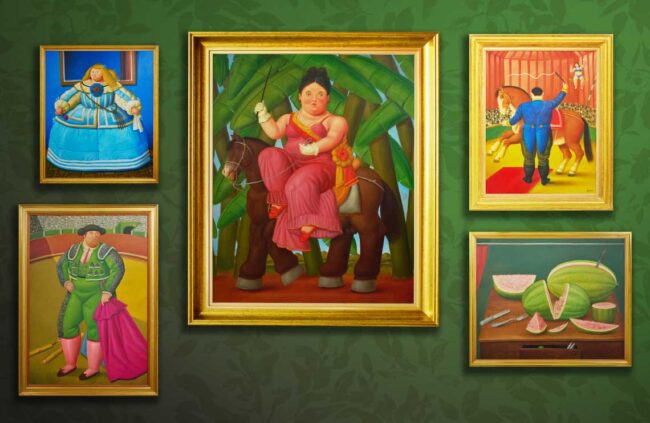
Botero in Singapore is the largest ever exhibition of the Colombian artist in Asia: Photo: Botero Foundation.
  •  

Colombia’s National Museum Marks 200 Years with “Inspire, Move, Convoke”

Two centuries after its founding in the turbulent aftermath of the Wars of Independence, the National Museum of Colombia is marking its bicentenary with one of the most ambitious exhibitions in its history. Inspirar, conmover y convocar: el Museo de la nación (1823–2023) opens this week in Bogotá, inviting visitors to reflect on 200 years of scientific curiosity, cultural formation, and collective memory in a country still redefining its national narrative.

The anniversary is more than a celebration of institutional longevity. It is a moment of self-examination for a museum conceived during the birth of the Republic and shaped by generations of scientists, historians, artists, and citizens. The museum was created by law on July 28, 1823, and inaugurated the following year, rooted in the vision of plenipotentiary Francisco Antonio Zea. During his diplomatic mission in Europe, Zea recruited a cohort of naturalists – including José María Lanz, Mariano de Rivero, Jean-Baptiste Boussingault, and François-Désiré Roulin – to establish a museum of natural history, along with a school of mines, a geography program, and a lithography workshop in the newly constituted Gran Colombia.

These early scientific figures navigated riverways and mountain passes to reach Bogotá, awaiting the young Republic’s final approval of their contracts. Their collections – birds, reptiles, minerals, anatomical studies, botanical illustrations, archaeological finds – formed the foundation of a museum that initially served as a scientific repository for a nation eager to document the vast richness of its territory. Drawings by artists such as Francisco Javier Matís and explorations ordered by Juan María Céspedes gave visual life to the landscapes and ancient cultures the Republic sought to understand and claim as part of its expanding identity.

But as the exhibition demonstrates, the museum’s role has never been static. If the early 19th century emphasized scientific discovery, later decades shifted toward the collection of historical objects, battle flags, ethnographic pieces, and cultural artifacts that broadened the institution’s mandate. Letters exchanged between luminaries De Rivero and Alexander von Humboldt, or between independence-era leaders such as Antonio José de Sucre and Gerónimo Torres, testify to the museum’s early symbolic power. Sucre himself donated the acso– a ceremonial mantle attributed to Atahualpa’s queen – and ordered that defeated Spanish flags be displayed publicly so Colombians could “witness the heroism” of their troops in the war for independence. These gestures turned the museum into a site where political memory and scientific knowledge intertwined.

Two hundred years later, the new exhibition reframes these layered histories through three major sections designed to show how Colombians have constructed, questioned, and reimagined national identity over time.

The first section, Guardar lo que eres (“Preserve What You Are”), looks back at the 19th century through illustrations, botanical specimens, and scientific journalis. These items reveal how the young nation sought to see itself—literally and symbolically—through classification, measurement, and representation. The pieces trace a lineage from early scientific expeditions to the first attempts to map Colombia’s natural and cultural diversity.

The second section, Superar la desventura (“Overcoming Hardship”), addresses conflict and reconstruction. Drawing on flags, legal documents, military archives, and early photographic material, it examines the ways Colombian society has grappled with political rupture, violence, and the challenge of rebuilding. While the exhibition includes objects from independence-era battlefields in Peru, Bolivia, and the Nueva Granada, it also connects more recent struggles with  reconciliation, and justice. The curators highlight that conflict-related objects—whether symbols of patriot triumph or testimonies of displacement and suffering—offer crucial insight into how Colombians understand the past and imagine the possibility of peace.

The third and final section is a celebration of life. Here, archaeological pieces, masks, contemporary artworks, and textiles created by Indigenous communities in Nariño and weavers from Charalá (Santander), emphasize the endurance of living traditions. Rather than presenting heritage as static, the museum foregrounds the constant reinvention of cultural expression—what it calls “a Colombia still weaving its future.”

In total, the exhibition brings together 168 pieces, including nearly 100 that had remained in storage for more than 50 years due to their fragility. Among them are old etchings, rare flags, and objects that once traveled down the Magdalena River to reach the high-altitude capital of Santa Fe de Bogotá. Their exceptional display marks a milestone for the institution and for the country’s historical patrimony.

Visitors encounter not only objects but immersive environments. A multisensory installation projects shifting images onto suspended fabrics, accompanied by a soundscape inspired by Colombian landscapes and local memories. Tactile stations offer replicas with ink and braille textures, making the experience accessible to diverse audiences. Interactive elements invite the public to create postcards, explore regional museum networks, and engage with a digital map linking Bogotá to 45 co-curated displays in 12 departments across the country. Each participating regional museum is exhibiting an object emblematic of its local identity, extending the bicentenary celebration far beyond the capital.

The exhibition reflects the museum’s evolution since its founding as a scientific cabinet of curiosities. Today, grounded in the principles of the 1991 Constitution – cultural diversity,  coexistence, protection of natural and cultural heritage – the National Museum positions itself as a space where collective histories intersect with citizen voices. The bicentenary, the museum highlights, recognizes that history is not a fixed record but an instrument for understanding present challenges and imagining future possibilities.

The exhibition at Museo Nacional runs until March 15, 2026, and includes guided tours and workshops. Admission is Free.

Museo Nacional. Cra 7 No.28-66.

www.museonacional.gov.co

  •  
❌