
Reading view

Paseo Millionario: don’t be taken for a ride

An express kidnapping highlights the risks of taking a taxi in Colombia’s capital. What happened, and how to avoid it happening to you.

A few rogue taxis among Bogotá's 55,000 are implicated in express kidnappings. Photo: S. Hide.
A few rogue taxis among Bogotá’s 55,000 are implicated in express kidnappings. Photo: S. Hide.

Bogotá breathed a collective sigh of relief on Tuesday morning when news broke of the safe arrival home of Diana Ospina, a rola missing for almost 40 hours after being kidnapped by a taxi she had hailed in the street after a night out in Chapinero.

Ospina was the latest victim of El Paseo Millonario, the ‘millionaire ride’, where passengers riding in yellow public taxis are physically attacked and forced to hand over cash and valuables.

The technique varies, but victims are usually targeted late at night in busy streets in party zones outside restaurants or discotheques, then driven to a quiet spot where two accomplices of the driver climb in the back seat and threaten the passenger with knives, guns or syringes.

See also: Bogotá’s Murder Mosaic

The following ordeal can last minutes or hours or even days. Victims are intimidated with beatings or stab wounds, and hooded or blindfolded. Some are killed, as in the case of a university professor found dead on the outskirts of the city in January this year.

Foreigners are also targeted: in 2013, a DEA officer Terry Watson was stabbed to death in a Bogotá taxi after two assailants jumped in the back seat. Authorities later said the army veteran resisted the attack. Seven taxi drivers were later captured and extradited to the U.S. to face charges for his murder.

According to police data, during 2025 in Bogotá there were registered 37 cases of kidnapping for ransom or extortion, though these crimes are highly under-reported. This is because the same gangs threaten the victims to keep quiet, and in the case of taxi gangs, know where their targets live.

Publicity blitz
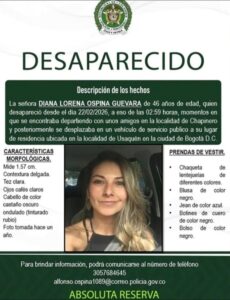
Poster for Diana Ospina, later found safe.
Police poster for Diana Ospina, later found safe.

In the case of Ospina, her kidnap started early Sunday morning when she hailed a yellow taxi that took her to within one block of her home in Engativá, where two men from a following taxi climbed in the back, threatened her and took her blindfolded for a three-hour driver around the city while using her phone and bank cards.

The ordeal did not end there. Ospina was then passed on to another kidnap group operating in the south of the city and held in a house there while more extortion demands were made. Late on Monday night, after being captive for nearly 40 hours, Ospina was dropped off in the hills above Bogotá where she eventually walked to a police station for assistance.

According to information on FM radio, from contacts close to the family, the kidnap gang released her after the “feeling pressure from the media blitz” with social media platforms widely publicising her disappearance. Other news reports stated they released her only after draining 50 million pesos (US$15,000) from her bank accounts.

This week the authorities were still hunting the perpetrators, expecting arrests imminently.

Your world in your phone

The Ospina case highlights how smartphones have upped the risks for kidnap victims in Colombia.

Whereas in the past a paseo millonario was usually a short-term event – passengers held for an hour while the gang used their bankcards at an ATM – criminals nowadays are eyeing much bigger profits from emptying bank accounts held on smartphones.

The insistence by banks and other financial platforms to use biometric approvals such as face recognition or fingerprint scanning has created the need for gangs to keep their targets captive for many days, in some cases drugging them into compliance or subduing them through threats of violence.

See also: Bogotá Police take down gang drugging victims in Teusaquillo and Chapinero

The rise of the digital nomads in Colombia often with juicy crypto accounts accessed through their phones has also created opportunities for tech savvy criminals. After such attacks, platforms are reluctant to reimburse funds arguing that they were transferred with the biometric approval of the victim.

One thing is clear: apart from increased financial losses, the longer victims are held captive the worse their outcome, both in terms of physical and psychological damage, the risk of sexual violence, or death from an overdose of the powerful drugs such as burundanga administered by the gangs.

The Canaries

Bogotá has more than 55,000 public taxis circulating on any given day sometimes referred to as ‘Los Canarios’ (the canaries) after their yellow cars and a popular telenovela depicting taxi drivers. It is worth noting that taxi drivers are themselves frequently the victims of robbery, extortions and murder.

Yellow taxi companies in Bogotá are registered and controlled by the Secretería de Movilidad with each driver given a Tarjeta de Control, the plasticized card hanging down the seat back that – in theory – displays the name, details and photo of the driver as well as the fare scale, and is revalidated every month.

In Bogotá, passengers can independently check the status of registered drivers by entering the numberplate into the menu at SIMUR at  www.simur.gov.co/conductores-de-taxi.

But in a random test by The Bogotá Post, out of 10 taxis entered by number plate, only six had a registered driver. Four were reported “without an active registration”.

That lack of control is further weakened by the fact that registered taxistas often allow other drivers to take the wheel, said transport companies this week.

“We work on good faith, but we can’t guarantee that drivers don’t hand over their cars to other persons to commit crimes,” Maria  Botero, manager of Radiotaxis told Noticias Caracol.

In the case of Ospina, the taxis that abducted her were quickly identified along with their owners, but not the actual attackers. One car was not currently registered on SIMUR.

Bogota´'s SIMUR taxi checker. In a random test by The Bogotá Post, only six out of 10 taxis were found to have a current registration.  Access the site here
Bogotá’s SIMUR taxi checker. In a random test by The Bogotá Post, only six out of 10 taxis were found to have a current registered driver. To do your own test, access the site here.

No dar papaya

How to avoid becoming a victim? A good tip is to use a ride platforms like Didi, Cabify, Uber or Indrive. Some like Didi are also linked to the yellow public taxis, but safer because the ride is traced. At times hailing a street taxi is the only option because app cars are far off, and you weigh the risks of standing on the street, or (as in the case of Diana Ospina) the app ride is suddenly cancelled.

Attacks are usually at night, on weekends, on persons leaving bars or restaurants. But passengers can be targeted in daytime, particularly in financial districts or leaving a bank. If you are riding the yellow taxis, here are some ways to no dar papaya, as they say in Bogotá (‘don’t be a sucker’).

Before going out:

  • Carry a clean phone with no banking apps and limited personal data. Many people in Bogotá are now leaving their financial transactions on a second phone or tablet stored safely at home.
  • Carry a wad of cash. Perhaps counterintuitively, in the digital world cash makes you less of a target. And it is easy to hand over.
  • If you do carry a bank card, take just one linked to a low-balance account.

Getting the taxi:

  • Travel in a group. Criminals generally target solo passengers.
  • Check the taxi numberplate in SIMUR, see above. This takes seconds and confirms if there is a registered driver. If not, walk away.
  • Take a photo of the taxi numberplate, send to friends or family. Ensure the driver sees you doing this.
  • Before entering a taxi, look carefully to ensure there is no-one hidden inside.
  • Check the Tarjeta de Control photo with the actual driver. Do this before setting off.
  • Check doors can be locked and unlocked from the passenger seat.

During the trip:

  • Lock doors on both sides.
  • Share your real-time location with a family member or friend.

Signs of danger:

  • The driver changes the route without explanation.
  • The taxi turns onto dark or deserted streets.
  • The driver suddenly stops to pick up other persons.
  • Motorcycles or other cars or taxis closely follow the vehicle.

During an attack:

  • Prioritize your physical safety.
  • Give up any valuables without resistance.

If you suspect someone you know has been abducted by a taxi gang, call the GAULA special police unit (Grupos de Acción Unificada por la Libertad Personal) that deals with extortion and kidnapping, on Line 165.

“Safe taxi” zones

Moment of terror; two attackers approach the taxi of Diana Ospina.

Even with these precautions, street taxis are still a risk, and a growing one according to Bogotá security authorities who during 2025 arrested at least 20 persons from several different Paseo Millonario gangs such as La 57 and La Zona T.

A recent advance by the city has been the recognition of the crime as “kidnap with extortion”, with up to 40 years in jail for perpetrators.

Another nitiative announced by the Secretaría de Seguridad this week was taxi seguro zones where uniformed teams patrol outside nightspots and assist revellers to take only registered taxis.

But while mediatic, such initiatives are likely to have only limited impact. Taxi gangs are generally compact, with three people, and mobile so they can cruise new zones. And new gangs seem to pop up as quickly as old ones are taken down.

So while the city can celebrate the safe return of Diana Ospina, and hopefully soon see her attackers rounded up, there will be plenty more candidates for the Millionaire Ride.  

The post Paseo Millionario: don’t be taken for a ride appeared first on The Bogotá Post.

  •  

Colombians now the biggest foreign contingent on Ukraine’s frontlines

Thousands of miles from Bogotá, in the frozen trench lines of eastern Ukraine, Colombian accents have become a familiar sound of war.

Between 1,000 and 2,000 Colombian nationals are currently serving in the ranks of the Armed Forces of Ukraine, according to recent investigations, while as many as 7,000 have passed through the country’s defence forces since Russia’s full-scale invasion in 2022. Their presence has turned Colombia into the single largest source of foreign fighters in Ukraine’s war effort – and estimated 25% – and an unexpected human bridge between two distant conflicts.

What might once have been dismissed as a story of mercenaries and combat-tested veterans has evolved into something far more complex: a shadowy window into the globalization of military labor.

Many of those arriving in Ukraine have witnessed close-hand Colombia’s internal conflict, which for more than six decades has forged one of Latin America’s most experienced armed orces. Trained in counterinsurgency, reconnaissance and irregular warfare, Colombian fighters bring a skillset that has proven adaptable to the grinding, attritional combat of the Donbas.

Ukrainian commanders have taken notice. In some units, Colombians have made up a majority of infantry personnel, valued for their endurance and battlefield discipline. Their roles range from trench warfare to fortification building and increasingly to drone operations, a defining feature of the war.

Yet their journey to the frontlines is rarely driven by ideology.

A steady stream of Colombian soldiers leaves active service each year, often in their late 30s or early 40s. While formal reintegration programmes exist, many veterans struggle to transition into civilian life. Salaries drop sharply after retirement, and the domestic private security sector is saturated. For some, Ukraine offers an economic lifeline.

Combat pay of between US$3,000 and US$5,000 a month – several times the average Colombian wage – is supplemented by signing bonuses and compensation packages for families in the event of death. The contrast is stark enough to turn war into a viable, if perilous, form of employment.

“Colombians understand the risks … yet they still come,” one Ukrainian officer involved in recruitment told local media.

The legal and political framing of these fighters remains contested. In December 2025, the Colombian Congress ratified the United Nations convention against mercenaries, a move backed by the leftist government of President Gustavo Petro.

Under the Convention’s definition, however, most Colombians serving in Ukraine are not considered mercenaries. They are formally integrated into Ukraine’s military structures, receive equal pay to local troops and operate under state command rather than private contracts.

Even so, President Petro has cast the phenomenon as a form of exploitation, warning of the risks faced by citizens drawn into distant war, including the conflict in south Sudan.

Those causes are visible not only in Colombia’s labor market but also in Ukraine’s evolving military structure. As the war has dragged on, Kyiv has reorganized its foreign units, integrating international volunteers into larger brigades to improve coordination and access to heavy weaponry. The shift has further embedded foreign fighters – Colombians among them – into the core of Ukraine’s defensive operations.

The human cost of this integration has been steep. Estimates from the Atlantic Council claim that between 300 and 550 Colombians have been killed in Ukraine since 2022, making them the foreign nationality with the highest number of combat deaths. In Kyiv, Colombian flags now appear among the growing patchwork of memorials to fallen soldiers – a quiet testament to the war’s global reach.

Despite the losses, recruitment has continued. Military analysts say the phenomenon reflects deeper structural failures. Colombia’s decades-long conflict produced a large pool of highly trained personnel, but the transition to civilian life has lagged behind. Skills honed in war have limited application in the formal economy, leaving many veterans in a precarious position.

This dynamic has fed what some researchers describe as a transnational market for military labor, operating in the grey zones of international law. Fighters move between conflicts not necessarily out of allegiance, but out of necessity – carrying their expertise with them.

The implications extend beyond Ukraine. Security analysts warn that the eventual return of battle-hardened veterans, particularly those trained in emerging technologies such as drone warfare, could pose risks if criminal organizations seek to absorb their skills.

For now, however, the flow continues in one direction.

On a recent winter evening in Kyiv, a Colombian veteran reflected on the reality behind the headlines. “Tell Colombians not to come,” he said quietly. “More die than return.”

It is a warning that captures the paradox at the heart of this story: a war that is both distant and deeply connected, drawing in those for whom the frontlines are not just a cause, but a last resort.

In that sense, the presence of Colombians in Ukraine is not an anomaly. It is a signal – of how modern conflicts intersect, and of how the consequences of one war can echo, years later, in another.

  •  

Tayrona Park closure highlights security risks on Colombia’s Caribbean coast

The Colombian government temporarily closed last week PNN Tayrona National Natural Park following threats against park staff and escalating violence between rival armed groups fighting for control of drug trafficking corridors along the Caribbean coast.

The shutdown, announced on Feb. 17 by Parques Nacionales Naturales de Colombia, was described as a preventive measure to protect visitors, local communities and officials.

“The National Government announced the temporary closure of PNN Tayrona as a preventive measure to protect the lives and safety of visitors, communities, and officials, and to ensure their security,” the agency said in a statement.

Tayrona, located near the city of Santa Marta in the foothills of the Sierra Nevada de Santa Marta, is one of Colombia’s most visited protected areas, drawing as many as 750,000 visitors annually. Known for its white-sand beaches and dense tropical forest, the park is a pillar of the tourism economy in the Magdalena department.

The closure comes amid an intensifying turf war between the Conquering Self-Defense Forces of the Sierra Nevada (ACSN) and the Gaitanist Army of Colombia (EGC), better known as the Clan del Golfo, a criminal organization designated as a terrorist group by the United States.

Authorities say the immediate trigger for the crisis was a Feb. 11 operation to dismantle unauthorized constructions within the protected area, including houses, bathrooms and hiking trails built without state permission.

According to the parks agency, the demolitions prompted threats on social media directed at park personnel. Tensions escalated on Feb. 16 when local residents blocked employees from entering the park. Officials said individuals then began charging tourists for access and allowing entry without formal registration, effectively taking over certain administrative functions.

“This created a situation that prevents a minimum level of security from being ensured within the protected area,” authorities said.

While the government has not formally attributed responsibility for the threats, the timing of the closure has drawn attention to the deteriorating security environment in northern Colombia. Recent confrontations between the Clan del Golfo and the ACSN in nearby municipalities, including Aracataca, have led to forced displacements and heightened fears about the stability of the region.

Colombia’s Ombudsman’s Office has previously warned of the presence of both groups in and around Tayrona, citing risks ranging from extortion to sexual violence. The violence, analysts say, reflects a broader struggle for control over strategic drug trafficking corridors extending into the departments of Cesar and La Guajira.

Yet the official narrative has been complicated by contrasting statements from government negotiators engaged in talks with the ACSN.

Mauricio Silva, the government’s chief negotiator in a socio-legal dialogue with the ACSN, said the decision to close the park was driven largely by climatic and preventive considerations. While acknowledging the existence of security risks and territorial control by armed groups in parts of the Sierra Nevada, Silva said it would be inappropriate to assign criminal responsibility without completed judicial investigations.

“One thing is to recognize the delicate security situation in the territory, and another is to point to specific perpetrators without proof,” Silva said, underscoring the government’s cautious position amid ongoing negotiations.

Local tourism operators have also questioned the link between the closure and the armed conflict. Some community leaders argue that the dispute stems in part from longstanding grievances over how ticket revenues are managed. They contend that funds collected by the central government are not sufficiently reinvested in infrastructure and local development within the park and surrounding communities.

The crisis has exposed deeper tensions over who exercises effective authority in one of Colombia’s most emblematic tourist destinations. Indigenous communities, national authorities and armed groups all operate in the broader Sierra Nevada region, where state presence has historically been uneven.

Although tourists in Tayrona have generally been insulated from direct violence — with armed groups preferring to profit indirectly through extortion, drug trafficking and prostitution — the park’s closure has raised concerns that the conflict could increasingly disrupt legitimate economic activity.

For the department of Magdalena, where tourism  depends on Tayrona as key source of revenue, the shutdown represents both a security and economic setback. Hotel operators and tour agencies in Santa Marta have reported cancellations since the announcement, though officials have not provided a timeline for reopening.

The government has said the closure will remain in effect until minimum security conditions can be guaranteed. Meanwhile, the dispute underscores the fragile balance between conservation, tourism and public saefty in a region where armed actors continue to expand their territorial control.

  •  
❌