Apple is working on a new MacBook Pro that could launch next week ahead of the "Special Experience" planned for March 4, so we thought we'd highlight all of the rumors about the device so far.
Design
There are no rumors of design changes, and we are expecting the upcoming M5 MacBook Pro models to look just like the M4 versions. Apple will continue to offer 14-inch and 16-inch size options, both of which should come in M5 Pro and M5 Max varieties.
M5 Max and M5 Pro Chip
We already got the base model 14-inch MacBook Pro with the new M5 chip in October, so what we're expecting are upgraded 14-inch and 16-inch models with M5 Pro and M5 Max chips.
The M5 family is built on a more advanced N3P 3-nanometer process from TSMC, and it offers speed and efficiency improvements. The M5 chip is up to 20 percent faster in multi-core CPU performance than the M4 chip, and we could see similar improvements for the M5 Pro and M5 Max chip options. GPU performance is up to 30 percent faster.
With the M5, Apple added a Neural Accelerator to each GPU core, improving the speeds of GPU-based AI workloads. The chip also supports third-generation ray-tracing, second-generation dynamic caching, and enhanced shader cores.
The 16-core Neural Engine is more energy efficient than before, and unified memory bandwidth has improved significantly. These are all features that we're likely to see with the M5 Pro and M5 Max chips as well.
Other Possible Updates
We haven't heard rumors about any other features coming to the MacBook Pro line. Apple did update SSD speeds for the M5 MacBook Pro models, so we could see the same upgrade to the M5 Pro and M5 Max machines.
Why You Shouldn't Buy an M5 Pro/Max MacBook Pro
If you're not in serious need of a new MacBook Pro right away, early 2026 is a bad time to upgrade. The next-generation MacBook Pro after the early 2026 models is expected to feature an OLED display and touchscreen capabilities, both of which will mark a major upgrade in display quality. It's expected to include a Dynamic Island instead of a notch, and macOS will be optimized for touch interactions.
Most people shelling out extra money for a MacBook Pro with a higher-end M5 Pro or M5 Max chip need the extra performance or display quality, so it is worth waiting for the huge update that's coming.
The transition to OLED will also likely bring a design update along with M6 Pro and M6 Max chip technology, which is another reason to wait.
Of course, the new features could be limited to higher-end MacBook Pro models or could be significantly more expensive. If you're on a budget, need a Mac now, or don't care about OLED, the M5 Pro and Max models could still be worth considering.
Launch Date
The new MacBook Pro models could be announced via press release next week ahead of Apple's Special Experience.
In October 2025, Apple notified the European Commission that it would be acquiring invrs.io LLC's sole employee, and certain assets from the company. Following a four-month waiting period, the European Commission published this information this week.
That sole employee appears to be Martin Schubert, according to his LinkedIn profile. Schubert founded invrs.io in 2023 to advance AI-guided design, initially focusing on optical and photonics technologies for AR/VR, data centers, and more.
"Invrs develops open-source frameworks for photonics research, providing standardized simulation challenges and a public leaderboard for benchmarking and comparing design results," reads a notice on the European Commission's website.
Schubert's systems could be useful for future Apple Vision Pro development, but it is unclear exactly what he was hired to work on at this point. He previously worked at Alphabet's X, on AI-powered photonic design, and at Meta.
Last month, Apple announced that it acquired Q.ai, an Israeli startup working on AI technology for audio. That was reportedly Apple's second-biggest acquisition ever, with the deal valued at nearly $2 billion. Apple's largest acquisition was the headphone brand Beats, which it bought for $3 billion in 2014. Apple Music launched a year later, and it was built on the foundation of the former Beats Music streaming service.
Polizisten gehen bundesweit gegen mutmaßliche politische Kriminalität im Netz vor. Unter Führung des Bundeskriminalamts laufen rund 140 Ermittlungsverfahren, es geht vor allem um Postings in sozialen Medien.[mehr]
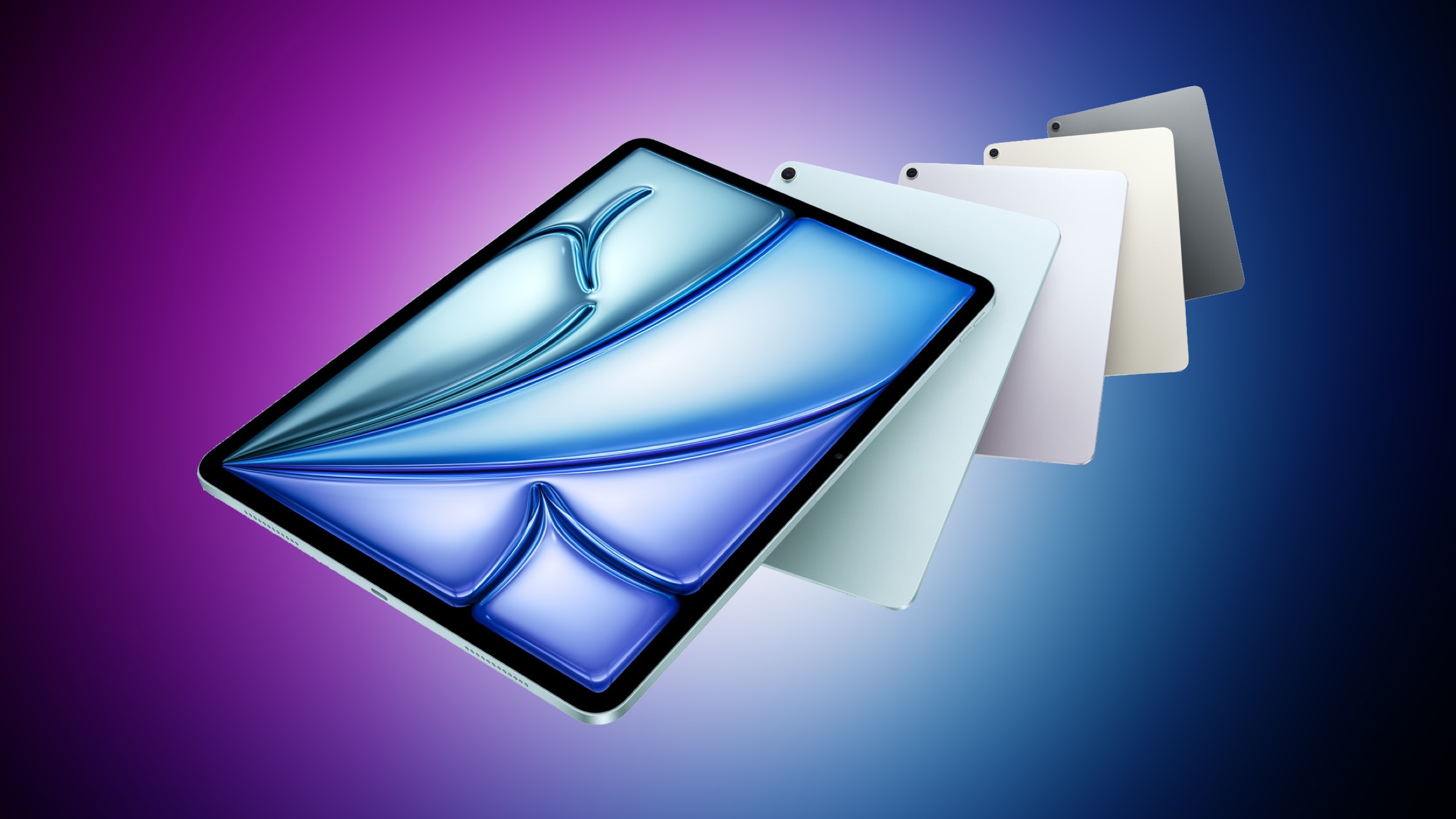
Apple is planning to hold an "Experience" on March 4 for select members of the media, and in the days before the event, we're expecting several product refreshes. The iPad Air is one of the new devices that could get an update, so we thought we'd highlight what's coming.
Design and Display
There are no design changes rumored for the iPad Air, so we can expect the same 11-inch and 13-inch size options.
The iPad Air is thicker and heavier than the iPad Pro, and it uses a standard LED display instead of OLED technology. The iPad Air will eventually be upgraded to OLED, but for now, the higher-end display technology will remain limited to the iPad Pro. The iPad Air also doesn't support ProMotion, and there's no sign that Apple is planning to add it.
The iPad Air will continue to feature USB-C, a Touch ID top button, and the same front and rear cameras.
It's possible there will be a new color option, but it's not guaranteed with a minor refresh. No new accessories are rumored, and it will continue to work with the Magic Keyboard and the Apple Pencil Pro.
M4 Chip
Apple has been updating the iPad Air with an M-series chip that's a generation behind the chip in the iPad Pro. Since the iPad Pro was updated in October 2025 with the M5, the iPad Air is set to get the M4 chip.
The M3 in the current iPad Air and the M4 chip are both built on a 3-nanometer process, but the M4 has an updated process that brings speed and efficiency improvements.
There are up to 10 CPU cores instead of 8, the Neural Engine is faster, and there's more memory bandwidth. The GPU is also more power efficient for potential battery gains. The M4 CPU is up to 30 percent faster than the M3 CPU, while the GPU is up to 21 percent faster.
The iPad Air already supports Apple Intelligence, and the next-generation model will continue to do so. Apple increased the RAM in iPad Pro models with higher storage tiers, but there's no word on whether that same change will come to the iPad Air. Current models feature 8GB RAM, the minimum for Apple Intelligence.
Charging
The iPad Pro gained faster charging with the M5 update, and that's something that could trickle down to the iPad Air.
N1 Networking Chip
The iPad Air is likely to adopt the N1 networking chip that Apple first introduced in the iPhone 17 models.
The N1 chip is an Apple-designed Wi-Fi and Bluetooth chip that offers connectivity and efficiency improvements compared to the third-party chips that Apple has used in previous devices. The N1 supports the latest Wi-Fi 7 and Bluetooth 6 technology.
The current iPad Air offers Wi-Fi 6E support, so the next-generation model could see faster Wi-Fi speeds on compatible networks with Wi-Fi 7.
Apple Modem
Apple used the C1X in the M5 iPad Pro, and the cellular versions of the iPad Air will get that same modem chip. The C1X is an upgraded variant of the C1, Apple's first in-house modem chip.
It offers performance on par with Qualcomm chips, though 5G connectivity is limited to sub-6GHz with no support for mmWave 5G. That's not an issue on the iPad, because the current version of the iPad Air doesn't support mmWave.
Apple's modem chips are much more power efficient than Qualcomm modem chips, and are able to better integrate with other iPad components.
Pricing
There are no rumors of a price increase, so the 11-inch model is expected to continue to start at $599, while the 13-inch model will start at $799.
Launch Date
The iPad Air could come out as soon as next week, ahead of Apple's March 4 Special Experience.
The Dynamic Island will replace the notch, leaving more available screen space for content. As with the iPhone's Dynamic Island, the Mac Dynamic Island will be interactive and it will contextually expand based on the app or Mac feature in use.
Apple is updating macOS to make it more touch friendly. Users will be able to tap or click on-screen elements, and controls will change based on input method. If a user taps on a menu bar item, for example, it will display a larger set of controls optimized for touch. Touch-based options will be integrated throughout macOS, and it will support iPad features like pinch gestures for zooming in or out and fast scrolling.
The new MacBook Pro will be the first Mac that supports touch gestures on the display, despite Apple's insistence over the years that it would not bring touch-based technology to the Mac. Apple did experiment with an OLED Touch Bar in prior MacBook Pro models, but ultimately removed it after it proved to be unpopular. Apple apparently is not going to advertise the MacBook Pro as a touch-first device like the iPad, and will let customers use touch and mouse gestures interchangeably for all functions.
Along with a touchscreen and OLED display technology, the MacBook Pro could have an updated design with a slimmed-down chassis, but it will look a lot like the current MacBook Pro. Apple is not removing the keyboard or the trackpad, and sizes aren't expected to change. Apple is planning for OLED versions of both the 14-inch and 16-inch MacBook Pro models.
Apple plans to update the MacBook Pro with M5 Pro and M5 Max chips this spring, but the OLED MacBook Pro models will adopt the M6 Pro and M6 Max chips, built on Apple's new 2-nanometer process. The OLED MacBook Pro models are expected to launch toward the end of 2026, so Apple is planning for two MacBook Pro refreshes in 2026.
The Struggle Continues: students painting murals at the Universidad Nacional last week. Photo: S Hide.
Student leaders declare ‘indefinite strike’ at Bogotá’s sprawling Universidad Nacional as controversial rector reappointed.
In another twist in the saga of who runs the ‘Nacho’, Colombia’s largest public university, controversial candidate Ismael Peña was formally inducted as rector last week ending a two-year legal wrangle.
Peña was sworn in during a small private ceremony on Thursday just days after a Bogotá tribunal ordered his reinstatement in the job. This followed the resignation last November of another rector whose possession was ruled illegitimate by Colombia’s state council.
The initial controversy was sparked in 2024 in the highly politicized campus when a popular candidate, Leopoldo Múnera, lost out to Peña in the last voting round by the university council.
#BOGOTÁ | Este es el panorama a esta hora (6:53 p.m.) en la calle 26 a la altura de la Universidad Nacional.
Los servicios troncales que transitan realizan retornos en Corferias y Concejo de Bogotá.
The ensuing strikes and protests galvanized the university for four months setting back the academic agenda and creating an exhausting three-term year in 2025, from which students and professors are only just recovering.
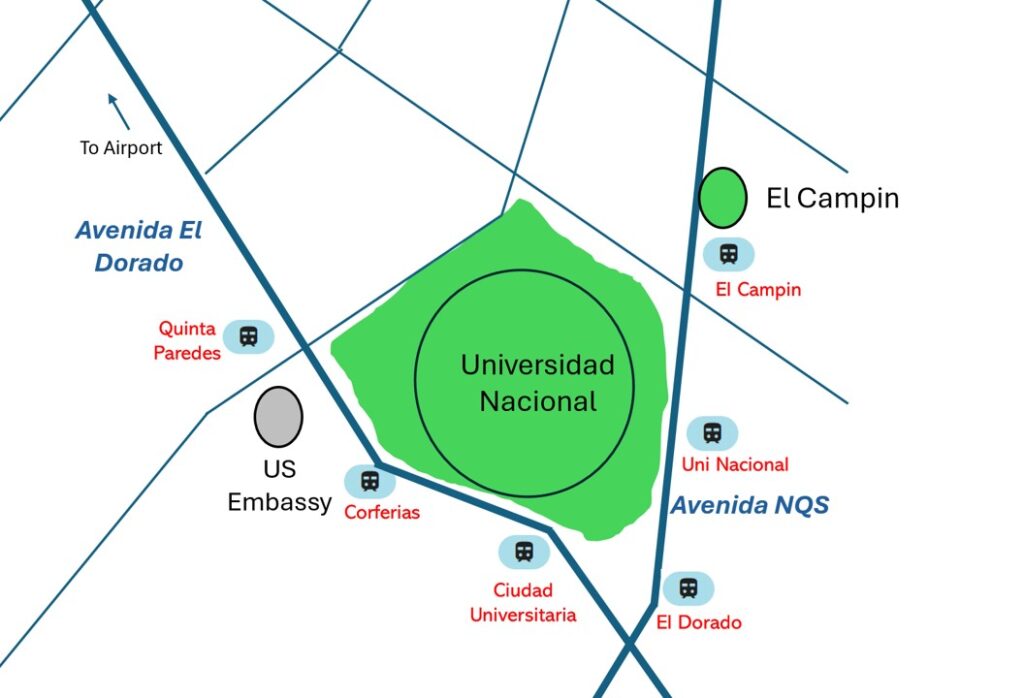
Protests and vandalism spilled over onto major nearby transport routes around the Bogotá campus. In Bogotá, the Nacho sits in the corner of the busy Avenida NQS and Avenida El Dorado, two of the most vital throughfares for both public and private transport.
Bogotá’s Universidad Nacional campus sits on the junction of the city’s main transport routes.
Return of Torres
Mural of Camilo Torres.
Even as news of Peña’s legal victory and imminent reinstatement was announced last week, students and supporters quickly blocked the Avenida El Dorado forcing Transmilenio buses to suspend operations and thousands of commuters to make their way on foot.
Student assemblies at the university’s two main campuses, Bogotá and Medellin, called for “indefinite strikes” to protest Peña reinstatement.
To add to the confusion, the Bogotá campus was also invaded by a large group of campesinos from Cauca whose later protests detained workers in government buildings, part of a plan to draw attention to conflict-related problems in their department.
On Friday, when The Bogotá Post visited the university, most of the faculties were closed but the campus was filled with students busy painting fresh murals to celebrate the return of the remains to the campus of Camilo Torres, a revolutionary priest and founder of the university Sociology Department, who joined the ELN guerrillas and was killed in action against the army in 1966.
Many students gave their views on the return of Peña but declined to be fully identified.
Roberto, a sociology student selling food in the campus, said he supported the strike to “preserve the autonomy of the university”. Peña was seen as an unpopular candidate “linked to private interests that will privatize the curriculum and syphon off profits”, he said.
Corporate spinoffs
Similar sentiments were expressed across the campus: that Peña was being parachuted in with the backing of the Centro Democratic party to advance both a right-wing agenda and disburse lucrative contracts to a select group of private companies.
According to an investigation by magazine La Raya last year, Peña was the continuity candidate for “a parallel administration system” embedded in a company called Rotorr that dished out deals on behalf of the university, but bypassed internal auditing procedures leaving an opaque tangle of beneficiaries.
During his rectorship Múnera described these corporate spinoffs as engaging in “crimes against the university” and flagged them to the judicial authorities, but so far with no clear resolution.
Despite these controversies, Peña’s return was boosted by support from the Consejo Superior Universitario, the highest decision-making body of public universities in Colombia, that unanimously agreed to respect the tribunal ruling, clearing any final legal hurdles.
Strike Down
In another unexpected outcome, an online poll of students revealed that a majority were against the suspension of classes.
The initial strike call came after a hastily convened student assembly on the Bogotá campus where some student representatives later complained that their voices were not heard.
“There was one classmate, he raised his hand and they wouldn’t let him speak. So, the next day we decided to conduct a survey to ask the students if they agreed with the strike,” student representative Kevin Arriguí told City TV.
The results, based on a total of 5,438 respondents, showed that 56 per cent (3,060 students) disagreed with the strike, while only 36 per cent (2,141 students) supported it. There were 237 undecideds.
Tellingly, the online strike survey had a higher participation among students than last year’s vote to install a Constituyente Universitaria – a people’s body – that is now in place.
Some students consulted on the campus by The Bogotá Post last week were mindful of the outcome of the 2024 strike which lasted several months and created hardships, particularly for poor students from rural areas who had spent money to travel to the capital to study, only to face severe interruptions to their curriculums and the risk of having to study another year to gain their degrees.
“We don’t want Peña. People are angry. But we don’t want to stop the term either,” said Carla, a student outside the newly constructed 70,000-million-peso arts faculty building.
Bogotá is Colombia’s protest capital with thousands of events every year. Photo: S Hide.
Fragile mobility
Finding a compromise could be problematic. Activists on the campus were pressuring undergraduates to not attend classes and most lessons were abandoned. Some professors offered their classes on-line.
The student assembly planned this week at the Bogotá site could reverse the strike plans, though this seems unlikely. The general mood among students on the campus was that they would “block Peña, whatever it takes”.
Such talk is common at a university that is a petri dish for the national condition and at times – literally – a battleground for political divisions, particularly in a city nominated as the country’s “protest capital”.
This was revealed by data published in an El Espectador op-ed this week which showed Bogotá had 1,678 mass mobilization recorded during 2025, roughly 32 per week, and an increase of 17 per cent on the previous year.
While celebrating this increase as a “symptom of democracy”, it also pointed out that these protests “affected public order and the fragile mobility of millions of Bogotanos”.
That included two million people using the Transmilenio each day, with a majority of these on lines passing close to the Universidad Nacional. Easy targets for agitators based on the campus.
Which is why trouble at the Nacho generally means headaches for the whole city.
Apple has announced that Foxconn will begin assembling some Mac mini computers at a factory in Houston, Texas later this year.
"Apple is deeply committed to the future of American manufacturing, and we're proud to significantly expand our footprint in Houston with the production of Mac mini starting later this year," said Apple CEO Tim Cook, in a press release.
Apple is also expanding AI server manufacturing at the Houston factory, and it is opening a new Advanced Manufacturing Center in the city later this year. The dedicated facility will "provide hands-on training in advanced manufacturing techniques to students, supplier employees, and American businesses of all sizes."
Mac mini units assembled in the U.S. will primarily serve the U.S. market, while production will continue in Asia for orders abroad, according to Khan.
As the report notes, the Mac mini is a niche product for Apple, with research firm Consumer Intelligence Research Partners estimating that the desktop computer accounted for only 5% of Apple's global Mac sales last year. In 2024, the Mac mini received its first major redesign since 2010, along with M4 and M4 Pro chips.
In the U.S., the Mac mini starts at just $599, but customers must supply their own display, keyboard, and trackpad or mouse.
Apple touted assembly of the Mac Pro desktop tower in Texas in 2019, during U.S. President Donald Trump's first term, but it had been assembling the computer there since 2013. Apple's plan to begin assembling some Mac mini units in the U.S. comes during Trump's second term, and this time it does involve some assembly shifting stateside.
Apple said it is on track to purchase more than 100 million chips from TSMC's Arizona factory this year, and it has directed TSMC and Texas Instruments to purchase bare silicon wafers from GlobalWafers' new factory in Sherman, Texas.
How to choose the best open source project management software
Finding the right project management software for your organization can be a challenge — especially when you want a solution that is transparent, flexible, and gives you full control over your data.
Open source project management tools are increasingly popular in 2026, as many organizations look for alternatives to proprietary platforms, rising licensing costs, and cloud-only solutions. At the same time, requirements around data privacy, security, and compliance continue to grow — particularly for public institutions and regulated industries.
To help you make an informed decision, we have updated our overview of the top open source project management software in 2026. The tools listed below differ in focus and strengths: some are built for agile teams, others for software development workflows, and others for full-featured project planning across an organization.
When comparing project management software, make sure to consider:
Feature set and supported methodologies (classic, agile, or hybrid)
Hosting options (cloud vs. self-hosted)
Data protection and privacy strategy
Community activity and long-term maintenance
Pricing and available support options
The tools listed in this article are widely used and well-established open source solutions, each with different strengths depending on your organization’s needs.
Here are our 5 top open source project management tools to consider in 2026:
OpenProject is a widely used open source project management platform, licensed under GNU GPL v3.
Best for in 2026: organizations looking for a secure solution that supports classic, agile, and hybrid project workflows.
Free and open source software
The software code is freely available on GitHub. All changes to the source code are transparently traceable at any time. With OpenProject, there is no vendor lock-in.
OpenProject meets high data protection and security requirements. The company, based in Berlin, Germany, focuses on developing a secure and privacy-compliant European alternative for project management and team collaboration. Read more about security and privacy conditions at OpenProject.
Data sovereignty
With OpenProject, users retain full control over their data. With the self-installed version hosted on own servers, OpenProject offers a high level of data sovereignty. Alternatively, hosting is provided on demand on secure servers within Germany. OpenProject follows a strict privacy approach and does not rely on user tracking within the application. Read the OpenProject privacy policy.
Secure hosting
If you don’t have the capacity or knowledge to host OpenProject in your environment, the Enterprise cloud edition offers secure hosting in the EU.
Feature set
OpenProject maps the entire project lifecycle, from project planning and execution to project controlling and closure. The software supports classic, agile, and hybrid project management.
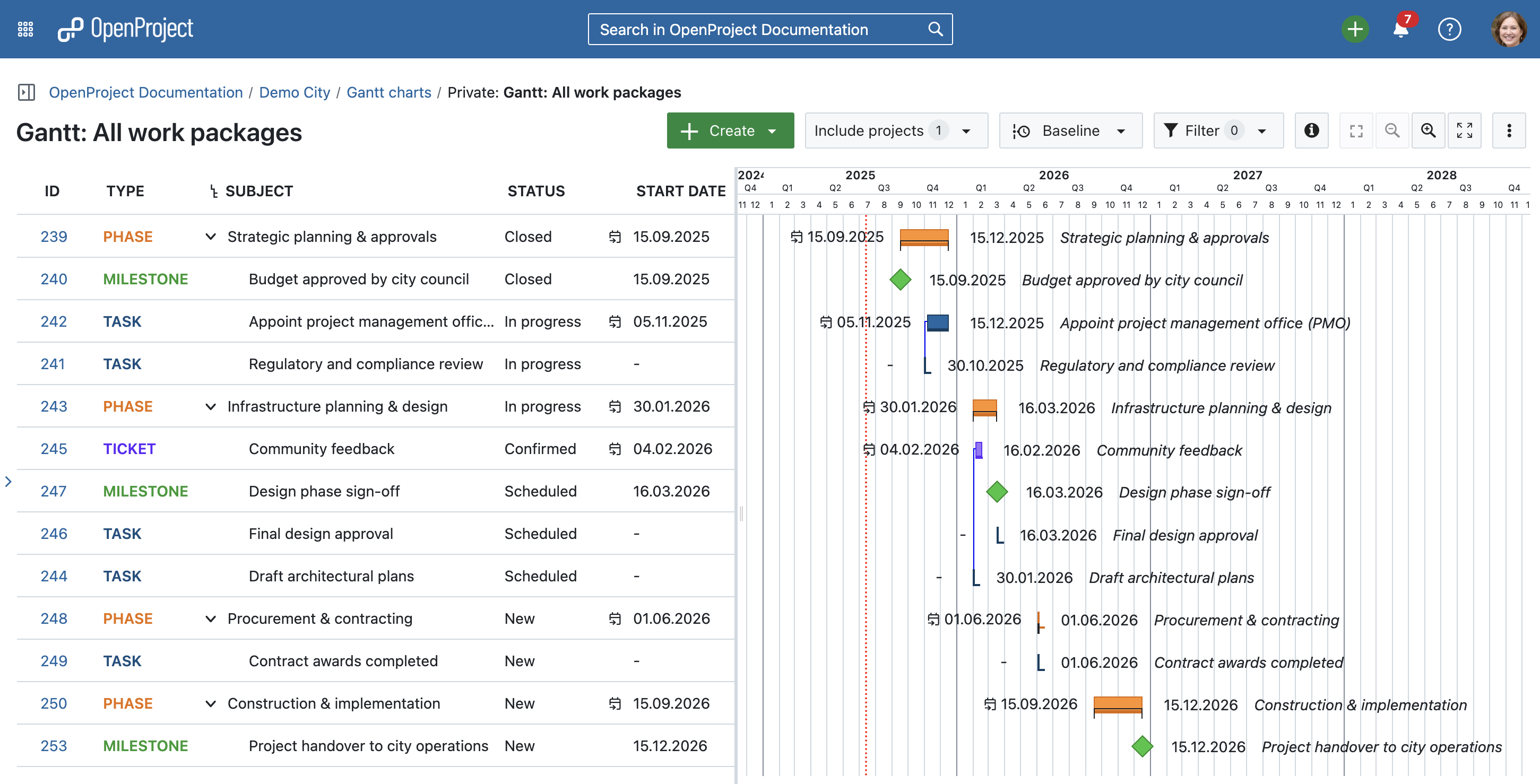
It includes extensive project management functions such as project and milestone planning (Gantt charts), task management, agile boards, meetings, project wiki, forums, time and cost tracking, budgets, and more. See OpenProject collaboration features.
Configuration
The software is flexibly configurable and can be adapted to individual requirements. With a powerful API, additional systems can be connected if required.
Part of openDesk
OpenProject is part of openDesk, an open source office and collaboration suite for the German public sector. Learn more about openDesk.
Active maintenance and development
OpenProject is continuously developed and maintained by an active developer Community. New features, improvements, and updates are released regularly. To learn more, take a look at the OpenProject roadmap.
The OpenProject Community edition is free of charge and self-hosted. All essential project and task management features are included in this free version.
OpenProject also offers a 14 days free trial to explore the Enterprise edition in practice — no credit card required, and you won’t receive unwanted marketing emails.
Redmine
Redmine is a long-established open source project management and issue tracking tool, licensed under GNU GPL v2.
Best for in 2026: teams looking for a lightweight, self-hosted solution focused on issue tracking and extensibility through plugins.
Feature set
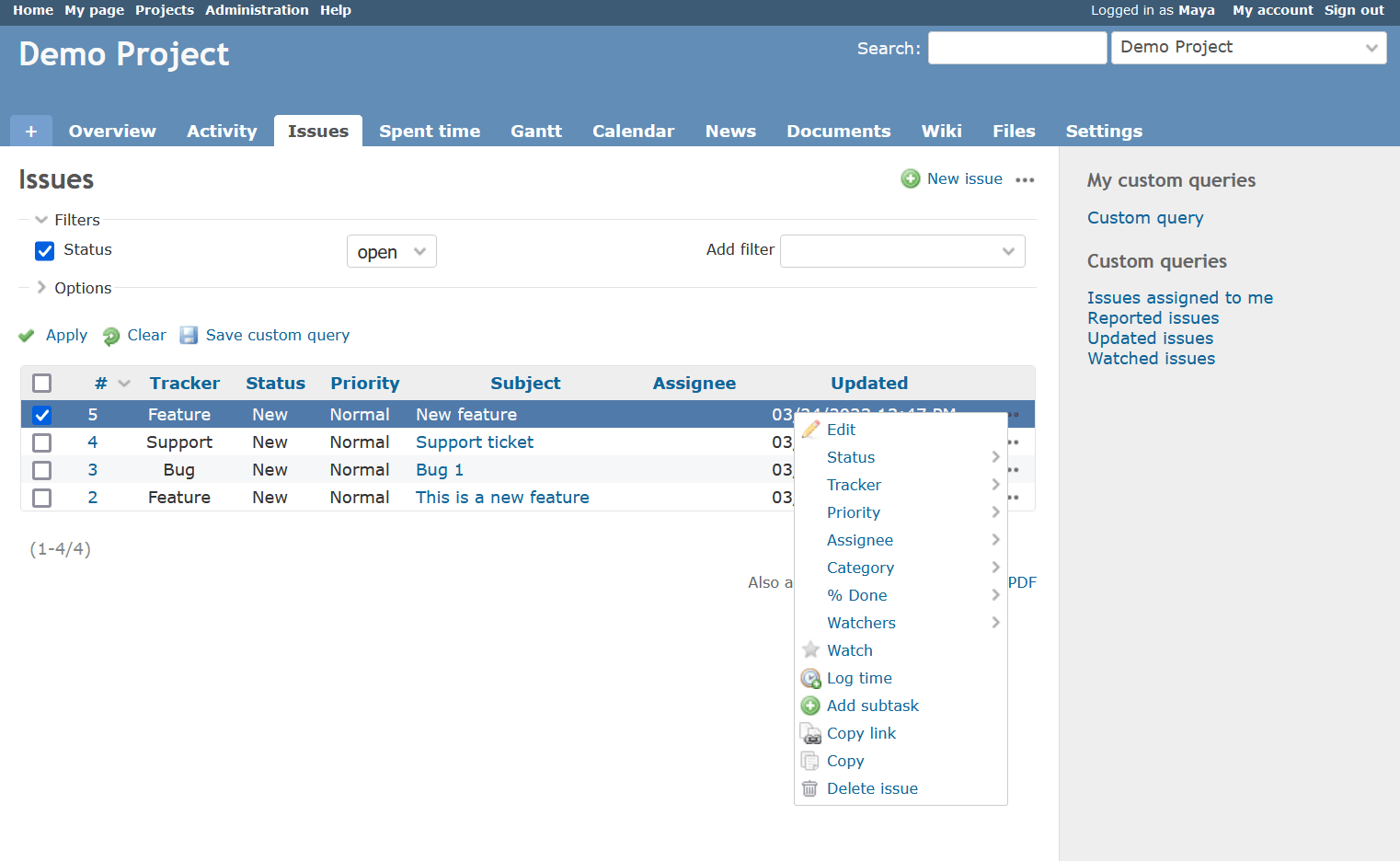
Redmine combines project management with strong issue tracking capabilities. It is particularly popular among technical teams who want a flexible tool for managing tasks, bugs, and workflows.
Key features include:
Issue and task tracking
Project and role-based access management
Custom fields and workflows
Wiki and documentation features
Plugin ecosystem for extending functionality
Redmine is often chosen for its simplicity and adaptability. However, compared to more modern platforms, it may require additional configuration and plugins to cover advanced project planning features such as Gantt-based scheduling or portfolio management.
Redmine is primarily designed for self-hosting, giving organizations full control over where their data is stored. This makes it a common choice for teams with strict infrastructure or compliance requirements.
Pricing
Redmine is free to use as open source software. Costs typically depend on hosting, maintenance, and whether professional support is provided by third-party vendors.
GitLab
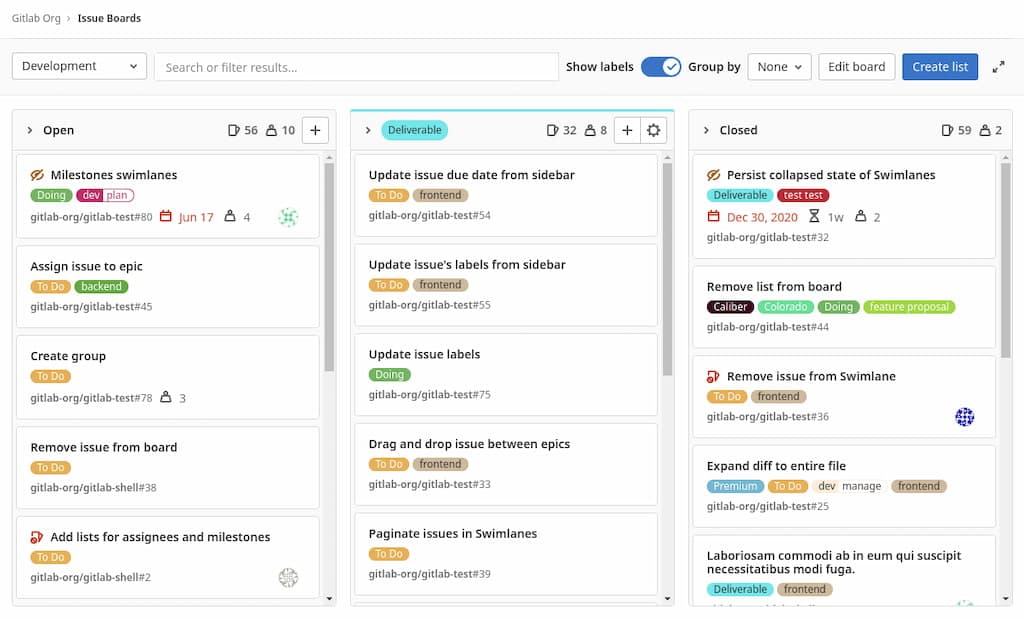
GitLab is a source code management and DevOps platform that can also be used for project planning and collaboration. It is licensed under an MIT open source license and has a clear focus on software development teams.
Best for in 2026: software development teams looking to manage code, CI/CD, and project planning in one integrated platform.
GitLab offers a broad feature set to support the entire software delivery lifecycle. In addition to version control and DevOps functionality, it includes project management features such as issue tracking, agile boards, workflows, and timelines.
GitLab is especially strong for teams that want to connect project work directly to development processes. However, features such as budgeting, cost tracking, or more advanced project portfolio management are not a core part of GitLab’s offering.
Tip
If you are not entirely convinced by the GitLab offering in terms of project management, but like its feature set, you can use OpenProject with its GitLab integration.
GitLab is available both in the cloud and as a self-hosted on-premises solution. The self-managed version provides full control over your data and infrastructure.
GitLab.com, the hosted cloud offering, is primarily operated on Google Cloud infrastructure in the United States. For organizations with strict compliance requirements, hosting location and applicable regulations should be reviewed carefully.
Pricing
GitLab offers a free tier with limited features. Paid plans provide additional functionality and support, with pricing depending on the selected edition and team size. GitLab also offers a free trial for its paid plans.
Tuleap
Tuleap is an open source project management and application lifecycle management (ALM) platform, licensed under GNU GPL.
Best for in 2026: agile software development teams that need structured planning and lifecycle management in one open source platform.
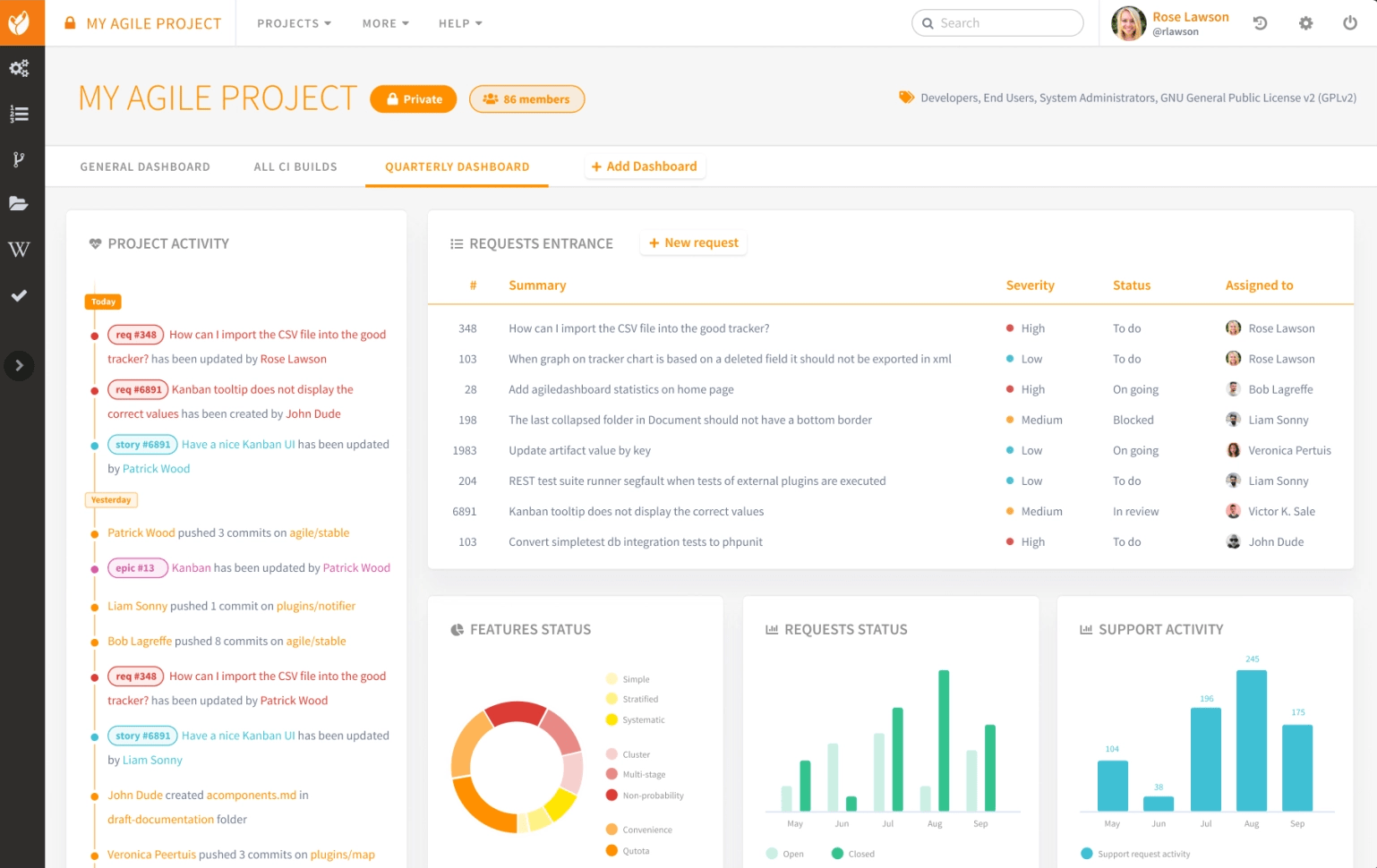
Tuleap provides a comprehensive set of agile project management features, including task boards, backlogs, Kanban boards, burnup and burndown charts, and dashboards.
In addition to agile planning, Tuleap supports software development workflows such as test management and project tracking, making it particularly relevant for teams working in regulated or complex development environments.
For organizations looking for a broader project management approach, Tuleap’s focus on agile and ALM may feel more specialized. Traditional project management features such as Gantt-based scheduling, budgeting, or cost tracking are not as central as in other tools.
Tuleap is available both as a cloud solution and as a self-hosted on-premises edition.
For the premium cloud version, hosting providers are available in several regions, including France, Switzerland, the USA, the UK, Korea, and others. Organizations with specific compliance requirements should review the hosting setup carefully depending on the chosen plan.
Pricing
Tuleap does not offer a fully free cloud version. Pricing depends on the selected edition and hosting model, and a free trial is available upon request.
Taiga
Taiga is an open source project management software whose beginnings date back to a Kaleidos hackathon in 2013. It is licensed under MPL 2.0.
Best for in 2026: agile teams looking for a simple and visually intuitive tool focused on Scrum and Kanban workflows.
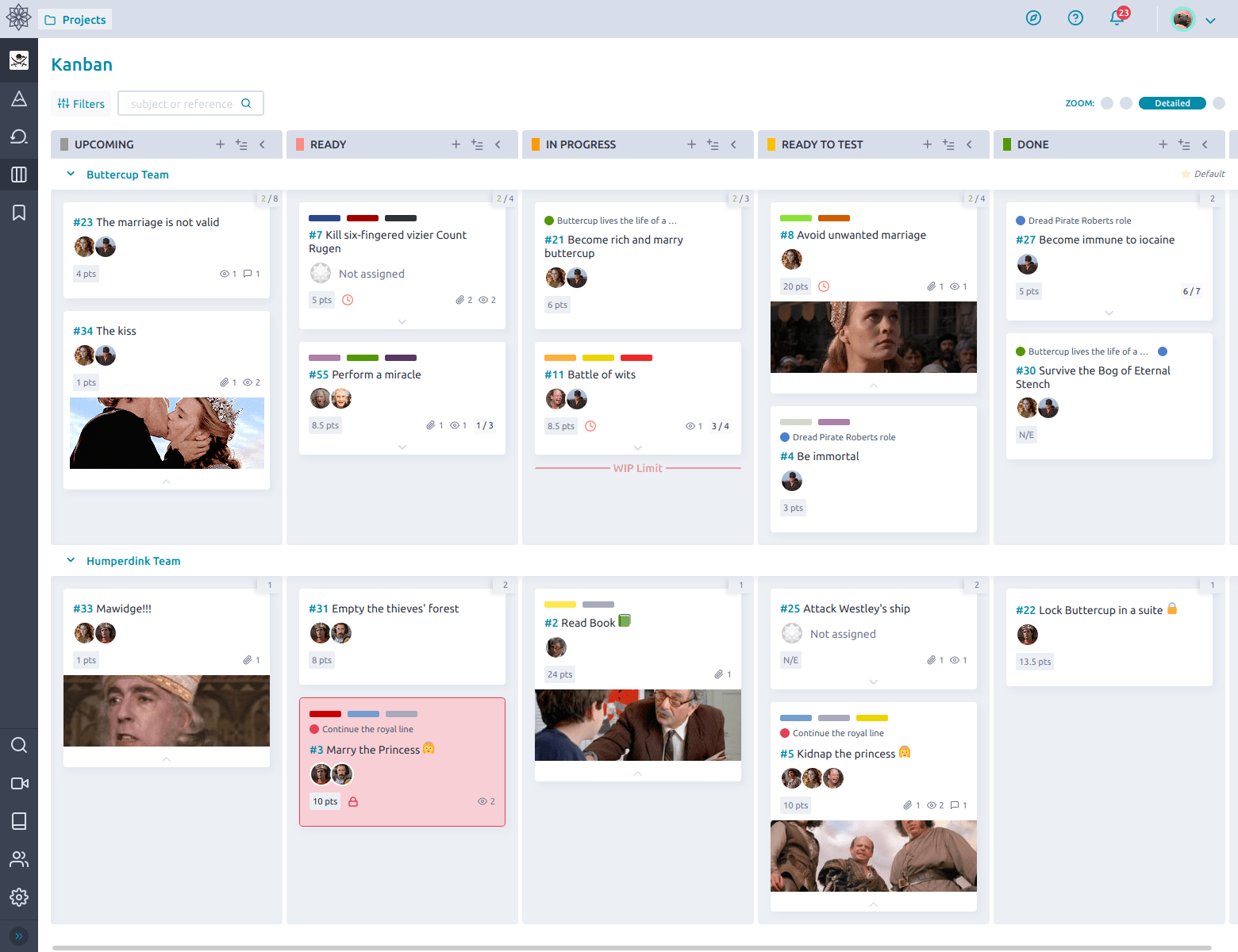
Taiga was created with the goal of providing an accessible and user-friendly agile project management tool for developers and designers.
It offers a comprehensive feature set for agile methodologies, including:
Kanban boards
Product and sprint backlogs
Issue tracking
Estimation tools
Dashboards and reporting features
Taiga is well suited for teams working primarily with Scrum or Kanban. However, classic project management features such as Gantt charts, budget tracking, or broader portfolio planning are not part of its core focus.
Taiga is available both as a cloud solution and as a self-hosted on-premises edition.
The cloud version is hosted in the European Union via AWS, which can be relevant for organizations that require GDPR-aligned hosting.
Pricing
Taiga offers free cloud and self-hosted options. Paid plans provide additional services such as premium support, with pricing depending on the selected edition.
Compare the top 5 open source project management software in 2026
Choosing the best project management software for your organization depends on a variety of criteria, including the features and workflows you need, the size of your team, and your hosting and data privacy requirements.
All listed open source project management tools have their own strengths and are suited for different use cases — from lightweight issue tracking to full-featured hybrid project planning.
If you are looking for an open source project management software in 2026, we recommend taking a closer look at OpenProject, Redmine, GitLab, Tuleap, and Taiga.
To give you a quick summary:
Tool
Best for in 2026
Hosting options
OpenProject
Hybrid project management across teams
Cloud + self-hosted
Redmine
Lightweight issue tracking and plugins
Mainly self-hosted
GitLab
DevOps teams managing code + planning
Cloud + self-hosted
Tuleap
Agile planning + lifecycle management
Cloud + self-hosted
Taiga
Scrum and Kanban teams
Cloud + self-hosted
OpenProject supports classic, agile, and hybrid project management in one platform. It offers features such as Gantt charts, agile boards, time and cost tracking, and a strong focus on data sovereignty through self-hosting or secure EU-based cloud hosting.
Redmine is a long-established open source tool focused on issue tracking and extensibility through plugins. It is primarily self-hosted and often used by technical teams looking for a lightweight and customizable solution.
GitLab combines project planning with source code management and DevOps workflows. It is especially relevant for software development teams that want to manage code and project work in one integrated environment.
Tuleap focuses on agile project management and application lifecycle management (ALM). It is well suited for teams working in structured software development environments that require agile planning and lifecycle tracking.
Taiga provides an intuitive and visually appealing agile project management experience, focused on Scrum and Kanban workflows. It is a strong option for teams looking for simplicity in agile execution.
Regarding pricing and hosting details, we recommend visiting the individual websites, as costs and available plans may vary depending on team size, deployment model, and support requirements.

 Login
Login