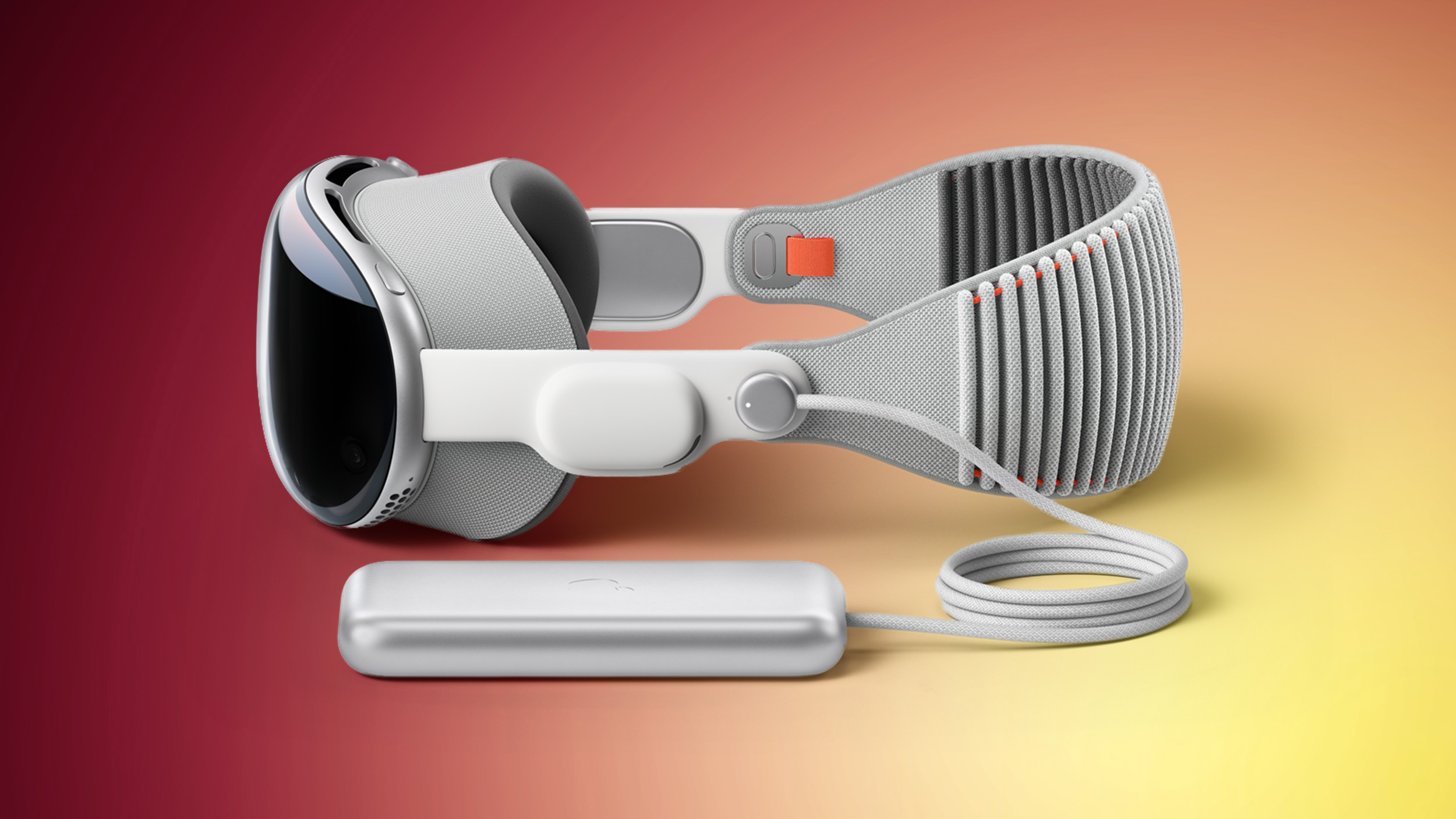
Apple is working on a next-generation version of the Vision Pro with an updated chip, and it could include a new Dual Knit Band that provides a more comfortable fit.
Updated Apple backend code found by MacRumors includes a reference to a "Dual Knit Band," which is not a band that exists at the current time. The Apple Vision Pro comes with a Solo Knit Band and a Dual Loop Band, but no Dual Knit Band.
Based on the name, the new band could be a cross between Apple's two existing bands, featuring the same comfortable material as the Solo Knit Band but with a more supportive two-band fit. A text description of the Dual Knit Band suggests that there will be an upper band that spans the top of the head and another band that fits behind the head.
Some people have made custom adjustments to the Vision Pro to get it to accommodate two Solo Knit Bands for extra support at the top of the head, and those that have gone that route suggest it is much more comfortable than Apple's current Dual Loop Band.
Back in July, Bloomberg's Mark Gurman said that the refreshed Vision Pro could include a new strap that would make it easier to wear the headset for long periods of time, and it looks like the rumor is accurate.
The Vision Pro weighs between 21.2 and 22.9 ounces, putting considerable strain on the head when it's worn for long periods of time. Some users find the weight of the device and the poor distribution of the Solo Knit Band to cause discomfort. The Dual Loop Band removes some of the weight from the face, but because it doesn't have the same knit design as the Solo Knit Band, it is less comfortable.
Apple is expected to refresh the $3,499 Vision Pro before the end of 2025. It will get a faster M5 chip, but Apple doesn't plan to make any other updates to the device.
The AirPods Pro 3 and AirPods Max are Apple's highest-end headphone options, so which should you choose?
Apple just debuted the AirPods Pro 3, adding new features like improved active noise cancellation, the U2 chip, and heart rate monitoring. The AirPods Pro 2 were already more advanced than the AirPods Max, which have not been meaningfully refreshed since their introduction in 2020, so the AirPods Pro 3 take an even bigger leap ahead of their over-ear siblings. Nevertheless, there is still a good case for buying the AirPods Max against the AirPods Pro.
Both the AirPods Max and the AirPods Pro feature active noise cancellation, Personalized Spatial Audio with dynamic head tracking, volume controls, "Hey Siri" commands, and automatic switching. As the two highest-end AirPods options, should you consider purchasing the $249 AirPods Pro 3, or do you need the AirPods Max, which still sell for $549? Our guide helps to answer the question of how to decide which of these AirPods are best for you.
AirPods Pro 3 (2025)
AirPods Max (2020, 2024)
Plastic design
Aluminum, stainless steel, and silicone design
IP57 dust, sweat, and water resistant earbuds and charging case
Available in White only
Lightning: Available in Silver, Space Gray, Sky Blue, Pink, and Green
USB-C: Starlight, Midnight, Blue, Purple, and Orange
Up to 8 hours of listening time on a single charge
Up to 20 hours of listening time on a single charge
5 minutes in the case provides around 1 hour of listening time
5 minutes of charge time provides around 1.5 hours of listening time
Charge with Apple Watch charger, MagSafe charger, Qi wireless charging mats, and USB-C
Charge via USB-C or Lightning only (depending on model)
MagSafe Charging Case
Smart Case to preserve battery charge in ultra-low-power state
$249
$549
While there is some overlap between the AirPods Pro and AirPods Max with features like Active Noise Cancellation and Transparency, the entirely different fit and form factor of the headphones should make it easier for most customers to decide which device they prefer. Some users will even buy and use both.
The AirPods Max offer a wide range of color options and a premium design, making them more of a fashion accessory. They also feature much longer continuous battery life from a single charge. If you dislike the in-ear design of the AirPods Pro, the AirPods Max may also be more comfortable, especially for longer listening sessions.
Owing to its over-ear design and significantly larger drivers, the AirPods Max deliver markedly better audio quality than the AirPods Pro, so if your main priority is audio quality, the AirPods Max will undoubtedly be the best choice. They also support Lossless Audio via USB-C.
On the other hand, the AirPods Pro 3 offer a high-level of convenience and portability due to their small size and charging case. The audio quality of the AirPods Pro cannot rival the AirPods Max, but features like Adaptive Audio, Loud Sound Reduction, Conversation Boost are ideal for when you're on the go.
Due to their lightweight, in-ear design and sweat and water resistance, the AirPods Pro are perfect for outdoors use and fitness activities. They also now feature heart-rate monitoring during workouts.
The AirPods Pro 3 are much more versatile when it comes to charging, with four different ways to charge, compared to the AirPods Max's obligatory USB-C port. Due to their size, weight, less durable design, and limited portability, the AirPods Max are best used at home for high-fidelity, prolonged listening sessions, while the AirPods Pro offer a more balanced experience with a high level of convenience and portability.
It is also worth noting that the AirPods Pro have many more features than the AirPods Max, such as "Siri" voice commands, Precision Finding, Bluetooth 5.3, wireless lossless audio with the Vision Pro, Live Translation, and Hearing Test.
AirPods frequently see hefty discounts on Amazon and other third-party retailers, so stepping up to the Max version may be more worth it if you can take advantage of one of those deals. Both sets of AirPods often see solid discounts, so it is always worth seeking the best price using our Deals roundup.
The MacBook Air is Apple's most popular laptop – a thin, fanless machine that wields quiet power thanks to the efficiency of Apple silicon. While the M4 model isn't exactly old, attention is already turning to its successor.
Apple doesn't telegraph new product launches ahead of time, but we can draw a surprisingly clear picture of what to expect by looking at Apple's silicon roadmap, release cycles, and past upgrades.
Release Timing and Price
Apple appears to have settled into a spring refresh cycle for the MacBook Air. After releasing the M2 model in mid-2022 with an all-new design, Apple skipped 2023 and then delivered back-to-back M3 and M4 MacBook Air updates in March 2024 and March 2025, respectively.
Indeed, Bloomberg's Mark Gurman reports that Apple plans to roll out M5 versions of the MacBook Air in the first quarter of 2026. This suggests a likely March 2026 window – unless Apple breaks the cycle, of course. As for pricing, we expect it to remain stable, with the base model sticking with the current entry-level $999 price.
Processor Upgrade
The M5 series is expected to feature an enhanced ARM architecture and is reportedly being manufactured using TSMC's advanced 3-nanometer process technology. Apple's decision to forgo TSMC's more advanced 2nm process for the M5 chip is believed to be due to cost considerations.
Recent leaked benchmarks – allegedly from a next-gen iPad Pro running an M5 chip – show single-core scores around 4,133 and multi-core scores around 15,437. That's roughly a 12-15% jump over the current M4 iPad Pro in both categories. As for graphics performance, the M5 chip appears to have up to a 36% faster GPU compared to the M4 chip.
The benchmark suggests Apple has focused on modest clock speed increases and core-level efficiency improvements for the M5 chip, rather than an architecture overhaul. In other words, the M5 will be similar to the step-wise performance upgrade from M3 to M4. Expect 10-15% faster CPU speeds, a slightly more powerful GPU, and better efficiency, potentially leading to even longer battery life.
As a result, the M5 MacBook Air will likely feel more responsive in daily use, particularly in single-threaded tasks, but it won't dramatically outpace the M4 for sustained workloads like video rendering.
Display and Other Possible Changes
M4 MacBook Air in Sky Blue, the color Apple debuted earlier this year
Apple tends to stick with the same industrial design for multiple chip generations. The current MacBook Air design (introduced with the M2 model) is only three years old and shows no signs of ageing. Expect the same 13- and 15-inch sizes, the same fanless aluminium unibody, and similar display technology – that means no OLED, which Apple appears to be saving for initial adoption in the MacBook Pro line later next year or in 2027.
If there are any physical changes, they'll likely be subtle. Think improved webcam quality, or tweaks to accommodate the next generation of wireless connectivity (such as Wi-Fi 7 or Bluetooth LE Audio). You never know – Apple could even offer the machine in a new color, just like it did this earlier year with the M4.
Looking Further Ahead
According to reports out of Korea, Apple plans to release a MacBook Air with an improved LCD display in 2027, featuring Oxide TFT technology instead of the current amorphous silicon (a-Si) panels.
The new display technology is said to be a significant upgrade over current MacBook Air screens. Oxide TFT LCD panels offer better power efficiency and improved performance compared to traditional a-Si displays, resulting in sharper images, smoother scrolling, and enhanced battery life.
The transition to Oxide TFT technology should also mean faster pixel response times and more consistent brightness across the screen. In practical terms, this should translate to reduced motion blur when watching videos or gaming, and more uniform lighting without the "clouding" effect sometimes visible on current LCD displays.
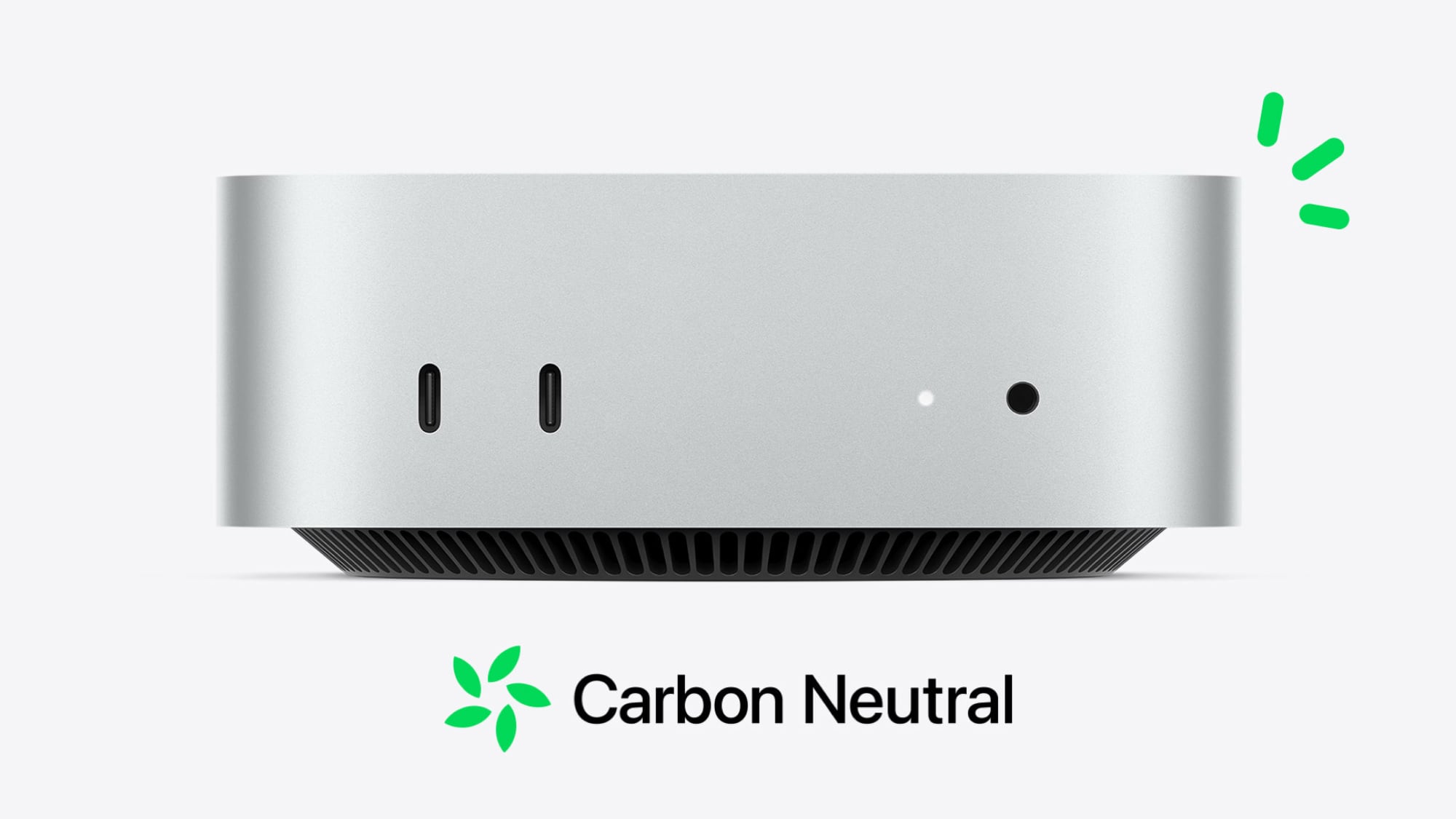
As noted by the French blog WatchGeneration, the Apple Watch and Mac mini are no longer advertised as "carbon neutral" products on Apple's website.
The term "carbon neutral" means that, on a net basis, a product does not add any carbon dioxide to the atmosphere. Apple achieves this by reducing emissions and through projects that offset carbon, including working with Forestal Apepu to develop fast-growing eucalyptus forests for timber production on deforested lands in Paraguay.
When paired with select bands, the Apple Watch Series 9 and Apple Watch Ultra 2 models were Apple's first carbon-neutral products, and the Apple Watch Series 10 and the latest Mac mini with M4 chips were also advertised as being carbon neutral.
In 2023, Apple said each carbon neutral Apple Watch model met the following strict criteria: 100% clean electricity used for manufacturing and product use, at least 30% recycled or renewable material by weight, and at least 50% of shipments occurring without air transportation. Apple said these combined efforts resulted in at least a 75% reduction in product emissions for the new Apple Watch models, and it said it would use "high-quality carbon credits" to address the "small amount of remaining emissions."
However, starting with the Apple Watch Series 11 and Apple Watch Ultra 3, Apple no longer includes a "carbon neutral" label on its product pages or packaging worldwide. Apple also removed the label from its Mac mini product pages. This change took effect worldwide following Apple's iPhone event in September.
There are a few reasons why.
In August, Apple's vice president of environment Sarah Chandler told Fast Company that this change was not the result of a change in the company's environmental efforts. Instead, a new law in the EU taking effect in September 2026 will ban companies from using claims like "carbon neutral" or similar across packaging, ads, and product pages.
Second, a German court ruled the Apple Watch could no longer be advertised as "carbon neutral," after a local environmental group accused Apple of "greenwashing" with misleading carbon neutrality claims. According to Reuters, some ecologists said carbon offsetting plantations can actually harm biodiversity and require high water usage.
Apple likely still considers the Series 11 and Ultra 3 to be carbon neutral internally, but it is getting ahead of laws and rulings that prevent it from advertising it. Apple removed the label worldwide to avoid potentially confusing customers.
Given the Mac mini received no changes last month, it likely remains carbon neutral too.
Apple is still aiming for carbon neutrality across its global footprint by 2030.
"We're proud of our carbon neutral products and on track to achieve carbon neutrality throughout our entire supply chain by 2030," said Apple, in a statement shared with Fast Company. "Every Apple product is designed with the environment in mind, and that commitment will continue, regardless of new EU rules restricting how we can talk about it."
Nearly two weeks after the iPhone 17 series launched, analysts at investment banking firm Morgan Stanley said demand for the devices has been "modestly stronger than we originally expected," based on a combination of extended shipping estimates on Apple's online store and information it gathered from Apple's supply chain.
There has been strong early demand for the iPhone 17, iPhone 17 Pro, and iPhone 17 Pro Max, according to the analysts. However, they said the ultra-thin iPhone Air has faced "relative weakness" in demand so far.
"Our supply chain checks suggest an iPhone 17 build increase is likely imminent," wrote Morgan Stanley analyst Erik Woodring, in a research note today. In the second half of 2025, Apple's supply chain might increase its production of the new iPhones to more than 90 million units, up from 84 million to 86 million units currently, the note said.
Morgan Stanley has raised its price target for Apple shares to $298. However, analysts believe the company's stock price already reflects strong demand for the iPhone 17 series, and they would need to see even more upside "to argue for more sustained near-term stock outperformance." Apple's shares are trading for around $256 at the time of writing.
The analysts are bullish about iPhone shipments in 2026 and 2027, as Apple is widely expected to release its first foldable iPhone model in September next year.
"iPhones are getting old and Apple's biggest innovation in years less than 12 months away," the analysts wrote, in reference to the long-rumored foldable iPhone.
We have released version 2.10.0 of the OpenProject integration app for Nextcloud! ✨ This update brings several usability improvements and fixes to make your project collaboration experience even smoother.
We recommend updating to the latest version via your Nextcloud app center to benefit from the newest enhancements.
Changes of the release 2.10.0:
Clearer error messages for missing or unsupported apps
Improved group handling to avoid user removal issues
Enhanced SSO support for external token exchange setups
Better translations and more user-friendly messages
Thanks to Nextcloud for the continued partnership!
After March 28, 2029, Jira Data Center licenses and apps will expire and become read-only, leaving cloud hosting as the only supported way to stay with Jira. But for many organizations, cloud hosting is not an option. On top of that, Atlassian recently burdened its customers with significant price increases for Jira Service Management (JSM) Cloud products.
The challenge: Finding a new self-hosted project management software within a short period of time, migrating existing data and onboarding the users so that your teams can switch over as effortlessly as possible.
Looking for: A feature-rich and affordable project management tool that also offers long-term on-premises solution. A solution where you have full ownership and control of your data within your own infrastructure.
Break free from Jira’s vendor lock-in and choose freedom with OpenProject
OpenProject offers exactly what many (still) Jira customers are looking for: a secure, powerful, and, above all, reliable solution for their projects, at attractive pricing models, or even completely free of charge in our Community version.
Next steps for your migration from Jira Data Center to OpenProject
If your organization depends on Jira Data Center, you have to act now.
Start your free OpenProject trial to get to know our product hands-on.
Map your use cases with OpenProjects features or ask us for help to understand your possibilities with OpenProject.
Choose a self-managed, long-term solution.
We will help you plan a migration path and the onboarding plan.
OpenProject is a powerful open source alternative to Jira
OpenProject is a highly developed, fully featured best-in-class project management software that offers a long-term on-premise solution. It supports both self-hosted and managed hosting options and gives you full control over your infrastructure without locking you into a specific vendor.
With advanced work package tracking – comparable to Jira issues – and comprehensive modules for agile boards, Gantt charts, and time and cost tracking, OpenProject covers a wide range of project requirements.
The software is available as a cost-free Community Edition, while the Enterprise Edition includes powerful add-ons for authentication, integrations, and custom workflows at fair prices.
OpenProject has been continuously developed for over ten years by a growing German company. It is based on a strong commitment to transparency, data sovereignty, and long-term reliability. We continuously develop the product based on our users’ needs.
Important
OpenProject will continue offering its on-premises solution — including new features and security updates — beyond 2029. You choose where to run your data.
Benefit from the open source alliance
Perhaps you’ve considered switching to open source before, but the timing never seemed right? Now is the perfect moment. Security and reliability is just one of at least 8 reasons to choose open source software whenever possible. It’s user-centric, offers fast developments and a high level of customization. And, of course, without vendor lock-in that Atlassian customers currently face.
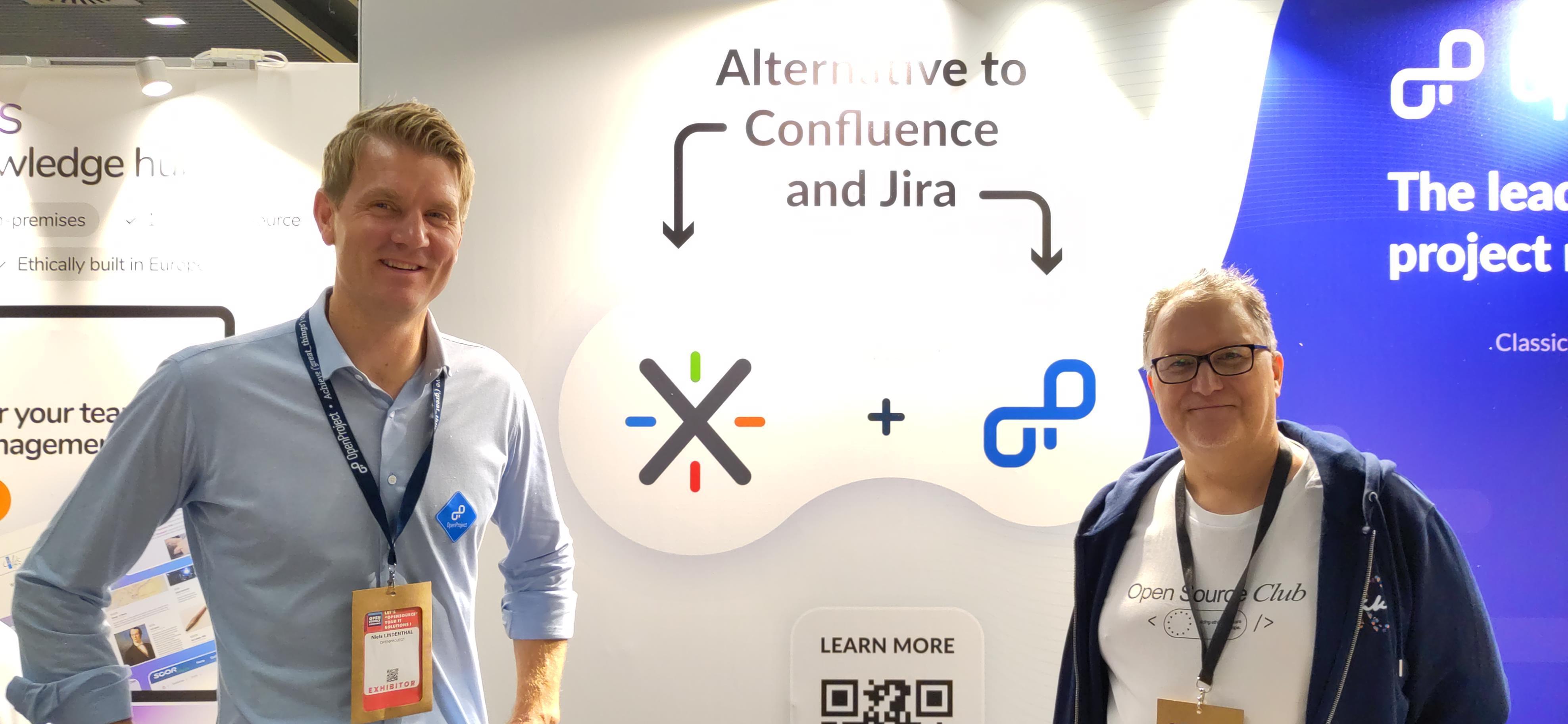
OpenProject is part of a strong open source ecosystem that builds secure, sovereign alternatives to proprietary software — and actively works to improve interoperability. One example is our partnership with XWiki and CryptPad, officially launched in July 2025. So if you are looking for a Confluence alternative we can recommend checking out XWiki, which is optimized for shared use with OpenProject.
Image: Niels Lindenthal (CEO OpenProject) and Ludovic Dubost (CEO XWiki and CryptPad) at the OSXP in Paris.
Nice to know: OpenProject and XWiki are also part of openDesk, offering a fully sovereign workspace for the public sector in Europe. Stronger together is more than just a slogan for us.
Tip
Another advantage of transparent source code: the members of our open source Community share the same values, and some of them are very competent and proactive. This led to the creation of the OpenProject Jira Importer – a tool written and hosted by a Community member and available as open source as well.
No strings attached: Start your free trial now
Your next step doesn’t need to be complicated. Start a free OpenProject trial today or get in touch to discuss migration paths from Jira Data Center. Because at OpenProject, we are on our user’s side and let you decide where and how to host your data.
When managing complex projects, it is beneficial to use a project management methodology for guidance. PRINCE2 is one of the most popular and widely used methodologies available. OpenProject is a popular tool that supports PRINCE2, offering the advantages of open source software while also being cost-effective. Let’s learn how exactly project managers can implement PRINCE2 with OpenProject.
Note
Originally published in 2018, this article has been substantially revised to reflect the latest changes in both PRINCE2 and OpenProject. The PRINCE2 framework was updated to version 7 in September 2023, adding new priorities such as sustainability, people-centric management, and digital/data integration. At the same time, OpenProject has introduced key features — like meetings enhancements, baseline comparison, and new permissions — that make applying PRINCE2 workflows easier and more powerful.
Article navigation
If you are already familiar with the PRINCE2 framework, you can jump straight to the practical section on using OpenProject.
PRINCE2 (or Projects inControlled Environments) offers a structured process for projects & provides recommendations for each project phase. It is one of the leading project management methodologies (next to PMBOK (from the Project Management Institute)) and is used in over 150 countries.
PRINCE2 provides a clear structure for projects and is based on 7 principles, 7 practices (formerly known as themes) and 7 processesas described by PRINCE2.com. Let’s take a look at those basics before diving into the OpenProject software.
7 Principles
PRINCE2 is built on seven principles which represent guiding obligations and good practices.
The 7 Principles are:
Continued business justification: A project must make good business sense (justified use of time and resources, clear return on investment).
Learn from experience: Previous projects should be taken into account. Project teams use a lessons log for this purpose.
Define roles, responsibilities and relationships: The decision makers in the project are clearly defined. Everyone in the project knows what they and others are doing. The ‘relationships’ has been added later to PRINCE2 as dependencies are an important part of project management.
Manage by exception: The project board is only informed if there is or may be a problem. As long as the product is running well, there is not a lot intervention from managers.
Manage by stages: Difficult tasks are broken into manageable chunks, or management stages.
Focus on products: Everyone knows ahead of time what is expected of the product. Product requirements determine work activity.
Tailor to suit the project: The PRINCE2 methodology can be tailored and scaled. Projects which are adjusted based on the actual needs perform better in general than projects which use PRINCE2 dogmatically. Formerly known as ‘Tailor to the environment’.
7 Practices
In addition to these 7 Principles, there are 7 Practices – formerly called ‘Themes’ – which are addressed continually throughout the project. They provide guidance for how the project should be managed. They are set up at the beginning of the project and then monitored continually to keep the project on track:
Business Case: This practice is used to determine if a project is worthwhile and achievable. It is related to the principle of Continued Business Justification.
Organization: Project managers are required to keep a record of every team member’s roles and responsibilities. It is related to the Define Roles and Responsibilities principle.
Quality: At the beginning of the project, the project manager defines what constitutes the quality of the project. This is related to the Focus on Products principle.
Plans: A plan is set up which describes how objectives are going to be achieved. It is focused on cost, quality, benefits, timescale and products.
Risk: Uncertain events during the project are identified, assessed and controlled. They are recorded in a risk log. Positive risks are called opportunities, negative risks are called threats.
Issue: How to handle change requests and all types of project-related concerns that arise and require resolution. Issues shouldn’t be ignored, but changes should only be implemented once agreed upon. This practice was formerly called ‘Change’.
Progress: This principle is about tracking the project. This allows project managers to verify and control whether they are performing according to the project plan.
7 Processes
To structure the step-wise progression through a project, there are 7 Processes. Every one of the steps is overseen by the project manager and approved by the project board:
1. Starting up a project
Create a project mandate to answer logistical questions about the project. It covers the purpose of the project, who will carry it out and how to execute it.
From the project mandate a project brief is derived, as well as lessons log and discussions with project members.
A project team is assigned.
2. Directing a project
This is an ongoing process covering the entire life time of the project.
The project board manages activities such as initiation, stage boundaries, guidance, project closure.
3. Initiating a project
During this stage, the project manager determines what needs to be done to complete the project and outlines how the performance targets will be managed (cost, time, quality, benefits, risks, scope)
4. Controlling a stage
Project managers break the project into work packages / manageable activities and assign them to the project members.
The project manager oversees and reports the work package progress.
5. Managing product delivery
This manages how the communication between the team and the project manager is controlled.
The activities include accepting, executing and delivering work packages.
6. Managing stage boundaries
The project manager and the board review every stage. The board decides whether to continue the project. The project manager records lessons learned with the team for the next stage.
This process includes
Planning the next stage
Updating the project plan
Updating the business case
Reporting the stage end or producing an exception plan
7. Closing a project
In the final process, the project is closed. This includes decommissioning the project, identifying follow-on actions, preparing project evaluation and benefits reviews, freeing up leftover resources and handing over products to the customer.
Implementing PRINCE2 with OpenProject
OpenProject supports the seven processes, seven principles and seven practices laid out by the PRINCE2 methodology. Let’s see how exactly project managers can implement PRINCE2 with OpenProject in 7 steps:
Starting up a project: Create a project, activate modules, create project Mandate, add members.
Directing a project: Define roles and permissions, create decision checkpoints and track them.
Initiating a project: Define performance targets, set up budgets and assign them.
Controlling a stage: Create work packages and relations, estimate and assing work.
Before any work begins, PRINCE2 recommends clarifying whether the project is viable and worth pursuing. In OpenProject, this “starting up” step is fast and intuitive — you create a new project space, enable the modules you need, and prepare the foundation for structured collaboration, governance, and documentation.
Create a project
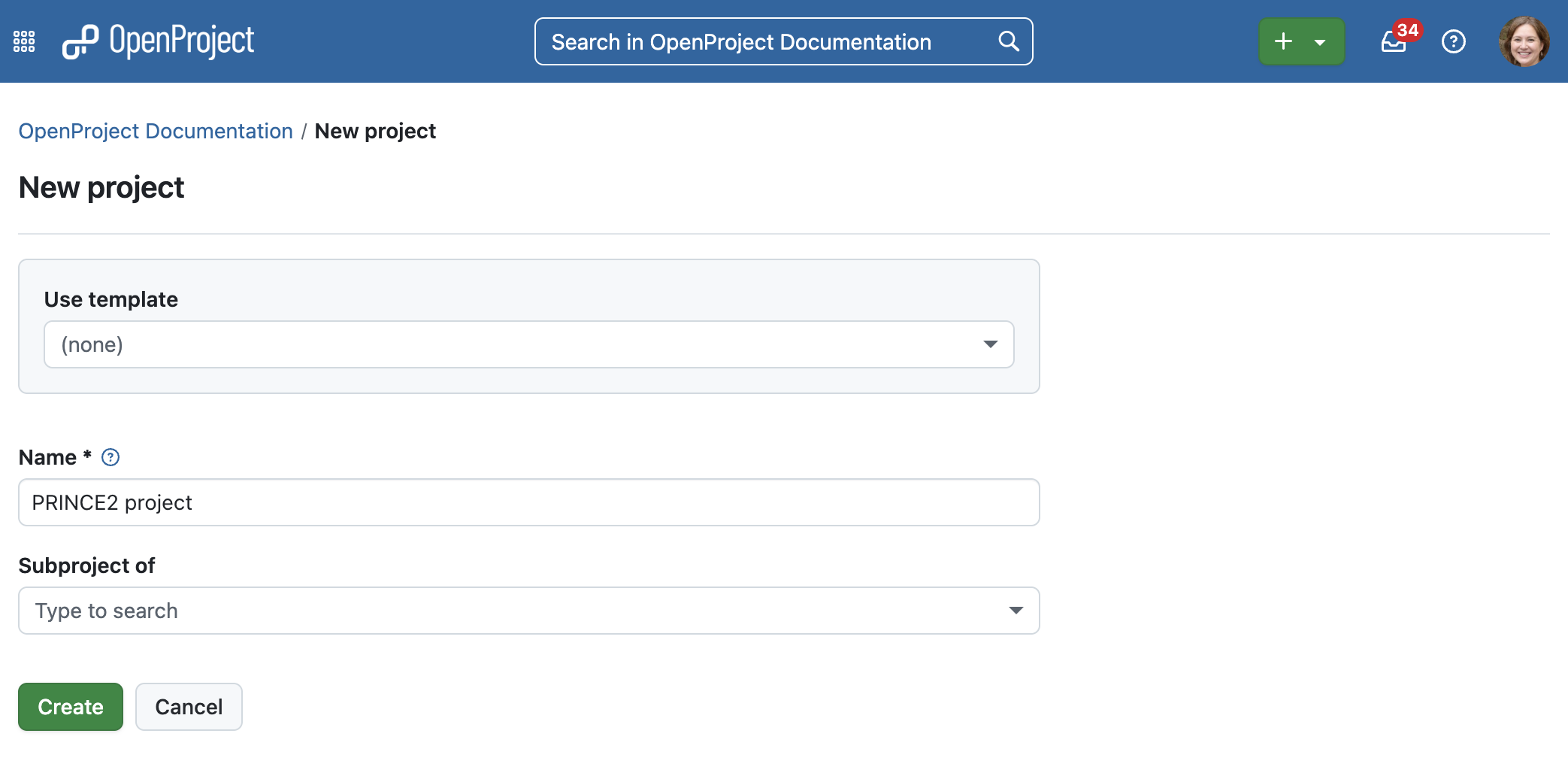
Starting up a project in OpenProject starts by simply creating a project. Simply click on the green + button in the header navigation and select + Project in the dropdown. Next, all you need is to provide a name and click on Create.
Activate the modules you need
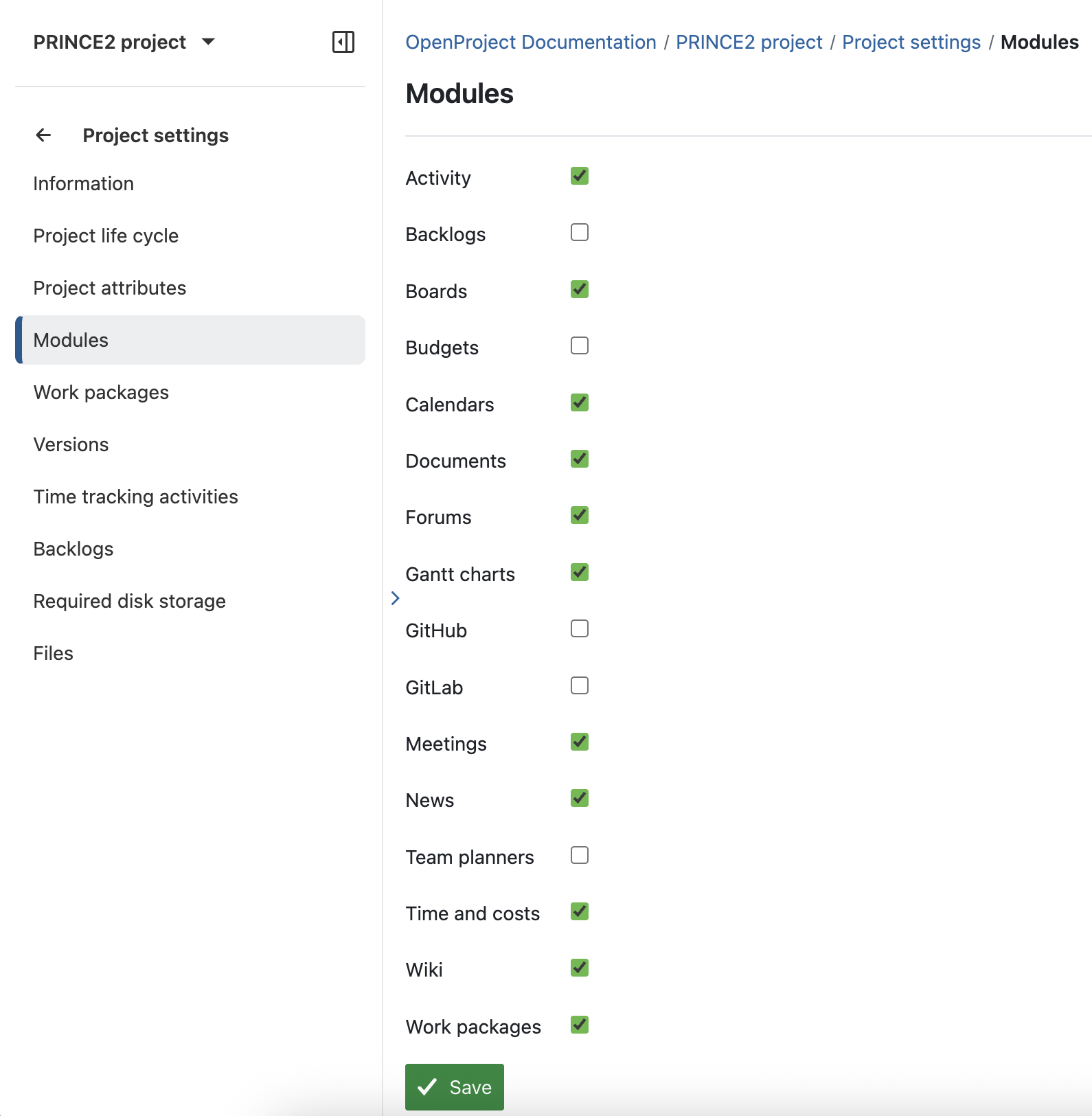
Now the project is created and you can start with some basic settings. Navigate to project settings → Modules to make sure that the Wiki, Work packages, Time and costs, and — optionally — Meetings, Forums, Budgets, and News modules are activated. These modules support transparency, collaboration, and documentation, which are all central to a people-focused approach in PRINCE2 7.
The Wiki module is especially useful for documenting your Project Mandate, Lessons Log, and other artifacts like communication plans. This aligns with PRINCE2’s emphasis on accountability, people, and continual learning.
Create a Project Mandate in the Wiki module
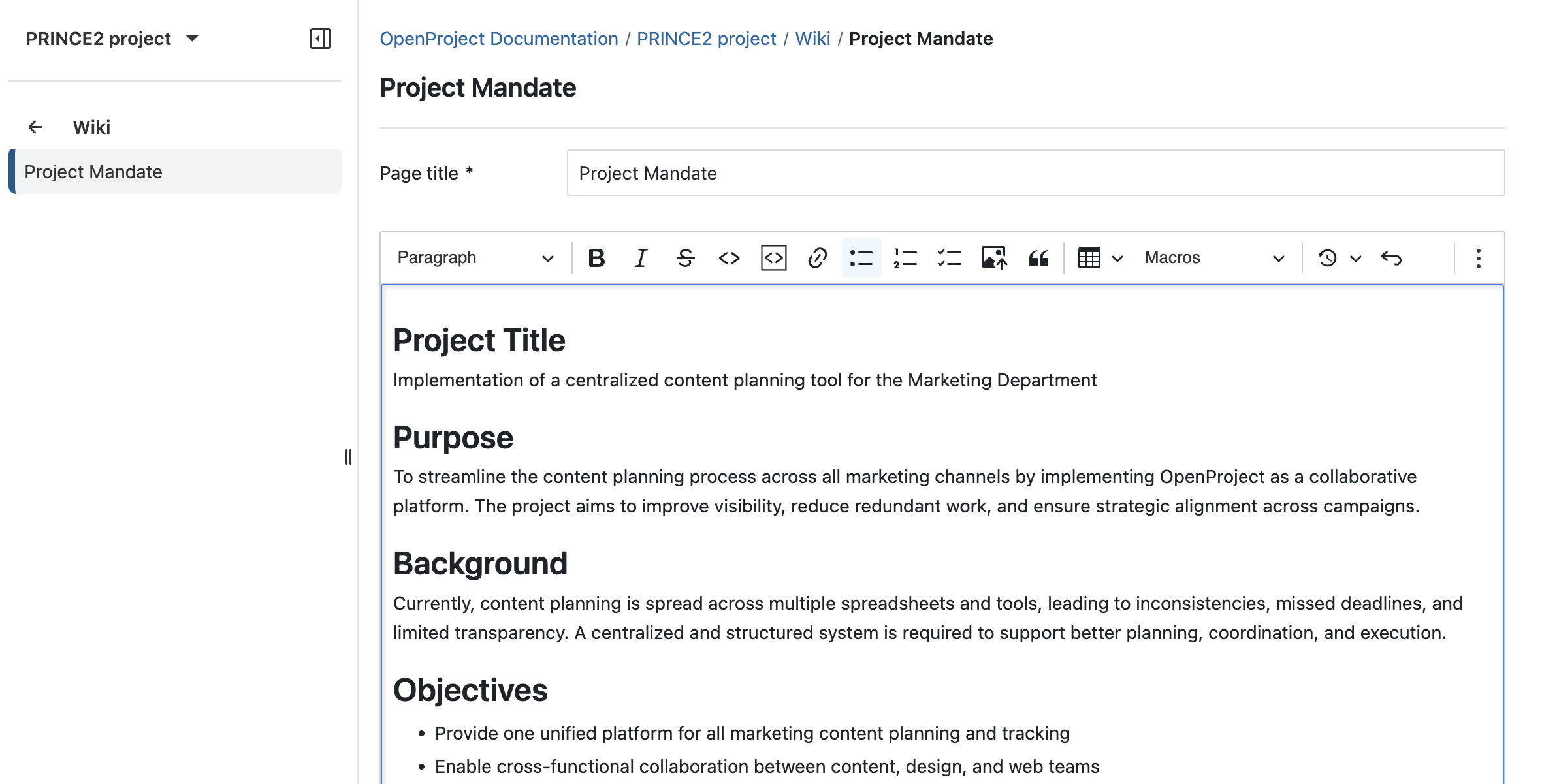
Next, select Wiki from the side menu on the left side and use it to create the Project Mandate. Make sure to press the Save button at the end. If you like, you can already create more wiki pages, such as the Lessons log as well.
Add members to your project
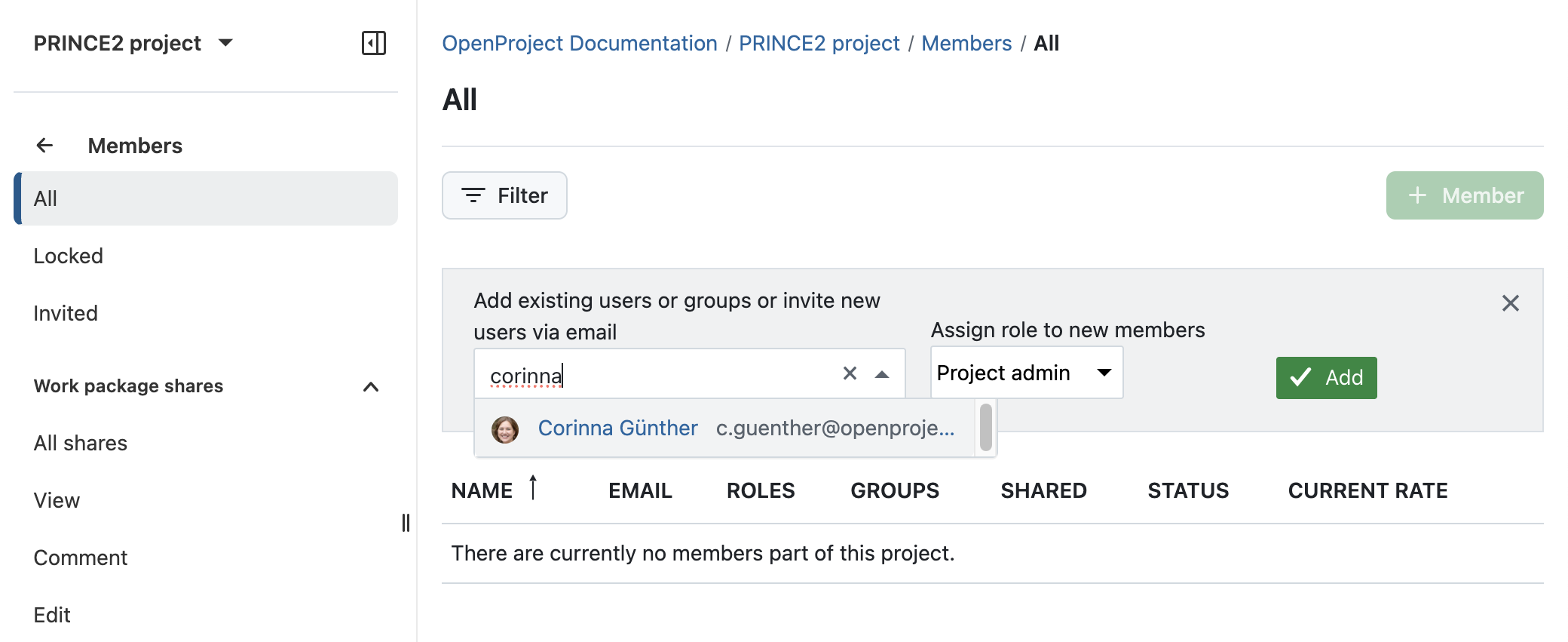
Afterward, go back to your project and select Members from the side menu to add the project members and assign them roles.
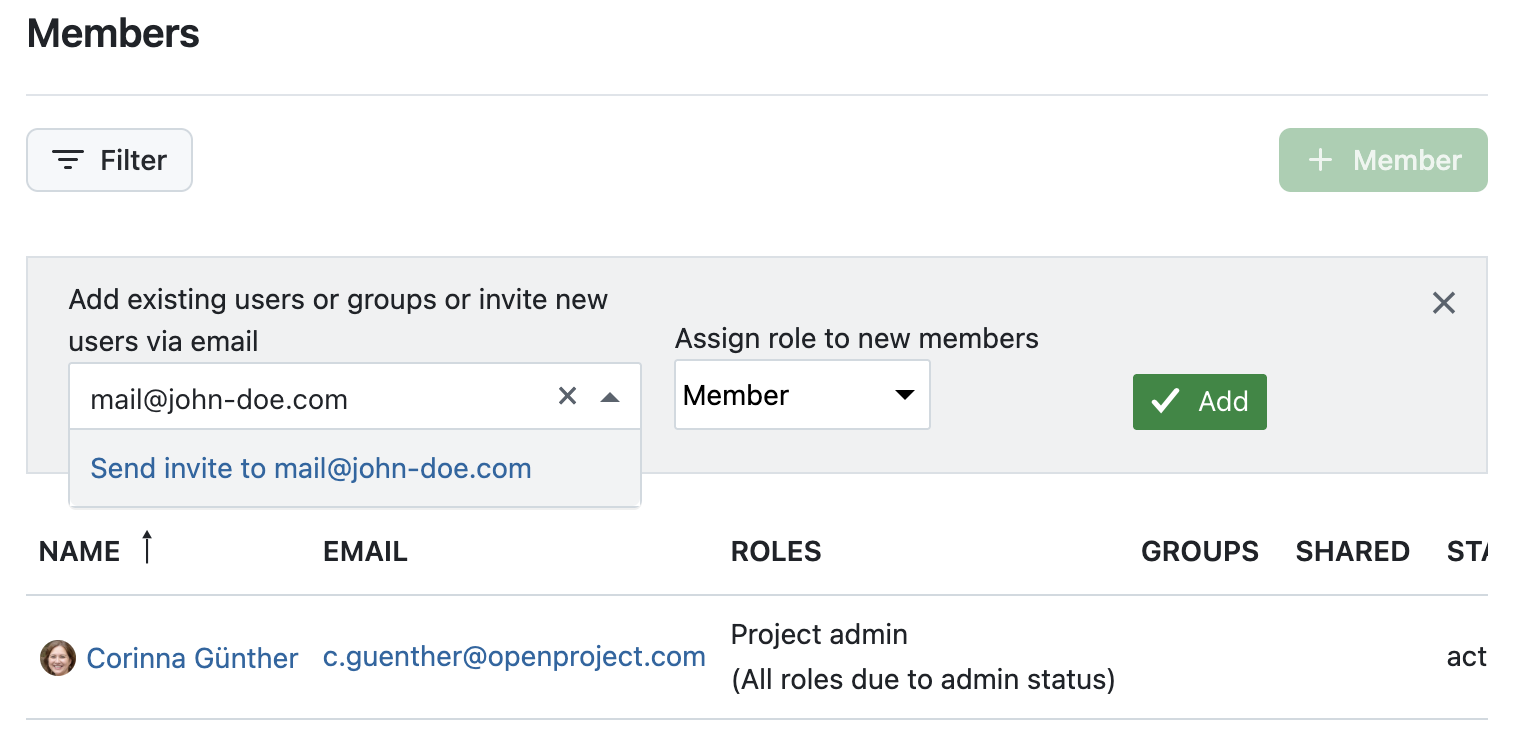
If the project members do not yet have an OpenProject account, you can send an invite to them directly in your project.
Tip
If you’re a system admin, you can invite new members to your instance and add them to the project afterward. Click on your avatar on the top right and select Administration → Users and permissions. You can also assign entire groups to add multiple project members at once.
2. Directing a project
Once the project is set up and the team assigned, the project board’s role in PRINCE2 is to guide the project and approve important decisions. In OpenProject, you can reflect this setup through roles, permissions, and decision checkpoints.
Define roles and permissions
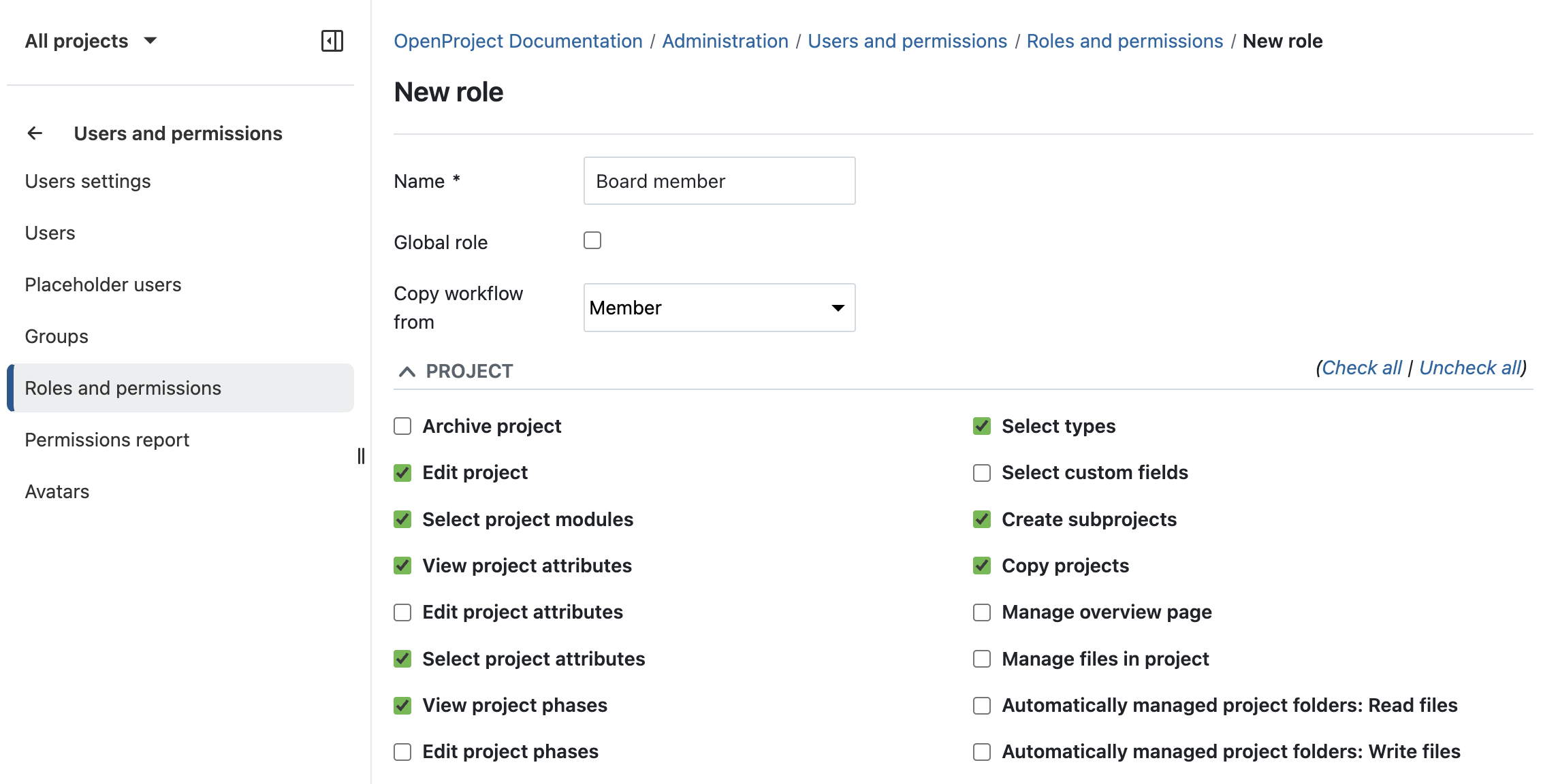
You can configure which roles have permissions to edit, approve, or only view information under Administration → Users and permissions → Roles and permissions.
This lets you ensure that:
Project managers can update plans and work packages.
Board members can review progress and approve major stages.
Team members see only what’s relevant to them.
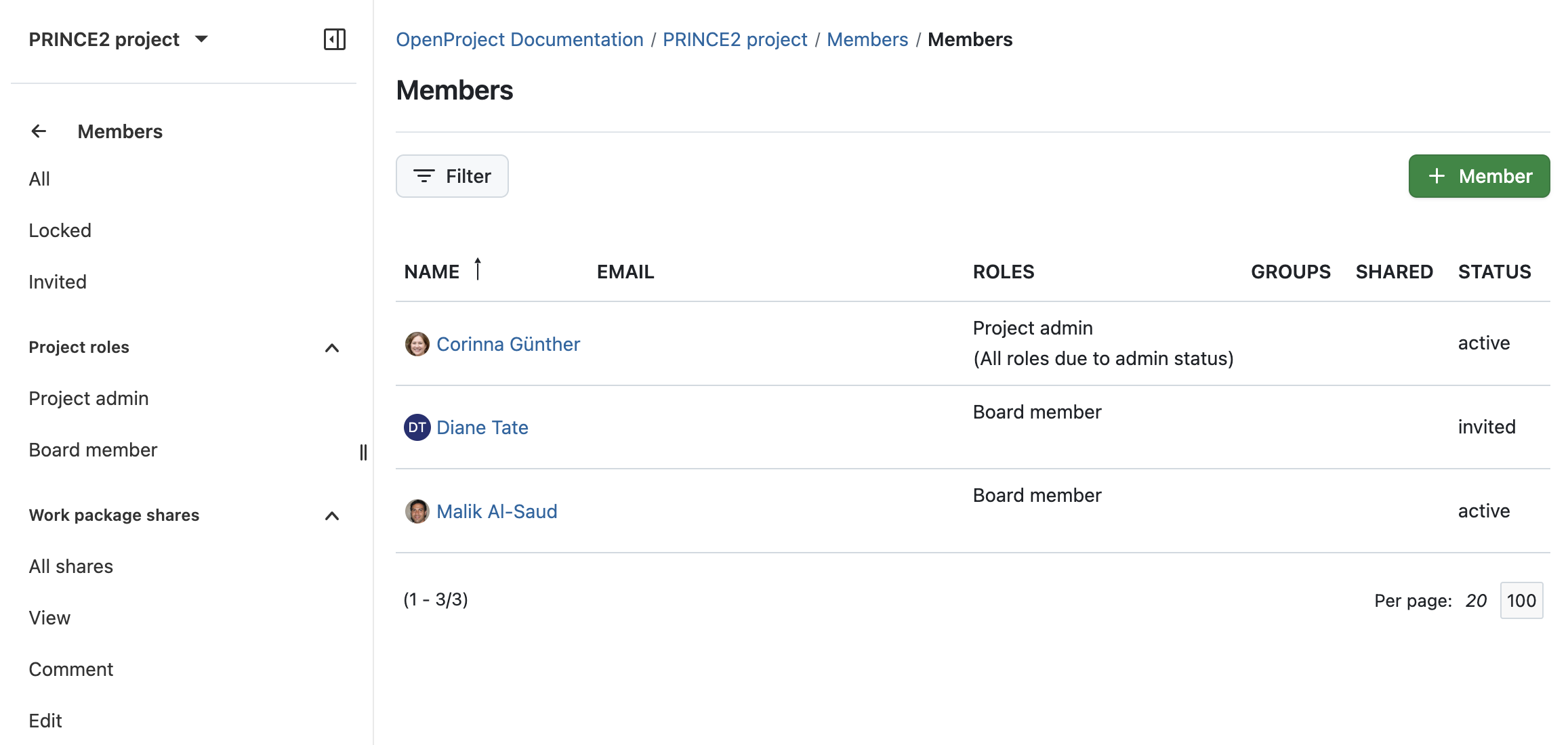
If these permissions are set in the system administration, you can go back to your project, navigate to Members in the left menu and assign key roles like Project Manager and Board Member.
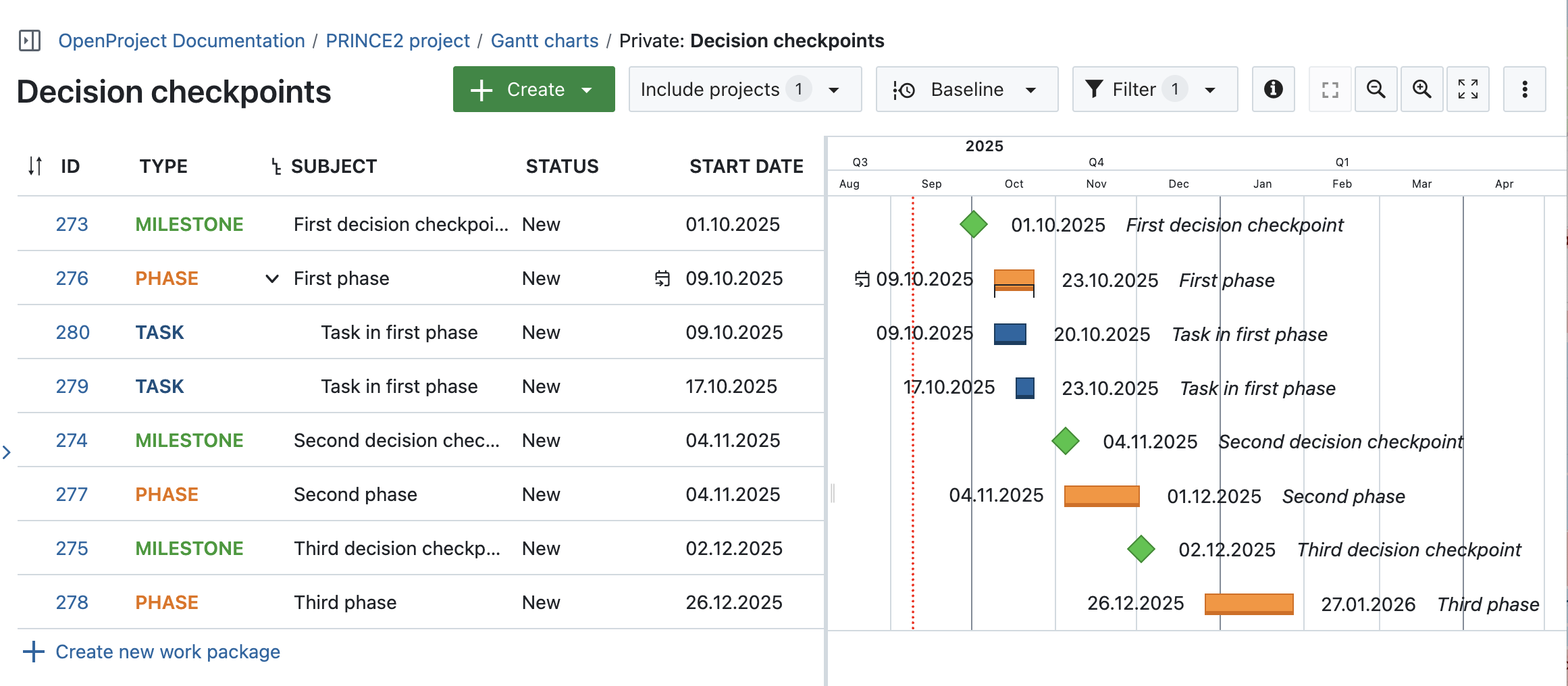
Create decision checkpoints with Milestones and Gantt charts
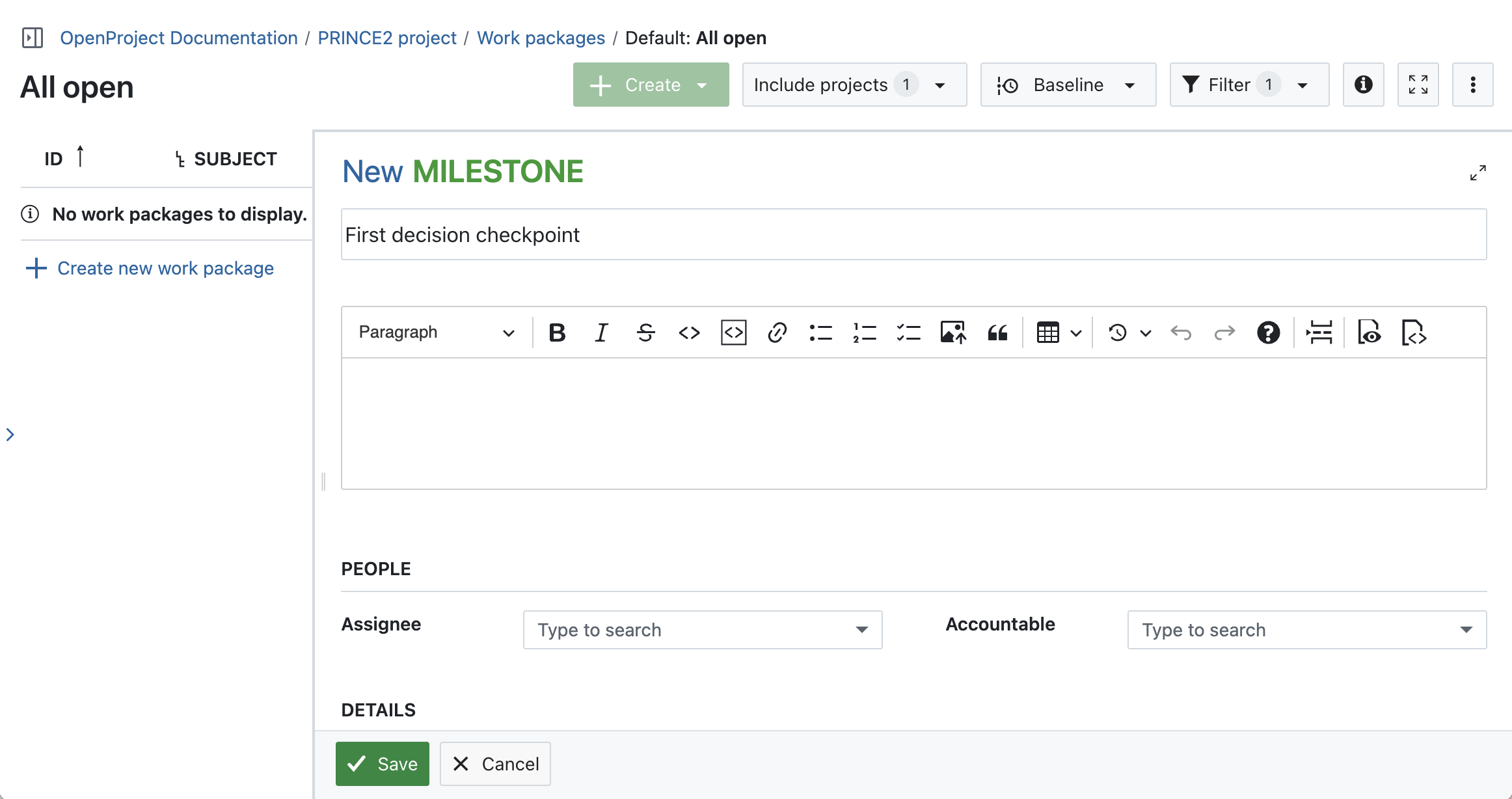
Use Milestones to mark stage boundaries that require approval. In OpenProject, milestones are a type of work package that has a target date, but no duration like other type of work packages. To display milestones and their connected work packages, use OpenProject’s Gantt charts.
Go to Gantt charts in the left side menu, click on the green + Create button and select Milestone in the dropdown. You can also add watchers (e.g. the group ‘board members’) to be notified when a milestone is reached.
Create several decision checkpoints (Milestones) along with phases, tasks and other work package types you need and create relations and hierarchies.
Track decisions and approvals
Use status fields to indicate when a stage or work package is waiting for board approval. For example, set the status to “Pending board decision” or use a custom field with dropdown options like “Pending”, “Approved”, or “Exception required”.
Board members can leave comments or change the status directly in the work package — no separate tool or email chain needed.
3. Initiating a project
Once the project board has authorized the start, PRINCE2 focuses on planning how the project will be executed, controlled, and completed. In OpenProject, this is where you lay the groundwork: define performance targets, plan project phases, and estimate resources.
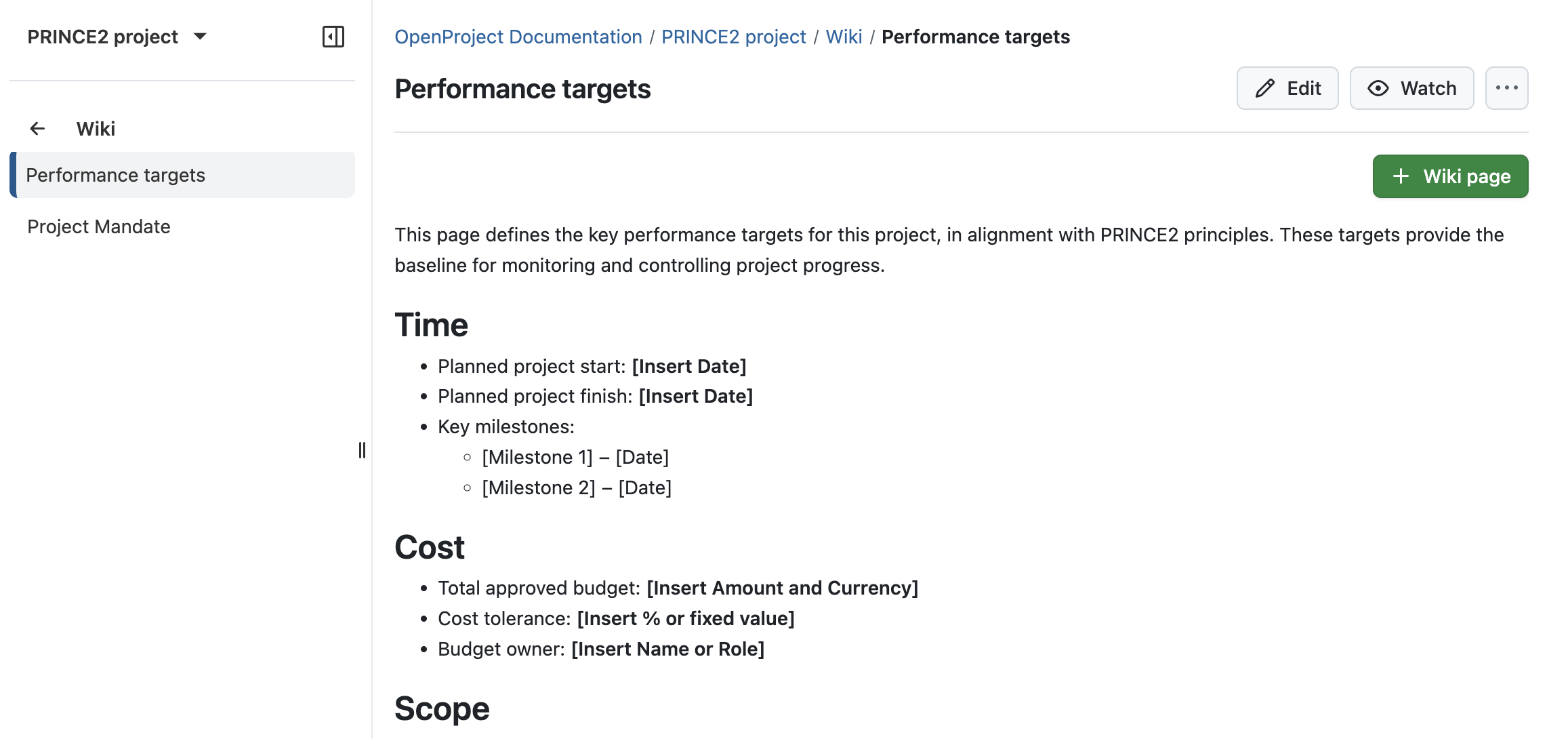
Define performance targets
Use a Wiki page to summarize the project’s key targets — such as time, cost, scope, risk, quality, and benefits. This creates a shared understanding for everyone involved.
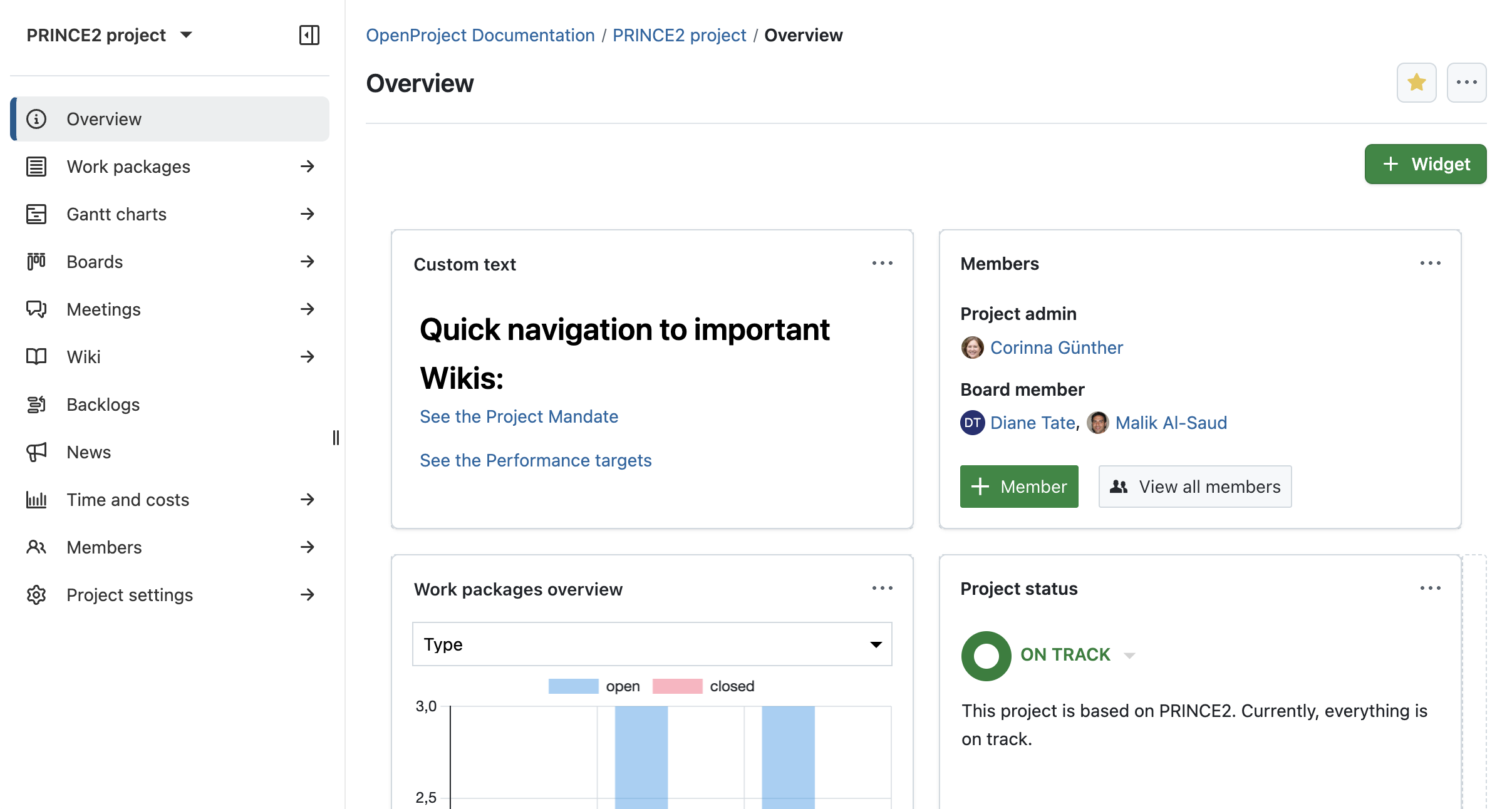
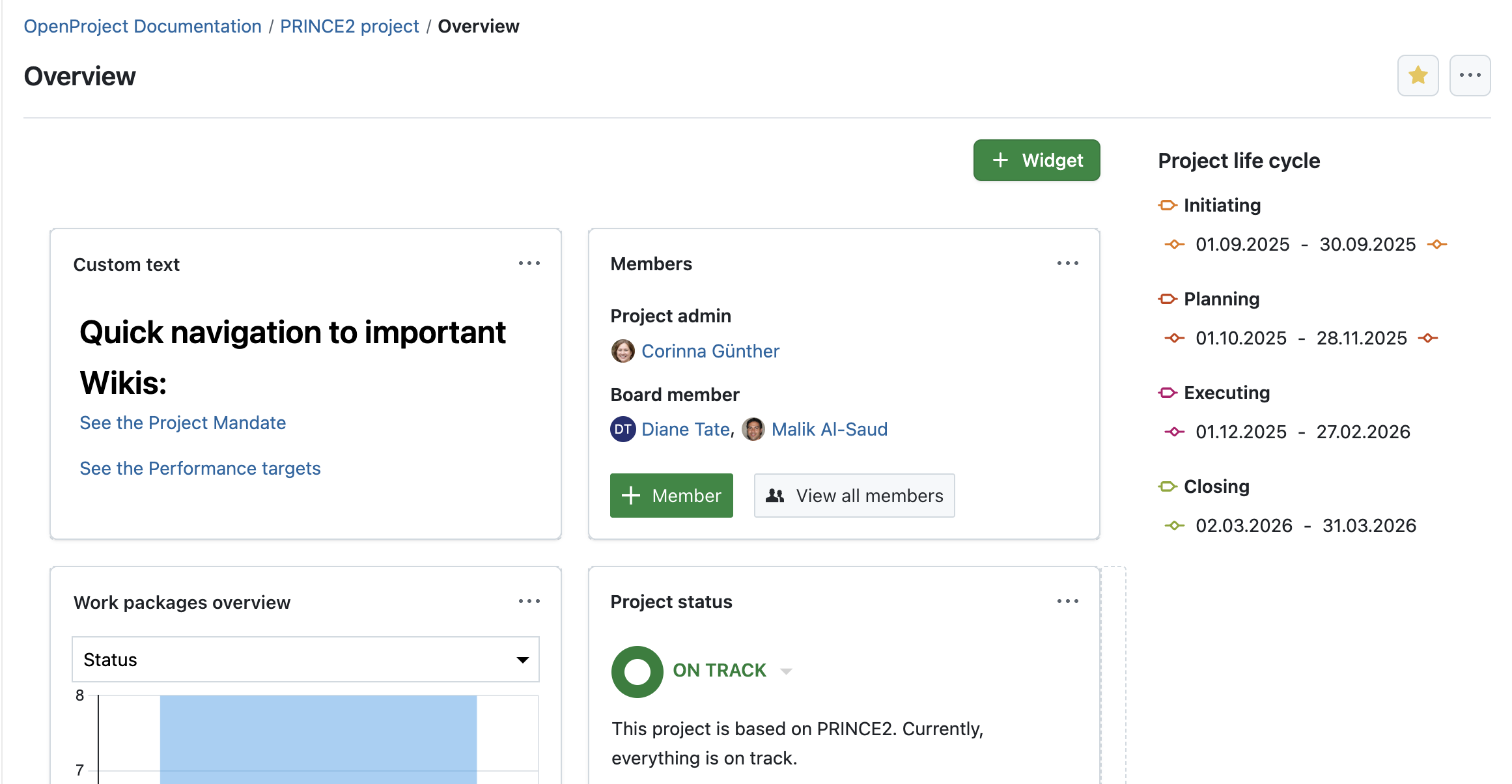
You can include the wiki as a custom text widget on the project overview page to make it visible at a glance. To do this, open the Overview, and click on + Widget, then select Custom text. On this page, you can also display other key performance targets to see all important information when accessing your project.
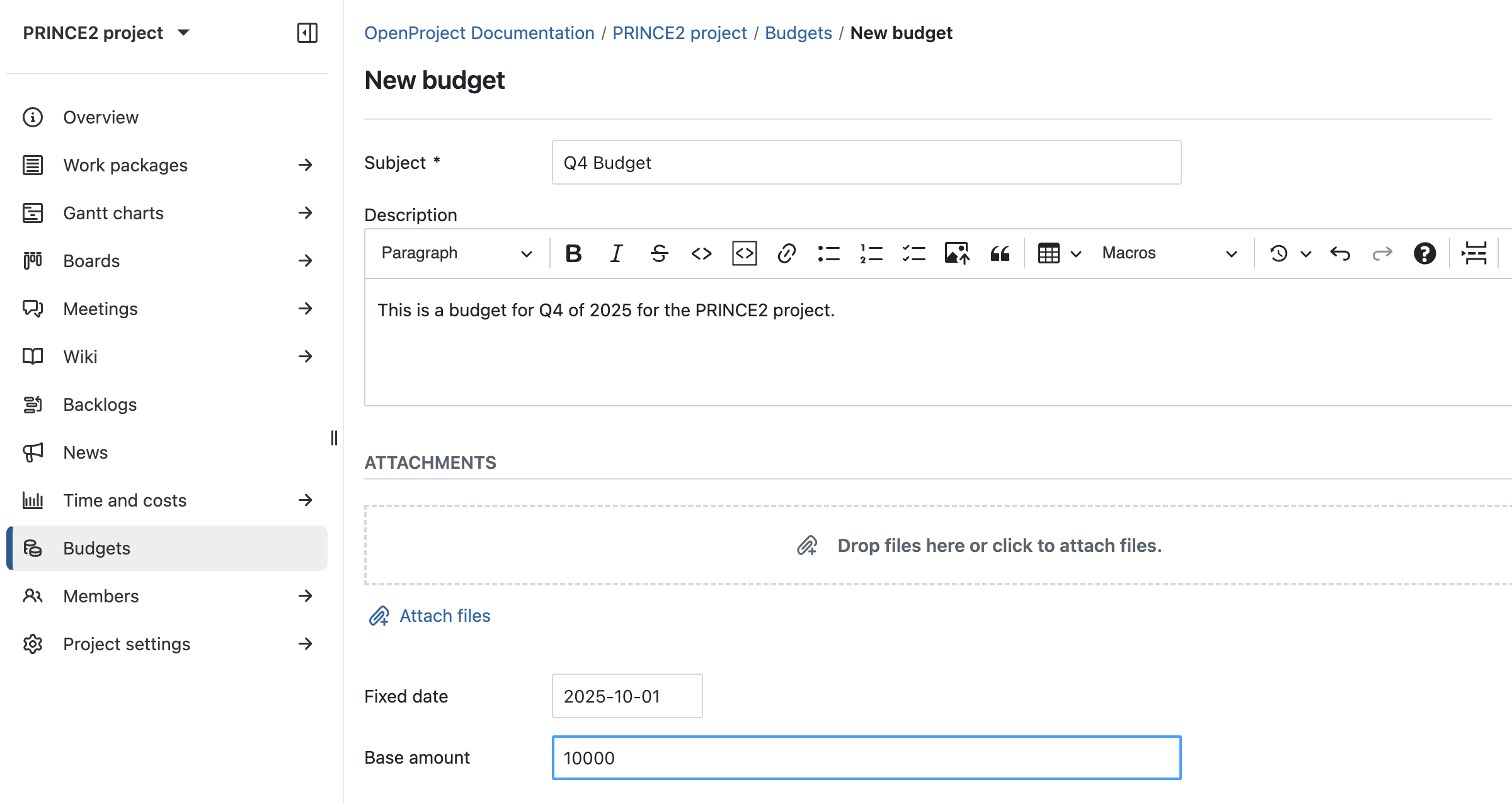
Set up budgets and assign them
Go to the Budgets module to create a new budget. Enter a name and define cost units, such as hourly labor rates or material costs. You can also set a base amount. This will help you track whether the PRINCE2 project remains within its financial boundaries throughout.
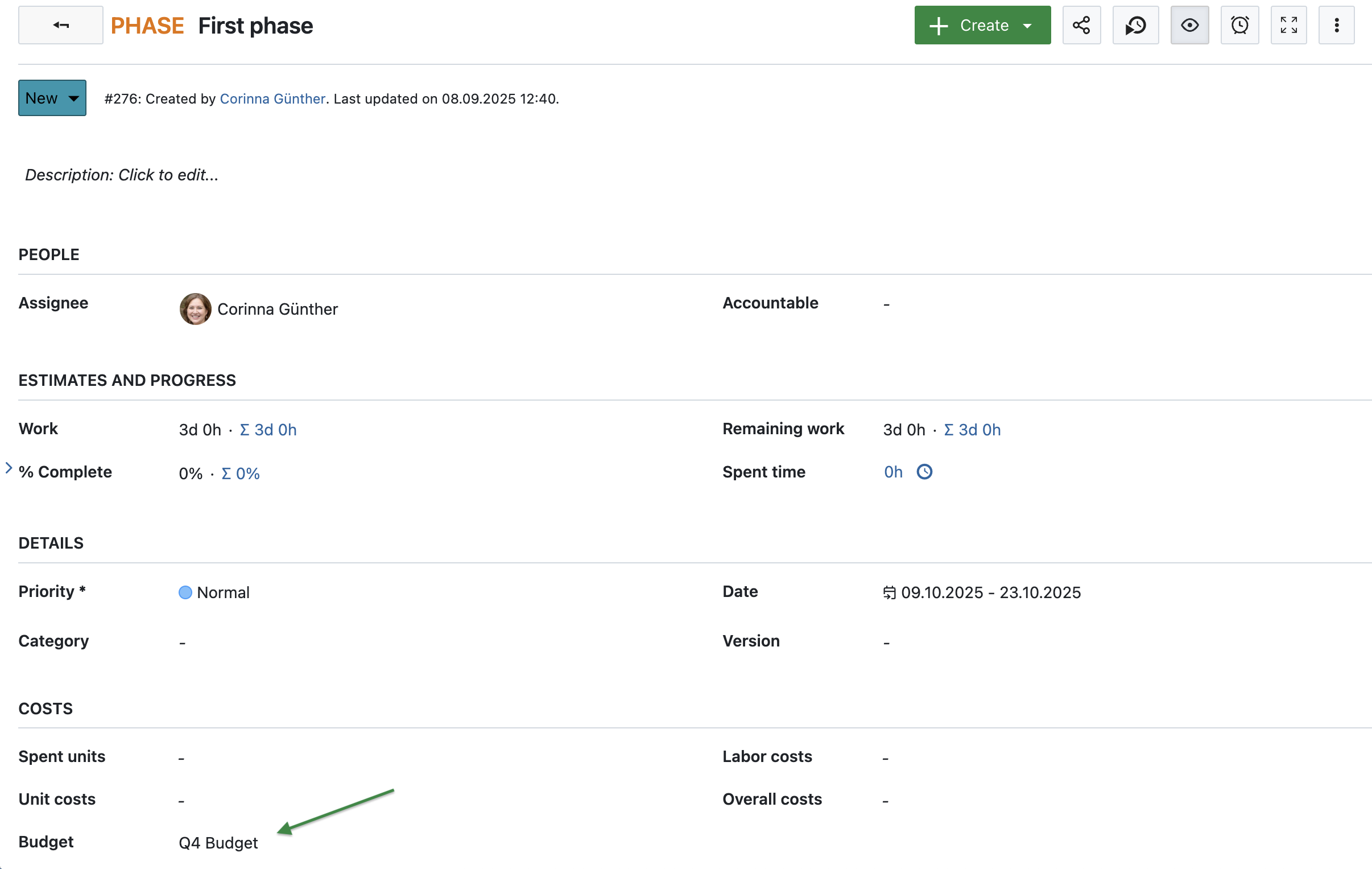
If you’ve created phases or milestones in the directing phase, you can now assign budgets to them. Click the info icon to open the Details view, then assign them to your budget under the Costs section. This ensures financial alignment across stages.
In PRINCE2, the project manager is responsible for monitoring progress within each stage and ensuring that work packages are delivered according to the plan. In OpenProject, you can break phases into smaller work packages, assign responsibilities, and track progress using the work package table.
Break down the work and create relations
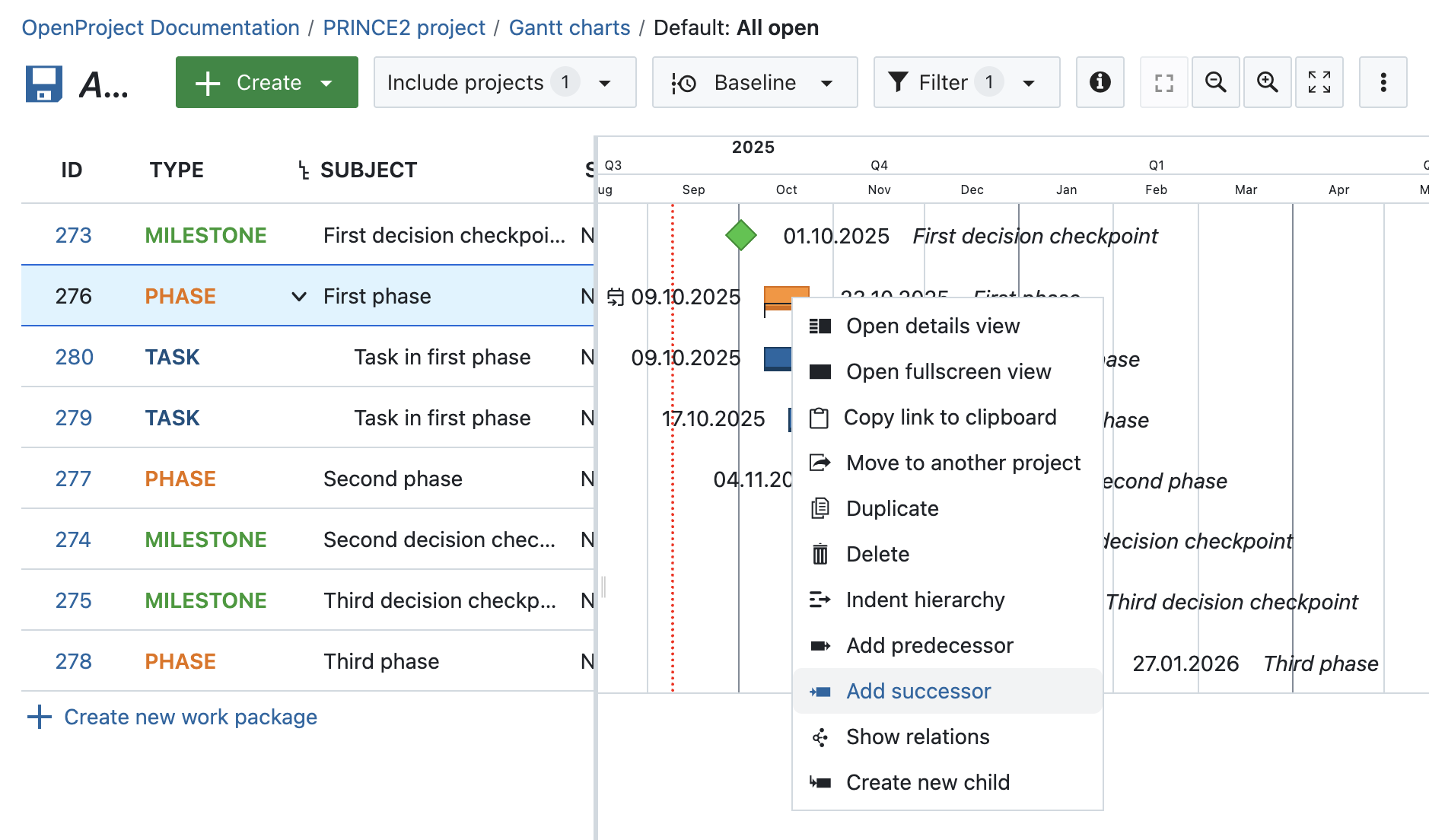
After setting up the initial phases and milestones, continue by breaking the phases down into work packages. To do this, click on the three little dots next to a phase and select Create new child. Select type Task or Work package if you created a separate type for this. See the OpenProject user guide on how to create a new type.
To show dependencies between work packages and create logical links, users can create different types of relations between work packages, e.g. predecessor, successor, child, blocks, part of … or relations without logical effects on the related work package.
Estimate work
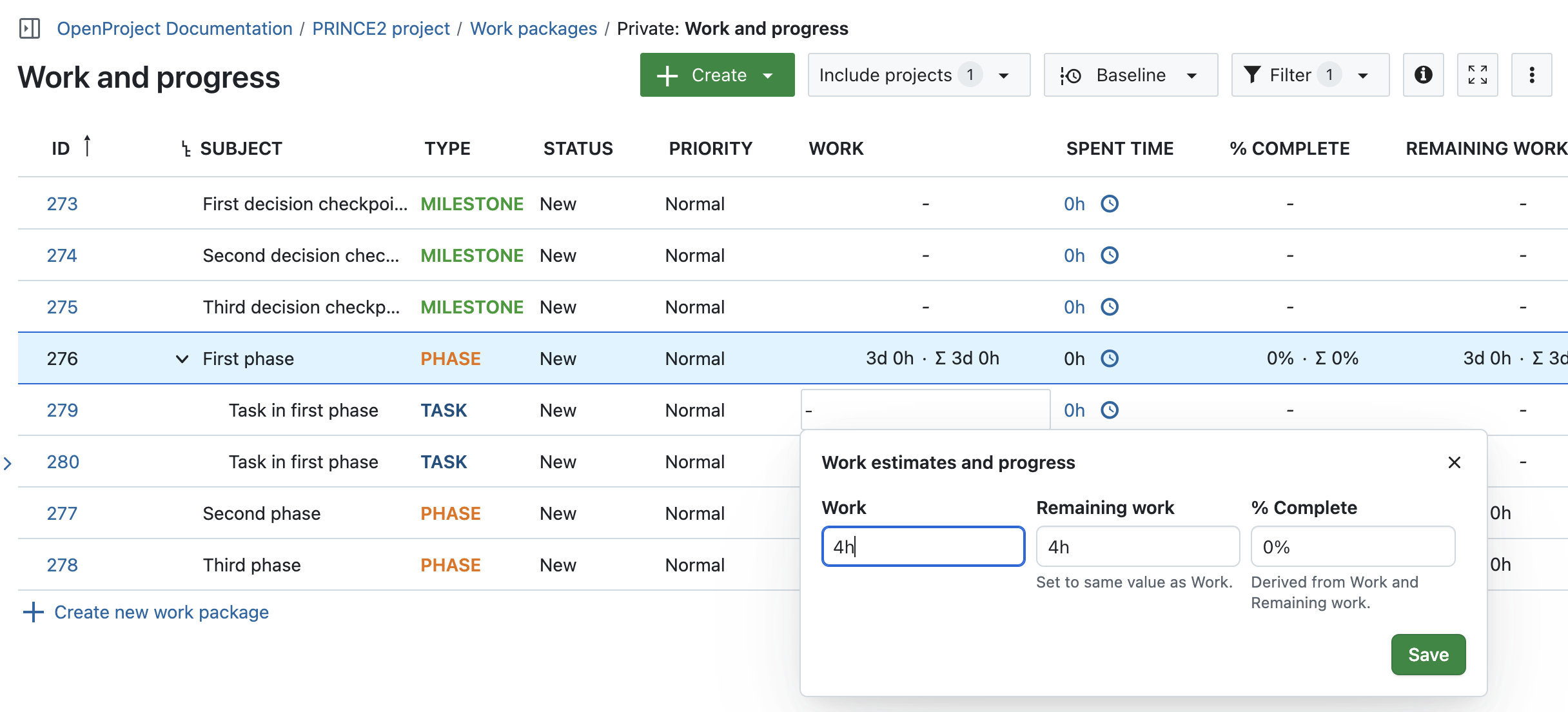
During the Controlling a stage process in PRINCE2, it’s crucial to track ongoing work and respond proactively to any risks of deviation. In OpenProject, the Estimates and progress section in each work package provides a clear overview of effort and status.
This section includes:
Work
Spent time
Remaining work
% Complete
To add work, you can either open a work package and add the information there. Or, if you want to edit several work packages right after each other, create a work package table that shows columns for progress. Add the column Estimated time to provide an effort estimate in hours.
Assign work
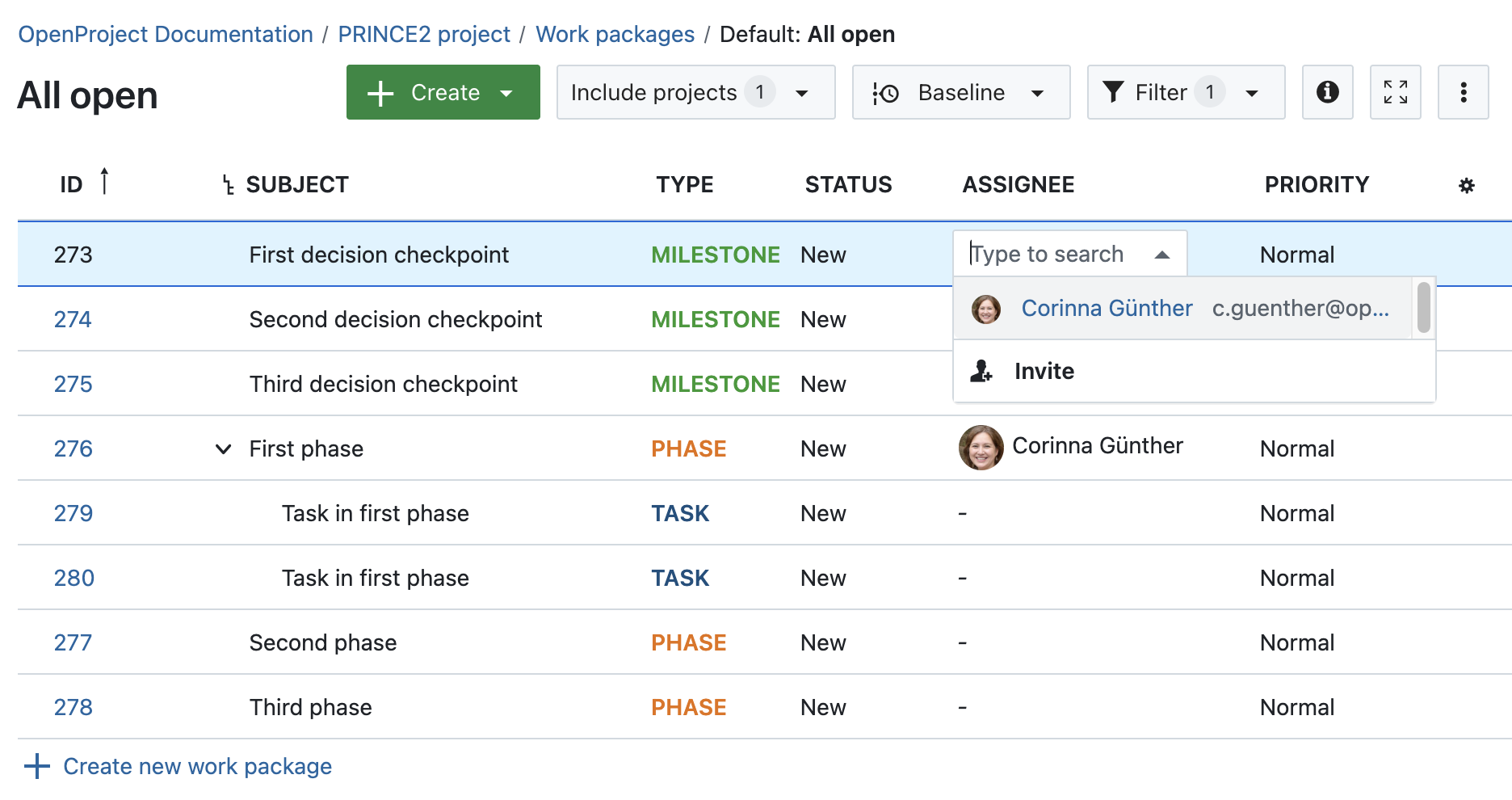
Afterward, continue by assigning the work packages to the project members by clicking on the cells in the Assignee column.
5. Managing product delivery
According to PRINCE2, this process focuses on the scheduled execution of work and the delivery of high-quality outcomes. OpenProject supports this through structured collaboration, time tracking, and transparent communication — all directly linked to each work package.
Log time on work packages
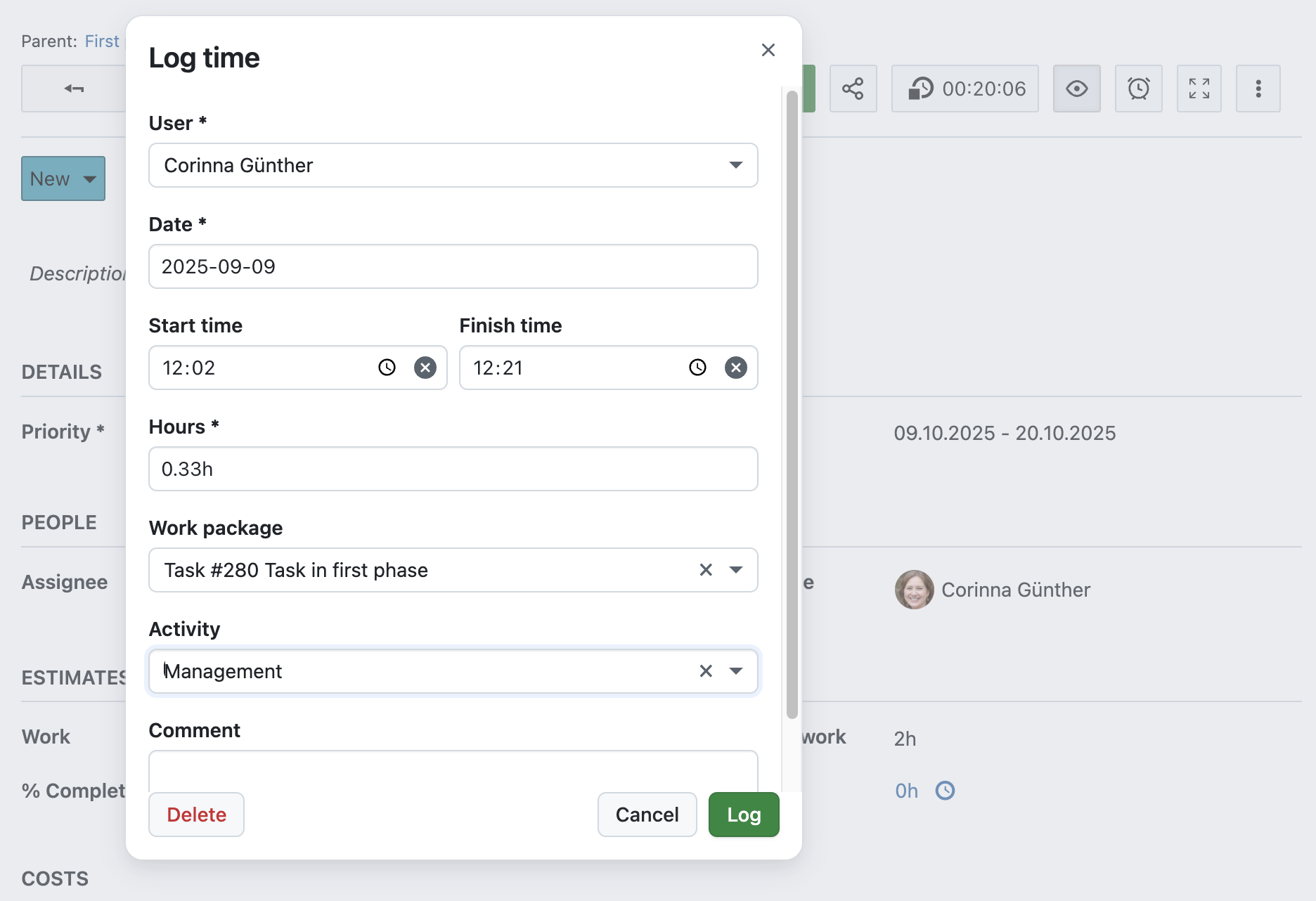
While working on the project, project members can log their time by opening the work package details view, selecting the More (three dots) menu and then the Log time entry. Alternatively, they can click the Time tracking button (clock icon) in the top bar. This starts a timer. Clicking it again stops the timer and opens the Log time modal with the duration pre-filled.
Communicate and document on work packages
To facilitate the communication within the project, OpenProject offers the forums, meetings and news module.
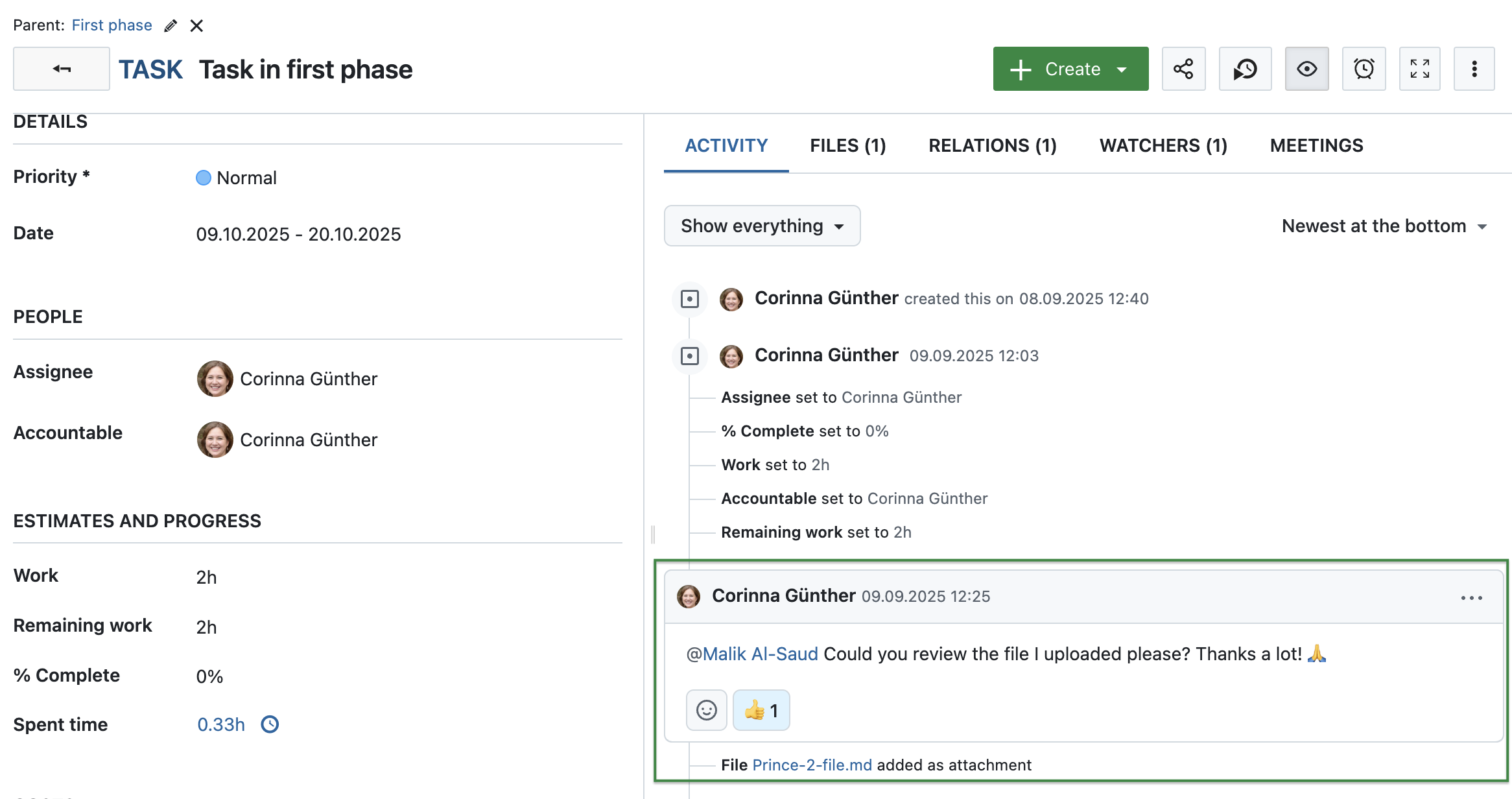
The Activity tab in each work package enables team members and project managers to collaborate and keep track of changes. Use @mentions, emoji reactions, and internal comments (available as Enterprise add-on) to stay aligned throughout the delivery phase. Read more about work package activity with OpenProject.
And then there is file management with OpenProject: Upload files with few clicks to your work package or use one of our integrations to link to and from Nextcloud, OneDrive (Enterprise add-on) or SharePoint (Enterprise add-on).
6. Managing stage boundaries
In PRINCE2, every stage should end with a review and approval before moving on. In OpenProject, you can support this by structuring your project into phases and milestones, tracking progress in the Estimates and progress section, and reviewing key outcomes with the team.
The progress of the phases is documented automatically in the Activity section of the phase. Additionally, the progress can be set directly, as we described in the section on how to control a stage.
Manage meetings
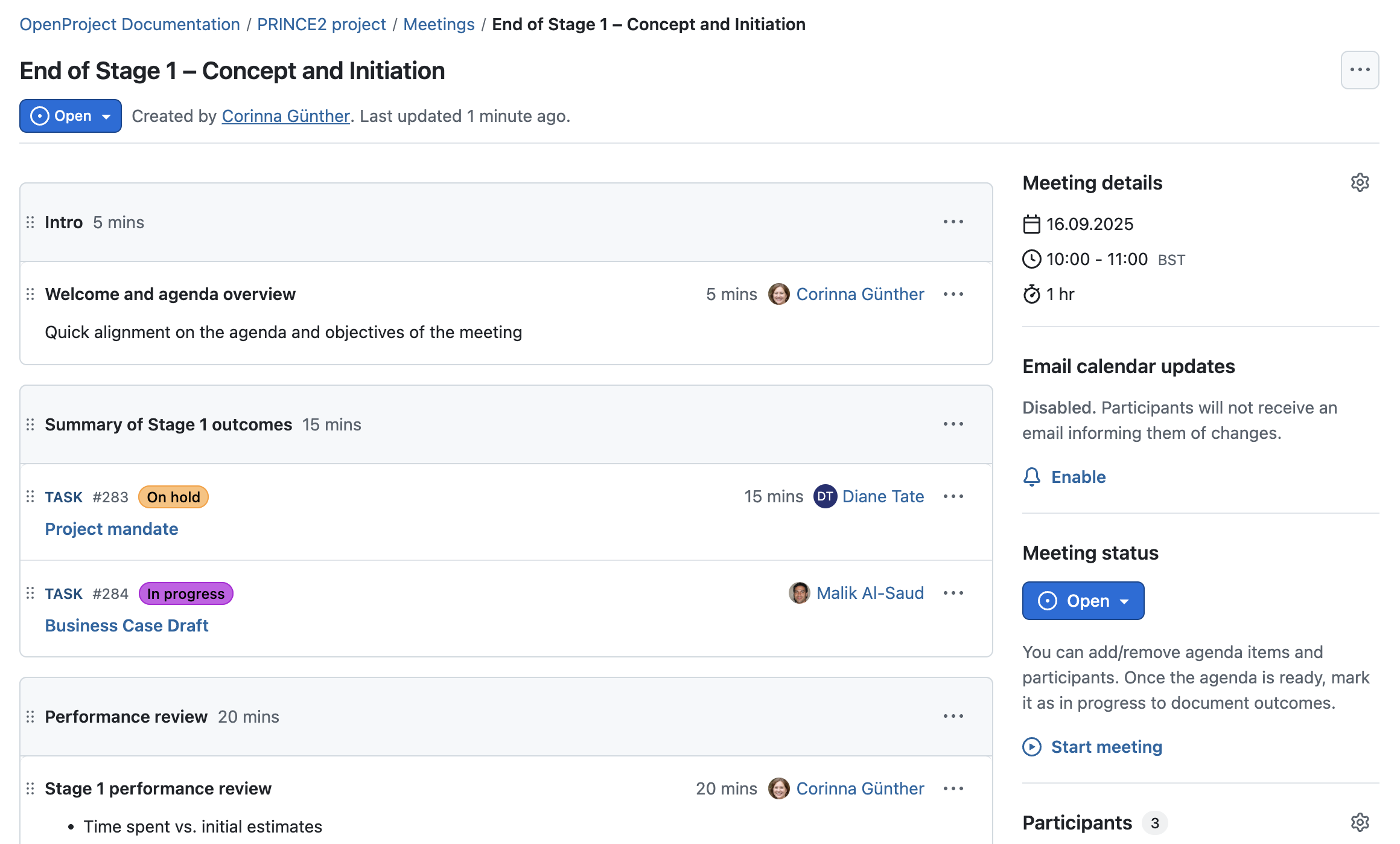
To review progress and make go/no-go decisions between stages, we strongly recommend using OpenProject’s Meetings module. It allows you to prepare structured agendas, assign work packages for discussion, and document decisions directly — all in one place.
You can use recurring meetings (e.g., after each stage) and apply templates to keep reviews consistent across projects. During the meeting, outcomes can be recorded directly in the agenda, and follow-up actions can be created as work packages right away. This ensures accountability and traceability for your stage boundary decisions.
Tip
Need to share meeting notes with external stakeholders? Simply export the meeting as a PDF to circulate a summary of key outcomes.
Project life cycle with stages and stage gates
Support stage transitions with approval gates: OpenProject’s project life cycle feature — originally designed for the PM² framework — lets you define phases and gates. In our Enterprise edition, you can edit them and create new ones. Use this feature to visually structure your PRINCE2 stages and introduce checkpoints for management approvals before continuing.
Baseline comparison
To assess how you’re performing against your original plan, use the Baseline comparison feature. With one click, you can quickly see what has changed in your work package tables since a previous snapshot—helpful for identifying deviations before moving to the next stage.
7. Closing the project
In PRINCE2, closing a project means formally completing all work, reviewing outcomes, and handing over deliverables. OpenProject provides the structure and documentation tools to support a smooth and transparent closure process.
PDF reports
When all the tasks, phases and milestones have been completed, you can document the final project report in a wiki page, add a news or create a new document. If you finish your project with a meeting, you can download this as a PDF to generate a final report as well.
Archive the project
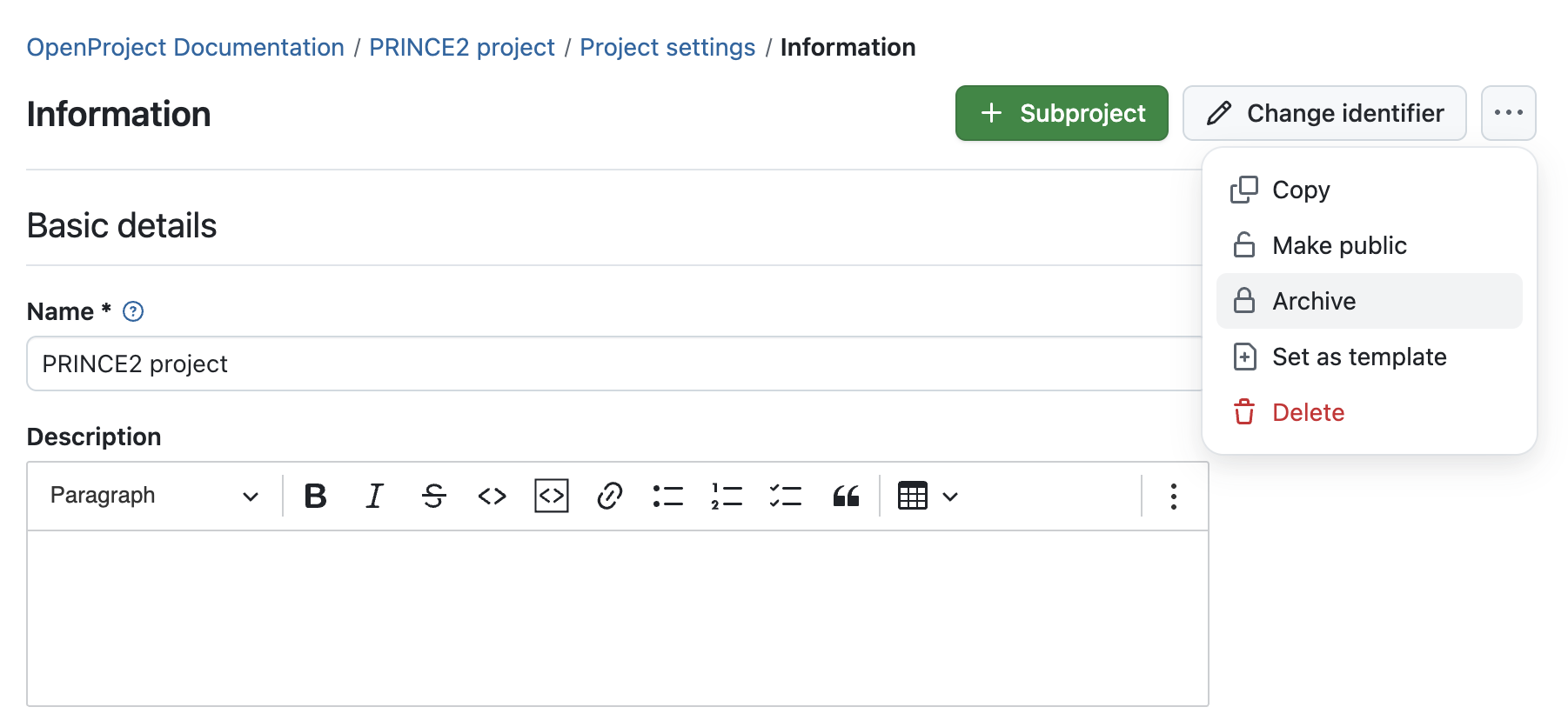
As a last step, you can archive the project by selecting Project settings and then Archive. If you think you’ll work on a project with a similar structure in the future, you can also set this project as a template.
Tip
Archiving a project also helps keep your workspace clean and focused on active work. You can still access closed projects and filter them in your project list as needed.
Apply PRINCE2 to your free OpenProject test environment
Whether you’re certified in PRINCE2 or simply looking for a structured, flexible framework, OpenProject gives you the tools to manage projects with clarity, accountability, and transparency — all in a secure, open source environment.
More and more organizations are turning to open source alternatives to implement PRINCE2 and avoid vendor lock-in or rising license costs. With OpenProject, you can build workflows that match your organization’s needs, without compromising control.
Start your free OpenProject trial now and see for yourself how you can implement your company’s workflows with OpenProject. No credit card, no phone number, no strings attached. So there’s really no reason not to give OpenProject a try: https://start.openproject.com/
Working remotely has many advantages, above all maximum flexibility for employees. However, having colleagues spread across the globe also has the disadvantage that you can’t just meet up for a coffee or after-work get-together.
That’s why we in the OpenProject team – which works 100% remotely – try to make sure that social interaction isn’t neglected. One way to socialize in a relaxed atmosphere is through monthly game nights, which are organized by and for employees outside working hours.
Read this article to get an insight into what these events are like.
Ways to make remote work fun
So, how do you keep connected in a remote team? You don’t have hallway conversations, you don’t have socializing in the office after 5pm, you don’t even have similar summer or Christmas events as in non-remote companies.
At OpenProject, here’s what we do to socialize:
Virtual Christmas party,
On-site meetups wherever possible, at least once a year with the whole company,
Monthly random coffee chats (2-4 people),
After work game nights.
Together, these activities help keep the team together and bring fun to work. Let’s take a closer look at OpenProject game nights now.
How game nights at OpenProject work
Game nights are internally organized by employees and usually take place once a month, always outside working hours and are, of course, absolutely voluntarily. Even though sometimes new colleagues join, it’s usually the same group of 5-10 people who are participating.
We started the first game night in 2023, and it soon became an unofficial, but regular place to socialize.
And over time, game night has also become a space for running jokes and shared humor.
To keep things easy and fun and include everyone who wants to participate, we follow these simple ground rules:
Browser-based games only,
Free to play only,
In the evening, outside working hours,
Once a month, we start a poll to decide on the next date.
Games we like to play
As mentioned above, we restrict ourselves to browser-based games to have low-entry barriers. Here are some of our all-time favorites:
skribbl – Each player takes turns drawing a term, which the others guess via text chat (as often as they like). Points are awarded for guessing correctly quickly and for drawing well.
codenames – Two teams play against each other, with one person from each team having to explain certain terms from a 5x5 grid of cards to their team. But: they are only allowed to say one word and one number (indicating how many cards are meant).
timeguessr – You see a random picture and have to decide when and where it was taken. We play that by one person sharing their screen and us collectively discussing to find the right solution.
make it meme – A fun game in which each person chooses a meme (image) and adds text to it. After a few minutes, the outcomes are presented and you can vote for the memes you like best. For us, this is THE game of inside jokes.
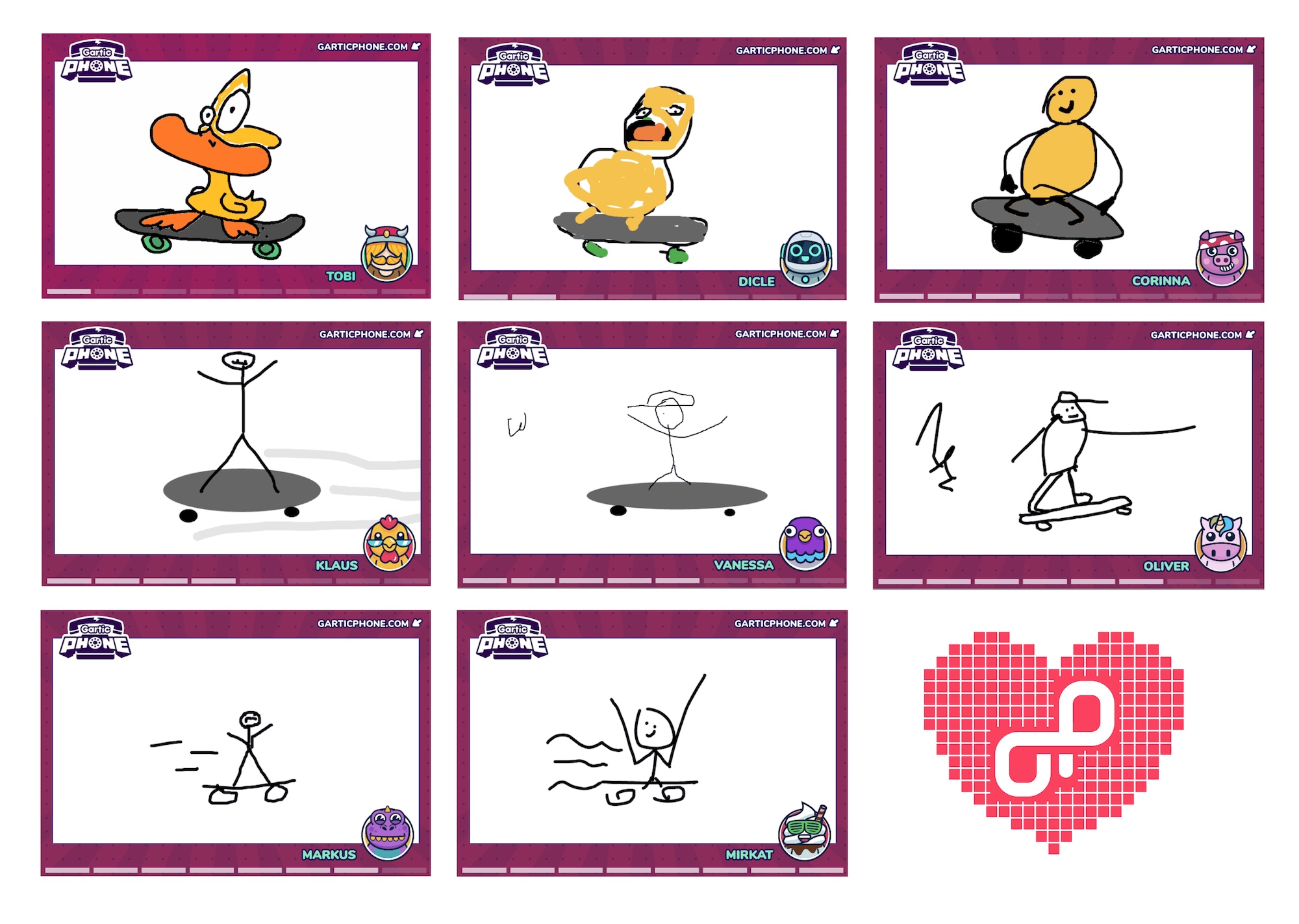
garticphone – There are various creative game variations to choose from. They all involve drawing and a kind of Chinese whispers. For example, everyone draws a picture, then receives the picture of another player and has to write a short description. After that, everyone receives only a text and has to draw a picture to go with it - and so on.
wikispeedruns – This game plays through Wikipedia: You choose a starting term and an ending term – e.g. from OpenProject to Banana. To get from the Wikipedia page for the starting term to the ending term, you have to click on links in the text. The player who needs the fewest clicks wins.
Some games are cooperative, some are competitive, and most require a little creativity. A mouse is helpful, especially for drawing-based games, but other than that, all you need is a stable internet connection. And, of course, it’s not really about winning or creating the most beautiful doodles — the focus is always on having fun together.
Some visual insights
Image: Outcomes of a game called Garticphone: One draws something, the next person has to re-draw it but with less time, and so on. From art to absurdity in a few hilarious steps.
Image: Collage of outputs created during OpenProject game nights. Two doodles from garticphone, one meme from make it meme, and one image from wikispeedrun.
Note
As OpenProject employees speak different native languages, we generally communicate in English. Still, it happens sometimes that all game nights participants are German speaking. This is where we switch language and the reason why one image from the above is in German.
Want to take part? Become a colleague!
These social activities are organized by the team, for the team — and are entirely optional. But they’re a great way to have fun together. If this sounds like the kind of workplace you’d enjoy, take a look at our current vacancies.
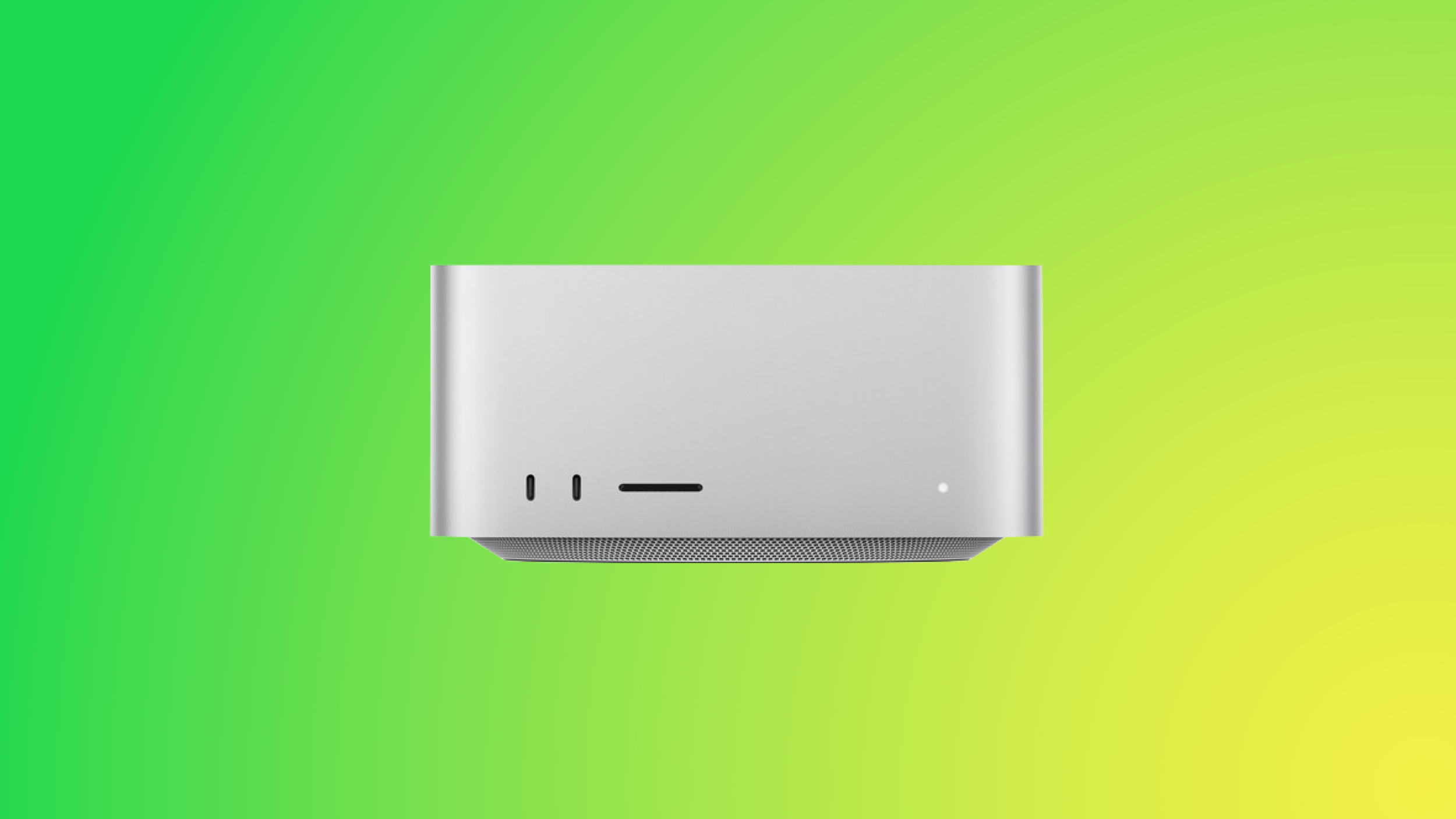
If you have a Mac Studio with an M3 Ultra chip and can't get macOS Tahoe to install, you're not alone. There is a bug that is preventing the update from installing properly on machines that have the M3 Ultra.
Affected users go to install macOS Tahoe, wait through the installation process and see the Mac Studio reboot, and then end up with macOS Sequoia 15.7 still running instead of macOS Tahoe. The macOS Tahoe update fails again and again.
A discussion thread on the Apple Support Communities suggests that the bug is impacting all Mac Studios with an M3 Ultra chip, and we have a Mac Studio that is unable to be upgraded. A Mac user who dug into the error messages suggests that the installer loads the macOS Tahoe driver for the Apple Neural Engine, but then a hardware check fails, and the installation process is aborted.
Mac Studio owners say that attempting to install via standard software update, safe mode, and recovery mode have all failed. There is no known fix right now, and M3 Ultra Mac Studio users will need to wait for Apple to release a fix to solve the issue.
Apple is aware of the problem, so hopefully the problem will be resolved shortly.
It turns out that Apple's new Adaptive Power mode extends beyond the iPhone.
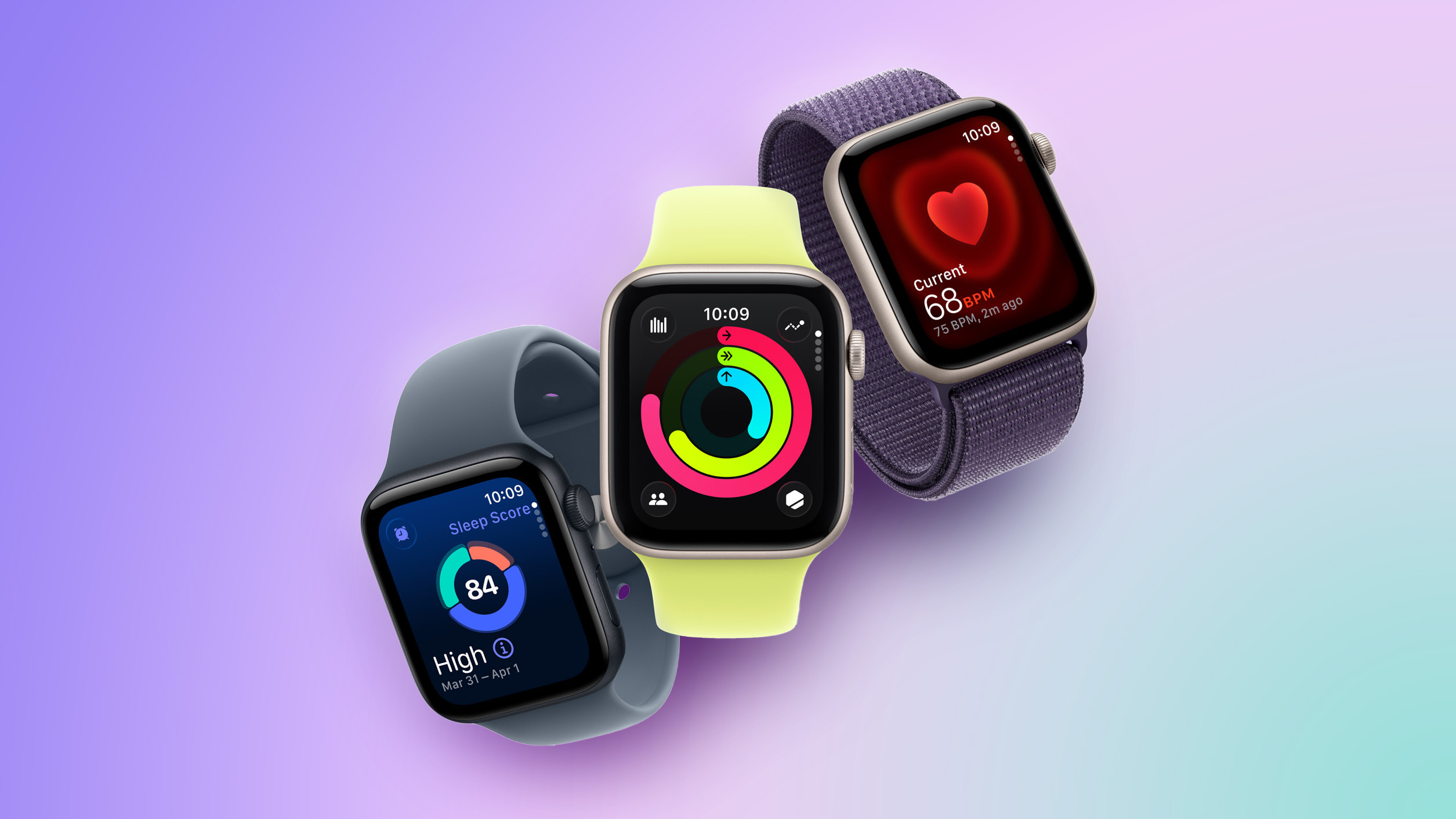
Starting with watchOS 26, Adaptive Power is enabled by default on all compatible Apple Watch models set up via Apple Watch For Your Kids, formerly known as Family Setup. This includes an Apple Watch that is already set up and updated to watchOS 26.
Apple Watch For Your Kids lets parents set up an Apple Watch — a model with cellular connectivity is required — for a child who does not have their own iPhone.
On the Apple Watch, Adaptive Power can help to extend battery life by adjusting the performance of certain features, according to an Apple support document. Apple says Siri may take longer to process requests, and some animations and scrolling might appear less smooth on the screen, but it is unclear how often this will happen.
Parents can turn off Adaptive Power on the child's Apple Watch, by opening the Settings app on it, tapping on Battery, and scrolling down to Adaptive Power.
Adaptive Power is only available on Apple Watch units set up via Apple Watch For Your Kids.
On the iPhone, Apple says the optional setting can make "performance adjustments" when necessary to extend battery life, including slightly lowering the display brightness, allowing some activities to "take longer," and automatically turning on Low Power Mode when remaining battery life reaches the 20% mark.
With an ultra-thin design that measures just 5.6mm at its thinnest point, Apple's new iPhone Air tops the iPhone 6 as the thinnest iPhone ever released.
With a 6.9mm frame, the iPhone 6 was prone to bending, although the most egregious examples were often seen in YouTube videos that used excessive force.
The big question: Will the iPhone Air bend?
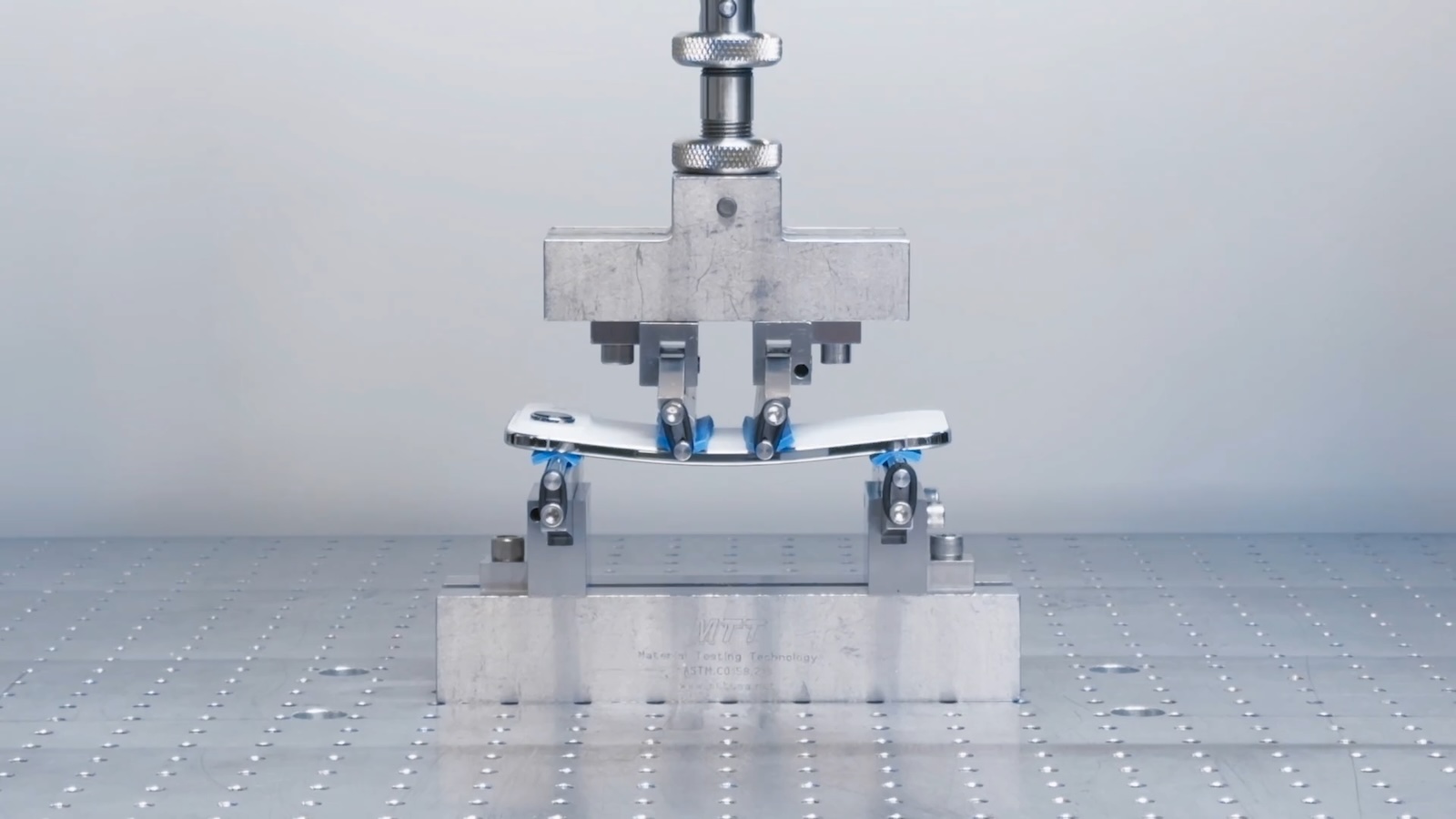
In a video that Apple provided to Tom's Guide, Apple subjected the iPhone Air to a machine that simulated "130 pounds of pressure" on the middle of the device. The publication said the video shows the device "springs back remarkably well and doesn't show any lasting curve from the experience." You can watch it for yourself in their report.
It appears the iPhone Air should be bend-proof in most if not all real-world scenarios, but we still have to wait for independent, third-party tests.
It does seem pretty safe to say that the iPhone Air will not bend in the same way the iPhone 6 did, and a big reason for that is the device has a titanium frame, whereas the iPhone 6 was made with aluminum. Apple said the iPhone Air "exceeds" its "stringent bend strength requirements," and touted it as the most durable iPhone ever.
The report also includes a few other durability test videos from Apple, including one that tests the Ceramic Shield 2 front cover on iPhone 17 models, which is promised to offer 3× better scratch resistance compared to the previous generation. Another video subjects the iPhone 17 Pro to simulated drop tests. Unsurprisingly, given these videos are from Apple, the results are favorable. Real-world tests will confirm things soon.
The first reviews of the iPhone 17 Pro and iPhone 17 Pro Max have now been published by selected media outlets and YouTube channels, offering a closer look at the device ahead of Friday's launch.
The iPhone 17 Pro models feature one of the biggest design changes to the device in years, moving to an aluminum unibody frame and a full-width rear camera plateau. New color options include Silver, Deep Blue, and Cosmic Orange.
A completely new front-facing camera features an 18-megapixel square sensor, facilitating automatic rotation and Center Stage. There is also a 48-megapixel telephoto camera for the first time, enabling 4x and 8x optical zoom.
The A19 Pro chip enables better performance with Neural Accelerators. A vapor chamber cooling system is built-in for even better heat dissipation.
Other new features include noticeably longer battery life, an improved anti-reflective coating, Ceramic Shield 2, a brighter display, Genlock support, and more.
The two key advantages the Pro models have over the ultra-thin iPhone Air include roughly 20% to 40% longer battery life, and a Telephoto rear camera with 4x and 8x optical zoom. The devices also have an Ultra Wide camera, if you use it.
The iPhone 17 Pro and 17 Pro Max can be pre-ordered now. Below, we have rounded up some of the reviews.
This results in a longer battery life for the iPhone 17 Pro according to our battery drain test, reaching a time of 15 hours and 32 minutes. That's a marked improvement over the iPhone 16 Pro’s average run of 14 hours and 7 minutes.
I'm also seeing solid all-day battery life with my real world use. Most of my time on the phone has been spent surfing the web, taking tons of photos with all its cameras, watching videos on YouTube, and getting in a few sessions with Diablo Immortal and Age of Origins throughout my day. I've made a point to not top off its battery during the day, only to find it at about 20% battery life by the end of the night.
CNET took a closer look at the new Telephoto camera:
I thought I'd notice the difference between 4x and 5x, but unless I had the phones side-by-side, I was unaware. The 17 Pro Max's telephoto images are brighter and have better details and resolution than ones from the 16 Pro, which is likely the result of the larger sensor.
And similar to the wizardry Apple uses to make 2x photos look good, the telephoto camera is able to achieve 8x images. Telephoto images at 4x taken under good lighting (like a nice sunny day) can stand toe-to-toe with images from the main camera. But when I took telephoto images in less than ideal lighting, the 4x images held up OK, whereas the 8x images had more noise and softness.
I played one of the most demanding games on the iPhone right now—Assassin's Creed Mirage—and performance was significantly smoother than when I played it on the iPhone 16 Pro last year. The iPhone 17 Pro still got hot, but the heat was spread out over the entire back of the phone, so it didn't feel as uncomfortable to hold while gaming (unlike the iPhone 17 and Air). I maxed out the graphical settings, and the frames per second were noticeably more stable, and I rarely saw stutters at all.
Engadget said the A19 Pro's Neural Accelerators make a meaningful difference to AI tasks:
I do want to commend Apple for the improved performance in Image Playground and Genmoji. It used to take ages for AI-generated pictures or emoji to appear (especially those based on a picture of someone in my photo album), but on the iPhone 17 Pro I was able to get several options in succession before things slowed down. Pictures where I opted to use ChatGPT’s more realistic styles took a lot longer, but by and large I saw a marked improvement in speed here. Those neural accelerators in the A19 Pro’s six-core GPU are certainly pulling their weight.

 Login
Login