
Reading view

Colombia’s Armed Forces confirm over 50 dead in FARC dissident clashes in Guaviare

Colombia’s Armed Forces and regional authorities are struggling to verify the full scale of a bloody confrontation between rival FARC dissident factions in the remote southeastern department of Guaviare after clashes reportedly left more than 50 combatants dead.

The fighting, described by officials as one of the deadliest episodes this year involving former Revolutionary Armed Forces of Colombia (FARC) splinter groups, erupted in rural areas near the departmental capital San José del Guaviare between forces loyal to two dissident commanders known by their war aliases “Calarcá” and “Iván Mordisco.”

According to a communiqué released by the faction aligned with Calarcá, the confrontation began when approximately 250 fighters allegedly under the command of Néstor Gregorio Vera Fernández, alias Iván Mordisco, launched a surprise assault on a dissident encampment in the hamlet of La Siberia.

The clashes were reported in the rural sectors of Barranco Colorado, Charras and Trocha Ganadera, cattle farming regions with limited state presence.

The Calarcá faction claimed that a combat column belonging to the Isaías Carvajal Front had been resting overnight when it was attacked before dawn.

“In an act of legitimate self-defense, our units broke the siege, inflicting the first enemy casualties,” the group said in the statement, which was circulated through clandestine channels on Thursday.

“After three hours of combat, the enemy withdrew leaving fifty dead on the battlefield and carrying away a large number of wounded,” the communiqué added.

Colombia’s Army confirmed that troops from Brigade 22 remain deployed in the rural outskirts of San José del Guaviare, the epicenter of the fighting, but authorities acknowledged that they have been unable to fully enter the conflict zone due to difficult terrain and the continued presence of heavily armed illegal groups.

Defense Minister Pedro Sánchez confirmed the clashes took place in the Barranco Colorado sector, more than 100 kilometers east of San José del Guaviare, but refrained from confirming casualty figures. Minister Sánchez did, however, claim that the official statement amounted to a “confession and public admission” of an “atrocious crime”. Sánchez also warned that the reported deaths of underage combatants would constitute a grave violation of international humanitarian law and Colombian criminal legislation, further intensifying scrutiny over forced recruitment of children by FARC dissidents.

Officials said access to the region is severely restricted, with many areas reachable only through jungle tracks and river routes. Colombia’s forensic authorities, including Medicina Legal, have yet to recover or identify bodies from the battlefield.

Regional authorities convened an extraordinary security council meeting on Wednesday amid fears that the violence could intensify ahead of Colombia’s presidential election scheduled for May 31.

San José del Guaviare Mayor Willy Rodríguez told Caracol Radio that preliminary reports suggested “dozens” may have died, though he cautioned that authorities had not yet independently verified the numbers.

“We are receiving alarming information from residents in the rural areas, but the Armed Forces still have not been able to fully enter and confirm the situation,” Rodríguez said.

Governor Yeison Rojas joined police and military commanders in emergency deliberations as intelligence agencies attempted to establish the true scale of the confrontation.

The dissident faction loyal to Calarcá accused Iván Mordisco of provoking the conflict and described the elusive guerrilla commander as “a mentally disturbed individual with ideological shortcomings and psychopathic tendencies.”

The statement also claimed the group seized a significant cache of weapons during the battle, including four machine guns, 49 assault rifles, two Dragunov sniper rifles and more than 10,000 rounds of ammunition.

The faction further stated that two of its own fighters were killed and three wounded, while also claiming to have captured “a female prisoner of war.”

“We inform the Colombian people that this tragic event, occurring four days before an electoral contest, was not initiated by us,” the communiqué concluded. “It was an act of legitimate self-defense.”

The confrontation underscores the growing fragmentation and territorial disputes among Colombia’s remaining armed groups following the 2016 peace accord between the Colombian government and the FARC guerrillas.

Iván Mordisco, once considered one of the most powerful dissident commanders operating outside the peace agreement, has become a central figure in the collapse of President Gustavo Petro’s “Total Peace” negotiations with illegal armed groups.

Security analysts warn that Guaviare, a historic stronghold for the former FARC insurgency and a major coca-producing region, has increasingly become the scene of violent turf wars involving rival dissident fronts competing for narcotics routes, extortion rackets and territorial control.

The latest bloodshed also raises concerns over the deteriorating security situation in Colombia’s southeastern departments  just days before Colombians vote in a presidential election, May 31.

San José del Guaviare, long considered a strategic stronghold in Colombia’s anti-narcotics campaign, hosts one of the country’s largest counterinsurgency and anti-drug military bases, including a fleet of Black Hawk helicopter gunships used in jungle operations against armed groups and cocaine trafficking networks. The region has also historically maintained the presence of U.S. military personnel and advisers supporting intelligence, surveillance and counternarcotics missions in southeastern Colombia.

As of Thursday, Colombia’s Attorney General’s Office, National Forensic Institute – Medicina Legal – and Armed Forces had yet to issue a definitive death toll.
  •  

Lines on Stone: The Millennial Rock Art of the La Lindosa Range

At the eastern fringes of the Andes, where the Orinoco River Basin unfurls in an ondulating canvas of green, punctuated by majestic rivers and sandstone mesas, lies one of the world’s most astonishing open-air galleries of human existence.

The Serranía de La Lindosa, in the department of Guaviare, is a monumental tableau carved by nature and painted by hands that may have been among the earliest storytellers on the planet. For centuries, these walls stood largely hidden to the world, known only to Indigenous communities and a handful of intrepid explorers. Today, they form the heart of a groundbreaking exhibition in Bogotá’s Museo del Oro: Trazos sobre piedra: Pinturas milenarias en la serranía de La Lindosa, an ambitious, year-long showcase hosted by Banco de la República.

The exhibition that opens on November 28 is the most extensive institutional undertaking yet to unravel the symbols, narratives, and cosmologies that animate a rock-art tradition stretching back tens of millennia. Far from a display of a lost civilization, the Central Bank’s ambition matches that of the cliffs themselves – massive escarpments where hunters, shamans, and master painters returned generation after generation to leave visual testaments of their world.

The story of La Lindosa begins, in many ways, with a single mark. A red smear – thin, elongated, always intentional – painted on the rough face of a stone wall deep in an expanse of canopy and tropical rainforest. To an untrained eye, the pigment blends with natural iron deposits. But to archaeologists who have studied the region for years, it marks the threshold of an extraordinary visual universe. That smear belongs to a constellation of tens of thousands of pictograms across Guaviare and neighboring Amazonian massifs, including the monumental cliffs of the PNN Chiribiquete National Park. Together, they form one of the world’s oldest and largest rock-art traditions.

Archaeologists describe La Lindosa as a cultural landscape, a place where art, geology, ecology, and spirituality intertwine. The Serranía’s towering sandstone walls were formed by tectonic forces millions of years ago, creating natural canvases that humans began to paint long before the earliest agricultural societies emerged.

Only recently have researchers begun to grasp the full temporal depth of these murals. While Europe’s famed Lascaux cave contains roughly 600 images dating to the Upper Paleolithic (between 15,000 and 13,000 BC), the paleo-Indian paintings of Colombia could be far older. In Chiribiquete, analysis of natural dyes, superimposed layers, and stylistic continuity suggests that some images may date back as far as 35,000 BC. La Lindosa shares many of these motifs and techniques, hinting at a cultural horizon that may reach back to the earliest chapters of human imagination.

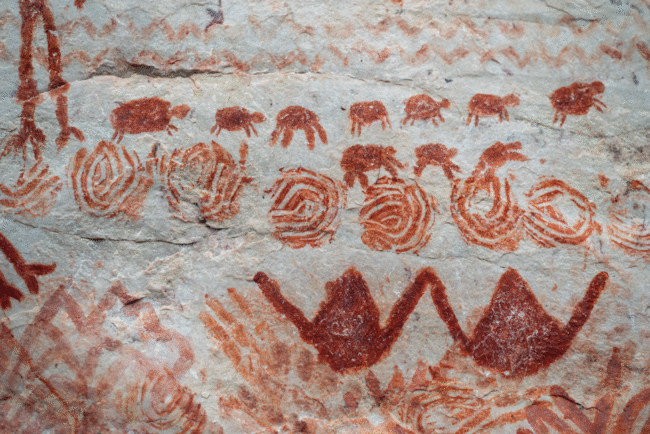
Details on the rock face of La Lindosa. Photo: Federico Ríos/Banco de la Repúblics

This immense chronology is not just a scientific revelation – it is a window into a world where every figure, every line, carries meaning. The murals of La Lindosa are filled with scenes of ritual dances, hunting parties, geometric patterns, spirit beings, and animal-human hybrids. They depict jaguars, monkeys, fish, snakes, birds, and the silhouettes of humans with outstretched arms. In some panels, the figures appear in motion; in others, they stand in tight, nearly choreographed formations that suggest communal ceremony. The dazzling variety of imagery points to a worldview rooted in transformation, reciprocity, and ecological intimacy.

One of the most compelling findings to emerge from recent research is the specialized nature of the painting tradition. Archaeologists believe that the most experienced storytellers – shamans, ritual specialists, or highly trained painters – scaled treacherous escarpments to reach spaces associated with spirits and cosmic forces.

These elevated murals often contain the most complex iconography, executed with astonishing precision. Younger or less experienced painters worked closer to the ground, contributing simpler figures or layering their work atop earlier compositions. Over centuries, entire cliffs became palimpsests: surfaces where multiple generations added, corrected, reinterpreted, and echoed the narratives of their ancestors.

The Banco de la República’s exhibition, under Judith Trujillo’s curatorship, mirrors this layered history. Visitors encounter immersive installations, high-resolution photographic panels, pigment analyses, and interactive 3D reconstructions that recreate the sense of standing before the colossal walls themselves. Rather than isolating images, the exhibition places each pictogram within the broader landscape – its geology, myths, and ecological rhythms.

To step inside the exhibition is to enter a world where the boundaries between art and survival dissolve. The rock art of La Lindosa was not decorative; it was a method of world-making. It engaged with spirits, conveyed moral codes, transmitted ecological knowledge, and anchored communities in a landscape that could be both bountiful and unforgiving. Many murals appear near water sources, ancient pathways, or natural shelters – places where human life pulsed most intensely.

Just as telling is the continuity these images embody. Despite colonization, displacement, and the fragmentation of Indigenous territories, the symbolic vocabulary of the Amazon endures. Elements of this cosmology survive in the ritual practices of several Indigenous groups today, whose elders regard the panels not as archaeological remains but as living documents.

As Colombia confronts the pressures of illegal mining, deforestation, and climate change, the need to protect sites like La Lindosa has become urgent. These walls hold traces of human existence long before national borders or written histories were printed. They extend the timeline of pre-Columbian identity back tens of thousands of years, reminding visitors that the Amazon and Orinoco watersheds have always been at the center of innovation, imagination, and spiritual awakening.

Inside the Gold Museum’s hallowed halls, visitors will pause before the vivid reds – their unexpected brightness, their persistence through rain, wind, time. These pigments, ground from seeds, minerals, and endemic plants, were not chosen at random; they were sacred. They signaled life, danger, transformation. They were meant to endure.

Whether the ancient painters imagined their work surviving 30,000 years is just one of many unsolved mysteries. Their names may be lost, but their visions endure – a vast, breathing archive that continues to astonish and challenge us.

Guests to this landmark exhibition are not mere spectators either, but participants in La Lindosa’s vast “Sistine Chapel” – an offering handed-down to generations, and carried forward through the endless corridors of time.

Visitor Information – Museo del Oro

Museo del Oro, Banco de la República
Cra. 6 No. 15-88.

Exhibition runs until November 27, 2026.

Opening Hours

  • Tuesday–Saturday: 9:00 a.m. – 7:00 p.m.
  • Sunday: 10:00 a.m. – 5:00 p.m.
  • Monday: Closed

Admission: COP $5,000

Follow the exhibition on social media: Instagram @MuseoDelOro #LaLindosa #MuseoDelOro

  •  

Colombia Confirms 15 Minors Killed in Army Bombings Against FARC Dissidents

The Colombian government of President Gustavo Petro has acknowledged that at least 15 minors recruited by illegal armed groups were killed in four military operations carried out between August and November, after a report by the National Institute of Forensic Medicine revealed a higher number of child casualties than initially disclosed by the Defence Ministry.

The deaths occurred during a series of bombings and clashes in the departments of Guaviare, Amazonas and Arauca, according to the forensic agency. The figures have intensified scrutiny of President Gustavo Petro’s security decisions and the conduct of the Armed Forces under a government that has repeatedly pledged to uphold human rights protections while pursuing its “total peace” agenda.

Defence Minister Pedro Sánchez said the military was aware of the probability that minors were present in the camps targeted during the operations but insisted all actions were carried out in accordance with the principle of distinction under International Humanitarian Law (IHL), which obliges armed actors to differentiate between combatants and civilians.

The revelation comes a week after an operation in Calamar, Guaviare, on November 10, that left seven minors dead in a bombing against dissident factions of the FARC. The incident prompted a wave of criticism and forced the government to respond publicly to accusations that it had failed to take sufficient precautions to avoid killing children forcibly recruited by armed groups.

According to the forensic report, the first of the four operations took place on August 24 in the rural village of Nueva York, in El Retorno, Guaviare. The agency received eight bodies from the site — seven men and one woman. Three of them were minors: two boys and one girl. The institute did not provide ages or identities.

The second operation occurred in Puerto Santander, Amazonas, where four bodies were transferred to the forensic institute on October 7. All four — three males and one female — were identified as minors. The bombing, reported earlier this month by local media, targeted structures allegedly belonging to the FARC dissident group led by alias ‘Iván Mordisco’ .Military intelligence believed Mordisco might have been in the area, but he later escaped, officials said.

The most lethal operation occurred on November 10 in Calamar, Guaviare, where 20 bodies were recovered from a bombing site and transported to forensic authorities on November 12. Sixteen have been identified, while four remain unidentified. Thirteen of the victims were male and seven female. Of the total, seven were minors, Forensic Medicine said.

The fourth incident took place on November 13 in Puerto Rondón, Arauca. Eight people were killed there – three men and five women – including one girl.

The forensic report has deepened the political crisis surrounding the deaths of children in military operations, a long-standing and highly sensitive issue in Colombia’s armed conflict. It has also revived long-running questions about the state’s responsibility to ensure the protection of minors, even when they have been forcibly recruited by illegal armed groups.

The Public Ombudsman’s Office, which monitors human rights violations, reiterated after the latest bombings that the presence of minors in illegal armed groups does not justify attacks that could endanger them, stressing that the Armed Forces must adopt “all possible precautions” to protect children, who are guaranteed special protection under both domestic and international law.

The warning underscores concerns that date back years. In 2019, then-Defence Minister Guillermo Botero resigned after revelations that a military bombing in Caquetá killed eight minors. At the time, opposition senators – including Gustavo Petro, Iván Cepeda and Roy Barreras – sharply criticized the government for failing to prevent avoidable child deaths.

Now in power, Petro faces similar criticism over what rights groups describe as a recurring pattern: intelligence-driven bombardments aimed at neutralizing armed groups, but which result in the deaths of children who have been forcibly recruited and used as human shields by illegal organizations.

Defence Minister Sánchez rejected accusations that the government attempted to conceal the new information. He said the operation on August 24 in El Retorno was not a bombing but a ground confrontation, disputing suggestions that authorities had misrepresented the conditions under which the minors were killed.

Minister Sánchez now faces a no confidence vote in Congress following the Guaviare incident in which seven minors were killed. The no-confidence vote comes as the Petro government is as odds with the United Nations over cocaine productions figures. According to the UN, 3,000 tons of the illegal narcotic were produced in 2024, and number the leftist leader refutes.

  •  
❌