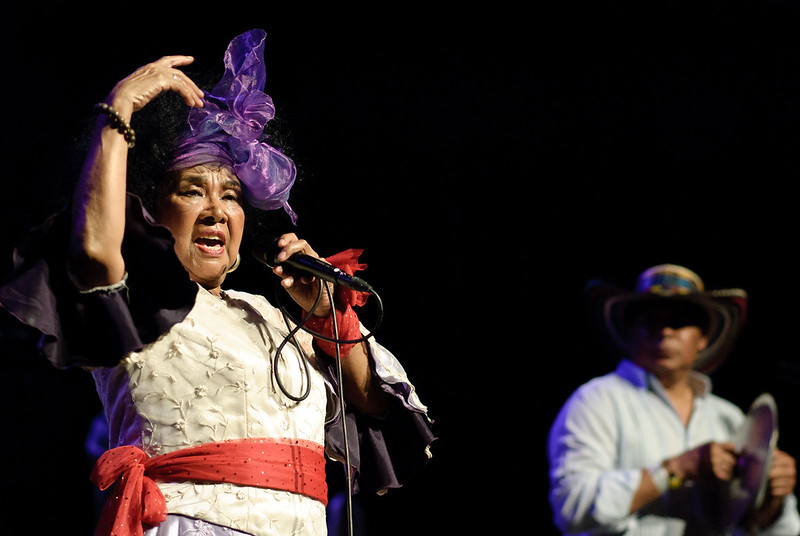
Totó la Momposina at the Sala Barts, Barcelona. Image credit: Dani Alvarez via Flickr
Colombia is mourning the death of legendary singer and dancer Totó la Momposina, the artist who carried the rhythms of the Caribbean coast to audiences around the world.
Totó’s death was disclosed in a statement by Colombia’s Ministry of Culture today, which described her as “the eternal master”, praising her decades-long contribution to Cumbia, Porro, Mapalé and Bullerengue music.
Her family confirmed that Totó died on Sunday, May 17, in Celaya, Mexico at age 85, after years battling neurocognitive health complications.
Born Sonia Bazanta Vides in 1940 in Talaigua Nuevo, Bolívar, near the historic river town of Mompox, Totó devoted her life to preserving and promoting traditional Caribbean music rooted in African, Indigenous and Spanish influences.
For more than six decades, Totó became the voice of Colombia’s Caribbean soul. Raised in a musical family — her father was a drummer and her mother a singer and dancer — she began performing at an early age before later studying folklore and music in Bogotá, Paris and Cuba.
In 1982, she accompanied Gabriel García Márquez to Stockholm during his Nobel Prize ceremony, where she performed Colombian Caribbean music before international dignitaries — a moment that became part of the country’s cultural history.
Her international breakthrough came with the 1993 album La Candela Viva, released through Peter Gabriel’s Real World label, which introduced global audiences to the song “El Pescador” and to authentic Colombian rhythms.
Over the years, Totó collaborated with and influenced artists across genres, while her music was sampled by international musicians including Jay-Z and Major Lazer. Her song “Latinoamérica” alongside Calle 13 won her two Latin Grammy Awards in 2011. She officially retired from performing in 2022 due to health complications.
Totó received numerous honors throughout her career, including the Womex Award in 2006, Colombia’s Life and Work Award in 2011, and the Latin Grammy Award for Musical Excellence in 2013.
Colombian President Gustavo Petro honored the singer in a post on X today, calling her “an exalted figure of Colombian Caribbean art and culture,” adding, “may she fly high to the stars.”
Her family also announced that a tribute honoring the singer-songwriter will be held on May 27 at the National Capitol in Bogotá, as the country prepares to bid farewell to one of the most influential voices in its cultural history.
When One Hundred Years of Solitude author Gabriel García Márquez accepted the Nobel Prize for Literature in Stockholm in 1982, Colombia arrived with him — not only in prose, but in rhythm, drumbeat and dance.
Among the delegation of more than 200 Colombian musicians and artists who traveled to Sweden was a barefoot singer from the banks of the Magdalena River whose voice would stop the banquet hall in its tracks. Her name was Sonia Bazanta Vides, though the world would come to know her simply as Totó La Momposina.
“It was as if everyone from Macondo had come down the staircase of Stockholm City Hall,” The City Paper wrote in a 2016 profile titled Colombia’s Queen of Cumbia. Totó, wrapped in the musical traditions of Colombia’s Caribbean interior, danced across the marble floors singing cumbia and bullerengue before royalty and diplomats.
After the performance, she recalled, a palace official approached with a message from the Queen of Sweden: “Never stop singing.” And for more than six decades, she never did.
On Tuesday, Colombia awoke to the news that Totó La Momposina had died at age 85 in Mexico, where she had been living in recent years after retiring from music in 2022 due to declining health. Colombia’s Ministry of Culture confirmed her death, calling her “eterna Totó,” the eternal voice who elevated and transformed the traditional music of the Caribbean coast.
Her son, Marcio Vinicio, told Colombian media that the singer had spent recent months in palliative care. President Gustavo Petro described her as an “illustrious figure of Colombian Caribbean art and culture.” Opposition leader and presidential candidate Paloma Valencia highlighted that Totó la Momposina “took our music to the world and taught us to feel pride in what is ours. Her legacy is the nation’s heritage”.
Born in 1940 in Talaigua Nuevo, on the Magdalena River near Santa Cruz de Mompox, Totó emerged from a lineage where music was inherited as naturally as language itself. Her father was a shoemaker and drummer; her mother sang, danced and played the mandola. By age six, Totó was already performing onstage.
But it was the villages and wetlands of Colombia’s Caribbean coast that became her true conservatory.
As a teenager, she traveled from town to town absorbing rhythms born from the collision of African, Indigenous and Spanish traditions. She studied the cantadoras — women who sang while washing clothes in the river, grinding corn or tending cassava fields — and transformed those oral traditions into a musical language that would eventually reach audiences around the globe.
“The love for music is passed on through your genes,” she told The City Paper in 2016. “I never lost my sense of belonging.”
That belonging was rooted in Mompós, the island town from which her stage name derived. For centuries, the Magdalena River served as Colombia’s great cultural artery, carrying not only gold and commerce inland from the Caribbean coast, but rhythms: cumbia, mapalé, chalupa, porro and bullerengue.
Totó would become their most recognizable ambassador.
After her family fled violence during Colombia’s mid-century civil conflict and settled in Bogotá, her mother transformed their home into a sanctuary for Caribbean music. Musicians such as Lucho Bermúdez passed through the house, and Totó soon formed her own group in the 1960s, performing at neighborhood parties and on television.
In the 1980s, she moved to Paris to study at the Sorbonne University, immersing herself in music history, choreography and stage production while singing in metro stations, restaurants and street corners throughout the French capital.
France would become a second home — and the launching pad for international recognition.
Her breakthrough arrived when Peter Gabriel heard her perform and invited her to record at his Real World studio near Bath, England. The resulting 1993 album, La Candela Viva, introduced global audiences to songs like El Pescador and cemented her place on the world music stage.
She would go on to perform across Europe, Latin America and the United States, reportedly appearing more than 300 times at New York’s Radio City Music Hall. Her influence stretched far beyond folk music circles. Artists including Manu Chao and Timbaland sampled her work, while she lent vocals to Latinoamérica.
Though often called “The Queen of Cumbia” or “The Voice of Colombia,” Totó resisted celebrity detached from tradition. For her, the stage remained sacred. “The stage is a temple,” she told The City Paper. “You must respect it. I give my heart to the audience. It is a commitment.”
Even in her seventies, she continued performing with fierce energy, appearing at events tied to Colombia’s peace process and receiving honors including the Latin Grammy Lifetime Achievement Award and France’s highest Order of Arts and Letters, the Chevalier des Arts et Lettres.
Her final public years coincided with a renewed appreciation among Colombians for their own musical roots — roots Totó had spent a lifetime defending.
In September 2022, she announced her retirement due to neurocognitive complications. Yet her songs endured as living memory: the voice of fishermen on the Magdalena, of Afro-Colombian drumming circles, of women singing beside the riverbanks of the Caribbean coast.
“The day that I cease to be nervous before going on stage, I will retire,” she once said. “Because at that point music will have become mechanical.”
For Totó La Momposina, music never became mechanical. It remained alive, ceremonial, ancestral — a fire carried across generations. And perhaps that is why the Queen of Sweden’s words still resonate today: Never stop singing.
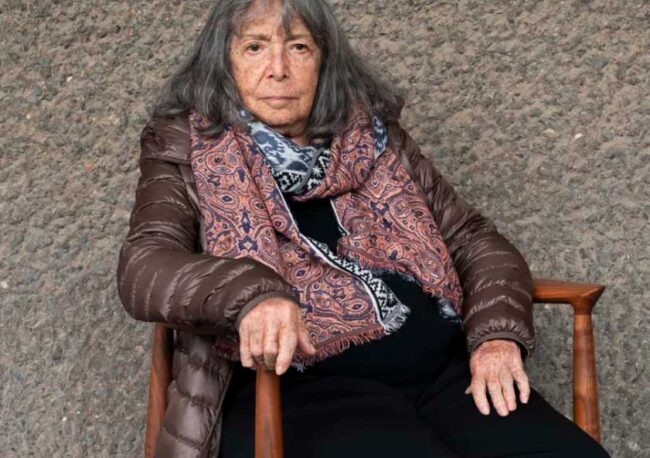
Beatriz González, one of Latin America’s most influential contemporary artists, whose boldly colored, deliberately unrefined paintings and installations confronted Colombia’s long history of political violence, public mourning and social inequality – while also reshaping the country’s most important public art collection – died on Jan. 9, 2026, at her home in Bogotá. She was 93.
Her death was announced by the Banco de la República, Colombia’s central bank, where for more than four decades she played a decisive role in shaping the institution’s cultural mission and its vast art collections. In a statement, the bank described her as “an essential figure in Colombian art and culture” and “a masterful narrator of memory.”
González was not only a prolific artist but also a historian, curator, educator and critic — a rare figure who helped define how Colombia would see its art, its past and, ultimately, itself. “Artists exist so that memory is not thrown in the trash,” she once said, a line that came to stand as a quiet manifesto for a career devoted to preserving what official histories often erased.
Born in Bucaramanga in 1932, González came of age during La Violencia, the brutal civil conflict that engulfed Colombia between 1948 and 1958. That formative experience would leave an indelible mark on her work. After briefly studying architecture, she enrolled at the University of the Andes in Bogotá, graduating with a degree in fine arts in 1962. She later studied printmaking in Rotterdam and counted among her teachers the influential critic Marta Traba, who helped shape modern art discourse in Latin America.
González’s early work drew attention for its irreverent treatment of European art history and Colombian popular imagery. Her critical view of “good taste” led her to reject academic refinement in favor of what the art critic Germán Rubiano described as an approach that was consciously unpolished and deliberately opposed to sophistication.
She appropriated masterpieces by Manet, Leonardo da Vinci and Raphael, flattening their compositions and translating them into the visual language of curtains, furniture and household objects. Armoires, beds, trays and even wallpaper became supports for paintings marked by compressed figures and bold color palettes — a strategy that blurred the boundary between high art and domestic life.
One of her earliest and most discussed works, The Sisga Suicides (1965), reimagined a newspaper photograph of a young couple who drowned themselves in a dam outside Bogotá. Rendered in vivid, almost cheerful colors, the painting exposed the uneasy coexistence of tragedy and banality in Colombian public life — a theme that would recur throughout her career.
By the 1980s, González’s art took on an increasingly overt political tone. Press photographs of presidents, massacres and grieving families became central to her work. She painted them repeatedly, transforming news images into objects of repetition and contemplation, as if to ask how a society becomes accustomed to its own suffering. “It’s been a critique of power that has permeated my work,” she told ArtReview in 2016. “For that very reason, I don’t think of it as ‘political’; it has an ethical commitment.”
Her focus on mourning was particularly stark in works depicting mothers weeping after the 1996 Las Delicias massacre, in which dozens of Colombian soldiers were killed by the FARC guerrilla. These images, stripped of sentimentality, confronted viewers with grief as a collective, inescapable condition. The depth with which González addressed both individual and collective mourning stands among her most significant contributions to contemporary art.
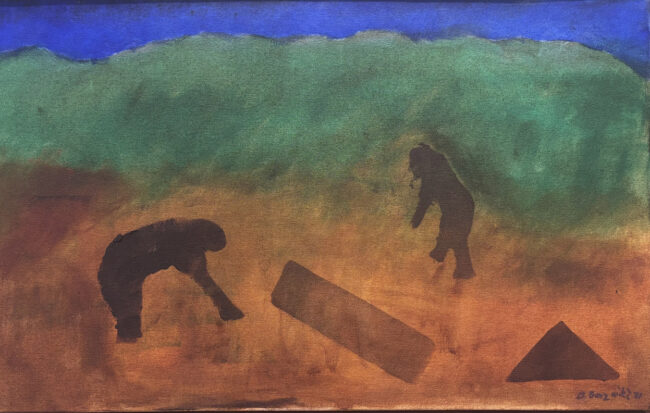
The Burial. Beatriz González/Private Collecion
That macabre clarity intensified in the 2000s. In Anonymous Auras (2023), one of her final major works, González installed more than 8,000 printed silhouettes of workers carrying corpses across the wall niches of Bogotá’s Central Cemetery. The figures – anonymous, repetitive and almost ritualistic – transformed the cemetery into a monumental archive of loss, honoring victims whose names were never recorded.
“Artists exist so that memory is not thrown in the trash”
Parallel to her artistic production, González exerted extraordinary influence as a curator and cultural policymaker. Beginning in the 1980s, she became a close collaborator of the Banco de la República’s cultural division, serving as a researcher, curator and longtime member of its advisory committee on visual arts. In that role, she helped guide the formation of a national art collection with a distinctly Colombian focus, while insisting on dialogue with international works of the highest quality.
Few individuals knew the Central Bank’s art collection as intimately as González. Over more than forty years, she worked alongside successive generations of curators, historians and collectors, helping to consolidate one of the most important public art collections in Latin America.
In 2020, she donated her personal archive and library — nearly 100,000 documents — to the Banco de la República to ensure free public access. The archive documents not only her artistic practice but also her work as an educator, curator and historian, and provides an unparalleled record of Colombian art, politics and visual culture.
Her institutional impact reached beyond the Central Bank. At the Museo de Arte Moderno de Bogotá (MAMBO), she founded the influential School of Guides, a pioneering program for museum education that trained figures who would later become leading artists and curators. From 1989 to 2004, she served as chief curator of the Museo Nacional de Colombia, where she reorganized the permanent collection and helped redefine the country’s historical narrative through art.
International recognition came steadily. Her work appeared in Documenta 14, the Berlin Biennale and the landmark exhibition “Radical Women: Latin American Art, 1960–1985.” Major retrospectives were held at the Pérez Art Museum Miami, the Museum of Fine Arts, Houston, and the CAPC in Bordeaux. In 2026, the Barbican Centre in London is set to host her first major retrospective in the United Kingdom.
González received numerous honors, including Colombia’s Premio Vida y Obra and honorary doctorates from the University of the Andes and the University of Antioquia. In 2025, the city of Bogotá awarded her the Civil Order of Merit, recognizing her invaluable legacy and profound influence on the nation’s cultural life.
Yet she remained skeptical of accolades. She preferred to speak of discipline, research and responsibility — and of the obligation, as she saw it, to bear witness. From a childhood habit of collecting film-star postcards to a lifetime spent gathering images of state violence, Beatriz González devoted herself to the stubborn preservation of memory and to an unapologetic voice in Colombian contemporary art.
Read the Banco de la República’s tribute (in Spanish) to Beatriz González, written by Claudia Cristancho Camacho of the Cultural Section and Art Collection.

 Login
Login