
 Login
Login
Troops arrive in Cauca to calm clashes between indigenous communities.
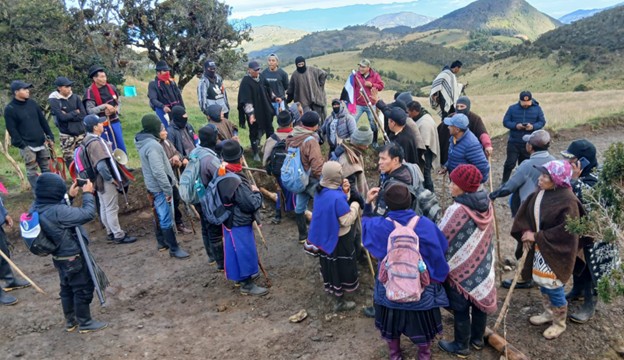
A large military contingent has been sent to Cauca today to halt clashes between members of the Nasa and Misak communities fighting over ancestral territory.
The first of 500 troops arrived in Popayán, the department capital, to be ferried by helicopters to the hills around Sylvia in northern Cauca where members of both indigenous groups were fighting on Thursday. The violent confrontation led to seven deaths and more than 100 people injured, some seriously, according to latest reports.
Colombia’s minister of defence Pedro Sánchez, announcing the troop deployment, said the death toll was likely to rise as both military and state institutions gained access to the zone.
Videos posted online showed people from both communities fighting with machetes, spears and home-made explosives. But many dead and injured had gunshot wounds, suggesting firearms were being used, said Sánchez.
Leaders called for calm today, and Colombia’s president Gustavo Petro appealed to both sides to re-start talks over the contested land.
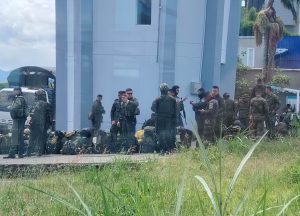
“I have requested a meeting with the highest authorities of the Misak and Nasa peoples to guarantee peaceful coexistence,” tweeted Petro. He offered to broker talks next week.
Petro’s government has been attempting to resolve historical territorial issues with indigenous communities who often lack legal land titles through the Agencia Nacional de Tierras (ANT), the national land agency.
An “interethnic pact” was urgently needed in Cauca to return fertile land to original communities for agricultural crops, said Petro. The expertise of indigenous farmers could turn the tide of drug trafficking in the region, he added.
Conflict hotspot
Cauca, in southwest Colombia, is one of the country’s most conflicted regions with multiple armed groups in conflict with the state.
It is also home to some of Colombia’s largest indigenous communities, such as Nasa that inhabit large tracts of highlands that span the Andean massif and defend their land with both political bodies – powerful lobbies such as the CRIC or Consejo Regional Indigena del Cauca – and self-defense forces known as Guardia Indigena.
In Cauca, the Guardia Indigena are frequently targeted by armed groups and members of CRIC are victims of kidnap or assassination.
See also – Cauca bombs: What’s Going On?
Vice-presidential candidate Aida Quilcué, herself Nasa, survived an abduction attempt in February this year when armed men intercepted her vehicle in the highlands of Cauca. She was rescued by Guardia Indigena who trailed her into the mountains.
This week’s clashes erupted after simmering dispute over 800 hectares (2,000 acres) of páramo highlands bordering the Pitayó Reserve, belonging to Nasa, and Guambia territory of the Misak.

Political twist
According to members of the communities, the plot of land had three springs and was of cultural and spiritual significance to both groups. But in 2023 the ANT appeared to award titles to Nasa based on colonial maps from the colonial era of the 1750s, and act that infuriated Misak who also claimed it as their ancestral territory.
In the aftermath of Thursday’s clashes, opposition politicians were quick to blame the Petro government for fomenting the violence, accusing the ANT of favoring the Nasa reserve and CRIC – widely seen as allied with Petro’s Pacto Historico party – of using the ANT judgment to invade Misak territory.
In a Facebook post right-wing presidential candidate Paloma Valencia accused Nasa’s community in the Pitayó reserve of breaking negotiations to take the disputed territory by force.
In a further twist, Valencia implicated Quilcué, the running mate of her main political rival Iván Cepeda in this month’s presidential elections. Quilcué, who previously led CRIC and was openly supported by the organization in her vice-presidential bid, had pushed the dispute, claimed Valencia.
“Instead of deciding to resolve the issues, the Nasa then decided to advance and invade the Misak territory,” she added.
Allowed to fester
According to an analysis by El Espectador, the conflict stemmed from a misunderstanding of 2023’s ANT declaration, which was an interim finding leaving a “wide margin of interpretation” for who owned the land.
Nasa interpreted the finding as an excuse to use the land traditionally inhabited by Misak, and in return the Misak community blocked access roads.
In March this year the governor of the Pitayó reserve Edinson Pacho condemned the Misak for causing economic damage to farmers unable to take their products to market.
In turn, this week Misak representative Liliana Pechenche accused the “armed forces of the CRIC” – the Guardia Indigena – of killing at least two Misak men and kidnapped 10 more of the Guambia community during the escalation.
She also denied the Misak were armed, claiming this was false information spread by the Nasa to justify their armed incursion: “We are at risk of physical extermination through persecution; we are a peaceful people.”
Both sides agreed on one thing: that the government and its ANT agency had allowed the misunderstanding to fester for several years despite warning signs that violence was brewing.
CRIC, which according to its website represents many indigenous groups including Misak in Cauca, rejected the appropriation of the conflict by national politicians.
“These situations cannot be used to deepen the division between fraternal communities,” it said in a statement.
“These conflicts…are the result of historical decisions and institutional omissions …to generate disputes, confusion, fragmentation and confrontations between indigenous groups,” it concluded.
By Friday a tense calm had settled on the area according to observers, with hopes for a quiet weekend before talks planned for next week.
The post Troops arrive in Cauca to calm clashes between indigenous communities. appeared first on The Bogotá Post.
