Reading view

Tecnoglass Posts Record Q1 Revenue as Aluminum Tariffs and Colombian Wage Costs Compress Margins

Tariff headwinds compress Tecnoglass margins despite record Q1 sales

Tecnoglass, Inc. (NYSE: TGLS) reported first-quarter 2026 revenue of $249.0 million USD, a 12.0% year-over-year increase and a first-quarter record for the Barranquilla, Colombia-based window and architectural glass manufacturer. Despite the top-line growth, net income fell to $31.9 million USD, or $0.71 per diluted share, from $42.2 million USD, or $0.90 per diluted share, in the same period of 2025, as elevated US aluminum costs linked to import tariffs, mandatory minimum wage increases in Colombia, and a strengthening Colombian peso combined to compress gross margins by 540 basis points to 38.5%.

Multi-family and commercial revenues rose 20.4% year-over-year, driven by continued activity across key markets including geographies beyond Florida, which has historically dominated the company’s US revenue mix. Single-family residential revenues were relatively flat on a year-over-year basis, with management attributing the result to the timing of order conversion into revenue rather than underlying demand, noting that order growth in the segment remained positive into April 2026. On a geographic basis, the US accounted for $237.1 million USD, or approximately 95% of total revenues, up 11.6%. Colombia generated $7.5 million USD, up 17.2%, and other international markets contributed $4.4 million USD, up 27.3%.

Gross profit declined to $95.8 million USD from $97.5 million USD in Q1 2025 despite the higher revenue base. The company cited an unfavorable revenue mix driven by a greater proportion of installation-related revenue, higher raw material costs — with US aluminum tariffs representing an incremental headwind of approximately $6.4 million USD in the quarter — higher salary expenses resulting from annual minimum wage adjustments in Colombia, and the effect of a stronger Colombian peso on costs incurred locally. Pricing actions and operating leverage on higher volume partly offset these pressures.

“We see a clear path to fully offsetting the impact of tariffs in 2027, when full-year pricing across both businesses and incremental automation savings are expected to be realized.” — Santiago Giraldo, Chief Financial Officer, Tecnoglass

Selling, general, and administrative expenses rose to $50.9 million USD, or 20.4% of revenues, from $42.5 million USD, or 19.1%, in Q1 2025. The increase reflected higher personnel costs from annual salary adjustments, peso appreciation, and higher transportation and commission costs tied to revenue growth. The period also included a one-time charge of $2.9 million USD related to Colombia’s *impuesto al patrimonio*, a government-imposed wealth tax levied on large corporations to fund measures addressing recent climate-related events in the country.

Adjusted EBITDA — which excludes non-cash foreign exchange gains and losses, the bad-debt provision, non-recurring charges, and equity-method adjustments related to the company’s joint venture in Vidrio Andino with Saint-Gobain (EPA: SGO) — came in at $61.5 million USD, or 24.7% of total revenues, compared to $70.2 million USD, or 31.6%, in Q1 2025. Adjusted net income was $34.6 million USD, or $0.78 per diluted share, versus $43.1 million USD, or $0.92, in the prior-year quarter.

Cash provided by operating activities was $6.7 million USD, a significant decline from $46.9 million USD in Q1 2025, driven in part by a deliberate build-up of US-sourced aluminum inventories — up $34.3 million USD in the quarter — as part of the company’s tariff mitigation strategy. Capital expenditures of $17.3 million USD reflected scheduled payments tied to previously announced capacity and automation projects. During the quarter, Tecnoglass returned $16.5 million USD to shareholders through share repurchases and paid $6.7 million USD in cash dividends. As of May 7, 2026, approximately $92.5 million USD remained available under the current share repurchase program. The company ended the quarter with total liquidity of approximately $425.0 million USD, comprising $91.1 million USD in cash and cash equivalents and more than $330.0 million USD in revolving credit facility availability, against total debt of $200.3 million USD.

The company’s order backlog reached a record $1.36 billion USD at quarter-end, up 19.1% year-over-year, extending multi-family and commercial pipeline visibility into 2027. Tecnoglass cited continued expansion of its dealer network and showroom footprint as supporting geographic diversification and market share gains, with vinyl product lines identified as an incremental growth driver broadening the company’s addressable market.

José Manuel Daes, chief executive officer, commented on the results: “First quarter results were in line with our expectations, with resilient performance across our key metrics reflecting the continued strength of our vertically integrated business model despite a dynamic cost environment. Demand for our product offerings remains strong, as demonstrated by another quarter of record backlog and healthy order activity, with momentum continuing into the second quarter. Our previously announced pricing actions are now in place, and the broad-based nature of industry cost pressures supports our confidence in executing these increases while preserving our competitive positioning.”

Christian Daes, chief operating officer, addressed the tariff response and the company’s assessment of a potential US manufacturing presence. “Our pricing initiatives and cost mitigation efforts are well underway, including logistics improvements, further automation across our operations, and ongoing supply chain optimization,” he said. “We are also advancing our assessment of a proposed US manufacturing initiative, with a well-located site identified and significant state and local incentives secured that strengthen the project’s potential economics if we decide to move forward based on market demand.”

Santiago Giraldo, chief financial officer, reaffirmed full-year 2026 guidance and outlined the company’s tariff offset timeline. “Based on our strong execution to start the year, we are reiterating our full year revenue outlook in the range of $1.06 billion to $1.13 billion USD and Adjusted EBITDA outlook in the range of $225 million to $245 million USD,” Giraldo said. “This reflects the impact of the recently implemented 10% tariff on finished aluminum window imports as previously disclosed, which is expected to be partly offset in 2026 through pricing actions effective on orders from early May forward, with additional efficiency initiatives from logistics optimization and automation underway and expected to begin contributing benefits by year end. We see a clear path to fully offsetting the impact of tariffs in 2027, when full-year pricing across both businesses and incremental automation savings are expected to be realized.”

On the corporate structure front, Tecnoglass’ board of directors has approved a plan to redomicile the company from the Cayman Islands to the United States, subject to shareholder approval. If approved, the redomiciliation is expected to be completed during Q2 2026. The company stated that the move is intended to simplify its organizational and regulatory structure, improve the tax efficiency of dividend distributions, and expand its potential investor base to include funds and accounts limited to US-domiciled securities. Tecnoglass will retain its Miami, Florida headquarters following the change.

Separately, the company is conducting a feasibility study for a potential new US manufacturing facility. A site meeting project specifications has been identified and substantial state and local tax credits have been secured. The proposed facility is described as highly automated and intended to support future growth while also improving lead times, reducing transportation costs for certain markets, enhancing supply chain efficiency, and enabling the company to compete for Buy America-eligible projects and rapid-turnaround contracts. Tecnoglass expects to complete the purchase of land for the potential facility during Q2 2026, at an estimated cost of $20 million to $25 million USD to be financed through available credit facilities. The company noted that the land purchase does not constitute a commitment to proceed with construction, which would occur in phases contingent on demand, market conditions, and return profiles. The company’s 5.8-million-square-foot vertically integrated manufacturing complex in Barranquilla, Colombia, would continue to serve as its primary production base.

Above photo: Tecnoglass facilities in Barranquilla

  •  

ICRC tells Colombian armed groups to ‘stop targeting civilians’.

2025 was worst humanitarian crisis in over a decade, says report.

Delegates from the International Committee of the Red Cross in Colombia. Photo: ICRC

Colombia’s armed groups must stop targeting civilians, urged the International Committee of the Red Cross (ICRC) this week in a report highlighting the country’s intensifying conflict.

In 2025 the impact of armed conflict on communities was the worst recorded in a decade, said the ICRC, with all indicators showing mistreatment of civilians on the rise.

Quoting statistics from Colombia’s victim support unit – the UARIV – the human rights organization reported more than 87,000 persons displaced in mass events by conflict or threats, and a further 235,000 forced to uproot their lives individually.

Also in 2025, at various times more almost 177,000 people were confined in their communities by aggression by armed groups, either by combat or closing of transport routes.

And in a shocking figure, 965 persons were killed or injured by explosives, often delivered by drones, an increase of 34% on the previous year (2024). Most victims were civilians.

“The scale of this human tragedy cannot be described by numbers alone but is reflected in the suffering of entire communities living in fear of fighting,” said the ICRCs Colombia chief Olivier Dubois, presenting the findings.

“Families are forced to leave everything behind in order to survive, the search for thousands of missing persons, and the shattered lives of boys and girls scarred by war,” he added.

New forms of warfare

The ICRC has a key role in promoting International Humanitarian Law (IHL) in armed conflicts – the so-called ‘rules of war’ – of which an important part is keeping civilians out of the crossfire. The Geneva-based organization, which has been present in Colombia for decades, said upholding these rules depended on decisions by the armed actors themselves.

This was an increasingly difficult task given the breakdown of formerly hierarchical armed groups into numerous factions. And with new forms of warfare.

“In 2025, our teams worked in a context marked by the intensification and transformation of armed conflict dynamics, including an increasing use of new technologies, such as the use of drones, with significant consequences on civilians’ daily lives,” said Dubois.

The increase of explosive hazards – booby traps, landmines and drone bombs – affected civilians as clashes intensified in departments such as Norte de Santander, Cauca, Antioquia and Valle.

In these areas a total of 75 civilians were affected by landmines, and more than 540 injured or killed by “controlled detonation devices and launched explosive devices”, a term that includes a range of improvised devices from roadside bombs to armed drones and clumsy pipe mortars firing cooking gas cylinders packed with explosives.

Intimidation and power

The rise in drone-dropped bombs had not only intensified in the conflict but “generated fear, uncertainty and serious harm among affected communities”.

The report also described scant regard for civilian spaces as explosives were found scattered in fields, roads and even schools, stated the report.

“The way in which hostilities are conducted, and weapons are used, has direct implications for civilians and civilian property”, it added.

The ICRC also warned of the horror of sexual violence within the conflict framework, though often hidden and unreported. From its own presence in zones dominated by armed groups, the ICRC was aware that rape and abuse survivors faced stigmatization and fear of reprisals.

This created barriers for victims seeking care and assistance and under-reporting of cases: “The available figures do not reflect the true scale of this phenomenon,” said the report.

Armed groups used sexual violence as a form of intimidation and a show of power, but in some cases also as a form of punishment in communities under their control.

The report also called on armed groups to stop recruiting minors: “No person under the age of 18 should be recruited, used or involved in hostilities under any circumstances,” it said.

The humanitarian crisis observed last year was not a sudden phenomenon, explained the ICRC, but rather the culmination of year-on deterioration since 2018.

Bad month for civilians

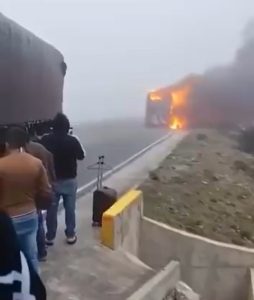
A public bus burnt by armed men on a highway on May 12th. Photo: X

The report follows a calamitous month for Colombia in terms of civilian victims. In late April, 21 bus passengers were killed in Cauca when the EMC armed group exploded a roadside bomb by a queue of stopped traffic.

And in early May a young journalist was tortured and murdered by suspected Frente 36 dissidents in a rural area close to Briceño, Antioquia.

See also: Colombian journalist found dead days after being reported missing

The report’s findings chime with those from thinktanks and UN agencies that have rung alarm bells over growing conflict and abuses by armed groups.

In February, UNICEF warned of a spike in child recruitment with numbers rising 400 per cent over five years, with one minor forced into conflict on average every 20 hours.

The same month thinktank Fundacion Ideas para la Paz (FIP) published data showing that Colombia’s illegal armed groups had grown by 84 per cent during the three years of the Petro government’s Paz Total policy

Armed groups had cynically used rounds of negotiations to expand both in numbers and territory, FIP analyst Gerson Arias told The Bogotá Post.

“As such, the policy gave a gigantic strategic advantage to the armed groups to strengthen their fighting forces,” he said.

War without ideology

A common theme between conflict commentators was the lack of ideology among today’s armed groups, lowering any humanitarian impulses. This even though these groups at times mimicked the uniforms, logos and terminology of former rebel movements with social agendas such as the FARC-EP.

“Any ideological dimension of these groups has been replaced by the dynamics of illegal markets,” Gerson told The Bogotá Post last week. “The dimension now is military strength to sustain those markets.”

From the 1960s to the 1980s Colombia’s guerrilla movements were close to rural communities. That relationship was now predatory, said Gerson. “Communities in Cauca, for example, don’t feel represented or protected by these armed groups who attack them, confine them and recruit their children,” he explained.

The question now is: will the current crop of combatants heed the ICRC’s call this week to respect civilian communities?

ICRC’s Olivier Dubois said that while the context was challenging, international humanitarian law should be foremost in the minds of all fighters in the conflict.

In particular, he called on armed groups to protect children from war, and respect spaces such as schools. He also called for an end to forced disappearances, of which the ICRC recorded 308 new cases last year, on top of the 132,000 historical cases reported by the authorities over six decades of conflict.

No one should go missing, and no family should have to endure the uncertainty of not knowing what happened or where their loved one is. Preventing the disappearance of persons is an obligation imposed by Interntional Humanitarian Law on all parties to armed conflicts,” he said.

“Upholding international humanitarian law is fundamental to limit suffering in armed conflicts. When these rules are not respected, suffering is exacerbated”.

The post ICRC tells Colombian armed groups to ‘stop targeting civilians’. appeared first on The Bogotá Post.

  •  

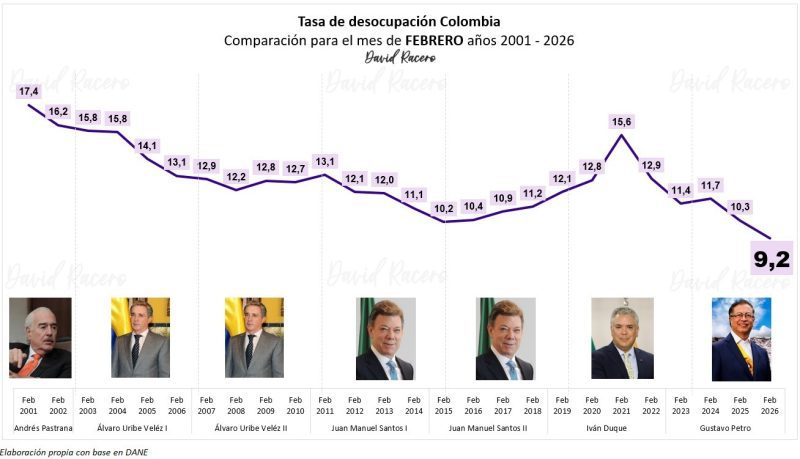
Colombia Unemployment Drops to 9.2% in February, Lowest Since 2001

Colombia’s unemployment rate dropped to 9.2% in February from 10.3% a year earlier, marking the lowest level for the month since 2001, according to official data.

In February 2026, Colombia’s unemployment rate stood at 9.2%, a decrease of 1.1 percentage points compared with the same month in 2025 and the lowest figure for a February since 2001, according to the government through the National Administrative Department of Statistics (DANE).

According to the report, “at the national level, the employed population increased by 624,000 people compared with the previous year.” The sectors that contributed most to job creation were professional, scientific and technical activities, with 250,000 new positions, and the public sector (administration, education and health), with 244,000. In contrast, agriculture lost 363,000 jobs and the transportation sector 86,000 compared with February 2025.

President Gustavo Petro highlighted the result on his X account, stating that “we return to a single-digit unemployment rate, 9.2%, the lowest since 2018. More reasons not to accept the mistake of the right parties in claiming that raising the minimum wage to a living wage would bring an employment catastrophe. That was not true: we have the lowest unemployment of this century for the month of February.” The president also defended the minimum wage increase, which reached 23.7%, the highest recorded in the country.

Volvemos a un dígito de tasa de desocupación, 9,2%, la más baja desde el 2018.

Más razones para no aceptar la equivocación de la derecha al afirmar que el subir el salario mínimo al nivel del salario vital traería una catástrofe del empleo.

No fue cierto, tenemos el menor… https://t.co/vXz7Muv3f0 pic.twitter.com/Jx7RBeIWLb

— Gustavo Petro (@petrogustavo) March 30, 2026

Downward trend in unemployment

When analyzing the December–February rolling quarter, the unemployment rate stands at its lowest level in the past ten years, according to DANE reports. The figure rose from an average of 10.7% in 2017–2018 to a peak of 15.7% in 2020–2021, a period marked by the impact of the COVID-19 pandemic, before declining steadily to 9.2% in February 2026.

For the same period in 2025, the rate stood at 10.4%, representing a reduction of more than one percentage point.

These figures are consistent with estimates by the International Labour Organization (ILO) in Colombia, which had projected a gradual decline in unemployment from around 16% in 2020 to an estimated 8.3% for the previous year.

Chart showing unemployment in Colombia from February 2016 to February 2021, including the presidents in office during that period. Image shared by Pacto Histórico Representative David Racero.

Chart showing unemployment in Colombia from February 2016 to February 2021, including the presidents in office during that period. Image shared by Pacto Histórico Representative David Racero.

Gaps and challenges in the labor market

Despite the overall improvement, the DANE report also highlights challenges in terms of labor inclusion. In February 2026, the unemployment rate for men was 7.4%, while for women it reached 11.7%, representing a gender gap of 4.3 percentage points.

However, the government noted that this gap has been narrowing, as it stood at 5.2 percentage points in the previous month.

The data come from “The Great Integrated Household Survey” (La Gran Ecuesta Integrada de Hogares – GEIH), DANE’s statistical instrument that provides information on the labor market, income, monetary poverty and the sociodemographic characteristics of Colombia’s population.

  •  

Aris Mining Reports 2025 Financial Results and Increases 2026 Production Guidance

Aris Mining Corporation (TSX: ARIS; NYSE: ARIS) has released its financial and operating results for the fourth quarter and full year ending December 31, 2025. The company reported 2025 gold production of 256,503 ounces, a 22% increase from the 210,955 ounces produced in 2024. This output exceeded the midpoint of the company’s annual guidance of 230,000 to 275,000 ounces.

Annual gold revenue reached $909 million USD, representing an 82% increase over the previous year. Adjusted EBITDA rose to $464 million USD, up 185% from 2024, while adjusted net earnings were reported at $241 million USD, or $1.28 USD per share. As of year-end 2025, the company’s cash balance stood at $392 million USD, with net debt reduced to $86 million USD from $241 million USD at the end of 2024.

The Marmato Mine produced 28,741 ounces of gold, a 23% increase over the 2024 production level.

Operational Performance at Segovia and Marmato

Operations at the Segovia Operations in Colombia produced 227,762 ounces of gold in 2025, a 21% increase from 2024. This performance was supported by average gold grades of 9.82 g/t and a 17% increase in tonnes milled, following the installation of a second ball mill in June 2025. All-in sustaining costs (AISC) for owner-operated mining at Segovia were $1,534 USD per ounce, while AISC for Contract Mining Partners (CMPs) was $1,973 USD per ounce, reflecting a purchase formula linked to rising gold prices.

The Marmato Mine produced 28,741 ounces of gold, a 23% increase over the 2024 production level. The result exceeded the 2025 guidance range of 20,000 to 25,000 ounces. The company is currently advancing construction of a new carbon-in-pulp (CIP) processing facility at Marmato, with first gold production expected in the fourth quarter of 2026.

2026 Outlook and Project Development

Aris Mining has set its 2026 consolidated gold production guidance between 300,000 and 350,000 ounces. Production is expected to be weighted toward the second half of the year as the Marmato CIP plant begins operations. At Segovia, production is forecast to increase to between 265,000 and 300,000 ounces.

The company also provided updates on its development portfolio:

  • Soto Norte Project (Colombia): Aris Mining completed a Prefeasibility Study (PFS) in September 2025. The company intends to submit an environmental license application to the Autoridad Nacional de Licencias Ambientales (ANLA) in the second quarter of 2026.
  • Toroparu Project (Guyana): A Preliminary Economic Assessment (PEA) was completed in October 2025, and a PFS is currently underway with a targeted completion in 2026. A construction decision is anticipated in early 2027.

In the fourth quarter of 2025, Aris Mining used $60 million USD in cash for the acquisition of the remaining 49% interest in the Soto Norte project. Subsequent to the year-end, the company received a $40 million USD installment deposit under its precious metals stream financing after reaching a 50% construction milestone at Marmato.

Aris Mining’s operations are subject to oversight by the Agencia Nacional de Minería (ANM) in Colombia and the Guyana Geology and Mines Commission (GGMC) in Guyana.

  •  
❌