Login
Login


KW 20

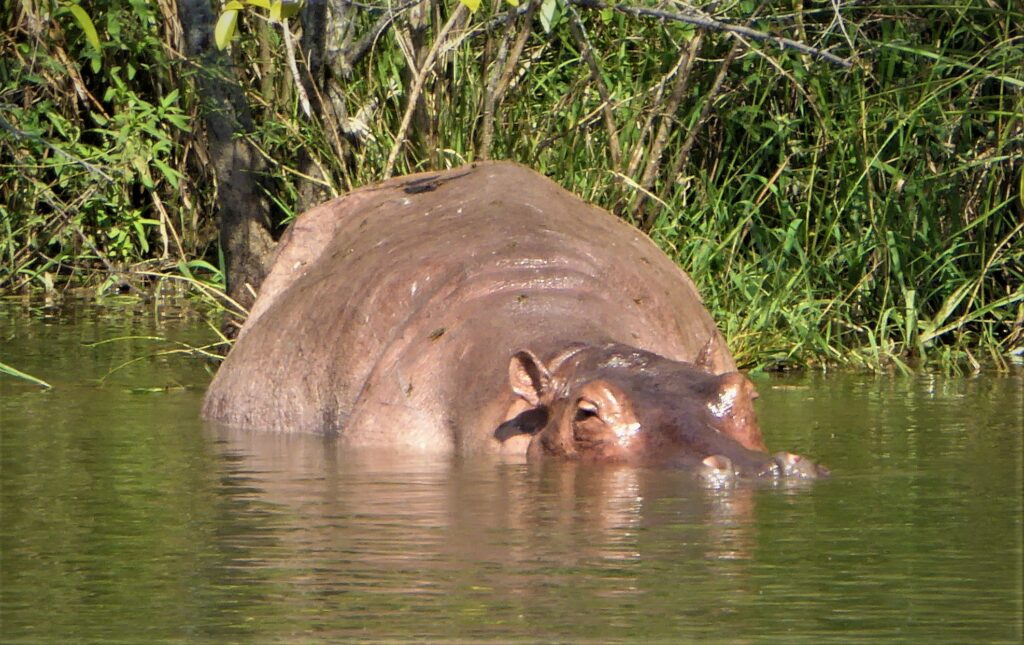
After years of debate over the fate of Colombia’s wild hippos – during which the feral beasts have multiplied in lush tropical rivers – the ministry of the environment has announced a plan to kill at least 80 of the African imports.
The non-native species was smuggled into Colombia by drug baron Pablo Escobar in 1980 as part of his collection of exotic animals – including rhinos and lions – which he kept at his ranch, Hacienda Napoles.
The infamous drug trafficker died in a rooftop battle in Medellín in1993, but a few hippos escaped his lowland ranch to find what biologists would later describe as “perfect conditions” in the nearby Magdalena River.
In the decades since around 200 offspring have spread over 100 kilometers (60 miles) of river and swamps bordering departments of Antioquia, Bolívar, Santander and Sucre.
But after years of procrastination over what to do with the wayward Hippopotamus amphibius – with various schemes to sterilize them or ship them to zoos and sanctuaries around the world – Colombia’s environment minister Irene Vélez said this week a cull was the only option.
“We’re talking of a process of euthanasia, which is the technical recommendation,” she told Blu Radio.
The plan was initially to reduce the population by 80 breeding individuals, then cull around 30 beasts per year which would systematically reduce the population.
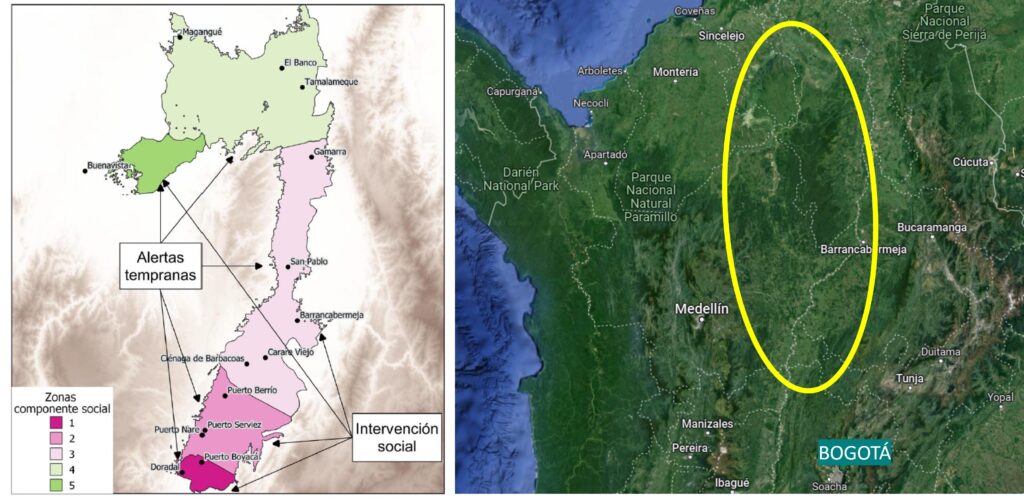
The controversial decision is based on a 170-page technical report by the Humboldt Institute and Universidad Nacional in 2022.
The report concluded that the hippos were damaging the tropical ecosystem of the Magdalena river valley by spreading disease and overloading their watery habitat with nitrates: the amphibious herbivores grazed the riverbanks to each munch 50 kilos of grass a day – but then pooped the waste out into rivers and lakes.
Without an urgent cull the population “could increase to 500 hippopotamuses affecting our ecosystem by 2030,” Vélez told a press conference this week. This boom would further put at risk native populations of turtles and manatees.
See also: Hippos need culling, says report
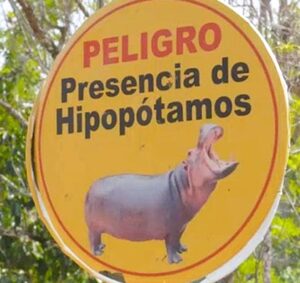
Then there what the report referred to as “hippo – human interactions”, such as a car hitting a two-ton creatures on the main Bogotá – Medellín highway – which runs close to their main hangout near Puerto Triunfo – and even cases of locals trying to keep young ones as pets.
The report also pointed out that hippos were aggressive and territorial and officially the deadliest large mammal – they kill on average 500 people in Africa every year – and attacked boats and canoes on the river aswell as people, cattle and horses around the River Magdalena.
In other videos posted online people are seen chasing them down the highstreet in the town of Doradal.
To justify the cull, Vélez said reduction methods such as sterilization were too difficult – anaesthetizing wild hippos is no easy task – and none of the seven nations initially interesting in receiving live hippos for zoos and wildlife parks had followed through.
The cull would start in the second half of the 2026 around hippo hotspots close to Hacienda Nápoles in Puerto Triunfo and Isla del Silencio, a river island near to Puerto Boyacá, she said.
This island is home to a large group one of which attacked and severely injured a farmer collecting water from the riverbank in 2020, according to a news report. Colombia’s wet lowlands had perfect conditions for hippos, biologist Katerine Corrales told a Caracol news crew visiting the island this week.
“Africa has droughts and adverse weather patterns. Here we have a constant climate with abundant water and resources which generates a faster reproduction rate,” she said.
In the same report local villagers complained that the hippos had “taken over the island” and restricted commercial fishing.
Not everyone welcomed news of the cull. Hippo protection group Comisión Protectora de la Vida de los Hipopótamos – founded in the town of Puerto Triunfo close to Hacienda Nápoles and which benefits from hippo tourism – rejected the “terrible decision of the national government to authorize a hippo hunt”.
“In our municipality, we are committed to the protection and conservation of these incredible living beings. Hippos are an important part of our identity, and we must live in harmony with them,” said the group on its Facebook page this week.
It called a meeting in Bogotá to seek “non-violent” alternatives to the cull, such as a return to the plan of transferring live hippos to other countries.
Previous attempts to shoot hippos have ended in public relations disasters, such as the killing of Pepe in 2009. The large male hippo was slated for transfer to a zoo in Costa Rica after rampaging around Puerto Berrio.
But he was shot after a bungled attempt to capture him, and photos of an army platoon posing with his remains caused public revulsion, and a court ban on hunting hippos.
Pepe also highlighted the affection local communities had for “Pablo’s hippos”. For some folk the state persecution of the mammals was synonymous with the hunt for Pablo Escobar, still a popular figure among communities that benefitted from his largesse in the 1980s.
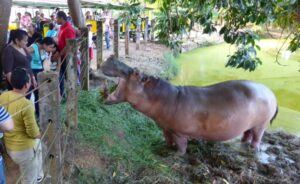
In fact, in the drug baron’s heyday the original hippos were kept at his Hacienda Nápoles in a public zoo and safari park where local families could tour for free. Today the hacienda and zoo is still there but managed by the state as part of a huge amusement park.
This week, Minister Vélez was adamant that culling must form part of any population control.
It was global restrictions on wildlife trafficking – the CITES agreements – that had condemned the hippos in Colombia by preventing them being easily shipped abroad, she explained.
“It’s not enough for a zoo to raise its hand; the country must authorize their entry. Unfortunately, no country has given the green light. This administrative silence indicates that there is no interest in receiving them”.
It seems that putting Pablo’s hippos in overseas zoos is proving as difficult as extraditing the cartel kingpin himself. Like their progenitor, the big beasts face a violent end in Colombia rather than a cage in a foreign land.
The post Colombia to cull its wild hippo population appeared first on The Bogotá Post.
Urban art has many benefits, from the colour it adds to our streets to the space it gives for political and social expression. But a more tangible benefit could be seen at a recent art auction organised by Lure media and Galería Beta, where a number of works went under the hammer to raise money for charity.
Galería Beta’s Daniela Camero Rosso told us, “I believe that urban artists are always eager to help and you see that in the fact that they are always giving workshops, and of course in the fact that they are painting on the streets and that they want to get their message across to people without getting any money in return.”
Art from DJLU, Toxicómano, Juegasiempre, Erre and others was up for auction in front of an audience that included the great and the good of the city’s art world.
Daniela added, “These are amazing artists in the Colombian arts scene and the Latin American arts scene, and the fact that they were willing to help was another thing that made the auction beautiful.”
The aim of the auction was to raise money for Fundación Pescador de Letras, which works within a disadvantaged community in Cartagena offering education and social development programmes to 120 children aged 3-12.
Daniela said that the event had been a success, thanks to the Calle 93 venue and the great artists and galleries who made people want to go and support such a worthy cause. “Of course, they get a beautiful piece of art in return for their support, which is a win-win situation,” she said.
Events like this are also important, she added, because they help to change the perception of urban art in Colombia which – although still considered by some to be vandalism – ought to be valued as highly as other forms of art.
The post Going, going, gone appeared first on The Bogotá Post.
Hundreds of thousands are expected to attend this year’s Petronio Alvárez Pacific Music festival, a celebration of Colombian Pacific music which will take place in Cali from August 14 to 19.
We spoke to Diego Gómez, Llorona Records founder and producer, who is also a traditional Colombian music veteran, about the rise in popularity of Pacific sounds.
The post Is 2019 the start of a new era for Colombian Pacific folk music? appeared first on The Bogotá Post.
The Bogotá Post visits rural communities in Colombia’s most forgotten corner and hears first-hand how armed groups continue to terrorise rural communities.
Sarah Lapidus
W
hen the Colombian government signed the 2016 peace agreement with the FARC, many thought the conflict was over. But the FARC’s conversion from an armed group to a political party has left a power vacuum in rural areas where their guerrillas were once present.
Filling this gap are drug gangs, re-emerging guerrilla groups, and shadowy armed groups. And, as in the past, these fighters are now targeting civilians and small-scale farmers, often from both afro-Colombian and indigenous communities.
Those who speak out are most at risk. According to the Defensora del Pueblo, since the start of 2016, over 460 social leaders have been assassinated.
So even as communities struggle to adapt to the post-conflict era, and preserve the memories of the victims from decades of state conflict with the FARC, new threats are on the rise.
Nowhere is this more apparent than Alto Guayabal, a village and Emberá Katío indigenous reserve set in the rainforest of Chocó, Colombia’s wildest and most westerly department.
“The conflict has worsened. The ELN guerillas continue to commit crimes, assassinate and carry out kidnappings. Also, the paramilitaries, like the AGC, are stronger than ever. There has been little political effort, especially by our president, Iván Duque,” 22-year-old local activist Larry Mosquera tells The Bogotá Post during the second Festival de Memoria held in Alto Guayabal.
The annual festival is organised by the Inter-Church Justice and Peace Commission (CIJP), a human rights nonprofit watchdog. The commission has also assisted the Embera community to create a humanitarian zone where – in theory – armed groups are banned. However, that ban is proving hard to enforce: in the weeks before our visit the indigenous community had reported gangs with guns terrorising villagers.
But even with these recent threats, the Festival de Memoria goes ahead in Alto Guayabal, bringing together dozens of people from all sides of the conflict – ex-military, ex-FARC, and civilian victims – to share their stories.
A chance to speak out
Also present are delegates from Colombia’s Truth Commission, whose role is to listen and gather victim’s stories. It is part of the transitional justice agreement born from the FARC’s peace process with the state.
Danilo Rueda, the national coordinator of the CIJP, addresses attendees in the communal gathering hut: “The goal is for everyone to recount what they have experienced and what they feel, without accusing anyone,” he says. “This is about having a conversation, because we are convinced that through dialogue we can construct a different country. Words heal the soul.”
A Truth Commission delegate stands up to ask the group, “not to judge others, but simply to understand what is happening in society and how we were able to stop the war.”
The conflict victims we talk to are grateful for the chance to tell their stories in front of the Truth Commission delegates, but they also worry that as they look back at the old conflict, a new one is emerging. For some it feels that the war never ended.
“For us, there is no peace,” says Jorge Eliezer, sitting next to his partner in one of the communal huts. Armed men have threatened to kill him.
“They killed my cow, took our food, and fumigated our land,” he says. “And still, the government hasn’t kicked them out yet. They haven’t fulfilled their promise of land redistribution. The businesses are still there, and they look for intermediaries to enter [our territories] to rob us.”
His story follows a narrative common in Colombia, according to human rights groups, whereby people with business and commercial interests use armed groups to threaten small-scale farming and indigenous communities, all part of a plan to force them to give up their land or sell it at a low price.
In their effort to dislodge farmers from their properties, these gangs will escalate their threats to murder and massacres. Fear of these attacks can displace thousands of people and even whole communities.
The CIJP has documented dozens of these types of threats and attacks. In fact the week following the Festival de Memoria, seven militia entered the community in a failed attempt to murder indigenous Embera community leader Bernado Zapilla. He was kidnapped and injured after being mistaken for another community member. They were thought to be members of the Autodefensas Gaitanistas de Colombia (AGC), one of the powerful armed groups that has grown since the peace deal was signed.
Keep pushing for peace
Meanwhile, victims displaced by previous waves of violence are still waiting for financial reparation and restitution of land previously stolen.
Many barriers still exist to getting back to their land, explains 16-year-old Diomedes Daveiba: “We want to return to where we were living before, but we can’t return. There are too many mines. We want them to clean up the mines on the roads, but there is no effort by the government.”
Meanwhile in the midst of continued conflict, communities like Alto Guayabla keep pushing for peace, explains El Espectador columnist Laura Mendoza, also taking part.
“In Colombia we talk about constructing peace. This event is constructing peace. None of us work alone in supporting the process, in raising awareness. There is a lot of work being done despite the continuous violence,” she explains.
It’s a theme taken up by Larry Mosquera. Despite the continued violence, assassinations and fear in the community, he underlines the need to keep going.
“The situation is very sad, but in the rural communities we continue to resist and fight for true and sustainable peace.”
The post Post-conflict: No peace in the Chocó appeared first on The Bogotá Post.
Bogotá Art District: A taste of some of the visual delights on offer in San Felipe.
Emily Hastings
There’s been a mini art revolution brewing in San Felipe for some years now. With 16 galleries in what’s become known as the Bogotá Art District, or BAD, the small zone has become a hub of creativity.
It’s not quite the Soho of Bogotá – or Boho as it should probably be called – but the creative community is already a firm fixture on the city’s art landscape. Indeed, San Felipe is one of the three districts to be included in the ARTBO weekend circuits.
What takes me there on a rainy Saturday is ‘Experimenta el Arte’, an event organised by Lure media (the team behind the comprehensive Living in Bogota guide). Lure’s boss, Boris Kruijssen tells me, “After we received several requests, we decided to move into organising experiences – we want to help people to uncover some of the city’s hidden secrets.”
The walking tour began at Galería Beta, which is run by Daniela Camero Rosso. She gives us a potted history of San Felipe, and explains that the man behind the area’s artistic development is architect and patron of many Colombian artists, Alejandro Castaño.
“This collector succeeded in getting various of us to move into the barrio, and then the other galleries started to come in a natural way,” she explained.
We were lucky enough to visit Castaño’s private collection – an Aladdin’s cave with practically every inch of wall (and indeed floor and parts of the ceiling) crammed with the work of artists from all over the continent. Camero told us that Castaño has supported a number of Colombian artists from their early days and continues to do so, a passion that shines through in the sheer volume of art. From videos in cubby holes to a dragonfly that flickers to life; chanting miniature crowds brought alive through a vinyl record to paper guns carved into the pages of a book; at every step and every turn there’s something else to catch your eye.
The two floors of Camero’s Beta gallery reflect the two sections of their collection. “One of modern art,” Camero enthuses. “That branch is focussed on contemporary art, particularly abstract and conceptual art.” We see this downstairs in Diego Mendoza’s woodblock prints showing an upside-down world of trees and machinery.
Upstairs, we are transported to the colours of La Candelaria with the familiar styles of well-known graffiti artists like CRISP and DJ Lu. Awash with colour, the urban art branch of the gallery opened two years ago. Camero says, “Our goal is to promote art more in open spaces, not only in closed ones.” That’s why they have done 15-20 interventions, when art takes over a public space as a sort of pop-up gallery area, within the neighbourhood.
The SGR gallery is a different beast entirely. We are greeted by a mess of melted wax chairs in front of a static screen – mirrored on the other side of the room by rows of pristine chairs lined up in front of a screen showing a chair. A symbol for nations of couch potatoes melting into images of themselves?
The galleries are not the only interesting thing about San Felipe. If you haven’t yet discovered Chichería Demente, an open plan restaurant that opened a few months ago, you are in for a treat. I’d go back time and again for their zucchini fries and palmitos frescos alone.
If the fries can’t tempt you, San Felipe is simply a must for anyone who wants to get a better feel for contemporary Colombian art.
Check it out:
Galleries of San Felipe: FLORA ars + natura, SKETCH, Instituto de vision, Liberia, Casa 4, 12:00, Galería Beta, Permanente, Rincón Projects, Estudio 74, Casa Valhalla, SGR, Espacio KB, Estudio 101, Plural, Fundación Arkhé.
If you are thinking about checking out the big BAD art district, Camero recommends the noches de San Felipe (@nochesanfelipe). Every two months, all of the galleries open their doors between 7pm-10pm.
Lure will also organising activities in San Felipe from June onwards. Contact them on info@luremediagroup.co or instagram @lurecityguide to find out more.
The post Not half BAD appeared first on The Bogotá Post.
During the last six years e-commerce in Colombia has increased remarkably.
According to a study published by the Colombian Chamber of E-Commerce, approximately 82% of the Colombian population over the age of 15 years now is online every day of the week.
Growth of e-commerce has occurred in all segments of society, despite challenges faced by the most vulnerable of the country’s population. Smartphones are the first means by which users in the country transact online (93%), followed by laptops (36%), desktops (28%), smart televisions (16%), and tablets (11%).
What’s been the impact of COVID-19 on Colombian e-commerce?
The arrival of the coronavirus has had an impact worldwide, Colombia not withstanding. For example, in Colombia’s capital of Bogota, messaging and home services have increased by 28%, a higher figure compared to last March.
In a study carried out by MercadoLibre, 4 out of 10 Colombians had changed their purchasing habits through e-commerce as a result of COVID-19.
In the last four weeks in the country, there’s been a reported increase of 190,000 searches related to products in health categories such as face masks (10 million), antibacterial (3.5 million, gel alcohol (8.5 million), thermometers (1 million ) among others.
Searches related to products for health protection have increased 11x more than usual. Purchases of basic necessities have also increased, specifically groceries, personal hygiene products and medications.
In total MercadoLibre’s platform registered more than 1.7 million new users in Latin America. Since Covid’s arrival in the region, of which 56% made at least 1 or 2 purchases within the platform, 20% made at minus 2 purchases and 24% made more than 3 purchases.
E-commerce has increased over 1000% in past decade
In 2018 Colombia ranked fourth in Latin America in sales via e-commerce, with $6 billion USD in sales being recorded.
Adobe, the Fortune 500 tech behemoth, this past quarter partnered with Medellin multinational Talos Digital in a collaboration aiming to expand e-commerce footprints in Latin America. According to Talos, the e-commerce market in Latin America will reach $70 billion USD in 2020.

While there are a number of ways e-commerce needs to improve in the region, including in shipping and transportation, the region has been consolidating itself into one of the most attractive markets in the world.
By 2021, e-commerce retail sales in Colombia are expected to exceed $ 10 billion, thus bringing the country to the same level as countries like Argentina and Mexico. Brazil today remains the country with the highest sale of e-commerce in Latin America.
The post A look into Colombia’s e-commerce industry in the time of COVID-19 appeared first on The Bogotá Post.