Reading view

Medellín mayor draws criticism over M-19 book launch ban 

Medellín, Colombia – Medellín Mayor Federico Gutiérrez prompted outrage last week after “censoring” a new book on M-19 guerrilla history at a public library.

Gutiérrez cancelled a talk of the book on April 21, saying that it glorifies terrorism and has no place in a public library.

The cancellation has drawn widespread criticism, with many observers citing the hypocrisy of the move one month after UNESCO designated Medellín as its 2027 World Book Capital.

Shortly before an event for the book at a public library on April 21, Gutiérrez announced on X: “This event will be cancelled. In Medellin, there will never be room for the glorification of terrorism. The M-19 was not a ‘romantic tale’: it was a terrorist armed group that left victims, pain, and death in Colombia.”

Attendants at the packed auditorium were visibly opposed to the measure, according to newspaper El País. Although staff removed microphones and speakers and the police surrounded the building, spectators remained in their seats.

Promotional e-pamphlet of book launch
Image source: Federico Gutiérrez via X.

“Our city respects the memory of the victims; no to propaganda for those that wielded weapons. This event has an obviously political character, and no public entity can host it,” the mayor continued. 

But the book’s author, sociology professor Jaime Rafael Nieto, insisted that the government should not be able to censor events like the one last week: “This is not a space for government officials, but for writers, artists and citizens,” he told Spanish newspaper El País via phone call. 

The April 19th Movement (M-19) guerrilla was founded in the early 1970s and became a violent urban actor, perpetrating kidnappings and killings in cities as well as symbolic crimes including the theft of libertador Simon Bolívar’s sword from its resting place and the Palace of Justice siege which left over 100 dead. 

Incumbent leftist Colombian President Gustavo Petro – who has routinely publicly clashed with rightist Gutiérrez – was an M-19 militant, operating under the nome de guerre “Aureliano”. 

He joined in the criticism of Gutiérrez’s move, writing on X: “The M-19 after making peace, was a legal movement with legal status. What you’re doing is censorship. Those who censor books end up burning them, and then they end up burning humans at stakes. Don’t censor; let minds and thoughts be free.”

Medellín’s history of books: a reformed city 

Colombia’s second-largest city has seen a 542% rise in bookstores over the past seven decades, and is home to over 110 bookstores and 25 libraries – many of which were transformed from former prisons and police facilities, as per UNESCO. 

“Medellín has become an international reference for urban and cultural transformation, where books and libraries play a crucial role in bringing positive social change. [Its] designation as World Book Capital 2027 is a powerful message on how culture can build peace and social cohesion,” noted Khaled El-Enany, UNESCO director-general. 

The city’s literary turn is thus inseparable from its broader reinvention. Having been named the world’s “murder capital” in 1991, when 16 people were murdered daily on average, it has spent decades recasting itself through culture and education. 

In 2004, then-mayor Sergio Fajardo – now a presidential candidate for the upcoming May 31, 2026 election – deployed a plan to combat structural violent patterns, investing in the city’s poorest neighborhoods. Libraries, metrocables and cultural centers were planted in the hillside of comunas, once the most dangerous neighborhoods in the Americas. 

Over a 15-year period, Medellin built 60 cultural facilities in areas with the highest poverty, historic violence and population densities, and by 2024, the city recorded 300 homicides per 100,000 people – the lowest since 1942. 

The result is a city that has made literary culture central to its identity. Every September, the Fiesta del Libro y la Cultura (Celebration of Books and Culture) – backed by $9 billion Colombian pesos ($2.5 million USD) from the mayor’s office – draws hundreds of national and international guests to its botanical gardens, parks and cultural centers. 

The city also hosts an annual edition of the Hay Festival, the prestigious Welsh literary gathering. 

Banned in the city of books 

Regardless of Mayor Gutiérrez’s disapproval, the event on April 21 continued, with organizers stressing they consulted with the attendees what they believed should be done. 

“There were three options: cancelling the event, going someplace different, or reaffirming our condition of citizens which occupy the city’s public space,” they said. Meanwhile, Nieto confirmed that the launch had been scheduled a month prior, and that the decision to go ahead in spite of the mayor’s outrage was an “act of civil resistance.” 

“[The book is about] interpreting how the M-19 emerged and what its characteristics were. It isn’t about justifying its actions, because then the investigation would take on a partisan bias, and that’s not the case,” the M-19: From War to Politics author added

The M-19 has become a contentious subject in Colombian politics since the election of Petro in 2022 as the country’s first leftist president, although the group demobilized in 1990. 

Petro joined the urban guerrilla at 17 years old, but not as a combatant. As per Colombian news outlet La silla vacía, he was arrested by armed forces in 1985, and spent 18 months in prison, where he directed the jail library. 

One of Petro’s greatest feats as an M-19 militant, in fact, was promoting the peace process that saw the group’s turn to peace and legality from 1989 to 1990. Most recently, the head of state celebrated his birthday on the anniversary of the armed group’s founding.

Nieto believes that studying M-19 history is imperative to understanding Petro’s government, and his book’s thesis: the M-19 was the Colombian armed actor that best knew how to combine war with politics.

“Every act of war produced political effects. And that made it a political actor,” he told El País.

Featured image: Federico Gutiérrez via X.

The post Medellín mayor draws criticism over M-19 book launch ban  appeared first on The Bogotá Post.
  •  

Colombia’s JEP increases number of ‘false positive’ killings to 7,837

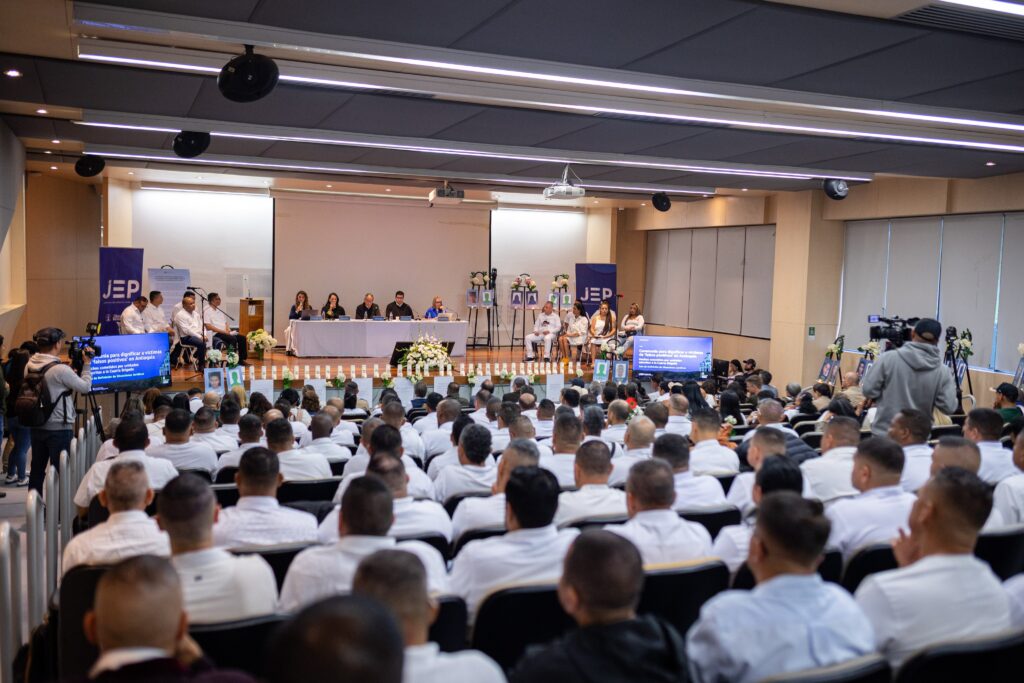
A JEP hearing about the “false positives”. Image credit: JEP

Colombia’s transitional justice mechanism, the Special Jurisdiction for Peace (JEP), announced yesterday that it had revised the official number of “false positive” killings – deaths illegitimately presented as combat casualties – from 6,402 to 7,837.

The announcement came as part of the JEP’s Macro Case 03, which is investigating extrajudicial executions between 1990 and 2016.

The country’s Truth Commission had previously established 6,402 cases of “false positive” killings but the JEP’s latest figures suggest the scale of one of the country’s largest scandals was greater than previously thought. 

The information was provided by Pedro Elías Díaz on April 24, Magistrate of the Legal Situations Definition Chamber, during a hearing related to a massacre of leaders and children in San José de Apartadó, Antioquia. Díaz first revealed that 1,932 people had been killed in the department between 1990 and 2016, before disclosing the new national figure.

“The report also highlighted statistics on homicides and forced disappearances allegedly attributed to the public force between 1990 and 2016 nationwide, classified as illegitimate killings presented as combat deaths, amounting to 7,837 victims—a figure that remains dynamic as cases progress,” said Díaz. 

The magistrate affirmed that in addition to the forensic identification of victims, the latest figures were based on victims’ reports submitted to the JEP since 2018 and documents from the National Center for Historical Memory, the Office of the Inspector General, and the Office of the Attorney General.

JEP President Alejandro Ramelli Arteaga later confirmed the revised figures and said that the period during which the “false positives” occurred was extended, from 2002 to 2008, to 1990 to 2016. 

Ramelli added that the number is likely to increase as investigations continue: “They have been holding territorial hearings with those most responsible, who are also confessing to cases of executions and disappearances that had never been investigated. It is most likely that this new figure will continue to increase in the future.”

The “false positives”, many of which occurred during the administration of ex-President Álvaro Uribe (2002-2010) are highly politicized.

President Gustavo Petro responded to the news with thinly veiled criticism of Uribe, whose Democratic Center (CD) party won the second highest number of seats in recent congressional elections. 

“There are 7,837 victims of the state due to the systematic execution of young people under the government of the so-called “Democratic Security” policy — in reality, a policy of total death… They do not want reelection for social justice; they want it for death,” wrote Petro on X.  

Paloma Valencia, the CD’s presidential candidate, has pledged an iron-fisted approach to armed groups similar to that of her political mentor, Uribe, who continues to lead the party. 

The post Colombia’s JEP increases number of ‘false positive’ killings to 7,837 appeared first on The Bogotá Post.

  •  

Suspected sex tourists being turned back at Colombian airports

Increasing numbers of travelers being denied entry after interrogations at the border.

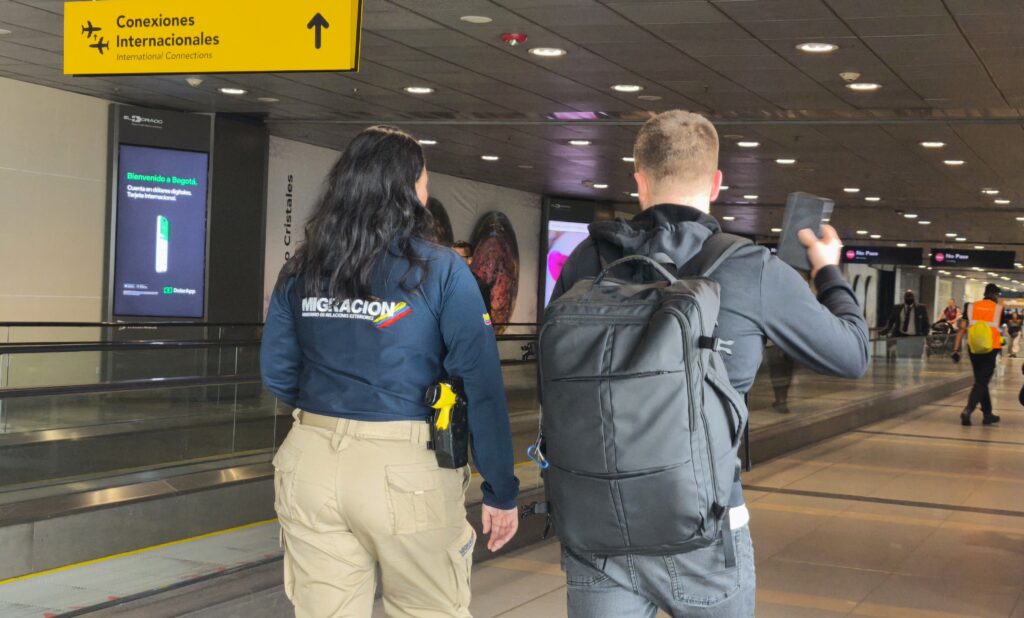
Immigration officers have powers to interrogate, detain and return travelers they suspect of bad plans. Photo: Migración Colombia.
Immigration officers have powers to interrogate, detain and deny entry to travelers. Photo: Migración Colombia.

Five foreign tourists flying into Colombia were turned back at Medellín airport Tuesday last week after other passengers reported them for “conversing on the plane about their plans for sexual encounters”.

Although not clear who exactly denounced the travelers, or what other evidence was produced, immigration officers barred them entry after declaring their reasons to visit Colombia as “illegitimate”.

The case is part of a growing crackdown by immigration authorities against sex tourism in Colombia, which has been on the rise in recent years.

The five U.S. citizens were interviewed by immigration officials after arriving at José Maria Cordova airport on a United Airlines flight from Houston.

According to posts by Migración Colombia, the men were overheard during the inbound flight discussing hiring sex workers to “fulfil their fantasies”.

The cases highlighted a trend of increasing sex tourism but also stronger measures to prevent it, said immigration officials this week.

“We are focusing immigration control on detecting these types of offenders, fighting sexual exploitation, and protecting children not only in Antioquia but throughout the country,” said Gloria Arriero, director of Migración Colombia.

Data showed that 60 tourists were denied entry at airports in the first four months of 2026, compared to 110 in all of 2025. 

Watching angels

The problem existed in tourist destinations like Cartagena and Bogotá, but was most evident in Medellín, the capital of Antioquia and Colombia’s second city, said Arriero, with 48 of the cases registered at the José María Córdova Airport. Of the persons barred this year 51 were U.S. citizens.

In the last week alone 15 foreign nationals, mostly U.S. nationals, were denied entry including the five passengers overheard on the plane. Many of the suspects were arriving on flights from Houston, Miami and New York, added Arriero.

The latest expulsions followed a campaign by Medellín’s mayor Fico Gutiérrez to stamp out a rise in human trafficking and sexual exploitation, particularly of children, linked to organized crime and visitors to the city.

Prostitution is legal in Colombia although immigration officers have autonomous powers to deny entry to travelers if they suspect them of sex tourism. Checks have gathered pace in recent years under the “Angel Watch” system that allows Colombian immigration to identify foreign travelers with criminal records or reports of sexual offences against minors before they enter the country.

Angel Watch, which has been running in Colombia since 2024, gives immigration officers real-time access to data from national sex offender registries and state websites in the U.S, including the Department of Homeland Security and National Center for Missing & Exploited Children (NCMEC).

The U.S.-based Angel Watch Center then alerts overseas authorities to its citizens with convictions for sexual crimes against minors. Specialized police task forces in Colombia also use international alerts from INTERPOL to intercept other nationalities.

Angel Watch alerts can catch potential offenders at points of entry or prevent undesirables from obtaining or extending visas, if they are long stayers. The system blocks around 50 travelers a year detected with a history of pedophilia or sexual aggression.

Inadmiitted: five tourists sent home after talking trash on their inbound flight. Photo: Migración

Cell phones searches

For other cases border authorities rely on old-fashioned detective work, such as the case of the five travelers hauled in for questioning after reports of their lewd talk on the plane.

In February, two men were netted after being spotted filming children during the inbound flight. On investigation, border officers found bans from multiple countries for sexual offences involving minors.

Others have been interrogated based on items detected in their luggage; in February, a Lithuanian was sent home after inspectors found a huge haul of sex toys. These were decreed “inconsistent with his declared purpose for visiting Colombia” according to a press release at the time.

Migración has also revealed cases where large numbers of condoms, lingerie, or exaggerated quantities of “potency drugs” triggered interrogations and cell-phone searches which then revealed plans for sex tourism.

Migration officers also accompanied police units in sweeps where foreigners were suspected to be involved in wrongdoing. Tactics included visiting hotels and hostels which had registered visitors with previous convictions, but also monitoring their social media profiles for incriminating material.

Disturbing the peace

Earlier in April, Migración deported in a blitz of publicity Medellín-based influencer ‘Chill Capo’ (real name Steve Newland) who was sent back to the U.S. after being detained at a party in the city’s Parque Lleras, a hotspot for sex workers.

“We found he repeatedly used his social media to invite and organize sex parties at various establishments where the main focus is on women, viewed as just another object to attract foreigners,” said director of the regional migration office Paola Salazar.

#Medellín | Ruso, con extenso historial de quejas por alteraciones al orden público, fue expulsado, por parte de la autoridad migratoria.
El individuo abordó un vuelo con destino a Miami luego de que la entidad consolidara un contundente expediente basado en múltiples denuncias pic.twitter.com/wMcuQSz2zk

— Migración Colombia (@MigracionCol) April 13, 2026

The 42-year-old content creator denied the accusation claiming his on-line videos of sleaze-fests were simply to encourage “a safe experience” for clients seeking the services he advertised on social media. But since Newland’s visa had expired, he was slung out anyway and banned from the country for five years.

In another recent case, a U.S-Russian citizen living in the El Poblado district was detained and deported after two years of loud music, partying, and a constant parade of bikini-clad women in and out of his flashy flat. 

40-year-old George Wolfe held day-long parties on his rooftop flat and accumulated dozens of fines for disturbing the peace.

Wolfe, who claimed to be a lawyer, threatened to sue immigration authorities but they reminded him that the state “has the discretion to admit, not admit, or expel foreign citizens”.

The question circulating on social media after Wolfe’s deportation was if Colombia was now less welcoming to overseas visitors. But statistics suggest otherwise since more than nine million tourists visited last year. Instead, the message for Migración seems increasingly clear: sex tourists aren’t welcome.

The post Suspected sex tourists being turned back at Colombian airports appeared first on The Bogotá Post.

  •  
❌