
Reading view

Medellín mayor draws criticism over M-19 book launch ban 

Medellín, Colombia – Medellín Mayor Federico Gutiérrez prompted outrage last week after “censoring” a new book on M-19 guerrilla history at a public library.

Gutiérrez cancelled a talk of the book on April 21, saying that it glorifies terrorism and has no place in a public library.

The cancellation has drawn widespread criticism, with many observers citing the hypocrisy of the move one month after UNESCO designated Medellín as its 2027 World Book Capital.

Shortly before an event for the book at a public library on April 21, Gutiérrez announced on X: “This event will be cancelled. In Medellin, there will never be room for the glorification of terrorism. The M-19 was not a ‘romantic tale’: it was a terrorist armed group that left victims, pain, and death in Colombia.”

Attendants at the packed auditorium were visibly opposed to the measure, according to newspaper El País. Although staff removed microphones and speakers and the police surrounded the building, spectators remained in their seats.
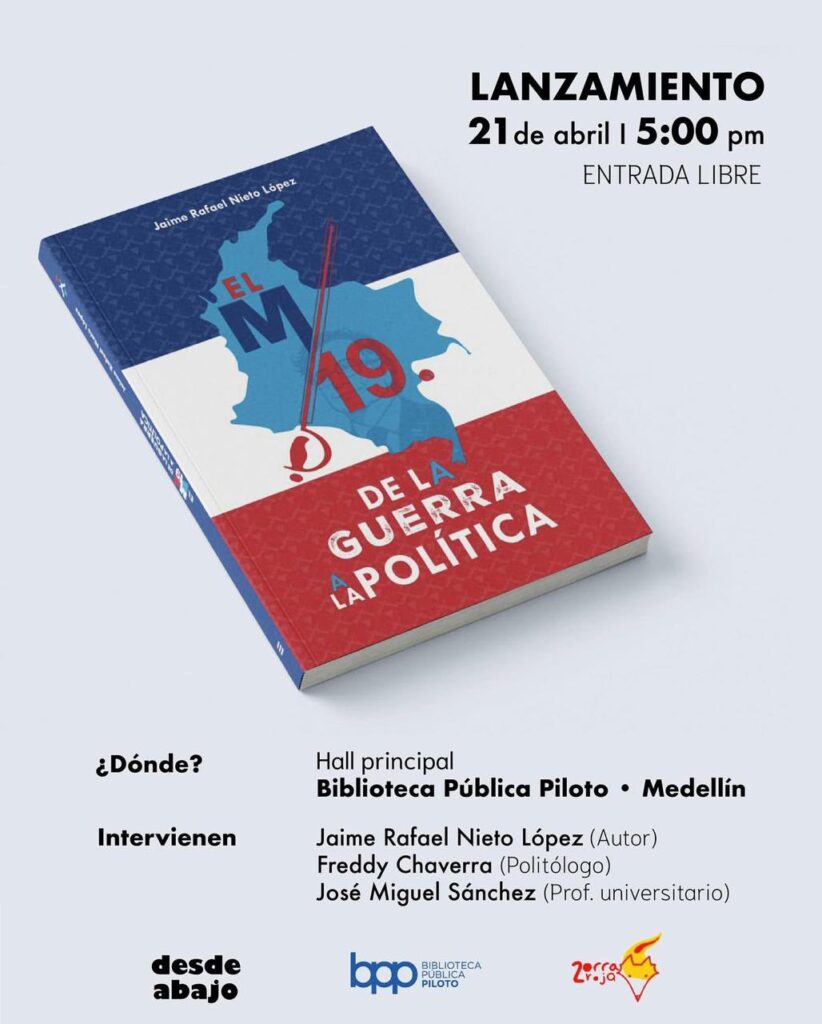
Promotional e-pamphlet of book launch
Image source: Federico Gutiérrez via X.

“Our city respects the memory of the victims; no to propaganda for those that wielded weapons. This event has an obviously political character, and no public entity can host it,” the mayor continued. 

But the book’s author, sociology professor Jaime Rafael Nieto, insisted that the government should not be able to censor events like the one last week: “This is not a space for government officials, but for writers, artists and citizens,” he told Spanish newspaper El País via phone call. 

The April 19th Movement (M-19) guerrilla was founded in the early 1970s and became a violent urban actor, perpetrating kidnappings and killings in cities as well as symbolic crimes including the theft of libertador Simon Bolívar’s sword from its resting place and the Palace of Justice siege which left over 100 dead. 

Incumbent leftist Colombian President Gustavo Petro – who has routinely publicly clashed with rightist Gutiérrez – was an M-19 militant, operating under the nome de guerre “Aureliano”. 

He joined in the criticism of Gutiérrez’s move, writing on X: “The M-19 after making peace, was a legal movement with legal status. What you’re doing is censorship. Those who censor books end up burning them, and then they end up burning humans at stakes. Don’t censor; let minds and thoughts be free.”

Medellín’s history of books: a reformed city 

Colombia’s second-largest city has seen a 542% rise in bookstores over the past seven decades, and is home to over 110 bookstores and 25 libraries – many of which were transformed from former prisons and police facilities, as per UNESCO. 

“Medellín has become an international reference for urban and cultural transformation, where books and libraries play a crucial role in bringing positive social change. [Its] designation as World Book Capital 2027 is a powerful message on how culture can build peace and social cohesion,” noted Khaled El-Enany, UNESCO director-general. 

The city’s literary turn is thus inseparable from its broader reinvention. Having been named the world’s “murder capital” in 1991, when 16 people were murdered daily on average, it has spent decades recasting itself through culture and education. 

In 2004, then-mayor Sergio Fajardo – now a presidential candidate for the upcoming May 31, 2026 election – deployed a plan to combat structural violent patterns, investing in the city’s poorest neighborhoods. Libraries, metrocables and cultural centers were planted in the hillside of comunas, once the most dangerous neighborhoods in the Americas. 

Over a 15-year period, Medellin built 60 cultural facilities in areas with the highest poverty, historic violence and population densities, and by 2024, the city recorded 300 homicides per 100,000 people – the lowest since 1942. 

The result is a city that has made literary culture central to its identity. Every September, the Fiesta del Libro y la Cultura (Celebration of Books and Culture) – backed by $9 billion Colombian pesos ($2.5 million USD) from the mayor’s office – draws hundreds of national and international guests to its botanical gardens, parks and cultural centers. 

The city also hosts an annual edition of the Hay Festival, the prestigious Welsh literary gathering. 

Banned in the city of books 

Regardless of Mayor Gutiérrez’s disapproval, the event on April 21 continued, with organizers stressing they consulted with the attendees what they believed should be done. 

“There were three options: cancelling the event, going someplace different, or reaffirming our condition of citizens which occupy the city’s public space,” they said. Meanwhile, Nieto confirmed that the launch had been scheduled a month prior, and that the decision to go ahead in spite of the mayor’s outrage was an “act of civil resistance.” 

“[The book is about] interpreting how the M-19 emerged and what its characteristics were. It isn’t about justifying its actions, because then the investigation would take on a partisan bias, and that’s not the case,” the M-19: From War to Politics author added

The M-19 has become a contentious subject in Colombian politics since the election of Petro in 2022 as the country’s first leftist president, although the group demobilized in 1990. 

Petro joined the urban guerrilla at 17 years old, but not as a combatant. As per Colombian news outlet La silla vacía, he was arrested by armed forces in 1985, and spent 18 months in prison, where he directed the jail library. 

One of Petro’s greatest feats as an M-19 militant, in fact, was promoting the peace process that saw the group’s turn to peace and legality from 1989 to 1990. Most recently, the head of state celebrated his birthday on the anniversary of the armed group’s founding.

Nieto believes that studying M-19 history is imperative to understanding Petro’s government, and his book’s thesis: the M-19 was the Colombian armed actor that best knew how to combine war with politics.

“Every act of war produced political effects. And that made it a political actor,” he told El País.

Featured image: Federico Gutiérrez via X.

The post Medellín mayor draws criticism over M-19 book launch ban  appeared first on The Bogotá Post.
  •  

Rising Violence in Colombia: Highway Explosion Leaves 21 Dead, Dozens Injured

Petro’s “Total Peace” strategy is under pressure ahead of presidential elections as violence by armed groups escalates

An explosive attack on the Pan-American Highway near the municipality of Cajibío, in Colombia’s Cauca department, left at least 21 people dead and 56 injured, Defense Minister Pedro Sánchez Suárez confirmed.

The attack occurred Saturday, April 25, on one of the main roads in the country’s southwest, an area historically affected by the presence of illegal armed groups.

The minister attributed the attack to alias “Marlon,” described as one of the most wanted leaders in the region, “for whom we are offering a reward of up to $1.4 million USD,” he said.

According to local media reports cited by El Tiempo, “the attack was initially intended to target army troops. However, a change in military plans reportedly led to the explosive being detonated while civilians were passing through the area.”

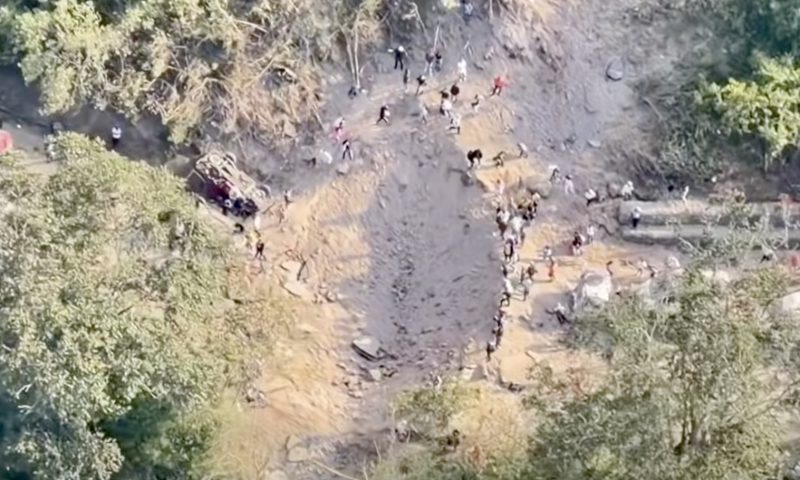
The impact of the attack was significant. Spain’s El País reported “that the explosion created a large crater, left the road covered in debris, and forced rescue operations that lasted several hours due to difficult access conditions.”

Aerial view of the crater caused by the explosion on the Pan-American Highway. Photo courtesy of Colombia’s Ministry of Defense.

Aerial view of the crater caused by the explosion on the Pan-American Highway. Photo courtesy of Colombia’s Ministry of Defense.

Cauca Governor Octavio Guzmán described the incident as one of the most serious attacks in the region in decades. “What happened on April 25 constitutes the most brutal and ruthless attack against civilians in decades,” he said.

The attack comes amid a resurgence of violence in southwestern Colombia, where illegal armed groups linked to drug trafficking, illegal mining and other illicit economies operate. Authorities continue operations in the area as investigations proceed to clarify the circumstances of the attack and determine responsibility.

According to reports by BBC Mundo, alias “Marlon” is a dissident FARC leader identified as Iván Jacobo Idrobo Arredondo, “the alleged head of the Jaime Martínez structure, part of the Estado Mayor Central (EMC),” one of the country’s most powerful illegal armed groups.

Operations and arrests

As part of response operations, the National Police reported the capture of José Alex Bitoco, alias “David” or “Mi Pez,” identified as the leader of the Dagoberto Ramos structure, another illegal armed faction, who is believed to have acted under orders from alias “Marlon”.

National Police Director Gen. William Rincón Zambrano said the detainee “will have to answer for the wave of terrorist activity” and linked him directly to the attack, stating that “he is responsible for what happened on April 25 in the El Túnel sector on the Pan-American Highway.”

The Defense Ministry reiterated that alias “Marlon” remains a priority target. “He is a high-value target, and we are searching for him with all the capabilities of the state. We have deployed a dedicated intelligence task force to locate him,” Sánchez said, confirming a reward of up to $1.4 million USD for information leading to his capture.

Context: criticism of “Paz Total” policy (Total Peace)

The attack comes amid growing security deterioration in Colombia, intensifying criticism of President Gustavo Petro’sTotal Peace” policy. The Ideas for Peace Foundation (FIP) has warned of a possible failure of the strategy, noting that “less than four months before the end of the government, the lack of progress in peace negotiations and the deterioration of security have become one of the main points of criticism of the Petro administration.”

According to the think tank, during the current administration “the number of disputed territories between illegal actors has nearly doubled, and the number of members in these structures has increased by 85%: they now total more than 27,000 members, including armed individuals and support networks.”

This figure not only represents a significant increase but also places the country at levels similar to, and even higher than, those seen before the peace process with the FARC began. Between 2011 and 2012, the estimate stood at around 26,800 members, compared with 14,600 at the end of Iván Duque’s administration in 2022.

The recent increase has also been rapid. According to the FIP, armed groups grew by 23.5% over the past year (from December 2024 to December 2025), reflecting a swift reconfiguration of these structures. At the same time, violence has intensified. Analysts such as Professor Karol Solís Menco note that over the weekend of April 25–26 alone, “26 terrorist attacks of varying magnitude” were recorded across the country.

Political analysis outlets point to a structural dynamic. According to La Silla Vacía, “Cauca is not experiencing an isolated event, but rather a phase of intensifying territorialized violence, marked by fragmentation among armed actors and a type of violence capable of producing national-level impacts.”

In this context, FARC dissident groups have once again taken center stage in the conflict. “Once again, attention is turning to FARC dissidents. Every attack, every gas cylinder bomb, every assault in Valle and Cauca ends with the same name on the table: the Jaime Martínez structure, one of the strongest groups of Iván Mordisco’s Estado Mayor Central,” El País reported.

Violence indicators also reflect sustained deterioration. “In the first four months of 2026, Colombia has already recorded 48 massacres, with 229 victims, most of them civilians, according to Indepaz. It is the highest figure in the past decade. With these numbers, which represent only a partial picture of the country’s violence, this election year is shaping up to be the most violent since the 2016 peace agreement with the now-defunct FARC guerrilla group,” the same outlet reported.

Cauca, where the attack took place, is considered one of the most sensitive regions. “Cauca is particularly complex because it combines multiple layers of conflict: the historic presence of Indigenous, peasant and Afro-descendant communities; illicit economies; Pacific corridors; disputes over drug trafficking routes; control of the Pan-American Highway; and the presence of FARC dissidents, particularly structures linked to Iván Mordisco,” El País said.

Experts agree that part of the difficulty lies in the design and implementation of the government’s strategy. “Early implementation was a valuable innovation in intent, but it failed to ensure minimum conditions of verification and institutional coherence,” said analyst Germán Valencia of the Peace and Reconciliation Foundation (Pares).

Taken together, these factors have led various sectors to conclude that the “Total Peace” policy faces serious structural limitations amid a scenario of armed fragmentation and territorial expansion by illegal groups.

  •  

Gunfire Incident on Putumayo River Revives Tensions Between Colombia & Peru

Despite the severity of the incident, Colombia and Peru have indicated a willingness to address it through diplomacy

 An incident on April 12, 2026, has reignited diplomatic and security tensions in the Amazon border region between Colombia and Peru, following an exchange of gunfire between a Colombian civilian vessel and the Marina de Guerra del Perú, a Peruvian Navy River unit, on the Putumayo River. The incident left one Colombian citizen dead and one person injured on each side.

The episode occurred near Marandúa (Amazonas, Colombia), across from the Peruvian town of El Estrecho. According to Colombia’s Defense Minister, Pedro Sánchez, the fatal victim was identified “as José Miguel Gutiérrez Baquero, owner of the cargo vessel involved in the incident, and one of his sons was injured,” while two other crew members were detained by Peruvian authorities.

Conflicting accounts of the operation

According to the Peruvian government statement, “the incident occurred during a patrol operation aimed at securing the electoral process,” previously coordinated between the two countries. Authorities said two Navy speedboats requested that the Colombian vessel stop for identification.

Peru’s Ministry of Foreign Affairs, which is leading the process, said that “the Colombian vessel refused to comply with the control order and opened fire on two Peruvian Navy units, which returned fire.” As a result, “a member of the Peruvian Navy was also injured, although he is out of danger.”

Colombian authorities, led by the Foreign Ministry, have requested a full clarification of the events and verification of the circumstances surrounding the exchange of gunfire.

Diplomatic channels activated

Following the incident, the governments of Colombia and Peru activated diplomatic and military channels. Colombia’s defense minister said that “preliminary measures were agreed, including prioritizing medical attention for the injured, facilitating the work of judicial authorities, and establishing a binational commission to investigate what happened.”

Colombia’s Foreign Ministry formally requested clarification of “the circumstances of time, mode and place” of the attack, while the Peruvian government expressed its “willingness to cooperate and maintain border coordination mechanisms.”

The detained individuals “remain in the custody of the Fiscalía Provincial Mixta de Putumayo, with access to consular assistance and due process guarantees.”

So far, no final responsibilities have been determined, and both countries agree on the need for a thorough investigation. Both governments said the issue will be addressed at the next High-Level Mechanism on Security and Judicial Cooperation meeting, scheduled for May 2026 in Bogotá.

Context of prior tensions

The incident comes amid sensitive bilateral relations. In recent months, Colombia and Peru have had disagreements over territorial issues in the Amazon, particularly regarding Santa Rosa de Loreto island.

The dispute dates back to August 5, 2025, when President Gustavo Petro said on X that the “government of Peru has taken over territory that belongs to Colombia” and alleged a “violation of the Rio de Janeiro Protocol, which defines the boundaries between the two countries.”

“The Rio de Janeiro Protocol established that the border is the deepest channel of the Amazon River and that any dispute must be resolved between the parties,” Petro said, referring to the emergence of new river islands “north of the current deepest channel,” which, according to his position, should belong to Colombia.

In response, Peru’s Foreign Ministry expressed its “strongest and most forceful protest,” stating that the island, home to about 3,000 residents, mostly Peruvians, is part of its territory and is key to regional river trade.

Tensions escalated days later when then-presidential pre-candidate Daniel Quintero traveled to the island and raised a Colombian flag during a campaign event broadcast on social media, saying: “I will not allow them to take the Amazon from us. Santa Rosa is Colombia.”

The Peruvian government described the act as an “unnecessary action” that “distracts from the cooperation efforts that Peru and Colombia must prioritize to jointly address urgent challenges.”

Headline photo: President Gustavo Petro, Vice President Francia Márquez and Defense Minister Pedro Sánchez at an event held in Leticia (Amazonas) to address tensions with Peru, Aug. 7, 2025. Photo courtesy of Colombia’s Ministry of Defense.

  •  

Colombia to Reinforce Border Security with Ecuador Amid Escalating Trade Tensions

Colombia’s Defense Ministry detailed a plan to bolster security along the Ecuador border

Colombia’s government has announced a package of measures to strengthen security in municipalities along the border with Ecuador, amid escalating tensions between the two countries over security and trade issues.

According to a statement released by the presidency, the actions include “the deployment of 200 additional National Police officers and 270 soldiers, as well as enhanced maritime and riverine capabilities for territorial control and the fight against drug trafficking.”

The plan also includes technical support for surveillance systems, the deployment of two armored platoons to ensure troop mobility, and meetings aimed at strengthening joint operations by security forces and control at border crossings.

Defense Minister Pedro Sánchez announced the measures, stating that “we will not allow criminal groups seeking to profit from illegal activities such as drug trafficking, illegal mining, extortion and smuggling to affect security indicators.”

He added that security forces have already seized 2.4 tons of drugs and remain deployed in the region “to protect our seas and critically disrupt drug trafficking.”

Context: security and trade tensions

The measures come days before Ecuador’s tariff increase takes effect, raising the so-called “security tariff” on Colombian goods from 50% to 100% starting May 1, 2026.

Ecuadorian President Daniel Noboa told Revista Semana magazine that the decision is not part of a “trade war” with Colombia but rather reflects the costs of reinforcing border security. “We have to spend twice as much, and it costs $400 million USD more per year to keep our armed forces deployed at the border,” he said.

For its part, Colombia’s government has rejected claims of insufficient action on border security. Minister of Commerce, Industry and Tourism Diana Marcela Morales Rojas said Colombia has kept diplomatic channels open.

“We have exhausted all diplomatic efforts and maintained open dialogue channels with the Government of Ecuador, seeking a solution that benefits both countries, businesses and, above all, communities on both sides of the border. However, we have not received a positive response,” she said in a statement.

At the same time, Colombia is evaluating its tariff response. Although President Gustavo Petro previously said he would not impose 100% tariffs on Ecuador, a draft update to Decree 170 of 2026 has recently emerged proposing differentiated tariffs of 35%, 50% and 75% on imports from the neighboring country. So far, the proposal has not been signed or officially published.

More information on the trade dispute between Colombia and Ecuador? Read Trade War Between Colombia And Ecuador Escalates, With 50% Tariffs Threatened by Finance Colombia.

  •  
❌