
Reading view

U.S. Issues Strong “Do Not Travel” Advisory for Southwestern Colombia

The United States has updated a “do not travel” warning for large parts of southwestern Colombia after a wave of terrorist attacks have left over 20 people dead, underscoring growing international concern over the country’s deteriorating security situation and prompting regional authorities to demand stronger support from the leftist government of President Gustavo Petro.

The U.S. Department of State maintained most of Colombia at Level 3 – “Reconsider Travel” – citing crime, terrorism, civil unrest, kidnapping and natural disasters, but reinforced its Level 4 advisory for several conflict-hit regions, including the departments of Arauca, Cauca, Valle del Cauca and Norte de Santander.

Under the latest guidance, Americans are advised not to travel to Cauca, excluding the departmental capital Popayán, and Valle del Cauca, excluding Cali, due to crime and terrorism.

Norte de Santander and Arauca remain under the same highest warning level, while travel within 10 kilometers of the Colombia-Venezuela border is also strongly discouraged because of kidnapping risks, armed conflict and the possibility of detention.

“Do not travel to these areas for any reason,” the State Department said in its advisory, adding that violent crime, armed robbery and murder remain common, while terrorist groups continue to operate in remote and rural zones.

The warning was reinforced by a U.S. Embassy security alert issued in Bogotá on April 27, following 26 separate attacks across southwestern Colombia during the weekend of April 25. The attacks targeted transportation corridors, military installations and police stations, with authorities confirming at least 20 deaths and dozens of injuries.

Police and military facilities are frequent targets of armed groups, and the State Department warned that attacks in Colombia have included car bombs, grenades, truck bombs, explosive devices placed on roads and buildings, and even drones carrying explosives.

Illegal armed groups, including dissident factions of the former Revolutionary Armed Forces of Colombia (FARC), narcotrafficking organizations and other insurgent groups, have expanded their territorial presence in recent years, particularly in remote areas where coca cultivation, illegal mining and strategic trafficking corridors overlap.

The deadliest recent attack occurred near the El Túnel sector in Cajibío, Cauca, along the Pan-American Highway, where an explosive device detonated against civilian vehicles, killing 20 civilians and injuring over 50 more. Authorities attributed the bombing to FARC dissidents under command of alias “Iván Mordisco”.

The attack shocked the country and intensified criticism of President Gustavo Petro’s “Total Peace” policy, which seeks negotiated settlements with illegal armed groups but has faced mounting scrutiny as violence worsens in several regions.

In response, the Cauca governor’s office declared three days of official mourning. Authorities described the bombing as an “atrocious and unjustifiable” act and ordered flags to be flown at half-mast across public institutions and schools as a tribute to the victims.
The government also called for national unity and a stronger institutional response to confront armed violence in one of Colombia’s most volatile departments.

In neighboring Valle del Cauca, Governor Dilian Francisca Toro said she respected the U.S. warning but urged foreign governments and the media not to define the entire region by recent attacks.
“We ask that our region not be stigmatized,” Toro said, insisting that Valle del Cauca remains open to visitors and that violence does not represent the department’s cultural, economic and social identity.
At the same time, she sharply criticized the national government’s security response after attacks in Cali and Palmira, calling for “real, sustained and effective support” through more troops, stronger intelligence operations and direct action against criminal structures operating in the region.

Following an explosion near the Agustín Codazzi Engineers Battalion in Palmira, Toro announced an investment of nearly 70 billion pesos ($17 million) to strengthen police communications infrastructure, expand surveillance camera networks and improve secure transport corridors across municipalities.

In Cali, Mayor Alejandro Eder said an attempted attack against the Pichincha Battalion involved explosive gas cylinders, one of which failed to detonate while another exploded inside a minibus.

Authorities activated a citywide security operation and Eder offered a reward of up to 50 million pesos for information leading to the capture of those responsible. “We cannot allow terrorism to regain ground in our city,” Eder said.
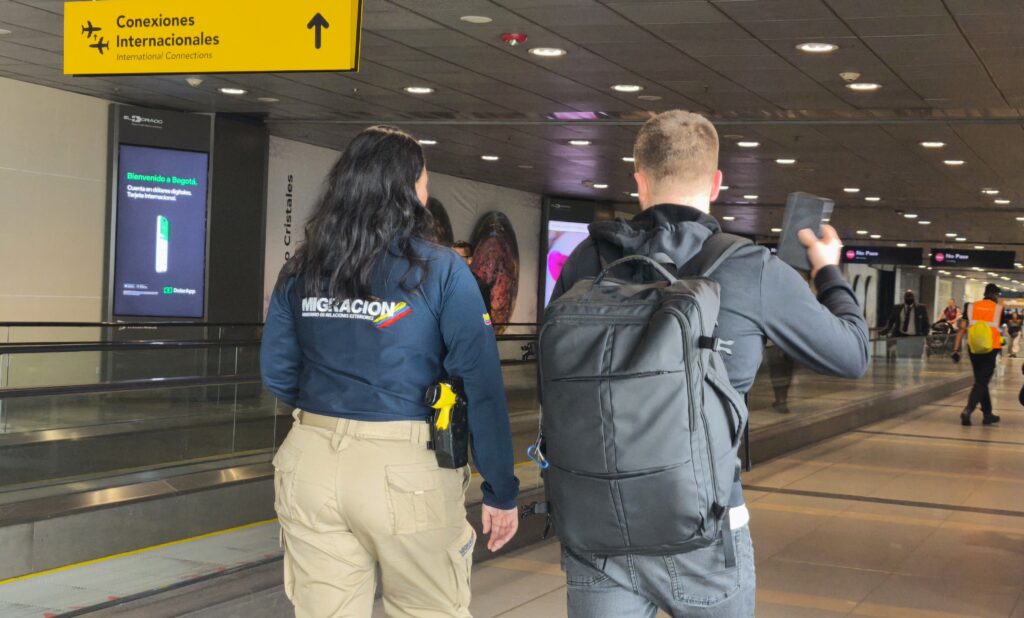
  •  

Suspected sex tourists being turned back at Colombian airports

Increasing numbers of travelers being denied entry after interrogations at the border.

Immigration officers have powers to interrogate, detain and return travelers they suspect of bad plans. Photo: Migración Colombia.
Immigration officers have powers to interrogate, detain and deny entry to travelers. Photo: Migración Colombia.

Five foreign tourists flying into Colombia were turned back at Medellín airport Tuesday last week after other passengers reported them for “conversing on the plane about their plans for sexual encounters”.

Although not clear who exactly denounced the travelers, or what other evidence was produced, immigration officers barred them entry after declaring their reasons to visit Colombia as “illegitimate”.

The case is part of a growing crackdown by immigration authorities against sex tourism in Colombia, which has been on the rise in recent years.

The five U.S. citizens were interviewed by immigration officials after arriving at José Maria Cordova airport on a United Airlines flight from Houston.

According to posts by Migración Colombia, the men were overheard during the inbound flight discussing hiring sex workers to “fulfil their fantasies”.

The cases highlighted a trend of increasing sex tourism but also stronger measures to prevent it, said immigration officials this week.

“We are focusing immigration control on detecting these types of offenders, fighting sexual exploitation, and protecting children not only in Antioquia but throughout the country,” said Gloria Arriero, director of Migración Colombia.

Data showed that 60 tourists were denied entry at airports in the first four months of 2026, compared to 110 in all of 2025. 

Watching angels

The problem existed in tourist destinations like Cartagena and Bogotá, but was most evident in Medellín, the capital of Antioquia and Colombia’s second city, said Arriero, with 48 of the cases registered at the José María Córdova Airport. Of the persons barred this year 51 were U.S. citizens.

In the last week alone 15 foreign nationals, mostly U.S. nationals, were denied entry including the five passengers overheard on the plane. Many of the suspects were arriving on flights from Houston, Miami and New York, added Arriero.

The latest expulsions followed a campaign by Medellín’s mayor Fico Gutiérrez to stamp out a rise in human trafficking and sexual exploitation, particularly of children, linked to organized crime and visitors to the city.

Prostitution is legal in Colombia although immigration officers have autonomous powers to deny entry to travelers if they suspect them of sex tourism. Checks have gathered pace in recent years under the “Angel Watch” system that allows Colombian immigration to identify foreign travelers with criminal records or reports of sexual offences against minors before they enter the country.

Angel Watch, which has been running in Colombia since 2024, gives immigration officers real-time access to data from national sex offender registries and state websites in the U.S, including the Department of Homeland Security and National Center for Missing & Exploited Children (NCMEC).

The U.S.-based Angel Watch Center then alerts overseas authorities to its citizens with convictions for sexual crimes against minors. Specialized police task forces in Colombia also use international alerts from INTERPOL to intercept other nationalities.

Angel Watch alerts can catch potential offenders at points of entry or prevent undesirables from obtaining or extending visas, if they are long stayers. The system blocks around 50 travelers a year detected with a history of pedophilia or sexual aggression.

Inadmiitted: five tourists sent home after talking trash on their inbound flight. Photo: Migración

Cell phones searches

For other cases border authorities rely on old-fashioned detective work, such as the case of the five travelers hauled in for questioning after reports of their lewd talk on the plane.

In February, two men were netted after being spotted filming children during the inbound flight. On investigation, border officers found bans from multiple countries for sexual offences involving minors.

Others have been interrogated based on items detected in their luggage; in February, a Lithuanian was sent home after inspectors found a huge haul of sex toys. These were decreed “inconsistent with his declared purpose for visiting Colombia” according to a press release at the time.

Migración has also revealed cases where large numbers of condoms, lingerie, or exaggerated quantities of “potency drugs” triggered interrogations and cell-phone searches which then revealed plans for sex tourism.

Migration officers also accompanied police units in sweeps where foreigners were suspected to be involved in wrongdoing. Tactics included visiting hotels and hostels which had registered visitors with previous convictions, but also monitoring their social media profiles for incriminating material.

Disturbing the peace

Earlier in April, Migración deported in a blitz of publicity Medellín-based influencer ‘Chill Capo’ (real name Steve Newland) who was sent back to the U.S. after being detained at a party in the city’s Parque Lleras, a hotspot for sex workers.

“We found he repeatedly used his social media to invite and organize sex parties at various establishments where the main focus is on women, viewed as just another object to attract foreigners,” said director of the regional migration office Paola Salazar.

#Medellín | Ruso, con extenso historial de quejas por alteraciones al orden público, fue expulsado, por parte de la autoridad migratoria.
El individuo abordó un vuelo con destino a Miami luego de que la entidad consolidara un contundente expediente basado en múltiples denuncias pic.twitter.com/wMcuQSz2zk

— Migración Colombia (@MigracionCol) April 13, 2026

The 42-year-old content creator denied the accusation claiming his on-line videos of sleaze-fests were simply to encourage “a safe experience” for clients seeking the services he advertised on social media. But since Newland’s visa had expired, he was slung out anyway and banned from the country for five years.

In another recent case, a U.S-Russian citizen living in the El Poblado district was detained and deported after two years of loud music, partying, and a constant parade of bikini-clad women in and out of his flashy flat. 

40-year-old George Wolfe held day-long parties on his rooftop flat and accumulated dozens of fines for disturbing the peace.

Wolfe, who claimed to be a lawyer, threatened to sue immigration authorities but they reminded him that the state “has the discretion to admit, not admit, or expel foreign citizens”.

The question circulating on social media after Wolfe’s deportation was if Colombia was now less welcoming to overseas visitors. But statistics suggest otherwise since more than nine million tourists visited last year. Instead, the message for Migración seems increasingly clear: sex tourists aren’t welcome.

The post Suspected sex tourists being turned back at Colombian airports appeared first on The Bogotá Post.

  •  
❌