
Reading view

Apple's First Retail Stores Opened 25 Years Ago Today

Apple's retail operation turns 25 years old today, marking a quarter century since the company opened its first stores on May 19, 2001.
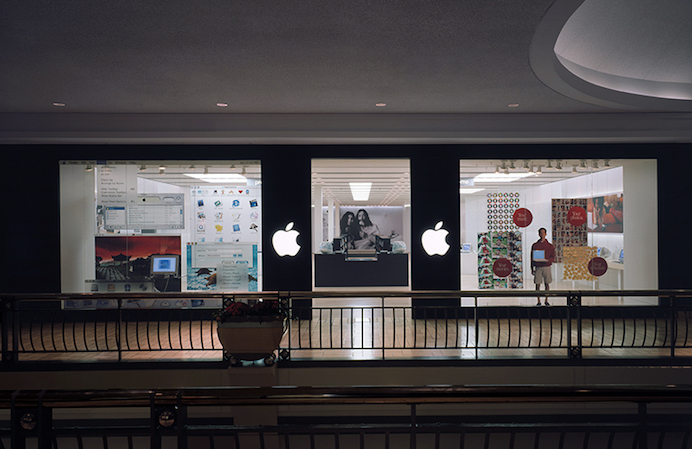


Steve Jobs personally guided members of the press through the Tysons Corner store four days before it opened, after Apple announced the retail initiative on May 15. Some 500 visitors lined up before dawn on opening day, with the queue growing to over 1,000 by the time the doors opened at 10 a.m. The two stores, located at Tysons Corner Center in McLean, Virginia and Glendale Galleria in California, welcomed over 7,700 visitors and recorded $599,000 in combined sales across their opening weekend.

The decision to enter brick-and-mortar retail came at a precarious moment for Apple. With a market share hovering around 2.8%, the company was struggling to showcase its products through third-party retailers, where Macs were routinely relegated to dusty corners staffed by clerks with limited product knowledge. Jobs believed Apple would never shed its "cult" image unless it controlled the entire customer experience right down to the point of purchase. As he told Walter Isaacson for his biography: "Unless we could find ways to get our message to customers at the store, we were screwed."

To lead the retail push, Jobs recruited Ron Johnson, who had transformed Target's image with his designer merchandise line. Together they refined the store concept in a secret warehouse prototype, working through every detail from the single-entrance layout to the Genius Bar, which Johnson modeled on the service experience at Ritz-Carlton hotels. Gap CEO Mickey Drexler, who had joined Apple's board in 1999, also played a key role in shaping the retail vision.


Skepticism was widespread at the time. Apple's sales had dropped 29% the previous year, Gateway had just shuttered 40 of its own stores, and Channel Marketing analyst David Goldstein publicly predicted Apple would be "turning out the lights on a very painful and expensive mistake" within two years.

By 2003, Apple was recording $3 million in profit per store, per quarter, with approximately 60,000 visitors at each location. Apple Retail hit $1.2 billion in revenue in 2004, breaking the record for the fastest retail operation to reach a billion-dollar milestone. The company today operates more than 500 stores across 27 countries, with each location generating approximately $5,500 per square foot annually, among the highest figures in the retail industry.

The original Tysons Corner store relocated and reopened in a larger, redesigned space within the same mall in May 2023. Apple retail stores in both Tysons Corner and Glendale Galleria locations remain open today.
Tag: Retail

This article, "Apple's First Retail Stores Opened 25 Years Ago Today" first appeared on MacRumors.com

Discuss this article in our forums

  •  

Fortnite Returns to the App Store Worldwide as Epic Signals 'Final Battle' With Apple

Fortnite is back on the App Store in every country except Australia, Epic Games announced today, as the company declared it is entering the "final battle" of its long-running legal dispute with Apple.


Epic said the decision to push Fortnite back onto iOS globally was prompted by Apple's own words to the U.S. Supreme Court, in which Apple acknowledged that "regulators around the world are watching this case to determine what commission rate Apple may charge on covered purchases in huge markets outside the United States." Epic CEO Tim Sweeney framed the move as a strategic provocation, writing on X that the return marks "the beginning of the end of the Apple Tax worldwide."

The return follows Fortnite's reinstatement to the U.S. App Store in May 2025 after nearly five years off the platform. The return was forced after District Judge Yvonne Gonzalez Rogers threatened to require the Apple official overseeing app decisions to appear in court, which prompted Apple to approve the submission. Today's worldwide rollout extends that comeback to most remaining markets, with Epic expressing confidence that an upcoming court-ordered transparency process will expose what the company calls Apple's "junk fees."

Apple knows the U.S. federal court will force it to be transparent about how it charges its App Store fees. Fortnite is returning to the App Store now because we are confident that once Apple is forced to show its costs, governments around the world will not allow Apple junk fees to stand.


In late April, the Ninth Circuit Court of Appeals reversed a stay that had allowed Apple to pause its compliance with rulings on ‌App Store‌ fees, sending the case back to Judge Gonzalez Rogers to determine what commission Apple can charge on purchases made via external links, if any.

Epic said it will "continue to challenge Apple's anticompetitive ‌App Store‌ practices of banning alternative app stores and competition in payments," pointing to regulatory momentum in Japan, the European Union, and the United Kingdom. The company alleged that Apple has "evaded the laws with scare screens, fees and onerous requirements" in each of those jurisdictions.

Australia is the one major market where Fortnite has not returned. Epic said it won its court case there and that an Australian court found many of Apple's developer terms to be unlawful, but Apple continues to enforce those terms regardless. Epic said it cannot return "under an illegal payment arrangement" and is waiting for a court order to compel Apple to comply.
This article, "Fortnite Returns to the App Store Worldwide as Epic Signals 'Final Battle' With Apple" first appeared on MacRumors.com

Discuss this article in our forums

  •  

Apple Previews New Accessibility Features Powered by Apple Intelligence

Apple today announced a suite of accessibility updates that use Apple Intelligence to expand capabilities across VoiceOver, Magnifier, Voice Control, and Accessibility Reader, with additional new features for generated subtitles and wheelchair control via Apple Vision Pro.


‌Apple Intelligence‌ powers several of the new features coming later this year:


  • VoiceOver Image Explorer uses ‌Apple Intelligence‌ to produce more detailed descriptions of images throughout the system, including photographs, scanned bills, and personal records. Users can also press the Action button on the iPhone to ask questions about what the camera viewfinder sees, with follow-up questions supported in natural language.

  • Magnifier brings Apple Intelligence-powered visual descriptions to its high-contrast interface for users with low vision, also accessible via the Action button, with support for spoken commands like "zoom in" or "turn on flashlight."

  • Voice Control gains natural language input so users can describe onscreen elements conversationally, such as "tap the guide about best restaurants" or "tap the purple folder," rather than memorizing exact label names or numbers. Apple says the feature can also help where on-screen elements lack proper accessibility labels.

  • Accessibility Reader gains support for more complex document layouts including scientific articles with multiple columns, images, and tables, plus on-demand summaries and built-in translation that retains a user's custom font, color, and formatting preferences.

  • Generated Subtitles use on-device speech recognition to automatically transcribe spoken audio in uncaptioned video content, including clips recorded on iPhone, received from friends and family, or streamed online, across the iPhone, iPad, Mac, Apple TV, and ‌Apple Vision Pro‌. Initially available in English in the U.S. and Canada.

  • Power Wheelchair Control for Apple Vision Pro uses the headset's precision eye-tracking system as an alternative input method for users who cannot operate a joystick, launching with support for the Tolt and LUCI alternative drive systems in the U.S. via Bluetooth and wired connections.


Apple shared a video about the new Voiceover feature:


Apple also announced a number of smaller additions coming later this year:

  • Vehicle Motion Cues are coming to visionOS to help reduce motion sickness when using Vision Pro as a passenger in a moving vehicle.

  • Apple Vision Pro will support face gestures for performing taps and system actions, plus a new way to select elements with one's eyes while using Dwell Control.

  • Made for iPhone hearing aids will gain more reliable pairing and handoff between Apple devices, with an improved setup experience across iOS, iPadOS, macOS, and visionOS.

  • Name Recognition, which notifies users who are deaf or hard of hearing if someone says their name, expands to more than 50 languages globally.

  • Larger Text support is coming to tvOS, allowing viewers with low vision to increase onscreen text size.

  • Sony Access controller is gaining support as a game controller on iOS, iPadOS, and macOS, with full button and thumbstick customization and support for combining two controllers.

  • FaceTime gains a new API allowing sign language interpretation app developers to add a human interpreter to an ongoing video call.

  • Touch Accommodations gain a new way to personalize setup in iOS and iPadOS.


Starting today, the Hikawa Grip & Stand for iPhone, an adaptive MagSafe accessory designed by Los Angeles-based designer Bailey Hikawa, is available globally in three new colors via the Apple Store online. The accessory was developed in collaboration with individuals with disabilities affecting grip, strength, and mobility, and is now available internationally via a partnership with PopSockets.

All of the announced features are expected to arrive later this year. Voice Control's natural language capabilities will be available in English in the U.S., Canada, the UK, and Australia.

Today's announcement is part of Apple's annual tradition of previewing upcoming accessibility features ahead of Global Accessibility Awareness Day, which falls on the third Thursday of May each year. While no firm release date is given for the features, they typically arrive with Apple's new operating system updates in the fall. This year that means iOS 27, iPadOS 27, macOS 27, tvOS 27, and visionOS 27, all of which are expected to be unveiled at WWDC in June before shipping in September.
Related Roundup: iOS 27

This article, "Apple Previews New Accessibility Features Powered by Apple Intelligence" first appeared on MacRumors.com

Discuss this article in our forums
  •  

India Refuses to Let Apple Pause App Store Antitrust Case

An Indian court has ruled that Apple must cooperate with a government investigation into its App Store practices, rejecting the company's attempt to put the case on hold (via Reuters).


The Delhi High Court ruling keeps a probe by the Competition Commission of India (CCI) alive, which found in 2024 that Apple had abused its dominant position in the iPhone apps market. The CCI wants Apple's financial data to calculate potential penalties, but Apple has refused to hand it over so far.

Apple's argument is largely procedural; it is separately challenging the legality of India's penalty framework in court, and says the CCI should wait until that challenge is resolved. India's updated competition law allows fines to be based on a company's global revenue rather than just local earnings, which given Apple's scale could mean enormous exposure.

The court did not give Apple the pause it wanted, but it did prevent the CCI from issuing a final ruling before July 15, buying the company some time. Apple also succeeded in getting certain documents placed on the legal record, though the court order didn't say what they were.

India is one of Apple's most important growth markets. Counterpoint Research puts the company's iPhone market share there at 9%, up from just 4% two years ago. Apple has also been ramping up iPhone manufacturing in the country through Foxconn and Tata as it reduces its dependence on China. A hostile regulatory environment complicates that ambition.

It is also the latest front in a years-long global battle over ‌App Store‌ rules. Apple faces similar scrutiny in the U.S. and Europe, where regulators and courts have pushed back on its control over app distribution and in-app payments.
This article, "India Refuses to Let Apple Pause App Store Antitrust Case" first appeared on MacRumors.com

Discuss this article in our forums

  •  
❌