
Reading view

Colombia on Guard as ‘Super’ El Niño Threatens Record Heat, Drought and Food Security

A potentially historic El Niño climate event is emerging as one of the defining stories for Colombia through the remainder of 2026, with authorities warning that extreme heat, drought, water shortages and energy pressures could push vulnerable regions toward crisis conditions.

Climate agencies, environmental authorities and agricultural groups are increasingly sounding alarms over what some scientists describe as a possible “super” El Niño – an exceptionally intense warming of Pacific Ocean waters capable of disrupting global weather systems and triggering severe consequences across Latin America.

In Colombia, the warnings are becoming stark.

Authorities fear a prolonged period of extreme temperatures, dwindling reservoirs, forest fires, crop failures and surging food prices that could stretch into early 2027 when typically the “summer season” starts. Officials have already begun urging Colombians to conserve water and electricity as forecasts indicate the phenomenon may intensify during the second half of the year.

The environmental authority of Cundinamarca, known as the CAR, warned that the probability of El Niño has reached 82%, threatening domestic water supplies, industrial production and hydroelectric generation across central Colombia.

“The measures of prevention and adaptation must be taken immediately,” CAR director Alfred Ignacio Ballesteros said, warning that the event could coincide with the Andean region’s traditional dry season in January and February, placing additional pressure on already strained water systems.

For Bogotá, however, authorities insist the capital is better prepared than during the water crisis of 2023 and 2024. The city’s Aqueduct and Sewer Company said no water rationing measures are currently expected despite the arrival of El Niño. Diego Montero, manager of the utility’s master water system, said reservoir levels remain stable, with the Chingaza system — including the Chuza and San Rafael reservoirs — holding nearly 20 million cubic meters above the established guidance curve. Officials also said the Tibitoc treatment plant is undergoing capacity upgrades aimed at increasing production and reducing pressure on the Chingaza system, which supplies most of Bogotá’s drinking water.

Fears beyond Inconvenience

Meteorologists predict temperatures in Colombia’s Caribbean region could surpass 40 degrees Celsius, while prolonged drought conditions may devastate agriculture and livestock production. Industry groups have warned that prices for staple foods including milk, rice, vegetables and beef could rise sharply toward the end of the year, adding renewed pressure to inflation at a moment when many households are already struggling with high living costs. A ‘super’ El Niño could push inflation above 7 percent, warns the National Association of Financial Institutions – ANIF.

Officials are also concerned about the vulnerability of Colombia’s energy grid, which depends heavily on hydroelectric power. Reduced rainfall and lower reservoir levels could increase the risk of electricity rationing or blackouts similar to those experienced during past El Niño events.

The country’s fragile páramo ecosystems and wetlands — critical natural water regulators located in the Andes — may also face heightened threats from forest fires and prolonged heatwaves. Environmentalists warn that drought could destroy sensitive habitats and endanger wildlife already under pressure from deforestation and climate change.

The emerging crisis is part of a broader global climate pattern that scientists say is being intensified by human-driven warming.

El Niño occurs every few years when ocean waters in the eastern and central Pacific become abnormally warm, altering rainfall patterns, shifting jet streams and increasing global temperatures. However, so-called “super” El Niño events are far rarer and more dangerous, with sea surface temperatures rising more than 2 degrees Celsius above historical averages.

Some climate researchers now fear the world could be heading toward one of the strongest El Niño events in modern history.

Paul Roundy, a professor of atmospheric sciences at the University of Albany, recently warned there was “real potential” for the strongest El Niño event in 140 years. Forecasts from the European Centre for Medium-Range Weather Forecasts suggest Pacific Ocean temperatures could rise three degrees Celsius above average.

Such projections have revived comparisons to the catastrophic El Niño of 1877-1878, which contributed to massive crop failures and famine across parts of India, China, Brazil and Africa. Historians estimate more than 50 million people died globally during that climate disaster.

While modern infrastructure and global trade networks make a repeat of 19th-century famine unlikely, experts say today’s interconnected crises — inflation, inequality, geopolitical conflict and fragile food systems — create new vulnerabilities.

“Hunger is fundamentally political and economic,” warns Benjamin Selwyn from the University of Sussex. “Wars disrupt trade routes, inequality restricts access to food and profit-driven agricultural systems prioritize industrial production over resilience. Climate shocks such as El Niño amplify those existing weaknesses,” writes Selwyn in The Conversation.

Studies by the UN Food and Agriculture Organization and the World Meteorological Organization have already shown that rising temperatures are reducing crop yields and making agricultural labor increasingly dangerous in tropical regions. Heat stress also lowers livestock productivity and survival rates.

In Colombia, the government of leftist President Gustavo Petro has begun discussing contingency measures, though critics argue the country remains dangerously unprepared.

Carlos Carrillo, director of Colombia’s National Unit for Disaster Risk Management (UNGRD), has called for urgent efforts to conserve water and energy while identifying regions at high risk of forest fires. There is also growing concern that years of underinvestment in water storage, energy diversification and climate adaptation could leave Colombia exposed to prolonged disruptions.

If the global forecasts prove accurate, Colombians could soon face months of punishing heat, food inflation and growing anxiety over the resilience of the country’s infrastructure in an age of accelerating climate extremes.
  •  

“Before They Touch My Family, They’ll Have to Kill Me”: Uribe Warns Protest Outside Antioquia Estate

Former Colombian President Álvaro Uribe Vélez confronted a group of protesters outside his residence in Rionegro, Antioquia, on Wednesday after activists began painting a mural referencing victims of Colombia’s “false positives” scandal.

Videos and images shared widely on social media showed Uribe surrounded by security personnel while holding a paint roller near the wall where the mural was being painted. Wearing a light field jacket and broad-brimmed hat, the former president appeared visibly upset as tensions rose between demonstrators, supporters and members of his security team.

The incident quickly became one of Colombia’s most discussed political flashpoints this week, exposing deep divisions surrounding the country’s internal armed conflict with ex-FARC, the transitional justice system, and the increasingly polarized 2026 presidential race. The official candidate of Uribe’s Centro Democrático party, Paloma Valencia, is considered Cepeda’s strongest rival in the event of a run-off election on June 21.

Uribe later said he had interrupted a political meeting in Medellín after receiving a call informing him that a large group had gathered near the entrance to his property while his wife was home alone.

“Cowardly Cepeda, stop sending people to my house where my lady was alone,” Uribe wrote on X Wednesday, referring his political foe and presidential frontrunner Iván Cepeda.

In a separate statement, Uribe accused the hard-leftist senator and Hernán Muriel, a congressman from the governing Historic Pact coalition, of promoting what he described as “acts of provocation and intimidation” against his family.

According to Uribe, the protesters arrived in three buses and gathered close to the entrance of the estate while artists painted the mural. He claimed one of his supporters was injured with a knife during the confrontation and said a member of his security detail was also hurt.

“I told them that I was going to erase the mural,” Uribe wrote. “Before provoking violence against my family and our home, they would have to kill me.”

Later footage showed Uribe personally covering the painted wall with a roller while supporters and security personnel stood guard nearby.

The mural referenced the latest figures released by Colombia’s Special Jurisdiction for Peace (JEP), the transitional tribunal created following the 2016 peace accord with FARC. The tribunal recently updated estimates tied to the “false positives” scandal, in which civilians were allegedly killed by members of the armed forces and falsely presented as combat casualties during more than four decades of Colombia’s internal conflict.

Muriel, who organized the demonstration, rejected accusations that the protest was intended to threaten Uribe or his family. He described the gathering “as a peaceful act” organized by victims’ organizations, social movements and human rights defenders seeking to highlight the revised JEP findings.

“We are carrying out an act of social mobilization and memory pedagogy,” Muriel said in remarks shared online. “We are here with social organizations, victims and human rights defenders following the new figure of 7,837 false positives announced by the JEP.”

According to Muriel, the mural was painted on public property near the residence and was intended to commemorate victims of the conflict.

The confrontation prompted swift reactions from political allies of the former president in Antioquia, one of Colombia’s most conservative regions and a longtime bastion of Uribe’s “democratic security” agenda.

Medellín Mayor Federico Gutiérrez criticized the protest and accused supporters of President Gustavo Petro of fostering political hostility toward opposition figures. “It’s the same method used during the last mayoral campaign in Medellín,” he wrote on social media, adding that political tensions in the country were continuing to escalate.

Antioquia Governor Andrés Julián Rendón also condemned the incident and called for respect toward Uribe and his family.

The episode underscores how historical revisionism spread on social media continues to discredit the legacy of the country’s two-term president (2002-2010), and leading opposition leaders. By Thursday morning, the images from Rionegro — showing Uribe beside the mural with a paint roller in hand — had spread across Colombian media and social networks, becoming the latest symbol of how the left justifies ideologically-fueled protests to vandalize public space and infrastructure.

  •  

Totó la Momposina, Colombia’s treasured Caribbean singer, dies at 85

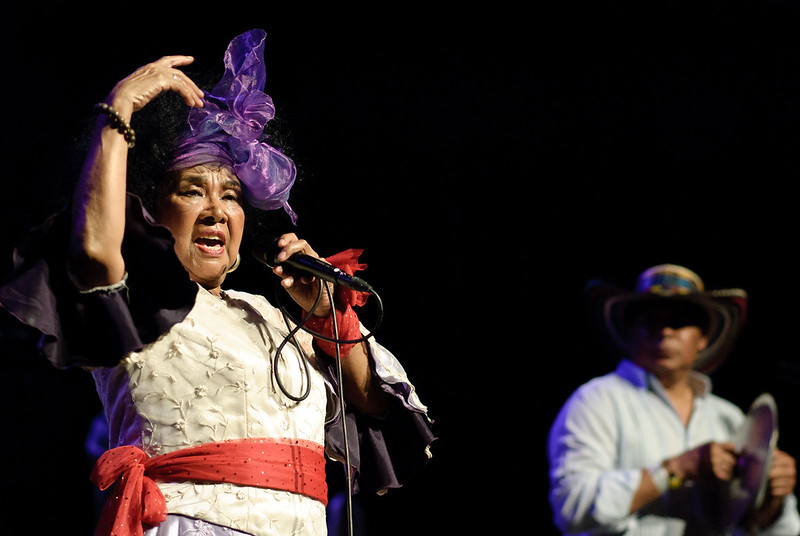
Totó la Momposina at the Sala Barts, Barcelona. Image credit: Dani Alvarez via Flickr

Colombia is mourning the death of legendary singer and dancer Totó la Momposina, the artist who carried the rhythms of the Caribbean coast to audiences around the world. 

Totó’s death was disclosed in a statement by Colombia’s Ministry of Culture today, which described her as “the eternal master”, praising her decades-long contribution to Cumbia, Porro, Mapalé and Bullerengue music.

Her family confirmed that Totó died on Sunday, May 17, in Celaya, Mexico at age 85, after years battling neurocognitive health complications.

Born Sonia Bazanta Vides in 1940 in Talaigua Nuevo, Bolívar, near the historic river town of Mompox, Totó devoted her life to preserving and promoting traditional Caribbean music rooted in African, Indigenous and Spanish influences.

For more than six decades, Totó became the voice of Colombia’s Caribbean soul. Raised in a musical family — her father was a drummer and her mother a singer and dancer — she began performing at an early age before later studying folklore and music in Bogotá, Paris and Cuba. 

In 1982, she accompanied Gabriel García Márquez to Stockholm during his Nobel Prize ceremony, where she performed Colombian Caribbean music before international dignitaries — a moment that became part of the country’s cultural history.

Her international breakthrough came with the 1993 album La Candela Viva, released through Peter Gabriel’s Real World label, which introduced global audiences to the song “El Pescador” and to authentic Colombian rhythms.

Over the years, Totó collaborated with and influenced artists across genres, while her music was sampled by international musicians including Jay-Z and Major Lazer. Her song “Latinoamérica” alongside Calle 13 won her two Latin Grammy Awards in 2011. She officially retired from performing in 2022 due to health complications.

Totó received numerous honors throughout her career, including the Womex Award in 2006, Colombia’s Life and Work Award in 2011, and the Latin Grammy Award for Musical Excellence in 2013.

Colombian President Gustavo Petro honored the singer in a post on X today, calling her “an exalted figure of Colombian Caribbean art and culture,” adding, “may she fly high to the stars.” 

Her family also announced that a tribute honoring the singer-songwriter will be held on May 27 at the National Capitol in Bogotá, as the country prepares to bid farewell to one of the most influential voices in its cultural history.

The post Totó la Momposina, Colombia’s treasured Caribbean singer, dies at 85 appeared first on The Bogotá Post.

  •  
❌