Reading view

Right-wing De La Espriella in Face-Off Election Against Marxist Iván Cepeda

Right-wing presidential candidate Abelardo “El Tigre” de la Espriella emerged as the frontrunner in Colombia’s presidential election on Sunday, setting up a high-stakes runoff against left-wing senator Iván Cepeda in a contest that could reshape the political future of one of Latin America’s largest economies.

With more than 97% of ballots counted, National Registry Bulletin No. 15 showed De la Espriella leading with 43.77% of the vote, or approximately 10.1 million ballots, compared with Cepeda’s 40.88%, or slightly above 9.4 million votes. The margin of roughly 667,000 votes exceeded many pre-election forecasts and positioned the Barranquilla-based criminal defense lawyer as the favorite heading into the decisive June 21 runoff.

Election authorities reported that voting unfolded peacefully across the country, with preliminary results available just 90 minutes after polling stations closed at 4:00 p.m. More than 41 million Colombians had been eligible to participate in the election, including 1.4 million citizens residing abroad.

The result represents a significant rebuke to President Gustavo Petro’s political project and highlights growing voter concerns over security, economic performance and public confidence in state institutions.

Petro, who is constitutionally barred from seeking re-election, has thrown his support behind Cepeda, a leading figure within the governing coalition and one of the principal defenders of the government’s controversial “Total Peace” strategy. The policy sought negotiated settlements with FARC dissidents, criminal organizations and other armed groups operating throughout the country, but critics argue it failed to reduce violence in many regions.

While Cepeda entered election day as the favorite in most opinion polls, De la Espriella successfully capitalized on public frustration over extortion, insecurity, illegal armed groups and what many voters perceive as a deterioration of public order under Petro’s administration.

Known to supporters as “El Tigre,” De la Espriella built his campaign around a tough-on-crime platform inspired in part by the security policies of El Salvador’s President Nayib Bukele. He has promised to strengthen the military, restore state authority in conflict-affected regions and confront criminal organizations with what he describes as an uncompromising approach.

His message appears to have resonated particularly among middle-class voters, business sectors and residents of regions heavily impacted by drug trafficking and armed violence.

The election also exposed the weakness of Colombia’s political center, which for years attempted to position itself as an alternative to the country’s increasingly polarized political landscape.

Conservative candidate Paloma Valencia secured more than 1.5 million votes (or 6.9%) but remained well behind the two frontrunners. Although her campaign attracted traditional conservatives and followers of former president Álvaro Uribe Vélez, she struggled to expand beyond the party’s core support base.

Centrist Sergio Fajardo, the former mayor of Medellín and former governor of Antioquia, won just 4.6% of the vote, just shy of one million ballots. Once regarded as a politician capable of bridging Colombia’s ideological divides, Fajardo failed in his third attempt to reach the presidency as voters increasingly gravitated toward candidates offering sharply contrasting visions for the country’s future.

Former Bogotá mayor Claudia López suffered one of the day’s most dramatic defeats, capturing less than 1% of the national vote. The result marked a stunning collapse for a politician who only a few years ago was considered among Colombia’s most vocal leaders.

Analysts say the runoff campaign is now likely to become a referendum on Petro’s presidency and the future direction of the country.

For Cepeda’s supporters, the June 21 vote offers an opportunity to preserve and deepen many of the social and political reforms promoted by the current administration. For De la Espriella’s backers, it represents a chance to reverse those policies and return to a security-centered model associated with the administrations of former president Álvaro Uribe.

The key question over the coming weeks will be whether De la Espriella can consolidate support among conservative and independent voters while Cepeda seeks to unite the left and attract Colombians wary of a return to hardline security policies.

After a largely peaceful election day, Colombia now faces three weeks of intense campaigning before voters make what many observers consider one of the most consequential political decisions since the country’s historic shift to the left in 2022.
  •  

Voting Begins in Colombia’s Closely Watched Presidential Race

Much of Colombia woke up to temperate weather and clear skies over the capital, Bogotá. As lines began to form outside polling stations when they opened at 8:00 a.m. on Sunday, voters cast their ballots in one of the country’s most closely watched presidential elections in decades, a contest that could redefine the political direction of the South American nation at a time of mounting security concerns and economic uncertainty.

In Bogotá, outside Corferias, the country’s largest exhibition and convention center and one of Colombia’s busiest voting locations, queues of unregistered voters formed well before polling stations officially opened.

According to the National Registry Office, more than 41 million Colombians are eligible to vote in the election, including approximately 1.4 million citizens residing abroad. Polling stations are under tight security nationwide and will remain open until 4:00 p.m. local time.

The 2026 election has been overshadowed by a resurgence of political violence, recalling memories of some of the country’s darkest electoral periods. Authorities have heightened security measures following a tense campaign season marked by threats against candidates, concerns over public safety, and growing polarization between the political left and right.

President Gustavo Petro, who is constitutionally barred from seeking re-election, has thrown his support behind left-wing senator Iván Cepeda, 63, who is widely regarded as the architect of the government’s failed “Total Peace” strategy aimed at negotiating disarmament agreements with FARC dissidents and other illegal armed groups.

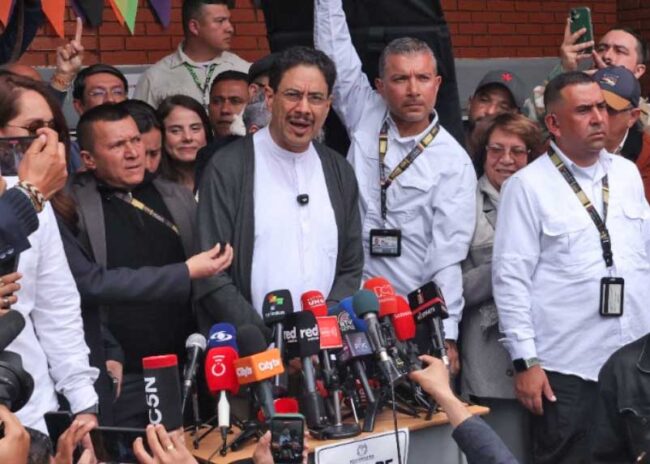
Iván Cepeda of the Historic Pact coalition voted at a district school in the locality of Kennedy, Bogotá. Photo: Cepeda Presidente.

President Petro cast his vote at 9:10 am from the Plazoleta Mosquera inside the National Capitol.

Opinion polls have placed Cepeda in first place with support ranging between 33% and 40%, making him the clear favorite to advance to a second-round runoff scheduled for June 21 should no candidate secure an outright majority of 50% plus one vote on Sunday.

Cepeda, of the ruling Historic Pact coalition, is facing two formidable opponents to his Marxist agenda: right-wing senator Paloma Valencia, 48, of the Centro Democrático party, and criminal defense lawyer Abelardo de la Espriella, 47, considered the “outsider” in the race, whose rapid rise has become one of the defining stories of the campaign.

Valencia and De la Espriella both embrace the “democratic security” doctrine associated with former president Álvaro Uribe Vélez, whose two administrations between 2002 and 2010 were defined by an aggressive military campaign against the FARC and ELN guerrillas.

De la Espriella, known among supporters as “The Tiger,” has portrayed himself as a political outsider capable of restoring economic growth and defeating criminal organizations. His campaign has gained momentum through a pro-Bukele message, fueled by a strong social media presence and rhetoric that resonates with middle-class Colombians on the Caribbean coast who are frustrated by extortion, insecurity, and the traditional political establishment.

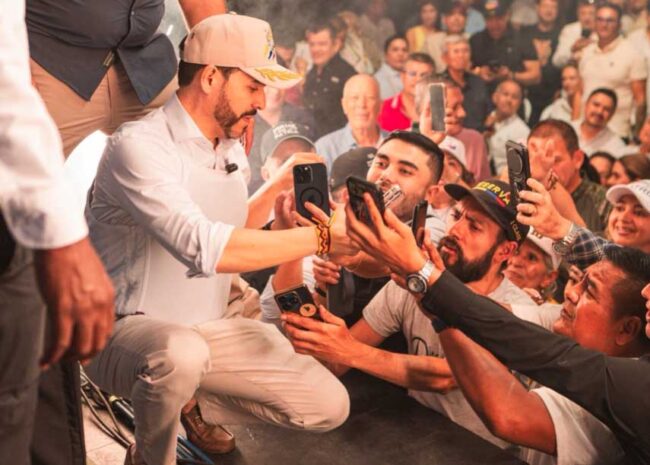
Abelardo De La Espriella has hosted large rallies along the Colombian coast. Photo: X

The political capital of  Sergio Fajardo and Claudia López appears to be spent, as the race has increasingly evolved into a contest between three candidates. The self-professed centrists and former mayors – one from Medellín (Fajardo) and other from Bogotá (López) — have consistently polled in the single digits, but on Sunday, their political relevance could evaporate a quickly with the final tally.

Sunday’s vote is unlikely to produce an outright winner, making a runoff between Cepeda and one of his conservative challengers the most probable outcome.

The key uncertainty is whether Valencia’s established party machinery and her effort to capture the undecided centre by naming Juan Daniel Oviedo as her running mate will push her beyond the six million votes she received in the March primaries.

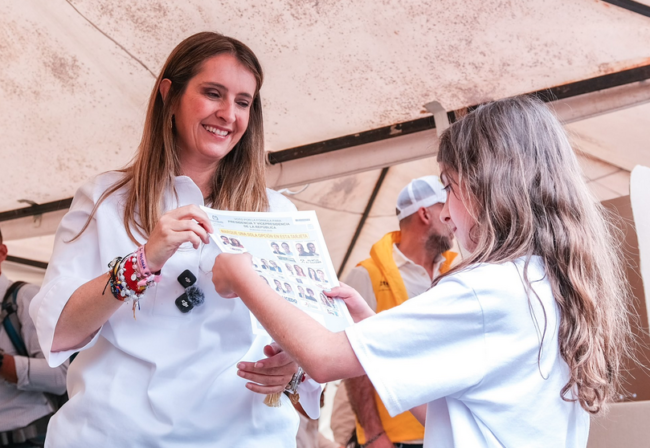
Candidate Paloma Valencia voted Sunday in Bogotá accompanied by her daughter Amapola. Prensa Paloma.
Candidate Paloma Valencia votes Sunday in Bogotá accompanied by her daughter Amapola. Prensa Paloma.

Should Valencia outperform polling forecasts, De la Espriella will be forced on Monday to convince his supporters to back Uribe’s official candidate.

For many Colombians, this election represents more than a contest between three frontrunners. It has become a referendum on President Petro’s stalled reform agenda, the country’s deteriorating security situation, and the future direction of a democracy facing some of its most significant challenges at a time when the “pink tide” of left-wing governments across Latin America has largely receded. Or in the words of former FARC hostage and ex-presidential candidate Ingrid Betancourt: “May ethics, hope, truth, and commitment to Colombia prevail today over the machismo, fear, violence, and misogyny of the extremes. I trust that we will have the first woman President.”


  •  

Age of Empires 2 for Mac is Finally Available

Age of Empires II, regarded as one of the best real-time strategy games of all time, is finally available for Mac. Sure, it originally debuted back in 1999 for Windows, but AoE 2’s depth and replayability has allowed it to maintain a longstanding following that has kept the game wildly popular even 25+ years later. ... Read More
  •  

Bogotá Mayor sparks backlash over extended ‘ley seca alcohol ban

Shops were barred from selling alcohol. Credit: Bogotá Post archives.

The Mayor of Bogotá, Carlos Fernando Galán, brought forward a scheduled citywide alcohol ban by 24 hours in a move that has enraged business owners and nightlife operators.

Under Decree 191, the ‘dry law’ (Ley Seca), which restricts the sale and consumption of alcohol hours before and during the voting period, came into effect in Bogotá at 6PM on Friday, 24 hours earlier than in the rest of the country.

While the move is purportedly to maintain order and security ahead of presidential elections on Sunday, many have questioned why Bogotá’s ban was extended at the last minute.

In a statement, Asobares, the country’s leading trade association that represents food and drink establishments, said that “continuing to enforce such restrictions is to impose outdated measures on a modern service economy, which currently sustains thousands of families”.

In the document, Asobares points out that nearly 100,000 workers (such as waiters, DJs, and security staff) will lose their shifts, which is a big hit because they earn up to 70% of their weekly pay during those days.

After the announcement, many establishments were forced to cancel events. For example, Theatron, one of the largest entertainment venues in Latin America, canceled a scheduled club night called ‘Theatron on Radio: Parcial Final y a Perrear’.

Asobares also highlighted that beyond nightlife venues, the measure disrupts the entire supply chain, negatively impacting the revenue of producers, distributors, transport workers, and farmers who supply the formal commercial sector.

“Security should not be achieved at the expense of the right to work and economic stability,” Camilo Ospina, Asobares President, told The Bogotá Post. “Bogotá needs to show that it is a mature capital, capable of holding a peaceful election day without needing to declare the temporary bankruptcy of its most productive sectors”.

The post Bogotá Mayor sparks backlash over extended ‘ley seca alcohol ban appeared first on The Bogotá Post.

  •  

The truth behind Petro’s claims of Colombia voting fraud

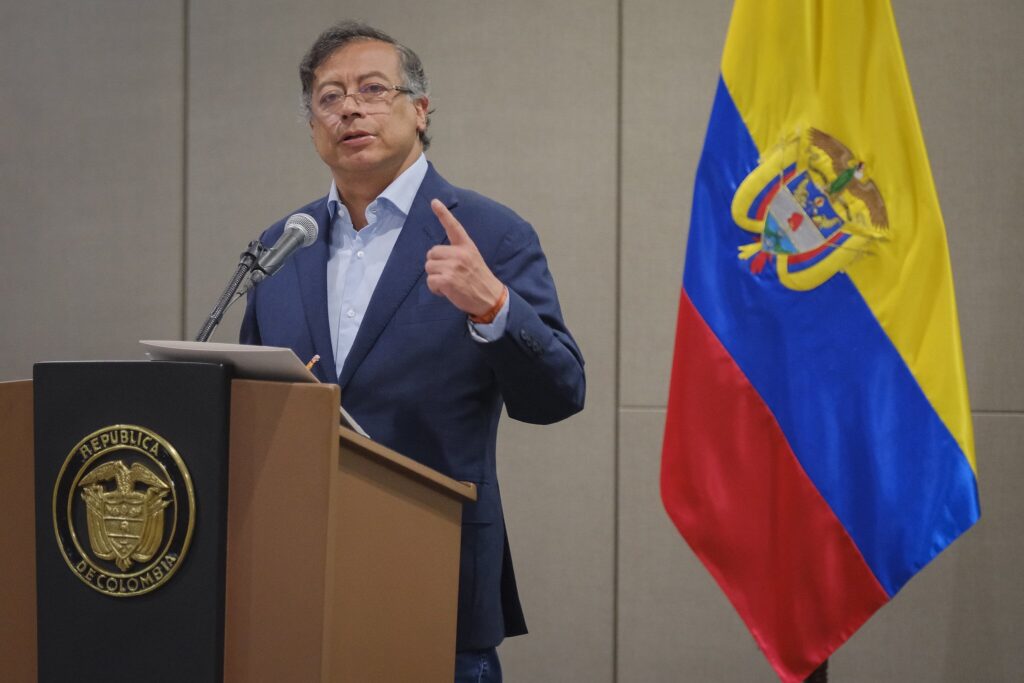
President Gustavo Petro. Image credit: @infopresidencia via X.

Just days away from Colombia’s first-round presidential election, incumbent President Gustavo Petro continues to sound the alarm about voter fraud. 

On Tuesday, he repeated claims that the National Registrar’s Office is allowing the vote to be manipulated against his party’s candidate, Senator Iván Cepeda.

Petro renewed calls for citizens to supervise the vote count, describing it as the only way to avoid fraud: “Only the physical vigilance of millions of people can overcome the algorithm manipulations that the Registrar’s Office refused to prevent.”

But are the president’s claims of vulnerabilities in the voting system valid?

A decade-long dispute

Petro’s claims stem from a long-running grudge with Thomas Greg & Sons, a multinational security and printing company tasked with issuing Colombian passports and overseeing electoral logistics.

According to Petro, the firm cannot be trusted with the sensitive task of printing, delivering, and processing vote counting forms.

While the president’s claims have widely been dismissed by electoral institutions as reckless, there is some foundation for them.

Following the 2014 legislative elections, the evangelical political party, MIRA, filed a legal petition against the Registrar’s Office, claiming a discrepancy between the ballot pre-count (filled out by citizen juries in a form known as E-14) and the digitized tally of the vote (filled out by officials in the E-24 form).

MIRA claimed to have evidence of manipulation of the software used for “voting, information, transmission, or tabulation of election results,” which was managed by a subsidiary of Thomas Greg & Sons. 

After a lengthy four-year legal case, the Council of State (Consejo de Estado), the highest court overseeing the government, issued a ruling in favor of MIRA. It found evidence of destruction of electoral material and inconsistencies between the E-14 and E-24 forms. 

Crucially, the Council of State said that it could not confirm that voting software had been sabotaged because it did not have access to the source code of the software during the elections.

Without the original code, it was impossible to know if the system had been tampered with.

The body issued a clear recommendation to prevent repetitions of the dispute in future elections: “Direct the Electoral Organization to acquire the necessary vote-counting software for use within the state—that is, software owned by the organization itself—which allows for full traceability of the vote-counting process from the polling stations through to the official declaration of the election results.”

In other words, it recommended that electoral authorities roll out their own software, rather than relying on third party providers.

But 12 years later, Thomas Greg & Sons remains in charge of the electoral software; according to the Registrar’s Office, purchasing proprietary software and operating the corresponding data centers is not feasible.

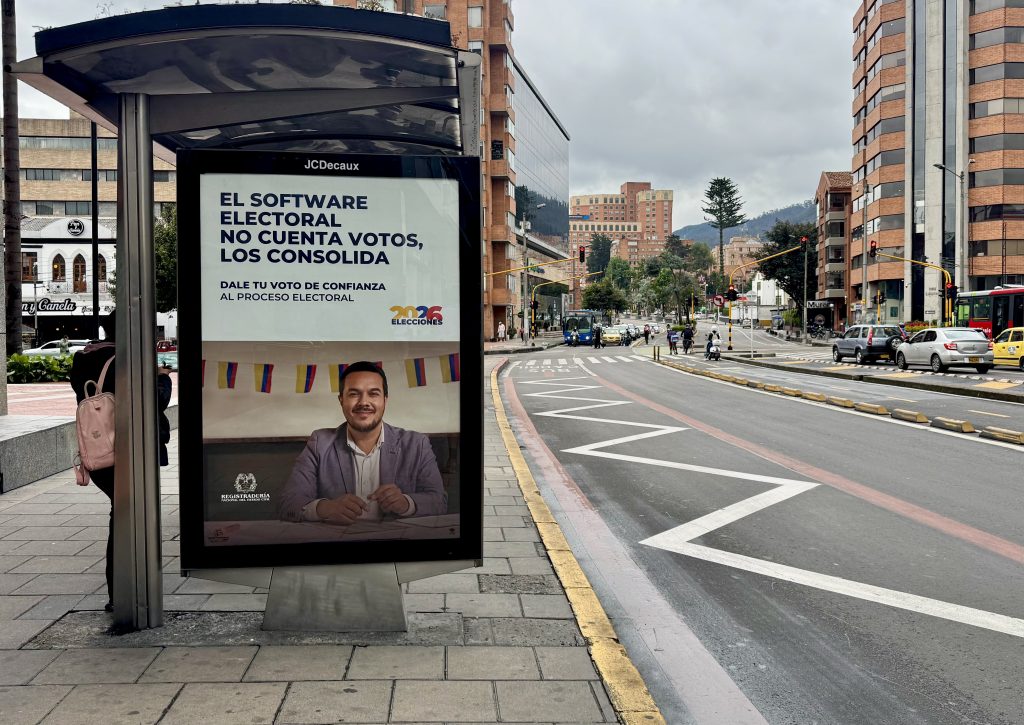
The Registrar’s Office has launched an advertisement campaign defending the integrity of the voting process. Image credit: Alfie Pannell.

While Petro continues to lobby for a fully state-owned system, he has concentrated his efforts on mitigating the risks of a repeat of the 2014 source code issue.

The president has repeatedly demanded that the Registrar’s Office share the source code with the government and the public, which he says would allow them to prevent a repeat of the situation in 2014.

But the Registrar’s Office maintains that there is no need, suggesting that publicizing the code would leave the software more vulnerable to attacks and defending internal audit processes.

Petro rebutted, calling the claim “an immense lie”.

Other types of fraud

As well as warning about software manipulation, the president has also raised the alarm about differences between the pre-count and the official, scrutinized count. Ahead of the March elections, he warned that the pre-count may not accurately reflect the results.

Petro’s concerns stem from the 2022 legislative elections in which over half a million votes for his Historic Pact coalition were excluded in the pre-count and later revealed in the scrutiny. 

Rather than software, the culprit for the discrepancy, which in total represented a 5.49% difference, was human error; the Electoral Observation Mission (MOE) had warned the ballot sheets were designed in a way that could lead to Historic Pact votes being neglected. 

But the 2022 vote appears to be an outlier, with the MOE reporting just a 0.28% discrepancy between the pre-count and the scrutinized votes in March’s legislative elections.

Petro’s mistrust in the pre-count may be valid in the case of a tight race with razor-thin margins but not so much if there is a clear winner. And, in any case, the scrutiny process should clear up any doubts. 

“In Colombian elections, it is judges who determine electoral disputes and not a logistical operator such as Thomas Greg & Sons,” explained Sergio Guzmán, director at Colombia Risk Analysis, a political risk think tank.

Bigger fish to fry

While Petro aims his crusade against Thomas Greg & Sons, a firm which he has clashed with on a range of issues, there are other, more prescient threats to electoral integrity.

“I think that concerns about voters being coerced to vote are legitimate… but I think concerns that somebody will steal the election are overblown,” said Guzmán.

International observers including the United Nations have warned that violence may undermine the elections, particularly in areas under armed group control. 

Vote buying is also a well-documented phenomenon in many regions of the country.

While Petro has some basis for his allegations of voter fraud, there is no evidence of software manipulation determining presidential election results in Colombia.

In a razor-thin race, observers would be wise to wait for the scrutinized vote count to declare a winner. But for now, Petro’s warnings about election-rigging appear to be largely overblown.

The post The truth behind Petro’s claims of Colombia voting fraud appeared first on The Bogotá Post.

  •  

Bogotá, Colombia brace for presidential vote with dry law, security alerts and international observers

Colombia is preparing for one of the largest international election observation missions in its history as the country heads toward Sunday’s presidential election amid heightened security measures, dry laws and nationwide institutional alerts aimed at safeguarding the democratic process.

Polling stations across Colombia will open on Sunday, May 31, from 8:00 a.m. until 4:00 p.m. as voters head to the ballot box to elect a new president for the 2026–2030 term. If no candidate secures an outright majority, a runoff election will be held on June 21.

More than 1,200 international observers from 22 countries are expected to monitor the elections under a mission coordinated by Colombia’s National Electoral Council (CNE), in what officials describe as one of the most extensive observation deployments ever organized in the country.

The official installation of the International Observation Mission took place Friday morning at Bogotá’s Grand Hyatt Hotel, where electoral authorities, diplomats and representatives of multilateral organizations gathered ahead of the vote.

According to the CNE, a total of 1,207 accredited observers will participate in territorial inspections, technical briefings and electoral monitoring operations across various regions of Colombia.

Authorities say the mission seeks to strengthen public confidence, transparency and legitimacy in a country where concerns over disinformation campaigns, fake news and political polarization have increasingly shaped the electoral climate.

Official figures show Colombia will install 118,346 voting tables distributed across 13,489 polling stations nationwide.

Among the international observers already arriving in Colombia is U.S. Republican Senator from Ohio, Bernie Moreno, who landed in Cartagena to participate in election monitoring activities.

Moreno, who was born in Colombia before emigrating to the United States, is part of the delegation accredited by the National Electoral Council to observe the presidential elections and verify the conditions under which the democratic process unfolds.

In Bogotá, authorities have implemented extraordinary measures aimed at maintaining public order during election weekend.

Mayor Carlos Fernando Galán’s administration announced that the capital’s “Ley Seca,” or dry law, will begin at 6:00 p.m. on Friday, May 29, and remain in effect until midday on Monday, June 1.

The restrictions prohibit the sale and consumption of alcoholic beverages in public spaces and establishments open to the public throughout Bogotá.

The measure begins 24 hours earlier than the nationwide presidential decree regulating election weekend restrictions and has sparked criticism from nightlife businesses, bars and restaurant owners who warn the extended dry law could significantly impact weekend revenues.

Business owners have also pointed to the timing of the UEFA Champions League final scheduled for Saturday evening between Paris Saint-Germain and Arsenal F.C. at Budapest’s Puskás Aréna, an event expected to draw large crowds to bars and public viewing venues across the Colombian capital.

“The decree seeks to guarantee coexistence and the proper development of the electoral process,” Bogotá authorities said in the official order announcing the restrictions.

At the same time, Bogotá’s Health Secretariat declared a yellow hospital alert across the entire capital beginning Friday evening and lasting through Monday evening.

The alert places the city’s public and private hospital network under a state of heightened operational readiness in anticipation of any emergencies or disturbances related to the elections.

“We call on all hospital directors and healthcare providers to strictly comply with the directives established under this alert,” José Vicente Guzmán, Bogotá’s deputy director for Emergency and Disaster Risk Management, said in a statement.

“It is essential to streamline patient admissions in emergency rooms, optimize ambulance response times and maintain direct and real-time communication channels with the city’s Emergency and Urgency Coordination Center,” he added.

Under the emergency protocols, hospitals have been ordered to activate disaster risk contingency plans, guarantee staffing availability, ensure sufficient medical supplies and maintain full operational readiness of ambulance services and patient transfer systems.

Authorities warned the alert level could be raised to orange or red depending on events during the weekend.

Residents requiring emergency medical attention have been advised to contact Bogotá’s 137 emergency hotline, which will remain operational around the clock throughout the election period.

Elsewhere in Colombia, local governments are also implementing measures to facilitate voting and public mobility.

In Medellín and the surrounding Aburrá Valley metropolitan region, authorities announced free rides on the city’s metro and cable car systems on election day until 6:00 p.m., while bus services will continue operating normally.

The presidential election arrives at a politically charged moment for Colombia after months of polarized campaigning, growing security concerns in several regions and intense national debate over the future direction of the country following the first leftist administration of President Gustavo Petro.

International observers, electoral authorities and security forces are expected to remain deployed throughout the weekend as Colombia prepares for one of the most consequential elections in recent years.

  •  

Colombia’s Armed Forces confirm over 50 dead in FARC dissident clashes in Guaviare

Colombia’s Armed Forces and regional authorities are struggling to verify the full scale of a bloody confrontation between rival FARC dissident factions in the remote southeastern department of Guaviare after clashes reportedly left more than 50 combatants dead.

The fighting, described by officials as one of the deadliest episodes this year involving former Revolutionary Armed Forces of Colombia (FARC) splinter groups, erupted in rural areas near the departmental capital San José del Guaviare between forces loyal to two dissident commanders known by their war aliases “Calarcá” and “Iván Mordisco.”

According to a communiqué released by the faction aligned with Calarcá, the confrontation began when approximately 250 fighters allegedly under the command of Néstor Gregorio Vera Fernández, alias Iván Mordisco, launched a surprise assault on a dissident encampment in the hamlet of La Siberia.

The clashes were reported in the rural sectors of Barranco Colorado, Charras and Trocha Ganadera, cattle farming regions with limited state presence.

The Calarcá faction claimed that a combat column belonging to the Isaías Carvajal Front had been resting overnight when it was attacked before dawn.

“In an act of legitimate self-defense, our units broke the siege, inflicting the first enemy casualties,” the group said in the statement, which was circulated through clandestine channels on Thursday.

“After three hours of combat, the enemy withdrew leaving fifty dead on the battlefield and carrying away a large number of wounded,” the communiqué added.

Colombia’s Army confirmed that troops from Brigade 22 remain deployed in the rural outskirts of San José del Guaviare, the epicenter of the fighting, but authorities acknowledged that they have been unable to fully enter the conflict zone due to difficult terrain and the continued presence of heavily armed illegal groups.

Defense Minister Pedro Sánchez confirmed the clashes took place in the Barranco Colorado sector, more than 100 kilometers east of San José del Guaviare, but refrained from confirming casualty figures. Minister Sánchez did, however, claim that the official statement amounted to a “confession and public admission” of an “atrocious crime”. Sánchez also warned that the reported deaths of underage combatants would constitute a grave violation of international humanitarian law and Colombian criminal legislation, further intensifying scrutiny over forced recruitment of children by FARC dissidents.

Officials said access to the region is severely restricted, with many areas reachable only through jungle tracks and river routes. Colombia’s forensic authorities, including Medicina Legal, have yet to recover or identify bodies from the battlefield.

Regional authorities convened an extraordinary security council meeting on Wednesday amid fears that the violence could intensify ahead of Colombia’s presidential election scheduled for May 31.

San José del Guaviare Mayor Willy Rodríguez told Caracol Radio that preliminary reports suggested “dozens” may have died, though he cautioned that authorities had not yet independently verified the numbers.

“We are receiving alarming information from residents in the rural areas, but the Armed Forces still have not been able to fully enter and confirm the situation,” Rodríguez said.

Governor Yeison Rojas joined police and military commanders in emergency deliberations as intelligence agencies attempted to establish the true scale of the confrontation.

The dissident faction loyal to Calarcá accused Iván Mordisco of provoking the conflict and described the elusive guerrilla commander as “a mentally disturbed individual with ideological shortcomings and psychopathic tendencies.”

The statement also claimed the group seized a significant cache of weapons during the battle, including four machine guns, 49 assault rifles, two Dragunov sniper rifles and more than 10,000 rounds of ammunition.

The faction further stated that two of its own fighters were killed and three wounded, while also claiming to have captured “a female prisoner of war.”

“We inform the Colombian people that this tragic event, occurring four days before an electoral contest, was not initiated by us,” the communiqué concluded. “It was an act of legitimate self-defense.”

The confrontation underscores the growing fragmentation and territorial disputes among Colombia’s remaining armed groups following the 2016 peace accord between the Colombian government and the FARC guerrillas.

Iván Mordisco, once considered one of the most powerful dissident commanders operating outside the peace agreement, has become a central figure in the collapse of President Gustavo Petro’s “Total Peace” negotiations with illegal armed groups.

Security analysts warn that Guaviare, a historic stronghold for the former FARC insurgency and a major coca-producing region, has increasingly become the scene of violent turf wars involving rival dissident fronts competing for narcotics routes, extortion rackets and territorial control.

The latest bloodshed also raises concerns over the deteriorating security situation in Colombia’s southeastern departments  just days before Colombians vote in a presidential election, May 31.

San José del Guaviare, long considered a strategic stronghold in Colombia’s anti-narcotics campaign, hosts one of the country’s largest counterinsurgency and anti-drug military bases, including a fleet of Black Hawk helicopter gunships used in jungle operations against armed groups and cocaine trafficking networks. The region has also historically maintained the presence of U.S. military personnel and advisers supporting intelligence, surveillance and counternarcotics missions in southeastern Colombia.

As of Thursday, Colombia’s Attorney General’s Office, National Forensic Institute – Medicina Legal – and Armed Forces had yet to issue a definitive death toll.

  •  

Colombia congress holds hearing on 1989 plane bombing blamed on Pablo Escobar

Families move closer to justice over the downing of Avianca Flight 203, blamed on Pablo Escobar.

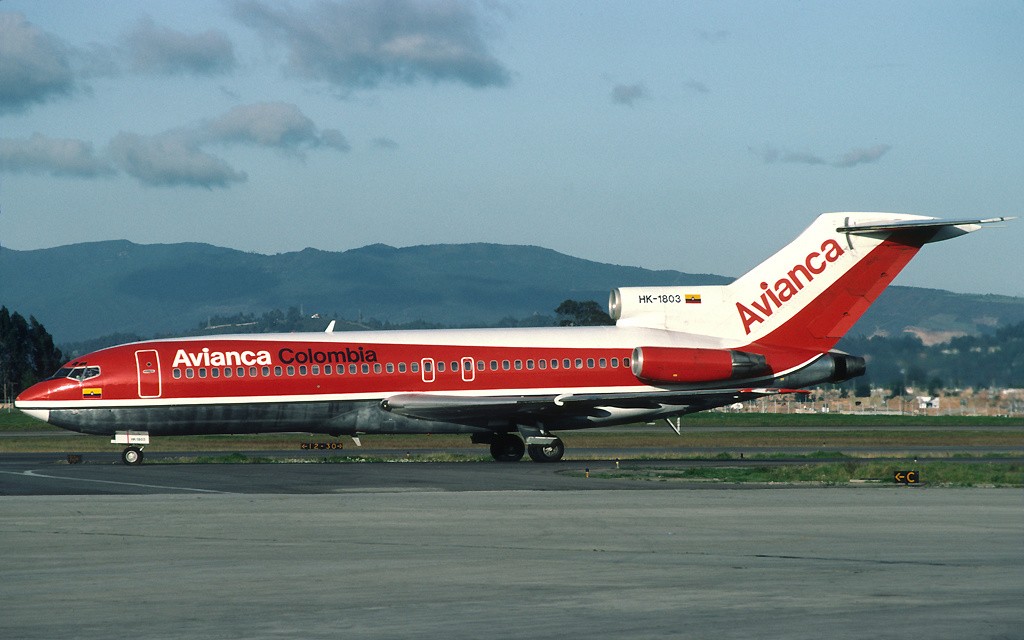
Avianca Boeing 727-21 HK-1803, which was downed in 1989. Image credit: Richard Vandervord via Wikimedia Commons.

Colombia’s Congress held a hearing on Wednesday on the bombing of Avianca Flight 203 for the first time since it happened on November 27, 1989. 

The explosion killed all 107 people on board shortly after take-off from Bogotá on its way to Cali, and has been widely attributed to Pablo Escobar’s Medellin Cartel.

Families have long demanded truth, justice and reparations for the attack, considered one of Colombia’s deadliest acts of narco-related violence.

The hearing, held as a political oversight session, focused on truth, justice, memory and reparations for victims of narcoterrorism.

The Attorney General’s Office has led the investigation for decades, but families say the process has been “painfully slow.”

“It is a case that remains in a preliminary stage, as if it had happened this morning,” Gonzalo Enrique Rojas Peña, son of one of the victims, told The Bogotá Post.

Rojas was 10 years old when his father, Gonzalo Hernán Rojas Castro, was killed. He now represents families of victims of the bombing.

Gonzalo Rojas alongside his late father. Image credit: Catherine Ellis.

“Many aspects have not been clarified by the state, particularly regarding who planned and carried out the attack, and the possible involvement of other actors,” he explained.

The hearing highlighted questions that remain unanswered, including the identity of all those responsible and the current status of investigations.

Authorities initially attributed the attack to an assassination attempt on presidential candidate César Gaviria, who did not board the plane on the advice of his security team.

Later investigations concluded that a young man boarded the plane with explosives under orders from the Medellín Cartel, one of the most violent drug trafficking organisations in Colombia’s history. Questions around the case, however, persist, and victims continue to seek justice.

Just one person was jailed for the attack: Dandeny Muñoz Mosquera, known as “La Quica”, who was sentenced to three life terms in the United States, although he has repeatedly denied involvement.

The session was convened by the Human Rights Commission of the Chamber of Representatives and led by Representative Juan Daniel Peñuela. The National Centre for Historical Memory, the Victims’ Unit and the Ministry of the Interior were present, alongside families of victims, many of whom spoke about their loved ones.

However, two key institutions — the Attorney General’s Office and the Special Jurisdiction for Peace (JEP) — did not attend, despite being formally invited.

“On one hand we had two national institutions, but on the other it was unfortunate that the Fiscalía and the JEP did not attend. It is unfortunate that responses remain very ambiguous,” Gonzalo said.

Gonzalo Rojas at the hearing on May 27. Image credit: Catherine Ellis.

The hearing also addressed the issue of reparations, which families say they have spent decades waiting for.

The Victims’ Unit said it will convene working groups to address long-standing gaps in registration and documentation that affect families’ access to reparations under Colombia’s 2011 Victims Law. The law provides recognition, financial compensation, symbolic measures and psychosocial support for victims of armed conflict.

Claudia Peñón was 17 years old when her father was killed on the flight in 1989.

“He was an excellent man and a hardworking man. He had the hope of seeing me graduate from high school, and he never got to do that,” she told The Bogotá Post, adding so many people’s lives were shattered that fateful day. “One hundred and seven families’ lives were left shattered. One hundred and seven families had their dreams destroyed.”

Her mother always expected answers, but died ten years ago without receiving them or reparations.

“She never got to see real restitution, never got to see justice in that situation. And honestly, so many other families have been failed too — and we’re still fighting,” she said. 

Families are also pushing for stronger memory-building efforts.

While there have been initiatives to recognize victims of armed conflict, the history of narcoterrorism has often been marginal in official narratives.

During the hearing, the National Centre for Historical Memory said the case has not yet been developed as a dedicated exhibition in Colombia’s planned Museum of Memory. It is included in broader reports and timelines, but could still be incorporated through a future “memory initiative”.

The hearing triggered formal follow-up steps from state institutions.

Congress will send official requests to the Attorney General’s Office over its absence and may refer the matter to the Procuraduría for review.

But for many families, the session underscored a deeper reality: after 37 years, there has been no new judicial breakthrough and no clear path to resolution.

“I think the day was partially positive,” said Gonzalo.  “I feel calm that other families were able to have a space to receive more information about the case. But there is still more to do.”

The post Colombia congress holds hearing on 1989 plane bombing blamed on Pablo Escobar appeared first on The Bogotá Post.

  •  
❌