
Normal view

S&P Global Ratings Downgrades Colombia to BB- Amid Fiscal Concerns

8 April 2026 at 22:44

Credit downgrade is an indictment of the Petro administration’s fiscal management, including suspension of the fiscal rule.

On April 8, 2026, S&P Global Ratings (NYSE: SPGI) lowered its long-term foreign currency sovereign credit rating on Colombia to BB- from BB and its long-term local currency rating to BB from BB+. The outlook for both ratings is stable, reflecting expectations that the Government of Colombia will gradually reduce its fiscal deficit while sustaining moderate growth in the national gross domestic product.

The rating action follows persistent fiscal imbalances and a policy environment that has become less predictable since the pandemic-related recession. The government decision to suspend the national fiscal rule in 2025 marked a significant shift in the policy framework. Pro-cyclical fiscal policies have provided marginal support for employment and consumption, but have also contributed to higher inflation expectations and a wider current account deficit. S&P expects the general government fiscal deficit to reach 5.6% of the national gross domestic product in 2026, compared to 5.3% in 2025.

“We expect Colombia to have consistently large fiscal deficits over the next few years.” — S&P Global Ratings

Institutional stability remains a key factor in the rating, though challenges persist. A fragmented legislature followed the March 2026 elections, where Pacto Histórico and Centro Democrático emerged with the largest minorities. The upcoming presidential election, scheduled for May 31, 2026, adds further uncertainty. Candidates such as Iván Cepeda of Pacto Histórico, Paloma Valencia, and Abelardo de la Espriella have proposed varying approaches to fiscal consolidation. The new administration will inherit spending pressures related to domestic security, rising healthcare costs, and pension payments linked to minimum wage increases.

The Banco de la República, the independent central bank of the country, has maintained a tight monetary policy to combat inflationary pressures. Annual inflation reached 5.3% in February 2026, prompting the bank to increase reference rates to 11.25%. S&P anticipates that inflation will not return to the target range of 3% +/- 1% until early 2029. While the independent status of the central bank provides a buffer against external shocks, high interest rates and lower-than-expected revenue collections have contributed to the widening deficit since 2024.

Economic growth is projected at 2.5% for 2026, slightly below the 2.6% recorded in 2025. Per capita growth is estimated at $9,900 USD for 2026, with real growth expected to average just above 2% through 2029. Despite being a net energy exporter, the performance of the US economy and international energy prices continue to influence national outcomes. Hydrocarbon exports declined to 35% of goods exports in 2025, down from 67% in 2013, showing some diversification even as the sector remains a primary source of volatility.

Net general government debt is forecast to approach 66% of the national gross domestic product by 2029, rising from 60.4% in 2025. S&P notes that the government interest burden will average 12.3% of general government revenue over the next three years. The shift toward issuing shorter-term debt instruments has reduced reported interest payments but increased vulnerability to interest rate fluctuations. External indicators remain a concern, with narrow net external debt expected to stabilize at 130% of current account receipts through 2029. Foreign direct investment is expected to be the primary source for funding the current account deficit, which is projected to stabilize around 2.6% of the national gross domestic product.

Vise photo credit © Loren Moss
Petro severs ties with Central Bank after Colombia rate rise

President Gustavo Petro has triggered a rare institutional confrontation with the Central Bank  after he ordered to “break relations” following an modest interest rate increase, raising concerns over economic policy independence just two months before the May 31 presidential election.

The board of Banco de la República voted on March 31 to raise its benchmark rate by 100 basis points to 11.25 per cent, defying government pressure for looser policy. Finance minister Germán Ávila denounced the move as “disproportionate” and withdrew from the board, accusing policymakers of privileging financial sector interests over economic growth.

The decision marks an unprecedented rupture in Colombia’s macroeconomic governance framework. By stepping away from the board, Ávila has effectively deprived it of the quorum required to meet under existing statutes, raising the prospect of a policy deadlock just as inflation remains above target.

At stake is more than a disagreement over rates. The confrontation exposes deeper tensions between a government focused on growth and redistribution and a technocratic central bank committed to price stability. It also risks undermining one of Colombia’s most respected institutions at a time of heightened global uncertainty.

Governor Leonardo Villar defended the rate hike, insisting the bank’s constitutional mandate to control inflation could not be subordinated to political considerations. He said the board remained focused on steering inflation back to its 3 per cent target, noting that price pressures — currently running at 5.29 per cent annually — remain elevated despite signs of moderation.

“The decisions are based on technical criteria,” Villar said, rejecting accusations of bias towards the financial sector. He also warned that the government’s withdrawal runs counter to institutional norms.

Markets are now watching whether the government intends to sustain its boycott. Under Colombian law, the presence of a Finance Minister is required for board meetings, meaning continued absence could paralyse rate-setting decisions in the coming months. Three key meetings — in April, June and July — are scheduled before the end of Petro’s term, with the latter two falling after a decisive first-round of the presidential elections.

Business leaders have reacted with alarm. Camilo Sánchez, head of utilities association Andesco, described the breakdown in coordination as “dire”, warning that permanent dialogue between fiscal and monetary authorities is essential for economic stability.

Analysts say the government may be using institutional leverage to halt further rate increases, given that a majority of board members had signalled a tightening bias to anchor inflation expectations. A prolonged standoff could, however, carry significant costs.

Colombia has long been viewed by investors as a regional outlier for its strong central bank independence. Any perception that political pressure is eroding that autonomy could weigh on the peso, increase borrowing costs and deter foreign investment.

The dispute comes against a complex macroeconomic backdrop. Inflation has been fuelled in part by a sharp increase in the minimum wage and higher public spending, while external risks — including rising energy prices linked to the war in the Middle East and closure of the Strait of Hormuz by Iran.

For Petro, the rate hike reinforces a long-standing critique that tight monetary policy is stifling growth and employment. Writing on social media, the president accused the central bank of pursuing a “suicidal” policy that harms the wider economy.

Yet economists warn that weakening institutional credibility could ultimately prove more damaging than high interest rates. “The risk is not just policy error,” one Bogotá-based analyst said. “It is the erosion of the rules of the game.”

The coming weeks will test whether the standoff is a negotiating tactic or the start of a more fundamental shift in Colombia’s economic governance. Either way, the episode has already injected a new layer of uncertainty into one of Latin America’s most closely watched economies.

Colombia’s Central Bank to Lift Interest Rates Amid Inflationary Pressure

30 March 2026 at 22:58

Monetary tightening impacts investment outlook in Colombia.

Colombia’s Banco de la República is preparing for a significant shift in monetary policy as inflationary risks deteriorate. According to the latest report from the Dirección de Investigaciones Económicas, Sectoriales y de Mercados at Bancolombia (NYSE: CIB), persistent internal pressures and a less favorable external environment are driving the need for a more restrictive stance.

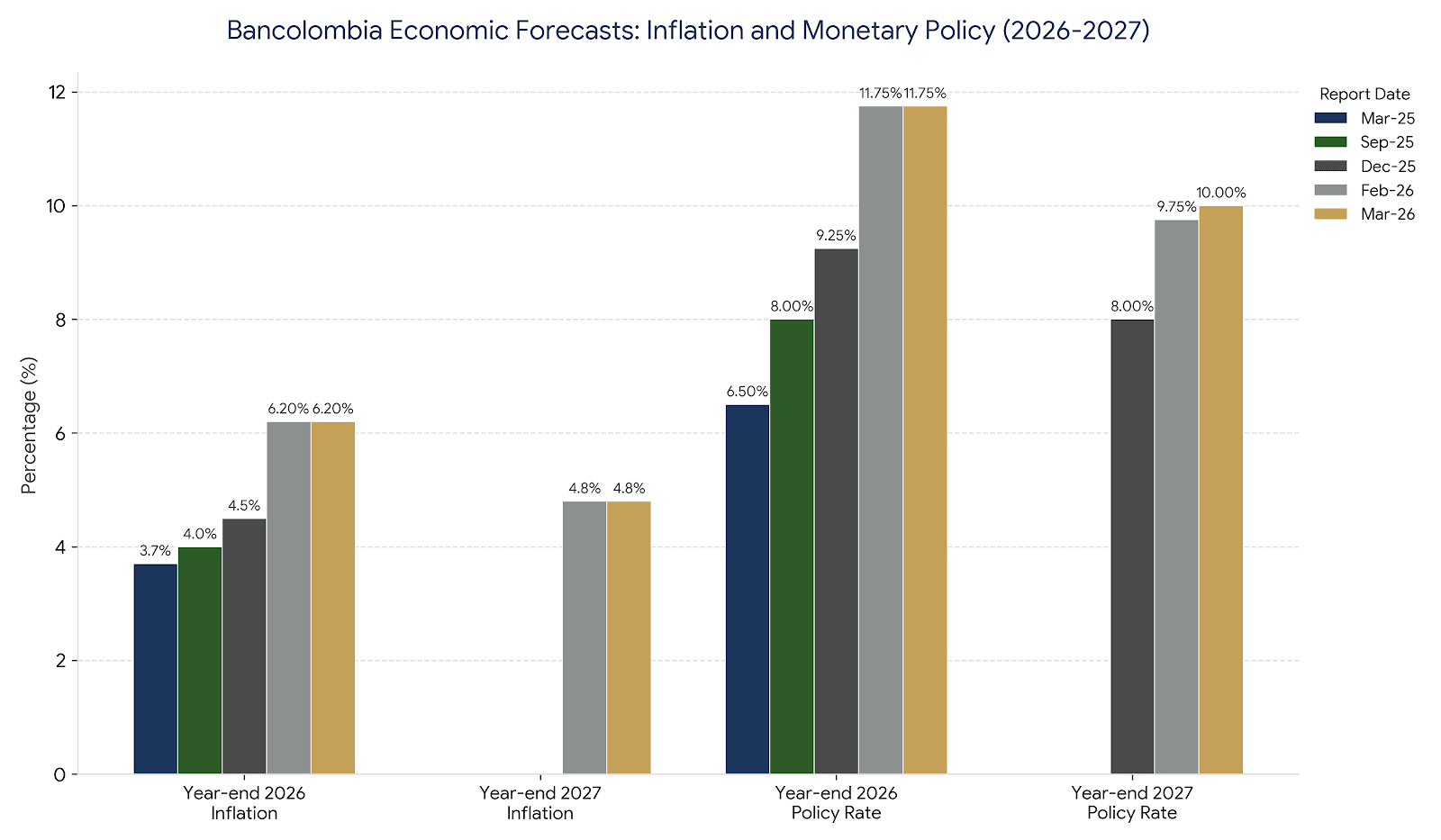
Bancolombia’s analysts expect the Junta Directiva of the Banco de la República to increase its policy interest rate by 100 basis points, bringing it to 11.25 percent. This forecast suggests that the first half of 2026 will be characterized by a more aggressive tightening cycle than previously anticipated, with the rate potentially reaching 12.75 percent.

The international landscape is playing an increasingly decisive role in these local policy configurations. A recent week of central bank decisions globally revealed a shift in tone among major financial institutions, primarily due to rising uncertainty stemming from the conflict in Iran. This geopolitical tension has directly impacted costs for energy, transportation, and agricultural inputs.

“The increase responds to the need to send a clear signal of commitment to price stability.” — Dirección de Investigaciones Económicas, Sectoriales y de Mercados at Bancolombia.

In the US, economic activity shows signs of moderation, yet producer price inflation in February exceeded expectations. The yield curve for US Treasuries, managed by the US Department of the Treasury, has shown mixed behavior as the conflict escalates, with the spread between 10-year and 3-month bonds reaching levels not seen since 2023. Inflation expectations in the US have rebounded in the short term, though they remain anchored over longer horizons.

Forecast Category Mar-25 Sep-25 Dec-25 Feb-26 Mar-26
Year-end 2026 Inflation 3.7% 4.0% 4.5% 6.2% 6.2%
Year-end 2027 Inflation 4.8% 4.8%
Year-end 2026 Policy Rate 6.50% 8.00% 9.25% 11.75% 11.75%
Year-end 2027 Policy Rate 8.00% 9.75% 10.00%

Domestically, the business indices from think-tank Fedesarrollo showed mixed results for February. However, there are positive indicators in the labor market, as the urban unemployment rate across the 13 primary metropolitan areas continued its downward trend. Additionally, goods exports recorded an advance during the same period.

In the local fixed-income market, the TES fixed-rate curve saw a recovery last week. However, the March Financial Institutions Survey suggests that devaluations of TES may persist in the short term. Long-term TES Class B placements in the first quarter reached 1.0 percent of the GDP.

Chart based on data from Grupo Cibest & the Banco de la República.

Chart based on data from Grupo Cibest & the Banco de la República.

Energy markets remain volatile as crude oil inventories in the US increased beyond expectations in the third week of March. Despite this, the price of Brent crude rose toward the end of the week, driven by skepticism regarding a potential ceasefire in the Middle East. The Colombian peso appreciated over the past week, tracking the intensity of the regional conflict.

The equity market results for the fourth quarter of 2025 remained neutral and aligned with market expectations. Global volatility continues to be shaped by energy shocks, geopolitical strife, and a cautious approach toward investments in artificial intelligence.

The projected rate hike by the Banco de la República is intended to send a definitive signal of commitment to price stability. This adjustment reflects not only recent inflation trends but also a strategic effort to prevent the further deterioration of expectations in a high-risk environment.

Headline image: Bogotá headquarters of Banco de la República (Banrepublica). Photo credit Juan Enrique Rodríguez, courtesy Banrepublica

❌