Normal view

Colombia Launches English-Language Portal to Attract Foreign Portfolio Investors

3 June 2026 at 16:43

New microsite gives foreign investors English-language access to Colombian capital markets

A new English-language microsite aimed at foreign portfolio investors in Colombia’s capital markets went live June 3, the product of a public-private working group that has been operating since late 2023. The platform, called “Foreign Portfolio Investor,” is accessible through the website of the Financial Superintendency of Colombia (Superintendencia Financiera de Colombia, SFC) at superfinanciera.gov.co.

The microsite offers information in English on the structure of the Colombian capital market, its participants, operating procedures covering enrollment, ongoing participation and divestment, issuers and issuances, links to statistical data, applicable regulations, and frequently asked questions. The initiative operates under the broader program titled Mercado de Capitales en Colombia, Colombia Destino de Inversión (Capital Markets in Colombia, Colombia Investment Destination).

The web page can be reached at: https://www.superfinanciera.gov.co/publicaciones/10115712/foreign-portfolio-investor/ 

“Historically, foreign investors have faced the challenge of understanding the functioning of the Colombian securities market,” said SFC Financial Superintendent César Ferrari (above photo). “The new microsite is a first step in addressing this challenge by offering, in clear English, information necessary to make foreign portfolio investments in Colombia.”

The working groups behind the project brought together several government bodies, including the Banco de la República, the Financial Regulatory Unit (Unidad de Regulación Financiera, URF) of the Ministry of Finance, and the National Tax and Customs Directorate (Dirección de Impuestos y Aduanas Nacionales, DIAN). From the private sector, the Securities Market Self-Regulator (Autorregulador del Mercado de Valores, AMV) and the Colombian Stock Exchange (Bolsa de Valores de Colombia, BVC: BVC) contributed to the platform’s development.

Carlos Emilio Betancourt Galeano, Director General of the DIAN, said the microsite addresses a core barrier to attracting foreign capital. “Providing clear and easily accessible information reduces barriers, improves understanding of the regulatory environment and strengthens the confidence of international investors,” he said.

URF Director Larisa Caruso said the platform addresses language as a structural obstacle to market participation. “This microsite represents an important milestone to strengthen the internationalization of the Colombian capital market and will allow foreign investors to better understand the regulation and the particularities of the local market, promoting greater transparency, trust and access to information, while contributing to reducing entry barriers associated with language,” she said.

AMV President Hernán Alzate described the launch as part of a longer-term positioning effort. “It represents a decisive step to position Colombia as an attractive and reliable destination for international investment,” he said. “Facilitating access to clear and timely information is critical to strengthening foreign investor confidence in an increasingly interconnected world.”

Andrés Restrepo Montoya, CEO of the BVC, framed the microsite as part of the exchange’s ongoing efforts to draw international capital. “To attract investment we must also facilitate access to clear and reliable information,” he said. “This is an important step to bring foreign investors closer to the Colombian capital market.”

The initiative comes as Colombia’s capital markets face scrutiny from international investors and ratings agencies over the country’s fiscal trajectory. The working group structure that produced the microsite has been active since late 2023, with the SFC serving as lead coordinator across multiple public and private stakeholders.

Colombia’s Debt-to-GDP Ratio Settles Into a New 60% Baseline After 20 Years of Macroeconomic Swings

29 May 2026 at 11:20

Twenty-Year Debt Arc Resets Colombia’s Sovereign Risk Outlook

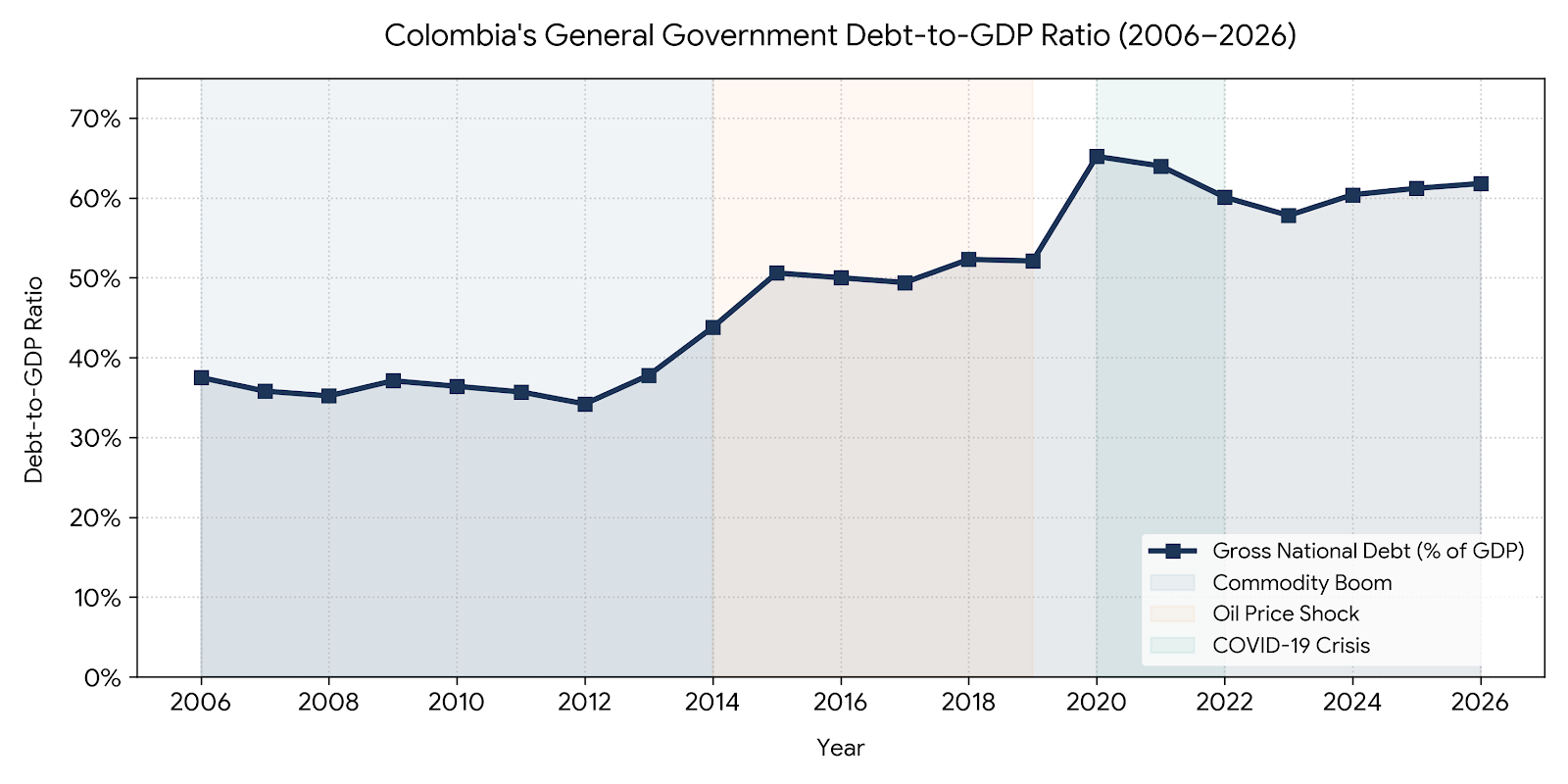
Two decades of fiscal data show that Colombia’s gross general government debt has moved through four distinct macroeconomic phases, ending the current cycle at a level that is materially higher than its pre-pandemic baseline. Persistent annual fiscal deficits, currency volatility, an emergency spending shock and weaker-than-projected tax revenues have combined to push the ratio of public debt to gross domestic product from the mid-30s percent range in the mid-2000s to a band of roughly 60 to 62 percent at the start of 2026, according to figures published by the Ministerio de Hacienda y Crédito Público and the Banco de la República.

The shift carries direct implications for sovereign bondholders, multinationals operating in Colombia and any investor pricing country risk in the Andean region. All three major rating agencies — S&P Global Ratings, Moody’s Ratings and Fitch Ratings — now place Colombia in speculative-grade, or junk, territory, with consecutive downgrades through 2025 and into early 2026.

“The activation of the escape clause confirms that the deterioration observed in 2024 will not be corrected in 2025.” — Renzo Merino, sovereign analyst, Moody’s Ratings

The commodity cushion: 2006 to 2014

During the global commodity supercycle, Colombia benefited from sustained gross domestic product growth and steady government revenue. Hydrocarbon and mining receipts — channeled through Ecopetrol (NYSE: EC; BVC: ECOPETROL) and the broader extractive sector — supplied a substantial share of national tax intake. The debt-to-GDP ratio remained relatively stable during this period, generally hovering between 34 and 38 percent. Even with chronic primary deficits, nominal growth in the denominator absorbed new borrowing, masking the underlying structural imbalance that the Comité Autónomo de la Regla Fiscal (CARF) would later flag as the persistent driver of fiscal stress.

The currency and revenue shock: 2014 to 2019

The mechanics of the ratio changed sharply when Brent crude prices collapsed in late 2014. Reduced hydrocarbon royalties widened the fiscal gap just as the Colombian peso depreciated against the US dollar. Because a significant share of Colombia’s sovereign liabilities is denominated in foreign currency, the peso’s slide automatically inflated the local-currency value of outstanding external debt when measured against domestic GDP. The combined effect — wider deficits funded by new borrowing, plus a valuation effect on existing dollar-denominated obligations — pushed the ratio steadily higher through the late 2010s.

The structural revenue weakness that surfaced during this period has remained a recurring theme in subsequent fiscal assessments from Fedesarrollo and the Pontificia Universidad Javeriana Observatorio Fiscal, both of which have noted that successive tax reforms failed to fully close the gap between commitments and ordinary income.

The pandemic ceiling: 2020

The combination of emergency social spending under the Ingreso Solidario program, expanded health outlays and a sharp contraction in nominal GDP drove the ratio to a historic peak above 65 percent in 2020. The Ministerio de Hacienda reports the all-time high at 65.3 percent of GDP that year. The government activated the escape clause of the regla fiscal — Colombia’s fiscal rule, codified in Law 1473 of 2011 and modified by Law 2155 of 2021 — to accommodate the spending response, suspending the rule for 2020 and 2021.

That episode also triggered the first sovereign downgrade cycle: S&P Global Ratings cut Colombia’s long-term foreign currency rating to BB+ from BBB- in May 2021 after the administration of then-president Iván Duque withdrew a tax reform bill following street protests, costing the country its investment-grade status with that agency.

The new baseline: 2023 to 2026

Strong post-pandemic nominal growth briefly pulled the debt ratio down toward 57 percent in 2023. The decline did not hold. Structural spending pressures, elevated international interest rates and tax collections below budgeted projections pushed the ratio back up, establishing a new operating band around 60 to 62 percent of GDP. The Ministerio de Hacienda reported government debt to GDP at 61.3 percent for 2024.

The administration of President Gustavo Petro and Finance Minister Germán Ávila Plazas activated the regla fiscal escape clause for a second time in June 2025, with the Consejo Superior de Política Fiscal (Confis) approving a three-year suspension covering 2025 through 2027. The decision came despite an unfavorable technical opinion from the Comité Autónomo de la Regla Fiscal, which concluded that legal conditions for activating the clause were not met outside of a national emergency. The clause had previously been invoked only during the COVID-19 pandemic.

According to the Marco Fiscal de Mediano Plazo (MFMP) presented by the Ministerio de Hacienda, net public debt to GDP is projected to rise from 53 percent in 2023 to 61.3 percent in 2025 and approximately 63 percent in 2026. The fiscal deficit for 2025 was initially projected at 7.1 percent of GDP and later revised to roughly 6.2 percent of GDP, with the administration targeting a deficit below 6 percent of GDP for 2026.

Debt service consumes a larger share of the budget

The cost of servicing this debt has reshaped the structure of the national budget. The 2026 draft budget presented by Minister Ávila totals $557 trillion COP, equivalent to roughly $134.7 billion USD, and represents 28.9 percent of GDP. Of that, debt servicing costs are projected at $102.5 trillion COP, or 5.3 percent of GDP, down from 6.2 percent of GDP in 2025.

The figures published by the Ministerio de Hacienda for domestic debt service in 2026 are higher when measured against tax intake alone: of an estimated $130 trillion COP in domestic debt service, $79 trillion COP corresponds to principal that can be rolled over through new issuances, while $51 trillion COP represents interest payments funded directly from the budget. Against projected tax revenue of approximately $300 trillion COP, that implies roughly one in every three pesos collected by the central government is allocated to interest on existing debt.

Rating agencies reprice the sovereign

The rating cycle has accelerated alongside the fiscal trajectory. Moody’s Ratings downgraded Colombia to Baa3 and subsequently into junk territory in 2025, citing the suspension of the fiscal rule. S&P Global Ratings issued a further downgrade in April 2026, its second cut in less than a year, on the same persistent deficit and debt concerns. Fitch Ratings also moved Colombia deeper into speculative grade in December 2025.

The Banco de la República reported external debt — combining public and private liabilities — at $238.7 billion USD at the close of November 2025, equivalent to 54.8 percent of GDP, an increase of $15.8 billion USD from January of the same year. The Colombian economy is currently valued at approximately $435 billion USD.

What investors are watching next

The Comité Autónomo de la Regla Fiscal has stated in its most recent reports to Congress that the 2025 primary balance target was missed by a wide margin even after the escape clause was activated, and that incoming projections for 2026 raise the bar for any return to the original fiscal rule by 2028. Business groups including Fenalco and the Consejo Gremial Nacional have publicly opposed the suspension and signaled potential legal challenges.

The 2026 financing plan disclosed by the Ministerio de Hacienda includes approximately $4.6 billion USD in global bond issuances, primarily to refinance a one-year Swiss-franc Total Return Swap operation valued at roughly $9.3 billion USD. The ministry has stated that the issuance does not constitute net new external debt. Updated debt and deficit targets are scheduled for release in the next iteration of the Plan Financiero.

For executives operating in Colombia or evaluating new investment, the baseline shift from a mid-30s to a low-60s debt-to-GDP environment alters several variables simultaneously: peso volatility tied to refinancing cycles, the trajectory of corporate tax policy as Congress weighs successive reform proposals, and the path of domestic interest rates set by the Banco de la República as it manages inflation alongside elevated sovereign funding costs. Detailed historical and forward-looking debt data is published by the Investor Relations Colombia office of the Ministerio de Hacienda.

Colombia's General Government Debt-to-GDP Ratio (2006-2026) (image: Google)

Colombia’s General Government Debt-to-GDP Ratio (2006-2026) (image: Google)

Manufacturing growth points to structural shift in Colombia’s economy

19 May 2026 at 00:01

Colombia’s gross domestic product expanded 2.2% in the first quarter of 2026 compared to the same period of 2025, surpassing prevailing market estimates, according to data released May 16 by the Departamento Administrativo Nacional de Estadística (DANE) and presented by the Ministerio de Comercio, Industria y Turismo. The results reflected positive performance across production, industry, and domestic commerce.

The manufacturing sector was among the quarter’s strongest contributors, posting year-over-year growth of 2.9% and adding 0.3 percentage points to the annual variation in GDP. The sector’s performance placed it among the primary drivers of national economic output for the period.

Within manufacturing, two subsectors recorded particularly pronounced gains. Motor vehicle production expanded 27.8% year-over-year, while metallurgy grew 6.6%. Both categories function as inputs to broader industrial supply chains, and their recovery carries implications for upstream and downstream productive linkages, including employment in skilled manufacturing roles.

“What is notable about the first-quarter results is not solely the magnitude of the growth, but its composition. The performance of sectors such as motor vehicles, metallurgy, and machinery is particularly significant because it demonstrates a recovery of industrial capacities with greater effects on productive linkages, skilled employment, and economic sophistication.” — Diana Marcela Morales Rojas, Minister of Commerce, Industry, and Tourism of Colombia

Separate monthly data from statistical agency DANE’s índice de producción industrial (IPI) showed that real industrial output grew 3.9% in March 2026 compared to March 2025. The expansion was distributed across multiple subsectors, including motor vehicles, metallurgy, machinery and equipment, chemicals, pharmaceuticals, rubber, plastics, and non-metallic minerals, indicating that the manufacturing recovery was not concentrated in a single production category.

Wholesale and retail trade expanded 6.0% in the first quarter, reflecting increased domestic market activity and business commerce. The trade sector’s performance complemented the manufacturing gains and contributed to the overall breadth of the quarter’s expansion.

Not all sectors contributed positively. Construction contracted 5.4% compared to the first quarter of 2025, the weakest result among major economic categories for the period. Public administration, defense, social security, education, and health services grew 5.7%, and reporting by Colombian media citing DANE data indicated that public spending accounted for approximately 46% of total first-quarter growth — a concentration that introduces a structural caveat to the headline figure, as private-sector momentum remains uneven across the economy.

Diana Marcela Morales Rojas, minister of the Ministerio de Comercio, Industria y Turismo, addressed the composition of the results in a statement issued alongside the data release. “What is notable about the first-quarter results is not solely the magnitude of the growth, but its composition,” she said. “The recovery of manufacturing, metallurgical, and industrial production activities demonstrates a greater role for sectors associated with transformation, productive capacity, and value-added generation within the national economic dynamic. The performance of sectors such as motor vehicles, metallurgy, and machinery is particularly significant because it demonstrates a recovery of industrial capacities with greater effects on productive linkages, skilled employment, and economic sophistication. These are meaningful indicators of strengthening of the manufacturing structure and national production.”

The first-quarter data were released as Colombia continues to manage elevated monetary policy rates and fiscal pressures that have weighed on investment activity in recent quarters. The Ministerio de Comercio, Industria y Turismo indicated that the quarter’s results reflect progress on an agenda oriented toward strengthening industry, domestic production, and commercial activity, though the degree to which private-sector industrial recovery can sustain these gains independently of public spending remains a key variable for subsequent quarters.

Headline photo credit: Tecnoglass

Public Debt Markets Adjust Amid Colombia’s S&P Credit Downgrade

27 April 2026 at 22:58

Colombia navigates fiscal challenges following S&P rating revision.

In Colombia’s local fixed-income market, the Títulos de Tesorería (TES) fixed-rate curve appreciated across its entire structure over the last month. As of March, the total balance of TES in circulation stood at 747.9 trillion COP. Despite this positive market valuation, macroeconomic headwinds remain a central concern for the Ministerio de Hacienda y Crédito Público. The fiscal balance of the Gobierno Nacional Central (GNC) reported an accumulated deficit of 1.7% of GDP through February.

These persistent fiscal imbalances were cited as the primary driver behind the recent decision by S&P Global (NYSE: SPGI) to downgrade Colombia’s sovereign credit rating. The administration continues to manage these debt instruments against a backdrop of tight monetary conditions, which remain a primary focus for institutional investors holding Colombian sovereign paper.

Colombian fixed-income markets show valuation gains despite a recent S&P credit downgrade linked to ongoing fiscal imbalances.

The international fixed-income landscape experienced notable shifts between March 25 and April 23, 2026. The yield curve for US Treasury bonds displayed mixed performance, defined by a decrease in short-term rates and an increase in long-term yields. Analysts attribute this volatility primarily to conflicting signals regarding the ongoing conflict in the Middle East.

Economic indicators released by the Bureau of Labor Statistics show that annual consumer inflation, measured by the Consumer Price Index (CPI), accelerated by 0.9 percentage points to reach 3.3% in March. This data triggered a rebound in short-term inflation expectations within the Treasury bond market, while medium and long-term outlooks remained stable. Consequently, the Intercontinental Exchange (NYSE: ICE) MOVE index—which tracks public debt market volatility—and the Cboe (NYSE: CBOE) VIX—which monitors S&P 500 equity volatility—both registered significant declines during the period.

Colombia’s Central Bank Prepares to Raise Policy Rate to an Expected 12.00%

27 April 2026 at 22:47

Central bank hike aims to stabilize inflation amid global volatility.

The upcoming monetary policy meeting of the Banco de la República, scheduled for April 30, takes place as the balance of financial risks has shifted significantly compared to the first quarter of 2026. Analysts from Bancolombia (NYSE: CIB) expect the Junta Directiva to increase the benchmark interest rate by 75 basis points, bringing the policy rate to 12.00%.

The convergence of elevated inflation, recent reversal episodes, and misaligned market expectations has reinforced the perceived need for a restrictive monetary stance. This strategy aims to contain domestic demand while preserving the institutional credibility of the central bank. Unlike previous sessions, the current decision-making process is influenced by a shifting global environment where markets have moved toward a higher-for-longer interest rate scenario amid increased uncertainty.

Recent discussions regarding the participation of the Ministro de Hacienda in the Junta Directiva sessions have introduced an additional element of analysis. However, current assessments suggest this does not alter the fundamental policy diagnosis, and no disruptions to the decision-making process are anticipated. Monetary policy is expected to maintain consistency, with the strategic focus shifting from reaching a contractive level to determining the necessary duration of that posture.

Analysts project Banco de la República will raise rates to 12.00% to combat inflation despite slowing domestic economic growth.

The international economic context provides a mixed backdrop for the Colombian decision. Private sector activity in the US appeared to accelerate in April, following a 1.7% monthly increase in retail sales during March. In contrast, the Eurozone reported a contraction in economic activity during April. Energy markets have also seen volatility, with US crude inventories rising in the second week of April while gasoline stocks saw a significant decline. Furthermore, crude prices surged following reports of new security incidents in the Strait of Hormuz.

Domestically, the Departamento Administrativo Nacional de Estadística reported that the Índice de Seguimiento a la Economía grew by 1.6% in February. While imports maintained growth during the same month, the urban unemployment rate across the 13 primary metropolitan areas continued a downward trend through March 2026. In the fixed income market, the central government reported debt levels at 64.2% of GDP for the first quarter, with internal debt accounting for 71.2% of that total.

Market movements reflected these broader trends as the US Treasury curve saw valuation increases driven by investor caution. In the region, Colombia, Brazil, and Uruguay emerged as the primary beneficiaries of the J.P. Morgan (NYSE: JPM) GBI index rebalancing in March. Locally, fixed-rate Títulos de Tesorería experienced devaluations across the entire curve last week. According to the April Encuesta de Opinión Financiera, these devaluations are expected to persist in the coming months. In currency markets, the COP appreciated last week against a backdrop of global and local factors, while the Euro lost ground against the USD.

Headline photo: Bogotá headquarters of Banco de la República (Banrepublica). Photo credit Juan Enrique Rodríguez, courtesy Banrepublica

S&P Global Ratings Downgrades Colombia to BB- Amid Fiscal Concerns

8 April 2026 at 22:44

Credit downgrade is an indictment of the Petro administration’s fiscal management, including suspension of the fiscal rule.

On April 8, 2026, S&P Global Ratings (NYSE: SPGI) lowered its long-term foreign currency sovereign credit rating on Colombia to BB- from BB and its long-term local currency rating to BB from BB+. The outlook for both ratings is stable, reflecting expectations that the Government of Colombia will gradually reduce its fiscal deficit while sustaining moderate growth in the national gross domestic product.

The rating action follows persistent fiscal imbalances and a policy environment that has become less predictable since the pandemic-related recession. The government decision to suspend the national fiscal rule in 2025 marked a significant shift in the policy framework. Pro-cyclical fiscal policies have provided marginal support for employment and consumption, but have also contributed to higher inflation expectations and a wider current account deficit. S&P expects the general government fiscal deficit to reach 5.6% of the national gross domestic product in 2026, compared to 5.3% in 2025.

“We expect Colombia to have consistently large fiscal deficits over the next few years.” — S&P Global Ratings

Institutional stability remains a key factor in the rating, though challenges persist. A fragmented legislature followed the March 2026 elections, where Pacto Histórico and Centro Democrático emerged with the largest minorities. The upcoming presidential election, scheduled for May 31, 2026, adds further uncertainty. Candidates such as Iván Cepeda of Pacto Histórico, Paloma Valencia, and Abelardo de la Espriella have proposed varying approaches to fiscal consolidation. The new administration will inherit spending pressures related to domestic security, rising healthcare costs, and pension payments linked to minimum wage increases.

The Banco de la República, the independent central bank of the country, has maintained a tight monetary policy to combat inflationary pressures. Annual inflation reached 5.3% in February 2026, prompting the bank to increase reference rates to 11.25%. S&P anticipates that inflation will not return to the target range of 3% +/- 1% until early 2029. While the independent status of the central bank provides a buffer against external shocks, high interest rates and lower-than-expected revenue collections have contributed to the widening deficit since 2024.

Economic growth is projected at 2.5% for 2026, slightly below the 2.6% recorded in 2025. Per capita growth is estimated at $9,900 USD for 2026, with real growth expected to average just above 2% through 2029. Despite being a net energy exporter, the performance of the US economy and international energy prices continue to influence national outcomes. Hydrocarbon exports declined to 35% of goods exports in 2025, down from 67% in 2013, showing some diversification even as the sector remains a primary source of volatility.

Net general government debt is forecast to approach 66% of the national gross domestic product by 2029, rising from 60.4% in 2025. S&P notes that the government interest burden will average 12.3% of general government revenue over the next three years. The shift toward issuing shorter-term debt instruments has reduced reported interest payments but increased vulnerability to interest rate fluctuations. External indicators remain a concern, with narrow net external debt expected to stabilize at 130% of current account receipts through 2029. Foreign direct investment is expected to be the primary source for funding the current account deficit, which is projected to stabilize around 2.6% of the national gross domestic product.

Vise photo credit © Loren Moss

❌