
Normal view

Colombia tributes political legacy of ex-VP Germán Vargas Lleras

11 May 2026 at 20:36

The departure of former Vice President Germán Vargas Lleras’s coffin from Bogotá’s Palacio de San Carlos on Monday morning blended state mourning with unmistakable political symbolism, as Colombia’s political elite gathered to bid farewell to one of the country’s most influential figures.

His daughter, Clemencia Vargas Umaña, attended the ceremony accompanied by her father’s two French bulldogs – Toño and Henry –  adding a deeply personal note to the solemn proceedings before the main funeral mass at 11:00 a.m. inside Bogotá’s Primatial Cathedral of Bogotá. The service marked the conclusion of three days in which the Foreign Ministry headquarters became the center of national political attention.

Vice President Francia Márquez represented the national government in the absence of President Gustavo Petro and delivered one of the most emotional moments of the day when she embraced Clemencia Vargas before the ceremony. Earlier, Márquez had publicly offered condolences to the family, praising Vargas Lleras’ democratic legacy and saying his “democratic work will be remembered.”

Colombia’s VP Francia Márquez and former presidential candidate Juan Carlos Pinzón attended the funeral ceremony. Photo: Richard Emblin

The wake drew figures from across Colombia’s political spectrum, reflecting Vargas Lleras’ decades-long influence. Former presidents Juan Manuel Santos, with whom Vargas Lleras served as vice president, Ernesto Samper, and Iván Duque were present, along with senator Paloma Valencia and former president Álvaro Uribe Vélez, whose attendance underscored the respect afforded to Vargas Lleras despite years of sharp public disputes between the two men.

Vargas Lleras died Friday in Bogotá after a prolonged battle with cancer. He was 64. His death ends a political career spanning more than three decades as senator, minister, vice president, and two-time presidential candidate.

The only daughter of Germán Vargas Lleras, Clemencia Vargas, receives the flag from VP Francia Márquez. Photo: Richard Emblin

Born in Bogotá on February 19, 1962, Vargas Lleras came from one of Colombia’s most prominent political dynasties. His grandfather, former President Carlos Lleras Restrepo, was a leading figure of the Liberal Party.

He built his own career as a city councilman, congressman, minister, and ultimately leader of the Cambio Radical party. His first presidential run came in 2010, where he finished third with nearly 1.5 million votes. Though unsuccessful, the campaign positioned him as a national force.

President Santos later appointed him to his cabinet, and in 2014 selected him as his running mate for reelection. The pair won in the runoff, and Vargas Lleras assumed office as vice president on August 7 that year.

He ran again for president in 2018 under the “Mejor Vargas Lleras” coalition, focusing on infrastructure, housing and administrative reform. He finished fourth in the first round and did not advance to the runoff.

Throughout his career, Vargas Lleras survived two assassination attempts and weathered political scandals, including accusations linked to parapolitics investigations, though he was never formally charged.

In later years, his health increasingly limited his public life. He was diagnosed with a benign meningioma in 2016 after a fainting episode, and in recent years battled cancer while largely stepping back from frontline politics.

Even as his public appearances became rare, his influence endured. Monday’s funeral made clear that, in death as in life, Germán Vargas Lleras remained a central figure in Colombia’s political history.
The flag-draped coffin of former Vice President Germán Vargas Lleras leaves Bogotá’s Primatial Cathedral of Bogotá on May 11. Photo: Richard Emblin

Colombia Confirms 14 Candidates for 2026 Presidential Election

20 March 2026 at 21:26

Though surprises are possible, polling says the front runners are Iván Cepeda, Abelardo de la Espriella, and Paloma Valencia.

The Registraduría Nacional del Estado Civil of Colombia (RNEC), the entity responsible for organizing elections in the country, reported that a total of 14 candidates have officially registered to run in the country’s presidential elections, scheduled for May 31, 2026. In this vote, citizens will elect the President and Vice President of the Republic for the 2026–2030 term.

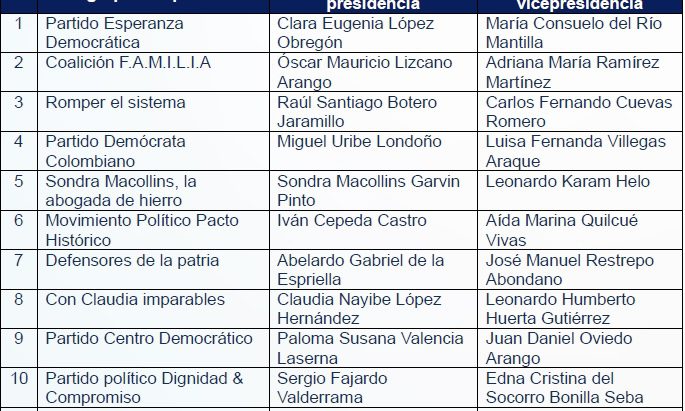
According to the electoral authority, the candidates represent a wide range of political perspectives, from left to right, including independent candidacies running through political movements. Here the list and brief profile of the candidates:

  1. Clara Eugenia López Obregón, currently a senator for the Esperanza Democrática She has served as Minister of Labor (2016–2017), acting mayor of Bogotá (2011–2012), and Bogotá’s secretary of government (2008–2010). She has been affiliated with left-wing parties and was Gustavo Petro’s vice presidential running mate in the 2010 election.
  2. Óscar Mauricio Lizcano, from the FAMILIA coalition. He served as Minister of Information Technologies (2023–2025), was a senator (2010–2018), and a member of the House of Representatives (2006–2010).
  3. Raúl Santiago Botero, candidate of the “Romper el Sistema” movement (Break the Establishment). An agronomist engineer and businessman from Medellín, he presents himself as an independent candidate with no prior political experience.
  4. Miguel Uribe Londoño, father of the slain presidential candidate Miguel Uribe Turbay. He is running under the Colombian Democratic Party and previously served as president of the Centro Democrático party founded by Álvaro Uribe Vélez.
  5. Sondra Macollins Garvin, from the movement “La Abogada de Hierro” (The Iron Lawyer) A criminal lawyer and psychologist, she presents herself as an independent candidate without political affiliations. She ran for the House of Representatives in 2022 and is known for her work in narcotrafficking and corruption cases.
  6. Iván Cepeda Castro, a senator since 2014 and the official candidate of the Pacto Histórico, the same party as President Gustavo Petro. Polls project he will receive the highest vote share in the first election round. He is aligned with left-wing political ideas.
  7. Abelardo de la Espriella, a lawyer with far-right positions, running for the first time under the Defensores de la Patria movement. Recent polls place him as a likely second or third contender in voter preference.
  8. Claudia López Hernández, former mayor of Bogotá (2020–2023) and former senator (2014–2018), running under the centrist movement “Imparables con Claudia.” She is known for her anti-corruption agenda and secured her candidacy with more than 570,000 votes (about 9%) in recent interparty primaries.
  9. Paloma Valencia Laserna, current senator and candidate of the Centro Democrático party led by Álvaro Uribe Vélez. She won the right-wing interparty primary on March 8 with more than 3 million votes. Polls place her among the top three contenders, and if she reaches a runoff, she would become the first woman in Colombia’s history to do so.
  • Sergio Fajardo Valderrama, an academic and mathematician running for the Dignidad y Compromiso He served as mayor of Medellín and governor of Antioquia and is running for president for the third time.
  • Roy Barreras, from the political party La Fuerza (The Force). He won the left-wing coalition primary on March 8 with the lowest vote total (257,000 votes, about 3.6%). Although currently aligned with left-wing movements and part of the Petro administration, he has previously been affiliated with right- and center-leaning parties.
  • Gustavo Matamoros Camacho, of the Colombian Ecologist Party. He served in the Colombian Army for 43 years. With no prior political experience, his campaign focuses on public security.
  • Luis Gilberto Murillo, who served as Minister of Foreign Affairs (2024–2025) and Colombia’s ambassador to the United States (2022–2024). A human rights advocate and Afro-Colombian leader from Chocó, he presents himself as an independent, moderate, centrist candidate.
  • Carlos Eduardo Caicedo, running under the independent movement “Con Caicedo.” He was mayor of Santa Marta (2012–2015) and governor of Magdalena (2020–2023), where he built a strong base as a left-wing political leader.

The RNEC also reported that “the draw to determine the position of presidential candidates on the ballot will take place on March 25 at the Ágora Bogotá Convention Center.”

This process marks the formal start of the final phase of the presidential campaign, during which candidates will seek to consolidate support ahead of the first round on May 31. If no candidate secures an absolute majority, a runoff between the two leading candidates will be held on June 21.

List of registered candidates for Colombia’s presidency. Photo courtesy of the Registraduría Nacional del Estado Civil.

List of registered candidates for Colombia’s presidency. Photo courtesy of the Registraduría Nacional del Estado Civil.

Headline photo: Polling station in Colombia during last Congress elections in March 8, 2026. Photo courtesy of the Registraduría Nacional del Estado Civil.

❌