Normal view

Colombia Confirms 14 Candidates for 2026 Presidential Election

20 March 2026 at 22:26

Though surprises are possible, polling says the front runners are Iván Cepeda, Abelardo de la Espriella, and Paloma Valencia.

The Registraduría Nacional del Estado Civil of Colombia (RNEC), the entity responsible for organizing elections in the country, reported that a total of 14 candidates have officially registered to run in the country’s presidential elections, scheduled for May 31, 2026. In this vote, citizens will elect the President and Vice President of the Republic for the 2026–2030 term.

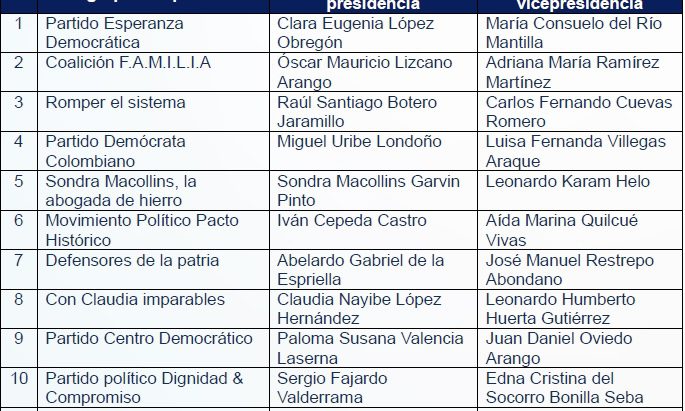
According to the electoral authority, the candidates represent a wide range of political perspectives, from left to right, including independent candidacies running through political movements. Here the list and brief profile of the candidates:

  1. Clara Eugenia López Obregón, currently a senator for the Esperanza Democrática She has served as Minister of Labor (2016–2017), acting mayor of Bogotá (2011–2012), and Bogotá’s secretary of government (2008–2010). She has been affiliated with left-wing parties and was Gustavo Petro’s vice presidential running mate in the 2010 election.
  2. Óscar Mauricio Lizcano, from the FAMILIA coalition. He served as Minister of Information Technologies (2023–2025), was a senator (2010–2018), and a member of the House of Representatives (2006–2010).
  3. Raúl Santiago Botero, candidate of the “Romper el Sistema” movement (Break the Establishment). An agronomist engineer and businessman from Medellín, he presents himself as an independent candidate with no prior political experience.
  4. Miguel Uribe Londoño, father of the slain presidential candidate Miguel Uribe Turbay. He is running under the Colombian Democratic Party and previously served as president of the Centro Democrático party founded by Álvaro Uribe Vélez.
  5. Sondra Macollins Garvin, from the movement “La Abogada de Hierro” (The Iron Lawyer) A criminal lawyer and psychologist, she presents herself as an independent candidate without political affiliations. She ran for the House of Representatives in 2022 and is known for her work in narcotrafficking and corruption cases.
  6. Iván Cepeda Castro, a senator since 2014 and the official candidate of the Pacto Histórico, the same party as President Gustavo Petro. Polls project he will receive the highest vote share in the first election round. He is aligned with left-wing political ideas.
  7. Abelardo de la Espriella, a lawyer with far-right positions, running for the first time under the Defensores de la Patria movement. Recent polls place him as a likely second or third contender in voter preference.
  8. Claudia López Hernández, former mayor of Bogotá (2020–2023) and former senator (2014–2018), running under the centrist movement “Imparables con Claudia.” She is known for her anti-corruption agenda and secured her candidacy with more than 570,000 votes (about 9%) in recent interparty primaries.
  9. Paloma Valencia Laserna, current senator and candidate of the Centro Democrático party led by Álvaro Uribe Vélez. She won the right-wing interparty primary on March 8 with more than 3 million votes. Polls place her among the top three contenders, and if she reaches a runoff, she would become the first woman in Colombia’s history to do so.
  • Sergio Fajardo Valderrama, an academic and mathematician running for the Dignidad y Compromiso He served as mayor of Medellín and governor of Antioquia and is running for president for the third time.
  • Roy Barreras, from the political party La Fuerza (The Force). He won the left-wing coalition primary on March 8 with the lowest vote total (257,000 votes, about 3.6%). Although currently aligned with left-wing movements and part of the Petro administration, he has previously been affiliated with right- and center-leaning parties.
  • Gustavo Matamoros Camacho, of the Colombian Ecologist Party. He served in the Colombian Army for 43 years. With no prior political experience, his campaign focuses on public security.
  • Luis Gilberto Murillo, who served as Minister of Foreign Affairs (2024–2025) and Colombia’s ambassador to the United States (2022–2024). A human rights advocate and Afro-Colombian leader from Chocó, he presents himself as an independent, moderate, centrist candidate.
  • Carlos Eduardo Caicedo, running under the independent movement “Con Caicedo.” He was mayor of Santa Marta (2012–2015) and governor of Magdalena (2020–2023), where he built a strong base as a left-wing political leader.

The RNEC also reported that “the draw to determine the position of presidential candidates on the ballot will take place on March 25 at the Ágora Bogotá Convention Center.”

This process marks the formal start of the final phase of the presidential campaign, during which candidates will seek to consolidate support ahead of the first round on May 31. If no candidate secures an absolute majority, a runoff between the two leading candidates will be held on June 21.

List of registered candidates for Colombia’s presidency. Photo courtesy of the Registraduría Nacional del Estado Civil.

List of registered candidates for Colombia’s presidency. Photo courtesy of the Registraduría Nacional del Estado Civil.

Headline photo: Polling station in Colombia during last Congress elections in March 8, 2026. Photo courtesy of the Registraduría Nacional del Estado Civil.

Extreme flooding in northern Colombia triggers humanitarian crisis

10 February 2026 at 21:17

Unseasonal heavy rains and severe flooding across northern Colombia have created a full-blown humanitarian crisis, displacing hundreds of thousands, destroying homes and farmland, and pushing local infrastructure and health systems to breaking point.

The disaster has hit hardest in the department of Córdoba, where officials say 156,000 people have been affected and 80% of the territory remains underwater following rainfall that broke historical records for February, traditionally one of the region’s driest months.

“In one day we received the amount of rain expected for an entire month,” Ghisliane Echeverry, director of the Institute of Hydrology, Meteorology and Environmental Studies (Ideam), told ministers during a government emergency council meeting.

The flooding has spread across multiple departments, including Sucre, Magdalena, La Guajira, Chocó and Antioquia, but Córdoba — a key agricultural and cattle-raising hub — has borne the brunt of the devastation.

“This is much more serious than even the most pessimistic scenarios we expected,” Carlos Carrillo, director of the National Unit for Disaster Risk Management (UNGRD), said. “We are facing a severe climate crisis that has overwhelmed traditional coping mechanisms.”

Displacement and extensive damage

Preliminary government assessments report at least 14 confirmed deaths linked to flooding and landslides, while thousands of families have been forced into temporary shelters as floodwaters inundate entire neighborhoods.

In Córdoba’s rural areas, officials estimate that around 157,000 hectares of agricultural land are submerged, affecting crops such as plantain, yucca and watermelon as well as commercial monocultures like African palm. Livestock losses are mounting, with local authorities reporting that more than 5,500 animals have been affected.

“We have 1,700 homes already destroyed and 4,000 more uninhabitable,” Carrillo said, though he cautioned that final figures are expected to change once waters recede and damage is fully assessed.

The United Nations Office for the Coordination of Humanitarian Affairs (OCHA) said more than 27,000 families have been impacted by flooding across the Caribbean departments, with thousands more indirectly affected as access roads and bridges have been reduced to rubble.

Public health officials warn that overcrowded shelters are becoming hotspots for disease, exacerbated by lack of access to clean water, sanitation and essential medical care.

“We are seeing extreme levels of waterborne and respiratory illnesses among displaced families,” said a health official in Montería, the capital of Córdoba. “The combination of stagnant water, cramped conditions and limited resources is a ticking time bomb.”

Essential supplies including food, mattresses and personal hygiene products are in critically short supply in many shelters, officials said.

Cold front and climate pressures

Meteorologists have attributed the extreme rainfall to an atypical cold front entering from the Caribbean, which has pushed precipitation far above normal levels. Rainfall in some areas has been measured at more than 64% above average for January and February.

“The water levels we are witnessing have never been recorded in February,” Carrillo said. Ideam has maintained high-level yellow and red alerts for at least 16 departments as flooding and landslide risks persist.

Typically dry early months of the year have instead seen consistent rains, and meteorologists warn that March and April could bring the usual seasonal rains, compounding the already dire situation.

Local officials across affected regions reported severe disruptions to vital road networks, bridges and public services, isolating some communities entirely. In the Urabá Antioqueño in western Antioquia, authorities said more than 9,000 families were left displaced in 13 municipalities that declared calamity.

Despite the scale of the disaster, the national government has not formally declared an economic emergency, a move that would unlock additional disaster funds and expedite aid. President Gustavo Petro, who convened a council of ministers in Montería, has signaled that such a declaration is under consideration.

“The magnitude of these floods demands a national response,” one government official said. “We are mobilizing resources but the scale of the crisis is beyond anything we normally plan for.”

The response has also brought renewed scrutiny to long-standing water management challenges in the region. Carrillo and other government officials have criticized decades-old hydraulic works, including reservoirs and levees, for altering natural water flows and potentially exacerbating flooding.

President Petro echoed these concerns on social media, singling out infrastructure such as the Urrá hydroelectric reservoir — built in the 1990s — as part of the region’s broader hydrological challenges.

“These reservoirs were not designed to manage excess water but to drain lands and disrupt natural flow patterns,” Petro wrote, arguing that such interventions may have contributed to current conditions.

Communities struggle amid uncertainty

In two coastal departments – La Guajira and Magdalena – continuous rainfall has caused streams to overflow and paralyzed mobility, while in the colonial port city of Santa Marta, strong winds and currents drove a cargo vessel ashore, highlighting the intensity of the storms.

For residents in isolated rural towns, the toll is deeply personal. Entire families have lost homes and livelihoods, and many are now waiting for relief that has been slow to reach remote areas.

“We’ve never seen water this high,” said a farmer in northern Córdoba. “We are afraid of what comes next — we don’t know how we will recover.”

With rains expected to continue over the coming weeks, authorities and humanitarian organizations warn that the full scale of the disaster may not be known for months, and that recovery will require sustained national and international support.

Tropical storms batter Colombia’s Caribbean coast, flooding tens of thousands of homes

5 February 2026 at 00:02

Powerful storm surges and weeks of unusually intense rainfall have triggered widespread flooding across Colombia’s Caribbean coast, affecting more than 50,000 families, damaging homes and infrastructure, and placing hundreds of thousands of livestock at risk, authorities said.

The floods have hit the Magdalena River basin and large swathes of northern Colombia, forcing beach closures in major tourist hubs and leaving vast rural areas under water, particularly in the department of Córdoba, one of the country’s most productive cattle-raising regions.

In Cartagena, Colombia’s flagship Caribbean destination, six-foot waves driven by strong winds washed ashore this week, prompting authorities to close beaches and confine tourists to hotels as storm conditions intensified. Local officials warned that continued rough seas could further disrupt port operations and tourism activity.

Córdoba has borne the brunt of the emergency. According to local authorities, up to 70% of the department remains flooded after rivers burst their banks following sustained heavy rainfall. The National Federation of Cattle Ranchers (Fedegán) said losses to agriculture and livestock production were already “in the millions of dollars.”

Leonardo Fabio de las Salas, Fedegán’s coordinator in Córdoba, said 20 municipalities were flooded, with 4,778 rural properties submerged and more than 263,000 animals at risk. “Córdoba is the most severely affected department so far,” he said.

The floods have killed at least five people in Córdoba and left 24 of its 30 municipalities in a state of emergency, according to Colombia’s disaster management agency.

Carlos Carrillo, director of the National Unit for Disaster Risk Management (UNGRD), confirmed that the entity will oversee the delivery of emergency aid kits to affected families. The agency said more than 7,500 humanitarian kits — including food, hygiene products, cooking supplies and blankets — have already been distributed in municipalities such as Ciénaga de Oro, Montelíbano, Moñitos and Puerto Libertador.

Additional deliveries are being extended to Canalete, Cereté, San Pelayo and San Bernardo del Viento, while a new phase of assistance has been scheduled for towns including Lorica, Sahagún, Valencia and Puerto Escondido, some 6,000 families are expected to receive aid this week.

Córdoba Governor Erasmo Zuleta described the situation as one of the worst climate emergencies the department has faced in recent years. “The balance for Córdoba is very sad, very hard,” Zuleta said in a radio interview. “We have 23 of our 30 municipalities affected, 12 of them in critical condition. Around 20,000 families are currently displaced or severely impacted by the rains.”

The extreme weather has not been confined to Córdoba. In Santa Marta, a diesel tanker ran aground on Los Cocos beach on Tuesday morning near the city’s historic center after losing maneuverability amid strong currents and gale-force winds. The vessel remained stranded overnight, with authorities saying hazardous sea conditions continued to hamper efforts to remove it.

The incident also highlighted the scale of debris and waste washed ashore by the storm surge along Colombia’s Caribbean coastline. Local authorities in Santa Marta, echoing measures taken earlier in Cartagena, ordered the temporary closure of beaches as a cold front from the northern hemisphere intensified rainfall, winds and rough seas across the region.

Residents filmed the cargo vessel as it became lodged in the sand just meters from the shore, near the city’s marina. Officials have not yet said how long it will take to refloat the ship, citing ongoing maritime risks.

The first months of 2026 have been marked by persistent and unusually heavy rainfall across Colombia, from the Caribbean coast to central and western regions. Authorities say swollen rivers, landslides and flash floods have destroyed homes, killed people and animals, and caused widespread material losses.

Meteorological officials have warned that further rainfall is expected in the coming days, raising concerns that flooding could worsen in already saturated areas as emergency services struggle to reach remote communities.

❌