
Normal view

Leaked Internal Documents Point to Possible $42 Million USD Corrupt Deal Inside Ecopetrol

22 March 2026 at 20:20

Ricardo Roa was appointed CEO of Ecopetrol after serving as Colombian President Gustavo Petro’s campaign manager. The Presidential campaign is also under investigation for campaign finance violations.

The controversy surrounding the filing of charges against Ricardo Roa Barragán, president of Colombia´s oil and energy company, Ecopetrol, has taken a new turn following the leak of an internal report suggesting that more than $42 million USD may have been transferred to a private company based in the British Virgin Islands.

According to disclosed information, “the media outlet 6AM W obtained documents showing the link between the USD 42 million payment made by Ecopetrol and a company connected to Serafino Iácono,” as stated by the outlet itself.

It is important to recall that on March 11, Colombia’s Attorney General’s Office (Fiscalía General de la Nación – FGN) formally charged Ricardo Roa Barragán with the alleged crime of influence peddling by a public official. According to the accusation, the executive allegedly intervened to favor a third party (Serafino Iácono) in the assignment of a gasification project in exchange for personal benefits. The FGN stated that Roa “ordered that a specific person be assigned to a gasification project in exchange for a reduction in the price of an apartment” located in northern Bogotá. During the hearing, the executive did not accept the charges.

Regarding the leaked documents, 6AM W reports that the published material “is a memorandum produced following a communication between the lawyers of Miller & Chevallier, hired by Ecopetrol, and Charles Cain, head of the Anti-Corruption Unit for Foreign Operators at the US Securities Exchange Commission (SEC).” This suggests that the document is an internal Ecopetrol report produced in 2024.

Additionally, the report includes references to an “audit commissioned by Ecopetrol to Control Risks, which identifies Iácono as a possible beneficiary of the alleged irregular payment of $42 million USD made through a purchase option” of power generation plants linked to the company Genser, associated with the businessman.

The leaked documents can be accessed through the Caracol Radio website via “Las contradicciones de Ecopetrol y Serafino Iácono en el caso del apartamento de Roa y Termomorichal.”

For his part, Serafino Iácono issued a statement, published by La República via the social network X, in which he affirms that since April 7, 2017, he has had no relationship with the company and that the transaction in question took place in 2023, after his departure.

At this stage, although the information has been reported by the media, judicial decisions remain under the authority of Colombia’s Attorney General’s Office, which is leading the proceedings against Ricardo Roa. Iacono said that he would be filing suit against Control Risks, and hired well-known Colombian lawyer Jaime Lombana Villalba to begin the process.

For further context, readers are encouraged to consult the article “Colombia’s Top Prosecutor Charges Ecopetrol President in Alleged Influence-peddling Case,” published by Finance Colombia.

Beyond the communications previously issued and reported by Finance Colombia in the aforementioned article, no new official statements have been released by Ecopetrol’s board of directors since March 12, prior to the information leak. Finance Colombia has reached out to Iacono for comment and will report any additional information.
Colombia Confirms 14 Candidates for 2026 Presidential Election

20 March 2026 at 22:26

Though surprises are possible, polling says the front runners are Iván Cepeda, Abelardo de la Espriella, and Paloma Valencia.

The Registraduría Nacional del Estado Civil of Colombia (RNEC), the entity responsible for organizing elections in the country, reported that a total of 14 candidates have officially registered to run in the country’s presidential elections, scheduled for May 31, 2026. In this vote, citizens will elect the President and Vice President of the Republic for the 2026–2030 term.

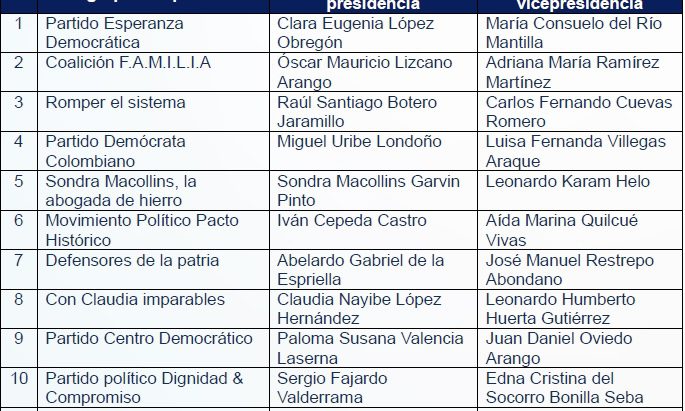
According to the electoral authority, the candidates represent a wide range of political perspectives, from left to right, including independent candidacies running through political movements. Here the list and brief profile of the candidates:

  1. Clara Eugenia López Obregón, currently a senator for the Esperanza Democrática She has served as Minister of Labor (2016–2017), acting mayor of Bogotá (2011–2012), and Bogotá’s secretary of government (2008–2010). She has been affiliated with left-wing parties and was Gustavo Petro’s vice presidential running mate in the 2010 election.
  2. Óscar Mauricio Lizcano, from the FAMILIA coalition. He served as Minister of Information Technologies (2023–2025), was a senator (2010–2018), and a member of the House of Representatives (2006–2010).
  3. Raúl Santiago Botero, candidate of the “Romper el Sistema” movement (Break the Establishment). An agronomist engineer and businessman from Medellín, he presents himself as an independent candidate with no prior political experience.
  4. Miguel Uribe Londoño, father of the slain presidential candidate Miguel Uribe Turbay. He is running under the Colombian Democratic Party and previously served as president of the Centro Democrático party founded by Álvaro Uribe Vélez.
  5. Sondra Macollins Garvin, from the movement “La Abogada de Hierro” (The Iron Lawyer) A criminal lawyer and psychologist, she presents herself as an independent candidate without political affiliations. She ran for the House of Representatives in 2022 and is known for her work in narcotrafficking and corruption cases.
  6. Iván Cepeda Castro, a senator since 2014 and the official candidate of the Pacto Histórico, the same party as President Gustavo Petro. Polls project he will receive the highest vote share in the first election round. He is aligned with left-wing political ideas.
  7. Abelardo de la Espriella, a lawyer with far-right positions, running for the first time under the Defensores de la Patria movement. Recent polls place him as a likely second or third contender in voter preference.
  8. Claudia López Hernández, former mayor of Bogotá (2020–2023) and former senator (2014–2018), running under the centrist movement “Imparables con Claudia.” She is known for her anti-corruption agenda and secured her candidacy with more than 570,000 votes (about 9%) in recent interparty primaries.
  9. Paloma Valencia Laserna, current senator and candidate of the Centro Democrático party led by Álvaro Uribe Vélez. She won the right-wing interparty primary on March 8 with more than 3 million votes. Polls place her among the top three contenders, and if she reaches a runoff, she would become the first woman in Colombia’s history to do so.
  • Sergio Fajardo Valderrama, an academic and mathematician running for the Dignidad y Compromiso He served as mayor of Medellín and governor of Antioquia and is running for president for the third time.
  • Roy Barreras, from the political party La Fuerza (The Force). He won the left-wing coalition primary on March 8 with the lowest vote total (257,000 votes, about 3.6%). Although currently aligned with left-wing movements and part of the Petro administration, he has previously been affiliated with right- and center-leaning parties.
  • Gustavo Matamoros Camacho, of the Colombian Ecologist Party. He served in the Colombian Army for 43 years. With no prior political experience, his campaign focuses on public security.
  • Luis Gilberto Murillo, who served as Minister of Foreign Affairs (2024–2025) and Colombia’s ambassador to the United States (2022–2024). A human rights advocate and Afro-Colombian leader from Chocó, he presents himself as an independent, moderate, centrist candidate.
  • Carlos Eduardo Caicedo, running under the independent movement “Con Caicedo.” He was mayor of Santa Marta (2012–2015) and governor of Magdalena (2020–2023), where he built a strong base as a left-wing political leader.

The RNEC also reported that “the draw to determine the position of presidential candidates on the ballot will take place on March 25 at the Ágora Bogotá Convention Center.”

This process marks the formal start of the final phase of the presidential campaign, during which candidates will seek to consolidate support ahead of the first round on May 31. If no candidate secures an absolute majority, a runoff between the two leading candidates will be held on June 21.

List of registered candidates for Colombia’s presidency. Photo courtesy of the Registraduría Nacional del Estado Civil.

List of registered candidates for Colombia’s presidency. Photo courtesy of the Registraduría Nacional del Estado Civil.

Headline photo: Polling station in Colombia during last Congress elections in March 8, 2026. Photo courtesy of the Registraduría Nacional del Estado Civil.

Colombia’s Top Prosecutor Charges Ecopetrol President in Alleged Influence-Peddling Case

18 March 2026 at 22:07

The charge adds to a separate investigation over alleged violations of campaign finance limits during President Gustavo Petro’s 2022 presidential campaign

Colombia’s Attorney General’s Office (Fiscalía General de la Nación – FGN) charged the president of the country’s state-controlled oil and energy company Ecopetrol (NYSE: EC’, BVC: ECOPETROL), Ricardo Roa Barragán, with the alleged crime of influence peddling by a public official. The charge was formally presented on March 11 during a public hearing.

According to the prosecutors press release, Roa “ordered that a specific person be assigned to a gasification project in exchange for a reduction in the price of an apartment” located in northern Bogotá. The Attorney General’s Office said the alleged intervention was related to the executive’s interest in acquiring the property below market value.

During the hearing, a prosecutor from the Specialized Anti-Corruption Directorate formally presented the charge. However, Roa did not accept the accusation.

The newspaper El Colombiano explained that “the filing of charges is a formal act within the criminal process through which the person under investigation is officially notified of their link to a judicial case and the facts attributed to them. However, this step does not imply a conviction or a final decision and maintains the presumption of innocence that protects the executive.”

After the judicial decision became public, Ecopetrol’s Board of Directors said Roa will remain in his position as president of the company. In a public statement, the company’s highest governing body said it respects “Ricardo Roa’s presumption of innocence and his right to due process.” It also said it will continue acting according to the company’s established protocols for evaluating this type of situation.

Roa pled innocent to the influence trafficking charges.

Context: political, legal, and corporate challenges

Ecopetrol is currently facing several political and economic challenges. These include judicial and disciplinary proceedings involving its president, as well as questions about the company’s institutional and financial stability.

For example, the company’s 2025 annual report sparked public debate after reporting the highest reserve replacement ratio in the last four years (121%). According to the document, “300 million barrels of oil equivalent (BOE) were added, guaranteeing an average reserve life of 7.8 years.”

The report also said, “net proven reserves reached 1.944 billion barrels of oil equivalent.” However, private firms such as the independent investment bank BTG Pactual questioned those figures due to a change in the methodology used to calculate them.

Another point of debate has been the presidency of the Board of Directors, currently headed by Ángela María Robledo Gómez, a psychologist and former member of Colombia’s House of Representatives for Bogotá. Robledo was a member of the Partido Alianza Verde between 2010 and 2018 and later ran as vice presidential candidate alongside Gustavo Petro in the 2018 elections.

Roa’s legal situation is also linked to another investigation related to alleged irregularities in the financing of the Pacto Histórico presidential campaign in 2022, which he managed and which resulted in Petro becoming president.

In February, the Attorney General’s Office said investigators had found evidence suggesting that the campaign exceeded the legal spending limits. A similar case had already been examined by Colombia’s elections regulator Consejo Nacional Electoral, which fined those responsible more than $5 billion Colombian pesos (over $1.4 million USD).

For his part, Colombian President Gustavo Petro has publicly defended Roa. During a public event broadcast by media outlets such as Blue Radio, the president said the accusations are politically motivated. “We did not exceed spending limits; I have reviewed that accounting up and down,” he said. He also argued that the opening of criminal proceedings could be interpreted as an attempt to politically target his government.

Headline photo: Colombian President Gustavo petro (left) with former campaign manager and current Ecopetrol CEO Ricardo Roa (photo courtesy Ecopetrol).

❌