Reading view

Apulo After Steam: Life Along Colombia’s Abandoned Railway

The last black steam train departed Apulo on a Sunday in 1978, pulling away from a crowded platform of waving hands and tearful spectators. With its departure, the town lost more than a railway connection to Bogotá. It lost the pulse that had once tied this sweltering outpost in the Tequendama valley to Colombia’s capital. Though only 90 kilometers separate the two communities, the retreat of the “Iron Rooster” left Apulo suspended in time, a town stranded between memory and reinvention.

Today, the journey from Bogotá unfolds along the winding Mosquera–Girardot highway, where the Andes gradually loosen their grip and the air grows heavier with heat. In barely two hours, the cool drizzle of the high plateau gives way to the dry furnace of the Magdalena basin. Apulo, now home to some 16,000 residents, appears suddenly among dusty hillsides and tangled vegetation, its streets shimmering beneath a relentless tropical sun.

During the late 19th and early 20th centuries, the railway transformed Apulo into one of central Colombia’s favored warm-weather retreats. The steam locomotive carried Bogotá’s elites — men in fedoras and women in flowing linen dresses — away from the cold capital toward rivers, waterfalls, and languid afternoons beneath mango trees. The train itself moved slowly, hissing and rattling through the mountains with stubborn determination, yet for generations it represented modernity, escape, and connection.

Just beyond a rugged ridge lies Anapoima, Apulo’s better-known sister town, long celebrated for what a television documentary once proclaimed the “second best climate in the world.” But locals insist Apulo is hotter still. Here the heat is not gentle but elemental — dry, oppressive, and all-consuming. It settles onto rooftops and skin alike, dictating the rhythm of daily life. People move slowly in the afternoons, gathering beneath awnings and trees, while stray dogs sprawl motionless in pockets of shade.

The town’s main street feels cinematic, like a forgotten set from a spaghetti Western abandoned beneath the tropical sun. A broad dirt avenue cuts through the center, lined with weatherworn storefronts whose peeling paint curls away from cracked walls. Rusted iron balconies sag above roadside restaurants serving thick cuts of pork rind wrapped in newspaper to travelers stopping in SUVs on their way farther south. Between tufts of wild grass, fragments of the old railway tracks still emerge from the earth — ghostly reminders of an era when steam engines once thundered through town.

At the heart of Apulo stands its Republican-era town hall, painted in fading yellow and white. The building once served as one of Colombia’s grandest hotels, welcoming honeymooners, politicians, and wealthy families escaping Bogotá’s cold rains. Even now, its broad façade preserves traces of vanished elegance. But the prosperity that sustained the town slowly evaporated. A nearby cement factory relocated its operations decades ago, taking jobs and stability with it, while tourism gradually shifted behind the walls of private condominiums built into the surrounding hillsides.

A short drive separates two strikingly different versions of Apulo. On one side are gated communities hidden behind walls as tall as trees, guarded day and night by private security. Inside, modern bungalows surround tiled swimming pools and tennis courts shaded by palms. On Friday afternoons, executives from Bogotá arrive in polished SUVs, trading office shoes for sandals and linen shirts. Children ride in golf carts while parents retreat beneath air-conditioning humming against the heat.

Down by the river – Río Apulo – another Apulo unfolds. Some homes stand behind concrete walls, others beneath corrugated tin roofs balanced precariously on wooden beams. Dust from passing cars filters through open windows and settles across furniture. Young girls wander the streets in oversized high heels borrowed from their mothers, while boys cradle baby chicks in their hands and watch traffic pass from shaded doorways. Families gather outdoors in folding chairs, squinting against the white glare of the afternoon sun.

Each weekend, these parallel worlds intersect. Women from the riverside neighborhoods pass through the condominium gates in uniforms to prepare ajiaco, sweep patios, and skim leaves from swimming pools. On Sunday evenings, as the visitors depart for Bogotá and the mountain road climbs back toward cooler air, workers wave goodbye and wait for the next caravan of weekend arrivals.

As dusk settles over Apulo, the town softens. Residents drift toward the central square to catch the evening breeze, gathering beneath old-fashioned lampposts as beer bottles clink across plastic tables. Couples lean together in the fading heat while motorcycles rumble slowly past. In the darkness, the potholes, graffiti, and crumbling façades recede from view, allowing the imagination to reconstruct the town as it once was — a glamorous retreat animated by music, polished automobiles, and the arrival of the evening train.

The luxury condominiums now serve the role once occupied by the grand hotel, yet visitors still come searching for the same landscape: the dry heat, the riverside calm, the clouds of mint-green butterflies that drift through the valley at sunset. In Apulo, movement never truly stops. Cars continue arriving from Bogotá every weekend. Only the train remains absent — its station swallowed by vines, its rails rusting quietly beneath the grass, like a memory slowly disappearing into the tropical earth.

Trains no longer connect Apulo with Colombia's capital, but it's still a popular getaway. (Creative Commons)
Trains no longer connect Apulo with Colombia’s capital, but it’s still a popular getaway. (Creative Commons)

  •  

Colombia on Guard as ‘Super’ El Niño Threatens Record Heat, Drought and Food Security

A potentially historic El Niño climate event is emerging as one of the defining stories for Colombia through the remainder of 2026, with authorities warning that extreme heat, drought, water shortages and energy pressures could push vulnerable regions toward crisis conditions.

Climate agencies, environmental authorities and agricultural groups are increasingly sounding alarms over what some scientists describe as a possible “super” El Niño – an exceptionally intense warming of Pacific Ocean waters capable of disrupting global weather systems and triggering severe consequences across Latin America.

In Colombia, the warnings are becoming stark.

Authorities fear a prolonged period of extreme temperatures, dwindling reservoirs, forest fires, crop failures and surging food prices that could stretch into early 2027 when typically the “summer season” starts. Officials have already begun urging Colombians to conserve water and electricity as forecasts indicate the phenomenon may intensify during the second half of the year.

The environmental authority of Cundinamarca, known as the CAR, warned that the probability of El Niño has reached 82%, threatening domestic water supplies, industrial production and hydroelectric generation across central Colombia.

“The measures of prevention and adaptation must be taken immediately,” CAR director Alfred Ignacio Ballesteros said, warning that the event could coincide with the Andean region’s traditional dry season in January and February, placing additional pressure on already strained water systems.

For Bogotá, however, authorities insist the capital is better prepared than during the water crisis of 2023 and 2024. The city’s Aqueduct and Sewer Company said no water rationing measures are currently expected despite the arrival of El Niño. Diego Montero, manager of the utility’s master water system, said reservoir levels remain stable, with the Chingaza system — including the Chuza and San Rafael reservoirs — holding nearly 20 million cubic meters above the established guidance curve. Officials also said the Tibitoc treatment plant is undergoing capacity upgrades aimed at increasing production and reducing pressure on the Chingaza system, which supplies most of Bogotá’s drinking water.

Fears beyond Inconvenience

Meteorologists predict temperatures in Colombia’s Caribbean region could surpass 40 degrees Celsius, while prolonged drought conditions may devastate agriculture and livestock production. Industry groups have warned that prices for staple foods including milk, rice, vegetables and beef could rise sharply toward the end of the year, adding renewed pressure to inflation at a moment when many households are already struggling with high living costs. A ‘super’ El Niño could push inflation above 7 percent, warns the National Association of Financial Institutions – ANIF.

Officials are also concerned about the vulnerability of Colombia’s energy grid, which depends heavily on hydroelectric power. Reduced rainfall and lower reservoir levels could increase the risk of electricity rationing or blackouts similar to those experienced during past El Niño events.

The country’s fragile páramo ecosystems and wetlands — critical natural water regulators located in the Andes — may also face heightened threats from forest fires and prolonged heatwaves. Environmentalists warn that drought could destroy sensitive habitats and endanger wildlife already under pressure from deforestation and climate change.

The emerging crisis is part of a broader global climate pattern that scientists say is being intensified by human-driven warming.

El Niño occurs every few years when ocean waters in the eastern and central Pacific become abnormally warm, altering rainfall patterns, shifting jet streams and increasing global temperatures. However, so-called “super” El Niño events are far rarer and more dangerous, with sea surface temperatures rising more than 2 degrees Celsius above historical averages.

Some climate researchers now fear the world could be heading toward one of the strongest El Niño events in modern history.

Paul Roundy, a professor of atmospheric sciences at the University of Albany, recently warned there was “real potential” for the strongest El Niño event in 140 years. Forecasts from the European Centre for Medium-Range Weather Forecasts suggest Pacific Ocean temperatures could rise three degrees Celsius above average.

Such projections have revived comparisons to the catastrophic El Niño of 1877-1878, which contributed to massive crop failures and famine across parts of India, China, Brazil and Africa. Historians estimate more than 50 million people died globally during that climate disaster.

While modern infrastructure and global trade networks make a repeat of 19th-century famine unlikely, experts say today’s interconnected crises — inflation, inequality, geopolitical conflict and fragile food systems — create new vulnerabilities.

“Hunger is fundamentally political and economic,” warns Benjamin Selwyn from the University of Sussex. “Wars disrupt trade routes, inequality restricts access to food and profit-driven agricultural systems prioritize industrial production over resilience. Climate shocks such as El Niño amplify those existing weaknesses,” writes Selwyn in The Conversation.

Studies by the UN Food and Agriculture Organization and the World Meteorological Organization have already shown that rising temperatures are reducing crop yields and making agricultural labor increasingly dangerous in tropical regions. Heat stress also lowers livestock productivity and survival rates.

In Colombia, the government of leftist President Gustavo Petro has begun discussing contingency measures, though critics argue the country remains dangerously unprepared.

Carlos Carrillo, director of Colombia’s National Unit for Disaster Risk Management (UNGRD), has called for urgent efforts to conserve water and energy while identifying regions at high risk of forest fires. There is also growing concern that years of underinvestment in water storage, energy diversification and climate adaptation could leave Colombia exposed to prolonged disruptions.

If the global forecasts prove accurate, Colombians could soon face months of punishing heat, food inflation and growing anxiety over the resilience of the country’s infrastructure in an age of accelerating climate extremes.

  •  

“Before They Touch My Family, They’ll Have to Kill Me”: Uribe Warns Protest Outside Antioquia Estate

Former Colombian President Álvaro Uribe Vélez confronted a group of protesters outside his residence in Rionegro, Antioquia, on Wednesday after activists began painting a mural referencing victims of Colombia’s “false positives” scandal.

Videos and images shared widely on social media showed Uribe surrounded by security personnel while holding a paint roller near the wall where the mural was being painted. Wearing a light field jacket and broad-brimmed hat, the former president appeared visibly upset as tensions rose between demonstrators, supporters and members of his security team.

The incident quickly became one of Colombia’s most discussed political flashpoints this week, exposing deep divisions surrounding the country’s internal armed conflict with ex-FARC, the transitional justice system, and the increasingly polarized 2026 presidential race. The official candidate of Uribe’s Centro Democrático party, Paloma Valencia, is considered Cepeda’s strongest rival in the event of a run-off election on June 21.

Uribe later said he had interrupted a political meeting in Medellín after receiving a call informing him that a large group had gathered near the entrance to his property while his wife was home alone.

“Cowardly Cepeda, stop sending people to my house where my lady was alone,” Uribe wrote on X Wednesday, referring his political foe and presidential frontrunner Iván Cepeda.

In a separate statement, Uribe accused the hard-leftist senator and Hernán Muriel, a congressman from the governing Historic Pact coalition, of promoting what he described as “acts of provocation and intimidation” against his family.

According to Uribe, the protesters arrived in three buses and gathered close to the entrance of the estate while artists painted the mural. He claimed one of his supporters was injured with a knife during the confrontation and said a member of his security detail was also hurt.

“I told them that I was going to erase the mural,” Uribe wrote. “Before provoking violence against my family and our home, they would have to kill me.”

Later footage showed Uribe personally covering the painted wall with a roller while supporters and security personnel stood guard nearby.

The mural referenced the latest figures released by Colombia’s Special Jurisdiction for Peace (JEP), the transitional tribunal created following the 2016 peace accord with FARC. The tribunal recently updated estimates tied to the “false positives” scandal, in which civilians were allegedly killed by members of the armed forces and falsely presented as combat casualties during more than four decades of Colombia’s internal conflict.

Muriel, who organized the demonstration, rejected accusations that the protest was intended to threaten Uribe or his family. He described the gathering “as a peaceful act” organized by victims’ organizations, social movements and human rights defenders seeking to highlight the revised JEP findings.

“We are carrying out an act of social mobilization and memory pedagogy,” Muriel said in remarks shared online. “We are here with social organizations, victims and human rights defenders following the new figure of 7,837 false positives announced by the JEP.”

According to Muriel, the mural was painted on public property near the residence and was intended to commemorate victims of the conflict.

The confrontation prompted swift reactions from political allies of the former president in Antioquia, one of Colombia’s most conservative regions and a longtime bastion of Uribe’s “democratic security” agenda.

Medellín Mayor Federico Gutiérrez criticized the protest and accused supporters of President Gustavo Petro of fostering political hostility toward opposition figures. “It’s the same method used during the last mayoral campaign in Medellín,” he wrote on social media, adding that political tensions in the country were continuing to escalate.

Antioquia Governor Andrés Julián Rendón also condemned the incident and called for respect toward Uribe and his family.

The episode underscores how historical revisionism spread on social media continues to discredit the legacy of the country’s two-term president (2002-2010), and leading opposition leaders. By Thursday morning, the images from Rionegro — showing Uribe beside the mural with a paint roller in hand — had spread across Colombian media and social networks, becoming the latest symbol of how the left justifies ideologically-fueled protests to vandalize public space and infrastructure.

  •  

Remembering Totó La Momposina, the Voice of Colombia’s Caribbean Soul

When One Hundred Years of Solitude author Gabriel García Márquez accepted the Nobel Prize for Literature in Stockholm in 1982, Colombia arrived with him — not only in prose, but in rhythm, drumbeat and dance.

Among the delegation of more than 200 Colombian musicians and artists who traveled to Sweden was a barefoot singer from the banks of the Magdalena River whose voice would stop the banquet hall in its tracks. Her name was Sonia Bazanta Vides, though the world would come to know her simply as Totó La Momposina.

“It was as if everyone from Macondo had come down the staircase of Stockholm City Hall,” The City Paper wrote in a 2016 profile titled Colombia’s Queen of Cumbia. Totó, wrapped in the musical traditions of Colombia’s Caribbean interior, danced across the marble floors singing cumbia and bullerengue before royalty and diplomats.

After the performance, she recalled, a palace official approached with a message from the Queen of Sweden: “Never stop singing.” And for more than six decades, she never did.

On Tuesday, Colombia awoke to the news that Totó La Momposina had died at age 85 in Mexico, where she had been living in recent years after retiring from music in 2022 due to declining health. Colombia’s Ministry of Culture confirmed her death, calling her “eterna Totó,” the eternal voice who elevated and transformed the traditional music of the Caribbean coast.

Her son, Marcio Vinicio, told Colombian media that the singer had spent recent months in palliative care. President Gustavo Petro described her as an “illustrious figure of Colombian Caribbean art and culture.” Opposition leader and presidential candidate Paloma Valencia highlighted that Totó la Momposina “took our music to the world and taught us to feel pride in what is ours. Her legacy is the nation’s heritage”.

Born in 1940 in Talaigua Nuevo, on the Magdalena River near Santa Cruz de Mompox, Totó emerged from a lineage where music was inherited as naturally as language itself. Her father was a shoemaker and drummer; her mother sang, danced and played the mandola. By age six, Totó was already performing onstage.

But it was the villages and wetlands of Colombia’s Caribbean coast that became her true conservatory.

As a teenager, she traveled from town to town absorbing rhythms born from the collision of African, Indigenous and Spanish traditions. She studied the cantadoras — women who sang while washing clothes in the river, grinding corn or tending cassava fields — and transformed those oral traditions into a musical language that would eventually reach audiences around the globe.

“The love for music is passed on through your genes,” she told The City Paper in 2016. “I never lost my sense of belonging.”

That belonging was rooted in Mompós, the island town from which her stage name derived. For centuries, the Magdalena River served as Colombia’s great cultural artery, carrying not only gold and commerce inland from the Caribbean coast, but rhythms: cumbia, mapalé, chalupa, porro and bullerengue.

Totó would become their most recognizable ambassador.

After her family fled violence during Colombia’s mid-century civil conflict and settled in Bogotá, her mother transformed their home into a sanctuary for Caribbean music. Musicians such as Lucho Bermúdez passed through the house, and Totó soon formed her own group in the 1960s, performing at neighborhood parties and on television.

In the 1980s, she moved to Paris to study at the Sorbonne University, immersing herself in music history, choreography and stage production while singing in metro stations, restaurants and street corners throughout the French capital.

France would become a second home — and the launching pad for international recognition.

Her breakthrough arrived when Peter Gabriel heard her perform and invited her to record at his Real World studio near Bath, England. The resulting 1993 album, La Candela Viva, introduced global audiences to songs like El Pescador and cemented her place on the world music stage.

She would go on to perform across Europe, Latin America and the United States, reportedly appearing more than 300 times at New York’s Radio City Music Hall. Her influence stretched far beyond folk music circles. Artists including Manu Chao and Timbaland sampled her work, while she lent vocals to Latinoamérica.

Though often called “The Queen of Cumbia” or “The Voice of Colombia,” Totó resisted celebrity detached from tradition. For her, the stage remained sacred. “The stage is a temple,” she told The City Paper. “You must respect it. I give my heart to the audience. It is a commitment.”

Even in her seventies, she continued performing with fierce energy, appearing at events tied to Colombia’s peace process and receiving honors including the Latin Grammy Lifetime Achievement Award and France’s highest Order of Arts and Letters, the Chevalier des Arts et Lettres.

Her final public years coincided with a renewed appreciation among Colombians for their own musical roots — roots Totó had spent a lifetime defending.

In September 2022, she announced her retirement due to neurocognitive complications. Yet her songs endured as living memory: the voice of fishermen on the Magdalena, of Afro-Colombian drumming circles, of women singing beside the riverbanks of the Caribbean coast.

“The day that I cease to be nervous before going on stage, I will retire,” she once said. “Because at that point music will have become mechanical.”

For Totó La Momposina, music never became mechanical. It remained alive, ceremonial, ancestral — a fire carried across generations. And perhaps that is why the Queen of Sweden’s words still resonate today: Never stop singing.

  •  

Battle of the Polls: Valencia to Face Cepeda in Second Round

A new national survey suggests Colombia’s 2026 presidential race is shaping into a high-stakes runoff between Iván Cepeda and conservative rival Paloma Valencia, with the first round on May 31 favoring the left-wing senator, but the second round  – on June 21 – projecting a narrow victory for the Centro Democratico candidate.

The latest poll by Fundación Génesis Crea places Cepeda at the top of voter intention for the first round with 35.1%, followed by Valencia with 25.4% and lawyer Abelardo de la Espriella with 21.6%, signaling an increasingly polarized contest just weeks before Colombians head to the polls.

The survey, conducted between May 4 and May 11 across 134 municipalities and 24 departmental capitals, interviewed 4,352 citizens and presents one of the most detailed snapshots yet of the country’s electoral mood ahead of what many analysts are calling the most decisive presidential vote in years.

Despite Cepeda’s strong lead in the opening round, the numbers suggest a dramatic reversal in a hypothetical runoff. In a second-round scenario against Valencia, the senator from the Democratic Center would secure 48.3% of the vote, compared to 45.6% for Cepeda, while blank votes would account for 6.1%.

The findings indicate that while Cepeda commands a consolidated progressive base, Valencia could benefit from a broader anti-government coalition in a runoff, uniting conservative, centrist and undecided voters wary of continuity with President Gustavo Petro’s political project.

Against other rivals, Cepeda performs more strongly. He would defeat De la Espriella with 46.5% to 41.4%, and also surpass former Bogotá mayor Claudia López with 47.2% to 40.2%, though blank voting would remain unusually high at around 12% in both matchups.

The poll also reflects the deep national divide over Petro’s presidency. Some 51.2% of respondents reported an unfavorable image of the president, while 44.6% viewed him positively. By contrast, former president Álvaro Uribe Vélez registered a 50.4% favorable rating, with 48.3% holding an unfavorable view.

These figures reinforce the enduring political influence of Uribe, whose legacy continues to shape right-wing mobilization, while Petro faces growing criticism over security concerns, economic uncertainty and the faltering progress of his “Total Peace” agenda.

Beyond the top three contenders, voter preference remains fragmented. López registers 3.6%, followed by Sergio Fajardo at 2.9%, while other names such as Roy Barreras, Mauricio Liscano and Carlos Caicedo remain below 1%.

Blank voting stands at 3.2%, while 5.4% of respondents said they remain undecided — a figure that could prove decisive in an increasingly volatile campaign season.

The study reports a margin of error of ±1.485% and a 95% confidence level, with data weighted according to official demographic indicators from the Dane and the National Civil Registry. The sample covered all major regions of Colombia, including the Caribbean, Pacific, Coffee Region, Llanos and Amazon basin.

With just two weeks before the first decisive round, the poll confirms that Colombia is heading toward an electoral confrontation defined less by ideological persuasion than by rejection: a battle between those seeking continuity with Petro’s leftist administration and those determined to stop it.

For now, Cepeda leads the first charge. But if the runoff materializes as projected, Paloma Valencia may be waiting at the finish line.

  •  

BOGOSHORTS Expands Global Audience at Cannes With Latin American Short Films

The Bogotá Short Film Festival – BOGOSHORTS – is strengthening its international footprint at the 79th Cannes Film Festival with a major presence at the Short Film Corner | Rendez-vous Industry, positioning Colombian and regional filmmakers before one of the world’s most influential film markets.

From May 13 to 24, this leading platforms for Latin America’s short films will present two curated collections of short films at Cannes while deepening industry ties through networking events, producer exchanges and strategic collaborations aimed at increasing international visibility for emerging Latin American talent.

The initiative marks the second consecutive year that the BOGOSHORTS universe has secured a prominent place within Cannes’ Cinema de Demain section, the festival’s platform dedicated to discovering the next generation of filmmakers.

This year, BOGOSHORTS will showcase 10 short films divided into two programs: BOGOSHORTS World Tour – Winners Colombia and BOGOSHORTS World Tour – Latin American Talents. The films will be available to accredited industry professionals through the Short Film Corner space within the Marché du Film and on Cinando, the industry networking platform used by festival programmers, producers, critics and institutional representatives.

The Colombian selection includes five award-winning films from the festival’s 23rd edition: Agachar el rostro, directed by Camilo Medina Noy; Un aparato para detectar fantasmas, by Mauricio Maldonado; Malas posturas, directed by Juan Pablo Castro; Mi viche todo el día, by Juan Camilo Moreno; and Luz de luna, directed by Claudia Alejandra Rivera Guarnizo.

The Latin American showcase brings together a new generation of filmmakers from across the region, including Uruguay’s stop-motion short Lodo, Mexico-Cuba co-production Cicatriz de fe, Mexican production Carne, Colombian short La ley de las acciones, and Chilean production Petra y el sol.

A delegation of 17 filmmakers and producers connected to these projects will attend Cannes in person, participating in a packed agenda of panels, workshops, masterclasses, project presentations and networking sessions.

For BOGOSHORTS founder and director Jaime E. Manrique, the presence at Cannes reflects a broader mission to ensure short films from Colombia and Latin America gain stronger access to international markets.

“Ensuring that Colombian and Latin American short film talent has a stronger presence and greater opportunities for international projection and connection is one of BOGOSHORTS’ core missions,” Manrique said in a statement.

“Thanks to the agreement with the Short Film Corner | Rendez-vous Industry at the Cannes Film Festival and the articulation with our film market, this goal is not only possible, but strengthened for the second consecutive year with the participation of a young Colombian producer in the New Producers Room.”

That producer is Melisa Zapata Montoya, who stands out as the only Latin American participant selected for the 2026 edition of the New Producers Room, a Cannes initiative that supports 10 promising short film producers from around the world.

Created in 2022, the New Producers Room is designed for producers who have already completed at least two short films and are seeking international co-production opportunities. The program combines online sessions with presentations in Cannes and facilitates meetings with potential collaborators, investors and creative partners.

Zapata, recognized for projects such as Menguante (2017), Paloquemao (2020) and the feature project Pétalos de sangre (2027), joins the group through BOGOSHORTS’ recommendation, reinforcing the festival’s role as a bridge between Colombian talent and the global industry.

As part of its collaboration with Cannes, BOGOSHORTS will also select one of the 10 New Producers Room participants to attend the next edition of the BFM — BOGOSHORTS Film Market in Bogotá this December.

The selected producer will receive a tailored industry agenda and enter the BFM incubator, designed to strengthen project development and long-term professional growth. Manrique will make the selection directly in Cannes after reviewing the participating projects.

The BFM, now preparing for its 10th edition, has become one of Colombia’s most important spaces for short film development and international co-production, serving as a platform for emerging filmmakers seeking access to wider distribution networks.

Beyond screenings and business meetings, BOGOSHORTS will host a reception on May 19 at Colombia’s national stand in Cannes with support from Proimágenes Colombia. The event will bring together Latin American filmmakers, producers and institutional allies as part of its strategy to consolidate international partnerships and present future global calls for participation.

The organization will also sponsor the closing cocktail of the New Producers Room, further increasing its visibility within Cannes’ professional circuit.

The Latin American talents collection was supported by Chile’s Cortos en Grande Festival and Uruguay’s Festival del Nuevo Cine – Detour, underscoring the regional collaboration behind the initiative.

For BOGOSHORTS, the growing presence at Cannes is part of a long-term internationalization strategy that extends beyond festival screenings.

It is an effort to position short film not as a stepping stone to feature filmmaking, but as a vital creative and industrial format in its own right – one capable of opening doors for a new generation of Latin American storytellers with many of the world’s leading industry professionals.

  •  

Bogotá Fashion Week Strengthens International Push for Colombia’s Designers

Under a mirage of glowing escalators inside Bogotá’s Ágora Convention Center, the catwalks of Bogotá Fashion Week opened Tuesday with more than fabrics and silhouettes on display. Behind the runway lights lies a larger ambition: to turn Colombia’s capital into a regional fashion export hub and bring designers from Bogotá’s workshops and popular commercial districts onto the global stage.

Now in its ninth edition, Bogotá Fashion Week (BFW), led by the Cámara de Comercio de Bogotá, has become the city’s main commercial and promotional platform for fashion, bringing together 145 brands, 28 runway shows, more than 80 international buyers and 755 business meetings aimed at strengthening Colombia’s presence in international markets.

For Ovidio Claros Polanco, president of the chamber, the event is no longer simply about showcasing collections, but about transforming fashion into a driver of economic growth and international competitiveness.

“In Bogotá, the fashion sector represents 33% of the city’s economic activity and brings together approximately 35,000 active companies, the majority of them microenterprises,” Claros said. He added that between 220,000 and 250,000 people are directly linked to the industry, with its impact extending into tourism, hotels, gastronomy and transportation.

The strategy, he said, is to move beyond the traditional notion of fashion as an exclusive industry and instead position it as an economic ecosystem capable of generating employment and export opportunities across all levels of the city.

That vision is particularly visible through [PUENTE] Internacional, a program created by the chamber to connect entrepreneurs from Bogotá’s traditional commercial districts such as San Victorino and Restrepo with major global fashion circuits including New York, Madrid, Dubai and Paris.

This year, eight Bogotá-based brands — Alanna, A Modo Mio, C’emadier, Más Cincuenta y Siete by Love Me Jeans, Lorant & Co, Lyenzo, Liza Herrera and Kernel Leather — were selected to present their autumn-winter collections during Fashion Designers of Latin America (FDLA) at New York Fashion Week in February.

The initiative marked one of the strongest international pushes yet for Bogotá’s so-called “popular fashion” sector, traditionally associated with local manufacturing districts rather than luxury runways.

“We are committed to the internationalization of Bogotá’s popular fashion because it is a powerful vehicle for economic growth and job creation,” Claros said. “We want the best of Bogotá’s design talent to arrive in the global capitals of fashion stepping forward with strength.”

The selection process involved curators and industry figures including Albania Rosario, founder of FDLA, José Forteza, former senior editor of Vogue México, Colombian designer Jorge Duque and stylist Estefanía Turbay.

For Albania Rosario, the initiative reflects the growing relevance of Latin American fashion beyond its domestic markets.

“Each of these brands represents not only the excellence of Bogotá’s design, but also the resilient and visionary spirit of our creative community,” Rosario said. “It is a reminder of the transformative power of Latin American fashion on the global stage.”

The international agenda continues well beyond Bogotá Fashion Week. Following the local runway events this week, [PUENTE] designers are scheduled to participate in Pasarela Madrid later in May, followed by Dubai Fashion Week in September, New York Fashion Week’s spring-summer season, and Paris Fashion Week later that month.

Inside Ágora, the business focus is equally visible. Alongside runway presentations from designers such as Kika Vargas, Francesca Miranda and Alejandro Crocker, the event hosts wholesale meetings between Colombian brands and international buyers seeking new suppliers and partnerships.

A multi-brand retail space open to the public and a series of 24 industry talks with more than 60 speakers also seek to bridge the gap between creative design and commercial scalability.

For organizers, integrating districts like San Victorino and Restrepo into this model is essential. Rather than separating emerging luxury labels from mass-market producers, the chamber is pushing for a unified ecosystem where independent designers, small workshops and large buyers operate within the same commercial conversation.

“There is a need to remove the idea that fashion belongs to only a few people,” Claros said. “This belongs to everyone. Countries change through actions like these.”

As Bogotá Fashion Week expands its global ambitions, the challenge will be whether Colombian brands can translate visibility into long-term exports and sustained international demand.

For now, however, the city is betting that fashion — from the ateliers of Chapinero to the workshops of San Victorino — can become one of Bogotá’s strongest international calling cards.

  •  

Colombia tributes political legacy of ex-VP Germán Vargas Lleras

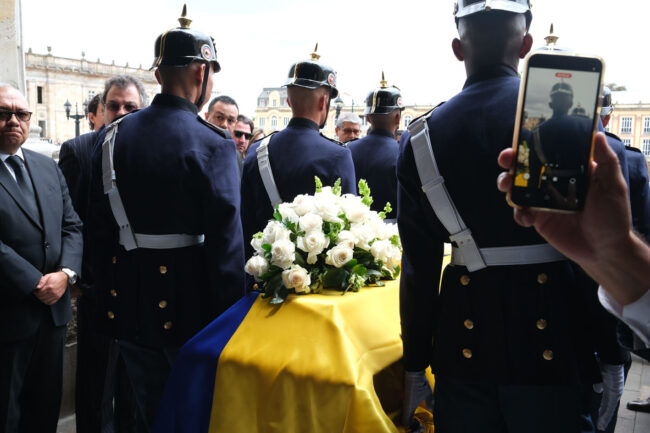
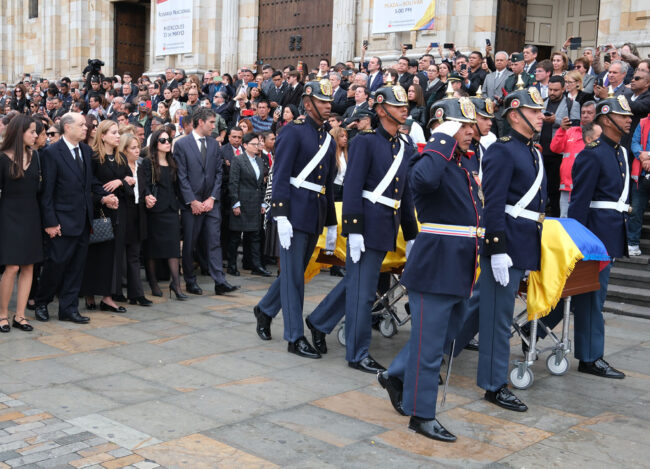
The departure of former Vice President Germán Vargas Lleras’s coffin from Bogotá’s Palacio de San Carlos on Monday morning blended state mourning with unmistakable political symbolism, as Colombia’s political elite gathered to bid farewell to one of the country’s most influential figures.

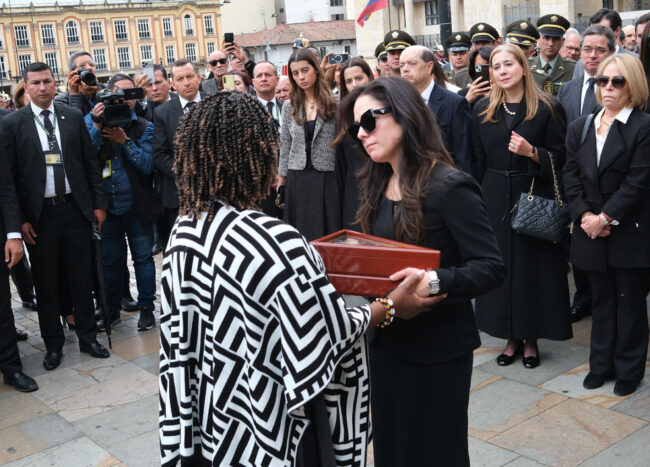
His daughter, Clemencia Vargas Umaña, attended the ceremony accompanied by her father’s two French bulldogs – Toño and Henry –  adding a deeply personal note to the solemn proceedings before the main funeral mass at 11:00 a.m. inside Bogotá’s Primatial Cathedral of Bogotá. The service marked the conclusion of three days in which the Foreign Ministry headquarters became the center of national political attention.

Vice President Francia Márquez represented the national government in the absence of President Gustavo Petro and delivered one of the most emotional moments of the day when she embraced Clemencia Vargas before the ceremony. Earlier, Márquez had publicly offered condolences to the family, praising Vargas Lleras’ democratic legacy and saying his “democratic work will be remembered.”

Colombia’s VP Francia Márquez and former presidential candidate Juan Carlos Pinzón attended the funeral ceremony. Photo: Richard Emblin

The wake drew figures from across Colombia’s political spectrum, reflecting Vargas Lleras’ decades-long influence. Former presidents Juan Manuel Santos, with whom Vargas Lleras served as vice president, Ernesto Samper, and Iván Duque were present, along with senator Paloma Valencia and former president Álvaro Uribe Vélez, whose attendance underscored the respect afforded to Vargas Lleras despite years of sharp public disputes between the two men.

Vargas Lleras died Friday in Bogotá after a prolonged battle with cancer. He was 64. His death ends a political career spanning more than three decades as senator, minister, vice president, and two-time presidential candidate.

The only daughter of Germán Vargas Lleras, Clemencia Vargas, receives the flag from VP Francia Márquez. Photo: Richard Emblin

Born in Bogotá on February 19, 1962, Vargas Lleras came from one of Colombia’s most prominent political dynasties. His grandfather, former President Carlos Lleras Restrepo, was a leading figure of the Liberal Party.

He built his own career as a city councilman, congressman, minister, and ultimately leader of the Cambio Radical party. His first presidential run came in 2010, where he finished third with nearly 1.5 million votes. Though unsuccessful, the campaign positioned him as a national force.

President Santos later appointed him to his cabinet, and in 2014 selected him as his running mate for reelection. The pair won in the runoff, and Vargas Lleras assumed office as vice president on August 7 that year.

He ran again for president in 2018 under the “Mejor Vargas Lleras” coalition, focusing on infrastructure, housing and administrative reform. He finished fourth in the first round and did not advance to the runoff.

Throughout his career, Vargas Lleras survived two assassination attempts and weathered political scandals, including accusations linked to parapolitics investigations, though he was never formally charged.

In later years, his health increasingly limited his public life. He was diagnosed with a benign meningioma in 2016 after a fainting episode, and in recent years battled cancer while largely stepping back from frontline politics.

Even as his public appearances became rare, his influence endured. Monday’s funeral made clear that, in death as in life, Germán Vargas Lleras remained a central figure in Colombia’s political history.

The flag-draped coffin of former Vice President Germán Vargas Lleras leaves Bogotá’s Primatial Cathedral of Bogotá on May 11. Photo: Richard Emblin
  •  

Qatar Airways Set to Operate to Caracas and Bogotá flights

Qatar Airways has affirmed its expansion in the Americas with the launch of new flight operations to Caracas, Venezuela, and Bogotá, Colombia, commencing from 22 July 2026. The service represents a significant milestone for the airline, as Qatar Airways becomes the first Gulf carrier to serve Venezuela, and the first airline to operate flights from the Middle East to Caracas and Bogotá. This expansion underscores the airline’s commitment, announced last year, to strengthening global connectivity for the region.

Qatar Airways flights to Caracas (CCS) and Bogotá (BOG)

Qatar Airways will operate two weekly flights to Caracas and Bogotá, further enhancing connectivity to, and from, the Americas. The flight schedule has been designed to provide smooth onward connections through Hamad International Airport to key markets including Australia, China, Japan, Lebanon, South Korea, and the United Arab Emirates. This offers passengers greater flexibility and seamless transfer options across Qatar Airways’ global network.

Departing every Wednesday and Sunday:

  • Doha (DOH) to Bogotá (BOG) – Flight QR783: Departure 07:30; Arrival 16:05
  • Bogotá (BOG) to Caracas (CCS) – Flight QR783: Departure 17:35; Arrival 20:40
  • Caracas (CCS) to Doha (DOH) – Flight QR783 Departure 22:40; Arrival 19:55 +1

The addition of Caracas and Bogotá marks both the 15th and 16th destinations in the Americas served by Qatar Airways. The airline began serving South America in 2010 with its inaugural flight to Brazil’s São Paulo.


  •  

Explosive Drone Deactivated Near Bogotá’s El Dorado International Airport

Colombian authorities have seized and safely deactivated a commercial drone carrying improvised explosive materials just 5.4 kilometers from Bogotá’s El Dorado International Airport and the nearby Military Air Transport Command (CATAM), raising fresh security concerns in the capital three weeks before the country’s May 31 presidential election.

The discovery marks a significant escalation from recent unauthorized drone sightings that twice forced temporary flight suspensions at El Dorado, Colombia’s busiest airport, and highlights growing fears that tactics once largely confined to conflict zones in the southwest and Catatumbo region are now reaching the capital.

According to preliminary police and military reports, the device was located in the locality of Kennedy, near the Río Bogotá, after a security alert issued by prosecutors in Popayán, Cauca, prompted specialized units of the Colombian Air Force (FAC) and National Police to track suspicious coordinates in southern Bogotá.

Authorities found what appeared to be a makeshift encampment before locating the commercial drone, its battery and an explosive charge separated from the fuselage.

Anti-explosives officers later confirmed the device had been modified with a non-conventional fiber-optic guidance system, a method increasingly used by illegal armed groups to evade electronic signal jammers designed to disable unmanned aircraft.

Investigators said the drone carried approximately 258 grams of C4 explosive material inside a PVC tube fitted with an improvised detonator.

The device was safely neutralized by National Police explosives experts and transferred to the Attorney General’s Office – Fiscalía General – for forensic analysis and the opening of a criminal investigation.

Authorities have not publicly identified those responsible or confirmed the intended target, but officials noted the location placed the drone within minutes of both El Dorado International Airport and CATAM, one of Colombia’s most strategic military aviation facilities.

Security analysts say the use of fiber-optic spools as a guidance mechanism resembles tactics recently documented in Catatumbo and southwestern Colombia, particularly among the National Liberation Army (ELN) guerrilla and FARC dissident factions under the command of alias “Iván Mordisco.”

A similar drone equipped with the same system was discovered in Popayán on April 25 during a wave of attacks blamed on FARC dissidents in Cauca, while another was found the same day in Villavicencio, the departmental capital of Meta.

The appearance of such devices in Bogotá has raised alarm among security officials, particularly given the proximity to civilian and military aviation infrastructure.

Pilots and aviation experts warn that even small commercial drones can cause catastrophic damage if they collide with an aircraft during takeoff or landing. A drone carrying explosives near an airport runway significantly increases the potential for a large-scale tragedy.

The discovery also comes at a politically sensitive moment, with Colombia entering the final weeks before its presidential election on May 31, as security and public order remain dominant campaign issues amid rising violence in the departments of Antioquia, Chocó, and Norte de Santander.

The leftist government of President Gustavo Petro has faced intense criticism over deteriorating security conditions, particularly following road bombing attributed to illegal armed groups in Cauca, Valle del Cauca, Nariño and Catatumbo, where the use of drones for surveillance and attacks has become increasingly common.

Last month, drone sightings near El Dorado airport twice forced authorities to suspend all air operations, disrupting domestic and international flights and exposing vulnerabilities near the country’s principal air gateway.

On April 30, Aerocivil halted airport operations after the Colombian Aerospace Force confirmed the presence of a drone in the Engativá district near the airport perimeter. Two aircraft were forced to carry out missed approaches, including an international LATAM Airlines Boeing 787 arriving from Santiago, Chile, while another domestic flight was diverted to Armenia, Quindío.

Just two days earlier, on April 28, another drone was detected near El Dorado, triggering a 45-minute suspension of takeoffs and landings while military personnel deployed anti-drone systems and visual searches.

Defense Minister Pedro Sánchez later confirmed that operations had been temporarily canceled because of the possible drone sighting, although no confirmed target was found.

Aerocivil has repeatedly warned that unauthorized drone activity near airports represents a grave threat to aviation safety and can result in criminal prosecution.

Thursday’s discovery, however, suggests the threat may extend far beyond operational disruption.

For Bogotá, the concern is no longer simply rogue recreational drones interfering with airport traffic, but the possibility that explosive-equipped devices linked to Colombia’s armed conflict are now within reach of the nation’s capital – and its most critical infrastructure.

  •  

From Bogotá to Barcelona: Why Summer Travel to Europe May Get Complicated

For thousands of Colombians planning their long-awaited European summer escape, the season of sun-drenched piazzas, Mediterranean beaches and packed airport terminals may come with unexpected advice: think local.

From Madrid and Paris to Rome and Athens, the 2026 summer travel season is approaching under the shadow of a mounting aviation crisis linked to the ongoing blockade of the Strait of Hormuz, the narrow maritime corridor through which nearly a fifth of the world’s oil supply normally passes. Since late February, when the United States and Israel escalated military operations against Iran, the region has become the epicenter of a global energy shock, sending jet fuel prices soaring and forcing airlines across Europe to begin trimming routes.

For travelers departing from Colombia — many of them booking multi-city holidays months in advance — the message is becoming increasingly clear: flexibility may be as important as a valid passport.

The warning signs began in mid-April, when the head of the International Energy Agency cautioned that Europe had “maybe six weeks of jet fuel left” if supply routes from the Gulf remained blocked. Kerosene, the refined petroleum product that powers most commercial aircraft, depends heavily on imports and refining chains linked to the Middle East. With shipping through Hormuz effectively frozen, that supply chain is under extraordinary pressure.

Although major airlines have sought to reassure passengers that immediate shortages are not yet critical, the economics are already biting. Jet fuel prices have reportedly doubled since the start of the crisis, squeezing carriers already operating on tight summer margins.

Low-cost airline Transavia became the latest carrier to announce flight cancellations for May and June, following similar moves by Ryanair, easyJet, Vueling and Volotea. The airlines cited the prohibitive cost of fuel and difficulties securing kerosene imports from Gulf suppliers.

On Thursday, more than 1,200 flights were cancelled, impacting travelers in Spain, England, France and Portugal. Barcelona and Amsterdam emerged as the airports most affected by delays.

For Colombian travelers, the risk is not necessarily that transatlantic flights from Bogotá to Europe will vanish overnight, but that onward connections within Europe — often booked separately on budget carriers — could be the first casualties.

A direct flight to Madrid may still depart on time, but the low-cost connection to Naples, Santorini or Dubrovnik could disappear after takeoff.

That creates a financial domino effect. Missed hotel reservations, prepaid train tickets, cruise departures and internal tours can quickly transform a dream holiday into an expensive logistical nightmare.

The Airports Council International Europe has warned that regional airports face an “existential threat” if airlines continue cutting capacity. Smaller airports, from Orly to Girona, and secondary tourist destinations are especially vulnerable because passengers on those routes tend to be more price-sensitive and airlines can pull service faster.

Even Germany’s flagship carrier Lufthansa recently cut 20,000 summer flights through its regional subsidiary CityLine, signaling that the strain is reaching far beyond the low-cost market.

Then there is the second concern unsettling travelers this season: public health alerts surrounding cases of Hantavirus contagion following the confirmed outbreak onboard the luxury cruise ship MV Hondius. A total of 146 people from 23 different countries remain aboard the vessel under “strict precautionary measures,” operator Oceanwide Expeditions said Thursday.

Though far less likely to disrupt flights than the fuel crisis, the outbreak has added another layer of anxiety for travelers heading to popular beach resorts, countryside retreats and nature-heavy itineraries across Europe. Health officials are urging tourists to remain cautious in cabins, campsites and rural accommodations where rodent exposure can increase infection risks.

For most travelers, the risk remains manageable with basic precautions, but it reinforces the same lesson of the COVID19 pandemic: preparation matters, so be ready for extra biosecurity screenings on arrival or to fly the 10-hour red-eye with a facemask.

Travel advisors are now recommending Colombians heading abroad this summer avoid rigid itineraries and consider refundable bookings wherever possible. Booking flights and connections under a single airline alliance can also offer stronger passenger protections than stitching together separate low-cost tickets.

Travel insurance, often treated as an afterthought, may become the smartest purchase of the trip.

Passengers should also monitor airline notices closely, especially if flying with budget carriers operating regional European routes. Some cancellations may come with limited notice, and rebooking options during peak summer weeks can be both scarce and expensive.

Industry analysts say much depends on diplomacy. If negotiations between Washington and Tehran resume and maritime traffic through Hormuz partially reopens, the worst-case scenario may be avoided. But if the blockade persists into June, Europe could face a genuine aviation squeeze just as millions of tourists arrive for the high season.

For Colombians dreaming of Paris cafés, Greek islands or the Amalfi Coast, Europe remains open — but no longer predictable.

This summer, the best souvenir may not be a photograph from the Mediterranean, but the peace of mind that comes from having a Plan B.

  •  

From Cartagena to Chelsea: Ruby Rumié Brings ¿How Are the Children? to New York

At Nohra Haime Gallery, in Manhattan’s white-walled Chelsea district, Cartagena-based artist Ruby Rumié is asking a deceptively simple question: How are the children?

It is not a casual greeting, nor the sentimental title of a new exhibition. Instead, it draws from the Maasai expression “Kasserian Ingera,” a phrase that measures the wellbeing of an entire community through the condition of its youngest members. If the children are well, the society is functioning; if they are not, everything else is called into question.

For Rumié, whose socially engaged practice has long examined dignity, memory and the politics of the body through installation and portrait photography, the question becomes the conceptual spine of her latest New York presentation. The exhibition, titled ¿How Are the Children?, marks a significant moment for the Cartagena-based artist, bringing her work once again into an international conversation that moves between Latin America, the Caribbean and the wider Global South.

Rather than beginning with a grand theoretical premise, the project emerged from something quieter: an old newspaper clipping documenting the disappearance of several children on a distant island. Nearly lost among family albums and forgotten papers, the fragment offered no resolution, only a trace. For Rumié, that absence became more powerful than explanation.

The result is an exhibition that does not attempt to solve a mystery but instead inhabits a state of unresolved concern. It asks viewers to remain with discomfort rather than consume a narrative neatly packaged for closure. In a cultural moment increasingly shaped by speed, certainty and spectacle, this refusal feels deliberate.

Within the work’s imagined structure, eleven children leave behind the violences of contemporary life: the pressure to perform, the normalization of fear, and the relentless demand to adapt to adult systems of productivity and control. Their destination is a volcano, a symbol that carries both danger and possibility.

Rumié anchors that image in a distinctly Colombian geography: the Totumo Mud Volcano, located between Cartagena and Barranquilla on Colombia’s Caribbean coast. Known locally as both a tourist curiosity and a place of ancestral ritual, the volcano is less about eruption than immersion. Visitors descend into a dense crater of warm mineral mud, confronting the instinctive fear of sinking—only to discover that the body floats.

This paradox sits at the heart of the exhibition and of Rumié’s photographic narratives.

Using portrait photography staged on the sandy slopes surrounding Totumo, she transforms her young subjects into something resembling living ceramics. Their bodies, coated in volcanic mud, appear sculptural and elemental – figures suspended between portrait and artifact, between childhood and myth. The mud gives them a tactile permanence, as though they have emerged from the earth itself rather than simply stood before the camera.

Here, mud is not scenic backdrop but primary material and metaphor. It is organic and mineral, medicinal and unsettling. It obscures the body while revealing something more essential beneath the surface. Covered in mud, distinctions of age, class, gender and origin begin to dissolve. The body ceases to be an object for display and returns to its simplest state: matter.

There is a quiet political force in that gesture. In a world saturated by images and increasingly hostile standards of beauty, the act of covering oneself in mud becomes a rejection of polished performance. It resists visibility as spectacle and proposes instead a form of symbolic density—one in which the body is not consumed but encountered.

The children in Rumié’s exhibition do not perform innocence. They do not dramatize suffering for the viewer’s emotional satisfaction. Instead, they surround the volcano with calm insistence, each holding a red ribbon that descends from its summit into their hands. The ribbon suggests connection rather than rescue, lineage rather than alarm. The volcano ceases to be a site of threat and becomes something closer to a shared origin: a matrix, a beginning.

That restraint is perhaps the work’s greatest strength. Rumié avoids the familiar traps of political art that over-explains its intentions or aestheticizes trauma into digestible symbolism. Instead, she builds an atmosphere of attention. The exhibition trusts silence. It asks not for interpretation alone, but for ethical presence.

This has been a defining feature of Rumié’s extensive projects. Her work often moves between installation, photography and social intervention, examining how communities remember violence and how institutions choose to see – or not – the vulnerable. Her native Cartagena, with its layered histories of colonialism, tourism and exclusion, remains both context and counterpoint.

Showing this work in New York adds another dimension. Chelsea galleries are not typically spaces associated with collective care or recetive to questions of social reparations. Yet that friction is productive. To pose “How are the children?” in the commercial heart of the international art market is to redirect attention from value to responsibility.

It is also a reminder that contemporary Latin American art is often at its most compelling when it resists exotic labels and insists on moral complexity instead. Rumié does not offer folklore, nor easy allegory. She offers a question as elusive as the landscape itself, echoing the vast and shifting terrains once depicted by the Prussian explorer Alexander von Humboldt during his travels across the continent.

And perhaps that is Rumié’s point. The exhibition offers no definitive answers, nor any final declaration of hope or despair. Instead, it leaves visitors carrying the weight of the original inquiry – returned intact, urgent and impossible to ignore, just like a volcano.

¿How Are the Children? opens on 7 May at Nohra Haime Gallery

Nohra Haime Gallery: 500A West 21st Street, New York.

  •  

Medellín Cartel’s Fabio Ochoa Vasco Returns to Colombia After U.S. Prison Term

Fabio Enrique Ochoa Vasco, a former insider of the defunct Medellín Cartel, and once accused by Pablo Escobar of betrayal and marked for death, has quietly returned to Colombia after serving a prison sentence in the United States, drawing renewed attention to the discreet return of aging narcotics operatives to the country.

Ochoa Vasco, known among the cartel’s henchmen as “Kiko Pobre” or “Carlos Mario,” returned to Medellín roughly two and a half months ago after completing a nine-year prison term in the United States for drug trafficking and money laundering, according to judicial sources.

Now 65, he is reportedly living in the Antioquia capital under a low profile, far from the notoriety that once surrounded his role inside the world’s most violent cocaine empire.

His return also reflects a broader trend in Colombia, where former cartel figures, paramilitary commanders and extradited traffickers are quietly re-entering civilian life after serving lengthy prison terms abroad, often without pending criminal cases at home.

Ochoa Vasco was part of the Medellín Cartel faction led by Fernando Galeano and Gerardo Moncada, two of Escobar’s most powerful associates who controlled major cocaine routes from the municipality of Itagüí.

Known respectively as “El Negro” and “Kiko,” Galeano and Moncada were once among Escobar’s closest allies, but their relationship collapsed in 1992 when Escobar accused them of hiding millions of dollars from him while he was serving his negotiated prison sentence inside La Catedral, the luxury prison he built for himself in Envigado.

Both men were tortured and murdered inside the prison on Escobar’s orders, triggering one of the most violent internal purges in the cartel’s history.

Ochoa Vasco, who had worked closely with their network, was forced into hiding as Escobar reportedly branded him a traitor and sought to have him killed.

He later aligned himself with Los Pepes — the vigilante alliance of Escobar’s most feared enemies and whose acronymn stood for “Persecuted by Pablo Escobar”.  Escobar’s relentless campaign of car bombings and assassinations contributed to the cartel boss’s downfall before he was killed by Colombian security forces in Medellín on December 3, 1993.

But the end of Escobar did not signal the end of Ochoa Vasco’s criminal career.

According to the U.S. Department of State, he had been involved in international narcotics trafficking since the early 1980s and was allegedly responsible for sending between six and eight tons of cocaine per month from Colombia to the United States.

U.S. authorities described him as the head of a drug trafficking organization that moved multi-ton shipments of cocaine by speedboats and cargo ships from Colombia to Central America for eventual distribution in the United States.

Investigators also linked him to the now-demobilized United Self-Defense Forces of Colombia, or AUC, the right-wing paramilitary organization founded by cattle ranchers in the middle Magdalena River valley, and under command of Carlos and Fidel Castaño.

In September 2004, prosecutors in the Middle District of Florida indicted Ochoa Vasco on charges of narcotics trafficking and money laundering. He also had a previous narcotics conviction in the United States and remained a fugitive on an earlier 1989 indictment from the Southern District of Florida.

He was captured in Venezuela in 2009 and extradited to the United States, where he was sentenced to nine years in prison.

With that sentence completed and no active judicial proceedings pending in Colombia, Ochoa Vasco was been able to return to Medellín without major public attention.

His case mirrors that of other former Medellín Cartel figures who have returned after decades in U.S. prisons.

Fabio Ochoa Vásquez, the youngest member of the powerful Ochoa family and one of the cartel’s best-known figures, returned to Colombia in December 2024 after serving nearly 30 years behind bars in the United States.

Now 69, he reportedly lives in Antioquia and has resumed the family’s long-standing horse breeding business.

Carlos Enrique Lehder Rivas, one of the cartel’s most eccentric members and who oversaw Pablo’s Caribbean cocaine routes, also returned to Colombia in March 2025 after serving 33 years in U.S. custody.

At 75, Lehder now moves between Bogotá and Medellín after all Colombian charges against him were closed.

One of the earliest and most infamous examples was Griselda Blanco, the so-called “Black Widow,” widely considered a pioneer of cocaine trafficking into Florida and New York during the 1970s.

After serving roughly 20 years of a U.S. sentence, she was deported to Medellín in 2004 and lived quietly there until she was shot dead by motorcycle gunmen outside a butcher shop in 2012.

The return of these figures underscores the long afterlife of Colombia’s drug wars.

Many of the men and women once at the center of cartel violence are now elderly, legally free, and living once again in the same cities where their criminal empires flourished.

For many Colombians, their quiet reintegration raises uncomfortable questions about justice, memory and how a country still marked by the legacy of narcotics violence confronts the survivors of that era.

  •  

Colombia’s 2021 National Strike violence was coordinated with illegal armed groups

A landmark ruling by the Superior Tribunal of Bogotá has delivered one of the strongest judicial rebukes yet of the narrative surrounding Colombia’s 2021 National Strike, concluding that some of the most destructive episodes of violence during the protests were not spontaneous acts of social unrest but part of a coordinated criminal strategy involving illegal armed groups.

The decision, issued by the Criminal Chamber of the tribunal under magistrate Jaime Andrés Velasco Velasco Muñoz, found that several of those prosecuted for violent acts in the capital maintained operational ties with cells linked to the Second Manuel Marulanda Vélez, a dissident faction of the Revolutionary Armed Forces of Colombia –  FARC.

For years, much of the public debate framed the violence of the so-called Paro Nacional as the uncontrolled overflow of legitimate citizen protests sparked by social inequality, police abuse, unemployment and widespread anger over the government of then-President Iván Duque.

But after reviewing wiretaps, surveillance records, testimonies and digital communications, the court concluded that several of the attacks that paralyzed Bogotá followed a clear operational structure, with leadership roles, territorial coordination and instructions issued in advance.

According to the ruling, some defendants acted in coordination with illegal armed actors to organize attacks on police command posts, TransMilenio stations, commercial establishments and strategic road corridors across the capital.

“For the magistrates, these were not isolated or improvised actions,” the ruling stated. “There existed an organized structure with assigned functions, defined leadership and a chain of command.”

The 2021 protests initially erupted after Duque introduced a controversial tax reform proposal during the height of the COVID-19 pandemic. The measure, widely criticized for placing additional burdens on the middle and working classes during an economic crisis, quickly ignited nationwide demonstrations.

Although the government later withdrew the reform, the protests escalated into weeks of nationwide unrest, marked by deadly confrontations between demonstrators and security forces, the burning of police stations, attacks on public transport infrastructure and prolonged road blockades that crippled supply chains across Colombia.

In Bogotá alone, dozens of TransMilenio stations were vandalized or destroyed, CAI neighborhood police posts were torched, and mobility across major avenues such as Las Américas, Carrera Séptima and Autonorte was severely disrupted.

Elsewhere, especially in southwestern Colombia, blockades led to shortages of fuel, medical oxygen and basic food supplies, with business leaders warning of millions of dollars in economic losses and humanitarian consequences for vulnerable communities.

The tribunal’s ruling argues that at least part of that violence was not the natural escalation of protest, but the result of deliberate planning.

Investigators identified several WhatsApp groups allegedly used to coordinate simultaneous actions across the city. Among the names cited in the judicial file were groups linked to strategic corridors such as “Américas,” “Carrera Séptima,” “Autonorte,” “Autosur” and “Caracas.”

According to prosecutors, these digital channels were used to organize blockades, assign responsibilities and plan attacks against public infrastructure.

The court also found that some young defendants had been tasked with recruiting new members and expanding influence within university environments, both public and private, strengthening support networks and facilitating operational logistics.

One of the most significant findings involved intercepted communications that allegedly referenced support from higher-ranking commanders connected to FARC dissidents.

For the magistrates, this reinforced the conclusion that there was external coordination behind the violence, rather than a purely spontaneous citizen uprising.

The ruling now sharply challenges the long-promoted narrative of the unrest as exclusively peaceful social protest and instead reframes part of the National Strike as coordinated urban sabotage carried out under the cover of legitimate public discontent.

It also revives scrutiny of the national strike committee and senior left-wing political leaders, including current President Gustavo Petro, who strongly supported the demonstrations and positioned himself as one of the loudest critics of Duque’s handling of both the protests and the pandemic.

Critics argue that political backing from opposition leaders helped legitimize actions that moved far beyond peaceful protest, allowing criminal actors to operate behind the shield of social mobilization while deepening institutional instability.

The protests also unfolded at one of the most fragile moments of the COVID-19 emergency, when Colombia was still facing high ICU occupancy, strict mobility restrictions and biosecurity measures intended to limit mass contagion.

Large demonstrations and road blockades directly violated those restrictions, and critics maintain that the protests contributed to additional infections and unnecessary strain on an already overwhelmed public health system.

For opponents of Petro and sectors of the business community, the ruling is less a revelation than a delayed institutional acknowledgment of what many citizens experienced firsthand: burned police stations, destroyed public transport, food shortages and entire cities brought to a standstill.

After evaluating the full body of evidence, the court sentenced three of the principal defendants to 19 years in prison for terrorism and criminal conspiracy. A fourth defendant received a 10-year prison sentence.

The tribunal also imposed fines exceeding 1 billion pesos, reflecting the severe damage caused to both public and private infrastructure.

Far from closing the chapter on the National Strike, the ruling reopens one of Colombia’s deepest political wounds: whether the country witnessed a legitimate social uprising, or whether parts of it were, from the beginning, a calculated strategy of destabilization supported by organized criminal networks.

For many Colombians, the answer may shape how the country remembers 2021—and who must ultimately be held responsible.

  •  

Drone sighting forces second suspension of flights at Bogotá’s El Dorado Airport in one week

Colombia’s busiest airport, Bogotá’s El Dorado International Airport, was forced to suspend operations early on Thursday after authorities detected a drone near the runway approach path, marking the second disruption in the same week and raising renewed concerns over aviation security at one of Latin America’s busiest air hubs.

The latest incident occurred at 5:20 a.m. local time when Colombia’s Aerospace Force confirmed the presence of an unauthorized drone in the Engativá district, near the airport’s operational perimeter, according to the Civil Aviation Authority (Aerocivil).

Authorities immediately activated emergency safety protocols, temporarily halting landings and departures while security teams assessed the airspace.

“A drone was detected near El Dorado airport in the Engativá sector. Two aircraft were forced to carry out missed approaches, a standard maneuver that guarantees operational safety,” Aerocivil said in a statement.

One of the affected aircraft was an international LATAM Airlines Boeing 787 Dreamliner arriving from Santiago, Chile, according to local media and flight tracking platform Flightradar24. The aircraft, which had departed Santiago late on Wednesday night and was scheduled to land in Bogotá around 4:30 a.m., was forced to circle above the capital before being cleared to land.

A second domestic Avianca flight also experienced disruption and was diverted to El Edén Airport in Armenia, Quindío, after it was unable to complete its descent into Bogotá.

Aerocivil said normal operations resumed at 5:44 a.m., after authorities secured the area and determined conditions were safe for aircraft movements.

“The improper use of drones near airports represents a serious risk to aviation safety,” the agency said, urging travelers to remain in contact with their airlines regarding possible schedule changes.
The incident follows a similar disruption on Tuesday night, when airport operations were suspended for approximately 45 minutes after another drone was detected flying above El Dorado’s international platform.

That alert was issued at approximately 6:36 p.m., prompting an immediate suspension of takeoffs and landings while anti-drone systems and visual inspections were deployed by aviation authorities and military personnel from CATAM, Bogotá’s military air transport command.
The airport concessionaire Opain and Aerocivil said the inspection protocols were necessary to ensure “an obstacle-free area” before flights could resume.

Defense Minister Pedro Sánchez later confirmed on social media platform X that operations had been halted due to a possible drone sighting and said military anti-drone mechanisms were activated, although no confirmed target was ultimately found.

“The situation was addressed immediately by the aeronautical authorities and the security devices in place, allowing normal operations to continue,” Sánchez said.

The repeated incidents have intensified scrutiny over security vulnerabilities surrounding El Dorado, which handles more than 35 million passengers annually and serves as Colombia’s principal international gateway.

Unauthorized drone activity near airports is prohibited under Colombian aviation regulations because of the risk of collision with commercial aircraft, particularly during takeoff and landing phases when planes are most vulnerable. Pilots and aviation experts warn that even small consumer drones can cause catastrophic damage if they strike engines, cockpits or critical control surfaces.

The back-to-back disruptions have also raised concerns over whether current detection and enforcement systems are sufficient to prevent repeat incursions near strategic infrastructure.
El Dorado has increasingly faced operational pressures in recent months, including weather-related disruptions, runway congestion and recent investigations into near-miss incident on April 19 involving two international flagship carriers.

Thursday’s early-morning shutdown caused delays for both arriving and departing passengers, with travelers reporting uncertainty inside terminals and pilots informing passengers that security protocols, rather than airline operational issues, were behind the disruptions.
Authorities have not yet identified the drone operator involved in either of this week’s incidents, and investigations remain ongoing.

Under Colombian law, unauthorized drone operations near airports can result in significant financial penalties and potential criminal investigations if public safety is endangered.
For now, aviation officials say stricter vigilance is essential.

  •  

Francis Alÿs at MAMU: A Global Portrait of Childhood Through Play

At a time when children are increasingly indoors – absorbed by screens, separated from the street and distanced from the spontaneous rituals of neighborhood play – a new exhibition by the Banco de la República has launched at the Museo de Arte Miguel Urrutia (MAMU), and one that asks a deceptively simple question: what happened to playing outside with friends?

Having opened on April 23 at El Parqueadero and second floor of MAMU, Francis Alÿs, juegxs de niñxs 1999–2025 brings together 27 video works from the Belgian-born, Mexico-based artist’s celebrated long-running series documenting children’s games across the world.

Curated by Cuauhtémoc Medina and Virginia Roy, the exhibition proposes something more than nostalgia. It invites viewers to see play as a form of social architecture – a place where children create rules, resolve disputes and build entire worlds from whatever their environment offers.

Games, the curators suggest, are “social laboratories in miniature.”

For more than two decades, Francis Alÿs has traveled across cities, villages and conflict zones filming children at play. What began in 1999 evolved into an audiovisual archive spanning more than 50 short films across five continents, 27 of which are included in the Bogotá exhibition.

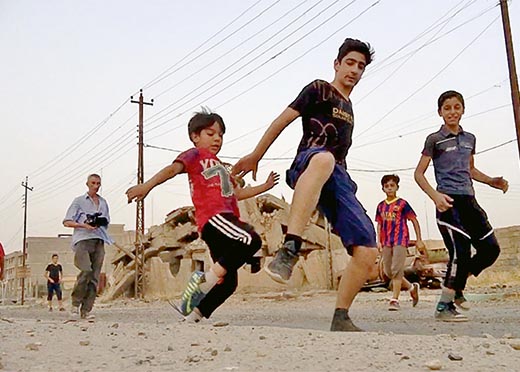
Children jump across hopscotch grids in Afghanistan, toss bones in India, spin tops in Mexico and invent rhythmic contests in narrow urban streets. One of the featured Colombian works, Trompos de semilla, Arara, Colombia, 2025, was filmed in the Amazon with support from Banco de la República’s Cultural Center in Leticia, capturing children in the Arara community playing with spinning tops made from seeds.

The games are simple, but the implications are not.

On the screen there are adults directing the action, no digital interfaces, no organized sports structures. Instead, children improvise with what is at hand – sticks, stones, crates, seeds, chalk, bottle caps – creating systems of cooperation and competition, rules and rebellion.

That act of invention lies at the center of Alÿs’s fascination.

Francis Alÿs, Children’s Game #29: La roue [The Wheel], Lubumbashi, Democratic Republic of the Congo, 2021. Courtesy Photo: © Francis Alÿs

Born in Belgium in 1959, Alÿs grew up with the image of Children’s Games (1560), the iconic painting by Pieter Bruegel the Elder depicting hundreds of children absorbed in play across a town square. According to the exhibition guide, the work became a lifelong reference point—an early visual map of how play reveals the structure of society itself.

Alÿs studied architecture at the Istituto Universitario di Architettura di Venezia before moving to Mexico in 1986 as part of an aid project to help install aqueducts in Oaxaca. He later settled in Mexico City’s historic center, where he developed the poetic and political language that would define his career.

His practice – spanning video, painting, installation and performance – often addresses borders, migration, urban fragility and the absurd mechanics of social order. Power dynamics, the commercialization of public space and the erosion of civic community remain central artistic preoccupations.

In Juegxs de niñxs those themes emerge quietly but powerfully.

Alÿs is not merely documenting childhood. He is observing how public life functions – and how children, often without adult mediation, rehearse the structures of society through play.

The exhibition reveals how games create temporary communities. They teach negotiation, competition, fairness and exclusion. They reflect both freedom and hierarchy. In some videos, the children play in ordinary neighborhoods filled with laughter and routine. In others, games unfold beside military checkpoints or in areas shaped by poverty, displacement and war.

Play persists, but never outside history.

The multi-screen installation at MAMU emphasizes these contrasts, showing both the universality of childhood and the inequalities that define it. Similar games appear across radically different geographies, suggesting what the curators describe as a kind of underground cosmopolitan culture of childhood – one that challenges the rigid identities of the adult world.

At the same time, the exhibition reflects on disappearance.

Traditional street games, some with roots stretching back to ancient Mesopotamia, are becoming less visible. Urban traffic has overtaken streets once used as playgrounds. Safety concerns have limited unsupervised outdoor play. Screens and digital entertainment increasingly dominate leisure time. Public space itself has become more regulated, commercialized and less available for improvisation.

Alÿs’s work does not romanticize the past, but it does capture transient moments of celebration.

What looks ordinary today – a spinning top, a hopscotch square, a game played with stones – may one day become a contemporary hieroglyph, evidence of how communities once formed themselves in public space.

As curator Cuauhtémoc Medina notes, games are not eternal. Their disappearance may signal something larger about the transformation of humanity itself.

If all the world’s a street, Alÿs has chosen not to place these collaborative works on the market, underscoring their documentary and communal nature. For the multi-medium storyteller, games, like art, are not commodities, but shared records of our collective experience.

This Bogotá presentation marks the exhibition’s fifth international stop following showings in Mexico City, Antwerp, Guadalajara and Santiago de Chile. In 2024, Alÿs also presented the project at the Barbican Art Gallery under the title Ricochets, marking the first time his work was shown in the United Kingdom.

At MAMU, the museum becomes more than a gallery – it becomes a space to reconsider childhood, the city and the fragile public spaces where both are formed.

Museo de Arte Miguel Urrutia. Calle 11 No.4-21.

Admission is Free.

Haram football in Mosul, Iraq, 2017. Photograph: Francis Alÿs
  •  

U.S. Issues Strong “Do Not Travel” Advisory for Southwestern Colombia

The United States has updated a “do not travel” warning for large parts of southwestern Colombia after a wave of terrorist attacks have left over 20 people dead, underscoring growing international concern over the country’s deteriorating security situation and prompting regional authorities to demand stronger support from the leftist government of President Gustavo Petro.

The U.S. Department of State maintained most of Colombia at Level 3 – “Reconsider Travel” – citing crime, terrorism, civil unrest, kidnapping and natural disasters, but reinforced its Level 4 advisory for several conflict-hit regions, including the departments of Arauca, Cauca, Valle del Cauca and Norte de Santander.

Under the latest guidance, Americans are advised not to travel to Cauca, excluding the departmental capital Popayán, and Valle del Cauca, excluding Cali, due to crime and terrorism.

Norte de Santander and Arauca remain under the same highest warning level, while travel within 10 kilometers of the Colombia-Venezuela border is also strongly discouraged because of kidnapping risks, armed conflict and the possibility of detention.

“Do not travel to these areas for any reason,” the State Department said in its advisory, adding that violent crime, armed robbery and murder remain common, while terrorist groups continue to operate in remote and rural zones.

The warning was reinforced by a U.S. Embassy security alert issued in Bogotá on April 27, following 26 separate attacks across southwestern Colombia during the weekend of April 25. The attacks targeted transportation corridors, military installations and police stations, with authorities confirming at least 20 deaths and dozens of injuries.

Police and military facilities are frequent targets of armed groups, and the State Department warned that attacks in Colombia have included car bombs, grenades, truck bombs, explosive devices placed on roads and buildings, and even drones carrying explosives.

Illegal armed groups, including dissident factions of the former Revolutionary Armed Forces of Colombia (FARC), narcotrafficking organizations and other insurgent groups, have expanded their territorial presence in recent years, particularly in remote areas where coca cultivation, illegal mining and strategic trafficking corridors overlap.

The deadliest recent attack occurred near the El Túnel sector in Cajibío, Cauca, along the Pan-American Highway, where an explosive device detonated against civilian vehicles, killing 20 civilians and injuring over 50 more. Authorities attributed the bombing to FARC dissidents under command of alias “Iván Mordisco”.

The attack shocked the country and intensified criticism of President Gustavo Petro’s “Total Peace” policy, which seeks negotiated settlements with illegal armed groups but has faced mounting scrutiny as violence worsens in several regions.

In response, the Cauca governor’s office declared three days of official mourning. Authorities described the bombing as an “atrocious and unjustifiable” act and ordered flags to be flown at half-mast across public institutions and schools as a tribute to the victims.
The government also called for national unity and a stronger institutional response to confront armed violence in one of Colombia’s most volatile departments.

In neighboring Valle del Cauca, Governor Dilian Francisca Toro said she respected the U.S. warning but urged foreign governments and the media not to define the entire region by recent attacks.
“We ask that our region not be stigmatized,” Toro said, insisting that Valle del Cauca remains open to visitors and that violence does not represent the department’s cultural, economic and social identity.
At the same time, she sharply criticized the national government’s security response after attacks in Cali and Palmira, calling for “real, sustained and effective support” through more troops, stronger intelligence operations and direct action against criminal structures operating in the region.

Following an explosion near the Agustín Codazzi Engineers Battalion in Palmira, Toro announced an investment of nearly 70 billion pesos ($17 million) to strengthen police communications infrastructure, expand surveillance camera networks and improve secure transport corridors across municipalities.

In Cali, Mayor Alejandro Eder said an attempted attack against the Pichincha Battalion involved explosive gas cylinders, one of which failed to detonate while another exploded inside a minibus.

Authorities activated a citywide security operation and Eder offered a reward of up to 50 million pesos for information leading to the capture of those responsible. “We cannot allow terrorism to regain ground in our city,” Eder said.

  •  

Colombia Elections: Cepeda Leads, Valencia Doubles in Race Down to Three

With just over a month to go before Colombia’s May 31 presidential election, a new Invamer poll suggests the race has narrowed to three viable contenders, as left-wing senator Iván Cepeda strengthens his lead and two right-wing rivals battle for a place in the runoff.

The survey, conducted for Noticias Caracol and Blu Radio, shows Cepeda commanding 44.3% of voting intention, a significant jump from 37.1% in February. The Pacto Histórico candidate has not only consolidated support among core voters but expanded his appeal across all regions, with particularly strong gains among younger voters aged 20 to 30.

Trailing behind, but still within striking distance of a second-round berth, are Abelardo de la Espriella with 21.5% and Paloma Valencia with 19.8%. While De la Espriella has posted modest gains since February, Valencia has emerged as the fastest-rising candidate, nearly doubling her support from 10% in the previous poll.

The data underscores a central dynamic shaping the race: a fragmented right competing for a single runoff slot, even as the left coalesces behind a dominant frontrunner. According to the data, as long as the right remains divided, any division among the pro-Uribe camps will continue to benefit Cepeda. Unless there is a clear consolidation after May 31, the numbers suggest the second round will be a contest over who faces the hard-leftist and not whether he gets to the final run-off.

The collapse of Colombia’s political center has been equally striking. Former Bogotá mayor Claudia López has seen her support plunge from 11.7% to 3.6%, while former Medellín mayor Sergio Fajardo has dropped from 6.6% to just 2.5%. Both candidates have lost more than half of their previous backing and now poll well below the 4% threshold required for state reimbursement of campaign expenses.

López’s decline appears particularly acute in urban constituencies, where she previously drew strong support, including among progressive and LGBTQ voters, pointing to a broader erosion of her core base. Fajardo, meanwhile, continues to struggle to regain traction, reflecting persistent voter dissatisfaction with centrist alternatives.

Analysts are also seeing how centrist voters are shifting toward Valencia, whose ticket includes former DANE statistics chief Juan Daniel Oviedo as the vice-presidential option. Oviedo appears to be decisive in broadening Valencia’s appeal beyond the Centro Democrático base.

Despite Cepeda’s commanding first-round lead, runoff scenarios suggest a more competitive contest – particularly if Valencia secures the second spot. In a hypothetical second round between Cepeda and De la Espriella, the left-wing candidate would win with 54.6% against 42.6%. However, against Valencia, the margin narrows significantly to 51.2% versus 46.6%.

That tightening gap reflects Valencia’s growing ability to attract support beyond her base, including voters from the political center and segments of the undecided electorate. According to the poll, she outperforms De la Espriella in capturing second-choice preferences, positioning her as the more competitive challenger in a potential runoff.

When respondents were asked who they would support if their first-choice candidate failed to advance, Cepeda led with 26.7%, followed closely by Valencia at 25.7%, with De la Espriella trailing at 19.8%. López and Fajardo lagged further behind, reinforcing their diminished relevance in the race.

Cepeda’s dominance, however, is not without warning signs. While he continues to lead comfortably, his projected runoff margins have narrowed compared to earlier surveys, particularly against Valencia. The erosion suggests that while his base remains solid, opposition voters may be coalescing more effectively than before.

For now, the trajectory is clear. Cepeda has gained ground nationally despite a worsening security situation and poll conducted before the terrorist bomb on Saturday, April 25 by FARC dissidents along the Pan-American highway in which 20 persons were killed.

With less than a month until Colombians head to the polls, the race appears increasingly defined not by a crowded field, but by a three-way struggle – one frontrunner and two challengers vying for the chance to stop him.

  •  

Colombia reels from worst terrorist attack in decades as Petro celebrates birthday

Colombians are expressing outrage and grief after a bombing attributed to dissident factions of the former FARC killed 20 people and left injured 46, marking the country’s deadliest attack in over a decade.

The blast on Saturday afternoon tore through a stretch of the Pan-American Highway near Cajibío, in the southwestern department of Cauca, leaving mangled vehicles, a massive crater, and scenes of devastation that authorities described as among the most brutal assaults on civilians in recent memory.

Departmental governor Octavio Guzmán said the explosion, which injured at least 36 people, including children, was the “most ruthless attack against the civilian population in decades,” adding that several vehicles were overturned by the force of the blast.

Military officials said attackers blocked traffic with a bus and another vehicle before detonating explosives as cars and buses were stranded along the highway, a vital artery linking Colombia’s southwest with the cities of Popayán and Cali.

The attack, attributed to a FARC dissident faction led by Iván Mordisco, came amid a surge of violence across southwestern Colombia, with authorities reporting at least 26 attacks over a two-day period in Cauca and neighbouring Valle del Cauca. Incidents included explosions, arson attacks on vehicles, and assaults on security forces in cities such as Cali, Palmira, and Jamundí.

But as the country mourns, President Gustavo Petro faced mounting criticism after posting images of himself celebrating his birthday, prompting accusations of insensitivity and a lack of leadership during a national crisis.

Late on Saturday evening, Petro shared a photograph on social media showing himself alongside three friends, all wearing Hawaiian-style flower garland necklaces, accompanied by a message marking his birthday on April 19. “Surrounded by love and bonds of affection,” Petro wrote. “We are an army of Quixotes doing the impossible and achieving the impossible.”

The post, which appeared hours after reports of the deadly attack emerged, sparked immediate backlash from political leaders and the public, many of whom questioned the president’s priorities at a moment of national mourning.

Senator Juan Manuel Galán criticized the timing of the message, writing on social media: “19 people murdered in Cajibío, Cauca, the country bleeding, the Pan-American highway turned into tragedy… but the priorities of Gustavo Petro were clear: the country in mourning and he showing us how he celebrated his birthday.”

Presidential hopeful Paloma Valencia travelled to Palmira to meet with victims’ families and express solidarity. “We are with the people who are afraid, who are mourning their loved ones, who need to feel safe again. Petro should be here,” she said.

The criticism underscores deep tensions surrounding Petro’s security strategy, particularly his “Total Peace” policy aimed at negotiating with illegal armed groups. Critics argue the approach has failed to contain violence in regions such as Cauca, where armed groups linked to narcotics trafficking and illegal mining continue to operate with increasing intensity.

Saturday’s bombing, one of the most lethal attacks since the 2016 peace accord with the FARC, has renewed fears about Colombia’s security trajectory and the resilience of dissident factions that refused to demobilise.

Images from the scene showed debris scattered across the highway, shattered vehicles, and a large crater where the explosion occurred. Authorities confirmed that 15 women and five men were among the dead, while several of the injured remained in critical condition.

For residents of the region, the attack has deepened a sense of vulnerability and abandonment.

“Cauca cannot continue to face this barbarity alone,” Governor Guzmán said, calling for greater national support and a stronger security response.

As Colombia approaches a general election on May 31, the attack also reveals the extent to which  the state remains unable to protect civilians, let alone presidential candidates opposed to the failed security policies of the country’s first leftist administration. “Petro: You are simply a disgrace. Show some empathy. Show some respect,” noted Paloma Valencia from Palmira.


  •  

Petro to meet Venezuela’s Delcy Rodríguez in Caracas, focus on border security

Colombian President Gustavo Petro will meet Venezuela’s interim leader Delcy Rodríguez in Caracas on Friday to address security challenges along the shared border, marking their first official encounter since Nicolás Maduro was captured by U.S special forces on January 3, 2026.

The meeting, to be held at the Miraflores presidential palace, is expected to center on coordination between the two countries to tackle armed groups, drug trafficking and other cross-border threats that have long destabilized frontier regions.

Colombia’s presidency said the talks aim to “strengthen bilateral cooperation, territorial control and coordination on security matters,” following the cancellation of a previous meeting scheduled for March 13 at the border due to security concerns cited by Caracas.

Friday’s talks come after Rodríguez assumed power earlier this year following the capture of former Venezuelan dictator Nicolás Maduro during Operation Absolute Resolve.

Petro is expected to travel to Caracas after holding meetings earlier in Bogotá. The leaders will first hold a private discussion to outline joint actions addressing border instability, followed by a broader metting between their respective delegations aimed at formalizing institutional commitments.

Officials from both countries are also expected to sign the final act of the III Commission on Neighborhood and Integration, with foreign ministers participating, before delivering statements to the media.

The Colombia–Venezuela border stretches more than 2,200 kilometers (1,367 miles) from the Caribbean coast to the Amazon basin and has long been a hotspot for illegal activity, including the presence of the National Liberation Army (ELN) guerrilla, as well as drug trafficking and smuggling networks.

Petro said earlier this week that the talks would place particular emphasis on the Catatumbo region, one of the most volatile areas along the frontier, where violence linked to armed groups and illicit economies has intensified.

“If we go, Catatumbo is a key issue to discuss with President Delcy,” Petro said during a cabinet meeting on April 21, adding that his delegation would include military and police officials to coordinate security strategies.

He said the goal is to develop a joint security plan, improve coordination between the two countries’ armed forces and police, and deepen intelligence-sharing, warning that a lack of cooperation could lead to operations that harm civilian populations.

The meeting also comes against the backdrop of a rebound in bilateral trade between the two countries following years of strained relations.

Trade flows have increased significantly in recent years, rising from around US$200 million three years ago to more than $1 billion, representing an increase of roughly 600%, according to official figures.

Colombia recorded a trade surplus of US$1 billion with Venezuela in 2025, underscoring the economic incentives for both governments to maintain stable ties despite ongoing political uncertainties.

Petro first announced the trip last week during an interview in Spain, referencing the earlier failed meeting and signaling his willingness to travel to Caracas to advance talks.

The visit marks a key test of Colombia’s role in engaging with Venezuela’s transitional leadership, as both countries seek to stabilize their shared border while cautiously rebuilding diplomatic and economic relations in the post-Maduro era.

  •  
❌