Reading view

Trump floats U.S. military action against Colombia after Maduro capture

U.S. President Donald Trump escalated rhetoric toward Colombia on Sunday, suggesting that a U.S. military operation against the country — which he said could be dubbed “Operation Colombia” — was a possibility following Washington’s capture of Venezuelan dictator Nicolás Maduro.

Speaking to reporters aboard Air Force One, Trump described Colombian President Gustavo Petro as “a sick man” and accused him of overseeing cocaine production destined for the United States.

“Colombia is run by a sick man who likes making cocaine and selling it to the United States,” Trump said. “And he’s not going to be doing it very long. Let me tell you.”

When asked directly whether he meant a U.S. military operation against Colombia, Trump replied: “Sounds good to me.”

Trump’s remarks came a day after the United States announced it had captured Maduro in a military operation in Caracas, an unprecedented move that has sent shockwaves across Latin America and raised fears of further U.S. interventions in the region.

Trump said the United States could also consider military action against Mexico if it failed to curb the flow of illicit drugs into the country. He added that Venezuelan migrants in the United States were among the factors considered in the raid against Maduro.

Trump also warned that Cuba, a close ally of Venezuela, was “a failing nation” and said its political future was “something we’ll end up talking about.”

Maduro is currently being held in a New York detention center and is expected to appear in court on Monday on drug trafficking charges. Trump said his administration would seek to work with remaining members of the Venezuelan government to crack down on drug trafficking and overhaul the country’s oil sector, rather than push immediately for elections.

Despite Maduro’s capture, Venezuela’s Vice President and oil minister, Delcy Rodríguez, has assumed interim leadership with the backing of the country’s top court. Rodríguez has insisted that Maduro remains Venezuela’s legitimate president and has denied Trump’s claim that she is willing to cooperate with Washington.

In an interview published by The Atlantic on Sunday, Trump warned that Rodríguez could “pay a bigger price than Maduro” if she failed to cooperate with the United States. Venezuela’s communications ministry did not immediately respond to a request for comment.

Petro denounces U.S. threats

Trump’s comments prompted an immediate and forceful response from Petro, who accused the U.S. president of slander and warned that Latin America risked being treated as “servants and slaves” unless it united.

“Stop slandering me,” Petro said, calling on regional leaders to close ranks in the face of what he described as renewed U.S. imperial aggression.

In a series of lengthy posts on X, Petro said the United States had crossed a historic line by bombing Caracas during the operation to capture Maduro.

“The United States is the first country in the world to bomb a South American capital in all of human history,” Petro wrote. “Neither Netanyahu, nor Hitler, nor Franco, nor Salazar did it. That is a terrible medal, one that South Americans will not forget for generations.”

Petro said revenge was not the answer but warned that the damage would be long-lasting.

“Friends do not bomb each other,” he said, likening the attack on Caracas to the Nazi bombing of Guernica during the Spanish Civil War.

Instead, Petro urged deeper regional integration, arguing that Latin America must look beyond alignment with global powers.

“We do not look only to the north, but in all directions,” he said. “Latin America must unite or it will be treated as a servant and not as the vital center of the world.”

In a separate post, Petro issued a stark message to Colombia’s armed forces, ordering commanders to immediately remove any officer who showed loyalty to the United States over Colombia.

“Every Colombian soldier has an order from now on,” Petro wrote. “Any commander of the public forces who prefers the U.S. flag over the Colombian flag must immediately leave the institution.”

Petro said the armed forces were under orders not to fire on civilians but to defend Colombia’s sovereignty against any foreign invasion.

“I am not illegitimate. I am not a narco,” Petro wrote, rejecting Trump’s accusations. “I trust my people and the history of Colombia.”

Colombia’s first leftist president and a former member of the M-19 guerrilla movement also raised the spectre of a return to armed struggle, saying that while he had sworn under the 1989 peace pact never to take up weapons again, he would do so if Colombia’s sovereignty were threatened.

“I am not a military man, but I know war and clandestinity,” Petro wrote. “I swore never to touch a weapon again, but for the homeland I would take up arms once more, even though I do not want to.”

Rising fears of wider intervention

Trump’s warnings to Colombia were not his first. In the immediate aftermath of Maduro’s capture, he said Petro needed to “watch his ass” and suggested that Cuba’s political collapse was imminent.

The comments have heightened anxiety across the region, where governments are closely watching Washington’s next moves following the Caracas operation.

In Venezuela, a state of emergency has been in force since Saturday. A decree published on Monday ordered police to “immediately begin the national search and capture of everyone involved in the promotion or support for the armed attack by the United States,” according to the text.

Caracas remained largely quiet on Sunday, though residents reported a tense atmosphere as uncertainty mounted over the country’s political future and the possibility of further U.S. action.

For Colombia – a key U.S. ally that shares a 2,000-kilometre border with Venezuela, a country the Trump administration has said it will “run” in the aftermath of Saturday’s seizure of Maduro – the remarks mark the most explicit threat of U.S. military action in more than two centuries of diplomatic relations, and an ominous deterioration in already strained ties between Washington and Bogotá.
  •  

Trump praises “brilliant” military operation against Venezuela’s Nicolás Maduro

U.S. President Donald Trump has hailed as “brilliant” the U.S. military operation that resulted in the capture of Venezuelan dictator Nicolás Maduro, as explosions were reported in Caracas early Saturday. Governments across the Americas and Europe are reacting to the arrest of the Maduro and his wife Cilia Flores.

In a brief telephone interview with The New York Times hours after the strikes, Trump praised the planning and execution of the operation. “A lot of good planning and a lot of great, great troops and people,” Trump said. “It was a brilliant operation, actually.”

Trump said U.S. forces carried out a large-scale strike against military targets in Venezuela and captured Maduro and his wife, Cilia Flores, who were flown out of the country. He has not disclosed where they are being held. The U.S. administration claims there were no American casualties in the operation but declined to comment on Venezuelan casualties.

Venezuelan authorities have yet to confirm Maduro’s capture. Vice President Delcy Rodríguez said on state television that the whereabouts of Maduro and Flores were unknown and demanded “proof of life” from Washington.

Interior Minister and the regime’s henchman Diosdado Cabello urged calm, telling Venezuelans not to “make things easier for the invading enemy,” and alleged without evidence that civilian buildings had been hit.

In a separate statement broadcast on state television VTV, Venezuela’s Attorney General Tarek William Saab formally requested proof of life for Maduro and Flores. Saab condemned the U.S. action as a shift “from rhetoric to direct violence” and described the strikes as a premeditated act of terrorism. He said the operation left an unspecified number of people injured and killed, without providing figures or evidence.

Explosions were reported across Caracas in the early hours of Saturday, with power outages affecting several districts, according to witnesses and local media. Venezuelan state outlets reported strikes on major military and government sites, including Fuerte Tiuna, the country’s largest military base, and the La Carlota air base in heart of the capital.

According to sources inside Venezuela, pro-opposition supporters aligned with Venezuela’s legitimate president-elect Edmundo González and Nobel Peace Prize laureate María Corina Machado have begun mobilizing to secure government buildings and institutions and are preparing steps toward a political transition. Sources claim to be preparing the groundwork for what they describe as a interim administration, though no formal announcement has been made.

The U.S. embassy in Bogotá issued a security alert urging American citizens in Venezuela to shelter in place, citing “reports of explosions in and around” Caracas. The United States suspended operations at its embassy in Caracas in 2019.

Bogotá Mayor Carlos Fernando Galán called for calm and announced increased security measures near the U.S. and Venezuelan diplomatic missions in the Colombian capital.  “It is clear that a new stage is opening today for Venezuela, which should be oriented toward the return of democracy. That process must be peaceful and with full respect for the civilian population and international law. At this moment, the protection of Venezuelan citizens, both within their country and abroad, is a priority. Bogotá is home to hundreds of thousands of Venezuelan citizens, and our responsibility is to ensure their safety, their rights, and coexistence in the city,” he said.

Maduro was indicted in the United States in 2020 on corruption and drug trafficking charges, which he has repeatedly denied. The U.S. State Department has offered a $50 million reward for information leading to his arrest or conviction.

U.S. Attorney General Pamela Bondi said Maduro and Flores had been indicted in the Southern District of New York on charges including narco-terrorism conspiracy and cocaine importation conspiracy, adding that both would face U.S. justice.

Republicans react to Venezuela strikes

U.S House Representative María Elvira Salazar, a Florida Republican and outspoken critic of the Maduro government, said the strikes represented “the fall of a criminal structure masquerading as a government.” She said Maduro’s removal opened the door for “a real democratic transition led by Venezuelans who have resisted tyranny for years.”

Republican Senator Carlos Gimenez affirmed that “President Trump has changed the course of history in our hemisphere. Our country and the world are safer for it. Today’s decisive action is this hemisphere’s equivalent to the Fall of the Berlin Wall.”

Senator Rick Scott announced “A new day for Venezuela and Latin America. The United States and our hemisphere are safer because of President Trump’s leadership!”

U.S. Deputy Secretary of State Christopher Landau said in a social media post that Maduro had been removed from power and would be put on trial or punished, without providing further details.

Reactions from Latin America

Former Colombian President Álvaro Uribe Vélez defended the U.S. action as legitimate self-defense, arguing that Venezuela had for years harbored armed groups and facilitated drug trafficking. Uribe said that when a country becomes “a sanctuary for narco-terrorism,” it inevitably triggers consequences. He accused Venezuela’s leadership of destroying democratic institutions and fueling an exodus of millions across the region, urging Venezuelans to pursue freedom and institutional reconstruction.

Former Colombian President Iván Duque also welcomed the development, calling Maduro’s capture “the beginning of the end of the narco-dictatorship in Venezuela.” Duque said the moment opened a path toward democratic reconstruction with international support, while emphasizing the need to protect regional security.

Colombia’s current President Gustavo Petro took a sharply different view, rejecting what he called aggression against Venezuela’s sovereignty. Petro said Colombia had deployed security forces to its border and activated contingency plans in case of a mass influx of refugees, while seeking to convene the United Nations Security Council. “Internal conflicts between peoples are resolved by those same peoples in peace,” Petro said.

Argentina’s President Javier Milei struck a celebratory tone, posting on “X”: “Long live freedom, carajo!”

Ecuador’s President Daniel Noboa voiced support for Venezuela and the opposition. “To María Corina Machado, Edmundo González and the Venezuelan people, it is time to recover your country,” Noboa wrote, adding that what he called “narco-Chavista criminal structures” would continue to fall across the continent.

Colombian presidential candidate Paloma Valencia of the Centro Democrático party was among the first to react to the breaking news, stating: “Free Venezuela. The illegitimate dictator who usurped power, and subjugated Venezuela and the Venezuelans, has fallen. Democrats yearned for an opportunity for the return of democracy and freedom.”

Medellin Mayor Federico Gutiérrez also celebrated the arrest of the regime leader, saying: “Dictator Nicolás Maduro has been captured. Every tyrant’s time comes. Venezuela Free.”

Spain’s Prime Minister Pedro Sánchez has urged restraint and respect for international law, while Cuba’s President Miguel Díaz-Canel condemned the  “criminal attack” by the United States.

As of Saturday morning, no senior Venezuelan military official, including Defense Minister Vladimir Padrino, had appeared publicly, and it remained unclear who controlled key state institutions or how Venezuela’s armed forces would respond as the crisis continued to unfold.

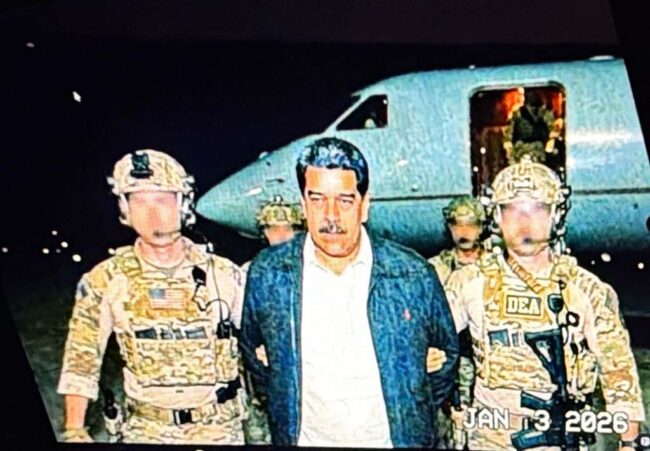
Screen capture from television shows DEA agents escorting Venezuela’s Nicolás Maduro.
  •  

BREAKING: Venezuela’s Maduro captured after U.S strikes Caracas

The United States has captured Venezuelan dictator Nicolás Maduro, along with his wife Cilia Flores, after a series of targeted military strikes on Caracas at 1:30 am on Saturday, January 3, 2026.

In a statement posted on his Truth Social platform, U.S President Donald J. Trump said U.S. forces, working with U.S. law enforcement, conducted a “large scale strike” that resulted in the capture of Maduro and his wife, Cilia Flores. Trump said both were flown out of Venezuela, without providing details on where they were taken or the legal basis for their detention.

“The United States of America has successfully carried out a large scale strike against Venezuela and its leader, President Nicolas Maduro,” Trump said, adding that more information would be released at a news conference scheduled for 11 a.m. ET at his Mar-a-Lago residence in Florida.

Explosions were reported across parts of Caracas in the early hours of Saturday, according to witnesses and videos posted on social media, which showed flashes in the sky, fires and power outages in several areas of the capital. One of the main targets appeared to be Fuerte Tiuna, the country’s largest military base and a key command center for Venezuela’s Bolivarian Armed Forces.

The extent of damage and possible casualties could not be independently verified. Venezuelan authorities did not immediately confirm whether senior military officials, including Defense Minister Vladimir Padrino, were injured or killed in the strikes.

In Washington, Republican lawmakers were quick to praise President Trump’s decisive action. Representative Mario Díaz-Balart praised the operation, saying it demonstrated decisive leadership against what he described as an illegitimate regime that posed a threat to U.S. and regional security. Other lawmakers raised questions about the legality of the strikes and whether Congress had authorized the use of force.

In Colombia, Medellín Mayor Federico Gutiérrez expressed support for Venezuelans living abroad, saying millions had fled repression and economic collapse under Maduro’s rule. Venezuelan migrants make up a significant share of Medellín’s population, local authorities say.

It remains unclear how Venezuela’s armed forces will respond or whether Maduro’s removal will lead to a peaceful transition of power with the return of President-elect Edmundo González and opposition leader Maria Corina Machado, both currently out of the country.

Developing News Story….

  •  

Airlines suspend Bogotá – Caracas routes over military build-up in the region.

Electronic jamming and missiles are two of the risks identified by US regulators.

Latam airlines suspended its Bogota´- Caracas route this week after FAA advice. Photo: CD Dobelli

Major airlines cancelled flights from Bogotá to Caracas this week after US regulators warned of “heightened military activity” around Venezuela.

Avianca and LATAM suspended flights through Venezuelan airspace, along with at least five other airlines, as a response to a Federal Aviation Authority NOTAM (Notice to Airmen) that reported “Global Navigation Satellite System (GNSS) interference” around Maiquetía “Simón Bolívar” International Airport, which serves nearby Caracas.

The warnings were linked to military exercises under way in Venezuela, a response to threats from US forces massing in the Caribbean and aerial attacks on suspect drug boats, some originating from Venezuelan waters.

Colombia’s own airline regulator, Aeronáutica Civil de Colombia, repeated the FAA’s warning but said that air operators in Colombia could take “autonomous decisions” over flights to Venezuela.

On Monday several airlines were continuing direct flights from Bogotá, such as Wingo, Avior (a Venezuelan airline) and Satena (a commercial airline linked to the Colombian Ministry of Defense). Copa offered connections via Panama.

Mobile missiles

The list of airlines suspending flights continued to grow on Monday night with TAP, Turkish Airlines, Iberia and GOL being joined by Air Europa and Plus Ultra.

This came despite pushback from Venezuela’s Instituto Nacional de Aeronáutica Civil (INAC) which threatened to punish airlines for following the FAA’s recommendations.  According to a report in Aviation Online, airlines avoiding Caracas could in the long term lose access to the country’s airspace.

INAC also issued an ultimatum for airlines suspending flights “to resume services within a 48-hour period” or risk losing their landing permits.

Meanwhile the US FAA issued a more detailed FAA backgrounder clarifying that Venezuela had “at no point expressed an intent to target civil aviation”.

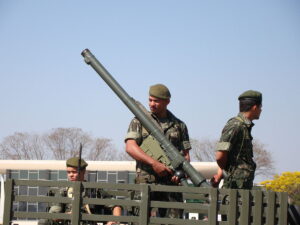
Portable Russian anti-aircraft missile similar to those used in Venezuela. Photo: André Gustavo Stumpf

It did, however, seem concerned that the current context could trigger an air accident.

Venezuela, it said, had mobilized “thousands of military and reserve forces” with access to shoulder-mounted anti-aircraft missiles, or MANPADs (man-portable air defense systems), capable of downing low-altitude aircraft.

This followed comments by Maduro last month that his military were in possession of Russian-made Igla-S missiles “with no fewer than 5,000 of them in key anti-aircraft defense positions to guarantee peace, stability, and tranquility”.

Jammers and spoofers

The more immediate risk was to electronic systems, said the FAA documents, with several civil aircraft recently reporting interference while transiting Venezuela, in some cases causing “lingering effects throughout the night”.

“GNSS jammers and spoofers can affect aircraft out to 250 nautical miles [450 kilometres] and can impact a wide variety of critical communication, navigation, surveillance, and safety equipment on aircraft.”

The FAA said it would “continue to monitor the risk environment for US civil aviation operating in the region and make adjustments, as appropriate, to safeguard U.S. civil aviation”.

In fact, the US airlines stopped all direct commercial and cargo flights into Venezuela as part of an order issued in 2019, related to sanctions against the Maduro regime, widely seen as illegitimate, with the US State Department offering a bounty of US$50 million “for information leading to the arrest and / or conviction” .

The rule of Venezuelan leader Nicolás Maduro is widely seen as illegitamate. Photo: Steve Hide
Venezuelan leader Nicolás Maduro has a US$50 million bounty on his head. Photo: Steve Hide

Open to talks

Commentators on US – Venezuelan relations this week said that FAA announcement was not necessarily a sign of imminent US military action. Former Associated Press analyst Dan Perry told News Nation that the FAA warning was “a message that they [the FAA] expected the country to become unstable”, but did not point to a ground invasion.

For most observers, the NOTAM was a continuation of the maximum pressure strategy pursued by Washington against the Maduro regime, including a recent decision to declare the Cártel de los Soles — a disconnected group of corrupt military officers who facilitate drug shipments — as a Foreign Terrorist Organization.

Last week Maduro said he was open to talks with Washington, according to AP News, though US President Trump underscored that military action was “still on the table”.

In recent months the US has sent eight navy ships, a submarine, an aircraft carrier and 10,000 service members to the Caribbean. And since August, US firepower has killed at least 83 people in aerial attacks on speedboats suspected of running drugs; for anyone arriving in Venezuela, air is still safer than sea.

The post Airlines suspend Bogotá – Caracas routes over military build-up in the region. appeared first on The Bogotá Post.

  •  
❌