Normal view

Trump Endorses De La Espriella, Calls Cepeda a “Radical Left-Wing Marxist”

3 June 2026 at 14:29

U.S. President Donald Trump has thrown his unconditional support behind Colombian hard-right presidential candidate Abelardo “El Tigre” de la Espriella, offering what he described as his “complete and total endorsement” ahead of the country’s June 21 runoff election.

The endorsement, published Tuesday evening on Trump’s Truth Social platform, immediately injected an international dimension into Colombia’s presidential race and marked a rare intervention by a sitting U.S. president in support of a candidate during an active electoral campaign.

The U.S. president went on to congratulate the Barranquilla-based lawyer on his first-round victory and expressed confidence that he would become Colombia’s next president. Trump also used the post to attack De la Espriella’s rival, left-wing senator Iván Cepeda, describing him as a “radical left-wing Marxist.”

Drawing parallels between MAGA (Make America Great Again), and “The Tiger’s” Defensores de la Patria (Defenders of the Homeland) movement, the two-term Republican leader stated the following:

“Abelardo de la Espriella, fights tirelessly for, and loves, his Great Country and People, just like I do for the United States of America.”

He then went on to claim: “As President, Abelardo would be tremendously successful in leading Colombia to Grow the Economy, Create Jobs, Promote Trade, Stop Illegal Immigration, Crack Down on Crime and Drugs, and Restore LAW AND ORDER! (…) “EL TIGRE” ABELARDO DE LA ESPRIELLA WILL NOT THE WONDERFUL PEOPLE OF COLOMBIA DOWN!”

The comments came less than three weeks before Colombians return to the polls to choose a successor to President Gustavo Petro, who is constitutionally barred from seeking reelection.

The runoff has emerged as one of the most polarized presidential contests in recent Colombian history, pitting firebrand De la Espriella, a political “outsider” who has campaigned on restoring security and strengthening ties with Washington, against Cepeda, a veteran senator and one of Petro’s closest political allies.

De la Espriella welcomed Trump’s endorsement, describing it as a sign of confidence in his vision for Colombia and its future relationship with the United States.

“President Trump has my deepest gratitude,” De la Espriella said in a statement following the endorsement.

The candidate has spent much of the campaign positioning himself as a staunch defender of free-market policies and a critic of Petro’s administration, which has faced mounting public dissatisfaction over security, corruption and economic management.

Trump’s endorsement follows months in which De la Espriella cultivated ties with conservative political figures in Washington. As his campaign gained momentum, he received backing from prominent Republican lawmakers including Florida Representative Maria Elvira Salazar and Ohio Senator Bernie Moreno, both influential allies of the U.S. president.

The support from Republican circles comes as Colombia remains one of Washington’s closest partners in Latin America. The two countries maintain extensive cooperation on trade, security, counternarcotics operations and migration issues.

Although U.S. administrations have traditionally avoided direct involvement in Colombian electoral politics, Trump’s endorsement places the White House squarely into the political conversation during the final stretch of the campaign.

Political analysts say the endorsement could resonate among some conservative voters while reinforcing De la Espriella’s efforts to present himself as the candidate most capable of rebuilding a close relationship with Washington.

President Gustavo Petro responded on social media without mentioning Trump by name, framing the issue as one of national sovereignty and warning against foreign influence in Colombia’s democratic process.

“When one country intervenes in the decisions of another country, freedom dies,” Petro wrote.

“I invite all Colombians to vote in complete freedom and not become slaves or a colony of anyone.”

The president also invoked Colombia’s independence heroes, writing that “an entire generation of young men and women of New Granada fought alongside Bolívar and Nariño to give us freedom and sovereignty.”

“If the heart of the world loses its freedom and sovereignty, the hope of the world and of Colombia is extinguished,” Petro added.

The exchange between U.S President Donald Trump and his Colombian counterpart adds a new layer of tension to an election campaign already marked by heightened political polarization and security concerns. The assassination of presidential candidate Miguel Uribe Turbay in June last year shocked the nation and has revived memories of Colombia’s violent political past.

More than 41 million Colombians are eligible to vote in the June 21 election, including approximately 1.4 million citizens living abroad. Recent polling suggests a highly competitive race, although De la Espriella has gained momentum since emerging as the leading candidate in the first round.

The Colombian runoff is now attracting attention far beyond the country’s borders. Whether the U.S. president’s words manages to convince undecided voters in the center of the political spectrum, remains to be seem, but it has already ensured that the race between De la Espriella and Cepeda raises a high-stakes political gambit in Washington and Bogotá.

Analysis: In Sunday’s Election, Many Colombians Rejected The Political Status Quo. A Stark Right-Left Choice Remains

2 June 2026 at 22:26

Colombia’s Runoff Could Reshape Investment, Energy, and Labor Policy

Colombia’s first-round presidential election, held Sunday, May 31, 2026, produced a result that crystallizes the country’s political exhaustion with both the governing left and the traditional right. Criminal defense attorney and political outsider Abelardo de la Espriella placed first with more than 10.3 million votes. Leftist Senator Iván Cepeda, a close ally of outgoing President Gustavo Petro and the lead architect of the administration’s Paz Total peace policy, finished second with just under 9.7 million votes. The two will face each other in a runoff election on June 21.

Senator Paloma Valencia, the candidate backed by former President Álvaro Uribe and the standard-bearer of his Uribismo movement, placed a distant third, receiving less than 7% of the vote — fewer than 1.7 million ballots. Former Medellín mayor and Antioquia governor Sergio Fajardo received just over one million votes, while former Bogotá mayor Claudia López finished below 1%, with approximately 225,000 votes. The remaining minor candidates combined for just over 1% of the total.

Under Colombia’s electoral system, the top two finishers advance to a runoff if no candidate surpasses 50% in the first round. The June 21 vote will determine who assumes the presidency on August 7.

Click above to watch the video!

The Candidates: Background and Context

Abelardo de la Espriella, 47, has never held elected office. He built a national profile over more than two decades as a high-profile defense attorney, founding De La Espriella Lawyers in 2002, with offices in Colombia and the United States. His client roster has included controversial figures: he represented Alex Saab, a Colombian-born businessman who became a close associate of Venezuelan President Nicolás Maduro and was implicated in a scheme to launder proceeds from Venezuela’s food-assistance program, the Comité Local de Abastecimiento y Producción (CLAP). Saab was extradited to the United States, convicted, and later granted clemency before being re-arrested in Venezuela in early 2026. De la Espriella also represented members of the Nule family in connection with the Carrusel de Contratos — a major contracting scandal tied to infrastructure works at Bogotá’s El Dorado airport corridor. He has additionally been reported to have represented individuals linked to organized crime.

De la Espriella has drawn comparisons to figures such as US President Donald Trump and El Salvador’s Nayib Bukele. His campaign has centered on hard-line security policy, including proposals for large-scale incarceration, expanded military operations against armed groups, and the rejection of negotiations with guerrilla organizations. He is reported to hold Italian and US citizenship in addition to his Colombian nationality, and is said to own property in Florida.

In a notable departure from his defense work, de la Espriella took the side of a victim in a high-profile acid-attack case, acting as a private prosecutor to secure a stronger sentence for the perpetrator — an episode that raised his public profile beyond the defense bar.

Iván Cepeda, 63, enters the runoff as the consolidated candidate of the Colombian left and Petro’s Pacto Histórico coalition. He is the primary legislative architect of Paz Total, the Petro administration’s policy of negotiating simultaneously with multiple armed actors, including the ELN and FARC dissident factions. Cepeda’s family background includes deep ties to the Colombian left: his father was secretary general of the Communist Party, and was assassinated. Cepeda himself studied in communist Bulgaria during the soviet era. The two finalists have an established legal and political history: Uribe attempted to bring criminal charges against Cepeda while both served in the Senate, but the Supreme Court determined that Uribe had fabricated the accusations and attempted to bribe witnesses — a case that resulted in Uribe’s criminal conviction.

“If nothing changes, Abelardo wins.” — Loren Moss, Finance Colombia

The Electoral Map

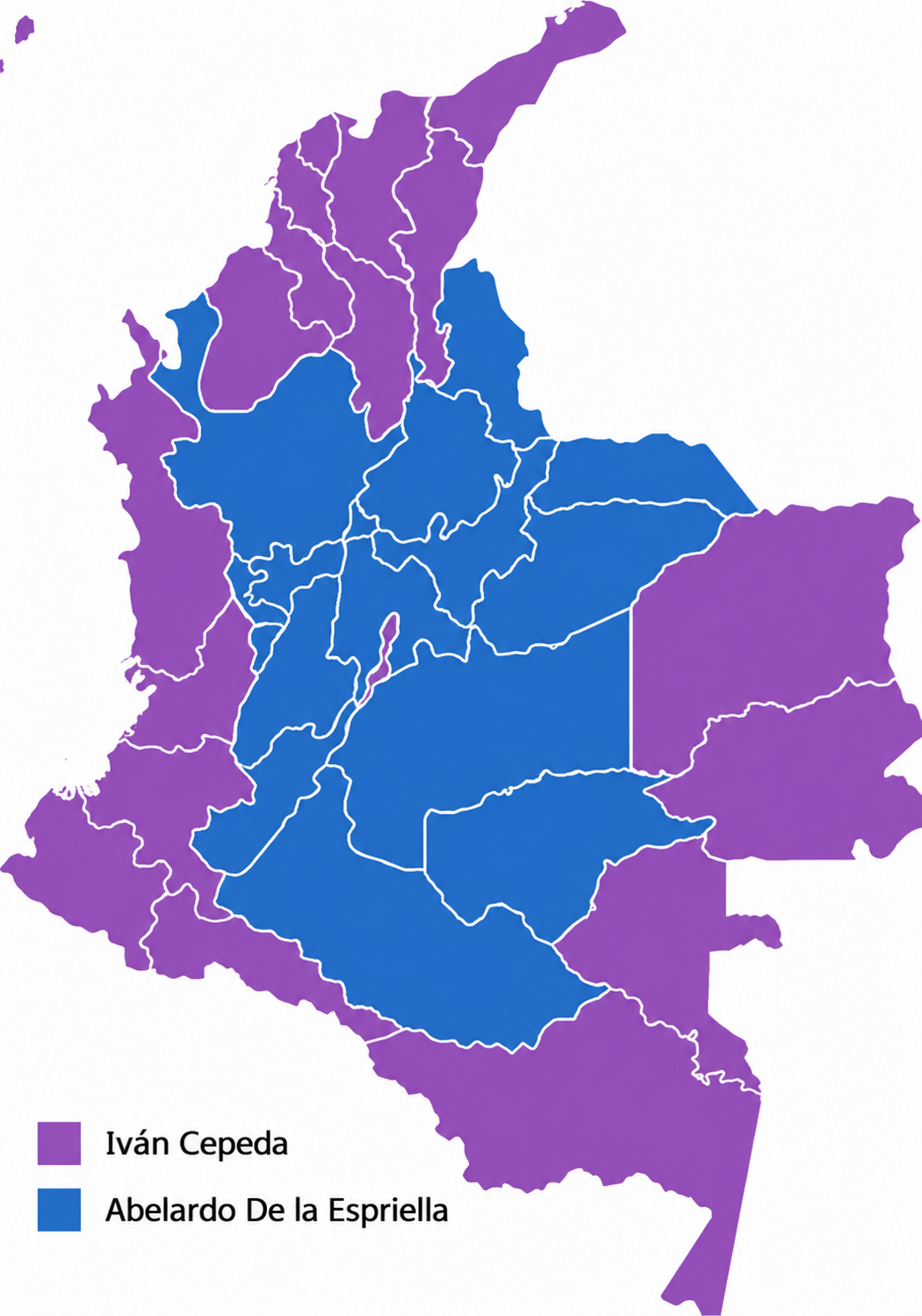
The geographic distribution of the vote reflects deep regional divisions. Cepeda carried Bogotá, which has trended left for years, particularly in lower-income districts on the city’s south and west sides. Antioquia — historically the heartland of Uribismo and home to Medellín, the country’s second-largest city — voted more than two to one for de la Espriella, a result that signals the weakening grip of Uribe’s movement even in its traditional stronghold.

The heart of coffee-growing country — the departments of Caldas, Risaralda, and Quindío also went to de la Espriella. Caquetá, a sparsely populated department in southern Colombia that has suffered sustained guerrilla violence from both the ELN and FARC dissident groups, voted for de la Espriella as well, a result we may interpret as a direct rejection of Petro and Cepeda’s Paz Total.

Cepeda carried Colombia’s Pacific coast, including the chronically neglected department of Chocó, as well as the sparsely populated Amazonas and Putumayo departments bordering Peru and Brazil, and the northern Caribbean coast. The Caribbean coast result is notable, as the region has historically suffered from underdevelopment, infrastructure deficits, and significant income inequality. Norte de Santander with its Catatumbo region on the Venezuelan border and experiencing severe armed-group activity — voted for de la Espriella, a result consistent with public exhaustion over security policy.

The Political Context: From Uribe to Petro and Beyond

Colombia’s current political trajectory is rooted in decisions made across the past two decades. President Uribe served two terms in the early 2000s and, together with then-Defense Minister Juan Manuel Santos, mounted a sustained military campaign against the FARC that significantly weakened the insurgency. Santos later broke from Uribe after assuming the presidency, governing independently and ultimately negotiating a peace agreement with the FARC — a deal that Uribe actively opposed. A plebiscite on the accord failed, but Santos used legislative maneuvering to implement it anyway.

Colombia 2026 1st round top two (Graphic: Sofi Imfeld for Finance Colombia)

Colombia 2026 1st round top two (Graphic: Sofi Imfeld for Finance Colombia)

Uribe’s next handpicked candidate, Iván Duque, won the 2018 election but finished his term with approximately 30% approval. Members of his own party publicly distanced themselves from him — Senator María Fernanda Cabal, a staunch Uribista, called Duque a “mamerto” (leftist idiot) while he was still in office. Under his administration, indicators on crime and guerrilla activity worsened, and armed groups including the ELN rebuilt operational capacity that had been degraded under Uribe and Santos.

Petro’s administration has not met initial fears of a Venezuelan-style democratic breakdown: Congress has largely blocked the most radical components of his agenda, including attempts to nationalize the private pension system and convert the healthcare system to a single-payer model. However, crime has increased, armed groups have expanded their operational footprints, and the security situation in several regions has worsened. Paz Total is widely seen as having produced few tangible results.

Uribe himself was convicted of witness tampering and attempted bribery in the case he had brought against Cepeda. Though released from house arrest after conviction, the judges who authorized his release are now reportedly under investigation for judicial corruption. Valencia’s poor performance in the first round — despite being Uribe’s chosen standard-bearer — suggests that Uribismo as a political force is waning, with its core constituency aging and new generations of voters disengaged from the Uribe legacy.

What to Expect Before June 21

Both campaigns will intensify mobilization efforts over the coming three weeks. Cepeda’s movement — Colombia Humana and the broader Pacto Histórico coalition — has historically relied on organized mobilizations, including indigenous community-led mingas, labor unions, and allied social movements. Cepeda’s running mate Senator Aida Quilcué is an indigenous activist, a choice expected to energize those constituencies. FECODE, the Federación Colombiana de Trabajadores de la Educación (Colombia’s main teachers’ federation), is expected to align officially with Cepeda, though individual teachers may not follow union leadership in their voting choices.

On the right, Paloma Valencia issued a public endorsement of de la Espriella immediately following the first-round results. Business community organizations, including ANDI (the Asociación Nacional de Empresarios de Colombia) and Fenalco (the Federación Nacional de Comerciantes), do not formally endorse candidates, but their members are widely understood to favor a government that supports private enterprise and market-oriented policy. De la Espriella holds no congressional constituency, meaning whichever candidate wins will face the same dynamic Petro encountered: a fragmented Congress that is likely to act as a check on executive authority.

The question of centrist voter alignment remains open. Fajardo and López are not expected to formally endorse either finalist, and the direction of their combined approximately 1.2 million votes is uncertain.

Winners and Losers by Sector

For international investors and executives operating in Colombia, the policy differences between the two candidates are substantive across several key sectors.

Petroleum and Natural Gas: De la Espriella has stated unequivocally that he will restart petroleum exploration and licensing, which the Petro administration blocked. Ecopetrol S.A. (NYSE: EC; BVC: ECOPETROL), Colombia’s state-controlled oil company, which also holds producing assets in the US Permian Basin and Gulf of Mexico, has operated under a government that halted new drilling permits. The consequences have included a decline in future production capacity at a time when global oil prices have risen due to Middle East tensions. Colombia has been forced to import natural gas at elevated prices to meet existing domestic demand — including from transportation fleets that were converted to natural gas under government incentive programs. Cepeda would be expected to continue or deepen current restrictions on fossil fuel expansion.

Healthcare: The Petro-Cepeda platform favors a government single-payer model. The administration has already taken over several Entidades Promotoras de Salud (EPS) — Colombia’s managed-care intermediaries — placing the healthcare system in legal and financial uncertainty. Private clinics, hospitals, and physicians who wish to operate outside a government-controlled framework would benefit from a de la Espriella administration. Cepeda’s healthcare agenda would accelerate the shift toward government-managed care.

BPO, Tech, and Call Centers: The BPO sector — which provides large volumes of formal employment, particularly in Medellín, Bogotá, Cali, and Barranquilla — was significantly affected by Petro-era minimum wage increases of 16% and 23% in successive years. These increases created contract renegotiation pressures with international clients, some of whom have shifted or considered shifting operations to competing jurisdictions including Honduras, Jamaica, the Dominican Republic, Mexico, and Guatemala. At the CX Summit, the industry’s main annual event held in Cartagena, the son of Álvaro Uribe appeared as an invited keynote speaker — a gesture that could be interpreted within the industry as an implicit signal of political alignment. A de la Espriella government, with its orientation toward labor market deregulation and reduced regulatory burden, would be viewed more favorably by this sector. Current Colombian labor law prohibits part-time employment contracts and places significant restrictions on dual employment, making workforce flexibility difficult for businesses that operate outside traditional 40-hour weekly structures.

Mining: The Petro administration has been less aggressive toward mining than toward petroleum, but sector participants expect a more permissive regulatory environment under de la Espriella, and continued constraints under Cepeda.

Security and Tourism: Both candidates have stated support for tourism promotion, but the sector’s trajectory is more directly linked to security conditions. Under current policies, several regions that were accessible to domestic and international travelers several years ago have experienced increased armed-group activity, effectively closing them to tourism. A de la Espriella administration is expected to pursue a more aggressive military posture toward the ELN and FARC dissident factions; a Cepeda government would likely continue dialogue-first approaches. The outcome will directly affect which parts of Colombia’s territory remain accessible to investment and tourism.

Foreign Relations: A de la Espriella government is expected to restore a broadly cooperative relationship with the United States, which deteriorated under Petro following several high-profile diplomatic incidents. De la Espriella has expressed admiration for US President Donald Trump, and reports indicate he holds US citizenship and owns property in Florida. Relations with Ecuador, which have been strained by mutual tariff escalations between Petro and Ecuadorian President Daniel Noboa, would be expected to normalize. Relations with Venezuela under Cepeda would likely continue along the current allied trajectory, while a de la Espriella government would be expected to take a more critical posture toward Caracas. China and Russia would find a more receptive diplomatic environment under Cepeda, and a cooler one under de la Espriella.

The Poor and Informal Workers: Cepeda’s campaign argues that minimum wage increases and expanded state services benefit lower-income Colombians. Critics counter that elevated formal labor costs have pushed more employment into the informal sector — which currently accounts for approximately half the Colombian workforce — depriving those workers of pension contributions, health benefits, and job security. De la Espriella’s platform, which emphasizes business formation, security, and labor market deregulation, would be presented as generating more formal-sector job creation. The actual distributional effects of either approach remain contested.

The Outlook

Assuming current polling trends hold and Uribista voters consolidate behind de la Espriella as expected following Valencia’s endorsement, de la Espriella enters the runoff as the frontrunner. Cepeda’s path to victory depends on driving high turnout among his base, securing support from centrist voters who did not vote for either finalist in the first round, and potentially benefiting from any missteps by de la Espriella in the final three weeks of campaigning.

The first-round results produced no major electoral violence. The ELN announced a temporary halt to armed actions during the voting period. Authorities detained some individuals reportedly attempting to purchase votes in rural areas, but no large-scale incidents were recorded.

The incoming president will face a Congress with no natural majority aligned to the executive, a healthcare system in partial administrative disarray, a petroleum sector whose future production trajectory is in question, and regions where state presence remains contested by armed groups. The June 21 runoff will determine which vision — market-oriented restructuring or continuation of the Petro project — Colombia pursues for the next four years.

Trump Nominates Nate Morris as U.S. Ambassador to Colombia

U.S. President Donald Trump has nominated Kentucky businessman and political ally Nathaniel “Nate” Morris to serve as the next U.S. ambassador to Colombia, placing a prominent supporter of the Republican president at the helm of one of Washington’s most important diplomatic posts in Latin America.

The nomination was formally submitted to lawmakers on Monday, one day after right-wing presidential candidate Abelardo “El Tigre” de la Espriella emerged as the frontrunner in Colombia’s first-round election, setting up a runoff that could reshape relations between Bogotá and Washington.

Morris, 45, is the founder of Rubicon Technologies, an environmental technology and waste-management company, and has become one of Trump’s most visible political allies in Kentucky. His nomination comes as Colombia enters a period of political transition and uncertainty over the future direction of bilateral cooperation on security, counternarcotics efforts, trade and migration.

The White House announced Morris’s nomination as part of a broader package of diplomatic appointments across Latin America. If confirmed by the Senate, he would become Washington’s top representative in Colombia at a pivotal moment for relations between the longtime allies.

Trump had previously urged Morris to abandon a potential bid for the U.S. Senate in Kentucky in order to join his administration.

“Nate is a fantastic businessman and a strong MAGA warrior,” Trump wrote on social media. “I have asked Nate to step aside from the Senate race to take a role in my Administration as Ambassador. Nate is Oxford-educated, tough as steel, loves our great nation, and will represent the United States very well.”

Although Morris has limited public diplomatic experience, his appointment reflects the Trump administration’s preference for politically connected allies and business leaders in several ambassadorial posts.

A native of Kentucky, Morris studied at George Washington University before pursuing further studies at the University of Oxford. He founded Rubicon Technologies, a company focused on waste management and environmental services, and later established Morris Industries, a private investment holding company based in Lexington with interests in sustainability, technology, industrial operations and financial services.

The nomination comes amid expectations that Colombia’s foreign policy could shift following Sunday’s election result. De la Espriella’s strong showing has fueled speculation that a future administration could seek closer alignment with Washington after years of tensions between the governments of President Donald Trump and Colombian President Gustavo Petro.

Before taking up the post in Bogotá, Morris must undergo Senate hearings and secure confirmation by a majority vote, a process that could take several weeks or months.

De la Espriella and Cepeda Advance to Colombia’s Presidential Runoff After Polarized First-Round Vote

1 June 2026 at 17:11

A June 21 presidential runoff will decide Colombia’s next president

Far-right candidate Abelardo de la Espriella and leftist Iván Cepeda advanced to the runoff round of Colombia’s presidential election after emerging as the top vote-getters in the May 31, 2026, first-round vote, in a result that reflects the deep political polarization shaping the country.

With 99.99% of polling stations counted, the Registraduría Nacional del Estado Civil reported that De la Espriella won more than 10.3 million votes (43.7%), while Cepeda secured 9.6 million votes (40.9%). The two candidates will face each other in a runoff election scheduled for June 21, 2026.

Voter turnout reached 23.7 million people, equivalent to 57.8% of eligible voters. Together, the two candidates captured nearly 85% of valid ballots, leaving the remaining contenders far behind and setting up a contest between two sharply contrasting political visions.

De la Espriella’s unexpected rise

De la Espriella’s first-round victory represents one of the biggest surprises of the election and marks the first time in Colombia’s modern political history that a far-right party has emerged with a realistic chance of winning the presidency.

A lawyer by profession with no previous elected office experience, De la Espriella built his campaign around a populist message focused on political confrontation, public security, a hard-liner approach to crime and opposition to negotiations with illegal armed groups. His political style has drawn comparisons to Argentine President Javier Milei, Salvadoran President Nayib Bukele and US President Donald Trump.

Most pre-election polls placed him in second or third position, with support ranging between 15% and 25%, well below his final result.

His platform emphasizes stronger security policies, tougher penalties for criminal and narcotraffic organizations, and the construction of large-scale prisons similar to those in El Salvador. He has also rejected peace negotiations with armed groups.

His opposition to diversity and inclusion policies, as well as controversies involving remarks toward female journalists for which he later apologized, also became defining features of his campaign.

Cepeda achieves the strongest result ever for Colombia’s left party

Although he finished second, Cepeda achieved the highest vote total ever received by a left-wing presidential candidate in Colombia, surpassing the 8.5 million votes won by President Gustavo Petro in a previous presidential election.

The candidate of the ruling Pacto Histórico party based his campaign on grassroots mobilization, public rallies and the consolidation of a unified left-wing movement. His message focused on expanding social programs, inclusion and reducing inequality.

However, his candidacy has also been weighed down by criticism of the current administration, particularly regarding security concerns, problems within Colombia’s healthcare system and the limited results of the government’s “Total Peace” policy, which Petro promoted and Cepeda supported during his years in Congress.

Cepeda’s political career has been built in Congress, where he became known for defending the rights of victims of paramilitary violence and for his role in legal cases involving former President Álvaro Uribe.

After preliminary results were released, both Cepeda and Petro publicly questioned the preliminary vote count while stating they would recognize the official results certified by electoral commissions, judges and notaries.

“As president, I do not accept the preliminary count results,” Petro wrote on X, arguing that Colombia’s pre-count system has no legal validity and that only the official scrutiny process produces binding results. He later added that “the binding results the president will recognize are those issued by the electoral scrutiny commissions.”

Cepeda has also sought to distance himself from some of Petro’s proposals, including the idea of convening a constituent assembly to revise Colombia’s constitutional framework.

Historic defeat for Uribe’s political movement

Another major statement of the election was the poor performance of Paloma Valencia, candidate of the Centro Democrático party and backed by former President Uribe, who campaigned alongside her throughout the country despite defections by several prominent supporters.

Valencia finished third with 1.6 million votes (6.9%), far below polling projections that had placed her above 20%.

The result is widely attributed to voter fatigue with Uribe’s political movement and the migration of conservative voters toward De la Espriella, who was endorsed during the campaign by several prominent right-wing figures, including senators Paola Holguín and María Fernanda Cabal, as well as leader and businessman José Félix Lafaurie.

Strategic decisions within Valencia’s campaign may also have contributed to the result, including the selection of former Bogotá councilman Juan Daniel Oviedo as her vice-presidential running mate and her reluctance to directly confront De la Espriella during the campaign.

This marks the second consecutive presidential election in which Uribe reaches the runoff without a candidate from his own party. Nevertheless, he quickly endorsed De la Espriella after the results became known.

That endorsement could prove crucial. If elected, De la Espriella would face a Congress in which his movement holds only limited representation, making support from Centro Democrático, the second-largest congressional bloc, essential for advancing legislation and reforms.

Centrist voters may decide the runoff

Former Medellín Mayor Sergio Fajardo, who campaigned as a centrist alternative, finished fourth with more than 1 million votes (4.2%), while none of the remaining candidates surpassed 1% of the vote.

As the runoff approaches, the votes won by both Valencia and Fajardo are expected to be closely watched by the two campaigns, as they could prove decisive in an election that is shaping up to be highly competitive, deeply polarized and politically fragmented.

While Valencia has already endorsed De la Espriella, Fajardo has yet to take a public position. In previous elections, the former Medellín mayor has preferred to leave his supporters free to decide rather than formally endorse either finalist.

In Valencia’s case, despite her endorsement of De la Espriella, it remains unclear whether her support came primarily from voters aligned with former President Álvaro Uribe or whether a significant share was driven by the candidacy of Juan Daniel Oviedo, who won more than 1.2 million votes in the coalition primaries held in March.

The June 21 presidential runoff will therefore pit two sharply different visions for Colombia’s future against one another, in a political environment marked by polarization, social tensions, and persistent challenges related to security and governance that the next administration will have to address.

Petro Advances Temporary Concentration Zones for “Clan del Golfo” as Final Push for Total Peace Policy

25 May 2026 at 17:36

More than 400 combatants would be concentrated in the new zones as negotiations continue in Doha, Qatar

President Gustavo Petro is moving forward with the creation of temporary concentration zones, known as Zonas de Ubicación Temporal (ZUT), for members of the Estado Mayor Conjunto del Ejército Gaitanista de Colombia (EGC), also known as the Clan del Golfo, the country’s largest drug trafficking armed group, in a renewed effort to advance his Total Peace (Paz Total) policy just days before Colombia’s presidential elections on May 31, 2026.

According to an official statement from Colombia’s presidency, the ZUTs would initially allow the concentration of more than 400 combatants while parallel negotiations continue over a possible peace agreement with the Colombian government, although no preliminary agreements have yet been reached.

The temporary concentration zones would function as designated areas where combatants suspend armed activities while participating in talks with the government and preparing for a potential reintegration into civilian life.

According to the government, the zones would remain in effect until December 31, 2026, meaning their future would ultimately depend on Colombia’s next president, who will take office on August 7, as well as on the broader future of the Total Peace policy.

Colombia’s most powerful criminal organization

The Clan del Golfo is considered by specialized organizations, including the Fundación Ideas para la Paz (FIP), to be Colombia’s most powerful criminal structure.

According to the organization, the group has nearly 10,000 armed members and operates in multiple strategic regions linked to drug trafficking, illegal mining and territorial control.

The US government has designated the group a transnational terrorist organization, while President Donald Trump previously warned of possible US military actions in Colombian territory over security and narcotics concerns, comments that sparked diplomatic tensions with Petro’s administration.

Institutional clash over arrest warrants and extradition requests

The ZUT proposal comes amid tensions between Colombia’s executive branch and the Attorney General’s Office over the legal conditions required to move the process forward.

The Office of the High Commissioner for Peace requested the suspension of arrest warrants against 29 Clan del Golfo members, including 13 individuals subject to extradition requests, among them Jobanis de Jesús Ávila Villadiego, alias “Chiquito Malo,” the group’s top leader.

Attorney General Luz Adriana Camargo rejected the request, citing legal limitations regarding individuals sought by foreign authorities.

Following the refusal, Petro publicly defended the process in a message on X. “I have been clear that, in the early stages of the process, individuals facing extradition do not participate,” the president wrote, denying any intention to suspend extradition orders unless there is “an advanced peace process, as established by law.”

Amid the controversy, the Clan del Golfo itself issued a statement accepting that individuals facing extradition requests would not initially participate in the temporary concentration zones.

“As an unequivocal demonstration of political will and coherence, the Joint High Command of the Gaitanista Army of Colombia accepts, in good faith, that access to the Temporary Concentration Zones will be limited to combatants who are not subject to extradition requests by any foreign government,” the group said.

The group added that the decision seeks to “remove any shadow of doubt” over the process and prevent extradition disputes from obstructing negotiations.

The presidency later highlighted that the EGC accepted the government’s conditions for concentrating fighters in Tierralta, Córdoba, and in the municipalities of Belén de Bajirá and Unguía, Chocó. According to the government, combatants and commanders are expected to begin entering the zones on June 25.

Criticism over timing

The initiative has sparked criticism because of its timing, arriving just days before presidential elections and during a government transition period.

Ombudswoman Iris Marín warned that the process creates uncertainty over how armed groups might interpret the political transition.

“The move toward those zones creates expectations among armed groups in the middle of an electoral context and government transition. It is impossible for disarmament to happen before August 7, 2026, so how do armed groups interpret that in an electoral context?” Marín said in a video shared on social media.

Marín clarified, however, that Colombia’s Constitution grants the president authority to pursue peace negotiations, meaning concerns center not on the legality of the initiative itself but on its political timing.

Negotiations between the Colombian government and the Clan del Golfo have been underway since 2025 in Doha, Qatar, which has quietly hosted talks between both parties. According to official sources, the ZUTs are intended as confidence-building measures and humanitarian relief for communities affected by the group’s violence.

*

Photo: Colombian government representative Álvaro Jiménez shakes hands with Clan del Golfo spokesperson Luis Armando Pérez in the presence of Qatar’s Minister of State for Foreign Affairs, Mohammed bin Abdulaziz bin Saleh Al-Khulaifi, in Doha on September 18, 2025, at the start of peace talks. Photo shared by Colombia’s Office of the High Commissioner for Peace.

Colombia’s Presidential Race Marked by Polarization, Divided Right and Absence of Debates

18 May 2026 at 22:53

As Colombia nears its presidential vote, two candidates have endorsed Iván Cepeda and eight others remain below 3.5% in polls

With less than two weeks remaining before Colombia’s presidential election, whose first round is scheduled for May 31, three candidates are concentrating most voter support and competing for access to the presidential palace, Casa de Nariño: ruling coalition senator Iván Cepeda, candidate of the left-wing Pacto Histórico party; senator Paloma Valencia, representing the right-wing Centro Democrático party; and lawyer and businessman Abelardo de la Espriella, a figure of Colombia’s far right.

Although 13 candidates will appear on the ballot, two contenders: Clara López and Luis Gilberto Murillo, withdrew their campaigns to support Cepeda, while the remaining candidates have failed to surpass 3.5% voter support in pre-elections polls, a figure close to the statistical margin of error.

If polling trends hold, no candidate is expected to secure the 50% plus one vote needed to win outright in the first round, making a runoff election on June 21, 2026, highly likely.

Cepeda has remained relatively stable in polls, with voter support ranging between 35% and 43%, effectively securing his place in a second round if trends continue.

The key question: Who will face Cepeda in a runoff?

The main electoral uncertainty centers on who will finish second and challenge the ruling coalition in a likely runoff.

Under Colombia’s electoral system, only the two candidates receiving the highest vote totals advance to the second round. The fragmentation of the political right has complicated efforts to consolidate support behind either Valencia or De la Espriella.

Polls suggest a competitive scenario. Valencia has registered between 14% and 21% voter support, while De la Espriella fluctuates between 16% and 24%, depending on the poll and methodology used.

The lack of unity between the two camps stems from both ideological differences and their political structures. Valencia is a member of the political party founded by former President Álvaro Uribe, while De la Espriella entered the race through an independent signature campaign, marking the first time Colombia’s far right has emerged as a viable contender for the presidency.

A campaign shaped by the absence of public debates

The presidential campaign has been marked by an unusual lack of debates among the leading candidates.

Cepeda has refused to participate in events organized by media outlets, arguing that proposed formats do not offer guarantees of neutrality or what he describes as “fair rules” established by news organizations.

As a result, part of the political confrontation has shifted to Congress, where both Cepeda and Valencia currently serve in the Senate.

Critics, however, have challenged Cepeda’s decision. Former Bogotá Mayor and presidential candidate Claudia López argued that his absence from debates reflects that “Cepeda does not want to take responsibility for the failures of Total Peace (Paz Total),” the negotiation policy with armed groups promoted by President Gustavo Petro, in which Cepeda played a key role as a lawmaker.

Instead of regular debates, the campaign has been dominated by disputes over media formats, digital presence, social media strategies and public controversies aimed at amplifying candidates’ visibility.

De la Espriella embraces confrontation

One of the candidates who has most effectively capitalized on the digital environment is Abelardo de la Espriella, whose political strategy has been compared to right-wing populist leadership styles such as those of Argentine President Javier Milei and US President Donald Trump.

In recent weeks, De la Espriella has faced several media controversies, including an incident involving journalist Laura Rodríguez of Piso 8 FM, for which he later apologized after accusations of inappropriate sexual conduct. He also clashed live on air with television presenter María Lucía Fernández of Caracol Noticias, whom he called “ignorant.”

Questions also emerged following reports by digital outlet La Silla Vacía regarding donations linked to the US Republican Party.

Despite the controversies, the strategy appears to be strengthening his electoral standing. An Atlas Intel poll for Semana magazine, published May 15, showed De la Espriella surpassing Valencia by a two-to-one margin for the first time, with 32.9% support compared with 16.7%.

However, the polling firm is currently under investigation by Colombia’s National Electoral Council (CNE) amid concerns over whether its methodology complies with national standards. If irregularities are confirmed, the firm could face suspension of its operations in Colombia.

Valencia seeks to broaden support toward the political center

Meanwhile, Valencia has sought to expand her electoral base by shifting strategically toward the political center.

As part of that effort, on May 17 she officially introduced her proposal “Mámá No Está Sola (Mom Is Not Alone),” aimed at female heads of household and focused on access to credit, employment and housing property. The proposal also includes a promise to deliver 1 million homes prioritized for women community leaders.

Valencia’s candidacy also marks a historic first for Colombia’s political right: it is the first time a major conservative party has nominated a woman for president.

Her vice presidential running mate, former Bogotá councilman Juan Daniel Oviedo, has openly identified as a member of the LGBTQ+ community, a move that represents a significant shift for the Centro Democrático traditionally conservative electorate.

Colombia appears headed for a runoff

With a highly fragmented field and no signs of consolidation among right-wing candidates, Colombia appears increasingly likely to hold a presidential runoff on June 21, 2026.

Barring a major shift in polling trends, the contest seems set to come down to Iván Cepeda and whichever opposition candidate manages to emerge from an increasingly competitive battle within Colombia’s political right.

Colombian authorities highlight anti-drug efforts amid US pressure

9 April 2026 at 23:47
Colombian police test illegal drugs. Credit: Colombian National Police

The Colombian National Police published a report this week summarizing the results of its counter-narcotics operations during the first quarter of 2026.

Authorities highlighted the results of their new anti-drug dubbed ‘Esmeralda Plus‘, which has led to the seizure of 124 tons of cocaine and 99 tons of cannabis.

The report comes as President Gustavo Petro faces pressure from the White House to prove his commitment to countering the illicit drug trade, which has been a source of dispute between the two administrations.

“We are delivering significant strikes against drug trafficking. Today we fulfill our duty to Colombia and the world with dignity,” said Brigadier General William Castaño Ramos, Director of the Anti-Narcotics Division, following the report’s publication.

In addition to the 124 tons of cocaine and 99 tons of cannabis confiscated, the police also seized over 450,000 gallons of liquid chemicals and 396,000 kilograms of solid ingredients used in drug production.

They also announced the destruction of 981 narcotics laboratories and the recovery of 99 ampoules of fentanyl.

The confiscation figures mark a significant increase in seizures compared to the first 100 days of 2025, which saw 104 tons of cocaine and 63 tons of cannabis confiscated. 

These figures serve as a response to the heavy tensions that preceded the White House meeting, when U.S. President Donald Trump personally attacked Petro, signaling him as a “man who likes to make cocaine” and claiming that Colombia was “very sick” under his leadership.

The report comes amid mounting pressure by Washington for the Petro administration to tackle drug production. 

Trump has accused Colombia of failing to cooperate in the fight against the narcotics trade and carried out a series of unilateral aerial strikes against suspected ‘narco-vessels’ off the coast of Colombia since September, actions condemned by the Petro as a violation of national sovereignty.

Furthermore, Colombia’s President is currently facing two preliminary criminal investigations in Brooklyn and Manhattan regarding his 2022 electoral campaign. U.S. prosecutors are examining alleged illicit donations from drug trafficking networks and meetings with traffickers intended to block extraditions.

“The United States has found a mechanism to pressure the government and extract the maximum amount of concessions regarding the fight against drugs,” Sandra Borda, Professor of Political Science at the University of the Andes, told The Bogotá Post

While the Colombian government appears to have stepped up its counter-narcotics operations amid U.S. pressure, some say this may not be enough to appease the White House.

“For Washington, these technical results are necessary, but they aren’t enough to fully restore trust,” Nelson Poveda, a political analyst and international affairs expert with experience in Colombia’s Ministry of Foreign Affairs, told The Bogotá Post. “Still, these reports act as a bridge for ‘technical diplomacy,’ allowing cooperation to continue even when the political relationship is tense.”

In the report, authorities stress that ‘Esmeralda Plus’ attacks narcotics trafficking as a holistic system rather than just seizing drugs.

“We are directly destabilizing the finances, logistics, and operational capacity of these criminal structures,” pointed out General William Rincón, Chief of the National Police Service.

But Colombia has been excluded from key regional counter-narcotics efforts, notably the “Shield of the Americas”, a new anti-drug alliance promoted by Donald Trump.

The White House has historically favored eradication – the destruction of drug crops – as a counter-narcotics strategy. 

But Petro has consistently defended his “Total Peace” policy, arguing that the war on drugs must move away from just persecuting farmers and shift toward dismantling the financial backbone of cartels and taking down criminal leaders.

However, authorities reported 40 arrests for extradition purposes and more than 17,000 arrests related to drug trafficking so far this year. Additionally, the manual eradication of around 2,000 hectares of illicit crops shows that the Colombian administration is maintaining a mixed offensive that combines social policy with high-impact law enforcement.

With the 2026 electoral cycle approaching in Colombia, Petro’s administration is under immense pressure to show that this humanitarian approach is not a sign of weakness before he leaves office.

The post Colombian authorities highlight anti-drug efforts amid US pressure appeared first on The Bogotá Post.

Apple CEO Tim Cook Explains His Relationship With Trump

Apple's CEO Tim Cook has maintained a working relationship with U.S. President Donald Trump, and he touched on that in a recent interview.


Cook sat down with Esquire's Ryan D'Agostino to discuss Apple's 50th anniversary, but he was also asked about how he navigates the Trump administration.

Cook responded by saying that "the Trump administration is very accessible."

"So you can talk with them about your point of view on things," said Cook. "They may not agree, but you can engage. You can be heard. You may not, in the end, be able to convince. But engagement for me, not just in the U.S. but around the world, is so important because it is very complex, working through local laws, local customs, local culture, local regulations. Every country is its own story. Everybody's looks at things differently."

"The only way you get a feel for that is to sit before someone and communicate and engage," he added. "If you went in my conference room, you would see the Teddy Roosevelt quote 'It is not the critic who counts.' I've never believed that just yelling from the sideline about plus or minus was a good strategy. Your voice just goes into the wind."

Cook went on to say that it is important to have "values that are consistent," and he assured that Apple's values and his own have not changed.

He emphasized Apple's focus on user privacy, the environment, accessibility, and education.

"So you'll see me everywhere, and you'll wonder 'oh, he's meeting with somebody that has a different view than him,'" Cook concluded. "I think that's good. I think it's good. I think a problem in the world right now is that it's so polarized and different views aren't shared or discussed. They just become hardened. And I don't think that's good."

In an interview last month, Cook said he is "not a political person."

"I interact on policy, not politics," he said.
This article, "Apple CEO Tim Cook Explains His Relationship With Trump" first appeared on MacRumors.com

Discuss this article in our forums

U.S. prosecutors probe Colombia’s Petro over alleged narco links, NYT reports

20 March 2026 at 19:10

U.S. federal prosecutors have opened preliminary criminal investigations into Colombian President Gustavo Petro over alleged links to drug traffickers and possible illicit financing of his 2022 campaign, according to a report by The New York Times.

The previously undisclosed probes are being conducted by federal prosecutors in Manhattan and Brooklyn and involve specialists in international narcotics trafficking, as well as agents from the Drug Enforcement Administration and Homeland Security Investigations, the newspaper said, citing people familiar with the matter.

Investigators are examining, among other issues, whether Petro held meetings with individuals connected to drug trafficking networks and whether his presidential campaign solicited or received donations from such actors. The two investigations are being carried out independently and remain in their early stages, with no certainty that they will lead to formal criminal charges.

There is no indication that the White House played any role in launching the investigations, according to the report. However, the inquiries emerge in a broader context of heightened tensions and fluctuating diplomacy between Bogotá and Washington.

Relations between Petro and U.S. President Donald Trump have been volatile, marked by sharp public exchanges, threats of tariffs that were never implemented, and the temporary revocation of Petro’s U.S. visa. Trump has repeatedly accused Petro of failing to curb narcotics production and has described him in highly critical terms, while Petro has denounced what he characterises as political pressure and interference.

The U.S. Treasury Department last year imposed sanctions on Petro, members of his family and senior officials, including Interior Minister Armando Benedetti, alleging links to narcotics activity. The measures, which included asset freezes and travel restrictions, were justified by Washington on the grounds that cocaine production in Colombia had reached record levels and that the government had offered concessions to armed groups involved in trafficking.

Petro has rejected those claims, insisting that his administration has strengthened seizures of cocaine and slowed the rate of expansion of coca cultivation. He has also denied any knowledge of illicit funds entering his campaign, dismissing the allegations as politically motivated attacks.

Colombia’s Attorney General  is examining charges that Petro’s son – Nicolás Petro – received money from individuals linked to illicit activities during the 2022 campaign. While his son acknowledged receiving funds that were not reported, no criminal charges have been filed against the president himself, and Petro has maintained he was unaware of the campaign “donations”.

According to the NYT, the U.S. investigations are taking place amid a broader strategy in which Washington has increasingly used legal and judicial tools to advance foreign policy objectives. Analysts say such actions could serve as leverage in bilateral relations or influence political dynamics in allied countries.

The timing of the probes is particularly sensitive, as Colombia prepares for presidential elections on May 31, with a potential runoff in June. Petro, the country’s first leftist president, is constitutionally barred from seeking re-election but has actively backed his political successor with hardleftist Iván Cepeda.

The allegations could reverberate through the electoral campaign, where relations with the United States remain a central issue. Candidates on the right have emphasised the importance of maintaining close ties with Washington, while figures on the left have framed U.S. actions as a challenge to Colombia’s sovereignty.

Despite months of tensions, diplomatic relations between the two countries have shown signs of stabilisation in recent weeks. Petro and Trump held a bilateral meeting at the White House earlier this year, which both sides described as constructive, and officials have since sought to rebuild communication channels.

Even so, uncertainty persists over the trajectory of the relationship, particularly as Washington continues to prioritise counternarcotics cooperation with Colombia, historically one of its closest partners in the region.

Petro has consistently denied any links to drug trafficking and has pointed to his government’s security strategy, which includes negotiations with armed groups and efforts to reduce violence, as evidence of a broader approach to the drug trade.

The start of U.S. investigations add a new layer of complexity to an already fraught political and diplomatic landscape, with potential implications not only for Petro’s post-presidential future but for Colombia’s ties with its most important security ally.

Petro and Trump: What next in U.S.–Colombia relations?

9 February 2026 at 16:28

Nearly a week after Donald Trump hosted Colombia’s president, Gustavo Petro, at the White House, calm has returned to a bilateral relationship that only recently appeared headed for rupture. The insults have stopped. The social media theatrics have faded. Diplomacy, not spectacle, is back in charge.

This alone tells us that both governments have agreed to “disagree” and agree again.

The meeting itself produced no headline agreements. Instead, it marked something more consequential and less dramatic – a quiet end to illusions. In Washington, Petro’s flagship policy of “Total Peace” is now widely regarded as exhausted, if not outright discredited. What replaces it is a far more traditional, conditional partnership: security cooperation first, democracy under scrutiny, and patience in short supply.

The timing matters. Within days of the White House meeting, the U.S. State Department announced that John McNamara, Washington’s chargé d’affaires in Bogotá, will leave his post on February 13. McNamara arrived a year ago at a moment of open hostility between Trump and Petro, when the relationship was being tested not only by policy disagreements but by personal antagonism. His task was not to advance grand initiatives, but to prevent a collapse. That he succeeded says much about the value of professional diplomacy in an era of impulsive politics.

His departure now marks the end of a holding pattern. What comes next will be harder, more explicit, and less forgiving.

The Trump – Petro encounter was cordial, almost surprisingly so. Trump praised Petro as “terrific.” Petro shared a handwritten note from Trump declaring his affection for Colombia. The optics were deliberate. But the substance lay elsewhere.

According to officials and lawmakers briefed on the talks, Washington’s message was blunt: negotiations without consequences have failed. Petro’s Paz Total—a strategy built on ceasefires, open-ended negotiations, and the assumption that armed groups could be coaxed into disarmament—has not reduced violence. In many regions, it has coincided with territorial expansion by FARC dissidents, rising extortion, and a deepening humanitarian crisis. From Washington’s perspective, it has blurred the line between peace realpolitik and paralysis.

U.S. cooperation with Colombia is now explicitly conditioned on key demands. First, decisive military action against armed groups, especially the ELN along the Venezuelan border, where insurgents have long enjoyed sanctuary. Second, ironclad guarantees that Colombia’s upcoming electoral processes will be free, fair, and transparent ahead of a high-stakes 2026 presidential race.

This is not ideological hostility. It is strategic calculation – from Bogotá to Caracas, and ultimately, the Oval Office.

Colombia remains indispensable to U.S. interests: a capstone of regional security, a key counter-narcotics partner, and a democratic anchor in a hemisphere unsettled by authoritarian drift and Venezuelan instability. But indispensability does not mean indulgence. Washington’s conclusion is that leverage must now be used, not deferred.

The shift was visible almost immediately. Colombian forces bombed ELN encampments in the Catatumbo region near the Venezuelan border, killing several fighters and seizing weapons. The strikes signaled a return to military pressure after months of restraint under Paz Total.

Yet they also exposed the moral and political cost of the new course. According to Colombia’s forensic authorities and reporting by El Colombiano, one of those killed in Catatumbo was a child. Seven bodies were recovered after the operation, including that of a minor. The incident echoed last November’s bombing in Guaviare that killed seven minors, among them an 11-year-old girl.

Shift in tone and strategy

Petro, in the aftermath of the Trump encounter, has responded with a stark argument: armed groups recruit children precisely to deter military action. Halting airstrikes, he said, would reward a “cowardly and criminal” strategy and accelerate forced recruitment. It is a grim logic, but not an implausible one—and it illustrates the impossible trade-offs now confronting the Colombian state.

Peace negotiations have not been spared. The Clan del Golfo, one of the country’s most powerful criminal organizations, suspended talks with the government after reports that Colombia and the United States discussed targeting “high-value” leaders. From Washington’s perspective, this reaction only reinforces its skepticism: armed groups talk peace when it buys time, not when it requires surrender.

None of this suggests enthusiasm in Washington for a militarized Colombia. It suggests resignation. The United States has seen this cycle before – in Colombia and throughout the hemisphere. Negotiations without enforcement are a contradiction. Ceasefires without verification entrench armed actors. Elections held amid coercion corrode democratic legitimacy from within.

Which brings us to the second pillar of the new relationship: electoral transparency.

U.S. officials have made clear that Colombia’s democratic processes will now be watched closely – not as a moral abstraction, but as a strategic necessity. A Colombia that cannot guarantee free elections is not a reliable ally, no matter how aligned its security policies may be.

This is the bargain now on offer. Not a reset. No rupture. Conditional coexistence.

John McNamara’s departure symbolizes the transition. His tenure was about keeping the peace between governments. The next phase will be about enforcing terms.

For Petro, the challenge is severe. He must deliver security results demanded by Washington without losing legitimacy at home, where skepticism of militarization runs deep. He must demonstrate democratic integrity while navigating a polarized political landscape. And he must do so knowing that Total Peace, once his signature promise, no longer commands confidence abroad.

The calm in U.S.–Colombia relations is real- but it is not comfort. It is the quiet before accountability.

All That Glitters Isn’t Trump Nor Petro

5 February 2026 at 14:40

Colombian President Gustavo Petro appeared on Tuesday to melt into the gilded woodwork of the Oval Office, wearing a gold tie and an uncharacteristically sober dark suit. Seated beside U.S. President Donald Trump, the two-hour meeting appeared—at least on the surface—to be a cordial encounter between political adversaries entrenched on opposite sides of the ideological divide.

After months of public insults, veiled threats and mutual distrust, both leaders emerged from their first face-to-face meeting keen to project warmth. “We got along very well,” Trump told reporters afterward. “I thought he was terrific.” Petro, speaking later at the Colombian embassy in Washington, described the encounter as “optimistic” and “constructive,” particularly on counter-narcotics cooperation.

Yet behind the gold accents, handshakes and flattering soundbites, the meeting revealed less of a breakthrough than a carefully choreographed de-escalation – one that stabilizes a fraught bilateral relationship without resolving its deepest contradictions.

The meeting defied expectations precisely because expectations were so low. Trump and Petro had spent months trading insults from afar. Trump had previously labeled the Colombian leader a “sick man” and an “illegal drug leader,” offering no evidence. Petro, a former left-wing guerrilla turned president, accused Trump’s administration of committing war crimes through strikes on suspected drug-smuggling vessels and denounced the U.S. operation that removed Venezuelan leader Nicolás Maduro as a “kidnapping.”

Analysts in Bogotá and Washington alike feared the encounter could spiral into confrontation—or worse, an unfiltered monologue. Instead, the Oval Office doors closed to the press, and when they reopened, both leaders spoke in unusually measured tones.

“There was more fear of what could go wrong than hope for what could go right,” wrote El País. “None of it happened.”

Trump hailed the talks as “terrific,” while Petro posted a photograph on X showing the two men smiling, accompanied by a handwritten note from Trump reading: “Gustavo – A great honor – I love Colombia.” For Petro, the optics alone mattered: after months of diplomatic frost, he had secured not only an invitation but public validation from the most unpredictable ally Colombia has.

Gilded optics for now

Despite the upbeat rhetoric, neither side announced concrete agreements. Trump said the two leaders were “working on” counter-narcotics efforts. Petro said he had urged Trump to cooperate in locating and capturing major drug traffickers living outside Colombia, including in the United Arab Emirates, Europe and the United States.

On Venezuela, Petro floated the idea of trilateral cooperation on oil and gas exports involving Caracas, Bogotá and Washington – an ambitious proposal that runs headlong into U.S. sanctions policy. He also claimed Trump agreed to mediate Colombia’s escalating trade dispute with Ecuador, whose president, Daniel Noboa, is a close Trump ally.

What emerged was less a roadmap than a reset: an agreement to keep talking.

That alone represents progress. Colombia’s security situation has deteriorated sharply, with armed groups such as the ELN expanding their reach. U.S. intelligence, technology and funding remain central to Bogotá’s counterinsurgency and counter-narcotics strategies—just as they were during the years that led the FARC to the negotiating table.

Petro’s political calculus

Domestically, the meeting strengthened Petro at a sensitive moment. As El País noted, Colombia is already edging toward a heated electoral cycle, and the prospect of a public clash with Trump had unnerved even some of Petro’s allies.

Instead, the Colombian president managed to appear pragmatic without abandoning his ideological posture. “He did not change his way of thinking on many issues, and neither did I,” Petro said. His quip about a “pact for life” to “make the America(s) great again” signaled both irony and accommodation – a rhetorical olive branch wrapped in Trump’s own slogan.

The presence of senior officials on both sides underscored the meeting’s importance. Petro was joined by Foreign Minister Rosa Yolanda Villavicencio, Defense Minister Pedro Sánchez and Ambassador Daniel García-Peña. Trump was flanked by Vice President J.D. Vance, Secretary of State Marco Rubio and Republican Senator Bernie Moreno.

The Clinton List

One issue loomed quietly in the background: Petro’s status on the so-called Clinton List. According to Colombian media reports citing sources close to the White House, Washington may reassess Petro’s inclusion only after Colombia’s 2026 presidential elections, with a decision expected no earlier than June.

If confirmed, the message is clear: Trump’s administration is willing to thaw relations—but not without leverage.

Trump also said he was working on lifting U.S. sanctions imposed on Petro last year over alleged links to the drug trade, accusations the Colombian president has repeatedly dismissed as “slander.” No timeline was offered.

Alliance restored

For the United States, Colombia remains indispensable: a key intelligence partner, a bulwark against narcotics flows, and a strategic player in a volatile region where Venezuela’s political and economic future remains uncertain. For Colombia, the relationship is existential – economically, militarily and diplomatically. Nearly 30% of Colombian exports go to the U.S., while remittances from more than three million Colombians living there exceed $13 billion annually.

What Tuesday’s meeting achieved was not reconciliation, but recalibration.

The gold tie, the flattering notes, the carefully chosen words – all that glittered. But neither Trump nor Petro abandoned their instincts, their ideologies or their mutual suspicion. The real test will come not in photographs or handwritten dedications, but in whether cooperation materializes once the optics fade.

Colombia’s Petro claims U.S. “kidnapped” Maduro during Caracas strike

28 January 2026 at 15:15

Colombian President Gustavo Petro said on Tuesday that Nicolás Maduro should be returned to Venezuela to face trial in his home country, calling the U.S. military operation that captured the ousted leader in Caracas earlier this month a “kidnapping” that violated Venezuelan sovereignty.

“They have to return him and have him tried by a Venezuelan court, not a U.S. one,” Petro said during a public event in Bogotá, days before a scheduled meeting with U.S. President Donald Trump at the White House on Feb. 3.

Maduro and his wife, Cilia Flores, were captured by U.S. forces on Jan. 3 during a military incursion in Caracas and flown to New York, where they face federal charges including drug trafficking, weapons possession and conspiracy. Both pleaded not guilty at an initial court appearance on Jan. 5 and are being held under maximum-security conditions at the Metropolitan Detention Center in Brooklyn. A follow-up hearing is scheduled for March 17.

Petro said the operation lacked a legal basis and risked causing long-lasting damage across Latin America. “No one in their right mind would bomb the homeland of Bolívar,” he said, referring to Venezuelan independence hero Simón Bolívar. “No young man or woman in Latin America will forget that missiles fell on the land of Bolívar.”

The Colombian president framed his remarks as part of a broader critique of U.S. foreign policy and international institutions, reviving rhetoric he has used previously against Trump. He argued that the case should be handled within Venezuela’s judicial system, citing what he described as civilizational differences between Latin America and the Anglo-European world.

“The Latin American civilization is different,” Petro said. “That is why he must be judged there, not in the United States.”

Petro’s comments came during an event announcing the reactivation of Bogotá’s historic San Juan de Dios Hospital, where he appeared alongside Mayor Carlos Fernando Galán. Later in the day, Petro again urged Trump to grant Maduro his freedom or return him to Venezuela, while criticising the United Nations for failing to stop the war in Gaza.

“The way to overcome that failure is not with missiles over the poor,” Petro said. “It is not bombing Caracas.”

The remarks come at a sensitive diplomatic moment, as Petro prepares to travel to Washington after the U.S. government granted him a temporary, five-day visa allowing him to attend the Feb. 3 meeting with Trump. The visa will be valid from Feb. 1 to Feb. 5 and is limited exclusively to the official visit, according to Colombia’s presidency.

Petro’s U.S. visa was withdrawn in September following an unscheduled pro-Palestinian speech he gave in New York during the United Nations General Assembly. On Tuesday, he questioned the decision to reinstate it.

“They took away my visa, now they say they put it back,” Petro said. “Why did they take it away from me? I don’t know if it was for a while or permanently. We’ll know on Feb. 3.”

He described the upcoming meeting with Trump as “determinant,” not only for him personally but “for the life of humanity,” language that underscored both the political symbolism and unpredictability surrounding the encounter.

Colombia’s presidential palace confirmed that the bilateral meeting will take place at 11 a.m. on Feb. 3 inside the White House and said the agenda has been set by the U.S. administration. Officials said the talks aim to stabilise bilateral relations, which have been strained in recent months by disagreements over foreign policy and regional security.

Foreign Minister Rosa Villavicencio will also travel to Washington under the same short-term visa arrangement, ensuring her participation in the official programme, the presidency said.

U.S. authorities have accused Maduro and Flores of overseeing armed groups involved in kidnappings and killings and of receiving hundreds of thousands of dollars in bribes linked to narcotics trafficking. The Justice Department has declassified indictments related to weapons possession and conspiracy involving machine guns and destructive devices.

Although U.S. authorities had previously offered rewards of up to $50 million for information leading to Maduro’s capture, Washington said no reward would be paid because the arrest was carried out directly by U.S. forces under Trump’s renewed extraction orders.

Petro did not address the specific charges against Maduro, focusing instead on what he said were the broader legal and moral implications of the operation, as Colombia seeks to balance its relationship with Washington while maintaining its longstanding opposition to foreign military interventions in the region.

On Wednesday, U.S. Secretary of State Marco Rubio is due to meet with Venezuelan opposition leader María Corina Machado at the State Department. The meeting follows U.S. intelligence assessments raising doubts over whether Venezuela’s interim Chavista-run government would cooperate with the Trump administration by severing ties with close international allies such as Iran, China and Russia. Reuters has reported that CIA Director John Ratcliffe travelled to Caracas on Jan. 15 for talks related to Venezuela’s political future. “I want to be clear with you what I’ve shared publicly. We made multiple attempts to get Maduro to leave voluntarily and to avoid all of this because we understood that he was an impediment to progress. You couldn’t make a deal with this guy,” remarked U.S Secretary of State Marco Rubio.

Trump shows AI map with Canada, Greenland and Venezuela under U.S flag.

20 January 2026 at 20:19

U.S. President Donald Trump said on Tuesday there was “no going back” on his goal to bring Greenland under U.S. control, refusing to rule out the use of force and escalating tensions with European allies already bracing for a renewed transatlantic trade dispute.

Trump’s remarks followed a series of social media posts featuring AI-generated images, including one depicting the president standing in Greenland holding a U.S. flag and another showing a map of North America with Canada, Greenland and Venezuela covered by the stars and stripes.

The imagery, shared without official explanation, has fuelled alarm among allies and raised questions about the blurring of political messaging and artificial intelligence at a moment of heightened geopolitical strain.

“As I expressed to everyone, very plainly, Greenland is imperative for National and World Security. There can be no going back — on that, everyone agrees,” Trump said after speaking with NATO Secretary General Mark Rutte.

Greenland, a vast Arctic island rich in minerals and strategically located between North America and Europe, is a self-governing territory of Denmark, a fellow NATO member. Trump’s renewed push to acquire it has revived a proposal he first floated during his previous term, but has now been accompanied by explicit warnings of tariffs and the possible use of force.

European leaders reacted with unease. Danish Prime Minister Mette Frederiksen told parliament in Copenhagen that “the worst may still lie ahead.”

“We can negotiate about everything — security, investments, the economy — but we cannot negotiate our most fundamental values: sovereignty, our country’s identity, our borders and our democracy,” Frederiksen said.

At the World Economic Forum in Davos, European Commission President Ursula von der Leyen urged the bloc to prepare for a more confrontational era.

“The seismic change we are going through today is an opportunity — in fact a necessity — to build a new form of European independence,” she said.

Trade war fears resurface

Trump has threatened steep tariffs on countries he says stand in the way of U.S. interests, including European allies involved in NATO exercises in Greenland. The European Union has warned it could retaliate with tariffs on up to €93 billion ($101 billion) of U.S. imports if trade measures are imposed.

One option under discussion is the EU’s Anti-Coercion Instrument, a powerful tool that could restrict access to public tenders, investment or services, including digital services where U.S. companies hold a surplus.

U.S. Treasury Secretary Scott Bessent sought to calm markets and dismissed fears of an escalating trade war.

“It’s been 48 hours. Sit back, relax,” Bessent told reporters in Davos. “Calm down the hysteria. Take a deep breath.”

Financial markets were less sanguine. U.S. stock index futures slid to one-month lows, global equities fell, and gold prices touched record highs as investors sought safety.

Canada and Venezuela react

The inclusion of Canada and Venezuela in the AI-generated map added to the controversy.

Canada, a close U.S. ally and NATO member, has previously been the subject of Trump’s rhetoric suggesting it could become the “51st state.” Canadian Prime Minister Mark Carney said he was “concerned” by the escalation and warned of the implications for North American and transatlantic security.

Canadian officials said Ottawa has drawn up plans to send a small contingent of soldiers to Greenland to participate in NATO military exercises, pending final approval from Carney. Canada already has aircraft and personnel deployed there as part of a NORAD exercise involving the United States.

Venezuela’s government condemned Trump’s post and called on citizens to share the country’s official map online in what officials described as a symbolic defence of sovereignty.

Russia weighs in

Russia, which has closely watched the growing rift between Washington and Europe, questioned Denmark’s sovereignty over Greenland. Foreign Minister Sergei Lavrov said the island was the result of “colonial conquest,” while denying Moscow had any designs on the territory.

Protesters also took to the streets in several European cities, including Zurich, where demonstrators carried banners opposing Trump’s appearance at Davos and denouncing what they called imperialist policies.

Despite pushback from allies and some members of Congress, Trump has shown no sign of softening his stance, leaving diplomats and markets braced for further escalation as NATO cohesion and global trade relations come under renewed strain.

Vocal on Gaza, Petro’s Silence on Iran Is Hypocrisy Incarnate

15 January 2026 at 22:20

Colombian President Gustavo Petro has made Gaza the moral centerpiece of his foreign policy. Since the October 7, 2023, Hamas terror attacks, he has devoted extraordinary political capital to denouncing Israel, questioning its right to self-defense, and framing the Gaza war as a singular global emergency.

He summoned “Free Palestine” marches, spent public funds hosting solidarity concerts in Bogotá’s Plaza de Bolívar, donned a keffiyeh near Times Square alongside Roger Waters, branded Israeli Prime Minister Benjamin Netanyahu a “war criminal,” labeled Gaza a “genocide,” and even urged U.S. military personnel to disobey orders from President Donald Trump over Middle East policy.

The performance was theatrical, relentless – and costly. Petro’s visa to the United States was revoked. Months later, he was placed on the U.S. Treasury’s OFAC sanctions list alongside his close political ally and interior minister Armando Benedetti, as well as his wife – or estranged wife – Verónica Alcocer, whose marital status, according to Petro himself, remains mysteriously unresolved.

Yet for all this moral fervor, Petro has remained conspicuously silent on one of the gravest human rights catastrophes unfolding today: Iran’s brutal suppression of nationwide protests.

His silence is deafening.

Since protests erupted across Iran in late December 2025, the regime has responded not with reform but with terror. Demonstrators demanding economic relief, dignity, and political change have been met with live ammunition. Militiamen aligned with the Revolutionary Guards have swept through cities on motorbikes, firing automatic weapons into crowds. Snipers reportedly aim at faces and genitals. Morgues are overflowing. Bodies are stacked in blood-soaked streets.  More than 12,000 are believed dead. Thousands more have been dragged from hospital beds into prisons, many never to be seen again.

This is not metaphorical violence. These are not contested narratives. These are crimes against humanity carried out by a theocracy against its own citizens.

And yet – nothing from Petro.

The Iranian regime insists the unrest is a foreign-engineered plot: psychological warfare orchestrated by hostile powers to destabilize the Islamic Republic. The opposition, by contrast, sees a nationwide rupture—an uprising rooted in decades of repression, economic collapse, and the severing of legitimacy between rulers and ruled.

Narrative control matters. In modern conflict, perception is a battlefield. As scholars Ihsan Yilmaz and Shahram Akbarzadeh have noted, authoritarian regimes increasingly rely on Strategic Digital Information Operations—psychological warfare designed not merely to suppress dissent, but to reshape reality itself. The objective is cognitive: to induce fear, discredit opponents, and convince societies that resistance is futile.

Petro’s brand of performative moralism has not been cost-free. His compulsive need to condemn Israel – and, by extension, the United States – was read in Washington not as symbolism but as direct provocation. It coincided with a marked deterioration in U.S.–Colombia relations, freezing high-level dialogue, undermining security cooperation, and contributing to the unprecedented decision to revoke his U.S. visa. For a country whose military, intelligence, and counter-narcotics apparatus remains deeply intertwined with American support, the damage was neither abstract nor symbolic – it was strategic.

The rupture with Israel was even more explicit. By publicly referring to Prime Minister Benjamin Netanyahu as a “Nazi,” Petro crossed a diplomatic red line that few world leaders have dared approach. The comparison – historically illiterate, morally inflammatory, and deeply offensive- effectively severed Colombia–Israel relations. Defense cooperation was halted, diplomatic channels collapsed, and decades of bilateral engagement in security, technology, and trade were sacrificed to rhetorical escalation. Whatever one’s view of Israel’s conduct in Gaza, equating the Jewish state with the architects of the Holocaust is not principled criticism; it is diplomatic arson.

In both cases, Petro appeared less concerned with consequences than with signaling ideological virtue to a global activist audience. The result has been the erosion of Colombia’s standing with two key partners—one its most important ally, the other a longstanding strategic collaborator—while yielding no tangible benefit to the civilians whose suffering he claims to champion.

What makes Petro’s silence on Iran so damning is not merely its contrast with his Gaza activism; it is the exposure of a deeper incoherence. For years, leftist politicians, celebrities, and fringe groups have flooded streets in capitals around the world denouncing Israel’s war as “genocide.” Now, when protesters are machine-gunned in Iran, hospitals are raided, and young people are summarily executed, this outrage dissipates.

As Allister Heath wrote recently in The Telegraph, this is “pure, unadulterated evil… a stain on humanity.” And yet where are the chants? Where is the flotilla? Where are the luvvies? One might also ask: where is the Colombian president who claims human rights as his moral compass?

The answer is uncomfortable. Gaza became a performative ritual of sit-ins and campus “occupations.” The tragedy of Iran exposes the hollowness of that performance.

When Iran’s protests began in Tehran’s Grand Bazaar, authorities initially assumed they were manageable. Bazaar merchants—traditionally conservative and closely linked to the state—were seen as transactional actors seeking economic relief, not regime change. Even Supreme Leader Ali Khamenei acknowledged their grievances, a rare concession.

But the regime miscalculated. Protests spread to more than 25 provinces. Ethnic minorities—Kurds, Baluch, Arabs, and Azeris—joined despite deep skepticism about the opposition and fears of what might follow. The unrest evolved from economic protest into an existential challenge to the state, triggering a massacre reportedly claiming more than 6,000 lives.

Meanwhile, fears of chaos loom. Exiled figures such as Reza Pahlavi position themselves as transitional leaders, even as their proposed roadmaps concentrate power in ways eerily reminiscent of the current theocracy. The Syrian precedent—where Western intervention elevated jihadist actors rather than democratic forces—haunts the region.

None of this excuses silence.

President Petro has every right to condemn injustice – especially on his own soil, where human rights abuses by FARC dissidents and the ELN guerrilla continue to inflict immense suffering on Colombia’s most vulnerable. Yet here, too, the silence has been deafening: soldiers kidnapped, children cowering under desks amid gunfire in Cauca, an ongoing humanitarian catastrophe in Catatumbo that has displaced more than 60,000 people and quietly slipped from the government’s agenda.

For Petro, moral leadership is selective. If civilian lives matter, they matter everywhere. If state violence is intolerable, it is intolerable whether committed by an ally, an adversary, or a regime ideologically convenient to ignore.

Silence in the face of mass murder is not neutrality. It is complicity by omission.

Petro’s foreign policy has become a study in selective empathy – loud where ideology demands it, louder still on social media, but mute where principle requires courage. That is not moral clarity. It is hypocrisy incarnate.

Right-wing candidate De la Espriella leads Colombia presidential race, shows latest poll

13 January 2026 at 13:00

Far-right independent candidate Abelardo De la Espriella, widely known by the nickname “El Tigre” (The Tiger), has taken the lead in Colombia’s presidential race five months ahead of the election, according to a new poll by AtlasIntel published by Semana magazine.

The survey places De la Espriella, founder of the pro-democracy movement Defensores de la Patria, at 28% of voting intentions, narrowly ahead of left-wing senator Iván Cepeda at 26.5%. Former Antioquia governor Sergio Fajardo ranks third with 9.4%, once again failing to surpass the 10% benchmark that has long eluded his centrist candidacies.

A corporate lawyer by training, De la Espriella rose to prominence as a high-profile legal advocate for conservative causes and a vocal critic of President Gustavo Petro’s reform agenda. His political ascent has been driven by hardline law-and-order rhetoric, a confrontational style and an aggressive use of social media, allowing him to position himself as an outsider channeling anti-establishment sentiment and opposition to the left.

In a hypothetical second-round runoff, De la Espriella would defeat hard-leftist Cepeda by 9.3 percentage points, the poll found, consolidating his status as the best-positioned opposition figure at this early stage of the race.

AtlasIntel also projected a runoff between De la Espriella and Fajardo. In that scenario, De la Espriella would secure 37.9% of the vote, compared with 23.2% for Fajardo — a margin of 14.7 points.

Fajardo, a mathematician and former governor of Antioquia from 2012 to 2016, has struggled to expand his electoral base beyond a narrow segment of moderate voters. His current polling echoes his performance in the first round of the 2022 presidential election, when he placed fourth with just over 800,000 votes, equivalent to 4.2% of the total, despite entering that race as a well-known national figure.

Further down the field, Juan Carlos Pinzón and Paloma Valencia each registered 5.1% support, followed by Claudia López (2.6%), Enrique Peñalosa (2.3%), Juan Daniel Oviedo (1.8%) and Aníbal Gaviria (1.3%). Several other candidates polled below 1%.

The survey found that 7.2% of respondents would vote blank, 5.7% remain undecided, and 1.1% said they would not vote.

Valencia, a senator from the right-wing Centro Democrático party, could nonetheless emerge as a pivotal figure in the race. Former president Álvaro Uribe Vélez, Colombia’s most influential conservative leader, has named Valencia as the party’s official presidential candidate, formally placing the weight of his political machine behind her campaign.

Uribe, who governed Colombia from 2002 to 2010, retains significant influence, particularly in his home region of Antioquia and in the country’s second-largest city, Medellín, long considered a stronghold of uribismo. Analysts say Valencia’s numbers could rise sharply as party structures mobilise and undecided conservative voters coalesce around an officially endorsed candidate.

In other simulated second-round matchups, Valencia would narrowly defeat Cepeda by 2.4 points, while Cepeda would beat former defence minister Pinzón by 4.5 points, according to the poll.

AtlasIntel also measured voter intentions ahead of Colombia’s interparty primaries scheduled for March 8, to be held alongside congressional elections. About 18.7% of respondents said they plan to participate in the “Gran Consulta por Colombia,” while 29.8% expressed interest in voting in the leftist “Pacto Amplio”. Former Colombian Ambassador to the United Kingdom and insider of the Petro administration, Roy Barreras, is seen as a leading contender to the clinch the consultation.

Within the Gran Consulta, Valencia leads with 19.1% among likely participants, followed by Pinzón (13.1%), Aníbal Gaviria (11.1%), Juan Daniel Oviedo (10.6%) and former Semana director  Vicky Dávila (7%).

The poll results reinforce a broader pattern of fragmentation across the centre and right, even as opposition voters increasingly focus on preventing a left-wing victory. With five months to go before the May 31 election, an emerging landscape of “all against Cepeda” has appeared on the horizon, in which disparate conservative and centrist forces could eventually rally behind a single contender in a runoff scenario on June 19, 2026.

In this context, De la Espriella — himself a close ideological ally of Uribe — could seek to consolidate all right-wing factions by selecting Valencia as a potential vice-presidential running mate,  move that would unite his strong support on the Colombian coast, with the  strength of Centro Democrático and Uribe’s loyal political base in conservative departments.

According to AtlasIntel’s CEO Andrei Roman, the contest is being shaped by persistent ideological polarisation, internal divisions within the opposition, and the growing dominance of social media.

“The race is structured around the continuity of Petro-style progressivism versus a broad anti-Petro front,” Roman said. “At the same time, digital presence has become decisive, allowing outsider figures to gain traction quickly and redefine political mobilisation.”

Petro Calls Colombians to the Streets After Trump Raises Military Option

7 January 2026 at 14:39

Colombian President Gustavo Petro has called on supporters to mobilise nationwide on Wednesday to defend “national sovereignty,” sharply escalating a diplomatic crisis with the United States after President Donald Trump said a U.S. military operation against Colombia “sounds good” to him.

The demonstrations are expected to take place in Bogotá’s Plaza de Bolívar, Parque Lourdes in the Chapinero locality, and outside the U.S. Embassy, with parallel protests planned in Medellín (Plaza Mayor), Cali (Plaza de Cayzedo), Bucaramanga (Plazoleta Cívica Luis Carlos Galán), Cartagena (Plaza de San Pedro Claver), Santa Marta (Parque de Bolívar).

The mobilisation follows Trump’s remarks aboard Air Force One on Sunday, when he described Petro as “a sick man” and appeared to endorse the idea of a U.S. military operation in Colombia — dubbed “Operation Colombia” by a journalist — comparable in scope to the operation that led to the arrest of Venezuela’s Nicolás Maduro and wife, Cilia Flores.

When pressed on whether he meant direct military action, Trump replied: “Sounds good to me,” before adding that Petro should “watch his ass.” The White House has not clarified whether the comments reflect official U.S. policy.

A Return to Arms?

Petro responded with a torrent of social media posts and public statements that have alarmed political opponents and business leaders . In some of his strongest language since taking office, the leftist president warned that U.S. military action would plunge Colombia back into armed conflict.

“If you bomb peasants, thousands of guerrillas will return to the mountains,” Petro said. “And if you arrest the president whom a good part of my people want and respect, you will unleash the popular jaguar.”

Petro, Colombia’s first leftist leader and a former militant of the M-19 guerrilla, said he had sworn under the 1989 peace pact never to take up arms again, but suggested that commitment could be reversed if Colombia’s sovereignty were threatened.

“Although I have not been a military man, I know war and clandestinity,” Petro wrote. “I swore not to touch a weapon again since the 1989 Peace Pact, but for the homeland I will take up arms again — even though I do not want to.”

He also warned Colombia’s armed forces against showing loyalty to Washington, saying any commander who prioritised U.S. interests over Colombia’s would be dismissed. The constitution, he said, required the military to defend “popular sovereignty.”

Diplomatic protest lodged in Washington

Colombia’s Foreign Ministry formally raised the dispute on January 4, issuing a diplomatic note of protest to the U.S. government through Ambassador Daniel García-Peña in Washington.

In the letter, the ministry said Trump’s remarks violated basic principles governing relations between sovereign states and amounted to “undue interference” in Colombia’s internal affairs.

“The President of the Republic of Colombia has been legitimately elected by the sovereign will of the Colombian people,” the statement said, adding that any attempt to discredit him was incompatible with international law and the United Nations Charter.

The Cancillería also cited principles of sovereign equality, non-intervention and mutual respect, saying threats or the use of force between states were “unacceptable.”

“Colombia is a democratic, sovereign state that conducts its foreign policy autonomously,” it said. “Its sovereignty, institutional legitimacy and political independence are not subject to external conditioning.”

The crisis has further polarised Colombia’s already fractured political landscape. Former president Álvaro Uribe, a vocal critic of Petro, said Colombia was drifting toward a Venezuela-style confrontation with the United States, though he stopped short of endorsing military intervention.

“What Colombia needs is a change of government,” Uribe told El Tiempo, adding that he trusted Washington’s strategy was “well conceived.”

Petro has cast Wednesday’s demonstrations as a defining moment for his presidency, portraying himself as the defender of national dignity against foreign aggression. He also reiterated the Colombian goverment’s position to cooperate fully with Washington on counter-narcotics and security issues. “You (Trump) took it upon yourself, in an act of arrogance, to punish my opinion — my words against the Palestinian genocide. Your punishment has been to falsely label me a drug trafficker and accuse me of running cocaine factories,” stated Petro hours after the Air Force One declations. “I don’t know whether Maduro is good or bad, or even whether he is a drug trafficker (…) so, stop the slander against me,” he said.

Petro’s critics accuse the president of instrumentalising public rallies to divert attention from Colombia’s deep internal security crisis, and to position himself politically alongside Venezuela’s ousted strongman. They argue that his language of “sovereignty” closely mirrors chavista narratives, warning that the protests risk morphing into an implicit show of solidarity with Nicolás Maduro rather than a defence of Colombia’s territorial integrity.

The White House has not walked back Trump’s remarks, and U.S. officials have so far declined to offer reassurances. On Wednesday morning, Secretary of State Marco Rubio and U.S. Secretary of War Pete Hegseth held a classified briefing with senators on Capitol Hill in which, according to Democratic leaders, their Republican counterparts refused to rule out sending U.S. troops to Venezuela or other countries.

Democratic Senate leader Chuck Schumer said he had asked for assurances that Washington was not planning operations elsewhere. “I mentioned some cases — including Colombia and Cuba — and I was very disappointed with their response,” Schumer said, adding that the meeting “left more questions than answers” and that the plan for the United States to govern Venezuela was “vague and based on illusions.”

As governments across Latin America closely watch the incoming chavista regime under interim president Delcy Rodríguez, the confrontation between Trump and Petro marks the most serious rupture in U.S.–Colombia relations in over two centuries. For Bogotá — long one of Washington’s closest allies in the region — the escalation has raised fears that incendiary rhetoric and mass mobilisation could push an already volatile situation into dangerous territory.

Editor’s Note: The U.S Embassy in Bogotá has issued a security alert, warning U.S. citizens to avoid large protests “as they have the potential to turn violent”.

Democracy Deferred: Did Washington Abandon María Corina Machado?

5 January 2026 at 22:15

The extraction of Nicolás Maduro on Saturday was meant to signal the end of an era. Instead, it has exposed an uncomfortable truth that may loom over Washington weeks and months after the “shock-and-awe” attacks in central Caracas have waned from headlines: was Venezuela’s democratic opposition sidelined at the very moment it appeared closest to victory?

Just weeks earlier, María Corina Machado, the 2025 Nobel Peace Prize laureate and the symbolic leader of Venezuela’s opposition, had laid out her Freedom Manifesto — a sweeping blueprint for a Venezuelan-led democratic transition rooted in dignity, elections, free markets and the return of millions of exiles. She framed the coming moment not as an American intervention, but as a national rebirth steered by Venezuelans themselves.

That vision now appears to be colliding with a far more transactional reality.

Following Maduro’s capture in a U.S.-led operation, President Donald Trump declined to elevate Machado or her movement into any formal role. Instead, senior U.S. officials have coalesced around Delcy Rodríguez – Maduro’s longtime lieutenant and overseer of the oil sector — as Washington’s primary interlocutor in Caracas. Trump publicly praised Rodríguez’s cooperation while dismissing Machado as a “very nice woman” who “lacks the support” to lead the country.

On Monday, Delsy Rodríguez took the oath of office in the presence of the Ambassadors to China, Iran and Russia. The scene from the National Assembly recalls the sham investiture of Maduro on January 10, 2025,  and sends a dire signal to the internationl community:  Does oil security matter more than a secure democracy?

White House insiders told U.S. media that Trump had never warmed to Machado, “because his feelings got hurt”, reads the Daily Beast. According to an article on Monday in The Washington Post, the president declined to pick Machado because she committed the “ultimate sin” of offending his pride, after receiving the Nobel Peace Prize. “If she had turned it down and said, ‘I can’t accept it because it’s Donald Trump’s,’ she’d be the president of Venezuela today,” cites the newspaper’s sources.

Having lost the Oslo podium as the world’s “peace president,” personal grievance and strategic calculation have marked the White House’s decision to annoint a “moderate” in Miraflores. But Rodríguez is no moderate, and her penchant for state repression remains intact. A  recent article in the Wall Street Journal affirms that Washington is willing to tolerate a Maduro 2.0 — a Chavista continuity government — so long as it cooperates on oil, narcotics enforcement and geopolitical alignment.

On the ground in Caracas, the mood reflects that ambiguity. There have been no mass celebrations, no release of political prisoners, and no clear roadmap. Power remains concentrated within the same military-backed elites that have pillaged Venezuela for over three decades, even as Maduro himself awaits trial in New York on charges expected to exceed those once brought against Joaquín “El Chapo” Guzmán.

U.S. officials insist this is realism, not betrayal. Secretary of State Marco Rubio has argued that squeezing the regime economically and forcing compliance on security and oil will eventually produce leverage. But he has stopped short of demanding immediate elections — a notable omission given that the opposition already won one.

Machado’s Freedom Manifesto now reads less like a transition plan and more like a rebuke. It imagined a Venezuela where sovereignty flowed from the ballot box, not from foreign capitals; where dignity, not expediency, guided reconstruction; and where Venezuelans — not external powers — chose their leaders.

Instead, Trump has suggested that the United States will “run” Venezuela, even as it leaves the same repressive security apparatus intact. The contradiction is stark: maximum news coverage abroad, minimal transformation on the ground.

The question, then, is not only whether Trump sidetracked María Corina Machado, but whether the United States has traded a rare democratic opening for short-term gains. If Chavismo survives without Maduro — its prisons full, its generals untouched, its oil flowing under U.S management — the Nobel laureate’s blueprint may yet stand as the document of a revolution deferred.

And history may judge that Venezuela was not lost for lack of courage at home, but for lack of conviction abroad. In the words of Mexican historian Enrique Krauze, the end-game is inevitable: “If geopolitics seeks to turn Venezuela into a pawn on its chessboard, the people will take to the streets. They have chosen a legitimate president: Edmundo González. And they have a moral leader: María Corina Machado. Obstacles may arise, but Venezuela’s liberation is irreversible.”

Trump floats U.S. military action against Colombia after Maduro capture

5 January 2026 at 16:52

U.S. President Donald Trump escalated rhetoric toward Colombia on Sunday, suggesting that a U.S. military operation against the country — which he said could be dubbed “Operation Colombia” — was a possibility following Washington’s capture of Venezuelan dictator Nicolás Maduro.

Speaking to reporters aboard Air Force One, Trump described Colombian President Gustavo Petro as “a sick man” and accused him of overseeing cocaine production destined for the United States.

“Colombia is run by a sick man who likes making cocaine and selling it to the United States,” Trump said. “And he’s not going to be doing it very long. Let me tell you.”

When asked directly whether he meant a U.S. military operation against Colombia, Trump replied: “Sounds good to me.”

Trump’s remarks came a day after the United States announced it had captured Maduro in a military operation in Caracas, an unprecedented move that has sent shockwaves across Latin America and raised fears of further U.S. interventions in the region.

Trump said the United States could also consider military action against Mexico if it failed to curb the flow of illicit drugs into the country. He added that Venezuelan migrants in the United States were among the factors considered in the raid against Maduro.

Trump also warned that Cuba, a close ally of Venezuela, was “a failing nation” and said its political future was “something we’ll end up talking about.”

Maduro is currently being held in a New York detention center and is expected to appear in court on Monday on drug trafficking charges. Trump said his administration would seek to work with remaining members of the Venezuelan government to crack down on drug trafficking and overhaul the country’s oil sector, rather than push immediately for elections.

Despite Maduro’s capture, Venezuela’s Vice President and oil minister, Delcy Rodríguez, has assumed interim leadership with the backing of the country’s top court. Rodríguez has insisted that Maduro remains Venezuela’s legitimate president and has denied Trump’s claim that she is willing to cooperate with Washington.

In an interview published by The Atlantic on Sunday, Trump warned that Rodríguez could “pay a bigger price than Maduro” if she failed to cooperate with the United States. Venezuela’s communications ministry did not immediately respond to a request for comment.

Petro denounces U.S. threats

Trump’s comments prompted an immediate and forceful response from Petro, who accused the U.S. president of slander and warned that Latin America risked being treated as “servants and slaves” unless it united.

“Stop slandering me,” Petro said, calling on regional leaders to close ranks in the face of what he described as renewed U.S. imperial aggression.

In a series of lengthy posts on X, Petro said the United States had crossed a historic line by bombing Caracas during the operation to capture Maduro.

“The United States is the first country in the world to bomb a South American capital in all of human history,” Petro wrote. “Neither Netanyahu, nor Hitler, nor Franco, nor Salazar did it. That is a terrible medal, one that South Americans will not forget for generations.”

Petro said revenge was not the answer but warned that the damage would be long-lasting.

“Friends do not bomb each other,” he said, likening the attack on Caracas to the Nazi bombing of Guernica during the Spanish Civil War.

Instead, Petro urged deeper regional integration, arguing that Latin America must look beyond alignment with global powers.

“We do not look only to the north, but in all directions,” he said. “Latin America must unite or it will be treated as a servant and not as the vital center of the world.”

In a separate post, Petro issued a stark message to Colombia’s armed forces, ordering commanders to immediately remove any officer who showed loyalty to the United States over Colombia.

“Every Colombian soldier has an order from now on,” Petro wrote. “Any commander of the public forces who prefers the U.S. flag over the Colombian flag must immediately leave the institution.”

Petro said the armed forces were under orders not to fire on civilians but to defend Colombia’s sovereignty against any foreign invasion.

“I am not illegitimate. I am not a narco,” Petro wrote, rejecting Trump’s accusations. “I trust my people and the history of Colombia.”

Colombia’s first leftist president and a former member of the M-19 guerrilla movement also raised the spectre of a return to armed struggle, saying that while he had sworn under the 1989 peace pact never to take up weapons again, he would do so if Colombia’s sovereignty were threatened.

“I am not a military man, but I know war and clandestinity,” Petro wrote. “I swore never to touch a weapon again, but for the homeland I would take up arms once more, even though I do not want to.”

Rising fears of wider intervention

Trump’s warnings to Colombia were not his first. In the immediate aftermath of Maduro’s capture, he said Petro needed to “watch his ass” and suggested that Cuba’s political collapse was imminent.

The comments have heightened anxiety across the region, where governments are closely watching Washington’s next moves following the Caracas operation.

In Venezuela, a state of emergency has been in force since Saturday. A decree published on Monday ordered police to “immediately begin the national search and capture of everyone involved in the promotion or support for the armed attack by the United States,” according to the text.

Caracas remained largely quiet on Sunday, though residents reported a tense atmosphere as uncertainty mounted over the country’s political future and the possibility of further U.S. action.

For Colombia – a key U.S. ally that shares a 2,000-kilometre border with Venezuela, a country the Trump administration has said it will “run” in the aftermath of Saturday’s seizure of Maduro – the remarks mark the most explicit threat of U.S. military action in more than two centuries of diplomatic relations, and an ominous deterioration in already strained ties between Washington and Bogotá.

Trump praises “brilliant” military operation against Venezuela’s Nicolás Maduro

3 January 2026 at 14:19

U.S. President Donald Trump has hailed as “brilliant” the U.S. military operation that resulted in the capture of Venezuelan dictator Nicolás Maduro, as explosions were reported in Caracas early Saturday. Governments across the Americas and Europe are reacting to the arrest of the Maduro and his wife Cilia Flores.

In a brief telephone interview with The New York Times hours after the strikes, Trump praised the planning and execution of the operation. “A lot of good planning and a lot of great, great troops and people,” Trump said. “It was a brilliant operation, actually.”

Trump said U.S. forces carried out a large-scale strike against military targets in Venezuela and captured Maduro and his wife, Cilia Flores, who were flown out of the country. He has not disclosed where they are being held. The U.S. administration claims there were no American casualties in the operation but declined to comment on Venezuelan casualties.

Venezuelan authorities have yet to confirm Maduro’s capture. Vice President Delcy Rodríguez said on state television that the whereabouts of Maduro and Flores were unknown and demanded “proof of life” from Washington.

Interior Minister and the regime’s henchman Diosdado Cabello urged calm, telling Venezuelans not to “make things easier for the invading enemy,” and alleged without evidence that civilian buildings had been hit.

In a separate statement broadcast on state television VTV, Venezuela’s Attorney General Tarek William Saab formally requested proof of life for Maduro and Flores. Saab condemned the U.S. action as a shift “from rhetoric to direct violence” and described the strikes as a premeditated act of terrorism. He said the operation left an unspecified number of people injured and killed, without providing figures or evidence.

Explosions were reported across Caracas in the early hours of Saturday, with power outages affecting several districts, according to witnesses and local media. Venezuelan state outlets reported strikes on major military and government sites, including Fuerte Tiuna, the country’s largest military base, and the La Carlota air base in heart of the capital.

According to sources inside Venezuela, pro-opposition supporters aligned with Venezuela’s legitimate president-elect Edmundo González and Nobel Peace Prize laureate María Corina Machado have begun mobilizing to secure government buildings and institutions and are preparing steps toward a political transition. Sources claim to be preparing the groundwork for what they describe as a interim administration, though no formal announcement has been made.

The U.S. embassy in Bogotá issued a security alert urging American citizens in Venezuela to shelter in place, citing “reports of explosions in and around” Caracas. The United States suspended operations at its embassy in Caracas in 2019.

Bogotá Mayor Carlos Fernando Galán called for calm and announced increased security measures near the U.S. and Venezuelan diplomatic missions in the Colombian capital.  “It is clear that a new stage is opening today for Venezuela, which should be oriented toward the return of democracy. That process must be peaceful and with full respect for the civilian population and international law. At this moment, the protection of Venezuelan citizens, both within their country and abroad, is a priority. Bogotá is home to hundreds of thousands of Venezuelan citizens, and our responsibility is to ensure their safety, their rights, and coexistence in the city,” he said.

Maduro was indicted in the United States in 2020 on corruption and drug trafficking charges, which he has repeatedly denied. The U.S. State Department has offered a $50 million reward for information leading to his arrest or conviction.

U.S. Attorney General Pamela Bondi said Maduro and Flores had been indicted in the Southern District of New York on charges including narco-terrorism conspiracy and cocaine importation conspiracy, adding that both would face U.S. justice.

Republicans react to Venezuela strikes

U.S House Representative María Elvira Salazar, a Florida Republican and outspoken critic of the Maduro government, said the strikes represented “the fall of a criminal structure masquerading as a government.” She said Maduro’s removal opened the door for “a real democratic transition led by Venezuelans who have resisted tyranny for years.”

Republican Senator Carlos Gimenez affirmed that “President Trump has changed the course of history in our hemisphere. Our country and the world are safer for it. Today’s decisive action is this hemisphere’s equivalent to the Fall of the Berlin Wall.”

Senator Rick Scott announced “A new day for Venezuela and Latin America. The United States and our hemisphere are safer because of President Trump’s leadership!”

U.S. Deputy Secretary of State Christopher Landau said in a social media post that Maduro had been removed from power and would be put on trial or punished, without providing further details.

Reactions from Latin America

Former Colombian President Álvaro Uribe Vélez defended the U.S. action as legitimate self-defense, arguing that Venezuela had for years harbored armed groups and facilitated drug trafficking. Uribe said that when a country becomes “a sanctuary for narco-terrorism,” it inevitably triggers consequences. He accused Venezuela’s leadership of destroying democratic institutions and fueling an exodus of millions across the region, urging Venezuelans to pursue freedom and institutional reconstruction.

Former Colombian President Iván Duque also welcomed the development, calling Maduro’s capture “the beginning of the end of the narco-dictatorship in Venezuela.” Duque said the moment opened a path toward democratic reconstruction with international support, while emphasizing the need to protect regional security.

Colombia’s current President Gustavo Petro took a sharply different view, rejecting what he called aggression against Venezuela’s sovereignty. Petro said Colombia had deployed security forces to its border and activated contingency plans in case of a mass influx of refugees, while seeking to convene the United Nations Security Council. “Internal conflicts between peoples are resolved by those same peoples in peace,” Petro said.

Argentina’s President Javier Milei struck a celebratory tone, posting on “X”: “Long live freedom, carajo!”

Ecuador’s President Daniel Noboa voiced support for Venezuela and the opposition. “To María Corina Machado, Edmundo González and the Venezuelan people, it is time to recover your country,” Noboa wrote, adding that what he called “narco-Chavista criminal structures” would continue to fall across the continent.

Colombian presidential candidate Paloma Valencia of the Centro Democrático party was among the first to react to the breaking news, stating: “Free Venezuela. The illegitimate dictator who usurped power, and subjugated Venezuela and the Venezuelans, has fallen. Democrats yearned for an opportunity for the return of democracy and freedom.”

Medellin Mayor Federico Gutiérrez also celebrated the arrest of the regime leader, saying: “Dictator Nicolás Maduro has been captured. Every tyrant’s time comes. Venezuela Free.”

Spain’s Prime Minister Pedro Sánchez has urged restraint and respect for international law, while Cuba’s President Miguel Díaz-Canel condemned the  “criminal attack” by the United States.

As of Saturday morning, no senior Venezuelan military official, including Defense Minister Vladimir Padrino, had appeared publicly, and it remained unclear who controlled key state institutions or how Venezuela’s armed forces would respond as the crisis continued to unfold.

Screen capture from television shows DEA agents escorting Venezuela’s Nicolás Maduro.

BREAKING: Venezuela’s Maduro captured after U.S strikes Caracas

3 January 2026 at 10:48

The United States has captured Venezuelan dictator Nicolás Maduro, along with his wife Cilia Flores, after a series of targeted military strikes on Caracas at 1:30 am on Saturday, January 3, 2026.

In a statement posted on his Truth Social platform, U.S President Donald J. Trump said U.S. forces, working with U.S. law enforcement, conducted a “large scale strike” that resulted in the capture of Maduro and his wife, Cilia Flores. Trump said both were flown out of Venezuela, without providing details on where they were taken or the legal basis for their detention.

“The United States of America has successfully carried out a large scale strike against Venezuela and its leader, President Nicolas Maduro,” Trump said, adding that more information would be released at a news conference scheduled for 11 a.m. ET at his Mar-a-Lago residence in Florida.

Explosions were reported across parts of Caracas in the early hours of Saturday, according to witnesses and videos posted on social media, which showed flashes in the sky, fires and power outages in several areas of the capital. One of the main targets appeared to be Fuerte Tiuna, the country’s largest military base and a key command center for Venezuela’s Bolivarian Armed Forces.

The extent of damage and possible casualties could not be independently verified. Venezuelan authorities did not immediately confirm whether senior military officials, including Defense Minister Vladimir Padrino, were injured or killed in the strikes.

In Washington, Republican lawmakers were quick to praise President Trump’s decisive action. Representative Mario Díaz-Balart praised the operation, saying it demonstrated decisive leadership against what he described as an illegitimate regime that posed a threat to U.S. and regional security. Other lawmakers raised questions about the legality of the strikes and whether Congress had authorized the use of force.

In Colombia, Medellín Mayor Federico Gutiérrez expressed support for Venezuelans living abroad, saying millions had fled repression and economic collapse under Maduro’s rule. Venezuelan migrants make up a significant share of Medellín’s population, local authorities say.

It remains unclear how Venezuela’s armed forces will respond or whether Maduro’s removal will lead to a peaceful transition of power with the return of President-elect Edmundo González and opposition leader Maria Corina Machado, both currently out of the country.

Developing News Story….

❌