It was a frustrating night for the roughly 6,000 supporters gathered in Bogotá’s Plaza de Bolívar to hear President Gustavo Petro deliver what many expected to be a fiery, anti-imperialist address.
After waiting for hours in cold, rainy conditions, demonstrators waved placards reading “Yankee Go Home,” “Out Trump,” and “Respect Colombia,” anticipating a confrontational speech aimed squarely at U.S. President Donald Trump following weeks of diplomatic tension.
Instead, when Petro finally took the stage, the tone of the rally shifted abruptly.
The Colombian president opened by announcing that he would not deliver his prepared speech. Rather than launching into the expected denunciation of Washington, Petro told the crowd that his delay was due to a lengthy phone call with Trump — a revelation that visibly stunned the audience.
As Petro spoke about the conversation, the plaza fell largely silent. Each mention of Trump appeared to drain the rally of its energy, replacing chants and applause with uneasy quiet. What had been billed as a mass show of resistance against U.S. pressure became an unexpected account of diplomatic rapprochement.
According to Petro, the call — conducted with simultaneous translation — lasted close to an hour and marked the first direct conversation between the two leaders since Trump’s return to office. “Today I came with one speech, and I have to give another,” Petro told supporters. “The first one was quite hard.”
A source at the presidential palace told El Colombiano that Petro appeared relaxed during the exchange, smiling several times as he spoke with Trump. A photograph of the moment, later shared by Petro, showed him seated at his desk mid-conversation.
Petro said the discussion focused primarily on drug trafficking, Venezuela and other bilateral disagreements. He acknowledged that significant differences remain but argued that dialogue was preferable to confrontation.
“I know that if anyone were to harm me — in any way — what would happen, given Colombia’s history and the level of support we have reached, is that the Colombian people would enter into conflict,” Petro said during the rally. “If they touch Petro, they touch Colombia.”
The remarks were a response to Trump’s recent comments suggesting that a military operation against Colombia, similar to the one carried out in Venezuela, “sounds good.” Petro, however, struck a notably more conciliatory tone on Wednesday, saying Trump “is not foolish,” even if he disagreed with him.
In a further surprise to supporters, Petro stated publicly that Nicolás Maduro was not his ally, claiming the Venezuelan leader had previously distanced him from Hugo Chávez by preventing him from attending Chávez’s funeral.
Shortly after the call, Trump issued a statement on his Truth Social platform confirming the conversation and signalling a thaw in relations.
“It was a Great Honor to speak with the President of Colombia, Gustavo Petro, who called to explain the situation of drugs and other disagreements that we have had,” Trump wrote. “I appreciated his call and tone, and look forward to meeting him in the near future.”
Trump added that Secretary of State Marco Rubio and Colombia’s foreign minister were already making arrangements for a meeting at the White House in Washington.
Petro confirmed that further discussions would be needed, particularly regarding drug trafficking figures, the role of the ELN guerrilla group along Colombia’s borders and Venezuela’s political future. “We cannot lower our guard,” Petro said. “There are still things to discuss at the White House.”
The president also revealed that he had spoken days earlier with Venezuela’s interim leader Delcy Rodríguez and had invited her to Colombia — a disclosure likely to further complicate regional diplomacy.
What was intended as a show of defiance against Washington ultimately became a public demonstration of Petro’s willingness to recalibrate his strategy, leaving his hardline supporters confused and critics questioning whether the president had overplayed the politics of mobilisation — only to pivot, unexpectedly, toward negotiation.
Colombian President Gustavo Petro has called on supporters to mobilise nationwide on Wednesday to defend “national sovereignty,” sharply escalating a diplomatic crisis with the United States after President Donald Trump said a U.S. military operation against Colombia “sounds good” to him.
The demonstrations are expected to take place in Bogotá’s Plaza de Bolívar, Parque Lourdes in the Chapinero locality, and outside the U.S. Embassy, with parallel protests planned in Medellín (Plaza Mayor), Cali (Plaza de Cayzedo), Bucaramanga (Plazoleta Cívica Luis Carlos Galán), Cartagena (Plaza de San Pedro Claver), Santa Marta (Parque de Bolívar).
The mobilisation follows Trump’s remarks aboard Air Force One on Sunday, when he described Petro as “a sick man” and appeared to endorse the idea of a U.S. military operation in Colombia — dubbed “Operation Colombia” by a journalist — comparable in scope to the operation that led to the arrest of Venezuela’s Nicolás Maduro and wife, Cilia Flores.
When pressed on whether he meant direct military action, Trump replied: “Sounds good to me,” before adding that Petro should “watch his ass.” The White House has not clarified whether the comments reflect official U.S. policy.
A Return to Arms?
Petro responded with a torrent of social media posts and public statements that have alarmed political opponents and business leaders . In some of his strongest language since taking office, the leftist president warned that U.S. military action would plunge Colombia back into armed conflict.
“If you bomb peasants, thousands of guerrillas will return to the mountains,” Petro said. “And if you arrest the president whom a good part of my people want and respect, you will unleash the popular jaguar.”
Petro, Colombia’s first leftist leader and a former militant of the M-19 guerrilla, said he had sworn under the 1989 peace pact never to take up arms again, but suggested that commitment could be reversed if Colombia’s sovereignty were threatened.
“Although I have not been a military man, I know war and clandestinity,” Petro wrote. “I swore not to touch a weapon again since the 1989 Peace Pact, but for the homeland I will take up arms again — even though I do not want to.”
He also warned Colombia’s armed forces against showing loyalty to Washington, saying any commander who prioritised U.S. interests over Colombia’s would be dismissed. The constitution, he said, required the military to defend “popular sovereignty.”
Diplomatic protest lodged in Washington
Colombia’s Foreign Ministry formally raised the dispute on January 4, issuing a diplomatic note of protest to the U.S. government through Ambassador Daniel García-Peña in Washington.
In the letter, the ministry said Trump’s remarks violated basic principles governing relations between sovereign states and amounted to “undue interference” in Colombia’s internal affairs.
“The President of the Republic of Colombia has been legitimately elected by the sovereign will of the Colombian people,” the statement said, adding that any attempt to discredit him was incompatible with international law and the United Nations Charter.
The Cancillería also cited principles of sovereign equality, non-intervention and mutual respect, saying threats or the use of force between states were “unacceptable.”
“Colombia is a democratic, sovereign state that conducts its foreign policy autonomously,” it said. “Its sovereignty, institutional legitimacy and political independence are not subject to external conditioning.”
The crisis has further polarised Colombia’s already fractured political landscape. Former president Álvaro Uribe, a vocal critic of Petro, said Colombia was drifting toward a Venezuela-style confrontation with the United States, though he stopped short of endorsing military intervention.
“What Colombia needs is a change of government,” Uribe told El Tiempo, adding that he trusted Washington’s strategy was “well conceived.”
Petro has cast Wednesday’s demonstrations as a defining moment for his presidency, portraying himself as the defender of national dignity against foreign aggression. He also reiterated the Colombian goverment’s position to cooperate fully with Washington on counter-narcotics and security issues. “You (Trump) took it upon yourself, in an act of arrogance, to punish my opinion — my words against the Palestinian genocide. Your punishment has been to falsely label me a drug trafficker and accuse me of running cocaine factories,” stated Petro hours after the Air Force One declations. “I don’t know whether Maduro is good or bad, or even whether he is a drug trafficker (…) so, stop the slander against me,” he said.
Petro’s critics accuse the president of instrumentalising public rallies to divert attention from Colombia’s deep internal security crisis, and to position himself politically alongside Venezuela’s ousted strongman. They argue that his language of “sovereignty” closely mirrors chavista narratives, warning that the protests risk morphing into an implicit show of solidarity with Nicolás Maduro rather than a defence of Colombia’s territorial integrity.
The White House has not walked back Trump’s remarks, and U.S. officials have so far declined to offer reassurances. On Wednesday morning, Secretary of State Marco Rubio and U.S. Secretary of War Pete Hegseth held a classified briefing with senators on Capitol Hill in which, according to Democratic leaders, their Republican counterparts refused to rule out sending U.S. troops to Venezuela or other countries.
Democratic Senate leader Chuck Schumer said he had asked for assurances that Washington was not planning operations elsewhere. “I mentioned some cases — including Colombia and Cuba — and I was very disappointed with their response,” Schumer said, adding that the meeting “left more questions than answers” and that the plan for the United States to govern Venezuela was “vague and based on illusions.”
As governments across Latin America closely watch the incoming chavista regime under interim president Delcy Rodríguez, the confrontation between Trump and Petro marks the most serious rupture in U.S.–Colombia relations in over two centuries. For Bogotá — long one of Washington’s closest allies in the region — the escalation has raised fears that incendiary rhetoric and mass mobilisation could push an already volatile situation into dangerous territory.
Editor’s Note: The U.S Embassy in Bogotá has issued a security alert, warning U.S. citizens to avoid large protests “as they have the potential to turn violent”.
U.S. President Donald Trump said on Saturday that the United States would “run” Venezuela until a “safe, proper and judicious transition” of power is completed, following a U.S. military operation that resulted in the capture of Venezuelan dictator Nicolás Maduro and his wife, Cilia Flores.
Speaking at a press conference at his Mar-a-Lago residence in Florida, Trump described the operation as a “spectacular assault” and “one of the most stunning, effective and powerful displays of American military might and competence in American history.”
“This was overwhelming military power,” Trump said, praising U.S. forces for what he called their “breathtaking speed, power, precision and competence.” He said the operation involved close coordination between the U.S. military, intelligence agencies and law enforcement.
Trump said Venezuelan forces had been “waiting for us” and were in a “ready position,” but were “completely overwhelmed and very quickly incapacitated.” He said no U.S. servicemembers were killed and no equipment was lost.
According to Trump, U.S. forces struck what he described as a “heavily fortified military fortress” in the heart of Caracas, disabling Venezuelan military capabilities and temporarily cutting power to the capital. “The lights went out due to a certain expertise that America has,” he said.
U.S. military officials said the operation, dubbed “Operation Absolute Resolve,” relied on months of intelligence gathering and the deployment of more than 150 aircraft. General Dan Caine said the mission maintained “total surprise,” dismantling Venezuelan air defense systems before U.S. helicopters arrived at Maduro’s compound shortly after 1:00 a.m. Eastern Time.
The helicopters came under fire, Caine said, prompting a response with “overwhelming force.” One aircraft was hit, but all returned safely. Maduro and his wife “gave up” and were taken into custody by the U.S. Department of Justice, boarding the USS Iwo Jima at 3:29 a.m., he added.
Trump said Maduro and Flores are being taken to New York to face drug trafficking-related charges. Maduro has repeatedly denied U.S. accusations that he leads a drug cartel.
Trump said the United States was prepared to carry out a second wave of attacks if necessary, adding that Washington was “not afraid of boots on the ground” and that U.S. forces had operated “at a very high level” inside Venezuela.
Asked how the United States would govern Venezuela during the transition, Trump offered few specifics, saying only that officials were “designating people right now.” He gestured toward himself and Secretary of State Marco Rubio, saying that for a period of time “it’s largely going to be the people standing right behind me.”
Rubio described Maduro as a “fugitive of American justice” with a US$50 million reward on his head. “I guess we saved ourselves $50 million,” Rubio said, prompting Trump to add: “We should make sure nobody claims it.”
Rubio said Maduro had been given “multiple opportunities” to avoid confrontation but instead chose to “act like a wild man,” accusing him of inviting Iran into Venezuela and allowing criminal gangs to send migrants into the United States. “President Trump is not a game player,” Rubio said.
Trump also said U.S. companies would be allowed to enter Venezuela to repair its oil infrastructure and “start making money for the country,” framing the intervention as the beginning of a “partnership” that would make Venezuelans “rich, independent and safe.” He referred to Maduro as an “illegitimate dictator.”
Trump confirmed that Rubio had been in contact with Delcy Rodríguez, Venezuela’s vice president and one of Maduro’s closest allies. Rodríguez issued an audio statement after the strikes urging the United States to provide proof of life for Maduro and Flores, sparking speculation that she may no longer be in Venezuela.
Trump said Rodríguez had expressed a willingness to do “whatever the U.S. asks,” though analysts say she would struggle to gain credibility as an agent of political change after years of defending the Maduro’s regime.
Opposition leader and Nobel Peace Prize laureate María Corina Machado has hailed the operation as a turning point for the country.
“The hour of freedom has arrived,” Machado said in a statement, declaring that Maduro is now facing international justice for “atrocious crimes” committed against Venezuelans and foreign citizens. She said the time had come for “popular sovereignty and national sovereignty” to prevail.
Machado called for the immediate recognition of opposition-backed Edmundo González Urrutia as Venezuela’s legitimate president and commander-in-chief of the armed forces, urging military officers to recognize his authority.
“We are prepared to enforce our mandate and take power,” she said, calling on Venezuelans inside the country to remain organized and on those abroad to mobilize international support for rebuilding Venezuela.
“Venezuela will be free,” Machado said. “Hand in hand with God, until the very end.”
As the year winds to an end, the Bogotá Post looks back at 2025 in Colombia
2025 might well be looked back upon in years to come as the calm before the storm. An early sign of the potentially troubled waters ahead was the assassination of Senator Miguel Uribe in early June. Other themes included friction with the US, political deadlock and a sense that much is being put off for next year.
Colombia still welcomes the world, but maybe not the US president. Photo: Emma Whitaker-Pitts
Relations with the USA started badly after Trump was sworn in, as he deported Colombian immigrants in chains on military planes. Petro at first refused to receive the flights, before relenting and allowing them to land but greeting the travellers and treating them with dignity.
From there it got worse, with Petro turning up on the New York streets protesting while on a visit to the UN. Trump in turn has no love for Petro, calling him a bad guy and putting him and his family on the Clinton List, alongside highly controversial longtime advisor Armando Benedetti. It also emerged at that point that Petro had separated from Veronica Alcocer some time ago.
After the US started bombing alleged narco ships in international waters in the Caribbean, things took an even darker turn. Petro, like most world leaders, was highly critical of US operations in the Caribbean, leading Trump to warn that “he could be next”.
Bogotá herself kept on with business as usual, although that’s not always a good sign. Mayor Gálan has little to show at the mid point of his time in the Palacio Liévano. Crime and rubbish are the most visible signs of a city that sometimes feels stuck in place, although the Metro seems to be on track.
Away from the febrile world of Colombian politics, there was plenty going on in cultural fields, from an impressive Copa América run by the superpoderosas to possibly the best festival Cordillera yet in Bogotá.
Violence mars the start of 2026 campaigning
Senator Miguel Uribe was assassinated at the start of his electoral bid in a worrrying reminder of what can happen in Colombian politics. The politician was shot a number of times in the head while making a visit to Modelia and put into intensive care for a month before passing.
Miguel Uribe giving a speech
One shooter, just 15 years of age was shot and captured at the scene by Uribe’s protection. Other suspects and accomplices were relatively quickly captured, although the intellectual author of the crime remains unclear. While social networks have been hothouses of rumours and propaganda, candidates have thankfully so far stayed largely clear of commenting.
Runners and riders for the presidency have emerged and started the process of thinning the field. The Liberales, Conservadores and Cambio Radical are yet to declare their representatives. However, there are still six candidates for political parties and another 14 who have acquired the requisite 635,000 signatures to run as independents.
Among the latter names there are some big names such as Claudia López, Luis Murillo, Abelardo de Espriella and Vicky Dávila. There’s also a number of seeming no-hopers, but remember that was Rodolfo Hérnandez this time last year and he got to the second round as a semi-protest candidate.
Iván Cepeda is Petro’s successor candidate for Pacto Historico, while the Centro Democrático have plumped for Paloma Valencia. Sergio Fajardo is back in the race again, for Dignidad y Compromiso. That means no place for some high profile heavyweights such as Maria Fernanda Cabal, Susana Muhamed and Gustavo Bolívar.
High-profile roadblocks, change by the back door
One of the constants in Colombian politics in 2025 was that major reforms and were blocked and delayed, yet a few things were snuck in through alternative measures. This was exemplified by Petro declaring economic emergency in a constitutionally dubious manner.
The reforma de salud was sunk again in the springtime, but by mid-year MinSalud had gone ahead with some of the changes anyway. This may well be reversed by an incoming government next year, meaning that EPSs remain somewhat in limbo.
Cómo así que no hay que castigar alcohol cuando más se tiene alcohol en la mercancía, ¿no sabe que es la droga que más produce muerte y daños en los sistemas presupuestales de salud? Menos alcohol en las personas y la sociedad es productivo y beneficioso para la vida. Aquí no se… https://t.co/GFbT4Wx0k5
Major budget changes are unlikely to get through under anyone, so failing to get this done can’t really be laid at Petro’s door. However, he’s gone ahead with what he can do: enormous hikes in the minimum salary, IVA abolished on certain items, demanding that pension funds divest from foreign investments and repatriate their savings.
Paz Total is looking more and more like Fracaso Total as time ticks on. At best, talks with various groups are going nowhere, while other talks have essentially collapsed. Trump declaring the Gaitanistas a terrorist group has muddied the waters even further. The ELN, Colombia’s largest remaining guerilla force, in particular have intensified operations.
While some of that has underlined the difference between their rhetoric and reality, with December’s paro nacional affecting little of the country, other attacks have been bloody and worrying, with the increased use of drones a dangerous direction of travel.
Economic uncertainty?
Whether the economy is doing well or not and whether that is because or in spite of the government will depend mainly on your fellings towards Petro. It’s a mixed bag with plenty of caveats on both sides. GDP growth has been good and ahead of expectation, with unemployment continuing to fall and inflation slowing. Those new jobs are largely formal, too.
However, the GDP growth isn’t as fast as it could be, while it’s outperforming regionally, it’s behind the global average. Unemployment is at a low point for the century, but is still mainly informal and the rate of decrease is slowing. It’s hard to guess how the recently announced minimum wage hike to COP$2,000,000 will affect this.
The minimum salary has reached a symbolic COP$2,000,000
Much more worrying is that much of this may be built on sand. While Petro has struggled to get big-ticket bills through the legislature, he’s quietly done things behind the scenes that have ramped up public spending. He’s betting on that being an investment which will keep delivering in the long run. If not, it will be an albatross for future governments.
Inflation remains at 5.3% annually, not calamitous, but stubbornly high. The cost of living, too, is ever-increasing, not helped by uncertainty in global trade routes. Despite all that wind and bluster between Trump and Petro, tariffs remain at the standard 10% for the time being.
Petro finally got his reforma laboral over the line, in some ways a major achievement considering the opposition it faced in the Senate. However, the text of the bill is somewhat underwhelming. For the main part, there are minor changes such as a cap on overtime and night shifts starting two hours earlier as well as solidifying full time contracts as the norm.
The most substantial change is a commitment to make online providers such as Rappi pay social security and workplace risk contributions for their workers. This may find the devil is in the details in terms of bringing it into reality.
Colombia also brought the Bre-B system of instant payments online. This is already having a huge impact in a country where digital payments are widespread and popular. Long term, this provides a base for increasing transparancy and reducing corruption. However, questions remain over the infrastructure underpinning these systems.
Transport no longer stuck in a jam
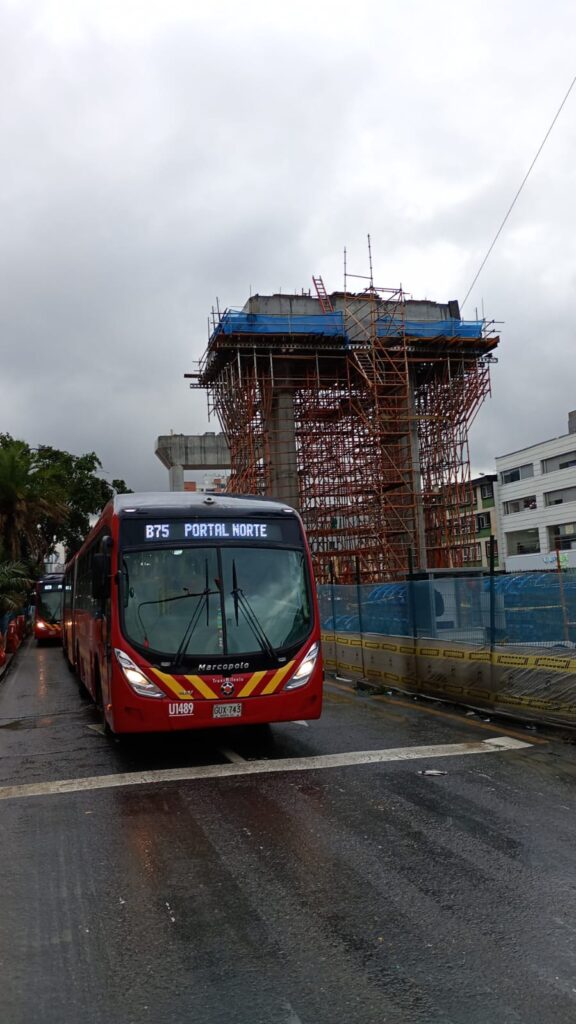
The Metro columns are popping up along the Caracas
The really big local news has been that the Metro is progressing as planned. This might not seem like big news, but given how long the project spent in planning and the tendency of the president to stick his beak in, it’s just good to see something being done.
The first trains have arrived in the country and are running tests while the towering columns of the track are in place all over the city. Today, that means pain as Transmi stations close and traffic is rerouted, but all is in place for a fully integrated public transport system in the future.
RegioTram is also more or less on schedule, although it will need to be reworked to connect with the Bogotá systems, after it was pointed out that the planned stations are a fair distance away from the trnasmi and Metro. Regardless, connecting satellite towns with the capital is a gamechanging proposal.
Life in the city remains irritating due to continued high crime levels and the seeming refusal of Carlos Fernando Galán to do anything about rubbish on the streets. The best that can be said about Gálan at this point is that he has done little of note, hardly a glowing resumé, given his ambitions coming into office.
Culture vultures
Festival Cordillera is now intertwined with la nevera
The capital saw a celebration of Latino music as Festival Cordillera 2025 confirmed the event’s stature as a lodestone of music in Colombia. With Festival Estéreo Picnic 2025 providing a balance that focuses on anglophone music, the capital is well set. However, with both those festivals in the Parque Bolívar, Rock al Parque is struggling to stay relevant.
Plenty of other bands were touring throughout the year too, with Bogotá increasingly on the map for big-name world superstars. That means enduring the likes of Guns N’ Roses, but also means that rolos can see contemporary stars like Dua Lipa.
Former busker Ed Sheeran popped up on stage as a surprise guest of J Balvin in December, while another Brit unsurprisingly failed to turn up because that’s what Morrissey does these days. Latinos across Instagram responded by trolling the famous vegetarian with meat recipes.
Elsewhere online, Colombian food performed well on a host of dubious internet polls, sparkign waves of reposted joy throughout the year. In more dispiriting news, Club Colombia Negra was discontinued by Bavaria, meaning you have few chances to neck the country’s last widely available dark lager.
For those more interested in staying home, Colombia’s first ever board games convention took place in November. Ludotopia was an undisputed success, attracting the likes of Wingspan artist Ana Maria Martínez (who teased the upcoming expansion for Wingspan South America, Central America and Caribbean) and proving that Bogotá retains a dynamic and evolving cultural scene.
Colombia fall just short again
The women’s football team came into the Copa América on good form and were within seconds of taking the title. With two minutes of regular time to go, Mayra Ramírez put Colombia ahead for the third and seemingly last time at 3:2. Brazilian superstar supersub Marta, in her last tournament, broke Colombian hearts as she rolled back the years with a last gasp equalizer in the sixth minute of injury time.
The drama wasn’t over, as she then put Brazil in front for the first time in extra time before Leicy Santos equalized and took the game to penalties. There, the game slipped through the fingers of the superpoderosas as perma-champions Brazil showed their experience. They took the shoot out 5:4 for their 9th title in ten Copa Américas.
The men’s team, also runners up in their Copa América, ground their way to qualification for next year’s World Cup in North America. Conmebol was a slogfest this time around, with everyone except Argentina involved in taking points off each other and goals in short supply.
Eventually, Colombia found form, only losing a single game in the year and finishing with a goalfest against Venezuela, beating their fierce rivals 6-3 in the last game. That leaves Colombia 13th in the FIFA rankings – unlucky for some maybe, but not coach Nestor Lorenzo.
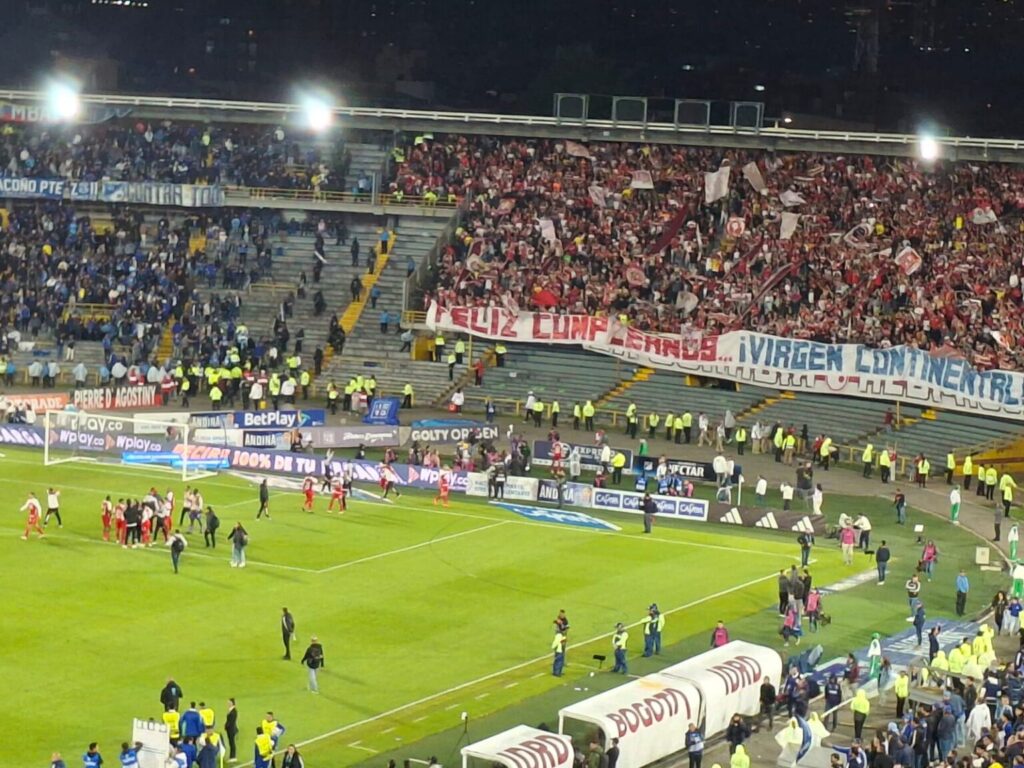
Santa Fe had a sweet victory over Millos en route to the first title
On the local stage, Santa Fe reclaimed the liga apertura for Bogotá, triumphing in Medellín over Independiente thanks to an inspired performance from Wigan legend Hugo Rodellega. Knocking out Millos and El Tigre Falcao on the way made it even sweeter. Junior of Barranquilla took the finalizácion, with Nacional winning the Copa Colombia. The latter was a Medellín derby and marred by a pitch invasion and violence at the end.
Cricket Colombia hit a six as MinDeportes officially recognised the gentleman’s game as a sport in the country. This opens up the field for more funding and support for events. They also welcomed a visiting team from Trinidad and Tobago as well as setting a T20 record for a last wicket chase in the Gulf Series against México.
What’s coming next?
Next year promises much more drama in Colombia, with national elections set to be hard-fought. This is an unusual cycle, as the country is preparing to see who will succeed a leftist president. Whether there will be continuity, a sharp tack rightwards or a drive for the centre is still anyone’s guess.
The lineups for the capital’s big music festivals seem strong, with a supporting cast of superstars also set to tour. The men’s football team have a relatively straightforward group in the World Cup and will fancy themselves to do well.
Our predictions for 2026 will be coming in the next few days, but whatever comes to pass, we’ll be here to keep you in the loop with what’s happening in Colombia and why. We got some of the 2025 calls right, after all. right Happy new year from the Bogotá Post – your English voice in Colombia!
Colombia’s president, Gustavo Petro, triggered yet another diplomatic rupture in South America on Sunday after denouncing Chile’s president-elect, José Antonio Kast, as a “Nazi,” rejecting the legitimacy of Chile’s democratic choice and sharply diverging from the cautious language typically observed between regional leaders.
Petro’s remarks came within hours of Kast’s decisive victory in Chile’s presidential runoff, in which the conservative candidate secured more than 58 per cent of the vote, defeating hard-left contender Jeannette Jara. Jara conceded promptly, saying that “democracy has spoken loud and clear” and wishing Kast success “for the good of Chile.”
Petro, however, used his social media platform X to frame Kast’s victory as evidence of an advancing wave of fascism in Latin America. “Fascism advances. I will never shake hands with a Nazi or a Nazi’s son, nor will I; they are death in human form,” the Colombian president wrote.
In a retort that called for Chileans to “take care of Neruda’s tomb,” Petro went on to equate Kast’s electoral mandate with the legacy of former dictator Augusto Pinochet. “It’s sad that Pinochet had to impose himself by force, but sadder now is that the people choose their Pinochet: elected or not, they are sons of Hitler and Hitler kills the people,” Petro said, adding that Latin Americans “know how to resist.”
The language marked one of the most explicit attacks by a sitting South American president on a democratically elected counterpart in recent years and raised immediate concerns about the state of Colombia – Chile relations, historically among the region’s most stable.
Kast’s victory completes a broader rightward shift in South American politics, following the election of Javier Milei in Argentina, Daniel Noboa in Ecuador and Nayib Bukele in El Salvador, while Bolivia recently ended nearly two decades of socialist rule with the election of centrist Rodrigo Paz. Petro, the region’s most unhinged left-wing leader, with just eight months remaining in his presidential term, appeared to ignore the potential diplomatic fallout of his remarks.
Within hours of Petro’s statement, US Republican Congressman Carlos Gimenez responded sharply, writing: “This guy (Petro) went too far with the drugs and alcohol. This is the real Gustavo Petro: incoherent, hateful, and schizophrenic.”
Former Colombian president Álvaro Uribe Vélez praised Chile’s electoral process and congratulated Kast, saying the vote had taken place peacefully and reflected citizens’ concerns about security and institutional stability. Uribe described Kast as “a guarantee for democratic institutions” in Chile and the wider region.
Another former president, conservative Andrés Pastrana, issued a sharply worded rebuke of Petro, saying the comments were “inappropriate and irresponsible” and did not represent Colombians nor the long-standing spirit of cooperation between Bogotá and Santiago.
Criticism also came from current lawmakers. Federico Hoyos, a congressman from the department of Antioquia, said Petro had “abandoned his role as head of state” and was acting instead as an “ideological agitator “unwilling to engage with leaders who do not share his views. Andrés Forero, a House representative from the opposition Centro Democrático party, accused Petro of disrespecting the sovereign will of Chilean voters, telling Colombians: “Let’s not fool ourselves, Petro is not a democrat.”
While Petro reviles diplomacy, Kast received public congratulations from international figures across the hemisphere. María Corina Machado, Venezuela’ opposition leader and 2025 Nobel Peace Prize Laureate, praised Chile’s election as “an extraordinary electoral day, an example for many nations of Latin America and the world.”
Addressing Kast directly, Machado wrote: “To the president-elect of Chile, José Antonio Kast, I send my affection and congratulations for the trust he has received. In the name of the Venezuelans, I wish him great success in his government.” She added that Venezuelans hoped to count on Kast’s support “to ensure an orderly transition to democracy in Venezuela” and to help build “a safe, prosperous and free hemisphere.”
Machado’s intervention was notable given her continued persecution by the regime of Nicolás Maduro and her public appearance at the Nobel ceremony last week in Oslo, her first in more than a year.
The United States also welcomed Kast’s victory. Secretary of State Marco Rubio said Washington looked forward to working with the incoming administration “to strengthen regional security and revitalise our trade relationship.”
Kast’s transition team said the president-elect would travel to Argentina this week to meet President Javier Milei, signalling an intention to align closely with like-minded governments in the region.
For Petro, the episode reinforces international perceptions that he has become an anachronism of regional politics — reliant on social-media provocation and historical revisionism.
For all the historical accuracy that seems to elude Petro, membership in Adolf Hitler’s National Socialist Party was not voluntary. While many Germans joined out of conviction, others were pressured or effectively compelled to enrol, particularly to obtain employment, documentation or travel permits. During and immediately after the Second World War, Germans seeking to live or work abroad — including in South America — were often required to disclose or document prior party affiliation to secure passports and legal work status, complicating later assessments of individual responsibility.
Michael Kast, born in 1924 in Thalkirschdorf, Bavaria, emigrated in Chile in 1946. His youngest son, José Antonio Kast (born 1966, Santiago) has repeatedly claimed his father was a Third Reich conscript.
Whether the outburst leads to lasting diplomatic consequences remains uncertain. But it has underscored how electoral change in Latin America is now accompanied not only by sharp policy shifts, but by open rhetorical conflict by a Colombian leader increasingly isolated among his regional peers, except for one ally, Venezuelan dictator Nicolás Maduro.
On Monday afternoon, Chile’s Minister of the Interior, Álvaro Elizalde, confirmed that a Letter of Protest will be sent to President Petro, stating in no uncertain terms that: “A decision has been made to uphold the point of view that has to do with Chilean democracy. Ultimately, the people of Chile decide, and we all have to respect that outcome”.
The U.S. seizure of an oil tanker off the Venezuelan coast appears designed to further squeeze the economy of President Nicolás Maduro’s government. The Dec. 10, 2025 operation — in which American forces descended from helicopters onto the vessel — followed months of U.S. military buildup in the Caribbean and was immediately condemned by Venezuela as “barefaced robbery and an act of international piracy.”
The seized tanker, according to reports, is a 20-year-old supertanker called Skipper, capable of carrying around 2 million barrels of oil.
According to the Trump administration, the vessel was heading to Cuba. Given its size, however, it is far more likely that the final destination was China. Tankers of this scale are rarely used for short Caribbean routes; much smaller vessels typically serve Cuba.
The tanker had been sanctioned by the U.S. Treasury in 2022 for carrying prohibited Iranian oil. At the time, it was alleged that the ship — then known as Adisa — was controlled by Russian oil magnate Viktor Artemov and linked to an oil smuggling network.
On the surface, the seizure was unrelated to U.S. sanctions imposed on Venezuela in 2019 and expanded in 2020 to include secondary sanctions on third parties doing business with Caracas.
Venezuelan officials have therefore described the move as unprecedented, and they are largely correct. While Iranian tankers have been seized in the past for sanctions violations, this marks the first time a vessel departing Venezuela with a Venezuelan crew has been taken.
The Trump administration has signaled it intends to seize not only the cargo but the ship itself — a significant loss for the owning company. Because the shipment was sold under a “Free on Board” contract, the buyer assumed responsibility once the vessel left Venezuelan waters.
Nonetheless, the seizure represents a clear escalation in pressure on Venezuela. Reports indicate that around 30 other tankers operating near the country face some form of sanction. These vessels are part of a shadow fleet designed to evade restrictions while transporting oil from Venezuela, Russia, and Iran.
The message from Washington is unambiguous: more seizures may follow as the U.S. seeks to further squeeze Venezuelan oil revenues.
Venezuela’s economy remains overwhelmingly dependent on oil. Although official figures have not been published for seven years, most analysts estimate that oil accounts for more than 80% of exports, with some placing the figure above 90%.
Most Venezuelan oil is sold on the black market, largely to independent refiners in China. Chinese state-owned firms avoid these purchases to limit sanctions exposure, while authorities in Beijing tend to overlook shipments to non-state entities — particularly when tankers conceal their true origin.
An estimated 80% of Venezuelan oil ultimately goes to China through this channel. About 17% is exported to the United States under a Treasury license granted to Chevron, while roughly 3% goes to Cuba, often on subsidized terms.
Oil also accounts for around 20% of Venezuela’s GDP and more than half of government revenue, making the sector indispensable to Maduro’s survival.
Crucially, Venezuela’s oil industry was already in steep decline before U.S. sanctions began. Production peaked at 3.4 million barrels per day in 1998, fell to 2.7 million by the time Maduro took office in 2013, and dropped to 1.3 million barrels per day by 2019.
The 2019 oil sanctions shut Venezuela out of the U.S. market, forcing it to rely more heavily on China and India. When secondary sanctions followed in 2020, Europe and India halted purchases altogether. Combined with the pandemic-driven oil slump, production collapsed to just 400,000 barrels per day.
Output has since recovered to about 1 million barrels per day, aided largely by Chevron’s continued operations.
To sustain exports, Venezuela relies on a shadow fleet that uses false flags, renamed vessels, and manipulated transponders. Cargoes are sometimes transferred at sea — posing major environmental risks — before being relabeled in transit hubs such as Malaysia and shipped on to China.
The tanker seizure had little immediate impact on global oil prices due to ample supply and Venezuela’s limited market share. However, a more aggressive U.S. campaign could change that calculus.
For Venezuelan oil prices, the consequences may be sharper. Already heavily discounted due to sanctions risk, Venezuelan crude is now likely to be sold at even steeper reductions. Buyers will demand higher discounts and fewer prepayments, while export volumes may fall, forcing production cuts that are costly to reverse.
The result will be further pressure on the limited revenues Maduro depends on to keep the Venezuelan state afloat.
About the author: Francisco J. Monaldi, Ph.D., is the Wallace S. Wilson Fellow in Latin American Energy Policy and director of the Latin America Energy Program at the Center for Energy Studies at Rice University’s Baker Institute for Public Policy.
This article is reproduced from The Conversation under a Creative Commons licence
Colombia’s Foreign Minister Rosa Villavicencio declared Thursday that the Government of President Gustavo Petro is “not in agreement” with the Nobel Peace Prize awarded to Venezuelan opposition leader María Corina Machado – a position that signals how Colombia remains a close ideological ally of one of the hemisphere’s most authoritarian states.
In remarks that were evasive at best and obtuse at worst, Villavicencio told Caracol Radio that Colombia did not send a delegation to the ceremony in Oslo because the prize “should not be granted to someone who incites aggression.” She accused Machado of having previously endorsed the possibility of foreign intervention to restore democracy in Venezuela — a talking point aligned with Maduro’s narrative but at odds with the reality of Machado’s persecution and exile.
The foreign minister tried to soften the blow by reminding listeners that the Norwegian Committee is “autonomous,” line repeated several times as if to imply Colombia’s hands were tied. But the message was unmistakable: Colombia has chosen the comfort of accommodating a dictatorship over defending a peaceful transition to democracy in Venezuela.
The Petro administration’s stance also signals how a government that claims to champion human rights now shows deference to regimes that imprison, torture, censor, and force political opponents into hiding. Colombia has deliberately refused to stand with a woman who risked her life to defend the most essential freedoms for all Venezuelans.
The contrast between Colombia’s silence and the global celebration of Machado cannot be more glaring. Leaders across Europe, Latin America, and the United States praised her courage, while King Harald of Norway presided over a ceremony attended by Argentina’s Javier Milei, former Colombian president Iván Duque, Panama’s José Raúl Mulino, Ecuador’s Daniel Noboa, and Paraguay’s Santiago Peña.
Machado’s Escape Exposes Bogotá’s Moral Vacuum
While Colombia questions the legitimacy of the award, Machado herself undertook a dramatic escape that underscored the brutality of the regime she confronts – and the grotesque irony of Bogotá’s position.
According to a Wall Street Journal investigation, Machado disguised herself with a wig, crossed ten military checkpoints, boarded a fishing boat to Curaçao, and flew to Oslo on a private jet. After more than a year in hiding, she emerged publicly in Norway. Her daughter, Ana Corina Sosa, accepted the Nobel Prize on her behalf during a emotional ceremony on Wednesday, December 10.
Machado’s audacity – and the global admiration it generated – stands in stark contrast to Colombia’s political miscalculations.
Villavicencio justified Colombia’s position by claiming Machado had “accepted any kind of military intervention” in Venezuela. But the remark functioned less as diplomacy and more as justification for a government unwilling to break ranks with a regime that operates as the “criminal hub of the Americas”.
Machado told reporters on Thursday, that Venezuela “has already been invaded” by Russian agents, Iranian agents, and terrorist groups Hezbollah and Hamas. “What sustains the regime is a very powerful and strongly funded repression system. Where do those funds come from? Well, from drug trafficking, from the black market of oil, from arms trafficking and from human trafficking. We need to cut those flows,” stated the Laureate next to Norway’s Prime Minister Jonas Gahr Stoere.
Machado has pledged to return to Venezuela with her Nobel Prize and insists her country will become democratic and free. She has denounced the criminal structures that sustain the Maduro regime and highlighted the broader regional security threat it poses.
Meanwhile, Colombia – critical of Israel’s human rights abuses in the Gaza Strip – has yet to condemn the October 7 massacre committed by Hamas, and remains notably quiet on Maduro’s sprawling torture centre, El Helicoide, in central Caracas.
Petro’s increasingly toxic foreign policy with the Trump administration has now crossed an indelible moral line. Latin America’s oldest continuous democracy is now publicly undermining a woman targeted by a dictatorship. In doing so, Colombia has distanced itself from other Western nations defending democratic ideals and aligned itself more closely with those eroding them.
The foreign ministry insists its position is based on principle. But to much of the international community, and to a majority of Colombians, the reality is unavoidable: the Petro government is no longer neutral, no longer cautious, and no longer a credible defender of democratic values. It has willingly taken Maduro’s side – and revealed a profound lack of moral courage on the world stage.
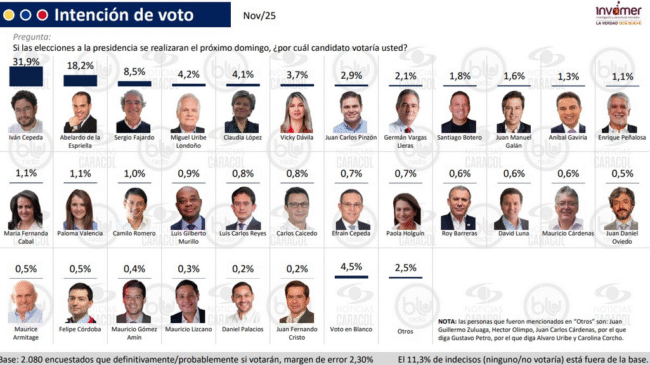
Senator Iván Cepeda of the ruling Historic Pact coalition has emerged as the early front-runner in Colombia’s 2026 presidential race, according to a nationwide Invamer poll released Sunday by Caracol TV and Blu Radio. The survey – the first major measurement since the lifting of Colombia’s recent polling restrictions – places the left-wing candidate at 31.9% of voting intention, six months ahead of the first round.
The results position Cepeda well ahead of candidate Abelardo de la Espriella of Defensores de la Patria, who received 18.2%, and independent centrist Sergio Fajardo, who registered 8.5%. Miguel Uribe Londoño, running for the leadership of President Álvaro Uribe Vélez’s Centro Democrático party, follows with 4.2%. Uribe Londoño is the father of Senator Miguel Uribe Turbay, victim of an assassination attempt on June 7, and who died two months later at the Santa Fe Hospital in Bogotá.
The findings come amid broad public dissatisfaction with the country’s direction and with the administration of President Gustavo Petro, who leaves office on August 7, 2026. According to the poll, 56% of respondents disapprove of Petro’s administration, while 37% approve. Although disapproval has dipped slightly from previous months, nearly six in ten Colombians remain critical of the government. National sentiment is similarly pessimistic: 59.8% believe Colombia is “on the wrong track,” compared with 34.4% who feel otherwise.
Internal security stands out as the leading concern. Asked whether Petro’s “Total Peace” policy had made them feel safer, 66.2% claim it made them feel more insecure. Nearly 65% believe the initiative is moving in the “wrong direction”, and 73% say the government has lost territorial control to illegal armed groups. Only 20% expressed confidence in the government’s peace and security approach.
The Invamer survey, conducted between November 15 and 27 among 3,800 respondents in 148 municipalities, does not include public reaction to the latest scandal involving alleged infiltration of state institutions by FARC dissidents. The poll has a 1.81% margin of error and a 95% confidence level.
Cepeda’s lead reflects firm support among left-leaning voters and measurable gains among independents and left-leaning centrists. Though only 24% of those polled identified themselves as “left-wing”, the senator’s 31.9% support suggests he is drawing backing among younger voters. He also carries a relatively high rejection rate: 23.9% said they would “never” vote for him.
The survey challenges the perception that Cepeda lacks room to grow beyond the left, even as 50% expressed that they would prefer to vote for a candidate opposed to Petro. Analysts believe the Historic Pact’s decision to hold its internal consultation last month helped consolidate support within the coalition and gave Cepeda a strategic advantage.
The Invamer poll of Colombia’s of 30 presidential candidates. Photo: Caracol/Blu Radio.
Despite his lead, Cepeda could face voter rejection should Petro’s disapproval ratings continue to climb. The candidate’s current negative rating is among the highest of any public figure, and his pro-Petro agenda on security, economy, and U.S relations could push the center closer to the moderate right. Still, the poll indicates Cepeda would win a runoff against De la Espriella with a wide margin, but face a “technical tie” with the mathematician and former Governor of Antioquia.
De la Espriella, meanwhile, has quickly consolidated the anti-Petro vote, emerging as a “dark horse” at the extreme right of the spectrum. Once absent from early electoral projections, the lawyer now surpasses established Centro Democrático politicians – including senators María Fernanda Cabal, Paola Holguín, and Paloma Valencia.
Former defense minister under President Juan Manuel Santos and ex-Ambassador to Washinton, Juan Carlos Pinzón, is in seventh place (2,9%), but these early numbers are likely to increase, given that he maintains a close relationship with three ideological camps (Centro Democrático, La U, Cambio Radical) represented in Presidents Uribe and Juan Manuel Santos, and German Vargás Lleras.
Even though the poll found that 63% of eligible voters know who De la Espriella is, there is room for continued growth for the five candidates who marked above 2% in the poll, among them, Vargas Lleras in fifth place (2.1%).
The centrist bloc, historically influential in Colombian politics, appears fragmented. Fajardo, once considered a reliable alternative to both left and right, no longer polls in double digits. While he maintains a lower rejection rate than most rivals and doubles the numbers of former Bogotá mayor Claudia López (4.1%), analysts say the proliferation of centrist candidates could dilute Fajardo’s base. Combined, these candidates would outpace De la Espriella’s support, but the numbers suggest this does not translate into a cohesive electoral force.
Foreign policy is also shaping voter priorities. A large majority – 78% – said maintaining strong relations with the United States is essential for the next administration. Respondents widely rejected Petro’s decision to use a megaphone in New York to urge U.S. soldiers not to follow orders from former President Donald Trump; 78% disapproved of the act, even though half of respondents hold an unfavorable view of Trump.
President Petro reacted to the poll on social media, framing the electoral landscape as a struggle between entrenched elites and what he described as a “powerful people” seeking to reclaim the state. Referring implicitly to Uribe and Fajardo, the president said Colombia must reject “mafioso elites” and work toward a “free and educated” society.
The Centro Democrático announced it will conduct an internal vote among more than 4,000 active party members to select two candidates for a March 2026 primary. The contenders are senators Cabal, Holguín, and Valencia, and Miguel Uribe Londoño.
With six months until the first round on May 31, 2026, the Invamer poll highlights a polarized electorate, deep concerns over security and corruption, and an early advantage for the ruling coalition’s candidate — with substantial uncertainty and new political alignments spearheaded by former presidents, especially Álvaro Uribe.

 Login
Login