New laws and sophisticated blocking techniques are making VPN use in Russia increasingly difficult. Here's what changed last year and what to expect over the next 12 months.
AdGuard VPN's TrustTunnel is already being used across AdGuard VPN apps and is now available to "use, run, tweak, extend, and build upon," said the provider.
AdGuard VPN's TrustTunnel is already being used across AdGuard VPN apps and is now available to "use, run, tweak, extend, and build upon," said the provider.
Colombia and Ecuador have started exchanging trade retaliations after Ecuadorian President Daniel Noboa announced a 30% “security” tariff on imports from Colombia, escalating tensions between Andean neighbours over border security cooperation.
Noboa said the measure would take effect on Feb. 1 and would remain in place until Colombia shows “real commitment” to jointly tackle drug trafficking and illegal mining along the shared frontier. He made the announcement from Davos, where he is attending the World Economic Forum.
“We have made real efforts of cooperation with Colombia… but while we have insisted on dialogue, our military continues facing criminal groups tied to drug trafficking on the border without any cooperation,” Noboa said in a post on X, citing an annual trade deficit of more than $1 billion.
Colombia’s foreign ministry rejected the tariff in a formal protest note, calling it a unilateral decision that violates Andean Community (CAN) rules, and proposed a ministerial meeting involving foreign affairs, defence, trade and energy officials on Jan. 25 in Ipiales, Colombia’s southern border city.
The government of President Gustavo Petro also announced a 30% tariff on 20 products imported from Ecuador in response, though it has not specified the items. Diana Marcela Morales, Colombia’s Minister of Commerce, Industry and Tourism (MinCIT) said Ecuador’s exports covered by the retaliatory measure total some $250 million, and described the policy as “temporary” and “revisable.”
Fedexpor, Ecuador’s exporters federation, said non-oil exports to Colombia rose 4% between January and November 2025, and that the Colombian market receives more than 1,130 Ecuadorian export products. The top exports include wood boards, vegetable oils and fats, canned tuna, minerals and metals, and processed food products.
The dispute has also spread into the energy sector. Colombia’s Ministry of Mines and Energy said on Thursday it had suspended international electricity transactions with Ecuador, citing climate-related pressure on domestic supply and the need to prioritise national demand amid concerns over a possible new El Niño weather cycle.
Ecuador has struggled with severe droughts in recent years, triggering long power cuts in 2024 and 2025 in a country where roughly 70% of electricity generation depends on hydropower, while Colombia has supplied electricity during periods of shortage.
President Petro noted that Colombia acted in solidarity during Ecuador’s worst drought in 60 years. “I hope Ecuador has appreciated that when we were needed, we responded with energy,” Petro said on Wednesday.
Following Colombia’s electricity suspension, Ecuador announced new tariffs on transporting Colombian crude through its heavy crude pipeline system. Environment and Energy Minister Inés Manzano said the oil transport fee through the OCP pipeline would reflect “reciprocity,” without giving details.
Colombia and Ecuador share a 600-kilometre border stretching from the Pacific coast to the Amazon, where Colombian armed groups and criminal networks operate, including organisations involved in drug trafficking, arms smuggling and illegal mining. Relations between Petro and Noboa, who sit on opposite ends of the political spectrum, have frequently been strained.
U.S. President Donald Trump said on Tuesday there was “no going back” on his goal to bring Greenland under U.S. control, refusing to rule out the use of force and escalating tensions with European allies already bracing for a renewed transatlantic trade dispute.
Trump’s remarks followed a series of social media posts featuring AI-generated images, including one depicting the president standing in Greenland holding a U.S. flag and another showing a map of North America with Canada, Greenland and Venezuela covered by the stars and stripes.
The imagery, shared without official explanation, has fuelled alarm among allies and raised questions about the blurring of political messaging and artificial intelligence at a moment of heightened geopolitical strain.
“As I expressed to everyone, very plainly, Greenland is imperative for National and World Security. There can be no going back — on that, everyone agrees,” Trump said after speaking with NATO Secretary General Mark Rutte.
Greenland, a vast Arctic island rich in minerals and strategically located between North America and Europe, is a self-governing territory of Denmark, a fellow NATO member. Trump’s renewed push to acquire it has revived a proposal he first floated during his previous term, but has now been accompanied by explicit warnings of tariffs and the possible use of force.
European leaders reacted with unease. Danish Prime Minister Mette Frederiksen told parliament in Copenhagen that “the worst may still lie ahead.”
“We can negotiate about everything — security, investments, the economy — but we cannot negotiate our most fundamental values: sovereignty, our country’s identity, our borders and our democracy,” Frederiksen said.
At the World Economic Forum in Davos, European Commission President Ursula von der Leyen urged the bloc to prepare for a more confrontational era.
“The seismic change we are going through today is an opportunity — in fact a necessity — to build a new form of European independence,” she said.
Trade war fears resurface
Trump has threatened steep tariffs on countries he says stand in the way of U.S. interests, including European allies involved in NATO exercises in Greenland. The European Union has warned it could retaliate with tariffs on up to €93 billion ($101 billion) of U.S. imports if trade measures are imposed.
One option under discussion is the EU’s Anti-Coercion Instrument, a powerful tool that could restrict access to public tenders, investment or services, including digital services where U.S. companies hold a surplus.
U.S. Treasury Secretary Scott Bessent sought to calm markets and dismissed fears of an escalating trade war.
“It’s been 48 hours. Sit back, relax,” Bessent told reporters in Davos. “Calm down the hysteria. Take a deep breath.”
Financial markets were less sanguine. U.S. stock index futures slid to one-month lows, global equities fell, and gold prices touched record highs as investors sought safety.
Canada and Venezuela react
The inclusion of Canada and Venezuela in the AI-generated map added to the controversy.
Canada, a close U.S. ally and NATO member, has previously been the subject of Trump’s rhetoric suggesting it could become the “51st state.” Canadian Prime Minister Mark Carney said he was “concerned” by the escalation and warned of the implications for North American and transatlantic security.
Canadian officials said Ottawa has drawn up plans to send a small contingent of soldiers to Greenland to participate in NATO military exercises, pending final approval from Carney. Canada already has aircraft and personnel deployed there as part of a NORAD exercise involving the United States.
Venezuela’s government condemned Trump’s post and called on citizens to share the country’s official map online in what officials described as a symbolic defence of sovereignty.
Russia weighs in
Russia, which has closely watched the growing rift between Washington and Europe, questioned Denmark’s sovereignty over Greenland. Foreign Minister Sergei Lavrov said the island was the result of “colonial conquest,” while denying Moscow had any designs on the territory.
Protesters also took to the streets in several European cities, including Zurich, where demonstrators carried banners opposing Trump’s appearance at Davos and denouncing what they called imperialist policies.
Despite pushback from allies and some members of Congress, Trump has shown no sign of softening his stance, leaving diplomats and markets braced for further escalation as NATO cohesion and global trade relations come under renewed strain.
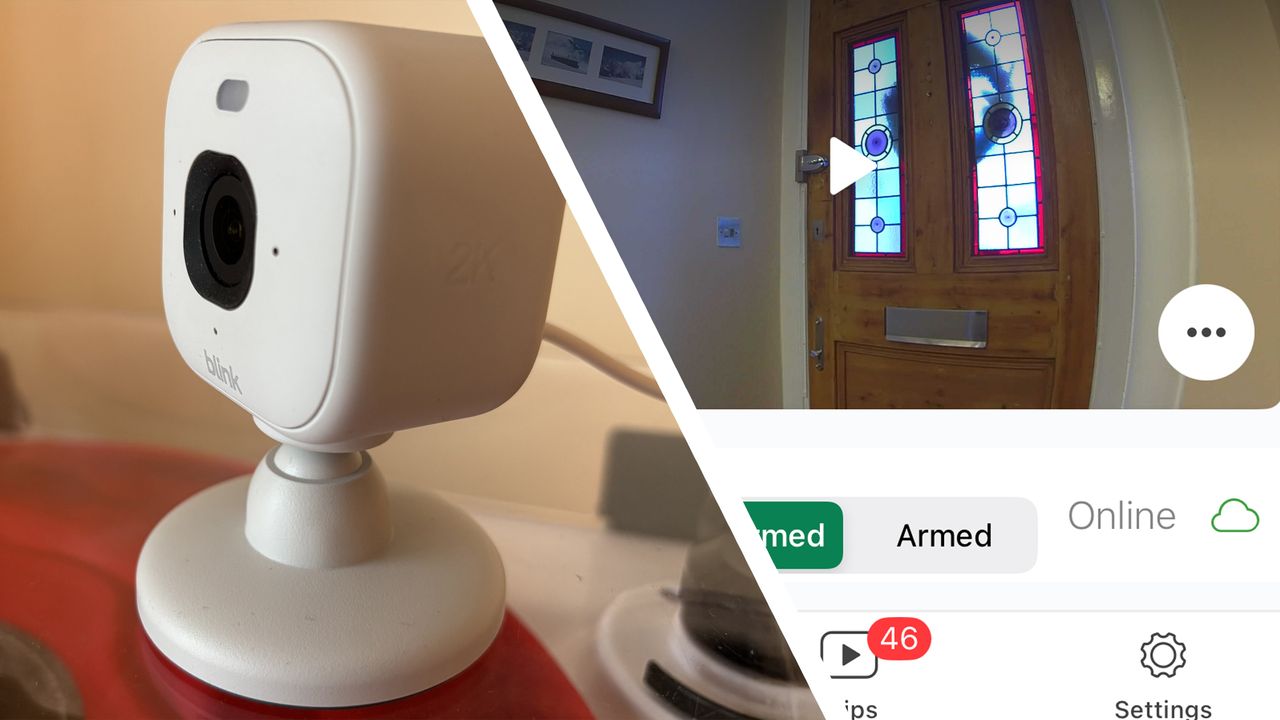
Boasting 2K video resolution, the tiny Blink Mini 2K+ also offers improved night vision over its predecessor thanks to the inclusion of a strong spotlight.
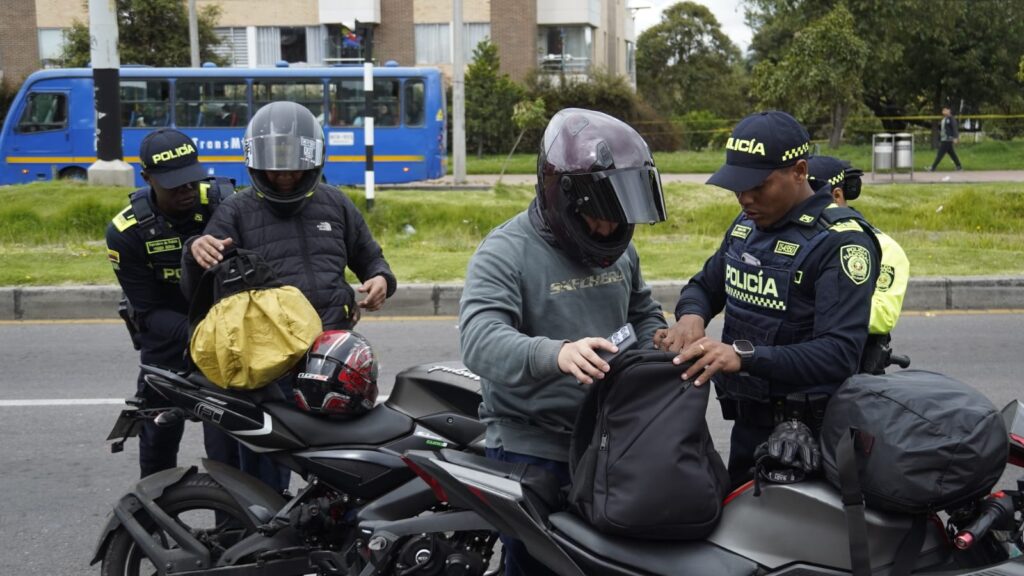
Police hunting suspected gang members on the streets of Bogotá. Photo Secretaría de Seguridad.
Bogotá’s mayor and security chiefs celebrated some positive results last week with stats showing an overall reduction of high-impact crimes in the city during 2025, with the murder rate dropping in the city even as violent deaths increased across Colombia.
“In Bogotá in 2025, there were fewer homicides robberies, fewer vehicle thefts, fewer motorcycle thefts, fewer cases of extortion, more drug seizures, more weapons seizures, and more arrests,” said Bogotá´s mayor Carlos Galán, presenting a security scorecard showing security shifts in the first two years of his administration.
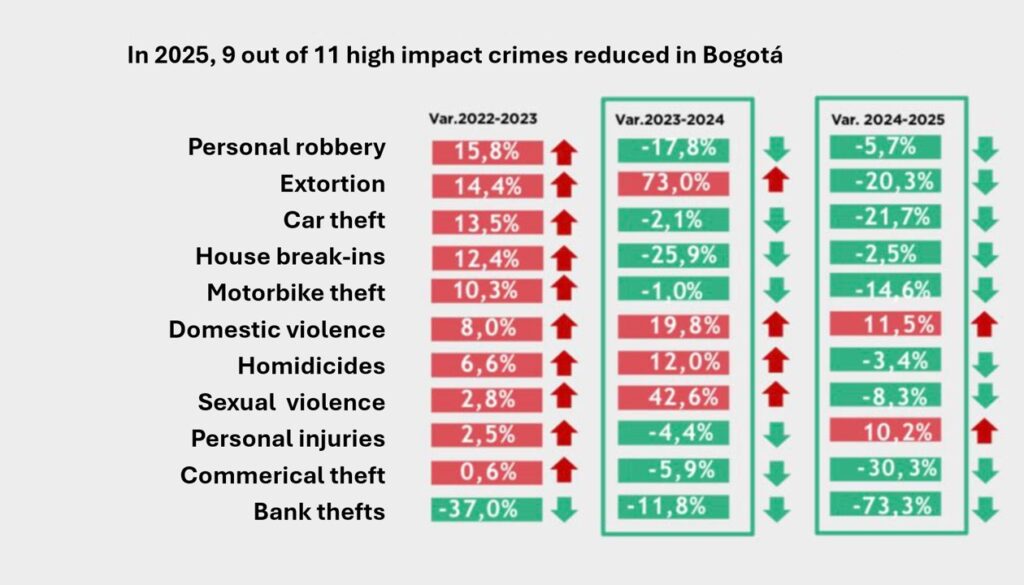
Some decreases were significant, such as extortion cases dropping by 20 per cent, stolen car cases by 22 per cent and commercial theft by 30 per cent. Others were less impressive: street robberies only reduced by 6 per cent, and cases of sexual violence by 8 per cent.
Official data presented by Bogotá’s mayor this week shows an overall reduction in high impact crime. Source: Secretaría de Seguridad
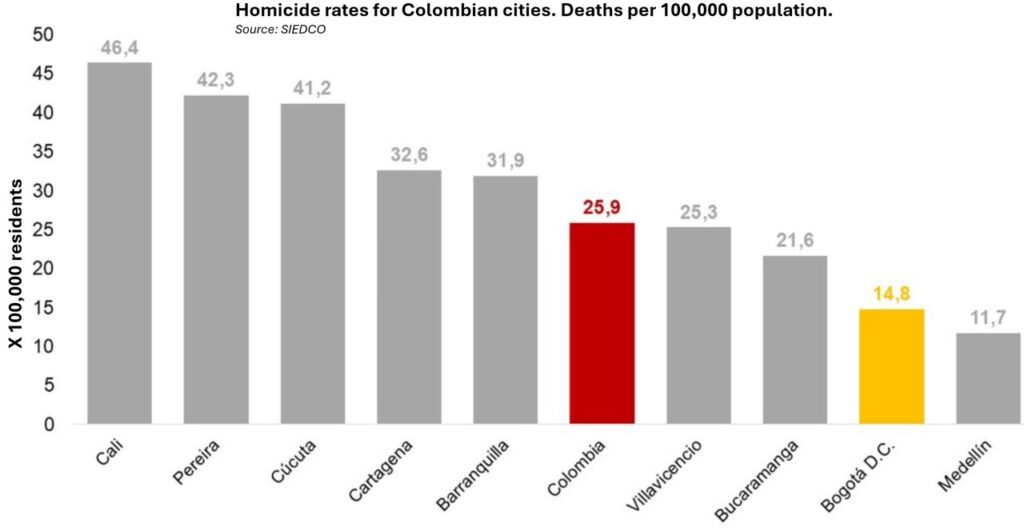
Homicides, perhaps the most significant metric, reduced last year by just 3.4%, with 1,165 killings recorded on the national police database compared to 1,214 in 2024. This gave Bogotá – with a population of around 8 million – a current homicide rate of 14.8 deaths per 100,000 of the population, according to the standard formula used to compare deaths across varying population sizes.
Limited success
This was way short of Mayor Galán’s stated goal of 8 deaths per 100,000 during his four-year tenure, but a better result than the national one. At 14.8, Bogotá’s homicide rate was considerably lower than Colombia’s national figure of 25.9 deaths per 100,000 of the population, based the alarming total of 12,484 violent deaths reported nationwide – a two per cent increase on the previous year.
City security secretary César Restrepo also pointed out that Bogotá had proportionally less murders than other major cities such as Bucaramanga, Cartagena, Barranquilla, Pereira and Cali (see table below). Medellín, however, bested the capital with a reduced rate of 11.7 per 100,000.
Comparison of homicide rates across Colombia. Adapted fromSecretaría de Seguridad
And in our own comparison with cities worldwide, Bogotá’s homicide rate was lower than Washington D.C. (17 per 100,000) Baltimore (23 per 100,000) or New Orleans (33 per 100,000) but much higher than most European cities such as London (currently at 1 per 100,000) or Berlin (3 per 100,000).
Backdrop of violence
The challenges facing Bogotá in reducing violence against a national backdrop of increasing insecurity were highlighted in a recent study by think tank Centro de Paz y Seguridad Externadista which compared homicides rates between recent national governments.
The current Petro government reported 40,633 violent deaths during its first three years, an increase of 11 per cent over the same period for the Juan Manuel Santos government (2014 to 18) and seven per cent higher than during Ivan Duque’s tenure from 2018 to 2022.
The data pointed to a failure of the Petro’s Paz Total (‘Total Peace’) process which reduced military pressure on illegal armed groups allowing them to expand their range and illegal activities in the last three years, concluded the report.
“Although the government insists that the national conflict is de-escalating, the figures point to another scenario: homicidal violence remains at high levels,” said study leader Andrés González in December presenting the findings on YouTube.
González also pointed out that while most territorial battles took place in rural areas, the effects reflected in urban hubs where local crime groups – often with links to larger armed groups – used lethal violence in conflicts linked to extortion and micro trafficking.
Catch and release
Another challenge for Bogotá’s security was the low conviction rate for captured criminals, according to city police chief Giovanni Cristancho in an interview with El Tiempo. Out of 33,000 criminals arrested in the city in 2025, less than 10 per cent ended up in jail, he said.
Criminals showed little fear of the justice system, and many caught by the police were multiple offenders, said Christancho, with the police having to “catch the same person 20 times”.
Recycling criminals back on the streets was “outside the control of the district government”, security chief Restrepoalso told El Tiempo last week, but recognised it reflected badly on the city administration.
“Most citizens express their annoyance because criminals are either released or not convicted. As long as these other conditions remain unresolved, all the results we announce will continue to generate frustration among the public,” he said
This chimed with a common perception in Bogotá that even if the police are clamping down, the justice system as a whole is failing the city. Those concerns were echoed in a recent public survey by city watchdog Bogotá Como Vamos that found that a 62% of respondents perceived Bogotá as less secure, the highest figure recorded since 2008.
Catch and kill
Low conviction rates could explain the resurgence of vigilante justice being meted out by frustrated rolos in recent years, with groups of citizens organizing to capture and beat offenders, sometimes tying them to lampposts or parading them naked through neighborhood and posting videos on social media.
Barrio justice has long been a problem in Bogotá; a study from 2016, reported in The Bogotá Post, showed an average of one lynching death every three days over a 12 month period in the city.
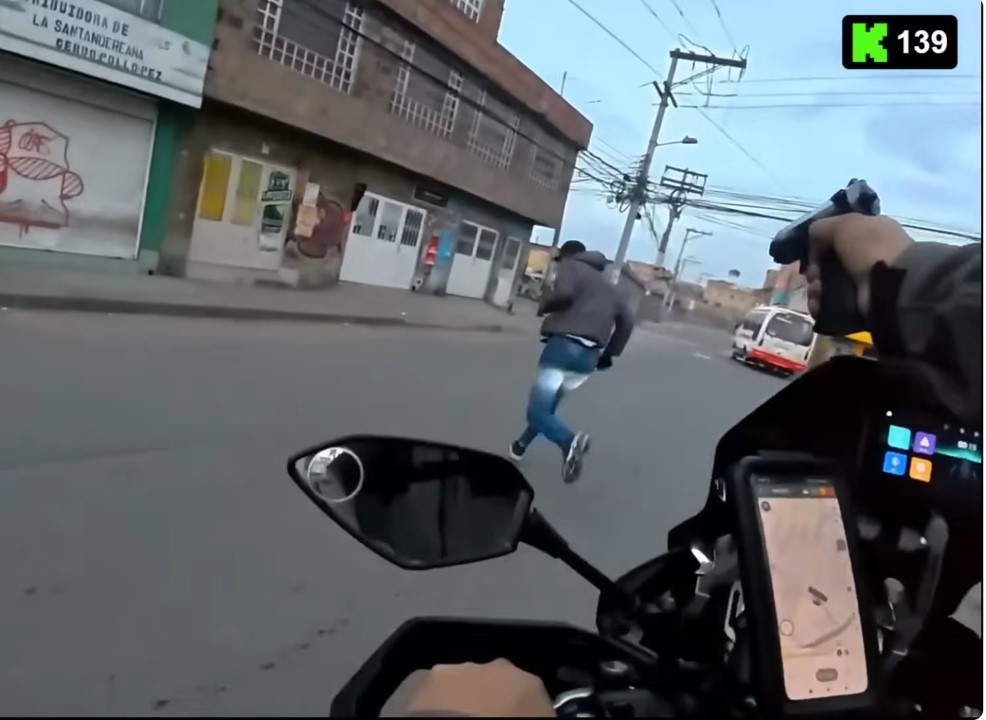
A more recent phenomenon in the city is the rise of fleets of armed private security guards mounted on motorbikes chasing down stolen vehicles.
Screenshot from Youtube video of private security guard opening fire on suspect car thief in downtown Bogotá. Vigilante firms are increasingly acting as law enforcement, often at risk to the public.
One company, Self Security GPS, uses satellite tracking and immobilizer devices to recover stolen vehicles, but also regularly posts alarming videos of their ‘commandos’ taking down car thieves, sometimes with dramatic shoot-outs on the street with passers-by diving for cover.
According to data from the mayor’s office, at the last count, there were 150,000 private security guards “supporting security in Bogotá” – far outnumbering the 17,500 uniformed police.
Increasingly though, frustration among everyday citizens has boiled over into drastic reactions to street crime. Such an attempt at instant justice ended in tragedy last week with three deaths after a Bogotá driver was robbed at gunpoint by two masked robbers on a motorbike; the victim gave chase and crushed the fleeing assailants with his pick-up truck. In the ensuing multi-vehicle crash one of the robbers was killed, along with two innocent travelers who also lost their lives.

 Login
Login