Apple has issued an important software for iOS 18 users who are holding out and avoiding iOS 26 for whatever reason. Specifically, iOS 18.7.7 for all iPhone models running iOS 18 (not running iOS 26 or newer), along with iPadOS 18.7.7 for all iPad users with iOS 18 (also not running iPadOS 26 or newer), ... Read More
Residency ‘R’ visas issued before 21 October 2022 need to be transferred to 5-year electronic format by October 31, 2026, Failure to comply could risk losing residency status.
Colombia’s cancilleria (foreign affairs ministry) was reminding foreign residents this week of the 2026 deadline to transfer their old resident visas to the new 5-year electronic visa scheme.
“Anyone with these visas, granted under previous regulations, must complete the mandatory process before October 31, 2026, before the Visa Authority,” announced the government, referring to resident ‘R’ visas issued before October, 2022, when new visa regulations came into effect.
Failure to transfer your visa by October 31 could lead to sanctions or even losing your residency status.
And even though the October deadline seems far away, the Cancilleria are expecting a flood of last-minute applications. Our advice is: don’t leave it to the last minute. Government websites are clunky at the best of times and you will need at least one appointment with Migración, which will be harder to get as the deadline approaches.
To avoid last-minute panic, here’s a quick Q and A to get ahead of the game…
I have a permanent ‘R’ residents visa in my passport. Surely that’s OK?
No. Under new laws passed in 2022 (law 5477 to be precise), all R visas for long-term residents are now subject to a transfer every five years, which also coincides with the lifespan of the Cedula Extranjeria (Colombian-issued ID card). So even if the visa stamp in your passport says indefinida, you still need to do the transfer.
The traspaso applies to:
All Resident (R) visas issued before October 21, 2022.
Any new R e-visas after five years (the expiry date is written on the visa).
If you change passports for any reason (expired, lost or stolen).
If you have a passport about to expire it makes sense to renew the passport before the visa transfer.
So, do I have to start the whole visa application process again?
No. The traspaso is relatively simple and can be done mostly online, directly with the Cancilleria website. Although touted as a ‘transfer’, in most cases you will be issued with a new visa number in an electronic format that will be sent to you by email. You can then print your own e-visa and carry it with your passport and store it in your phone.
Other steps require visiting your nearest Migración office.
What are the steps?
Obtain your Migration Movement Certificate from the nearest Migration Office.
Apply online for visa traspaso. Wait for the e-visa to be issued.
Register your new e-visa and apply for a new Cedula Extranjeria ID card online.
Make an appointment with Migration Office for your biometric data.
Collect your new Cedula Extranjeria ID card.
How much does it cost?
Around US$ 213 in total at current exchange rates. This breaks down to: US$25 for the Migration Movement Certificate, US$54 for the visa study, US$54 for the visa issuance, US$80 for a new replacement ID card (Cedula de Extranjeria).
What’s the Migration Movement Certificate?
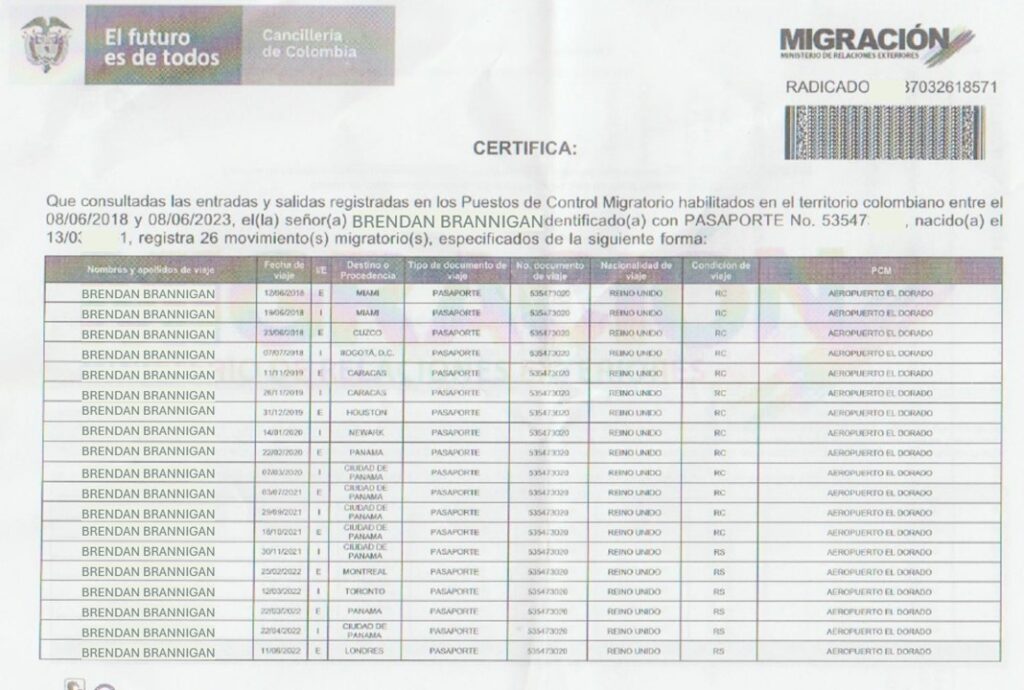
Before applying for the traspaso, you need to obtain Certificado de Movimientos Migratorios, which is a printed certificate issued by Migración showing your entrances and exits from Colombia. The purpose of the certificate is to show your presence in Colombia. If you have been absent from the country for more than two years your residency status is automatically cancelled. You can apply and pay for the certificate online at the Migración website Formulario Único de Trámites page.
Be careful to select the centro facilitador (Migration office) that is closest to you because you must collect the printed certificate in person from the office. Also select the 10-year option for the certificate’s timeframe.
Not usually. One you have applied online, Migración will send you an email within three days notifying that your certificate is ready. You can go to the office and skip the lines by showing the email to the door staff. The counter staff will then print off the certificate. There is usually no need to make an appointment.
Can I get the certificate from overseas?
At present, Migración is only giving the option to collect the certificate in person in Colombia. This is one way to ensure that the visa holder is resident in Colombia. The option to collect in an overseas – i.e. at Colombian consulates – could change in the future.
Example of the printed Certificado de Movimientos Migratorios.
OK, so what about the visa transfer?
Now you need to the visa website at www.cancilleria.gov.co, and navigate to the visa page called the SITAC. Note there are English and Spanish pages (the Spanish version sometimes works better).
Fill in your details to enter the system, then select ‘Visa traspaso’ from the dropdown menus. You will also be asked to click on the timeframe when your original ‘R’ visa was issued. You will then be told what documents to present; these can be uploaded in PDF.
The visa application page on the Cancelleria website. Choose ‘traspaso’ from the options.
What documents are required?
This varies depending on your type of Resident visa and when it was issued, but generally:
Scan of your original R visa.
Scan of your passport main page.
Scan of your current Cedula Extranjeria.
Scan of your most recent migration entry stamp to Colombia.
Scan of your Migratory Movements Certificate issued by Migración.
Letter requesting the transfer, explaining the reason for the request (i.e. ‘para cumplir con Ley 5477 de 2022’).
Passport-style digital photo meeting the specifications.
Holders of permanent resident visas do not need to provide any more information. Other types of R visas might require evidence that the conditions under which the visa was granted still applies.
How do I pay?
The fees are divided into a US$54 ‘study’ fee, which is paid on submission of the documents. When the visa transfer is approved you pay an additional ‘visa issuance fee’ of US$54. Payment is also online by Colombian PSE bank transfer scheme, or you can use Visa or Mastercard credit cards.
Is that the traspaso done?
No. Once your e-visa is sent to you be email, you need to register your visa and apply for a new Cedula Extranjeria ID card within 15 days of receiving the new e-visa. The initial application and payment is done online, using the Formulario Único de Trámites page. Tick the Cedula Extranjeria box and select your nearest Migración office from the drop-down menu.
You’ll need to provide more information, scans, and an US$80 payment.
Back to the FUT page, but this time for the Cedula and visa registration.
Surely that’s the end of it?
Nope. Now you need to make an appointment with the same Migración office to provide biometric data for your new CE. To make an appointment, first register with the website here. Slots for the following week are allocated often at 5pm on Sunday, so try at this time.
If there are no slots available, take a screenshot of the appointment page as you can later use this as evidence to prove you were trying to comply with the 15-day plan (Migración sometimes sanction visa holders for not registering on time).
If you do not get an appointment within 15 days don’t worry; with your screenshots of the full agendas, Migracion are unlikely to complain. Everyone knows the system is overloaded.
What about my Cedula de Extranjeria?
Another delay: some people wait months for the plastic card, though lately the wait has been getting shorter. You can use your old CE or your passport in the meantime.
Should I hire a commercial visa company to do the paperwork?
The Cancilleria recommends applicants to apply directly for the traspaso directly via the website. However, commercial visa companies can assist with the paperwork but will charge a fee up to several hundred dollars. Try the process yourself before seeking professional help.
On March 22, American Airlines flight attendant Eric Gutierrez went missing after a night out in Medellín.
Less than a week later, authorities found his body in a river three hours away from the city. They concluded he had not died of natural causes.
The U.S-Salvadoran citizen’s murder is the latest in a string of tourist deaths in the Colombian city famous for its nightlife.
But, in conversation with The Bogotá Post, Medellín’s Secretary of Security, Manuel Villa Mejía, offered reassurances that the city remains a safe destination for tourists and shared tips to stay safe.
Is Medellin a safe destination?
Gutiérrez, 32, appears to have been a victim of scopolamine robbery, in which thieves use the toxic drug to daze and incapacitate their targets. For years, this method has been well documented in Colombia, which is believed to have the highest number of cases in the world.
Medellín has a reputation as a party city and, accordingly, is often associated with stories about scams, druggings, and robberies.
But Villa Mejía insisted that the city does not tolerate criminal activities: “Our message is clear: there is no place for crime in Medellín.”
He highlighted the city’s recent security strategy to tackle crime, including increasing police presence in nightlife hotspots, dismantling gangs, and enhancing video surveillance.
The Secretary of Security noted how safety in Medellín – once the world’s murder capital – has dramatically improved in recent decades.
“Today is an example of how security can be improved through strategy, consistent effort, and institutional coordination,” said Villa Mejía.
He noted that the city’s homicide rate has fallen for two consecutive years, now standing at 10 per 100,000 inhabitants.
Villa Mejía compared this rate to U.S. cities like Atlanta (51), Washington D.C. (51), and Chicago (73).
“Although there is still a long way to go—since the only acceptable figure is zero—these advances reinforce our commitment to continue working every day to protect the lives, safety, and peace of mind of those who live in and visit the city,” said the Secretary of Security.
Tips to stay safe
While Villa Mejía defended Medellín’s record on crime, he also said that tourists must take precautions to avoid ending up victims of robbery or worse.
“We invite all travelers to enjoy the city at their leisure, but also to exercise caution and act responsibly,” said Villa Mejía.
He recommended that travellers use trusted transportation, avoid displaying large amounts of money or expensive jewellery in public, and stay in safe areas where police are present.
Villa Mejía also stressed the dangers of meeting strangers, especially online. He added that travellers who meet a stranger in person should avoid accepting drinks from them and not follow them to an unknown location.
“The main recommendation is to stay in control of your surroundings,” concluded the Secretary of Security.
Colombia is on the verge of banning female genital mutilation (FGM), as lawmakers advance legislation that would outlaw a practice still reported in parts of the country, making it the only nation in Latin America where cases have been documented.
In a unanimous decision, the First Commission of the Senate approved the bill in its third debate, leaving just one final vote in the full chamber before it can become law — a significant step in addressing a practice widely condemned as a violation of human rights.
The initiative, known as Bill 440 of 2025 (accumulated with 239 of 2024), seeks not only to prohibit FGM but to eradicate the conditions that allow it to persist, particularly in indigenous communities.
“This is about settling a historic debt with Indigenous women and girls,” Representative Jennifer Pedraza said after the vote. “Eradicating this violent and limiting practice is essential to guaranteeing their health and dignity.”
Globally, more than 230 million girls and women alive today have undergone FGM, according to the World Health Organization. The practice, defined as the partial or total removal of external female genitalia for non-medical reasons, is most often carried out on minors and can lead to severe bleeding, infections, complications in childbirth and long-term psychological trauma.
While FGM is most prevalent in parts of Africa, the Middle East and Asia, Colombia’s case has drawn particular concern due to its singular status in the Americas. Lawmakers noted that the practice disproportionately affects very young girls, often under the age of one, with cases concentrated in the departments of La Guajira, Chocó and Risaralda.
Official data show a gradual decline in reported cases: 91 in 2023, 54 in 2024 and 39 so far in 2025. Authorities caution, however, that underreporting, is pervasive.
The bill marks a strategic shift away from punitive approaches toward prevention, education and intercultural dialogue. Senator Clara López, who led the initiative in the Senate, argued that criminalization alone has failed to eliminate the practice elsewhere.
“In countries where FGM has been banned for decades, prevalence remains high,” López said during the debate, pointing to cases such as Mali and Egypt, where rates have remained above 80% despite legal prohibitions.
The legislation was developed through consultations with Indigenous leaders, including representatives of the Emberá community, where cases have been recorded. Juliana Dominico, a spokesperson for the Emberá, backed the bill while stressing that FGM is not an essential cultural or spiritual practice.
Supporters argue that framing FGM solely as a criminal issue risks driving it underground and alienating communities. Instead, the proposed law emphasizes public health strategies, education campaigns and culturally sensitive engagement to encourage abandonment of the practice.
International bodies have long called for a coordinated response. In 2008, the World Health Assembly adopted Resolution WHA61.16, urging governments to act across sectors including health, education, justice and social services.
Beyond its immediate health risks, FGM is widely recognized as a violation of fundamental rights, including bodily integrity and freedom from cruel or degrading treatment. In some cases, the procedure can be fatal.
The economic burden is also significant. The WHO estimates that treating complications related to FGM costs health systems around $1.4 billion annually, a figure expected to rise without stronger efforts to end the practice.
If approved in its final debate, Colombia’s ban would mark a turning point for the hemisphere, aligning the country with global efforts to eliminate FGM while testing a prevention-focused model that lawmakers hope will succeed where criminalization alone has fallen short.
Apple CEO Tim Cook is celebrating the 50th anniversary of Apple Inc being born, which was officially founded on April 1, 1976, with a nice note and dedicated page on the Apple.com site: “50 Years of Thinking Different”. The anniversary post discusses Apple’s humble origins in a garage, to the first Apple computer, the Mac, ... Read More
Apple has issued the first beta versions of iOS 26.5, MacOS Tahoe 26.5, and iPadOS 26.5, for users who are participating in the developer beta programs for Apple system software. The new versions of beta system software don’t include any major new features thus far, except for laying the groundwork for including advertisements in Apple ... Read More
The stunt began, as so many do in the age of viral fame, driven by the need to provoke a reaction.
At 35,000 feet above the Atlantic, inside the sealed cabin of an Avianca B-787 ‘Dreamliner’ en route from Bogotá to Madrid, passengers aboard flight AV46 were unwitting participants in a reckless influencer incident involving a “stink bomb”. At the center of it: Yeferson Cossio, a content creator whose appetite for shock value appears to have outpaced even the most basic understanding of context.
The incident occurred on March 11, 2026, during the long-haul crossing between Colombia and Spain – a route that typically lasts close to 10 hours and operates far from diversion airports for much of its duration. According to Avianca, Cossio activated “an odor-generating chemical device” mid-flight, releasing a strong, foul smell inside the cabin. Several passengers reportedly complained of discomfort, while others grew concerned about the nature of the substance.
What may have been conceived as a prank for social media rapidly escalated into a situation requiring intervention from the cabin crew, who followed established safety protocols for unknown substances in flight. In aviation, any unexplained odor – particularly one described as chemical – can trigger alarm, given the potential risks ranging from toxic exposure to onboard system malfunctions.
There is a particular kind of arrogance required to mistake a transatlantic flight for a social media stage.
Aircraft cabins are not neutral spaces. They are tightly controlled environments governed by strict international safety regulations, with air continuously recirculated through pressurization systems. Introducing any foreign substance – no matter how trivial its intent – can compromise not only passenger comfort but also operational safety.
Avianca’s response was swift and unequivocal. In an official statement, the airline confirmed it had terminated Cossio’s contract of carriage upon arrival and canceled his return ticket, citing “disruptive behavior” that affected “security, order, discipline, and sanitation” on board. The company also announced it would pursue legal action.
The airline went further, emphasizing the context: the aircraft was flying over the Atlantic Ocean at the time of the incident, limiting options for emergency diversion. Under such conditions, even a perceived threat can escalate quickly, placing additional pressure on crew and passengers alike.
Cossio, who commands more than 12 million followers on Instagram and upwards of 19 million on TikTok, has since denied the allegations. He claims the incident has been misrepresented and insists he will release video footage to clarify what happened, dismissing the reports as “gossip” and false accusations.
But denial does little to erase the broader implications.
The influencer has built his online persona around shock-driven content – often involving elaborate setups designed to provoke strong reactions. In previous videos, similar “odor-based” gags have been used on friends and acquaintances. Transplanting that formula into a commercial aircraft, however, represents a significant escalation.
In the algorithmic economy of social media, outrage is currency. Platforms reward engagement – clicks, shares, comments – often amplifying the most extreme content. For influencers, this creates constant pressure to push boundaries further, to transform everyday situations into spectacles.
But what happens when that spectacle unfolds in a high-risk, regulated environment?
The incident has reignited debate in Colombia over the limits of digital content and the responsibilities of public figures. Avianca used the moment to call on lawmakers to advance a Proyecto de Ley 153 de 2025, aimed at strengthening sanctions against conflictive passengers and enhancing protections for airline crews.
The aviation industry, both in Colombia and globally, has reported a rise in unruly passenger behavior in recent years. From altercations to non-compliance with safety instructions, the incident comes amid a wider shift in airline policy toward stricter enforcement of passenger conduct. Carriers are increasingly drawing hard lines around behavior once dismissed as merely inconsiderate. United Airlines, for instance, recently updated its contract of carriage to require passengers to use headphones when listening to personal devices, explicitly reserving the right to remove those who refuse and even ban repeat offenders.
The message is clear: in the confined, high-stakes environment of a commercial aircraft, disruption – no matter how trivial it may seem on the ground – is no longer tolerated. And for the passengers aboard AV46, the experience was not content. It was a disruption – uninvited, unsettling, and entirely avoidable.
Colombia’s security forces believe FARC dissident leader Iván Mordisco is alive but seriously wounded following a major aerial bombardment in the remote department of Vaupés, dealing a significant blow to one of the country’s most powerful armed groups.
Uncertainty over the fate of Mordisco — whose real name is Néstor Gregorio Vera Fernández — mounted over the weekend after the military reported six people killed in the strike, raising expectations that the elusive commander might be among the dead.
But Colombia’s forensic authority, Instituto Nacional de Medicina Legal, confirmed on March 29 that none of the bodies recovered from the operation corresponded to the rebel leader.
“After concluding forensic studies on six bodies received on March 28, it was determined that they correspond to four women and two men,” the agency said in a statement, adding that Mordisco was not among them.
Authorities said two of the women have yet to be formally identified. One of the victims is believed to have been a minor, aged between 16 and 17, according to officials.
The bombardment — one of the most powerful in recent months — targeted a jungle encampment linked to the dissident group’s Amazonas Bloc, considered part of Mordisco’s inner security ring. The operation combined air-to-ground strikes with a ground assault by elite units from Colombia’s military.
According to the armed forces, the offensive forms part of a broader escalation of operations against dissident factions that rejected the 2016 peace agreement with the FARC and resumed armed activity.
Military intelligence cited by local media indicates Mordisco was present in the area at the time of the attack and may have escaped wounded. Authorities say he is now “on the move” as troops attempt to close in on his location.
The head of Colombia’s Armed Forces, General Hugo Alejandro López Barreto, said the operation had “significantly affected the logistical and criminal capabilities” of the group, noting that weapons, explosives, communications equipment and computers were seized.
Among the items recovered were a pair of glasses resembling those used by Mordisco — a recurring detail in previous operations where the rebel leader narrowly escaped capture.
Security forces have since launched a large-scale containment operation in Vaupés, deploying troops, aircraft and surveillance drones in an effort to prevent his escape. “The objective is to establish a cordon — no one enters, no one leaves,” a security source said.
Mordisco, regarded as the top commander of the so-called Estado Mayor Central (EMC), has long been one of Colombia’s most wanted men. Authorities have placed a reward of 5 billion pesos (about $1.3 million) for information leading to his capture, while the United States has offered up to $5 million.
Despite sustained military pressure, he has repeatedly evaded capture. Officials say he has survived at least a dozen prior bombardments.
The latest operation follows a series of blows against his network earlier this month, including the arrest of several relatives and close associates in different parts of the country.
Government figures show that of 18 major operations carried out against illegal armed groups under President Gustavo Petro, 12 have targeted structures linked to the EMC.
The offensive comes as Petro’s “Total Peace” security strategy has stalled with illegal armed groups, including the National Liberation Army (ELN) guerrilla.
A confirmed injury or eventual capture of Mordisco would represent a major symbolic and operational victory for the government, potentially weakening one of the most hardline factions still engaged in conflict.
For now, uncertainty over his movements remains. While authorities have ruled out his death, the extent of his injuries — and his ability to continue commanding operations — is still unclear.
What is evident is that Colombian forces believe they are closer than ever to their target.
Segunda Marquetalia ordered the attack last year according to trial testimony.
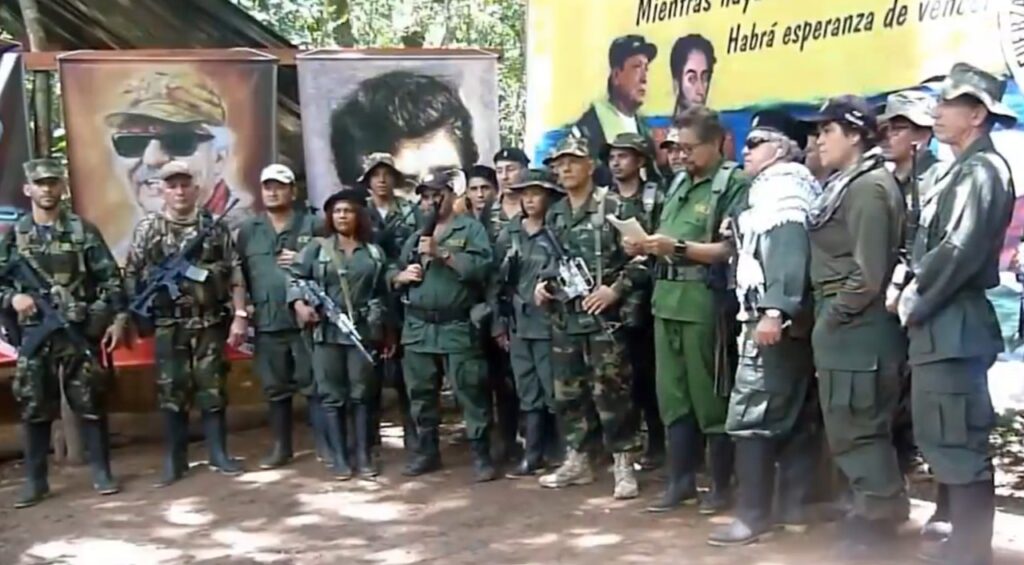
Segunda Marquetalia announce their formation in 2019, from the jungles of Guainia, Colombia. Video Capture.
Revelations that former FARC leaders ordered the 2025 killing of Miguel Uribe have heightened political tensions in the run-up to the May presidential elections.
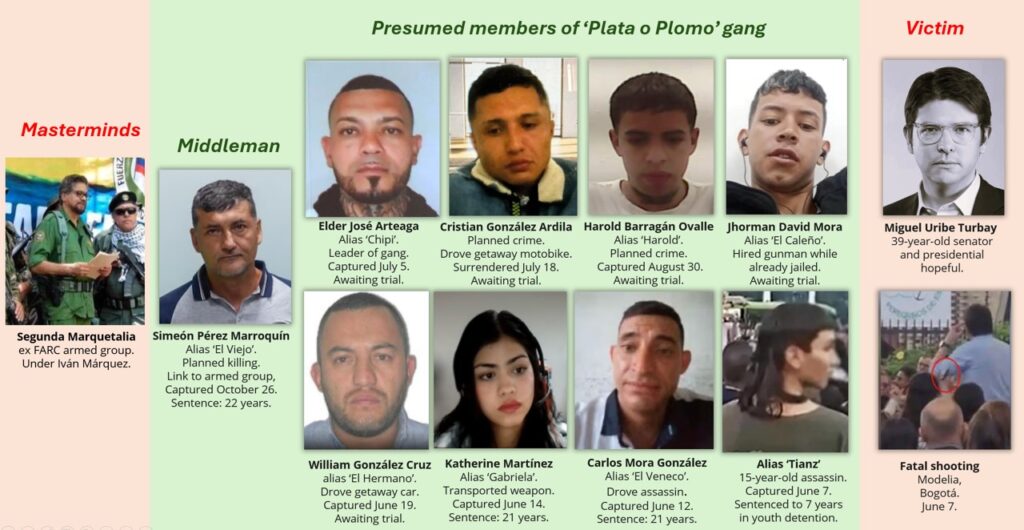
The 39-year-old Colombian senator and presidential hopeful was gunned down by a Bogotá gang hired by the Segunda Marquetalia, an armed group created by disgruntled guerrillas hiding in Venezuela, according to testimony revealed in court.
The senator was shot down by a 15-year-old assassin at an open-air political rally in the barrio of Modelia in June, 2025. Uribe died of head wounds two months later.
After months of investigations and multiple arrests, state prosecutors were last week finally able to link the local gang that carried out the hit with the armed group.
The breakthrough came during the trial of Bogotá-based gang leader Simeón Pérez Marroquín, also known as ‘El Viejo’, who admitted he had hired the local Plata o Plomo (‘Silver or Lead’) gang to carry out the killing on behalf of the Segunda Marquetalia armed group.
“The deal was that they would pay one billion pesos [US$270,000] for the senator’s death,” said Marroquín in a statement reported by magazine Semana.
Right hand man
Confirmation of involvement by an armed group founded by former FARC leaders sparked a political spat between front-runners for the upcoming presidential election.
Right-wing candidate Paloma Valencia was quick to accuse the Petro government of negotiating peace with the Segunda Marquetalia – even while the armed group was plotting the murder of Uribe.
Valencia referred to Marroquín’s statements that the hit was organized by veteran guerrilla Zarco Aldinever, the right-hand man of the group leader Iván Márquez, in early 2025.
At this time Aldinever was nominated a ‘peace manager’ by the Petro government, meaning any arrest warrants were suspended and the rebel was free to roam. This despite the collapse of peace talks with the Segunda Marquetalia at the end of 2024.
Valencia further pointed to the closeness between her main election rival Iván Cepeda and leaders of the armed group.
Old photo
Iván Cepeda with Iván Marquez.
“The killer of Miguel Uribe is photographed hugging Iván Cepeda,” she wrote on X, attaching a photo of her rival with Segunda Marquetalia founder Iván Márquez.
In fact, the photo of Cepeda dated from the 2016 FARC peace talks, explained President Petro in a strongly worded statement defending his friend and political ally.
“The photo shows Iván Cepeda’s attempt to help [the Santos government] achieve peace. At that time, the entire FARC was ready for peace,” said.
Iván Márquez was number two in the FARC at the time and widely respected for his role in the negotiations.
Petro went on to blame his predecessor, right-wing president Iván Duque, for undermining the FARC peace process that forced former guerrilla leaders like Márquez back to arms and the Segunda Marquetalia.
Following the 2016 deal, some former FARC leaders had been “entrapped by state prosecutors with fake drug charges”, he said, leading to extradition requests from the United States.
Faced with this legal pressure several top commanders, including Iván Márquez and Jesus Santrich, fled to Venezuela in 2018 before emerging on video a year later to announce their new incarnation as the Segunda Marquetalia, named after the village in the Tolima department where the original FARC first formed in 1964.
The armed group was active in drug trafficking and illegal mining along the Colombia-Venezuela border, in the departments such as Vichada and Guainía, according to a profile by InsightCrime. The leadership is suspected of hiding out in Venezuela.
Another study by Fundacion Ideas para La Paz estimated the group to have 530 armed combatants in 2025, an increase of 15% on 2024, and work mostly in the eastern plains of Colombia.
A hunt is on
In a press conference on Tuesday, Valencia accused Cepeda and other left-wing lawmakers of backing the former FARC commanders in their legal battles back in 2018, creating a chain of events leading to the creation of recycled armed group.
“Congressmen like Cepeda defended [Marquéz and Santrich] …and didn’t allow them to be extradited. If these thugs had been extradited, Miguel Uribe would be alive today,” she said.
In his own press statement Cepeda called Valencia’s comments “a dirty political game” and issued a challenge to the candidate, and her political mentor right-wing former president Álvaro Uribe, to back up the accusations in court.
“It’s infamy to accuse me or President Petro to have any type of involvement in such a deplorable deed as the assassination of senator and presidential pre-candidate Miguel Uribe,” he said.
Meanwhile this week the Colombian attorney general’s office launched a fresh hunt for the leaders of the Segunda Marquetalia, offering around million-dollar rewards for the capture of seven commanders including Iván Márquez and Zarco Aldinever.
In fact, Aldinever was reported killed by rival armed group ELN in Venezuela during a squabble over a cocaine shipment in August last year – the same month that Miguel Uribe died – according to Colombian state forces at the time.
This week Colombia’s Minister of Defense Pedro Sanchez walked back that claim saying no body had ever been found and that the initial report of Aldinever’s death – sent from the Segunda Marquetalia itself – could be disinformation.
“At this time, the position is clear: without a body there is no confirmation of death, and that is why all institutional resources remain active to locate him,” said Sanchez.
Underworld connections
Closer to home, the Segunda Marquetalia’s influence in Bogotá was under scrutiny after Simeón Marroquín’s testimony shed light on the murky connections with the city’s underworld.
Marroquín admitted that in previous decades he had acted as an urban operative for the FARC guerrillas, a hired gun ready to carry out orders in the city.
“I never wore camouflage, but while I was here in Bogotá, I was a miliciano. Guerrilla missions would come up, and I’d carry them out, but I was never in the ranks.”
His contacts with the FARC continued to the Segunda Marquetalia that tapped him for the Uribe killing.
Early in 2025, Marroquín was invited to a secret meeting in Cúcuta close to the Venezuelan border where, according to his testimony, Aldinever offered him one billion pesos for the crime (US$270,000) and another 600 million pesos (US$160,000) to “bribe the justice system” to deflect attention from the guerrilla group.
The motive for the killing was not clearly revealed by Marroquín, though a text message later found on his phone sent to his guerrilla paymasters talked of an “eye for an eye”, suggesting the former rebels were out for revenge.
The Uribe case uncovered links between the Segunda Marquetalia guerrillas and urban criminals.
Chilling revelation
Uribe was selected as an influential senator, scion of a right-wing political family, and popular candidate for this year’s presidential elections. He was also an easy target for assassins with his regular visits to communities where he had walkabouts to engage with local voters.
In the first few months of 2025, Marroquín worked his underworld connections to hire the Plata o Plomo gang which in turn lured the 15-year-old gunman who shot and wounded Miguel Uribe in a small park in the barrio of Modelia on June 7.
Marroquín’s account paints a picture of a loose network of petty criminals lured by cash rather than political interests, ignorant of the details of both their intended target and the paymasters behind the plot.
The middleman saw the hit as a “good business opportunity” but also a chance to rekindle his role as urban operative for a guerrilla organization.
Marroquín’s plan unraveled after the 15-year-old gunman and various low-level gang members were detained in the hours and days following the June attack, creating a trail leading to his own capture in October.
“What’s done is done”
One chilling revelation was the order from above for Marroquín to kill low-level gang members to cut links to the guerrilla masterminds. This included murdering alias Gabriela, who transported the weapon and was present on the day of the shooting.
Marroquín refused to kill Gabriela, telling investigators “I didn’t have the heart for that because she was very young.” But he did send her by bus to the city of Florencia where the guerrillas were lying in wait.
#ATENCIÓN | "No hay palabras que justifiquen dicho acto, pero pues ya está hecho (…)", fueron las palabras con las que Simeón Pérez Marroquín, alias ‘El Viejo’, pidió perdón a la familia del senador y precandidato presidencial Miguel Uribe Turbay, tras reconocer que fue el… pic.twitter.com/btgnOsTEF7
The 19-year-old never made it; police investigators, already on Gabriela’s trail, organized for the bus to “break down” some miles before Florencia. Her arrest there and subsequent interrogation lead to Marroquín’s capture and eventual exposing of the links to the Segunda Marquetalia.
Last week, during the court process, Simeón Marroquín attempted to apologize for his role in the killing of Miguel Uribe.
“There are no words to justify my actions, but what’s done is done,” he said on camera from his cell, addressing his victim’s family – Uribe was married with four children – and asking forgiveness. He was then sentenced to 22 years in prison.
How quickly Colombian investigators can find Zarco Aldinever or other Segunda Marquetalia commanders, dead or alive, or hiding in Venezuela, remains to be seen.
If you’re an iPhone user in the UK, you might want to hold off on the latest iOS 26.4 update for a bit, as many UK users are reporting problems with the new mandatory online Age Verification system that is included in the latest versions of iOS. Failures and issues with the age verification system ... Read More
Apple has released software updates for various older Apple devices, some of which are simple security patches that include important fixes to potential exploits, while others allow continued usage of core features like iCloud, iMessages, and FaceTime. These updates arrive as iOS 18.7.7, iPadOS 18.7.7, iOS 18.7.7, watchOS 8.8.2, and watchOS 5.3.10. Specifically, older Apple ... Read More
The disappearance of a U.S. flight attendant during a brief layover in Medellín has sparked an urgent search involving Colombian authorities, airline officials and U.S. representatives, as questions mount over his final hours in the city.
Eric Fernando Gutierrez Molina, 32, an American Airlines crew member based in Dallas-Fort Worth, arrived in Colombia’s second-largest city late on Saturday as part of a routine flight rotation. He and fellow crew members were scheduled to remain overnight before returning to the United States on a flight to Miami early Sunday.
But Molina never made it back to the airport.
According to local broadcaster Telemedellín, Molina left his hotel Saturday night with a colleague and went to a nightclub in the city. There, they reportedly met two men and later decided to continue the evening elsewhere after the venue closed.
Hours later, Molina’s colleague was found disoriented by authorities and taken to a medical center. The circumstances surrounding what happened next remain unclear.
The last confirmed sighting of Molina occurred in the early hours of Sunday in Medellín’s La América neighborhood, a largely residential area not typically frequented by foreign visitors. Investigators say the timeline of events following that sighting is fragmented and under review.
A final digital trace from Molina came in the form of a message sent around 5:00 a.m. on Sunday, sharing his location at an Airbnb property in El Poblado, a district known for its nightlife and popular among tourists. The location is roughly 20 kilometers from José María Córdova International Airport, where Molina had been expected to report for duty just hours later.
After that message, no further communication was recorded.
Friends and coworkers have since filed missing persons reports in both Medellín and Dallas, while Colombian authorities have activated an urgent search protocol. Officials have not ruled out any lines of investigation, including robbery, intoxication or other forms of assault.
Family members told local media that Molina had intended to use his layover to briefly explore Medellín’s nightlife, a common practice among airline crews on tight schedules. However, those who accompanied him that night have reportedly been unable to provide clear details about his last known movements.
One unconfirmed account suggests that while at the nightclub, Molina and his group were approached by a man who claimed to know the city well and offered to take them to other venues. Authorities have not substantiated this version of events and caution that it remains one of several hypotheses under consideration.
The case has drawn international attention, with American Airlines confirming it is working closely with Colombian law enforcement.
“We are actively engaged with local law enforcement officials in their investigation and doing all we can to support our team member’s family during this time,” the airline said in a statement to U.S. media.
The Association of Professional Flight Attendants also said it is supporting efforts to locate Molina, describing the situation as deeply concerning for colleagues across the airline industry.
U.S. diplomatic officials in Colombia have been notified of the disappearance, though details of their involvement have not been made public.
The incident also highlights ongoing safety concerns tied to nightlife in Medellín. Authorities have repeatedly warned of cases in which foreign visitors are targeted in bars or nightclubs, sometimes through the use of drugs such as scopolamine — locally known as “burundanga” — which can leave victims disoriented, unconscious or vulnerable to theft.
While officials have not linked Molina’s disappearance to such substances, the fact that his colleague was found disoriented has added to concerns among investigators and the public.
Local data shows that Medellín has reported 124 missing persons cases so far this year. Of those, 104 individuals were later found alive, two were found dead, and 18 remain unaccounted for.
Officials have not indicated whether Molina’s case is linked to any broader pattern.
As the search continues, investigators are working to reconstruct Molina’s final movements through surveillance footage, phone data and witness testimony. For now, significant gaps remain in the timeline, complicating efforts to determine what happened after he left the nightclub.
Nearly a week after his disappearance, Molina’s whereabouts remain unknown, leaving family, friends and colleagues awaiting answers in a case that has quickly evolved from a routine layover into an international missing persons investigation.
EDITOR’S UPDATE:
On Friday, March 27, authorities confirmed the discovery of the body of American Airlines flight attendant and U.S. citizen Éric Fernando Gutiérrez Molina in a rural area of Puente Iglesias, between the municipalities of Fredonia and Jericó.
Gutiérrez Molina had been reported missing since Saturday, March 21, after he was last seen leaving a nightclub in Itagüí, south of the Aburrá Valley. For days, family members and officials held out hope he would be found alive. However, after nearly a week of intensive search efforts, those hopes were dashed.
His body was located roughly 100 kilometers from the last place he was seen, raising serious questions about the circumstances surrounding his disappearance and death.
Authorities are pursuing multiple lines of investigation. One of the leading hypotheses is that Gutiérrez Molina may have been drugged with scopolamine – commonly used by criminal networks in Colombia to incapacitate victims – before being robbed. Investigators believe he may then have been transported to the remote area of Puente Iglesias, either while still alive but disoriented, or after his death, in an apparent attempt to mislead authorities and hinder search efforts.
Weeks on from the first floods in northern Colombia, thousands of people remain without many of the basics and facing further problems. Find out what you can do to help.
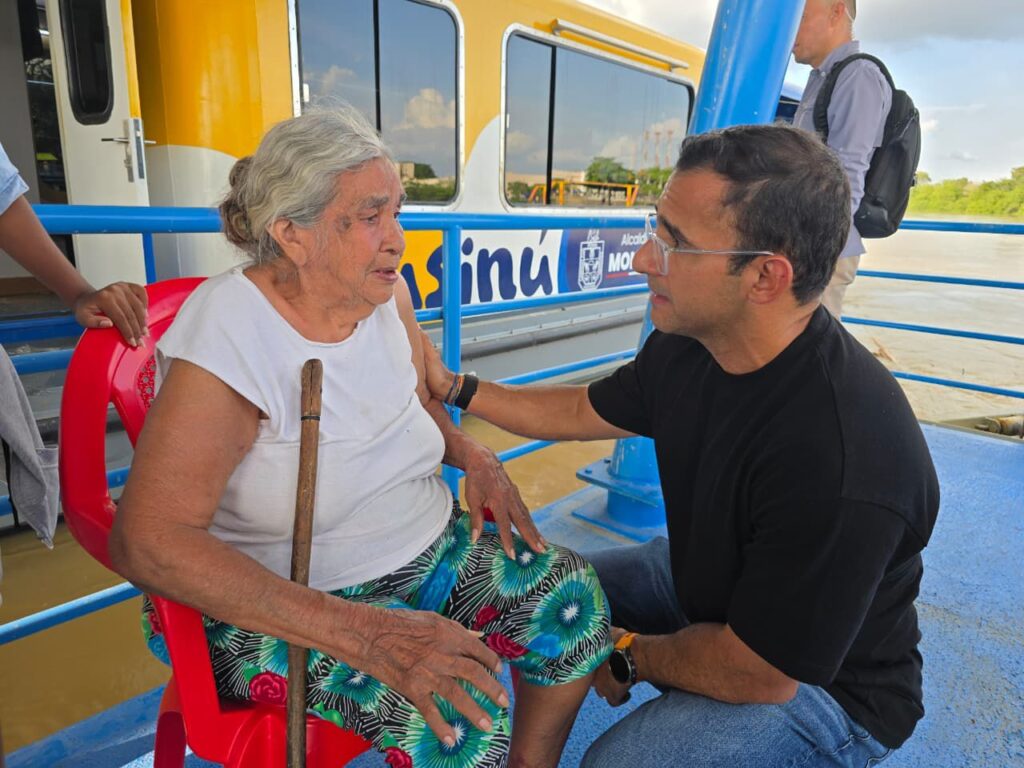
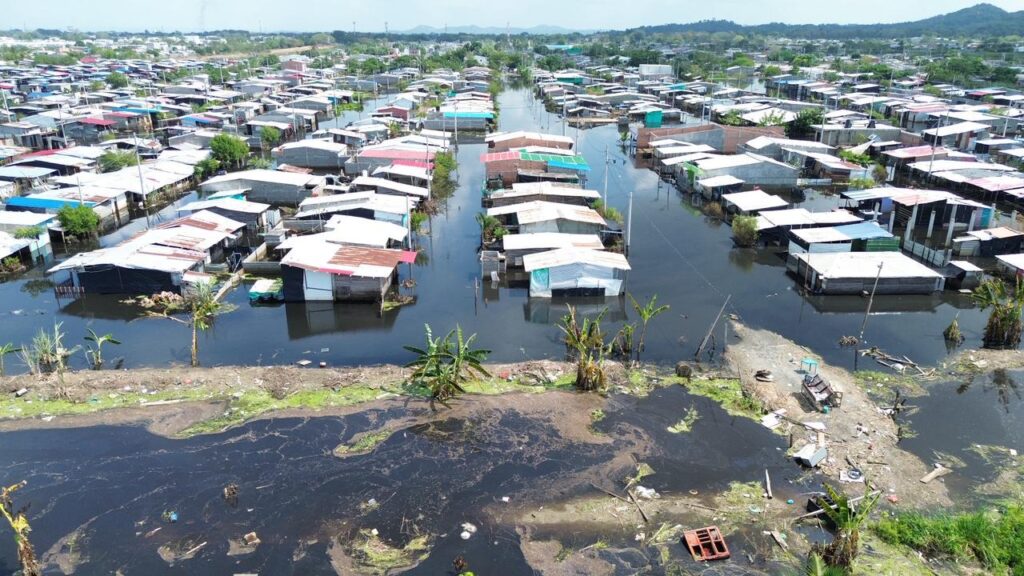
The northern Colombian city of Montería was hit by extreme weather earlier this year, as exceptionally heavy rains flooded the city completely. Thousands of people in the capital of Córdoba have lost everything in the deluge.
While the relentless cycle of news marches on to discuss the upcoming elections, the families affected cannot. Their lives remain in ruins, with further problems coming as the water recedes. Most of the department is relatively poor, with the affected communities overwhelmingly from those in need even previous to this disaster.
The rains have lessened in severity, with fewer downpours and the water is slowly draining, but it will take years to undo the damage that it has wrought. The immediate emergency may be over for the time being, but the recuperation process will take long years to complete.
Thousands of people need help, many in extreme risk
What can you do to help those affected by the Córdoba floods?
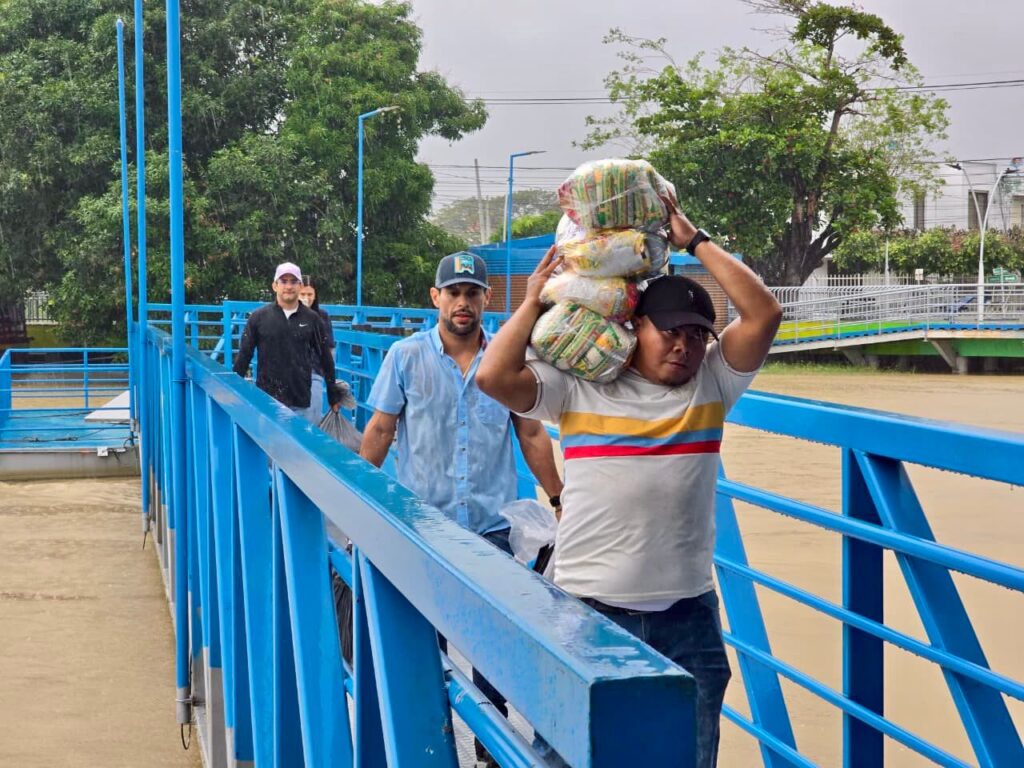
Today, the charitable organisation Colombia Unida por Córdoba is launching a donation drive to help those hit by the rains to rebuild their lives as quickly as possible after the deluge. You can donate here to make your contribution to the campaign.
The money raised will go towards rehabilitation and reconstruction of households, schools and medical centres on the one hand and humanitarian assistance such as temporary housing and medical care on the other.
In the short term, thousands of people need immediate help, whether in terms of shelter or medically. Moving into the medium term there will be a need to both rebuild and restock a range of buildings to get people back to their regular lives.
Within the range of services that are needed by the communities under threat are not only physical and monetary assistance but also psychological help for those that have lost everything. Many farmers will need specialist advisory services to reestablish their fields.
The campaign seeks to bring Colombia together in order to help out a department battered by the effects of extreme weather, something that has grown in magnitude in recent years. It is a movement run both for and by Colombians.
The aid project will require everyone to pull together
Full transparency and auditing is at the core of the project, meaning you can check where the money is really going, unlike some of the larger international organisations. Moreover, the organisers are people who know the situation from firsthand experience.
The Cruz Roja Colombiana are also taking donations of clothes and building materials at their Salitre centre (Av.68 #68b-31), and you can donate money directly on this link. The local government in Bogotá, too, is organising donation drives on this link.
What’s the situation on the ground?
The capital of Córdoba, Montería, is the worst hit major city in the country, with thousands of people evacuated in the city and surrounds. Over 200,000 people have been directly affected by the rains.
A flooded barrio in Montería, Colombia
Everyone has been hit hard – 365 barrios across 25 muncipios. Hundreds of farms are underwater, houses have been inundated and 15 Indigenous reservations are among the list of those now facing an uncertain and perilous future.
A lot of infrastructure is in ruins too, with over 2,000km of roads submerged and hundreds of schools and medical centres unusable for at least the medium term and no sign of what comes next. Córdoba is a relatively poor department, without the resources that Medellín or Bogotá can call upon.
Sadly, politics have come into play here too, with Petro clashing with regional governor Erasmo Zuleta over the management of the department. The pair have had a lot of differences over the years. He also said he was initially unable to land in Córdoba due to the risk of an attack.
More reasonable are Petro’s claims that the situation has been exacerbated by water management systems such as reservoirs. These have diverted normal water flows and critically diminished the region’s ability to handle pressure from unusual weather patterns. Zuleta’s response is that the national government oversees the Urrá hydro plant.
The Caribbean coast has been hard hot elsewhere, with Uraba Antioqueño, La Guajira and Sucre joining Córdoba, and the Amazon and Pacific regions have also seen unusually high rainfall for the start of the year.
Even when the rains stop, the long term effects will take years to overcome. Already, bad actors are starting to take advantage of the situation, with desperate houseowners paying through the nose for boaters to rescue their belongings before thieves arrive.
Fields that are now underwater will take an age to fully drain and even longer to recover from the damage currently being wrought upon them. Thousands upon thousands of hectares of farmland will be unusable for the near future.
If you’re the type of Mac, iPhone, or iPad user who likes to update their operating systems manually, you will want to pay attention to your devices after you have installed the latest iOS 26.4, iPadOS 26.4, and MacOS Tahoe 26.4 software updates, because installing those updates will enable automatic updates for system software. If ... Read More
Apple has released MacOS Sequoia 15.7.5 and MacOS Sonoma 14.8.5 as software updates for Mac users running the Sequoia or Sonoma operating systems. These updates focus entirely on security patches, and do not include new features or changes. Mac users who are running Tahoe can grab the macOS Tahoe 26.4 update instead. Separately, Apple released ... Read More
Colombian authorities are investigating whether mechanical failure, human error or excess weight caused the crash of a military C-130 aircraft that has now left at least 69 dead, as a political dispute intensifies over the condition of the country’s aging air fleet.
The aircraft, a Lockheed C-130 Hercules operated by the Colombian Aerospace Force (FAC), went down shortly after take-off on Monday near Puerto Leguízamo, in a remote jungle region bordering Peru and Ecuador.
The plane, identified as FAC 1016, was carrying 128 personnel when it crashed minutes after departure en route to Puerto Asís, roughly 200 kilometres away. Officials have confirmed dozens of survivors, though many remain hospitalised with injuries ranging from minor trauma to severe burns.
Emergency crews faced major challenges reaching the crash site due to the dense Amazonian terrain, while the impact and subsequent fire — compounded by detonations from ammunition on board — left many bodies severely damaged, complicating identification efforts.
Aging aircraft under scrutiny
The C-130H aircraft had been in service since 1983 and was donated to Colombia by the United States in 2020 as part of long-standing bilateral defence cooperation. It underwent a major maintenance overhaul in 2023, including structural inspections and system upgrades, before being returned to operation.
Despite its age, military officials insist the aircraft remained within operational limits. General Carlos Fernando Silva publicly contradicted President Gustavo Petro’s description of the aircraft as “scrap”, presenting detailed figures on its operational life during a televised cabinet meeting alongside Defence Minister Pedro Sánchez and senior military officials.
General Silva said the aircraft had flown 345 hours between 2021 and 2024, and 537 hours in 2025, broadly in line with standard annual usage of around 500 hours. Based on remaining flight capacity — estimated at up to 20,000 hours — he said the aircraft could theoretically continue operating for decades if strict maintenance protocols were followed.
Concerns have emerged from U.S. defence officials regarding maintenance standards and the availability of spare parts for aircraft supplied to Colombia, according to reports by El Tiempo. Sources cited by the newspaper said such aircraft can operate safely for around 10,000 hours, provided rigorous inspection and servicing regimes are maintained.
United States Southern Command has offered to support Colombia’s investigation with a technical team, underscoring the importance of determining whether maintenance, logistics or operational factors contributed to the crash.
Authorities reiterated there is no indication the crash was caused by hostile action, despite the aircraft going down in a region where dissident factions of the former FARC operate and where coca cultivation is widespread.
Investigators are focusing on three main hypotheses: mechanical failure, pilot error, or overloading at take-off. Officials said flight data, maintenance records and communications with air traffic control will be central to establishing the sequence of events.
The disaster has triggered a heated political exchange between President Gustavo Petro and his predecessor Iván Duque, exposing sharp divisions over defence policy and military procurement.
Petro described the aircraft as “scrap”, criticizing past administrations for accepting donated military equipment and arguing that such decisions have weakened Colombia’s operational capacity. “A country cannot defend itself with obsolete machines,” he said, pledging that his government would prioritize acquiring new equipment and strengthening domestic defence production.
He also questioned the long-term cost of maintaining aging platforms, suggesting that donated equipment can ultimately impose higher financial and operational burdens.
Duque strongly rejected the accusation, defending his administration’s handling of the armed forces and pointing to maintenance protocols carried out before the aircraft was delivered. He noted that C-130 aircraft continue to operate in dozens of countries worldwide and urged a technical investigation into factors such as aircraft weight, runway conditions and operational procedures.
Duque also accused Petro of callous social media statements in the hours after the tragedy, calling for restraint while investigations remain ongoing.
The crash adds to six previous military aviation accidents since 2022 and raises deep concerns about the readiness and sustainability of Colombia’s air fleet, much of which relies on aging platforms acquired through international cooperation.
Analysts say the incident could intensify scrutiny over budget-cuts in defence spending, maintenance capacity and the balance between acquiring new equipment and extending the life of existing assets.
As recovery operations continue in Putumayo’s dense jungle, authorities face the dual challenge of identifying victims and providing answers to families, while determining whether the disaster reflects isolated failure or deeper systemic issues within Colombia’s military aviation infrastructure.
iOS 26.4 for iPhone and iPadOS 26.4 for iPad have been released by Apple as software updates. The new versions of system software include a few minor new features and changes, a handful of new Emoji icons like Bigfoot, along with various bug fixes and security enhancements. One specific bug that is mentioned in the ... Read More
MacOS Tahoe 26.4 has been released as a software update for all Mac users running the Tahoe operating system. The update includes a few mission critical new Emoji icons like the cryptid Bigfoot, and some unspecified bug fixes, along with security updates, and is therefore recommended for all macOS Tahoe users to install. There are ... Read More
At least 66 people were killed after a Colombian military transport aircraft crashed shortly after take-off in the country’s southwest on Monday, authorities said, in one of the deadliest air disasters involving the armed forces in recent years.
The aircraft, a C-130 Hercules, went down at around 9:50 a.m. local time near the municipality of Puerto Leguízamo, in a remote jungle region close to the borders with Peru and Ecuador.
According to Colombia’s Defence Ministry, 128 people were on board the aircraft, including 11 crew members from the Colombian Aerospace Force, 115 members of the army and two police officers.
By late Monday, officials confirmed 66 fatalities: six from the air force, 58 from the army and two from the police. Rescue teams managed to evacuate 57 survivors, many of whom sustained injuries. Eight were transferred to hospitals in Florencia, while 49 were flown to Bogotá, where 19 are being treated at the Military Hospital and others for less serious injuries at a military medical facility.
Authorities said one soldier survived unharmed, while four others remained missing as search operations continued in dense jungle terrain.
The aircraft, identified as FAC 1016, had taken off from Puerto Leguízamo en route to Puerto Asís, roughly 200 kilometres away, when it lost altitude and crashed within minutes of departure.
Military officials said the plane went down about two kilometres from the airport in a rural area. Witnesses reported a fireball upon impact, followed by secondary explosions.
Defence Minister Pedro Sánchez said the situation was worsened by the detonation of ammunition being transported by troops on board.
“As a consequence of the fire, part of the ammunition carried by the personnel exploded,” Sánchez said, complicating rescue and recovery efforts.
Emergency crews faced significant challenges accessing the crash site due to the remote Amazonian terrain, while the condition of many bodies has made identification difficult.
No signs of attack
Military authorities said there is no evidence so far that the crash was caused by an attack.
“At this time, there is no information or indication that this was the result of an attack by any illegal armed group,” said General Hugo López, who added that a full investigation is underway.
The region where the aircraft crashed is known for the presence of dissident factions of the former FARC guerrilla group, which operate in areas with extensive coca cultivation used for cocaine production. However, officials stressed that current evidence points away from sabotage.
Questions over aircraft condition
The crash has triggered a political debate over the condition of Colombia’s military fleet, just weeks ahead of the country’s presidential elections.
The aircraft involved was a C-130H Hercules, an older variant of the widely used military transport plane originally introduced in the 1960s by Lockheed Martin.
According to available data, the aircraft had been in service since the early 1980s and was transferred to Colombia by the United States in 2020.
President Gustavo Petro suggested the plane represented outdated equipment acquired by a previous administration.
“In 2020, scrap was purchased,” Petro said on social media, referring to the government of former president Iván Duque. He added that his administration had sought to modernize military equipment but faced bureaucratic obstacles.
Opposition figures, however, argued that budget cuts under Petro’s government have affected maintenance and operational readiness within the armed forces.
In a message posted online, Petro expressed condolences to the families of the victims and praised residents of Putumayo who rushed to assist survivors.
“This is how a nation is built,” he wrote, thanking locals who reached the crash site on foot and by motorcycle to provide water and aid.
Authorities said the investigation will examine technical, mechanical and operational factors, including maintenance records and flight data, as Colombia seeks answers to a tragedy that has shaken the country’s military and reignited debate over defence policy.
Apple has announced their annual Worldwide Developer Conference (WWDC) for 2026 will begin on June 8, and extend through the 12th of that week. The keynote is set for June 8, which will give developers and users a look at what’s coming next from the software side of Apple. Historically, WWDC is where Apple introduces ... Read More

 Login
Login