
Reading view

UN report warns Colombia faces worsening human rights crisis

Colombia is at risk of sliding back into one of the darkest chapters of its recent history, according to a stark new report by the United Nations, which warns that escalating violence, territorial control by illegal armed groups and political instability are eroding hard-won human rights gains.

The annual assessment by the Office of the High Commissioner for Human Rights paints a troubling picture of 2025: a country where armed actors have deepened their grip over rural regions, civilians are increasingly trapped in conflict zones, and the implementation of the 2016 peace accord is under growing strain.

At the heart of the report lies a central warning — Colombia faces the “possibility of reverting” to pre-peace agreement levels of violence, particularly in territories where the state remains weak or absent.

Armed groups expand control

Across large swathes of the country — from the Catatumbo in Norte de Santander to the Pacific coast — non-state armed groups and criminal organizations have consolidated control over vulnerable populations, imposing what the report describes as “illegal armed governance”.

The criminal groups mentioned- Clan del Golfo, ELN, FARC dissidents – are responsible for a wide range of abuses: forced displacement, confinement, selective killings, sexual violence and the recruitment of children. Entire communities, especially Indigenous and Afro-Colombian populations, are subjected to coercion and forced participation in illicit economies. “Afro-descendant communities, particularly in regions such as Chocó, continue to face severe human rights violations due to the presence and social control exercised by non-state armed groups,” claims the report.

Even in areas where a single armed group dominates and overt violence is less visible, the UN notes that civilians live under strict systems of control, with basic freedoms curtailed and fear pervasive.

The UN documented 53 verified massacres in 2025, leaving 174 victims, the vast majority attributed to armed groups fighting over control of illegal economies such as drug trafficking.

The report also highlights a disturbing increase in indiscriminate attacks, including the use of explosives and drones in populated areas. Cities such as Cali were directly affected, with civilian casualties mounting as conflict spills into urban spaces.

In one incident in the southern department of Huila, a motorcycle bomb targeting a police station killed civilians and injured dozens, underscoring the growing risks faced by ordinary Colombians.

Child Recruitment

One of the report’s most alarming findings is the worsening situation for children.

The UN verified 150 cases of child recruitment in 2025, though it warns this represents only a fraction of the true scale due to underreporting and fear of retaliation. Armed groups are increasingly using social media platforms to lure minors, glamorising violence and illegal economies.

In some cases, children recruited into armed groups were later killed during military operations, raising further concerns about protection mechanisms.

Schools have also become battlegrounds. Armed groups have occupied educational spaces, disrupted classes and used them as recruitment grounds, particularly among Indigenous communities at risk of cultural and physical extinction.

Gender-based violence

The report details systematic patterns of sexual violence, exploitation and coercion, particularly against women and girls in conflict zones.

Armed groups have imposed control over reproductive rights, restricted access to healthcare and, in some cases, forced pregnancies. Girls are often recruited through manipulation and emotional coercion, only to face abuse, forced labour and sexual violence once under the control of armed actors.

Indigenous, Afro-descendant and migrant women are disproportionately affected, facing layered vulnerabilities exacerbated by institutional absence.

Pre-Election violence

As Colombia moves through a politically sensitive period, the report identifies a sharp rise in preelectoral violence.

The killing of the right-wing presidential candidate Miguel Uribe Turbay in August 2025 marked a dramatic escalation, while the UN recorded 18 assassinations and 126 attacks or threats against political leaders and candidates.

Nearly 650 municipalities were classified as high-risk zones by Colombia’s Ombudsman, raising concerns about the integrity of democratic participation.

The report also points to a surge in digital harassment. “Violence has also extended into the digital space, with an increase in hate speech and discriminatory discourse on social media platforms.”

Humanitarian conditions have deteriorated significantly. According to UN data, mass forced displacement rose by 85% compared with 2024, driven largely by clashes between armed groups. In Catatumbo alone, nearly 90,000 people were displaced, alongside a wave of killings, kidnappings and child recruitment.

Confinement — where communities are effectively trapped by armed actors — has also increased, restricting access to food, healthcare and livelihoods, particularly in departments such as Chocó and Cauca.

Despite these challenges, the report acknowledges partial progress in implementing the 2016 Final Accord with the ex-Revolutionary Armed Forces of Colombia (FARC) guerrilla.

While land reform initiatives have advanced, delays in formal land titling and uneven territorial implementation continue to limit impact of the 2016 agreement. The killing of 45 former FARC combatants in 2025 — a 36% increase from the previous year — highlights ongoing security gaps in reintegration efforts. “The United Nations Verification Mission documented the continued killing of former FARC, underscoring persistent security risks despite a peace agreement.”

A recurring theme throughout the United Nations report is the insufficient presence of the state in conflict-affected regions. It warns that weak institutional reach continues to limit protection for civilians and the effective implementation of security and development policies. The report also notes that “coca cultivation rose by 3% to 262,000 hectares in 2024,” although growth has slowed for a third consecutive year, cautioning that underfunded substitution programmes risk undermining efforts to transition to legal economies.

In many cases, responses by security forces have been too slow or insufficient to prevent abuses or protect communities.

A critical moment for Colombia

The UN concludes that Colombia stands at a pivotal juncture.

Without stronger coordination, sustained investment and a renewed focus on protecting civilians, the country risks undermining nearly a decade of peacebuilding.

“The persistence of violence and the strengthening of armed groups continue to gravely affect the civilian population,” the United Nations warns — a stark signal that security conditions are deteriorating across Colombia. As the country enters a polarised election season, the report suggests the stakes are no longer confined to preserving the 2016 peace accord, but to preventing a broader erosion of state authority and civilian protections in territories most at risk.
  •  

Beatriz González: The Artist of Colombia’s Political Memory (1932-2026)

Beatriz González, one of Latin America’s most influential contemporary artists, whose boldly colored, deliberately unrefined paintings and installations confronted Colombia’s long history of political violence, public mourning and social inequality – while also reshaping the country’s most important public art collection – died on Jan. 9, 2026, at her home in Bogotá. She was 93.

Her death was announced by the Banco de la República, Colombia’s central bank, where for more than four decades she played a decisive role in shaping the institution’s cultural mission and its vast art collections. In a statement, the bank described her as “an essential figure in Colombian art and culture” and “a masterful narrator of memory.”

González was not only a prolific artist but also a historian, curator, educator and critic — a rare figure who helped define how Colombia would see its art, its past and, ultimately, itself. “Artists exist so that memory is not thrown in the trash,” she once said, a line that came to stand as a quiet manifesto for a career devoted to preserving what official histories often erased.

Born in Bucaramanga in 1932, González came of age during La Violencia, the brutal civil conflict that engulfed Colombia between 1948 and 1958. That formative experience would leave an indelible mark on her work. After briefly studying architecture, she enrolled at the University of the Andes in Bogotá, graduating with a degree in fine arts in 1962. She later studied printmaking in Rotterdam and counted among her teachers the influential critic Marta Traba, who helped shape modern art discourse in Latin America.

González’s early work drew attention for its irreverent treatment of European art history and Colombian popular imagery. Her critical view of “good taste” led her to reject academic refinement in favor of what the art critic Germán Rubiano described as an approach that was consciously unpolished and deliberately opposed to sophistication.

She appropriated masterpieces by Manet, Leonardo da Vinci and Raphael, flattening their compositions and translating them into the visual language of curtains, furniture and household objects. Armoires, beds, trays and even wallpaper became supports for paintings marked by compressed figures and bold color palettes — a strategy that blurred the boundary between high art and domestic life.

One of her earliest and most discussed works, The Sisga Suicides (1965), reimagined a newspaper photograph of a young couple who drowned themselves in a dam outside Bogotá. Rendered in vivid, almost cheerful colors, the painting exposed the uneasy coexistence of tragedy and banality in Colombian public life — a theme that would recur throughout her career.

By the 1980s, González’s art took on an increasingly overt political tone. Press photographs of presidents, massacres and grieving families became central to her work. She painted them repeatedly, transforming news images into objects of repetition and contemplation, as if to ask how a society becomes accustomed to its own suffering. “It’s been a critique of power that has permeated my work,” she told ArtReview in 2016. “For that very reason, I don’t think of it as ‘political’; it has an ethical commitment.”

Her focus on mourning was particularly stark in works depicting mothers weeping after the 1996 Las Delicias massacre, in which dozens of Colombian soldiers were killed by the FARC guerrilla. These images, stripped of sentimentality, confronted viewers with grief as a collective, inescapable condition. The depth with which González addressed both individual and collective mourning stands among her most significant contributions to contemporary art.

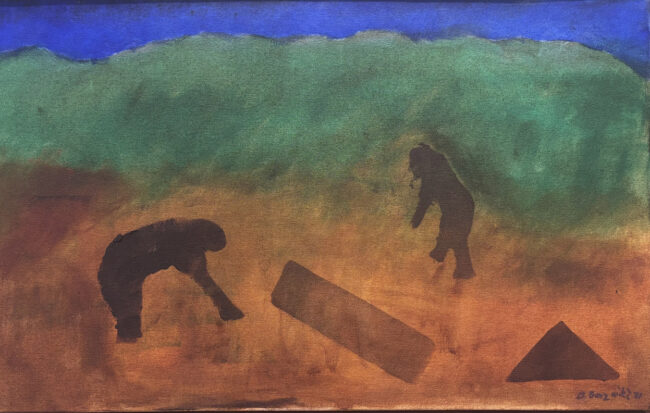
The Burial. Beatriz González/Private Collecion

That macabre clarity intensified in the 2000s. In Anonymous Auras (2023), one of her final major works, González installed more than 8,000 printed silhouettes of workers carrying corpses across the wall niches of Bogotá’s Central Cemetery. The figures – anonymous, repetitive and almost ritualistic – transformed the cemetery into a monumental archive of loss, honoring victims whose names were never recorded.

“Artists exist so that memory is not thrown in the trash”

Parallel to her artistic production, González exerted extraordinary influence as a curator and cultural policymaker. Beginning in the 1980s, she became a close collaborator of the Banco de la República’s cultural division, serving as a researcher, curator and longtime member of its advisory committee on visual arts. In that role, she helped guide the formation of a national art collection with a distinctly Colombian focus, while insisting on dialogue with international works of the highest quality.

Few individuals knew the Central Bank’s art collection as intimately as González. Over more than forty years, she worked alongside successive generations of curators, historians and collectors, helping to consolidate one of the most important public art collections in Latin America.

In 2020, she donated her personal archive and library — nearly 100,000 documents — to the Banco de la República to ensure free public access. The archive documents not only her artistic practice but also her work as an educator, curator and historian, and provides an unparalleled record of Colombian art, politics and visual culture.

Her institutional impact reached beyond the Central Bank. At the Museo de Arte Moderno de Bogotá (MAMBO), she founded the influential School of Guides, a pioneering program for museum education that trained figures who would later become leading artists and curators. From 1989 to 2004, she served as chief curator of the Museo Nacional de Colombia, where she reorganized the permanent collection and helped redefine the country’s historical narrative through art.

International recognition came steadily. Her work appeared in Documenta 14, the Berlin Biennale and the landmark exhibition “Radical Women: Latin American Art, 1960–1985.” Major retrospectives were held at the Pérez Art Museum Miami, the Museum of Fine Arts, Houston, and the CAPC in Bordeaux. In 2026, the Barbican Centre in London is set to host her first major retrospective in the United Kingdom.

González received numerous honors, including Colombia’s Premio Vida y Obra and honorary doctorates from the University of the Andes and the University of Antioquia. In 2025, the city of Bogotá awarded her the Civil Order of Merit, recognizing her invaluable legacy and profound influence on the nation’s cultural life.

Yet she remained skeptical of accolades. She preferred to speak of discipline, research and responsibility — and of the obligation, as she saw it, to bear witness. From a childhood habit of collecting film-star postcards to a lifetime spent gathering images of state violence, Beatriz González devoted herself to the stubborn preservation of memory and to an unapologetic voice in Colombian contemporary art.

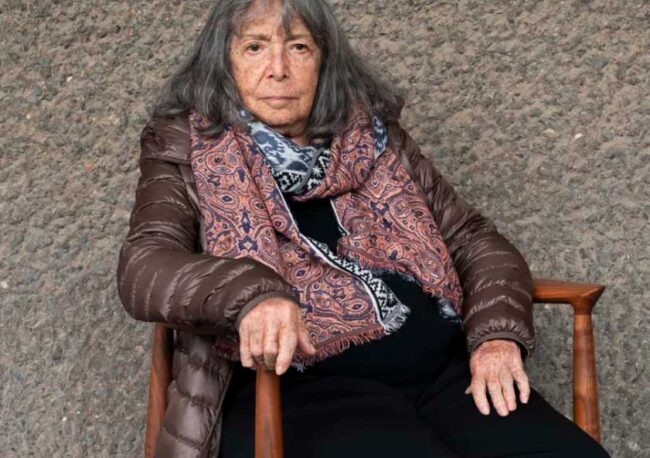
Portrait of Beatriz González, photographed at the Barbican, London, September 2024, ahead of a major retrospective of her work. © Louise Yeowart Barbican Art Gallery. Courtesy of the Barbican Centre.

Read the Banco de la República’s tribute (in Spanish) to Beatriz González, written by Claudia Cristancho Camacho of the Cultural Section and Art Collection. 

https://www.banrepcultural.org/noticias/despedimos-la-maestra-beatriz-gonzalez-figura-esencial-del-arte-y-la-cultura-en-colombia

  •  
❌