
Reading view

Colombia Confirms 14 Candidates for 2026 Presidential Election

Though surprises are possible, polling says the front runners are Iván Cepeda, Abelardo de la Espriella, and Paloma Valencia.

The Registraduría Nacional del Estado Civil of Colombia (RNEC), the entity responsible for organizing elections in the country, reported that a total of 14 candidates have officially registered to run in the country’s presidential elections, scheduled for May 31, 2026. In this vote, citizens will elect the President and Vice President of the Republic for the 2026–2030 term.

According to the electoral authority, the candidates represent a wide range of political perspectives, from left to right, including independent candidacies running through political movements. Here the list and brief profile of the candidates:

  1. Clara Eugenia López Obregón, currently a senator for the Esperanza Democrática She has served as Minister of Labor (2016–2017), acting mayor of Bogotá (2011–2012), and Bogotá’s secretary of government (2008–2010). She has been affiliated with left-wing parties and was Gustavo Petro’s vice presidential running mate in the 2010 election.
  2. Óscar Mauricio Lizcano, from the FAMILIA coalition. He served as Minister of Information Technologies (2023–2025), was a senator (2010–2018), and a member of the House of Representatives (2006–2010).
  3. Raúl Santiago Botero, candidate of the “Romper el Sistema” movement (Break the Establishment). An agronomist engineer and businessman from Medellín, he presents himself as an independent candidate with no prior political experience.
  4. Miguel Uribe Londoño, father of the slain presidential candidate Miguel Uribe Turbay. He is running under the Colombian Democratic Party and previously served as president of the Centro Democrático party founded by Álvaro Uribe Vélez.
  5. Sondra Macollins Garvin, from the movement “La Abogada de Hierro” (The Iron Lawyer) A criminal lawyer and psychologist, she presents herself as an independent candidate without political affiliations. She ran for the House of Representatives in 2022 and is known for her work in narcotrafficking and corruption cases.
  6. Iván Cepeda Castro, a senator since 2014 and the official candidate of the Pacto Histórico, the same party as President Gustavo Petro. Polls project he will receive the highest vote share in the first election round. He is aligned with left-wing political ideas.
  7. Abelardo de la Espriella, a lawyer with far-right positions, running for the first time under the Defensores de la Patria movement. Recent polls place him as a likely second or third contender in voter preference.
  8. Claudia López Hernández, former mayor of Bogotá (2020–2023) and former senator (2014–2018), running under the centrist movement “Imparables con Claudia.” She is known for her anti-corruption agenda and secured her candidacy with more than 570,000 votes (about 9%) in recent interparty primaries.
  9. Paloma Valencia Laserna, current senator and candidate of the Centro Democrático party led by Álvaro Uribe Vélez. She won the right-wing interparty primary on March 8 with more than 3 million votes. Polls place her among the top three contenders, and if she reaches a runoff, she would become the first woman in Colombia’s history to do so.
  • Sergio Fajardo Valderrama, an academic and mathematician running for the Dignidad y Compromiso He served as mayor of Medellín and governor of Antioquia and is running for president for the third time.
  • Roy Barreras, from the political party La Fuerza (The Force). He won the left-wing coalition primary on March 8 with the lowest vote total (257,000 votes, about 3.6%). Although currently aligned with left-wing movements and part of the Petro administration, he has previously been affiliated with right- and center-leaning parties.
  • Gustavo Matamoros Camacho, of the Colombian Ecologist Party. He served in the Colombian Army for 43 years. With no prior political experience, his campaign focuses on public security.
  • Luis Gilberto Murillo, who served as Minister of Foreign Affairs (2024–2025) and Colombia’s ambassador to the United States (2022–2024). A human rights advocate and Afro-Colombian leader from Chocó, he presents himself as an independent, moderate, centrist candidate.
  • Carlos Eduardo Caicedo, running under the independent movement “Con Caicedo.” He was mayor of Santa Marta (2012–2015) and governor of Magdalena (2020–2023), where he built a strong base as a left-wing political leader.

The RNEC also reported that “the draw to determine the position of presidential candidates on the ballot will take place on March 25 at the Ágora Bogotá Convention Center.”

This process marks the formal start of the final phase of the presidential campaign, during which candidates will seek to consolidate support ahead of the first round on May 31. If no candidate secures an absolute majority, a runoff between the two leading candidates will be held on June 21.
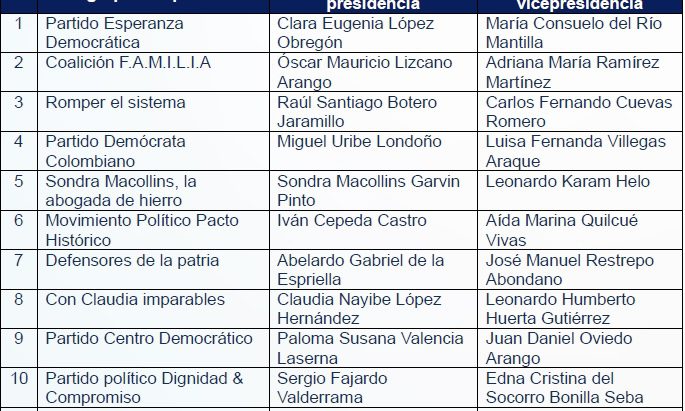
List of registered candidates for Colombia’s presidency. Photo courtesy of the Registraduría Nacional del Estado Civil.

List of registered candidates for Colombia’s presidency. Photo courtesy of the Registraduría Nacional del Estado Civil.

Headline photo: Polling station in Colombia during last Congress elections in March 8, 2026. Photo courtesy of the Registraduría Nacional del Estado Civil.
  •  

Defrocked Colombian Supreme Court Justice Sentenced to Over 10 Years Prison in Corruption Case

The sentence is the latest in the “Cartel of the Toga” judicial corruption scandal that has rocked the Colombian justice system over the past several years.

José Leonidas Bustos Martínez, a former Justice of the Sala Penal of the Corte Suprema de Justicia, was sentenced to 10 years and three months in prison for his role in the so-called “Cartel de la Toga,” a corruption network made up of judicial officials who received payments in exchange for influencing court decisions in favor of political leaders.

The Sala Especial de Primera Instancia issued ruling SEP 013 on February 20, 2026, finding Bustos Martínez guilty of criminal conspiracy. In addition to the prison sentence, the Court barred him from holding public office for the same period and imposed a fine of approximately $36,200 USD.

José Leonidas Bustos Martinez was a leader of the “Cartel of the Toga” that sold justice to the highest bribe.

The former justice, who twice served as President of the Supreme Court, was acquitted of a separate charge of abuse of public office related to influence peddling.

The ruling states that no alternative sentencing measures, such as suspended sentence or house arrest, will be granted, meaning Bustos Martínez must serve his sentence in a Colombian correctional facility to be designated by the Instituto Nacional Penitenciario y Carcelario (INPEC).

The Court also ordered the issuance of an arrest warrant and requested an Interpol Red Notice, as Bustos Martínez has resided in Canada since 2019.

According to the Comisión de la Verdad de Colombia (Truth Commission), the so-called “Cartel de la Toga” was a corruption scheme operating since 2010 through which “Colombia’s justice system was infiltrated through the purchase of judicial rulings.” The Commission stated that “officials involved diverted investigations, delayed proceedings, misused privileged information, altered evidence and discredited witnesses in order to favor those who paid for judicial decisions that appeared lawful.”

Investigations lead by the Commission determined that the scheme sought to illegally interfere in cases against high-level political leaders in exchange for substantial sums of money, including obstructing arrest warrants and preventing pretrial detention measures.

Bustos Martinez’s conviction adds to more than 50 arrests and extraditions related to the case since 2017, including sentences against former judicial officials, former members of Congress, former mayors and former governors from various regions of Colombia.

Headline photo:In 2008 then President Álvaro Uribe swore in José Leonidas Bustos Martínez as magistrate of the Criminal Cassation (Appeals) Chamber of the Supreme Court of Justice, during a ceremony held Tuesday, April 1st, in the Gobelinos Hall of the presidential palace (photo: Presidential Archives of Colombia)

  •  

Petro under fire in ‘cash for diplomas’ scandal

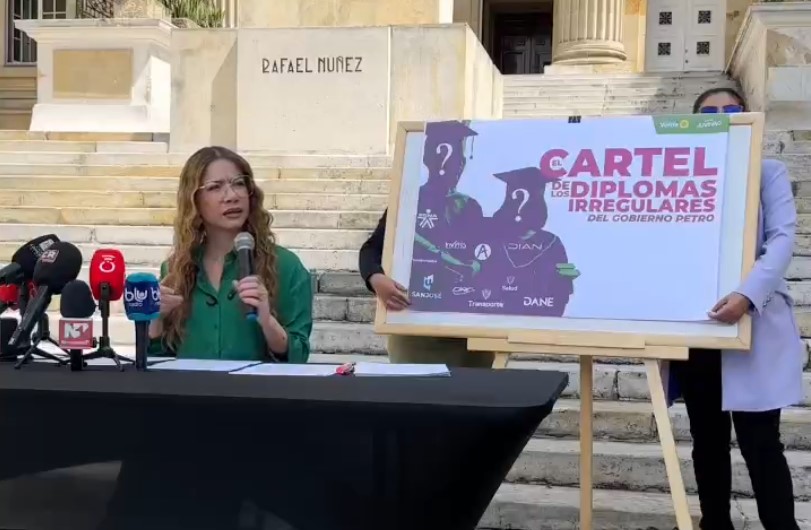
Representative Catherine Juvinoa at a press conference in Bogotá this week. Photo: X

A simmering spat over candidates for government posts boiled up this week with revelations that a Bogotá university was faking professional titles for workers in Petro’s administration.

According to congress members revealing the scandal, 24 public servants got top contracts using dodgy titles from Universidad Fundación San José, a mold-breaking higher education institute once famed for accessible courses, but now under scrutiny for selling degrees.

They also accused Petro and his education chiefs of dragging their feet in investigating the university for the suspected fraud case.  

“Petro’s promises for education come to nothing,” said house representative Catherine Juvinao after she claimed to have identified 24 cases where officials and contractors in top government entities appeared to have been hired with diplomas from the Univerisity Foundation San José without all the tests.

One stand-out case was a government functionary who, according to university records, graduated in four quite different degrees – Business Administration, Industrial Engineering, Public Accounting and International Marketing – on the same day.

“This is one of the most serious cases. Who graduates with four degrees on the same day?,” the representative said in an interview with Semana magazine.

According to Juvinoa, the university handed out diplomas to students who had failed to complete the independent technical tests, known as PruebaPro, and in some cases had not studied at all.

Fake titles for plum jobs?

Although academic fraud has occured regularly in Colombia – and similar scandals have rocked previous governments – the investigations by Juvinao and her team are targeting an administration that promised to turn its back on corruption.

This week’s revelations followed last year’s political dogfight over the proposed appointment of 23-year-old Juliana Guerrero as vice-minister of youth. The candidate, who was close to both Petro and his education minister, was already embroiled in controversies over private use of police planes. Then in September she was found to have falsified her accounting qualifications at the university.

After public pressure the university rescinded the degree, and Guerrero herself told Caracol news that she intended to take the independent exams to regain her title in November.

Juliana Guerrero, the candidate accused of faking her qualifications. Photo: Interior Ministry

Further investigations revealed a bigger suspicion: that the Petro government was routinely using the university – with which it had contracts – to fudge academic requirements for candidates favoured for plum jobs.

This week Juvinao accused  Petro government or running a “Cartel of Dodgy Diplomas” in cahoots with the San José university. “It’s bad news that our first left-wing government ended up being a monument to mediocrity, captured by an institution,” she said.

The state was “closing the door to those who studied hard by merit,” she said, while calling for a probe by the Attorney General’s office, adding that: “we have all the evidence to support any investigation”.

Political Attacks

For its part, the Ministry of Education announced this week it was investigating the University Foundation San José related to the case of Guerrero, Petro’s preferred candidate for the Ministry of Youth.

In the same communication, the ministry strongly denied it had any link to “illicit activities related to the expedition of academic titles”.

The Colombian president repeatedly defended Guerrero’s nomination for the post last year even after her degree was pulled by the university. Her only error was to claim her title before taking the final exam, he said, suggesting a storm in a teacup. The attacks were personal and political, he added.

“So, Juliana’s graduation exam, after completing her studies, was registered for in July and is scheduled for next November. Is that the summary of this scandal?” he wrote on X.

At first view Petro’s gesture seemed on target; young candidates, particularly female, get torrents of abuse in the rough-and-tumble of Colombian politics, often facing a public scrutiny less applied to old-school politicos.

But looking back that defence now seems misplaced: financial data revealed this month showed Guerrero had paid for her degree course long after receiving her diploma – almost unheard of in Colombia – while the university itself confirmed that she “never went to classes or presented exams nor complied with the accounting program”.

Doubling down

This week Petro doubled down on his defense of the University Foundation San José, claiming the accusations by the opposition unfairly focused on “poor single mothers” trying to get ahead.

“Private universities…allow these working women to study faster,” he said. “[Politicians] to gain votes shouldn’t destroy working women. I expect a public apology from these congresswomen to the working women of Colombia.”

To complicate the president’s narrative, referring to the Guerrero case, the university announced it had “detected and denounced a fraud” and had itself requested the attorney general’s office to investigate. It also promised to “stregthen internal audits” to prevent future cheating.

Representative Juvinao told Semana told Semana magazine that the Guerrero case suggested corruption in the form of cash for qualifications, and was likely “the tip off an iceberg”.

“There is a deliberate strategy to fabricate qualifications to fit the needs of Petro’s government departments,” she said.

In a country where people struggle for further education – and value highly their hard-earned academic qualifications – what started as an online spat over a youth representative is becoming a scandal with much more scope.

The post Petro under fire in ‘cash for diplomas’ scandal appeared first on The Bogotá Post.

  •  
❌