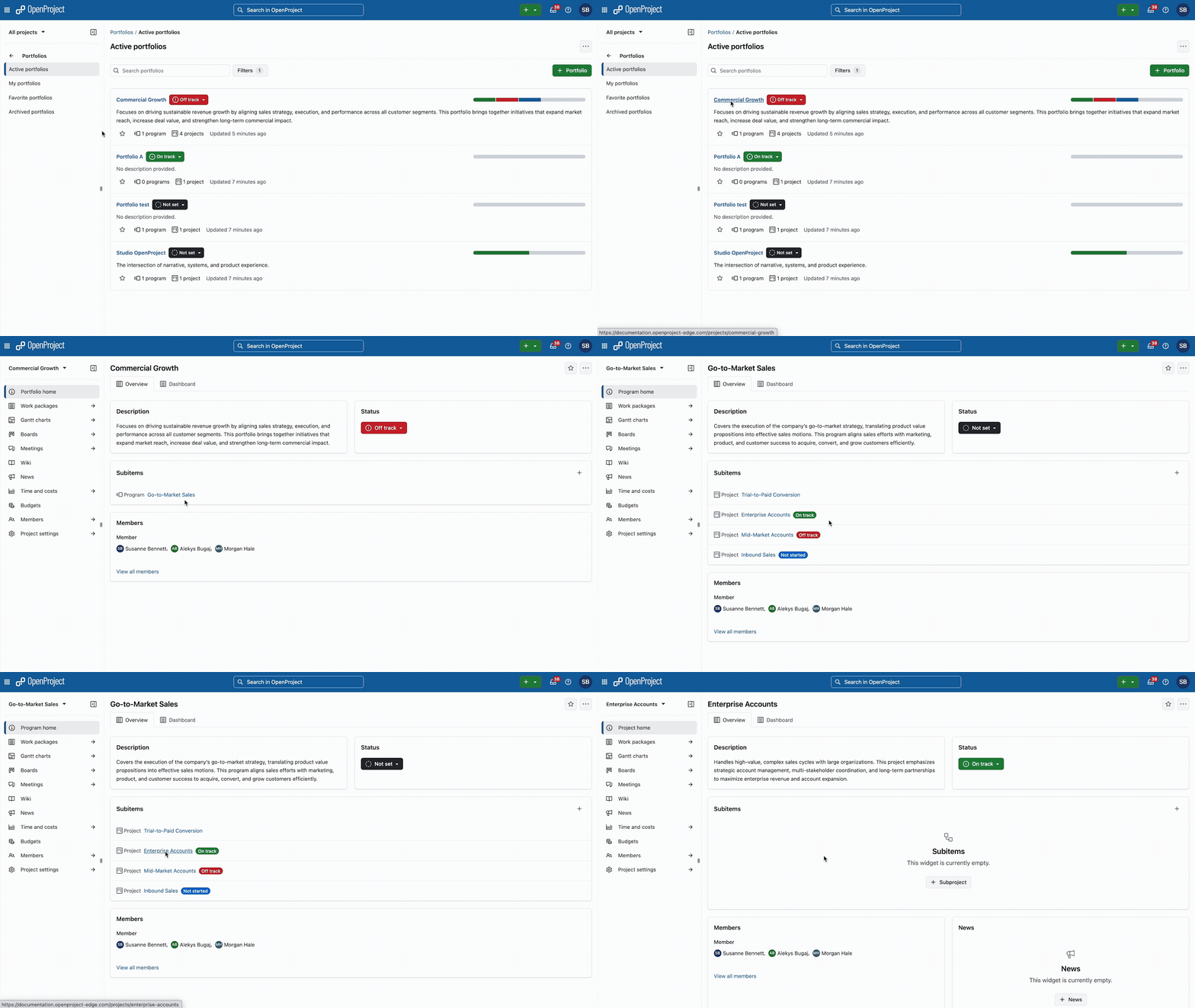
We have released version 2.11.0 of the OpenProject integration app for Nextcloud! ✨ This update brings several usability improvements and fixes to make your project collaboration experience even smoother.
We recommend updating to the latest version via your Nextcloud app center to benefit from the newest enhancements.
Changes of the release 2.11.0:
Simplified warning message for OIDC identification
Improved work package creation process
Clearer messaging in the select field during work package creation
Smoother UI in the “Create work package” modal (stable Subject field behavior)
Thanks to Nextcloud for the continued partnership!
Teams collaborate on ideas, strategies, and texts every day, but when this happens outside the project tool, context gets lost and coordination takes more time than necessary. With OpenProject 17.0, real-time collaboration is now built directly into the Documents module (Cloud and Containerized installations) — but only if the module is activated in your project.
In this article, you will learn why enabling the Documents module is worth it, how live collaboration works in OpenProject, and how to get started in just a few minutes.
Get started with live collaboration
Enabling the Documents module is a small step that can have an immediate impact on how your project team collaborates. Instead of using separate tools or exchanging document versions, teams can create and edit documents together directly in OpenProject.
Typical use cases include:
Brainstorming ideas together in real time.
Aligning on strategies, concepts, or project goals.
Drafting guidelines, proposals, or internal documentation.
Collecting input and feedback from multiple stakeholders.
Important
Real-time documents collaboration is available starting with version 17.0 and is automatically enabled for Containerized and Cloud-hosted installations. Packaged installations (DEB/RPM) require additional manual setup. Please see our system administration guide for more details.
Watch this video to understand how to benefit from OpenProject Documents with live collaboration:
How to use the OpenProject Documents module for real-time editing
Imagine a marketing team that wants to align on its strategy for the year. Several people need to contribute ideas, refine wording, and agree on priorities — ideally without exchanging files or switching between tools. The Meetings module helps collect ideas and align on topics in a structured way, but sometimes teams simply need a shared document to brainstorm collaboratively, without organizing everything as a meeting.
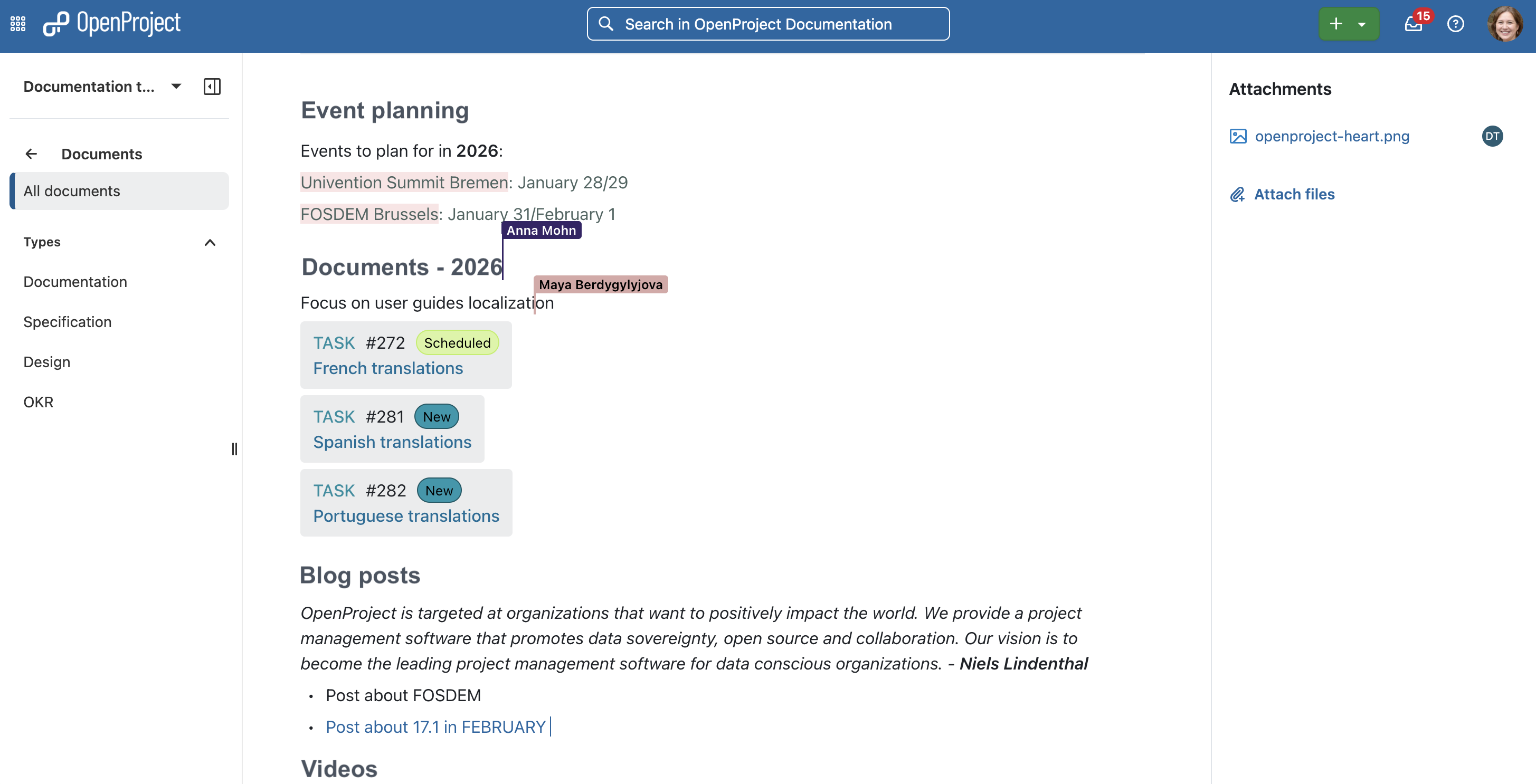
With the Documents module enabled, the team can create a shared document in their project and start working on it together in real time. Everyone sees changes instantly, comments can be addressed on the spot, and the document evolves collaboratively instead of through multiple versions.
Below is a simple example of how project admins can get started and introduce live collaboration in just a few steps.
1. Activate the Documents module in your project
As a project admin, open the project settings and activate the Documents module. This is the only required step to make live collaboration available to your project members. Once activated, all users with the appropriate permissions can create and edit documents together in real time.
2. Create types to structure your documents
To keep documents organized, you can define document types such as Strategy, Concepts, or Internal documentation. This is especially helpful when multiple teams or topics are involved. Types make it easier for project members to find and reuse documents later on and can be adjusted as your project grows.
3. Create your first document
Create a new document and give it a clear title, for example Marketing strategy 2026. The document opens directly in the editor, and changes are saved automatically while you work. From this point on, multiple users can edit the document at the same time without any additional setup.
4. Share the document with your team
Simply share the document link with your project members. Everyone with access to the project can open the document and start contributing immediately. No separate invitations or external sharing settings are required — project permissions apply automatically.
5. Explore the editor and link work packages in the text
Use the editor to structure your content, add lists or headings, and reference relevant work packages directly in the document text. This helps connect ideas and decisions with the tasks they relate to. For more advanced editing options, you can learn more about the underlying editor technology in the BlockNote documentation.
Tip
Use the news module to spread the word and encourage project members to try out live collaboration in Documents as well.
Activate live collaboration in your team
You are already taking the time to read about live collaboration — enabling the Documents module in your project takes less than a minute. Activate the Documents module, create a first document, and invite your team to work on it together.
If you are looking for more details on specific settings or permissions, our documentation is the best place to start. The User Guide explains how to work with documents, while the System admin guide covers technical setup and configuration options.
OpenProject 17.0 has been released and introduces several major improvements across the platform. In this article, we highlight the most important changes and what they mean for your daily work.
As this is a major release with many updates, we focus on the key highlights here. For a complete overview of all features, changes, and bug fixes, please see our release notes.
Project ideas, decisions, and agreements are often formed together. At the same time, they tend to be spread across different tools and files. This makes it harder to keep context, align as a team, and connect written content to actual project work.
With OpenProject 17.0, teams can collaborate on documents in real time, directly in OpenProject. What does that mean? – Multiple users can edit a document at the same time and see each other’s changes instantly. This helps teams develop ideas together, align on content, and keep everything centrally available.
That central approach works especially well because most documents are closely connected to your tasks and projects. You can reference milestones and link work packages, making it easier to move from a shared text draft to an actionable project plan. This is especially useful for project-related documents such as concepts, contracts, specifications, or planning documents, where collaboration and traceability matter.
Good to know: The redesigned Documents module is built on BlockNote, a modern, open source text editor that is also used in other European open source projects such as LaSuite and openDesk. This creates a strong foundation for future collaboration features across OpenProject.
Important
Real-time collaboration in Documents is available out of the box for all plans using OpenProject Cloud or on-premises installations with Docker Compose, Kubernetes, or Helm. For package-based installations, real-time communication needs to be set up separately. Also relevant for on-premises installations using packages: The package source has been changed to packages.openproject.com.
If you want to learn more about the design decisions, technical background, and what’s planned next, read this blog article.
Better meetings, less overhead: Draft and presentation modes, outcomes, and iCal
Meetings are essential for coordination and decision-making — but preparing agendas, guiding discussions, and documenting results often require extra manual effort. This can make meetings feel fragmented and outcomes hard to follow up on.
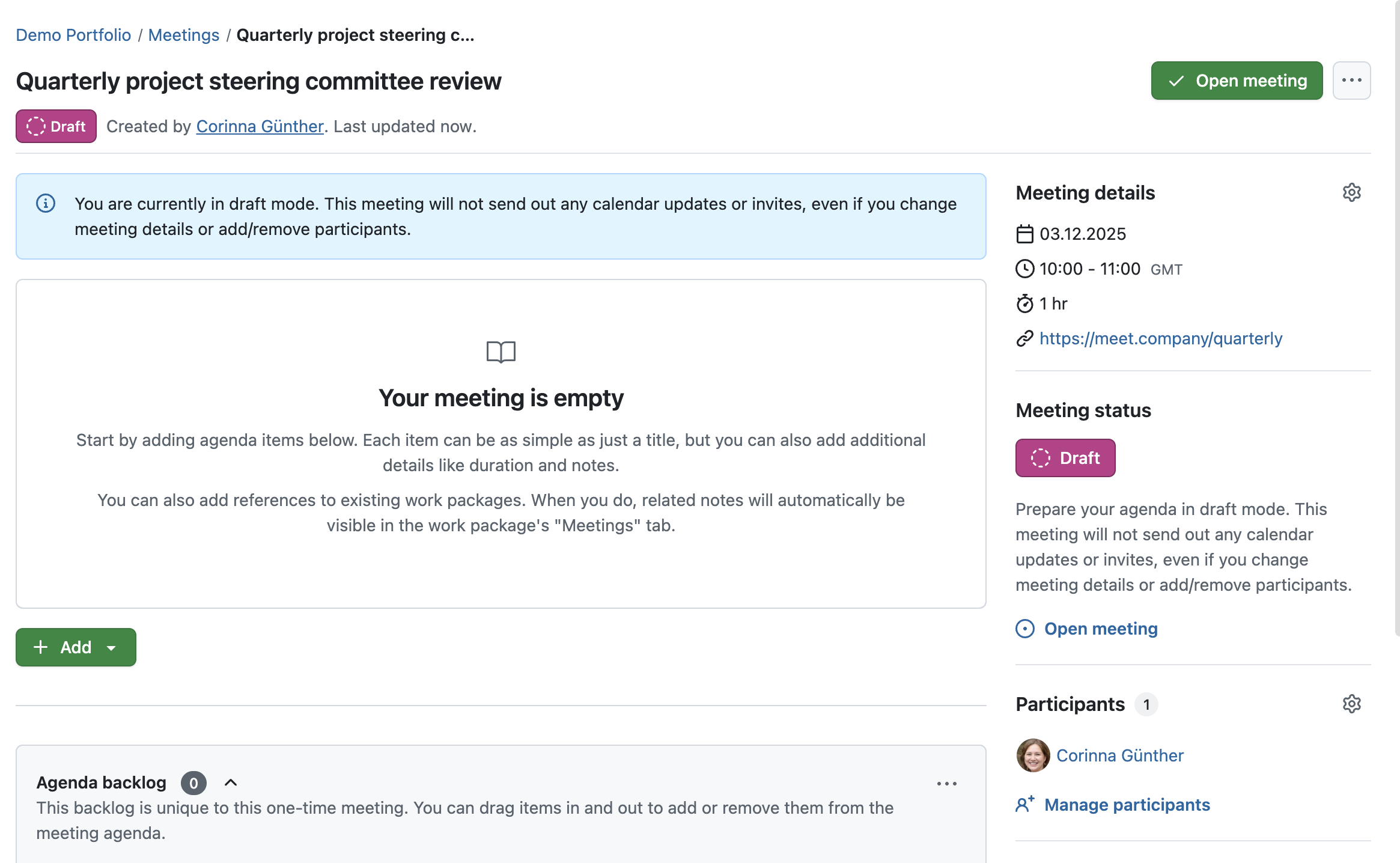
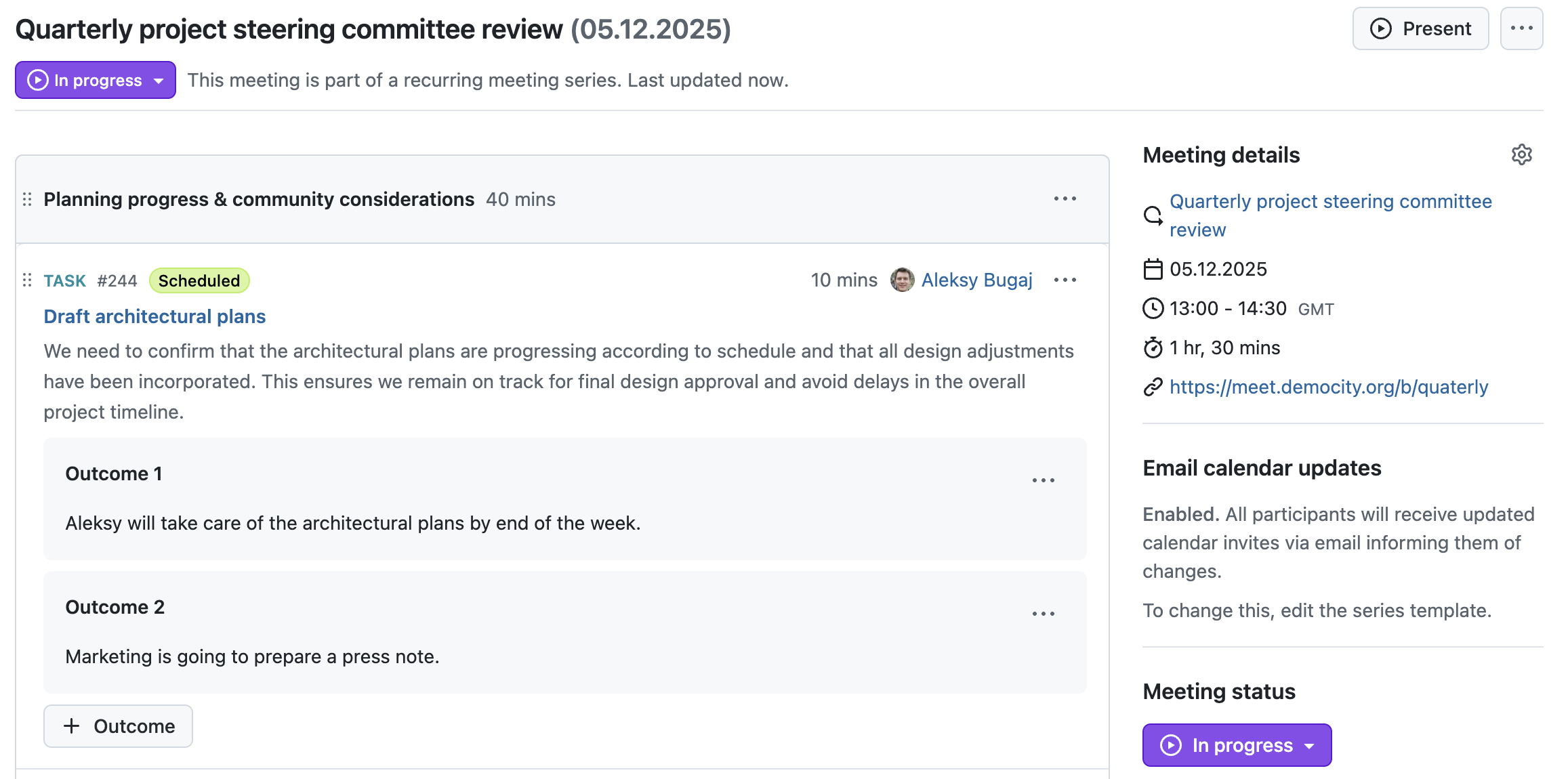
With draft mode, agendas can be created and refined collaboratively without notifying participants too early. This allows moderators to align internally before opening the meeting and sharing it with the full group.
Running a meeting: Presentation mode
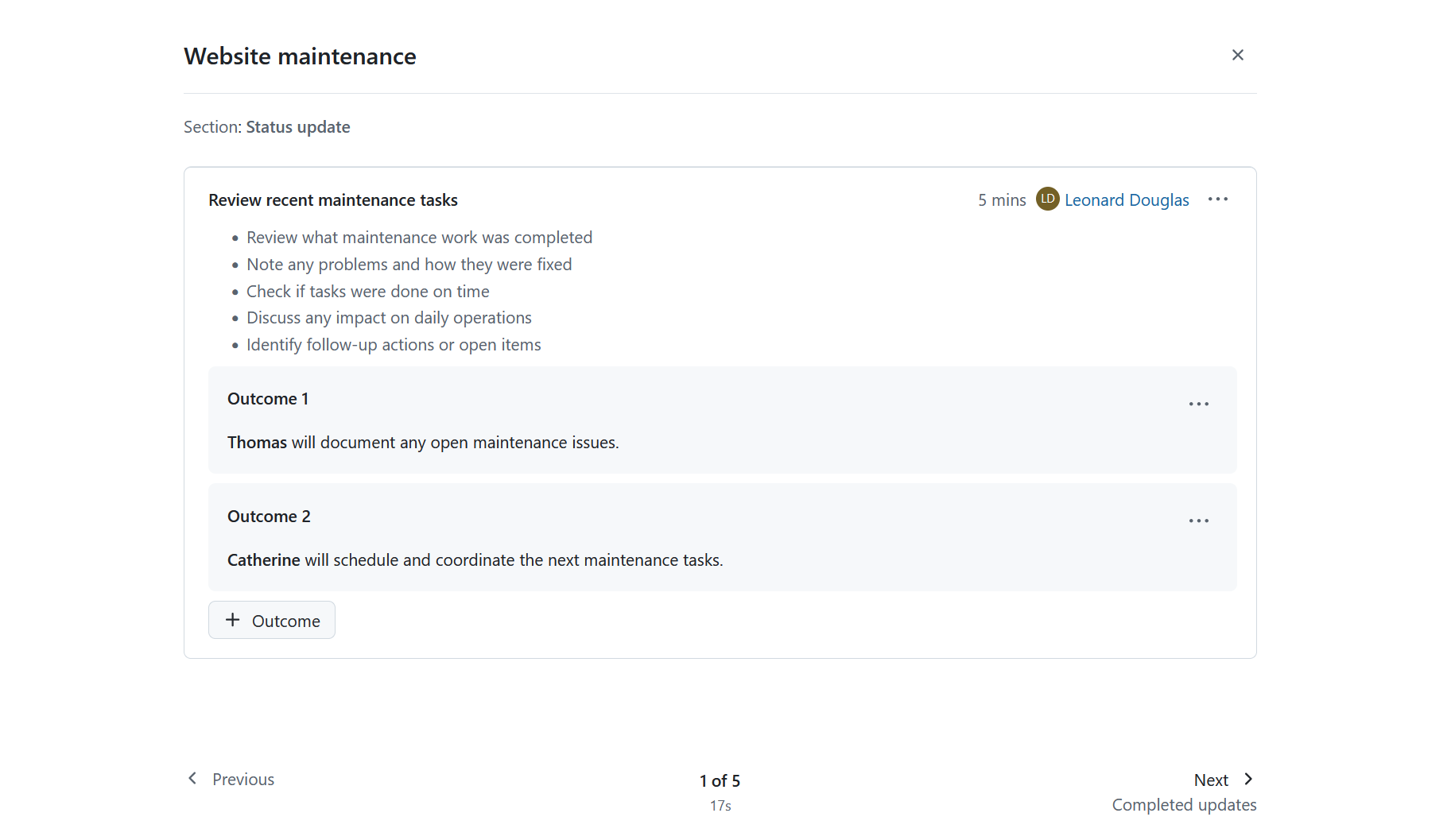
Once the meeting starts, keeping discussions focused can be challenging. Presentation mode helps moderators guide participants through the agenda step by step, making it easier to stay on topic and ensure that all items are addressed in order.
Documenting results: Multiple outcomes
Capturing results is just as important as running the meeting itself. Meetings can now include multiple text-based outcomes, making it easier to document decisions, agreements, or next steps directly where they belong. These outcomes remain part of the meeting documentation and can be reviewed later.
Staying informed: iCal subscription
To support follow-up and planning, meetings can also be subscribed to via iCal, allowing participants to stay informed about schedules and updates in their personal calendar tools.
Together, these improvements help teams run meetings more efficiently, keep discussions structured, and ensure that results are clearly documented and accessible.
Structure projects consistently: Redesigned project home and improved template selection
Creating projects in a consistent way is essential, especially for organizations working with defined project standards such as PM² or PMflex. In practice, project information is often spread across different views, and project setup can be error-prone, particularly for non-technical administrators.
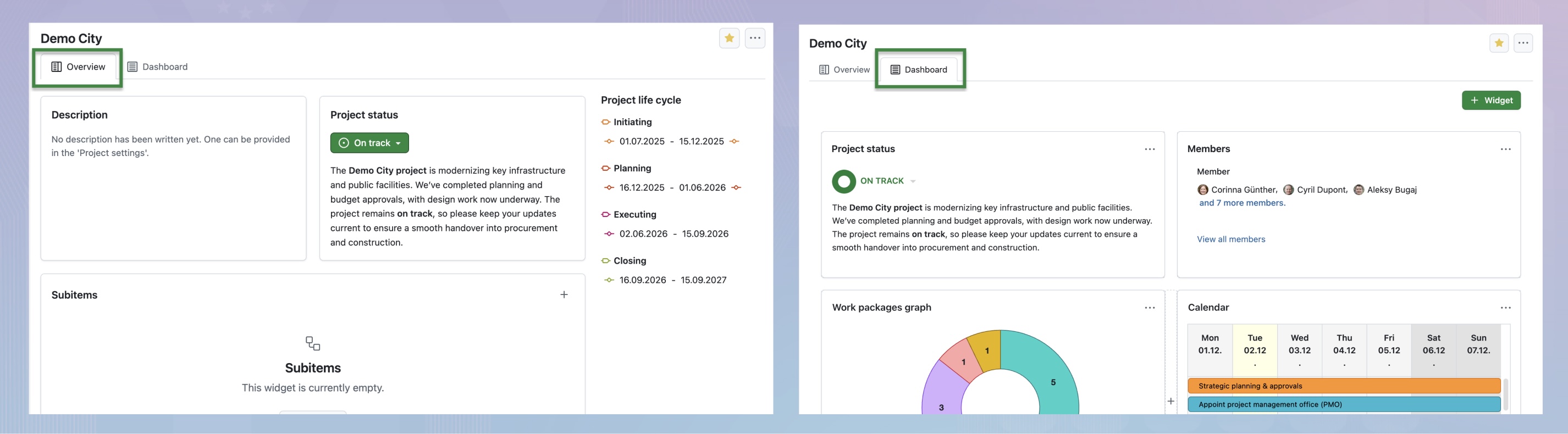
OpenProject 17.0 introduces a redesigned project home, now split into two dedicated tabs. This makes it easier to distinguish between high-level project information and operational details and helps teams understand a project’s structure at a glance. Please note that in addition to the redesign, the project overview page has been renamed to project home.
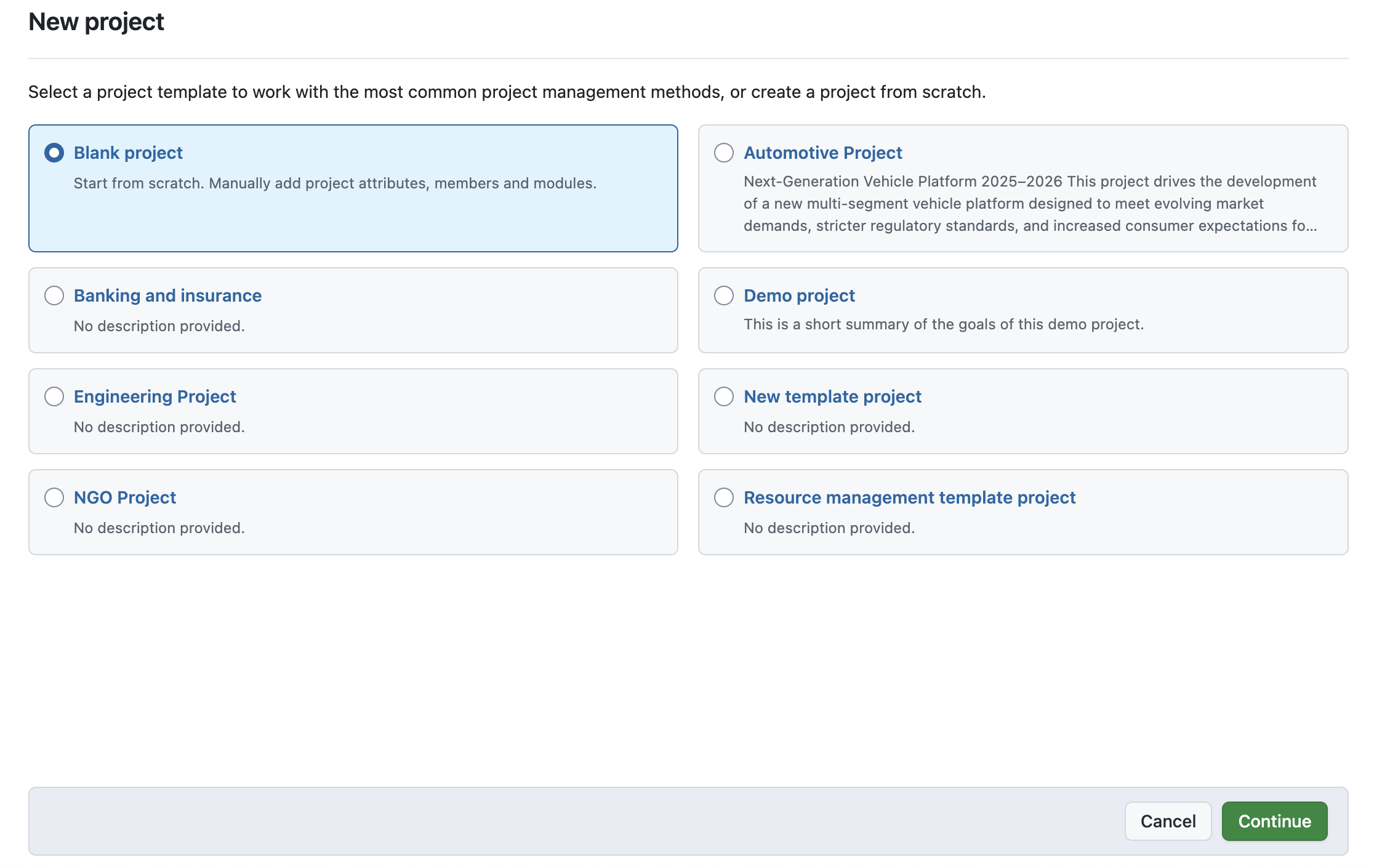
Project creation has also been improved. A clearer template selection guides users through the setup process and helps avoid common mistakes, even when projects are created by users without deep technical knowledge.
Note
These improvements lay the foundation for a planned multi-step project creation wizard in one of the next releases. The upcoming wizard aims to support the creation and processing of PM² / PMflex artifacts in a guided and user-friendly way. We plan to publish a preview article about this feature on our blog soon.
Manage projects at a strategic level: Programs and portfolios (Enterprise add-on)
As organizations grow, managing projects individually is often no longer enough. Strategic goals, dependencies, and priorities need to be visible across multiple projects — not just within them.
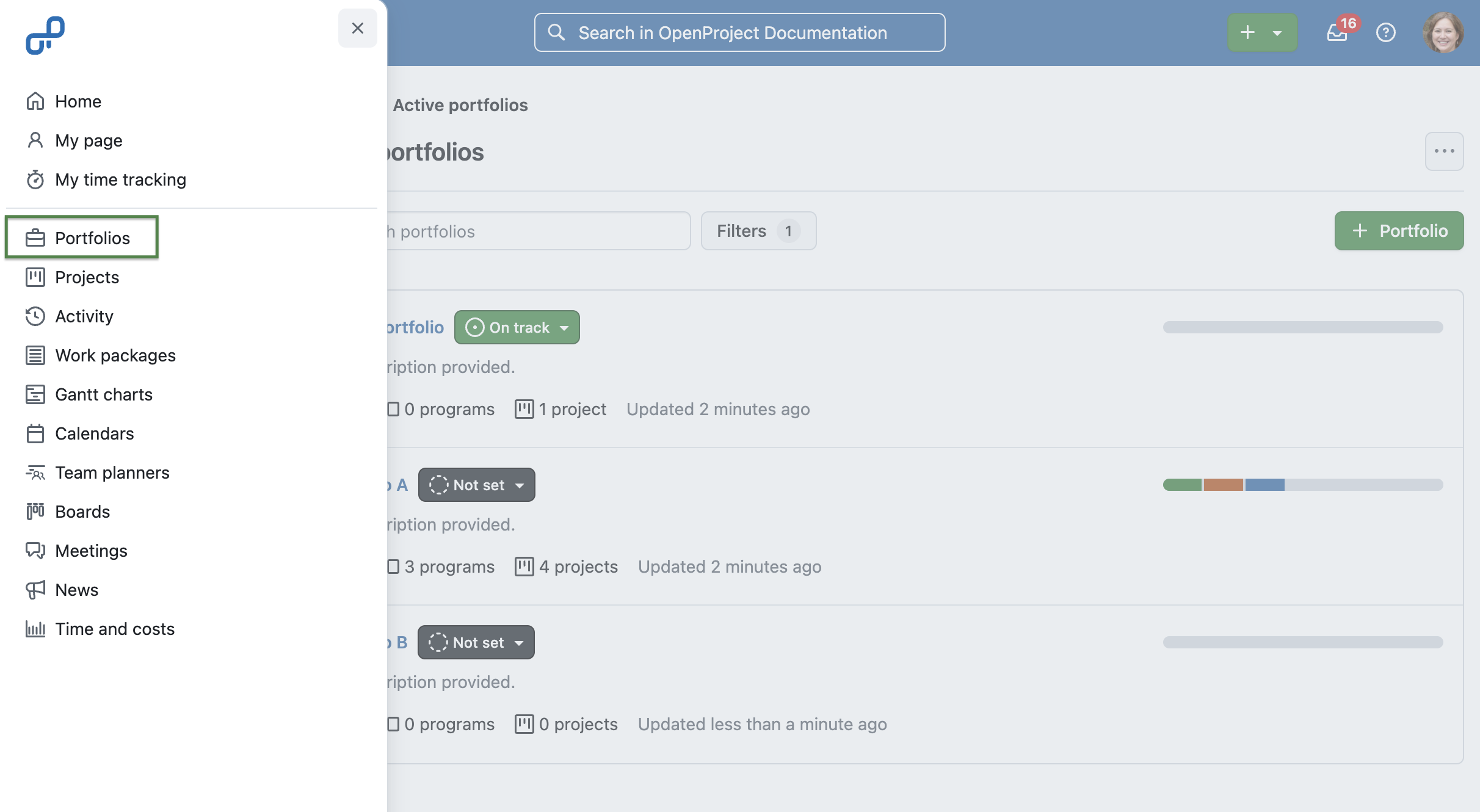
With programs and portfolios, OpenProject 17.0 helps organizations structure projects at a higher level. Related projects can be grouped into programs and portfolios to provide an overview of all ongoing initiatives. This makes it easier to align work with strategic goals, track progress across projects, and support informed decision-making.
This is particularly helpful for organizations working with PM² or PMflex, where projects are embedded in a broader strategic context and need to be managed consistently across portfolios and programs. PMOs, management teams, and public sector organizations benefit from increased transparency without adding complexity to day-to-day project work.
More control when connecting SharePoint: Updated SharePoint integration (Enterprise add-on)
Sharing and collaborating on documents across systems is common in many organizations — but it also raises questions around access control and data protection. Especially in regulated environments, it is important to clearly define who can see and edit which content.
With OpenProject 17.0, the existing SharePoint/OneDrive integration has been split into two separate integrations. This allows for more restrictive and clearer permission handling when connecting SharePoint content to OpenProject.
The updated SharePoint and OneDrive integrations are available as Enterprise add-ons in the Professional plan, just like before version 17.0. See our system admin guide to learn more about the SharePoint integration and now separate OneDrive integration for OpenProject.
Other great improvements
OpenProject 17.0 is a packed release. To keep this article concise, here is a quick look at some additional improvements worth highlighting:
You will find more information about all new features and changes in our Release notes or in the OpenProject Documentation.
If you need support, you can post your questions in the Community Forum, or if you are eligible for Enterprise support, please contact us and we will be happy to support you personally.
New to OpenProject? To test all features of OpenProject 17.0 right away, create a 14 days free trial instance for our OpenProject Enterprise cloud.
Prefer to run OpenProject 17.0 in your own infrastructure? Here you can find the Installation guidelines for OpenProject.
A very special thank you goes to Helmholtz-Zentrum Berlin, City of Cologne, Deutsche Bahn and ZenDiS for sponsoring released or upcoming features. Your support, alongside the efforts of our amazing Community, helps drive these innovations. Also a big thanks to our Community members for reporting bugs and helping us identify and provide fixes. Special thanks for reporting and finding bugs go to Alexander Aleschenko, Stefan Weiberg, and Markus Preisinger.
Last but not least, we are very grateful for our very engaged translation contributors on Crowdin, who translated quite a few OpenProject strings! This release we would like to particularly thank the following users:
stenberg.thomas, for a great number of translations into Swedish.
Sharmin, for a great number of translations into Persian.
Would you like to help out with translations yourself? Then take a look at our translation guide and find out exactly how you can contribute. It is very much appreciated!
As always, we welcome any feedback on this release.
iOS 26 is showing unusually slow adoption among iPhone users months after release, according to third-party analytics.
Usage data published by StatCounter (via Cult of Mac) for January 2026 indicates that only around 15 to 16% of active iPhones worldwide are running any version of iOS 26. The breakdown shows iOS 26.1 accounting for approximately 10.6% of devices, iOS 26.2 for about 4.6%, and the original iOS 26.0 release at roughly 1.1%. In contrast, more than 60% of iPhones tracked by StatCounter remain on iOS 18, with iOS 18.7 and iOS 18.6 alone representing a majority of active devices.
Historical comparisons highlight how atypical this adoption curve appears. StatCounter data from January 2025 shows that roughly 63% of iPhones were running some version of iOS 18 about four months after its release. In January 2024, iOS 17 had reached approximately 54% adoption over a similar timeframe, while iOS 16 surpassed 60% adoption by January 2023.
Based on those figures, iOS 26 adoption appears to be running at less than one-quarter of the rate achieved by recent predecessors during the same post-release window. StatCounter derives its estimates from web traffic analytics, tracking operating system versions via page impressions across its global network of participating websites.
In the first week of January last year, 89.3% of MacRumors visitors used a version of iOS 18. This year, during the same time period, only 25.7% of MacRumors readers are running a version of iOS 26. In the absence of official numbers from Apple, the true adoption rate remains unknown, but the data suggests a level of hesitation toward iOS 26 that has not been seen in recent years.
Unlike many previous releases, iOS 26 introduces Liquid Glass as a fundamental visual overhaul, replacing large portions of the traditional opaque interface with translucent layers, blurred backgrounds, and dynamic depth effects across system elements. Upon its announcement at WWDC last year, the redesign received mixed reviews, which could be a contributing factor to hesitation around upgrading.
Likewise, Apple now continues to support older operating systems with security updates, allowing users to remain on iOS 18 without immediate pressure to update or forfeit critical patches. This makes it much easier for users to remain on older software.
Electronic jamming and missiles are two of the risks identified by US regulators.
Latam airlines suspended its Bogota´- Caracas route this week after FAA advice. Photo: CD Dobelli
Major airlines cancelled flights from Bogotá to Caracas this week after US regulators warned of “heightened military activity” around Venezuela.
Avianca and LATAM suspended flights through Venezuelan airspace, along with at least five other airlines, as a response to a Federal Aviation Authority NOTAM (Notice to Airmen) that reported “Global Navigation Satellite System (GNSS) interference” around Maiquetía “Simón Bolívar” International Airport, which serves nearby Caracas.
The warnings were linked to military exercises under way in Venezuela, a response to threats from US forces massing in the Caribbean and aerial attacks on suspect drug boats, some originating from Venezuelan waters.
Colombia’s own airline regulator, Aeronáutica Civil de Colombia, repeated the FAA’s warning but said that air operators in Colombia could take “autonomous decisions” over flights to Venezuela.
On Monday several airlines were continuing direct flights from Bogotá, such as Wingo, Avior (a Venezuelan airline) and Satena (a commercial airline linked to the Colombian Ministry of Defense). Copa offered connections via Panama.
Mobile missiles
The list of airlines suspending flights continued to grow on Monday night with TAP, Turkish Airlines, Iberia and GOL being joined by Air Europa and Plus Ultra.
This came despite pushback from Venezuela’s Instituto Nacional deAeronáutica Civil (INAC) which threatened to punish airlines for following the FAA’s recommendations. According to a report in Aviation Online, airlines avoiding Caracas could in the long term lose access to the country’s airspace.
INAC also issued an ultimatum for airlines suspending flights “to resume services within a 48-hour period” or risk losing their landing permits.
Meanwhile the US FAA issued a more detailed FAA backgrounder clarifying that Venezuela had “at no point expressed an intent to target civil aviation”.
Portable Russian anti-aircraft missile similar to those used in Venezuela. Photo: André Gustavo Stumpf
It did, however, seem concerned that the current context could trigger an air accident.
Venezuela, it said, had mobilized “thousands of military and reserve forces” with access to shoulder-mounted anti-aircraft missiles, or MANPADs (man-portable air defense systems), capable of downing low-altitude aircraft.
This followed comments by Maduro last month that his military were in possession of Russian-made Igla-S missiles “with no fewer than 5,000 of them in key anti-aircraft defense positions to guarantee peace, stability, and tranquility”.
Jammers and spoofers
The more immediate risk was to electronic systems, said the FAA documents, with several civil aircraft recently reporting interference while transiting Venezuela, in some cases causing “lingering effects throughout the night”.
“GNSS jammers and spoofers can affect aircraft out to 250 nautical miles [450 kilometres] and can impact a wide variety of critical communication, navigation, surveillance, and safety equipment on aircraft.”
The FAA said it would “continue to monitor the risk environment for US civil aviation operating in the region and make adjustments, as appropriate, to safeguard U.S. civil aviation”.
In fact, the US airlines stopped all direct commercial and cargo flights into Venezuela as part of an order issued in 2019, related to sanctions against the Maduro regime, widely seen as illegitimate, with the US State Department offering a bounty of US$50 million “for information leading to the arrest and / or conviction” .
Venezuelan leader Nicolás Maduro has a US$50 million bounty on his head. Photo: Steve Hide
Open to talks
Commentators on US – Venezuelan relations this week said that FAA announcement was not necessarily a sign of imminent US military action. Former Associated Press analyst Dan Perry told News Nation that the FAA warning was “a message that they [the FAA] expected the country to become unstable”, but did not point to a ground invasion.
For most observers, the NOTAM was a continuation of the maximum pressure strategy pursued by Washington against the Maduro regime, including a recent decision to declare the Cártel de los Soles — a disconnected group of corrupt military officers who facilitate drug shipments — as a Foreign Terrorist Organization.
Last week Maduro said he was open to talks with Washington, according to AP News, though US President Trump underscored that military action was “still on the table”.
In recent months the US has sent eight navy ships, a submarine, an aircraft carrier and 10,000 service members to the Caribbean. And since August, US firepower has killed at least 83 people in aerial attacks on speedboats suspected of running drugs; for anyone arriving in Venezuela, air is still safer than sea.
Before he became Latin America’s most celebrated chef, Álvaro Clavijo spent years doing what few aspiring cooks romantically imagine: scrubbing plates in the basements of Parisian kitchens. He had left Bogotá after a brief, unsatisfying year studying architecture at Los Andes University. In Paris he dabbled in photography, learned impeccable French, and quickly discovered that the underbelly of a culinary capital is more grit than glamour.
But something in the rhythm of kitchens – heat, repetition, precision – anchored him. Despite his mother’s skepticism that he could make a living cooking (“She couldn’t even fry an egg,” he jokes), he enrolled at Barcelona’s prestigious Hofmann School, known for turning students into chefs ready for the academy’s own Michelin-starred restaurant.
Three years in Barcelona, five in France, and still, Colombia tugged at him. Yet just as he considered returning home, another city intervened – New York, home to the temples of modern gastronomy. He landed at Thomas Keller’s Per Se, where the immaculate choreography of haute cuisine shaped him indelibly. “My cooking is French, my ingredients are Colombian, and my organization is American,” he says today, seated in the dining room of El Chato, the Bogotá restaurant that has now been named Latin America’s Best Restaurant 2025 by Latin America’s 50 Best Restaurants.
Clavijo returned to Bogotá in 2013 to open the first incarnation of El Chato in Quinta Camacho. The menu – slow-cooked meats, obsessive technique, and elegant, deeply flavored dishes – won over small but devoted crowds. Still, it was removed from the city’s emerging gastrosphere. When a more neighborhood-friendly house became available in Chapinero Alto, he moved the restaurant, unaware that the next decade would transform it into one of the continent’s most influential kitchens.
Today, El Chato is a study in unpretentious sophistication. The 80-seat dining room blends the familiar with the eccentric: a 1970s rotary telephone, faded high-school portraits, and stacks of old medical encyclopedias donated by friends. Bare brick walls glow under soft lighting. The décor is tongue-in-cheek, but the menu – one page, clean, unfussy – reveals Clavijo’s philosophy: dining should thrill, not intimidate.
A meal begins with the restaurant’s signature “mule,” part Moscow classic, part tribute to the Colombian countryside’s icon. Infused with herbs and tropical fruits, the drink sets the tone for a night driven by local ingredients elevated through global technique. Upstairs, the kitchen team moves like monks—quiet, deliberate, wholly focused.
Clavijo’s signature dishes have become objects of devotion. A roast lamb, equal parts Boyacá and Provence, is tender, perfumed, and blanketed with a buttery cream sauce. The crab in avocado purée, studded with mango, foraged greens, and blackened-rice chips, is the kind of dish entire essays could be written about. Beef tartare arrives garnished with rose vinaigrette, mini croutons, and kale mayonnaise. Even the lunch menu—Cuban pulled pork sandwiches, bright shrimp buns—shows a level of refinement that belies its casual delivery.
Temperature, he insists, is everything. He pushes heat to its limits, and his meat cuts are never simply slapped onto a grill; they are cured in-house for weeks, allowing “alchemy,” as he calls it, to work. Rarely leaving the kitchen, he has built a culinary identity rooted in mastery of technique and reverence for Colombian produce, from the high Andes wetlands to the Amazon lowlands.
What distinguishes El Chato – and how it ascended from No. 3 in 2024 to No. 1 in 2025 – is its role as an ambassador for Colombian biodiversity. Working closely with small growers and horticulturists in the Sabana de Bogotá, people whose crops rarely reach high-end kitchens, Clavijo’s dishes are not recreations of Colombian cuisine but reinterpretations – rooted in memory, informed by travel, and executed with discipline.
On a typical night, the dining room hums with locals and international travelers alike. Bogotá’s restaurant scene is fiercely competitive; many places don’t survive their first year. El Chato did more than survive. It set a new standard, one that the world has now recognized by awarding it the top spot in Latin America’s 50 Best Restaurants.
For Clavijo, the accolade is gratifying but not defining. The work continues. The flavors deepen. The relationships with farmers strengthen. And every night, in that Chapinero house where mountain meets sea and garden meets homestead, his team quietly reshapes what Colombian cuisine can be.
The 2025 Latin America’s 50 Best list highlighted restaurants from 21 cities, including seven first-time entrants, underscoring the region’s growing culinary diversity. Kjolle in Lima ranked No. 2 and was named Best Restaurant in Peru, while Don Julio in Buenos Aires placed third, securing Best Restaurant in Argentina. Boragó in Santiago took the No. 6 spot, with its chef, Rodolfo Guzmán, receiving the Icon Award for his influence on Chilean cuisine. Quintonil in Mexico City (No. 7) and Tuju in São Paulo (No. 8) were recognized as the best restaurants in Mexico and Brazil respectively.
Cartagena-based Celelé also has an impressive rank among Latin America’s 50 Best, coming in at No.5.
Casa Las Cujas in Santiago, which debuted at No. 14, won the Highest New Entry Award, while Cosme in Lima earned the Highest Climber Award after rising 19 places to No. 9. Nuema in Quito, ranked No. 10 and named Best Restaurant in Ecuador, saw chef Alejandro Chamorro win the peer-voted Estrella Damm Chefs’ Choice Award.
Bianca Mirabili of Evvai in São Paulo (No. 20) was named Latin America’s Best Pastry Chef, and Argentina’s Maximiliano Pérez received the Best Sommelier Award for his wine-driven interpretations of local terroir. Ttássia Magalhães was awarded Latin America’s Best Female Chef for her leadership of an all-women kitchen team in São Paulo.
The awards also recognized national leaders: Maito in Panama City (No. 18), Sublime in Guatemala City (No. 19), Cordero in Caracas (No. 29), and Sikwa in San José (No. 43) were named the best restaurants in their respective countries. Seven new entries joined the 2025 ranking, including Afluente in Bogotá (No. 34), El Mercado in Buenos Aires (No. 27), Arami in La Paz (No. 48), and Demo Magnolia, Yum Cha and Karai by Mitsuharu in Santiago.
Oda in Bogotá received the Sustainable Restaurant Award for its focus on hyper-local sourcing. Additional previously announced prizes included Chef Tita of the Dominican Republic winning the Champions of Change Award, Kjolle receiving the Art of Hospitality Award, and Guatemala’s Ana being named the American Express One To Watch.
In 2017, after El Chato had recently opened its doors to the public, The City Paper profiled the venue and sat down to talk with the young, dynamic chef. The restaurant’s location on Calle 65 No.3B-76 remains the same, and reservations are required.
At the eastern fringes of the Andes, where the Orinoco River Basin unfurls in an ondulating canvas of green, punctuated by majestic rivers and sandstone mesas, lies one of the world’s most astonishing open-air galleries of human existence.
The Serranía de La Lindosa, in the department of Guaviare, is a monumental tableau carved by nature and painted by hands that may have been among the earliest storytellers on the planet. For centuries, these walls stood largely hidden to the world, known only to Indigenous communities and a handful of intrepid explorers. Today, they form the heart of a groundbreaking exhibition in Bogotá’s Museo del Oro: Trazos sobre piedra: Pinturas milenarias en la serranía de La Lindosa, an ambitious, year-long showcase hosted by Banco de la República.
The exhibition that opens on November 28 is the most extensive institutional undertaking yet to unravel the symbols, narratives, and cosmologies that animate a rock-art tradition stretching back tens of millennia. Far from a display of a lost civilization, the Central Bank’s ambition matches that of the cliffs themselves – massive escarpments where hunters, shamans, and master painters returned generation after generation to leave visual testaments of their world.
The story of La Lindosa begins, in many ways, with a single mark. A red smear – thin, elongated, always intentional – painted on the rough face of a stone wall deep in an expanse of canopy and tropical rainforest. To an untrained eye, the pigment blends with natural iron deposits. But to archaeologists who have studied the region for years, it marks the threshold of an extraordinary visual universe. That smear belongs to a constellation of tens of thousands of pictograms across Guaviare and neighboring Amazonian massifs, including the monumental cliffs of the PNN Chiribiquete National Park. Together, they form one of the world’s oldest and largest rock-art traditions.
Archaeologists describe La Lindosa as a cultural landscape, a place where art, geology, ecology, and spirituality intertwine. The Serranía’s towering sandstone walls were formed by tectonic forces millions of years ago, creating natural canvases that humans began to paint long before the earliest agricultural societies emerged.
Only recently have researchers begun to grasp the full temporal depth of these murals. While Europe’s famed Lascaux cave contains roughly 600 images dating to the Upper Paleolithic (between 15,000 and 13,000 BC), the paleo-Indian paintings of Colombia could be far older. In Chiribiquete, analysis of natural dyes, superimposed layers, and stylistic continuity suggests that some images may date back as far as 35,000 BC. La Lindosa shares many of these motifs and techniques, hinting at a cultural horizon that may reach back to the earliest chapters of human imagination.
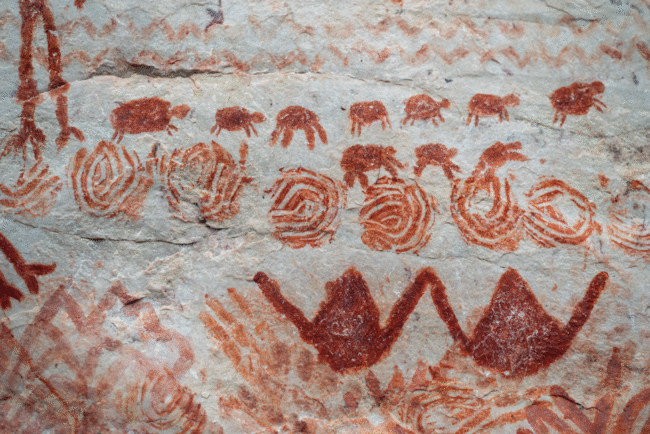
Details on the rock face of La Lindosa. Photo: Federico Ríos/Banco de la Repúblics
This immense chronology is not just a scientific revelation – it is a window into a world where every figure, every line, carries meaning. The murals of La Lindosa are filled with scenes of ritual dances, hunting parties, geometric patterns, spirit beings, and animal-human hybrids. They depict jaguars, monkeys, fish, snakes, birds, and the silhouettes of humans with outstretched arms. In some panels, the figures appear in motion; in others, they stand in tight, nearly choreographed formations that suggest communal ceremony. The dazzling variety of imagery points to a worldview rooted in transformation, reciprocity, and ecological intimacy.
One of the most compelling findings to emerge from recent research is the specialized nature of the painting tradition. Archaeologists believe that the most experienced storytellers – shamans, ritual specialists, or highly trained painters – scaled treacherous escarpments to reach spaces associated with spirits and cosmic forces.
These elevated murals often contain the most complex iconography, executed with astonishing precision. Younger or less experienced painters worked closer to the ground, contributing simpler figures or layering their work atop earlier compositions. Over centuries, entire cliffs became palimpsests: surfaces where multiple generations added, corrected, reinterpreted, and echoed the narratives of their ancestors.
The Banco de la República’s exhibition, under Judith Trujillo’s curatorship, mirrors this layered history. Visitors encounter immersive installations, high-resolution photographic panels, pigment analyses, and interactive 3D reconstructions that recreate the sense of standing before the colossal walls themselves. Rather than isolating images, the exhibition places each pictogram within the broader landscape – its geology, myths, and ecological rhythms.
To step inside the exhibition is to enter a world where the boundaries between art and survival dissolve. The rock art of La Lindosa was not decorative; it was a method of world-making. It engaged with spirits, conveyed moral codes, transmitted ecological knowledge, and anchored communities in a landscape that could be both bountiful and unforgiving. Many murals appear near water sources, ancient pathways, or natural shelters – places where human life pulsed most intensely.
Just as telling is the continuity these images embody. Despite colonization, displacement, and the fragmentation of Indigenous territories, the symbolic vocabulary of the Amazon endures. Elements of this cosmology survive in the ritual practices of several Indigenous groups today, whose elders regard the panels not as archaeological remains but as living documents.
As Colombia confronts the pressures of illegal mining, deforestation, and climate change, the need to protect sites like La Lindosa has become urgent. These walls hold traces of human existence long before national borders or written histories were printed. They extend the timeline of pre-Columbian identity back tens of thousands of years, reminding visitors that the Amazon and Orinoco watersheds have always been at the center of innovation, imagination, and spiritual awakening.
Inside the Gold Museum’s hallowed halls, visitors will pause before the vivid reds – their unexpected brightness, their persistence through rain, wind, time. These pigments, ground from seeds, minerals, and endemic plants, were not chosen at random; they were sacred. They signaled life, danger, transformation. They were meant to endure.
Whether the ancient painters imagined their work surviving 30,000 years is just one of many unsolved mysteries. Their names may be lost, but their visions endure – a vast, breathing archive that continues to astonish and challenge us.
Guests to this landmark exhibition are not mere spectators either, but participants in La Lindosa’s vast “Sistine Chapel” – an offering handed-down to generations, and carried forward through the endless corridors of time.
Visitor Information – Museo del Oro
Museo del Oro, Banco de la República
Cra. 6 No. 15-88.
Exhibition runs until November 27, 2026.
Opening Hours
Tuesday–Saturday: 9:00 a.m. – 7:00 p.m.
Sunday: 10:00 a.m. – 5:00 p.m.
Monday: Closed
Admission: COP $5,000
Follow the exhibition on social media: Instagram @MuseoDelOro #LaLindosa #MuseoDelOro
 Login
Login