Reading view

The truth behind Petro’s claims of Colombia voting fraud
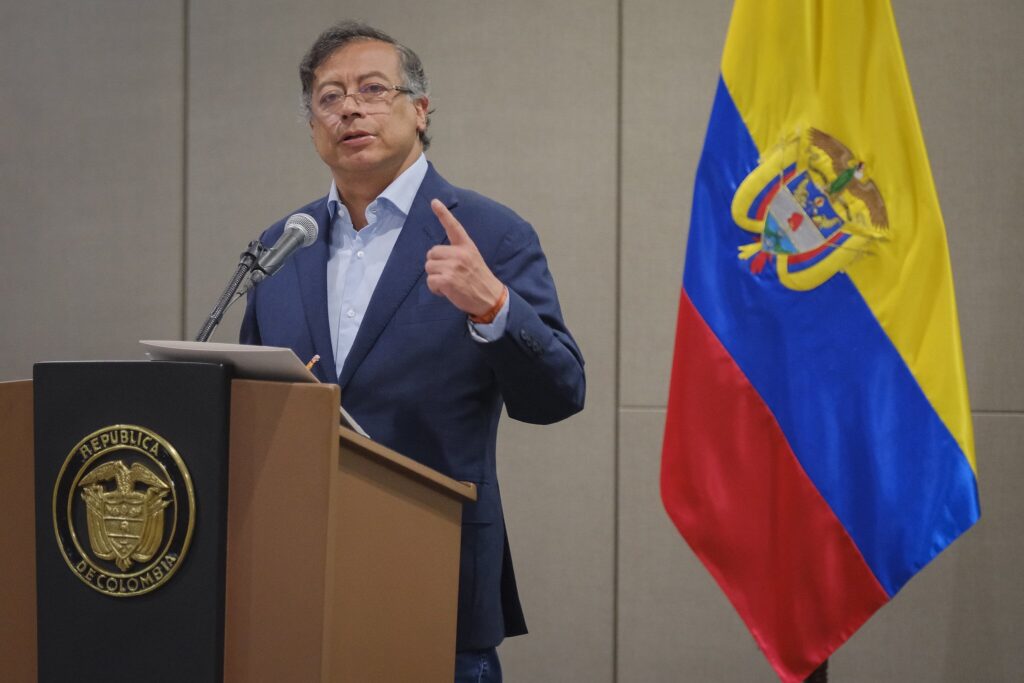
President Gustavo Petro. Image credit: @infopresidencia via X.

Just days away from Colombia’s first-round presidential election, incumbent President Gustavo Petro continues to sound the alarm about voter fraud. 

On Tuesday, he repeated claims that the National Registrar’s Office is allowing the vote to be manipulated against his party’s candidate, Senator Iván Cepeda.

Petro renewed calls for citizens to supervise the vote count, describing it as the only way to avoid fraud: “Only the physical vigilance of millions of people can overcome the algorithm manipulations that the Registrar’s Office refused to prevent.”

But are the president’s claims of vulnerabilities in the voting system valid?

A decade-long dispute

Petro’s claims stem from a long-running grudge with Thomas Greg & Sons, a multinational security and printing company tasked with issuing Colombian passports and overseeing electoral logistics.

According to Petro, the firm cannot be trusted with the sensitive task of printing, delivering, and processing vote counting forms.

While the president’s claims have widely been dismissed by electoral institutions as reckless, there is some foundation for them.

Following the 2014 legislative elections, the evangelical political party, MIRA, filed a legal petition against the Registrar’s Office, claiming a discrepancy between the ballot pre-count (filled out by citizen juries in a form known as E-14) and the digitized tally of the vote (filled out by officials in the E-24 form).

MIRA claimed to have evidence of manipulation of the software used for “voting, information, transmission, or tabulation of election results,” which was managed by a subsidiary of Thomas Greg & Sons. 

After a lengthy four-year legal case, the Council of State (Consejo de Estado), the highest court overseeing the government, issued a ruling in favor of MIRA. It found evidence of destruction of electoral material and inconsistencies between the E-14 and E-24 forms. 

Crucially, the Council of State said that it could not confirm that voting software had been sabotaged because it did not have access to the source code of the software during the elections.

Without the original code, it was impossible to know if the system had been tampered with.

The body issued a clear recommendation to prevent repetitions of the dispute in future elections: “Direct the Electoral Organization to acquire the necessary vote-counting software for use within the state—that is, software owned by the organization itself—which allows for full traceability of the vote-counting process from the polling stations through to the official declaration of the election results.”

In other words, it recommended that electoral authorities roll out their own software, rather than relying on third party providers.

But 12 years later, Thomas Greg & Sons remains in charge of the electoral software; according to the Registrar’s Office, purchasing proprietary software and operating the corresponding data centers is not feasible.
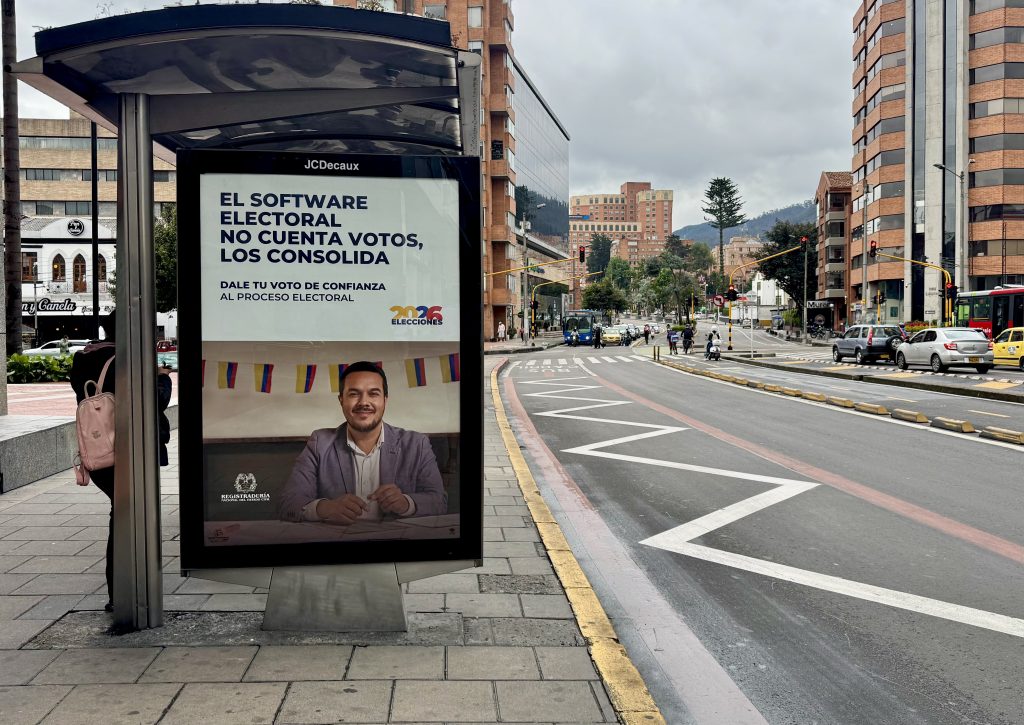
The Registrar’s Office has launched an advertisement campaign defending the integrity of the voting process. Image credit: Alfie Pannell.

While Petro continues to lobby for a fully state-owned system, he has concentrated his efforts on mitigating the risks of a repeat of the 2014 source code issue.

The president has repeatedly demanded that the Registrar’s Office share the source code with the government and the public, which he says would allow them to prevent a repeat of the situation in 2014.

But the Registrar’s Office maintains that there is no need, suggesting that publicizing the code would leave the software more vulnerable to attacks and defending internal audit processes.

Petro rebutted, calling the claim “an immense lie”.

Other types of fraud

As well as warning about software manipulation, the president has also raised the alarm about differences between the pre-count and the official, scrutinized count. Ahead of the March elections, he warned that the pre-count may not accurately reflect the results.

Petro’s concerns stem from the 2022 legislative elections in which over half a million votes for his Historic Pact coalition were excluded in the pre-count and later revealed in the scrutiny. 

Rather than software, the culprit for the discrepancy, which in total represented a 5.49% difference, was human error; the Electoral Observation Mission (MOE) had warned the ballot sheets were designed in a way that could lead to Historic Pact votes being neglected. 

But the 2022 vote appears to be an outlier, with the MOE reporting just a 0.28% discrepancy between the pre-count and the scrutinized votes in March’s legislative elections.

Petro’s mistrust in the pre-count may be valid in the case of a tight race with razor-thin margins but not so much if there is a clear winner. And, in any case, the scrutiny process should clear up any doubts. 

“In Colombian elections, it is judges who determine electoral disputes and not a logistical operator such as Thomas Greg & Sons,” explained Sergio Guzmán, director at Colombia Risk Analysis, a political risk think tank.

Bigger fish to fry

While Petro aims his crusade against Thomas Greg & Sons, a firm which he has clashed with on a range of issues, there are other, more prescient threats to electoral integrity.

“I think that concerns about voters being coerced to vote are legitimate… but I think concerns that somebody will steal the election are overblown,” said Guzmán.

International observers including the United Nations have warned that violence may undermine the elections, particularly in areas under armed group control. 

Vote buying is also a well-documented phenomenon in many regions of the country.

While Petro has some basis for his allegations of voter fraud, there is no evidence of software manipulation determining presidential election results in Colombia.

In a razor-thin race, observers would be wise to wait for the scrutinized vote count to declare a winner. But for now, Petro’s warnings about election-rigging appear to be largely overblown.

The post The truth behind Petro’s claims of Colombia voting fraud appeared first on The Bogotá Post.

  •  

Inside a pro-Abelardo de la Espriella rally in Bogotá

Abelardo de la Espriella supporters drive down Avenida La Esmeralda in Bogota on May 17, 2026. Image credit: John Boscawen.

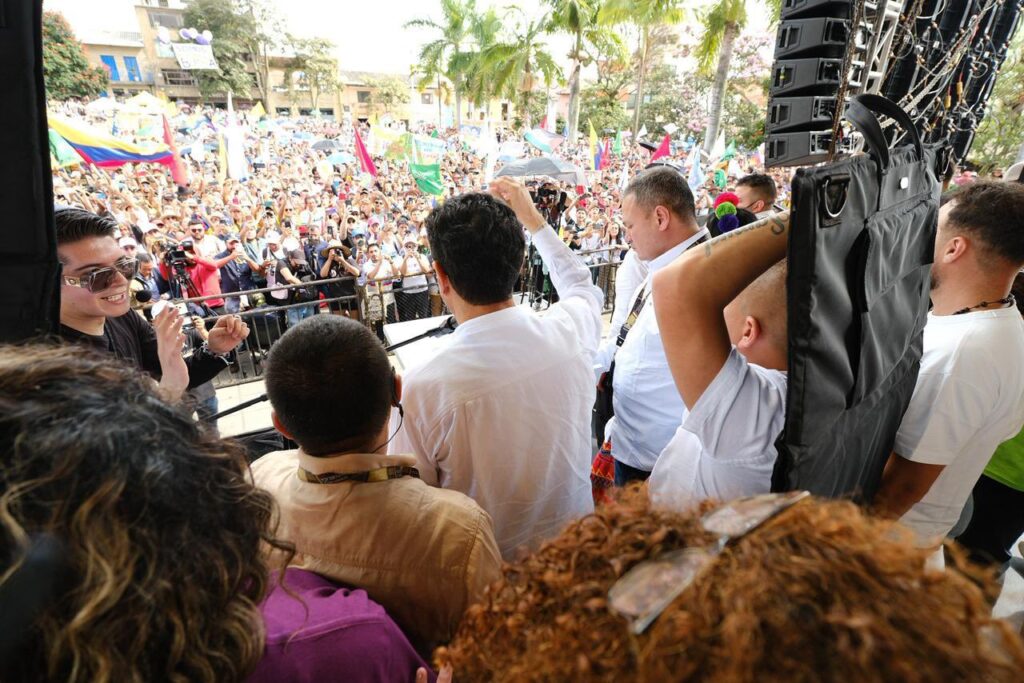
Hundreds of cars briefly blocked all three lanes of Avenida La Esmeralda in the center of Bogotá on Sunday afternoon as supporters of hard-right Abelardo de la Espriella gathered to show their support for his candidacy two weeks before the presidential elections kick off.

De la Espriella himself was campaigning in Valledupar, but his campaign called for Abelardistas in over 70 municipalities around the country to come out and show their support by convening a noisy caravan.

While many Colombian families relaxed in neighboring Parque Simón Bolívar, a few hundred die-hard supporters of the far-right populist showman answered the call.

The hallmark of de la Espriella’s campaign for the presidency is its promotion of sincere patriotic fervour, and this passion was very much on display.

Colombian flags and football jerseys, vallenato, vuvuzelas, balloons and the words “Firme por la Patria” (Steadfast for the Homeland) abounded.

While the lanes filled up, the self-titled Defensores de la Patria (Defenders of the Homeland) honked their horns, danced, took photos, chatted and saluted one another. Some applied camouflage paint to their faces to get in character.

Vendors were selling Colombia flags and mango biche while children danced to songs hailing El Tigre’s achievements and virtues.

Some Abelardistas donned fake military fatigues and camouflage face paint. Image credit: John Boscawen.

Speaking to The Bogotá Post, some of those present said they were attracted to de la Espriella as an aspirational figure who makes them feel proud to be Colombian. Others are attracted by his personal values. 

For Adriana, waving her flag in the middle of the road, “it is very important that he is a family man, he works hard for his family, he takes his family with him everywhere, and they are very close.”

She believes young people turn to crime because they lack the pride and self-confidence to make something of themselves, describing Abelardo as the kind of role model who could “inspire young people to make a positive contribution to society.”

Others had come along to demonstrate their implacable opposition to a government led by Iván Cepeda, the left-wing candidate currently leading in the polls.

Aron, wearing a baseball cap emblazoned with de la Espriella’s face, is saluting passersby. He explained his view that, “Petro is a socialist, but Cepeda is a communist. Petro is progressive, but Cepeda wants to completely change the country. He doesn’t believe in private property.”

His friend, Doris, added that, “Cepeda will take us down the path of Venezuela.”

Time and again participants reported that they believe Abelardo will bring freedom to Colombia. 

For some, that meant freedom of speech, which they feel has been curtailed under Petro.

For others, freedom meant freedom from crime and corruption, which Abelardo will end by “ruling with an iron fist.”

For yet others, freedom meant an end to economic regulations that they see as inhibiting economic competition.

Everyone who spoke to The Bogotá Post said Colombia needed “saving” from something – which varied from person to person – and that Abelardo was that “savior”.

One man even said, “If we don’t win, they will have stolen it from us.” Accounts affiliated to de la Espriella’s campaign have been disseminating fake polling that shows him winning 86% of the vote. 

Nevertheless, his supporters are pragmatic enough to vote tactically. Every person I spoke to admitted they would vote for right-wing Paloma Valencia in the second round, if Abelardo does not get through, in order to keep Cepeda from power. After an hour of stationary honking, the convoy, led by an enormous dumpster truck, set off on its tour of the city, and the mango biche sellers drifted back into the park.

The post Inside a pro-Abelardo de la Espriella rally in Bogotá appeared first on The Bogotá Post.
  •  

In conversation with Claudia López, ex-mayor of Bogotá and presidential candidate

Claudia Lopez. Image credit: Billy Ramsey.

Less than three weeks before Colombians head to the polls in presidential elections, centrist candidate Claudia Lopez’s odds at victory are slim, to say the least.

Since winning the primary contest to lead the Consultation of Solutions (Consulta de las Soluciones) bloc in March, the silver-haired former mayor of Bogotá has been criss-crossing the country to win over moderate voters.

But the latest polls report the 56-year-old’s share of the vote as being in the low single digits.

Dressed in her signature gilet and sipping from a mug of coffee, the former Harvard University guest lecturer says in flawless English that she wants to do the interview in Spanish – “I need to get people to vote for me,” she jokes. 

With little to lose, López speaks candidly about her time in office, her views on other politicians, and her experience on the campaign trail.

Watch the full interview here

Reflections on her mayorship

López, who steered Bogotá through the Covid-19 pandemic and a mass wave of anti-government protests, speaks proudly of her stint as mayor from 2020 to 2024.

The presidential hopeful rattles off a list of her achievements in office: her management of the Covid-19 pandemic, lifting 600,000 women out of poverty, and rolling out Bogotá’s public bicycle network.

López also speaks candidly about the problems during her mayorship, which spanned the administrations of presidents Iván Duque and Gustavo Petro.

“Interestingly, I ended up having an easier relationship with President Duque, a right-winger, than with my left-wing president, whom I voted for,” says López. 

López, who publicly backed Petro’s candidacy, describes friction between the national government and the mayor’s office.

“President Petro is an effusive leader, but he is too effusive, very machista, and I, well, I don’t agree with that; if there’s one thing I can’t stand in my life, it’s the abuse of power.”

On the campaign trail

Today, the former senator finds herself trying to carve out a place in a noisy election cycle marked by political extremes and polarization.

Her coalition’s platform is based on three pillars: security and territorial governance; equality and social justice; and regional development without corruption.

López’s shift to the center has drawn some criticism, including from voters who note the former Green Alliance member’s u-turn on key environmental issues like fracking.

Last year, she declared: “If god gave us oil, coal, and gas, that is what we will use.”

“I maintain this stance,” insists López, adding she opposes the Petro administration’s pause on all oil and gas exploration. “Stopping gas exploration means halting Colombia’s energy transition – it’s a mistake.”

López argues the policy has damaged the economy and reduced funds for investment and development. 

Instead, she backs a gradual transition: “I estimate that the transition in Colombia from fossil fuels to cleaner energy sources will take us about 25 years, give or take.”

The candidate believes in preserving biodiversity, saying she would not authorize mineral exploration in the country’s forests or protected areas, marking a softer stance than some of her opponents.

Among her rivals, López is especially critical of right-wing criminal defense attorney Abelardo de la Espriella.

“He is the only candidate – let’s put it this way – whom I would absolutely never vote for. He is a defender of mobsters. He is a shadowy character,” says López.

De la Espriella notoriously represented figures linked to paramilitary death squads, the head of the worst pyramid scheme in Colombian history, and Alex Saab, considered the frontman for corruption schemes by former Venezuelan dictator Nicolas Maduro. 

López argues that he is an Uribista – a supporter of the politics of right-wing ex-president Álvaro Uribe – but is on a different “side of the coin” to Uribe’s chosen candidate, Paloma Valencia.

“Paloma is definitely a supporter of Uribe, but she’s never exactly been a defender of mobsters,” explains López.

The ex-mayor refused to rule out voting for Valencia or for leftist candidate Ivan Cepeda, the two frontrunners alongside de la Espriella.

But López, a lesbian woman, is staunchly critical of Valencia’s stance on LGBTQ+ rights. The candidate for Uribe’s Democratic Center (Centro Democrático) party opposes adoption by same-sex couples while her party has blocked bans on conversion therapy. 

She is particularly critical of Juan Daniel Oviedo, a gay politician, for agreeing to be Valencia’s running mate in March. 

“I regret that Juan Daniel Oviedo feels compelled to play along with that anti-rights agenda. In fact, I believe he is the only person who has been told to his face that he is not considered an equal human being, that he is not considered a citizen with the same rights, and that they do not trust him to raise a child,” says López.

Despite her objections to Valencia, López says she still will not rule out voting for her in the second round, citing the improbable possibility that Paloma faces de la Espriella in a run-off.

But the former mayor maintains she would not endorse Valencia and Oviedo in any eventuality: “I wouldn’t campaign for them, ask anyone to vote for them, or endorse them.”

Looking to the future

Finally, faced with nearly impossible odds in May’s elections, López projects a springy optimism about her political future.

“I’m very happy with the campaign I’ve run, and I’m very grateful to the Colombian people,” says the candidate, stressing that it is just her first stab at the presidency.

“Ours is a new grassroots movement; we only just collected the signatures last year, so I feel grateful, happy, and very excited, and I’m going to continue in politics and continue working to build Colombian social democracy.”

Featured image description: Claudia Lopez.

Featured image credit: Billy Ramsey.

The post In conversation with Claudia López, ex-mayor of Bogotá and presidential candidate appeared first on The Bogotá Post.

  •  

Colombia elections: candidates set for debate after Cepeda backtracks

Bogotá, Colombia – Leftist presidential candidate Iván Cepeda challenged his opponents to a debate on Saturday after turning down previous proposals to face-off with his rivals.

“I challenge the far right, its two candidates – Senator Paloma Valencia and lawyer Abelardo de la Espriella – to a debate,” Cepeda told a crowd at a rally in Fusagasugá, a city near Bogotá. 

His opponents responded by accepting the proposal, while also highlighting that they had been calling for a debate for months.

The possibility of a live face-off between candidates has been a recurring theme ahead of first-round presidential elections on May 31.

Shortly after beginning his candidacy last year, Cepeda dismissed the idea of participating in a debate: “I’m not going to take part in debates—let me make this clear from the outset—to exchange insults with other candidates, or to threaten one another, or to denigrate one another.”

Iván Cepeda addressed a crowd of supporters on Saturday in Fusagasugá.

Cepeda’s rivals have repeatedly criticized him for refusing to spar with them on the public stage, something they highlighted following the leftist candidate’s U-turn on Saturday.

“Allow me to correct you: you’re not issuing a challenge; you’re accepting the challenge you were invited to take up months ago,” said criminal defense attorney de la Espriella.

Valencia, the candidate for the Centro Democrático (Democratic Center) party, also seized the opportunity to pounce on Cepeda: “A few weeks ago, it was I who challenged Iván Cepeda several times to a face-to-face debate, yet you chose to hide away in the Senate with a controlled microphone.”

She suggested that Cepeda’s U-turn owes to a worsening performance in recent polls: “Now that the polls are tightening, you’re coming out of Fusagasugá with this challenge.”

Analysts agreed with Valencia’s suggestion, saying that Cepeda’s debate proposal is an attempt to inject life into a stagnating campaign. 

“Cepeda has offered to debate because of his campaign’s inherent lack of momentum and general weakness. He is not captivating any new voters or finding a tangible way of changing the narrative in his favor,” Sergio Guzmán, Director at Colombia Risk Analysis, a political risk consultancy, told Latin America Reports

Internal party polls reportedly show sluggish growth in Cepeda’s polling numbers since he became the official candidate for the Pacto Histórico (Historic Pact) in October. 

Meanwhile, Valencia has been soaring in the polls following her victory in presidential primaries in March; Cepeda and de la Espriella did not partake.

But the debate is not without risk for Cepeda, according to Guzmán: “Cepeda runs the risk of having to go on the defensive of Petro and his administration.”

Others believe that Cepeda’s oratory style does not lend itself to the televised debate format.

“He has a much more academic tendency, which is not so typical in politics, let alone in modern politics,” noted Miguel Jaramillo Luján, a Colombian political strategist. In contrast, he noted that de la Espriella and Valencia have a more media-savvy communication style.

Nevertheless, the analyst told Latin America Reports that Cepeda’s debate style could give him the chance to woo crucial centrist voters: “I believe he can inspire confidence and credibility among his target audience and even among the centre, particularly when it comes to dispelling certain myths and lies that have been spread by the centre and the right.”

With the leading candidates agreeing to debate, the battle over the specifics – including moderators, questions, and location – begins. 

The post Colombia elections: candidates set for debate after Cepeda backtracks appeared first on The Bogotá Post.

  •  

Colombia presidential candidates appear in Governors’ Summit

Governors’ Summit 2026. Image credit: National Federation of Departments.

On Wednesday, the Universidad de la Sabana and the National Federation of Departments (FND) hosted the Governors’ Summit, a rare event that convened almost all of the frontrunners in Colombia’s presidential race.

Paloma Valencia, Abelardo de la Espriella, Sergio Fajardo, Roy Barreras, and Claudia López fielded questions from regional authorities about how they planned to tackle problems in Colombia’s provinces.

While Iván Cepeda, the leftist favorite, was scheduled to attend, his team pulled out at the last minute, fuelling the candidate’s reputation for being media-shy.

Early on Wednesday morning, governors and their aides began filtering into the heavily policed event in Chía, a municipality north of Bogotá.

The FND selected questions from governors which were then posed to candidates by the two moderators: El Tiempo Director Andrés Mompotes and his counterpart at radio station La FM, Juan Lozano.

The main themes of the day were tackling insecurity and armed groups, investing in regional development, and mechanisms to improve provincial representation.

For some governors, the event was an opportunity to redress an acute crisis; Erasmo Zuleta, who heads the local government in Córdoba, used the forum to highlight the ongoing effects of disastrous floods which began earlier this year.

“The emergency didn’t pass, nor did the tragedy. The floodwaters receded, leaving behind widespread damage; they took lives, homes, crops, and material possessions,” Zuleta told The Bogotá Post.

“Now more than ever, we need greater solidarity to recover from the damage,” continued the Governor, in a bid for help from the national government.

Another recurring theme was prison reform, following a recent scandal over a concert that took place in the Itagüí prison in Antioquia.

Abelardo de la Espriella, the firebrand criminal defense attorney and right-wing frontrunner, used the opportunity to push his tough-on-crime proposal.

“In Colombia, there are no prisons—there are universities of crime,” said de la Espriella, who took aim at the National Penitentiary and Prison Institute (INPEC), which he described as “a den of thieves.”

Abelardo de la Espriella talks at the summit. Image credit: National Federation of Departments.

The candidate added that Colombia should look to El Salvador to develop its incarceration model, praising dictator Nayib Bukele’s draconian mass imprisonment efforts that have dramatically reduced crime and drawn condemnation from rights’ groups.

Security, more broadly, was also high on the agenda, as Colombia grapples with a surge in violence related to illegal armed groups.

“Today we are living in the grip of insecurity. They want to drag us back into the abyss we thought we had left behind,” railed Paloma Valencia, the candidate for the right-wing Centro Democrático (Democratic Center) party. 

Fears of insecurity affecting democratic processes have overshadowed the elections, with the United Nations issuing a warning earlier this year that armed groups could disrupt the vote.

The Valle del Cauca department has been one of the most heavily affected by the armed conflict, with its capital, Cali, rocked by a wave of bomb attacks by rebel groups in the past year. 

But its Governor, Dilian Francisca Toro, offered reassurances in conversation with The Bogotá Post: “We ensure that in every municipality and across all regions, law enforcement is present so that we can have free, democratic elections where there is no restriction whatsoever on the ability to vote.”

Toro also cited the elections on March 8 as an example of the success of security planning: “In Valle del Cauca we really had very peaceful elections, and now, God willing, we will have them again.”

Amid the mounting threat by armed groups, candidates De la Espriella and Valencia vow an iron fist, using military force to crush rebel forces. They model themselves after former right-wing President Álvaro Uribe (2002-2010), who teamed up with the U.S. to launch a total war on the Revolutionary Armed Forces of Colombia (FARC). 

But leftist Iván Cepeda highlights the human rights abuses perpetrated by the government during that period, in which thousands of innocent civilians lost their lives. He proposes to continue the current administration’s Paz Total – or Total Peace – policy of negotiating with armed groups.

But Cepeda missed the opportunity to make his case to the public, fuelling criticism by his opponents.

De la Espriella has repeatedly called on Cepeda to agree to a debate, but the leftist candidate has yet to accept.

With less than two months before the May 31st election, there are increasingly few opportunities for the candidates to make their case before the public.

The post Colombia presidential candidates appear in Governors’ Summit appeared first on The Bogotá Post.

  •  

‘Gaitana IA’: The AI candidate that ran in Colombia’s elections

Gaitana IA. Image credit: @Gaitana_IA via X

On March 8, for the first time in Colombia’s history, an artificial intelligence candidate appeared on ballot papers across the country. 

Gaitana IA (AI) ran for the Indigenous seat in the Senate and the House of Representatives in the northern state of Sucre.

While Gaitana did not win a seat in either of the country’s legislative bodies, it has sparked debate about the role of AI in Colombian politics.

With the ballots counted, Gaitana won a total of under 3,000 votes – less than 2% of the total votes for the Indigenous seat – suggesting that many people remain skeptical of this new digital approach.

Many questions have emerged surrounding Gaitana, such as why the Registraduría—the Colombian entity in charge of validating and accepting candidates—permitted this unprecedented candidacy, or what the intentions were behind the AI.

“Many local media outlets talked about an AI going to Congress, but that is not the case; they are humans leading the project,” Gaitana’s co-founder, Natalia Aase, told The Bogotá Post

“It is actually a consensus tool developed by our community members, between 14 and 25 years old, from the Senú community of Reparo Torrente, in Coveñas,” she explained.

Rather than planning for the AI to assume office, Gaitana was devised as a democratic experiment underpinned by real human candidates

Aase detailed how the platform was designed to work: Colombian citizens could subscribe through a link to virtually participate and propose various debates regarding topics such as healthcare, women’s rights, and more. These interactions would also feed the AI database.

Once an initiative reached a collective consensus, the people occupying the seats in Congress would “decide the direction of the proposed laws.”

The two humans represented by Gaitana were Carlos Redondo Rincón, a Mechatronics Engineer from the Senú community, who was running for Senate, and Luz Rincón, an Embera-Katio Indigenous sociologist, who was seeking a seat in the House of Representatives.

The co-founder of Gaitana also revealed that the team conducted deep research into global democratic models, such as the one in Norway, and compared them with their own community dynamics.

As the research advanced, the team found that their community in Senú had already established a model of social interaction that worked well, prompting them to launch a digital project modeled on their own practices.  

This meant digitizing their traditional way of reaching a consensus; in the Senú community, men, women, and youth gather around tables to discuss specific topics, such as women’s health or local fishing.

“Gaitana IA is not a generative AI; it is a participatory AI. What does that mean? Well, it is not ChatGPT. Instead, it takes the information provided by the users and organizes it,” pointed out Aase. “Transparency and security are the most important things for us; that is why we use blockchain technology—a system of blocks—to power this platform.”

According to Aase, the project was born from a motivation to prevent corruption and explained that with ‘Gaitana AI’, the decisions are not made by a single person but must be approved by at least 100 people. 

“You might be able to manipulate one individual, but you cannot manipulate a hundred if you don’t even know who they are,” she concluded.

The post ‘Gaitana IA’: The AI candidate that ran in Colombia’s elections appeared first on The Bogotá Post.

  •  

In rural Antioquia, voters turn to Uribismo amid disappointment over Petro’s Colombia

Voters in San Pedro de los Milagros. Credit: Manuela Peña Giraldo.

Colombians voted for a new Congress on March 8 in an election that stretched across thousands of rural towns and villages, where geography, infrastructure and the legacy of armed conflict continue to shape how citizens participate in democracy.

“I don’t like politics,” said Silvia Bedoya, 52, a resident of San Pedro de los Milagros in the mountains north of Medellín. “Instead of uniting people to move the country forward, it tends to divide us.”

Despite that frustration, Bedoya said voting still matters. “If you vote, at least you have the chance to raise your voice about something you don’t like,” she said. “If you don’t vote, you just have to accept what happens.”

More than 40 million Colombians were eligible to vote in the elections, with 13,493 polling stations installed nationwide, including 7,482 in rural areas, according to the National Registry Office. Security forces said they deployed 120,000 police officers across the country to guarantee the vote in the nation’s 1,104 municipalities.

The scale of the operation reflects the logistical challenges of voting in rural Colombia, where many communities remain separated by mountains, unpaved roads and long travel distances.

In San Pedro de los Milagros, a cattle-farming municipality in the Andean department of Antioquia, voters arriving at polling stations described a mixture of civic duty, skepticism toward politicians and concern over the country’s economic and social problems.

Mauricio Martínez, 47, declined to say who he supported, but emphasized the importance of participation. “Voting is the greatest right and duty we have as citizens,” he said.

Others said their choices were shaped by dissatisfaction with the government of President Gustavo Petro, Colombia’s first leftist president, whose progressive agenda – including a major land reform program – has drawn both support and criticism in rural areas.

Maicol Jovani Sepulveda, 28, said he voted for the right-wing Democratic Center (Centro Democrático) party after losing faith in promises he believed would help young people. “I believed they were going to help us study,” he said. “But I didn’t receive a scholarship and I couldn’t go to university, so I was disappointed.”

The Democratic Center won more than 40% of the vote for both the Senate and the House of Representatives in San Pedro de los Milagros, a 24% increase from 2022. Across the department of Antioquia, it was also the most voted list with over 31% of votes, followed by the ruling leftist Historic Pact (Pacto Histórico) coalition with 16%.

Some voters in the town said their support for the right reflected growing frustration with Petro’s government. Among them was María Regina Avendaño Muñoz, 63, who said she cast her vote for Centro Democrático after feeling disappointed with the administration: “I’m very sad because he promised change and convinced many young people and teachers who voted for him.”

Beyond individual concerns, analysts say structural barriers have long shaped political participation in rural Colombia.

Rural voters play an important role in Colombia’s political landscape. Although the country’s largest voting blocs are concentrated in major cities, the countryside has long been central to debates over land ownership, security and development – issues that have shaped the country’s decades-long armed conflict and remain at the center of national politics.

“When we talk about political participation, we’re really talking about processes of democratization – who gets to speak and under what conditions,” Bladimir Ramirez Valencia, a professor at the University of Antioquia’s Institute of Regional Studies who works with farmers’ organizations, told Latin America Reports.

Historically, he said, rural communities have faced both violence and logistical obstacles that limit their ability to vote. About 75% of the victims of Colombia’s armed conflict have been civilians, many of them farmers, according to historical estimates.

Distance alone can also be a barrier. “For many communities, polling stations used to be three or four hours away,” Ramírez said. “Bringing voting sites closer to those places is fundamental.”

Authorities expanded electoral infrastructure for the 2026 vote, increasing the number of polling stations by 5,5% in rural areas compared with the previous 2022 election.

In some regions of Antioquia, Ramírez said, rural residents traveled to voting sites on foot or by chiva, the brightly colored buses that connect remote villages with municipal centers.

Recent government policies may also be shaping political engagement in the countryside. Programs related to land reform, land restitution and rural development have helped strengthen the government’s legitimacy among some farming communities, Ramirez said. “When farmers feel they are being heard and see policies reaching their territories, that can influence how they participate politically.”

Still, rural voting patterns remain complex and vary widely by region. “You can find campesino families involved in social movements defending their land,” Ramírez said. “But when elections arrive, they still vote for traditional parties.”

Across Colombia’s countryside, the election reflected both deep skepticism toward politics and the determination of rural voters to take part in a democratic process that has historically been harder to reach in the country’s most remote regions.

The post In rural Antioquia, voters turn to Uribismo amid disappointment over Petro’s Colombia appeared first on The Bogotá Post.

  •  

Colombia ex-president Alvaro Uribe running for senate after acquittal for witness bribery

Colombia’s outgoing president Alvaro Uribe meets the public during a visit to the Agro Del Pacífico 2010 agricultural fair in Cali. Image credit: Neil Palmer (CIAT) via Wikimedia Commons

Colombia’s former president Alvaro Uribe Velez will participate in this Sunday’s congressional election following his conviction and subsequent acquittal for procedural fraud and bribery of a public official. 

While he is last in line for a seat in his party’s list, the Centro Democrático, or Democratic Center, hopes his name will help it secure between 18 and 20 seats in the 103-seat Senate.

Uribe is returning to the ballots after resigning from the Senate in 2020, when the Supreme Court began proceedings against him over witness tampering allegations.

In Colombia’s congressional elections, parties and party coalitions can run either closed lists, where voters choose only the party and seats go to candidates in a predetermined order, or open lists, where voters can select individual candidates. Since the Democratic Center is running a closed list, being number 25 means that Uribe is the least likely candidate to get a seat in Congress for his party.

“The political strategy of placing Uribe in the 25th position is highly effective for pulling in votes and taking advantage of voters’ lack of understanding [about how closed lists work],” political advisor Felipe García told The Bogotá Post. 

The Democratic Center is a hyper-personalized party whose votes rely heavily on the stature of Uribe as the natural leader of Colombia’s political right. Therefore, it is likely that voters will go to the polls on Sunday to vote for whoever Uribe endorsed, regardless of whether he himself ends up being elected.

Legal battle

The legal case against Uribe centered on a libel suit he had brought against Senator Iván Cepeda Castro, the current leftist presidential frontrunner, who accused Uribe of being involved with paramilitary death squads. 

Uribe and Cepeda represent opposite poles of Colombia’s political spectrum. Uribe is a conservative, hardline anti-guerrilla leader, whereas Cepeda supports peace negotiations with rebels.

While investigating a separate case to the libel inquiry, authorities overheard in a wiretap that Uribe’s lawyer, Diego Cadena, had contacted jailed paramilitaries to change their testimony in Uribe’s favor.

This evidence became key to a July 2025 ruling which made Uribe Colombia’s first ex-president to be criminally convicted, with judge Sandra Heredia sentencing him to 12 years of house arrest. 

But the politician’s lawyers appealed the ruling and in October, the Superior Court of Bogotá acquitted Uribe of all charges, as the wiretap evidence against him was illegally collected.

A month before his acquittal, the Democratic Center – which was founded by Uribe – announced that its former leader would be number 25 on the party’s Senate candidate closed list.

Uribe’s 2020 resignation from the senate was seen as both a legal and political move, since it meant that his case would be picked up by the Attorney General’s Office, which at the time was headed by Francisco Barbosa Delgado, an ally of the former president.

After several failed attempts to close the case and after Barbosa left office as attorney general, the office formally charged former president Álvaro Uribe Vélez with bribery and witness tampering in May 2024. By that time, Uribe’s defense team was already alleging that the politician was the victim of lawfare.

Recently, the prosecution team in the Uribe trial and alleged victims of paramilitaries announced they would file an extraordinary appeal before the Supreme Court. The ruling is expected to carry greater legal significance than political or public impact, according to García.

Many victims’ groups celebrated Uribe’s conviction as a symbolic victory. Uribe was the president during the ‘false positives’ killings — cases in which Colombian soldiers killed civilians and falsely presented them as guerrilla members killed in combat.

The post Colombia ex-president Alvaro Uribe running for senate after acquittal for witness bribery appeared first on The Bogotá Post.
  •  

Colombia Defense Minister questions ELN election ceasefire pledge

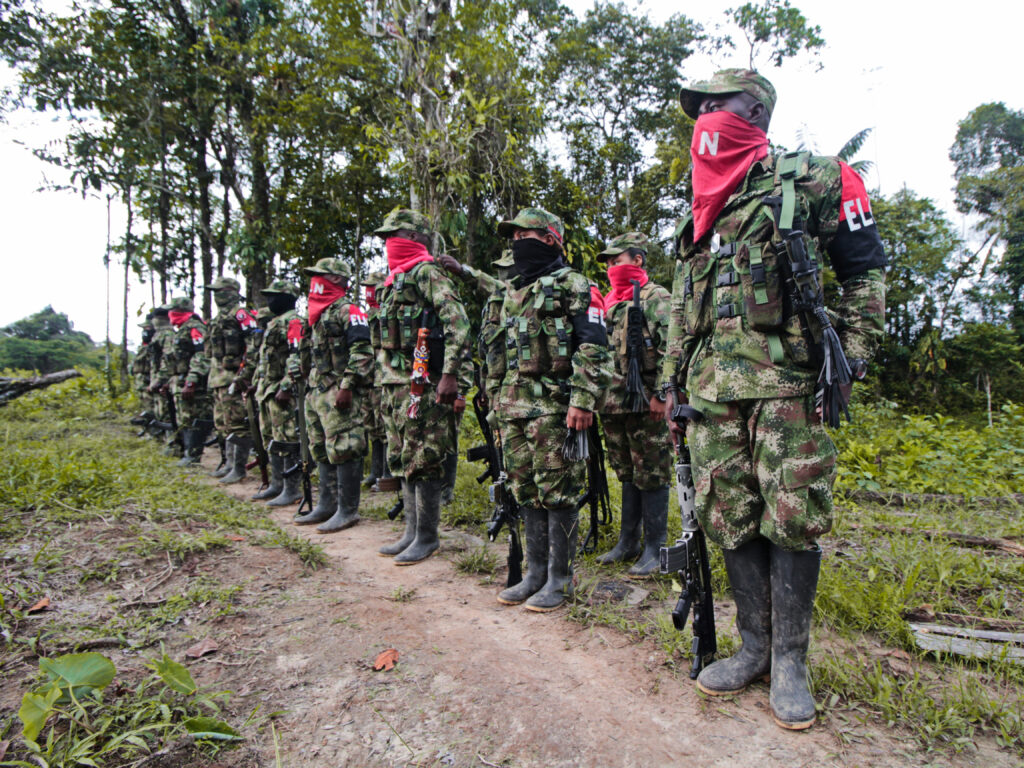
ELN fighters. Image credit: Brasil de Fato via Flickr

Colombian Defence Minister Pedro Sánchez urged the public not to trust the National Liberation Army’s (ELN’s) promise to observe a ceasefire during elections this weekend.

In a speech on Monday, Sánchez cast doubt on the ELN’s pledge last month to not launch any attacks during the election period, saying: “It is very easy for them to lie.”

The defense minister reiterated calls for the public to remain vigilant ahead of the legislative elections and presidential primaries scheduled for Sunday, which have been overshadowed by the threat of violence.

“The ELN recently distributed a pamphlet stating that it will not interfere with the elections,” Sanchez said at a press conference in Bogotá on Monday. “Let us remember what happened in December, when they said they would not harm any Colombian,” continued the minister, referring to the deaths of Colombian soldiers during an ELN Christmas ceasefire. 

Sánchez also highlighted additional potential threats to the electoral process coming from dissident factions of the now-defunct Revolutionary Armed Forces of Colombia (FARC). 

He said the groups led by Calarcá and Mordisco, as well as criminal organizations such as Los Pachenca and Los Conquistadores de la Sierra, should be closely monitored due to their past acts of violence, particularly interference in efforts to maintain a peaceful electoral environment.

To prevent any possible guerrilla attacks, Sánchez said the government has enacted extraordinary security measures across the country. 

“In response to these threats, we have deployed offensive operations and a security deployment that has allowed us to establish operational control of the area, without denying that the threat persists, but also without denying our will and our capacity to neutralize it,” added Sanchez.

The government has mobilized 246,000 members of the security forces, who will protect more than 13,000 polling stations across the country, according to the minister. Enhanced training is also taking place along with special measures such as drone‑jamming systems. 

Ahead of the elections, Sánchez reported that four ELN members, including one nicknamed “El Mono”, were arrested on March 1 for planning and carrying out terrorist actions against civilians as well as extortion. 

A Colombian Army report from 2025 recorded 165 ELN-related captures, 47 voluntary surrenders, and 15 minors recovered from armed groups during military operations.

Yet, the ELN’s stance toward the election remains unchanged, with its national leadership declaring unilateral ceasefires and emphasizing that it will continue acting in accordance with its policy in favor of the people and their freedom to act.

Previous attacks by the ELN

In the past, the ELN, officially recognized as a terrorist organization in Colombia and the United States, has carried out attacks on security forces, violence towards civilians, and kidnappings for political purposes.

Notably, the group has also launched attacks while engaging in peace negotiations, such as the car bomb at a police academy in Bogotá in 2019, one of the deadliest terrorist attacks in modern Colombian history, which killed 22 people and injured 66. 

President Ivan Duque, who was in office at the time, condemned the attack as a “miserable terrorist act” and vowed to bring those responsible to justice.

Fresh peace talks between the Gustavo Petro administration broke down in early 2025 when the ELN was blamed for violent clashes in the Catatumbo region which affected more than 90,000 people, according to the United Nations. 

The post Colombia Defense Minister questions ELN election ceasefire pledge appeared first on The Bogotá Post.
  •  

Colombian Elections 2026: How do they work?

Colombia is off to the polls in a little under a month, but what’s at stake and what could happen? And why can’t you have a drink while watching results roll in?

Sunday March 8th will be the first of three elections in Colombia. Photo: Element5 Digital on Unsplash

Every Colombian over the age of majority (18) and with a correctly registered cédula ciudandanía can vote. In return, each voter gets a half day off work. Non-citizens are not eligible to vote in national elections, but holders of resident visas will be able to vote in next year’s local elections.

The polls are open from 8am until 4pm and counting is usually very fast with the first results coming in just an hour or so later. Due to the PR system (see below), final results come through in the week. 

Land and fluvial borders will be closed for Colombian nationals on the day of the election, although foreigners can cross. From the Saturday afternoon before voting until the Monday morning, ley seca will apply, meaning no alcohol sales in bars, restaurants or shops. That applies for everyone, so no representation or boozing.

Oversight is carried out by the CNE (Consejo Nacional Electoral). In order to do this over the vast territory and number of stations, over 800,000 citizens are selected to be vote-counters. This is similar to jury duty in other countries and is compensated with a day off as well as a compulsory day of training a couple of weeks beforehand.

As the electorate is growing, there are now some 13,000 voting sites across the country, most with multiple voting tables. Colombians have to vote where their cédula is registered, so don’t be surprised to see some people trekking to other cities if they forgot to update their registration.

Some parties run a closed list system, meaning you simply vote for them, whereas others have open lists, meaning you vote for the party and can also vote for your preferred candidate within the party. For closed lists, the party will decide who enters congress, with an open list it will be done in order of preference.

A smidgen under 50% turnout is common for house elections, with higher figures expected for the presidential elections later this year. The Colombian parliament is a bicameral system with the Senate acting as the upper and more powerful house and the Cámara the lower house.

Most parties do not really have well-defined manifestos as such, although better-funded candidates will give a range of positions on matters. In general, there will simply be slogans and general aims that give voters an idea of where their candidates stand.

Who’s up for election?

With a PR system in place there are a plethora of parties to peruse. The country was dominated for decades by the Conservadores and Liberales and both remain strong across the country. In recent years they’ve been joined by the Centro Democrático as the third force. Expect all three to do well.

Mid-level parties include the likes of the right-wing Cambio Radical, particularly strong on the Caribbean, centrist (and not ecologically centred) Alianza Verde and ex-president Santos’ centrist partido de la U. The last election saw the leftist Colombia Humana rocket up to join these blocs.

Then there are the smaller parties, often operating essentially as almost one-man-bands. These usually have an enormous amount of support in a particular area or for a certain candidate but fail to translate this to a wider audience. It’s common to see them banding together, as with the governing coalition Pacto Histórico.

Finally, there are guaranteed seats in both the Senate and Cámara for certain groups and people. This year sees the Comunes party no longer receiving an automatic five seats in both houses that they had in the last two votes as part of the peace process. 

If you are a fan of PR, this system allows a diverse number of voices to be heard and limits the power of government, especially when there is opposition to their plans. For those more cynically-minded, it is a way to make sure that little gets done and few significant bills are passed.

There’s also the curious option of voto en blanco. Different from a spoiled vote, which is simply disregarded, this is an active protest. If it ranks highest in any race, then a rerun of the election must take place within a month with entirely new candidates and/or party lists. 

Colombian Senate Elections 2026

The Senate now has 103 seats (known as curules) and is the upper house in the bicameral system. Of those, a straight 100 are chosen by the electorate as a whole, while Indigenous communities select a further two and the runner-up in the presidential election will receive the final seat.

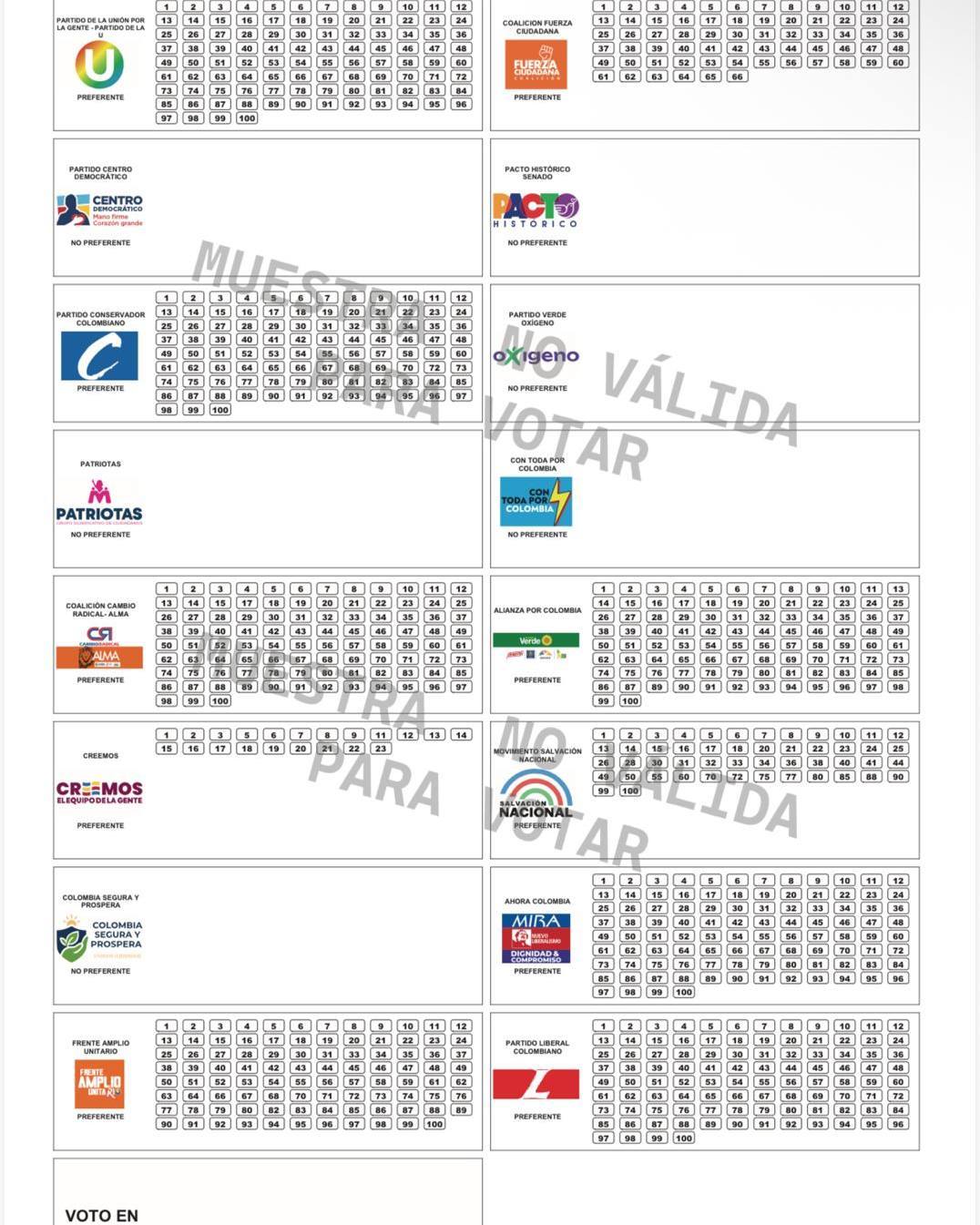
The voting list for elections in Colombia in 2026
The tarjetón for voting in the Senate. Photo courtesy of the Registraduría via Facebook

The Senate currently boasts a whopping 17 parties, but only six of those have double figure representation with the Conservadores’ 15 being the biggest single group. 26 parties are running 1,000 candidates between them this time. Voting is done on a national basis and tallied up across the territory, meaning this takes a little while to work out.

While there is a diverse group of parties, they hang together in loose blocs roughly delineated as government, opposition and neutral. With the government only controlling 34 curules and the opposition 24, the neutrals are incredibly important for horse-trading.

This will be a huge litmus test for the ruling leftist bloc. They will lose their guaranteed  Comunes seats, so any further losses will be highly problematic. On the other hand, gaining curules would be a huge shot in the arm in terms of public support, hence why they are campaigning in places like Huila, outside of their traditional strongholds.

The most likely outcome is that there will be little change in the makeup of the Senate, with neither the government nor opposition likely to take outright control or make large gains. Whichever of those two groups increases their representation will quickly turn it into a sign that they are on the right track and use that as support for their presidential campaign.

Cámara de Representantes election Colombia 2026

The lower chamber, too, is also up for election. It is significantly larger, with 188 seats and 23 parties. The government is also in a minority here and relies on support from independents to get things done. There are over 2,000 candidates representing nearly 500 parties, or listas of similar candidates.

The key difference in voting here is that it is largely territorial, with 161 seats divided between the departments and Bogotá, DC. The latter returns the most seats, with 18, closely followed by Antioquia with one fewer. Colombians living abroad and voting in embassies get one between them

However, these are not equal, as departments receive at least two seats, meaning Vaupés gets one representative for every 20,000 or so people, while the national average is more like 300,000. Changes in population have led to odd situations like Caldas returning more representantes (5) than Cauca (four) despite only having ⅔ of its population.

Then there are the special seats. Again, the Comunes party will lose their five extra seats in this term and it is also the last election to feature the 16 seats reserved for conflict victims. Colombians of Afro descent get two seats, while Indigenous Colombians and raizales from San Andres and Providencia have one apiece and the VP runner-up rounds it out.

Consultas for the presidential election

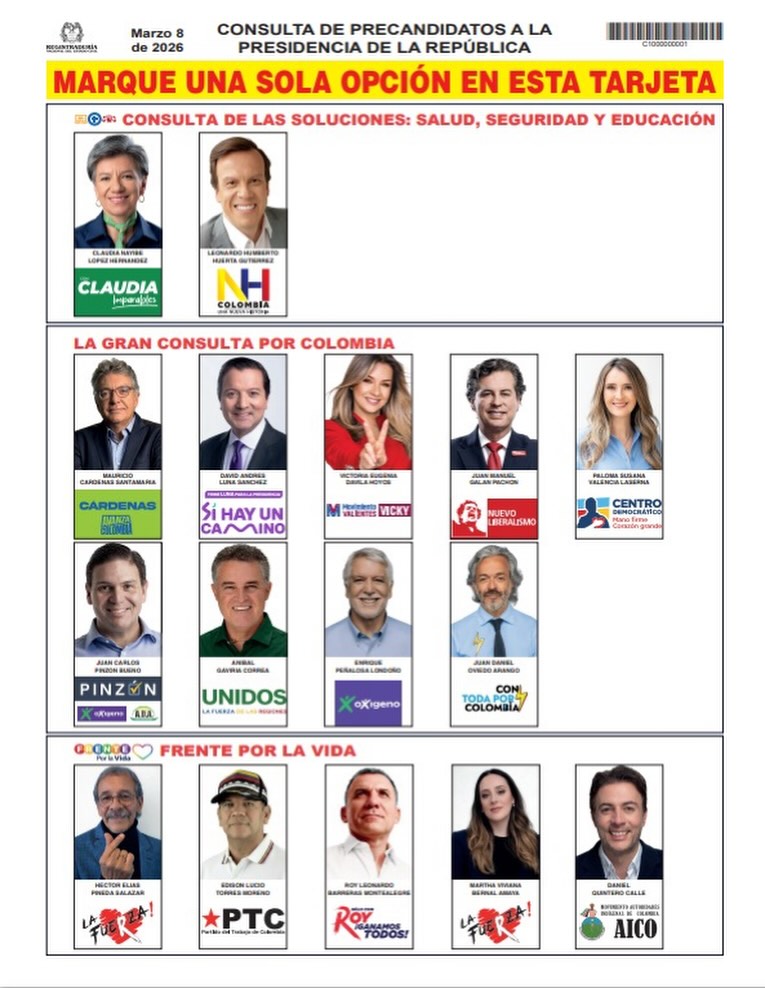
Just in case you thought there was enough on the plate, there are further considerations at stake. To avoid spreading the vote, various presidential candidates with similar positions group together for a preliminary vote. The losers in each consulta will drop out on March 9th. This year there are three on the voting card.

The voting list for consultas in Colombia elections 2026
The tarjetón for voting in the Senate. Photo courtesy of the Registraduría via Facebook

The biggest of these with 9 names is the Gran Consulta Por Colombia, which stretches the credibility of political similarity. It’s nominally centrist but features prominent rightists Vicky Dávila and Paloma Valencia alongside traditional centre voices such as Enrique Peñalosa and Juan David Oviedo. The latter is also the Centro Democrático candidate. 

The leftist consulta is under intense scrutiny as candidate Iván Cepeda, currently leading the polls, was blocked from taking part. That led to further withdrawals and angry denunciations from Cépeda and sitting president Gustavo Petro. Roy Barreras is now the favourite to win this five person race.

Then there’s a centrist competition between former Bogotá mayor Claudia López and little-known candidate Leonardo Huerta. López is the clear favourite here after perennial runner Sergio Fajardo chose to go directly to the first round of presidential voting.

At the moment, the presidential campaign is very unclear. Iván Cepeda leads polling and is extremely unlikely not to make the second round. Who joins him is hard to see at this point, so the consultas will trim that field significantly.

While the Senate and Cámara will be decided by mid-March, this is only the first lap of the field for the presidential candidates. Some will fall out, others will consolidate their position and things will start changing throughout the spring until the May 31st first round.

The post Colombian Elections 2026: How do they work? appeared first on The Bogotá Post.
  •  

Colombians take to streets as landmark minimum wage hike faces legal challenges 

Minister of Labor Antonio Sanguino being interviewed at the January 28 march in support of the minimum wage hike. Image credit: Cristina Dorado Suaza

Bogotá, Colombia — In the past week, Colombians have taken to the streets on two occasions to defend the government’s minimum wage increase as it faces legal attacks by business sectors. 

On January 28 and February 3, Colombians marched in major cities in support of the landmark 23% wage increase established at the end of last year.

But the future of Decree 1469, which established what the government has called a “living wage”, remains uncertain.

“This is a major step forward by the government of Gustavo Petro. It is not just an increase; it is the dignification of workers’ wages in Colombia. That is why, as union members and as teachers, we support this mission, which directly impacts people’s everyday lives,” Oscar Patiño, an attendee of the January 28 march, told The Bogotá Post

For Patiño, a teacher and union leader, the protest represented a demand that the Council of State act as a guarantor of workers’ rights through its role in defining public policy.

He was part of a wave of sit-in protests in cities across the country called by labor unions, with the backing of the government, to defend the minimum wage hike. The 23% raise brings the monthly base salary to COP$1,750,905 (USD$477) and the transportation allowance to COP $249,095 (USD$68). 

In Bogotá, the demonstration was joined by Labor Minister Antonio Sanguino and lawmakers from the pro-government bloc, including Senator Wilson Arias.

“This increase no longer leaves workers’ wages below key economic indicators. It is for the improvement of their quality of life,” said another attendee, who did not want to be named.

As well as raising the base salary, December’s decree incorporated the concept of a “living wage” as an additional criterion for setting the increase. This concept is not new: it is enshrined in Article 53 of Colombia’s Political Constitution and in International Labour Organization (ILO) Convention No. 131 of 1970.

“In that ruling, the Constitutional Court reminds the government that when setting wages, remuneration must be minimum, I quote, ‘living, and adjustable,’” said Mery Laura Perdomo, a lawyer specializing in labor, social security, and constitutional law. 

The “living wage” responds to the real cost of living, unlike the minimum wage, which barely covers basic needs. “This helps generate conditions for a dignified life in a Social State governed by the rule of law … The major shift is from a minimum wage to a living wage,” said Labor Minister Antonio Sanguino.

The government passed the decree raising wages unilaterally after failing to reach consensus with government representatives, business associations and labor unions. It determined the base salary raise based on economic criteria such as inflation (CPI), GDP, the contribution of wages to national income, inflation targets, and productivity.

But the decree generated dissatisfaction among business associations and parts of the public, prompting them to pursue legal action. 

Perdomo notes that there are two types of challenges to the wage increase: tutela actions—arguing violations of fundamental rights, specifically due process or harm to certain companies—and a lawsuit seeking the annulment of the decree.

“I believe there are no sufficient legal grounds for a potential declaration of unconstitutionality,” Perdomo said, noting that the decree grounds its constitutionality in ILO conventions, the constitution, and technical and economic studies and criteria. “There are constitutional, legal, jurisprudential, and technical-economic grounds to say that this minimum wage decree could not be declared unconstitutional.”

So far, tutela actions have not succeeded, according to Perdomo. As for the annulment lawsuit—filed by the National Federation of Merchants (Fenalco)—it is currently under review and awaiting evaluation by the assigned judge, according to the Colombian economic magazine Portafolio. The claim argues that constitutional and legal criteria were disregarded.

Portafolio also reports that the risks of the legal debate lie in the possibility that, while a final decision is pending, the Council of State could not only annul the decree but also order a provisional suspension of the wage increase.

But Perdomo warned this would be an unpopular move ahead of next month’s legislative elections: “Politically, this is risky in an electoral context, since a large portion of the population—especially low-income earners—is satisfied with the minimum wage increase. Overturning it could sour the political climate on the eve of elections and have a real impact on voting intentions.”

Meanwhile, Petro’s ruling Pacto Historico coalition, which has formed into a party ahead of the elections, has made a point of championing the minimum wage increase. 

On Tuesday, it called for rallies across the country to support the living wage, justice, and labor dignity. 

“The living wage is not a favor; it is a right. A dignified life begins with fair work, and this mobilization reminds us that labor dignity is the foundation of social justice,” declared Health Minister Guillermo Alfonso Jaramillo from Bogotá’s Plaza de Bolívar.

The post Colombians take to streets as landmark minimum wage hike faces legal challenges  appeared first on The Bogotá Post.
  •  
❌