Reading view

Apple Releases New Firmware for AirTag 2

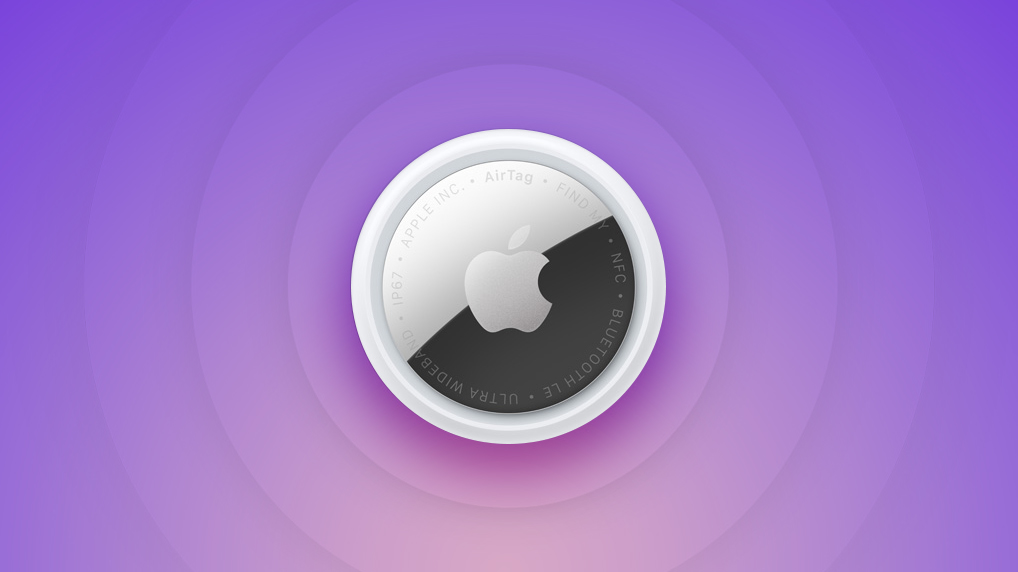
Apple today released new firmware for its second-generation AirTag item trackers. The firmware has a 3.0.49 version number, up from 3.0.45, and it is the second firmware update that Apple has provided for the ‌AirTag‌ 2.


There is no word yet on what's included in the firmware, but ‌AirTag‌ firmware updates most often address bugs and make other under-the-hood improvements. Apple's prior firmware update tweaked the unwanted tracking sound to make it easier to find an unknown ‌AirTag‌ when using Precision Finding.

Apple will provide details on what's in the 3.0.49 firmware when it updates its firmware support page.

For the original ‌AirTag‌, firmware was distributed on a rolling basis over two weeks, but Apple appears to be pushing firmware updates to all ‌AirTag‌ 2 users at the same time.

You can check your AirTag firmware by opening the Find My app, going to the Items tab, selecting an ‌AirTag‌ in the list, and tapping on the ‌AirTag‌'s name to see its firmware version.

There is no way to force an ‌AirTag‌ update, and firmware is installed over the air via a connected iPhone. To get new firmware, make sure your ‌AirTag‌ is within range of your iPhone, and then wait for the firmware to roll out.
Related Roundup: AirTag
Buyer's Guide: AirTag (Buy Now)

This article, "Apple Releases New Firmware for AirTag 2" first appeared on MacRumors.com

Discuss this article in our forums
  •  

Apple's AirTag-Sized AI Pendant: Five Features Rumored So Far

Apple is developing a wearable AI device that's been described as a pin or pendant, and that could compete with a similar AI product coming from OpenAI's Jony Ive. It wasn't clear if the wearable would actually make it to launch because Apple sometimes cancels projects, but it is still in the works and could come as soon as next year.


1. It'll Look Like an AirTag


Apple's design plans could change, but rumors suggest the device is a pin or pendant that looks similar to an AirTag. It's been described as having a thin, flat, circular disc shape, with an aluminum and glass shell. A physical control button is included on one edge.

Apple wants the final version of the device to be about the same size as an ‌AirTag‌, but because of the hardware inside, it could be thicker.

It sounds like the wearable will be versatile. It could have a clip to attach to clothing like a pin, but there's also supposedly a hole in the device so it can be worn as a necklace. Rumors have referred to it as both a pin and a pendant.

2. There Will Be Cameras


Apple's AI wearable is going to have at least one camera, but rumors are mixed on exactly what the camera will be used for.

Bloomberg says the pin will have a low-resolution camera that gives it info about its surroundings rather than a camera for capturing photos and videos. The camera will be always-on and processing visual data, but users will not be able to use it for images.

The Information reports there will be two front cameras, one with a standard lens and one with a wide-angle lens for capturing photos and videos.

Apple's AI device will rely heavily on Visual Intelligence, which is currently an iPhone feature that uses the camera to provide users with more information about places and objects around them.

3. Siri is the Brain


Rumors have described Apple's wearable as an AI pin or pendant, because it's going to be reliant on artificial intelligence. It's one of several AI-equipped devices that Apple is working on, and it will give wearers a way to interface with Siri without having to use an iPhone.

The camera on the pin will give ‌Siri‌ insight, and ‌Siri‌ will be able to answer questions about what the wearer is looking at or the wearer's surroundings.

Apple is planning to completely overhaul ‌Siri‌ in iOS 27, turning the personal assistant into a much smarter chatbot on par with Claude, Gemini, and ChatGPT.

4. iPhone Required


While the AI wearable will have a chip inside, it will be a smaller chip that's similar to the H2 in the AirPods. It won't use a high-powered chip, and most processing will need to be done on the iPhone.

The pin is not meant to be a standalone device, and it will instead be marketed as an iPhone accessory.

5. It'll Listen, But Might Not Talk Back


To listen for voice requests and to pick up sounds around the wearer, the AI pin will have a microphone. Apple has not yet decided whether to add a speaker for back-and-forth ‌Siri‌ conversations and audio playback.

If there's no speaker, responses might be directed to the wearer on the iPhone, Apple Watch, or AirPods.

Release Date


Bloomberg's Mark Gurman said this week that the AI wearable could see a launch as soon as 2027.
Related Roundup: AirTag
Buyer's Guide: AirTag (Buy Now)

This article, "Apple's AirTag-Sized AI Pendant: Five Features Rumored So Far" first appeared on MacRumors.com

Discuss this article in our forums
  •  

Apple Reportedly Working on All-New AirTag-Sized Wearable With iPhone Integration

Apple continues to work on a "pendant with cameras" for release as early as next year, according to the latest word from Bloomberg's Mark Gurman.


In a report today, Gurman said development of the all-new wearable accessory trails AirPods with cameras, which have apparently reached an advanced testing stage.

Apple also continues to work on smart glasses, according to his report.

Given the report was focused on the AirPods with cameras, no further details were provided about the pendant or the smart glasses. However, he has shared many details about the two products in his previous reporting, as recapped below.

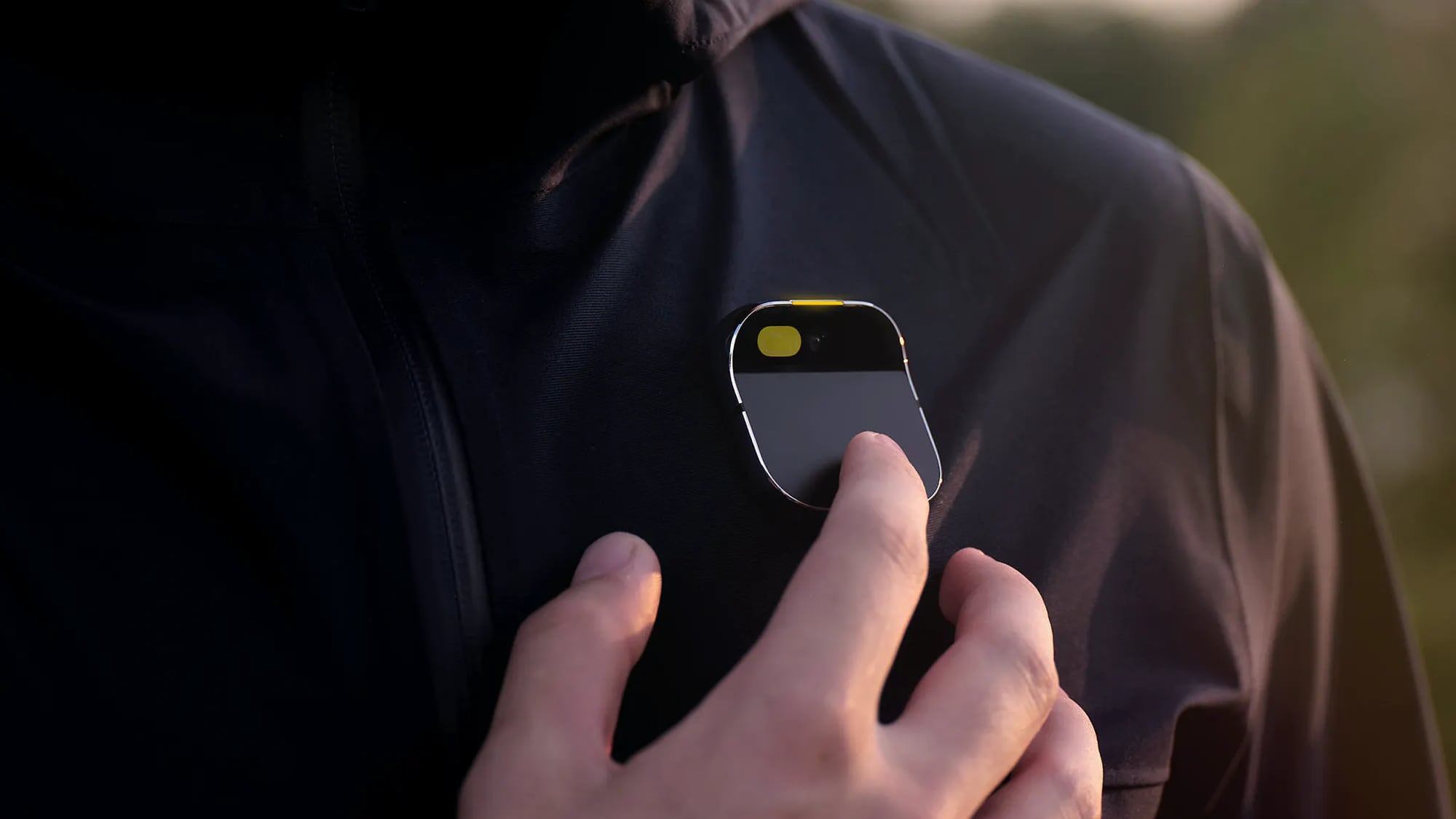
Gurman previously described the pendant as an "AirTag-sized" accessory that would be reminiscent of the failed Humane AI Pin. However, it would be an iPhone accessory rather than a standalone product.

Humane AI Pin

The pendant would feature an "always-on" camera and a microphone for Siri voice commands, but it would lack a display and laser projector, according to the report. The pendant is said to have its own chip, but performance is limited, so the device will apparently rely heavily on a paired iPhone for processing.

Apple is said to be debating whether to add a speaker to the accessory.

The pendant would attach to a person's clothing with a clip, or you could insert a cord or chain into a hole in the device and wear it as a necklace.

In January, The Information's Wayne Ma and Qianer Liu were first to report about Apple's so-called AI pin or pendant project, which remains in an early stage of development inside the company. According to both reports, the device could launch as early as 2027, but there is still a chance the project could be canceled.

The pendant would likely work with some of iOS 27's revamped Siri features.

As for the smart glasses, he said Apple plans to unveil them in late 2026 or early 2027, but that they will not be released until next year either way.

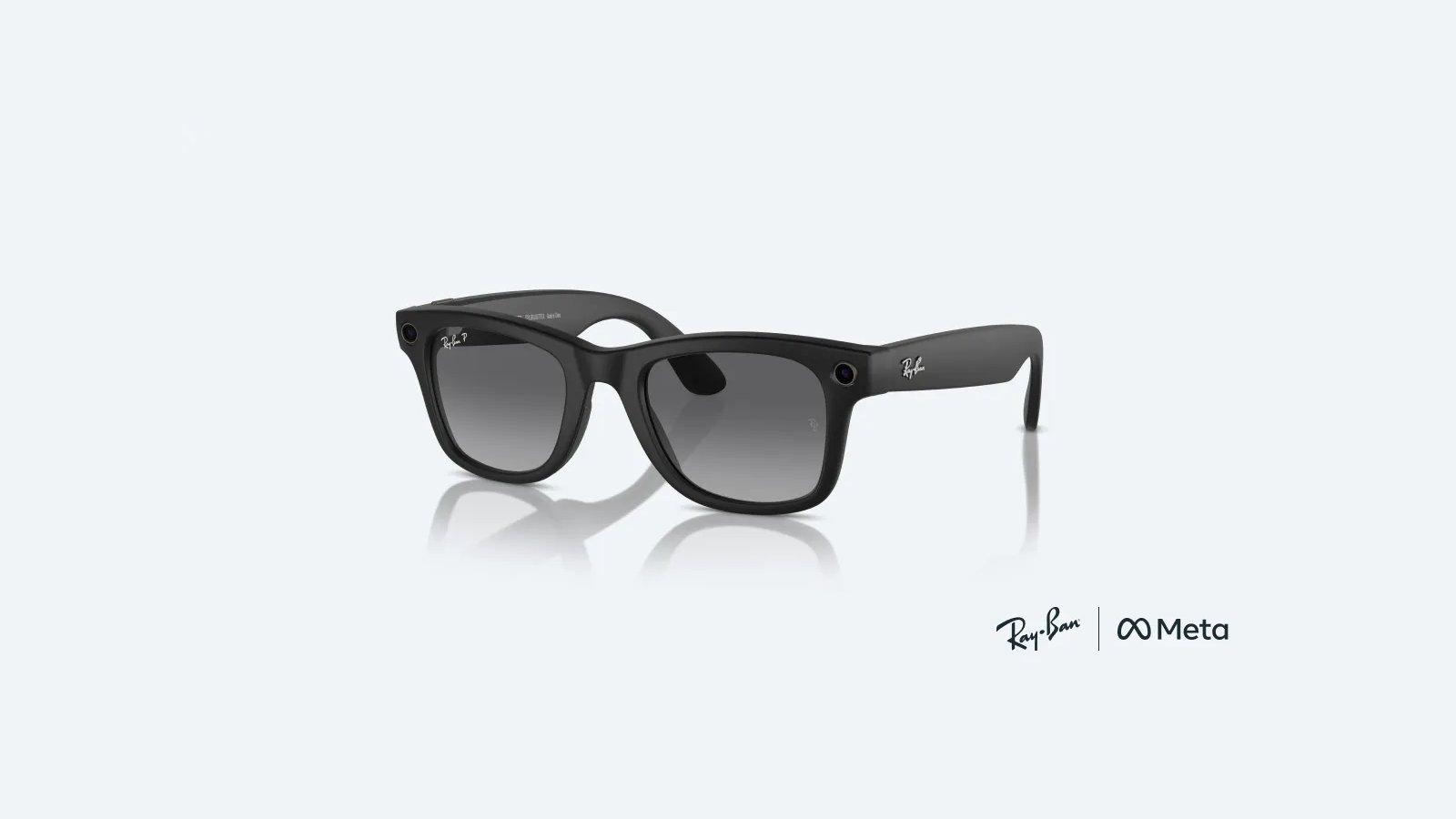
Like the Meta Ray-Bans, Gurman said Apple's glasses will have built-in cameras that let users capture photos and videos. He also expects the glasses to have speakers and microphones for music, phone calls, and notifications announced by Siri.


Apple is apparently focused on tight iPhone integration and premium build quality.

He did not provide too many details about the iPhone integration, but he does expect the cameras on the glasses to be able to feed data to Siri and Apple Intelligence, and this should help to improve features such as turn-by-turn walking directions.

As for build quality, he said Apple is designing its own plastic frames, with the company allegedly testing at least four potential designs:
  • A larger rectangular frame, similar to Ray-Ban's Wayfarers

  • A slimmer rectangular design, similar to the glasses worn by Apple CEO Tim Cook

  • Larger oval or circular frames

  • Smaller oval or circular frames
Apple is exploring a range of color options, including black, ocean blue, and light brown, and the glasses may have vertically-oriented oval camera lenses, he said.

Meta uses glasses frames from Ray-Ban, the popular brand owned by Italian company EssilorLuxottica, while Google and Samsung are reportedly working on smart glasses in partnership with the American eyewear company Warby Parker.

Unlike the latest generation of Meta Ray-Bans, Gurman does not expect Apple's first smart glasses to be equipped with an in-lens augmented reality display.
Related Roundup: AirTag
Buyer's Guide: AirTag (Buy Now)

This article, "Apple Reportedly Working on All-New AirTag-Sized Wearable With iPhone Integration" first appeared on MacRumors.com

Discuss this article in our forums

  •  

Apple Faces Dozens of Lawsuits Over AirTag Stalking After Class Action Denied

Apple is facing over 30 lawsuits from people who claim to have been stalked using Apple AirTags. The filings come after an AirTag lawsuit from 2022 (Hughes v. Apple) failed to get class certification.


In each filing, Apple is accused of releasing the ‌AirTag‌ while being aware that it could be "purchased and used by abusive, dangerous individuals, to track, coerce, control, and otherwise endanger and abuse innocent victims."

Further, the lawsuits say that Apple knew adequate safeguards were not in place when the ‌AirTag‌ launched in 2021, and Apple is aware that "AirTags remain a profound risk" to people like the plaintiffs. Apple reportedly received more than 40,000 stalking reports between April 2021 and April 2024, and Apple internal documents sourced from the original lawsuit show the company knew its safeguards would only "deter as opposed to prevent malicious use." The company also acknowledged that it "should have consulted domestic abuse organizations on the unwanted tracking policy before shipping."

Multiple news reports of AirTags being used for stalking are referenced, including cases that ended in murder. The lawsuits claim that AirTags "revolutionized the scope, breadth, and ease of location-based stalking."

While there are other tracking options on the market, the ‌AirTag‌ uses the Find My network that leverages any nearby device to relay the ‌AirTag‌'s location back to its owner.

Apple has put multiple anti-stalking measures in place, including cross-platform notifications that let potential stalking victims know that an unknown ‌AirTag‌ is following them, but the plaintiffs don't feel that Apple's protections are adequate. The lawsuit cites the 4-to-8-hour delay before a notification is received, and notes that originally, AirTags didn't send a notification to potential stalking victims until 72 hours had passed.

One of the ways an ‌AirTag‌ alerts users to its presence is by playing a sound, but the speaker can be removed. Sellers on sites like eBay even offer modified silent AirTags.

Each lawsuit includes the personal story of the plaintiff involved and all of whom claim to have been stalked using an ‌AirTag‌. Plaintiffs are seeking compensatory damages, punitive damages, attorney's fees, and an order preventing Apple from engaging in the unlawful business practices alleged in the filings.

The judge overseeing the 2022 ‌AirTag‌ lawsuit denied class certification because of the difference in state laws and the individual nature of each stalking incident. The plaintiffs were advised to file individual lawsuits within 28 days of the class certification denial.
Related Roundup: AirTag
Buyer's Guide: AirTag (Buy Now)

This article, "Apple Faces Dozens of Lawsuits Over AirTag Stalking After Class Action Denied" first appeared on MacRumors.com

Discuss this article in our forums

  •  

iFixit Shares AirTag 2 Teardown, Here's What's New

We were so busy covering Apple's earnings call last Thursday that iFixit's AirTag 2 teardown video that afternoon went under our radar until now.


For those who have yet to watch the video, iFixit opens up the AirTag 2 and reveals what is new inside, including a redesigned speaker that is up to 50% louder than the one in the previous AirTag, according to Apple. The teardown also provides a look at the AirTag 2's second-generation Ultra Wideband chip and more.

The overall design of the AirTag 2 is similar to the original version of the item tracking accessory.


While a previous teardown showed that it is more difficult to remove the speaker in the AirTag 2, compared to the one in the original AirTag, iFixit was still able to disable the speaker's audible chime with the use of a soldering gun.

For those who are not familiar, the AirTag is a small accessory that you can attach to your backpack, keys, or other items. Then, you can track the location of those items in the Find My app on the iPhone, iPad, Mac, Apple Watch, and iCloud.com.

Apple released the new AirTag last month. In addition to the louder speaker, Precision Finding works up to 50% farther away from an item compared to the previous-generation model, and the overall Bluetooth tracking range is also improved.

Related Reading: AirTag 2 Hands-On: What's New and Should You Upgrade?
Related Roundup: AirTag

This article, "iFixit Shares AirTag 2 Teardown, Here's What's New" first appeared on MacRumors.com

Discuss this article in our forums

  •  

AirTag 2 Hands-On: What's New and Should You Upgrade?

Apple just released the second-generation AirTag, five years after the original model debuted. There's been a lot of time for Apple to come up with improvements, so we thought we'd test out the new model to see what's changed, and whether it's worth upgrading from the first-generation ‌AirTag‌.


Unfortunately, Apple didn't update the design of the ‌AirTag‌ 2, so it looks almost identical to the original model. The only thing that's changed is the text on the back, which is now in caps and includes wording about the IP67 waterproofing, and that doesn't count as any kind of design change.

It would have been nice to have different design options or a rechargeable battery, but the ‌AirTag‌ is the same coin shape and it still uses CR2032 batteries. Apple didn't mention anything about battery life improvements, so the ‌AirTag‌ 2 still lasts about a year before you need to swap it out.

While there aren't external updates, Apple did boost connectivity. The ‌AirTag‌ 2 uses an upgraded version of Bluetooth and it has a second-generation Ultra Wideband (UWB) chip, so it can be tracked from further away over Bluetooth, and the close-range Precision Finding feature works over longer distances.

According to Apple, Precision Finding works from up to 50 percent further away, so when you lose your ‌AirTag‌ indoors or are close to it, a UWB-enabled iPhone (the ‌iPhone‌ 11 and later) can lead you right to it. Apple also enabled Precision Finding on the Apple Watch Series 9 and later and the Apple Watch Ultra 2 and later, which is super useful. You can't use an Apple Watch to locate an original ‌AirTag‌ nearby, and it's probably the best addition to the second-generation version.

You can even add a quick access toggle for Precision Finding to the Apple Watch for instant access to tracking down an ‌AirTag‌ without digging through menus. It's a much more natural way to find your items.

In our testing, Precision Finding on the Apple Watch worked reliably, tracking down an ‌AirTag‌ indoors even with walls and furniture in the way. The interface is the same as the Precision Finding interface on ‌iPhone‌, just scaled down to an Apple Watch size. You'll get a directional arrow and distance to help you accurately track down the ‌AirTag‌.

When pitting the original ‌AirTag‌ against the ‌AirTag‌ 2 with ‌iPhone‌ Precision Finding, the ‌AirTag‌ 2 was clearly superior. Both AirTags were tucked inside a backpack, and placed out of line of sight.

The original ‌AirTag‌ had a hard time with walls and objects, and required us to be closer to the backpack to get a connection. The ‌AirTag‌ 2 picked up signal from much further away, and kept the signal as we walked toward the backpack. It even worked with the ‌AirTag‌ 2 on a different floor, and kept its connection in a large office building.

Apple also updated the internals of the ‌AirTag‌ 2 to upgrade the sound, and it is noticeably louder. It is a pretty big improvement in audibility, and you will notice the difference between the two. The sound is sharper and easier to pinpoint, and it is much less likely to blend into background noise. It makes it easier to find items, but it also improves the ‌AirTag‌ 2's anti-stalking capabilities. It's harder to tuck an ‌AirTag‌ away and mute its sound, and Apple also made the speaker module more difficult to remove with additional adhesive.

The ‌AirTag‌ 2 is still priced at $29, with Apple offering a pack of four for $99, so it's a solid deal, especially with the tracking improvements. For most people, it's probably not worth upgrading to an ‌AirTag‌ 2 if you already have an original ‌AirTag‌, but if you're someone that heavily relies on AirTags on a regular basis, it could be a good idea to pick up a couple of the second-generation versions.
Related Roundup: AirTag

This article, "AirTag 2 Hands-On: What's New and Should You Upgrade?" first appeared on MacRumors.com

Discuss this article in our forums

  •  

Apple's Website Lists AirTag 4-Pack at Shockingly Low Price [Updated]

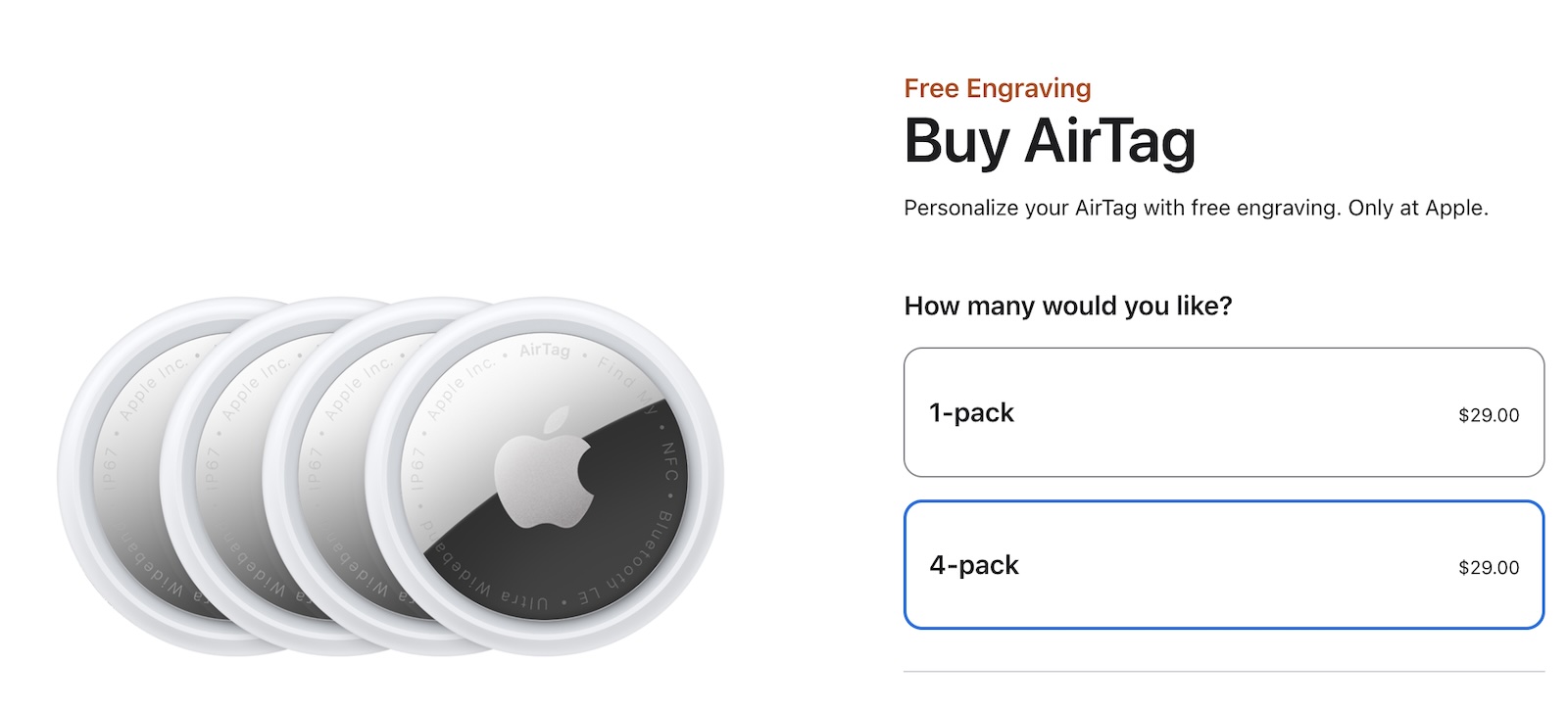
Apple's online store in the U.S. is suddenly offering a pack of four AirTags for just $29, which is the same price as a single AirTag.


This is likely a pricing error, and it is unclear if orders will be fulfilled. Apple has not discounted the AirTag four-pack in any other countries that we checked.

Delivery estimates are already pushing into late November to early December, suggesting that many customers are attempting to take advantage of the deal.


Bloomberg's Mark Gurman said Apple was planning to release an AirTag 2 in mid-2025, but that did not happen. The current AirTag was released in April 2021.

For those unfamiliar with the AirTag, it is a Bluetooth accessory that you can attach to items like a backpack and keys, and you can then track the location of those items in the Find My app across the iPhone, iPad, Mac, Apple Watch, and iCloud.com. Similar item trackers are sold by brands like Tile, Samsung, Chipolo, and Pebblebee.

Update: Apple has reverted the price of the AirTag four-pack to the usual $99.

It is still unclear if any of the $29 orders will be fulfilled. Some customers said their orders now show a price of $99, but it is a fluid situation.

In its U.S. sales policy, Apple says it "reserves the right to change prices for products at the Apple Store at any time, and to correct inadvertent pricing errors."

The policy also says "Apple may refuse or cancel any order or limit order quantity."

Update 2: Apple has cancelled many of the orders, but some customers managed to receive their discounted AirTag four-pack via in-store pickup or courier delivery.
Tag: AirTag

This article, "Apple's Website Lists AirTag 4-Pack at Shockingly Low Price [Updated]" first appeared on MacRumors.com

Discuss this article in our forums

  •  
❌