
Reading view

De la Espriella and Cepeda Advance to Colombia’s Presidential Runoff After Polarized First-Round Vote

A June 21 presidential runoff will decide Colombia’s next president

Far-right candidate Abelardo de la Espriella and leftist Iván Cepeda advanced to the runoff round of Colombia’s presidential election after emerging as the top vote-getters in the May 31, 2026, first-round vote, in a result that reflects the deep political polarization shaping the country.

With 99.99% of polling stations counted, the Registraduría Nacional del Estado Civil reported that De la Espriella won more than 10.3 million votes (43.7%), while Cepeda secured 9.6 million votes (40.9%). The two candidates will face each other in a runoff election scheduled for June 21, 2026.

Voter turnout reached 23.7 million people, equivalent to 57.8% of eligible voters. Together, the two candidates captured nearly 85% of valid ballots, leaving the remaining contenders far behind and setting up a contest between two sharply contrasting political visions.

De la Espriella’s unexpected rise

De la Espriella’s first-round victory represents one of the biggest surprises of the election and marks the first time in Colombia’s modern political history that a far-right party has emerged with a realistic chance of winning the presidency.

A lawyer by profession with no previous elected office experience, De la Espriella built his campaign around a populist message focused on political confrontation, public security, a hard-liner approach to crime and opposition to negotiations with illegal armed groups. His political style has drawn comparisons to Argentine President Javier Milei, Salvadoran President Nayib Bukele and US President Donald Trump.

Most pre-election polls placed him in second or third position, with support ranging between 15% and 25%, well below his final result.

His platform emphasizes stronger security policies, tougher penalties for criminal and narcotraffic organizations, and the construction of large-scale prisons similar to those in El Salvador. He has also rejected peace negotiations with armed groups.

His opposition to diversity and inclusion policies, as well as controversies involving remarks toward female journalists for which he later apologized, also became defining features of his campaign.

Cepeda achieves the strongest result ever for Colombia’s left party

Although he finished second, Cepeda achieved the highest vote total ever received by a left-wing presidential candidate in Colombia, surpassing the 8.5 million votes won by President Gustavo Petro in a previous presidential election.

The candidate of the ruling Pacto Histórico party based his campaign on grassroots mobilization, public rallies and the consolidation of a unified left-wing movement. His message focused on expanding social programs, inclusion and reducing inequality.

However, his candidacy has also been weighed down by criticism of the current administration, particularly regarding security concerns, problems within Colombia’s healthcare system and the limited results of the government’s “Total Peace” policy, which Petro promoted and Cepeda supported during his years in Congress.

Cepeda’s political career has been built in Congress, where he became known for defending the rights of victims of paramilitary violence and for his role in legal cases involving former President Álvaro Uribe.

After preliminary results were released, both Cepeda and Petro publicly questioned the preliminary vote count while stating they would recognize the official results certified by electoral commissions, judges and notaries.

“As president, I do not accept the preliminary count results,” Petro wrote on X, arguing that Colombia’s pre-count system has no legal validity and that only the official scrutiny process produces binding results. He later added that “the binding results the president will recognize are those issued by the electoral scrutiny commissions.”

Cepeda has also sought to distance himself from some of Petro’s proposals, including the idea of convening a constituent assembly to revise Colombia’s constitutional framework.

Historic defeat for Uribe’s political movement

Another major statement of the election was the poor performance of Paloma Valencia, candidate of the Centro Democrático party and backed by former President Uribe, who campaigned alongside her throughout the country despite defections by several prominent supporters.

Valencia finished third with 1.6 million votes (6.9%), far below polling projections that had placed her above 20%.

The result is widely attributed to voter fatigue with Uribe’s political movement and the migration of conservative voters toward De la Espriella, who was endorsed during the campaign by several prominent right-wing figures, including senators Paola Holguín and María Fernanda Cabal, as well as leader and businessman José Félix Lafaurie.

Strategic decisions within Valencia’s campaign may also have contributed to the result, including the selection of former Bogotá councilman Juan Daniel Oviedo as her vice-presidential running mate and her reluctance to directly confront De la Espriella during the campaign.

This marks the second consecutive presidential election in which Uribe reaches the runoff without a candidate from his own party. Nevertheless, he quickly endorsed De la Espriella after the results became known.

That endorsement could prove crucial. If elected, De la Espriella would face a Congress in which his movement holds only limited representation, making support from Centro Democrático, the second-largest congressional bloc, essential for advancing legislation and reforms.

Centrist voters may decide the runoff

Former Medellín Mayor Sergio Fajardo, who campaigned as a centrist alternative, finished fourth with more than 1 million votes (4.2%), while none of the remaining candidates surpassed 1% of the vote.

As the runoff approaches, the votes won by both Valencia and Fajardo are expected to be closely watched by the two campaigns, as they could prove decisive in an election that is shaping up to be highly competitive, deeply polarized and politically fragmented.

While Valencia has already endorsed De la Espriella, Fajardo has yet to take a public position. In previous elections, the former Medellín mayor has preferred to leave his supporters free to decide rather than formally endorse either finalist.

In Valencia’s case, despite her endorsement of De la Espriella, it remains unclear whether her support came primarily from voters aligned with former President Álvaro Uribe or whether a significant share was driven by the candidacy of Juan Daniel Oviedo, who won more than 1.2 million votes in the coalition primaries held in March.

The June 21 presidential runoff will therefore pit two sharply different visions for Colombia’s future against one another, in a political environment marked by polarization, social tensions, and persistent challenges related to security and governance that the next administration will have to address.
  •  

Colombia’s Presidential Race Marked by Polarization, Divided Right and Absence of Debates

As Colombia nears its presidential vote, two candidates have endorsed Iván Cepeda and eight others remain below 3.5% in polls

With less than two weeks remaining before Colombia’s presidential election, whose first round is scheduled for May 31, three candidates are concentrating most voter support and competing for access to the presidential palace, Casa de Nariño: ruling coalition senator Iván Cepeda, candidate of the left-wing Pacto Histórico party; senator Paloma Valencia, representing the right-wing Centro Democrático party; and lawyer and businessman Abelardo de la Espriella, a figure of Colombia’s far right.

Although 13 candidates will appear on the ballot, two contenders: Clara López and Luis Gilberto Murillo, withdrew their campaigns to support Cepeda, while the remaining candidates have failed to surpass 3.5% voter support in pre-elections polls, a figure close to the statistical margin of error.

If polling trends hold, no candidate is expected to secure the 50% plus one vote needed to win outright in the first round, making a runoff election on June 21, 2026, highly likely.

Cepeda has remained relatively stable in polls, with voter support ranging between 35% and 43%, effectively securing his place in a second round if trends continue.

The key question: Who will face Cepeda in a runoff?

The main electoral uncertainty centers on who will finish second and challenge the ruling coalition in a likely runoff.

Under Colombia’s electoral system, only the two candidates receiving the highest vote totals advance to the second round. The fragmentation of the political right has complicated efforts to consolidate support behind either Valencia or De la Espriella.

Polls suggest a competitive scenario. Valencia has registered between 14% and 21% voter support, while De la Espriella fluctuates between 16% and 24%, depending on the poll and methodology used.

The lack of unity between the two camps stems from both ideological differences and their political structures. Valencia is a member of the political party founded by former President Álvaro Uribe, while De la Espriella entered the race through an independent signature campaign, marking the first time Colombia’s far right has emerged as a viable contender for the presidency.

A campaign shaped by the absence of public debates

The presidential campaign has been marked by an unusual lack of debates among the leading candidates.

Cepeda has refused to participate in events organized by media outlets, arguing that proposed formats do not offer guarantees of neutrality or what he describes as “fair rules” established by news organizations.

As a result, part of the political confrontation has shifted to Congress, where both Cepeda and Valencia currently serve in the Senate.

Critics, however, have challenged Cepeda’s decision. Former Bogotá Mayor and presidential candidate Claudia López argued that his absence from debates reflects that “Cepeda does not want to take responsibility for the failures of Total Peace (Paz Total),” the negotiation policy with armed groups promoted by President Gustavo Petro, in which Cepeda played a key role as a lawmaker.

Instead of regular debates, the campaign has been dominated by disputes over media formats, digital presence, social media strategies and public controversies aimed at amplifying candidates’ visibility.

De la Espriella embraces confrontation

One of the candidates who has most effectively capitalized on the digital environment is Abelardo de la Espriella, whose political strategy has been compared to right-wing populist leadership styles such as those of Argentine President Javier Milei and US President Donald Trump.

In recent weeks, De la Espriella has faced several media controversies, including an incident involving journalist Laura Rodríguez of Piso 8 FM, for which he later apologized after accusations of inappropriate sexual conduct. He also clashed live on air with television presenter María Lucía Fernández of Caracol Noticias, whom he called “ignorant.”

Questions also emerged following reports by digital outlet La Silla Vacía regarding donations linked to the US Republican Party.

Despite the controversies, the strategy appears to be strengthening his electoral standing. An Atlas Intel poll for Semana magazine, published May 15, showed De la Espriella surpassing Valencia by a two-to-one margin for the first time, with 32.9% support compared with 16.7%.

However, the polling firm is currently under investigation by Colombia’s National Electoral Council (CNE) amid concerns over whether its methodology complies with national standards. If irregularities are confirmed, the firm could face suspension of its operations in Colombia.

Valencia seeks to broaden support toward the political center

Meanwhile, Valencia has sought to expand her electoral base by shifting strategically toward the political center.

As part of that effort, on May 17 she officially introduced her proposal “Mámá No Está Sola (Mom Is Not Alone),” aimed at female heads of household and focused on access to credit, employment and housing property. The proposal also includes a promise to deliver 1 million homes prioritized for women community leaders.

Valencia’s candidacy also marks a historic first for Colombia’s political right: it is the first time a major conservative party has nominated a woman for president.

Her vice presidential running mate, former Bogotá councilman Juan Daniel Oviedo, has openly identified as a member of the LGBTQ+ community, a move that represents a significant shift for the Centro Democrático traditionally conservative electorate.

Colombia appears headed for a runoff

With a highly fragmented field and no signs of consolidation among right-wing candidates, Colombia appears increasingly likely to hold a presidential runoff on June 21, 2026.

Barring a major shift in polling trends, the contest seems set to come down to Iván Cepeda and whichever opposition candidate manages to emerge from an increasingly competitive battle within Colombia’s political right.

  •  

Who are the Five Candidates Most Likely to Become Colombia’s Next Vice President After the Upcoming Elections?

Despite 13 campaigns underway, only five candidates’ poll above 2.5% in voter intention

Colombia is heading toward the first round of presidential elections on May 31, 2026, with 13 candidates in the race, in a scenario marked by political fragmentation and a strong concentration of voter support among a few contenders.

The next president will take office on August 7, following the end of President Gustavo Petro’s term, marking the transition from the country’s first left-wing government in recent history.

According to pre-election polls, only five candidates exceed 2% in voter intention, leaving most with limited chances of reaching the presidential palace. Among the leading contenders are Iván Cepeda, the candidate of the ruling Pacto Histórico, who leads polls with between 35% and 43% support; right-wing candidate Abelardo de la Espriella, with between 16% and 24%; and Paloma Valencia of the Centro Democrático party, with between 14% and 21%.

A second group includes centrist candidates Claudia López, polling between 3% and 4%, and Sergio Fajardo, at around 2.5%, reflecting a fragmented vote within that political segment.

Vice presidential picks shape campaign strategies

As the campaign unfolds, candidates have selected their running partners as a key strategy to broaden their electoral appeal.

Iván Cepeda has chosen Aida Quilcué, an Indigenous Nasa leader from southwestern Colombia, reinforcing the campaign’s leftist profile and its emphasis on including historically marginalized communities in political decision-making.

Quilcué has served as a governor and Indigenous authority in her community and, like Cepeda, is a victim of Colombia’s armed conflict: her husband was killed by state agents in 2008. She has been affiliated with the Regional Indigenous Council of Cauca (CRIC) and the National Indigenous Organization of Colombia (ONIC). She presents herself publicly as an Indigenous leader, human rights defender and senator (2022–2026), without reporting formal higher education credentials.

Abelardo de la Espriella has selected former Finance, and Commerce, Industry and Tourism Minister, Juan Manuel Restrepo, as his running mate, forming a ticket focused on security and economic strengthening. “That is a capability I have because I understand productivity, competitiveness and economic development,” Restrepo told La Silla Vacía during his registration.

Restrepo is an economist with a specialization in finance from Rosario University, a master’s degree in economics from the London School of Economics, a specialization in senior management from INALDE Business School, and a doctorate in higher education leadership from the University of Bath. He has also served as rector of three major universities in Colombia.

Juan Daniel Oviedo, a former Bogotá city councilor, is running alongside Paloma Valencia of the Centro Democrático party. As economist from Universidad del Rosario, Oviedo holds a master’s degree in mathematical economics and econometrics and a Ph.D. in economics from the University of Toulouse in France.

He previously served as head of Colombia’s National Statistics Agency (DANE) during the Iván Duque administration and ran for mayor of Bogotá in 2023.

His vice presidential bid gained momentum after securing more than 1.2 million votes in the March 8 inter-party primary, finishing second. His selection aims to attract centrist and center-right voters and strengthen Valencia’s chances of advancing to a potential runoff.

However, his nomination has sparked controversy, as it marks the first time the right-wing party has chosen a candidate with liberal positions on issues such as women’s rights and LGBTQ+ rights.

Claudia López selected Leonardo Huerta, a university professor of law and philosophy, as her running mate. According to Spain’s El País, he comes from “a working middle-class family,” is the youngest of four siblings, and is married with two children.

Huerta is a lawyer from Universidad Libre and holds a degree in philosophy from the Technological University of Pereira. He has a master’s degree in administrative law and is a doctoral candidate in law. His public sector experience includes serving as education secretary in Pereira and as a deputy ombudsman for health issues during the COVID-19 pandemic in 2020.

Sergio Fajardo selected Edna Bonilla as his running mate, reinforcing a campaign centered on education and dialogue. Bonilla previously served as Bogotá’s education secretary during Claudia López’s administration (2020–2023).

She is a public accountant from the National University of Colombia, holds a tax specialization from Externado University and a doctorate in political studies. During the campaign launch, Fajardo said: “We will work together to deliver the serious and safe change Colombia needs. To move beyond polarization and build bridges instead of trenches.”

Voter participation

According to Registraduría Nacional del Estado Civil, which oversees elections, a total of 41,421,973 citizens are eligible to vote in Colombia and abroad in the first round of the presidential election. Of these, 21,298,492 are women and 20,123,481 are men.

If no candidate secures more than 50% of the vote, a runoff election will be held on June 21, 2026, between the top two candidates.

  •  

Rising Violence in Colombia: Highway Explosion Leaves 21 Dead, Dozens Injured

Petro’s “Total Peace” strategy is under pressure ahead of presidential elections as violence by armed groups escalates

An explosive attack on the Pan-American Highway near the municipality of Cajibío, in Colombia’s Cauca department, left at least 21 people dead and 56 injured, Defense Minister Pedro Sánchez Suárez confirmed.

The attack occurred Saturday, April 25, on one of the main roads in the country’s southwest, an area historically affected by the presence of illegal armed groups.

The minister attributed the attack to alias “Marlon,” described as one of the most wanted leaders in the region, “for whom we are offering a reward of up to $1.4 million USD,” he said.

According to local media reports cited by El Tiempo, “the attack was initially intended to target army troops. However, a change in military plans reportedly led to the explosive being detonated while civilians were passing through the area.”

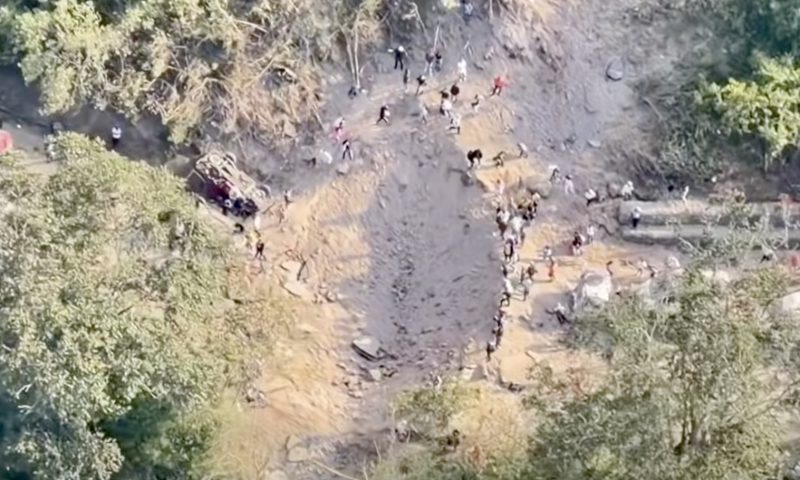
The impact of the attack was significant. Spain’s El País reported “that the explosion created a large crater, left the road covered in debris, and forced rescue operations that lasted several hours due to difficult access conditions.”

Aerial view of the crater caused by the explosion on the Pan-American Highway. Photo courtesy of Colombia’s Ministry of Defense.

Aerial view of the crater caused by the explosion on the Pan-American Highway. Photo courtesy of Colombia’s Ministry of Defense.

Cauca Governor Octavio Guzmán described the incident as one of the most serious attacks in the region in decades. “What happened on April 25 constitutes the most brutal and ruthless attack against civilians in decades,” he said.

The attack comes amid a resurgence of violence in southwestern Colombia, where illegal armed groups linked to drug trafficking, illegal mining and other illicit economies operate. Authorities continue operations in the area as investigations proceed to clarify the circumstances of the attack and determine responsibility.

According to reports by BBC Mundo, alias “Marlon” is a dissident FARC leader identified as Iván Jacobo Idrobo Arredondo, “the alleged head of the Jaime Martínez structure, part of the Estado Mayor Central (EMC),” one of the country’s most powerful illegal armed groups.

Operations and arrests

As part of response operations, the National Police reported the capture of José Alex Bitoco, alias “David” or “Mi Pez,” identified as the leader of the Dagoberto Ramos structure, another illegal armed faction, who is believed to have acted under orders from alias “Marlon”.

National Police Director Gen. William Rincón Zambrano said the detainee “will have to answer for the wave of terrorist activity” and linked him directly to the attack, stating that “he is responsible for what happened on April 25 in the El Túnel sector on the Pan-American Highway.”

The Defense Ministry reiterated that alias “Marlon” remains a priority target. “He is a high-value target, and we are searching for him with all the capabilities of the state. We have deployed a dedicated intelligence task force to locate him,” Sánchez said, confirming a reward of up to $1.4 million USD for information leading to his capture.

Context: criticism of “Paz Total” policy (Total Peace)

The attack comes amid growing security deterioration in Colombia, intensifying criticism of President Gustavo Petro’sTotal Peace” policy. The Ideas for Peace Foundation (FIP) has warned of a possible failure of the strategy, noting that “less than four months before the end of the government, the lack of progress in peace negotiations and the deterioration of security have become one of the main points of criticism of the Petro administration.”

According to the think tank, during the current administration “the number of disputed territories between illegal actors has nearly doubled, and the number of members in these structures has increased by 85%: they now total more than 27,000 members, including armed individuals and support networks.”

This figure not only represents a significant increase but also places the country at levels similar to, and even higher than, those seen before the peace process with the FARC began. Between 2011 and 2012, the estimate stood at around 26,800 members, compared with 14,600 at the end of Iván Duque’s administration in 2022.

The recent increase has also been rapid. According to the FIP, armed groups grew by 23.5% over the past year (from December 2024 to December 2025), reflecting a swift reconfiguration of these structures. At the same time, violence has intensified. Analysts such as Professor Karol Solís Menco note that over the weekend of April 25–26 alone, “26 terrorist attacks of varying magnitude” were recorded across the country.

Political analysis outlets point to a structural dynamic. According to La Silla Vacía, “Cauca is not experiencing an isolated event, but rather a phase of intensifying territorialized violence, marked by fragmentation among armed actors and a type of violence capable of producing national-level impacts.”

In this context, FARC dissident groups have once again taken center stage in the conflict. “Once again, attention is turning to FARC dissidents. Every attack, every gas cylinder bomb, every assault in Valle and Cauca ends with the same name on the table: the Jaime Martínez structure, one of the strongest groups of Iván Mordisco’s Estado Mayor Central,” El País reported.

Violence indicators also reflect sustained deterioration. “In the first four months of 2026, Colombia has already recorded 48 massacres, with 229 victims, most of them civilians, according to Indepaz. It is the highest figure in the past decade. With these numbers, which represent only a partial picture of the country’s violence, this election year is shaping up to be the most violent since the 2016 peace agreement with the now-defunct FARC guerrilla group,” the same outlet reported.

Cauca, where the attack took place, is considered one of the most sensitive regions. “Cauca is particularly complex because it combines multiple layers of conflict: the historic presence of Indigenous, peasant and Afro-descendant communities; illicit economies; Pacific corridors; disputes over drug trafficking routes; control of the Pan-American Highway; and the presence of FARC dissidents, particularly structures linked to Iván Mordisco,” El País said.

Experts agree that part of the difficulty lies in the design and implementation of the government’s strategy. “Early implementation was a valuable innovation in intent, but it failed to ensure minimum conditions of verification and institutional coherence,” said analyst Germán Valencia of the Peace and Reconciliation Foundation (Pares).

Taken together, these factors have led various sectors to conclude that the “Total Peace” policy faces serious structural limitations amid a scenario of armed fragmentation and territorial expansion by illegal groups.

  •  

RCN Poll Reveals Cepeda’s 30% Ceiling, Right’s Path to Consolidation

Colombia’s presidential race has entered poll season with a revealing snapshot from Noticias RCN and Spanish firm GAD3 that points to an election defined less by early frontrunners than by who can consolidate votes after March’s inter-party consultations.

At first glance, Historic Pact senator Iván Cepeda appears comfortably ahead. The RCN poll places him at 30% voting intention — well above far-right independent Abelardo de la Espriella (22%) and miles ahead of the scattered field trailing behind in single digits.

But a deeper reading of the numbers suggests Cepeda’s lead may already be capped.

The 30% figure aligns almost perfectly with President Gustavo Petro’s loyal electoral base, which has consistently hovered between 28% and 32% since his rise to national prominence. In other words, Cepeda appears to have consolidated petrismo rather than expanded beyond it. The poll reinforces this ceiling: 5% of respondents favor a blank vote, 11% say they would vote for none of the candidates, and 14% remain undecided — a combined 30% still outside the Petro orbit and unlikely to gravitate toward Cepeda.

Further down the list, potential left-leaning or independent figures barely register: Sergio Fajardo, Aníbal Gaviria, Juan Daniel Oviedo, Roy Barreras and Camilo Romero each sit around 1%. Even Claudia López and Germán Vargas Lleras score negligible fractions. The fragmentation benefits Cepeda for now, but it also masks the absence of new voters entering his camp.

By contrast, the Right’s apparent weakness hides a powerful consolidation opportunity.

The Gran Consulta por Colombia, on March 8, shows Paloma Valencia leading the consultation vote with 23%. Yet the poll also reveals that the rest of the consultation slate collectively commands nearly 20%: Juan Manuel Galán (8%), Vicky Dávila (8%), Juan Carlos Pinzón (6%), Juan Daniel Oviedo (4%), Aníbal Gaviria (3%), Enrique Peñalosa (2%), David Luna (1%) and Mauricio Cárdenas (1%).

This bloc is electorally decisive because it represents Colombia’s ideological center — liberal technocrats, urban moderates and business-friendly reformists who reject Petro’s economic direction but resist extreme rhetoric. Valencia’s political résumé, Senate visibility and party machinery position her as the most viable leader to absorb that vote once the consultation narrows the field.

If she consolidates those nearly 20 points, her support would leap toward — or beyond — 40%, instantly surpassing Cepeda’s apparent plateau.

De la Espriella’s 22% underscores the volatility on the Right but also its fragility. His voters overlap heavily with Valencia’s base and are expected to migrate toward a unified conservative candidacy. Even Uribe has hinted that such unity is inevitable in a runoff; the RCN poll suggests it could happen much earlier under electoral pressure.

Yet the poll’s most intriguing subplot lies within the Left’s own consultation, where Roy Barreras emerges as a latent threat to Cepeda despite low headline numbers.

In the Frente Amplio consultation, Cepeda commands 34%, but the striking figure is the 44% who say they would vote for none. Barreras registers 4%, and Camilo Romero 3%, revealing a progressive electorate deeply unconvinced by the current slate.

Barreras’ political positioning explains why that matters. Though aligned with Petro’s government, his ideological lineage is closer to former President Juan Manuel Santos — pragmatic, transactional and coalition-oriented. Unlike Cepeda, Barreras is seen as someone capable of negotiating with centrists and conservatives alike. He represents continuity without ideological rigidity.

If Barreras manages to capture even part of that dissatisfied 44%, Cepeda’s narrow base could erode quickly. The RCN poll already shows Cepeda strong only where the Left is unified and stagnant where broader voters are involved.

Second-round simulations deepen the warning. Cepeda defeats De la Espriella 40% to 32%, but those numbers again reflect Petro’s core plus soft undecideds. Against Paloma Valencia he drops to 43% versus her 20% — a gap that would narrow dramatically once Valencia inherits the consultation bloc. More telling still, Cepeda’s numbers barely move across matchups, reinforcing the perception of a fixed ceiling.

Colombia’s presidential arithmetic is therefore shifting beneath the surface.

Cepeda leads because the field is divided. Valencia stands to surge because her side is about to unify. Barreras lurks as the only left-leaning figure capable of fracturing Cepeda’s ideological monopoly and attracting voters beyond Petro’s loyalists.

While headlines focus on Cepeda versus De la Espriella, the RCN poll suggests the real race may ultimately emerge after March 8 — between Paloma Valencia consolidating a broad anti-Petro coalition and Roy Barreras positioning himself as the Left’s only candidate with cross-spectrum appeal.

In Colombia’s elections, momentum follows math. And the math is just beginning to move.

  •  
❌