
Reading view

The truth behind Petro’s claims of Colombia voting fraud
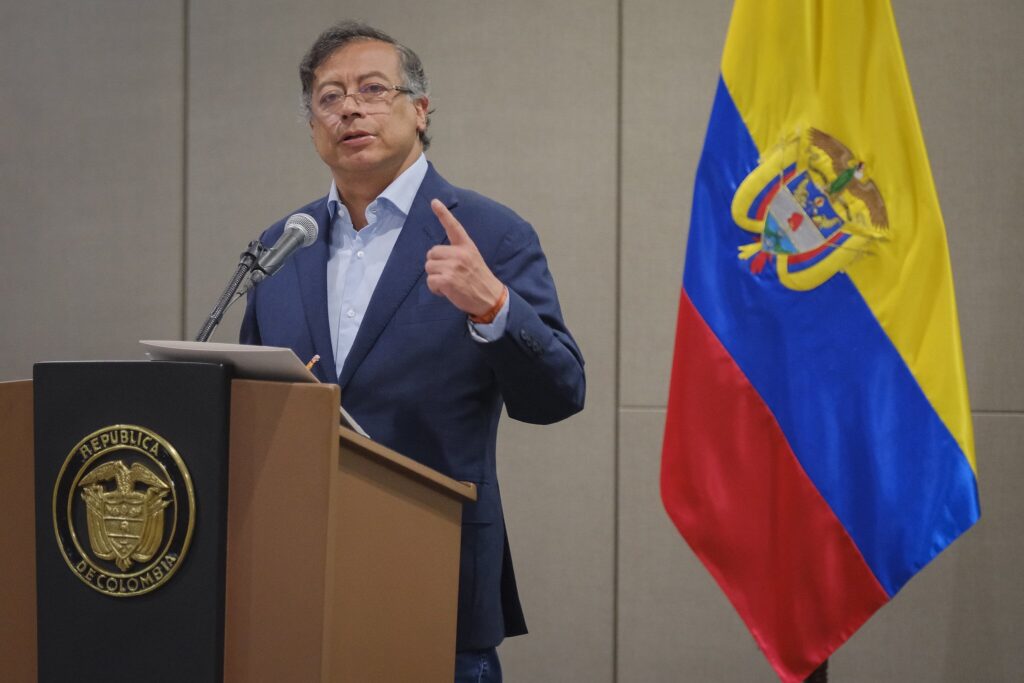
President Gustavo Petro. Image credit: @infopresidencia via X.

Just days away from Colombia’s first-round presidential election, incumbent President Gustavo Petro continues to sound the alarm about voter fraud. 

On Tuesday, he repeated claims that the National Registrar’s Office is allowing the vote to be manipulated against his party’s candidate, Senator Iván Cepeda.

Petro renewed calls for citizens to supervise the vote count, describing it as the only way to avoid fraud: “Only the physical vigilance of millions of people can overcome the algorithm manipulations that the Registrar’s Office refused to prevent.”

But are the president’s claims of vulnerabilities in the voting system valid?

A decade-long dispute

Petro’s claims stem from a long-running grudge with Thomas Greg & Sons, a multinational security and printing company tasked with issuing Colombian passports and overseeing electoral logistics.

According to Petro, the firm cannot be trusted with the sensitive task of printing, delivering, and processing vote counting forms.

While the president’s claims have widely been dismissed by electoral institutions as reckless, there is some foundation for them.

Following the 2014 legislative elections, the evangelical political party, MIRA, filed a legal petition against the Registrar’s Office, claiming a discrepancy between the ballot pre-count (filled out by citizen juries in a form known as E-14) and the digitized tally of the vote (filled out by officials in the E-24 form).

MIRA claimed to have evidence of manipulation of the software used for “voting, information, transmission, or tabulation of election results,” which was managed by a subsidiary of Thomas Greg & Sons. 

After a lengthy four-year legal case, the Council of State (Consejo de Estado), the highest court overseeing the government, issued a ruling in favor of MIRA. It found evidence of destruction of electoral material and inconsistencies between the E-14 and E-24 forms. 

Crucially, the Council of State said that it could not confirm that voting software had been sabotaged because it did not have access to the source code of the software during the elections.

Without the original code, it was impossible to know if the system had been tampered with.

The body issued a clear recommendation to prevent repetitions of the dispute in future elections: “Direct the Electoral Organization to acquire the necessary vote-counting software for use within the state—that is, software owned by the organization itself—which allows for full traceability of the vote-counting process from the polling stations through to the official declaration of the election results.”

In other words, it recommended that electoral authorities roll out their own software, rather than relying on third party providers.

But 12 years later, Thomas Greg & Sons remains in charge of the electoral software; according to the Registrar’s Office, purchasing proprietary software and operating the corresponding data centers is not feasible.
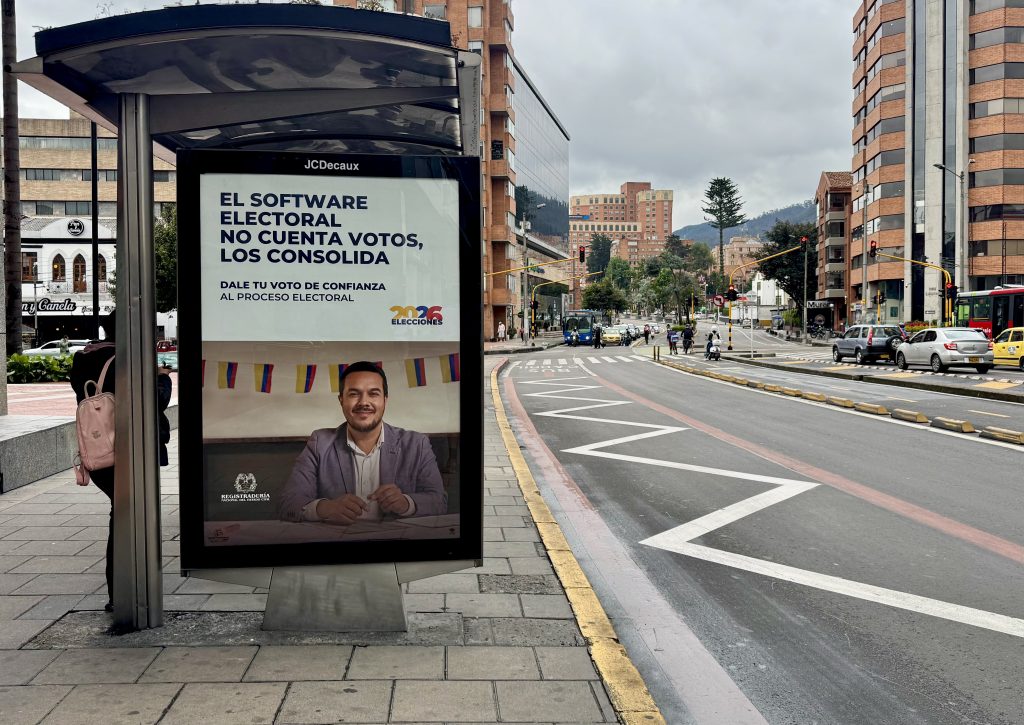
The Registrar’s Office has launched an advertisement campaign defending the integrity of the voting process. Image credit: Alfie Pannell.

While Petro continues to lobby for a fully state-owned system, he has concentrated his efforts on mitigating the risks of a repeat of the 2014 source code issue.

The president has repeatedly demanded that the Registrar’s Office share the source code with the government and the public, which he says would allow them to prevent a repeat of the situation in 2014.

But the Registrar’s Office maintains that there is no need, suggesting that publicizing the code would leave the software more vulnerable to attacks and defending internal audit processes.

Petro rebutted, calling the claim “an immense lie”.

Other types of fraud

As well as warning about software manipulation, the president has also raised the alarm about differences between the pre-count and the official, scrutinized count. Ahead of the March elections, he warned that the pre-count may not accurately reflect the results.

Petro’s concerns stem from the 2022 legislative elections in which over half a million votes for his Historic Pact coalition were excluded in the pre-count and later revealed in the scrutiny. 

Rather than software, the culprit for the discrepancy, which in total represented a 5.49% difference, was human error; the Electoral Observation Mission (MOE) had warned the ballot sheets were designed in a way that could lead to Historic Pact votes being neglected. 

But the 2022 vote appears to be an outlier, with the MOE reporting just a 0.28% discrepancy between the pre-count and the scrutinized votes in March’s legislative elections.

Petro’s mistrust in the pre-count may be valid in the case of a tight race with razor-thin margins but not so much if there is a clear winner. And, in any case, the scrutiny process should clear up any doubts. 

“In Colombian elections, it is judges who determine electoral disputes and not a logistical operator such as Thomas Greg & Sons,” explained Sergio Guzmán, director at Colombia Risk Analysis, a political risk think tank.

Bigger fish to fry

While Petro aims his crusade against Thomas Greg & Sons, a firm which he has clashed with on a range of issues, there are other, more prescient threats to electoral integrity.

“I think that concerns about voters being coerced to vote are legitimate… but I think concerns that somebody will steal the election are overblown,” said Guzmán.

International observers including the United Nations have warned that violence may undermine the elections, particularly in areas under armed group control. 

Vote buying is also a well-documented phenomenon in many regions of the country.

While Petro has some basis for his allegations of voter fraud, there is no evidence of software manipulation determining presidential election results in Colombia.

In a razor-thin race, observers would be wise to wait for the scrutinized vote count to declare a winner. But for now, Petro’s warnings about election-rigging appear to be largely overblown.

The post The truth behind Petro’s claims of Colombia voting fraud appeared first on The Bogotá Post.

  •  

Indicted Ex-Foreign Minister Calls Colombian President Gustavo Petro “Mafia Boss”

Former Foreign Minister Álvaro Leyva releases another scathing attack on his former boss as he fights charges.

On April 10, former Colombian Foreign Minister Álvaro Leyva Durán released a formal statement responding to his indictment by the Fiscalía General de la Nación. Leyva faces charges related to his 2023 decision to declare a passport procurement tender void, a process that involved the private security printing firm Thomas Greg & Sons. The former official characterized the legal proceedings as a politically motivated maneuver orchestrated from the Casa de Nariño.

The indictment for prevarication centers on Leyva’s intervention in the bidding process, which the Fiscalía interprets as a deliberate breach of administrative law. In his defense, Leyva maintained that his actions were necessary to address irregularities and ensure the application of the Constitución Política de Colombia. He argued that the prosecuting body’s thesis would criminalize the conduct of any public servant who identifies unconstitutional terms in a government contract.

“If that argument is accepted, then any official who declares a bidding process void because they find the terms and conditions unconstitutional or illegal should go to jail.” — Álvaro Leyva Durán, former Minister of Foreign Affairs.

Leyva also directed accusations toward his successor at the Cancillería, Luis Gilberto Murillo. According to the statement, Murillo suspended a subsequent legal bidding process to justify a state of emergency, which Leyva claims led to an unnecessary markup of approximately $30 billion COP. Furthermore, Leyva alleged that software contracts exceeding $10 billion COP were improperly managed and that the funds remain unaccounted for under the current administration.

The former minister’s statement included severe personal and political criticisms of President Gustavo Petro. Leyva alleged a lack of moral conduct by the head of state during international state visits and questioned the president’s sobriety in public settings. The letter further asserted that US authorities are currently investigating potential links between the executive branch and narcotics trafficking organizations.

Regarding the domestic political landscape, Leyva warned of perceived risks to the Colombian electoral process. He alleged that the administration has engaged in the illegal interception of political candidates and intends to undermine the integrity of future vote counts. Leyva concluded by affirming his intention to defend his record and his legal decisions before the Corte Suprema de Justicia.

COMUNICADO pic.twitter.com/7YYhoHJD4B

— Álvaro Leyva Durán (@AlvaroLeyva) April 10, 2026

Finance Colombia translation of Leyva’s recent open letter dated April 10th

Some time ago, I denounced in a public communiqué that Gustavo Petro had woven against me an atrocious persecution, as retaliation for my denunciations of his closeness to the world of drugs—denunciations that have led to the United States having him cornered today. There I warned that, from within the government, intrigues were being made to throw me in prison and that attempts would be made against my life.

Now, months later, the Attorney General’s Office accuses me of malfeasance (prevaricato) because I declared void a passport tender that, according to that same institution, was based on a “catch-all specifications document” (pliego sastre). For the accusing entity, I should not have fulfilled the obligation of applying the Constitution that I myself helped draft and, by seeking equality, I acted with malicious intent. The world turned upside down.

Understand the gravity: if that thesis is accepted, any official who declares a tender void because they find unconstitutional or illegal specifications must go to prison. So, faced with such a thing, the trial is welcome. I will give the battle in the Supreme Court with all my strength. Because I trust its magistrates, because my life has been a permanent struggle for Colombia, and because justice, reason, and the law are with me.

The acquittal will be the logical consequence of the process in which I will prove, with official documents and among other things, the following: that I left in motion a new, clean, and legal tender, which Minister Luis Gilberto Murillo suspended. That he thus justified another manifest urgency, completely unnecessary, and added an overcharge of nearly 30 billion pesos to it. And that he contracted software for more than 10 billion additional pesos, which was pocketed. All by hand-picking. All murky. All without control. Thus, by brute force, the door was opened to the passport debacle of today. I warned Petro of what was coming down on the country. But he kept silent.

Today I feel the pride of having helped unmask the boss of the mafia that has plunged Colombia into its darkest hours. I took office as his Foreign Minister with the hope of change. But then I came to know his life of vice and decadence. I was slow to understand his vileness and, surely, also slow to denounce it. But from my father Jorge Leyva Urdaneta, exiled for opposing the dictatorship, I inherited courage and respect for institutions; from Álvaro Gómez Hurtado, I learned the necessity of a just order; and from Misael Pastrana Borrero, I learned to think about social peace. So, faithful to myself and to the spirit of my mentors, I denounced in various letters the moral, political, and personal degeneration that I came to know in Gustavo Petro. And time has proven me right.

The President is an infamous being: international human trafficking is a scourge of the poor girls of Colombia, and he, in the middle of a state visit, ends up as a customer of a brothel in Lisbon; he claims to be a champion of peace, but full of hatred he violently divides society with his stale, classist, and racist rhetoric; he claims to fight drug trafficking, but he goes out into the public square drugged, drunk on alcohol and sectarianism, to mistreat and insult those who contradict him, while in the United States his ties to narcos are being investigated. And so, from scandal to scandal, the horrible night does not cease: the homeland trampled by its own President is today the object of all the mockery abroad.

Petro knows that the upcoming electoral process resembles the one recently lived in Chile. And, to avoid the same result, he illegally intercepts candidates, seeks to destroy them, and is already trying to cast a mantle of doubt over the vote count. But Colombia deserves a new dawn. And the radical left, which—turned into the President’s hooligan squad—forgives him everything, seems condemned to the desert. We shall see whether, in the future, they also forgive him for being responsible for their possible defeat. For my part, I remain ready for all battles: always embracing justice against oppression, and with the law as my spear, shield, and banner.


  •  
❌