
Normal view

Ecopetrol Posts Q1 EBITDA Gain as Refining Margins Surge, But Governance Crisis and Tax Headwinds Weigh on Net Income

19 May 2026 at 01:22

Refining margin surge cushions revenue drop amid leadership void

Ecopetrol S.A. (NYSE: EC, BVC: ECOPETROL) reported first-quarter 2026 consolidated revenues of 28.6 trillion COP, a decline of 8.7% from 31.4 trillion COP in the year-earlier period, as lower crude oil prices and reduced hydrocarbon production compressed the top line for Colombia’s state-controlled oil and gas company. Against that backdrop, a marked recovery in refining margins and disciplined cost management lifted EBITDA by 1.5% to 13.5 trillion COP, yielding a 47% EBITDA margin and partially offsetting the revenue headwind. At the Q1 2026 average exchange rate of approximately 3,700 COP per USD, the quarter’s revenues translate to roughly $7.73 billion USD and EBITDA to approximately $3.65 billion USD.
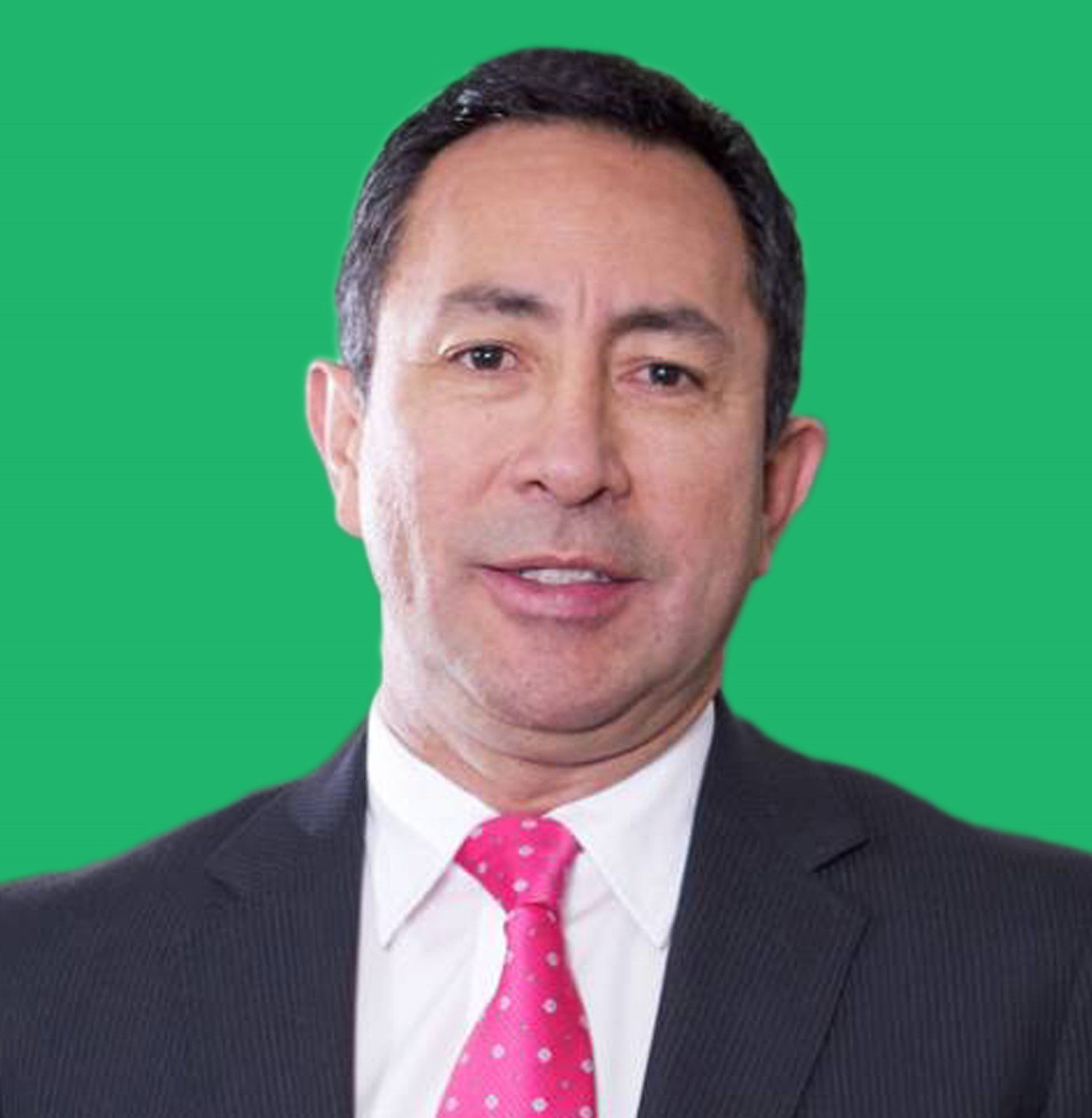
Embattled Ecopetrol CEO Ricardo Roa was appointed to the position by Colombian President Gustavo Petro after managing his political campaign. (photo: Ecopetrol)

Embattled Ecopetrol CEO Ricardo Roa was appointed to the position by Colombian President Gustavo Petro after managing his political campaign. (photo: Ecopetrol)

Net income for the quarter reached 2.9 trillion COP (approximately $784 million USD), down 7.7% year-over-year, reflecting the combined drag of lower revenues, a sharply elevated effective tax rate of 37.1%, and a one-time charge of 1.2 trillion COP for the impuesto al patrimonio — Colombia’s government-mandated wealth levy on large corporations established to fund post-disaster reconstruction measures. The company is also subject to a 10% income tax surcharge applicable for fiscal year 2026, which is embedded in the reported effective rate. The aggregate tax burden absorbed a disproportionate share of operating improvement relative to prior periods, limiting the flow-through of refining gains to the net income line.

Total hydrocarbon production averaged 725.2 thousand barrels of oil equivalent per day (kboed) in Q1 2026, below the 745 kboed recorded in the 2025 annual average cited by management during the March 2026 general shareholders’ meeting. Domestic crude output represented the largest component at approximately 520 thousand barrels per day (kbd). Ecopetrol’s Permian Basin operations in the United States contributed 91.8 kbd, underscoring the continued strategic importance of the international segment. Gas production continued a multi-year declining trend that poses a medium-term domestic supply challenge; management has sought to address this partially through regasification capacity additions at Puerto Bahía and on the Pacific coast, expected to come online in the second half of 2026 with a combined contribution of up to 430 billion BTU per day.

The refining segment delivered the quarter’s most pronounced operational outperformance. Ecopetrol’s domestic refineries, led by Refinería de Cartagena, processed 417.5 kbd of crude throughput. The integrated refining margin rose to $17.3 USD per barrel, a 60% improvement over the same quarter of 2025, driven by favorable differential pricing between domestic crude benchmarks and refined product values alongside ongoing operational efficiency improvements. The Comisión de Regulación de Energía y Gas (CREG) and the Ministerio de Minas y Energía remain central to the regulatory framework governing downstream margins over the medium term.

The balance sheet carries significant structural and contingent risk items of direct relevance to institutional credit and equity holders. Gross debt stood at 108.1 trillion COP (approximately $29.2 billion USD), representing a leverage ratio of 2.3 times trailing EBITDA — a level that leaves limited room for further deterioration before debt covenants or rating agency thresholds become binding. Ecopetrol holds a receivable of 4.2 trillion COP (approximately $1.14 billion USD) from the Fondo de Estabilización de Precios de los Combustibles (FEPC), a government fuel price stabilization mechanism that represents a claim on the Colombian treasury with timing and recovery risk. A dispute with the Dirección de Impuestos y Aduanas Nacionales (DIAN) over value-added tax assessments totals 12.26 trillion COP (approximately $3.31 billion USD) in aggregate, of which 10.22 trillion COP relates to Ecopetrol’s consolidated operations and 2.04 trillion COP to Refinería de Cartagena. Both cases are under administrative and judicial review; no provisions have been recognized in the financial statements pending resolution, but the potential liability represents a material contingency relative to the company’s quarterly net income.

On the corporate development front, Ecopetrol disclosed three significant transactions during or following the quarter. The company agreed to acquire producing assets from Gran Tierra Energy (NYSE: GTE, TSX: GTE) for $92.4 million USD, adding Colombian upstream production inventory in basins where both companies have operated. In Brazil, Ecopetrol launched a tender offer for shares of Brava Energia (BVMF: BRAV3) at 23 BRL per share, seeking to expand its footprint in that country’s oil and gas sector. And in a transaction that would reshape the mid-size independent landscape in Colombia, the company reached an agreement to acquire Parex Resources (TSX: PXT) for $250 million USD; Parex is a Colombia-focused producer with a complementary asset base across the Llanos and other producing basins. Collectively, the three transactions signal that Ecopetrol’s capital allocation strategy under the current government continues to favor upstream consolidation despite the elevated leverage profile.

The exploration portfolio generated positive news announcements. The Copoazú-1 exploratory well, drilled in Colombia’s Llanos foothills region, was confirmed as a commercial discovery, adding to the domestic reserve base. The Sirius offshore project advanced through the Consulta Previa process — a legally mandated prior consultation with indigenous and Afro-Colombian communities required before development of projects in or near their territories — reaching a milestone in community engagement that brings the project closer to formal development sanction. The Agencia Nacional de Hidrocarburos (ANH) oversees the licensing framework within which both projects operate.

“Ecopetrol is listed on the New York Stock Exchange; we are governed by the strict regulations of US federal agencies. Agencies like OFAC and the SEC could intervene in the company and could even accelerate the payment of financial obligations, which would be extremely grave for Ecopetrol.” — Martín Ravelo, President, Unión Sindical Obrera (USO)

The ISA transmission segment, managed through Ecopetrol’s majority stake in ISA — Interconexión Eléctrica S.A., contributed stable regulated cash flows during the quarter. ISA completed 46 transmission reinforcement works across its Latin American concession portfolio. The segment also completed the acquisition of 100% of IE Madeira in Brazil, consolidating its position in that country’s power grid interconnection infrastructure. ISA further submitted a competitive bid for the Río Bueno–Puerto Montt high-voltage transmission line concession in Chile, demonstrating the group’s appetite for long-duration, inflation-linked infrastructure assets across the Andes region. For institutional investors evaluating Ecopetrol as a blended hydrocarbons-and-infrastructure holding, ISA’s consistent cash generation provides partial diversification from crude price volatility, though it does not insulate the consolidated entity from headline governance risk.

The most consequential variable for the investment thesis over the near term is Ecopetrol’s prolonged governance crisis. At the company’s general shareholders’ meeting on March 27, 2026, held at the Corferias convention center in Bogotá, minority shareholders loudly heckled president Ricardo Roa — with audible shouts of “¡Fuera, fuera!” reverberating through the hall — as debate over his leadership erupted into open confrontation. The meeting approved a dividend of 121 COP per share for minority holders and a 4 trillion COP distribution to the Colombian government as majority shareholder, payable in two installments by June 30, 2026. Despite the financial business conducted, governance overshadowed the proceedings.

Roa faces two separate judicial proceedings. The Fiscalía General de la Nación formally charged him in connection with alleged influence peddling related to the purchase of an apartment in northern Bogotá — charges he has denied. Separately, the Consejo Nacional Electoral (CNE) is examining whether campaign spending limits were violated during President Gustavo Petro’s 2022 presidential campaign, which Roa managed — an investigation that Finance Colombia has covered in detail. Angela Maria Robledo, Chair of the Board of Directors, defended the board’s decision to retain Roa at the March assembly, citing the constitutional presumption of innocence. However, four of the nine board members had already formally recorded their support for his removal at that point, exposing a divided governance structure at a time when strategic and operational decisions require unified leadership.

The Unión Sindical Obrera (USO), which represents approximately one-third of Ecopetrol’s workforce, issued a production strike ultimatum timed to a March 30 board meeting. Martín Ravelo, president of the USO, framed the leadership crisis explicitly in terms of US regulatory risk: “Ecopetrol is listed on the New York Stock Exchange; we are governed by the strict regulations of US federal agencies. Agencies like OFAC and the SEC could intervene in the company and could even accelerate the payment of financial obligations, which would be extremely grave for Ecopetrol.” Ravelo further warned that the company’s outstanding international debt — which he placed at approximately $30 billion USD and which is exacerbated by elevated interest rates — left Ecopetrol exposed to potential covenant triggers or early repayment demands in a scenario where the Securities and Exchange Commission (SEC) or the Office of Foreign Assets Control were to take enforcement action.

Following sustained pressure from the USO, minority shareholders, and opposition political figures, Ecopetrol’s board approved an extended leave of absence for Roa beginning April 7, 2026. Under the arrangement, Roa used accrued vacation through May 27, followed by 30 calendar days of unpaid leave beginning May 28, extending his absence through the end of June — a period encompassing Colombia’s presidential first round on May 31 and a potential runoff on June 21. Juan Carlos Hurtado Parra, the company’s executive vice president of hydrocarbons and designated first alternate to the presidency since November 2025, was appointed acting president. Hurtado Parra holds an MBA in International Oil and Gas and brings more than 28 years of energy sector experience to the acting role, having previously served as vice president of exploration, development, and production.

The political calendar creates a structural transition risk that sits above the operational and financial results as the primary concern for long-duration investors. Colombia’s incoming government, to be inaugurated August 7, 2026, is widely expected to appoint a new Ecopetrol board and select a new company president. That transition may bring material shifts in strategic priorities — including the pace of upstream investment, the approach to the FEPC receivable recovery, the trajectory of energy transition spending, and the capital allocation balance between the hydrocarbons segment and the ISA infrastructure platform. The Ministerio de Hacienda y Crédito Público and the Ministerio de Minas y Energía will both play key roles in establishing the post-election policy framework under which Ecopetrol operates. Institutional investors holding exposure to Ecopetrol via NYSE: EC or BVC: ECOPETROL must weigh Q1’s genuine operational improvement — most visibly in refining margins and EBITDA stability — against a governance and policy transition risk profile that is unlikely to be resolved before the August handover.

Ecopetrol’s Cartagena refinery (photo courtesy Ecopetrol)
Indicted Ex-Foreign Minister Calls Colombian President Gustavo Petro “Mafia Boss”

10 April 2026 at 15:01

Former Foreign Minister Álvaro Leyva releases another scathing attack on his former boss as he fights charges.

On April 10, former Colombian Foreign Minister Álvaro Leyva Durán released a formal statement responding to his indictment by the Fiscalía General de la Nación. Leyva faces charges related to his 2023 decision to declare a passport procurement tender void, a process that involved the private security printing firm Thomas Greg & Sons. The former official characterized the legal proceedings as a politically motivated maneuver orchestrated from the Casa de Nariño.

The indictment for prevarication centers on Leyva’s intervention in the bidding process, which the Fiscalía interprets as a deliberate breach of administrative law. In his defense, Leyva maintained that his actions were necessary to address irregularities and ensure the application of the Constitución Política de Colombia. He argued that the prosecuting body’s thesis would criminalize the conduct of any public servant who identifies unconstitutional terms in a government contract.

“If that argument is accepted, then any official who declares a bidding process void because they find the terms and conditions unconstitutional or illegal should go to jail.” — Álvaro Leyva Durán, former Minister of Foreign Affairs.

Leyva also directed accusations toward his successor at the Cancillería, Luis Gilberto Murillo. According to the statement, Murillo suspended a subsequent legal bidding process to justify a state of emergency, which Leyva claims led to an unnecessary markup of approximately $30 billion COP. Furthermore, Leyva alleged that software contracts exceeding $10 billion COP were improperly managed and that the funds remain unaccounted for under the current administration.

The former minister’s statement included severe personal and political criticisms of President Gustavo Petro. Leyva alleged a lack of moral conduct by the head of state during international state visits and questioned the president’s sobriety in public settings. The letter further asserted that US authorities are currently investigating potential links between the executive branch and narcotics trafficking organizations.

Regarding the domestic political landscape, Leyva warned of perceived risks to the Colombian electoral process. He alleged that the administration has engaged in the illegal interception of political candidates and intends to undermine the integrity of future vote counts. Leyva concluded by affirming his intention to defend his record and his legal decisions before the Corte Suprema de Justicia.

COMUNICADO pic.twitter.com/7YYhoHJD4B

— Álvaro Leyva Durán (@AlvaroLeyva) April 10, 2026

Finance Colombia translation of Leyva’s recent open letter dated April 10th

Some time ago, I denounced in a public communiqué that Gustavo Petro had woven against me an atrocious persecution, as retaliation for my denunciations of his closeness to the world of drugs—denunciations that have led to the United States having him cornered today. There I warned that, from within the government, intrigues were being made to throw me in prison and that attempts would be made against my life.

Now, months later, the Attorney General’s Office accuses me of malfeasance (prevaricato) because I declared void a passport tender that, according to that same institution, was based on a “catch-all specifications document” (pliego sastre). For the accusing entity, I should not have fulfilled the obligation of applying the Constitution that I myself helped draft and, by seeking equality, I acted with malicious intent. The world turned upside down.

Understand the gravity: if that thesis is accepted, any official who declares a tender void because they find unconstitutional or illegal specifications must go to prison. So, faced with such a thing, the trial is welcome. I will give the battle in the Supreme Court with all my strength. Because I trust its magistrates, because my life has been a permanent struggle for Colombia, and because justice, reason, and the law are with me.

The acquittal will be the logical consequence of the process in which I will prove, with official documents and among other things, the following: that I left in motion a new, clean, and legal tender, which Minister Luis Gilberto Murillo suspended. That he thus justified another manifest urgency, completely unnecessary, and added an overcharge of nearly 30 billion pesos to it. And that he contracted software for more than 10 billion additional pesos, which was pocketed. All by hand-picking. All murky. All without control. Thus, by brute force, the door was opened to the passport debacle of today. I warned Petro of what was coming down on the country. But he kept silent.

Today I feel the pride of having helped unmask the boss of the mafia that has plunged Colombia into its darkest hours. I took office as his Foreign Minister with the hope of change. But then I came to know his life of vice and decadence. I was slow to understand his vileness and, surely, also slow to denounce it. But from my father Jorge Leyva Urdaneta, exiled for opposing the dictatorship, I inherited courage and respect for institutions; from Álvaro Gómez Hurtado, I learned the necessity of a just order; and from Misael Pastrana Borrero, I learned to think about social peace. So, faithful to myself and to the spirit of my mentors, I denounced in various letters the moral, political, and personal degeneration that I came to know in Gustavo Petro. And time has proven me right.

The President is an infamous being: international human trafficking is a scourge of the poor girls of Colombia, and he, in the middle of a state visit, ends up as a customer of a brothel in Lisbon; he claims to be a champion of peace, but full of hatred he violently divides society with his stale, classist, and racist rhetoric; he claims to fight drug trafficking, but he goes out into the public square drugged, drunk on alcohol and sectarianism, to mistreat and insult those who contradict him, while in the United States his ties to narcos are being investigated. And so, from scandal to scandal, the horrible night does not cease: the homeland trampled by its own President is today the object of all the mockery abroad.

Petro knows that the upcoming electoral process resembles the one recently lived in Chile. And, to avoid the same result, he illegally intercepts candidates, seeks to destroy them, and is already trying to cast a mantle of doubt over the vote count. But Colombia deserves a new dawn. And the radical left, which—turned into the President’s hooligan squad—forgives him everything, seems condemned to the desert. We shall see whether, in the future, they also forgive him for being responsible for their possible defeat. For my part, I remain ready for all battles: always embracing justice against oppression, and with the law as my spear, shield, and banner.


Colombia Confirms 14 Candidates for 2026 Presidential Election

20 March 2026 at 21:26

Though surprises are possible, polling says the front runners are Iván Cepeda, Abelardo de la Espriella, and Paloma Valencia.

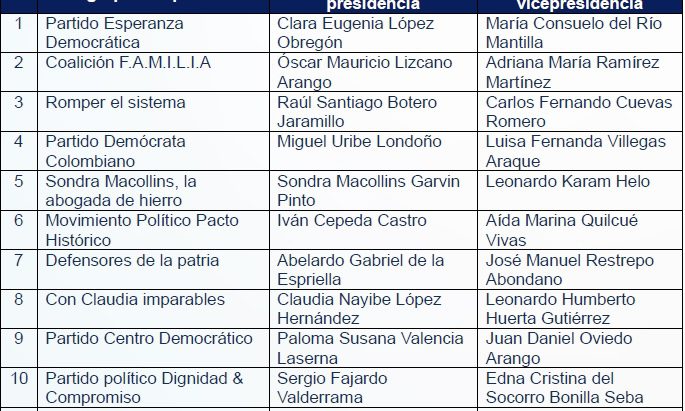
The Registraduría Nacional del Estado Civil of Colombia (RNEC), the entity responsible for organizing elections in the country, reported that a total of 14 candidates have officially registered to run in the country’s presidential elections, scheduled for May 31, 2026. In this vote, citizens will elect the President and Vice President of the Republic for the 2026–2030 term.

According to the electoral authority, the candidates represent a wide range of political perspectives, from left to right, including independent candidacies running through political movements. Here the list and brief profile of the candidates:

  1. Clara Eugenia López Obregón, currently a senator for the Esperanza Democrática She has served as Minister of Labor (2016–2017), acting mayor of Bogotá (2011–2012), and Bogotá’s secretary of government (2008–2010). She has been affiliated with left-wing parties and was Gustavo Petro’s vice presidential running mate in the 2010 election.
  2. Óscar Mauricio Lizcano, from the FAMILIA coalition. He served as Minister of Information Technologies (2023–2025), was a senator (2010–2018), and a member of the House of Representatives (2006–2010).
  3. Raúl Santiago Botero, candidate of the “Romper el Sistema” movement (Break the Establishment). An agronomist engineer and businessman from Medellín, he presents himself as an independent candidate with no prior political experience.
  4. Miguel Uribe Londoño, father of the slain presidential candidate Miguel Uribe Turbay. He is running under the Colombian Democratic Party and previously served as president of the Centro Democrático party founded by Álvaro Uribe Vélez.
  5. Sondra Macollins Garvin, from the movement “La Abogada de Hierro” (The Iron Lawyer) A criminal lawyer and psychologist, she presents herself as an independent candidate without political affiliations. She ran for the House of Representatives in 2022 and is known for her work in narcotrafficking and corruption cases.
  6. Iván Cepeda Castro, a senator since 2014 and the official candidate of the Pacto Histórico, the same party as President Gustavo Petro. Polls project he will receive the highest vote share in the first election round. He is aligned with left-wing political ideas.
  7. Abelardo de la Espriella, a lawyer with far-right positions, running for the first time under the Defensores de la Patria movement. Recent polls place him as a likely second or third contender in voter preference.
  8. Claudia López Hernández, former mayor of Bogotá (2020–2023) and former senator (2014–2018), running under the centrist movement “Imparables con Claudia.” She is known for her anti-corruption agenda and secured her candidacy with more than 570,000 votes (about 9%) in recent interparty primaries.
  9. Paloma Valencia Laserna, current senator and candidate of the Centro Democrático party led by Álvaro Uribe Vélez. She won the right-wing interparty primary on March 8 with more than 3 million votes. Polls place her among the top three contenders, and if she reaches a runoff, she would become the first woman in Colombia’s history to do so.
  • Sergio Fajardo Valderrama, an academic and mathematician running for the Dignidad y Compromiso He served as mayor of Medellín and governor of Antioquia and is running for president for the third time.
  • Roy Barreras, from the political party La Fuerza (The Force). He won the left-wing coalition primary on March 8 with the lowest vote total (257,000 votes, about 3.6%). Although currently aligned with left-wing movements and part of the Petro administration, he has previously been affiliated with right- and center-leaning parties.
  • Gustavo Matamoros Camacho, of the Colombian Ecologist Party. He served in the Colombian Army for 43 years. With no prior political experience, his campaign focuses on public security.
  • Luis Gilberto Murillo, who served as Minister of Foreign Affairs (2024–2025) and Colombia’s ambassador to the United States (2022–2024). A human rights advocate and Afro-Colombian leader from Chocó, he presents himself as an independent, moderate, centrist candidate.
  • Carlos Eduardo Caicedo, running under the independent movement “Con Caicedo.” He was mayor of Santa Marta (2012–2015) and governor of Magdalena (2020–2023), where he built a strong base as a left-wing political leader.

The RNEC also reported that “the draw to determine the position of presidential candidates on the ballot will take place on March 25 at the Ágora Bogotá Convention Center.”

This process marks the formal start of the final phase of the presidential campaign, during which candidates will seek to consolidate support ahead of the first round on May 31. If no candidate secures an absolute majority, a runoff between the two leading candidates will be held on June 21.

List of registered candidates for Colombia’s presidency. Photo courtesy of the Registraduría Nacional del Estado Civil.

List of registered candidates for Colombia’s presidency. Photo courtesy of the Registraduría Nacional del Estado Civil.

Headline photo: Polling station in Colombia during last Congress elections in March 8, 2026. Photo courtesy of the Registraduría Nacional del Estado Civil.

Defrocked Colombian Supreme Court Justice Sentenced to Over 10 Years Prison in Corruption Case

3 March 2026 at 23:56

The sentence is the latest in the “Cartel of the Toga” judicial corruption scandal that has rocked the Colombian justice system over the past several years.

José Leonidas Bustos Martínez, a former Justice of the Sala Penal of the Corte Suprema de Justicia, was sentenced to 10 years and three months in prison for his role in the so-called “Cartel de la Toga,” a corruption network made up of judicial officials who received payments in exchange for influencing court decisions in favor of political leaders.

The Sala Especial de Primera Instancia issued ruling SEP 013 on February 20, 2026, finding Bustos Martínez guilty of criminal conspiracy. In addition to the prison sentence, the Court barred him from holding public office for the same period and imposed a fine of approximately $36,200 USD.

José Leonidas Bustos Martinez was a leader of the “Cartel of the Toga” that sold justice to the highest bribe.

The former justice, who twice served as President of the Supreme Court, was acquitted of a separate charge of abuse of public office related to influence peddling.

The ruling states that no alternative sentencing measures, such as suspended sentence or house arrest, will be granted, meaning Bustos Martínez must serve his sentence in a Colombian correctional facility to be designated by the Instituto Nacional Penitenciario y Carcelario (INPEC).

The Court also ordered the issuance of an arrest warrant and requested an Interpol Red Notice, as Bustos Martínez has resided in Canada since 2019.

According to the Comisión de la Verdad de Colombia (Truth Commission), the so-called “Cartel de la Toga” was a corruption scheme operating since 2010 through which “Colombia’s justice system was infiltrated through the purchase of judicial rulings.” The Commission stated that “officials involved diverted investigations, delayed proceedings, misused privileged information, altered evidence and discredited witnesses in order to favor those who paid for judicial decisions that appeared lawful.”

Investigations lead by the Commission determined that the scheme sought to illegally interfere in cases against high-level political leaders in exchange for substantial sums of money, including obstructing arrest warrants and preventing pretrial detention measures.

Bustos Martinez’s conviction adds to more than 50 arrests and extraditions related to the case since 2017, including sentences against former judicial officials, former members of Congress, former mayors and former governors from various regions of Colombia.

Headline photo:In 2008 then President Álvaro Uribe swore in José Leonidas Bustos Martínez as magistrate of the Criminal Cassation (Appeals) Chamber of the Supreme Court of Justice, during a ceremony held Tuesday, April 1st, in the Gobelinos Hall of the presidential palace (photo: Presidential Archives of Colombia)

Petro under fire in ‘cash for diplomas’ scandal

23 January 2026 at 22:47
Representative Catherine Juvinoa at a press conference in Bogotá this week. Photo: X

A simmering spat over candidates for government posts boiled up this week with revelations that a Bogotá university was faking professional titles for workers in Petro’s administration.

According to congress members revealing the scandal, 24 public servants got top contracts using dodgy titles from Universidad Fundación San José, a mold-breaking higher education institute once famed for accessible courses, but now under scrutiny for selling degrees.

They also accused Petro and his education chiefs of dragging their feet in investigating the university for the suspected fraud case.  

“Petro’s promises for education come to nothing,” said house representative Catherine Juvinao after she claimed to have identified 24 cases where officials and contractors in top government entities appeared to have been hired with diplomas from the Univerisity Foundation San José without all the tests.

One stand-out case was a government functionary who, according to university records, graduated in four quite different degrees – Business Administration, Industrial Engineering, Public Accounting and International Marketing – on the same day.

“This is one of the most serious cases. Who graduates with four degrees on the same day?,” the representative said in an interview with Semana magazine.

According to Juvinoa, the university handed out diplomas to students who had failed to complete the independent technical tests, known as PruebaPro, and in some cases had not studied at all.

Fake titles for plum jobs?

Although academic fraud has occured regularly in Colombia – and similar scandals have rocked previous governments – the investigations by Juvinao and her team are targeting an administration that promised to turn its back on corruption.

This week’s revelations followed last year’s political dogfight over the proposed appointment of 23-year-old Juliana Guerrero as vice-minister of youth. The candidate, who was close to both Petro and his education minister, was already embroiled in controversies over private use of police planes. Then in September she was found to have falsified her accounting qualifications at the university.

After public pressure the university rescinded the degree, and Guerrero herself told Caracol news that she intended to take the independent exams to regain her title in November.

Juliana Guerrero, the candidate accused of faking her qualifications. Photo: Interior Ministry

Further investigations revealed a bigger suspicion: that the Petro government was routinely using the university – with which it had contracts – to fudge academic requirements for candidates favoured for plum jobs.

This week Juvinao accused  Petro government or running a “Cartel of Dodgy Diplomas” in cahoots with the San José university. “It’s bad news that our first left-wing government ended up being a monument to mediocrity, captured by an institution,” she said.

The state was “closing the door to those who studied hard by merit,” she said, while calling for a probe by the Attorney General’s office, adding that: “we have all the evidence to support any investigation”.

Political Attacks

For its part, the Ministry of Education announced this week it was investigating the University Foundation San José related to the case of Guerrero, Petro’s preferred candidate for the Ministry of Youth.

In the same communication, the ministry strongly denied it had any link to “illicit activities related to the expedition of academic titles”.

The Colombian president repeatedly defended Guerrero’s nomination for the post last year even after her degree was pulled by the university. Her only error was to claim her title before taking the final exam, he said, suggesting a storm in a teacup. The attacks were personal and political, he added.

“So, Juliana’s graduation exam, after completing her studies, was registered for in July and is scheduled for next November. Is that the summary of this scandal?” he wrote on X.

At first view Petro’s gesture seemed on target; young candidates, particularly female, get torrents of abuse in the rough-and-tumble of Colombian politics, often facing a public scrutiny less applied to old-school politicos.

But looking back that defence now seems misplaced: financial data revealed this month showed Guerrero had paid for her degree course long after receiving her diploma – almost unheard of in Colombia – while the university itself confirmed that she “never went to classes or presented exams nor complied with the accounting program”.

Doubling down

This week Petro doubled down on his defense of the University Foundation San José, claiming the accusations by the opposition unfairly focused on “poor single mothers” trying to get ahead.

“Private universities…allow these working women to study faster,” he said. “[Politicians] to gain votes shouldn’t destroy working women. I expect a public apology from these congresswomen to the working women of Colombia.”

To complicate the president’s narrative, referring to the Guerrero case, the university announced it had “detected and denounced a fraud” and had itself requested the attorney general’s office to investigate. It also promised to “stregthen internal audits” to prevent future cheating.

Representative Juvinao told Semana told Semana magazine that the Guerrero case suggested corruption in the form of cash for qualifications, and was likely “the tip off an iceberg”.

“There is a deliberate strategy to fabricate qualifications to fit the needs of Petro’s government departments,” she said.

In a country where people struggle for further education – and value highly their hard-earned academic qualifications – what started as an online spat over a youth representative is becoming a scandal with much more scope.

The post Petro under fire in ‘cash for diplomas’ scandal appeared first on The Bogotá Post.

❌