Reading view

From Cartagena to Chelsea: Ruby Rumié Brings ¿How Are the Children? to New York

At Nohra Haime Gallery, in Manhattan’s white-walled Chelsea district, Cartagena-based artist Ruby Rumié is asking a deceptively simple question: How are the children?

It is not a casual greeting, nor the sentimental title of a new exhibition. Instead, it draws from the Maasai expression “Kasserian Ingera,” a phrase that measures the wellbeing of an entire community through the condition of its youngest members. If the children are well, the society is functioning; if they are not, everything else is called into question.

For Rumié, whose socially engaged practice has long examined dignity, memory and the politics of the body through installation and portrait photography, the question becomes the conceptual spine of her latest New York presentation. The exhibition, titled ¿How Are the Children?, marks a significant moment for the Cartagena-based artist, bringing her work once again into an international conversation that moves between Latin America, the Caribbean and the wider Global South.

Rather than beginning with a grand theoretical premise, the project emerged from something quieter: an old newspaper clipping documenting the disappearance of several children on a distant island. Nearly lost among family albums and forgotten papers, the fragment offered no resolution, only a trace. For Rumié, that absence became more powerful than explanation.

The result is an exhibition that does not attempt to solve a mystery but instead inhabits a state of unresolved concern. It asks viewers to remain with discomfort rather than consume a narrative neatly packaged for closure. In a cultural moment increasingly shaped by speed, certainty and spectacle, this refusal feels deliberate.

Within the work’s imagined structure, eleven children leave behind the violences of contemporary life: the pressure to perform, the normalization of fear, and the relentless demand to adapt to adult systems of productivity and control. Their destination is a volcano, a symbol that carries both danger and possibility.

Rumié anchors that image in a distinctly Colombian geography: the Totumo Mud Volcano, located between Cartagena and Barranquilla on Colombia’s Caribbean coast. Known locally as both a tourist curiosity and a place of ancestral ritual, the volcano is less about eruption than immersion. Visitors descend into a dense crater of warm mineral mud, confronting the instinctive fear of sinking—only to discover that the body floats.

This paradox sits at the heart of the exhibition and of Rumié’s photographic narratives.

Using portrait photography staged on the sandy slopes surrounding Totumo, she transforms her young subjects into something resembling living ceramics. Their bodies, coated in volcanic mud, appear sculptural and elemental – figures suspended between portrait and artifact, between childhood and myth. The mud gives them a tactile permanence, as though they have emerged from the earth itself rather than simply stood before the camera.

Here, mud is not scenic backdrop but primary material and metaphor. It is organic and mineral, medicinal and unsettling. It obscures the body while revealing something more essential beneath the surface. Covered in mud, distinctions of age, class, gender and origin begin to dissolve. The body ceases to be an object for display and returns to its simplest state: matter.

There is a quiet political force in that gesture. In a world saturated by images and increasingly hostile standards of beauty, the act of covering oneself in mud becomes a rejection of polished performance. It resists visibility as spectacle and proposes instead a form of symbolic density—one in which the body is not consumed but encountered.

The children in Rumié’s exhibition do not perform innocence. They do not dramatize suffering for the viewer’s emotional satisfaction. Instead, they surround the volcano with calm insistence, each holding a red ribbon that descends from its summit into their hands. The ribbon suggests connection rather than rescue, lineage rather than alarm. The volcano ceases to be a site of threat and becomes something closer to a shared origin: a matrix, a beginning.

That restraint is perhaps the work’s greatest strength. Rumié avoids the familiar traps of political art that over-explains its intentions or aestheticizes trauma into digestible symbolism. Instead, she builds an atmosphere of attention. The exhibition trusts silence. It asks not for interpretation alone, but for ethical presence.

This has been a defining feature of Rumié’s extensive projects. Her work often moves between installation, photography and social intervention, examining how communities remember violence and how institutions choose to see – or not – the vulnerable. Her native Cartagena, with its layered histories of colonialism, tourism and exclusion, remains both context and counterpoint.

Showing this work in New York adds another dimension. Chelsea galleries are not typically spaces associated with collective care or recetive to questions of social reparations. Yet that friction is productive. To pose “How are the children?” in the commercial heart of the international art market is to redirect attention from value to responsibility.

It is also a reminder that contemporary Latin American art is often at its most compelling when it resists exotic labels and insists on moral complexity instead. Rumié does not offer folklore, nor easy allegory. She offers a question as elusive as the landscape itself, echoing the vast and shifting terrains once depicted by the Prussian explorer Alexander von Humboldt during his travels across the continent.

And perhaps that is Rumié’s point. The exhibition offers no definitive answers, nor any final declaration of hope or despair. Instead, it leaves visitors carrying the weight of the original inquiry – returned intact, urgent and impossible to ignore, just like a volcano.

¿How Are the Children? opens on 7 May at Nohra Haime Gallery

Nohra Haime Gallery: 500A West 21st Street, New York.

  •  

Francis Alÿs at MAMU: A Global Portrait of Childhood Through Play

At a time when children are increasingly indoors – absorbed by screens, separated from the street and distanced from the spontaneous rituals of neighborhood play – a new exhibition by the Banco de la República has launched at the Museo de Arte Miguel Urrutia (MAMU), and one that asks a deceptively simple question: what happened to playing outside with friends?

Having opened on April 23 at El Parqueadero and second floor of MAMU, Francis Alÿs, juegxs de niñxs 1999–2025 brings together 27 video works from the Belgian-born, Mexico-based artist’s celebrated long-running series documenting children’s games across the world.

Curated by Cuauhtémoc Medina and Virginia Roy, the exhibition proposes something more than nostalgia. It invites viewers to see play as a form of social architecture – a place where children create rules, resolve disputes and build entire worlds from whatever their environment offers.

Games, the curators suggest, are “social laboratories in miniature.”

For more than two decades, Francis Alÿs has traveled across cities, villages and conflict zones filming children at play. What began in 1999 evolved into an audiovisual archive spanning more than 50 short films across five continents, 27 of which are included in the Bogotá exhibition.

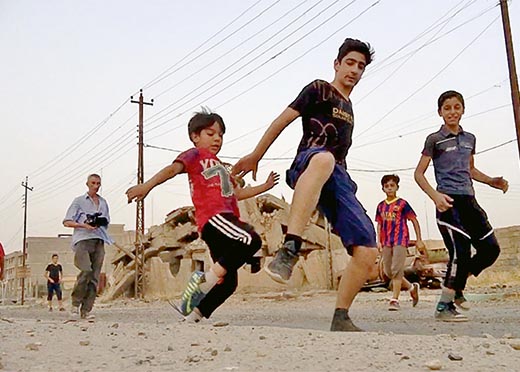
Children jump across hopscotch grids in Afghanistan, toss bones in India, spin tops in Mexico and invent rhythmic contests in narrow urban streets. One of the featured Colombian works, Trompos de semilla, Arara, Colombia, 2025, was filmed in the Amazon with support from Banco de la República’s Cultural Center in Leticia, capturing children in the Arara community playing with spinning tops made from seeds.

The games are simple, but the implications are not.

On the screen there are adults directing the action, no digital interfaces, no organized sports structures. Instead, children improvise with what is at hand – sticks, stones, crates, seeds, chalk, bottle caps – creating systems of cooperation and competition, rules and rebellion.

That act of invention lies at the center of Alÿs’s fascination.

Francis Alÿs, Children’s Game #29: La roue [The Wheel], Lubumbashi, Democratic Republic of the Congo, 2021. Courtesy Photo: © Francis Alÿs

Born in Belgium in 1959, Alÿs grew up with the image of Children’s Games (1560), the iconic painting by Pieter Bruegel the Elder depicting hundreds of children absorbed in play across a town square. According to the exhibition guide, the work became a lifelong reference point—an early visual map of how play reveals the structure of society itself.

Alÿs studied architecture at the Istituto Universitario di Architettura di Venezia before moving to Mexico in 1986 as part of an aid project to help install aqueducts in Oaxaca. He later settled in Mexico City’s historic center, where he developed the poetic and political language that would define his career.

His practice – spanning video, painting, installation and performance – often addresses borders, migration, urban fragility and the absurd mechanics of social order. Power dynamics, the commercialization of public space and the erosion of civic community remain central artistic preoccupations.

In Juegxs de niñxs those themes emerge quietly but powerfully.

Alÿs is not merely documenting childhood. He is observing how public life functions – and how children, often without adult mediation, rehearse the structures of society through play.

The exhibition reveals how games create temporary communities. They teach negotiation, competition, fairness and exclusion. They reflect both freedom and hierarchy. In some videos, the children play in ordinary neighborhoods filled with laughter and routine. In others, games unfold beside military checkpoints or in areas shaped by poverty, displacement and war.

Play persists, but never outside history.

The multi-screen installation at MAMU emphasizes these contrasts, showing both the universality of childhood and the inequalities that define it. Similar games appear across radically different geographies, suggesting what the curators describe as a kind of underground cosmopolitan culture of childhood – one that challenges the rigid identities of the adult world.

At the same time, the exhibition reflects on disappearance.

Traditional street games, some with roots stretching back to ancient Mesopotamia, are becoming less visible. Urban traffic has overtaken streets once used as playgrounds. Safety concerns have limited unsupervised outdoor play. Screens and digital entertainment increasingly dominate leisure time. Public space itself has become more regulated, commercialized and less available for improvisation.

Alÿs’s work does not romanticize the past, but it does capture transient moments of celebration.

What looks ordinary today – a spinning top, a hopscotch square, a game played with stones – may one day become a contemporary hieroglyph, evidence of how communities once formed themselves in public space.

As curator Cuauhtémoc Medina notes, games are not eternal. Their disappearance may signal something larger about the transformation of humanity itself.

If all the world’s a street, Alÿs has chosen not to place these collaborative works on the market, underscoring their documentary and communal nature. For the multi-medium storyteller, games, like art, are not commodities, but shared records of our collective experience.

This Bogotá presentation marks the exhibition’s fifth international stop following showings in Mexico City, Antwerp, Guadalajara and Santiago de Chile. In 2024, Alÿs also presented the project at the Barbican Art Gallery under the title Ricochets, marking the first time his work was shown in the United Kingdom.

At MAMU, the museum becomes more than a gallery – it becomes a space to reconsider childhood, the city and the fragile public spaces where both are formed.

Museo de Arte Miguel Urrutia. Calle 11 No.4-21.

Admission is Free.

Haram football in Mosul, Iraq, 2017. Photograph: Francis Alÿs
  •  

ARTBO Weekend turns 10: Bogotá’s Art Circuits Come of Age

ARTBO Weekend returns to Bogotá this week with a milestone worth noting – and a programme that suggests the event is no longer content with staying within its traditional comfort zones.

Celebrating its tenth edition from April 16 to 19, the city-wide initiative organized by the Bogotá Chamber of Commerce (CCB) arrives bigger, more dispersed and arguably more ambitious than ever. With over 160 free activities, 86 participating spaces and 280 artists from 27 countries, the numbers alone tell a story of steady expansion. But the real shift this year is geographic.

For the first time, ARTBO Weekend – Fin de Semana – pushes decisively into new territory. The addition of Kennedy, Nogal and Chicó as official circuits marks a deliberate move away from the event’s familiar enclaves. It is, in many ways, a statement about where Bogotá’s art scene is headed – or where it wants to go.

Kennedy stands out. Historically on the fringes of the city’s cultural programming, the district’s inclusion is more than symbolic. The reopening of the Chamber of Commerce’s exhibition space in the area signals a longer-term investment in decentralising Bogotá’s art ecosystem. It also raises a question that has hovered over ARTBO Weekend in recent years: who, exactly, is the event for?

For organisers, the answer has consistently been “everyone.” And, on paper, that commitment holds. Entry remains free across all venues, and the programme spans everything from gallery exhibitions and museum shows to performances, workshops, talks and editorial launches. The addition of complimentary transport routes – the Bus ARTBO – helps bridge the distances between circuits, turning what could be a logistical challenge into something closer to an urban stroll.

Still, navigating ARTBO Weekend requires a degree of planning. Bogotá is not compact, and its art circuits are spread across distinct neighbourhoods, each with its own pace and character. San Felipe, long considered the epicentre of the contemporary gallery scene, remains a reliable starting point, particularly for first-time visitors. Chapinero offers a more eclectic mix, where independent spaces sit alongside institutional venues, while the Centro Histórico provides a slower, more contemplative route through museums and heritage sites.

This year, however, the draw may well lie in the unfamiliar. Kennedy’s circuit promises a different rhythm – less polished, perhaps, but more reflective of the city’s broader social fabric. Chicó and Nogal, by contrast, introduce a more polished, design-forward dimension to the programme, expanding the conversation beyond traditional gallery spaces.

What distinguishes ARTBO Weekend from its larger counterpart, ARTBO, is precisely this sense of movement. There are no booths, no central venue, no singular point of focus. Instead, the city itself becomes the exhibition space, and the act of moving between circuits becomes part of the experience.

That experience is not purely visual. The “Conversaciones” series, curated by Raphael Fonseca of the Denver Art Museum, brings together artists, curators and academics for a series of panel discussions that aim to unpack the themes shaping contemporary art today. With free entry and simultaneous translation, the talks offer a point of entry for audiences looking to engage more deeply with the works on display.

Equally, the Encuentro Editorial continues to carve out a niche within the programme. Focused on independent publishing and the book as an artistic medium, it provides a quieter counterpoint to the busier exhibition circuits. For many, it is here – among the artist books and experimental print projects – that the creative pulse is most tangible.

After a decade, ARTBO Weekend has settled into a rhythm that feels both established and open-ended. It has succeeded in building audiences, supporting local galleries and positioning Bogotá within a wider Latin American art conversation. At the same time, it continues to grapple with the challenges of scale, access and representation that come with growth.

For visitors, the best approach may be to resist the urge to see everything. Pick two or three circuits per day. Use the Bus ARTBO, but don’t be afraid to walk, and take an umbrella for the inclement April weather. Allow time for the unexpected – a performance that spills into the street, a conversation that runs longer than planned, a small space that wasn’t on the map.

Because if ARTBO Weekend has proven anything over the past ten years, it is that Bogotá’s art scene is not confined to a single district, or a single idea of what art should be. It is scattered, evolving and, at its best, deeply connected to the city.

  •  

Bogotá’s Museo Santa Clara opens provocative exhibition exploring queer spirituality and colonial memory

In the gilded stillness of one of Bogotá’s most striking colonial spaces, a new exhibition is quietly unsettling centuries-old certainties. Entonces llamó a un arcángel, the latest show by Colombian artist David Felipe Escobar, opens this week at the Museo Santa Clara, inviting visitors into a dialogue between baroque religious iconography and contemporary queer identities.

The exhibition, which opens on April 9 and runs until June 28, unfolds within the former church of the Real Convento de Santa Clara, a desacralised 17th-century site renowned for its lavish altar pieces and paintings of angels and archangels. Rather than treating these works as static relics, Escobar reactivates them—drawing them into conversation with bodies and identities historically excluded from the narratives they once upheld.

Taking its title from a verse by Saint John of the Cross, the exhibition imagines a meeting point between celestial beings and “queer, disobedient bodies” that exist beyond traditional gender norms. The result is not a confrontation with religious imagery, but a reframing of it—one that suggests ambiguity and fluidity were always present within baroque visual culture.

Indeed, Escobar’s premise rests on a subtle but powerful observation: that angels, often depicted as androgynous figures suspended between heaven and earth, already occupy a space of indeterminacy. By foregrounding this ambiguity, the exhibition reveals latent connections between colonial representations and contemporary non-binary identities, without imposing anachronistic readings onto the past.

The show is organised into two thematic sections. The first, centred on fluid identities in dislocated spaces, physically reshapes the museum environment. Selected paintings of archangels are removed from their traditional placements, disrupting long-standing visual hierarchies within the former temple. This curatorial gesture invites a more intimate engagement with the works, while questioning notions of permanence—both in museography and in gender constructs.

The second section, Una nueva Iglesia, shifts from disruption to speculation. Here, Escobar assembles apocryphal figures alongside materials such as chains and silks, constructing a symbolic space where alternative forms of belief can coexist. It is an imagined sacred realm—one that embraces multiplicity and offers refuge to identities historically marginalised by institutional religion.

Together, these interventions transform the Museo Santa Clara into a site of active reinterpretation. The building itself, once a place of rigid spiritual authority, becomes a stage for reconsidering how the sacred has been represented, contested and lived. In this sense, the exhibition does not position itself in opposition to religion, but rather proposes a space of encounter—where past and present converge to open new possibilities for understanding spirituality.

Born in Bogotá in 1992, Escobar’s practice spans visual art and writing, often exploring the intersections of violence, desire and the divine. A graduate of Parsons School of Design and Hunter College, he has participated in international residencies across Latin America. His literary work includes the novel Soap Bubble (2024) and the poetry collection 7 Iridescent Prayers (2026), further extending his exploration of spiritual and corporeal themes.

As Bogotá’s cultural calendar continues to foreground conversations around memory, identity and inclusion, Entonces llamó a un arcángel stands out for its quiet radicalism—suggesting that even within the most traditional of spaces, new meanings can still emerge.

The exhibition runs from April 9 to June 28, 2026, Tuesday to Sunday, 9:00 a.m. to 4:30 p.m., with a programme of guided tours, workshops and public discussions designed to deepen reflection on the relationships between body, spirituality and diversity. Admission is free.


  •  

Marina Sánchez paints Bogotá’s Cerros in luminous colour at Museo del Chicó

In Bogotá, the mountains are never out of sight. They rise abruptly along the city’s eastern edge, forming a green wall that shapes the capital’s light, weather and sense of place. For Colombian artist Marina Sánchez, the ridges that surround the Colombian capital’s cardinal points are also more intimate: a constant presence, a point of orientation and, increasingly, a subject of quiet urgency.

Her latest exhibition, Panorámicas de la Sabana, runs from 5 to 29 March inside the colonial  Museo del Chicó, where 26 acrylic-on-canvas works reinterpret the high-altitude plateau of the Sabana through a distinctly chromatic lens. Installed in the museum’s Salón Colonial, the show brings together landscape, memory and abstraction in a series that feels both personal and outward-looking.

Sánchez has long been recognized for her expressive use of colour but this body of work marks a measured shift. While her earlier practice leaned towards abstraction, here the forms are more legible—ridgelines, shifting skies, traces of vegetation – yet never fixed. Instead, they dissolve through layered pigments and gestural brushwork that privilege sensation over strict representation.

What distinguishes Sánchez’s approach becomes clear in the work itself. The Cerros are not rendered as stable topography but as shifting, atmospheric forms. Bands of diffusec green rise and fold into one another, interrupted by flashes of cobalt, ochre and lilac, while a dense, unsettled sky presses down with quiet intensity. The composition resists stillness. It moves – closer to inclement weather than landscape.

Rather than mapping terrain, Sánchez constructs it through colour. The mountains appear to breathe, their contours dissolving at the edges as if seen through mist or memory. There is no single vantage point; the eye travels across the canvas, tracing lines that feel at once familiar and unstable.

“I want to show the relevance of these giants that often go unnoticed,” Sánchez says. For Bogotá’s residents, the hills are omnipresent yet rarely examined beyond their silhouette. In her telling, they become active participants in the city’s identity – “guardians” that accompany an urban landscape marked by rapid, and at times impersonal, expansion.

The project began during the pandemic, when isolation altered both her routine and perspective. Working from home, Sánchez found herself drawn to the view outside her window: the slow fade of light across the mountains, the subtle shifts in colour at dusk.

“Being away from people – family, friends – I was left with the sky and the light of sunsets,” she says. “I wanted to replicate something I hadn’t fully appreciated and, in doing so, feel part of nature.”

Her visual language, however, is not shaped by Bogotá alone. Sánchez has exhibited in New York City and Milan – cities where she has also lived, and whose pace and structure have informed her approach to rhythm and composition. If Bogotá provides the grounding geography, New York and Milan introduce a contrasting sensibility: verticality, movement and a heightened awareness of structure.

Artist Marina Sánchez describes her work as “chromatic poetry”, a phrase that aligns with her broader intention: to create space for reflection. Photo: Courtesy artist/Marina Sánchez

These contrasting narratives – from urban to rural, isolation and engagement, are visible throughout Panorámicas de la Sabana. Linear gestures – suggestive of passing headlights or urban flow – cut across certain canvases, briefly suspending the stillness of the mountains. It is a restrained intervention but an effective one, hinting at the tension between expansion and preservation.

Colour, in Sánchez’s palette, is not decorative but foundational. Greens shift from luminous to dense; blues dissolve into shadow; entire forms recede into haze. The landscape is reassembled through pigment, hovering between recognition and abstraction.

She describes her work as “chromatic poetry”, a phrase that aligns with her broader intention: to create space for reflection. “I want to offer a moment of calm beyond the difficulties that surround us,” she says, “despite the inevitable conflicts, wars and inequalities.”

In Bogotá, that impulse carries particular weight. The Eastern Hills and peaks to the West are not only a visual constant but a fragile ecological system—central to water sources and biodiversity, yet increasingly under pressure from urban growth. Sánchez’s paintings do not argue this point directly; instead, they suggest it, allowing atmosphere and colour to carry meaning.

For the artist, colour remains essential. “It would be difficult for me to imagine the world in black and white,” she says. “Colour is vitality. It gives strength and solidity. It is pure magic.”

That conviction runs through the exhibition. The hills emerge not as backdrop but as presence—shifting, watchful and quietly insistent. In Sánchez’s hands, they ask to be seen again, and more carefully this time.

Panorámicas de la Sabana runs from 5 to 29 March at the Museo del Chicó (Carrera 9 No. 93-38, Bogotá). Admission is free.

  •  

Fernando Botero Takes on Singapore with Landmark Exhibition

Singapore has never been shy about scale. But this season, the city’s appetite for monumentality takes on a distinctly Latin American accent. For the first time, the work of Colombian master Fernando Botero makes his Singapore debut with the largest exhibition of his work ever showcased in Asia.

Spanning galleries, inter-active theatres and extensive public gardens, the landmark show presents more than 130 works, positioning the city-state as a hub for global Botero immersion. As the largest presentation of the Medellín-born artist (1932-2023), and timed to coincide with Singapore Art Week, Botero in Singapore unfolds across gallery walls, immersive media spaces and public gardens.

“My father loved Singapore,” remarked the artist’s son Fernando Botero Zea to The Strait Times, highligting that with this retrospective, the country now “has the highest concentration of Botero per capita”.

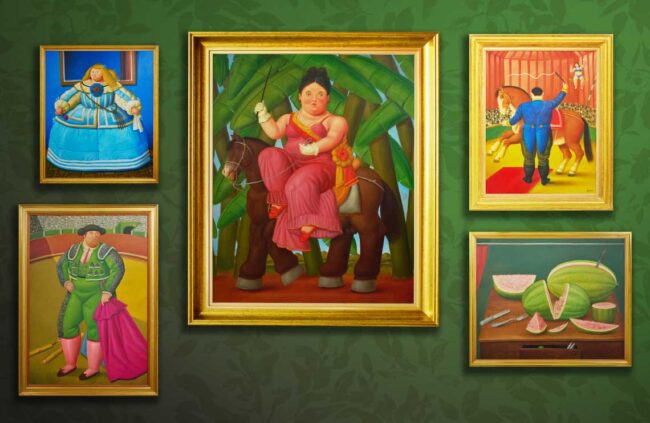
At the heart of the programme is Heart of Volume, a major gallery exhibition at IMBA Theatre, presenting more than 100 works drawn directly from the Botero family collection. Spanning seven decades, the exhibition traces the evolution of what the artist famously described not as exaggeration, but as “volume”: a formal strategy that lends weight, humour and authority to everyday scenes, portraits, still lifes and reimagined art-historical references.

Seen up close, the discipline behind Botero’s apparent abundance becomes clear. Small watercolours and intimate studies reveal a careful calibration of colour and balance, while larger canvases demonstrate his lifelong dialogue with European painting traditions—from Renaissance composition to modernist distortion—filtered through a distinctly Colombian sensibility. The effect is quietly didactic without ever feeling academic, a curatorial tone well suited to Singapore’s measured cultural landscape.

If Heart of Volume offers intimacy, Garden Grandeur delivers spectacle. Extending across the Silver Garden at Gardens by the Bay, ten monumental bronze sculptures bring Botero’s work into the rhythm of daily life. A towering Horse—more than three meters tall and weighing three tonnes – anchors the display, joined by familiar figures such as Adam and Eve, The Dancers and Woman on Horse. Installed against a backdrop of tropical greenery and glass conservatories, the sculptures feel less like foreign imports and more like temporary citizens of the city.

This democratic impulse was central to Botero’s thinking. As his son, Fernando Botero Zea, noted at the opening, the artist believed that public art should be touched, photographed and shared—an ethos that fits neatly with Singapore’s highly social public spaces. Here, Botero’s bronzes become meeting points and landmarks, their generous forms softening the city’s precision with a dose of playfulness.

The exhibition also introduces Life in Fullness, the world’s first immersive Botero experience: a 45-minute audiovisual journey narrated by his son, combining archival footage, animation and storytelling. It is a humanizing counterpoint to the grand scale elsewhere, framing Botero as father, provocateur and craftsman—an artist whose work often invites smiles, but is underpinned by a serious engagement with power, politics and art history.

Beyond the artworks themselves, Botero in Singapore signals a broader shift. Latin American artists have long been underrepresented in Southeast Asia’s major exhibition circuits, despite Singapore’s ambition to position itself as a global cultural hub. This collaboration—between IMBA, the Fernando Botero Foundation, and Colombia’s diplomatic mission—suggests a growing appetite for narratives that extend beyond the usual Euro-American axis.

There is also a certain symmetry at play. Botero’s art, with its emphasis on presence rather than speed, arrives in a city known for efficiency and control. His figures occupy space unapologetically; they slow the viewer down. In Singapore’s gardens and galleries, that insistence on taking up room feels less like excess and more like quiet persuasion.

As Singapore Art Week draws international collectors, curators and critics to one of the most affluent cities in Asia, Botero’s debut is both timely and long-overdue. It is not a retrospective weighed down by reverence, but a confident, outward-looking presentation that invites the public in – free of charge in the Gardens, and without intimidation indoors.

Botero’s Singapore moment is less about spectacle than about accessibility. His volumes, for all their heft, carry a lightness of spirit, and a persuasive contribution that art should always coexist alongside everyday life.

Botero in Singapore is the largest ever exhibition of the Colombian artist in Asia: Photo: Botero Foundation.
  •  

Colombia in a Breath: Wind Instruments That Tell the Story of a Nation

Musical instruments are far more than tools for producing sound: they embody the cultural identity of a territory, carrying spiritual meanings, collective memory, and the deep-rooted expressions that shape a community’s history. Colombia en un Aliento 2026 (Colombia in a Breath 2026) invites audiences on a sonic journey through the country’s wind instruments, encouraging reflection on how human breath and aerophones have shaped identities, spiritual practices, and spaces of encounter from pre-Hispanic times to the present day.

Conceived as a national cultural project, Colombia en un aliento: instrumentos de viento que narran un país (Wind Instruments That Tell the Story of a Nation) brings together ancestral knowledge, popular traditions, and contemporary artistic creation. Through an interdisciplinary approach, the initiative connects past, present, and future via a wide-ranging cultural program structured around four thematic lines.

El soplo como rito de la vida (Breath as a Rite of Life) explores the symbolic and ritual significance of wind instruments among Indigenous and Afro-Colombian cultures, where blowing air through wood is understood as an act of vitality, spirituality, and connection with the natural world. In these traditions, breath is not merely physical – it is a force that sustains life, memory, and the sacred.

El viento del encuentro (The Wind of Encounter) focuses on the social and communal role of wind instruments in fiestas, carnivals, and collective celebrations. From village plazas to major public gatherings, these instruments create shared rhythms, reinforce bonds of belonging, and transform music into a space for encounter and social cohesion.

Alientos universales, músicas locales (Universal Breaths, Local Music) examines historical processes of cultural exchange, mestizaje, and adaptation. It traces how wind instruments introduced from other parts of the world were reinterpreted across Colombia’s diverse regions, giving rise to musical expressions deeply rooted in local landscapes, histories, and identities.

Respirar el future (Breathing the Future) looks toward contemporary creation techniques, from experimentation with digital technologies to new sonic languages. The section reflects on current artistic practices in which tradition and innovation coexist, opening pathways for composition, teaching, and cultural narratives.

Together, these four thematic pillars support spaces for reflection and research, that strengthen Colombia’s sound identity. From making local knowledge visible and fostering cultural innovation, more than a series, Colombia en un Aliento / Colombia in a Breath proposes a collective experience – an invitation to understand wind instruments as symbols of life, resistance, and social cohesion.

As a year-long project by the Cultural Subdirectorate of the Banco de la República – Central Bank – this initiative will continue in 2027 with a new thematic focus on the human voice as a sonic element, expanding its exploration of sound as a carrier of memory and meaning.

The initiative will be officially launched with the public conversation “El soplo y los instrumentos: sonidos que cuentan historias / Breath and Instruments: Sounds That Tell Stories” on Tuesday, February 3 at 5:00 p.m. in the Audiovisual Hall of the Luis Ángel Arango Library (BLAA) in Bogotá.

The event will feature José Pérez de Arce, Chilean musicologist and leading authority on ancestral aerophones; Humberto Galindo, Colombian researcher and director of the Museo Mundo Sonoro; and Luis Fernando Franco, composer and co-founder of Guana Récords with more than four decades dedicated to musical research and creation.

The conversation will also be streamed live on Banrepcultural’s YouTube channel, opening this shared reflection on breath, sound, and identity to audiences in Colombia and internationally.

For more information visit the cultural page of the Central Bank: https://www.banrepcultural.org/noticias/instrumentos-de-viento-en-colombia-en-un-aliento-2026

  •  

Beatriz González: The Artist of Colombia’s Political Memory (1932-2026)

Beatriz González, one of Latin America’s most influential contemporary artists, whose boldly colored, deliberately unrefined paintings and installations confronted Colombia’s long history of political violence, public mourning and social inequality – while also reshaping the country’s most important public art collection – died on Jan. 9, 2026, at her home in Bogotá. She was 93.

Her death was announced by the Banco de la República, Colombia’s central bank, where for more than four decades she played a decisive role in shaping the institution’s cultural mission and its vast art collections. In a statement, the bank described her as “an essential figure in Colombian art and culture” and “a masterful narrator of memory.”

González was not only a prolific artist but also a historian, curator, educator and critic — a rare figure who helped define how Colombia would see its art, its past and, ultimately, itself. “Artists exist so that memory is not thrown in the trash,” she once said, a line that came to stand as a quiet manifesto for a career devoted to preserving what official histories often erased.

Born in Bucaramanga in 1932, González came of age during La Violencia, the brutal civil conflict that engulfed Colombia between 1948 and 1958. That formative experience would leave an indelible mark on her work. After briefly studying architecture, she enrolled at the University of the Andes in Bogotá, graduating with a degree in fine arts in 1962. She later studied printmaking in Rotterdam and counted among her teachers the influential critic Marta Traba, who helped shape modern art discourse in Latin America.

González’s early work drew attention for its irreverent treatment of European art history and Colombian popular imagery. Her critical view of “good taste” led her to reject academic refinement in favor of what the art critic Germán Rubiano described as an approach that was consciously unpolished and deliberately opposed to sophistication.

She appropriated masterpieces by Manet, Leonardo da Vinci and Raphael, flattening their compositions and translating them into the visual language of curtains, furniture and household objects. Armoires, beds, trays and even wallpaper became supports for paintings marked by compressed figures and bold color palettes — a strategy that blurred the boundary between high art and domestic life.

One of her earliest and most discussed works, The Sisga Suicides (1965), reimagined a newspaper photograph of a young couple who drowned themselves in a dam outside Bogotá. Rendered in vivid, almost cheerful colors, the painting exposed the uneasy coexistence of tragedy and banality in Colombian public life — a theme that would recur throughout her career.

By the 1980s, González’s art took on an increasingly overt political tone. Press photographs of presidents, massacres and grieving families became central to her work. She painted them repeatedly, transforming news images into objects of repetition and contemplation, as if to ask how a society becomes accustomed to its own suffering. “It’s been a critique of power that has permeated my work,” she told ArtReview in 2016. “For that very reason, I don’t think of it as ‘political’; it has an ethical commitment.”

Her focus on mourning was particularly stark in works depicting mothers weeping after the 1996 Las Delicias massacre, in which dozens of Colombian soldiers were killed by the FARC guerrilla. These images, stripped of sentimentality, confronted viewers with grief as a collective, inescapable condition. The depth with which González addressed both individual and collective mourning stands among her most significant contributions to contemporary art.

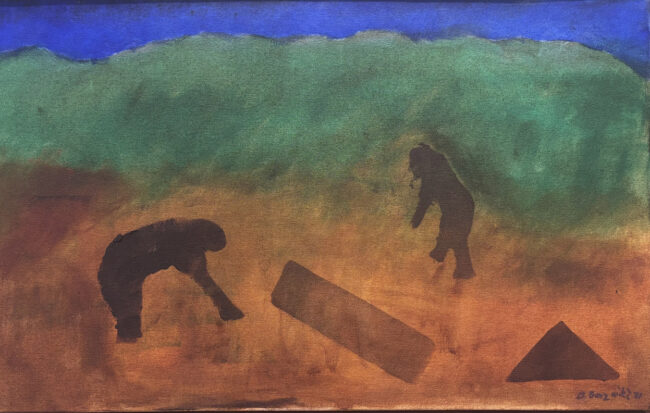
The Burial. Beatriz González/Private Collecion

That macabre clarity intensified in the 2000s. In Anonymous Auras (2023), one of her final major works, González installed more than 8,000 printed silhouettes of workers carrying corpses across the wall niches of Bogotá’s Central Cemetery. The figures – anonymous, repetitive and almost ritualistic – transformed the cemetery into a monumental archive of loss, honoring victims whose names were never recorded.

“Artists exist so that memory is not thrown in the trash”

Parallel to her artistic production, González exerted extraordinary influence as a curator and cultural policymaker. Beginning in the 1980s, she became a close collaborator of the Banco de la República’s cultural division, serving as a researcher, curator and longtime member of its advisory committee on visual arts. In that role, she helped guide the formation of a national art collection with a distinctly Colombian focus, while insisting on dialogue with international works of the highest quality.

Few individuals knew the Central Bank’s art collection as intimately as González. Over more than forty years, she worked alongside successive generations of curators, historians and collectors, helping to consolidate one of the most important public art collections in Latin America.

In 2020, she donated her personal archive and library — nearly 100,000 documents — to the Banco de la República to ensure free public access. The archive documents not only her artistic practice but also her work as an educator, curator and historian, and provides an unparalleled record of Colombian art, politics and visual culture.

Her institutional impact reached beyond the Central Bank. At the Museo de Arte Moderno de Bogotá (MAMBO), she founded the influential School of Guides, a pioneering program for museum education that trained figures who would later become leading artists and curators. From 1989 to 2004, she served as chief curator of the Museo Nacional de Colombia, where she reorganized the permanent collection and helped redefine the country’s historical narrative through art.

International recognition came steadily. Her work appeared in Documenta 14, the Berlin Biennale and the landmark exhibition “Radical Women: Latin American Art, 1960–1985.” Major retrospectives were held at the Pérez Art Museum Miami, the Museum of Fine Arts, Houston, and the CAPC in Bordeaux. In 2026, the Barbican Centre in London is set to host her first major retrospective in the United Kingdom.

González received numerous honors, including Colombia’s Premio Vida y Obra and honorary doctorates from the University of the Andes and the University of Antioquia. In 2025, the city of Bogotá awarded her the Civil Order of Merit, recognizing her invaluable legacy and profound influence on the nation’s cultural life.

Yet she remained skeptical of accolades. She preferred to speak of discipline, research and responsibility — and of the obligation, as she saw it, to bear witness. From a childhood habit of collecting film-star postcards to a lifetime spent gathering images of state violence, Beatriz González devoted herself to the stubborn preservation of memory and to an unapologetic voice in Colombian contemporary art.

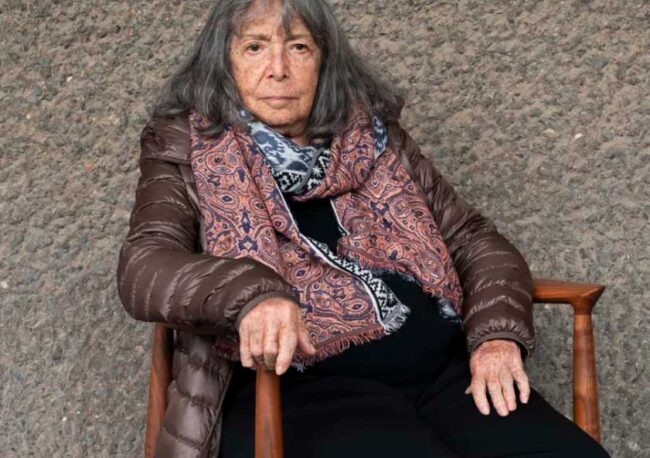
Portrait of Beatriz González, photographed at the Barbican, London, September 2024, ahead of a major retrospective of her work. © Louise Yeowart Barbican Art Gallery. Courtesy of the Barbican Centre.

Read the Banco de la República’s tribute (in Spanish) to Beatriz González, written by Claudia Cristancho Camacho of the Cultural Section and Art Collection. 

https://www.banrepcultural.org/noticias/despedimos-la-maestra-beatriz-gonzalez-figura-esencial-del-arte-y-la-cultura-en-colombia

  •  

Colombia’s National Museum Marks 200 Years with “Inspire, Move, Convoke”

Two centuries after its founding in the turbulent aftermath of the Wars of Independence, the National Museum of Colombia is marking its bicentenary with one of the most ambitious exhibitions in its history. Inspirar, conmover y convocar: el Museo de la nación (1823–2023) opens this week in Bogotá, inviting visitors to reflect on 200 years of scientific curiosity, cultural formation, and collective memory in a country still redefining its national narrative.

The anniversary is more than a celebration of institutional longevity. It is a moment of self-examination for a museum conceived during the birth of the Republic and shaped by generations of scientists, historians, artists, and citizens. The museum was created by law on July 28, 1823, and inaugurated the following year, rooted in the vision of plenipotentiary Francisco Antonio Zea. During his diplomatic mission in Europe, Zea recruited a cohort of naturalists – including José María Lanz, Mariano de Rivero, Jean-Baptiste Boussingault, and François-Désiré Roulin – to establish a museum of natural history, along with a school of mines, a geography program, and a lithography workshop in the newly constituted Gran Colombia.

These early scientific figures navigated riverways and mountain passes to reach Bogotá, awaiting the young Republic’s final approval of their contracts. Their collections – birds, reptiles, minerals, anatomical studies, botanical illustrations, archaeological finds – formed the foundation of a museum that initially served as a scientific repository for a nation eager to document the vast richness of its territory. Drawings by artists such as Francisco Javier Matís and explorations ordered by Juan María Céspedes gave visual life to the landscapes and ancient cultures the Republic sought to understand and claim as part of its expanding identity.

But as the exhibition demonstrates, the museum’s role has never been static. If the early 19th century emphasized scientific discovery, later decades shifted toward the collection of historical objects, battle flags, ethnographic pieces, and cultural artifacts that broadened the institution’s mandate. Letters exchanged between luminaries De Rivero and Alexander von Humboldt, or between independence-era leaders such as Antonio José de Sucre and Gerónimo Torres, testify to the museum’s early symbolic power. Sucre himself donated the acso– a ceremonial mantle attributed to Atahualpa’s queen – and ordered that defeated Spanish flags be displayed publicly so Colombians could “witness the heroism” of their troops in the war for independence. These gestures turned the museum into a site where political memory and scientific knowledge intertwined.

Two hundred years later, the new exhibition reframes these layered histories through three major sections designed to show how Colombians have constructed, questioned, and reimagined national identity over time.

The first section, Guardar lo que eres (“Preserve What You Are”), looks back at the 19th century through illustrations, botanical specimens, and scientific journalis. These items reveal how the young nation sought to see itself—literally and symbolically—through classification, measurement, and representation. The pieces trace a lineage from early scientific expeditions to the first attempts to map Colombia’s natural and cultural diversity.

The second section, Superar la desventura (“Overcoming Hardship”), addresses conflict and reconstruction. Drawing on flags, legal documents, military archives, and early photographic material, it examines the ways Colombian society has grappled with political rupture, violence, and the challenge of rebuilding. While the exhibition includes objects from independence-era battlefields in Peru, Bolivia, and the Nueva Granada, it also connects more recent struggles with  reconciliation, and justice. The curators highlight that conflict-related objects—whether symbols of patriot triumph or testimonies of displacement and suffering—offer crucial insight into how Colombians understand the past and imagine the possibility of peace.

The third and final section is a celebration of life. Here, archaeological pieces, masks, contemporary artworks, and textiles created by Indigenous communities in Nariño and weavers from Charalá (Santander), emphasize the endurance of living traditions. Rather than presenting heritage as static, the museum foregrounds the constant reinvention of cultural expression—what it calls “a Colombia still weaving its future.”

In total, the exhibition brings together 168 pieces, including nearly 100 that had remained in storage for more than 50 years due to their fragility. Among them are old etchings, rare flags, and objects that once traveled down the Magdalena River to reach the high-altitude capital of Santa Fe de Bogotá. Their exceptional display marks a milestone for the institution and for the country’s historical patrimony.

Visitors encounter not only objects but immersive environments. A multisensory installation projects shifting images onto suspended fabrics, accompanied by a soundscape inspired by Colombian landscapes and local memories. Tactile stations offer replicas with ink and braille textures, making the experience accessible to diverse audiences. Interactive elements invite the public to create postcards, explore regional museum networks, and engage with a digital map linking Bogotá to 45 co-curated displays in 12 departments across the country. Each participating regional museum is exhibiting an object emblematic of its local identity, extending the bicentenary celebration far beyond the capital.

The exhibition reflects the museum’s evolution since its founding as a scientific cabinet of curiosities. Today, grounded in the principles of the 1991 Constitution – cultural diversity,  coexistence, protection of natural and cultural heritage – the National Museum positions itself as a space where collective histories intersect with citizen voices. The bicentenary, the museum highlights, recognizes that history is not a fixed record but an instrument for understanding present challenges and imagining future possibilities.

The exhibition at Museo Nacional runs until March 15, 2026, and includes guided tours and workshops. Admission is Free.

Museo Nacional. Cra 7 No.28-66.

www.museonacional.gov.co

  •  

Lines on Stone: The Millennial Rock Art of the La Lindosa Range

At the eastern fringes of the Andes, where the Orinoco River Basin unfurls in an ondulating canvas of green, punctuated by majestic rivers and sandstone mesas, lies one of the world’s most astonishing open-air galleries of human existence.

The Serranía de La Lindosa, in the department of Guaviare, is a monumental tableau carved by nature and painted by hands that may have been among the earliest storytellers on the planet. For centuries, these walls stood largely hidden to the world, known only to Indigenous communities and a handful of intrepid explorers. Today, they form the heart of a groundbreaking exhibition in Bogotá’s Museo del Oro: Trazos sobre piedra: Pinturas milenarias en la serranía de La Lindosa, an ambitious, year-long showcase hosted by Banco de la República.

The exhibition that opens on November 28 is the most extensive institutional undertaking yet to unravel the symbols, narratives, and cosmologies that animate a rock-art tradition stretching back tens of millennia. Far from a display of a lost civilization, the Central Bank’s ambition matches that of the cliffs themselves – massive escarpments where hunters, shamans, and master painters returned generation after generation to leave visual testaments of their world.

The story of La Lindosa begins, in many ways, with a single mark. A red smear – thin, elongated, always intentional – painted on the rough face of a stone wall deep in an expanse of canopy and tropical rainforest. To an untrained eye, the pigment blends with natural iron deposits. But to archaeologists who have studied the region for years, it marks the threshold of an extraordinary visual universe. That smear belongs to a constellation of tens of thousands of pictograms across Guaviare and neighboring Amazonian massifs, including the monumental cliffs of the PNN Chiribiquete National Park. Together, they form one of the world’s oldest and largest rock-art traditions.

Archaeologists describe La Lindosa as a cultural landscape, a place where art, geology, ecology, and spirituality intertwine. The Serranía’s towering sandstone walls were formed by tectonic forces millions of years ago, creating natural canvases that humans began to paint long before the earliest agricultural societies emerged.

Only recently have researchers begun to grasp the full temporal depth of these murals. While Europe’s famed Lascaux cave contains roughly 600 images dating to the Upper Paleolithic (between 15,000 and 13,000 BC), the paleo-Indian paintings of Colombia could be far older. In Chiribiquete, analysis of natural dyes, superimposed layers, and stylistic continuity suggests that some images may date back as far as 35,000 BC. La Lindosa shares many of these motifs and techniques, hinting at a cultural horizon that may reach back to the earliest chapters of human imagination.

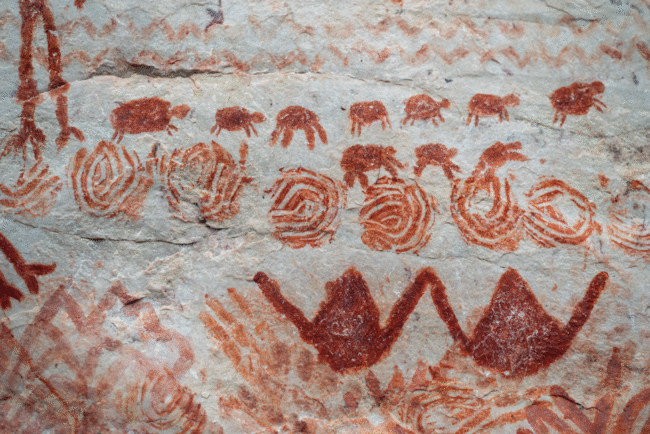
Details on the rock face of La Lindosa. Photo: Federico Ríos/Banco de la Repúblics

This immense chronology is not just a scientific revelation – it is a window into a world where every figure, every line, carries meaning. The murals of La Lindosa are filled with scenes of ritual dances, hunting parties, geometric patterns, spirit beings, and animal-human hybrids. They depict jaguars, monkeys, fish, snakes, birds, and the silhouettes of humans with outstretched arms. In some panels, the figures appear in motion; in others, they stand in tight, nearly choreographed formations that suggest communal ceremony. The dazzling variety of imagery points to a worldview rooted in transformation, reciprocity, and ecological intimacy.

One of the most compelling findings to emerge from recent research is the specialized nature of the painting tradition. Archaeologists believe that the most experienced storytellers – shamans, ritual specialists, or highly trained painters – scaled treacherous escarpments to reach spaces associated with spirits and cosmic forces.

These elevated murals often contain the most complex iconography, executed with astonishing precision. Younger or less experienced painters worked closer to the ground, contributing simpler figures or layering their work atop earlier compositions. Over centuries, entire cliffs became palimpsests: surfaces where multiple generations added, corrected, reinterpreted, and echoed the narratives of their ancestors.

The Banco de la República’s exhibition, under Judith Trujillo’s curatorship, mirrors this layered history. Visitors encounter immersive installations, high-resolution photographic panels, pigment analyses, and interactive 3D reconstructions that recreate the sense of standing before the colossal walls themselves. Rather than isolating images, the exhibition places each pictogram within the broader landscape – its geology, myths, and ecological rhythms.

To step inside the exhibition is to enter a world where the boundaries between art and survival dissolve. The rock art of La Lindosa was not decorative; it was a method of world-making. It engaged with spirits, conveyed moral codes, transmitted ecological knowledge, and anchored communities in a landscape that could be both bountiful and unforgiving. Many murals appear near water sources, ancient pathways, or natural shelters – places where human life pulsed most intensely.

Just as telling is the continuity these images embody. Despite colonization, displacement, and the fragmentation of Indigenous territories, the symbolic vocabulary of the Amazon endures. Elements of this cosmology survive in the ritual practices of several Indigenous groups today, whose elders regard the panels not as archaeological remains but as living documents.

As Colombia confronts the pressures of illegal mining, deforestation, and climate change, the need to protect sites like La Lindosa has become urgent. These walls hold traces of human existence long before national borders or written histories were printed. They extend the timeline of pre-Columbian identity back tens of thousands of years, reminding visitors that the Amazon and Orinoco watersheds have always been at the center of innovation, imagination, and spiritual awakening.

Inside the Gold Museum’s hallowed halls, visitors will pause before the vivid reds – their unexpected brightness, their persistence through rain, wind, time. These pigments, ground from seeds, minerals, and endemic plants, were not chosen at random; they were sacred. They signaled life, danger, transformation. They were meant to endure.

Whether the ancient painters imagined their work surviving 30,000 years is just one of many unsolved mysteries. Their names may be lost, but their visions endure – a vast, breathing archive that continues to astonish and challenge us.

Guests to this landmark exhibition are not mere spectators either, but participants in La Lindosa’s vast “Sistine Chapel” – an offering handed-down to generations, and carried forward through the endless corridors of time.

Visitor Information – Museo del Oro

Museo del Oro, Banco de la República
Cra. 6 No. 15-88.

Exhibition runs until November 27, 2026.

Opening Hours

  • Tuesday–Saturday: 9:00 a.m. – 7:00 p.m.
  • Sunday: 10:00 a.m. – 5:00 p.m.
  • Monday: Closed

Admission: COP $5,000

Follow the exhibition on social media: Instagram @MuseoDelOro #LaLindosa #MuseoDelOro

  •  
❌