Reading view

Frontera Energy Pivots to Pure-Play Colombian Infrastructure as Shareholders Approve $750 Million USD Parex Sale

Infrastructure pivot frees up $1.3 billion USD for shareholders

Frontera Energy Corporation (TSX: FEC) (OTCQX: FECCF) reported first-quarter 2026 net income from continuing operations of $13.1 million USD and adjusted EBITDA of $28.5 million USD, as the Calgary-based company moves to close the sale of its Colombian exploration and production portfolio to Parex Resources Inc. (TSX: PXT) and reposition itself as a standalone Colombian infrastructure company anchored by its pipeline and port assets.

Total revenues from continuing operations were $26.8 million USD in the first quarter, compared with $26.9 million USD in the fourth quarter of 2025 and $25.1 million USD in the first quarter of 2025. Net loss for the period, including discontinued operations, was $15.4 million USD, reflecting a $28.5 million USD net loss from the Colombian E&P assets now classified as held for sale.

“In total, this strategy will have unlocked approximately $1.3 billion of capital for investors.” — Gabriel de Alba, Chairman of the Board, Frontera Energy Corporation

The Parex transaction

On April 30, 2026, Frontera shareholders approved a plan of arrangement under which Parex Resources, through a wholly-owned subsidiary, will acquire all of Frontera’s Colombian upstream business — including its oil and gas exploration and production assets, a reverse-osmosis water-treatment facility, and a palm-oil plantation. The transaction carries an enterprise value of $750 million USD. The cash purchase price consists of $500 million USD payable at closing, subject to customary adjustments, plus an additional $25 million USD contingent payment tied to specified development milestones to be achieved within 12 months of closing.

At the same shareholder meeting, investors approved a reduction of Frontera’s capital account of up to $647 million CAD (approximately $470 million USD) to fund a return of capital to shareholders from the net proceeds of the transaction. The Supreme Court of British Columbia issued its final order approving the arrangement on May 4, 2026. Closing remains subject to the satisfaction of remaining conditions and is expected in May 2026.

Chairman Gabriel de Alba said the company would retain roughly $50 million USD of cash to support growth opportunities at the remaining infrastructure business, including an LNG regasification project being developed in partnership with Ecopetrol (NYSE: EC) (BVC: ECOPETROL). “In total, this strategy will have unlocked approximately $1.3 billion of capital for investors,” de Alba said.

ODL pipeline drives cash flow

Frontera holds a 35 percent equity interest in the Oleoducto de los Llanos (ODL) crude oil pipeline, which connects the Rubiales, Quifa, Caño Sur, Llanos-34, and other production blocks to the Monterrey and Cusiana stations in the department of Casanare. ODL’s share of income contributed $14.2 million USD to Frontera in the first quarter, compared with $15.1 million USD a year earlier, with the year-over-year decline reflecting higher depreciation, amortization, and operating costs.

ODL transported 233,875 barrels per day in the first quarter of 2026 at an average tariff of $4.70 USD per barrel, compared with 236,387 barrels per day at $4.73 USD per barrel in the first quarter of 2025. The pipeline declared $185 million USD in total dividends, of which $64.7 million USD is net to Frontera. The company expects to receive those distributions during 2026 in installments of approximately 40 percent in the second quarter, 35 percent in the third quarter, and 25 percent in the fourth quarter.

Long-term debt at Frontera totaled $167.8 million USD at the end of the first quarter and is expected to decline to approximately $131 million USD by year-end 2026, primarily through scheduled amortizations and cash-sweep mechanisms tied to ODL cash flows. From May 2025 through December 2026, long-term debt is expected to fall by more than $100 million USD.

Puerto Bahía expands cargo mix

Puerto Bahía, the multipurpose maritime terminal located in Cartagena adjacent to the Bocachica access channel and near the Reficar refinery, generated $12.7 million USD in revenue in the first quarter of 2026, compared with $10.0 million USD in the same period a year earlier. The 150-hectare facility comprises a hydrocarbons terminal with nominal capacity of 2,672,000 barrels and a general cargo terminal. Frontera holds a 99.97 percent equity interest in the port.

General cargo growth offset weaker liquids volumes. The general cargo terminal handled 38,067 roll-on/roll-off (RORO) units in the first quarter, more than double the 18,223 units handled a year earlier, alongside 3,851 twenty-foot equivalent units (TEUs) of containerized cargo, up from 1,256 TEUs in the first quarter of 2025. Break-bulk volumes declined to 25,216 tons/m³ from 41,198 tons/m³. RORO dwell times shortened from 40 days to 31 days year over year.

The liquids terminal handled 36,937 barrels per day in the first quarter of 2026, down from 51,579 barrels per day a year earlier. Ecopetrol volumes accounted for 26,273 barrels per day, Frontera-related volumes for 7,389 barrels per day, and other third-party volumes for 3,275 barrels per day. The company attributed the decline mainly to lower third-party throughput and the absence of certain trading flows.

Operating costs at the port rose to $7.6 million USD in the first quarter from $5.0 million USD a year earlier, driven by increased infrastructure maintenance in the liquids terminal and higher cargo volumes in the general cargo facility.

LPG and LNG projects advance

Puerto Bahía’s liquefied petroleum gas (LPG) project began initial operations in March 2026, providing capacity to handle up to 10,000 tons per month. The terminal is targeted to become fully operational during the first quarter of 2028. Capital expenditures during the first quarter totaled $1.0 million USD, including $0.4 million USD for major tank maintenance and $0.3 million USD for the LPG project.

The company is also advancing an LNG regasification project at Puerto Bahía in partnership with Ecopetrol, intended to support Colombia’s domestic gas supply as domestic production declines. Frontera is also pursuing expansion of containerized cargo operations.

Discontinued operations

Following the execution of the arrangement agreement, the Colombian E&P assets are now classified as discontinued operations under IFRS 5. Colombian production averaged 36,700 barrels of oil equivalent per day in the first quarter of 2026, comprising 25,394 barrels per day of heavy crude, 8,653 barrels per day of light and medium crude combined, 5,706 thousand cubic feet per day of conventional natural gas, and 1,652 barrels of oil equivalent per day of natural gas liquids. That compares with 39,010 barrels of oil equivalent per day a year earlier.

The operating netback from the discontinued Colombian operations was $41.79 USD per barrel of oil equivalent in the first quarter of 2026, compared with $34.22 USD per barrel of oil equivalent in the first quarter of 2025, supported by a higher Brent reference price of $78.38 USD per barrel against $74.98 USD per barrel a year earlier.

Frontera retains exploration and development interests in Guyana through subsidiaries that include CGX Energy Inc. (TSXV: OYL), which is not part of the Parex transaction. The company’s go-forward portfolio will be anchored by the ODL pipeline stake and Puerto Bahía, with the infrastructure business generating approximately $77 million USD of distributable cash flow in 2025, according to the management information circular dated March 30, 2026.

Above photo courtesy Frontera Energy Corporation.

  •  

Ecopetrol Posts Q1 EBITDA Gain as Refining Margins Surge, But Governance Crisis and Tax Headwinds Weigh on Net Income

Refining margin surge cushions revenue drop amid leadership void

Ecopetrol S.A. (NYSE: EC, BVC: ECOPETROL) reported first-quarter 2026 consolidated revenues of 28.6 trillion COP, a decline of 8.7% from 31.4 trillion COP in the year-earlier period, as lower crude oil prices and reduced hydrocarbon production compressed the top line for Colombia’s state-controlled oil and gas company. Against that backdrop, a marked recovery in refining margins and disciplined cost management lifted EBITDA by 1.5% to 13.5 trillion COP, yielding a 47% EBITDA margin and partially offsetting the revenue headwind. At the Q1 2026 average exchange rate of approximately 3,700 COP per USD, the quarter’s revenues translate to roughly $7.73 billion USD and EBITDA to approximately $3.65 billion USD.

Embattled Ecopetrol CEO Ricardo Roa was appointed to the position by Colombian President Gustavo Petro after managing his political campaign. (photo: Ecopetrol)

Embattled Ecopetrol CEO Ricardo Roa was appointed to the position by Colombian President Gustavo Petro after managing his political campaign. (photo: Ecopetrol)

Net income for the quarter reached 2.9 trillion COP (approximately $784 million USD), down 7.7% year-over-year, reflecting the combined drag of lower revenues, a sharply elevated effective tax rate of 37.1%, and a one-time charge of 1.2 trillion COP for the impuesto al patrimonio — Colombia’s government-mandated wealth levy on large corporations established to fund post-disaster reconstruction measures. The company is also subject to a 10% income tax surcharge applicable for fiscal year 2026, which is embedded in the reported effective rate. The aggregate tax burden absorbed a disproportionate share of operating improvement relative to prior periods, limiting the flow-through of refining gains to the net income line.

Total hydrocarbon production averaged 725.2 thousand barrels of oil equivalent per day (kboed) in Q1 2026, below the 745 kboed recorded in the 2025 annual average cited by management during the March 2026 general shareholders’ meeting. Domestic crude output represented the largest component at approximately 520 thousand barrels per day (kbd). Ecopetrol’s Permian Basin operations in the United States contributed 91.8 kbd, underscoring the continued strategic importance of the international segment. Gas production continued a multi-year declining trend that poses a medium-term domestic supply challenge; management has sought to address this partially through regasification capacity additions at Puerto Bahía and on the Pacific coast, expected to come online in the second half of 2026 with a combined contribution of up to 430 billion BTU per day.

The refining segment delivered the quarter’s most pronounced operational outperformance. Ecopetrol’s domestic refineries, led by Refinería de Cartagena, processed 417.5 kbd of crude throughput. The integrated refining margin rose to $17.3 USD per barrel, a 60% improvement over the same quarter of 2025, driven by favorable differential pricing between domestic crude benchmarks and refined product values alongside ongoing operational efficiency improvements. The Comisión de Regulación de Energía y Gas (CREG) and the Ministerio de Minas y Energía remain central to the regulatory framework governing downstream margins over the medium term.

The balance sheet carries significant structural and contingent risk items of direct relevance to institutional credit and equity holders. Gross debt stood at 108.1 trillion COP (approximately $29.2 billion USD), representing a leverage ratio of 2.3 times trailing EBITDA — a level that leaves limited room for further deterioration before debt covenants or rating agency thresholds become binding. Ecopetrol holds a receivable of 4.2 trillion COP (approximately $1.14 billion USD) from the Fondo de Estabilización de Precios de los Combustibles (FEPC), a government fuel price stabilization mechanism that represents a claim on the Colombian treasury with timing and recovery risk. A dispute with the Dirección de Impuestos y Aduanas Nacionales (DIAN) over value-added tax assessments totals 12.26 trillion COP (approximately $3.31 billion USD) in aggregate, of which 10.22 trillion COP relates to Ecopetrol’s consolidated operations and 2.04 trillion COP to Refinería de Cartagena. Both cases are under administrative and judicial review; no provisions have been recognized in the financial statements pending resolution, but the potential liability represents a material contingency relative to the company’s quarterly net income.

On the corporate development front, Ecopetrol disclosed three significant transactions during or following the quarter. The company agreed to acquire producing assets from Gran Tierra Energy (NYSE: GTE, TSX: GTE) for $92.4 million USD, adding Colombian upstream production inventory in basins where both companies have operated. In Brazil, Ecopetrol launched a tender offer for shares of Brava Energia (BVMF: BRAV3) at 23 BRL per share, seeking to expand its footprint in that country’s oil and gas sector. And in a transaction that would reshape the mid-size independent landscape in Colombia, the company reached an agreement to acquire Parex Resources (TSX: PXT) for $250 million USD; Parex is a Colombia-focused producer with a complementary asset base across the Llanos and other producing basins. Collectively, the three transactions signal that Ecopetrol’s capital allocation strategy under the current government continues to favor upstream consolidation despite the elevated leverage profile.

The exploration portfolio generated positive news announcements. The Copoazú-1 exploratory well, drilled in Colombia’s Llanos foothills region, was confirmed as a commercial discovery, adding to the domestic reserve base. The Sirius offshore project advanced through the Consulta Previa process — a legally mandated prior consultation with indigenous and Afro-Colombian communities required before development of projects in or near their territories — reaching a milestone in community engagement that brings the project closer to formal development sanction. The Agencia Nacional de Hidrocarburos (ANH) oversees the licensing framework within which both projects operate.

“Ecopetrol is listed on the New York Stock Exchange; we are governed by the strict regulations of US federal agencies. Agencies like OFAC and the SEC could intervene in the company and could even accelerate the payment of financial obligations, which would be extremely grave for Ecopetrol.” — Martín Ravelo, President, Unión Sindical Obrera (USO)

The ISA transmission segment, managed through Ecopetrol’s majority stake in ISA — Interconexión Eléctrica S.A., contributed stable regulated cash flows during the quarter. ISA completed 46 transmission reinforcement works across its Latin American concession portfolio. The segment also completed the acquisition of 100% of IE Madeira in Brazil, consolidating its position in that country’s power grid interconnection infrastructure. ISA further submitted a competitive bid for the Río Bueno–Puerto Montt high-voltage transmission line concession in Chile, demonstrating the group’s appetite for long-duration, inflation-linked infrastructure assets across the Andes region. For institutional investors evaluating Ecopetrol as a blended hydrocarbons-and-infrastructure holding, ISA’s consistent cash generation provides partial diversification from crude price volatility, though it does not insulate the consolidated entity from headline governance risk.

The most consequential variable for the investment thesis over the near term is Ecopetrol’s prolonged governance crisis. At the company’s general shareholders’ meeting on March 27, 2026, held at the Corferias convention center in Bogotá, minority shareholders loudly heckled president Ricardo Roa — with audible shouts of “¡Fuera, fuera!” reverberating through the hall — as debate over his leadership erupted into open confrontation. The meeting approved a dividend of 121 COP per share for minority holders and a 4 trillion COP distribution to the Colombian government as majority shareholder, payable in two installments by June 30, 2026. Despite the financial business conducted, governance overshadowed the proceedings.

Roa faces two separate judicial proceedings. The Fiscalía General de la Nación formally charged him in connection with alleged influence peddling related to the purchase of an apartment in northern Bogotá — charges he has denied. Separately, the Consejo Nacional Electoral (CNE) is examining whether campaign spending limits were violated during President Gustavo Petro’s 2022 presidential campaign, which Roa managed — an investigation that Finance Colombia has covered in detail. Angela Maria Robledo, Chair of the Board of Directors, defended the board’s decision to retain Roa at the March assembly, citing the constitutional presumption of innocence. However, four of the nine board members had already formally recorded their support for his removal at that point, exposing a divided governance structure at a time when strategic and operational decisions require unified leadership.

The Unión Sindical Obrera (USO), which represents approximately one-third of Ecopetrol’s workforce, issued a production strike ultimatum timed to a March 30 board meeting. Martín Ravelo, president of the USO, framed the leadership crisis explicitly in terms of US regulatory risk: “Ecopetrol is listed on the New York Stock Exchange; we are governed by the strict regulations of US federal agencies. Agencies like OFAC and the SEC could intervene in the company and could even accelerate the payment of financial obligations, which would be extremely grave for Ecopetrol.” Ravelo further warned that the company’s outstanding international debt — which he placed at approximately $30 billion USD and which is exacerbated by elevated interest rates — left Ecopetrol exposed to potential covenant triggers or early repayment demands in a scenario where the Securities and Exchange Commission (SEC) or the Office of Foreign Assets Control were to take enforcement action.

Following sustained pressure from the USO, minority shareholders, and opposition political figures, Ecopetrol’s board approved an extended leave of absence for Roa beginning April 7, 2026. Under the arrangement, Roa used accrued vacation through May 27, followed by 30 calendar days of unpaid leave beginning May 28, extending his absence through the end of June — a period encompassing Colombia’s presidential first round on May 31 and a potential runoff on June 21. Juan Carlos Hurtado Parra, the company’s executive vice president of hydrocarbons and designated first alternate to the presidency since November 2025, was appointed acting president. Hurtado Parra holds an MBA in International Oil and Gas and brings more than 28 years of energy sector experience to the acting role, having previously served as vice president of exploration, development, and production.

The political calendar creates a structural transition risk that sits above the operational and financial results as the primary concern for long-duration investors. Colombia’s incoming government, to be inaugurated August 7, 2026, is widely expected to appoint a new Ecopetrol board and select a new company president. That transition may bring material shifts in strategic priorities — including the pace of upstream investment, the approach to the FEPC receivable recovery, the trajectory of energy transition spending, and the capital allocation balance between the hydrocarbons segment and the ISA infrastructure platform. The Ministerio de Hacienda y Crédito Público and the Ministerio de Minas y Energía will both play key roles in establishing the post-election policy framework under which Ecopetrol operates. Institutional investors holding exposure to Ecopetrol via NYSE: EC or BVC: ECOPETROL must weigh Q1’s genuine operational improvement — most visibly in refining margins and EBITDA stability — against a governance and policy transition risk profile that is unlikely to be resolved before the August handover.

Ecopetrol’s Cartagena refinery (photo courtesy Ecopetrol)

  •  

Tecnoglass Posts Record Q1 Revenue as Aluminum Tariffs and Colombian Wage Costs Compress Margins

Tariff headwinds compress Tecnoglass margins despite record Q1 sales

Tecnoglass, Inc. (NYSE: TGLS) reported first-quarter 2026 revenue of $249.0 million USD, a 12.0% year-over-year increase and a first-quarter record for the Barranquilla, Colombia-based window and architectural glass manufacturer. Despite the top-line growth, net income fell to $31.9 million USD, or $0.71 per diluted share, from $42.2 million USD, or $0.90 per diluted share, in the same period of 2025, as elevated US aluminum costs linked to import tariffs, mandatory minimum wage increases in Colombia, and a strengthening Colombian peso combined to compress gross margins by 540 basis points to 38.5%.

Multi-family and commercial revenues rose 20.4% year-over-year, driven by continued activity across key markets including geographies beyond Florida, which has historically dominated the company’s US revenue mix. Single-family residential revenues were relatively flat on a year-over-year basis, with management attributing the result to the timing of order conversion into revenue rather than underlying demand, noting that order growth in the segment remained positive into April 2026. On a geographic basis, the US accounted for $237.1 million USD, or approximately 95% of total revenues, up 11.6%. Colombia generated $7.5 million USD, up 17.2%, and other international markets contributed $4.4 million USD, up 27.3%.

Gross profit declined to $95.8 million USD from $97.5 million USD in Q1 2025 despite the higher revenue base. The company cited an unfavorable revenue mix driven by a greater proportion of installation-related revenue, higher raw material costs — with US aluminum tariffs representing an incremental headwind of approximately $6.4 million USD in the quarter — higher salary expenses resulting from annual minimum wage adjustments in Colombia, and the effect of a stronger Colombian peso on costs incurred locally. Pricing actions and operating leverage on higher volume partly offset these pressures.

“We see a clear path to fully offsetting the impact of tariffs in 2027, when full-year pricing across both businesses and incremental automation savings are expected to be realized.” — Santiago Giraldo, Chief Financial Officer, Tecnoglass

Selling, general, and administrative expenses rose to $50.9 million USD, or 20.4% of revenues, from $42.5 million USD, or 19.1%, in Q1 2025. The increase reflected higher personnel costs from annual salary adjustments, peso appreciation, and higher transportation and commission costs tied to revenue growth. The period also included a one-time charge of $2.9 million USD related to Colombia’s *impuesto al patrimonio*, a government-imposed wealth tax levied on large corporations to fund measures addressing recent climate-related events in the country.

Adjusted EBITDA — which excludes non-cash foreign exchange gains and losses, the bad-debt provision, non-recurring charges, and equity-method adjustments related to the company’s joint venture in Vidrio Andino with Saint-Gobain (EPA: SGO) — came in at $61.5 million USD, or 24.7% of total revenues, compared to $70.2 million USD, or 31.6%, in Q1 2025. Adjusted net income was $34.6 million USD, or $0.78 per diluted share, versus $43.1 million USD, or $0.92, in the prior-year quarter.

Cash provided by operating activities was $6.7 million USD, a significant decline from $46.9 million USD in Q1 2025, driven in part by a deliberate build-up of US-sourced aluminum inventories — up $34.3 million USD in the quarter — as part of the company’s tariff mitigation strategy. Capital expenditures of $17.3 million USD reflected scheduled payments tied to previously announced capacity and automation projects. During the quarter, Tecnoglass returned $16.5 million USD to shareholders through share repurchases and paid $6.7 million USD in cash dividends. As of May 7, 2026, approximately $92.5 million USD remained available under the current share repurchase program. The company ended the quarter with total liquidity of approximately $425.0 million USD, comprising $91.1 million USD in cash and cash equivalents and more than $330.0 million USD in revolving credit facility availability, against total debt of $200.3 million USD.

The company’s order backlog reached a record $1.36 billion USD at quarter-end, up 19.1% year-over-year, extending multi-family and commercial pipeline visibility into 2027. Tecnoglass cited continued expansion of its dealer network and showroom footprint as supporting geographic diversification and market share gains, with vinyl product lines identified as an incremental growth driver broadening the company’s addressable market.

José Manuel Daes, chief executive officer, commented on the results: “First quarter results were in line with our expectations, with resilient performance across our key metrics reflecting the continued strength of our vertically integrated business model despite a dynamic cost environment. Demand for our product offerings remains strong, as demonstrated by another quarter of record backlog and healthy order activity, with momentum continuing into the second quarter. Our previously announced pricing actions are now in place, and the broad-based nature of industry cost pressures supports our confidence in executing these increases while preserving our competitive positioning.”

Christian Daes, chief operating officer, addressed the tariff response and the company’s assessment of a potential US manufacturing presence. “Our pricing initiatives and cost mitigation efforts are well underway, including logistics improvements, further automation across our operations, and ongoing supply chain optimization,” he said. “We are also advancing our assessment of a proposed US manufacturing initiative, with a well-located site identified and significant state and local incentives secured that strengthen the project’s potential economics if we decide to move forward based on market demand.”

Santiago Giraldo, chief financial officer, reaffirmed full-year 2026 guidance and outlined the company’s tariff offset timeline. “Based on our strong execution to start the year, we are reiterating our full year revenue outlook in the range of $1.06 billion to $1.13 billion USD and Adjusted EBITDA outlook in the range of $225 million to $245 million USD,” Giraldo said. “This reflects the impact of the recently implemented 10% tariff on finished aluminum window imports as previously disclosed, which is expected to be partly offset in 2026 through pricing actions effective on orders from early May forward, with additional efficiency initiatives from logistics optimization and automation underway and expected to begin contributing benefits by year end. We see a clear path to fully offsetting the impact of tariffs in 2027, when full-year pricing across both businesses and incremental automation savings are expected to be realized.”

On the corporate structure front, Tecnoglass’ board of directors has approved a plan to redomicile the company from the Cayman Islands to the United States, subject to shareholder approval. If approved, the redomiciliation is expected to be completed during Q2 2026. The company stated that the move is intended to simplify its organizational and regulatory structure, improve the tax efficiency of dividend distributions, and expand its potential investor base to include funds and accounts limited to US-domiciled securities. Tecnoglass will retain its Miami, Florida headquarters following the change.

Separately, the company is conducting a feasibility study for a potential new US manufacturing facility. A site meeting project specifications has been identified and substantial state and local tax credits have been secured. The proposed facility is described as highly automated and intended to support future growth while also improving lead times, reducing transportation costs for certain markets, enhancing supply chain efficiency, and enabling the company to compete for Buy America-eligible projects and rapid-turnaround contracts. Tecnoglass expects to complete the purchase of land for the potential facility during Q2 2026, at an estimated cost of $20 million to $25 million USD to be financed through available credit facilities. The company noted that the land purchase does not constitute a commitment to proceed with construction, which would occur in phases contingent on demand, market conditions, and return profiles. The company’s 5.8-million-square-foot vertically integrated manufacturing complex in Barranquilla, Colombia, would continue to serve as its primary production base.

Above photo: Tecnoglass facilities in Barranquilla

  •  

iPhone 17 Is Apple's Most Popular Lineup Ever

Apple's iPhone 17 models are its most popular iPhones to date, Apple CFO Kevan Parekh told the Financial Times. Both Parekh and Apple CEO Tim Cook attributed Apple's stellar Q2 2026 performance to iPhone sales.


"The ‌iPhone 17‌ family is now the most popular line-up in our history... we believe we gained market share during the quarter," said Parekh. Cook told Reuters that iPhone demand was "off the charts," and that supply was constrained despite the impressive sales.

"And there's just a little less flexibility in the supply chain at the moment for getting more parts," Cook said. Apple's iPhone sales were held back by the A19 and A19 Pro chips that it gets from TSMC, as TSMC also manufactures AI chips.

Parekh said that memory had an "increasing impact" between the first and second quarters of 2026.

Issues with chip supply and increasing problems acquiring RAM could potentially have an impact on the iPhone 18 lineup that Apple is expected to introduce this September. The lineup will include Apple's first foldable iPhone.

The current ‌iPhone 17‌ family includes the ‌iPhone 17‌, iPhone 17 Pro, ‌iPhone 17 Pro‌ Max, iPhone 17e, and iPhone Air.
Related Roundups: iPhone 17, iPhone 17 Pro
Related Forum: iPhone

This article, "iPhone 17 Is Apple's Most Popular Lineup Ever" first appeared on MacRumors.com

Discuss this article in our forums

  •  

Apple Reports Record-Breaking 2Q 2026 Results: $29.6B Profit on $111.2B Revenue

Apple today announced financial results for the second fiscal quarter of 2026, which corresponds to the first calendar quarter of the year.
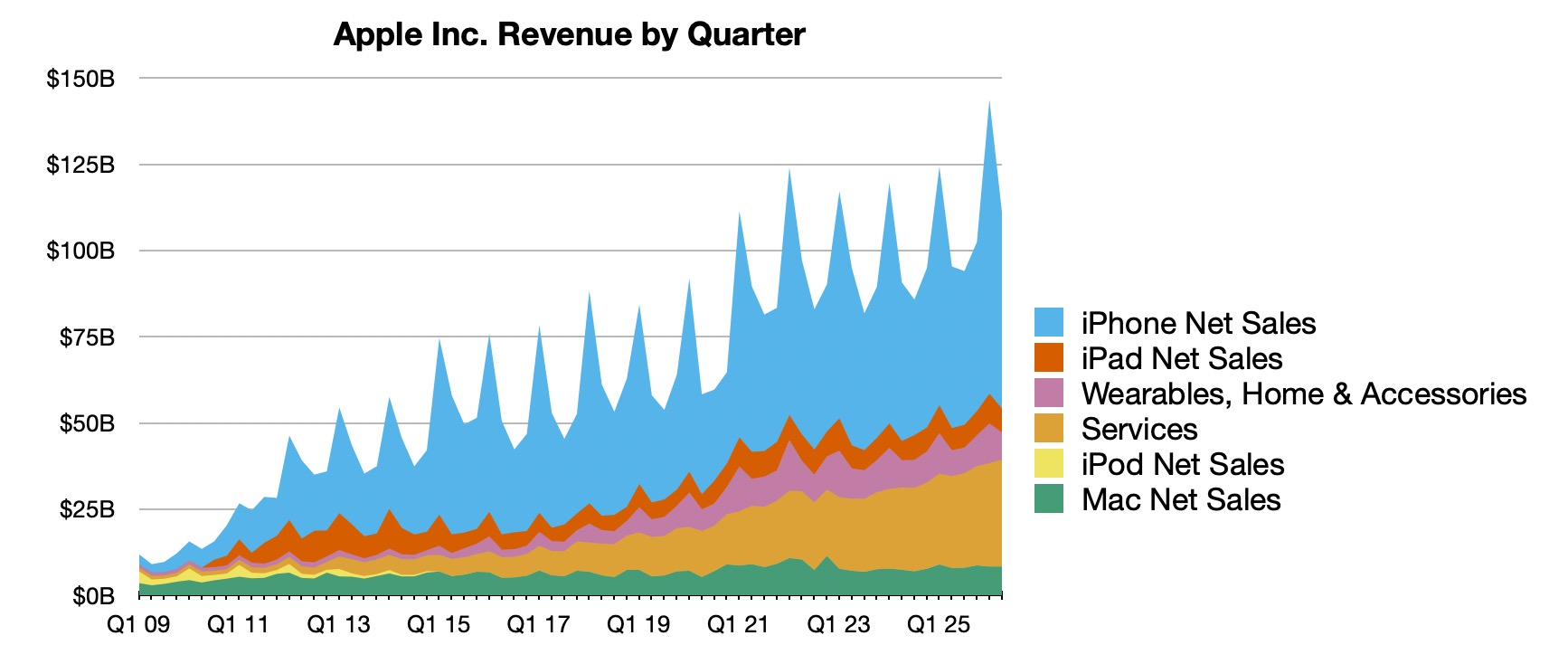

For the quarter, Apple posted revenue of $111.2 billion and net quarterly profit of $29.6 billion, or $2.01 per diluted share, compared to revenue of $95.4 billion and net quarterly profit of $24.8 billion, or $1.65 per diluted share, in the year-ago quarter. Services revenue again reached an all-time high during the quarter, while company revenue, earnings per share, and iPhone revenue all set March quarter records.

Gross margin for the quarter was 49.3 percent, compared to 47.1 percent in the year-ago quarter. Apple's board of directors also authorized an additional $100 billion for share repurchases and declared an increased dividend payment of $0.27 per share, up from $0.26 per share. The dividend is payable May 14 to shareholders of record as of May 11.
"Today Apple is proud to report our best March quarter ever, with revenue of $111.2 billion and double-digit growth across every geographic segment," said Tim Cook, Apple's CEO. "iPhone achieved a March quarter revenue record, fueled by such extraordinary demand for the iPhone 17 lineup. During the quarter, Services achieved yet another all-time record, and we were excited to introduce remarkable new products to our strongest lineup ever. That included the addition of the iPhone 17e and the M4-powered iPad Air, along with the launch of MacBook Neo, which is captivating customers all around the world."
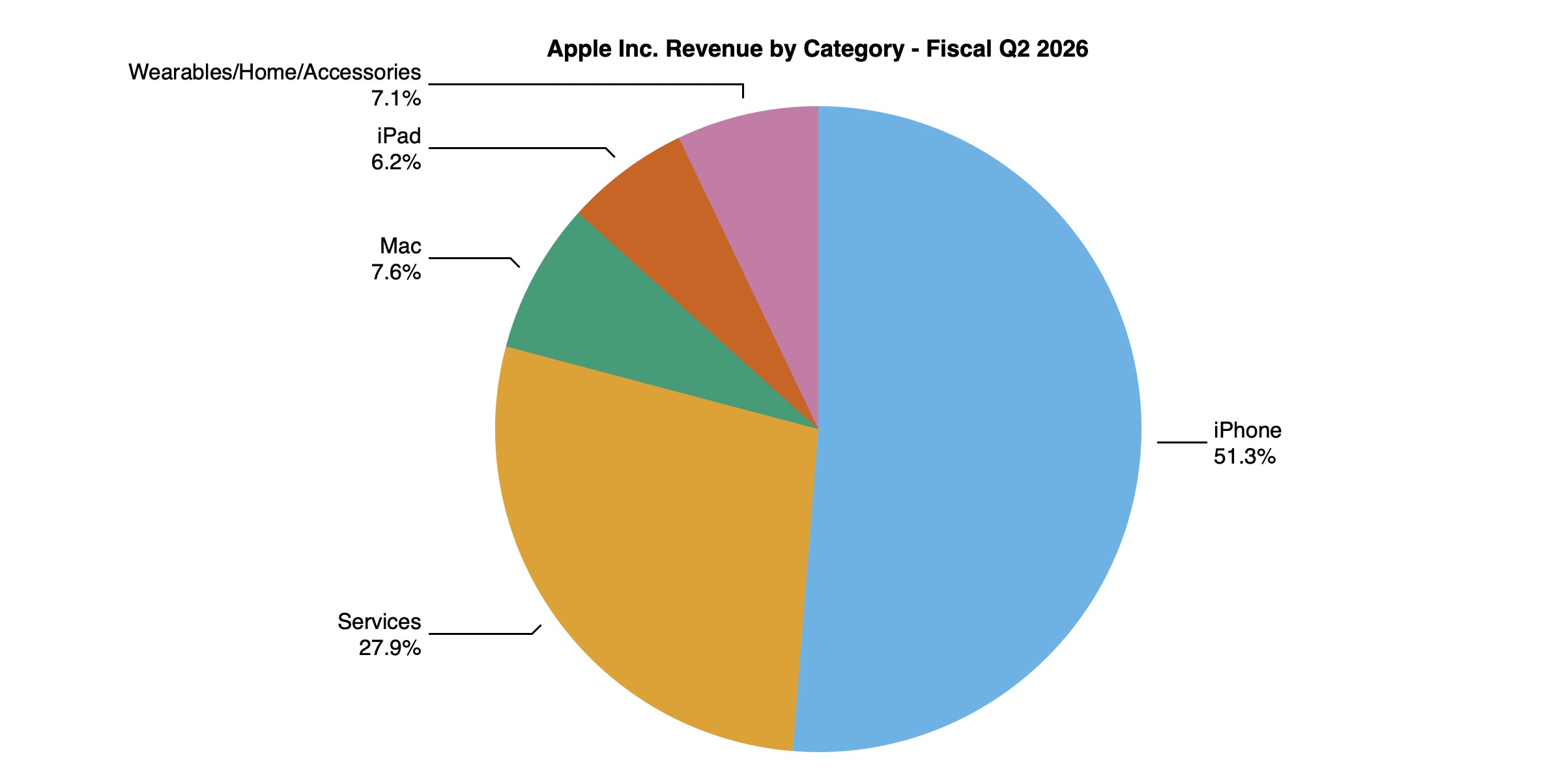

Apple will provide live streaming of its fiscal Q2 2026 financial results conference call at 2:00 pm Pacific, and MacRumors will update this story with coverage of the conference call highlights.

Conference call recap ahead...


1:39 pm: Apple's share price is currently down approximately 0.5% in after-hours trading following the earnings release, after rising by around 0.5% in regular trading today.

1:39 pm: "Our strong business performance during the March quarter generated over $28 billion in operating cash flow and drove new March quarter records for both operating cash flow and EPS," said Kevan Parekh, Apple's CFO. "Continued strong customer demand for our products and services once again helped us achieve a new all-time high for our installed base of active devices across all major product categories and geographic segments."

1:42 pm: All five of Apple's revenue categories saw year-over-year increases in the quarter: iPhone up 21.7%, Services up 16.3%, iPad up 8.0%, Mac up 5.7%, and Wearables, Home and Accessories up 5.0%.

1:44 pm: All five of Apple's geographic segments also saw year-over-year increases: Americas up 11.9%, Europe up 14.7%, Greater China up 28.1%, Japan up 15.1%, and Rest of Asia Pacific up 25.3%.

1:58 pm: In a few minutes, Apple's quarterly earnings call and Q&A with analysts will begin. Typically, Apple CEO Tim Cook and CFO Kevan Parekh host, but we could get an appearance from incoming CEO John Ternus. He takes over for Cook in September.

2:01 pm: The call is beginning with standard boilerplate about forward-looking statements from Investor Relations head Suhasini Chandramouli.

2:01 pm: On the call is Apple CEO ‌Tim Cook‌. John Ternus will join for a "brief set of remarks" followed by CFO Kevan Parekh.

2:03 pm: "Good afternoon everyone, and thanks for joining the call. Before we get into the quarter, I wanted to take a moment to talk about the transition we recently announced."

2:03 pm: This is Tim's 89th earnings call.

2:03 pm: Tim: "I'll always be proud of the impact Apple has had on our users' lives, and I can't begin to express how grateful I am for our amazing teams. It's because of them that there is no company like Apple, and I truly believe there never will be."

2:04 pm: Tim: "This moment for the transition is the right one for a number of reasons. First, our business has been performing extremely well. The first half of this year was very strong, growing double digits year over year. Second, our road map is incredible. And most importantly, we have the right leader ready to step into the role."

2:04 pm: Tim: "As I have said, There is no one on this planet I trust more to lead Apple into the future than John Ternus. John is a brilliant engineer, a deep thinker, a person of remarkable character and a born leader. I know he will push us to go further than we think is possible in order to deliver the greatest products and services for our users I have been so proud to call him a colleague and a friend and I will be even more proud to call him Apple CEO."

2:05 pm: Tim: "Over the coming months, John and I will be working closely together to make sure this transition is perfectly smooth. I very much look forward to stepping into the role of executive chairman on September 1... I will be here to support him in any way he needs and in any way I can. I am incredibly optimistic about Apple's future, and I know we have the right team in place to deliver on the promise of this company."

2:05 pm: Tim: "I also want to take just a moment to share my profound gratitude for our shareholders, especially our long term shareholders, for believing in Apple and for your support over the years. It means a great deal to all of us."

2:06 pm: John Ternus, making his first remarks: "In my view, Tim is one of the greatest business leaders of all time. Stepping into the role of CEO is an incredible honor, and it means a great deal to me to have Tim's trust and confidence. I want to echo Tim's sentiment about our shareholders, especially those who have been with us for many years. Thank you so much for your confidence in our company."

2:06 pm: Ternus: "As you know, one of the hallmarks of Tim's tenure has been a deep thoughtfulness, deliberateness and discipline when it comes to the financial decision making of the company. And I want you to know that is something Kevan and I intend to continue when I transition into the role in September. This is an especially exciting moment for Apple. As Tim mentioned, we have an incredible roadmap ahead. And while you're not going to get me to talk about the details of that roadmap, suffice it to say this is the most exciting time in my 25 year career at Apple to be building products and services. There are so many opportunities before us, and I couldn't be more optimistic about what's to come for now, let me simply say I am deeply grateful to Tim, to the executive team and to everyone at Apple, and I look forward to all of the important work ahead."

2:07 pm: Tim is back: Apple revenue grew 17% from a year ago, to a March quarter record and above the high end of the guidance range. Grew despite supply constraints, with a March quarter record on iPhone, an all-time record on Services, and a March quarter record earnings per share of $2.01, up 22% year over year.

2:08 pm: Tim: "We recently marked Apple's 50th anniversary with celebrations in our retail stores and with users around the world. It was a special moment for us to reflect on the incredible journey we've shared with our users, to thank everyone who's been a part of it, and to look forward to writing the next chapter in our story of innovation. We have always believed that people who think different can change the world and we have been proud to build tools and technologies that allow them to do just that."

2:09 pm: Starting with iPhone, generating $57 billion in revenue, despite supply constraints. Launched the iPhone 17e during the quarter. "The most powerful, capable and versatile iPhone family we've ever created."

2:11 pm: Tim is talking about Apple's current iPhone lineup, noting that the iPhone 17 family is the most popular lineup in its history, and mentioned that the Artemis II astronauts took photos and videos with the iPhone 17 Pro Max during their trip around the moon.

2:12 pm: Moving to the Mac, revenue was $8.4 billion, up 6% from a year ago. Set March quarter records for upgraders and customers new to the Mac. "Tremendous enthusiasm for MacBook Neo."

2:13 pm: Turning to ‌iPad‌, revenue was $6.9 billion, up 8% year over year.

2:13 pm: "Today, our ‌iPad‌ lineup is stronger than ever, led my the M4-powered iPad Air. It raises the bar for what users can do on ‌iPad‌."

2:14 pm: Wearables, Home and Accessories revenue came in at $7.9 billion, up 5% from a year ago.

2:15 pm: He's touting the various Apple Watch and AirPods in the lineup.

2:16 pm: Tim: "What truly sets Apple apart is how Apple intelligence is woven into the core of our platforms powered by Apple silicon and designed from the ground up to deliver intelligence that is fast, personal and private, this is not AI as a standalone feature but AI as an essential, intuitive part of the experience across our devices."

2:17 pm: "It builds on years of innovation from the neural engine to advanced on device processing, enabling capabilities that are not only incredibly powerful, but also respectful of user privacy. Increasingly, that same foundation is drawing developers and researchers to our products as powerful platforms for building and running agentic AI thanks to the unique combination of performance, efficiency, and on device capabilities."

2:17 pm: Moving to Services, generated $31 billion in sales, with double-digit growth across developed and emerging markets, with all-time revenue records across most Services categories.

2:18 pm: Apple Retail set a March quarter revenue record, with very high levels of store traffic throughout the quarter.

2:19 pm: Tim: "At Apple, we believe powerful innovation and uncompromising quality can go hand in hand with sustainability. Over the last year, we've reached new milestones in the environment, including the use of recycled content in 30% of the materials and all of our products, shipped in 2025, the most we've ever had. That includes the use of 100% recycled cobalt in all Apple design batteries and 100% recycled rare earth elements in all magnets. We've also achieved our goal of removing plastic from packaging with every Apple product now shipping in fiber based packaging."

2:20 pm: Tim: "We're also making great progress in advancing American Supply Chain Innovation as part of our $600 billion commitment to the US. We were pleased to share recently that Mac mini production is coming to America later this year, expanding our factory operations in Houston with a brand new facility. In March, we were thrilled to welcome four new companies to our American manufacturing program to help manufacture essential materials and components for Apple products sold worldwide."

2:20 pm: Tim: "These include sensors that support key iPhone features like camera stabilization and integrated circuits, essential for features like crash detection and activity tracking. These efforts build on the progress we've made in the American manufacturing program, including the work we're doing to advance an end to end silicon supply chain across the US."

2:21 pm: Tim: "These efforts build on the progress we've made in the American manufacturing program, including the work we're doing to advance an end to end silicon supply chain across the US. At TSMC's Arizona facility, for example, Apple is on track to purchase well over 100 million advanced chips."

2:22 pm: Tim: "Whether around the world or in our own backyard, we're proud of the difference Apple has made to enrich lives and support the communities we serve. Looking ahead, we're delighted to welcome developers back to Apple Park for WWDC 26. We can't wait to share what we've been working on, from AI advancements to exciting new software and developer tools, it's going to be an incredible week."

2:22 pm: Tim: "As always, we remain in relentless pursuit of even more powerful innovations, guided by our North Star, our users, as we celebrated 50 Years of Apple, we are even more excited and more optimistic about the next 50 years and beyond."

2:23 pm: Kevan: Saw strong performance with revenue records in every geographic segment. FX was 2.5 percentage point tailwind to the March quarter growth rate. We believe if you remove the favorable benefit from foreign exchange and add back the unfavorable impact from supply constraints, we would have had a higher growth rate for total company revenue.

2:23 pm: Products revenue was $80.2 billion, up 17% year over year. Company gross margin was 49.3%, up 110 bp sequentially. Products gross margin was 38.7%, down 200bp. Services GM was 76.7% up 20bp sequentially.

2:24 pm: Net income was $29.6 billion, and diluted earnings per share of $2.01, with $28.7 billion in operating cash flow.

2:24 pm: iPhone revenue was $57 billion, up 22% year over year, driven by the ‌iPhone 17‌ family. iPhone grew double-digits in the majority of markets tracked.

2:24 pm: iPhone active install base grew to an all-time high, and set a March quarter record for iPhone upgraders. iPhone was the top-selling model in the US, urban China, the UK, Australia and Japan.

2:25 pm: Customer sat for ‌iPhone 17‌ family was recently measured at 99% by 451 Research.

2:25 pm: Mac revenue was $8.4 billion, driven by the strength of recent product launches and up 6% year over year. In the US, customer sat was 97%.

2:26 pm: ‌iPad‌ revenue was $6.9 billion, up 8% year over year. All-time high for the install base, with more than half of ‌iPad‌ customers new to the product. Emerging markets revenue grew by double digits including in India, Mexico and Thailand. Customer sat of ‌iPad‌ was 98% in the US.

2:27 pm: Wearables, Home and Accessories was $7.9 billion, up 5% year over year, driven by Wearables and Accessories. More than half of Apple Watch buyers were new to the product. Customer sat of Apple Watch was 96%.

2:27 pm: Services revenue hit $31 billion, up 16% year over year, with all-time records in both developed and emerging markets, and all-time revenue records in most Services categories. More than 2.5 billion active devices, and transacting and paid accounts reached all-time highs in the quarter.

2:28 pm: Apple is touting its improvements in business and enterprise, especially for AI development.

2:29 pm: Kansas City Public Schools are switching their high school students from Windows laptops and Chromebooks to ‌MacBook Neo‌, moving to an all-Apple district.

2:31 pm: Apple has $147 billion in cash, reflecting $5.8 billion in debt maturities, commerical paper at $2 billion, and Apple has $85 billion in total debt, with net cash of $62 billion. Returned $15 billion to shareholders, with $3.8 billion in dividends and $11 billion in open market repurchases of 42 million Apple shares.

Moving ahead, we will no longer provide "net cash neutral" as a formal target. Apple has reduced net cash by over $100 billion since 2018.

2:33 pm: Color on forward-looking statements, assumes that global tariffs and policies stay in effect. Revenue to grow 14-17% year over year, with constrained supply and an A16-powered ‌iPad‌ compare from last year. Services revenue to grow similarly to the March quarter year over year, with FX tailwinds removed. Gross margin between 47.5% and 48.5%. OpEx between $18.8b and $19.1b. OINE around $250 million, tax rate around 17%.

2:33 pm: Tim and Kevan are taking questions, not John Ternus.

2:35 pm: Q: How much did demand outpace supply for iPhone and Mac in the quarter, and did June reflect supply constraints for those segments?

A: The constraints were primarily driven by the availability of the advanced nodes our SOCs are produced on. The constraints will be primarily on several Mac models given the high levels of demand we're seeing and we have less flexibility in the supply chain than we would normally have.

On ‌Mac mini‌ and Mac Studio, both are amazing platforms for AI and agentic tools, and the customer recognition of that is happening faster than what we predicted so we have higher than expected demand. Customer response to ‌MacBook Neo‌ has been off the charts, and March quarter record for customers new to the Mac partly due to the Neo. Looking forward, the ‌Mac mini‌ and ‌Mac Studio‌ may take several months to reach supply demand balance.

2:37 pm: Q: Re net cash neutral not being a formal target, are we thinking about different types of capital return policy, it doesn't seem so but can you give some more detail about investments, is that organic vs inorganic?

A: Our goal of net cash neutral has served us well and has been a valuable framework for us. We're evaluating cash and debt independently and to make optimal economic decisions around how we best utilize debt and cash to support the business. We believe we can do this while being very efficient and remaining disciplined. We remain committed to returning excess cash to shareholders. We look to invest in the business. We've returned over a trillion dollars to shareholders, $850 billion through share repurchases. Added a new $100 billion buyback authorization, so capital return is something very important to us.

2:39 pm: Q: There's been some commentary around an agentic smartphone, I don't even know what that means, but comment about AI on the edge and that agents could catalyze smartphones, but also shift the smartphone form factor. With the rise of agents, how would you like us to think about that? Are new products coming of a totally new form factor or anything high level about that trend or non-trend?

A: You know we don't get into our future roadmap so I don't want to give too much info there, but we're thrilled with how the iPhone is doing, growing 22% in the quarter, followed from an incredible Q1, having the strongest cycle that we've ever had in our history from the launch through the March quarter, we could not be happier with it.

2:41 pm: Q: To the question around constraints and whatnot, I'll try to do it nicely given my age, the big concern out there is how margins go after the June quarter given the components and trends and whatnot and all these constraints. Is there some kind of overarching philosophy that you want us to think about? Is 47-48 a range you think you can stay in or is there no visibility beyond June to answer this question? Any comfort there would be so helpful.

A: Let me talk about memory specifically which I think is the root of the question. I'll go back to December for a moment. In the December quarter, we had a minimal impact due to memory and you can see that in the gross margin results. We said it would be a bit more in the March quarter and we did see higher memory costs, partially offset by benefit from carry-in inventory. For June, and what's embedded in the guidance, we expect significantly higher memory costs. They are also partly offset by the benefit of carry-in inventory. Where we don't give color beyond June, beyond the June quarter, we believe memory costs will drive an increasing impact on our business. We will continue to evaluate this and we will look at a range of options.

2:43 pm: Q: Given success of ‌MacBook Neo‌, can you talk about how it's driven penetration with new customer segments with education, value or emerging markets, and how do you think about opportunities in underpenetrated markets more broadly and how will the future product roadmap inform that?

A: We are supply constrained, we were very bullish on the product before announcing it, but we undercalled the level of enthusiasm that would be with it. It's very much focused on getting the Mac to even more people than we were reaching before. We're very focused on customers new to the Mac and customers that have been holding onto their Mac a very long period of time. We're doing well with both of those. As Kevan alluded to, we're seeing school systems that are switching from Chromebooks and Windows PCs to the ‌MacBook Neo‌ and hearing anecdotally of those kinds of stories happening at the school system level and at the consumer level. We could not be happier with how things are going at the moment.

2:45 pm: Q: Has new ad inventory on the App Store been a noteworthy improvement to Services revenue on the store, and also adding ads to Maps this summer?

A: We did see year-over-year growth in ads, we did introduce additional ads to the ‌App Store‌ search results on platforms that users trust. This summer in the US and Canada, Apple Maps will feature ads during key search and discovery moments. We believe it's possible to help business of all sizes to grow while preserving the user experience and letting people preserve their fundamental right to privacy.

2:46 pm: Q: You noted higher memory costs in the June quarter; you have a lot of supply chain efficiencies, relationships, relative to your competitors. Do you think that in times of such dislocation, Apple would be more focused on share gain or potentially you don't raise pricing and lower ends of the portfolio where competitors are struggling or more focused on profitability?

A: We will look at a range of options with memory costs increasing and I don't really want to go beyond that at this point.

2:47 pm: Q: How is Apple thinking about the broader monetization, what parts of the AI stack do you think Apple will be focused on internally versus leveraging your partners, early looks into where you're developing relationships? Where will Apple invest more heavily over the next several years, and does this relate to your net cash comments as we enter an AI-centric world?

A: We are investing more and you can see that in the OpEx numbers, and if you look at R&D you'll see that that is accelerating much higher than the company is, we're investing in products and services and see opportunities in both of those and could not be more excited in both of those. From the start we believe AI is a very important investment for Apple.

2:49 pm: Q: Going back to iPhone performance, you've had 20%+ growth despite supply constraints and that may continue into June. What are the levers driving this impressive growth despite constraints and what's the durability of the growth?

A: It's the ‌iPhone 17‌ family driving it, that is as you point out, despite the supply constraints that we're experiencing, the things that are driving people to the 17 are people loving the design, the performance, the durability, they love the camera, Center Stage and that Apple Intelligence is integrated across the platform. From where we're seeing the growth, we're seeing double-digit growth across the markets we track, and set a new March quarter record for upgraders as well. What's driving all this is that customer satisfaction for ‌iPhone 17‌ family in the US is 99%, these numbers are unheard of. We're thrilled with how things are going.

2:51 pm: Q: What advice are you giving John to build on Apple's trends while shaping up the next chapter for hte company?

A: Steve's advice to me lifted a huge burden and that advice did well to me for 15 years. My advice is, one of the most important decisions he'll make is where to spend his time, and to spend it where the biggest benefit to the company and the users are. Remember the North Star to the company, making the best products in the world that really enrich other people's lives, and if you keep focusing on that and make your decisions around that, it will produce a great business and we'll be able to build more products and do it all over again.

2:53 pm: Q: Re supply constraints and your ability to acquire SOC and also memory?

A: The primary constraint in the March and June quarter is the availability of the advanced nodes our SOCs are produced on, not memory. I don't want to predict on our ability for supply and demand to match. If I look at ‌Mac mini‌ and ‌Mac Studio‌, I think it will take several months to reach supply / demand balance. We're not at the point where we're saying this is going to end anytime soon. We just undercalled the demand. There are lead times to this, and it takes a while to correct that. The primary constraint from a product point of view, or the majority of it for this quarter, will be on the Mac. It's ‌Mac mini‌, ‌Mac Studio‌ and ‌MacBook Neo‌.

2:54 pm: Q: To the product mix within Services that are asymptotically difficult to scale that business from a profitability perspective, is there still low-hanging fruit in terms of value and leverage?

A: We have a wide range of businesses within the Services business, with different models and profitability, look at Q2, Services margin was up 20bp, but that was driven by mix. Some services improve in profitability as we scale, but we have a wide portfolio that grows in different rates at different times but we're encouraged by the overall trajectory that we've seen.

2:55 pm: Q: Your foundational models and the collaboration with Google, do you feel like you need to double down and invest more to balance those two priorities?

A: We're investing more, you can see that in the OpEx numbers, the collaboration with Google is going well, we're happy with where things are and happy with the work that we're doing independently as well.

2:58 pm: Q: For sequential moderation in gross margin is relatively muted compared to what we've seen over the last few year, was it mix?

A: Product margin dropped by 200bp, driven by seasonal loss of leverage and higher memory. Overall performance, sequential gross margin up 150bp was driven by FX, favorable mix, lower tariff costs, offset by seasonal loss of leverage and higher memory costs.

For March quarter, gross margin of 49.3% did include the impact of tariff-related costs, but tariffs in March vs December were lower because we had lower product volume sequentially from Q1 to Q2 and the full-quarter benefit in the reduction in the IEEFA tariff rates and the Section 122 tariffs. In filing a refund, we're following the processes and we plan to reinvest any amount we receive back into US innovation and advanced manufacturing. These would be new investments, and would be in addition to our prior commitments in the US.

3:00 pm: Q: What are you seeing specifically in China? From a competitive perspective, are you seing advantages from supply constraints impacting competitors?

A: First half of the year grew 33%, March quarter up 28%. The performance is driven by iPhone, which was also a March quarter record. If you look at the individual products, iPhone was the top-selling model in Urban China, ‌Mac mini‌ was the top desktop, MacBook Air was the top laptop model. The traffic in our stores grew by double digits, we were celebrating Apple's 50th anniversary there and it's amazing to be a part of the community there. I'm really happy with how things have gone the first half of this year.

3:01 pm: Q: The same question for the India market, how are you seeing the market in India evolve around the base of iPhones and the opportunities of the rising middle class, the overall opportunity set in that market?

A: It's a huge opportunity for us, we've been focused on this for a while. It's the 2nd largest phone market and the 3rd largest PC market, we still have a modest share and I think that really speaks to the opportunity that we have. There are a lot of people moving into the middle class there and we've got some great products for them, both currently and coming. If you look at the majority of customers in all of our categories, from the iPhone to the Mac to the ‌iPad‌ to the Watch are new to that product there, it speaks very well to growing the install base there. Net net, I'm over the moon excited about India.

3:01 pm: That wraps the call, and leaves ‌Tim Cook‌ with one more earnings call before he moves from CEO to Executive Chairman.
This article, "Apple Reports Record-Breaking 2Q 2026 Results: $29.6B Profit on $111.2B Revenue" first appeared on MacRumors.com

Discuss this article in our forums

  •  

Avianca Group International Limited Reports $411 Million USD EBITDAR in Q3 2025

Avianca Group International Limited (AGIL) yesterday reported its consolidated financial results for the third quarter of 2025. The company achieved $411 million USD in Earnings Before Interest, Taxes, Depreciation, Amortization, and Rent (EBITDAR), resulting in a 27.2% margin for the period.

The third-quarter EBITDAR represents a 15.5% year-over-year increase from the $356 million USD reported in Q3 2024. Total operating revenues reached $1,509 million USD, marking a 12.8% increase compared to the $1,338 million USD recorded in the same period of the prior year. Total operating costs increased by 13.3% year-over-year, settling at $1,290 million USD. Net income for the quarter was $101 million USD, an improvement from $72 million USD in Q3 2024.

Operational and Capacity Metrics

Capacity, measured in Available Seat Kilometers (ASKs), reached 18,284 million, denoting a 6.8% increase compared to Q3 2024. This growth was attributed primarily to a 6.2% year-over-year increase in Stage Length. Passenger departures increased 1.0% year-over-year. The company transported 9.7 million passengers, consistent with the volume in the comparable period of 2024. The network encompassed 169 routes serving 83 destinations across 28 countries. Subsequent to the quarter’s close, Avianca introduced three new international routes, which included Belém (Brazil) and Monterrey (Mexico).

Cost performance for the quarter indicated a reduction in overall per-unit costs. Total Passenger CASK (Cost per Available Seat Kilometer) was 5.7 cents, a 1.9% decrease relative to Q3 2024. This decline was largely driven by Passenger Fuel CASK, which decreased 9.9% to 1.7 cents, resulting from lower fuel prices and increased fuel efficiency. Passenger CASK excluding fuel increased 2.1% year-over-year to 3.9 cents.

Balance Sheet and Credit Rating Actions

As of September 30, 2025, Avianca reported liquidity totaling $1,361 million USD, which represented 24.2% of last-twelve-month revenue. This total includes a cash balance of $1,161 million USD and $200 million USD available through an undrawn Revolving Credit Facility. The Net Debt to last-twelve-month EBITDAR ratio improved sequentially to 2.8x from 2.9x reported on June 30, 2025.

Rating agencies Moody’s and Fitch  upgraded Avianca’s credit ratings to B1 and B+ respectively. Both rating actions were assigned a stable outlook.

Business Unit Performance and Network Development

The cargo division, Avianca Cargo, recorded $157 million USD in revenue during Q3 2025, representing a 14.1% year-over-year increase. The operating freighter fleet currently consists of nine Airbus A330s, following the integration of two additional P2F aircraft during the quarter.

The loyalty program, LifeMiles, reported a 72% year-over-year increase in Q3 2025 Third-Party Cash EBITDA, reaching $77 million USD.

In network strategy, AGIL expanded its Business Class service to 54 additional routes from key operational centers including Bogotá (Colombia), Medellín (Colombia), San Salvador (El Salvador), Quito, and Guayaquil (Ecuador). The company’s passenger operating fleet totaled 161 aircraft as of September 2025, including 134 Airbus A320 family aircraft, 15 Boeing 787s, and 12 Airbus A330s.

Avianca is a member of Star Alliance  and is part of the Abra Group. The Abra Group also controls Gol Linhas Aéreas Inteligentes S.A.   and holds a strategic investment in Wamos Air .

Above photo: Avianca A330F cargo jet (photo courtesy Avianca)

  •  

Apple's Q4 2025 Earnings Call Takeaways

Apple held its earnings call for the fourth fiscal quarter (third calendar quarter) of 2025 today. With quarterly revenue of $102.5 billion, Apple set a new September quarter revenue record, beating analyst expectations. Apple CEO Tim Cook and Apple CFO Kevan Parekh provided insight into iPhone sales, holiday quarter expectations, and more.


We've rounded up the most interesting takeaways from the call.

iPhone 17 Sales


Cook said that demand for the iPhone 17 models is "off the chart." Traffic in stores is up significantly, and Cook said that consumer reception is "very strong." Apple set a September quarter record for upgraders.

‌iPhone‌ supply was constrained during the quarter, and several ‌iPhone 17‌ models are still constrained. Cook said Apple is working hard to fulfill all the orders that it has.

When asked why the ‌iPhone 17‌ was doing so well, Cook said the following:
I think it's all about the product. The product lineup is incredibly strong or strong as ever. The 17 Pro is the most pro phone we've ever done. It's incredible. And the design sings. The iPhone air feels so thin and so light in your hand, it feels like it's going to fly away. And then the 17 phone is an incredible value, and takes several of the features that were reserved for pro before and brings them down to the consumer lineup. So overall, strongest iPhone lineup ever, and it's resonating around the world.


iPad


Though Apple refreshed the iPad lineup with the iPad Pro, many other iPads haven't had an update as of late. ‌iPad‌ sales were flat, with $6.95 billion in revenue.

Half of customers who purchased an ‌iPad‌ during the quarter were new to the product.

Mac


Mac sales were up, thanks to the launch of new MacBook Air models this year. Mac revenue was $8.7 billion, up from $7.7 billion last year. The Mac install base reached a new all-time high.

Apple said next quarter's Mac sales won't be as impressive because of an "extremely difficult compare." Last year, Apple launched several Macs late in the year, but this year the company only released the M5 MacBook Pro.

Wearables, Home and Accessories


Apple's wearables category includes the Apple Watch and Vision Pro. Sales were slightly down at $9.01 billion compared to $9.04 billion last year.

Services


Apple's Services segment hit a new all-time revenue record, reaching $28.8 billion, up from $25 billion in the year-ago quarter.

Services set revenue records in Americas, Europe, Japan, Rest of Asia Pacific, and a September quarter record in Greater China. Payment services hit an all-time revenue record and there was double-digit growth on Apple Pay active users.

Services revenue has surpassed $100 billion for the year, up 14 percent.

Siri Revamp


Apple is still on track to release an upgraded version of Siri next year, according to Cook. Apple is also planning for more partnerships like the ChatGPT integration in Apple Intelligence.

AI


Parekh said that Apple is "significantly increasing" its investments in AI, with operating expenses between $18.1 and $18.5 billion expected.

Cook said that Apple is continuing to develop its Apple foundation models, and several are in development. But he also said that Apple continually looks at the market and is open to pursuing an acquisition if it will advance the company's roadmap.

China


Despite strong ‌iPhone‌ sales, revenue in China was down significantly. Cook said that China is expected to return to growth in the December quarter because of the reception to the ‌iPhone 17‌.

Revenue in China was $14.5 billion, down from $15 billion last year, and below analyst expectations of approximately $16.4 billion.

Tariffs


Apple said that it had $1.1 billion in tariff-related costs in Q4 2025. Apple expects $1.4 billion in tariff-related costs next quarter, assuming that nothing changes. It does include the recent tariff change on goods imported from China, which dropped to 10 percent from 20 percent.

December Quarter


Apple CEO ‌Tim Cook‌ said that total company revenue would grow 10 to 12 percent year over year in the December quarter. ‌iPhone‌ revenue is expected to grow double digits, and Apple is projecting that it will have its best December quarter ever.
This article, "Apple's Q4 2025 Earnings Call Takeaways" first appeared on MacRumors.com

Discuss this article in our forums

  •  

Apple Projects Best-Ever December Quarter Revenue Thanks to iPhone 17 Demand

During today's call for the fourth fiscal quarter of 2025, Apple CEO Tim Cook gave rare insight into Apple's expected performance in the holiday quarter. Cook said that Apple believes it will set a new all-time revenue record in the December quarter.


"We are incredibly excited about the strength we're seeing across our products and services," said Cook. "We expect the December quarter revenue to be the best ever for the company and the best ever for iPhone." Overall revenue is expected to grow 10 to 12 percent year over year, while ‌iPhone‌ revenue is expected to grow double digits.

Cook went on to say that Apple is heading into the holiday season with a "truly remarkable lineup that includes the biggest leap ever for ‌iPhone‌." Apple has received a "tremendous response" to the iPhone 17 lineup despite supply constraints for some ‌iPhone 17‌ models and also iPhone 16 models before the ‌iPhone 17‌ launched.

Apple set a new ‌iPhone‌ September revenue record at $49 billion, up six percent year-over-year.

This article, "Apple Projects Best-Ever December Quarter Revenue Thanks to iPhone 17 Demand" first appeared on MacRumors.com

Discuss this article in our forums

  •  

Apple Reports 4Q 2025 Results: $27.5B Profit on $102.5B Revenue

Apple today announced financial results for the fourth fiscal quarter of 2025, which corresponds to the third calendar quarter of the year.


For the quarter, Apple posted revenue of $102.5 billion and net quarterly profit of $27.5 billion, or $1.85 per diluted share, compared to revenue of $94.9 billion and net quarterly profit of $14.7 billion, or $0.97 per diluted share, in the year-ago quarter.

Apple's profits in the year-ago quarter were hit hard by a one-time charge of $10.2 billion over tax issues in the European Union. Without that one-time charge, Apple's profits in the year-ago quarter would have been $1.64 per share.

Gross margin for the most recent quarter was 47.2 percent, compared to 46.2 percent in the year-ago quarter. Apple also declared a quarterly dividend payment of $0.26 per share, payable on November 13 to shareholders of record as of November 10.

Apple set September quarter records for total revenue, iPhone revenue, and earnings per share, and an all-time record for Services revenue.

For the full fiscal year, Apple recorded $416.2 billion in sales and $112.0 billion in net income, compared to $391.0 billion in sales and $93.7 billion in net income for fiscal 2024. Both numbers set all-time fiscal year records for Apple, topping previous highs set in fiscal 2022.
"Today, Apple is very proud to report a September quarter revenue record of $102.5 billion, including a September quarter revenue record for iPhone and an all-time revenue record for Services," said Tim Cook, Apple's CEO. "In September, we were thrilled to launch our best iPhone lineup ever, including iPhone 17, iPhone 17 Pro and Pro Max, and iPhone Air. In addition, we launched the fantastic AirPods Pro 3 and the all-new Apple Watch lineup. When combined with the recently announced MacBook Pro and iPad Pro with the powerhouse M5 chip, we are excited to be sharing our most extraordinary lineup of products as we head into the holiday season."
As has been the case for over five years now, Apple is once again not issuing detailed guidance for the current quarter ending in December, though it should provide some color on things in its conference call.


Apple will provide live streaming of its fiscal Q4 2025 financial results conference call at 2:00 pm Pacific, and MacRumors will update this story with coverage of the conference call highlights.

Conference call recap ahead...


1:40 pm: Apple's share price is roughly flat in after-hours trading following the earnings release, after rising 0.6% in regular trading earlier today.

1:40 pm: "Our September quarter results capped off a record fiscal year, with revenue reaching $416 billion, as well as double-digit EPS growth," said Kevan Parekh, Apple's CFO. "And thanks to our very high levels of customer satisfaction and loyalty, our installed base of active devices also reached a new all-time high across all product categories and geographic segments."

1:44 pm: Quarterly ‌iPhone‌ revenue was up 6.1% year-over-year, while Mac revenue was up 12.7% and Services revenue was up 15.1%. iPad revenue was essentially flat, while Wearables revenue was down 0.3%.

1:46 pm: Looking at revenue by geographic segment, the Americas were up 6.1%, Europe was up 15.2%, Japan was up 12.0%, and Rest of Asia Pacific was up 14.4%. The only weak segment was Greater China, which was down 3.6%.

1:47 pm: The quarterly earnings call between Apple CEO Tim Cook, CFO Kevan Parekh, and analysts will begin at the top of the hour.

1:48 pm: Apple's share price has risen in the last few minutes and is now up 3.5% compared to the 4:00pm Eastern close.

1:52 pm: Regarding the current December quarter: "We expect total company revenue to grow by 10 to 12% year over year, we expect ‌iPhone‌ revenue to grow double digits, year over year, and we expect that that would make the December quarter the best ever in the history of the company," Cook told CNBC.

2:01 pm: The call is beginning with the standard warnings on forward-looking statements, legal and regulatory proceedings, tariffs, and other developments.

2:03 pm: Tim is starting his introductory remarks, sounding upbeat about the results, including the September quarter revenue record, up 8% from last year, and an all-time Services revenue record of $28.8 billion, up 15% from last year. Earnings per share was $1.85, a September quarter record. September quarter records were set in dozens of markets in the US, Canada, Latin America, Western Europe, the Middle East, Japan, Korea and South Asia. September quarter records were set in emerging markets and an all-time revenue record for India.

2:04 pm: Apple set an all-time revenue record for the complete fiscal year of $416 billion.

2:04 pm: For the full year, Apple set records in ‌iPhone‌ and in Services, as well as across every geographic segment.

2:05 pm: He's now going through the various new products launched recently, hyping up the company's upcoming December holiday quarter.

2:07 pm: Apple is selling new iPhones, M5 iPad Pro, M5 MacBook Pro, M5 Apple Vision Pro, as well as the new Liquid Glass user interface on nearly all Apple's platforms.

2:07 pm: There are new AI features including Live Translation and Workout Buddy, too.

2:07 pm: He says Apple is making "good progress" on the more personalized Siri, and it's expected next year.

2:08 pm: ‌iPhone‌ faced supply constraint on iPhone 16 and iPhone 17 models during the quarter, and set a revenue record for the September quarter at $49 billion, up 6% from last year, with growth in the majority of tracked markets.

2:09 pm: Mac revenue was $8.7 billion, up 13% year over year, driven by the strength of the MacBook Air.

2:09 pm: ‌iPad‌ revenue was $7 billion, with iPadOS 26 launching as well as the new M5 ‌iPad Pro‌.

2:10 pm: "The new ‌iPad Pro‌ makes every interaction delightful with its thin, light and portable design."

2:10 pm: Wearables, Home and Accessories revenue was $9 billion, with the new Apple Watch lineup.

2:11 pm: "AI and advanced machine learning are at the core of powerful health features like heart rate monitoring, fall detection, crash detection and more."

2:12 pm: There are new features including hypertension detection and sleep score, as well. AirPods Pro 3 "have been a huge hit" with users and reviewers alike praising the sound quality and improved fit.

2:12 pm: For Services, revenue was $28.8 billion for the quarter, an all-time record. Double-digit growth in both developed and emerging markets, and all-time records in Advertising, App Store, Cloud Services, Music, Payment Services and Video. Apple TV won 22 Emmy Awards.

2:13 pm: ‌Apple TV‌ will pick up Formula One in the US next year. "F1 is one of the most exciting and fastest growing sports in the world. Starting next year, ‌Apple TV‌ will be the place for subscribers to follow every twist and turn of the new season."

2:14 pm: The quarter marked the 10-year anniversary of Apple News.

2:14 pm: Retail has seen the first stores in India and the UAE, plus new stores in the US and China. Apple Ginza, the company's first overseas store, was just redesigned and reimagined.

2:16 pm: Apple is committed to invest over $600 billion in the United States, supporting more than 450,000 jobs across thousands of suppliers in all 50 states. A new factory in Houston started shipping products for advanced AI services.

2:17 pm: Now Kevan is on to discuss things in more detail.

2:17 pm: Growth was driven by sales of ‌iPhone‌ and Mac, with installed, active devices reaching an all time high across all product categories and geographies. Services revenue was up double digits in the majority of markets.

2:18 pm: Gross margin was 47.2%, above the high end of the guidance range, up 70 basis points sequentially, driven by favorable mix. It includes $1.1 billion of tariff-related costs. Hardware gross margin was 36.2%, up 170 basis points, driven by favorable mix. Services margin was 75.3%, down 30 basis points sequentially. OpEx was $15.9 billion, up 11% year over year, driven by increased investment in R&D.

2:19 pm: Earnings per share was $1.85%, up 13% year over year on an adjusted basis.

2:19 pm: Cash flow was a September quarter record at $29.7 billion. ‌iPhone‌ set a September quarter record for upgraders, and ‌iPhone‌ was the top-selling model in the US, urban China, the UK, France, Australia and Japan. Customer satisfaction in the US was 98%.

2:20 pm: Mac revenue was $8.7 billion, with double-digit growth in emerging markets and strong growth in every geographic segment. 96% customer satisfaction, and the install base reached another all-time high.

2:20 pm: ‌iPad‌ was $7 billion, flat year-over-year, against a difficult compare against last year's iPad Air and ‌iPad Pro‌ launch. New all-time high for the install base, and half of cutsomers who purchased an ‌iPad‌ were new to the product. 98% customer satisfaction in the US.

2:21 pm: Wearables, Home and Accessories revenue was $9 billion, flat, but driven by growth in Watch and AirPods, offset by accessories which were affected by the ‌iPad‌ launches last year.

2:22 pm: Services set revenue records in the Americas, Europe, Japan, Rest of Asia Pacific, and a September quarter record in Greater China. All-time revenue records in payment services and saw double-digit growth year over year on Apple Pay active users. Revenue in Services passed $100 billion for the year, up 14%. Both transacting and paid accounts reached new all-time highs.

2:23 pm: Apple is also continuing its penetration in the enterprise. BMW is deploying thousands of iPhones, including to factory employees, and Capital One is expanding its Mac Choice program to add thousands of MacBook Airs across its workforce.

2:24 pm: Apple has $132 billion in cash and marketable securities. $1.3 billion of debt maturities, decreased commercial paper by $1.9 billion, with $99 billion in total debt. Net cash of $34 billion. Returned $24 billion to shareholders, with $3.9 billion in dividends and equivalents and $20 billion through repurchases of 89 million Apple shares.

2:24 pm: $416 billion in yearly revenue, with growth on ‌iPhone‌, Mac, ‌iPad‌ and Services. Full year operating results with all-time records of net income and diluted EPS, which grew double-digits year over year on an adjusted basis.

2:25 pm: We expect December quarter company revenue to grow by 10-12 percent year over year. ‌iPhone‌ revenue to grow double-digits year over year. On Mac, we expect a difficult compare against last year. Services to grow in a year over year rate similar to fiscal 2025. Gross margin between 47 and 48%, and estimated $1.4 billion in tariff related costs. We are significantly increasing our investments in AI, with operating expenses between $18.1 and $18.5 billion.

2:26 pm: Cash dividend of $0.26/share, payable on November 13, 2025.

2:26 pm: Now we're moving to the Q&A portion of the call.

2:27 pm: Q: Why do you think the ‌iPhone 17‌ is having the degree of success it is as this point? Is this the age of the install base replacement cycle, specific features or functionality this cycle?

A: I think it's all about the product. The lineup is incredibly strong, our strongest ever. The Pro is the most pro phone we've ever done, the design sings, the iPhone Air feels so thin and light in your hand it feels like it's going to fly away. And then the 17 phone is an incredible value and brings several features that were reserved for Pro and brings them down to the consumer lineup. Strongest ‌iPhone‌ lineup ever and it's resonating around the world.

2:29 pm: Q: Can you discuss your approach to managing component cost inflation? Memory prices are going through some pretty significant inflation.

A: We have a world class procurement team and they're finding ways to drive cost opportunities. We're seeing changes in memory and storage prices, but as seen in our gross margin performance, I think we're managing costs pretty well. We just launched a bunch of new products and they do have a higher cost structure, but we focus on getting those costs down over time.

2:30 pm: Q: Can you talk about ‌iPhone‌ in China? How is that trend going into December and have you turned the corner there?

A: I was just there, store traffic is up significantly, it's incredibly vibrant and dynamic. The ‌iPhone 17‌ family has been very well received there. We believe that we'll return to growth in Q1, largely based on the reception of the ‌iPhone‌ there. I couldn't be more pleased with how things are going there in the early going.

2:31 pm: Q: Wondering if the antitrust ruling, if there was anything in the Google trial that affected your performance in Services.

A: There was no tax related impact, our strong performance in the quarter was really organically driven. Nothing abnormal at all, pretty much all organic growth.

2:33 pm: Q: Services revenue growth was the fastest across many categories and fastest in the last two years, if you could unpack the drivers of the acceleration — was there cross selling with the new ‌iPhone‌ launch, install base growth, you've been doing a lot of bundling with Apple One and AppleCare One, any thoughts on that would be very helpful.

A: The way we looked at it, it's not one thing to point to. It's higher than we've seen the last few quarters but the Services profile is very broad with lots of different businesses. Our strength was very broad across categories and geographically, so wouldn't point to one factor that drove any kind of performance.

2:34 pm: Q: On ‌iPhone‌ sell-through, are you seeing any notable shifts in trends between sell-through coming from upgraders versus switchers, US carrier dynamics, promotional activity and channel inventory?

A: We set a September quarter record for upgraders so it was a great quarter from that point of view, it's too early in the cycle on 17 to make any comments about upgraders or switchers. In terms of channel inventory we ended the quarter toward the lower end of the targeted range. We are constrained today on several models of ‌iPhone 17‌ today, there's not a ramp issue we just have very strong demand. We are working hard to fill all the orders that we have.

2:35 pm: Q: Can you walk through the expectations on gross margin in December quarter, I think it implies up 30 basis points, can you talk through the puts and takes on there?

A: Targeting 47-48 percent, a lot of puts and takes. This is a quarter we launched a lot of new products that are more expensive than those we replace, those were more favorable mix and higher leverage, those are the two big drivers but really favorable mix from the product side.

2:37 pm: Q: For China, what resulted in the weakness over there and the pause, what drove the weakness in September? What is the uptick for December?

A: Greater China revenue was down 4% year over year, driven by ‌iPhone‌ and if you look at the ‌iPhone‌, the majority of the sequential year over year change was due to supply constraints mentioned earlier. That drove the results. We're thrilled with what we're seeing now with traffic up and the reception of the 17 family. We expect a return to growth this quarter.

2:38 pm: Q: Regarding constraints and demand for iPhones, do you see yourself exiting December without constraints or do you think they'll still be there at the end of the quarter? Do you know what revenue might have been without constraints?

A: If you look at the supply constraints, we are constrained on several 17 models. We're not predicting when the supply/demand will balance. We're obviously working very hard to achieve that, we want to get as many of these products out to people as possible. Today I'm not going to predict.

2:39 pm: Q: Talked about new records across a lot of categories and services. I didn't hear search explicitly called out. There are some concerns about search volumes decelerating at the expense of AI, how do you see these growth rates continuing for services?

A: Advertising, which is a combination of third-party and first-party, did set a record during the quarter.

Q: Both Apple's internal advertising and external set record?

A: I'm not saying that, we don't split that out. I'm dodging the question intentionally.

2:41 pm: Q: Strong momentum in China, what are your thoughts on subsidies in that region and how they play a role?

A: The subsidies play a favorable role, they're across multiple categories from PCs to tablets, smartwatches and smartphones, but it only applies to certain price ranges, there's a maximum price. Several of our products are above that price are not eligible for a subsidy. It does have a favorable effect and is driving some consumer demand.

2:42 pm: Q: On OpEx increase into December, that's a sizable step up. What are the components and that increase in OpEx exceeds your revenue growth, should we expect this to continue?

A: As we've been outlining, we are increasing our investments in AI, while also continuing to invest in our product roadmap. Vast majority of the increase is R&D, we're managing the company in a thoughtful and disciplined way an we're managing the business for the long term. We have seen OpEx growing faster than revenue, but we've seen gross margin expansion and operating income growth has been outpacing revenue growth for the past several years.

2:43 pm: Q: Can you help us understand the tariff impact sequentially from September to December, especially around ‌iPhone‌ supply constraints, tariffs going from $1.1 billion to $1.4 billion, but the uplift on ‌iPhone‌ revenue and production will be dramatically bigger so how do these tariff headwinds work as we move forward?

A: Yes, $1.1 to projection of $1.4, that's based on what we know right now and where the tariff rates and policies are. It assumes a stable environment for the quarter. It does comprehend the changes that were just made that we were very encouraged to see with the tariffs moving from 20% to 10% in China. That is factored in and is one of the reasons why it's not linear to volume.

2:45 pm: Q: When you think about it, you're going into a holiday season, the attach possibilties for other products to the ‌iPhone‌ in this season, is there an opportunity to see upside to ‌iPhone‌ attach?

A: We always like to remind people who buy an ‌iPhone‌ of all the other things that we offer. We're definitely doing that. From a Mac point of view, the challenge was the last year was the mother of all Mac launches. All of these, from Mac mini to iMac to all the MacBook Pros all launched literally at the same time. That compares to launching the 14-inch ‌MacBook Pro‌, so it's a very difficult compare. In the long run, I'm very bullish on the Mac. You can see that the Mac again last quarter outgrew the market. We feel really well about how Mac is positioned but this certain quarter is an extremely difficult compare. We also had the DRAM upgrade last year for the Mac lineup, another factor.

2:47 pm: Q: On the ‌iPhone‌ constraints, is there a way to quantify how much business was left on the table because of the constraints, and does different ‌iPhone‌ manufacturing from different regions contribute to the constraints?

A: It was not related to manufacturing capacity per se. We called the number of ‌iPhone 16‌ that we were going to make and we were a bit short of the demand, we're a bit short of where demand really was. We're not publicly estimating the extent of that. On ‌iPhone 17‌, the demand is very strong and we came out of Q4 with lots of backorders.

2:48 pm: Q: Given the prevalence of chatbots and AI-infused web services, do you think that could change consumer behavior on the mobile app ecosystem or are you seeing any of that? Would there be any impact on the ‌App Store‌?

A: I think there are opportunities on the ‌App Store‌ with artificial intelligence. We have made our on-device models available for developers and we've seen developers begin to adopt them. As that proliferates, there's an opportunity for developers and Apple to benefit from that.

2:49 pm: Q: When we look at the ‌iPhone 17‌ demand, has there been any discernable changes in mix relative to prior cycles?

A: It's too early to call to the mix to be honest, and we don't publicly disclose that for competitive reasons, but we don't know what the mix will be because we have constraints at both the top and at the entry, we'll see what happens as we get more supply.

2:50 pm: Q: As we work through the AI narrative, can you provide thoughts on the build out of AI's private compute cloud?

A: Our PCC is being used today for a number of queries for ‌Siri‌, and we will continue to build it out. The manufacturing plant that makes the servers used for Apple Intelligence just started manufacturing in Houston a few weeks ago and we've got a ramp planned there for use in our data centers. It's robust. In 2025 we did have CapEx costs associated with PCC environment in our first party data centers, so some of that would be in our CapEx invest this year.

2:51 pm: Q: Does the consumer reception on ‌iPhone Air‌ give you a feel on the foldable phone market or are the two form factors too different?

A: I'm not sure that one is a proxy for the other. The thing that I would say, we don't get into the model demand, at the aggregate level we're thrilled with how ‌iPhone‌ has been received and that's why we're expecting double-digit growth in the coming quarter.

2:52 pm: Q: On personalized ‌Siri‌, would you continue to use the three-prong approach with your own foundation models, partner with LLM providers or potential M&A?

A: We're continuing Apple foundation models, we ship them on device and use them in the Private Cloud Compute as well. We have several in development. We also continually surveil the market on M&A and are open to pursuing M&A if we think it will advance our roadmap.

2:53 pm: Q: We've often seen Apple be a fast follower, whether with large displays or 4G/5G, are you seeing AI capabilities being a material purchase consideration for consumers or are your record sales levels reflecting other factors?

A: There are many factors that influence people's purchasing considerations. We don't have a great, in-depth survey yet on the current ‌iPhone 17‌ yet. It's very new in the cycle and we give it some time to formulate. I would say that ‌Apple Intelligence‌ is a factor. We're very bullish on it becoming a greater factor. That's the way that we look at it.

2:54 pm: Q: In the wake of every other tech company raising their CapEx in advance of AI demand, and mentioning scarce capacity, do you anticipate changing your hybrid approach to your own and third-party data centers and the role for Apple silicon?

A: We are expecting increases to CapEx spending related to AI spending... we had investments this year to build out our Private Cloud Compute environment. I don't see us moving away from this hybrid model with first-party and third-party capacity.

2:55 pm: And with that, the call — and Apple's 2025 fiscal year — are complete!
This article, "Apple Reports 4Q 2025 Results: $27.5B Profit on $102.5B Revenue" first appeared on MacRumors.com

Discuss this article in our forums

  •  
❌