Despite being over two years old, Apple's AirPods Pro 2 still dominate the premium wireless‑earbud space, thanks to a potent mix of top‑tier audio, class‑leading noise cancellation, and Apple's habit of delivering major new features through software updates. Rumors suggest AirPods Pro 3 could arrive as soon as September 2025 alongside the iPhone 17 lineup, giving prospective AirPods buyers a dilemma: snap up the proven AirPods Pro 2 at today's prices, or hold off for the next‑generation model that could raise the bar once again?

Apart from their sonic strengths, the enduring popularity of AirPods Pro 2 owes much to Apple's ongoing feature rollouts. iOS 17 (2023) introduced Adaptive Audio, mute controls, and faster device switching. iOS 18 (2024) followed up with head‑gesture Siri commands, Voice Isolation, finer Adaptive Audio sliders, and a Personalized Spatial Audio mode for gamers. Apple then used iOS 18.1 and iOS 18.2 to add FDA‑authorizedhearing‑aid functionality in supported regions, letting AirPods Pro 2 double as over‑the‑counter hearing aids for mild to moderate hearing loss.
2025 AirPods Pro: What the Rumors Say
Design and Case Tweaks
Every credible report agrees that AirPods Pro 3 will inherit today's software feature set, but hardware refinements are also expected. Multiple supply‑chain sources point to a refreshed look for both the buds and the case, with rumors of a slimmer form factor, a concealed status LED, and a front‑facing capacitive pairing button – an approach taken for Apple's fourth‑generation AirPods.
Audio Processor and ANC Upgrades
Under the hood, Apple is said to be testing a faster audio chip that drives "much better" Active Noise Cancellation than the already‑impressive AirPods Pro 2 manage. That bump will be crucial if Apple hopes to stay ahead of rivals like Sony's WF‑1000XM5 and Bose's QuietComfort Ultra.
Health Sensors: Heart‑Rate Monitoring
According to Bloomberg's Mark Gurman, Apple is adding in‑ear heart‑rate tracking to AirPods Pro 3. The company's recent Powerbeats Pro 2 already capture heart data during workouts but cannot stream music to gym equipment simultaneously. Apple will need to nail seamless audio playback alongside biometric reporting if AirPods Pro 3 are to satisfy fitness‑focused users, but Apple Watch owners are unlikely to be enthused by heart rate monitoring, given they already have the feature on their wrist.
In‑Ear Temperature Detection
Apple is also researching ear‑canal temperature sensing, which – if it ships – could offer faster, more reliable body‑temperature readings than the skin‑temperature estimates produced by Apple Watch Series 8 and later. Whether the sensor will be production‑ready in time for a 2025 release remains unclear.
On‑Device Live Translation
One rumor claims AirPods Pro 3 will partner with the iPhone's Translate app to deliver real‑time conversation translation directly through the earbuds. Imagine an English speaker hearing an instant English rendition of a Spanish counterpart's words (and vice versa) without fumbling with handheld devices. Implementation details are still thin, but the idea fits in with Apple's broader AI push.
iOS 26 Feature Updates
Apple's upcoming iOS 26, iPadOS 26, and macOS Tahoe updates will add several new features to AirPods via a firmware update, including the auto-pausing audio when you fall asleep, the ability to use AirPods as a camera remote, an option to keep audio in your AirPods when your iPhone connected to other playback devices (like car stereos), and improved call quality.
Looking Ahead
Longer‑term, analyst Ming‑Chi Kuo believes Apple is prototyping AirPods with infrared cameras to enhance spatial‑audio experiences, while Gurman has heard of small cameras being explored for AI‑driven features. The infrared cameras could potentially enable "in-air gesture control" as well, allowing for device interaction with hand movements. Both projects are said to be high priority inside Apple, but neither is likely to debut before 2026.

AirPods 4 Hints
The fourth‑generation AirPods offer useful clues to Apple's design cues for AirPods Pro 3. Apple has replaced the rear setup button with a hidden capacitive sensor under the status light on the case front, and the LED itself now disappears when inactive. These stealth touches make for Apple's smallest and lightest charging case yet, and it is hard to imagine the company not extending them to the Pro line.
Release Date
While there are widespread expectations for a 2025 launch, there have been some conflicting reports more recently. Analyst Jeff Pu of GF Securities Hong Kong suggests Apple may not launch the AirPods Pro 3 until 2026, while fellow analyst Ming-Chi Kuo has also hinted at potential delays.
That said, evidence continues to mount for a 2025 release, including recent Apple beta software updates that leaked code hinting at AirPods Pro 3 happening soon. iOS 26 code includes a specific mention of "AirPods Pro 3" by name hidden in audio interface elements.
Fortunately, Bloomberg's Mark Gurman, who initially reported on the 2025 timeline, said in his Power On newsletter over the weekend that Apple plans to ship new AirPods Pro models in the fall.
Historically, Apple has launched significant AirPods updates alongside new iPhones, so an early September event, likely shared with the upcoming iPhone 17 series, remains the most plausible window. Apple is expected to hold its annual iPhone announcement event during the week of September 8, 2025, with September 9 or 10 emerging as the most likely dates. According to internal information from German mobile phone providers, the iPhone 17 event is scheduled for Tuesday, September 9.
Summing Up
With AirPods Pro 3 potentially arriving soon, should you wait or pick up an existing model? AirPods 4 put Active Noise Cancellation within reach at $179, while AirPods Pro 2 continue to satisfy with top‑tier sound, proven ANC, and hearing‑aid mode. But if heart‑rate tracking, live translation, and even better ANC sound appealing, AirPods Pro 3 promise the biggest leap since the original Pros, and hopefully without raising the $249 price tag.
AirPods Max fans hoping for a second-generation version of Apple's over-ear headphones shouldn't hold their breath, according to Bloomberg's Mark Gurman.
In his latest Power On newsletter, Gurman suggests Apple's wireless noise-canceling cans are stuck in commercial limbo – "too popular for Apple to stop selling them, and not popular enough for the company to invest a ton of time and money into creating a new version."
The reality check follows a report from analyst Ming-Chi Kuo earlier this year indicating AirPods Max 2 could enter mass production in 2027. Gurman's assessment paints an equally bleak picture (if not more so), claiming that Apple's audio team is more focused on annual AirPods updates and supporting audio components across other products. Apple is expected to release new AirPods Pro 3 this coming fall.
Apple's minimal commitment to the AirPods Max line became apparent last year when the company only updated the headphones with USB-C charging to comply with EU regulations, as well as some new color options. No other meaningful improvements were made.
It's already been nearly five years since the original AirPods Max launched in December 2020 – "a remarkably long time for an Apple product" to go without a real upgrade, Gurman notes.
Bloomberg's Mark Gurman expects Apple to release new AirPods Pro this year, and he said the earbuds will have a key new feature: heart rate monitoring.
As for Apple's other devices, there's a lot in the fall pipeline — though many of the new products are only incremental upgrades.
There will be Apple Watch updates, faster Vision Pro headsets and iPad Pros with the M5 processor. You should also expect new AirPods Pro earbuds (I reported earlier this year that Apple is working on a pair with heart-rate monitoring), as well as HomePod minis and Apple TV set-top boxes.
Apple already introduced a heart rate monitoring feature on the Powerbeats Pro 2 earlier this year.
When both Powerbeats Pro 2 earbuds are placed in the ears, and heart rate monitoring is active, Apple says LED optical sensors pulse at over 100 times per second to measure heart rate via blood flow. The feature integrates with popular fitness apps to collect data during workouts and sync it to Apple's Health app on the iPhone.
The feature is based on the Apple Watch's heart rate sensing technology. If someone is wearing both Powerbeats Pro 2 and an Apple Watch, Apple says apps default to using Apple Watch heart rate data, and that will likely be the case for the new AirPods Pro too.
Beyond heart rate monitoring, it is likely that the next AirPods Pro will feature improved sound quality, increased active noise cancellation, design changes, and more.
The current AirPods Pro 2 launched in September 2022, and they were updated with a USB-C charging case and a few other tweaks in September 2023.
Negative side-effect: users of the option to automatically mark updated articles as unread will once have some articles with enclosures re-appear as unread
Programme management in public administration is complex. Multiple projects need to be coordinated, dependencies managed, and the achieved benefits demonstrated transparently. With PM², the project management methodology of the European Commission, there is a clear framework for this. The German Federal Office of Administration has adapted this standard with PMflex specifically for German authorities – practice-oriented and with checklists for programmes, portfolios, and projects.
To keep an overview as a programme manager, you need a central control point – a kind of cockpit that bundles all relevant information. The open source software OpenProject, developed in Europe, provides exactly this support. In this article, we present seven features that specifically support and empower you in programme management.
What does good programme management mean?
Good programme management means steering several interrelated projects so that they jointly deliver the planned benefits. Unlike project management, it is not only about successfully completing a single initiative, but about keeping the overall impact in focus. While portfolio management sets the strategic selection and prioritization, programme management ensures the coordinated operational execution.
For public administrations, this approach is crucial: programme management creates transparency, enables accountability to stakeholders, and ensures that political or organizational objectives are actually achieved.
Programme management in the public sector in Europe
OpenProject supports you in implementing both approaches. With standardized workflows, transparency across programme structures, and central documentation, it is an ideal tool for managing programmes according to PM² and PMflex.
Tip
Of course, OpenProject supports not only programme management but also project and portfolio management. Projects form the operational level, programmes bundle several projects with a shared benefit, and portfolios provide the strategic orientation. With OpenProject, administrations have one solution that covers all three levels – integrated, transparent, and compliant with PM² and PMflex.
Seven features for successful programme management
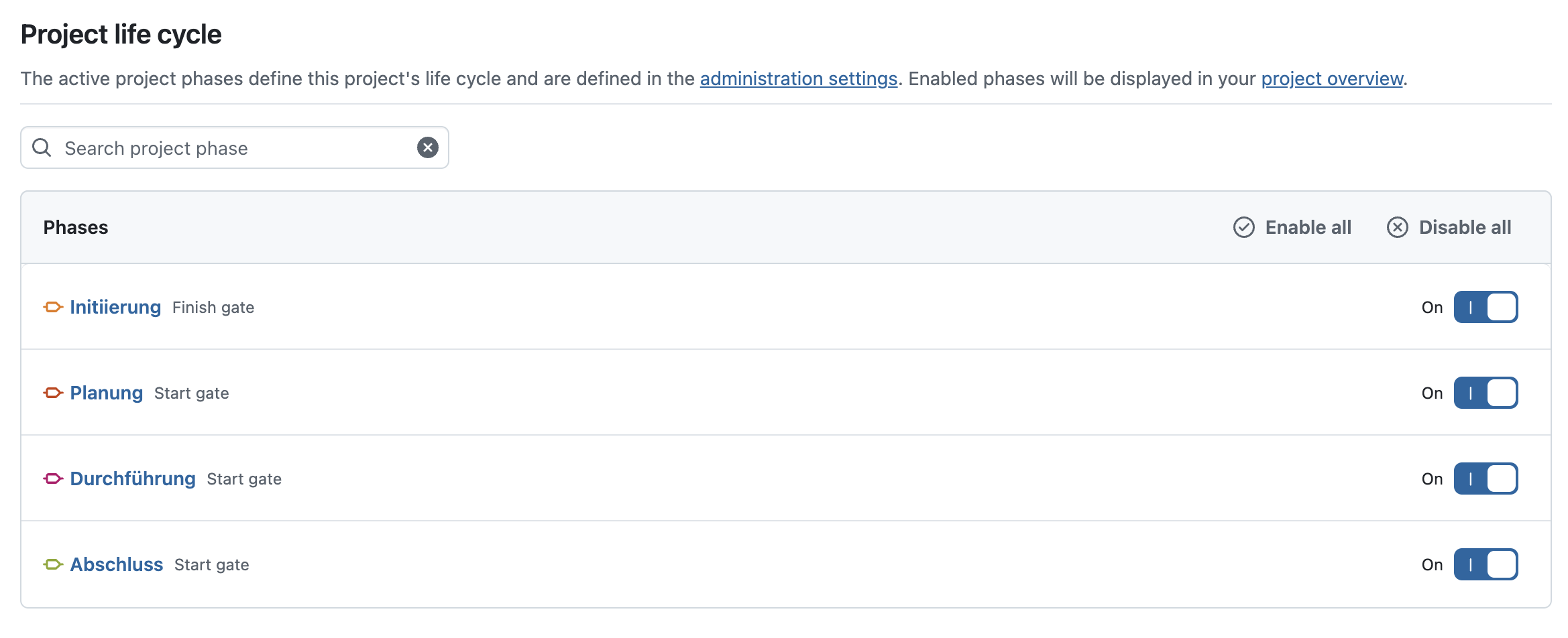
In PM² and PMflex, phases and phase gates are central building blocks. Every programme runs through defined stages – from initiation through planning and implementation to closure. At the phase gates, it is checked whether a phase has been successfully completed and whether the next one may start. This governance ensures that decisions are transparent and traceable.
OpenProject helps you apply this logic in practice. Even in the cost-free Community Edition, you can create and monitor phases and phase gates according to PM² specifications. In the Enterprise Edition, you can customize them individually as well as add new phases or phase gates. This way, you stay in control – and always know whether your programme is on track.
2. Keep the overview: Programme dashboards and baseline
For programme managers, a quick overview at the programme level is essential:
Monitor the status of all sub-projects (e.g. phase, phase-gate status, traffic light).
Detect deviations and bottlenecks early (schedule, budget, quality).
Track upcoming milestones and deadlines.
Identify risks and issues that need to be escalated.
Consolidate key figures for reporting and decision-making.
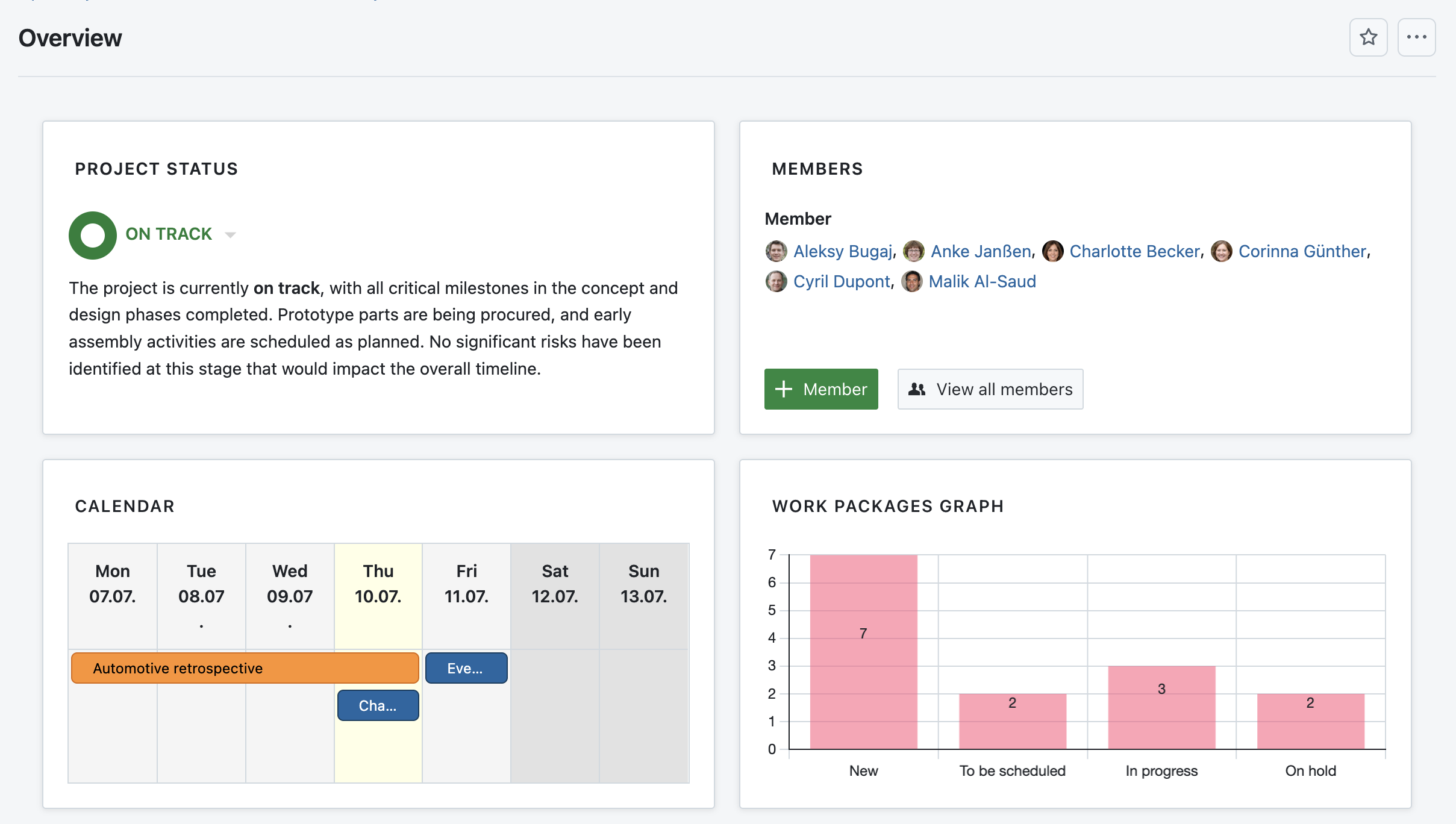
With OpenProject, you set up an overview page (dashboard) for each programme that displays all relevant information. In addition, you can create, filter, save and share project lists to consolidate the metrics of all sub-programs or sub-projects in one clear table. To dive deeper into work packages, risks, and recent changes, you can use the Baseline feature.
Returning to the cockpit metaphor from the introduction: in OpenProject, this becomes your cockpit, where all information is available at a glance and forms the basis for well-founded decisions at any time.
3. Clarify dependencies: Milestones and relations
Programmes consist of many sub-projects with close content-related and time-related interdependencies. To detect delays or conflicts at an early stage, dependencies and common milestones must always be visible.
In OpenProject, you represent a programme as a project with sub-projects. Dependencies are managed through the diverse relations types between work packages:
Temporal dependencies such as predecessor / successor.
Logical relations such as blocks / blocked by or includes.
Parent-child relations to clearly structure complex tasks.
Programme-level milestones that apply to multiple sub-projects.
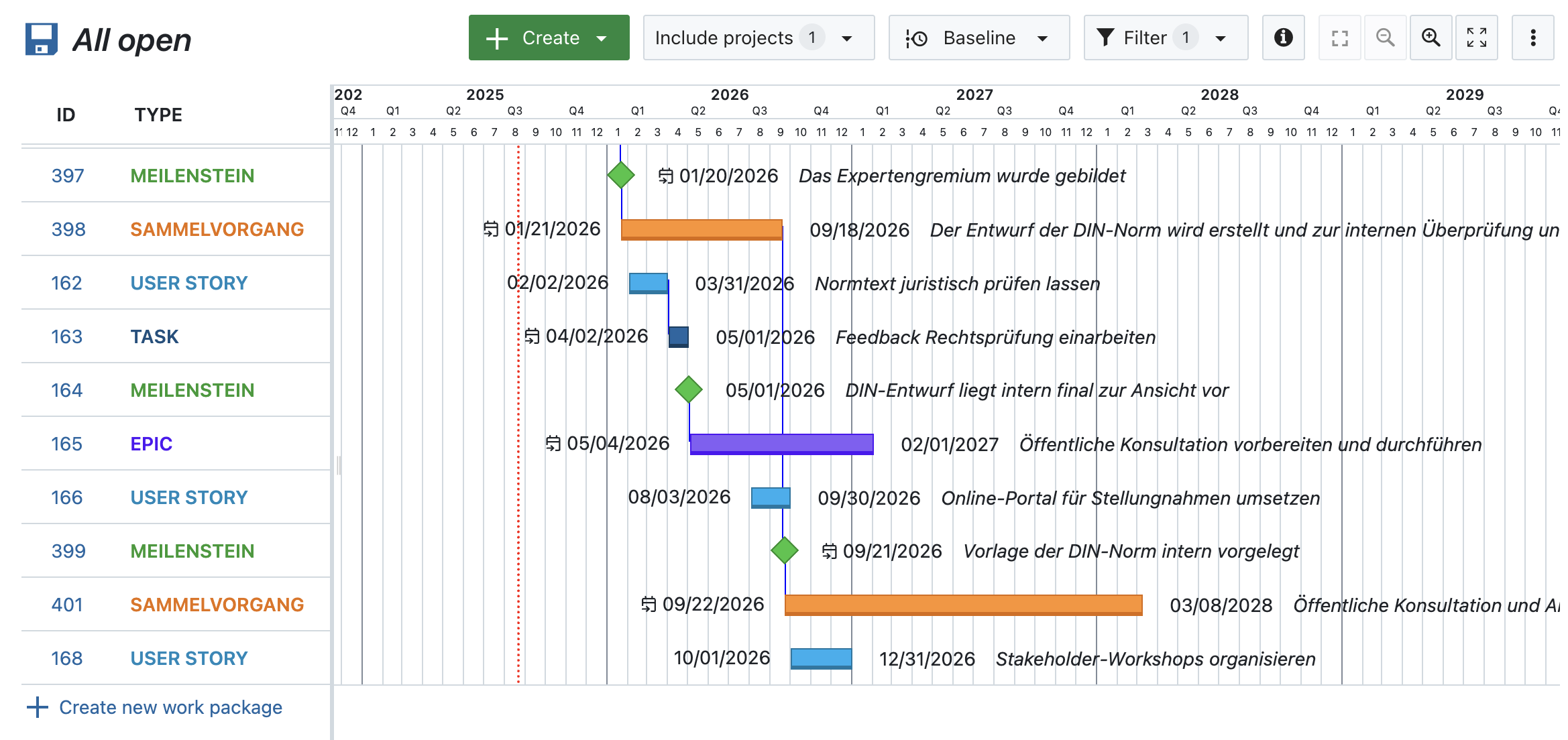
These dependencies can be visualized in different views – for example, in the Gantt chart for timelines, in table views for detailed overviews, or also in parent-child boards (Enterprise add-on) to visualize the hierarchy of work packages.
4. Make impact visible: Outputs, outcomes, and benefits
In PM² and PMflex, a clear distinction is made between three levels:
Outputs are the tangible results of a project, e.g. a new IT system.
Outcomes are the direct effects when these results are used, e.g. active use of the system.
Benefits are the long-term value for the organization, e.g. more efficient processes or reduced costs.
For programme managers, it is crucial to keep this entire chain of impact in view, rather than focusing only on the completion of individual deliverables.
OpenProject supports you by allowing outputs, outcomes, and benefits to be defined as separate work package types. These types can be equipped with status transitions for custom workflows, attributes, and status values, and tailored exactly to the specific steering needs. This creates a transparent structure that makes it clear at any time whether the programme is actually delivering the planned benefits.
5. Detect problems early: Risk and issue management
Good risk management helps you sleep at night. As a programme manager, you need to keep an eye not only on current problems but also on potential risks and issues that may endanger the entire programme.
In OpenProject, risks and issues can be represented just like Outputs or Outcomes as their own work package types – with individual workflows and attributes. This allows you to manage probabilities of occurrence, impacts, and countermeasures systematically and ensures that critical points are not lost in the daily project routine.
Note
The OpenProject team is currently working intensively on an extended risk module that will soon support the PMflex requirements even more consistently and enable more precise control at the programme level. Stay up to date: Risk module development on OpenProject Community
6. Create transparency: Reports and controlling
For programme managers, it is essential to always have reliable information available – for their own control and for mandatory reporting upwards. You need clarity about the status of your programme, and at the same time standardized documentation to reliably inform portfolio managers, agency leaders, or political decision-makers.
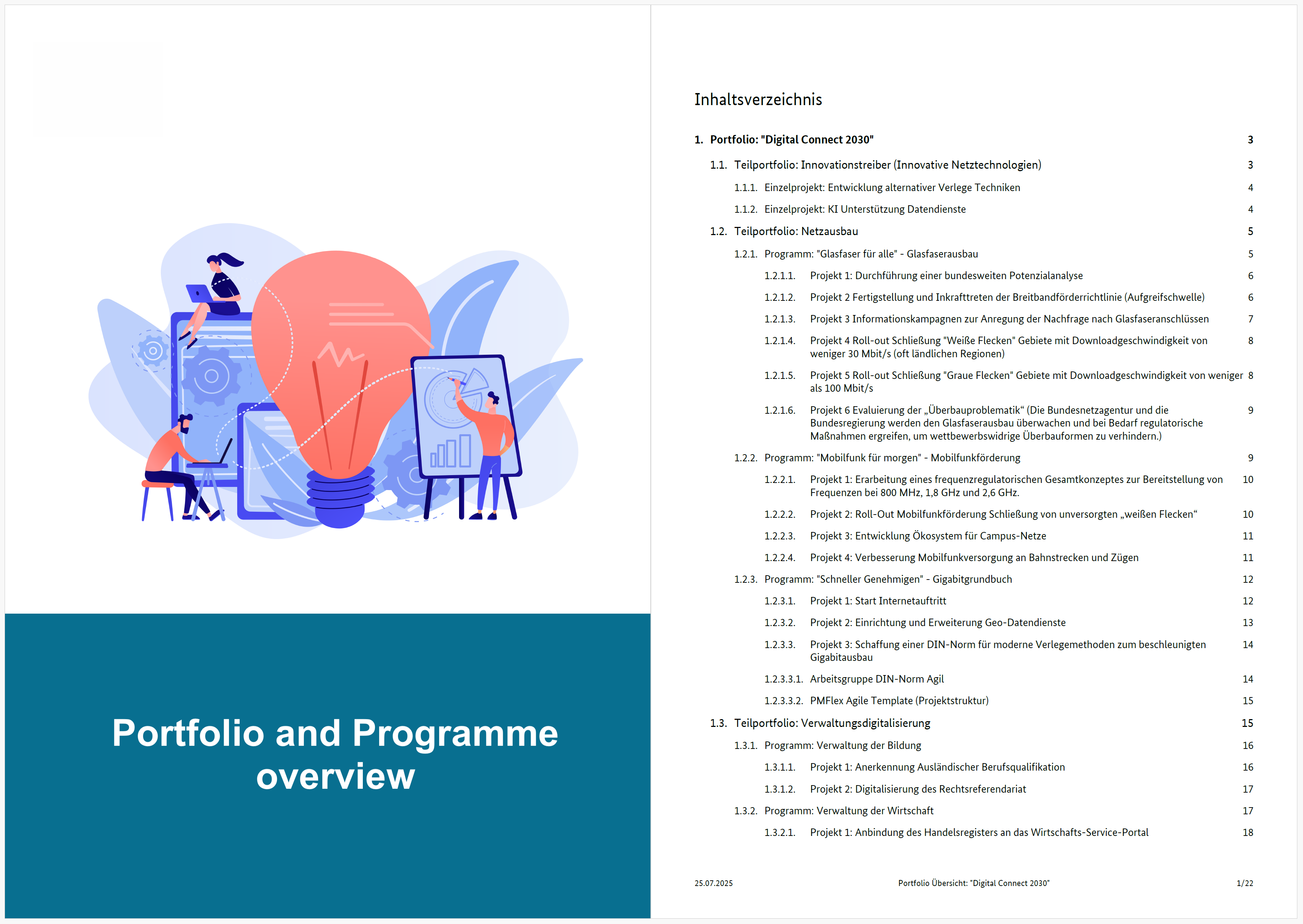
OpenProject provides standardized reports and controlling features for this purpose. Status reports, budget overviews, or progress analyses can be consolidated and exported directly as PDFs – ideal for regular communication with stakeholders. In addition, OpenProject takes PMflex templates into account, so your reports comply with established standards and are ready to use without additional editing.
This way, you keep your own overview while at the same time providing transparent, comparable information for control at portfolio and management level.
7. Strengthen collaboration: Meetings based on work packages
What if your team meetings started exactly where the actual work happens? Instead of meticulously gathering information from emails or external Word or Excel documents, in OpenProject you can directly access work packages stored in the programme or sub-project.
This way, you create agendas with the relevant topics in no time, document results directly during the meeting, and generate minutes immediately – in the OpenProject style, with links to the respective risks, milestones, outcomes, and more. Everyone involved stays aligned, and traceability is ensured at all times. OpenProject’s Meetings module is a highlight for many programme managers, and offers significant advantages, especially in public sector programmes with many stakeholders.
Conclusion: Successfully implementing programme management with PM² and PMflex
Programme managers in public administrations face the task of steering complex initiatives transparently and traceably. With PM² and PMflex, clear standards are available – and with OpenProject, a tool that consistently supports these standards in practice.
From phase gates to dashboards, risk management, and meetings: OpenProject provides you with an integrated “cockpit” that ensures governance, creates transparency, and strengthens collaboration. This way, you not only guide programmes reliably through the individual phases but also ensure that the planned outcomes and benefits are actually achieved.
Especially in public administration, where traceability and accountability are crucial, OpenProject is the right solution to bring programmes to success according to European standards.
OpenProject 16.3 is here, bringing a fresh look, more control over email notifications for meetings, along with other improvements that make everyday work more efficient. This release is all about helping you stay focused, find what you need faster, and keep your projects running smoothly.
We will summarize the most important changes in this blog article and, as always, please see our release notes that contain all changes, features and bug fixes.
Here is a quick navigation to all feature descriptions:
Your workspace should help you focus — not distract you. That’s why in 16.3, we’ve refined the design and navigation to make OpenProject easier and more pleasant to use:
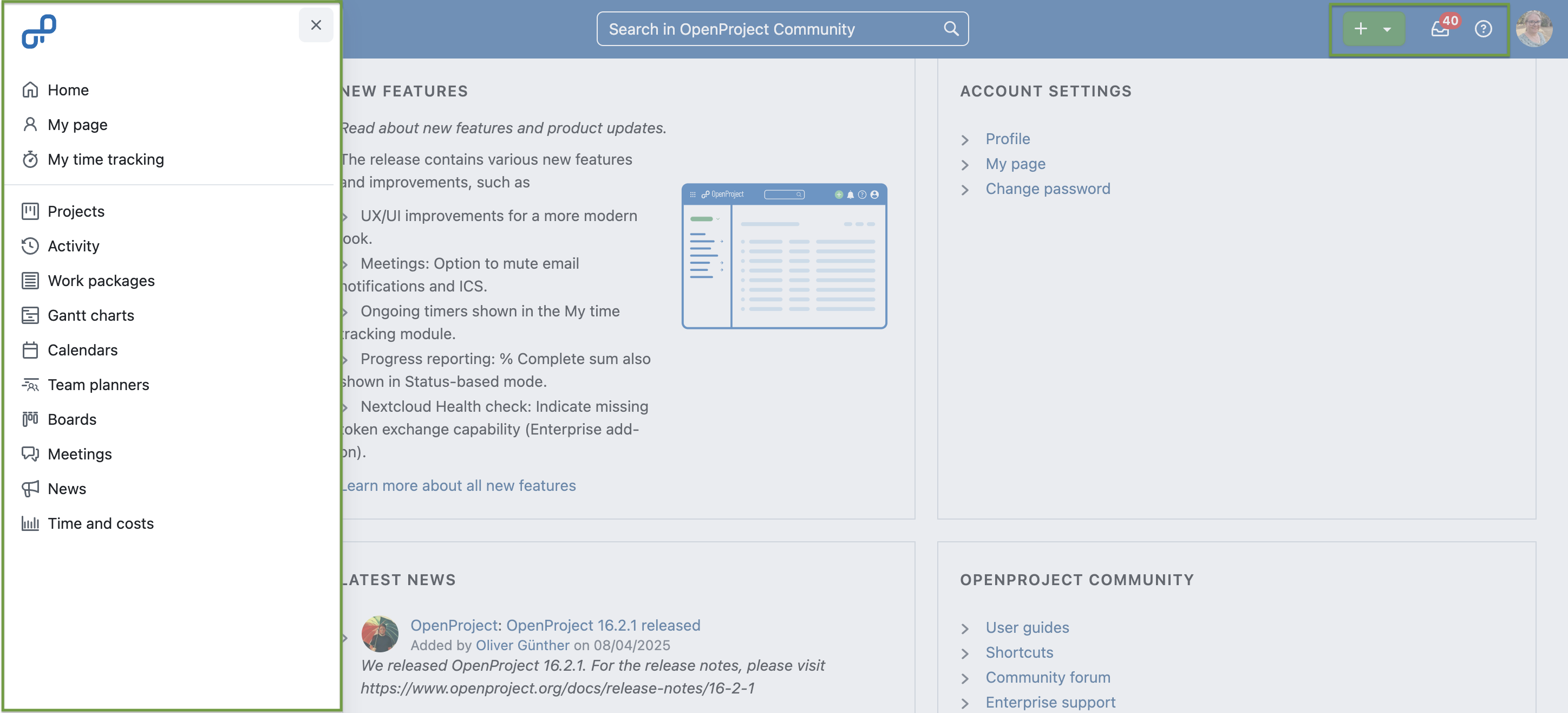
The header has been redesigned with Primer, including a fresh icon for notifications.
The grid icon now opens as a smooth lateral menu, giving you quick access to Home, My Page, and My time tracking.
The sign-in modal and running time tracking section have moved to a new overlay menu on the right, keeping the header clean and uncluttered.
These changes make it easier to find your way around and keep important tools within reach.
Better control of meetings notifications
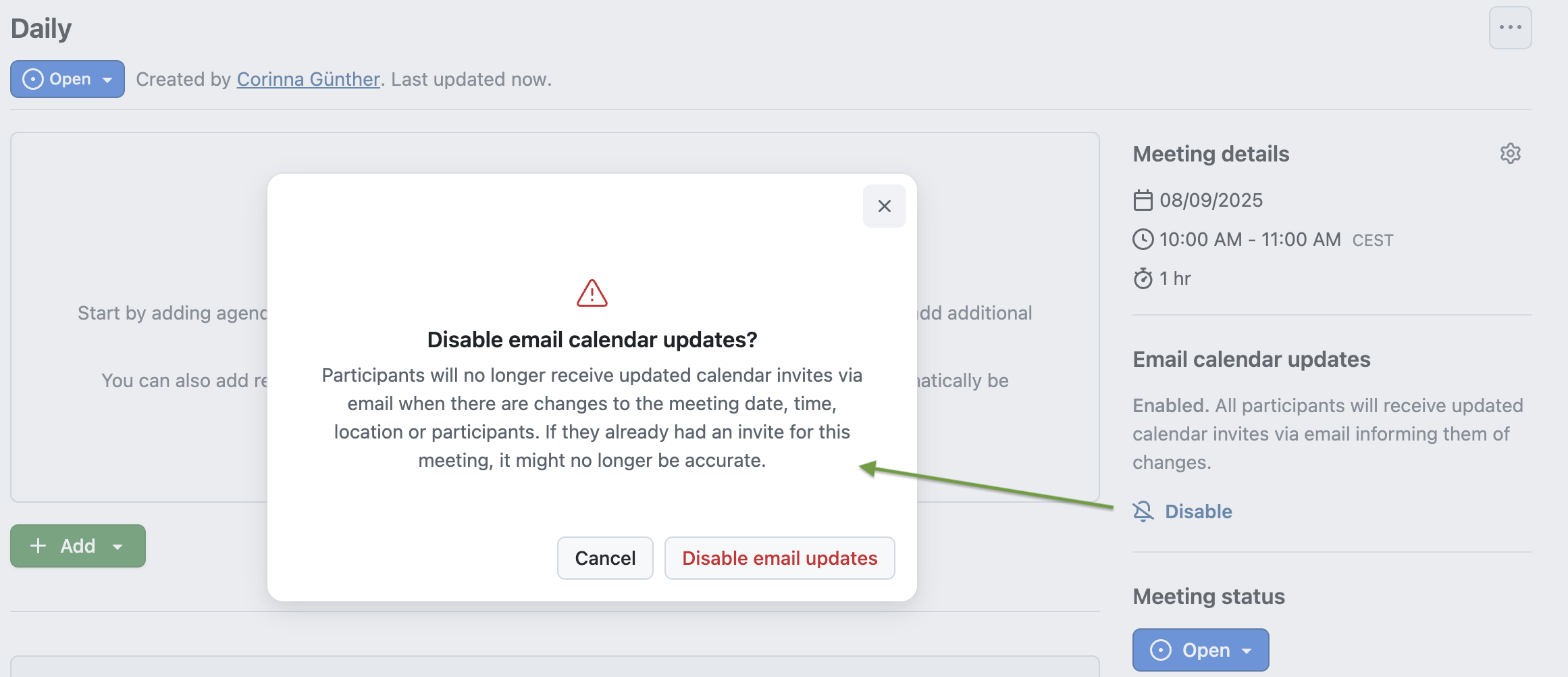
Receiving emails about every small update can be annoying. With OpenProject 16.3, you can now choose whether participants receive email calendar updates when creating or copying a meeting.
A simple checkbox in the meeting form lets you enable or mute notifications. The current status is always visible in the sidebar:
For one-time meetings, you can toggle notifications directly there.
For recurring meetings, you can set the preference in the template so it applies to the whole series.
This small change gives you more control over how and when participants are informed and keeps your communication timely and relevant.
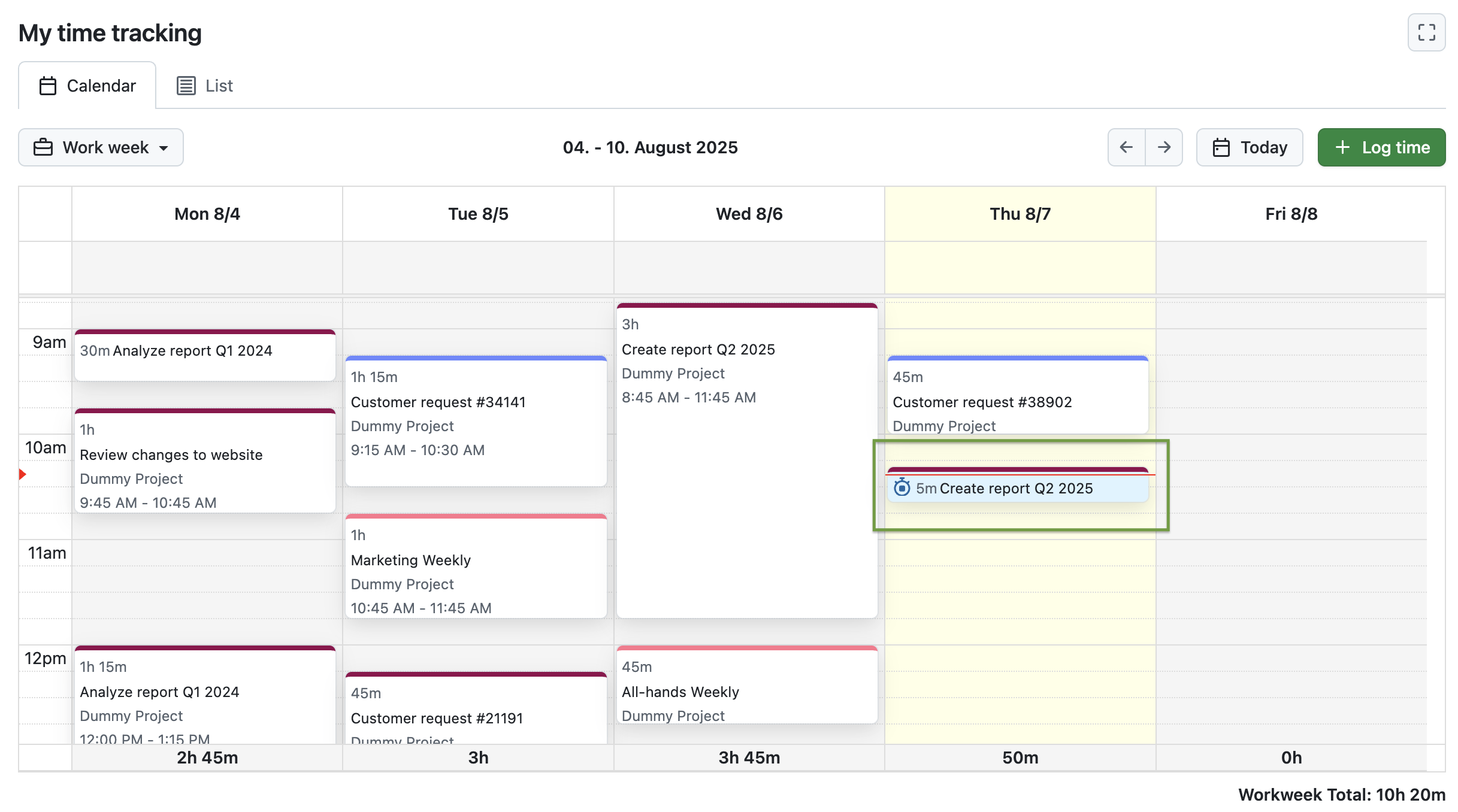
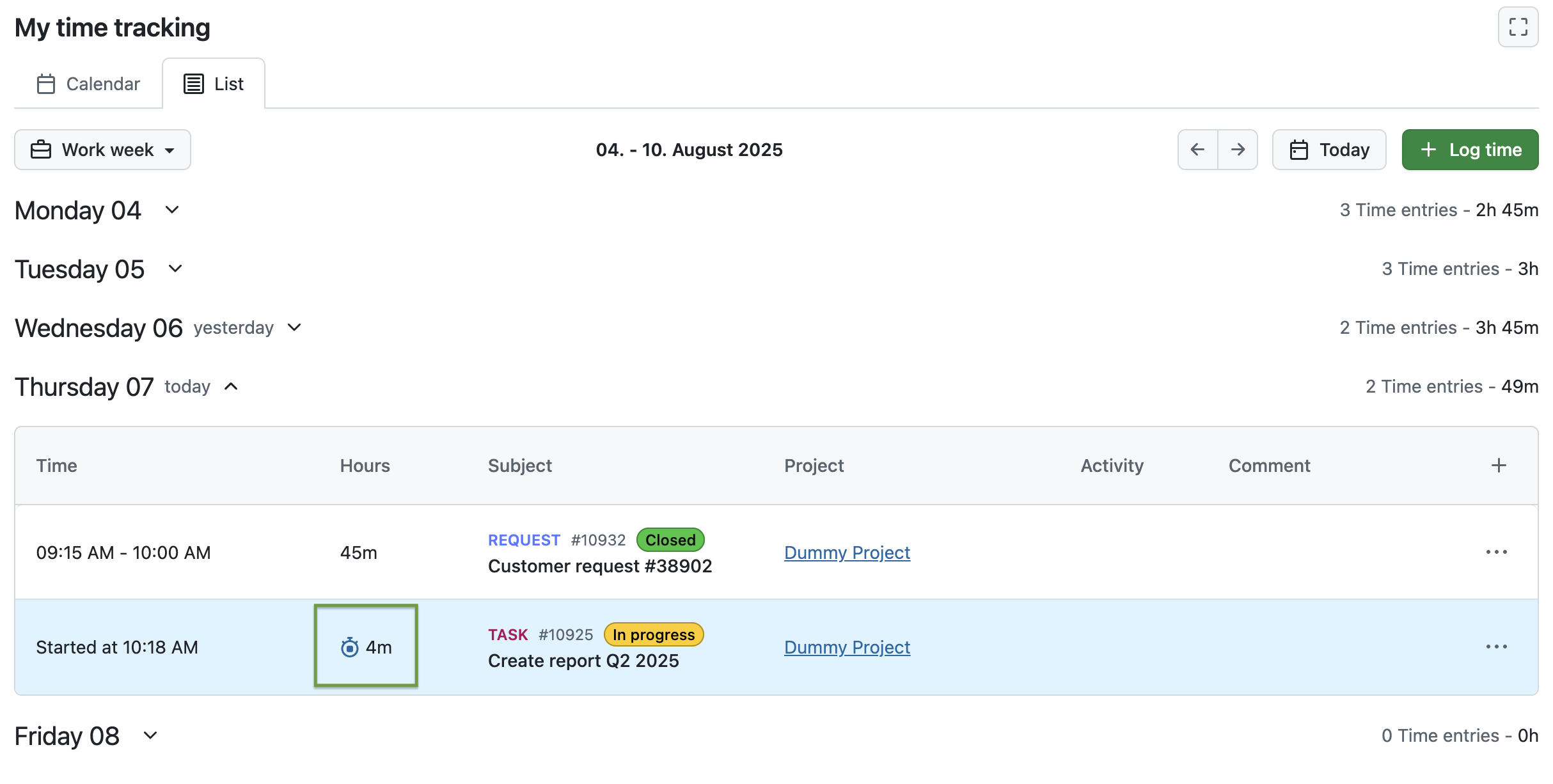
We’ve made it easier to avoid double time entries and keep an eye on your work in progress. The My time tracking module now clearly shows if a timer is running: In both list view and calendar view, the work package currently being tracked is marked with a small timer icon and blue background. This makes it easy to spot ongoing tracking, especially if you step away and return later in the day.
Progress reporting in work package tables is now more reliable. In OpenProject 15.5, we introduced % Complete sums, but in some cases — especially when not all work packages had values for Work or Remaining work — the calculation could be misleading.
With 16.3, these % Complete sums are now calculated accurately across all progress calculation modes, including status-based and simple averages. This means you can trust the numbers you see, no matter how your team tracks progress.
For teams using the Nextcloud integration in the Corporate plan, there’s now a clearer way to spot one specific issue: missing token exchange capability. If your identity provider doesn’t support token exchange (often due to older OIDC settings), the health check will now flag this directly. That way, you’ll get a precise message pointing to the cause, instead of a generic “token refresh failed” error.
Faster cost reporting with autocomplete
Cost reports are a powerful way to get insight into your projects — and now, setting them up is faster. In OpenProject 16.3, key filters like User or Work package now support autocomplete in cost report filters. Just start typing and select from matching results, instead of scrolling through long lists. It’s a small change that can save you time every week.
You will find more information about all new features and changes in our Release notes or in the OpenProject Documentation.
If you need support, you can post your questions in the Community Forum, or if you are eligible for Enterprise support, please contact us and we are happy to support you personally.
New to OpenProject? To test all features of OpenProject 16.3 right away, create a 14 days free trial instance for our OpenProject Enterprise cloud.
Prefer to run OpenProject 16.3 in your own infrastructure? Here you can find the Installation guidelines for OpenProject.
A very special thank you goes to City of Cologne, Deutsche Bahn and ZenDiS for sponsoring released or upcoming features. Your support, alongside the efforts of our amazing Community, helps drive these innovations. Also a big thanks to our Community members for reporting bugs and helping us identify and provide fixes. Special thanks for reporting and finding bugs go to Sven Kunze, Michael Lathion, Gábor Alexovics, and Tom Gugel.
Last but not least, we are very grateful for our very engaged translation contributors on Crowdin, who translated quite a few OpenProject strings! This release we would like to particularly thank the following users:
Alin Marcu, for a great number of translations into Romanian.
William, for a great number of translations into Chinese Traditional.
OlhaTrotska, for a great number of translations into Ukrainian.
Would you like to help out with translations yourself? Then take a look at our translation guide and find out exactly how you can contribute. It is very much appreciated!
As always, we welcome any feedback on this release. 💙
AI is everywhere. Especially large language models (LLM), which are what most people mean when they talk about AI today. These models are becoming common tools at work and in everyday life. At the same time, concerns around data protection and transparency remain.
At OpenProject, we’ve been exploring this topic deeply. We recognize both the incredible potential and the valid concerns. This article gives you a first look at how OpenProject approaches AI — and what you can expect as a user.
How does OpenProject approach AI?
At OpenProject, we approach AI — or more precisely, language models — with both curiosity and caution. Our goal is clear: help users save time and reduce complexity, without compromising privacy or open source standards.
We stick to a simple principle: “A fool with a tool is still a fool.” This applies to software just as much as it does to artificial intelligence: What matters is how you use it. Or, in other words, technology only helps if it’s used responsibly. That’s why we develop AI-powered features to assist, not replace, human decision-making.
We will use language models to save our users time and hassle in their work. At the same time, we remain firmly committed to our principles: Open source standards will not be broken and data protection is our top priority.
One quick note: While we use the term “AI” in this article, we technically refer to large language models (LLMs). The distinction matters, but for clarity, we follow everyday language.
Important
Even though we will be implementing AI/LLM features in OpenProject, the final decision will always be up to you, the user. Therefore, we want to emphasize that we will offer the option to enable or disable AI features.
OpenProject follows strict ethical AI guidelines
Human decision authority
AI serves as decision support, never autonomous decision-making
Transparent recommendations with clear explanations
Human oversight required for all critical decisions
Clear accountability chains maintained
Privacy & GDPR compliance
Strict data isolation between projects and tenants
Our AI features are designed to align with PM² as well as with PMflex, the official German standard for strategic project and portfolio management in the public sector. This means workflows automatically follow government requirements — no manual checks needed.
Thanks to AI, OpenProject can detect risks early, before they disrupt timelines or budgets. Real-time analytics and predictive insights give public sector teams the confidence to make data-driven decisions.
At the same time, automating workflows and reporting can save up to 80% of the time normally spent on admin tasks — allowing teams to focus on strategy rather than routine.
Preview of some of the first AI features in OpenProject
Even though we cannot make any firm promises regarding the release date for AI features at this time, we would like to show you some features that we are working on intensively. Especially with the still relatively new topic of AI, we want to test all features extensively before we release them.
Note
Some technical information: To develop AI features, we use our own OpenProject Haystack. Just like the rest of OpenProject, all source code is publicly available. Visit our Haystack GitHub to see it and learn more about the system architecture.
During a hackathon in July, we designed several AI-powered features and showcased them in a demo. Here’s a short overview of the specific AI features that we now continue working on:
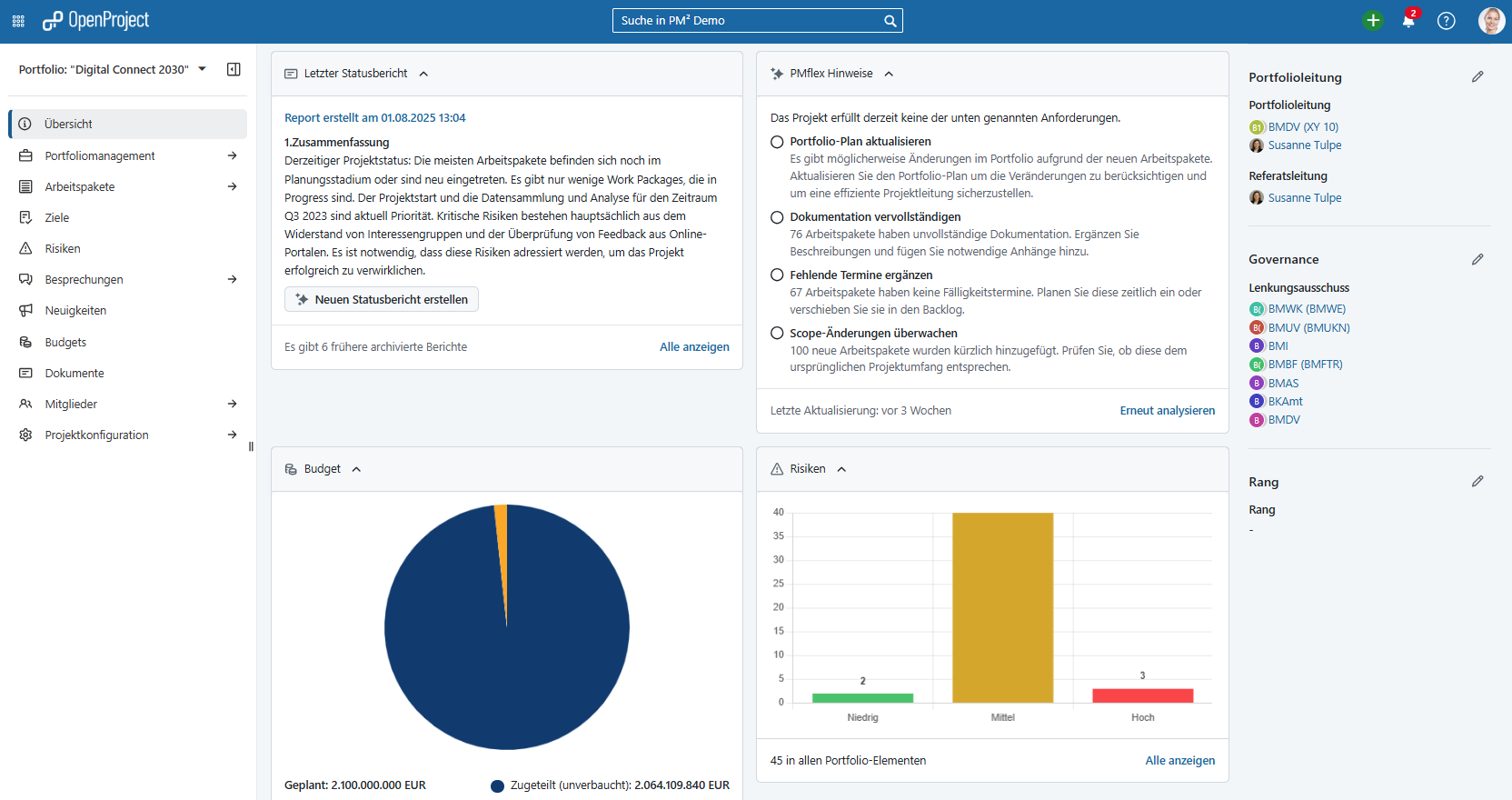
Automatically generated tips to improve your project management
Some users are new to project and portfolio management and might need support. Ideally, this takes place directly in the application so that users don’t have to look up information in their handbook. Additionally, no external handbook can give you the exact information you need based on the data you already created.
This is why we created a feature to automatically display tips, specifically based on PMflex and PM² standards. But also users who are not working with these standards will benefit from this feature as some hints and are generally helpful in the area of project and portfolio management.
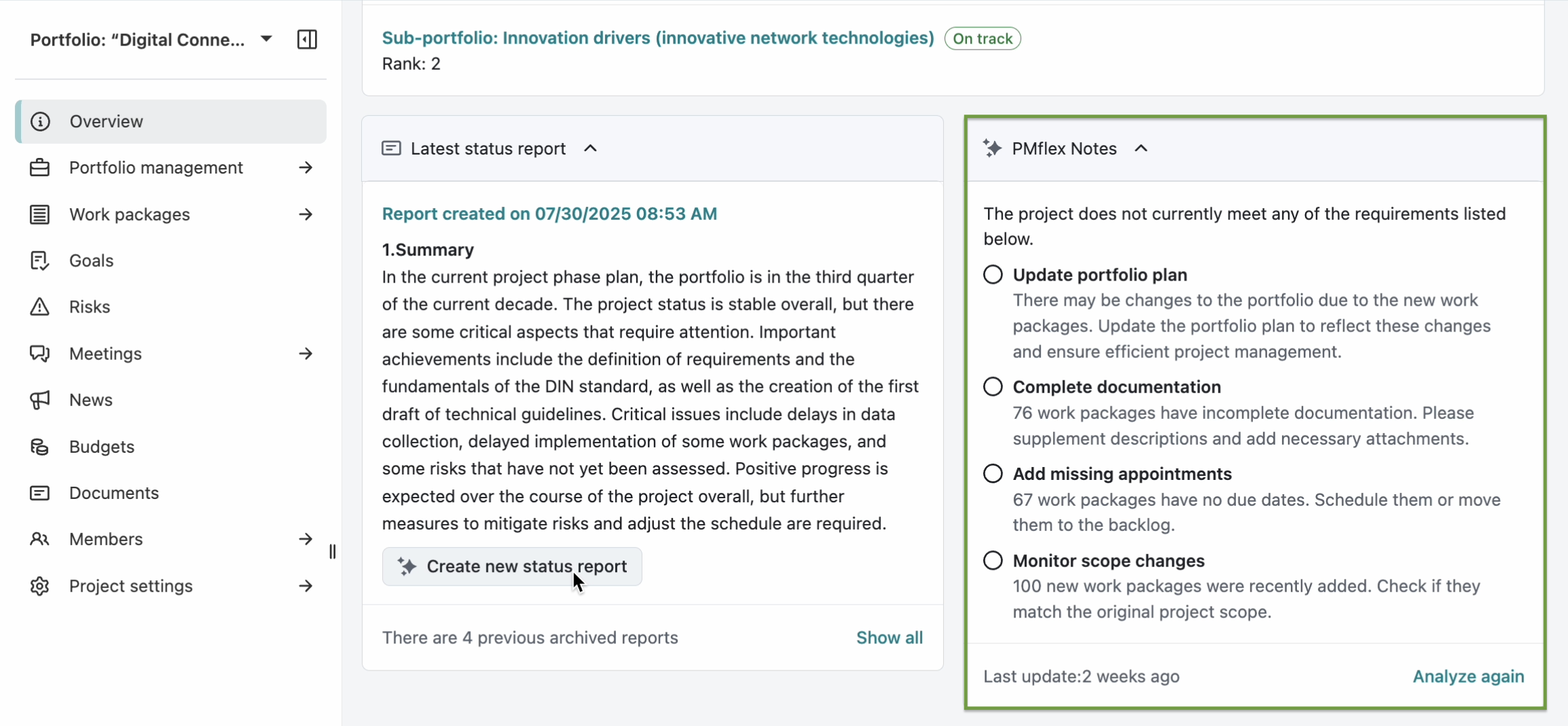
Here’s an example of how we implemented this feature on a demo instance:
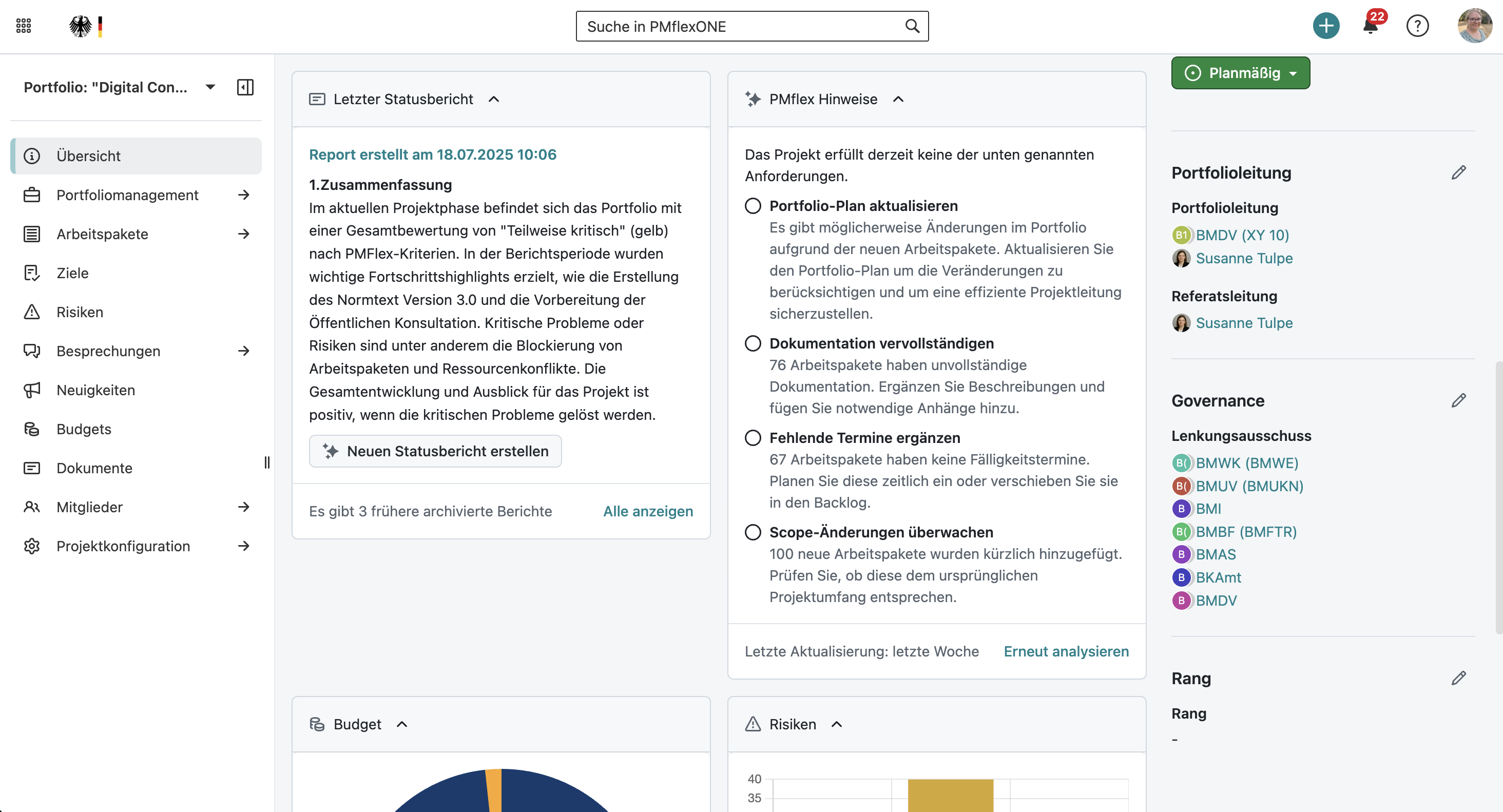
These are the hints in the example screenshot:
Update portfolio plan
Complete documentation
Add missing deadlines
Monitor scope changes
The overview page only shows the five most relevant notes. The information includes not only missing tasks, but also notes on what has already been accomplished.
Automatically generated status reports
Creating a project status report can be very time-consuming and tedious, requiring a lot of copying and pasting. With the help of the OpenProject LLM, users save several hours of time and can focus on more important things.
The feature to generate status reports by just pressing a button is still in development, and some parts of it don’t even need AI functionality. The LLM mainly summarizes the information used in the project and creates a short text based on that.
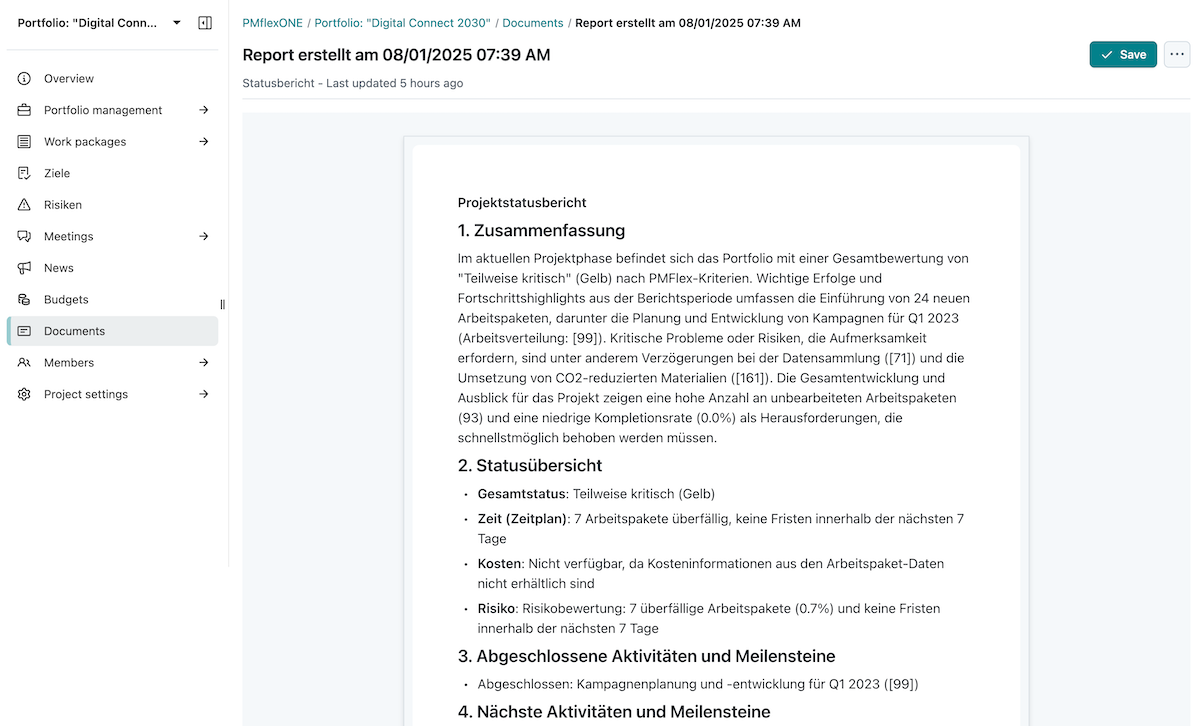
After one minute, your project status report is created and you can adjust, save and share it with others. This is how a status report could look:
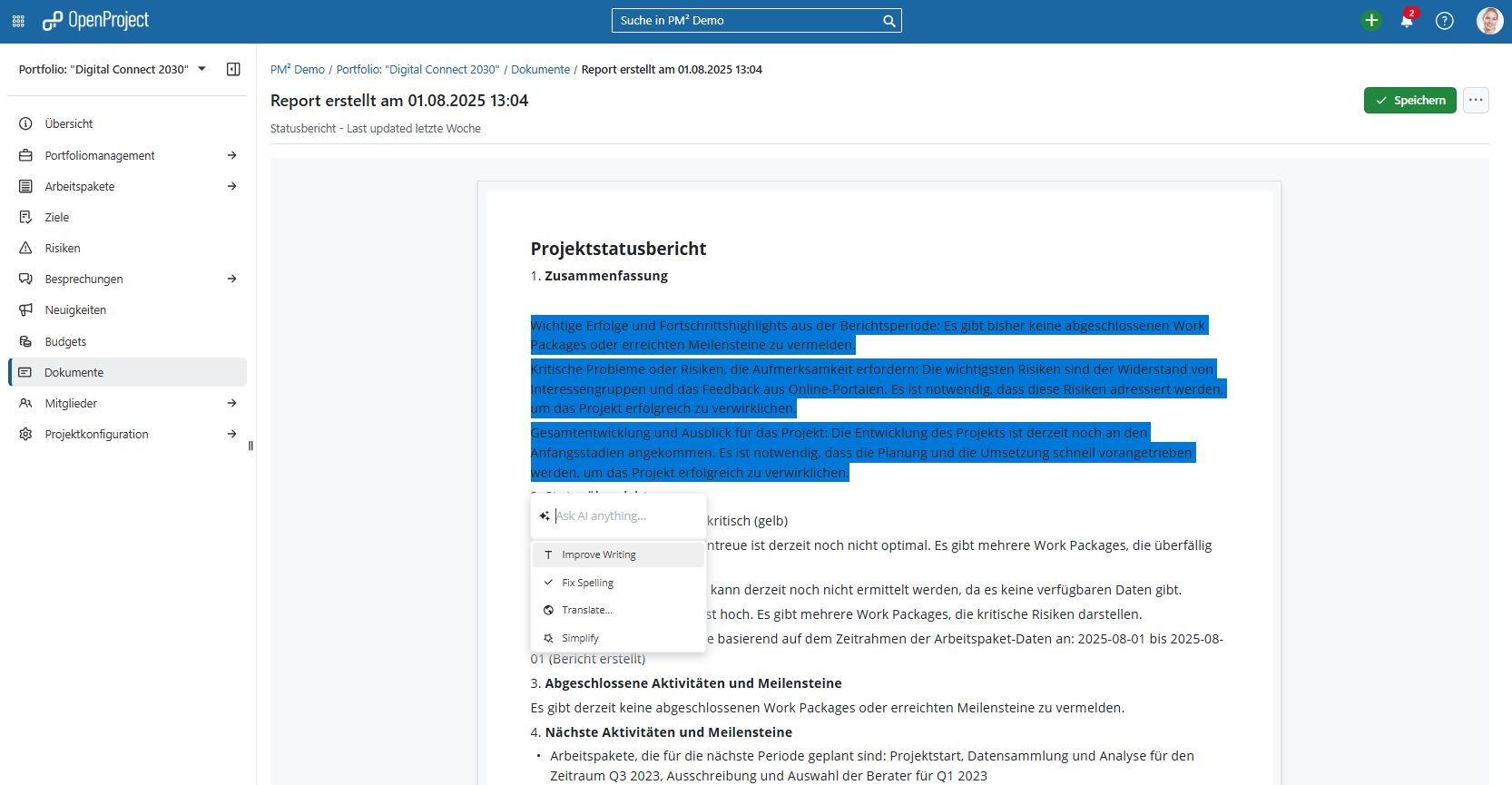
AI Document features: Ask AI, Improve writing and more
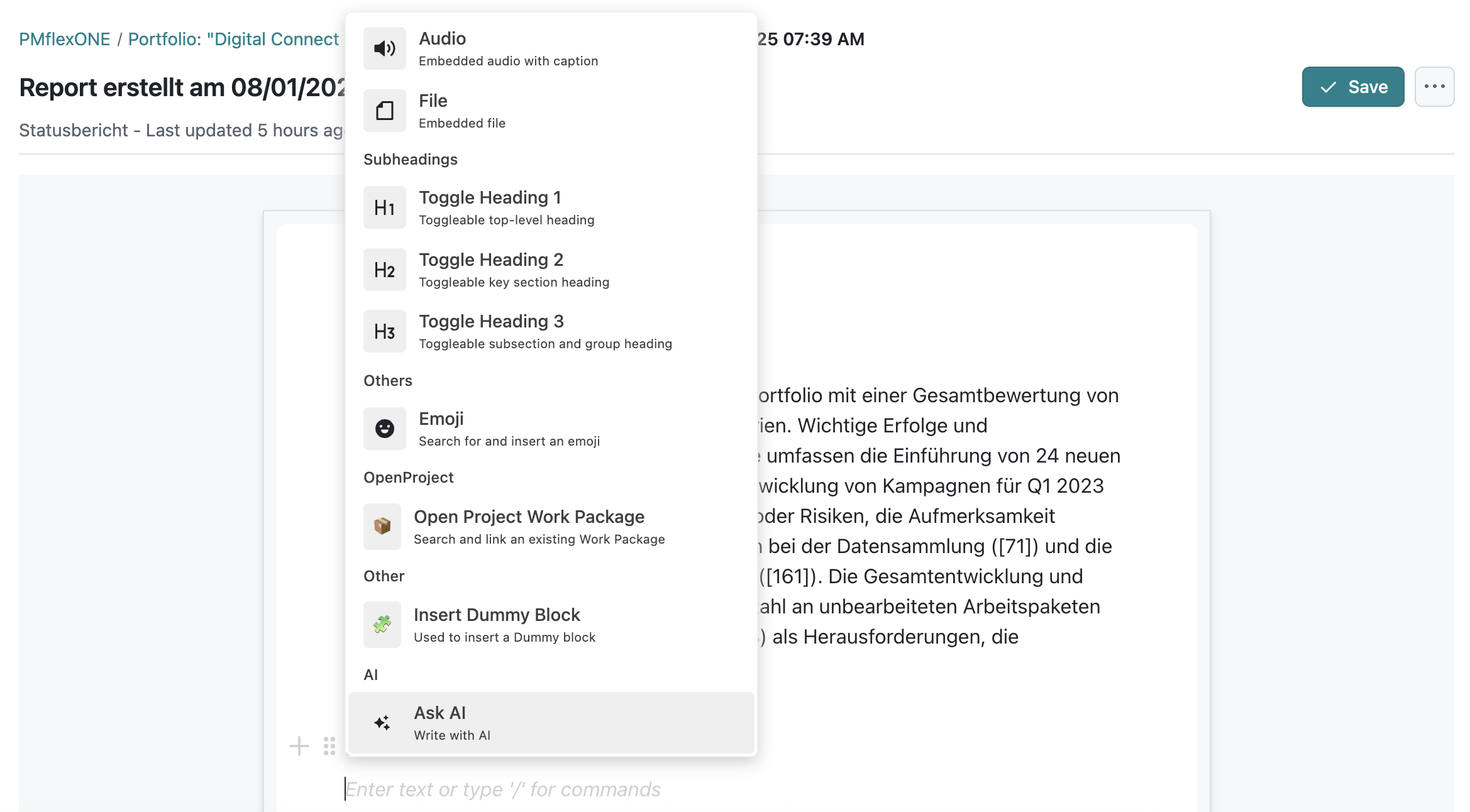
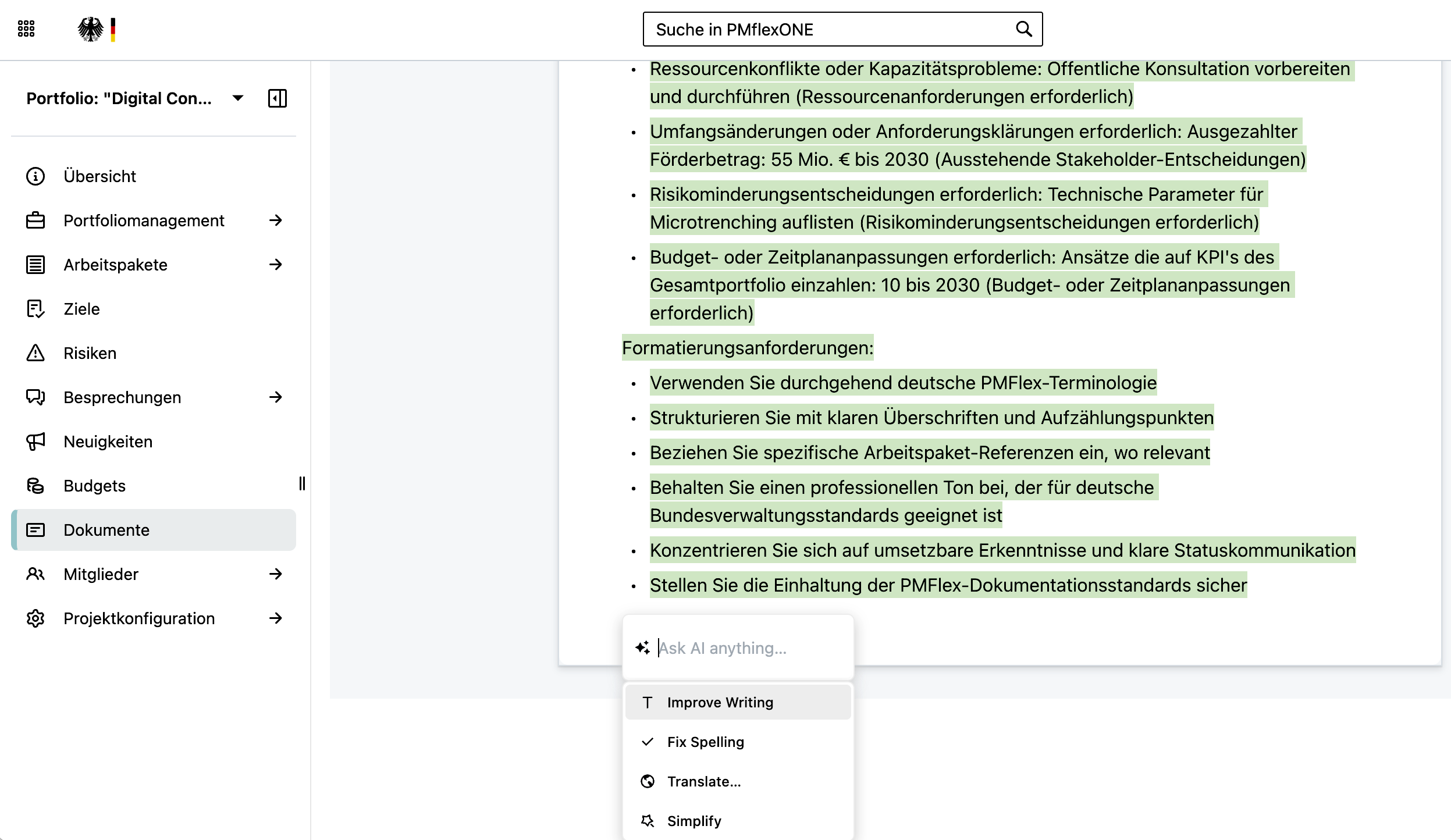
OpenProject is working on integrating familiar AI-powered writing tools directly into its editor — making it easy to translate, rephrase, check spelling, or generate first drafts without switching tools. Within the Documents module, on which we’re also currently working, the AI can also perform helpful tasks like summarizing longer texts. This streamlines your workflow and supports teams in creating high-quality content more efficiently.
Conclusion and outlook on AI features in OpenProject
“We are continuing to work on AI features with one goal in mind: more efficient, standard-compliant work with a single mouse click, even without prior knowledge of AI.” – Dominic Bräunlein, Feature lead for AI topics at OpenProject
With OpenProject, we are committed to building AI features that are not only helpful, but also ethical, secure, and transparent. We believe that language models can significantly support users in their daily work — especially in the public sector, where structured processes, compliance, and documentation are essential.
By combining AI with OpenProject’s proven project management features, we want to reduce manual effort, accelerate strategic alignment, and make professional project and portfolio management accessible to more people. Whether you’re new to project management or a seasoned expert — our goal is to support your work without replacing your judgment.
We will continue developing and testing AI features carefully, hand in hand with our Community, partners, and users. If you’re interested in trying out the first features, we’ll keep you informed through our blog and newsletter. The future of project management is intelligent, but above all: open and secure.
What does a software solution look like that enables employees in the public sector to successfully prioritize, manage, implement, and report on strategic initiatives?
At OpenProject, we explored this question during a hackathon last week. In this article, we give you an overview of our results.
The requirements we defined are based on PM² the open source project management methodology provided by the European Commission.
If you already want to “spoil” the results, feel free to watch the following video (available in German only), which we presented at the end of the hackathon:
Wanted: A software solution for the strategic implementation of digitalization initiatives
Transparency is one of our core values, so in this article we want to share an overview of the hackathon, the requirements, and of course our proposed solutions.
Requirements included:
Compatibility to PM² (tailoring)
Consistency across portfolio, program, and project levels
Cross-agency collaboration
Agility
Enjoyable user experience
Challenges for us:
Only one week to develop additional features, comprehensive demo material, documentation, and (video) presentation. All of this alongside our daily business, including the release of version 16.2.
Immersing ourselves in the working environment and various user stories from public administration, which operates very differently than we do internally. Here, our extensive experience with the public sector, especially in connection with openDesk, was a major advantage.
Overview of the required user stories:
Several user stories were provided, each with associated data like budget, status, target states, and more. Every user story included at least one fictional persona, from whose perspective the solution needed to be demonstrated.
Prioritize portfolio elements
Manage portfolio
Report program status
Report project status
In addition to the predefined user stories, we also showcased how the solution could be used on the go via the mobile app.
Delivered: Full commitment for ten new PM² features
Alongside 19 developers, many other OpenProject team members were fully engaged in the PM² hackathon. Despite — or perhaps because of — the short timeframe and complex requirements, the energy and team spirit were tangible across all days, even across our globally distributed remote workspaces.
For Rosanna Sibora, who had her very first week at OpenProject as Chief Product Officer during the hackathon, the team’s commitment, creativity, and passion made a strong impression:
“During the hackathon, I was impressed by how well the self-organized teams collaborated. It clearly showed me how well-aligned the OpenProject team is and how open and empowering the culture is. We proved that 2+2 is definitely more than 4 — and what can be achieved with great collaboration and empowerment.” – Rosanna Sibora, CPO, OpenProject GmbH
OpenProject implementation – behind the scenes:
Full energy and passion, not just from developers
15,000+ lines of new code
Team formation for developing new features, building a demo instance, and designing product mockups for additional features
Daily hackathon stand-ups, retros, and pulse checks with the PM² experts and other stakeholders, 100% remote collaboration using other open source tools like Big Blue Button and Element
Daily operations continued in parallel: support and release of OpenProject 16.2
OpenProject implementation – on the product level:
While the current version of OpenProject already supports the majority of requirements, we identified several aspects we wanted to expand or develop from scratch during the hackathon week. Especially relevant across all user stories was the development of features for reporting and managing goals, risks, and budgets.
Here is an overview of our main development focuses during the hackathon:
Let’s take a closer look at what these features and requirement implementations looked like by the end of the hackathon week.
Important
Please note that this is a summary of key developments. Additional features were also planned, designed, and developed during the hackathon. As these features were created in a very short time, they are not yet fully tested or finalized.
Planning and managing portfolios and programs
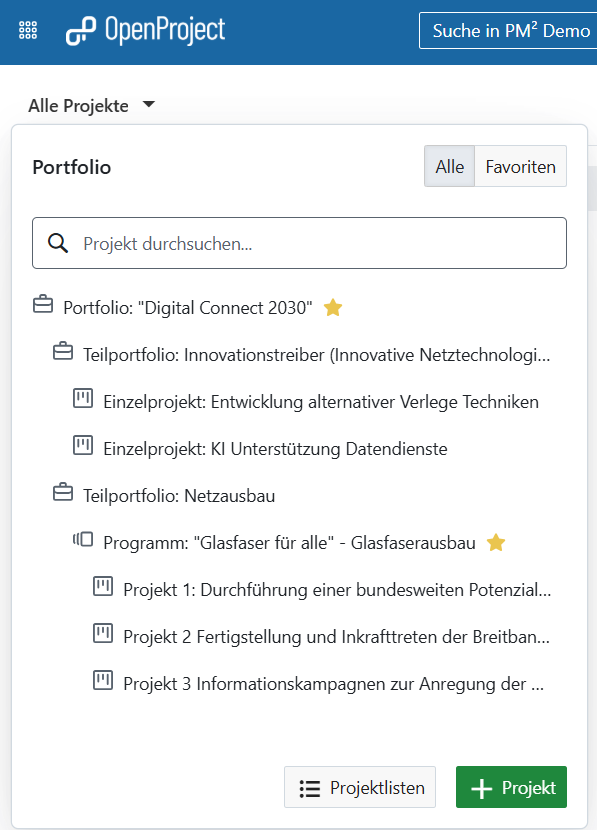
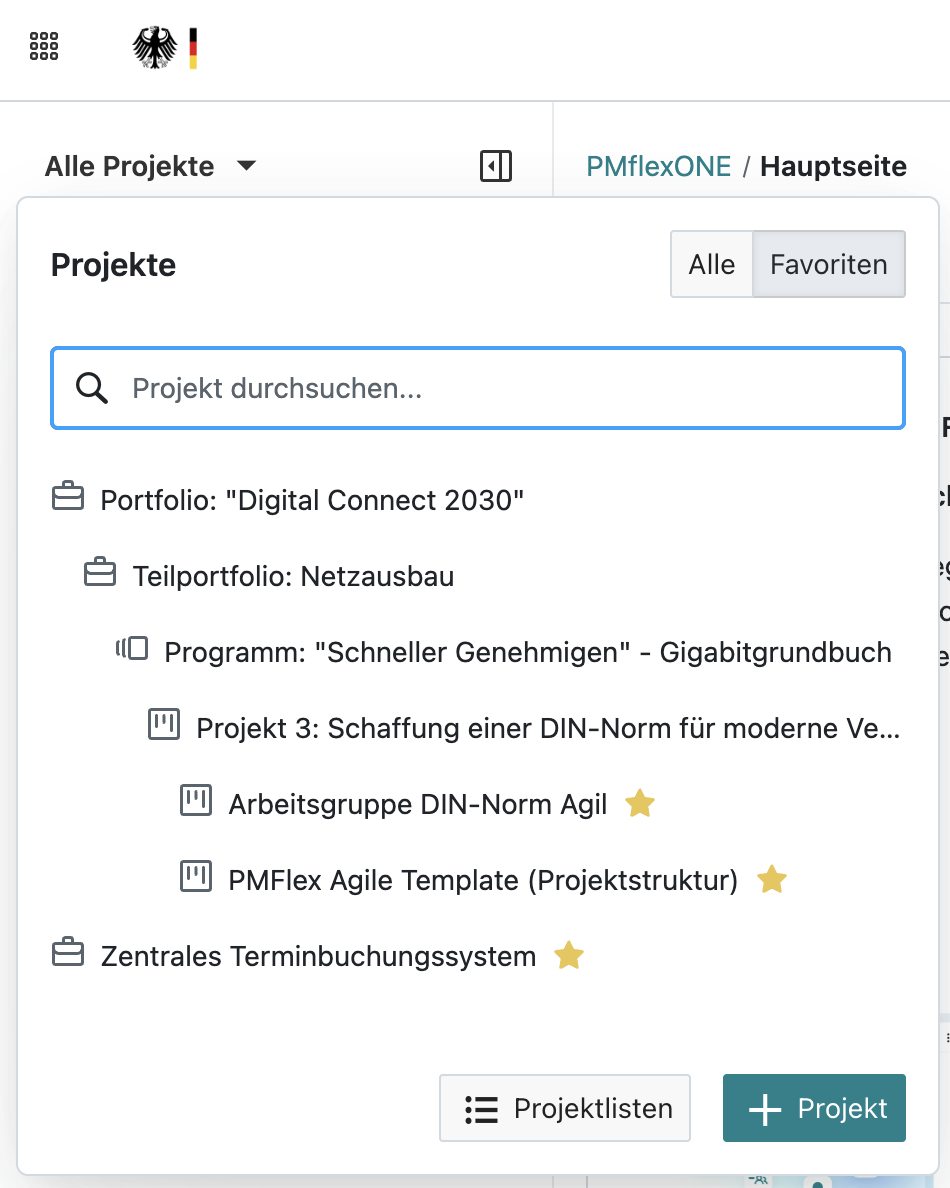
To support PM², OpenProject needed to manage not just projects but also portfolios and programs. Modeling these was the first step during the hackathon. Portfolio, sub-portfolio, and program extend the existing project hierarchy with the ability to group projects and manage them collectively.
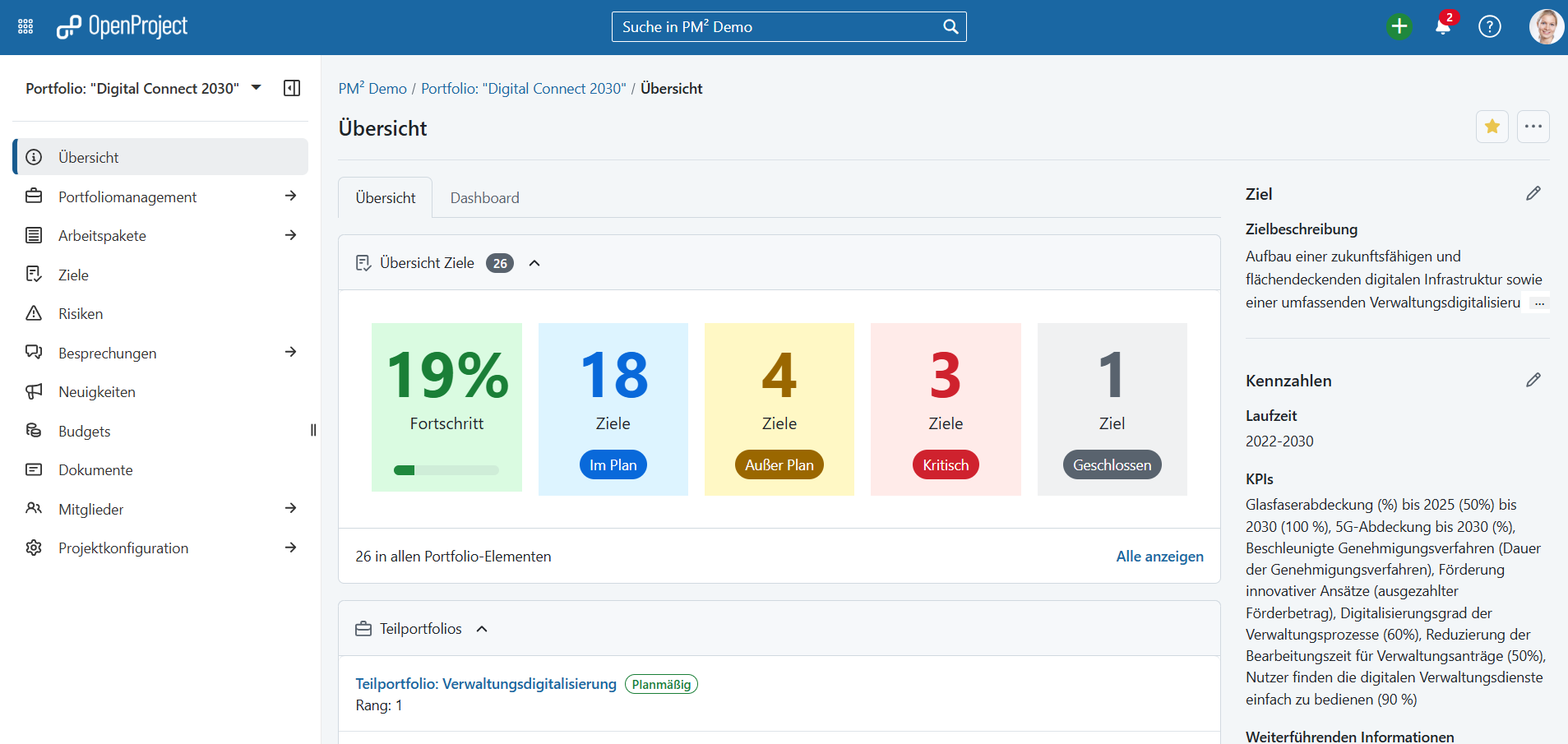
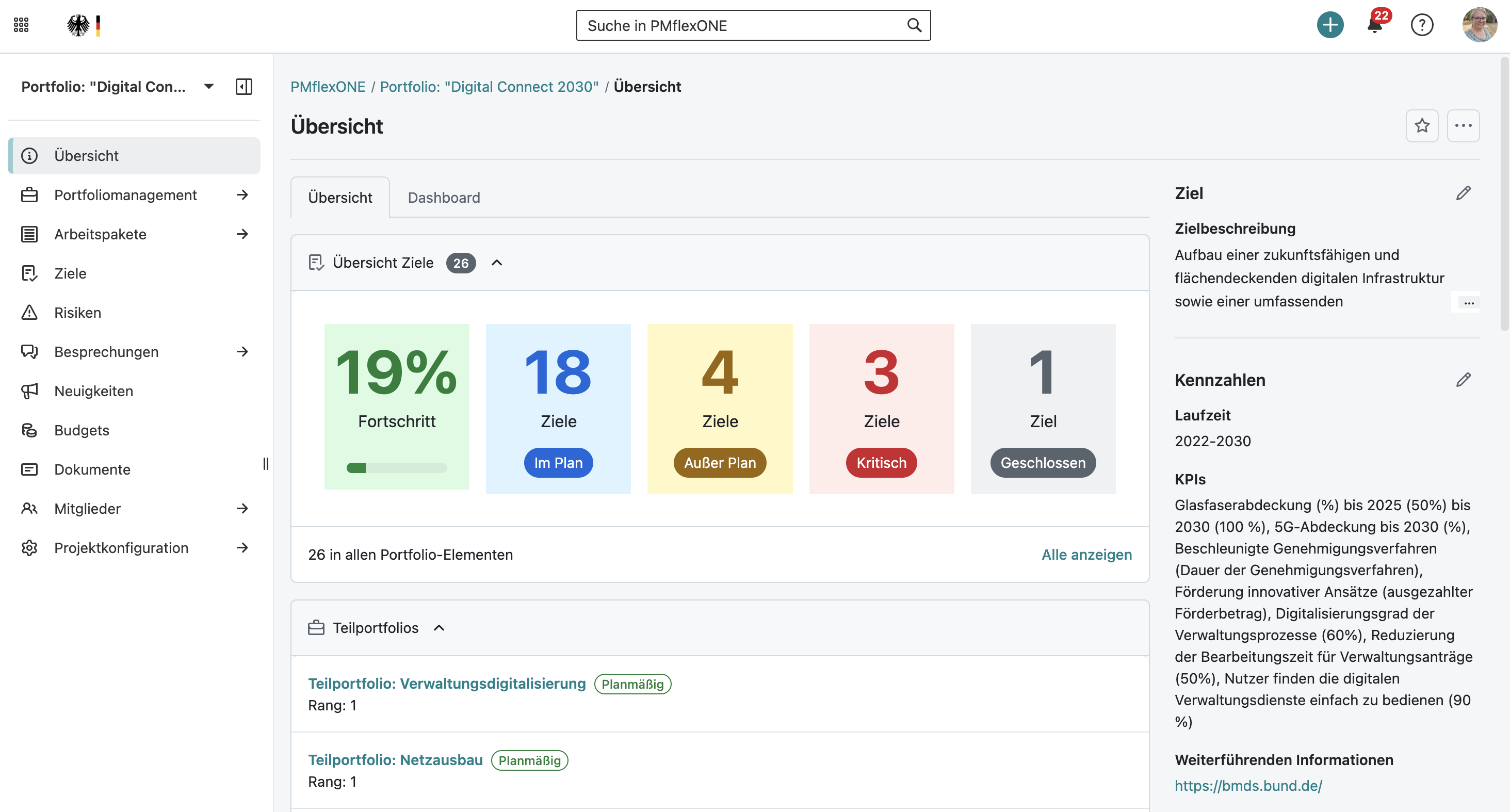
Enhancing portfolio and program dashboards
On the overview pages for portfolios, (sub-)programs, or even projects, managers want to see key information about goals, milestones, risks, and budgets at a glance. To enable this, we created widgets during the hackathon that visually aggregate this data: charts for budgets and risks, listings of components with their priority, status, and goal progress. These widgets were implemented as prototypes in a new dashboard using the OpenProject Design System.
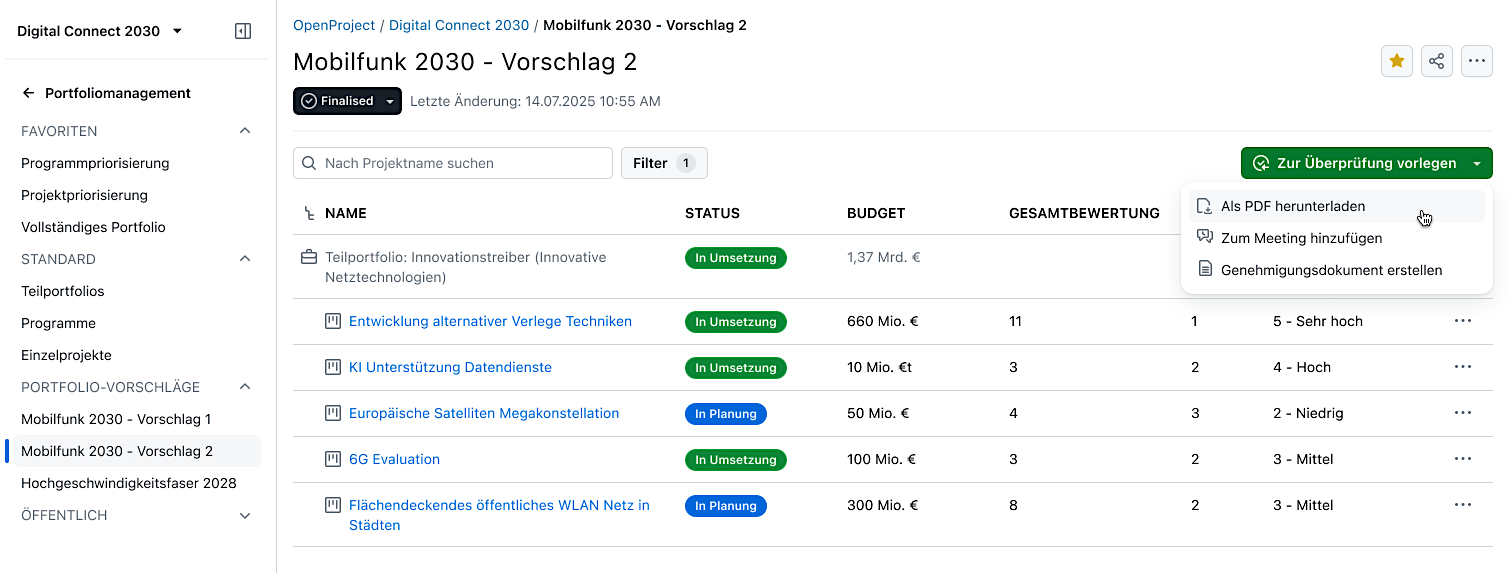
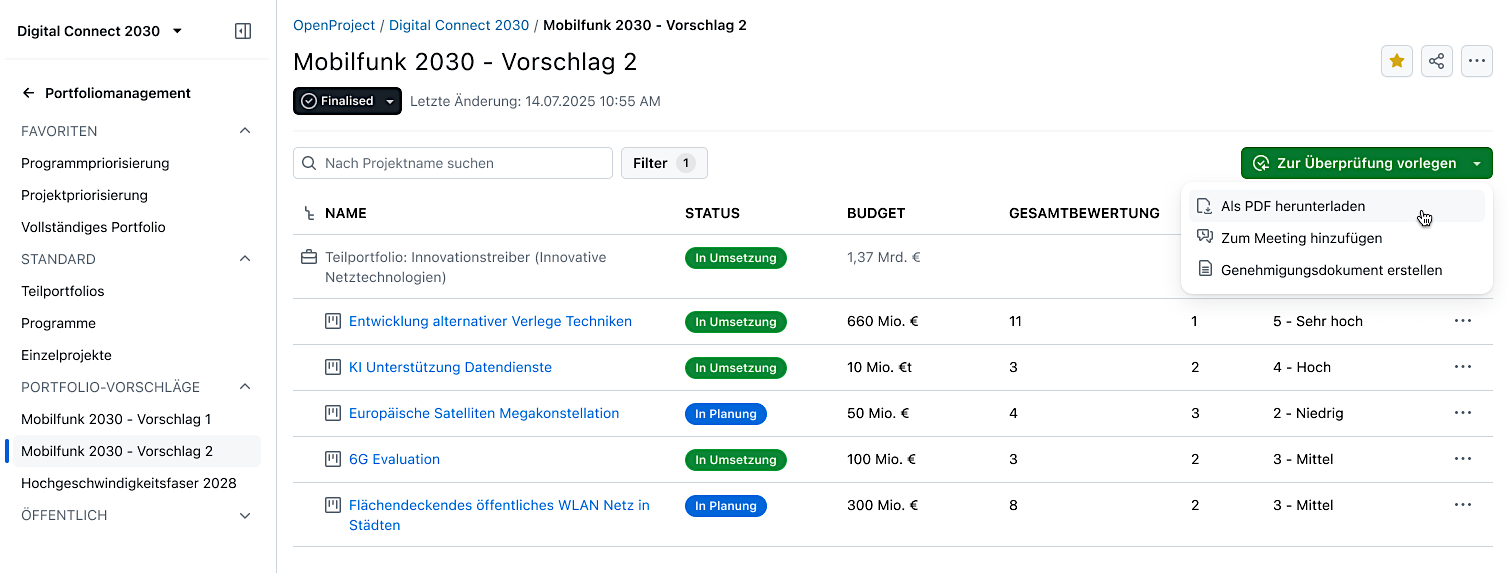
Portfolio management with proposal functionality
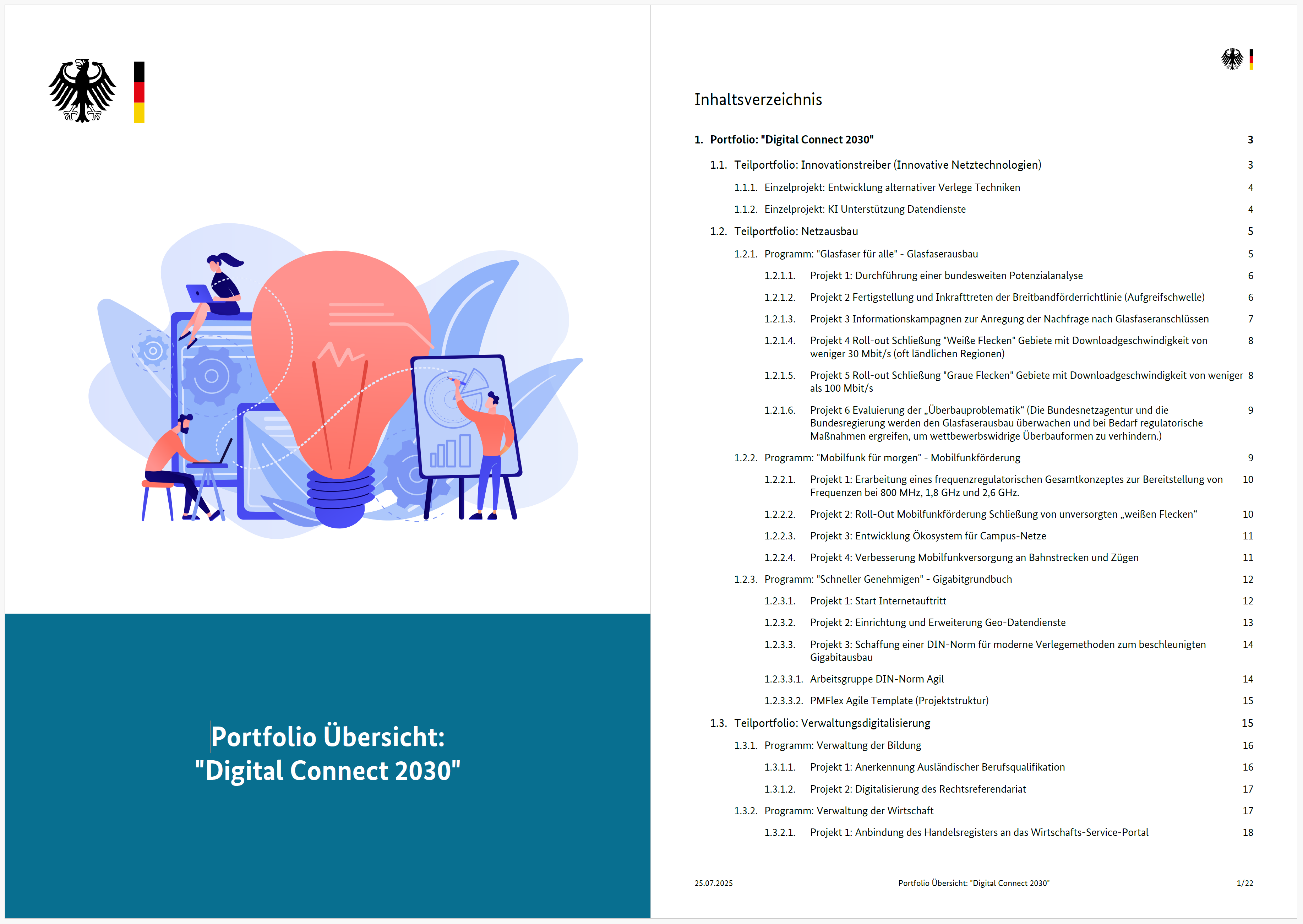
We created a dedicated module for portfolio management where managers can first create portfolio proposals and then submit them for review. These can be downloaded as PDFs or added to a meeting.
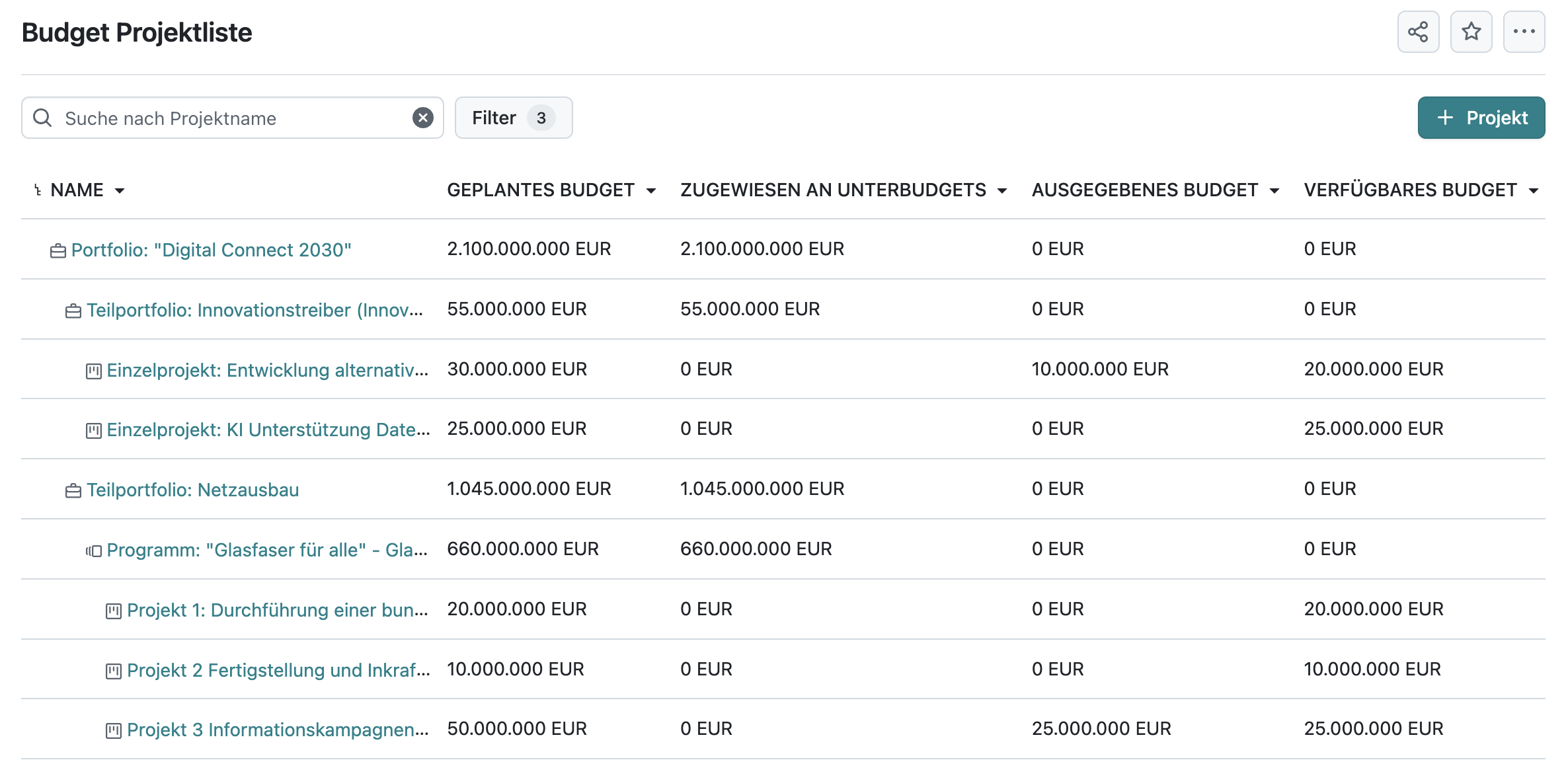
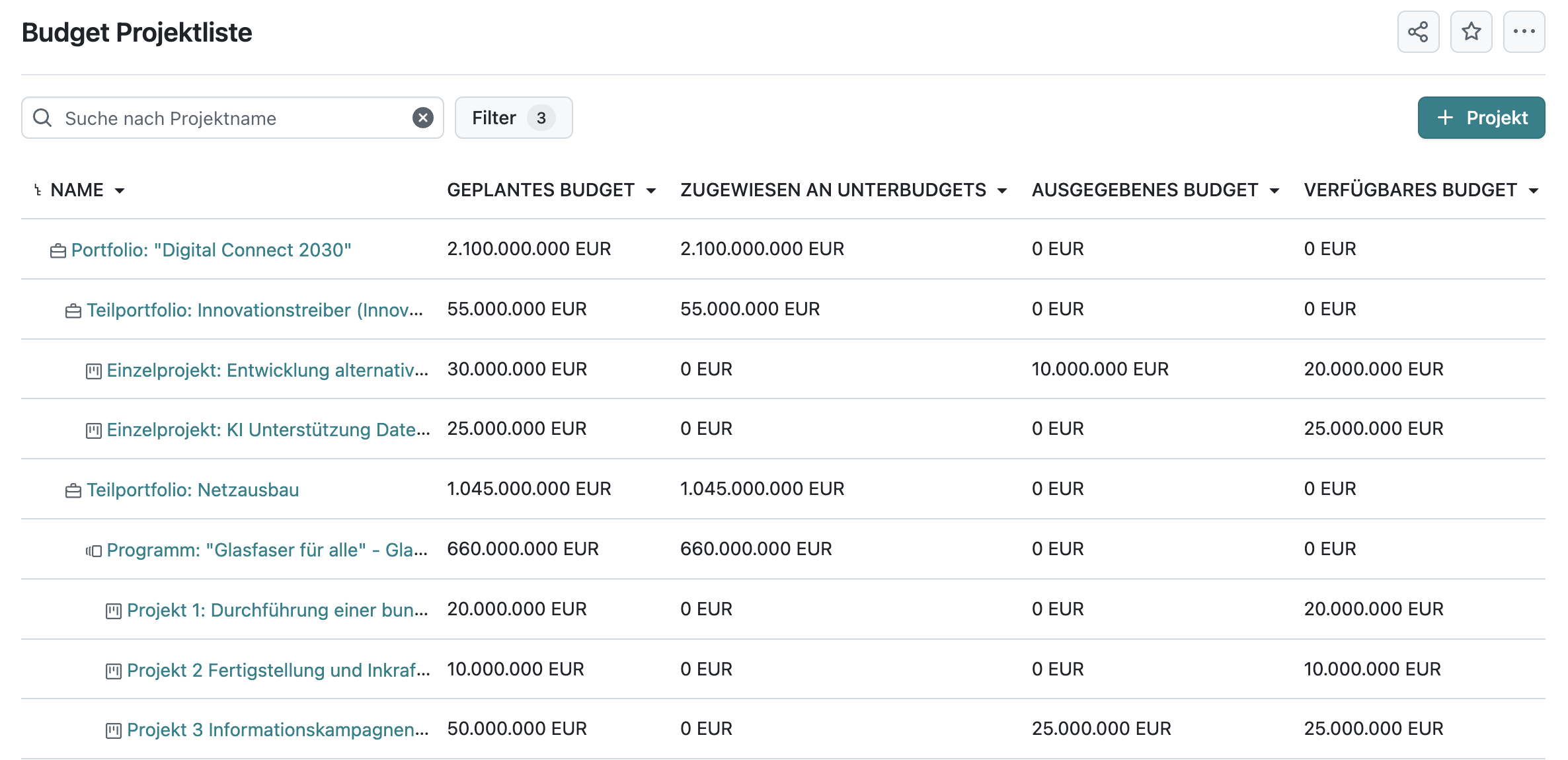
Linking and improved display of budget planning and overviews
OpenProject already supports extensive budgeting and cost tracking, but previously limited this to individual projects. During the hackathon, we added cross-project budgeting, distinctions between planned and booked costs, and modeling of sub-budgets. The overview page and project lists can now display total budgets and their components.
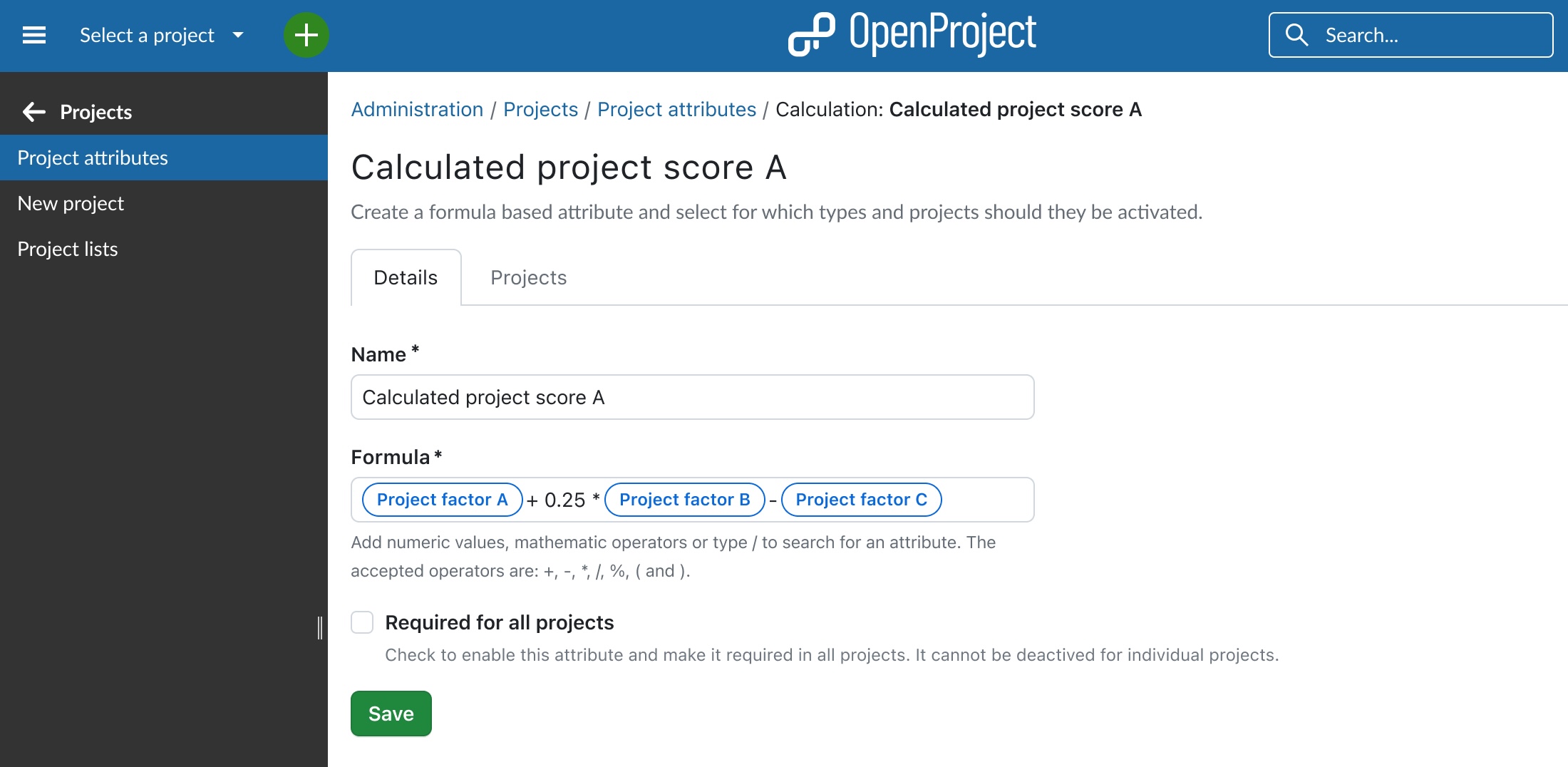
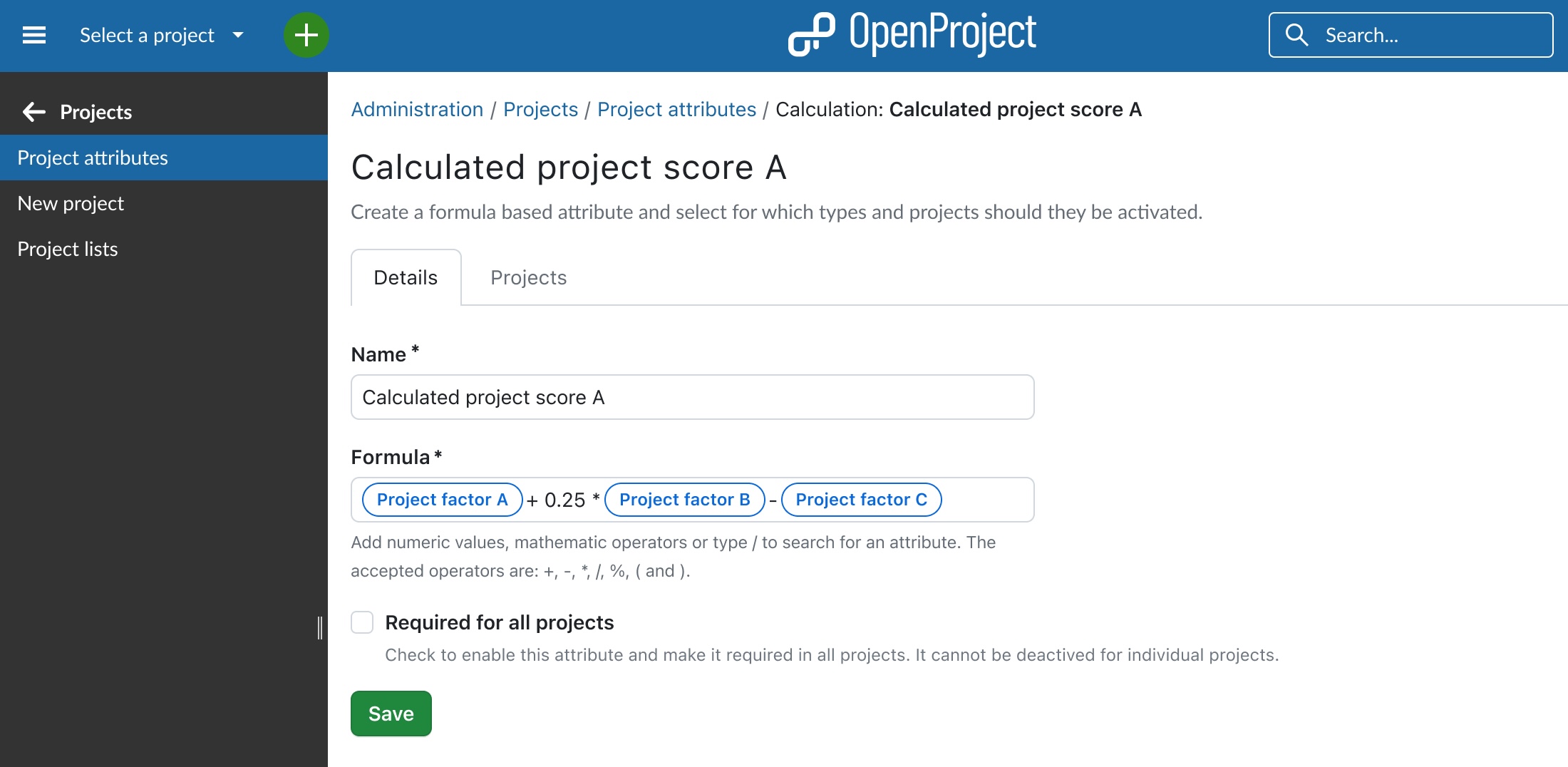
Calculated project scoring
Portfolio managers want to calculate project scores automatically based on project attributes, allowing better evaluation, prioritization, and communication of decisions. This functionality was further developed during the hackathon and activated on the demo instance to display ranking values for project weighting.
It is now possible to apply formulas to freely configurable values that together generate a score. This increases transparency and comparability of evaluations.
This feature is still in development (thanks City of Cologne for their support here), so we’re showing a design draft here:
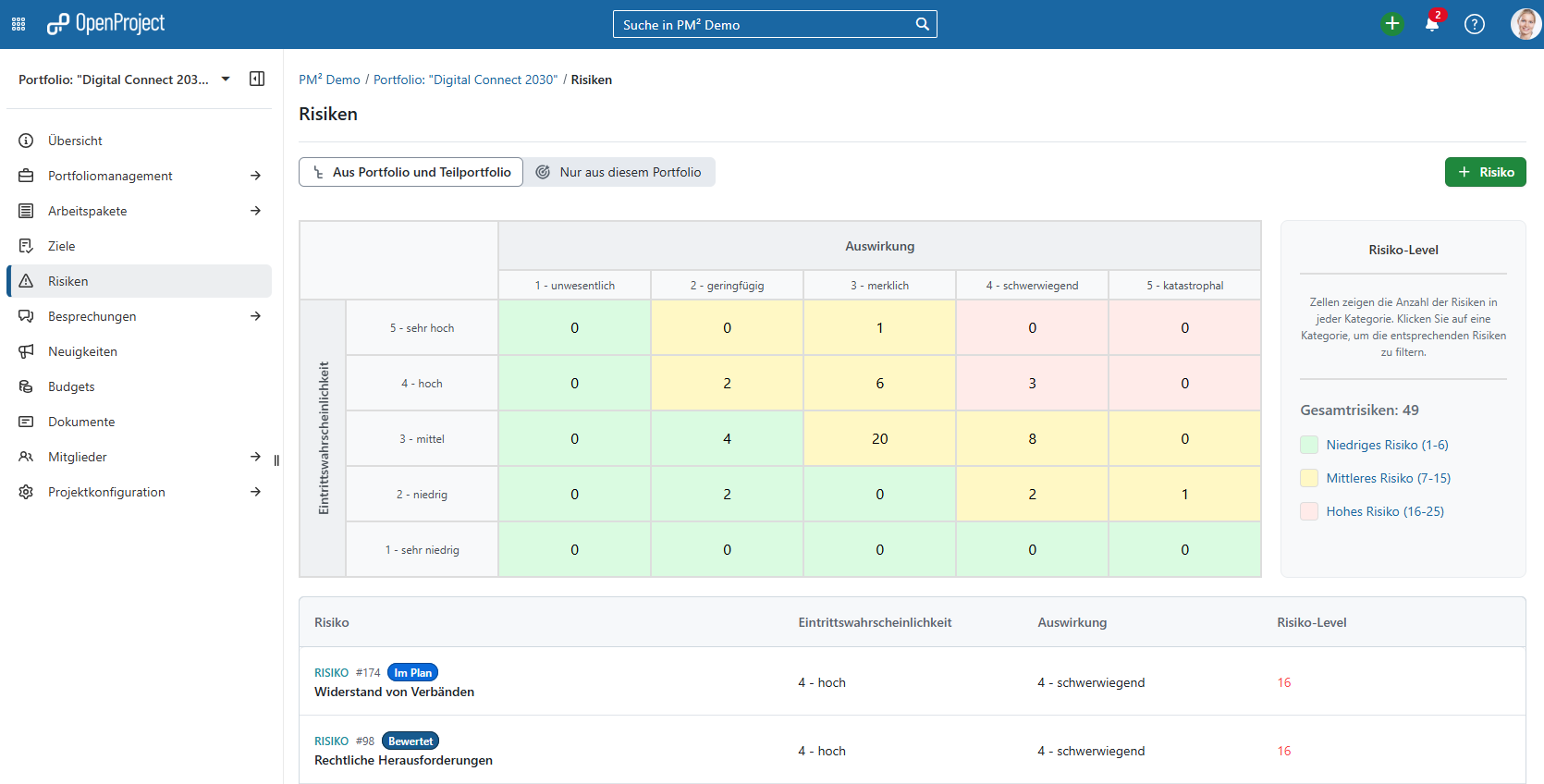
Risk management and overview
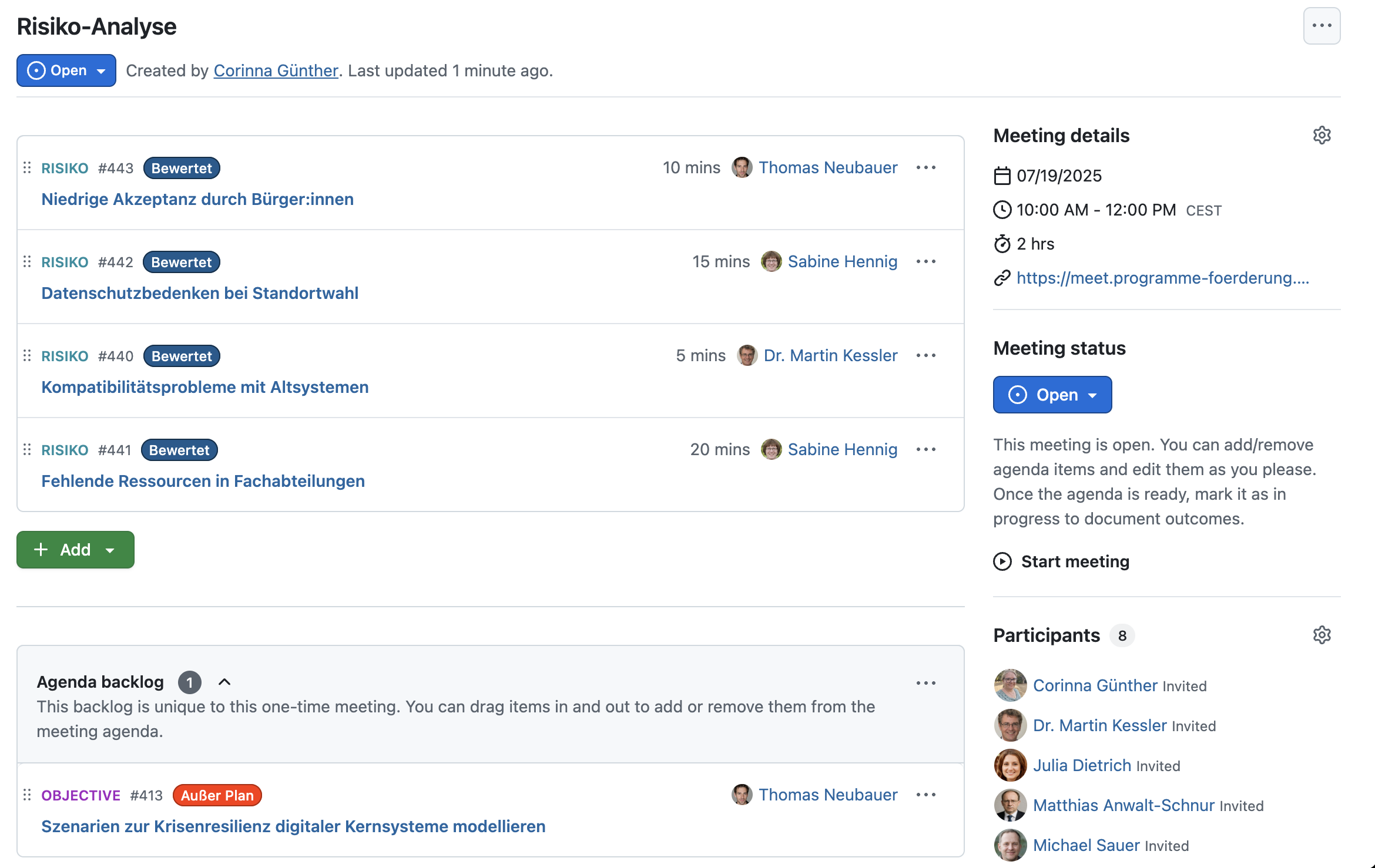
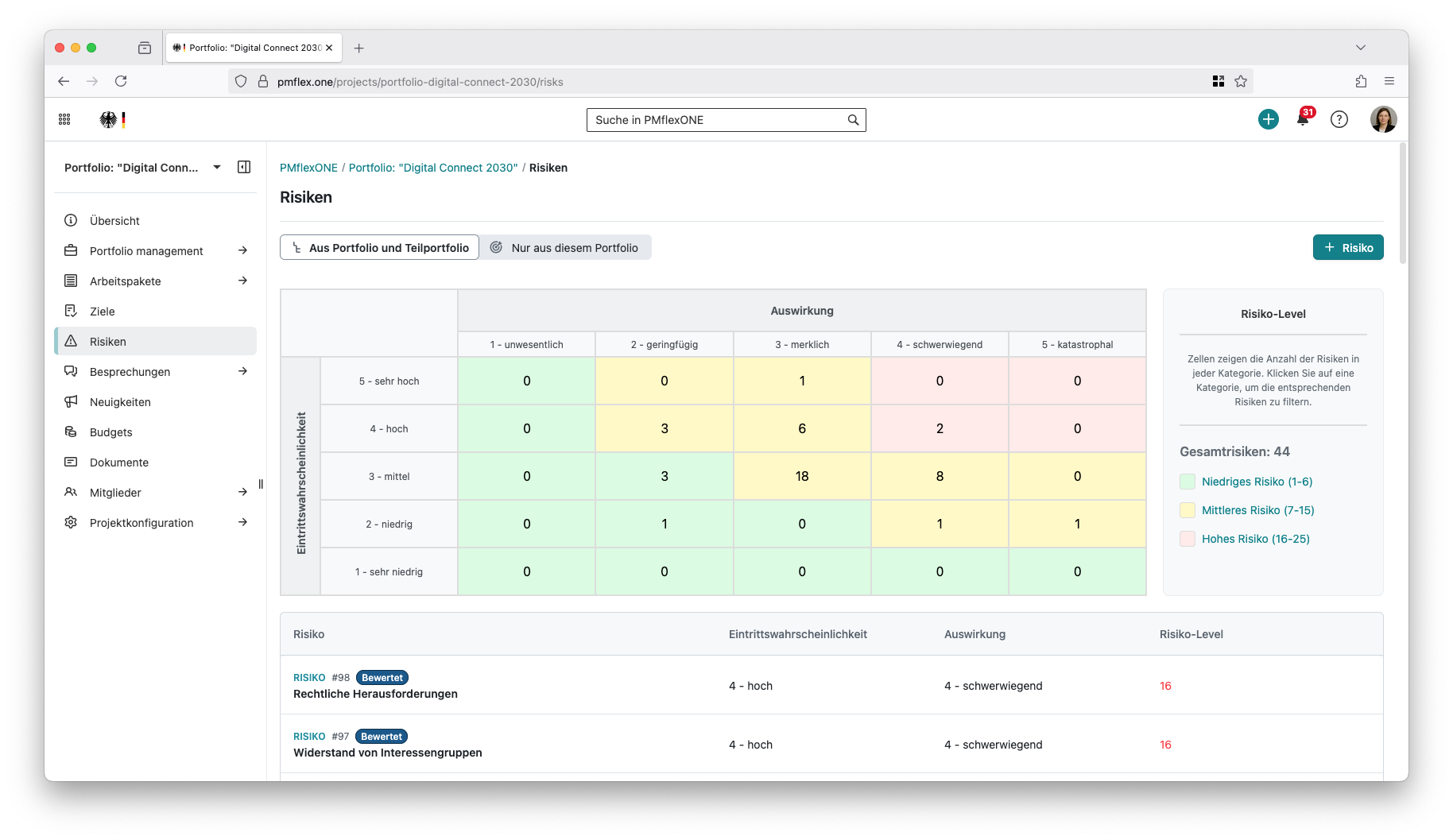
Since risk management is a core requirement for the public sector, we created a dedicated risk module. It includes a risk matrix that visualizes project, portfolio, or program risks with color-coded severity.
Modeling is based on probability (1–5) and impact (1–5). The system calculates a risk level from these values.
This also means: Risks now have their own data type and are a core part of OpenProject. Users are encouraged to document risks, monitor them regularly, and take countermeasures.
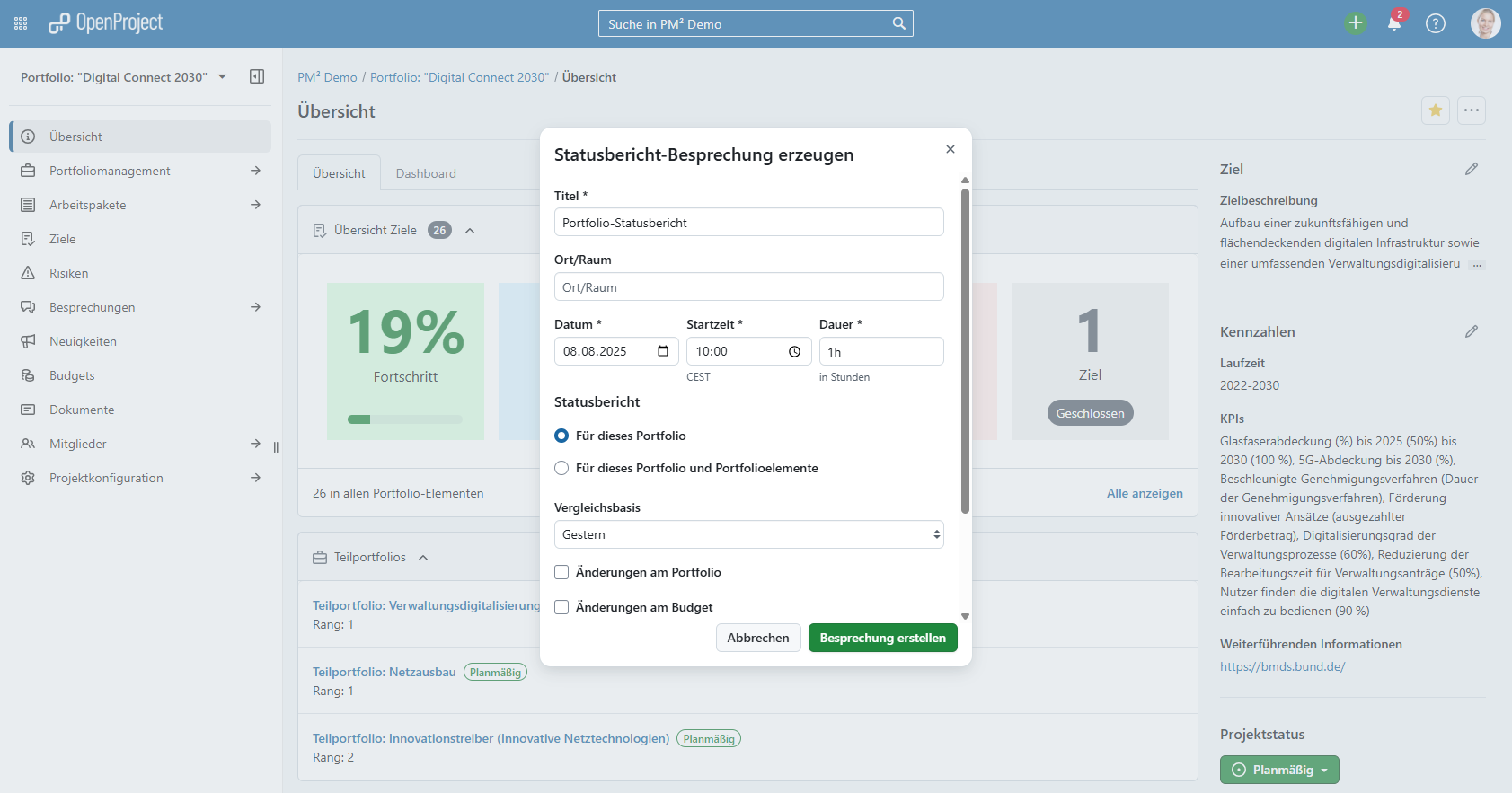
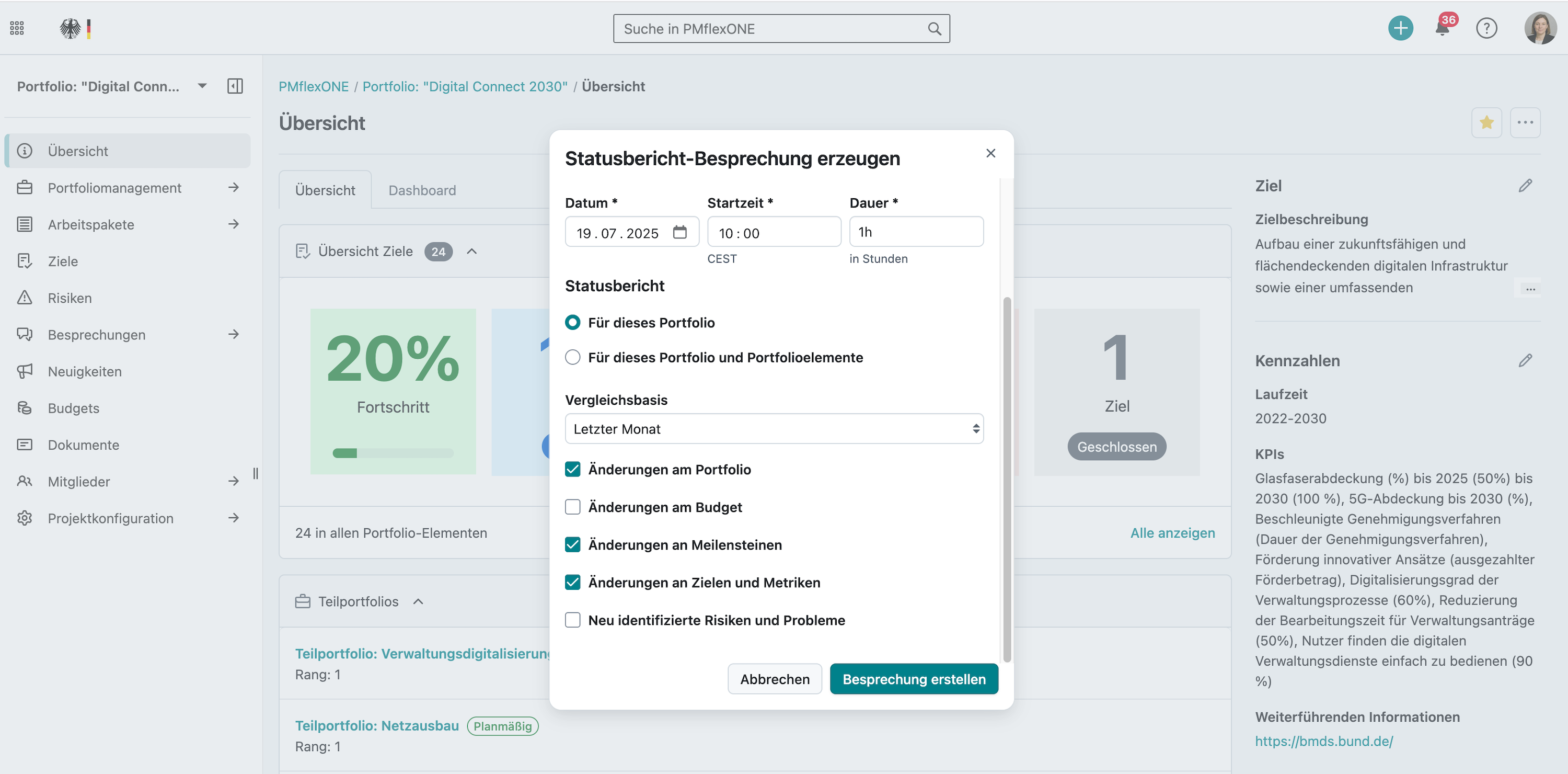
Create status report meetings
Status reports are a key element of PM². But they are not just documents — they are often discussed in meetings. That’s why we created a feature to automatically generate status report meetings.
Directly from the overview page, managers can create proposals for a status report meeting with the steering committee. They can select a baseline timeframe and add currently relevant information from the portfolio. The system generates an agenda based on selected changes for further editing.
Documents module with real-time editing
A few weeks ago, OpenProject successfully participated in Hack Days 2025 in Paris, organized by the French government’s digital directorate, DINUM (direction interministérielle du numérique). We’ve now extended those features to enable collaborative real-time editing for multiple users.
To support collaborative creation and sharing of typical documents, the OpenProject documents module was completely redesigned. It now allows for automatically updated content and real-time collaborative editing.
Mobile app enhancements for portfolio/program management
We have been working on a mobile app (iOS/Android) for OpenProject for some time. During the hackathon, we also developed new functionality to differentiate between portfolio, program, and project levels in the app.
Please note that developing a high-quality mobile app takes time, and we want to ensure the best experience before release. Of course, we will announce availability as soon as it’s ready for users.
AI foundations and support for documents and project/portfolio management
OpenProject was extended with two core services: Haystack to gather relevant information, and a custom LLM (Large Language Model). Both services operate within the same network as OpenProject and have no internet access. No data leaves the cluster for AI usage.
Detailed AI features developed during the hackathon include:
AI-generated status report drafts
Create drafts of status reports based on work packages and attributes visible to the respective user, using a local AI trained on PMflex
AI assistance in project and portfolio management
Display of PMflex-based best practices on the overview page, based on analysis of project data and work packages
A secure local AI assists with introducing best practices and provides timely management recommendations
AI support in documents
Writing tools in the OpenProject editor (translate, rephrase, spell check, generate drafts, etc.)
Familiar AI editing features directly inside the editor
The documents module uses the LLM to perform simple text tasks like summarizations
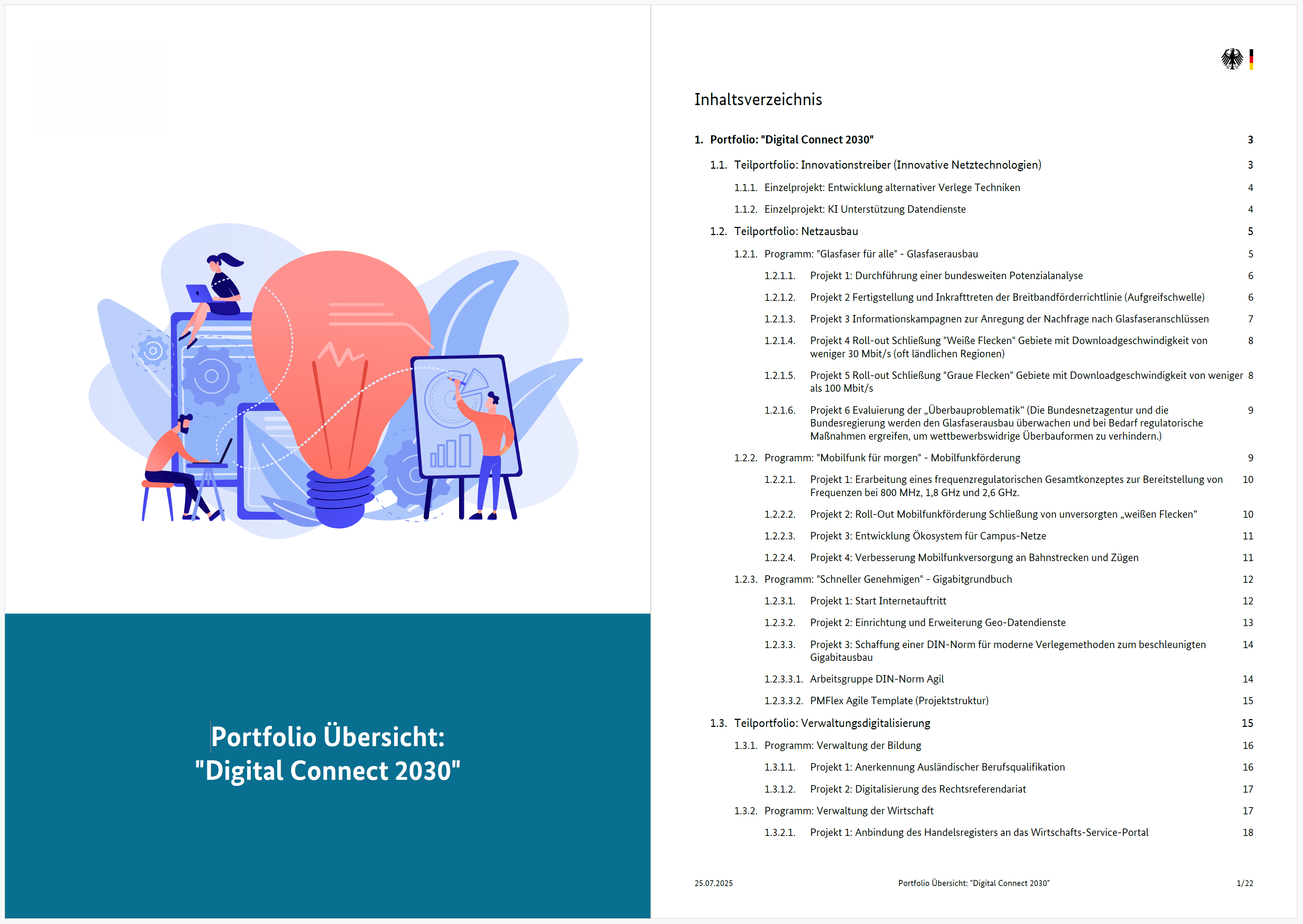
PDF export of portfolio and program status
We believe in a single source of truth for project data. However, there many use cases where an export is extremely helpful, e.g. when information needs to be documented in external systems. So during the hackathon we built a status report engine that creates pixel-perfect PDF files from the data in the system.
Status information
Budget
Risks
Objectives
KPIs
Milestones
Custom attributes
[…]
Kudos go to the German Federal Ministry of the Interior who sponsored the pdf export of work packages in 2023. The PDF export library we developed laid the foundation for this feature.
As an outlook, we are working on more configuration options to adjust the export to the specific needs. Additionally, we plan to add further charts and illustrations.
Found? – What happens after the hackathon?
All released features will be available either in OpenProject itself or in openDesk, the secure office and collaboration suite designed specifically for the public sector.
Demo environments provided through OpenProject’s SaaS infrastructure
Even though the work is progress this hackathon clearly demonstrated how OpenProject, as an open source solution, can meet the concrete requirements of public administration — quickly, competently, and collaboratively.
There is a visible shift toward data sovereignty, open standards, and independent software solutions — not only, but especially in the public sector.
The server location is a relevant criterion when looking for software: If you choose a software provider from the EU with servers in the EU, you can rely on EU data protection (GDPR). Especially with project management (PM) software, data protection and security is an extremely important issue, since sensitive data is stored. But which project management software meets this requirement?
Find out in the article why the German PM software OpenProject is a safe choice in terms of server location, data protection and customer service.
Overview: Project management software from Germany
Anyone researching PM cloud software will quickly come across well-known solutions such as Jira, Asana or Trello. However, most market leaders for PM software are not based in the European Union and regularly host their servers outside the European Union. And even if software is hosted in Europe, stored data could be made available to US authorities upon request. This is in conflict with the GDPR and would therefore contradict the use of any cloud services with US reference.
If you are specifically looking for PM software from Germany, you need to take a good look. The following PM software providers have both their headquarters and server locations in Germany: OpenProject, Stackfield, InLoox, Factro, awork.
All of the above solutions offer servers in the European Union. In addition, they all offer German-language support, documentation – and, of course, a German user interface.
The best open source PM software from Germany: OpenProject
OpenProject stands out from other German project management software providers mainly because of the following criteria:
A wide range of German-speaking companies and organizations already rely on the Enterprise version of OpenProject, including, for example: City of Cologne, Autoliv, University of Zurich, Fraunhofer, Volksbank Bocholt, Brandenburg State Parliament, Siemens or Charité Berlin. Many more are managing their projects with the free of charge Community version.
European legal security: DSGVO compliant and open source
Of course, the cloud-hosted version of OpenProject is DSGVO compliant. All data - starting with marketing! - is treated with strict confidentiality. Our goal is to minimize data storage, that is, to capture and store only Data that is really necessary. No matter if you are browsing the OpenProject website or using the software. We do not set cookies that are not technically necessary, and we do not collect or process personal data for any purpose other than ensuring our services.
In short: For OpenProject, data protection is not just a legal regulation, but a matter of course.
CEO Niels Lindenthal: “Our goal is to bring OpenProject to perfection as a lighthouse project for data privacy and security in Europe.”
As open source software, the source code of OpenProject is publicly available. This means that numerous people can quickly expose errors and possible security vulnerabilities. Because: Like any software, OpenProject can be affected by security vulnerabilities. These can usually be found and fixed much faster in OpenProject by the vigilant community than in project management software that is not open source.
Good to know: For EU customers it is required by the GDPR to sign a data processing agreement (sometimes called data processing addendum) before using the OpenProject Enterprise cloud edition. To save bureaucratic effort and time for both sides, OpenProject has automated this process.
In addition to data security, data sovereignty is a top priority at OpenProject. Together with other open source software providers, OpenProject is currently working on openDesk - the Sovereign Workplace, an open source alternative to Microsoft, Google and Co. OpenDesk is initiated and supported by the Federal Ministry of the Interior and Homeland of Germany.
Server locations in Europe
OpenProject can be operated on self-managed servers (”on-premises”) or used as software-as-a-service in the cloud. If you decide to use the cloud version of OpenProject, your data will be stored on secure servers within the EU. If you prefer a server location specifically in France, this is also possible without any problems - just contact us!
Important
Prior to March 2026 our services are hosted across both Netways (Germany) and Scaleway (France) data center environments. Starting with March 2026, Scaleway will become our sole data center provider for the EU shard.
Security always includes backups, which are continuously created for OpenProject’s cloud solutions. This means that data can be easily restored in the event of an emergency. Backups are stored on separate servers at OpenProject and encrypted as data-at-rest (with AES-256).
German-speaking support for international customers
Another important criterion when deciding on project management software is customer support. While many people in the DACH region speak English, most feel most confident in their native language, especially when it comes to technical vocabulary. OpenProject, as a German company based in Berlin, offers full German support.
Book training and consulting in German or English, or contact our English- or German-speaking customer support staff. Our digital user guide is also available in German as well as English. And also in Spanish and French - further languages are planned.
Rely on OpenProject for all-around secure data handling in your project management. Software from Germany, with European standards - for international customers.
What does a software solution look like that enables employees in the German federal administration to successfully prioritize, manage, implement, and report on strategic initiatives?
At OpenProject, we had the chance to explore this very question during a hackathon last week, as we are on the shortlist for this software solution. In this article, we will present the exact requirements from the German Federal Ministry for Digital and Modernization of the State (BMDS) and the results we were able to deliver.
The requirements defined by the BMDS are based on PMflex, a comprehensive strategic management solution and integrated project management system developed at the federal level specifically for public administration. PMflex is based on the open source project management methodology PM² provided by the European Commission.
If you already want to “spoil” the results, feel free to watch the following video (available in German only), which we presented to the ministry at the end of the hackathon:
Wanted: A software solution for the strategic implementation of federal digitalization initiatives
During the week of July 14–18, 2025, OpenProject not only released a new software version but also spontaneously participated in a kind of hackathon. The client was the Federal Ministry for Digital and Modernization of the State (BMDS). The ministry is looking for a software solution to implement strategies at the portfolio, program, and project levels.
We at OpenProject are honored to be shortlisted for this solution and used the hackathon to show that all requirements are either already met or will be met in the near future.
Transparency is one of our core values, so in this article we want to share an overview of the hackathon, the requirements, and of course our proposed solutions.
Requirements included:
PMflex compatibility (tailoring)
Consistency across portfolio, program, and project levels
Cross-agency collaboration
Agility
Enjoyable user experience
Challenges for us:
Only one week to develop additional features, comprehensive demo material, documentation, and (video) presentation. All of this alongside our daily business, including the release of version 16.2.
Immersing ourselves in the working environment and various user stories from public administration, which operates very differently than we do internally. Here, our extensive experience with the public sector, especially in connection with openDesk, was a major advantage.
Overview of the required user stories:
Several user stories were provided, each with associated data like budget, status, target states, and more. Every user story included at least one fictional persona, from whose perspective the solution needed to be demonstrated.
Prioritize portfolio elements
Manage portfolio
Report program status
Report project status
In addition to the predefined user stories, we also showcased how the solution could be used on the go via the mobile app.
Delivered: Full commitment for ten new features and implementation in PMflexONE
Alongside 19 developers, many other OpenProject team members were fully engaged in the BMDS hackathon. Despite — or perhaps because of — the short timeframe and complex requirements, the energy and team spirit were tangible across all days, even across our globally distributed remote workspaces.
For Rosanna Sibora, who had her very first week at OpenProject as Chief Product Officer during the hackathon, the team’s commitment, creativity, and passion made a strong impression:
“During the hackathon, I was impressed by how well the self-organized teams collaborated. It clearly showed me how well-aligned the OpenProject team is and how open and empowering the culture is. We proved that 2+2 is definitely more than 4 — and what can be achieved with great collaboration and empowerment.” – Rosanna Sibora, CPO, OpenProject GmbH
OpenProject implementation – behind the scenes:
Full energy and passion, not just from developers
15,000+ lines of new code
Team formation for developing new features, building a demo instance, and designing product mockups for additional features
Daily hackathon stand-ups, retros, and pulse checks with the BMDS and other stakeholders, 100% remote collaboration using other open source tools like Big Blue Button and Element
Daily operations continued in parallel: support and release of OpenProject 16.2
OpenProject implementation – on the product level:
While the current version of OpenProject already supports the majority of requirements, we identified several aspects we wanted to expand or develop from scratch during the hackathon week. Especially relevant across all user stories was the development of features for reporting and managing goals, risks, and budgets.
Here is an overview of our main development focuses during the hackathon:
Let’s take a closer look at what these features and requirement implementations looked like by the end of the hackathon week.
Important
Please note that this is a summary of key developments. Additional features were also planned, designed, and developed during the hackathon. As these features were created in a very short time, they are not yet fully tested or finalized.
Planning and managing portfolios and programs
To support PMflex, OpenProject needed to manage not just projects but also portfolios and programs. Modeling these was the first step during the hackathon. Portfolio, sub-portfolio, and program extend the existing project hierarchy with the ability to group projects and manage them collectively.
Enhancing portfolio and program dashboards
On the overview pages for portfolios, (sub-)programs, or even projects, managers want to see key information about goals, milestones, risks, and budgets at a glance. To enable this, we created widgets during the hackathon that visually aggregate this data: charts for budgets and risks, listings of components with their priority, status, and goal progress. These widgets were implemented as prototypes in a new dashboard using the OpenProject Design System.
Portfolio management with proposal functionality
We created a dedicated module for portfolio management where managers can first create portfolio proposals and then submit them for review. These can be downloaded as PDFs or added to a meeting.
Linking and improved display of budget planning and overviews
OpenProject already supports extensive budgeting and cost tracking, but previously limited this to individual projects. During the hackathon, we added cross-project budgeting, distinctions between planned and booked costs, and modeling of sub-budgets. The overview page and project lists can now display total budgets and their components.
Calculated project scoring
Portfolio managers want to calculate project scores automatically based on project attributes, allowing better evaluation, prioritization, and communication of decisions. This functionality was further developed during the hackathon and activated on the demo instance to display ranking values for project weighting.
It is now possible to apply formulas to freely configurable values that together generate a score. This increases transparency and comparability of evaluations.
This feature is still in development (thanks City of Cologne for their support here), so we’re showing a design draft here:
Risk management and overview
Since risk management is a core requirement for the BMDS, we created a dedicated risk module. It includes a risk matrix that visualizes project, portfolio, or program risks with color-coded severity.
Modeling is based on probability (1–5) and impact (1–5). The system calculates a risk level from these values.
This also means: Risks now have their own data type and are a core part of OpenProject. Users are encouraged to document risks, monitor them regularly, and take countermeasures.
Create status report meetings
Status reports are a key element of PMflex. But they are not just documents — they are often discussed in meetings. That’s why we created a feature to automatically generate status report meetings.
Directly from the overview page, managers can create proposals for a status report meeting with the steering committee. They can select a baseline timeframe and add currently relevant information from the portfolio. The system generates an agenda based on selected changes for further editing.
Documents module with real-time editing
A few weeks ago, OpenProject successfully participated in Hack Days 2025 in Paris, organized by the French government’s digital directorate, DINUM (direction interministérielle du numérique). We’ve now extended those features to enable collaborative real-time editing for multiple users.
To support collaborative creation and sharing of typical PMflex documents, the OpenProject documents module was completely redesigned. It now allows for automatically updated content and real-time collaborative editing.
Mobile app enhancements for portfolio/program management
We have been working on a mobile app (iOS/Android) for OpenProject for some time. During the hackathon, we also developed new functionality to differentiate between portfolio, program, and project levels in the app.
Please note that developing a high-quality mobile app takes time, and we want to ensure the best experience before release. Of course, we will announce availability as soon as it’s ready for users.
AI foundations and support for documents and project/portfolio management
OpenProject was extended with two core services: Haystack to gather relevant information, and a custom LLM (Large Language Model). Both services operate within the same network as OpenProject and have no internet access. No data leaves the cluster for AI usage.
Detailed AI features developed during the hackathon include:
AI-generated status report drafts
Create drafts of status reports based on work packages and attributes visible to the respective user, using a local AI trained on PMflex
AI assistance in project and portfolio management
Display of PMflex-based best practices on the overview page, based on analysis of project data and work packages
A secure local AI assists with introducing best practices and provides timely management recommendations
AI support in documents
Writing tools in the OpenProject editor (translate, rephrase, spell check, generate drafts, etc.)
Familiar AI editing features directly inside the editor
The documents module uses the LLM to perform simple text tasks like summarizations
PDF export of portfolio and program status
We believe in a single source of truth for project data. However, there many use cases where an export is extremely helpful, e.g. when information needs to be documented in external systems. So during the hackathon we built a status report engine that creates pixel-perfext PDF files from the data in the system.
Status information
Budget
Risks
Objectives
KPIs
Milestones
Custom attributes
[…]
Kudos go to the German Federal Ministry of the Interior who sponsored the pdf export of work packages in 2023. The PDF export library we developed laid the foundation for this feature.
As an outlook, we are working on more configuration options to adjust the export to the specific needs. Additionally, we plan to add further charts and illustrations.
Found? – What happens after the hackathon?
At the time of writing, it is still open what the next steps will be for OpenProject and the BMDS. What we do know is that the entire OpenProject team has grown through this experience — and we are proud of what was achieved and delivered during the week.
Regardless of the outcome of the tender, we will finalize, thoroughly test, and potentially release the developed features to our customers in future versions.
All released features will be available either in OpenProject itself or in openDesk, the secure office and collaboration suite designed specifically for the public sector.
If OpenProject is selected in the BMDS tender, the rollout would likely proceed as follows:
Implementation consulting via specialized partners such as ]init[
Demo environments provided through OpenProject’s SaaS infrastructure
Even though the BMDS decision is still pending, this hackathon clearly demonstrated how OpenProject, as an open source solution, can meet the concrete requirements of public administration — quickly, competently, and collaboratively.
There is a visible shift toward data sovereignty, open standards, and independent software solutions — not only, but especially in the public sector.
OpenProject 16.2 has been released and this version introduces new features and improvements again. We look forward to hearing your thoughts and feedback on the latest updates. Please take a few minutes to learn what changes for you. We will summarize the most important changes in this blog article and, as always, please see our release notes that contain all changes, features and bug fixes.
In this blog article, we will focus on the design updates and briefly summarize some more important features. Here is a quick navigation to all feature descriptions:
New header and sidebar with improved navigation and design
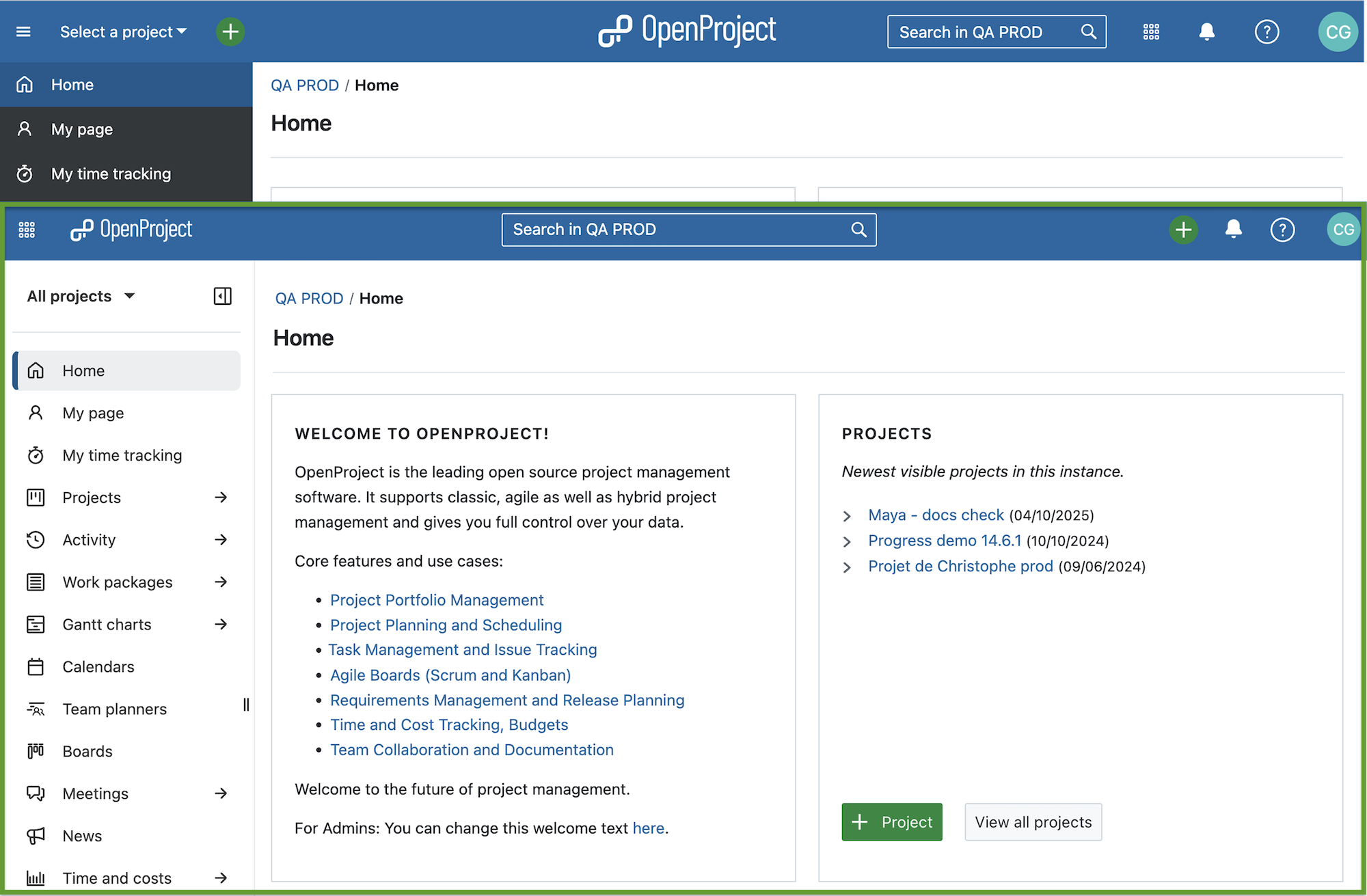
The most striking change from 16.1 to 16.2 is the more modern design and improved user experience of the sidebar and header navigation. The reason for these changes is to give the application a more contemporary look and to ensure compatibility with the openDesk application. It is important to us to provide the best possible user experience in openDesk when navigating between the different applications within openDesk.
The updates in OpenProject itself also follow familiar logic. For example, the project navigation has moved consistently into the sidebar. Here’s an overview of what’s new in OpenProject 16.2, regarding header and sidebar navigation:
The hamburger sidebar toggle has moved from the header to the sidebar.
The default sidebar color in light mode is now brighter.
The search and create buttons have a new, more intuitive position in the header.
Please note that these changes will not affect your already customized designs.
See a comparison between OpenProject version 16.1 (top) and 16.2 (highlighted below):
What do you think of these updates? As with any change, it may take some time to get used to the new navigation, but we hope that it will provide you with a better user experience in the long run and a more intuitive start for new users.
Other design updates in OpenProject 16.2
The changes to the header and sidebar weren’t the only design changes: as part of the ongoing updates to the Primer design system, the user interface and process for creating a new project or copying an existing one has also been improved. For example, when you create a project based on a template, you can now immediately select which modules and parts you want to copy and which you want to skip.
Also, in the Relations tab of a work package, the + Relation dropdown now uses second-level navigation: Only the first relations are shown directly, others are displayed when clicking on “Other relations”.
Seamless integration of open source applications with a SCIM API (Enterprise add-on)
While this is a rather technical update, the newly added SCIM API can be a huge benefit for seamless integration with other open source applications. It allows your identity provider (IdP) to automatically provision and de-provision users in OpenProject, based on the open SCIM standard.
This reduces manual work for administrators, ensures your user data stays in sync across systems, and improves overall security.
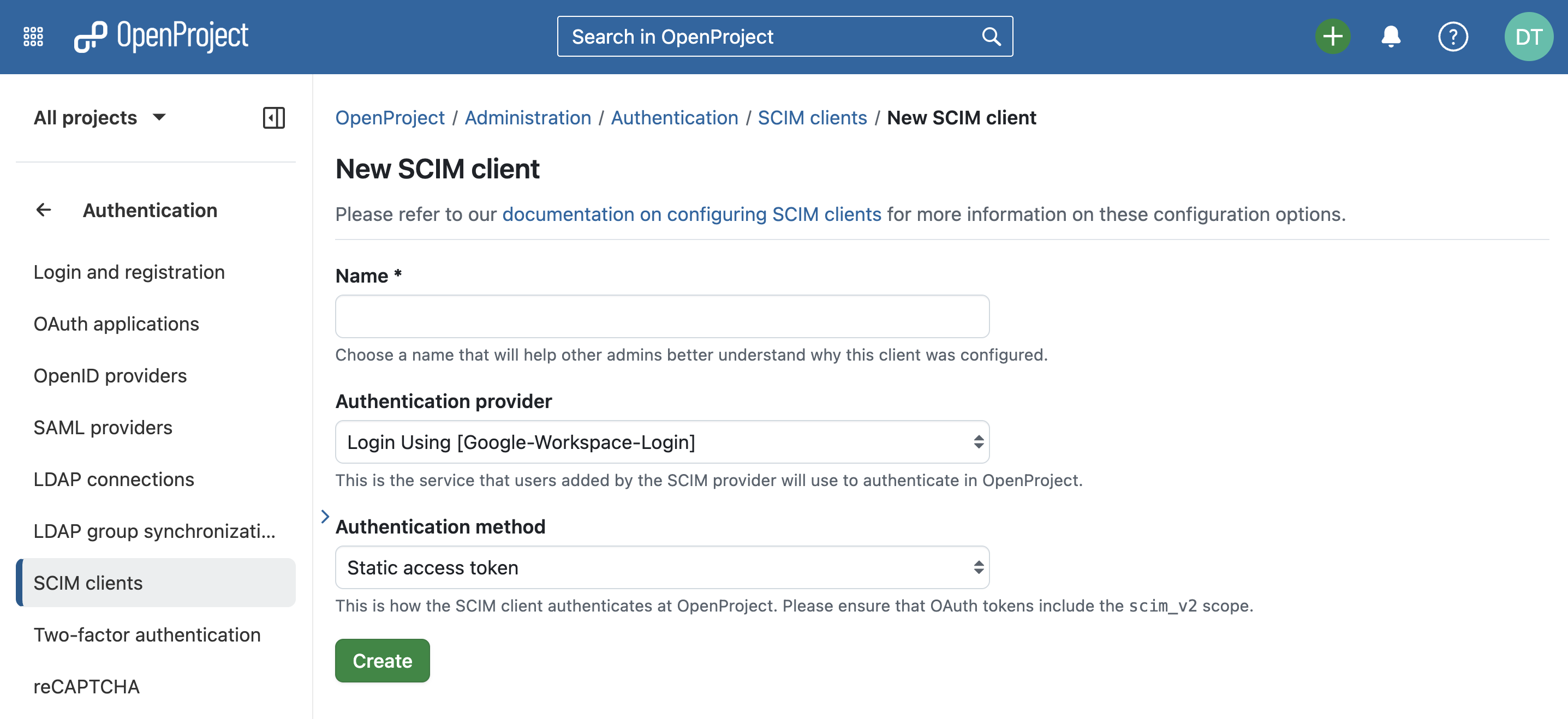
The SCIM API is available as an Enterprise add-on in the Corporate plan. Administrators can configure SCIM clients directly in OpenProject, generate secure system tokens, and see which users are managed by which client – all within the authentication settings.
This is particularly valuable for organizations looking to connect OpenProject to other open source tools such as Nextcloud or Keycloak, supporting a fully sovereign and integrated digital workspace.
See our system admin guide to learn more about authentication methods for OpenProject.
Non-Latin languages and emojis supported in PDF exports
We’re especially happy about this update, because it makes OpenProject even more international and inclusive: PDF exports of work packages now fully support non-Latin scripts and emojis, so languages like Arabic, Chinese, Japanese, Korean and many others appear exactly as intended. This means your multilingual project data and even your favorite emojis are displayed correctly in your exported documents.
Option to disable keyboard shortcuts for better accessibility
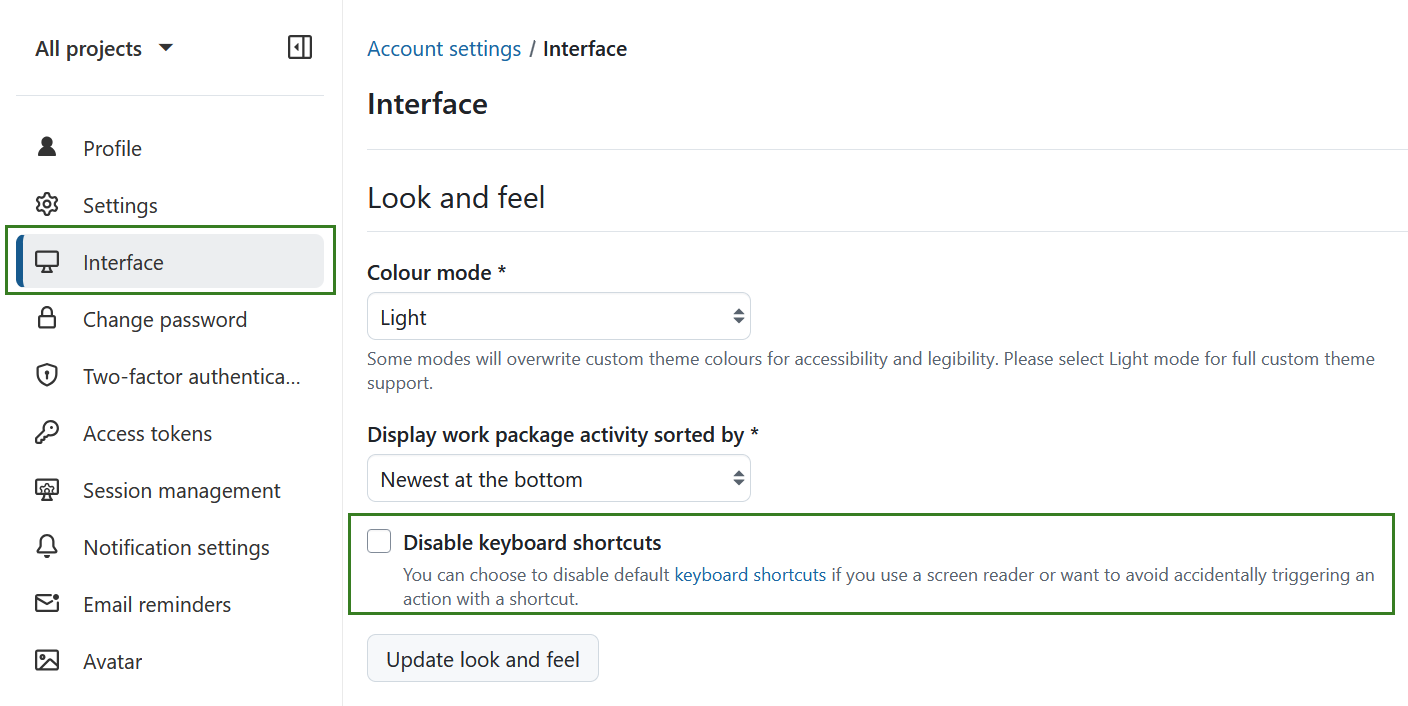
Here comes another step in improving accessibility across OpenProject. Users can now disable all keyboard shortcuts in their personal settings. That’s not only helpful for people working with screen readers or other assistive technologies, but also for anyone who prefers to avoid unintended shortcut actions.
Tip
Have you noticed? We recently also updated the font on our website to make it easier to read. While improving the OpenProject application is our main focus, we are also aware of accessibility issues on our website and in our documentation, and we are working to address them.
Smoother experience with Custom fields, Meetings, and My time tracking
Apart from the already mentioned feature updates, OpenProject 16.2 includes many small improvements that make everyday work just a bit smoother.
When creating custom fields or project attributes, you can now pick the field type right at the start — saving clicks and making the setup process clearer.
For meetings, OpenProject is now listed as the organizer in calendar invitations instead of the person who created the meeting. This means everyone can freely accept or decline without accidentally canceling the event for all participants.
And in the My time tracking module, weekly views now collapse future days, helping you stay focused on what matters today.
OpenProject 16.2: Migration, installation, updates and support
You will find more information about all new features and changes in our Release notes or in the OpenProject Documentation.
If you need support, you can post your questions in the Community Forum, or if you are eligible for Enterprise support, please contact us and we are happy to support you personally.
New to OpenProject? To test all features of OpenProject 16.2 right away, create a 14 days free trial instance for our OpenProject Enterprise cloud.
Prefer to run OpenProject 16.2 in your own infrastructure? Here you can find the Installation guidelines for OpenProject.
A very special thank you goes to City of Cologne, Deutsche Bahn and ZenDiS for sponsoring released or upcoming features. Your support, alongside the efforts of our amazing Community, helps drive these innovations. Also a big thanks to our Community members for reporting bugs and helping us identify and provide fixes. Special thanks for reporting and finding bugs go to Michael Lathion, Jason Culligan, Sven Kunze, and Gábor Alexovics.
Last but not least, we are very grateful for our very engaged translation contributors on Crowdin, who translated quite a few OpenProject strings! This release we would like to particularly thank the following users:
William, for a great number of translations into Chinese Traditional.
rmiyata, for a great number of translations into Japanese.
rubenpedrolopez, for a great number of translations into Spanish.
Would you like to help out with translations yourself? Then take a look at our translation guide and find out exactly how you can contribute. It is very much appreciated!
As always, we welcome any feedback on this release. 💙
Whether you’re a team of five or fifty — as your organization grows, so does the number of projects, tasks, and priorities. At some point, work packages that once fit on one board become a sea of cards, and keeping focus becomes a challenge.
That’s why we created the Attribute highlighting feature: it helps you immediately see what needs your attention most. In this article, we’ll walk you through a relatable scenario and show how this feature can support you in staying focused and scaling successfully.
Important
Before February 2026, Attribute highlighting was part of the Enterprise edition in OpenProject. With the release of version 17.1, it is part of the free Community edition, because we value our Community a lot and aim to give “back” Enterprise add-ons to all users every few releases. You can find more information about this feature in our documentation.
You’ve grown — now it’s time to change how you work
Things might be going well. Your organization is growing. More clients, more projects, more team members. But with growth comes complexity. What used to be a simple backlog is now a multi-project list of dozens — maybe hundreds — of open tasks. And suddenly, you’re no longer sure what’s urgent, what’s blocked, or what’s been waiting for weeks.
Your system hasn’t changed, but your needs have. And that’s a good thing — because it means it’s time to invest in new ways to keep your growing team aligned.
Clean up your work package table by highlighting priority, status or finish date
Let’s take your team’s work package table as an example. Imagine you’ve filtered for this month’s deliverables — but the list is still long. You spot tasks with due dates coming up, some that are marked high priority, and one that was updated just now. But it takes a few minutes of scrolling and reading to get the full picture.
That’s where Attribute highlighting comes in. This feature allows you to visually emphasize specific values in your work package table using color: overdue tasks can turn red, high-priority items might stand out in orange, and different status values can appear in clearly distinguishable shades.
With just a glance, your team can now immediately see:
What’s overdue,
What’s marked as high or urgent priority,
What’s resolved or in progress.
How Attribute highlighting works
Let’s say your team uses the Priority attribute and a custom status workflow. You can highlight individual attributes inline (Status, Priority, Finish date) or apply full-row highlighting based on Status, Type, or Priority.
Once you’ve set this up in the work package table view, your team sees these visual cues automatically — without needing to open each task individually.
Tip
You can configure which colors are used for each priority and status in the System administration. Learn how to adjust them for priorities and for statuses.
Let’s look at an example work package table and how it looks with different attributes highlighted. Please note that you can change the colors for work package attributes and that they might look different in dark mode or light mode.
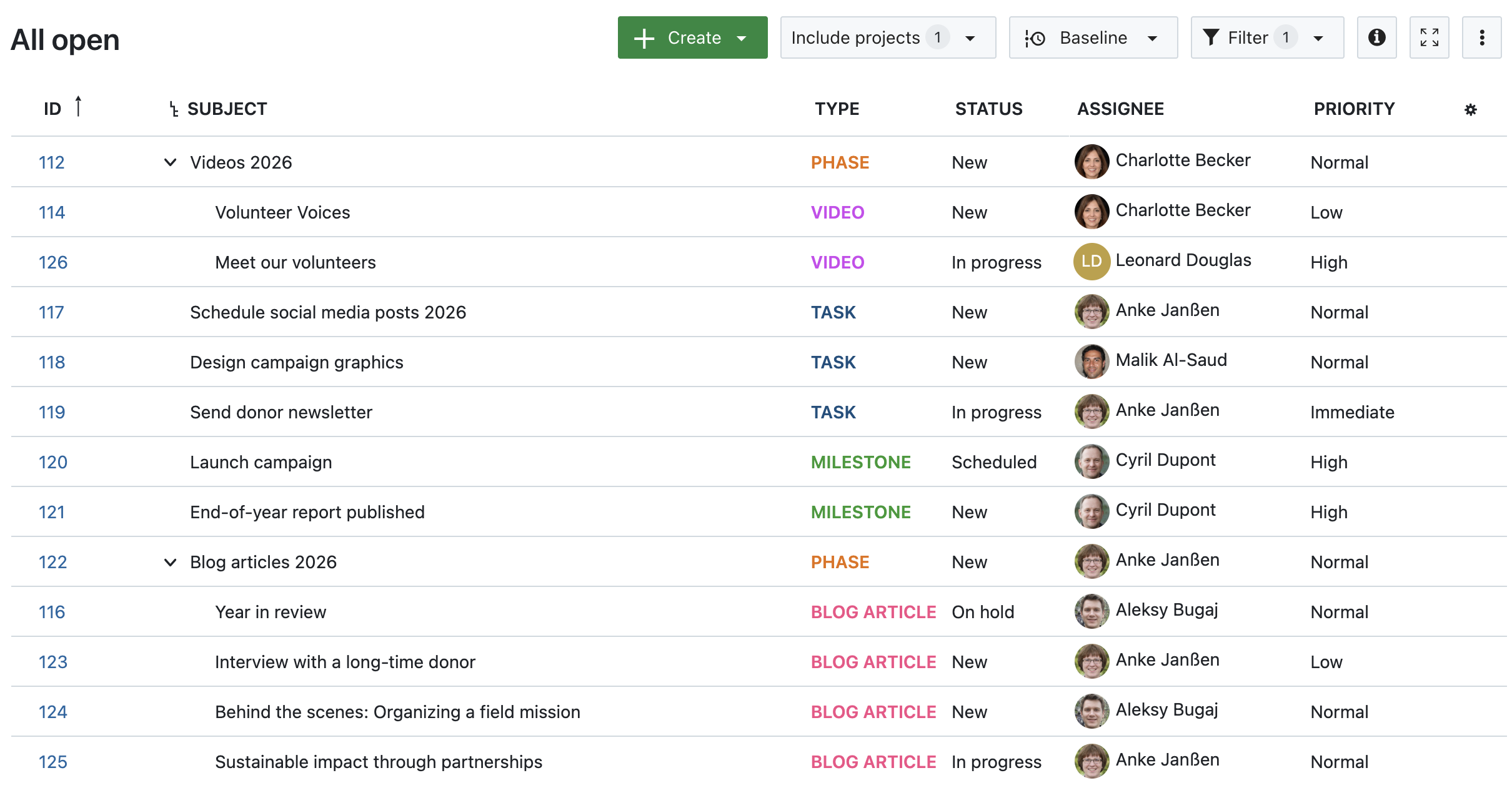
1. No attribute highlighting
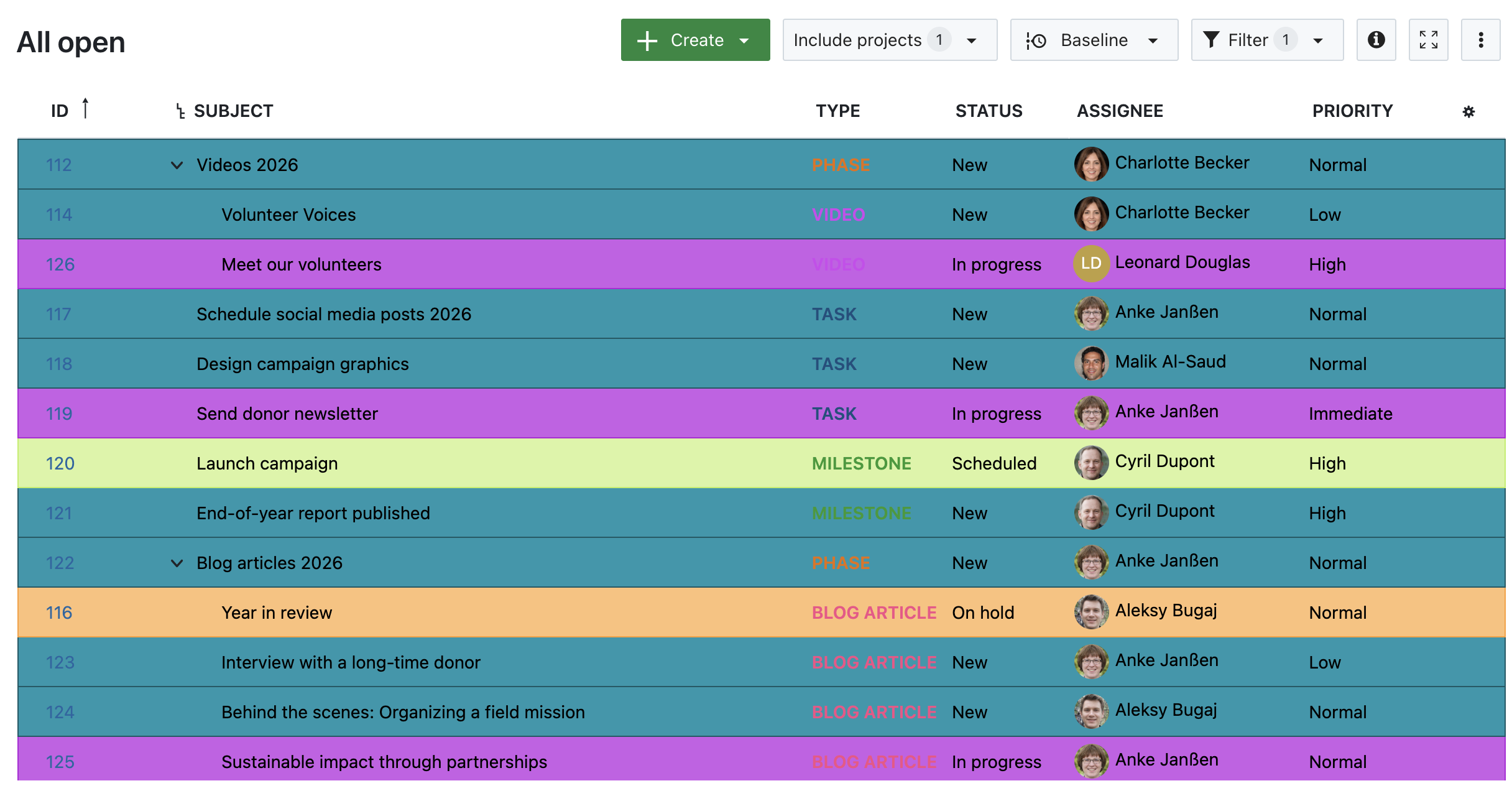
Image 1: A work package table in OpenProject, no attributes highlighted.
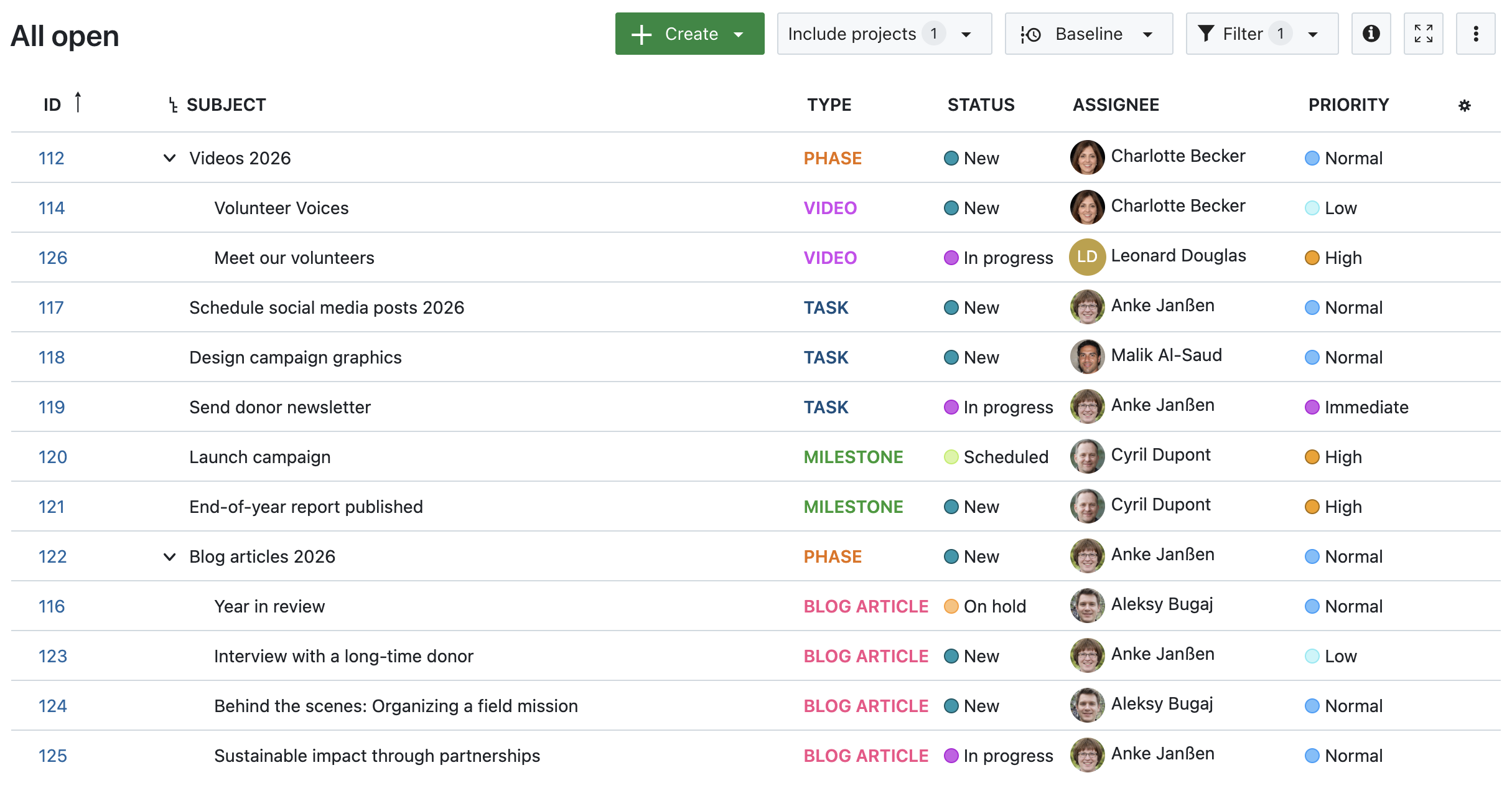
2. Status, Priority and Finish date highlighted inline
Image 2: A work package table in OpenProject, with inline-highlighted Status, Priority and Finish date.
3. Highlighted by Status
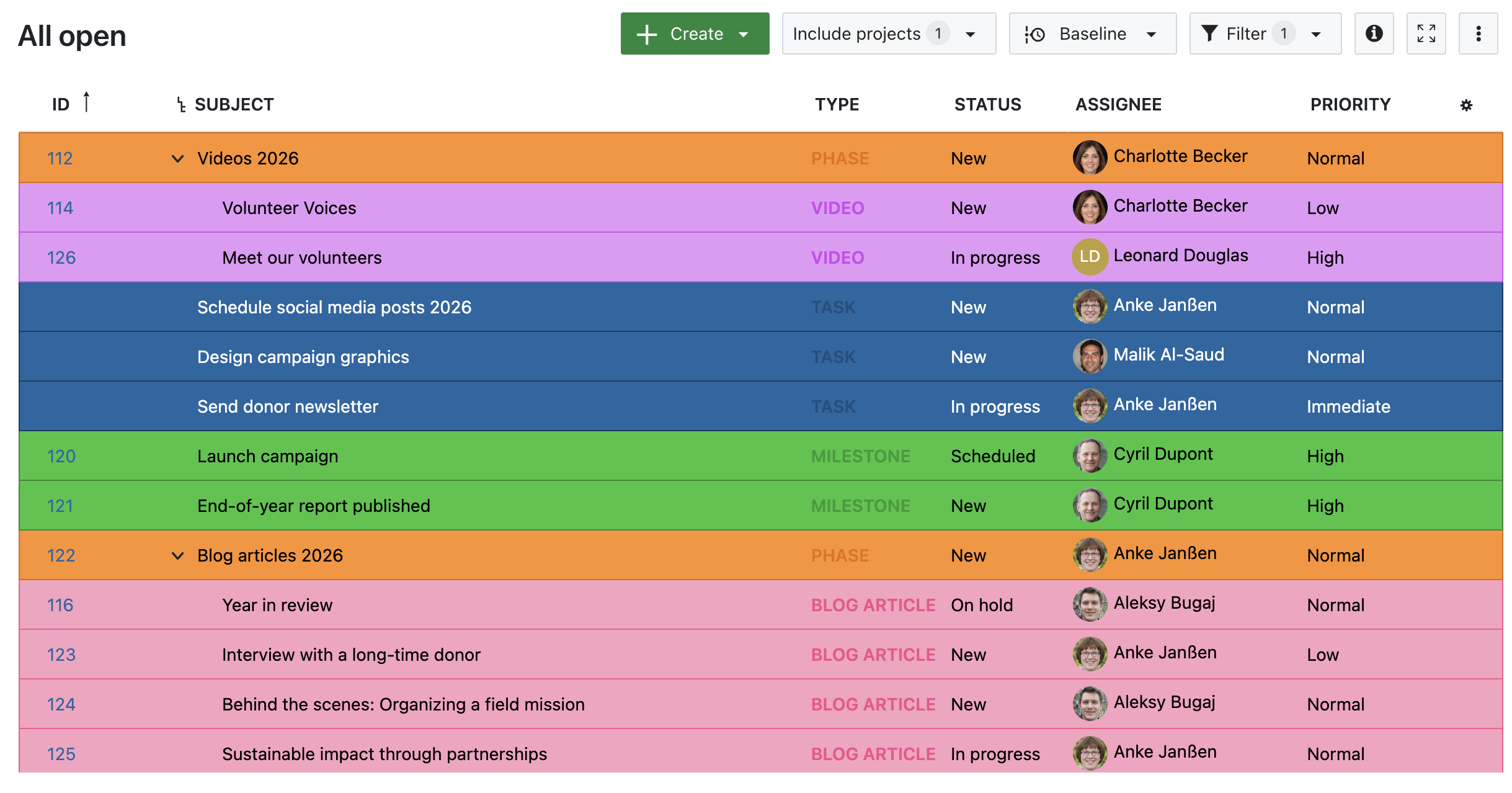
Image 3: A work package table in OpenProject, highlighted by Status.
4. Highlighted by Type
Image 4: A work package table in OpenProject, highlighted by Type.
5. Highlighted by Priority
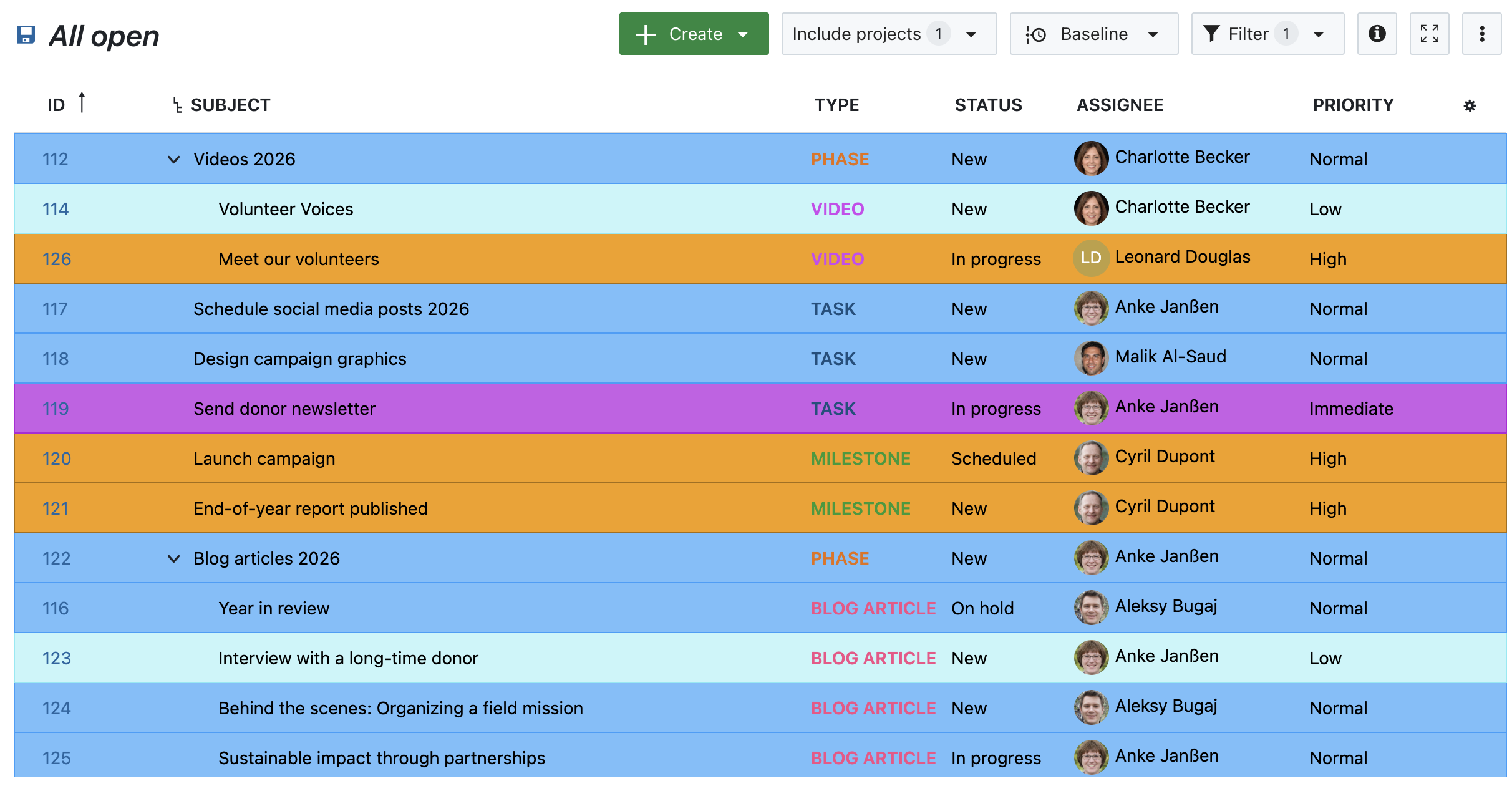
Image 5: A work package table in OpenProject, highlighted by Priority.
Other helpful features for prioritizing work packages
Attribute highlighting works best in combination with other prioritization features. Here are a few tools to support your growing team:
Status workflows
Define which status transitions are possible and by whom, helping structure review and approval processes.
Date alerts and reminders
Automatically notify assignees or watchers when a due date is approaching.
Versions
Group work packages under a common version to align delivery and deadlines across tasks.
Custom fields
Add structured information to work packages that you can then use for filtering, highlighting, or grouping.
Each of these features helps you bring structure to complexity — and together, they make it easier to stay focused.
Stay focused as you scale
Growth is exciting — but only sustainable if your tools grow with you. Features like Attribute highlighting can make a real difference: not by changing how you work, but by making it easier to see what matters.
With a growing team and more responsibilities, the ability to focus at a glance isn’t just a nice-to-have — it’s essential. Let OpenProject help you take that next step.
In this release, we have restarted to focus on features. A long-awaited feature has been added, namely sorting articles by various criteria: received date (existing, default), publication date, title, link, random.
A few highlights ✨:
Add order-by options to sort articles by received date (existing, default), publication date, title, link, random
Allow searching in all feeds, also feeds only visible at category level with &get=A, and also those archived with &get=Z
In this release, the coding focus has been on moving to PHP 8.1+ and refactoring the integration of the SimplePie library (which was long due). At the same time, plenty of new features have been added. Enjoy! 🎄
Breaking changes 💥:
Require PHP 8.1+ (and improved support of PHP 8.4+)
Require PostgreSQL 10+ or MariaDB 10.0.5+ or MySQL 8+
⚠️ Advanced regex syntax for searches depends on the database used (SQLite, PostgreSQL, MariaDB, MySQL),
but FreshRSS filter actions such as auto-mark-as-read and auto-favourite always use PHP PCRE2 syntax.
Allow dynamic search operator in user queries, like search:UserQueryA date:P1d
New feed mode HTML+XPath+JSON dot notation (JSON in HTML)
Better HTTP compliance with support for HTTP response headers Cache-Control: max-age and Expires
New unicity policies and heuristic for feeds with bad article IDs (reduce the problem of duplicated articles)
New option to automatically mark new articles as read if an identical title already exists in the same category
Add ability to remove content from articles with CSS selectors, also when not using full content
New condition option to selectively retrieve full content of articles
New UI feature to download a user’ SQLite database or a database SQLite export (to be produced by CLI)
⚠️ Advanced regex syntax for searches depends on the database used (SQLite, PostgreSQL, MariaDB, MySQL),
but FreshRSS filter actions such as auto-mark-as-read and auto-favourite always use PHP PCRE2 syntax.
Allow dynamic search operator in user queries, like search:UserQueryA date:P1d#6851
New feed mode HTML+XPath+JSON dot notation (JSON in HTML) #6888
Better HTTP compliance with support for HTTP response headers Cache-Control: max-age and Expires#6812, FreshRSS/simplepie#26
Support custom HTTP request headers per feed (e.g. for Authorization) #6820
New unicity policies and heuristic for feeds with bad article IDs #4487, #6900