
Reading view
Mac Mini and Mac Studio Facing Extreme Shipping Delays Amid Severe RAM Shortage
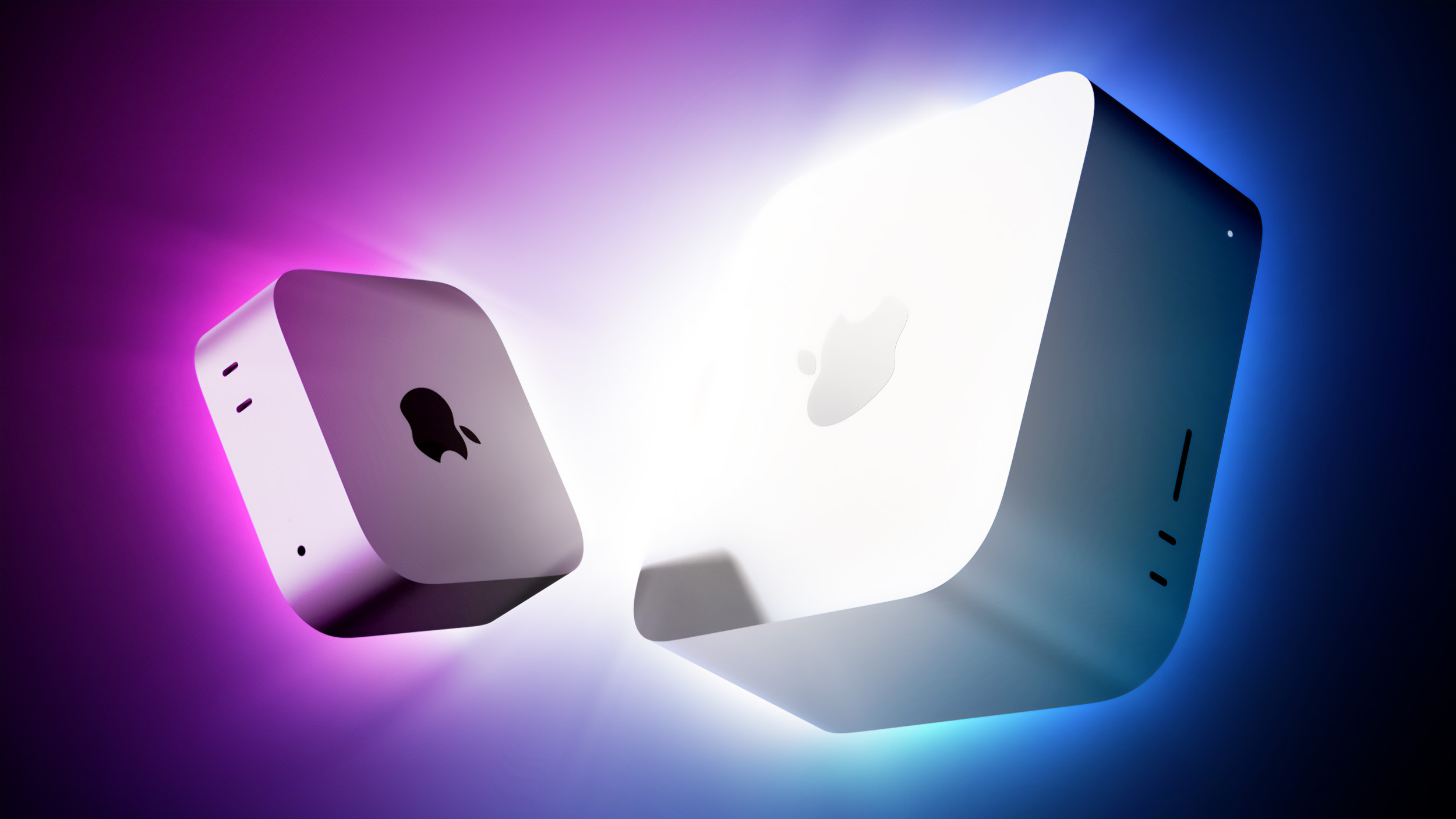
For example, a Mac mini with an M4 Pro chip and 64GB of RAM ordered from Apple's online store in the U.S. today is estimated to ship in 16-18 weeks.
Even the $599 base model with an M4 chip and 16GB of RAM has a one-month delay.
Likewise, a Mac Studio with an M3 Ultra chip and 256GB of RAM is estimated to ship in 4-5 months, with in-store pickup not available until September.
Last month, Apple entirely removed the Mac Studio's 512GB of RAM option.
Memory chip prices are reportedly starting to stabilize or slightly decrease, but prices still remain well above historical averages, so high-end Mac mini and Mac Studio shipping estimates might not meaningfully improve any time soon.
This article, "Mac Mini and Mac Studio Facing Extreme Shipping Delays Amid Severe RAM Shortage" first appeared on MacRumors.com
Discuss this article in our forums
NASA Shares Photos Shot on iPhone 17 Pro Max During Artemis II Mission to the Moon
Shot on iPhone 17 Pro Max (Wiseman)In February, NASA announced that the iPhone had been fully qualified for extended use in orbit, with reports indicating that each of the four crew members aboard the Orion are equipped with an iPhone 17 Pro Max for personal photos and videos.
The photos show Artemis II's Commander Reid Wiseman and Mission Specialist Christina Koch looking back at Earth through one of the Orion spacecraft's main cabin windows. Flickr data indicates that these photos were shot with the iPhone 17 Pro Max's front camera on April 2, which was the second day of the mission.
Shot on iPhone 17 Pro Max (Koch)All other photos from the mission shared so far were captured with other cameras, such as the Nikon D5, Nikon Z 9, and GoPro HERO4 Black.
Shot on Nikon D5Artemis II is NASA's first crewed mission to the Moon since 1972. The crew is expected to reach the far side of the Moon on Monday, breaking the all-time record for the farthest distance traveled from Earth by humans. However, the Orion is not capable of landing on the Moon and is set to return to Earth on April 10.
This article, "NASA Shares Photos Shot on iPhone 17 Pro Max During Artemis II Mission to the Moon" first appeared on MacRumors.com
Discuss this article in our forums
HomePod Mini Is Now 2,000 Days Old
Apple unveiled the HomePod mini at its iPhone 12 event on October 13, 2020, positioning it as a smaller and more affordable alternative to the original HomePod. The device launched at just $99, with pre-orders beginning November 6 and availability following on November 16.
Unlike the original HomePod, which emphasized premium audio at a higher price point, the HomePod mini was designed as a mass-market smart speaker that could be deployed throughout the home at comparatively low cost. Apple described it as delivering "amazing sound" alongside Siri functionality and smart home control, with a compact spherical design that enabled 360-degree audio.
The HomePod mini is powered by the Apple S5 chip, the same processor used in the Apple Watch Series 5, and features a single full-range driver, dual passive radiators, and a four-microphone array. It supports 802.11n Wi-Fi, Bluetooth 5.0, Ultra Wideband for proximity-based features, and Thread networking, allowing it to function as a smart home hub.
Apple expanded the available colors in 2021, adding blue, yellow, and orange options to the original white and space gray finishes, and later replaced space gray with a similar "midnight" variant. Beyond these cosmetic updates, the underlying hardware has remained unchanged, making the HomePod mini one of the longest-running Apple devices without a specification revision.
Apple is widely expected to release a second-generation HomePod mini sometime soon, and the most consistent expectation is a move to a newer chip in place of the current S5, which should improve responsiveness, computational audio performance, and headroom for future Siri features. A second-generation Ultra Wideband chip and Apple's N1 Bluetooth and Wi-Fi chip are also possibilities.
The new HomePod mini was reportedly "ready" to launch since late last year. Now, the device is said to be "on hold" until Apple releases its more personalized version of Siri later this year. The revamped assistant is expected to debut in iOS 27, which will be available in beta starting in June and should be released to all users with a compatible iPhone in September.
This article, "HomePod Mini Is Now 2,000 Days Old" first appeared on MacRumors.com
Discuss this article in our forums
New Apple TV Waiting for Siri: Here's What's Coming When It Launches
Design
Apple TV design updates are few and far between, and that's not changing in 2026. The next Apple TV is going to have the same squircle shape as the current model, and it'll continue to be made from a black plastic material.
We're expecting the 2026 Apple TV to be indistinguishable from the existing Apple TV on the exterior.
New Chip
A new A-series chip will be the main Apple TV update, and rumors suggest that it will get the A17 Pro chip that Apple first used in the iPhone 15 Pro models.
Compared to the A15 Bionic in the current Apple TV, the A17 Pro is a big update, and it's a good reason to hold off on buying the current model. The A17 Pro is built on a 3-nanometer process for faster speed and better efficiency, and it has hardware-accelerated ray tracing for higher-quality graphics in games.
Given that Apple has held the Apple TV update for so long, it's entirely possible it'll get an even newer chip like the A18 or A19. A RAM update is possible too, especially if the Apple TV has any kind of Apple Intelligence support.
Apple Intelligence and Siri
The next Apple TV is supposedly ready to launch at any time, but new Siri features are the holdup. Apple wants to debut the Apple TV with the smarter version of Siri that's in the works, and it's not ready to go.
Bloomberg's Mark Gurman says the Apple TV is linked to "new artificial intelligence features" that Apple has postponed until September 2026. Apple intended to launch the Apple Intelligence Siri features in spring 2026, but the company was still experiencing issues with Siri. At this point, we're not going to see new Siri capabilities until iOS 27, which also means a delay for all the devices that Apple is holding.
Along with the Apple TV, the rumored home hub and a next-generation version of the HomePod are waiting on Siri.
Updated Siri features will likely require more RAM and a faster chip, so if you want the smarter Siri on the Apple TV, that's another reason to wait before making a purchase.
Wi-Fi
The Apple TV could get Apple's N1 networking chip with Wi-Fi 7 support. Wi-Fi 7 works with the 6GHz band offered by newer routers.
6GHz connectivity is faster and less congested, which you generally want for a device designed for streaming content.
Bluetooth
The Apple TV 4K could get Bluetooth 6 for connecting devices like controllers and earbuds.
Pricing
There might be a cheaper version of the Apple TV available because there have been rumors of a price drop.
Apple could release two models, one that's higher-end and one that has lower specs and a lower price tag, or it could keep the existing Apple TV around as a low-cost option.
Launch Date
If the new version of Siri has been pushed to iOS 27 and the Apple TV is tied to that update, we're not going to see the Apple TV refreshed until September 2026 or later.
This article, "New Apple TV Waiting for Siri: Here's What's Coming When It Launches" first appeared on MacRumors.com
Discuss this article in our forums
iFixit AirPods Max 2 Teardown: Same Design, Same Repairability Issues
A comparison of the internal components of the AirPods Max 2 and the USB-C AirPods Max indicate the headphones are identical, and opening them up requires the same steps. The only difference is the updated H2 chips inside each earcup.
Apple hasn't addressed the common failure points in the AirPods Max, such as condensation that builds up in the earcups in humid environments, and Apple doesn't have parts or repair manuals available.
iFixit suggests that if Apple made instructions and components available through its self-service repair program and made the battery and USB-C port more accessible, the AirPods Max would be repairable and could have a much longer lifespan.
With no updates to the AirPods Max 2 design, the headphones are no more repairable than the prior-generation models. iFixit gave the prior version a repairability score of 6/10.
This article, "iFixit AirPods Max 2 Teardown: Same Design, Same Repairability Issues" first appeared on MacRumors.com
Discuss this article in our forums
Apple Now Sells Refurbished M4 iPad Pro Models Starting at $759
There are both 11-inch and 13-inch options available, in multiple storage configurations. Apple is offering Wi-Fi and Cellular refurbished models, and silver and black color options.
Pricing on the 11-inch M4 iPad Pro starts at $759, down from the original $999 price. The 13-inch model is priced starting at $1,019, down from the original $1,299 price. Entry-level models are Wi-Fi only with 256GB of storage.
Apple released the M4 iPad Pro models in May 2024, but this is the first time that refurbished models have been available for purchase. Apple discontinued the M4 iPad Pro models with the launch of the M5 iPad Pro in October 2025.
Apple sells refurbished devices with the same one-year warranty that comes with a new Apple product. Refurbished iPads feature all manuals and accessories, plus Apple has a testing, repair, repackaging, and cleaning process to make sure that refurbished products are identical to new devices. Refurbished products are eligible for AppleCare+ protection.
This article, "Apple Now Sells Refurbished M4 iPad Pro Models Starting at $759" first appeared on MacRumors.com
Discuss this article in our forums
Apple TV Releases Trailer for Mysterious New 'Genre-Bending' Series
Widow's Bay is described as a "quaint island town 40 miles off the coast of New England," but apparently "something lurks beneath the surface."
Matthew Rhys stars as Mayor Tom Loftis, who is trying to revive the struggling community.
"There's no Wi-Fi, spotty cellular reception and he must contend with superstitious locals who believe their island is cursed," Apple explains.
"Loftis is determined to build a better future for his teenage son and turn the island into a tourist destination," adds Apple. "Miraculously, he succeeds: tourists are finally coming. Unfortunately, the locals were right. After decades of calm, the old stories that seemed too ludicrous to be true, start happening again."
Apple says Widow's Bay blends genuine horror with character-driven comedy.
The first three episodes in the 10-episode season are set to premiere on Apple TV on Wednesday, April 29, and one additional episode will come out every Wednesday through June 17, with a special two-episode release on Wednesday, May 27. The series is created and executive produced by Katie Dippold, and Hiro Murai directs five episodes this season.
In the U.S., Apple TV is priced at $12.99 per month or $129 per year, with a free one-week trial available for new subscribers. Apple TV is also included in Apple One and Peacock bundles, with all of the options outlined on Apple's website.
You can stream Apple TV in the Apple TV app, which is available on the iPhone, iPad, Mac, Apple TV 4K, Apple Vision Pro, Android, PlayStation, Xbox, Roku, Amazon Fire TV, select smart TVs, on the web at tv.apple.com, and more.
This article, "Apple TV Releases Trailer for Mysterious New 'Genre-Bending' Series" first appeared on MacRumors.com
Discuss this article in our forums
Apple's New 16-Inch MacBook Pro Charger Has a Compatibility Issue
After the 16-inch MacBook Pro was updated last month, customers in some countries began to notice that Apple's 140W USB-C Power Adapter that comes with it has a subtle design change that breaks compatibility with Apple's Power Adapter Extension Cable.
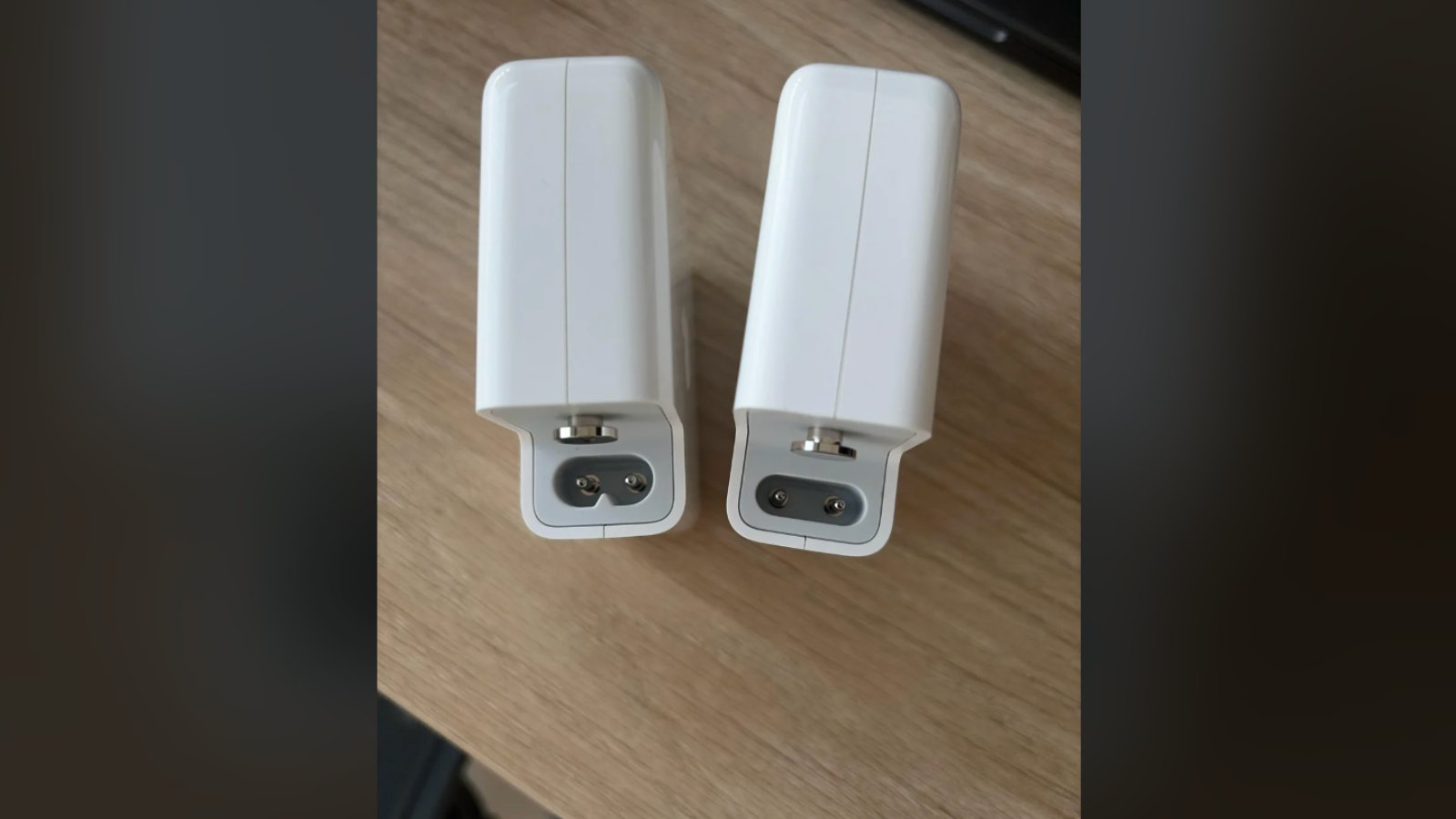
Specifically, while the charger continues to have a removable plug, Apple has apparently tweaked the design of the underlying male connector with two pins. The connector now has a slimmer pill-like shape, whereas it previously had a modified C7 design. Due to this change, the new charger does not work with Apple's Power Adapter Extension Cable, which still has a female connector designed to match the previous male connector.
The redesigned male connector (on the right in the photo)Oddly, Apple's product page for the Power Adapter Extension Cable says the cable is compatible with its 140W USB-C power adapters, despite this issue.
Apple's discontinued World Travel Adapter Kit is also incompatible with the version of Apple's 140W USB-C Power Adapter with the redesigned male connector.
The new design has been spotted in Australia and China, but other customers have said their power adapters are not affected, so it is a hit-or-miss situation. We have yet to confirm exactly which countries are impacted by this issue, or if the 140W USB-C Power Adapter that Apple sells separately is affected by this change anywhere.
We have reached out to Apple for comment.
This article, "Apple's New 16-Inch MacBook Pro Charger Has a Compatibility Issue" first appeared on MacRumors.com
Discuss this article in our forums
Little Finder Guy Stars in Nine New Apple TikTok and YouTube Videos
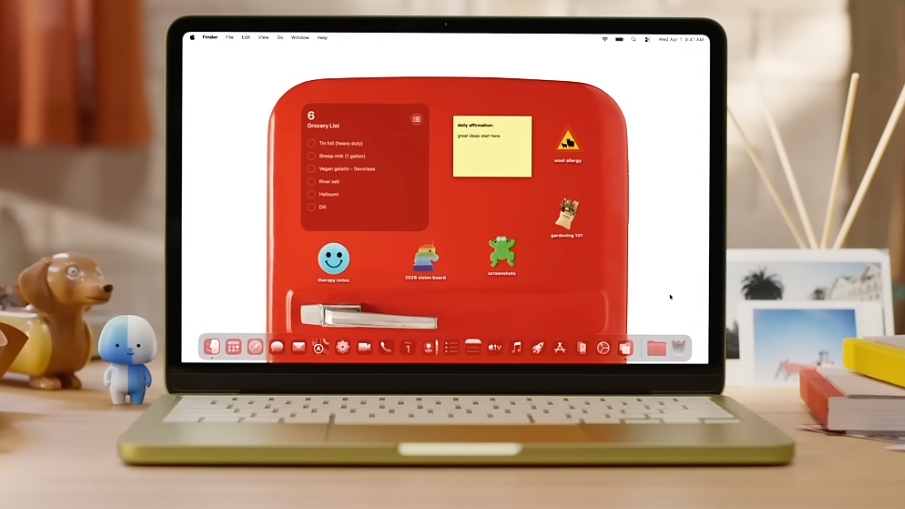
The short videos promote the MacBook Neo through a series of Mac tips, all of which include Little Finder Guy in cute poses. A video about journaling features the character with a book and a pen, while another about the Passwords app has Little Finder Guy with a magnifying glass.
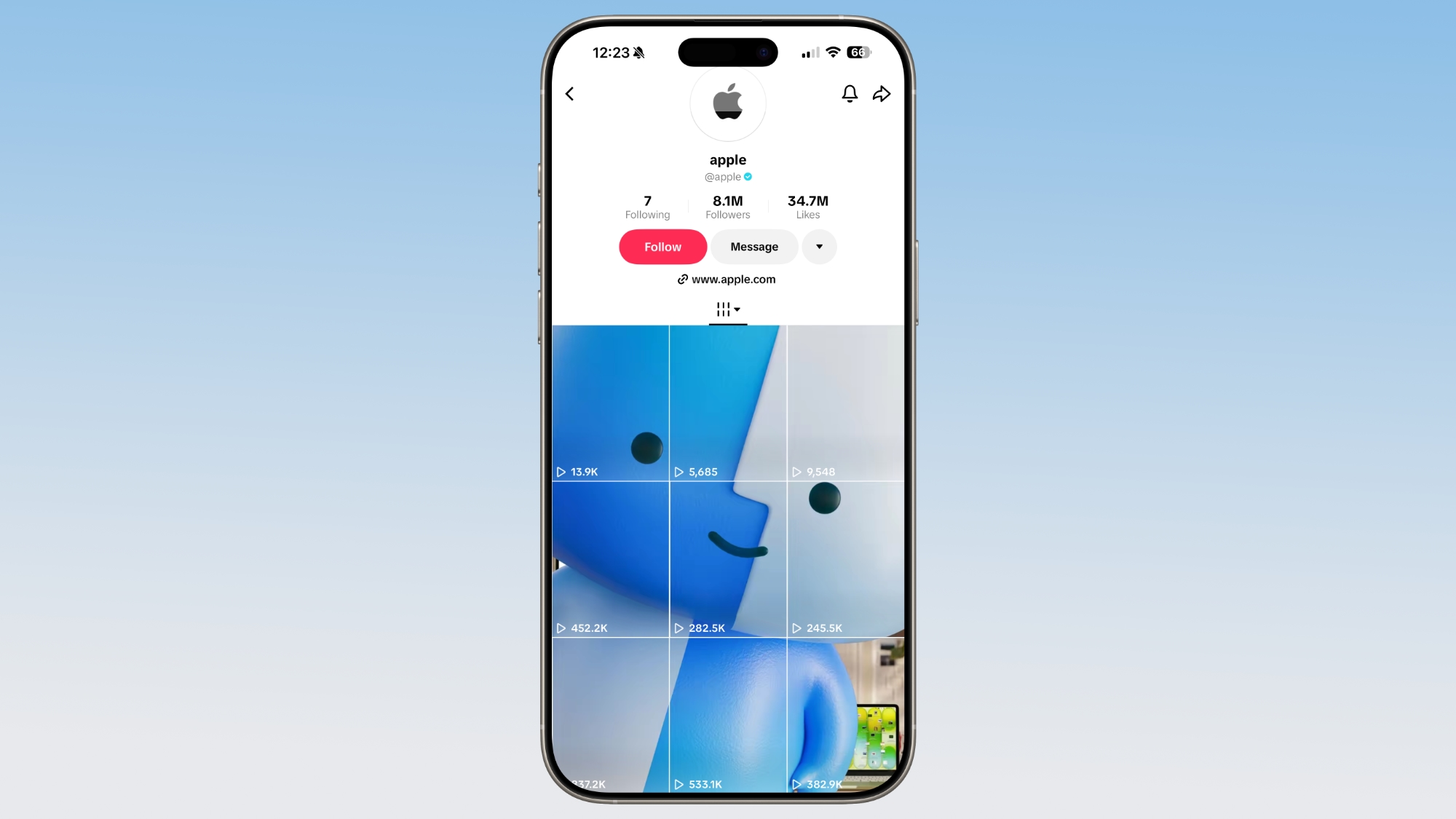
Apple has shared nine Little Finder Guy videos this week, and on TikTok, the thumbnails for the videos come together to make a Little Finder Guy mosaic on the Apple TikTok page.
Now that Apple has likely completed its Little Finder Guy image on TikTok, videos with the character could stop or become less frequent, but Apple might opt to keep the mascot around because of how it's caught on.
Apple introduced Little Finder Guy after launching the MacBook Neo in early March, and Apple users immediately liked the character. Stephen Hackett of 512 Pixels created a 3D print version, and Basic Apple Guy has a series of mockups, plus stickers for sale. PCalc's James Thomson also made a set of 5K Little Finder Guy wallpapers.
This article, "Little Finder Guy Stars in Nine New Apple TikTok and YouTube Videos" first appeared on MacRumors.com
Discuss this article in our forums
What the latest innovation ranking for Medellin tell us about the future of entrepreneurship in the city
The startup ecosystem in Medellin has long been a leading success story for both Colombia and Latin America. In recent weeks, the progress of Medellin’s evolution into a knowledge-based economy and hub for innovation has gained even more traction.
Globally, Medellin currently ranks at #145, according to the StartupBlink Ecosystem Index, and holds 5th place regionally in South America. On a national level, the strength and diversity of Medellin’s startup ecosystem is second only to Bogota.
Now, the launch of a new official district-level ranking designed to measure local performance in science, technology, and innovation promises to strengthen the innovation sector in Medellin even further. The “CTi Ecosystem Pulse” (Pulso Ecosistema CTI) is an initiative from the Mayor of Medellin and Ruta-N will provide local organizations with granular data on their performance set against an official innovation benchmark.
The benchmark being rolled out with the CTi Ecosystem Pulse initiative will support organizations in Medellin’s innovation ecosystem to benchmark themselves, make more strategic decisions, and strengthen their national and international positioning.
In addition, Ruta-N also announced that Medellin has been included in the World Economic Forum’s (WEF) Network of Innovation Ecosystems, a platform that connects 17 cities across the Americas, Europe, and Asia to promote collaboration, shared learning, and the development of innovative solutions.
Here, the WEF recognized the role Ruta-N has played as orchestrator of the innovation ecosystem, connecting companies, academia, the public sector, and civil society to strengthen entrepreneurship. The organization has also been ranked 1st among the country’s public open innovation ecosystems in the 2025 Open Startups 100 ranking.
It’s also interesting to note how quickly Medellin has been able to climb through the rankings in a short span of time. In 2025/2026, the city climbed 17 spots in global rankings and is recognized for having the highest growth among startup ecosystems in South America.
The data, coupled with the new CTi Ecosystem Pulse initiative, suggests that Medellin is expected to continue with this impressive upward trajectory on a national, regional and global scale.
However, this success story has been made possible by three central pillars of innovation: Academia, conferences and local investors. Let’s take a closer look at how these play out across the city.

University Support Nurtures Innovation in Medellin
First of all, universities and academic institutions represent a core pillar of Medellin’s innovation economy.
EAFIT’s Impact Entrepreneurship Center is one academic unit that has played an active role in boosting entrepreneurship in the city. In 2021, EAFIT University’s president, Claudia Restrepo found that less than 5% of the most impactful startups in Colombia had EAFIT alumni as founders.
In response to the data, the university decided to take entrepreneurship out of its academic silo and connect it with the real-world ecosystem by creating the Impact Entrepreneurship Center, known as On.going.
Four years after the initial survey, the center has incubated nearly 190 initiatives. In addition, 40% of these are now formalized ventures, showing why nurturing entrepreneurship in Medellin pays dividends in short time frames.
Under the leadership of Director Tomás Ríos, On.going joined forces with EAFIT, Fundación Fraternidad Medellín and Universidad EIA to establish U Ventures, the first VC fund in Colombia designed to invest in university talent.
“Out of every thousand ideas, maybe four grow and scale,” Ríos explained in an interview with Ana Herazo of Contxto. “To have 40 large companies in the future, you need 10,000 ideas today.”
Medellin conferences boost international collaboration
Events and conferences represent another central pillar within most innovation strategies, and Medellin has also spurred collaboration on an international scale through this channel.
One example of a homegrown initiative can be found with Starter Company, today one of the largest startup events in Latin America. In 2025, Starter Company brought together 13,000 attendees from 20 countries, 340 startups, and more than 160 investment funds.
According to CEO Juan Gabriel Arboleda, part of the reason why Starter Company has found such success is that they don’t try to mimic models from other parts of the world. Instead, they have built something from the ground up that works for entrepreneurs in the region.

We can see numerous examples of public-private collaborations that support the rise of tech innovation in Medellin and bring international attention to the city. For example, TECH SPHERE was organized by software development enterprise Source Meridian, 360 Health Data and the Pascual Bravo University Institution. Mike Hoey founded Source Meridian and is one of the city’s leading international tech entrepreneurs.
The conference highlighted Medellin’s role as a catalyst for AI research in Latin America and brought together business execs, researchers, entrepreneurs, and professionals from across sectors and backgrounds to explore how AI can be practically applied to solve real challenges and scale impactful solutions.
While local initiatives play an important role, we can also see the rise of international events choosing to host conferences in Medellin and South America and the region continues to be recognized for its contributions to innovation.
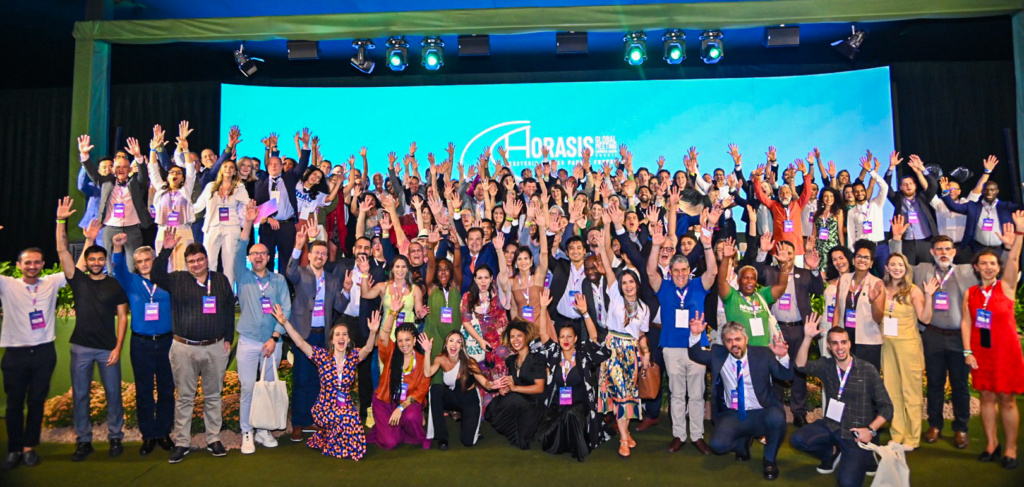
Horasis, a global think tank headquartered in Zurich led by Frank-Jürgen Richter, held the Horasis Global Summit 2025 in Brazil. The event represented the largest meeting the organization has held to date, bringing together 1000 speakers from 50 countries, a testament to the draw of the region.
Local entrepreneurs and investors solve real-world problems
The final pillar to this success story lies in the presence of eager local entrepreneurs and investors from Medellin. Both the innovator and the investor are integral to the ongoing success of Medellin’s innovation ecosystem.
360 Health Data is a platform built by Colombian tech experts to overcome healthcare disparities due to language barriers.
Its platform, Coralia Health, translates medical knowledge and resources into Spanish through tech-powered automations, meaning physicians in the region now have rapid access to up-to-date, reliable, and relevant information.
Without more support and funding systems like U Ventures to sustain ideas from the earliest stages, the pipeline collapses before it can produce results.
Meanwhile, local innovators have a keen understanding of the gaps in the market and the solutions can drive the most impact.
As Medellin continues to rise through the global innovation rankings, it’s likely to encourage more entrepreneurs to stay and encourage more investors to back high-tech ideas.
The post What the latest innovation ranking for Medellin tell us about the future of entrepreneurship in the city appeared first on The Bogotá Post.

Apple TV Channels Gains Crunchyroll Anime Streaming Service
Apple TV users in the U.S., Canada, UK, and Australia are now able to subscribe to Crunchyroll through the Apple TV. There's a 7-day free trial available, after which the service is priced at $9.99 per month. The Crunchyroll Apple TV Channel is separate from existing Crunchyroll subscriptions, and an existing account can't be linked to the Apple TV app.
As with all Apple TV Channels content, if you sign up for Crunchyroll with the Apple TV app, you'll be billed through Apple. Crunchyroll says its full catalog of over 50,000 episodes is available through the Crunchyroll Apple TV Channel.
Apple TV Channels have long been an Apple TV app feature that makes subscribing to multiple services more convenient. Channels content can be watched in the Apple TV app without having to open up another app, and access can be shared with up to six members of a Family Sharing group. Channels also offer watch on-demand content and offline downloads.
Some of the available Apple TV Channels include Starz, Paramount+, AMC+, Mubi, Shudder, MGM+, and IFC Films.
This article, "Apple TV Channels Gains Crunchyroll Anime Streaming Service" first appeared on MacRumors.com
Discuss this article in our forums
MacBook Neo Review: Can Apple's Cheapest Laptop Handle Real Work?
At $599 (or $499 for students), the MacBook Neo is the cheapest laptop that Apple has come out with, and given the quality of the product, it's an impressive price. The A18 Pro chip isn't underpowered for a notebook machine, and the Neo is going to handle every day-to-day task that you might throw at it.
8GB RAM might sound like not enough because all of Apple's other Macs have 16GB or more, but Macs use RAM so efficiently that most people aren't going to miss having more RAM. If you're browsing the web, watching videos, managing documents, writing, scrolling through social media apps, sending emails, completing homework, and doing other light work, the MacBook Neo isn't going to struggle. 8GB RAM is also sufficient for all of the Apple Intelligence features that Apple has come out with so far.
The MacBook Neo works totally fine for editing photos and videos, but it's of course not as quick as Apple's MacBook Air and MacBook Pro with M-series chips. You're going to see slower export times, but the actual process of editing video on the MacBook Neo doesn't feel overly sluggish.
The MacBook Neo had no problems with 30 Chrome tabs open with YouTube, Google Docs, news sites, spreadsheets, Twitter, and more, even when other apps like Mail, Messages, and Spotify were running. Bumping up to 60 tabs used all of the available RAM, but everything running was usable with no freezing or beach balls. A Windows laptop probably wouldn't be able to operate like the Neo does on just 8GB RAM, but with Apple's SoC, it works.
There are some compromises with the MacBook Neo in addition to the RAM. You're not going to get Apple's best display, but it's not too far off the MacBook Air display. There's just no True Tone for adjusting the display white balance to the lighting in the room. You're limited to two USB-C ports (one limited to USB 2 speeds at 480Mb/s, which does impact how fast files transfer), and another that's USB 3 at 10Gb/s. There's no Thunderbolt, no MagSafe charger, no SD card slot, no HDMI port, and no backlighting for the keyboard. The trackpad is mechanical instead of Force Touch, but it works largely the same, and there's a 1080p camera.
Battery life is solid at up to 16 hours on a full charge, and the power draw is low enough that you can get some extra juice with a small power bank. The MacBook Neo only comes in 256GB and 512GB configurations, so storage is a bit limited, and we do recommend that 512GB upgrade for an extra $100 if you can swing it because it adds Touch ID to the keyboard. The MacBook Neo is slim and lightweight at 2.7 pounds, plus it comes in fun colors like blush, citrus, silver, and indigo.
The MacBook Neo is designed for students on a budget, parents buying a first laptop for a child, and people who just need a basic machine for everyday online tasks. It may be Apple's lowest tier Mac, but it is one of the best computers you can get in its price range.
Many competing Windows PCs and Chromebooks around the $600 mark are bulkier and uglier, with dimmer displays and less powerful chips. PC makers haven't had to try in the low-end market because Apple didn't compete there, but now that's changed.
There's a reason why ASUS CFO Nick Wu said that the MacBook Neo was a "shock" to the entire PC industry that's being taken "very seriously." PC makers are going to need to innovate to keep Apple from dominating the affordable and education market.
This article, "MacBook Neo Review: Can Apple's Cheapest Laptop Handle Real Work?" first appeared on MacRumors.com
Discuss this article in our forums
Political tensions rise as guerrilla group revealed to be behind Miguel Uribe’s murder
Segunda Marquetalia ordered the attack last year according to trial testimony.

Revelations that former FARC leaders ordered the 2025 killing of Miguel Uribe have heightened political tensions in the run-up to the May presidential elections.
The 39-year-old Colombian senator and presidential hopeful was gunned down by a Bogotá gang hired by the Segunda Marquetalia, an armed group created by disgruntled guerrillas hiding in Venezuela, according to testimony revealed in court.
The senator was shot down by a 15-year-old assassin at an open-air political rally in the barrio of Modelia in June, 2025. Uribe died of head wounds two months later.
After months of investigations and multiple arrests, state prosecutors were last week finally able to link the local gang that carried out the hit with the armed group.
See also: Who ordered the murder of presidential candidate Miguel Uribe?
The breakthrough came during the trial of Bogotá-based gang leader Simeón Pérez Marroquín, also known as ‘El Viejo’, who admitted he had hired the local Plata o Plomo (‘Silver or Lead’) gang to carry out the killing on behalf of the Segunda Marquetalia armed group.
“The deal was that they would pay one billion pesos [US$270,000] for the senator’s death,” said Marroquín in a statement reported by magazine Semana.
Right hand man
Confirmation of involvement by an armed group founded by former FARC leaders sparked a political spat between front-runners for the upcoming presidential election.
Right-wing candidate Paloma Valencia was quick to accuse the Petro government of negotiating peace with the Segunda Marquetalia – even while the armed group was plotting the murder of Uribe.
See also: Peace Plan has caused more conflict, says thinktank
Valencia referred to Marroquín’s statements that the hit was organized by veteran guerrilla Zarco Aldinever, the right-hand man of the group leader Iván Márquez, in early 2025.
At this time Aldinever was nominated a ‘peace manager’ by the Petro government, meaning any arrest warrants were suspended and the rebel was free to roam. This despite the collapse of peace talks with the Segunda Marquetalia at the end of 2024.
Valencia further pointed to the closeness between her main election rival Iván Cepeda and leaders of the armed group.

Old photo

“The killer of Miguel Uribe is photographed hugging Iván Cepeda,” she wrote on X, attaching a photo of her rival with Segunda Marquetalia founder Iván Márquez.
In fact, the photo of Cepeda dated from the 2016 FARC peace talks, explained President Petro in a strongly worded statement defending his friend and political ally.
“The photo shows Iván Cepeda’s attempt to help [the Santos government] achieve peace. At that time, the entire FARC was ready for peace,” said.
Iván Márquez was number two in the FARC at the time and widely respected for his role in the negotiations.
Petro went on to blame his predecessor, right-wing president Iván Duque, for undermining the FARC peace process that forced former guerrilla leaders like Márquez back to arms and the Segunda Marquetalia.
Following the 2016 deal, some former FARC leaders had been “entrapped by state prosecutors with fake drug charges”, he said, leading to extradition requests from the United States.
Faced with this legal pressure several top commanders, including Iván Márquez and Jesus Santrich, fled to Venezuela in 2018 before emerging on video a year later to announce their new incarnation as the Segunda Marquetalia, named after the village in the Tolima department where the original FARC first formed in 1964.
The armed group was active in drug trafficking and illegal mining along the Colombia-Venezuela border, in the departments such as Vichada and Guainía, according to a profile by InsightCrime. The leadership is suspected of hiding out in Venezuela.
Another study by Fundacion Ideas para La Paz estimated the group to have 530 armed combatants in 2025, an increase of 15% on 2024, and work mostly in the eastern plains of Colombia.
A hunt is on
In a press conference on Tuesday, Valencia accused Cepeda and other left-wing lawmakers of backing the former FARC commanders in their legal battles back in 2018, creating a chain of events leading to the creation of recycled armed group.
“Congressmen like Cepeda defended [Marquéz and Santrich] …and didn’t allow them to be extradited. If these thugs had been extradited, Miguel Uribe would be alive today,” she said.
In his own press statement Cepeda called Valencia’s comments “a dirty political game” and issued a challenge to the candidate, and her political mentor right-wing former president Álvaro Uribe, to back up the accusations in court.
“It’s infamy to accuse me or President Petro to have any type of involvement in such a deplorable deed as the assassination of senator and presidential pre-candidate Miguel Uribe,” he said.
Meanwhile this week the Colombian attorney general’s office launched a fresh hunt for the leaders of the Segunda Marquetalia, offering around million-dollar rewards for the capture of seven commanders including Iván Márquez and Zarco Aldinever.
In fact, Aldinever was reported killed by rival armed group ELN in Venezuela during a squabble over a cocaine shipment in August last year – the same month that Miguel Uribe died – according to Colombian state forces at the time.
This week Colombia’s Minister of Defense Pedro Sanchez walked back that claim saying no body had ever been found and that the initial report of Aldinever’s death – sent from the Segunda Marquetalia itself – could be disinformation.
“At this time, the position is clear: without a body there is no confirmation of death, and that is why all institutional resources remain active to locate him,” said Sanchez.
Underworld connections
Closer to home, the Segunda Marquetalia’s influence in Bogotá was under scrutiny after Simeón Marroquín’s testimony shed light on the murky connections with the city’s underworld.
Marroquín admitted that in previous decades he had acted as an urban operative for the FARC guerrillas, a hired gun ready to carry out orders in the city.
“I never wore camouflage, but while I was here in Bogotá, I was a miliciano. Guerrilla missions would come up, and I’d carry them out, but I was never in the ranks.”
His contacts with the FARC continued to the Segunda Marquetalia that tapped him for the Uribe killing.
Early in 2025, Marroquín was invited to a secret meeting in Cúcuta close to the Venezuelan border where, according to his testimony, Aldinever offered him one billion pesos for the crime (US$270,000) and another 600 million pesos (US$160,000) to “bribe the justice system” to deflect attention from the guerrilla group.
The motive for the killing was not clearly revealed by Marroquín, though a text message later found on his phone sent to his guerrilla paymasters talked of an “eye for an eye”, suggesting the former rebels were out for revenge.

Chilling revelation
Uribe was selected as an influential senator, scion of a right-wing political family, and popular candidate for this year’s presidential elections. He was also an easy target for assassins with his regular visits to communities where he had walkabouts to engage with local voters.
In the first few months of 2025, Marroquín worked his underworld connections to hire the Plata o Plomo gang which in turn lured the 15-year-old gunman who shot and wounded Miguel Uribe in a small park in the barrio of Modelia on June 7.
See also: Arrests made – but still questions in Uribe shooting.
Marroquín’s account paints a picture of a loose network of petty criminals lured by cash rather than political interests, ignorant of the details of both their intended target and the paymasters behind the plot.
The middleman saw the hit as a “good business opportunity” but also a chance to rekindle his role as urban operative for a guerrilla organization.
Marroquín’s plan unraveled after the 15-year-old gunman and various low-level gang members were detained in the hours and days following the June attack, creating a trail leading to his own capture in October.
“What’s done is done”
One chilling revelation was the order from above for Marroquín to kill low-level gang members to cut links to the guerrilla masterminds. This included murdering alias Gabriela, who transported the weapon and was present on the day of the shooting.
Marroquín refused to kill Gabriela, telling investigators “I didn’t have the heart for that because she was very young.” But he did send her by bus to the city of Florencia where the guerrillas were lying in wait.
#ATENCIÓN | "No hay palabras que justifiquen dicho acto, pero pues ya está hecho (…)", fueron las palabras con las que Simeón Pérez Marroquín, alias ‘El Viejo’, pidió perdón a la familia del senador y precandidato presidencial Miguel Uribe Turbay, tras reconocer que fue el… pic.twitter.com/btgnOsTEF7
— ÚltimaHoraCaracol (@UltimaHoraCR) March 20, 2026
The 19-year-old never made it; police investigators, already on Gabriela’s trail, organized for the bus to “break down” some miles before Florencia. Her arrest there and subsequent interrogation lead to Marroquín’s capture and eventual exposing of the links to the Segunda Marquetalia.
Last week, during the court process, Simeón Marroquín attempted to apologize for his role in the killing of Miguel Uribe.
“There are no words to justify my actions, but what’s done is done,” he said on camera from his cell, addressing his victim’s family – Uribe was married with four children – and asking forgiveness. He was then sentenced to 22 years in prison.
How quickly Colombian investigators can find Zarco Aldinever or other Segunda Marquetalia commanders, dead or alive, or hiding in Venezuela, remains to be seen.
The post Political tensions rise as guerrilla group revealed to be behind Miguel Uribe’s murder appeared first on The Bogotá Post.
Mac Pro Discontinued: Reflecting on 20 Years of Apple's Desktop Tower
Below, we reflect on nearly two decades of the Mac Pro.
2006 to 2013
In August 2006, Apple introduced the original Mac Pro, which was an Intel-based follow-up to the PowerPC-based Power Mac G5 that debuted a few years earlier.
Mac Pro was the final Mac model to transition from PowerPC to Intel processors.
"Apple has successfully completed the transition to using Intel processors in just seven months—210 days to be exact," said Apple's then-CEO Steve Jobs, in a press release announcing the first Mac Pro. "And what better product to complete it with than the new Mac Pro, the workstation Mac users have been dreaming about."
The original Mac Pro was powered by two dual-core Intel Xeon processors, making it up to twice as fast as the Power Mac G5, according to Apple. It could be configured with up to 2TB of storage—the most ever in a Mac at the time—and up to 16GB of RAM. The computer was equipped with an NVIDIA GeForce 7300 GT graphics card.
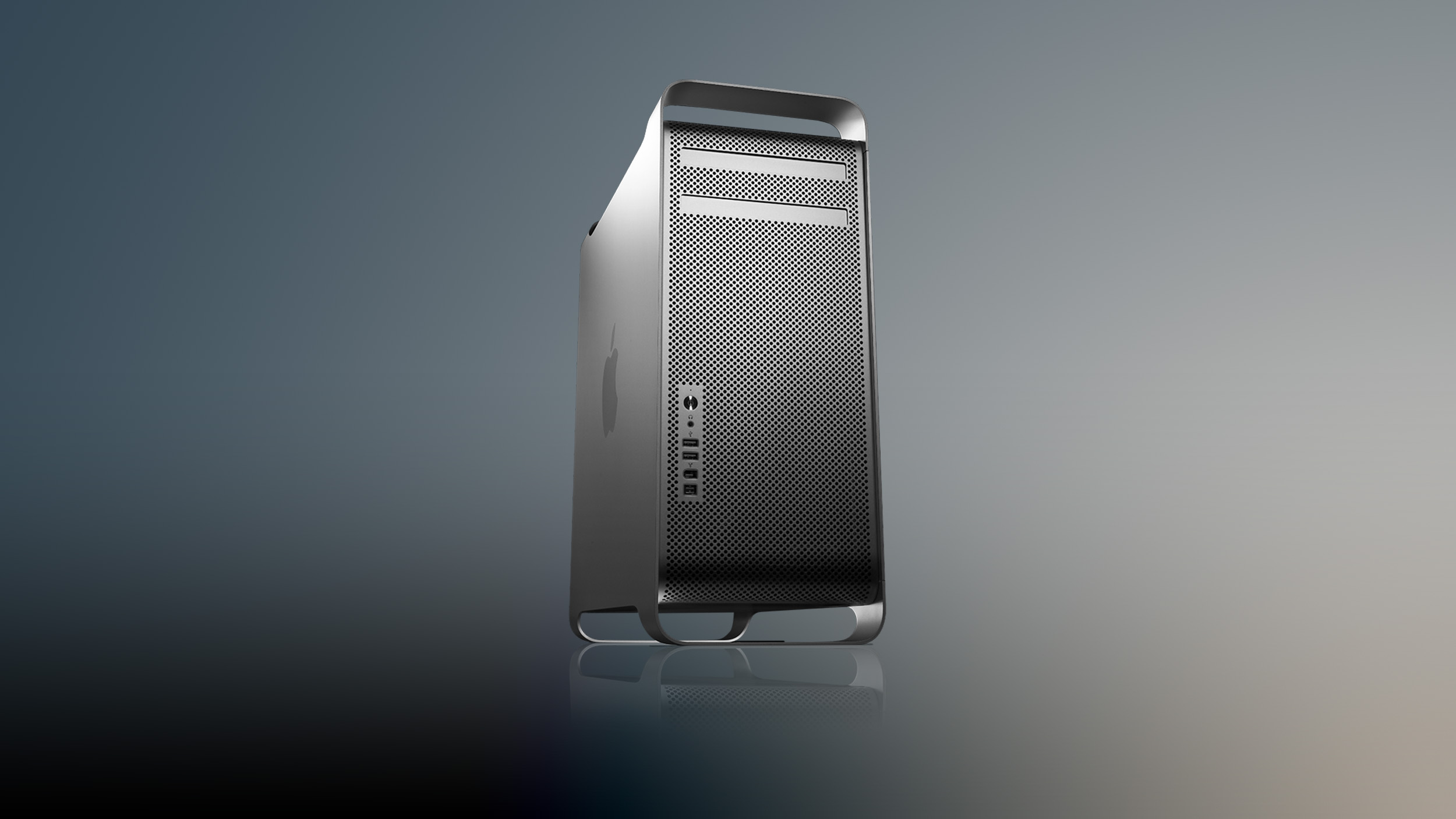
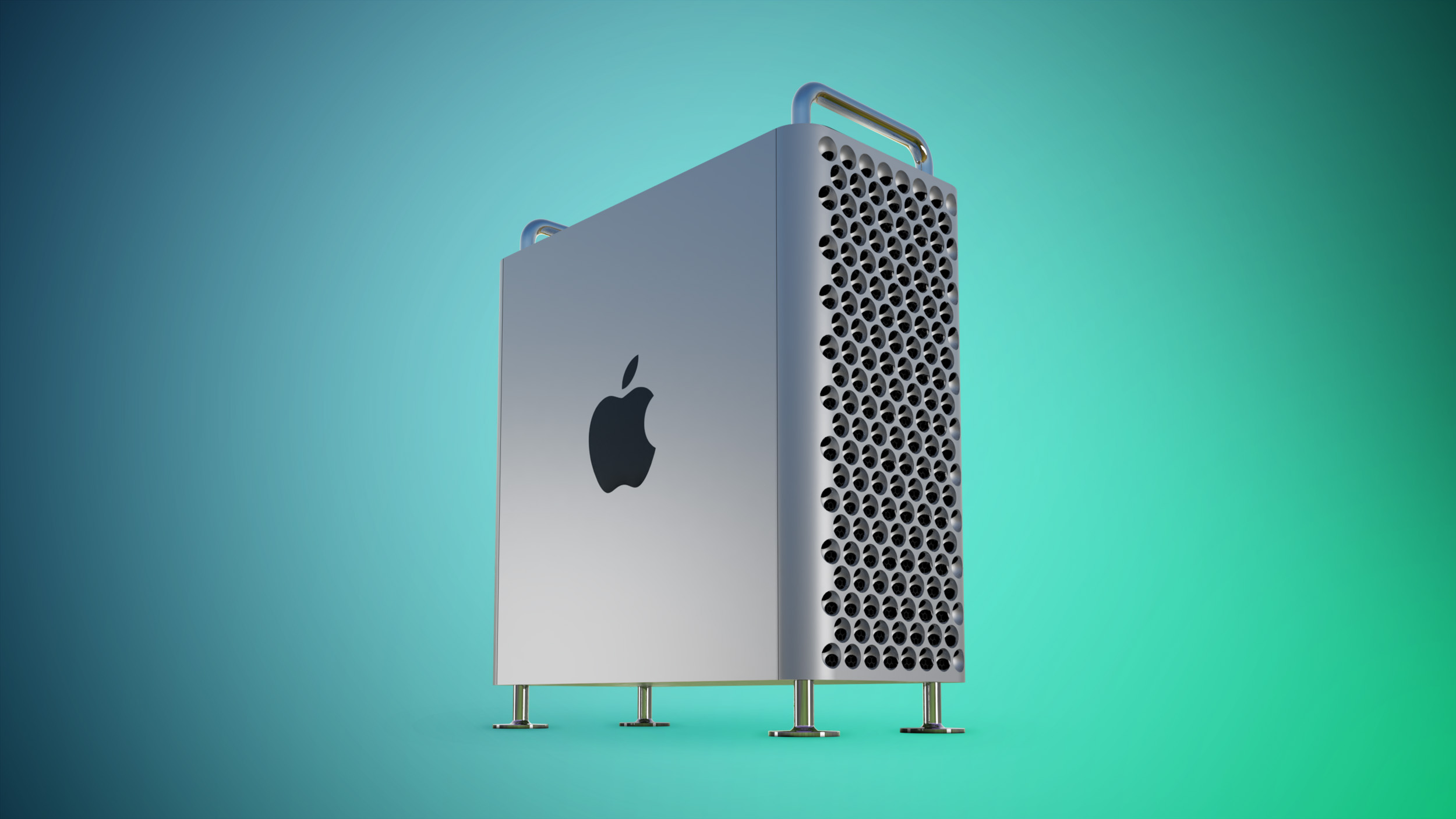
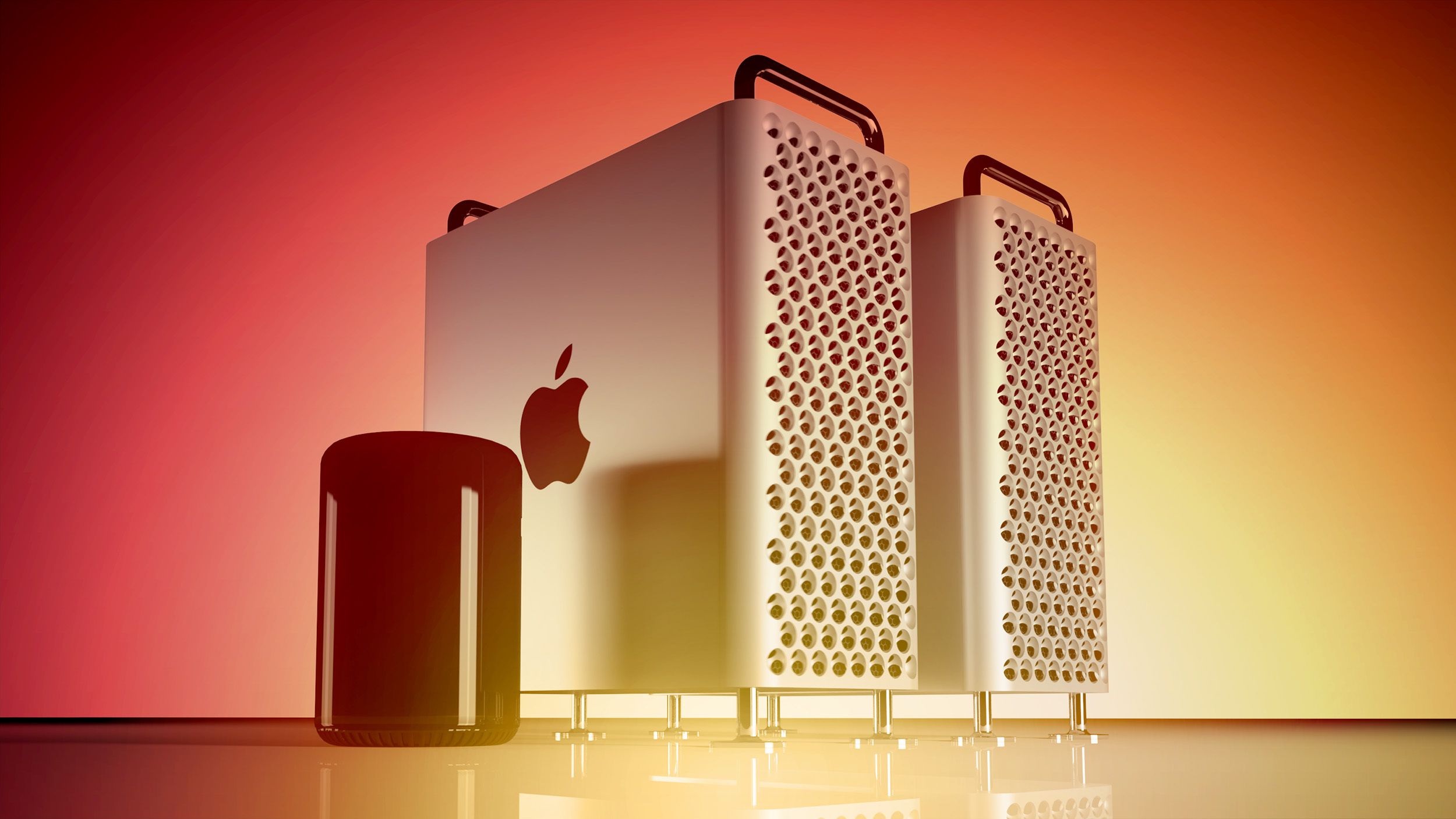
Like the Power Mac G5, the Mac Pro featured an aluminum tower with a perforated front panel, which earned it the nickname "cheese grater Mac Pro." The computer was equipped with a variety of FireWire and USB-A ports, and it had PCI Express expansion slots. In the U.S., the original Mac Pro started at $2,499.
The classic Mac Pro went on to receive faster Intel processors and other spec bumps until 2012.
2013 to 2019
"Can't innovate anymore, my ass," Apple's former marketing chief Phil Schiller infamously joked, when unveiling the redesigned Mac Pro in June 2013.
"The new Mac Pro is our vision for the future of the pro desktop, everything about it has been reimagined and there has never been anything like it," said Schiller, in a press release announcing the second-generation Mac Pro.
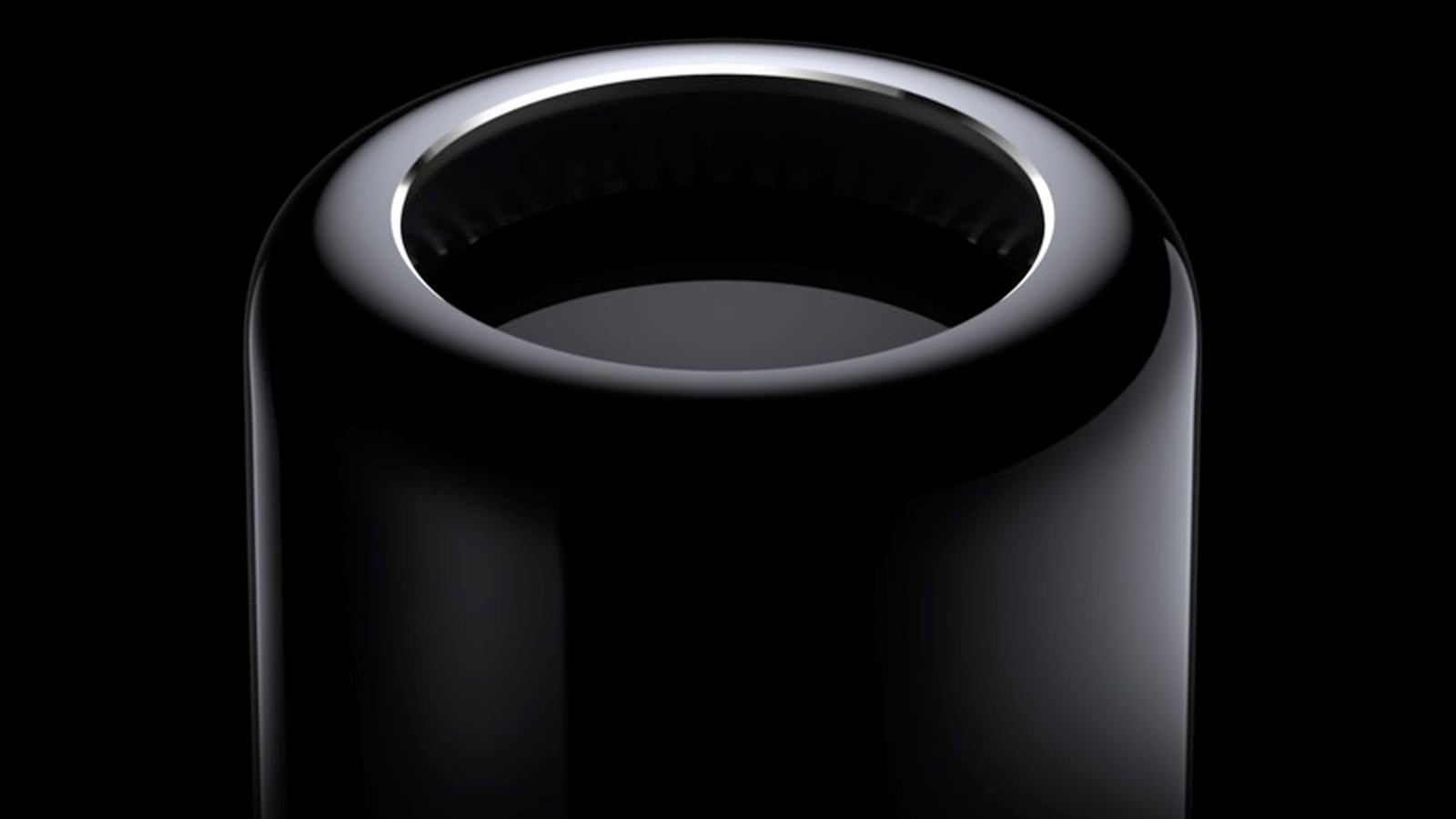
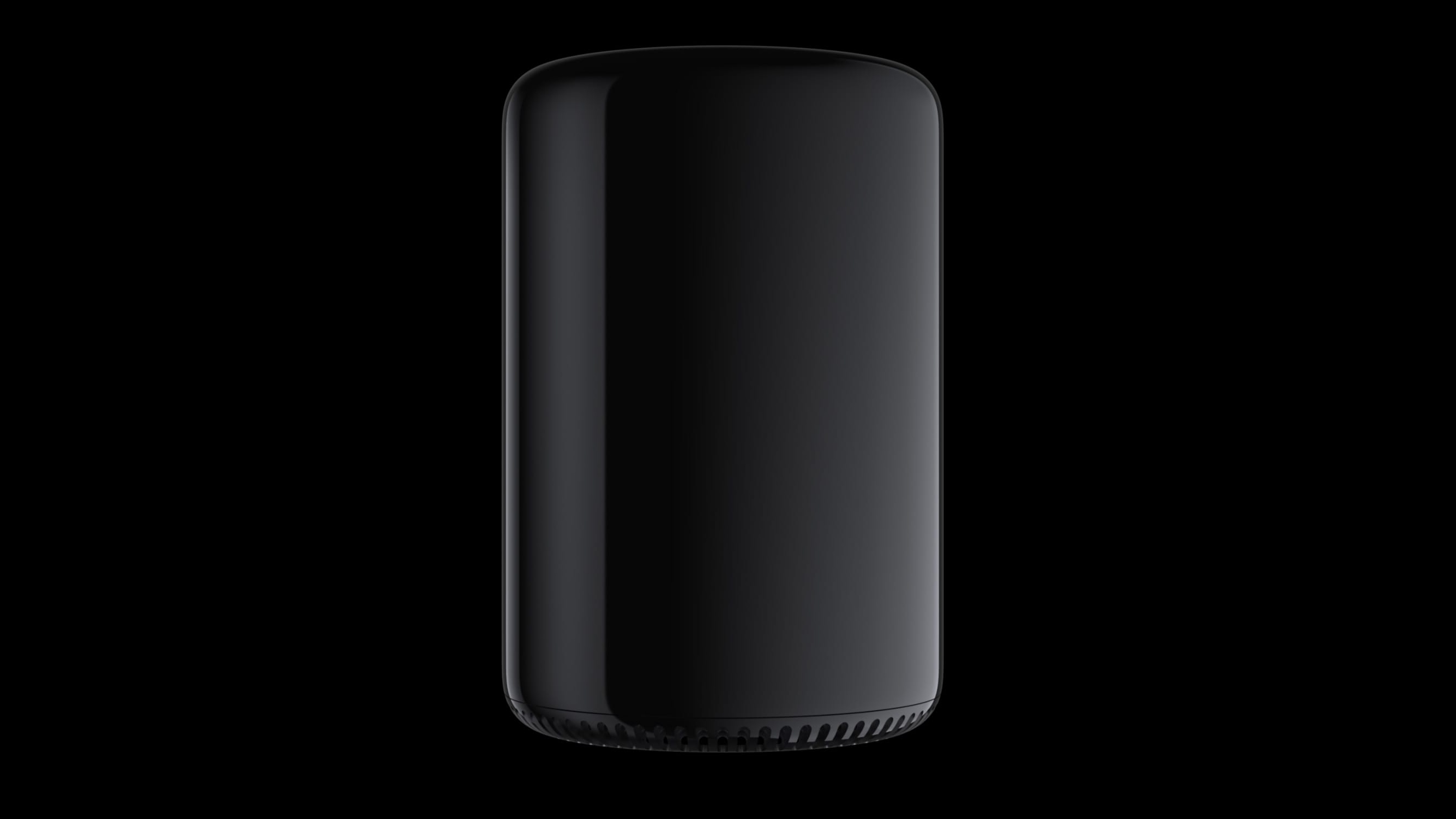
The so-called "trash can" Mac Pro featured a cylindrical design with a polished black aluminum finish and a "unified thermal core." The computer was visually striking, but Apple later admitted that it was thermally constrained, and it had poor upgradeability. Instead of internal slots, Apple pushed expansion via six Thunderbolt 2 ports.
Other specs included up to a 12-core Intel Xeon processor, dual AMD FirePro GPUs, up to 64GB of RAM, and up to a 1TB SSD. In the U.S., pricing started at $2,999.
Overall, Apple prioritized the Mac Pro's compact size, thermal efficiency, and quiet operation, when most pro users simply wanted the most performant and expandable Mac possible. Then, the Mac Pro went years without receiving upgrades, leading some to question whether Apple was still committed to the high-end Mac market.
The criticism ultimately led Apple to make the rare and surprising move of publicly apologizing to Mac users and ensuring that it remained committed to the Mac. Apple also pre-announced that it was working on a "completely rethought" Mac Pro with a modular design, along with what became the iMac Pro and Pro Display XDR.
"I think we designed ourselves into a bit of a thermal corner, if you will," said Apple's software engineering chief Craig Federighi, at the time. "We designed a system with the kind of GPUs that at the time we thought we needed, and that we thought we could well serve with a two GPU architecture. That that was the thermal limit we needed, or the thermal capacity we needed. But workloads didn't materialize to fit that as broadly as we hoped."
So, Apple went back to the drawing board.
2019 to 2023
In December 2019, the third-generation Mac Pro arrived. As promised, it fixed many of the problems that arose with the "trash can" model.
With this Mac Pro, Apple returned to a modular design with an aluminum housing that lifts off for "360-degree access" to the entire system. The computer had a "state-of-the-art thermal architecture" and eight PCI Express expansion slots.
"We designed Mac Pro for users who require a modular system with extreme performance, expansion and configurability," said Schiller, in a press release at the time. "With its powerful Xeon processors, massive memory capacity, groundbreaking GPU architecture, PCIe expansion, Afterburner accelerator card and jaw-dropping design, the new Mac Pro is a monster that will enable pros to do their life's best work."
This was the final Intel-based model, with up to a 28-core Xeon processor available alongside up to 1.5TB of RAM and up to an 8TB SSD. It could be configured with AMD's Radeon Pro Vega II Duo, which Apple said was the world's most powerful graphics card at the time. Other specs included four Thunderbolt 3 ports and an Apple Afterburner accelerator card that enabled playback of three streams of 8K ProRes RAW video simultaneously.
In the U.S., pricing started at $5,999, which was much higher than the previous models.
2023 to 2026
In June 2023, the Mac Pro entered the Apple silicon era when it received the M2 Ultra chip.
Mac Pro was the final Mac model to transition from Intel to Apple silicon.
Apple stuck with the same overall design as the previous generation, but the M2 Ultra chip with unified graphics and memory freed up a lot of internal space compared to the Intel model, resulting in a "hollow" appearance. And on the exterior, the Mac Pro gained eight Thunderbolt 4 ports, up from four Thunderbolt 3 ports previously.
Other specs included up to 192GB of unified memory and up to an 8TB SSD. In the U.S., starting pricing rose to a steep $6,999.
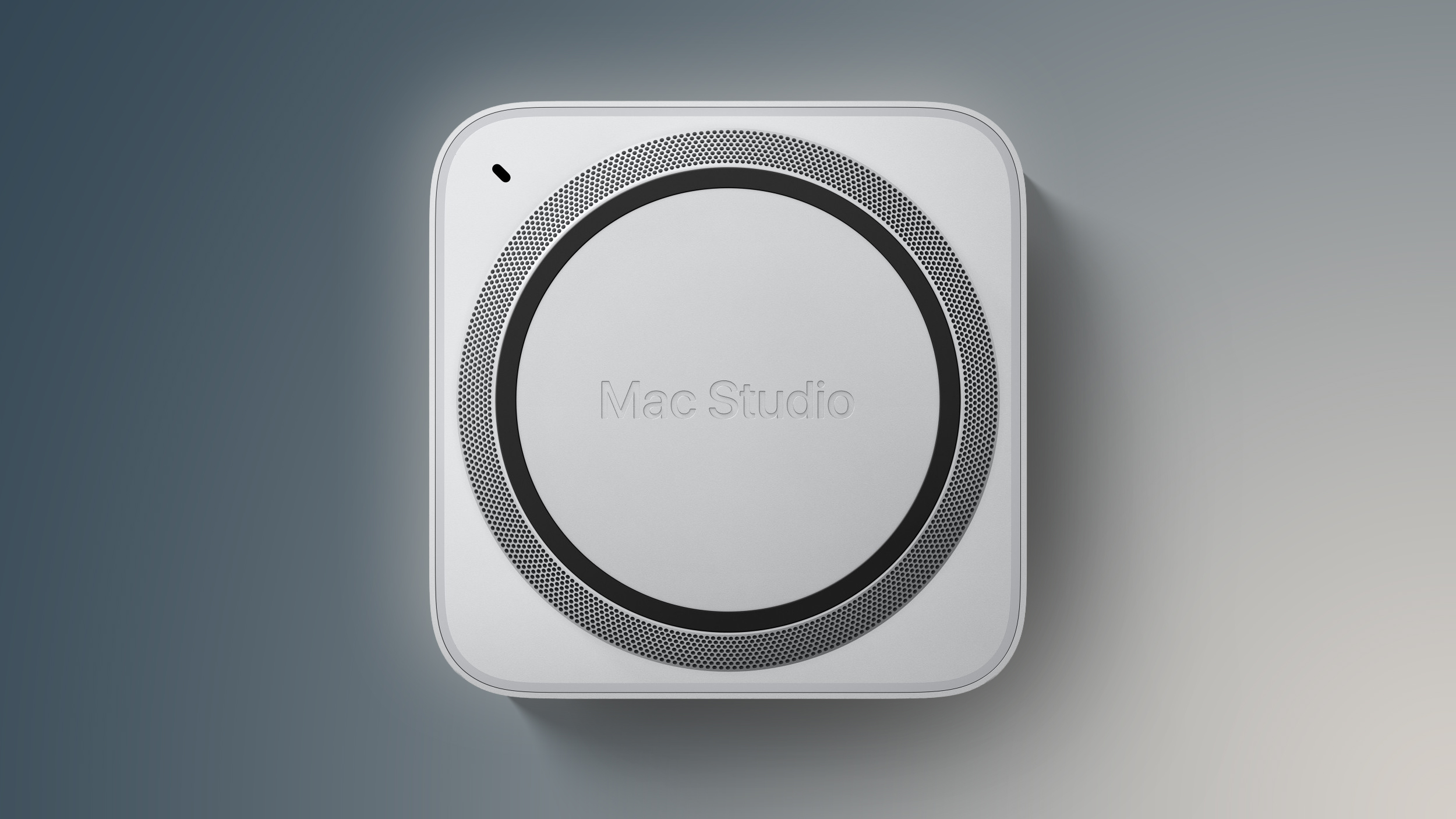
By the time the Mac Pro moved to Apple silicon, Apple had already released the Mac Studio, another desktop computer that is smaller than a Mac Pro but beefier than a Mac mini. It is currently powered by M4 Max or M3 Ultra chips, and configurations with M5 Max and M5 Ultra chips are expected to launch later this year.
The primary reason to purchase the latest Mac Pro over the Mac Studio was PCI expansion, but the Mac Pro's starting price was thousands of dollars higher than the Mac Studio, so the writing was on the wall that the Mac Pro's days were probably numbered.
Indeed, the Mac Pro was ultimately discontinued this week, marking the end of an era.
This article, "Mac Pro Discontinued: Reflecting on 20 Years of Apple's Desktop Tower" first appeared on MacRumors.com
Discuss this article in our forums
New Apple Immersive Video of BBC Proms Concert on Apple Vision Pro
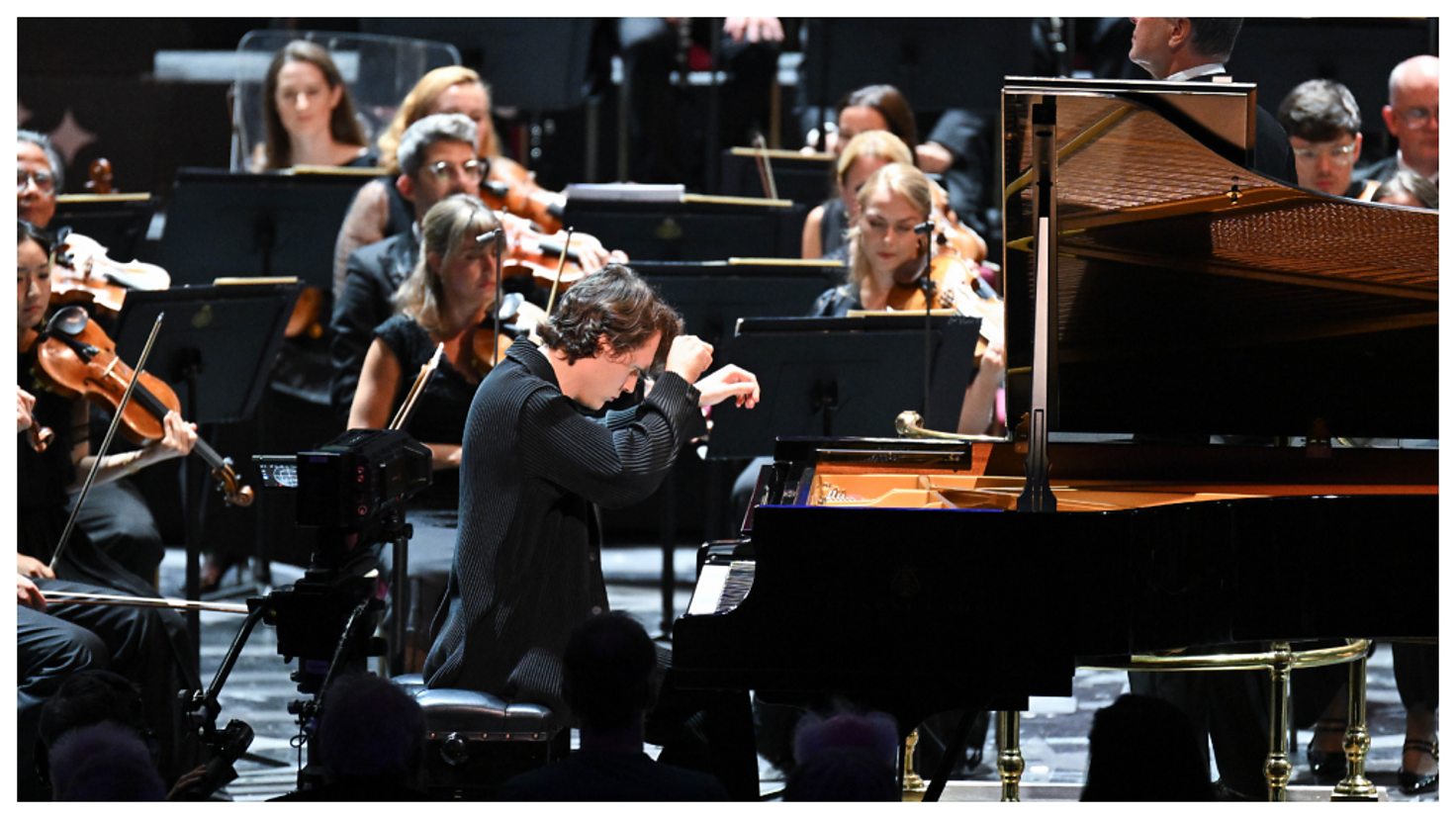
Filmed by Livewire Pictures using Blackmagic's URSA Cine Immersive cameras, the experience follows Austrian piano sensation Lukas Sternath as he takes to the stage in his BBC Proms debut, performing Edvard Grieg's Piano Concerto in A Minor with the BBC Symphony Orchestra, under chief conductor Sakari Oramo.
From the BBC media center:
"BBC Arts is committed to seeking out new ways for people to experience arts and culture, and to reach new audiences with our rich offering. We're grateful that Apple Vision Pro makes this innovative project possible, and to Livewire Pictures for embracing the new technology. We hope audiences are encouraged to also experience the magic of the Proms in person at the Royal Albert Hall this summer, or to follow from home on BBC iPlayer and BBC Sounds."The new immersive video experience is available now on the Apple TV app for Vision Pro.
This article, "New Apple Immersive Video of BBC Proms Concert on Apple Vision Pro" first appeared on MacRumors.com
Discuss this article in our forums
Your Jira exit solution: The OpenProject Jira Migrator
Caution
Atlassian has announced that Jira Data Center will reach end of life on March 28, 2029. After this date, Data Center licenses and apps will expire and become read-only, leaving cloud hosting as the only supported option.
Teams around the world are looking for alternatives to Jira, whether due to changing project requirements, a preference for open source solutions or rising costs. However, switching tools is often easier said than done – especially if a seamless migration solution is not readily available. We at OpenProject are currently developing a Jira migration tool to meet this need. With version 17.2 in February 2026, it has been released under feature flag – meaning it is in its final testing phase and soon to be released to our users.
The challenge: Migrating from Jira to OpenProject
For many teams, Jira has long been the project management tool of choice. In many cases, simply out of habit and a lack of time to start over. Especially since Atlassian continues to raise prices and “lock-in” users into their cloud offering, more and more organizations are rethinking their options and looking for cost-effective open source alternatives that are trustworthy and feature-rich.
However, switching from Jira to OpenProject presents challenges:
- Time constraints – teams often don’t have the resources to manually migrate their projects.
- Technical complexity – a migration tool must be able to handle issues, work logs and custom fields.
- Lack of ready-made solutions – until now, there was no specific importer tool that guides the user through a migration process.
The solution: The Jira Migrator, official migration wizard from OpenProject
In current beta version, the Jira Migrator is able to import the following basic data:
- Projects
- Issues (name, title, description, attachments)
- Users (name, email, project membership)
- Statuses
- Types
With upcoming releases, we aim to also include importing:
- Workflows
- Custom fields
- Issue relations
- Permissions
Currently, we only support Jira Server/Data Center versions 10.x and 11.x. Cloud instances are not supported at this time.
See our documentation to learn how to experiment with the Jira Migrator in beta version. You might also take a look at our best practices for Jira migrations.
Warning
Please be aware that right now (March 2026), this feature is still under active development. We know that many users are eagerly awaiting the release, and we are working hard to provide a high-quality migration tool soon.
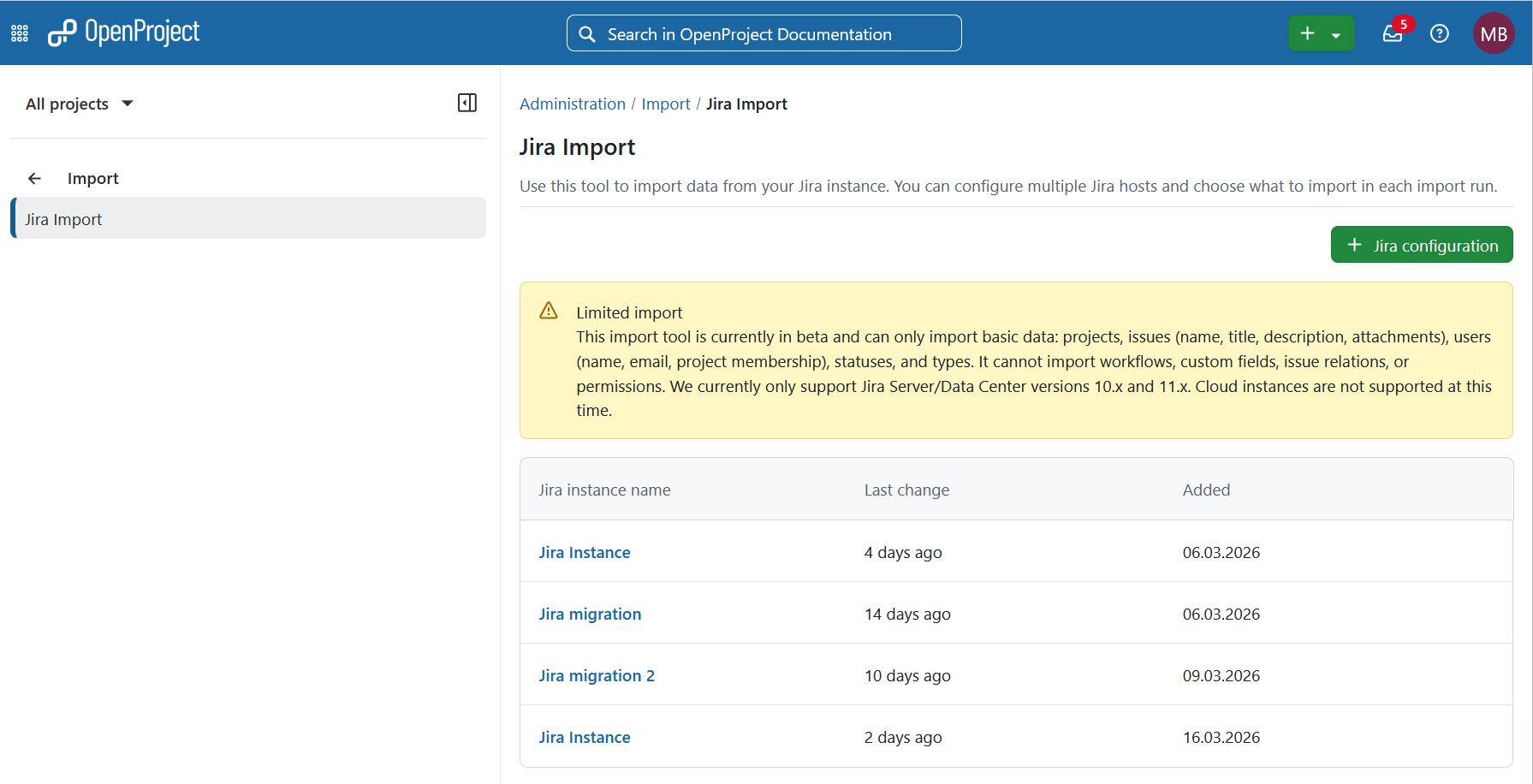
Watch this video to learn how the OpenProject Jira Migrator will support teams in their Jira exit:
We at OpenProject want to help finding migration solutions
At OpenProject, we want to support solutions that make migration easier. Many teams want to make the switch but don’t have the time or technical skills to do so. Which is why, in the past months, the OpenProject core team was quite busy working on a Jira Migrator.
To support the development of the official migration tool, we are collecting anonymized data samples. This data helps test and validate import capabilities across different Jira and Confluence configurations. Please reach out to us if you want to donate your data, we will sign an NDA to ensure confidentiality.
OpenProject 17.2: Bring AI to your projects. Without giving up control.
OpenProject 17.2 has been released and introduces several improvements across the platform. This release opens new possibilities for integrating AI into your project workflows, improves transparency on the Project Overview page, and continues our work on usability and accessibility.
One highlight of this release is the introduction of the MCP Server, which enables secure connections between OpenProject and AI systems while keeping full control over how project data is accessed.
In this article, we highlight the most important changes and what they mean for your daily work. As always, please see our release notes that contain the complete list of features, changes, and bug fixes.
A quick article navigation:
- Bring AI to your projects with secure MCP Server (Professional plan and higher)
- Reusable meeting templates (Basic plan and higher)
- Project Overview improvements with budget widgets and improved accessibility
- Comment fields for project attributes
- PDF export improvements
- Require login before opening external links (Premium plan and higher)
- UX/UI updates with the Primer design system
- Migration, installation, updates and support
Bring AI to your projects with secure MCP Server (Professional plan and higher)
Artificial intelligence is quickly becoming part of everyday work. Teams are exploring AI assistants that can answer questions, summarize information, and help analyze project data.
Many organizations are therefore asking the same question: How can we bring AI into our project workflows without losing control over our data and systems?
With OpenProject 17.2, we introduce the MCP Server, a new capability that enables secure connections between OpenProject and AI systems.
The MCP Server implements the Model Context Protocol (MCP) and exposes OpenProject’s APIv3 resources as MCP-compatible endpoints. This allows external tools, including large language models (LLMs) and other MCP clients, to access structured project data from OpenProject in a controlled way.
With this connection in place, AI assistants can interact with real project context. For example, they can summarize project status, analyze dependencies between work packages, or support planning workflows based on up-to-date information from OpenProject.
At the same time, control remains fully in your hands. The MCP Server integrates with OpenProject’s authentication mechanisms, including OAuth2, API tokens, and external OpenID Connect providers. Administrators can configure the server directly in OpenProject and control aspects such as response formats and response volume.
The MCP Server was sponsored and developed with the support of Mercedes-AMG, who are actively using it in their OpenProject environment. Their collaboration helped shape the feature based on real-world requirements and demonstrates how large organizations can benefit from securely connecting AI workflows to their project data.
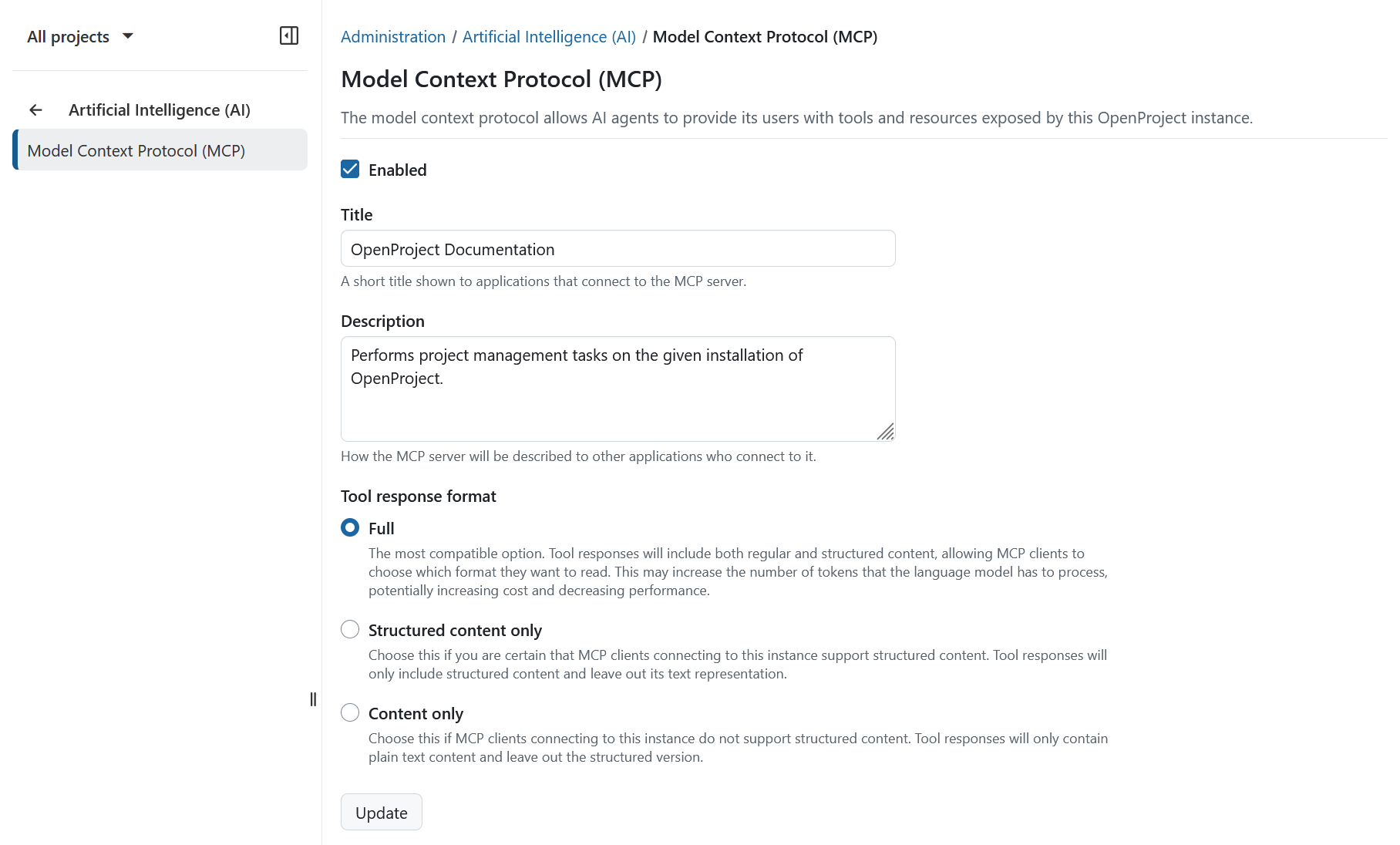
Administrators can configure the MCP Server directly in the OpenProject administration interface and control aspects such as response formats and response volumes. This allows organizations to decide how their project data is exposed and how external tools interact with it.
To learn about how to use the MCP server, please see our documentation.
Note
The MCP Server is available as an Enterprise add-on in the Professional plan and higher. See our pricing page and contact us for more information on upgrading to a higher plan.
Reusable meeting templates (Basic plan and higher)
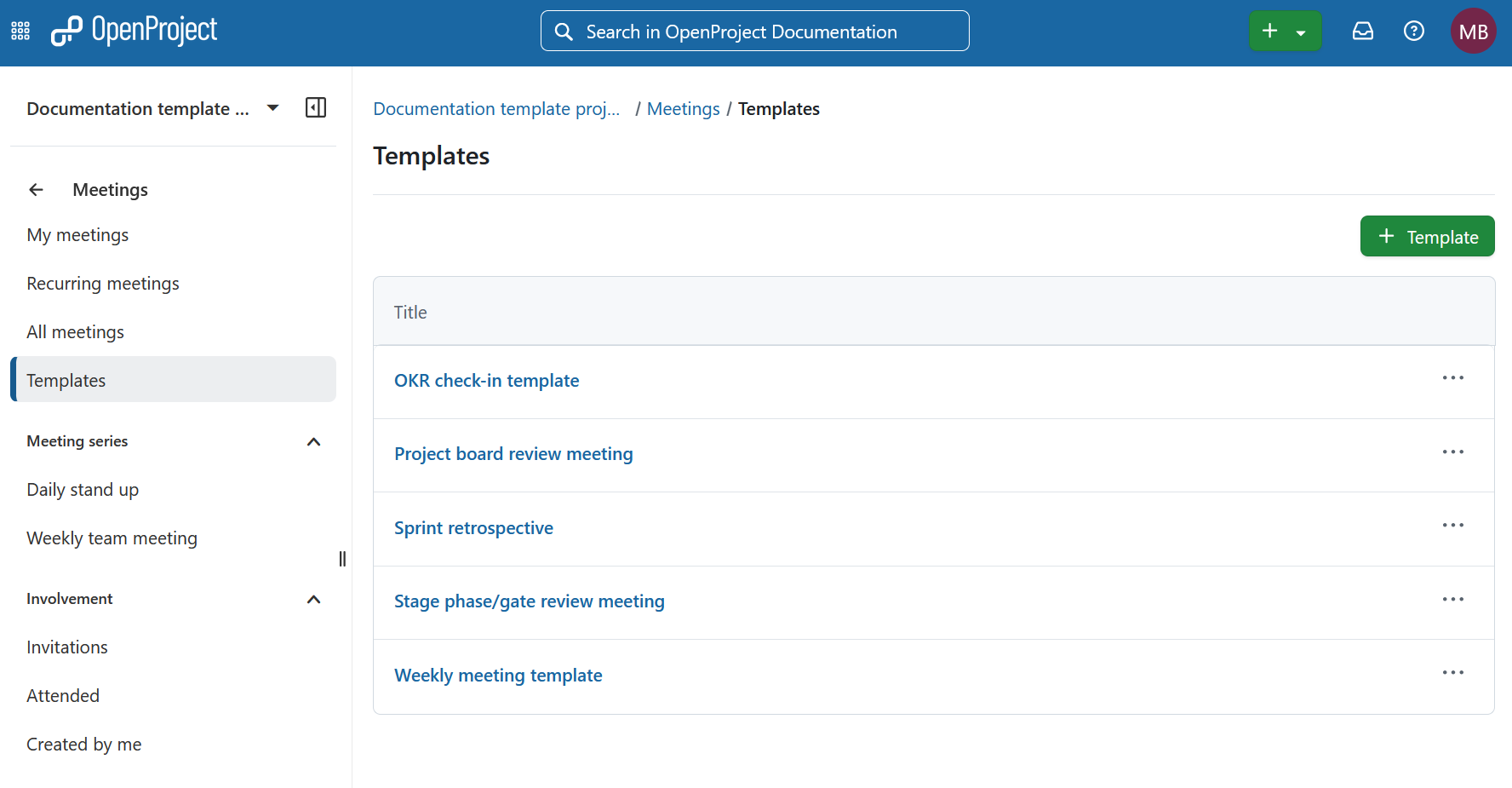
Preparing meetings often involves recreating the same agenda structure again and again. With OpenProject 17.2, administrators can now define reusable meeting templates that provide a predefined agenda layout for their teams.
Instead of starting from scratch, users can select a template when creating a meeting. The agenda will automatically include predefined sections and items.
This saves time when preparing meetings and helps teams reuse proven formats for discussions and decision-making.
Note
The reusable meeting templates are available as an Enterprise add-on in the Basic plan and higher. See our pricing page and contact us for more information on upgrading to a higher plan.
Project Overview improvements with budget widgets and improved accessibility
OpenProject 17.2 enhances the Project Overview page to provide clearer financial insights, easier editing, and improved accessibility.
Budget widgets for financial insights
Project managers and stakeholders can now see key financial indicators directly on the Overview page.
New widgets display information such as:
- planned budget
- actual costs
- spent budget
- remaining budget
Visual breakdowns by cost type and recent monthly actuals help teams understand financial trends directly within the project context.
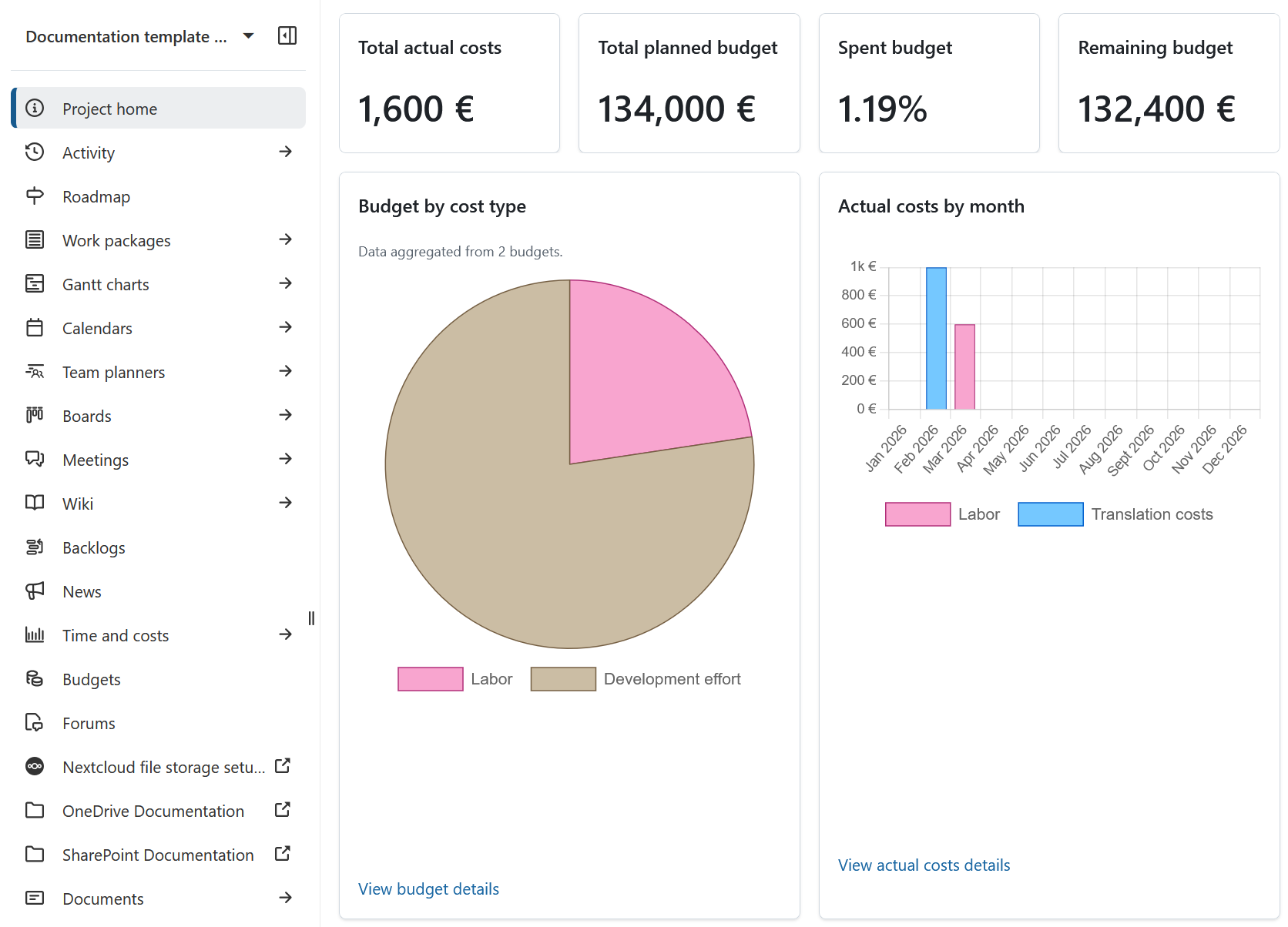
Inline editing for project description and status
The project description and project status widgets on the Overview tab can now be edited directly inline. Authorized users can update information directly where it is displayed.
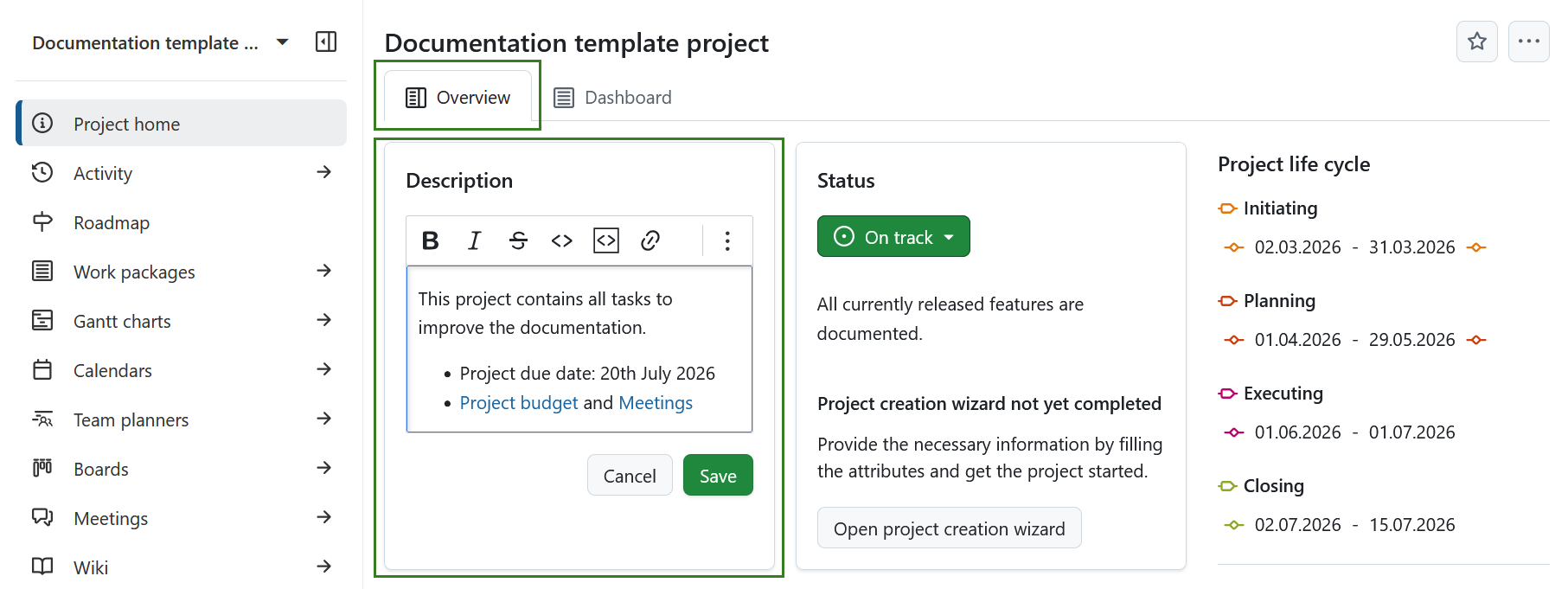
Improved accessibility of Project Overview and dashboard widgets
We have significantly improved the accessibility of widgets on both the Project Overview and Project dashboard pages. Widgets are now fully operable via keyboard, provide clearer structural semantics for screen readers, and follow WCAG 2.1 AA guidelines for focus management, labeling, and navigation order.
These improvements ensure that project information and controls are accessible to all users, including those relying on assistive technologies.
Comment fields for project attributes
Project attributes often require additional explanation. For example, a chosen value may depend on assumptions, governance decisions, or project-specific context.
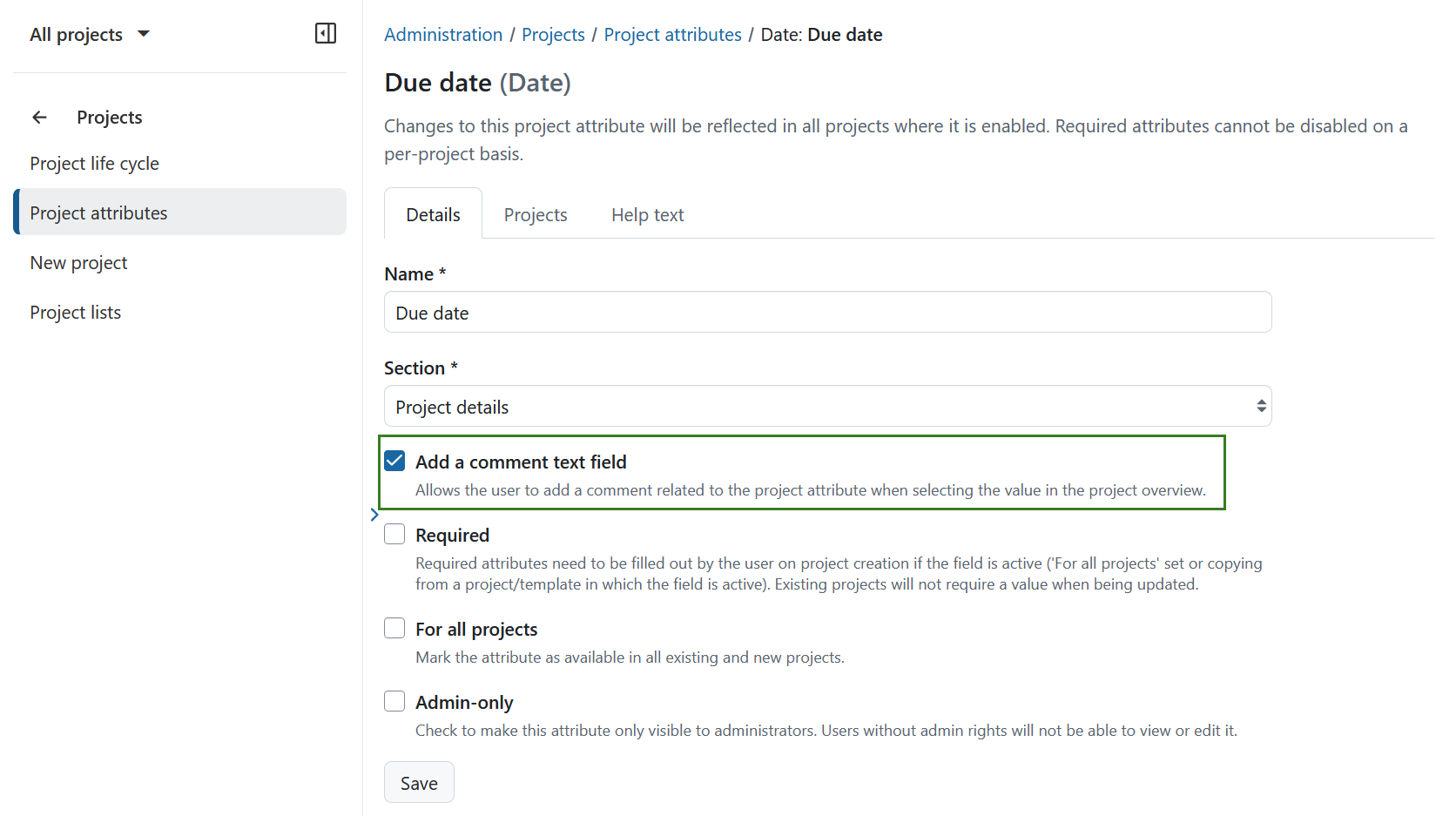
With OpenProject 17.2, administrators can now enable comment fields for project attributes. This allows users to document the reasoning behind selected attribute values directly where the attribute is maintained.
Comments follow the same permission logic as the attribute itself and are:
- displayed alongside the attribute on the Project Overview page
- tracked in project activity
- included in exports
- accessible via the API
This provides additional transparency and helps teams better understand important project decisions.
PDF export improvements
OpenProject 17.2 enhances PDF exports to provide more comprehensive reporting.
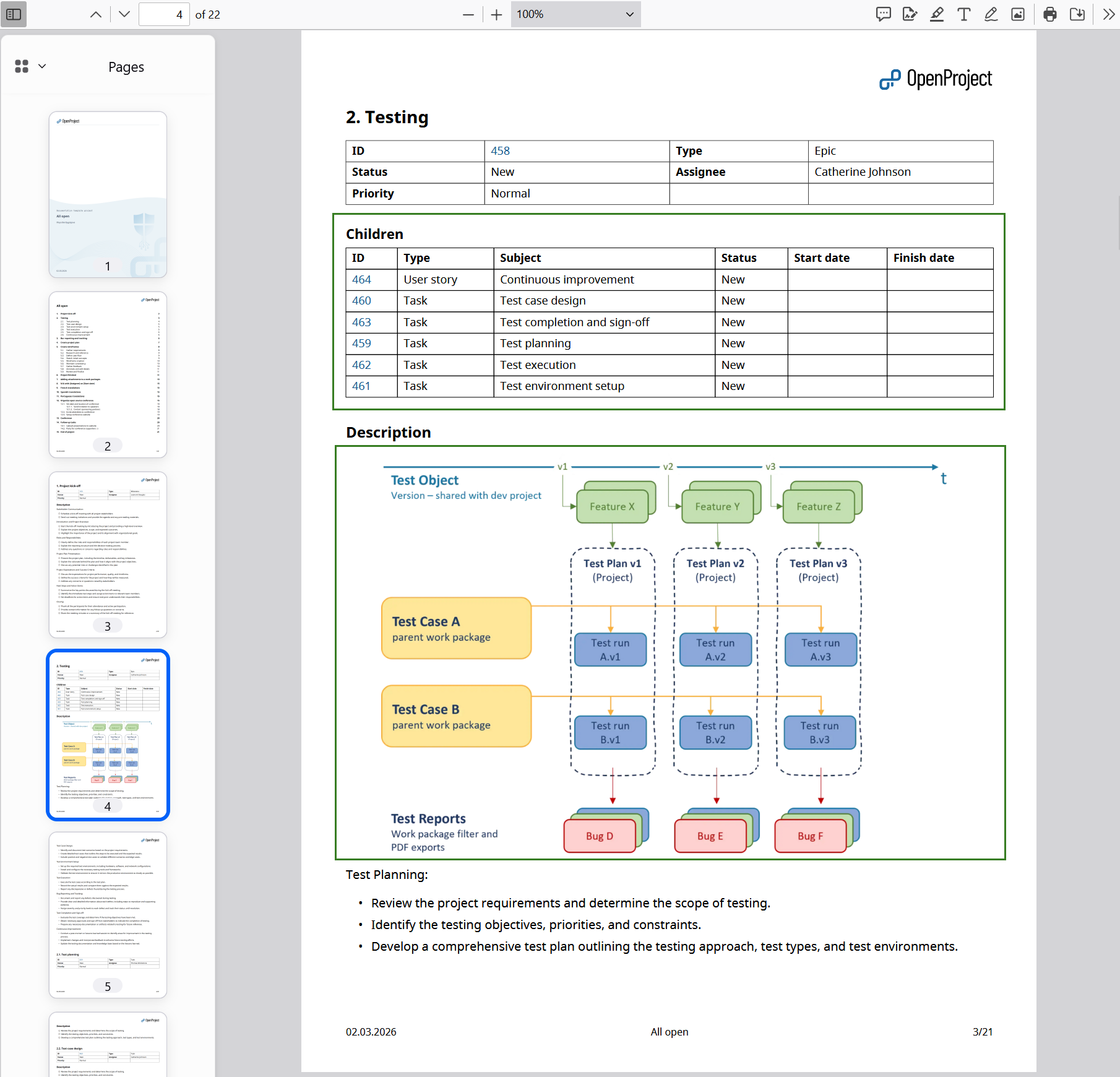
Work package queries can now include relationship columns, which are exported as structured tables in the PDF report. This ensures that dependencies between work packages remain visible in exported documentation.
In addition, WebP images embedded in work package descriptions are now supported in exported PDFs.
Require login before opening external links (Premium plan and higher)
Following external links inside collaboration platforms can sometimes pose security risks.
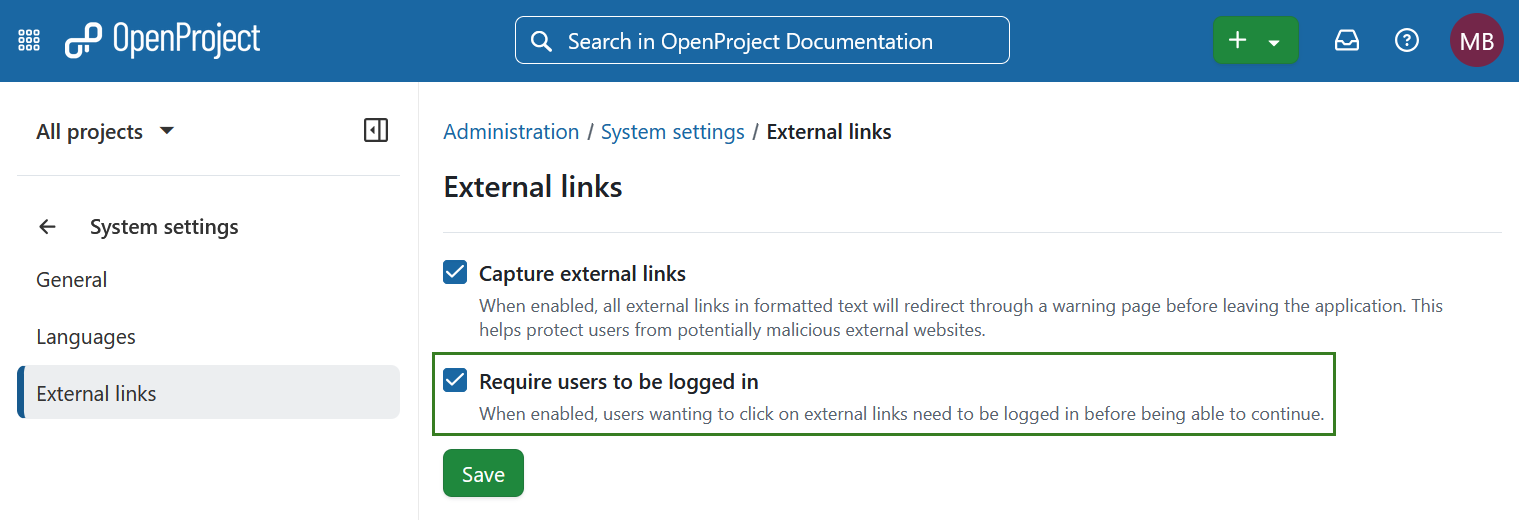
Building on the external link safety options introduced in OpenProject 17.1, OpenProject 17.2 adds the option to require users to be logged in before opening external links.
When this setting is enabled, users must authenticate before they can follow external links.
Note
This feature is available as an Enterprise add-on in the Premium plan and higher. See our pricing page and contact us for more information on upgrading to a higher plan.
UX/UI updates with the Primer design system
OpenProject continues the transition to the Primer design system, helping unify the user interface across the application.
Backlogs module update
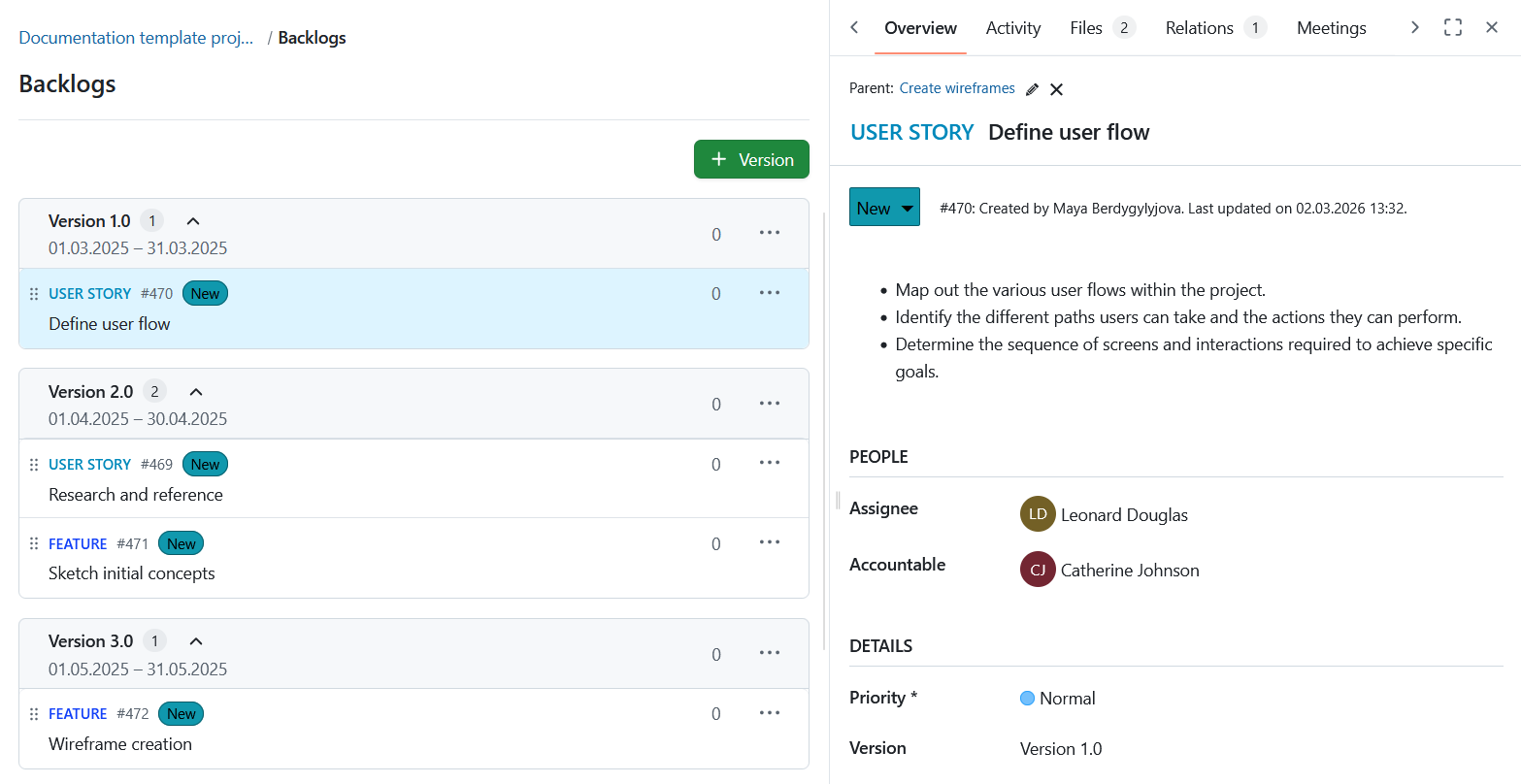
The Backlogs module has been updated using Primer components. This results in a cleaner layout and more consistent interaction patterns.
Work packages can now also be viewed in a split screen, allowing teams to manage backlog items while reviewing work package details.
Improvements in administration interfaces
Administrative interfaces for Custom Fields, Versions, and Groups have also been aligned with the Primer design system.
OpenProject 17.2: Migration, installation, updates and support
Follow the upgrade guide for the packaged installation or Docker installation to update your OpenProject installation to OpenProject 17.2. We update your hosted OpenProject environments (Enterprise cloud) today, March 11, 2026.
You will find more information about all new features and changes in our Release notes and in the OpenProject Documentation.
If you need support, you can post your questions in the Community Forum, or if you are eligible for Enterprise support, please contact us and we will be happy to support you personally.
- New to OpenProject? To test all features of OpenProject 17.2 right away, create a 14 days free trial instance for our OpenProject Enterprise cloud.
- Prefer to run OpenProject 17.2 in your own infrastructure? Here you can find the Installation guidelines for OpenProject.
- Want to upgrade from a Community version to try out the Enterprise add-ons? Get a 14 days free trial token to test the Enterprise add-ons (all plans).
Credits
A very special thank you goes to Mercedes-AMG for sponsoring the MCP server feature and supporting its development. Your collaboration and real-world feedback helped shape this functionality and demonstrate how large organizations can benefit from securely connecting AI workflows to their project data in OpenProject.
We would also like to thank Helmholtz-Zentrum Berlin, City of Cologne, Deutsche Bahn and ZenDiS for sponsoring released or upcoming features. Your support, alongside the efforts of our amazing Community, helps drive these innovations. Also a big thanks to our Community members for reporting bugs and helping us identify and provide fixes. Special thanks for reporting and finding bugs go to Alexander Aleschenko, Gabor Alexovics, Jörg Mollowitz and Александр Татаринцев.
Last but not least, we are very grateful for our very engaged translation contributors on Crowdin, who translated quite a few OpenProject strings! This release we would like to particularly thank the following users:
- Adam Siemienski, for a great number of translations into Polish.
- Mehmet Coşkun, for a great number of translations into Turkish.
- Liangzdz, for a great number of translations into Chinese Simplified.
Would you like to help out with translations yourself? Then take a look at our translation guide and find out exactly how you can contribute. It is very much appreciated!
As always, we welcome any feedback on this release.
Apple's $700 Mac Pro Wheels Kit Discontinued Along With Mac Pro
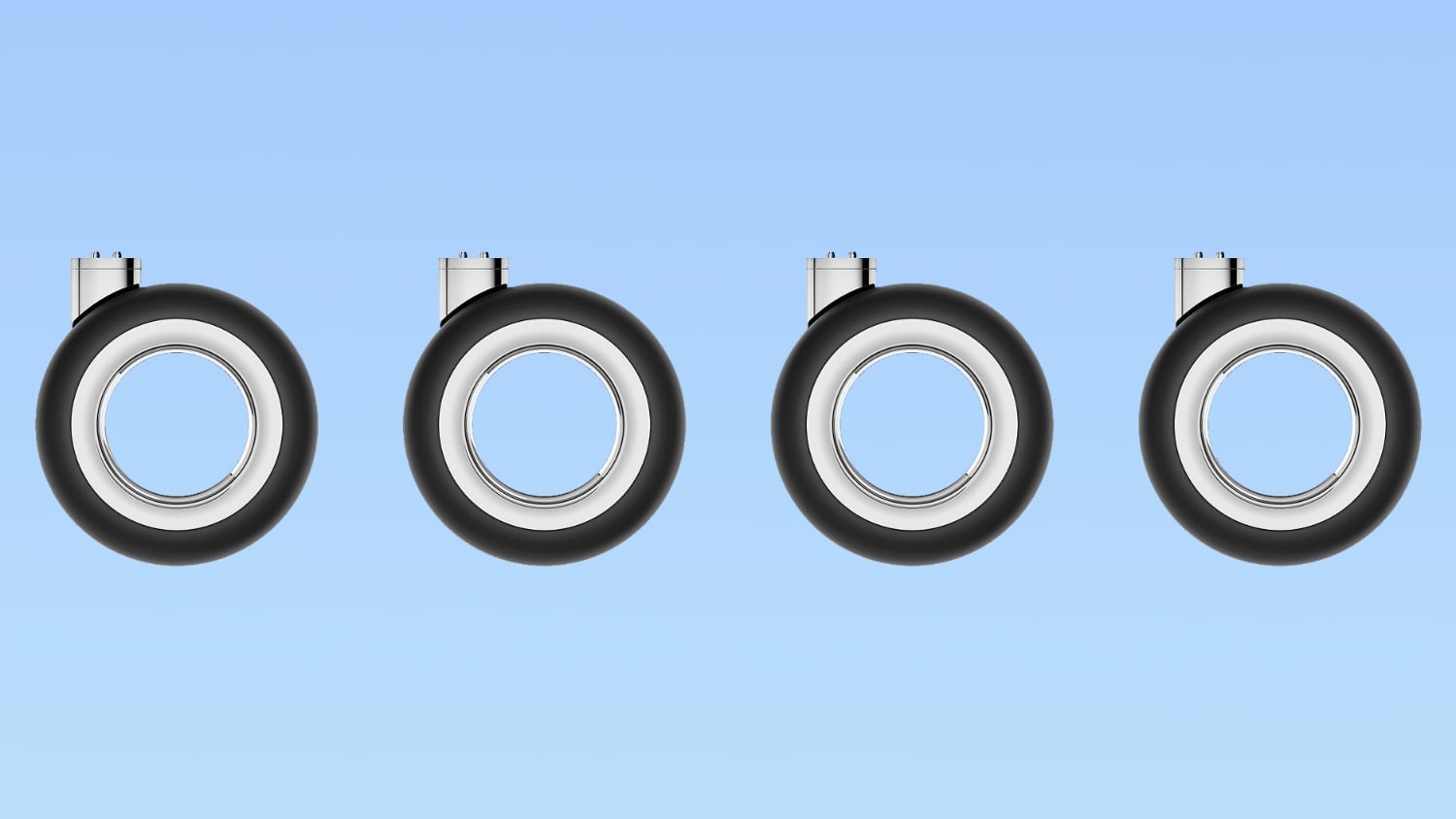
The Mac Pro Wheels kit was introduced in 2020, and allowed Mac Pro owners to add wheels to their machine after purchase. The Mac Pro could be bought with a wheel option for an additional $400, but the lower price was because opting for wheels removed the $300 feet.
Apple's kit included a 1/4-inch to 4mm hex bit for installing the wheels, and an installation guide.
Apple also sold a $300 Mac Pro Feet Kit for users who ordered wheels but wanted to swap to standard feet. That kit has also been discontinued. The Mac Pro and its accessories have been removed from Apple's website entirely, and old links now redirect to the online Apple Store.
For Mac Pro owners who want to switch to wheels but are now unable to do so, OWC sells a less expensive Rover Pro wheels kit for $200.
This article, "Apple's $700 Mac Pro Wheels Kit Discontinued Along With Mac Pro" first appeared on MacRumors.com
Discuss this article in our forums
Apple Confirms Mac Pro Is Dead, No Future Models Planned
The Mac Pro was last updated in 2023, which was when Apple added an M2 Ultra Apple silicon chip, but the chassis has not been refreshed since 2019. Apple redesigned the Mac Pro to be more modular in 2019 after failing with its "innovative" trashcan Mac Pro, but the machine has never been mainstream due to its $6,999 starting price.
Apple has largely replaced the Mac Pro with the Mac Studio, a device that is smaller and uses newer Apple silicon chips. The Mac Studio is now Apple's high-end desktop machine designed for professional use.
The current Mac Studio features an M3 Ultra chip, though it is expected to get an M5 Ultra refresh later this year. Apple's desktop lineup also includes the Mac mini and the iMac.
The Mac Pro's downfall started in 2013 when Apple introduced a radical cylindrical design that turned out to be a major mistake. The Mac Pro's components were mounted around a central thermal dissipation core and cooled with a single fan that pulled air from under the case, through the core, and out of the top of the machine. It was quiet, but not efficient.
When Apple announced the 2013 Mac Pro, Phil Schiller infamously said "Can't innovate anymore, my ass," in response to critics who complained about the Mac Pro's lack of updates and Apple's failure to create products for pro users.
Unfortunately, the 2013 Mac Pro's design did not include PCIe expansion slots for graphics cards and other hardware, with expansion handled through Thunderbolt 2 ports. The design also did not account for future updates in GPU technology, leaving Apple unable to add larger graphics cards and other components to the device.
Apple ended up apologizing to its pro user base and said the 2013 design was thermally constrained in a way that made upgrades impossible. It took Apple until 2019 to unveil the current Mac Pro, which adopted a more standard tower form factor with eight PCIe slots.
After the 2019 launch, the Mac Pro got an Apple silicon chip in 2023, and that's it. There have been three Mac Pro updates in the last 13 years, so it's not surprising to see the Mac Pro retired. The Mac Studio offers almost all of the same capabilities as the Mac Pro, with the exception of PCIe expansion slots.
This article, "Apple Confirms Mac Pro Is Dead, No Future Models Planned" first appeared on MacRumors.com
Discuss this article in our forums