Reading view

Colombia’s Armed Forces confirm over 50 dead in FARC dissident clashes in Guaviare

Colombia’s Armed Forces and regional authorities are struggling to verify the full scale of a bloody confrontation between rival FARC dissident factions in the remote southeastern department of Guaviare after clashes reportedly left more than 50 combatants dead.

The fighting, described by officials as one of the deadliest episodes this year involving former Revolutionary Armed Forces of Colombia (FARC) splinter groups, erupted in rural areas near the departmental capital San José del Guaviare between forces loyal to two dissident commanders known by their war aliases “Calarcá” and “Iván Mordisco.”

According to a communiqué released by the faction aligned with Calarcá, the confrontation began when approximately 250 fighters allegedly under the command of Néstor Gregorio Vera Fernández, alias Iván Mordisco, launched a surprise assault on a dissident encampment in the hamlet of La Siberia.

The clashes were reported in the rural sectors of Barranco Colorado, Charras and Trocha Ganadera, cattle farming regions with limited state presence.

The Calarcá faction claimed that a combat column belonging to the Isaías Carvajal Front had been resting overnight when it was attacked before dawn.

“In an act of legitimate self-defense, our units broke the siege, inflicting the first enemy casualties,” the group said in the statement, which was circulated through clandestine channels on Thursday.

“After three hours of combat, the enemy withdrew leaving fifty dead on the battlefield and carrying away a large number of wounded,” the communiqué added.

Colombia’s Army confirmed that troops from Brigade 22 remain deployed in the rural outskirts of San José del Guaviare, the epicenter of the fighting, but authorities acknowledged that they have been unable to fully enter the conflict zone due to difficult terrain and the continued presence of heavily armed illegal groups.

Defense Minister Pedro Sánchez confirmed the clashes took place in the Barranco Colorado sector, more than 100 kilometers east of San José del Guaviare, but refrained from confirming casualty figures. Minister Sánchez did, however, claim that the official statement amounted to a “confession and public admission” of an “atrocious crime”. Sánchez also warned that the reported deaths of underage combatants would constitute a grave violation of international humanitarian law and Colombian criminal legislation, further intensifying scrutiny over forced recruitment of children by FARC dissidents.

Officials said access to the region is severely restricted, with many areas reachable only through jungle tracks and river routes. Colombia’s forensic authorities, including Medicina Legal, have yet to recover or identify bodies from the battlefield.

Regional authorities convened an extraordinary security council meeting on Wednesday amid fears that the violence could intensify ahead of Colombia’s presidential election scheduled for May 31.

San José del Guaviare Mayor Willy Rodríguez told Caracol Radio that preliminary reports suggested “dozens” may have died, though he cautioned that authorities had not yet independently verified the numbers.

“We are receiving alarming information from residents in the rural areas, but the Armed Forces still have not been able to fully enter and confirm the situation,” Rodríguez said.

Governor Yeison Rojas joined police and military commanders in emergency deliberations as intelligence agencies attempted to establish the true scale of the confrontation.

The dissident faction loyal to Calarcá accused Iván Mordisco of provoking the conflict and described the elusive guerrilla commander as “a mentally disturbed individual with ideological shortcomings and psychopathic tendencies.”

The statement also claimed the group seized a significant cache of weapons during the battle, including four machine guns, 49 assault rifles, two Dragunov sniper rifles and more than 10,000 rounds of ammunition.

The faction further stated that two of its own fighters were killed and three wounded, while also claiming to have captured “a female prisoner of war.”

“We inform the Colombian people that this tragic event, occurring four days before an electoral contest, was not initiated by us,” the communiqué concluded. “It was an act of legitimate self-defense.”

The confrontation underscores the growing fragmentation and territorial disputes among Colombia’s remaining armed groups following the 2016 peace accord between the Colombian government and the FARC guerrillas.

Iván Mordisco, once considered one of the most powerful dissident commanders operating outside the peace agreement, has become a central figure in the collapse of President Gustavo Petro’s “Total Peace” negotiations with illegal armed groups.

Security analysts warn that Guaviare, a historic stronghold for the former FARC insurgency and a major coca-producing region, has increasingly become the scene of violent turf wars involving rival dissident fronts competing for narcotics routes, extortion rackets and territorial control.

The latest bloodshed also raises concerns over the deteriorating security situation in Colombia’s southeastern departments  just days before Colombians vote in a presidential election, May 31.

San José del Guaviare, long considered a strategic stronghold in Colombia’s anti-narcotics campaign, hosts one of the country’s largest counterinsurgency and anti-drug military bases, including a fleet of Black Hawk helicopter gunships used in jungle operations against armed groups and cocaine trafficking networks. The region has also historically maintained the presence of U.S. military personnel and advisers supporting intelligence, surveillance and counternarcotics missions in southeastern Colombia.

As of Thursday, Colombia’s Attorney General’s Office, National Forensic Institute – Medicina Legal – and Armed Forces had yet to issue a definitive death toll.

  •  

Petro Advances Temporary Concentration Zones for “Clan del Golfo” as Final Push for Total Peace Policy

More than 400 combatants would be concentrated in the new zones as negotiations continue in Doha, Qatar

President Gustavo Petro is moving forward with the creation of temporary concentration zones, known as Zonas de Ubicación Temporal (ZUT), for members of the Estado Mayor Conjunto del Ejército Gaitanista de Colombia (EGC), also known as the Clan del Golfo, the country’s largest drug trafficking armed group, in a renewed effort to advance his Total Peace (Paz Total) policy just days before Colombia’s presidential elections on May 31, 2026.

According to an official statement from Colombia’s presidency, the ZUTs would initially allow the concentration of more than 400 combatants while parallel negotiations continue over a possible peace agreement with the Colombian government, although no preliminary agreements have yet been reached.

The temporary concentration zones would function as designated areas where combatants suspend armed activities while participating in talks with the government and preparing for a potential reintegration into civilian life.

According to the government, the zones would remain in effect until December 31, 2026, meaning their future would ultimately depend on Colombia’s next president, who will take office on August 7, as well as on the broader future of the Total Peace policy.

Colombia’s most powerful criminal organization

The Clan del Golfo is considered by specialized organizations, including the Fundación Ideas para la Paz (FIP), to be Colombia’s most powerful criminal structure.

According to the organization, the group has nearly 10,000 armed members and operates in multiple strategic regions linked to drug trafficking, illegal mining and territorial control.

The US government has designated the group a transnational terrorist organization, while President Donald Trump previously warned of possible US military actions in Colombian territory over security and narcotics concerns, comments that sparked diplomatic tensions with Petro’s administration.

Institutional clash over arrest warrants and extradition requests

The ZUT proposal comes amid tensions between Colombia’s executive branch and the Attorney General’s Office over the legal conditions required to move the process forward.

The Office of the High Commissioner for Peace requested the suspension of arrest warrants against 29 Clan del Golfo members, including 13 individuals subject to extradition requests, among them Jobanis de Jesús Ávila Villadiego, alias “Chiquito Malo,” the group’s top leader.

Attorney General Luz Adriana Camargo rejected the request, citing legal limitations regarding individuals sought by foreign authorities.

Following the refusal, Petro publicly defended the process in a message on X. “I have been clear that, in the early stages of the process, individuals facing extradition do not participate,” the president wrote, denying any intention to suspend extradition orders unless there is “an advanced peace process, as established by law.”

Amid the controversy, the Clan del Golfo itself issued a statement accepting that individuals facing extradition requests would not initially participate in the temporary concentration zones.

“As an unequivocal demonstration of political will and coherence, the Joint High Command of the Gaitanista Army of Colombia accepts, in good faith, that access to the Temporary Concentration Zones will be limited to combatants who are not subject to extradition requests by any foreign government,” the group said.

The group added that the decision seeks to “remove any shadow of doubt” over the process and prevent extradition disputes from obstructing negotiations.

The presidency later highlighted that the EGC accepted the government’s conditions for concentrating fighters in Tierralta, Córdoba, and in the municipalities of Belén de Bajirá and Unguía, Chocó. According to the government, combatants and commanders are expected to begin entering the zones on June 25.

Criticism over timing

The initiative has sparked criticism because of its timing, arriving just days before presidential elections and during a government transition period.

Ombudswoman Iris Marín warned that the process creates uncertainty over how armed groups might interpret the political transition.

“The move toward those zones creates expectations among armed groups in the middle of an electoral context and government transition. It is impossible for disarmament to happen before August 7, 2026, so how do armed groups interpret that in an electoral context?” Marín said in a video shared on social media.

Marín clarified, however, that Colombia’s Constitution grants the president authority to pursue peace negotiations, meaning concerns center not on the legality of the initiative itself but on its political timing.

Negotiations between the Colombian government and the Clan del Golfo have been underway since 2025 in Doha, Qatar, which has quietly hosted talks between both parties. According to official sources, the ZUTs are intended as confidence-building measures and humanitarian relief for communities affected by the group’s violence.

*

Photo: Colombian government representative Álvaro Jiménez shakes hands with Clan del Golfo spokesperson Luis Armando Pérez in the presence of Qatar’s Minister of State for Foreign Affairs, Mohammed bin Abdulaziz bin Saleh Al-Khulaifi, in Doha on September 18, 2025, at the start of peace talks. Photo shared by Colombia’s Office of the High Commissioner for Peace.
  •  

Editorial: Gustavo Petro’s “Total Peace” Has Led to Total Chaos in Colombia

Colombia’s President Gustavo Petro ran for president on a campaign promising Paz Total—Total Peace. He promised to give the FARC dissidents, the vicious ELN guerillas, and mafias like the Clan del Golfo a good talking to, and with that, they will just lay down their weapons and become model citizens. Petro promised that through dialogue with bloodthirsty kidnappers and extortionists, they would be willing to stop being bloodthirsty kidnappers and extortionists; as if they are just misunderstood little muffins who only need a hug.

Nubia Carolina Córdoba, governor of Chocó, Colombia (photo from her Twitter account)

Nubia Carolina Córdoba, governor of Chocó, Colombia (photo from her Twitter account)

According to figures compiled by the Universidad Externado and reported by The City Paper Bogotá, Colombia has recorded 40,663 homicides during the first three years of the Petro presidency. Over 400 human rights defenders have been slaughtered between 2022 and 2025 according to the United Nations Office of the High Commissioner on Human Rights. Human Rights Watch reports that the ELN and FARC dissidents have expanded their territories by up to 55%. They are taking back over Colombia.

Under Gustavo Petro’s watch, Colombia has returned to the Institute for Economics and Peace’s Global Terrorism Index top ten list of countries impacted by terrorism, along with Total Peace destinations like Democratic Republic of Congo, Somalia, and Syria. Just this past week, a Clan del Golfo poster was put up within walking distance from the Aeropuerto Internacional José María Córdova just outside of Medellín. This Total Peace nonsense is a failure.

Right now, in the neglected Pacific department of Chocó, the ELN has kidnapped whole communities. Petro ran a campaign promising that he was going to embrace these historically neglected communities—places like Chocó, Nariño, La Guajira, and Norte de Santander—but insecurity is increasing. Chocó’s governor, Nubia Carolina Córdoba, says 6,047 people are trapped inside of their homes because the ELN has announced an illegal armed curfew in the municipality of Bajo Baudó. Most of these people are already poor, and now they have been kidnapped en masse by this guerilla group that operates with impunity because Gustavo Petro coddles them with “dialogue.”

According to Governor Córdoba, they attacked the police station in the village of Santa Rita using grenades attached to drones. It has gotten so bad that Colombia has restricted the entry of drones into the country. These people are calling out for help, but the president insists on talking as the ELN grows and continues to menace the police forces, the Colombian military, and, most importantly, the innocent public.

There is currently public disorder where belligerents have completely blocked the roads in the north of Antioquia, in the region called Bajo Cauca, and also in the neighboring department of Córdoba. The city of Caucasia is under curfew. Antioquia’s Governor, Andrés Rendón, has urgently called on the national government to stop the talk and take action. Groups are attacking ambulances and burning people’s motorcycles as they try to get by the roadblocks, regardless of the emergency.

Governor Rendón stated: “There can be no dialogue amidst blockades and human rights violations. It’s been seven days now with the Bajo Cauca region paralyzed and the country held hostage by chaos.” He called on the Fiscalía General de la Nación to bring those responsible to justice and challenged the Minister of Defense, Pedro Sánchez, to order the immediate reopening of the roads. “We’re not talking about small-scale miners here; behind this are criminal structures, as everyone knows, that finance themselves through illegal mining and move billions of pesos,” Rendón added, demanding full authority against the criminals who use communities as a shield.

El gobernador de Antioquia, @AndresJRendonC, se pronunció sobre la situación de orden público en el Bajo Cauca, en medio de los bloqueos que ya completan varios días y afectan la movilidad y la seguridad en la región. @GobAntioquia pic.twitter.com/4SPQgTa68r

— MiOriente (@MiOriente) March 22, 2026

The current situation with these organized criminal groups—whether regular mafias like the Clan del Golfo or murderous Marxist guerillas like the ELN and the FARC dissidents—is reminiscent of a classroom where a substitute teacher has lost all control. Petro promised Total Peace, but the result has been Total Chaos. Investors do not want to deal with this mess. While the Petro government claims they want tourism to be a major economic driver, road blocks make many areas look like scenes out of Mad Max: Road Warrior. Whole zones of the Pacific coast are unsafe even for residents, met with pure impotence from the regime.

Ten years ago, it was safe to drive from Medellín to the beachside town of Coveñas in Sucre, but that is no longer the case. While it remains safe to visit Colombia for business or tourism in major hubs like Bogotá, Medellín, Santa Marta, or the San Andrés islands, the long-term outlook is concerning. My hope is that Colombians choose a future leader serious about law and order as a prerequisite for human rights. It is not only the government that we need to protect human rights from; those who kill, steal, kidnap, and forcibly recruit children are violating those rights as well.

Colombian anti-explosives experts inspect propaganda by the Clan del Golfo mafia group just minutes away from Medellin's international airport in March, 2026 (image from Facebook).

Colombian anti-explosives experts inspect propaganda by the Clan del Golfo mafia group just minutes away from Medellin’s international airport in March, 2026 (image from Facebook).


  •  

Colombia records 40,663 murders under Petro, surpassing Santos and Duque

Colombia has recorded 40,663 homicides during the first three years of President Gustavo Petro’s government, surpassing the totals reported under the administrations of Iván Duque and Juan Manuel Santos, according to a report published Tuesday by the Centro de Paz y Seguridad of Universidad Externado. The report documents killings between August 2022 and August 2025, a period that encompasses Petro’s “Total Peace” agenda with illegal armed groups. According to the data, Colombia registered a 7.59% increase in homicides compared with the same timeframe under Duque, who reported 37,795 cases, while Santos’ second term saw 36,646.

“During the first three years of Gustavo Petro’s administration, violence did not decrease under the banner of ‘Paz Total’. On the contrary, homicides continued to rise,” the study states. Petro’s annual average now stands at 13,554 murders per year, compared with 12,598 under Duque and 12,215 under Santos. Nationally, investigators estimate one person is killed every 39 minutes, a faster rate than during the two previous governments.

The findings, compiled by researchers Andrés González Díaz, Diego Rodríguez Pinzón and Carolina Saldaña, present a wide set of indicators showing the acceleration of lethal violence. Monthly murders during Petro’s term average 1,130 cases — compared with 1,050 under Duque — while daily homicides rose from 34.5 to 37 per day.

The authors also document a territorial reconfiguration of violence. Their analysis identifies rapidly shifting hotspots driven by disputes among armed groups, expanding drug economies and the weakening of state authority in several regions.

The study found the Caribbean region registered the steepest increases, displacing historically violent departments in the southwest. Six departments account for the largest share of the national rise when compared with Duque’s tenure, including Bolívar with 870 homicides, Magdalena: (811), Atlántico: (803) and Santander (530).

Researchers said these spikes coincide with the emergence of new criminal alliances, intensified disputes over drug-trafficking corridors and the collapse of informal ceasefires amid the government’s stalled negotiations with armed groups.

In Catatumbo, one of Colombia’s most unstable border regions, killings rose sharply due to clashes between the National Liberation Army (ELN) and FARC dissidents. “The increase in violence in Norte de Santander — 141 additional homicides — reflects escalating confrontations, particularly in Tibú, Ocaña, El Tarra and Cúcuta,” the report said. Rising attacks on social leaders and former FARC peace signatories further contributed to what analysts describe as an “acute humanitarian risk.”

Bogotá becomes a “critical node”

Despite being the country’s most heavily policed territory, Bogotá recorded one of the most significant increases in homicide volume. Murders rose from 3,198 to 3,427, an increase of 229 cases (7.16%), making the capital the single largest contributor to the regional rise in central Colombia.

The department of Cundinamarca added 139 cases, rising from 1,111 to 1,250 homicides (+12.51%), while Boyacá registered the steepest proportional jump in the region — +17%, from 247 to 289 cases — despite being one of the country’s historically safest departments.

The report concludes that identifying and intervening in these “critical territorial nodes” is essential to reversing the national upward trend. It also adds that the shifting geography of violence reflects a broader proliferation of armed groups and illicit economies fueled by kidnapping, drug trafficking and illegal mining, during Petro’s final months in office.

  •  

Hard-Left Candidate Iván Cepeda Leads Poll for Colombia’s 2026 Election

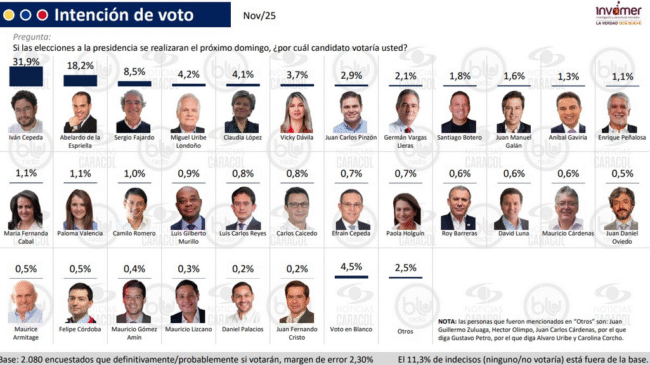
Senator Iván Cepeda of the ruling Historic Pact coalition has emerged as the early front-runner in Colombia’s 2026 presidential race, according to a nationwide Invamer poll released Sunday by Caracol TV and Blu Radio. The survey – the first major measurement since the lifting of Colombia’s recent polling restrictions – places the left-wing candidate at 31.9% of voting intention, six months ahead of the first round.

The results position Cepeda well ahead of candidate Abelardo de la Espriella of Defensores de la Patria, who received 18.2%, and independent centrist Sergio Fajardo, who registered 8.5%. Miguel Uribe Londoño, running for the leadership of  President Álvaro Uribe Vélez’s Centro Democrático party, follows with 4.2%. Uribe Londoño is the father of Senator Miguel Uribe Turbay, victim of an assassination attempt on June 7, and who died two months later at the Santa Fe Hospital in Bogotá.

The findings come amid broad public dissatisfaction with the country’s direction and with the administration of President Gustavo Petro, who leaves office on August 7, 2026. According to the poll, 56% of respondents disapprove of Petro’s administration, while 37% approve. Although disapproval has dipped slightly from previous months, nearly six in ten Colombians remain critical of the government. National sentiment is similarly pessimistic: 59.8% believe Colombia is “on the wrong track,” compared with 34.4% who feel otherwise.

Internal security stands out as the leading concern. Asked whether Petro’s “Total Peace” policy had made them feel safer, 66.2% claim it made them feel more insecure. Nearly 65% believe the initiative is moving in the “wrong direction”, and 73% say the government has lost territorial control to illegal armed groups. Only 20% expressed confidence in the government’s peace and security approach.

The Invamer survey, conducted between November 15 and 27 among 3,800 respondents in 148 municipalities, does not include public reaction to the latest scandal involving alleged infiltration of state institutions by FARC dissidents. The poll has a 1.81% margin of error and a 95% confidence level.

Cepeda’s lead reflects firm support among left-leaning voters and measurable gains among independents and left-leaning centrists. Though only 24% of those polled identified themselves as “left-wing”, the senator’s 31.9% support suggests he is drawing backing among younger voters. He also carries a relatively high rejection rate: 23.9% said they would “never” vote for him.

The survey challenges the perception that Cepeda lacks room to grow beyond the left, even as 50% expressed that they would prefer to vote for a candidate opposed to Petro. Analysts believe the Historic Pact’s decision to hold its internal consultation last month helped consolidate support within the coalition and gave Cepeda a strategic advantage.

The Invamer poll of Colombia’s of 30 presidential candidates. Photo: Caracol/Blu Radio.

Despite his lead, Cepeda could face voter rejection should Petro’s disapproval ratings continue to climb. The candidate’s current negative rating is among the highest of any public figure, and his pro-Petro agenda on security, economy, and U.S relations could push the center closer to the moderate right. Still, the poll indicates Cepeda would win a runoff against De la Espriella with a wide margin, but face a “technical tie” with the mathematician and former Governor of Antioquia.

De la Espriella, meanwhile, has quickly consolidated the anti-Petro vote, emerging as a “dark horse” at the extreme right of the spectrum. Once absent from early electoral projections, the lawyer now surpasses established Centro Democrático politicians – including senators María Fernanda Cabal, Paola Holguín, and Paloma Valencia.

Former defense minister under President Juan Manuel Santos and ex-Ambassador to Washinton, Juan Carlos Pinzón, is in seventh place (2,9%), but these early numbers are likely to increase, given that he maintains a close relationship with three ideological camps (Centro Democrático, La U, Cambio Radical) represented in Presidents Uribe and Juan Manuel Santos, and German Vargás Lleras.

 Even though the poll found that 63% of eligible voters know who De la Espriella is, there is room for continued growth for the five candidates who marked above 2% in the poll, among them, Vargas Lleras in fifth place (2.1%).

The centrist bloc, historically influential in Colombian politics, appears fragmented. Fajardo, once considered a reliable alternative to both left and right, no longer polls in double digits. While he maintains a lower rejection rate than most rivals and doubles the numbers of former Bogotá mayor Claudia López (4.1%), analysts say the proliferation of centrist candidates could dilute Fajardo’s base. Combined, these candidates would outpace De la Espriella’s support, but the numbers suggest this does not translate into a cohesive electoral force.

Foreign policy is also shaping voter priorities. A large majority – 78% – said maintaining strong relations with the United States is essential for the next administration. Respondents widely rejected Petro’s decision to use a megaphone in New York to urge U.S. soldiers not to follow orders from former President Donald Trump; 78% disapproved of the act, even though half of respondents hold an unfavorable view of Trump.

President Petro reacted to the poll on social media, framing the electoral landscape as a struggle between entrenched elites and what he described as a “powerful people” seeking to reclaim the state. Referring implicitly to Uribe and Fajardo, the president said Colombia must reject “mafioso elites” and work toward a “free and educated” society.

The Centro Democrático announced it will conduct an internal vote among more than 4,000 active party members to select two candidates for a March 2026 primary. The contenders are senators Cabal, Holguín, and Valencia, and Miguel Uribe Londoño.

With six months until the first round on May 31, 2026, the Invamer poll highlights a polarized electorate, deep concerns over security and corruption, and an early advantage for the ruling coalition’s candidate — with substantial uncertainty and new political alignments spearheaded by former presidents, especially Álvaro Uribe.

  •  

Colombia Confirms 15 Minors Killed in Army Bombings Against FARC Dissidents

The Colombian government of President Gustavo Petro has acknowledged that at least 15 minors recruited by illegal armed groups were killed in four military operations carried out between August and November, after a report by the National Institute of Forensic Medicine revealed a higher number of child casualties than initially disclosed by the Defence Ministry.

The deaths occurred during a series of bombings and clashes in the departments of Guaviare, Amazonas and Arauca, according to the forensic agency. The figures have intensified scrutiny of President Gustavo Petro’s security decisions and the conduct of the Armed Forces under a government that has repeatedly pledged to uphold human rights protections while pursuing its “total peace” agenda.

Defence Minister Pedro Sánchez said the military was aware of the probability that minors were present in the camps targeted during the operations but insisted all actions were carried out in accordance with the principle of distinction under International Humanitarian Law (IHL), which obliges armed actors to differentiate between combatants and civilians.

The revelation comes a week after an operation in Calamar, Guaviare, on November 10, that left seven minors dead in a bombing against dissident factions of the FARC. The incident prompted a wave of criticism and forced the government to respond publicly to accusations that it had failed to take sufficient precautions to avoid killing children forcibly recruited by armed groups.

According to the forensic report, the first of the four operations took place on August 24 in the rural village of Nueva York, in El Retorno, Guaviare. The agency received eight bodies from the site — seven men and one woman. Three of them were minors: two boys and one girl. The institute did not provide ages or identities.

The second operation occurred in Puerto Santander, Amazonas, where four bodies were transferred to the forensic institute on October 7. All four — three males and one female — were identified as minors. The bombing, reported earlier this month by local media, targeted structures allegedly belonging to the FARC dissident group led by alias ‘Iván Mordisco’ .Military intelligence believed Mordisco might have been in the area, but he later escaped, officials said.

The most lethal operation occurred on November 10 in Calamar, Guaviare, where 20 bodies were recovered from a bombing site and transported to forensic authorities on November 12. Sixteen have been identified, while four remain unidentified. Thirteen of the victims were male and seven female. Of the total, seven were minors, Forensic Medicine said.

The fourth incident took place on November 13 in Puerto Rondón, Arauca. Eight people were killed there – three men and five women – including one girl.

The forensic report has deepened the political crisis surrounding the deaths of children in military operations, a long-standing and highly sensitive issue in Colombia’s armed conflict. It has also revived long-running questions about the state’s responsibility to ensure the protection of minors, even when they have been forcibly recruited by illegal armed groups.

The Public Ombudsman’s Office, which monitors human rights violations, reiterated after the latest bombings that the presence of minors in illegal armed groups does not justify attacks that could endanger them, stressing that the Armed Forces must adopt “all possible precautions” to protect children, who are guaranteed special protection under both domestic and international law.

The warning underscores concerns that date back years. In 2019, then-Defence Minister Guillermo Botero resigned after revelations that a military bombing in Caquetá killed eight minors. At the time, opposition senators – including Gustavo Petro, Iván Cepeda and Roy Barreras – sharply criticized the government for failing to prevent avoidable child deaths.

Now in power, Petro faces similar criticism over what rights groups describe as a recurring pattern: intelligence-driven bombardments aimed at neutralizing armed groups, but which result in the deaths of children who have been forcibly recruited and used as human shields by illegal organizations.

Defence Minister Sánchez rejected accusations that the government attempted to conceal the new information. He said the operation on August 24 in El Retorno was not a bombing but a ground confrontation, disputing suggestions that authorities had misrepresented the conditions under which the minors were killed.

Minister Sánchez now faces a no confidence vote in Congress following the Guaviare incident in which seven minors were killed. The no-confidence vote comes as the Petro government is as odds with the United Nations over cocaine productions figures. According to the UN, 3,000 tons of the illegal narcotic were produced in 2024, and number the leftist leader refutes.

  •  
❌