Reading view

Bogotá Fashion Week Strengthens International Push for Colombia’s Designers

Under a mirage of glowing escalators inside Bogotá’s Ágora Convention Center, the catwalks of Bogotá Fashion Week opened Tuesday with more than fabrics and silhouettes on display. Behind the runway lights lies a larger ambition: to turn Colombia’s capital into a regional fashion export hub and bring designers from Bogotá’s workshops and popular commercial districts onto the global stage.

Now in its ninth edition, Bogotá Fashion Week (BFW), led by the Cámara de Comercio de Bogotá, has become the city’s main commercial and promotional platform for fashion, bringing together 145 brands, 28 runway shows, more than 80 international buyers and 755 business meetings aimed at strengthening Colombia’s presence in international markets.

For Ovidio Claros Polanco, president of the chamber, the event is no longer simply about showcasing collections, but about transforming fashion into a driver of economic growth and international competitiveness.

“In Bogotá, the fashion sector represents 33% of the city’s economic activity and brings together approximately 35,000 active companies, the majority of them microenterprises,” Claros said. He added that between 220,000 and 250,000 people are directly linked to the industry, with its impact extending into tourism, hotels, gastronomy and transportation.

The strategy, he said, is to move beyond the traditional notion of fashion as an exclusive industry and instead position it as an economic ecosystem capable of generating employment and export opportunities across all levels of the city.

That vision is particularly visible through [PUENTE] Internacional, a program created by the chamber to connect entrepreneurs from Bogotá’s traditional commercial districts such as San Victorino and Restrepo with major global fashion circuits including New York, Madrid, Dubai and Paris.

This year, eight Bogotá-based brands — Alanna, A Modo Mio, C’emadier, Más Cincuenta y Siete by Love Me Jeans, Lorant & Co, Lyenzo, Liza Herrera and Kernel Leather — were selected to present their autumn-winter collections during Fashion Designers of Latin America (FDLA) at New York Fashion Week in February.

The initiative marked one of the strongest international pushes yet for Bogotá’s so-called “popular fashion” sector, traditionally associated with local manufacturing districts rather than luxury runways.

“We are committed to the internationalization of Bogotá’s popular fashion because it is a powerful vehicle for economic growth and job creation,” Claros said. “We want the best of Bogotá’s design talent to arrive in the global capitals of fashion stepping forward with strength.”

The selection process involved curators and industry figures including Albania Rosario, founder of FDLA, José Forteza, former senior editor of Vogue México, Colombian designer Jorge Duque and stylist Estefanía Turbay.

For Albania Rosario, the initiative reflects the growing relevance of Latin American fashion beyond its domestic markets.

“Each of these brands represents not only the excellence of Bogotá’s design, but also the resilient and visionary spirit of our creative community,” Rosario said. “It is a reminder of the transformative power of Latin American fashion on the global stage.”

The international agenda continues well beyond Bogotá Fashion Week. Following the local runway events this week, [PUENTE] designers are scheduled to participate in Pasarela Madrid later in May, followed by Dubai Fashion Week in September, New York Fashion Week’s spring-summer season, and Paris Fashion Week later that month.

Inside Ágora, the business focus is equally visible. Alongside runway presentations from designers such as Kika Vargas, Francesca Miranda and Alejandro Crocker, the event hosts wholesale meetings between Colombian brands and international buyers seeking new suppliers and partnerships.

A multi-brand retail space open to the public and a series of 24 industry talks with more than 60 speakers also seek to bridge the gap between creative design and commercial scalability.

For organizers, integrating districts like San Victorino and Restrepo into this model is essential. Rather than separating emerging luxury labels from mass-market producers, the chamber is pushing for a unified ecosystem where independent designers, small workshops and large buyers operate within the same commercial conversation.

“There is a need to remove the idea that fashion belongs to only a few people,” Claros said. “This belongs to everyone. Countries change through actions like these.”

As Bogotá Fashion Week expands its global ambitions, the challenge will be whether Colombian brands can translate visibility into long-term exports and sustained international demand.

For now, however, the city is betting that fashion — from the ateliers of Chapinero to the workshops of San Victorino — can become one of Bogotá’s strongest international calling cards.
  •  

Colombia tributes political legacy of ex-VP Germán Vargas Lleras

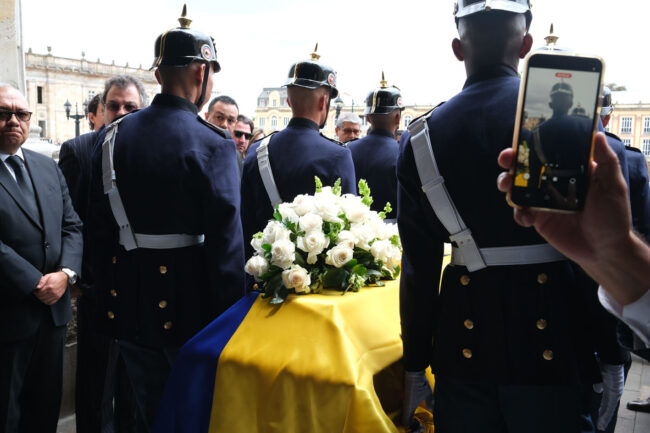
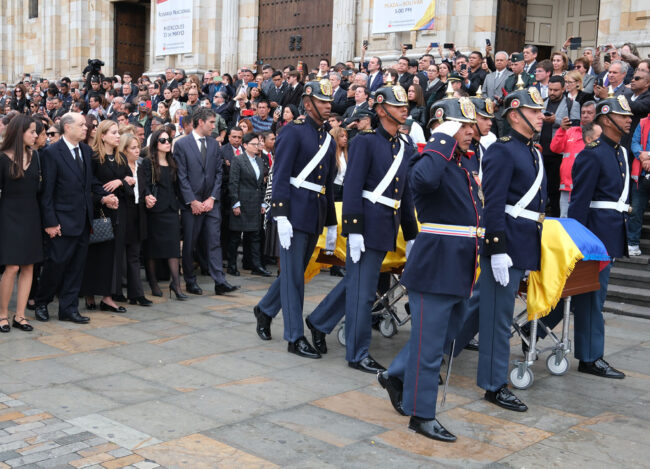
The departure of former Vice President Germán Vargas Lleras’s coffin from Bogotá’s Palacio de San Carlos on Monday morning blended state mourning with unmistakable political symbolism, as Colombia’s political elite gathered to bid farewell to one of the country’s most influential figures.

His daughter, Clemencia Vargas Umaña, attended the ceremony accompanied by her father’s two French bulldogs – Toño and Henry –  adding a deeply personal note to the solemn proceedings before the main funeral mass at 11:00 a.m. inside Bogotá’s Primatial Cathedral of Bogotá. The service marked the conclusion of three days in which the Foreign Ministry headquarters became the center of national political attention.

Vice President Francia Márquez represented the national government in the absence of President Gustavo Petro and delivered one of the most emotional moments of the day when she embraced Clemencia Vargas before the ceremony. Earlier, Márquez had publicly offered condolences to the family, praising Vargas Lleras’ democratic legacy and saying his “democratic work will be remembered.”

Colombia’s VP Francia Márquez and former presidential candidate Juan Carlos Pinzón attended the funeral ceremony. Photo: Richard Emblin

The wake drew figures from across Colombia’s political spectrum, reflecting Vargas Lleras’ decades-long influence. Former presidents Juan Manuel Santos, with whom Vargas Lleras served as vice president, Ernesto Samper, and Iván Duque were present, along with senator Paloma Valencia and former president Álvaro Uribe Vélez, whose attendance underscored the respect afforded to Vargas Lleras despite years of sharp public disputes between the two men.

Vargas Lleras died Friday in Bogotá after a prolonged battle with cancer. He was 64. His death ends a political career spanning more than three decades as senator, minister, vice president, and two-time presidential candidate.

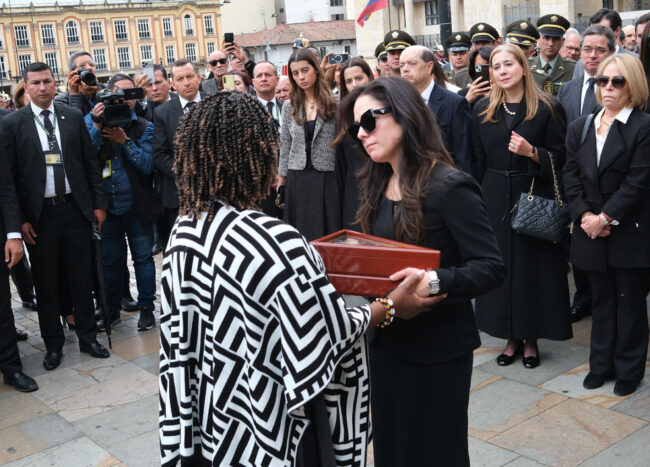
The only daughter of Germán Vargas Lleras, Clemencia Vargas, receives the flag from VP Francia Márquez. Photo: Richard Emblin

Born in Bogotá on February 19, 1962, Vargas Lleras came from one of Colombia’s most prominent political dynasties. His grandfather, former President Carlos Lleras Restrepo, was a leading figure of the Liberal Party.

He built his own career as a city councilman, congressman, minister, and ultimately leader of the Cambio Radical party. His first presidential run came in 2010, where he finished third with nearly 1.5 million votes. Though unsuccessful, the campaign positioned him as a national force.

President Santos later appointed him to his cabinet, and in 2014 selected him as his running mate for reelection. The pair won in the runoff, and Vargas Lleras assumed office as vice president on August 7 that year.

He ran again for president in 2018 under the “Mejor Vargas Lleras” coalition, focusing on infrastructure, housing and administrative reform. He finished fourth in the first round and did not advance to the runoff.

Throughout his career, Vargas Lleras survived two assassination attempts and weathered political scandals, including accusations linked to parapolitics investigations, though he was never formally charged.

In later years, his health increasingly limited his public life. He was diagnosed with a benign meningioma in 2016 after a fainting episode, and in recent years battled cancer while largely stepping back from frontline politics.

Even as his public appearances became rare, his influence endured. Monday’s funeral made clear that, in death as in life, Germán Vargas Lleras remained a central figure in Colombia’s political history.

The flag-draped coffin of former Vice President Germán Vargas Lleras leaves Bogotá’s Primatial Cathedral of Bogotá on May 11. Photo: Richard Emblin
  •  

Qatar Airways Set to Operate to Caracas and Bogotá flights

Qatar Airways has affirmed its expansion in the Americas with the launch of new flight operations to Caracas, Venezuela, and Bogotá, Colombia, commencing from 22 July 2026. The service represents a significant milestone for the airline, as Qatar Airways becomes the first Gulf carrier to serve Venezuela, and the first airline to operate flights from the Middle East to Caracas and Bogotá. This expansion underscores the airline’s commitment, announced last year, to strengthening global connectivity for the region.

Qatar Airways flights to Caracas (CCS) and Bogotá (BOG)

Qatar Airways will operate two weekly flights to Caracas and Bogotá, further enhancing connectivity to, and from, the Americas. The flight schedule has been designed to provide smooth onward connections through Hamad International Airport to key markets including Australia, China, Japan, Lebanon, South Korea, and the United Arab Emirates. This offers passengers greater flexibility and seamless transfer options across Qatar Airways’ global network.

Departing every Wednesday and Sunday:

  • Doha (DOH) to Bogotá (BOG) – Flight QR783: Departure 07:30; Arrival 16:05
  • Bogotá (BOG) to Caracas (CCS) – Flight QR783: Departure 17:35; Arrival 20:40
  • Caracas (CCS) to Doha (DOH) – Flight QR783 Departure 22:40; Arrival 19:55 +1

The addition of Caracas and Bogotá marks both the 15th and 16th destinations in the Americas served by Qatar Airways. The airline began serving South America in 2010 with its inaugural flight to Brazil’s São Paulo.


  •  

Explosive Drone Deactivated Near Bogotá’s El Dorado International Airport

Colombian authorities have seized and safely deactivated a commercial drone carrying improvised explosive materials just 5.4 kilometers from Bogotá’s El Dorado International Airport and the nearby Military Air Transport Command (CATAM), raising fresh security concerns in the capital three weeks before the country’s May 31 presidential election.

The discovery marks a significant escalation from recent unauthorized drone sightings that twice forced temporary flight suspensions at El Dorado, Colombia’s busiest airport, and highlights growing fears that tactics once largely confined to conflict zones in the southwest and Catatumbo region are now reaching the capital.

According to preliminary police and military reports, the device was located in the locality of Kennedy, near the Río Bogotá, after a security alert issued by prosecutors in Popayán, Cauca, prompted specialized units of the Colombian Air Force (FAC) and National Police to track suspicious coordinates in southern Bogotá.

Authorities found what appeared to be a makeshift encampment before locating the commercial drone, its battery and an explosive charge separated from the fuselage.

Anti-explosives officers later confirmed the device had been modified with a non-conventional fiber-optic guidance system, a method increasingly used by illegal armed groups to evade electronic signal jammers designed to disable unmanned aircraft.

Investigators said the drone carried approximately 258 grams of C4 explosive material inside a PVC tube fitted with an improvised detonator.

The device was safely neutralized by National Police explosives experts and transferred to the Attorney General’s Office – Fiscalía General – for forensic analysis and the opening of a criminal investigation.

Authorities have not publicly identified those responsible or confirmed the intended target, but officials noted the location placed the drone within minutes of both El Dorado International Airport and CATAM, one of Colombia’s most strategic military aviation facilities.

Security analysts say the use of fiber-optic spools as a guidance mechanism resembles tactics recently documented in Catatumbo and southwestern Colombia, particularly among the National Liberation Army (ELN) guerrilla and FARC dissident factions under the command of alias “Iván Mordisco.”

A similar drone equipped with the same system was discovered in Popayán on April 25 during a wave of attacks blamed on FARC dissidents in Cauca, while another was found the same day in Villavicencio, the departmental capital of Meta.

The appearance of such devices in Bogotá has raised alarm among security officials, particularly given the proximity to civilian and military aviation infrastructure.

Pilots and aviation experts warn that even small commercial drones can cause catastrophic damage if they collide with an aircraft during takeoff or landing. A drone carrying explosives near an airport runway significantly increases the potential for a large-scale tragedy.

The discovery also comes at a politically sensitive moment, with Colombia entering the final weeks before its presidential election on May 31, as security and public order remain dominant campaign issues amid rising violence in the departments of Antioquia, Chocó, and Norte de Santander.

The leftist government of President Gustavo Petro has faced intense criticism over deteriorating security conditions, particularly following road bombing attributed to illegal armed groups in Cauca, Valle del Cauca, Nariño and Catatumbo, where the use of drones for surveillance and attacks has become increasingly common.

Last month, drone sightings near El Dorado airport twice forced authorities to suspend all air operations, disrupting domestic and international flights and exposing vulnerabilities near the country’s principal air gateway.

On April 30, Aerocivil halted airport operations after the Colombian Aerospace Force confirmed the presence of a drone in the Engativá district near the airport perimeter. Two aircraft were forced to carry out missed approaches, including an international LATAM Airlines Boeing 787 arriving from Santiago, Chile, while another domestic flight was diverted to Armenia, Quindío.

Just two days earlier, on April 28, another drone was detected near El Dorado, triggering a 45-minute suspension of takeoffs and landings while military personnel deployed anti-drone systems and visual searches.

Defense Minister Pedro Sánchez later confirmed that operations had been temporarily canceled because of the possible drone sighting, although no confirmed target was found.

Aerocivil has repeatedly warned that unauthorized drone activity near airports represents a grave threat to aviation safety and can result in criminal prosecution.

Thursday’s discovery, however, suggests the threat may extend far beyond operational disruption.

For Bogotá, the concern is no longer simply rogue recreational drones interfering with airport traffic, but the possibility that explosive-equipped devices linked to Colombia’s armed conflict are now within reach of the nation’s capital – and its most critical infrastructure.

  •  
❌