Paris, London and New York are more often associated with culture, finance and history than with dangerous heat. Yet each summer all three are increasingly exposed to extreme temperatures they were never designed to withstand.
Like many dense urban areas, they amplify heat through what is known as the “urban heat island effect”. This reflects the way that warmth is trapped in concrete, asphalt and glass, turning hot days into hazardous ones.
With skyscrapers made of glass and steel, roadways encased in cement and blocks of residential apartments, New York traps heat like few other metropolitan centres. In fact, the city has one of the highest urban heat island effects in the United States, a measurement of thermal difference between urban and rural areas.
Heat kills more than 500 New Yorkers every year, a grim statistic that exacerbates inequalities along the lines of race and class. While many people escape to the seaside or countryside to find relief, others remain in cities where the heat can be harder to avoid and more difficult to endure. Yet these uneven experiences of urban heat are not new. In cities such as London, Paris and New York, coping with hot summers has long been shaped by inequality.
Across the 19th and 20th centuries, urban residents developed a range of strategies to manage extreme heat in densely built environments. Our research for the Melting Metropolis project examines everyday experiences of heat. Here are some of the ways people have coped with these conditions in the past and what they reveal about living with heat in the city.
London
For most historic urbanites, escaping the confines of their home provided the greatest relief from the heat. In the mid-20th century, some Londoners escaped to the roof of their apartment building to catch the cooling breezes that swirled above the city’s streets.
For many others, since the 19th century, public spaces have provided the greatest respite from heat in their homes. Londoners turned to the shade provided by trees in nearby parks, paddled in water fountains or went for cooling dips in lidos and ponds.
Historic urbanites have also tried to cope with the heat at home. In contrast to those who sought relief from the heat in public spaces, wealthier Londoners used money and technology to keep cool. In the 19th century they purchased imported ice from Norway or employed servants to operate fans.
Paris
In the heatwaves of the 19th century, Parisians also headed out in search of relief. Like Londoners, they made extensive use of the parks that urban planners embedded into the fabric of the city during the late 19th-century Haussmann-era redesign. But it was not only dense greenery that provided respite from the heat: the trees planted along the avenues of the city offered shelter from the rays of the sun on hot summer days.
Although the Seine held great potential for cooling down, bathing in its waters was banned in the middle of the 19th century. Despite the official ban, photographic records show that some Parisians in search of freshness broke the law and took the plunge.
To keep cool indoors, the more privileged 19th-century Parisians used ice imported from northern regions or collected locally during the winter and stored in ice houses until temperatures rose. Ice remained a luxury item until the late 1870s, when technological developments allowing ice to be made artificially lowered its cost and widened its accessibility.
Daily life in Paris – including in the summer – had undergone thorough transformations by the middle of the 20th century. Air conditioning began to gain momentum but some traditional ways to cool down have remained at the core of summer life: crowds continue to swarm café terraces, the banks of the Seine stay packed with people, 19th-century water fountains are still used to refill water bottles.
New York
In the 19th century, the tenements of New York City were filled with people sleeping on roofs, sweating on fire escapes, and avoiding the sweltering indoors. The wealthy simply fled the city for countryside estates. Newspapers called these seasonal migrants “heat refugees”.
When seeking outdoor relief, most 19th-century New Yorkers headed to the beach – the city is an island, after all. But by the 20th century, they were also planing block parties with plenty of ice from corner store bodegas. On occasion, they also cracked open fire hydrants – a relief strategy that has become a classic trope of New York City summers.
Future heat waves
For as long as episodes of extreme heat in cities have affected urban life, urbanites have developed ways to cope. Today, cities are taking heat more seriously when they look to the future and working towards adaptation strategies. The disastrous heatwave of 2003 served as a wake-up call in Paris, which implemented a heat plan the following year and continues to work on ways to make the city more liveable in the summer.
Central to New York’s climate resilience plans, air conditioning has become a political battleground in activists’ fight for a “right to cooling” (a bundle of legislation championed by local environmental justice organisations).
Though it can compound the problem of climate change, technologically aided cooling keeps people alive as we all find ways to weather the intensifying heat. In May 2026, the UK’s Climate Change Committee declared that the British way of life is under threat from heat.
In June, London will launch its heat plan for the capital, a first step in supporting the city and its residents to live better with extreme heat.
About the author:Chloe Dutell is a Postdoctoral Research Associate, School of Histories, Languages and Cultures Faculty of Humanities and Social Sciences, University of Liverpool.
The article is reproduced from The Conversation thanks to a Creative Commons licence
Confused about the upcoming Colombian presidential election? We’re here to help you with a set of cheat sheets on the top candidates so you can follow the local news. Today we’re looking at Paloma Valencia of the Centro Democrático.
Who is Paloma Valencia?
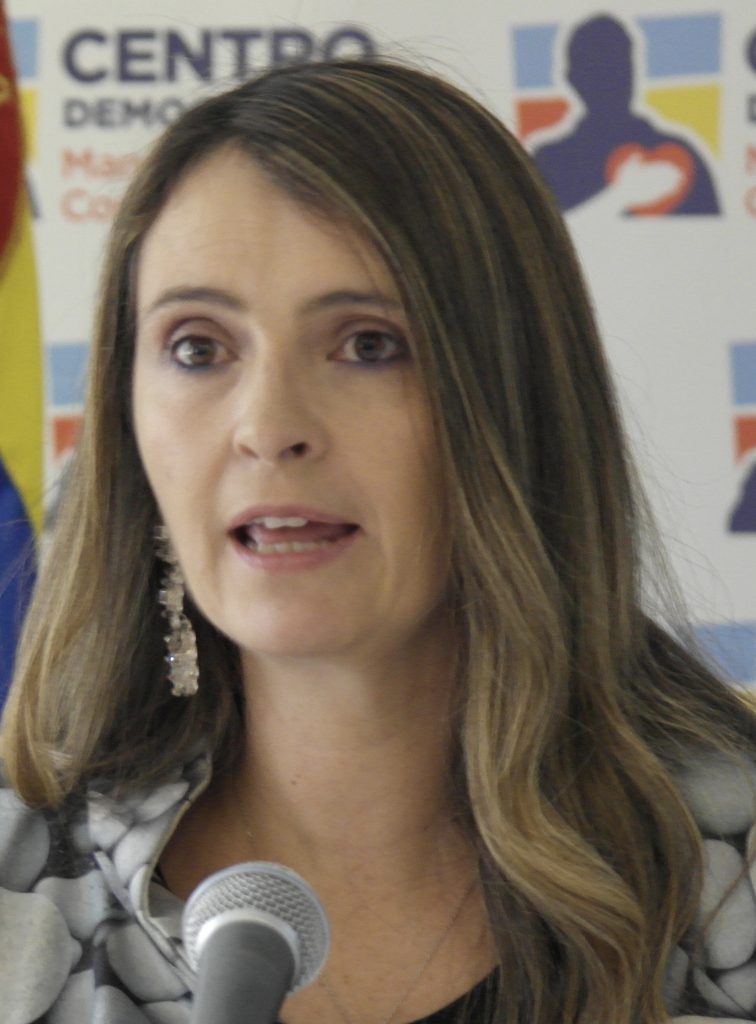
Paloma Valencia, candidate for the Colombian presidential election 2026. Photo courtesy of Wikicommons
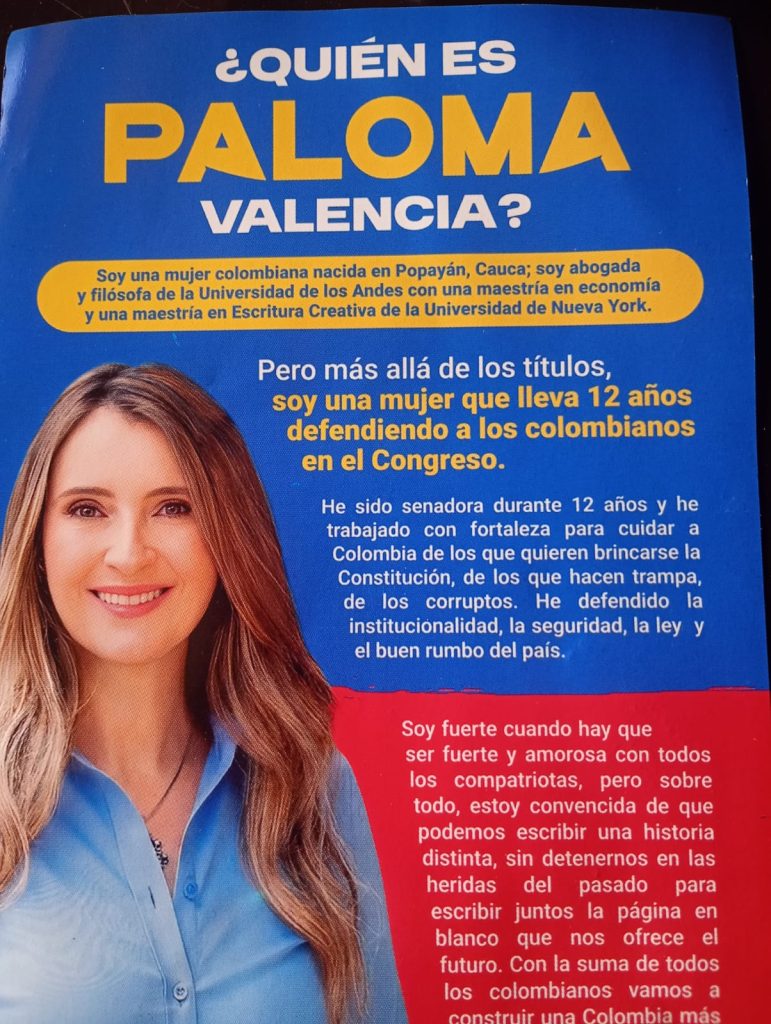
Paloma Susana Valencia Laserna is a conservative politician who has represented the Centro Democrático in the Senate for 12 years. She won her primary battle with three million votes in March, confirming her position as the establishment rightist candidate.
Anti-establishment types, look away now. Her paternal grandfather Guillermo León Valencia was President of the Republic from 1962-66, while her maternal grandfather Mario Laserna Pinzón founded the Universidad de los Andes.
Perhaps not coincidentally, that’s her alma mater, studying economics there before a Master’s in creative writing at New York University. She’s been heavily involved in politics for two decades now, originally as a candidate for Alas Equipo Colombia before jumping ship to the Centro Democrático.
Her faith is deeply important to her, as is tradition. Coming from the circle of the Popayán elite, she is a fairly standard conservative on most cultural and social issues. On the economy, she tacks more to a neoliberal line.
Is she polling well?
Not as well as she would like. While she won comfortably in the March primaries as part of the Gran Consulta por Colombia, she has since fluctuated around 15-25%, usually rising and falling in rhythm with rightist rival Abelardo de la Espriella.
Most recent polling has her in third place a week out from the election, which is a problem. She does outperform Abelardo in head-to-head matchups with Iván Cepeda in most polls, which her messaging will want to lean into over the coming week.
What’s her campaign like?
Centrism, slightly improbably. As one of two rightists in an election with a clearly dominant leftist candidate, two flailing centrists and a host of also-rans, she’s positioning herself as the closest to the centre of the viable options.
That’s her offer
However, she’s firmly of the right, although tempered somewhat by her far more liberal vicepresidential candidate Juan Daniel Oviedo. This is best evidenced by the fact she is very much ‘la que dice Uribe’, clearly having the backing of the controversial yet still influential ex-president.
Her campaign logo features a cross, with religion playing a large role for her stance on many cultural and social issues. She leans heavily into those as a conservative. Colombia Más Grande is the slogan, but they don’t use it particularly well.
If elected, she would be Colombia’s first ever female head of state (with a first ever gay vicepresident too), although she’s not really leant into that much as you might think. As with much else, she’s not managing to cut through particularly well on socials or make a big splash in the national debate.
So what’s in her manifesto then?
You can read it for yourself online, under the name 111puntos. You even get an extra point for free. It’s fairly well presented, laid out and supported, but that’s not necessarily going to win any votes. Overall, other than a massive reliance on AI, there’s no big surprise or radical shakeup here, more a return to the old ways of doing things.
Paloma is certainly no dove when it comes to security and crime, promising a tough line. COP$20tn over four years for the armed forces in order to modernise and rebuild, finishing at 4% of annual GDP destined for the forces. That includes recruiting 30,000 more military personnel and the same number of police officers.
The rest of the money will go on increasing pay, conditions and so forth as well as a big push on tech. Drones are the centrepiece for investment, but cyberdefence is also highlighted as an area that needs urgent investment.
Slightly more old-school is her plan to militarise key transportation routes immediately. More of the same with coca farms: more spraying that allegedly won’t affect ecosystems or people, combined with subsidies for substitution. The fact that neither of those things have worked for decades isn’t stopping her.
On the other side of the coin, Paloma Valencia promises zero impunity: “el que la hace, la paga”. That means more powers to seize illicit gains and more prison sentences for those found guilty of corruption, reducing the number of casa por carcel sentences. 22,000 more penitentiary places and 19,000 more prisoners.
There will be 50 new casas de justicia and mobile courts to tour the country visiting rural locations that are currently not served by the legal systems. All of this is working towards an aim to get congestion in the system from 48% down to 0. Ominously, there’s also a promise of a law to “regulate protest and punish vandalism”.
New laws on corruption are to be brought in, mostly focused around greater transparency using tech. That means blockchain to record transactions and deals as well as AI to analyse potential discrepancies. There will be greater enforcement of existing regulations and a guardian of public integrity to oversee processes.
On the economy, it’s all about recovering confidence from the international market. That will be done by getting infrastructure and mining production back up to pre-pandemic levels (6%+), USD$10mn more in exports and growth over five percent annually.
More FDI to the tune of USD$2bn annually, 25% of GDP to go into internal investment and reducing the deficit by COP$50tn. How is she going to pay for all this? With, err, tax cuts for homeowners and businesses, efficiency savings of 25% and debt refinancing. Good luck with all that.
She’s the only candidate to really take the healthcare crisis seriously. First up is a promise to resolve 10 million blocked prescriptions, appointments and so on in the first 100 days. She plans to send doctors to patients in rural areas, not the other way round.
This will be paid for by a COP$9tn investment. A third of that is destined for delivery of outstanding operations and prescriptions, the rest for paying accumulated state debt to healthcare operators. Many taxpayers won’t like the latter.
Energy faces a similar situation: paying off state debts to operators within the first three months. The goal here is to avoid blackouts and brownouts in the short term, while putting in place structures to avoid the same issues over the long term.
Turning on the taps for both oil and gas lies at the heart of this plan, with a reboot of exploration and extraction projects. Partly, this is to attract AI database and server investment. There’s also support for renewables and alternatives, but it seems more of an afterthought.
Her plan on international relations is to ride two horses. Free competition with China and more co-operation on infrastructure and exports from Colombia. At the same time, leadership in Donald Trump’s Shield of the Americas project while guaranteeing that only the Colombian Armed Forces will operate in national territory.
There will be 187,000 free school places for talented children, 150,000 grants for vulnerable children and 10 public superschools. ICETEX loans, in line with other countries, will only be repayable when you have a salary. COLFUTURO will be rescued as well. The 16 biggest urban centres will have psycho-social units to look out for vulnerable children.
Businesses employing people under 28 will receive a subsidy of up to 30% of minimum wage for a year. Agricultural workers will receive better lines of credit, three million hectares of land formalised and a million new farming zones designated. Tourism is projected to double, with new routes opened for Asia and Europe.
There is a heavy focus on the grey economy. Informal workers will have access to seed capital, loans, a virtual wallet and a host of other possibilities. The goal is to offer help without persecution.
Pensioners will all be covered unconditionally, regardless of law or budget changes as well as three million vulnerable adults to receive subsidies. Each child born into poverty will have COP$500,000 put aside as seed capital to start saving.
Infrastructure starts off with 35,000km of new roads as well as increased satellite connectivity for marginalised communities. There will be 1 million new homes built, with a quarter of those directly subsidised. A million further homes will receive new or improved potable water access.
Finally, the environment. The brakes will go on for deforestation and the national parks will be protected from guerrilla activity. Local families will be given subsidies in order to protect areas of natural interest. Money generated from mining will be ploughed back into environmental protection.
Who is she running with?
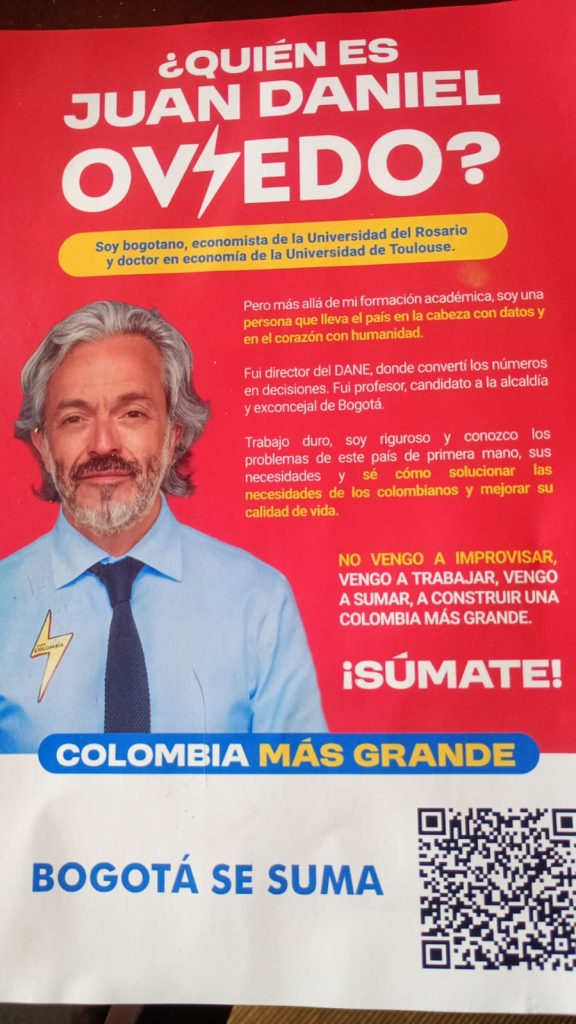
Oviedo has been a key asset for the Paloma Valencia campaign
Juan Daniel Oviedo, former head of DANE and candidate in the last race for Bogotá mayor. In that contest, he managed to force Gustavo Bolívar into third place in a two-horse race, showcasing his impressive campaigning ability. He came second in the Gran Consulta with over a million votes, reinforcing his reputation.
He’s been more visible than Paloma Valencia for much of the campaign and is much more active than either of the other two undercards. That was the reason he was brought in – to appeal to more liberal voters and to provide an injection of energy on socials. He’s delivered in spades on both accounts.
However, there are a couple of issues here. Firstly, he runs the risk of overshadowing Paloma Valencia with his charisma and presence. Secondly, by joining her campaign he lost some of those centrist voters who saw it as a betrayal to join forces with the Centro Democrático.
They certainly aren’t natural bedfellows, with Oviedo a fair bit left of Valencia on a lot of economic issues. More profound splits are found on social issues. For example, Oviedo is out and proud while Valencia stands against gay adoption and marriage. Awkward at best.
— Álvaro Uribe Vélez (@AlvaroUribeVel) May 18, 2026
Uribe is still firmly behind Paloma Valencia
That’s a bit unfair on a candidate with a long and storied political career of her own. However, while she isn’t just Uribe’s candidate, she certainly makes a lot of having his passionate backing.
That’s been a mixed blessing for a while now, with Uribe’s influence waning as the years pass. While his candidate won in 2018, they failed to even make the second round in 2014 and 2022 and we could well be on for a repeat of that.
The ex-president certainly casts a long shadow and that’s not always positive, especially with Oviedo also shining bright. Support for Uribe has dwindled over the past two decades, as Colombian demographics change profoundly.
However, Uribe does retain a large swell of support and also commands the biggest party machine of the candidates in the race. The Centro Democrático will be able to make a huge campaigning push on and offline across the entire country, which may be underreported.
Any skeletons in her closet?
A few, mainly over her combative social media use while in the Senate. Paloma Valencia has largely avoided serious controversy though, with most of her twitterstorms being differences of opinion rather than accusations of impropriety.
She accused now-president Gustavo Petro of corruption in 2018 following the Odebrecht affair. This amounted to grainy footage of him receiving cash at an unknown point. That was archived as being far too flimsy to be evidence of anything at all.
In 2022 she defended the Colombian state’s actions during the armed conflict, saying that while there may have been errors and atrocities, they were legitimate and in defence of the country. That unsurprisingly met with a huge backlash from various quarters.
Una narrativa mucho más constructiva (y verdadera) es: Los para y la guerrrilla fueron y son monstruosos. El Estado cometió errores y atrocidades, pero era legítimo y fundamentalmente estuvo en la defensa de los ciudadanos.
— Paloma Valencia L (@PalomaValenciaL) July 29, 2022
An extraordinary claim from Paloma Valencia here
There is one case hanging over Paloma Valencia still. Her link to Uribe led to her questioning the legitimacy of a key witness in the case against him. In turn, the witnesses defence lawyers filed a defamation case against the senator, over which the Supreme Court has ordered a conciliatory process. That has not yet concluded.
She’s also clashed with Cepeda’s vicepresidential candidate Aida Quilcué over indigenous rights in Cauca. Indeed, she’s gone as far as to suggest splitting the entire department in two, one for Indigenous Colombians only, something many view as racially motivated.
So, can she succeed?
Yes, she can. Next weekend is arguably a harder test for her than a second round would be if she gets through. Similar concerns swirled around her in the Gran Consulta por Colombia, but she ended up sailing through comfortably.
If she can repeat that trick, she matches up better than anyone else against Iván Cepeda. However, that’s very far from guaranteed, as they’re closely matched. It’s assumed that she’ll gain a lot of Abelardo voters, but that may not be true. The anti-left will flock to her, but the anti-establishment might not.
Her main draw is presenting herself as the only viable sensible candidate. In part that’s with Oviedo on board, in part that both Cepeda and de la Espriella are seen as populist. There’s a lot of centrist voters that will hold their noses and vote for her along those lines.
Having said all that, centrism isn’t in vogue in many places globally and Colombia is no exception. That may block her even getting to a final face-off and her chances of winning rest with anti-Cepeda votes. More than any other candidate, hers would be a loveless victory.
Confused about the 2026 Colombian presidential elections? We’re here to help you with a set of cheat sheets on the top candidates so you can follow the local news. First we’re looking at Abelardo de la Espriella of Defensores de la Patria.
Who is Abelardo de la Espriella?
Abelardo de la Espriella hails from Montería, which he makes great play of. He was actually born in Bogotá, as well as studying in various universities here. He rose to fame as a defence lawyer, eventually setting up his own firm, De La Espriella Lawyers Enterprise. Their clients have been varied (more of that later).
He has a colourful background alongside his legal activity, releasing two albums of classical and traditional music as well as launching De La Espriella Style, his menswear line. He also has his fingers in other pies, including rum, wine and coffee, several books and a foundation to help impoverished kids.
Abelardo de la Espriella has always loved the limelight
A former atheist, he saw the light in the pandemic and came around to Catholicism, which is convenient for winning votes in a deeply religious country. He holds Italian and US passports. He takes pride in his appearance, often suited and tidily-bearded but switching to sombreros vueltiaos or guayaberas when appropriate.
While he has a varied and successful background in business, he has no experience at all in government, either at local or national level. He is leaning into that, taking the mantle of the outsider candidate and promising to do politics differently. Courting controversy is second nature for this bullish and outspoken candidate.
Is he polling well?
Abelardo de la Espriella in 2017. Photo courtesy of wikicommons.
He started strongly towards the end of last year, then seemed to have dipped as we moved into springtime. Since the March elections though, he’s picked up the pace again and is peaking again at just the right time.
He’s now ahead of Paloma again with most pollsters and stands a good chance of making the second round, where he faces a strong challenge against Cepeda. His incredibly divisive rhetoric and persona mean that he doesn’t match up easily in a one-on-one.
Like many populists in the caudillo mould, he splits opinions – while he wins a lot of hearts and minds, so too does he turn a lot of people against him. Very few people are neutral on Abelardo, which means he could struggle to win the more centrist voters, even against Cepeda. Expect voto en blanco to do well if he’s in the second round.
What’s his campaign like?
Pick your adjective depending on how you view him generally: controversial, innovative, problematic, fierce, strong, crass, outspoken. What’s unarguable is that it is very much focused on him, features a lot of show and spin and is extremely light on detail.
Very much in the vein of a Trump or Bukele, two key influences he acknowledges himself, he positions himself as the outsider candidate compared to the professional politicians in the race. This has not only been successful elsewhere, but almost took Rodolfo Hernández to the presidency four years ago.
Interestingly, Abelardo de la Espriella is in one way openly following a very similar line to the leftists he claims to hate. He is courting “los que nunca” against “los que siempre”, fitting his position as the outsider candidate. His promises often revolve directly around shaking everything up.
So what’s in his manifesto then?
You can read it for yourself online, or what is there at least. It’s barely a manifesto and more a collection of ideas, positions and wishes. He focuses heavily on law and order with a generous side serving of efficiency savings. Quite how any of this will get done or whether it’s viable is often unclear.
First thing on the agenda is that he’s tough on crime. He’s proposed 10 megacarceles in the Bukele mould, a ‘primera linea’ of reservists and veterans and a new bloque de búsqueda for barrios. He targets a 30% reduction in gender-based violence and 40% cut in feminicides. That involves an accelerated 24/7 judicial process in 72 hours maximum.
More widely, he wants to reform and better fund the armed forces in order to both establish state control of territory and enforce the state monopoly on arms. That carries over into his stance on armed groups. He wants to eliminate 330,000 hectares of coca farms using any and all tools available to him. That means spraying, manual elimination, express recuperation of proceeds of crime and so on.
Para cambiar a Colombia primero hay que sobrevivirle a quienes no quieren que cambie. pic.twitter.com/h6Tf8refWr
— De La Espriella Presidente (@AbelardoPTE) May 17, 2026
Abelardo is firmly positioned as a hardliner on crime and security
The mano dura is also set to come down on politicians. He’s fiercely anti-corruption, which he defines broadly. He plans to start with Ecopetrol and then clean out state organisations of their links to “narco-trafficking, corruption and bad management”.
Politicians and administrators that are not corrupt won’t be safe, either. He promises zero tolerance for ineptitude and inefficiency. He wants results within 100 days and those with empty hands will be told to sling their hook. Ambassadors have been told they need to promote the country, not just shoot whisky on the public purse.
Tax avoidance is also on the radar – Abelardo de la Espriella wants to use AI to radically improve DIAN’s processes and deal with widespread avoidance. Subsidies will also be revised to make sure they are going to the right places.
He wants to recover energy self-sufficiency and to restart drilling and exploration as well. Gas is his main focus, although rare earth mining is also highlighted, alongside reform of the costly ElectroCaribe. A main driver is drawing a clear line between legal and illegal mining.
The national budget will also benefit from the efficiency savings – merging or abolishing agencies he sees as redundant such as the Ministerio de Igualdad. That’s part of a shock plan to save around 3.1% of GDP.
With those savings, the aim is to get the deficit to -4.8%(!) within the first year, falling to under 3.5% or lower by 2030. Dovetailing with that is a promise to anchor the debt/GDP ratio at no higher than 55%. All this will require annual growth of at least 3% with 5%+ targeted.
On education, there is to be greater focus on technology, as well as a ‘virtual university’ and free computers in schools. Unsurprisingly, details are limited. A STEM program specifically aimed at girls will be set up to deal with the tech gender gap.
Rural communities are a key part of his voter base and he’s promising 600,000 new jobs outside cities as well as 100,000 young people to receive education on improved farming methods and use of tech. 2 million hectares are to be delivered to the people.
Rounding up, there will be COP$125bn aimed at co-investment or seed capital for creative projects; mass sterilisation of stray animals to reduce populations and 200,000 carers to be given subsidies.
Who is he running with?
José Manuel Restrepo, the closest thing to an aristocrat that a two-century-old republic can have. He claims direct descendency from revolutionary hero Francisco de Paula Santander. In sharp contrast to Abelardo, he’s a classic buttoned-down conservative.
He served under Duque as Ministro de Hacienda following the botched intent at fiscal reform, having previously been at Comercio. Outside of politics he has been rector of three different universities, most notably the Rosario, his alma mater alongside Bath and the LSE.
However, given that Abelardo de la Espriella loves the limelight, his undercard is not a key part of this campaign. While the other two real candidates have genuinely strong vice-presidential candidates, Abelardo is doing all the heavy lifting himself.
What’s all this El Tigre stuff?
Abelardo understands the importance of branding, and this is a key part of his appeal. He says that the big cat represents courage, ferocity and independence, all of which are qualities he identifies with. In a country where blankets featuring tigers are a staple of many homes, this is a good brand to have.
Dancing tigers, because of course.
Tigre in Colombia can refer to tigers or jaguars, both of which he uses, though the former are more common. That means video screens with dancing tigers on them, tiger-print shoes up for sale and a whole lot more. He’s often to be seen wearing tiger-print clothes.
Cepeda’s running mate Aida Quilcué has publicly asked him to stop using jaguars as part of this, claiming they hold a special significance for Indigenous Colombians. Abelardo de la Espriella has predictably ignored that.
Any skeletons in his closet?
Sort of. There’s certainly a great deal of controversy, but a lot of it he simply leans into and doesn’t see as problematic at all. That’s true of personal attacks on Paloma Valencia, as well as frequent homophobic and sexist outbursts.
It’s less true of his past as a criminal defence lawyer, an area that often makes him quite touchy. He has represented some pretty shady characters, including Álvaro Uribe himself. Jorge Pretelt and David Guzmán are just two high-profile clients accused of corruption that de la Espriella has defended.
In fairness, his firm has also taken on some genuinely important defences, most notably Natalia de la Ponce and Rosa Elvira Cely. However, even this is disputed, with family members taking to Instagram to dispute his take on that and suggest it was more about financial interest.
Then there’s the outstanding allegations that the firmas he collected in order to be able to run were improperly registered. He won 5 million, more than any other Colombian, of which 3 million were ruled invalid. That still leaves him comfortably over the threshold, but raises questions about his support.
So, can he succeed?
Yes, he can. It’s nowhere near guaranteed that he’ll make the second round, of course, and he absolutely has the potential to do or say something that will torpedo his campaign. However, he’s a maverick and is campaigning well, which makes him unpredictable.
He is offering easy solutions to complex problems, but that’s often popular with the electorate. Get past the rhetoric and he identifies a lot of key problems and his proposals could be a good thing. He just doesn’t make it clear exactly how this is going to happen.
More to the point, Abelardo de la Espriella represents the outsider position compared to everyone else: he really is not a professional politician like them, for good or for bad. Again, that’s popular with many voters after decades of incompetence from technocrats.
Comparisons with Trump in the USA or Bukele in El Salvador are clichéd, but they stand up. He frequently flirts with sexism and homophobia while mocking opponents, but claims innocence, he promises a hard line on crime and he avoids clarity over his proposals. Both those candidates won comfortably with similar electorates to Colombia.
If he gets to the second round, he could win due to a dislike of the other candidate, as that will almost certainly be Cepeda. In that case, there could be a lot of voters holding their noses to vote either for or against him. At the moment, that’s a coin flip.
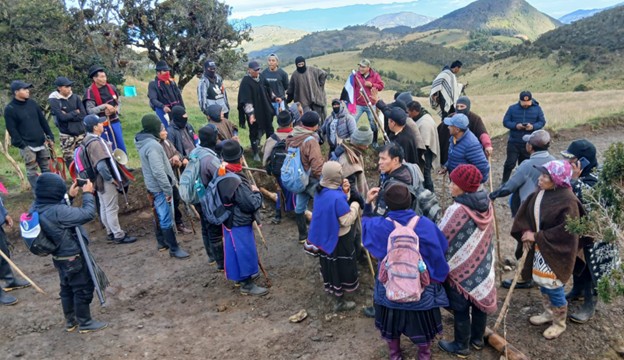
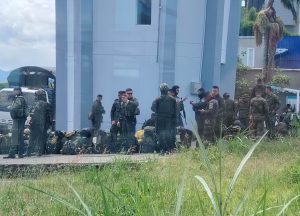
Misak community meeting in the Cauca hills during clashes on Thursday. Photo: X
A large military contingent has been sent to Cauca today to halt clashes between members of the Nasa and Misak communities fighting over ancestral territory.
The first of 500 troops arrived in Popayán, the department capital, to be ferried by helicopters to the hills around Sylvia in northern Cauca where members of both indigenous groups were fighting on Thursday. The violent confrontation led to seven deaths and more than 100 people injured, some seriously, according to latest reports.
Colombia’s minister of defence Pedro Sánchez, announcing the troop deployment, said the death toll was likely to rise as both military and state institutions gained access to the zone.
Videos posted online showed people from both communities fighting with machetes, spears and home-made explosives. But many dead and injured had gunshot wounds, suggesting firearms were being used, said Sánchez.
Leaders called for calm today, and Colombia’s president Gustavo Petro appealed to both sides to re-start talks over the contested land.
Troops arriving in Cauca on Friday.
“I have requested a meeting with the highest authorities of the Misak and Nasa peoples to guarantee peaceful coexistence,” tweeted Petro. He offered to broker talks next week.
Petro’s government has been attempting to resolve historical territorial issues with indigenous communities who often lack legal land titles through the Agencia Nacional de Tierras (ANT), the national land agency.
An “interethnic pact” was urgently needed in Cauca to return fertile land to original communities for agricultural crops, said Petro. The expertise of indigenous farmers could turn the tide of drug trafficking in the region, he added.
Conflict hotspot
Cauca, in southwest Colombia, is one of the country’s most conflicted regions with multiple armed groups in conflict with the state.
It is also home to some of Colombia’s largest indigenous communities, such as Nasa that inhabit large tracts of highlands that span the Andean massif and defend their land with both political bodies – powerful lobbies such as the CRIC or Consejo Regional Indigena del Cauca – and self-defense forces known as Guardia Indigena.
In Cauca, the Guardia Indigena are frequently targeted by armed groups and members of CRIC are victims of kidnap or assassination.
Vice-presidential candidate Aida Quilcué, herself Nasa, survived an abduction attempt in February this year when armed men intercepted her vehicle in the highlands of Cauca. She was rescued by Guardia Indigena who trailed her into the mountains.
This week’s clashes erupted after simmering dispute over 800 hectares (2,000 acres) of páramo highlands bordering the Pitayó Reserve, belonging to Nasa, and Guambia territory of the Misak.
CRIC indigenous guards from Cauca marching in Bogotá during the 2019 protests. Photo: S. Hide
Political twist
According to members of the communities, the plot of land had three springs and was of cultural and spiritual significance to both groups. But in 2023 the ANT appeared to award titles to Nasa based on colonial maps from the colonial era of the 1750s, and act that infuriated Misak who also claimed it as their ancestral territory.
In the aftermath of Thursday’s clashes, opposition politicians were quick to blame the Petro government for fomenting the violence, accusing the ANT of favoring the Nasa reserve and CRIC – widely seen as allied with Petro’s Pacto Historico party – of using the ANT judgment to invade Misak territory.
In a Facebook post right-wing presidential candidate Paloma Valencia accused Nasa’s community in the Pitayó reserve of breaking negotiations to take the disputed territory by force.
In a further twist, Valencia implicated Quilcué, the running mate of her main political rival Iván Cepeda in this month’s presidential elections. Quilcué, who previously led CRIC and was openly supported by the organization in her vice-presidential bid, had pushed the dispute, claimed Valencia.
“Instead of deciding to resolve the issues, the Nasa then decided to advance and invade the Misak territory,” she added.
Allowed to fester
According to an analysis by El Espectador, the conflict stemmed from a misunderstanding of 2023’s ANT declaration, which was an interim finding leaving a “wide margin of interpretation” for who owned the land.
Nasa interpreted the finding as an excuse to use the land traditionally inhabited by Misak, and in return the Misak community blocked access roads.
In March this year the governor of the Pitayó reserve Edinson Pacho condemned the Misak for causing economic damage to farmers unable to take their products to market.
In turn, this week Misak representative Liliana Pechenche accused the “armed forces of the CRIC” – the Guardia Indigena – of killing at least two Misak men and kidnapped 10 more of the Guambia community during the escalation.
She also denied the Misak were armed, claiming this was false information spread by the Nasa to justify their armed incursion: “We are at risk of physical extermination through persecution; we are a peaceful people.”
Both sides agreed on one thing: that the government and its ANT agency had allowed the misunderstanding to fester for several years despite warning signs that violence was brewing.
CRIC, which according to its website represents many indigenous groups including Misak in Cauca, rejected the appropriation of the conflict by national politicians.
“These situations cannot be used to deepen the division between fraternal communities,” it said in a statement.
“These conflicts…are the result of historical decisions and institutional omissions …to generate disputes, confusion, fragmentation and confrontations between indigenous groups,” it concluded.
By Friday a tense calm had settled on the area according to observers, with hopes for a quiet weekend before talks planned for next week.
On April 20, the Special Jurisdiction for Peace (JEP) – Colombia’s transitional justice mechanism – released a report on the impacts suffered by animals in the context of the armed conflict.
The JEP’s report, conducted in partnership with the University of Essex, found that an animal is killed or injured every 30 minutes due to the armed conflict.
Animal rights activists say the release represents a step forward in publicizing the often invisibilized violence inflicted upon animals in war.
The report was developed through the construction of a database using 237 national, regional, and local media outlets, and 600 X accounts belonging to social and environmental organizations, as well as State entities and multilateral organizations.
Based on the information collected, they made an individual categorization referring to domestic animals, and a collective one referring to species, that is, wild animals. In this context, 100,252 domestic animals faced violence and 44 species are at imminent risk of extinction as a result of the armed conflict.
Thirty-two percent of the recorded cases involving animals were directly linked to military actions, including armed confrontations, ambushes, and attacks. The impacts were not distributed evenly across the territory; there are regions where armed conflict, illegal economies, and environmental richness converge, intensifying the harm. For example, Antioquia is the department with the highest concentration of species threatened by the conflict.
“We realized that most cases involved incidents such as accidents with landmines, anti-personnel mines, ambushes against the public security forces, harassment of the public security forces, and armed confrontations. These were some of the situations in which animals were killed or injured. They were also affected by forced displacement,” Laura Ojeda, a researcher on the JEP’s Investigation and Prosecution Unit who contributed to the report, explained.
Forced abandonment was one of the most documented forms of harm identified in the report, largely because it was closely tied to the victimization of caregivers within the dynamics of the conflict. 27% of the recorded cases — corresponding to approximately 900,000 animals — involved forced abandonment.
The report also identified nine ways in which animals were used throughout the armed conflict: as means of transportation; as devices to detonate explosive artifacts; as instruments to inflict pain and suffering – torture –; as sentinels for rapid alerts; as surveillance tools; in practices of bioterrorism involving zoonotic diseases; as propaganda tools; as amulets or part of esoteric rituals; and as a means to intimidate communities and extort payments from business owners and farmers.
Visibilizing animal suffering
The report comes as part of the JEP’s efforts to recognize the environment within its processes of justice, truth, and reparation. This release, the third in a series of three, is the first to focus on the specific forms of violence suffered by animals.
“It is part of a strategy to recognize all forms of life that have been victims of the armed conflict in Colombia,” Ojeda told The Bogotá Post.
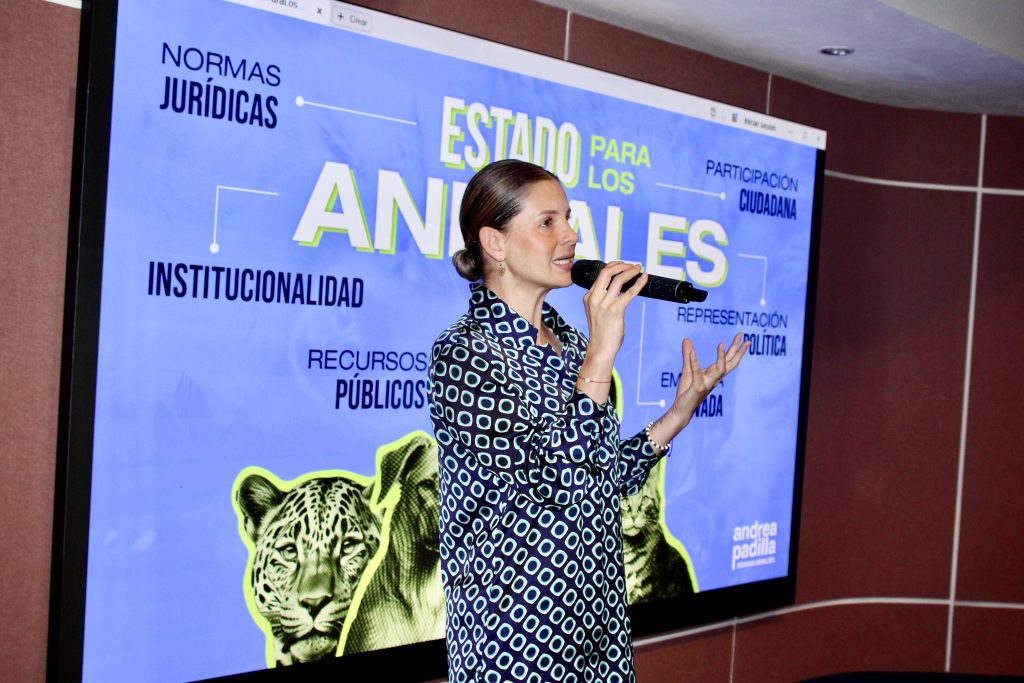
For Senator Andrea Padilla of the Green Alliance (Alianza Verde) party, the report represents a major step forward for animal rights.
She notes that harm to animals is usually addressed as a collateral issue, as damage to property under a framework of harm to human assets.
“Animals have always been excluded from any moral consideration, from any legal consideration, even from news coverage,” the senator told The Bogotá Post.
Senator Andrea Padilla delivers a speech on animal rights. Image credit: @andreanimalidad via X
The team behind the report faced the challenge of shifting the narrative away from the legal framework which refers to animals only as part of the natural environment.
Instead, it adopted a “differential” approach from natural sciences, in collaboration with La Enredadera & co, a scientific outreach collective.
For Luis Carlos Posso, anthropologist and member of the collective, the report represents an exception to the “unavoidable anthropocentrism permeating the law.”
Senator Padilla highlighted the animal rights implications: “I believe it is only fair that sentient beings capable of emotions, affection, and social, moral, and emotional lives are also considered as affected by the conflict.”
Padilla added that understanding the impact of the conflict on animals deepens the appreciation of the human toll of violence.
“When we understand that there are bonds of affection there, family bonds that are abruptly broken by war, we can also see the conflict in a deeper way — that is, we can understand the deepest forms of harm being caused,” said the senator.
Animals as victims of the armed conflict
In addition to detailing the harms inflicted upon animals, the report proposes various reparative measures. These include habitat restoration, veterinary care in conflict zones, public veterinary care networks, the inclusion of animals in memory and truth processes, protection measures for at-risk species, and conservation initiatives.
However, there is still a long way to go before animals can be fully recognized as victims.
“Legally they are not things, but they are also not rights-holders. If they are not rights-holders, they cannot be recognized as victims,” explains Ojeda.
Colombian law recognizes animals as sentient beings, and laws such as the Ángel Law reflect significant progress in their rights. Currently, there is a bill advancing in congress that seeks to historically and legally recognize animals and ecosystems as victims of the internal armed conflict, prohibiting their use as instruments of war and ordering their essential reparation. This is Bill No. 012 of 2025, led by Senator Esmeralda Hernández of the Pacto Histórico party.
Senator Padilla explained that the success of the legal changes will depend on whoever is elected as the next president.
“Undoubtedly, this report holds great value. It not only offers another perspective on the armed conflict, but also explicitly incorporates animals into the analysis of war, harm, and peace,” said Senator Padilla. She added that animals must be involved in reparations processes, insisting, “peace must include animals, or it will not be complete.”

 Login
Login